An overview of the angular geomorphic lock - an anti-rutting model for sustainable road infrastructure
Abstract
Sustainable road infrastructure is largely dependent on the resilience of the road foundation to withstand dynamic stresses. From Empirical to Mechanistic Empirical Pavement Design Guidelines (MEPDG), the use of unbound granular materials (UGMs) has been specified for road foundation bases for flexible roads. Rutting is a common road failure from these designs. MEPDG includes climate change factors that essentially invalidate the empirical approach. However, both design approaches still rely on the anisotropic particle interlock of UGM upon compaction, notwithstanding traditional or intelligent compaction technology. The anisotropic character of compacted UGM only exhibits vertical stiffness with the highest shear stress located in the mid layer. This makes the interface between the surface of the compacted subgrade and the bottom of the compacted subbase incompatible. Consequently, the stiffness of the UGM is satisfactory for static loads, but when these become dynamic, the inter-granular transmission of these stresses creates a new challenge, non-linearity of stress and the ensuing propensity for stress rotation. A model subbase of a road foundation was modified acknowledging the natural angle of repose of UGM. The ribbed saw tooth structure with an inherent composite anisotropic character seemed to offer significant stiffness. A three-point shear stress localisation (3-PSSL) was experimentally created with three stress levels identified within the subbase and a fourth stress level in the base. This geomorphic lock is possible by the use of an angular geo-lock compactor (AGL). Added stiffness in the road foundation should avert rutting, thereby increasing resilience and sustainability of road infrastructure, and ultimately stimulating socio-economic development. World Intellectual Property Organisation (WIPO) has documented this ongoing research as patent No. WO 2021/048590 A1 awaiting entry into The National Phase. This is Work in Progress, where particle intra-lock may invalidate particle interlock.
Angle of Repose; Composite anisotropy; Geomorphic lock; Rutting; Three-point shear stress localisation
1. INTRODUCTION
Sustainable transportation is linked to road infrastructure development where materials used in the construction of such infrastructure play a critical role in their performance. Functionality or performance of road infrastructure stems from the resilience of the incorporated materials. Acceptable performance of road infrastructure requires a well designed and constructed road that will withstand especially dynamic stresses from vehicular loads, which loads constitute one of the sources of road failure. Ultimately acceptable road performance translates into socio-economic growth of a country.
Roads can generally be classified into two categories, viz. flexible and rigid. Flexible roads are commonly finished with a top asphalt layer (Mohod and Kadam, 2016), while rigid roads are finished with a reinforced concrete layer (Pandey et al., 2021). In both flexible and rigid roads, the support platform of the compacted UGM layers is the compacted subgrade. The primary function of the subgrade is to provide structural support for the total road structure, whereas that of the intermediate layers, i.e., subbase and base, is to provide a reliable and sustainable support structure for the road and improve drainage (Arshad et al., 2018). These layers should not only prolong the life cycle of a road through reduced maintenance needs but should also provide the road with a long-term support platform (Araya et al., 2011). Thus, as an investment, a road and its performance must be of higher value than the initial cost, as observed by Whitworth and Rabbaland (2012). This paper presents an overview of the performance and functionality of flexible roads with a focus on the characteristic and behavioural aspects of unbound granular material (UGM) layers of a road pavement structure. An anti-rutting model, achievable through the proposed innovative angular geomorphic compaction (AGC) that brings about the angular geomorphic lock (AGL) of UGM materials, is further presented in the paper.
2. GRANULAR MATERIAL
Failure of roads within or outside their designed life spans, may originate from sources, geomorphology, quality as well as characteristic behaviour of granular materials before and during the construction process. Under the American Association of State Highway and Transportation Officials (AASHTO 1940 - 2004) design requirement and Mechanistic Empirical Pavement Design Guidelines (MEPDG, 2004 to date), UGM is compacted to construct both the subbase and base of the road foundation structure. The AASHTO (1940 -2004) road design approach is an empirical method which depends on Pavement Performance Prediction (PPP), where assumed parameters are used in the design, notwithstanding the geographic region where the road will be constructed. The current MEPDG (2004 to date) design approach is more comprehensive and incorporates climate factors. It is thus also referred to as a Pavement Response Calculation (PRC) design approach (Fladvad and Erlingsson, 2022).
Compaction of UGM, done to attain the desired load carrying capacity or road stiffness, can be achieved by traditional and/or intelligent compaction technology, as postulated by Aodah and Chandra (2018) and Liu et al. (2020). Upon compaction, the pattern in which individual granular particles fit in the available spaces may be dependent upon various factors that include the moisture content of UGM, the particle size of granular material and the compaction method. This is the basis of the anisotropic behaviour of granular materials. The resulting stiffness of a compacted UGM layer stems from this granular anisotropic behaviour, which, ultimately, results in particle interlock. Anisotropy, therefore, has an underlying impact on the resilience and sustainability of compacted UGM (Sidess et al., 2021).
It is acknowledged that when a layer of granular material is compacted, the highest shear strength is located in the middle of that mass. If another layer of granular material is spread and compacted on top of the latter, the highest shear strength in the new layer will also be located in the middle of that new layer and stiffness decreases with depth (Biswal et al., 2020). The implication is that the shear strengths on the interface between two compacted granular material layers are less than that at their mid-thickness points. This is of particular interest in this research because the two layers are designed to work in tandem as a single unit to support vehicular loads. From this perspective, they should be locked into each other, otherwise, endemic settlement of the road foundations may ensue, leading to rutting.
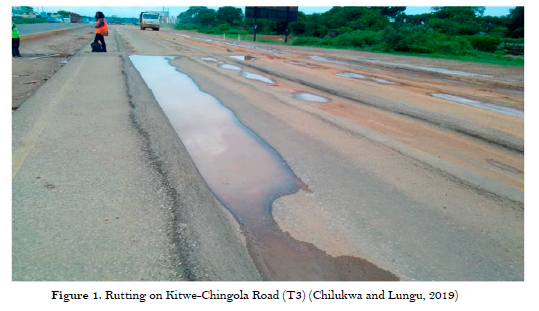
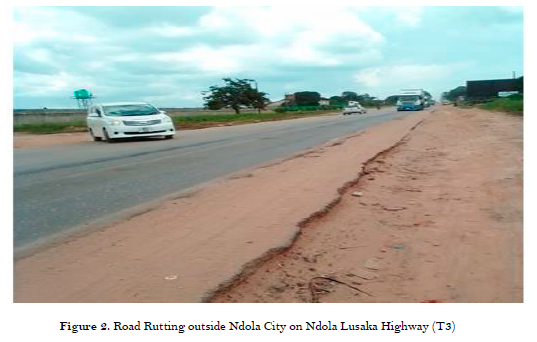
In Zambia, some highway sections have had endemic rutting problems. Evidence of this problem has been observed on some sections of Lusaka-Kabwe-Kapiri Mposhi-Mpika (T2) road, Kapiri Mposhi-Ndola-Kitwe-Chingola-Kasumbalesa (T3) road, Mpika-Kasama-Mbala (M1) road and Mirriam Mokola Road between Luanshya turn-off and Ndola-Lusaka Highway (T3 and T2). Figure 1 and Figure 2 show photos depicting the rutting on T3.
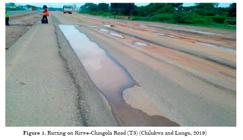
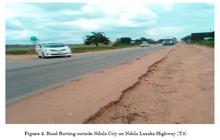
Rutting, particularly prevalent on many sections on the T2 and T3 roads, is a sign of possible road foundation failure and a suspected loss of UGM resilience in both the subbase and base layers. Such road sections inevitably demand attention in terms of maintenance and associated costs, which may not be sustainable. Road maintenance efforts on both paved and unpaved stretches in Zambia have been done but without significant success (Road Development Agency (RDA), 2019).
3. CONCEPTS RELATED TO THE ANGULAR GEOMORPHIC LOCK
3.1
Intergranular stress load dispersionTiti and Matar (2018) assert that the granular material that makes up the intermediate road layers brings about stability and the desired performance of a road foundation structure. Through the individual and matrix interactions of these layers, the inter-granular stress dispersion plays a critical role in the eventual load distribution function from the surface course to the subgrade (Pan et al., 2006). The inference is that when an indication of road failure, such as rutting, manifests on the road surface, the genesis of the failure can be traced to the malfunctioning of the compacted UGM in the subbase and base layers.
3.2
Plastic, permanent deformation and stress rotationFailure of a road foundation may have its origins from a number of factors that include plastic and permanent deformation of the UGM. The UGM is an elastoplastic material which undergoes plastic and permanent deformation when loaded. Where there is plastic deformation, the resilience of the UGM may be restored. However, with repeated loads, permanent deformation is inevitable (Wolff and Visser, 1994). Thus, when stress is induced from vehicular axles due to repeated loads, UGM behaviour will be negatively affected because the particles will not retain their individual integrity (Karaşahin, 2019). Furthermore, if there is a significant amount of moisture content, permanent deformation is also enhanced (Rahman and Erlingsson, 2016; Saevarsdottir and Erlingsson, 2013). Ultimately, deformation of UGM in the subbase and base layers, resulting from moving repeated vehicular loads manifests itself on the road surface as rutting (Li et al., 2021).
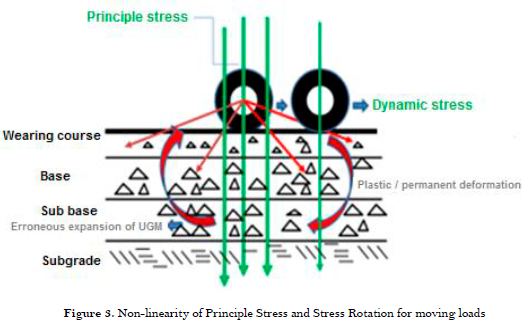
For a static wheel load, the UGM resists the imposed stress from its vertical anisotropic characteristic. However, as the wheel rotates, this axial stress becomes non-linear, meaning that there is a non-vertical stress that is induced on the UGM thereby significantly weakening the anisotropic state. Sandjak and Tiliouine (2019) and Xiao et al. (2018) submit that the non-linear moving or dynamic load has a propensity to rotate, i.e. it is directed at an angle away from the verticality (Figure 3). Conventionally compacted UGM fails in such situations because its behavioural strength is governed by vertical anisotropy stiffness, which cannot effectively withstand angular or rotational loading.
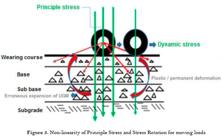
Additionally, load distribution in UGM sub bases and bases of flexible pavement structures is a result of grain to grain contact due to axial load. The implication is that, as the individual grains are subjected to angular, other than vertical stress and as the wheel rotates, the stress direction also becomes rotational (Xiao et al., 2018). This stress rotation has a propensity to produce horizontal pavement surface rippling effect. It is important, therefore, that this stress rotation is restrained or 'locked' within the subbase to prevent this rippling effect and possible ultimate road failure.
3.3
The angle of repose (AoR) and erroneous expansionThe angle of repose (AoR) is the natural angle at which UGM is stable, also referred to as the static angle of repose. In coarse aggregates, this angle may be between 42 and 45 degrees (Kleinhans et al., 2011). Depending on the surface angularity and grading of a granular material, a lower or higher AoR can be identified (Beakawi Al-Hashemi and Baghabra Al-Amoudi, 2018). If this angle is exceeded, the grains start to move continuously down, and the material assumes a dynamic angle. When this happens, the UGM will not be stable and will avalanche (Kleinhans et al., 2011). The proposal in this paper, therefore, is to work within the confines of the natural, static AoR, which offers the initial and inherent natural stability of UGM such that even upon compaction, this angle is maintained.
Casagrande and Carrillo (1944) identified the difference between initial anisotropy (as can be found in a heaped granular material where the AoR brings about stability in its static state) and anisotropy from an induced stress which happens when granular material is compacted. Essentially, after induced stress, the AoR is disturbed, and the compacted mass only gains stiffness vertically, i.e., becomes anisotropic vertically. Thus, the mass assumes a vertical stiffness but loses its natural stability, an inherent anisotropic characteristic that is dependent on static AoR. This research aims at reinforcing this inherent strength by undertaking innovative compaction such that will result in attainment of stiffness on the basis of natural stability material characteristics. Replicating this in a UGM layer could contain non-linear rotational stresses within a base layer. Rotation of axial stresses results in the movement of UGM between the lower interface of the compacted UGM layer and the top surface of the compacted subgrade, whose shear stresses and strains are different. This is referred to as erroneous expansion (Sandjak and Tiliouine, 2019; Shah et al., 2020; Xiao et al., 2018). The incompatibility in terms of the aforementioned shear stresses and surface strains is an inherent weakness in road foundation structures and is a source of rutting.
3.4
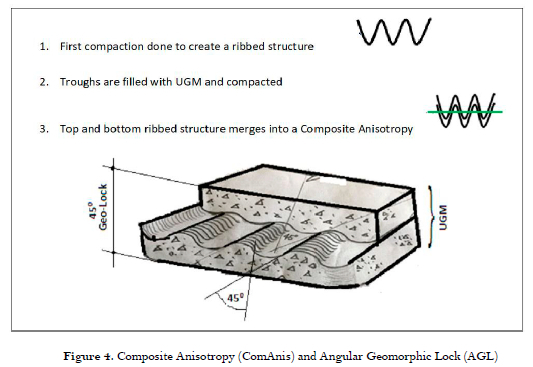
Composite anisotropy (ComAnis) and angular geomorphic lock (AGL)The relationship between anisotropy and composite anisotropy can be actualised through an angular geomorphic lock (AGL), as demonstrated in Figure 4. The AGL adopts the natural AoR of UGM in a ribbed road base structure where the first layer is compacted on the principle of anisotropy, and the second layer is compacted on the same principle after filling in the troughs in the ribbed structure. This creation of a saw tooth when the second layer is compacted merges the two layers in one homogenous composite layer, herein referred to as composite anisotropy (ComAnis).
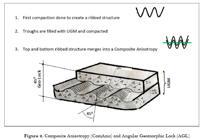
The ComAnis phenomenon enables stress localisation within the troughs (Nondo, 2021). This research thus adopts the inherent strength of natural UGM and modifies this into a compacted composite structure where UGM geomorphology and material characteristics can be utilised to offer stability and resilience. This can impede permanent deformation and significantly prevent premature failure.
3.5 Three-point shear stress localisation structure
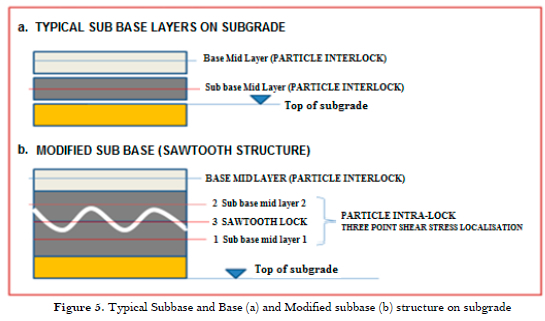
Figure 5 shows the arrangement of a typical/conventional subbase and base layers and a modified composite subbase arrangement, both laid on top of a subgrade. In the modified composite subbase, the first layer is a 45-degree ribbed structure whose highest shear strength can be located in the middle of the layer upon compaction (Liu et al., 2020). Unbound granular material is then spread over this ribbed surface and compacted. The second layer, therefore is an upturned saw tooth structure which, upon compaction, also has its highest shear strength located mid-height.
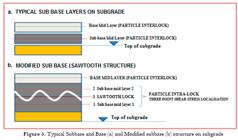
Ultimately, the final compaction should create a third highest shear strength point, emanating from the saw tooth arrangement located in the middle of the composite layer. This is how the Three-Point Shear Stress Localisation (3PSSL) structure is attained. This modified subbase structure should ensure resilience and sustainability of road foundation in that, due to the three points of highest shear stress resistance, significant axial loads can be contained within this composite. Consequently, the load reaching the top of the compacted subgrade should significantly reduce. Ideally, with particle interlock in the top base layer, the final number of highest shear strength points in the modified subbase (Figure 5) will be four (4). Accordingly, the stiffness of the road foundation should further be enhanced.
The subgrade is the natural soil that is compacted to receive the subbase, base and wearing course of the pavement and can vary in the way natural soils do. This means that where the functional requirement is not met, these can be modified to suit the requirement. This is commonly done through stabilisation using cement, lime, fly ash and other materials so that the bearing capacity of the subgrade upon compaction can reach at least not less than 10% that of the California Bearing Ratio (CBR) to avoid deflection (Schaefer et al., 2008).
3.6 Angular geomorphic compactor
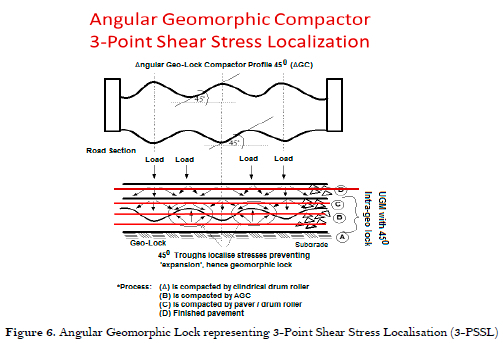
Compaction of UGM is conventionally undertaken by vibratory smooth drum roller compactors. The amplitude of the vibrating drum and the resonance from these compactors force the UGM particles to be well packed as a dense, compacted mass. The degree of compaction is guided by variables like particle size, aggregate angularity, source and moisture content of the material. The AGL, in Figure 6 depicts that the geo-lock can be created by a vibrating drum with an AoR compatible profile on the front drum, hence the name Angular Geomorphic Compactor (AGC).
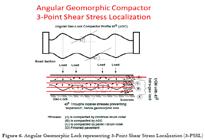
It is proposed that the AGC should have a central belly hopper that fills UGM into the open saw tooth profile (created by the front drum) so that the rear drum, a smooth cylinder, can compact the second layer with the same amplitude. Because the bottom layer is already compacted, the second layer should, through anisotropy, get locked into the saw tooth arrangement. This modification of the compactor to induce the geomorphological angle of repose of bound or unbound granular material should bring about composite anisotropy into the behavioural characteristics of not only unbound granular material but also bound material.
4. CONCLUSION
Permanent deformation occurs every time dynamic loads are applied on a road pavement. This induces non-linearity of UGM, stress rotation and erroneous expansion in the intermediate layers of road pavement, ultimately manifesting in rutting on a road pavement surface. Prevention of these factors leading to rutting could be achieved by enhancing anisotropy and particle interlock with the aim of achieving the highest shear strength in compacted UGM. Innovative Angular geomorphic compaction that brings about angular geomorphic lock (AGL) of UGM materials is proposed in this research. In turn, the AGL brings about the 3-Point Shear Stress Localisation (3-PSSL) in the intermediate pavement layers. This 3-PSSL would ensure resilience of the road foundation and hence sustainable performance of the road pavement.
Aodah, H., and Chandra, S. (2018). Intelligent compaction technology. https://www.researchgate.net/publication/328404219_Intelligent_Compaction_Technology.
Araya, A. A., Huurman, M., and Molenaar, A. A. A. (2011). Integrating traditional characterisation techniques in mechanistic pavement design approaches.Proceedings Transportation and Development Institute Congress 2011: Integrated Transportation and Development for a Better Tomorrow, Chicago, Illinois, USA.
5. ACKNOWLEDGEMENTS
The authors wish to express their gratitude for support rendered by the Copperbelt University, Zambia, to enable them to present this research paper at the 8th ICTA2023 Conference.
REFERENCES
- Arshad, A., Shaffie, E., Ismail, F., Hashim, W., and Abd Rahman, Z. (2018). Evaluation of subbase materials for mechanistic pavement design. International Journal of Civil Engineering and Technology, 9(8), 504-512.
- Beakawi Al-Hashemi, H. M., and Baghabra Al-Amoudi, O. S. (2018). A review on the angle of repose of granular materials. Powder Technology, 330, 397-417.
- Biswal, D. R., Chandra Sahoo, U., and Ranjan Dash, S. (2020). Structural response of an inverted pavement with stabilised base by numerical approach considering isotropic and anisotropic properties of unbound layers. Road Materials and Pavement Design, 21(8), 2160-2179.
- Casagrande, A., and Carrillo, N. (1944). Shear failure of anisotropic materials. Harvard Graduate School of Engineering, Harvard University.
- Chilukwa, N., and Lungu, R. (2019). Determination of layers responsible for rutting failure in a pavement structure. Infrastructures, 4(2), 29.
- Fladvad, M., and Erlingsson, S. (2022). Permanent deformation modelling of large-size unbound pavement materials tested in a heavy vehicle simulator under different moisture conditions. Road Materials and Pavement Design, 23(5), 1157-1180.
- Karaşahin, M. (2019). An anisotropic model of unbound granular material under repeated loading. Thermal Science, 23(1), 295-302.
- Li, N., Ma, B., and Wang, H. (2021). Strains comparisons of unbound base/subbase layer using three elasto-plastic models under repeated loads. Applied Sciences, 11(19), 9251.
- Liu, D., Wang, Y., Chen, J., and Zhang, Y. (2020). Intelligent compaction practice and development: a bibliometric analysis. Engineering, Construction and Architectural Management, 27(5), 1213-1232.
- Mohod, M. V., and Kadam, K. (2016). A comparative study on rigid and flexible pavement: A review. IOSR Journal of Mechanical and Civil Engineering, 13(3), 84-88.
- Nondo, C. M. (2021). Method of creating an angular geomorphic lock within the unbound granular material (USA Patent No. World Intellectual Property Organization.
- Pan, T., Tutumluer, E., and Anochie-Boateng, J. (2006). Aggregate morphology affecting resilient behavior of unbound granular materials. Transportation Research Record, 1952(1), 12-20.
- Pandey, S., Sachan, A. K., Rawat, A., and Singh, S. (2021). Optimum pavement thickness for rigid pament in UP eastern region. International Journal of Engineering and Advanced Technology, 10(5), 173-181.
- Rahman, M. S., and Erlingsson, S. (2016). Modelling the Moisture Dependent Permanent Deformation Behavior of Unbound Granular Materials. Procedia Engineering, 143, 921-928.
- Road Development Agency (RDA). (2019). Annual Report. Retrieved 2023/06/07, from http://www.rda.org.zm/?wpdmcategory=annual-reports
- Saevarsdottir, T., and Erlingsson, S. (2013). Water impact on the behaviour of flexible pavement structures in an accelerated test. Road Materials and Pavement Design, 14(2), 256-277.
- Sandjak, K., and Tiliouine, B. (2019). Influence of the granular layers properties on the nonlinear behaviour of flexible pavement structures 4th Eurasian Conference on Civil and Environmental Engineering (ECOCEE), June 17 - 18, 2019, Istanbul, Turkey.
- Schaefer, V. R., White, D. J., Ceylan, H., and Stevens, L. J. (2008). Design guide for improved quality of roadway subgrades and subbases (Iowa Highway Research Board (IHRB Project TR-525), Issue. https://core.ac.uk/reader/45659980
- Shah, K. S., Hashim, M. H. b. M., Emad, M. Z., Ariffin, K. S. b., Junaid, M., and Khan, N. M. (2020). Effect of particle morphology on mechanical behavior of rock mass. Arabian Journal of Geosciences, 13(15), 708.
- Sidess, A., Uzan, J., and Nigem, P. (2021). Fundamental characterisation of the anisotropic resilient behaviour of unbound granular materials. International Journal of Pavement Engineering, 22(3), 283-293.
- Titi, H. H., and Matar, M. G. (2018). Estimating resilient modulus of base aggregates for mechanistic-empirical pavement design and performance evaluation. Transportation Geotechnics, 17, 141-153.
- Whitworth, A., and Rabbaland, G. (2012). The Crisis in the Zambian Road Sector. In Working Paper No. 4 (pp. 1-14 ): Zambia Institute for Policy Analysis and Research (ZIPAR).
- Wolff, H., and Visser, A. (1994). Incorporating elasto-plasticity in granular layer pavement design. Proceedings of the Institution of Civil Engineers-Transport.
- Xiao, Y., Zheng, K., Chen, L., and Mao, J. (2018). Shakedown analysis of cyclic plastic deformation characteristics of unbound granular materials under moving wheel loads. Construction and Building Materials, 167, 457-472.