Environmental Conservation Attributes Influencing the Adoption of Sustainable Energy Delivery: A Confirmatory Factor Analysis Approach
Abstract
The concept of meeting the present needs without impeding future generations' needs is called sustainable development. Therefore, sustainable energy development is the pathway for every nation's economic growth and development. The purpose of this article is assessing the influence of environmental conservation attributes in the delivery of sustainable energy delivery (SED) in the South African (SA) Power sector. A quantitative research approach was adopted for this study, with data gathered through a questionnaire survey instrument from participants using a purposive sampling technique. Collected data were analysed in four stages: data reliability and validity, descriptive statistics, principal component analysis, and model testing and fit statistics. The top picks environmental conservation attributes influencing the adoption of SED in the SA power sector: reduction of fossil fuel consumption, adoption of clean, environmentally friendly technology, use of cleaner energy facilities, efficient energy usage for less consumption, building institutional framework that supports sustainable energy delivery and the decrease of greenhouse gas emissions (GHGs). Therefore, to address the complex environmental challenges that have put the lives of billions of people at risk, society requires a viable investment and the political will, vision, and determination to embrace viable institutional policy change in the sustainable energy sector and the change necessary to secure our collective future. conclusively, it is important to note that renewable energy sources, low carbon emissions, resource conservation, biodiversity and reduced environmental degradation are the pathway to mitigating this existential problem facing humanity. This study contributes to secured energy development in South Africa and by extension the entire emerging economies globally. This study will directly improve the reduction of global warming, better public health, secure energy supply, poverty eradication, wealth creation and better educational system.
Environmental conservation attributes; Sustainable energy delivery; Sustainability; Energy development; Economic development; Sustainable environment
1. INTRODUCTION
Sustainability is a concept of sustainable development. Sustainability is regarded as our shared future, which translates to the ability to meet the present needs without compromising those of future generations (Urbaniec et al., 2017). Sustainable development should be known for managing environmental quality and preserving natural resources assets such as forests, wetlands, and soil, amongst others (Baumol and Oates, 1993; Koop and Smith, 1993). Therefore, societies must adopt sustainable investment to establish growth and sustainable development (Serageldin, 1996). "Sustainability is the main challenge of our times, and abundant knowledge and technology are available to succeed in this quest for sustainability (Sachs, 2015).
In several countries, environmental degradation and resource depletion have thwarted economic plans. Therefore, these nations' environmental, economic, and social standards must be maintained to preserve sustainable development. Environmental preservation against further degradation is encouraged. The usefulness of natural resources suggests that the failure to manage ecological degradation will have negative implications, such as violating natural economic principles. To overcome the challenges posed in the actualisation of sustainable development, societies require political will, vision, and the determination to embrace institutional policy changes. Adding sustainability to development entails maintenance and consistent environmental investment (Taylor, 2013). Furthermore, there is a four-pillar model of sustainable development envisioned with the basic objectives of good governance (government and business), economic prosperity, social inclusion, coherence, and environmental sustainability (Urbaniec et al., 2017).
Therefore, sustainable energy is the balance of energy development, economic growth, and environmental preservation (Barrett, 1992). Energy efficiency has been the discourse by stakeholders for a long time now because sustainable energy development is crucial to every nation's economic growth and the optimisation of the standard of living of society (Saidur et al., 2012). Sustainable energy delivery (SED) can also be viewed from the area of energy consumption. This makes energy saving important and, when prioritised, can also aid in improving the efficiency of energy growth (Mohammed and Budaiwi, 2013). Concerns over energy and climate change are critical for determining a sustainable future for South Africa and the rest of the world. Finding a policy strategy that guarantees energy security and the demand for sustainability, equity and climate change mitigation is imperative. There is a lack of a comprehensive understanding of the specific environmental conservation attributes that significantly influence the adoption of sustainable energy delivery (SED) within the South African power sector. Previous studies have not sufficiently provided empirical data on how these environmental conservation attributes are prioritised and implemented in South Africa. There is a limited focus on the role of policy and institutional frameworks in supporting sustainable energy delivery in the South African power sector. The current study aims to assess the influence of environmental conservation attributes on adopting sustainable energy delivery (SED) in the South African power sector. This study seeks to fill the identified gaps by gathering and analysing empirical data through a questionnaire survey, focusing on key environmental conservation attributes such as reducing fossil fuel consumption, adopting clean technology, efficient energy usage, and establishing supportive institutional frameworks. The ultimate goal is to provide insights that can contribute to developing policies and practices that enhance sustainable energy delivery in South Africa and other emerging economies globally.
2. THEORETICAL BACKGROUND
The increasing awareness of the damaging effects of GHGs on the environment has reawakened the interest in integrating environmentally friendly technologies in generating electricity (Bibri, 2020). Using clean and environmentally friendly renewable energy and nuclear energy resources can drastically reduce the dependency on fossil fuels for generating energy. Renewable energy sources are economically friendly and relatively cheaper, therefore making them a better option for future adoption (Sinha, 2017). The integration of renewable and nuclear energy resources has no adverse effects on the environment and atmosphere with greenhouse gases, nor is there any harm done to future generations with radioactive waste. Adopting environmentally friendly technologies to generate electricity is highly recommended for the benefits it brings to mankind and the entire ecosystem (Demirtas, 2013). The negative impact and harm fossil fuels have caused the environment and the future generation have led nations to adopt climate change policies that would reduce and mitigate this negative impact caused by fossil fuel energy generation. The European Union, in its climate change policies, has adopted 20% gross usage of renewable energy technologies to reduce greenhouse gases by 20% and to enhance energy efficiency by 20% with the goal of reducing GHGs by up to 80-95% by the year 2050 through the help of renewable and nuclear energy resources (Duic et al., 2013).
However, achieving such an ambitious goal requires a decent and significant shift in policies and technology usage. The adoption of the best environmentally friendly technologies has been established as the right way to go in achieving this possible but difficult task. Making the entire transition an opportunity rather than a cost thing is a critical question. The transition to a green economy should not solve the environmental and ecosystem problems but should be able to address societal issues of unemployment and regional development (0stergaard et al., 2020). These benefits brought by the usage of environmentally friendly energy resources in producing electricity have been visible in several countries globally. The benefits are visible in economic growth in terms of various new technological developments and major gains in energy security and environmental protection. These have propelled the adoption of a green economy through energy sustainability as a global philosophy (Dagnachew et al., 2020).
The avoidance of greenhouse gas emissions is a priority for several nations globally. Also, this principle has long been adopted by the Kyoto Protocol and the Paris Agreement (Hickmann et al., 2021). The exploitation and adoption of renewal and nuclear energy resources are necessary for the reduction of greenhouse gas emissions (Lu et al., 2020). Furthermore, the shift towards an economy of less carbon requires the adoption of environmentally friendly energy sources for the generation of electricity. However, the total transition towards a low-carbon economy comes with its downside. Critics have pointed out employment reduction in the traditional energy sector and areas where traditional energy resources play a vital role in their economy. An example is the Rhenish lignite mining area (Jenniches and Worrell, 2019). Nevertheless, SED brings about benefits that cut across more viable sustainable regional development that address environmental and socioeconomic issues (Hopwood et al., 2005). Conclusively, the adoption and utilisation of SED can help change the way of energy production and consumption, thereby establishing a sustainable energy paradigm that can effectively transform the global economy and strengthen environmental protection (Mao et al., 2018).
2.1. The South African Energy Market
As one of the top producers of coal globally, about 77% of South Africa's electricity is obtained from coal. This has resulted in high levels of environmental degradation. South Africa has the record for the most greenhouse emissions in Africa. Moreover, the centrally generated power is not able to reach the interior communities owing to a lack of delivery infrastructure (Bello, 2018). South Africa houses a large base of both solar energy and wind energy generation, with less prowess for biomass, landfill gas and hydropower. To mitigate the energy challenges facing the country, inadequate access to electricity to the interior communities, the problem of frequent load shedding and the overdependence of coal base energy generation strategy, there is an urgent need for an effective and enabling energy policy framework that will mitigate these numerous barriers. There are numerous renewable energy technology usages in South Africa from 2001-2025 such as solar, wind, biomass, geothermal, hydropower, landfill gas and wave energy (Jain and Jain, 2017). The integration of this renewable energy into the national energy mix has the potential to address the critical energy dilemma currently plaguing the entire nation. Also, South Africa needs to galvanise and re-strategise on the already existing post-apartheid renewable energy technology policies such as the 1998 White Paper on Energy Policy (WPEP), the 2003 White Paper on Renewable (WPRE), and the 2011 White Paper on National Climate Change Response Policy (WPNCCRP). In addition, the 2011 National Development Plan (NDP) reintegrates the government's commitment to adopting renewable energy technologies for effective and efficient sustainable energy development (Pegels, 2010). The NDP emphasises the need for a diversified energy mix, the promotion of renewable energy, and the transition to a low-carbon economy, all aligning with the 2030 Agenda for Sustainable Development. The Carbon Tax Act (RSA, 2019), the National Climate Change Response White Paper (RSA, 2011), and other initiatives are geared towards reducing greenhouse gas emissions and enhancing resilience to climate change impacts.
Implementing renewable energy technologies would assist in mitigating greenhouse emissions and energy delivery challenges. The adoption of renewable energy technologies would also help reduce the rate of air pollution while contributing to the national public health paradigm. It is important to note that over twenty thousand people die in South Africa annually owing to air pollution (Mokhena et al., 2022). The adoption of renewable energy technologies is suitable for small-scale, off-grid solutions, which would increase electricity visibility in the nation's rural communities. The adoption of renewable energy resources into the South African energy mix will help address social issues associated with rural poverty and the HIV/Aids epidemic. Conclusively, in the South African context, the barriers commonly associated with the adoption of renewable energy technologies are the shortage of skills development for knowledge transfer, lack of adequate investment for sustainable energy advancement, and the ease of maintaining existing renewable technologies, as it is well documented that the South Africa renewable energy sector is dependent on the technology providers to facilitate the function of repairs and maintenance of existing technologies. Also, well-structured and implemented renewable energy technologies will address technical, environmental, economic, social, and political issues that pose an extreme threat to human existence (Naicker and Thopil, 2019).
3. RESEARCH METHODOLOGY
The research is focused on determining the environmental attributes influencing sustainable energy delivery. Exploiting a deductive method, the research was hinged on a post-positivist philosophical perspective fostered by quantitative data from energy professionals across South Africa. The choice of a questionnaire survey is due to its usefulness in gathering information from a large group of respondents and allows for the objectiveness and quantifiability of the research (Darko et al., 2018). The questionnaire was drafted from a wide-ranging literature review on the environmental attributes that influence SED. For the research, the targeted population were practising energy professionals in the South African power sector, and the sample size for the research adopted the formula given by (Musi et al., 2020). Generally, a complete count of two hundred and three (203) surveys were randomly allocated and deemed appropriate for analysis (Atkinson et al., 2005). The question presented to the participants elicited their understanding of the environmental attributes influencing sustainable energy delivery in the South African power sector. The participants were shown these effects and asked to rate them on a 5-Likert scale, which was to a full extent = 5, to a large extent = 4, to a moderate extent = 3, to a small extent = 4, and to a no extent = 5. "The methods of data analysis employed for the study are Cronbach's alpha, mean item score (MIS), exploratory factor analysis (EFA), and confirmatory factor analysis (CFA). Cronbach's alpha was used in ascertaining the reliability and validity of the research instrument". The analysis yielded a value of 0.872, indicating the reliability and validity of the study instrument (Tavakol and Dennick, 2011). Also, using SPSS version 27, the identified environmental attributes influencing sustainable energy delivery were analysed and ranked using MIS. Furthermore, the research employed EFA in assessing the uni-dimensionality of the established attributes as pinpointed by (Ikuabe et al., 2020; Ahadzie et al., 2008). According to Yong and Pearce (2013), this method of analysis gives insight into the designed outline and consequently simplifies the understanding of the relationship. As a sequel to the outcome of the EFA, an evaluation of the measurement equivalency of the derived clusters was conducted using a CFA. This was achieved using EQation Software (EQS) version 6.4. In conducting the assessment for the model, a multidimensional technique was deployed and entailed indexes such as Bentler goodness of fit index (GFI), comparative fit index (CFI), root mean square error of approximation (RMSEA), standardised root mean square residual (SRMR), Satorra-Bentler scaled chi-square (S - Bχ2), and root mean square error of approximation with 95% or 90% confidence interval (RMSEA @ 95% or 90% CI). According to Byrne (2006) and Kaplan (2008), these indexes represent incremental or comparative fit indexes while also providing the absolute fit index.
According to Kline (2015), the comparative or incremental fit indexes are χ2, S - Bχ2, CFI, and GFI, while the absolute fit indexes are SRMR and RMSEA. Both the SRMR and RMSEA serve as important measures for the establishment of fit for a priori model concerning the sample data and serve in the determination of the most superior fit of a conceptual model. Generally, the current study employed six index assessment techniques in anticipation of a robust model evaluation. The six indexes were the CFI, the GFI, SRMR, RMSEA, the Normed Fit Index (NFI), and the Non-Normed Fit Index (NNFI). These represent an aggregate of four incremental fit indexes and two absolute fit indexes, which were deployed for the study.
4. RESULTS AND DISCUSSION
4.1 Background Information
Among the different professionals making up the respondents, most of the respondents were Engineers which is attributed to 22.7% of the total respondents. This is closely followed by Quantity Surveyors, Project Managers, Architects, Financial Institution Personnel, and Business Managers, with 17.2%, 14.3%, 13.3%, 13.3%, and other professionals 7.4% respectively. Based on the years of professional experience of the various respondents, it was revealed that respondents with 6-10 years of experience made up 33.0% of the total respondents, thereby topping the category. This is followed by respondents having 1-5 years of professional experience, which is attributed to 28.6% of the total respondents. Also, respondents with 1115 years, less than 12 months and 16-20 years of professional experience comprised 15.3%, 10.3% and 8.9% of the total respondents, respectively, while the lowest percentage were respondents with more than 20 years of professional experience with 3.9%.
4.2 Descriptive Statistics
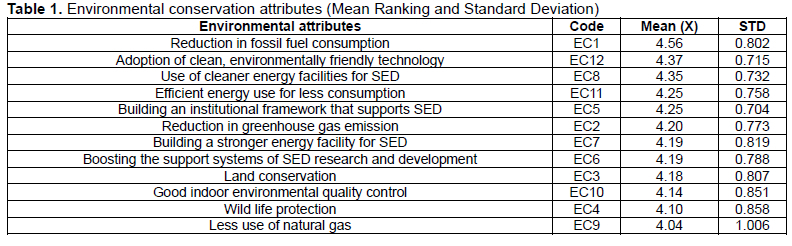
Table 1 shows the mean ranking of environmental conservation attributes influencing sustainable energy delivery. It is indicated that the overall most ranked variables are reduction in fossil fuel consumption (MIS = 4.56), adoption of clean, environmentally friendly technology (MIS = 4.37) and use of cleaner energy facilities for SeD (MIS = 4.35). While the least ranked variables are wildlife protection (MIS = 4.10) and less use of natural gas (MIS = 4.04). Furthermore, the value of Cronbach alpha for the measuring variables was given as 0.872.
4.3. Exploratory Factor Analysis
EFA is crucial in reducing the number of large amounts of variables and breaking them into simpler clusters for easier comprehension (Ayorinde et al., 2021; Tabachnick et al., 2007). The Bartlett test of sphericity, which gauges the factorability of the data pool, and the Kaizer-Meyer-Olkin (KMO) test, which establishes sampling adequacy, are shown in Table 2. The outcome shows a KMO value of 0.872, which attains the 0.6 threshold, as showcased in past studies (Aghimien et al., 2021; Ikuabe et al., 2022). The Bartlett's test of sphericity yielded a value of 905.763 at a p-value of 0.000, indicating its relevance (Pallant, 2020). The factorability of the data pool for performing EFA is important in light of the KMO and Barlett's test results.
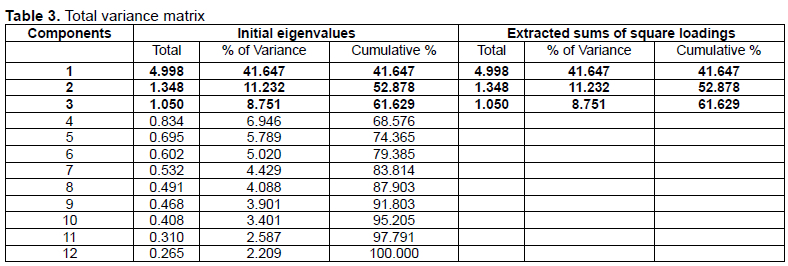
The data was regulated with principal component analysis (with varimax rotation). The eigenvalues have a high value of more than 1. As represented in Table 3, the total variance table, the extracted factor loading was three clusters with eigenvalues more than 0.5 and 1, for the total variance (see Table 3), as explained by each component extracted, component 1 (41,647), component 2 (11,232) and component 3 (8,751). Therefore, the result from the principal component analysis (PCA) and the factors extracted amounted to 61,630% of the total cumulative variance.
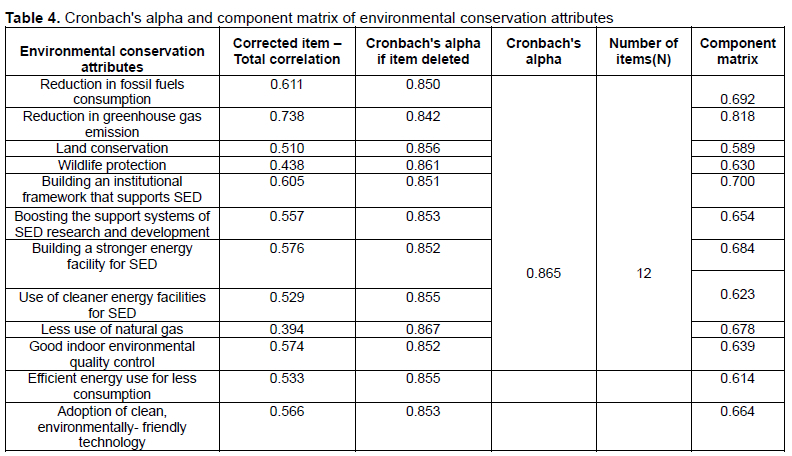
The total variance explained (Table 3) shows that all 12 factors of environmental conservation attributes are loaded into three (3) components. This showed that the three factors that were formed were interrelated and grouped into three components. The values obtained are shown in the component matrix column in Table 4. Furthermore, each factor loaded on the component obtained a loading factor greater than 0.4, as recommended by (Agumba, 2013). All the items loaded on component 3 were retained for further evaluation because the items had three eigenvalues of 4.998, 1.348, and 1.050 and explained 41.647%, 11.232, and 8.751 of the variance in the data. Enough evidence of convergent validity was provided for this construct. Furthermore, the items retained for further evaluation are shown in the component matrix column in Table 4. After careful assessment of the relationship amongst the factors under this component, the construct for factor 1 was termed "environmental adoption", the construct for factor 2 was termed "environmental protection mechanism", and the construct for factor 3 was termed "renewable resource usage".
Table 4 shows the Cronbach's alpha and component matrix obtained for environmental adoption, environmental conservation mechanism and renewable resource usage. Factor loading revealed three components, and the values are stipulated in Table 3, while Cronbach's alpha was 0.833, which is greater than 0.7, indicating acceptable internal reliability (Aigbavboa, 2014).
4.4 Confirmatory Factor Analysis
The study employed confirmatory factor analysis to affirm the reliability of the constructs generated from the EFA. The study employed robust maximum likelihood (RML) estimation due to the data set's non-normality. The non-normality of the data set should make up for the RML estimation (Bentler, 1980). Table 5 showcases the z-statistics, the coefficient of determination (R2), and the standardised coefficient, indicating the derived construct's validity. Also, the model's internal consistency was assessed using Rho alpha and Cronbach's alpha tests. The table shows that the standardised coefficient for the assessed attributes has values between 0.864 and 0.743. This translates to the portrayal of a valid construct since all factors are explained beyond 0.5 (50%). Furthermore, the internal consistency test result shows that the Cronbach alpha and Rho alpha had values of 0.776 and 0.772, respectively. This affirms good reliability since the resulting coefficients are above 0.7 (Bentler, 2006). Also, the results of the z-statistics show that all the factors are attributed with having values greater than 1.96, consequently indicating the significance of the identified environmental conservation attributes influencing sustainable energy delivery. Moreover, the R2, which gives the predictive accuracy of the effects, shows that the values are close to 1.0.
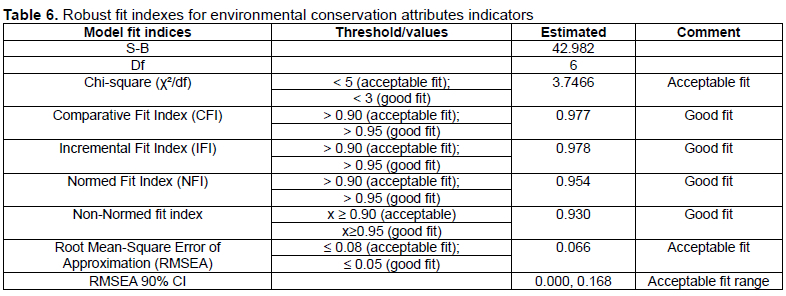
Table 6 shows the outcome of the fit indexes accompanied by the derivative output estimates. The results indicate that GFI and CFI have values of 0.978 and 0.977, respectively. According to Bollen (1989), GFI and CFI attain acceptable fit when the derived outcome is > 0.90, while a good fit is attained when the derived outcome is > 0.95. While the result shows that the RMSEA and SRMR have values of 0.066 and 0.168, respectively. Therefore, being adjudged as an acceptable and good fit, as Bollen (1989) noted, a value for RMSEA and SRMR is adjudged acceptable when it is <0.08, while it is passed as a good fit when the value is <0.05. Moreover, the Satorra-Bentler (S - Βχ2) of 3.7466 with 2 degrees freedom and an associated p-value of 0.000 was given from the model's sample data, which affirms the model's adequacy. Furthermore, the study revealed environmental conservation attributes influencing SED in the South African Power sector to be environmental sustainability, environmental management and environmental adoption. These are critical component that must be considered when adopting SED for a sustainable and industrialised societies.
5. DISCUSSION
The descriptive statistics analysis engaged by the study portrayed the significance of environmental conservation attributes influencing SED. Moreover, the result of the analysis derived from the EFA indicated that the factor loadings of the variables were highly coupled with a significant relationship among the variables. The result from the analysis conducted indicates the inter-factor correlations and the standardised factor values were statistically significant and large. This attribute, which is supported by the green economics theory, is viewed from the notion that the strategies put in place by organisations to effectively adopt policies that would promote resilient and environmentally friendly energy facilities will automatically promote SED adoption (European Commission, 2010; Jänicke, 2012). The result from the analysis carried out gives the important variables for the feature as the reduction in fossil fuel consumption, reduction in green gas emission, adoption of clean, environmentally friendly technology, wildlife protection, and good indoor environmental quality control.
Furthermore, ensuring environmental conservation attributes will drive economic innovations that will ensure better economic and welfare change for the citizenry. It is recommended that new renewable energy technologies should be adopted to promote environmental conservation, such as geothermal, biofuels, biomass, and other renewable energy technologies, which will help facilitate a well-developed economy, leading to a sustainable environment (Dyatlov et al., 2020). The systems theory, as stated by Doppelt and McDonough (2017), also affirmed that the smaller shift of interest in the dimension of sustainability can lead to a monumental result of economic development, better health care, good indoor environmental quality, and more inclusive social development.
In addition, ensuring environmental conservation attributes will drive economic innovations that will ensure better economic and welfare change for the citizenry. It is suggested that the adoption of new renewable energy technologies that promote environmental conservation, such as geothermal, biofuels, biomass and other renewable energy technologies, will help facilitate a well-developed economy, leading to a sustainable environment. The stockholder theory supports this argument. Freeman et al. (2004b) and Lozano (2015) stated that the injection of a massive investment in the sustainable energy sector will deliver a better quality of life that will greatly benefit society and its citizenry. The adoption of these innovative technologies is expected to solve the reoccurring unsustainable energy development, thereby improving nations' economic influence. The conventional model of energy development (CMED), as developed by Govindarajalu (1997), relates to the revitalisation of energy systems and the introduction of renewable energy technology as a means of revolutionising the area of sustainable energy innovations and eliminating those which are unsustainable.
6. CONCLUSION
The purpose of the research was to establish the influence of environmental conservation attributes on sustainable energy delivery. The review of extant literature made it possible to identify a pool of environmental conservation attributes and subsequently subject to analysis. The study employed a five-stage data analysis process involving data reliability and validity, descriptive statistics, principal component analysis, and model testing and fit statistics. The initial four stages were achieved with the use of SPSS Version 27, while the last stage was attained using EQS Version 6.4. Analysis from the CFA showed that only four indicator variables were affirmed from the test of factorial validity that was eventually adopted for the assessment of the environmental conservation attributes model goodness-of-fit. The identified environmental conservation attributes factors that influence SED for this study were the reduction of fossil fuel consumption, reduction of greenhouse gas emission, land conservation, wildlife protection, building an institutional framework that supports SED, boosting the support systems of SED research and development, building stronger energy facilities for SED, the usage of cleaner energy facilities for SED, less use of natural gas, good indoor environmental quality control, efficient energy use for less consumption and the adoption of clean, environmentally friendly technology. The findings of the study showed that the identified outcomes were influenced directly by the exogenous and endogenous variables analysed in this study. The findings of this study also showed that the identified outcomes were consistent across various sources in the literature on SED. In addition, based on the CFA, less use of natural gas was the highest-ranked influence environmental conservation has on the outcome of an SED model. This finding was consistent with the findings in the literature that advocates for the adoption of innovative technologies in the quest to minimise the over-reliance on fossil fuels as the major component of energy production. The findings from the literature showed further that more research was needed to dive more deeply into the adoption of each of the renewable energy technologies available.
6.1 Theoretical Contributions
The remarkable theoretical contributions made in this study will bridge the gap in literature about sustainable energy delivery philosophy. The gap in theoretical information regarding environmental conservation attributes significant in implementation of SED.
6.2 Practical Implications
This research will assist nations globally to improve their sustainability ability in the delivery of sustainable energy, both industrially and domestically. The adoption of SED will lead to a better healthcare system, better jobs, and ultimately, a better society. The research highlights the benefits of implementing SED. In particular, the study established the need for government and policy makers to be intentional in the implementing SED.
REFERENCES
- Aghimien, D., Aigbavboa, C., Meno, T., & Ikuabe, M. (2021). Unravelling the risks of construction digitalisation in developing countries. Construction Innovation, 21(3), 456-475.
- Agumba, J. N. (2013). A construction health and safety performance improvement model for South African small and medium enterprises (Master's thesis, University of Johannesburg, South Africa).
- Ahadzie, D. K., Proverbs, D. G., & Olomolaiye, P. O. (2008). Critical success criteria for mass house building projects in developing countries. International Journal of Project Management, 26(6), 675-687.
- Aigbavboa, C. O. (2014). An integrated beneficiary-centred satisfaction model for publicly funded housing schemes in South Africa (Master's thesis, University of Johannesburg, South Africa).
- Atkinson, R., Blandy, S., Flint, J., & Lister, D. (2005). Gated cities of today? Barricaded residential development in England. The Town Planning Review, 76(4), 401-422.
- Ayorinde, E. O., Ntebo, N., & Mathe, K. (2021). Economic challenges facing the adoption of sustainable construction delivery in the South African construction industry. In Advances in human factors, business management and leadership: Proceedings of the AHFE 2021 Virtual Conferences on Human Factors, Business Management and Society, and Human Factors in Management and Leadership (pp. 266-270). Springer International Publishing.
- Barrett, G. W. (1992). Landscape ecology: Designing sustainable agricultural landscapes. Journal of Sustainable Agriculture, 2(3), 83-103.
- Baumol, W. J., & Oates, W. E. (1993). Economics, environmental policy, and the quality of life. Gregg Revivals.
- Bellos, E. (2018). Sustainable energy development: How can the tension between energy security and energy transition be measured and managed in South Africa? Journal of Cleaner Production, 205, 738-753.
- Bentler, P. M. (1980). Multivariate analysis with latent variables: Causal modeling. Annual Review of Psychology, 31(1), 419-456.
- Bentler, P. M. (2006). EQS 6 structural equation program manual. Multivariate Software.
- Bibri, S. E. (2020). The eco-city and its core environmental dimension of sustainability: Green energy technologies and their integration with data-driven smart solutions. Energy Informatics, 3(1), 1-26.
- Bollen, K. A. (1989). Structural equations with latent variables. John Wiley & Sons.
- Byrne, J. (2006). Technical translation. Springer.
- Dagnachew, A. G., Hof, A. F., Lucas, P. L., & Van Vuuren, D. P. (2020). Scenario analysis for promoting clean cooking in sub-Saharan Africa: Costs and benefits. Energy, 192, Article 116641.
- Demirtas, O. (2013). Evaluating the best renewable energy technology for sustainable energy planning. International Journal of Energy Economics and Policy, 3(4S), 23-33.
- Doppelt, B., & McDonough, W. (2017). Leading change toward sustainability: A change-management guide for business, government and civil society. Routledge.
- Duić, N., Guzović, Z., Kafarov, V., Klemeš, J. J., Vad Mathiessen, B., & Yan, J. (2013). Sustainable development of energy, water and environment systems. Applied Energy.
- Dyatlov, S. A., Didenko, N. I., Ivanova, E. A., Soshneva, E. B., & Kulik, S. V. (2020). Prospects for alternative energy sources in the global energy sector. In IOP Conference Series: Earth and Environmental Science (Vol. 434, No. 1, Article 012014). IOP Publishing.
- European Commission. (2010). A European strategy for smart, sustainable and inclusive growth. Freeman, R. E., Wicks, A. C., & Parmar, B. (2004). Stakeholder theory and "the corporate objective revisited." Organization Science, 15(3), 364-369.
- Govindarajalu, C. (1997). Toward sustainable energy development in the Indian power sector: A critique of fifty years of power development in India and an analysis of sustainable energy alternatives (Master's thesis, University of Delaware).
- Hopwood, B., Mellor, M., & O'Brien, G. (2005). Sustainable development: Mapping different approaches. Sustainable Development, 13(1), 38-52.
- Ikuabe, M., Aghimien, D., Aigbavboa, C., & Oke, A. (2020, March). Exploring the adoption of digital technology at the different phases of construction projects in South Africa. In Proceedings of the International Conference on Industrial Engineering and Operations Management (pp. 10-12).
- Ikuabe, M., Aigbavboa, C., Anumba, C., Oke, A., & Aghimien, L. (2022). Confirmatory factor analysis of performance measurement indicators determining the uptake of CPS for facilities management. Buildings, 12(4), Article 466.
- Jain, S., & Jain, P. K. (2017). The rise of renewable energy implementation in South Africa. Energy Procedia, 143, 721-726.
- Janicke, M. (2012). Green growth: From a growing eco-industry to economic sustainability. Energy Policy, 48, 13-21.
- Kaplan, D. (2008). Structural equation modeling: Foundations and extensions. Sage Publishing.
- Kline, R. B. (2015). Principles and practice of structural equation modeling. Guilford Publications.
- Kopp, R. J., & Smith, V. K. (1993). Valuing natural assets: The economics of natural resource damage assessment. Resources for the Future.
- Lozano, R. (2015). A holistic perspective on corporate sustainability drivers. Corporate Social Responsibility and Environmental Management, 22(1), 32-44.
- Lu, Y., Khan, Z. A., Alvarez-Alvarado, M. S., Zhang, Y., Huang, Z., & Imran, M. (2020). A critical review of sustainable energy policies for the promotion of renewable energy sources. Sustainability, 12(12), Article 5078.
- Mokhena, T. C., Matabola, K. P., Mokhotu, T. H., Mtibe, A., Mochane, M. J., Ndlovu, G., & Andrew, J. E. (2022). Electrospun carbon nanofibres: Preparation, characterisation and application for adsorption of pollutants from water and air. Separation and Purification Technology, Article 120666.
- Musi, Y. W., Mukulu, E., & Oloko, M. (2018). Influence of strategic planning on firm performance in agricultural research-based institutions of Kenya. Journal of Management & Sustainability, 8, 83.
- Naicker, P., & Thopil, G. A. (2019). A framework for sustainable utility-scale renewable energy selection in South Africa. Journal of Cleaner Production, 224, 637-650.
- Østergaard, P. A., Duic, N., Noorollahi, Y., Mikulcic, H., & Kalogirou, S. (2020). Sustainable development using renewable energy technology. Renewable Energy, 146, 2430-2437.
- Pallant, J. (2020). SPSS survival manual: A step by step guide to data analysis using IBM SPSS. Routledge.
- Pegels, A. (2010). Renewable energy in South Africa: Potentials, barriers and options for support. Energy Policy, 38(9), 4945-4954.
- Sachs, J. D. (2015). The age of sustainable development. Columbia University Press.
- Saidur, R., Boroumand Jazi, G., Mekhilef, S., & Mohammed, H. A. (2012). A review on exergy analysis of biomass-based fuels. Renewable and Sustainable Energy Reviews, 16(2), 1217-1222.
- Serageldin, I. (1996). Sustainability as opportunity and the problem of social capital. The Brown Journal of World Affairs, 3(2), 187-203.
- Urbaniec, K., Mikulčić, H., Rosen, M. A., & Duić, N. (2017). A holistic approach to sustainable development of energy, water and environment systems. Journal of Cleaner Production, 155, 1-11.
- Yong, A. G., & Pearce, S. (2013). A beginner's guide to factor analysis: Focusing on exploratory factor analysis. Tutorials in Quantitative Methods for Psychology, 9(2), 79-94.
Emmanuel Ayorinde
Department of Civil Engineering Technology, University of Johannesburg
South Africa
Email address:

Revised: 01-10-2024
Accepted:18-11-2024