Operationalisation of the Information Technology strategy in an organisation
Abstract
In many organisations Information Technology (IT) strategies are adopted, and never operationalised. Instead, the development and adoption is repeated on a yearly or two-yearly basis. The process and approach are prohibitive, and affect competitiveness, sustainability, and business continuity. This challenge is primarily caused by the lack of an understanding of the factors that influence or dictate operationalisation in an organisation. The objective of this research was informed by the premise; to empirically reveal the factors that influence operationalisation of an IT strategy in an organisation. In order to vertically understand the depth of challenges within context, a case study approach was selected. Qualitative data was gathered, and duality of structure of structuration theory was employed in the analysis. From the analysis, six (6) factors were revealed as the primary influencers of the IT strategy operationalisation, from both enablement and constraint perspectives. The study is intended to be of interest to organisations, particularly: promoters of IT strategy, and managers in both IT and business units of an organisation.
Information technology; information technology strategy; operationalisation and structuration theory
1. INTRODUCTION
Information Technology has increasingly become a vital instrument for many organisations' survival and sustainability. Koornhof and Theron (2016:162) and Wixley and Everingham (2010:95) state that in most organisations, IT has become a pervasive and integral part, instrumental to supporting, sustaining, growing, and transforming business. Peppard and Ward (2016:11) suggest that the use of information systems and technologies (IS/IT) for competitive advantage requires a strategy. According to Iyamu (2015b:51), IT enables organisations to implement strategies and to realise objectives. Yeh, Lee and Pai (2012:197) suggest that organisations that have a well-planned IT strategy can increase their overall competitiveness by integrating corporate strategy and implementing IT effectively. According to Iyamu and Roode (2010:2), in a highly global competitive climate, organisations are increasingly dependent on IT strategies to increase their competitiveness, or merely even to survive. Organisations often spend too much time developing and implementing strategies, repeatedly, or revisiting existing strategies (Almalki, Alfleit & Zafar 2017:57). This is because implementation does not necessarily equate to operationalisation. Each component of the IT strategy needs to be operationalised to fulfil its goals and objectives in an organisation.
The development of an IT strategy by itself does not fulfil an organisation's needs and requirements until it is operationalised. This can be associated with the rapid advancements of IT solutions and the fast-changing nature of business objectives and requirements (Cascio & Montealegre 2016:350). Many organisations attempt to operationalise the IT strategies to realise their organisational goals and objectives. This however has not been easy; instead, some organisations develop IT strategies year-in and year-out, which has become prohibitive, and affect competitiveness and sustainability. It does require a clear and intelligent strategy to be operationalised through practice, diffused throughout the organisation, using available structures. From the perspective of structuration theory, Kort and Gharbi (2011:4) define structure as rules and resources, while Batyashe and Iyamu (2016:8) refer to innovation diffusion as a process that moves technological concepts, objects or methods, new or old ideas, from inception to use.
Both business and academics have begun to pay attention to the challenges of operationalisation of an IT strategy in organisations. Peppard and Ward (2016:11) report that IT studies have been conducted on post-implementation experiences, which did not reveal the factors that influence or determine operationalisation of the IT strategy. Numerous studies (Bartenschlager 2011:83; Bartenschlager & Goeken 2009:1; Gottschalk 1999:107; Grant 2016:161; Wynn 2009:78; Yeh et al. 2012:197) focus primarily on the implementation of IT strategy. Grant (2016:140) suggests that the factors that influence the operationalisation of strategies are either unknown or ignored. Consequently, the gap in the operationalisation of the IT strategy remains. Hitherto, little is known about the factors that influence IT strategy operationalisation in the context of an organisation. This spurs the objective of the study, which was to gain a better understanding of the factors that influence IT operationalisation, and the research question was analogously: What factors influence operationalisation of the IT strategy in an organisation?
The rest of article is divided into five (5) main sections. The first section is a review of literature focusing on IT strategy, implementation and operationalisation. The second section focuses on the research methods that were employed in the study. The third section discusses the mapping of the findings and the outcome thereof. The fourth section discusses the framework which organisations can use to operationalise their IT strategies. In the last section, a conclusion is drawn.
2. STRUCTURATION THEORY
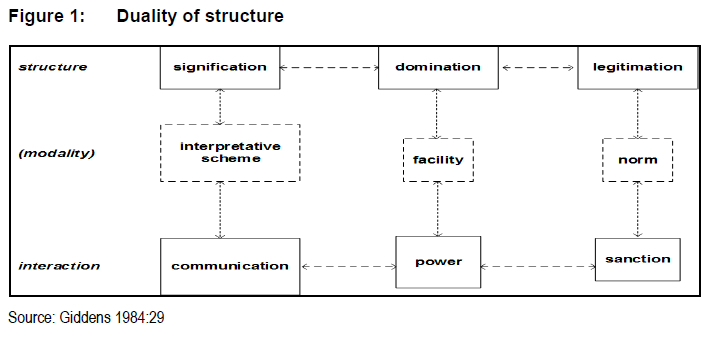
There is prima facie evidence that the duality of structure from the perspective of structuration theory can be used to reveal the factors that influence IT strategy operationalisation, in that the theory has been applied in similar circumstances and studies in the past. Some of the studies include (Chang 2014:79; Iyamu 2019:287; Mgudlwa & Iyamu 2018:1; Omar & Osmani 2015:77; Pozzebon 2004:253; Twum-Darko 2014:512; Whittington 2010:145). Structuration theory comes from sociology, aiming to shape the development of social phenomena. The theory posits that human actions directly condition or are conditioned by organisational processes in social contexts (Iyamu & Roode 2010:2). Giddens (1984:25) infers that the main tenets of structuration, structure and agent are a mutually constitutive duality. As shown in Figure 1, the duality of a structure consists of three (3) main dimensions, namely, structure, modality, and interaction. In Giddens (1984:31), this means that the social system is managed by a need for importance (significance), an importance of authority (domination) and rights and obligations (legitimation).
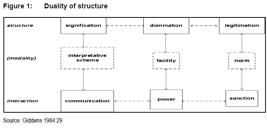
In structuration theory, a structure is defined as rules and resources as opposed to its literal meaning in the English language (lyamu & Roode 2010:4). The role of structure can be both constraining and enabling of human action in a social system such as an organisation. Canary and Tarin (2017:2) suggest that structures in organisations have these enabling and constraining aspects, enabling because they provide a valuable framework for social dealings, but also constraining as they afford little flexibility for how individuals conduct themselves and interact within the organisation's boundaries. While structuration theory assists to explain communication practices within organisations and helps to clarify how employees understand their organisational rules, structures can be useful as well as adverse for organisations and employees. The structuration theory expresses the power of agency and structure over time in a social system (Daff & Jack 2018:8).
A review of literature was conducted in the primary subject areas of IT strategy, and its operationalisation.
3.1. Information technology strategy
The IT strategy is a detailed plan by IT management, developed to direct the organisation towards achieving its goals and objectives, using technologies. Whether IT is a core or non-core function, for most organisations, the development and implementing of IT strategies to meet business objectives is vital. To meet the business objectives, an IT strategy would address gaps identified by several business units or divisions of the organisation (High 2014:36). Mithas and Rust (2016:223) view IT strategy as the articulation of an organisation's main strategic objectives, such as growing revenue, reducing cost or emphasising the achievement of both objectives. High (2014:44) furthermore suggests that an IT strategy is not a completely different plan; it is an IT interpretation of where it will focus to help organisations transform.
Ultimately, an IT strategy guides an organisation on how to pursue its objectives. Twum-Darko and Iyamu (2015:108) posit that an IT strategy assists and supports organisations to set direction, comprehend and concentrate on the future in the ever-changing business environment. It is for this reason that IT requires a strategy to achieve its set goals and objectives (Twum-Darko & Iyamu 2015:108). An IT strategy encourages organisations to afford the importance it deserves. It is pivotal that IT management conceptually connect the design and implementation of IT strategies that run in tandem to what the business is attempting to reach strategically. Business and IT strategy should be highly interdependent. Bharadwaj, El Sawy, Pavlou and Venkatraman (2013:471) assert that an IT strategy is influenced by the business strategy, transforming business processes and scope. It is only when an organisation's IT and business strategies are aligned that transformation is achieved. Consequently, organisations must develop an IT strategy that considers various principles and priorities aligned to the organisation's strategic plan to optimise the benefits of IT (Wanaswa, Awino & Ogutu 2017:26).
It is evident that an IT strategy is not just about adapting new technologies; it concerns issues of information, knowledge and changes of organisational practice (Peppard, Galliers & Thorogood 2014:3). Hence, Queiroz, Coltman, Sharma, Tallon and Reynolds (2012:11) classify IT strategy as "IS for efficiency", "IS for flexibility", or "IS for comprehensiveness". Teubner (2013:277) states that an IT strategy professes that information and technology are utilised in pursuit of business objectives entrenched in the organisation. Very few organisations can survive this dynamic, competitive environment without an IT strategy. High (2014:67) emphasises the importance of developing and implementing an IT strategy in concert with the overall organisational strategy. The significance of an IT strategy in organisations has become increasingly prevalent. Krimpmann (2015:1208) argues that in today's digitalised world, it is anticipated that business units of organisations will procure standard IT services from external IT suppliers, allowing their internal IT to only manage difficult and problematic services. As a result, an IT strategy must be positioned as a business enabler rather than a support function (Krimpmann 2015:1208).
The challenge is that many organisations are still formulating their strategies based on traditional planning approaches, yearly cycles, historical analytics and antiquated thinking (Bonnet & Maulik 2017:2). In addition, too many organisations' IT strategies lack the business expertise of managers from non-IT departments who should understand IT needs and opportunities from both business and IT divisions (Tiwana 2017:29). The pace and uncertainty that describes this new digital economy necessitates a shift away from the traditional growth planning formulation. As a result, organisations need to update their previously formulated IT strategy. Once a strategy has been formulated and adopted, it requires implementation. According to Ranjbar, Shirazi and Blooki (2014:129), although adopting the right strategy is crucial for an organisation to survive, strategy implementation is far more important. IT strategy, like any other strategy implementation, is the key to achieving an organisation's objectives.
Undoubtedly, IT is not merely a support function. It has become embedded in the systems and processes of many organisations. An IT strategy aims to create a plan that manages IT investments. Accordingly, Yeh et al. (2012:200) state an IT strategy aims to create a medium to long-term plan for introducing information systems and to manage related IT investments. Some researchers suggest that while organisations develop comprehensive IT strategies, they are unable to implement them successfully, thereby leading to poor overall organisational performance (Bartenschlager 2011:83; Estébanez, Grande & Colomina 2010:46; Peppard & Ward 2016:11). With this in mind, the operationalisation of an IT strategy is suffering.
3.2. Operationalisation
Once an IT strategy has been developed, an implementation plan is created. Implementation is the execution of such a plan. Implementation is defined as the use of plans to accept, incorporate and confirm interests and change practices and patterns within specific settings (Schillinger 2010:5). As a result, post-implementation refers to putting the IT strategy into use, or operationalising it. Operationalisation is a process of translating concept to practice. Jonker and Pennink (2010:51) state that operationalisation is "the process of changing a theoretical construct into a concept that can be 'seen' in the empirical reality".
Operationalisation involves more than implementing an IT strategy, it involves getting the organisation to behave and operate in a way that is aligned with the target future. According to Ismail, Hashim, Ismail and Majid (2009:226) operationalisation is the process necessitating the creation of an operational definition that will allow a concept or construct to be uniformly understood and used by all concerned parties. In the process of operationalisation, the parties encourage and operationalise the strategic concepts and involve them in day-to-day management (Larsen 2014:4; Nketia 2016:474). In the context of this study, operationalisation of an IT strategy refers to post-implementation, meaning putting an IT strategy into practice.
The difficulties that are involved in operationalising an IT strategy vary from one organisation to the other. For instance, Mair, May, O'Donnell, Finch, Sullivan and Murray (2012:357), conducting a study on an e-health strategy, are of the view that the implementation and entrenchment of new technologies of any kind are complex processes of change at both micro and meso levels. Operationalisation is influenced at IT strategy development and implementation by many factors, both technical and non-technical, which enable and simultaneously constrain the operationalisation of the IT strategy.
4. RESEARCH METHODOLOGY
In this study an interpretive approach was employed, allowing the subjective understanding of actions, activities and entities (Nehemia-Maletzky, Iyamu & Shaanika 2018:198). A qualitative method was used to collect data and through hermeneutics the data was analysed using the lens of the structuration theory as a guide. The qualitative method aims to obtain a deeper understanding of the phenomenon being studied. Myers (2013:5) concerts that a qualitative method helps scholars to understand people and their social settings within which they live and operate.
Data was collected from a public organisation. A public organisation is defined as an institution owned and fulfilling the mandate of the government of the country. Broad Spectrum, a public telecommunication organisation based in Johannesburg, South Africa, is the organisation used as a case in this research. The organisation was selected since it has developed an IT strategy, which was in the process of being implemented at the time of this study. Most importantly, among the organisations that were contacted, BS was the only one that granted permission for the study.
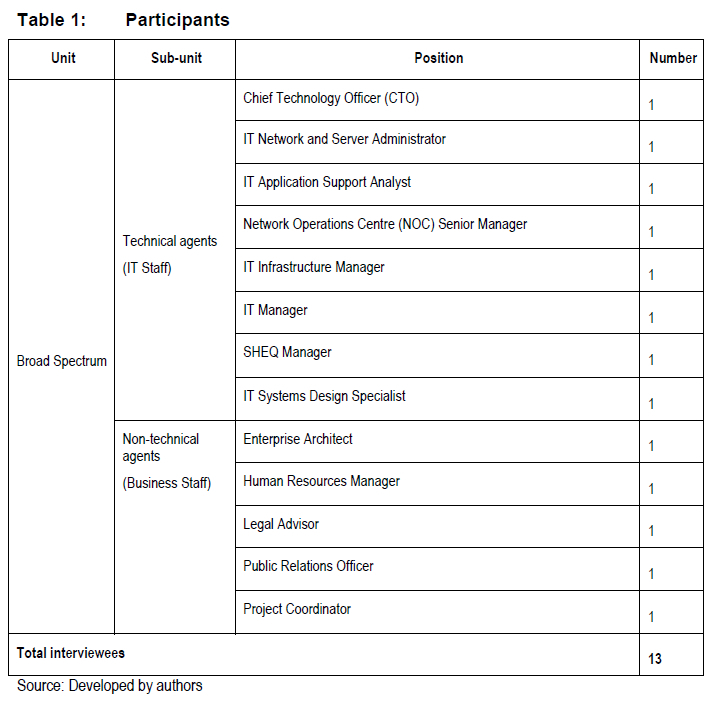
As shown in Table 1, a total of thirteen participants were interviewed through semi-structured interviews. According to Evans and Lewis (2018:2), semi-structured interviews are one of the most extensively used techniques for collecting qualitative data in information systems studies. This is mainly because the technique allows researchers to explore subjective viewpoints from participants (Evans & Lewis 2018:2), and obtain in-depth interpretations of their experiences. A set of criteria was used in selecting the participants. This included areas of specialisation, experience in the field, and years of service at the organisation used as a case in the study. The number of interviews was determined by the point of data saturation during data collection. Point of saturation, meaning there was no new information that was forthcoming. Data from the organisation was analysed by a hermeneutic approach from the interpretive stance, which was guided by structuration theory as a lens.
Units of analysis are the main entity analysed in a study. According to lyamu (2011:2), the units of analysis approach allows data to be analysed on a unit-by-unit basis. The organisation that was involved in the study was classified as the main unit as shown in Table 1. The main unit had sub-units, including both technical and non-technical agents (Table 1).
5. DATA ANALYSIS
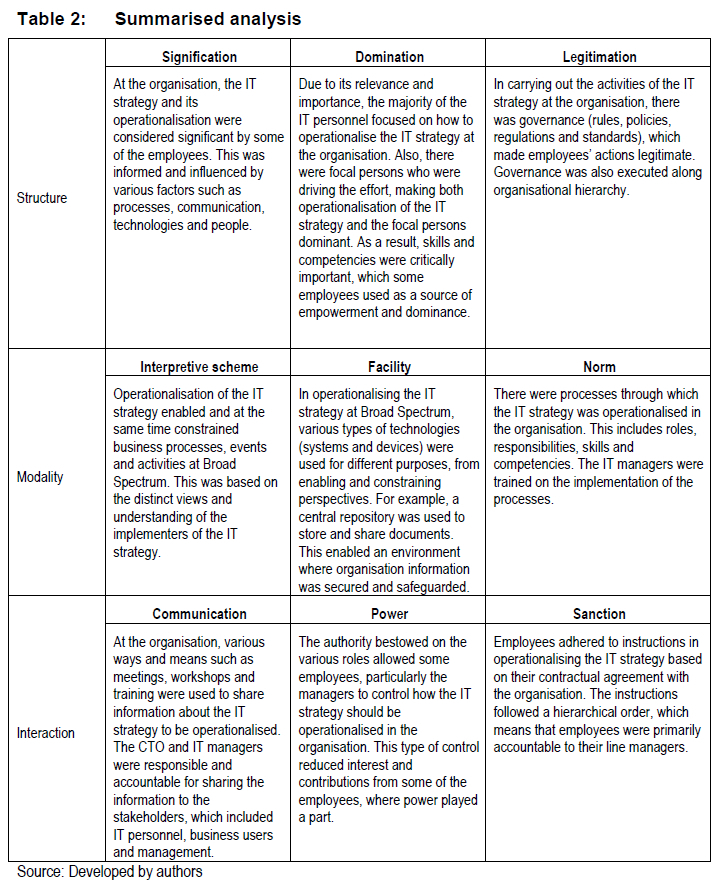
Structuration theory was selected and used from the main perspectives: (1) to examine the different agents and structures that existed in the operationalisation of an lT strategy in the organisation; and (2) through duality of structure, it was possible to examine how interaction was carried out using rules, and available resources, in the reproduction and reproduction of events, processes and activities, in operationalising the lT strategy. Duality of structure was established as a lens to guide the analysis of data as summarised in Table 2. The discussion that follows should be read together with Table 2 to gain a better understanding of the data analysis.
5.1. Signification/Interpretive scheme/Communication
At Broad Spectrum, the lT strategy was concerned with current and future use and management of computing artefacts to purposely advance organisational competitiveness, sustainability and efficiency. The entire organisation relied increasingly on the lT strategy. The concept of the lT strategy was therefore considered significant at the organisation. Two (2) fundamental factors were associated with the lT unit at the organisation: significance of the IT strategy and significance of the operationalisation of this strategy.
The employees considered IT strategy based on their roles and responsibilities; or the activities that technological artefacts enabled or constrained when carrying out their tasks. Through participation in the activities related to the IT strategy, some employees felt empowered. As a result, this group of employees considered the concept important. This assessment was for both personal gain as well organisational benefits. Some of the personal benefits include empowerment, skills development and incentives. On the organisational front, aims and objectives were being achieved. From a user perspective, one of the participants briefly explained how one of the deliverables of the IT strategy was operationalised to enable employees:
Many business users used to struggle in finding personal or organisational electronic documents until a document management system was implemented. The system makes it easy to manage projects, assigning activities and store our company documents (BS02, 6:249-253).
This renders operationalisation of the IT strategy critical at Broad Spectrum. The emphasis on operationalisation of the concept increased pressure on IT managers to ensure that highly skilled and competent personnel are involved in its deliverables. Operationalisation was important because of the advancements it brought to the organisation.
One of the objectives of operationalising the IT strategy was to improve the activities and processes of the environment, including oversight about IT solutions to the business, which led to the creation of a committee. The IT oversight committee focused on governance, including policies, standards and principles. Through this committee, laptop and security policies were formulated and promulgated as dictated by the IT strategy. In the process of operationalising the IT strategy, the IT oversight committee ensured specifications for hardware and software and others solutions aligned to the organisation's system architectural standards.
Some of the critical advancements that manifest from operationalising the IT strategy were the deployment of a repository system and virtualisation. These advancements reduced the complexities within the working environment. In the past, organisational documents and other artefacts were scattered throughout the environment. The repository system enables centralisation of documentation and artefacts, which allows ease of storage, access, use and management. The repository system also enables improved security and business continuity. A respondent shared his view:
We deployed solutions such as the SharePoint system as part of our strategy. Through this system we have been able to improve workflows and enhance the management of documentations in the organisation (BS05, 23:1010-1011).
There were many servers in the organisation; some were antiquated beyond their life span, occasionally malfunctioning during processing of business activities. Server manufacturers define life span as between 3-5 years. In addition, many of the servers were duplicates between business units, a result of business units not aligned and not interacting with each other. Through operationalisation of the IT strategy, these challenges were addressed by employing virtualisation.
Based on the concept of virtualisation, the number of existing servers in the environment was reduced. Many servers were discarded and replaced with newer ones with larger capacities. Virtualisation allows for the division of a single server into many compartments. A virtualised server allows the various compartments to host different systems and applications on one (1) server, so virtualisation reduces complexity and tightens management of the environment for increased competitiveness. One of the employees expressed his view:
We have too many aged and malfunctioning servers in this organisation. Many of these servers have passed their life-span and are giving use problems. We virtualised servers rather than buy more (BS11, 50:2177-2178).
However, some employees did not understand the IT strategy or how it can be operationalised in the organisation. This can be attributed to lack of interest, influenced by the communication, or lack thereof, certain groups of employees received. As a result, this group of employees resisted operationalisation of the IT strategy in the organisation. This challenge was from both technical and non-technical perspectives, including people (employees), communication and process.
The challenge affected how innovations from the IT strategy were conducted within the organisation. The resistance was based on the fact that some employees perceived new ideas and ways of performing their business activities and processes as a deterrence. An IT manager at Broad Spectrum explained:
...we had a situation where employees accustomed to the local area network (LAN) and manual ways to connect to the Wi-Fi, when it came to migrating to the automated way of connecting to Wi-Fi as defined by the IT strategy, some of the employees resisted its operation. The management had no choice but to force the employees to migrate (BS06, 32:1394-1395).
The significance associated with the IT strategy was based on individuals' interpretation of the concept. This means that not every employee regarded the IT strategy as significant. Even those employees who thought the concept significant did so from different viewpoints. Some of the employees associated the importance of the IT strategy with alignment between IT and business units of the organisation. Notwithstanding the advancements introduced by operationalisation and the universal understanding of the IT strategy in the organisation, some employees still misinterpreted the concept. Furthermore, some employees were uncertain about the advanced operationalisation brought into the organisation. The misinterpretation and uncertainty of the IT strategy and its operationalisation resulted from unclear strategic goals that were only vaguely communicated to employees.
Employees' interpretations and viewpoints about the IT strategy can be attributed to various factors such as the manner in which the concept was communicated. As elsewhere within the organisation, communication was conducted verbally and through documentation (in writing). Occasionally, communication was through videos and presentations that entail visual and images for enhanced clarity. According to the CTO:
We have different ways through which we share information with the employees including those who are involved with strategic change (implementation) activities. Also, we sometimes hold meetings which is aimed at sharing the strategy intent about IT with the key stakeholders (BS02, 9:403-406).
Some employees preferred to receive communication regarding the IT strategy verbally, a method taking the form of face-to-face meetings and interactive workshops, giving employees the opportunity to participate in discussions regarding IT's strategic intents, and how the strategy can be operationalised. These meetings and workshops conveyed inclusiveness, which influenced employees' decisions to support the technologies and processes implemented. One of the employees explained as follows:
We need to have workshops and people need to buy-in to ITs strategic intents. We need buy-in from managing executives. They must motivate their direct reports, including senior managers and lower level employees to attend workshops and implement the technologies that come from the IT strategy (BS06, 30:1276-1278).
Some employees preferred communication about the IT strategy through documentation -including electronic mail (email) and presentations. This communication method affords the opportunity to read, re-read and reference with ease. Moreover, this method enables the employees to interpret the IT strategy at their convenience.
Despite these inclusive approaches, with verbal and written documentation to communicate the activities of the IT strategy and its operationalisation, some employees still found it difficult to interpret some of the relevant terminology (often referred to as 'IT jargon') in the IT strategy. Some employees were either uninterested or disregarded the documentation distributed to them individually or through workshops. Some of the participants stated:
IT will send a presentation with a lots of IT jargon to us. I would like to have input into these presentations and assist IT to communicate in simple English (BS10, 45:19481949). Communication forums where business requirements for the operationalisation of the IT strategy are discussed and approved (BS10, 47:2044-2047).
At Broad Spectrum, the IT strategy and its operationalisation were given utmost importance by the management, including employees. How employees interpreted the concept of the IT strategy in the context of their organisation can be attributed to the respect afforded it. The interpretation of the concept was influenced by the ways in which the communication surrounding the IT strategy and its operationalisation were carried out in the organisation. The approach encouraged interaction and negotiation among the stakeholders.
5.2. Domination/Facility/Power
Many employees at Broad Spectrum were cognisant of the importance of the IT strategy from both a personal and organisational perspectives. Owing to the importance, which includes enabling competitiveness and sustainability, the IT strategy was discussed at the organisational level. The CTO presented the IT strategy and the progress of its operationalisation to the executive committees of the organisation, because the IT strategy was within his portfolio. In his role as head, the CTO is responsible for ensuring the IT strategy is implemented through operationalising the artefacts for organisational solutions. The CTO explained:
I present the IT strategy at the higher level (Executive Committee) of the organisation. I explain that the formalisation of the new strategy stems from revising the current strategy and the problems the steering committee identified. Hence, the decision that a new strategy should be implemented (BS02, 5:211-213).
The IT strategy relies on employees for its operationalisation, necessitating certain skills and competencies. Thus, some employees attended training, workshops and conferences to acquire these skills and competencies to empower them to participate in the operationalisation of the IT strategy within the organisation. In addition to the skills and competencies, infrastructure such as remote wireless connectivity was also needed to fulfil the objectives of operationalising the IT strategy at BS. An employee shared her view as follows:
We attend academic sessions, conferences or workshops. It is at these forums where we get to hear and learn about new things, new technologies and other solutions that serve as input into out IT strategy (BS02, 5:182-183).
At Broad Spectrum, several employees were privileged to be empowered through acquiring the relevant skills and competencies. Other employees were less privileged because they did not have such opportunities to acquire these skills and competencies. The employees who did not have the necessary skills did not participate in the operationalisation of the IT strategy at the organisation. By contrast, those who participated felt empowered, as they were relied upon during the course of operationalising the IT strategy. At times, some employees applied their additional skills and competencies as a source of power and dependency, which they used, whether consciously or unconsciously, to dominate their colleagues.
In fulfilling the IT strategy operationalisation objectives, the organisation provided facilities in the form of infrastructure, including levels of access to systems and remote wireless connectivity. These infrastructures and access enabled employees to support the organisation's business processes and activities from anywhere, and at any time. This fosters business continuity, which in turn fosters sustainability and competitiveness.
The employees who had access to the facilities used this to monitor, control and coordinate the activities towards operationalisation of the IT strategy. Based on this accessibility, some employees felt a sense of power, which intentionally or not, reproduced as they carried on with individual or group activities and events. This type of power or empowerment was domineering in the course of operationalising the IT strategy within the business environment, as one of the employees explained:
We have so many different models that we use and these are industry standard models. If we implement a project, we use different methodologies, like PRINCE II. Within the IT environment, we adopt and comply with the concepts of ITIL and COBIT. It is the same across the organisation. We employ the best models and methodologies to implement the IT strategy across the organisation (BS09, 42: 17781781).
At Broad Spectrum, the empowerment employees enjoyed manifested into incentives that included job security and financial bonuses. The incentives were designed to encourage employees to participate in the operationalisation of the IT strategy, while other employees who did not get these incentives were discouraged, responding with resistance to the idea of participating in the operationalisation of the IT strategy. The challenge was that demotivated or discouraged employees contributed to the derailment of processes and activities in the operationalisation of the IT strategy. Some of the responses from this group of employees included defiance and the ignoring of instructions from those who had the authoritative power to control the IT strategy operationalised in the organisation.
The Employees were cognisant of the criticality of operationalising the IT strategy. Some employees assumed the authority that was bestowed upon them to exercise power in their participation of the IT activities at the organisation. This included impressing their relevance, which was domineering within the environment. From another perspective, some employees did not have the facilities to contribute to the process, which derailed some activities surrounding the operationalising of the IT strategy. So, in other words, at the organisation, some employees had power bestowed on them through organisational hierarchy while others gained power through distinctive and useful skills.
5.3. Legitimation/Norm/Sanction
The IT strategy was a blueprint upon which the IT department and other units of the organisation relied on to enable business processes, information flow and technology deployment. Reliance on the IT strategy was accentuated by the fact that many of the employees saw it as an enabler and support tool for competitiveness and sustainability. As a result, there was emphasis on the IT strategy, particularly in its operationalisation. Thus, the concept of the IT strategy had to be approved and acknowledged through the organisational structure (hierarchy) which included the board of directors (BOD), the executive committee (ExCo), the IT oversight committee as well as the various user groups. One of the participants explained:
The IT oversight committee formulates policies with regard to implementing strategic activities. The policies govern processes and procedures of the various activities about the IT strategy. We implement a policy; make sure all the governance is in place and the accountable and responsibility is outlined (BS09, 41:1731-1733).
The BOD was headed by a chairperson, while both ExCo and IT oversight committees were led by the chief executive officer (CEO). Members of the committees included the chief financial officer (CFO), group human resource, and CTO, rendering committees powerful. This power was reflected in the allocation of resources and distribution of tasks.
The BOD followed a specific process in their approval of the organisation's IT strategy. The process included a presentation by the promoters of the IT strategy, the executives of the organisation. Subsequent to its approval, the strategy had to be executed (operationalised) to achieve its objectives, to enable and perform business events, activities and processes. One of the components in the execution of the IT strategy is governance, which includes rules, policies, regulations and standards.
In our process of operationalising the IT strategy, governance is needed because it enables and allows us to have controls in all areas of activities. Governance entails enterprise risk management, adherence to legal framework, enabling assurance and internal audit, and compliance with the government legislation (BS01, 01:77-79).
Due to the significant role of governance it was critical in operationalising the organisation's IT strategy. Within governance, the IT strategy was operationalised and distributed across the organisation, as the governance allowed the promoters of the strategy to define rules of engagement standards for various resources and employee roles and responsibilities in the operationalisation of the IT strategy.
Everyone in the organisation was expected to follow the process as delineated by governance since governance components were approved by both technical and business users in the organisation thereby allowing employees to partake from different angles in the operationalisation of the IT strategy.
The approval and authorisation of the IT strategy occurred at two (2) main levels, organisational and IT departmental. This was the norm at the organisation; the process was sanctioned by the employees: at the organisational level, the BOD, ExCo and oversight committee were involved; at the IT department level, IT specialist groups, such as network and application engineers and IT management, including IT managers and senior managers were involved.
At the time of this study, the BOD was the highest authority within the organisation, and as such, and in conjunction with the ExCo, provided oversight on the organisational strategy. This included ensuring that governance was in place, providing strategic direction and monitoring of implementation progress. According to one (1) of the employees of the organisation:
The Board of Directors is responsible for corporate governance and organisational strategy of the organisation and monitoring the organisation's progress (BS DOC-01, p30).
The IT specialist groups, the main implementers of the IT strategy based on their responsibilities within the organisational hierarchy, took instructions directly from the ExCo in operationalising the IT strategy. This group of specialists made sure that the activities and actions relating to operationalising of the IT strategy were properly conducted following the policies, rules, regulations and standards. In addition, the IT management group was responsible for ensuring that the activities and actions implemented in the organisation were aligned to the IT strategy. The involvement of IT specialist groups and IT management designed a culture through which IT solutions were implemented as defined in the strategy.
The employees played a role in operationalising the IT strategy to approve the IT strategy and operationalisation of it. A number of employees resisted the activities and processes implemented to operationalise the IT strategy, while others supported and contributed to operationalisation by becoming change agents. The employees who resisted operationalisation of the IT strategy became detractors, as their actions (or inactions) disrupted the operationalising process. Some employees, in fact, refused to participate in the operationalisation at all. One of the employees expressed their view:
The CTO told us the IT department is prohibiting us from saving company information on servers, it has to be on the SharePoint system. But I told the CEO it's going to be a problem unless I'm told in writing that I will not be held responsible if confidential information is lost. I'll upload the information on the SharePoint system, everybody in the organisation can do what they want with the information (BS12, 59:2583-2587).
Even though governance was employed in the operationalisation of the IT strategy, there were identifiable challenges owing to the fact that some employees were resisting the rules and regulations in operationalising the IT strategy. It became clear that without governance the business events, activities and processes were hindered because some employees were not carrying out their responsibilities as defined by the IT strategy. This was despite the fact that employees and management in the organisation were well aware of the IT strategy and its operationalisation primarily because it followed authorised processes, legitimising the concept. The processes went through various stages, from the BOD to the specialist levels. The processes were intensive in approval was required at each stage or level.
These processes became the norm at the organisation because the majority of the employees sanctioned them. Furthermore, processes were followed as a source of power for controlling the selection, implementation and use of IT solutions in the organisation.
6. DISCUSSION OF FINDINGS
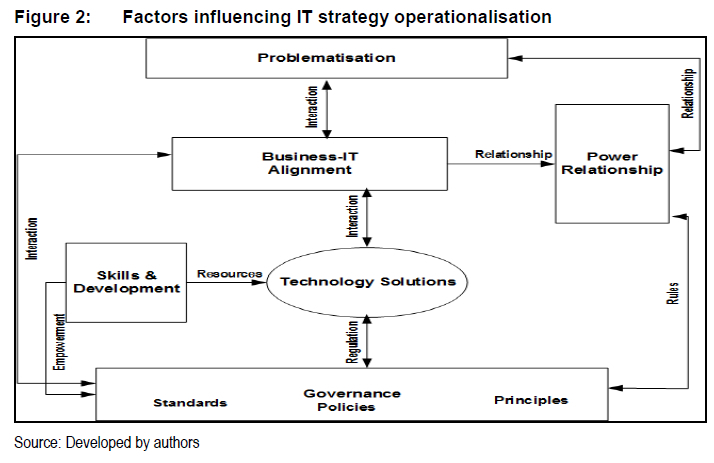
From the analysis presented above, six (6) factors were determined to influence the operationalisation of the IT strategy. As shown in Figure 2, the factors are as follows: problematisation; business and IT alignment; technological solutions; governance; power relationship; and skills and development. Figure 2 should be read with the discussion in mind to gain a better understanding of how the factors influenced operationalisation of IT strategy.
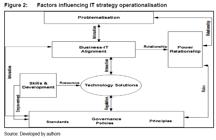
As shown in Figure 2, the factors are interconnected meaning that the factors shape and are shaped by others. Thus, by implication, the factors enable and constrain each other in the operationalising process of IT strategy in the organisation.
6.1.
Levels of problematisationProblematisation is a stage in the process of translation, of event, activity or episode, in which a solution can be proposed (Silvis & Alexander 2014:110). Problematisation refers to the stage where the focal actor outlines the nature of a problem, allowing the other actors to identify it as a problem requiring a solution (Callon 1986:199). Iyamu (2015a:72) argues that this moment occurs when powerful actors identify and define real world issues, such as managing technology solutions. According to Heeks and Stanforth (2015:38), the process of problematisation allows the focal actor to convince other actors to accept the problematised item.
In order for the IT strategy to be operationalised in the organisation, the concept was presented at various levels in efforts towards a successful solution. In the process, a deeper understanding is gained by the stakeholders, particularly those who are not IT personnel. This process happens at three (3) main levels: management, business users and IT specialists. At the management levels, approval is sought from the board of directors, executive committee and oversight committee. Business users are required to contribute an indirect approval of operationalisation activities. At the third level, the IT specialists accept tasks that are allocated to them as an indication of approval based on an understanding.
The level approach of problematisation, promoting inclusiveness, a primary factor for buy-in, allows people to interact and translate the content of the IT strategy and operationalisation plan into their own understanding. The interaction clarifies the meaning that individuals associate with the content and tasks and movement towards a common goal and purpose. This inclusiveness, as well as the understanding gained by both the business personnel and IT specialists at problematisation stage, promotes alignment.
6.2.
Business-IT alignmentAlignment between business and IT is an appropriate and timely factor in achieving business strategic goals and objectives (van de Wetering 2016:111). Kearns and Lederer (2003:1) argue that through alignment, a dialogue occurs between the business and IT managers through which they identify implementation responsibilities. According to Kearns and Sabherwal (2006:130), alignment between business and IT has accentuated organisational value for many years. The concept of business and IT alignment is not new; its effect has been explicitly examined in prior studies (Wagner & Meshtaf 2016:4920).
There had to be a certain level of alignment between the business and IT units in operationalising the IT strategy in the organisation. There was interaction between the units, fostering alignment during the operationalisation of the IT strategy. The interaction also enabled the oversight committee, instrumental to the alignment that was formed between the business and IT units.
Through the alignment, individuals from both business and IT units were able to establish relations, easing collaboration in the course of operationalising the IT strategy in the organisation. The specialists and the business users were able to interact, collaborate, and share notes and ideas pertaining to solutions that were defined in the IT strategy. In addition, the alignment clarifies understanding about roles and responsibilities, including task allocations, in operationalising the IT strategy. Due to this beneficial alignment, individual resistance to certain processes of IT strategy operationalisation was minimised. Otherwise, IT experts would have had struggled even more in operationalising the IT strategy, which dictates several technological solutions for the entire organisation.
6.3. Technological solutions
Technological solutions refer to new tools to enable activities, management events and gain knowledge (Tidd & Bessant 2018:91). Technological solutions, evolving over time and space, cover the changing needs of an organisation and its users (García-Holgado & García-Peñalvo 2017:1). As technological solutions are insufficient in themselves (Welford 2016:10), they are limited in what they can deliver in an organisation (Tidd & Bessant 2018:267).
Technology solutions include hardware and software used in operationalising the IT strategy in the organisation. Hardware includes the physical infrastructure and other artefacts such as servers, routers, switches, laptops, desktops and printers. Software includes operating systems and business applications for management processes and activities such as human resources, financial, sales and supply chain. While the hardware supports the software, the hardware operates under the control of software and is unworkable without it.
Operationalisation of the IT strategy is achieved through the deployment of technology solutions within the organisation. The IT strategy defines and categorises the technology solutions for deployment across the organisation. However, the solutions did not exist and operate by themselves; human skills must be coupled with the solutions for effective operationalisation. The IT unit was also empowered to develop applications, enhancing and supporting the applications and systems within the organisation. Interaction through business-IT alignment with technology solutions further enables organisational goals.
Moreover, the deployment of technology solutions requires regulation through governance to ensure appropriate use and management for best organisational purposes.
6.4.
GovernanceGovernance consists of control, management and planning processes, including principles, procedures, policies and standards (Selig 2018:1). Batyashe and Iyamu (2016:7) argue that IT governance sustains business objectives and mitigates against risks through regulations and compliance. According to Joshi, Bollen, Hassink, De Haes and Van Grembergen (2018:368), IT governance stimulates responsibility, accountability and transparency, primarily to strengthen operational capabilities and ultimately, competitiveness.
To operationalise IT strategy, the organisation employed standards, principles and policies in the selection, implementation, use and management of the various technology solutions. The organisation implemented different standards in addressing various diverse operations and events across the organisation, standards and principles that were proprietary, or bespoke, befitting the unique organisational requirements. The proprietary standards implemented eased operationalisation. The deployment of the technological solutions, though, assumed associated risks and vulnerabilities. Policies were formulated to manage and mitigate risks such as cyber security and data loss that could potentially affect solutions, including servers, personal computers (laptops and desktops), network and electronic mail.
The concept of governance empowered certain employees in carrying out their tasks, roles and responsibilities that would have likely been impossible previously because of resistance within the organisation. This is primarily because governance was established as organisational rules and regulations, furthering to operationalise the IT strategy across the organisation from both business and IT perspectives.
6.5.
Power relationshipIndividuals and groups take advantage of power bestowed upon them to draw, establish and maintain relationships with others through interactions (Moloi & Iyamu 2013:50). Nandhakumar and Jones (1997:77) suggest that power can be regarded as a relationship rather than a property of individuals, and can be used as either an enabler or constraint on human actions and interactions. Anderson, John and Keltner (2012:313) argue that power shapes individual behaviour in that it instils an elevated sense of ability and righteousness in them.
As power was an injection into the organisational structure and hierarchy, some employees relied on this to execute their roles and responsibilities in operationalising the IT strategy.
Power associated with distinct positions defined the types of employee relationships and influenced interactions in the course of IT operationalisation. The relationship that manifested from power enabled and constrained processes, activities and events in the operationalisation of IT strategy in the organisation, meaning that 'power relationships' resulted in employees resisting operationalisation because they were at liberty to act and behave at will.
In addition, power relationships influenced employee interactions at a variety of levels of business and IT units in the organisation. The interactions also influenced activities during problematisation of the IT strategy operationalisation. Consequently, the interactions affected the operationalisation of the IT strategy. In addition, relationships also influenced employee skills development.
6.6. Skills development
Technical skills, developed to provide attractive interface and maintain user interest (Nandhakumar and Jones 1997:83), are opportunities for new knowledge acquisition as they stimulate and provide responsive solutions (Adams, Jeanrenaud, Bessant, Denyer & Overy 2016:24), and for learning about the ecosystems (García-Holgado & García-Peñalvo 2017:2). According to Batyashe and Iyamu (2016:9), the selection, implementation and use of IT solutions depend significantly on skills. In the explanation by Van Grembergen and De Haes (2018:4877) skills are high on the requirement list for the innovation and transformation of solutions, as skill sets are based on knowledge which must be developed and reworked continuously (Batyashe & Iyamu 2016:9).
Skills were acquired through training programmes and attendance at business and academic conferences. The IT specialists acquired technical skills to manage and support new innovations. IT specialists used the knowledge acquired to operationalise the IT strategy by providing technical support to the business users. Business users were trained on the functionalities and features of the innovations that were implemented. This knowledge equipped business users to perform business activities and processes efficiently. The development and enhancement of skills were achieved through knowledge sharing and workshop sessions promoted within the organisation as being skilled equipped and empowered business and IT units to operationalise the IT strategy.
Based on the skills and development initiatives, business and IT units were able to operationalise the technological solutions. Meanwhile, the units in the organisation developed policies, standards and principles to coincide with the operationalisation of the IT strategy pertaining to regulations.
Problematisation through interactions secured alignment between business and IT units in the organisation, alignment which manifested into development and implementation of technological solutions as defined by the operationalisation. Governance was employed in the deployment of technological solutions to ensure that the policies, standards and principles managed, controlled and mitigated against risks. Although power relationships stirred resistance to operationalise, skills and development were introduced to diminish the resistance.
7. CONCLUSION
For many years, organisations continue to repeatedly develop IT strategies without operationalisation, which has implications on several fronts of activities, such as return on investment, sustainability, and enablement of solutions toward achieving the business objectives and goals. This repertoire type of approach is attributed, or viewed from two (2) angles: (1) the factors that influence operationalisation of the IT strategy were not empirically known to many IT managers; and (2) some IT managers who knew about some of the factors that could possibly influence operationalisation of the IT strategy struggle to gain an understanding of how they manifest. It has never been easy to detect or establish factors of influence, particularly when humans are concerned. It was on this basis an approach that has depth in rigour was followed, by employing the duality of structure from the perspective of structuration theory.
As shown in Figure 2, this study does not only reveal the factors that influence operationalisation of the IT strategy in an organisation, it also illustrates the connectedness of the factors. In addition, how the influencing factors manifest themselves are revealed through the data analysis, and interpretation of the findings as presented in sections 5 and 6, respectively. These should provide some degree of guidance and confidence for both IT and business managers in embarking on operationalisation of their IT strategy. From another angle, the use of structuration theory as a lens to view operationalisation of the IT strategy can be of interest and a contribution to the academic domain, for three (3) primary reasons. Firstly, as a lens, it provides methodological enhancement for the interpretive approach. Secondly, it adds to the existing literature in multiple fields: IT and strategic management. Thirdly, and finally, the study can be used as case material, particularly from a developing countries perspective.
The main limitation of this study is that it does not prescribe how the factors that influence operationalisation can be measured. The authors therefore recommend that this be explored in future studies.
REFERENCES
3. LITERATURE REVIEW
-
ADAMS R, JEANRENAUD S, BESSANT J, DENYER D & OVERY P. 2016. Sustainability-oriented innovation: A systematic review. International Journal of Management Reviews 18(2):180-205. (DOI:https://doi.org/10.1111/ijmr.12068.
» https://doi.org/10.1111/ijmr.12068 -
)
» https://www.researchgate.net/profile/Aasim_Zafar2/publication/315471085_Challenges_in_Implementation_of_I nformation_System_Strategies_in_Saudi_Business_Environ-ment_A_Case_Study_of_a_Bank/links/596f22aeaca272d552028ffb/Challenges-in-Implementation-of-Information-System-Strategies-in-Saudi-Business-Environ-ment-A-Case-Study-of-a-Bank.pdf -
]
» https://doi.org/10.1016/j.jsis.2014.01.002 -
ANDERSON C, JOHN OP & KELTNER D. 2012. The personal sense of power. Journal of Personality 80(2):313-344. (DOI:https://doi.org/10.1111/j.1467-6494.2011.00734.x.
» https://doi.org/10.1111/j.1467-6494.2011.00734.x -
).
» https://www.researchgate.net/profile/Jens_Bartenschlager/publication/265797800_Implementing_IT_Strategy_-_Laying_a_Foundation/links/555cb58808ae8c0cab2a6516.pdf -
)
» https://doi.org/10.25300/MISQ%2F2013%2F37%3A2.3 - BARTENSCHLAGER J & GOEKEN M. 2009. Designing artefacts of IT strategy for achieving business/IT alignment. California: AMCIS. (15th conference of Americas Conference on Information System; 6-9 Aug.
- )
-
]
» https://doi.org/10.1146/annurev-orgpsych-041015-062352 -
BATYASHE TN & IYAMU T. 2016. IT governance: An architectural framework based on consolidated best practices. Journal of Governance and Regulation 5(1):7-15. (DOI:https://www.researchgate.net/deref/http%3A%2F%2Fdx.doi.org%2F10.22495%2Fjgr_v5_i1_p1.
» https://www.researchgate.net/deref/http%3A%2F%2Fdx.doi.org%2F10.22495%2Fjgr_v5_i1_p1 -
)
» https://doi.org/10.1108/AAAJ-08-2015-2190 - )
-
BONNET P & MAULIK P. 2017. Reframing Growth Strategy in a Digital Economy. Internet:sloanreview.mit.edu/article/reframing-growth-strategy-in-a-digital-economy; downloaded on 14 June 2017.
» sloanreview.mit.edu/article/reframing-growth-strategy-in-a-digital-economy -
]
» https://doi.org/10.1057/palgrave.ejis.3000324 -
)
» https://doi.org/10.1080/21665095.2015.1026610 -
CANARY HE & TARIN A. 2017. Structuration theory. In Scott CR & Lewis L. (eds). The international encyclopaedia of organizational communication. London: Wiley. (DOI:https://doi.org/10.1002/9781118955567.wbieoc197). (pp 1-15.
» https://doi.org/10.1002/9781118955567.wbieoc197 -
)
» https://pdfs.semanticscholar.org/ae77/4ae366497a05d1c6efe187f1686263f7cb63.pdf -
)
» https://doi.org/10.4102/sajim.v13i1.419 -
CHANG CLH. 2014. The interaction of political behaviours in information systems implementation processes- Structuration Theory. Computers in Human Behaviour 33 79-91. [Internet:https://doi.org/10.1016/j.chb.2013.12.029; downloaded on 06 February 2019.
» https://doi.org/10.1016/j.chb.2013.12.029 -
]
» https://doi.org/10.4018/978-1 -4666-8524-6.ch003 - ]
-
EVANS C & LEWIS J. 2018. Analysing semi-structured interviews using thematic analysis: exploring voluntary civic participation among adults. SAGE Publications Limited. (DOI:http://dx.doi.org/10.4135/9781526439284.
» http://dx.doi.org/10.4135/9781526439284 -
)
» https://doi.org/10.1111/1540-5915.02289 - )
- GIDDENS A. 1984. The Constitution of Society: Outline of the Theory of Structuration. Cambridge, UK: Polity Press.
-
)
» https://doi.org/10.2471/BLT.11.099424 - GRANT RM. 2016. Contemporary strategy analysis: Text and cases edition. 9th ed. West Sussex, UK: Wiley.
- )
- HIGH PA. 2014. Implementing World Class IT Strategy: How IT Can Drive Organizational Innovation. San Francisco: Wiley.
-
]
» https://doi.org/10.4018/IJEGR.2015070105 -
IYAMU T & ROODE D. 2010. The Use of Structuration Theory and Actor Network Theory for Analysis: Case Study of a Financial Institution in South Africa. International Journal of Actor-Network Theory and Technological Innovation (IJANTTI) 2(1):1-26. (DOI: 10.4018/978-1 -4666-1559-5.ch001.
» https://doi.org/10.4018/978-1 -4666-1559-5.ch001 -
)
» https://doi.org/10.1108/18347641011023270 - )
- IYAMU T. 2015a. Application of Underpinning Theories in Information Systems. Victoria, Australia: Heidelberg Press.
-
)
» https://doi.org/10.1108/ITP-06-2013-0101 -
IYAMU T. 2019. Understanding the complexities of enterprise architecture through structuration theory. Journal of Computer Information Systems 59(3):287-295. (DOI:10.1080/08874417.2017.1354341.
» https://doi.org/10.1080/08874417.2017.1354341 - )
-
JOSHI A, BOLLEN L, HASSINK H, DE HAES S & VAN GREMBERGEN W. 2018. Explaining IT governance disclosure through the constructs of IT governance maturity and IT strategic role. Information & Management 55 (3):368-380. (DOI:https://doi.org/10.1016/j.im.2017.09.003.
» https://doi.org/10.1016/j.im.2017.09.003 - )
- )
-
KEARNS GS & SABHERWAL R. 2006. Strategic alignment between business and information technology: a knowledge-based view of behaviours, outcome, and consequences. Journal of management information systems 23(3):129-162. (DOI: https://doi.org/10.2753/MIS0742-1222230306.
» https://doi.org/10.2753/MIS0742-1222230306 - )
- )
-
KORT W & GHARBI JE. 2011. Call centres performance: An application of Structuration Theory. Communications of the IBIMA 2011(2011):1-16. (DOI:10.5171/2011.606307.
» https://doi.org/10.5171/2011.606307 -
)
» https://doi.org/10.1108/14637151211225171 -
KRIMPMANN D. 2015. IT/IS Organisation Design in the Digital Age-A Literature Review. International Journal of Computer and Information Engineering 9(4):1208-1218. (DOI:doi.org/10.5281/zenodo.1100358.
» https://doi.org/10.5281/zenodo.1100358 - )
- LARSEN MV. 2014. Strategizing through organising. The significance of relational sense making. 2nd ed. Chagrin Falls, Ohio: Taos Institute Publications.
- )
-
MGUDLWA S & IYAMU T. 2018. Integration of social media with healthcare big data for improved service delivery. South African Journal of Information Management 20(1):1-8. (DOI:http://dx.doi.org/10.4102/sajim.v20i1.894.
» http://dx.doi.org/10.4102/sajim.v20i1.894 - )
-
MITHAS S & RUST RT. 2016. How information technology strategy and investments influence firm performance: Conjecture and empirical evidence. MIS Quarterly 40(1):223-245. (DOI:https://doi.org/10.25300/MISQ/2016/40.1.10.
» https://doi.org/10.25300/MISQ/2016/40.1.10 - )
-
MOLOI R & IYAMU T. 2013. Competitive Intelligence in the Enterprise: Power Relationships. International Journal of Actor-Network Theory and Technological Innovation (IJANTTI) 5(2):50-64. (DOI: 10.4018/jantti.2013040104.
» https://doi.org/10.4018/jantti.2013040104 - )
- NANDHAKUMAR J & JONES M. 1997. Designing in the dark: the changing user-developer relationship in information systems development. Georgia: : ICIS. (International Conference on Information Systems; 15-17 Dec.
- )
-
NEHEMIA-MALETZKY M, IYAMU T & SHAANIKA I. 2018. The use of activity theory and actor network theory as lenses to underpin information systems studies. Journal of Systems and Information Technology 20(2):191-206. (DOI: https://doi.org/10.1108/JSIT-10-2017-0098.
» https://doi.org/10.1108/JSIT-10-2017-0098 - )
-
NKETIA BA. 2016. The influence of open strategizing on organizational members' commitment to strategy. Procedia-Socialand Behavioural Sciences 235(12): 473-483. (DOI:https://doi.org/10.1016/j.sbspro.2016.11.058.
» https://doi.org/10.1016/j.sbspro.2016.11.058 - )
- )
- PEPPARD J & WARD J. 2016. The Strategic Management of Information Systems: Building a Digital Strategy. 4th ed. Sussex, UK: Wiley.
- )
-
POZZEBON M. 2004. The influence of a structurationist view on strategic management research. Journal of Management Studies 41 (2):247-272. (DOI:https://doi.org/10.1111/j.1467-6486.2004.00431.x.
» https://doi.org/10.1111/j.1467-6486.2004.00431.x - )
- )
-
RANJBAR MS, SHIRAZI MA & BLOOKI ML. 2014. Interaction among intra-organizational factors effective in successful strategy execution: An analytical view. Journal of Strategy and Management 7(2):127-154. (DOI:https://doi.org/10.1108/JSMA-05-2013-0032.
» https://doi.org/10.1108/JSMA-05-2013-0032 - )
- SCHILLINGER D. 2010. An introduction to effectiveness, dissemination and implementation research. In FLEISHER P & GOLDSTEIN E (eds). From the Series: UCSF Clinical and Translational Science Institute (CTSI) Resource Manuals and Guides to Community-Engaged Research, P. Fleisher, ed. Published by Clinical Translational Science Institute Community Engagement Program, University of California San Francisco.
- SELIG GJ. 2018. IT Governance-An Integrated Framework and Roadmap: How to Plan, Deploy and Sustain for Competitive Advantage. Honolulu: PICMET. (Portland International Conference on Management of Engineering and Technology; 19-23 Aug). (pp 1-15.
- )
- )
-
TEUBNER RA. 2013. Information Systems Strategy. Business & Information Systems Engineering 5(4):243-257. (DOI:https://doi.org/10.1007/s12599-013-0279-z.
» https://doi.org/10.1007/s12599-013-0279-z - )
- TIWANA A. 2017. IT Strategy for Non-IT Managers: Becoming an Engaged Contributor to Corporate IT Decisions. Massachusetts, USA: The MIT Press.
-
TWUM-DARKO M. 2014. Factors influencing readiness for transformational e-government: A perspective of local governments in South Africa. Journal of Public Administration 49(2):512-523. [Internet:https://hdl.handle.net/10520/EJC158063; downloaded on 06 February 2020.
» https://hdl.handle.net/10520/EJC158063 - ]
-
TWUM-DARKO M & IYAMU T. 2015. Politicking Information Technology strategy in organisations: a case study of a selected organisation in South Africa. Journal of Governance and Regulation 4(3):107-114. (DOI:https://www.researchgate.net/deref/http%3A%2F%2Fdx.doi.org%2F10.22495%2Fjgr_v4_i3_c1_p2.
» https://www.researchgate.net/deref/http%3A%2F%2Fdx.doi.org%2F10.22495%2Fjgr_v4_i3_c1_p2 - )
- )
- VAN GREMBERGEN W & DE HAES S. 2018. Introduction to IT Governance and Its Mechanisms Minitrack. Hawaii: HICSS. (50th Hawaii International Conference on System Sciences; 3-6 Jan). (pp 4877-4879.
- )
- )
-
WANASWA PS, AWINO ZB & OGUTU M. 2017. Organizational Innovation, Technology, Strategic Planning and Competitiveness: Conceptual Perspective. DBA Africa Management Review 7(2):25-51. [Internet:http://journals.uonbi.ac.ke/damr/article/view/1623; downloaded on 04 March 2017.
» http://journals.uonbi.ac.ke/damr/article/view/1623 - ]
- WHITTINGTON R. 2010. Giddens, structuration theory and strategy as practice. In Golsorkhi D, Rouleau L, Seidl D & Vaara E. (eds). Cambridge handbook of strategy as practice. Cambridge: Cambridge University Press. (pp109-126.
- )
-
WYNN M. 2009. Information systems strategy development and implementation in SMEs. Management Research News 32(1):78-90. (DOI:https://doi.org/10.1108/01409170910922041.
» https://doi.org/10.1108/01409170910922041 - )