Investigating managerial practices for data and information overload in decision making
Abstract
Much research has been done on the effects of data and information overload on the psychological, physical and emotional state of managers. However, there appears to be less understanding of how data and information overload affect decision making. In a review study conducted in 2004, Eppler and Mengis reported this for articles that ranged from the year 1963 to the year 2000. Given the changes associated with technological progress and its effect on data and information overload, this study contributes to an improved understanding of practices and their impact on decision-making. This study confirmed previous findings that managers suffer from information overload; however, it further shows that managers, across various levels, suffered not only from information overload but more so from data overload. Once the concepts were explained to them, managers were able to expand their personal strategies for each. This study benefits managers and other decision makers as it assists them in identifying alternative strategies that aid in managing data and information overload and, consequently, assists in effective decision making.
data; data overload; decision making; information; information overload; management strategies
1. INTRODUCTION
'The master dwells in the substantial not in the superficial.
Rests in the fruit and not the flower'- Lao Tzu
As the quote by master Lao suggests, managers should base their decisions on the information (substantial) and not the data (superficial). It is through the sense-making of information that managers make the best decisions (the fruit).
The dawn of information technology has increased the focus on data and information overload. Technical advances have led to a more rich and complex information environment (Bawden & Robinson 2008:182). Information technology potentially infiltrates all aspects of organisational life (Tarafadar, Gupta & Turel 2013:270).
Owing to its ability to produce more information more quickly and to distribute this information to a wider audience than ever before, information technology may be the primary reason for information overload (Evaristo, Adams & Curley 1995:197; Hiltz & Turoff 1985 in Speier, Valacich & Vessey 1999:337).
Based on its digital nature, data flows to users at an alarming rate. This data, which is later converted into information, is available in countless formats and across various professional and social network platforms which include, but are not limited to: Ask.fm, ClassMates, email, Facebook, Flickr, Google Classroom, Google Plus +, Instagram, Linkedln, MeetMe, Meetup, Myspace, Pinterest, Tagged, text messages Tumblr, Twitter, Viber, Vine, VK, WhatsApp. This vast amount of data and its interruption of people's work can have adverse effects on personal well-being, productivity, and decision making (Hemp 2009:1).
Making a distinction between data and information is vital because managers might feel that they experience information overload when, in actual fact, they agonise over data overload. There is often confusion between the terms "data" and "information", with the two terms often used interchangeably. Understanding the difference might enable managers to effectively manage overload.
Understanding the effects of data and information overload on managers can add another brick in the data and information "wall" and suggest practices that may enable managers not only to handle data and information overload, but could also assist in improving the effectiveness of managerial decision making (Bettis-Outland 2012:185, Eppler & Mengis 2004:326).
1.1
The value of identifying discrepancy between data and informationA modern example of the difference between data and information can be illustrated by a concept as "simple" as emails. Consider a scenario where one opens one's mailbox and finds fifty {50) unopened emails. Before the e-mails are opened, there is no exact knowledge of the e-mails' contents, apart from a subject line, which does not give full details regarding the content of the email.
Therefore, before the emails are opened, they can be considered as "data". Once the emails have been opened and the content (data) interpreted and understood, it is then converted into what is considered as "information". The overload thereof is thus known as data overload and information overload respectively. Both these concepts are explored in the theoretical foundation.
Edmunds and Morris (2000:19) identify data as the raw material on which the human mind works to make information. It is further postulated that while one can access a great variety of facts but, without context, one cannot derive meaningful interpretation from such data alone. Information can thus be seen as the interpretation of data.
1.2
Too much data but not enough information: the dilemma of quantity over qualityThe development of the "big data" phenomenon, wherein companies are gathering vast amounts of data in order to know more about their customers, also stirs up more and more tension for managers. This phenomenon creates data and information overload for decision makers. According to McAfee and Brynjolfsson (2012:59), businesses collect more data than they can process, so in order for managers to know how to turn the collected data into competitive value, they will need new skills and a new management style.
Despite extensive research done on information overload, less focus has been given to data overload, particularly in a non-information technology (IT) environment. Furthermore, much of the research done was quantitative in nature and thus did not explore the "human participant" factor of data overload. A few examples of such studies are: Baker (2010:495-499), Beaudoin (2008:550-568), Yang, Lim, Park and Park (2013:31-39). This phenomenological study, attempts to understand people's perceptions, perspectives and understanding of a particular situation. This study follows a qualitative approach which brings into focus the previously mentioned "human participant".
Research has shown that while managers receive more data from more sources, through even more channels than anyone else in the company and are thus flooded with information, some of which is only potentially useful, they sometimes feel that they still do not get all the information they need to do their jobs (Farhoomand & Drurry 2002:127). To further highlight this point, Anderson and Palma (2012:1), quote Simon (1970) in saying that "a wealth of information creates a poverty of attention" a statement later echoed by Lanham (2006), that we are drowning in information but are short of the attention to make sense of that information.
The dilemma is clear: on the one hand managers get too much data and information; on the other hand they do not necessarily get enough of the right information (Katzer & Fletcher 1996 in Edmunds & Morris 2000:22). This brings into context the issue of quality of information, which was identified by Bawden and Robinson (2008:181), as being extremely crucial when making decisions.
The purpose of this study was to gain an in-depth understanding of how managers cope with data and information overload, as well as how they perceive data and information overload to affect their decision making.
This study addressed three questions:
■ What do managers perceive as data and information overload?
■ How does the overload of both data and information affect the decision making of managers? and
■ What strategy practices do managers employ to manage data and information overload?
2. THEORETICAL FOUNDATION
Past studies on data and information overload generally focused on the psychological, physical and emotional impact thereof. This study goes a step further and focuses on the intersection between data overload, information overload and managerial decision making.
Therefore the theory on these three constructs is explored in order to find directives towards practices for use by managers.
2.1
Data overloadThe extant literature from different research disciplines contains many definitions for data. From the realm of research, Cooper and Schindler (2008:92) define data as the facts presented to a researcher from the study's environment. Sherlock (2012:58), states that data is what is generated through day-to-day activities in various departments of a given organisation.
The amount of on-line content that is accessible to people in affluent nations is constantly increasing (Himma 2007:259). Our ability to extract meaning from artificial fields of data has, however, expanded much more slowly (Woods, Patterson & Roth 2002:22). The inability to process data or information at an appropriate pace, relative to the speed at which it is generated, can lead to overload (Farhoomand & Drurry 2002:128).
2.2
Information overloadSome information ethicists have argued that information is a ''primary good" in the sense that three conditions are always satisfied: (1) it is always rational to want information; (2) it is always rational to want more information compared to less information, and (3) information is needed in every rational plan of life regardless of its specifics (Himma 2007:260).
The question arising here is: "As a decision maker, is what you are receiving data or information? And if it is considered information, is it useful information or merely more data in reality?"
Researchers define information overload as a state of an individual or system in which not all communication inputs can be processed and utilized, leading to a breakdown (Rogers and Agarwala-Rogers in Jones, Ravid & Rafaeli 2004:96). Edmunds and Morris (2000:19) explain that information overload is the feeling experienced by having too much information, which uses up too much of one's time, causing one to feel stressed, which in turn affects decision making. An abundance of information exists, but obtaining the useful and relevant information amidst vast volumes of information is what is often difficult (Edmunds & Morris 2000:22).
Himma (2007:268) proposes a phenomenon known as "technostress", which is stress caused by dealing with technology of some sort. He further points out that there is a host of conditions typically associated with this stress: depression, anxiety and a sense of being overwhelmed may occur; he adds that, in extreme cases, panic can also be associated with this stress. Technostress has been linked to a decrease in job satisfaction, productivity and commitment and an increase in work overload and work-home conflict (Tarafadar, Gupta & Turel 2013:270). It is, however, very important to note that while technology has an influence on overload, it is not the sole cause of overload. Zou and Webster (2014:235), point out that technology can, in fact, be used as a tool to reduce information overload and consequently improve decision quality through, advanced information retrieval systems, filtering tools and decision support systems.
Individuals exhibit two specific behavioural responses to information overload by that should be considered. These are, firstly, adaptation in which human adaptive mechanisms delay the point at which overload is reached. The selective reception of relevant data helps reduce the cognitive burden. This process is seen as a psychological filter mechanism, which protects the individual from having to receive and process all the information with which s/he is confronted. Secondly, it includes stress and consequence: information overload has been increasingly acknowledged as a stressor in recent years. It manifests itself in the first category as an excess of stimuli.
An influx of information is accompanied by feelings of stress, anxiety, helplessness, cognitive fatigue, confusion and incompetence, which can lead to depression (Aljukhadar, Senecal & Daoust 2012:43, Klausegger, Sinkovics & Zou 2007:692, Zou & Webster 2014:237).
2.3 Management strategies for handling data and information overload
In addition to behavioural responses, there is literature that explores strategies that managers can use to cope with data and information overload. Tversky and Kahneman (1974) in Khanna, Jones and Boivie (2013:558), highlight the fact that, when making decisions, people often make use of heuristics or simplifying strategies in order to reduce the amount of information they need to process.
Several strategies are suggested by Edmunds and Morris (2000:23-26), for dealing with information overload. These "generic solutions" include: maintaining currency, which entails focussing on concepts and principles rather than on details and data. The second solution is that of personal information management:
In order to deal with information overload push technologies is also an identified solution and it works by pushing notices of pre-selected information sources across the computer screen, alerting users to new and updated information. Finally, the use of intelligent agents, who scan and comprehend text, summarise it and automatically route the information for users, can assist in data and information overload.
Savolainen (2007:617-618) proposes two alternative strategies for coping with information overload.
The first is the filtering strategy, which is based on systematic attempts to weed out useless information from sources that are chosen for use. The second is the withdrawal strategy which aims at keeping the number of daily information sources at a minimum so as to protect oneself from the excessive burst of information.
The basic difference between these two strategies is that the filtering approach focuses on information content while the withdrawal approach directs its attention towards information sources that should be avoided.
Similarly, the information processing theory suggests that in an attempt to compensate for overload, individuals tend to use simplifying heuristics. Once they have reached their maximum processing capacities, they may adopt various coping strategies and they may thus become highly selective which could lead to them ignoring a large amount of information provided to them (Zou & Webster 2014:240).
It is, however, important to note that while these may be coping mechanisms, they should be used with caution as they may lead to biases in information selection and lead to misrepresentation of information relevance (Edmunds & Morris 2000:19).
2.4 Managerial decision making
Hwang and Lin (1999:214) assert that the effect of information overload on decision quality is critical. At the very core of decision-making lies information selection. Decision makers are therefore tasked with the job of ensuring that they extract the "right" bits of information from a vast amount of information presented to them in order to ensure that they make optimal decisions (Walgrave & Dejaeghere 2016:1). Decision makers make decisions based on the information obtained by various means (Bolloju, Khalifa & Turban 2002:164).
Walgrave and Dejaeghere (2016:3) define an individual decision maker as someone who is limited in computational capacity, and who searches very selectively through large realms of possibilities in order to discover what alternatives of action are available, and what the consequences of each of these alternatives are.
Strategic decisions are concerned with long-term direction and are normally about trying to achieve some advantage for the organisation (Johnson & Scholes 1999 in Frishammar 2003:318). The link between firm performance and information management is inescapable, as is the fact that too much information can lead to dysfunctional performance (Malhotra, Jain & Lagakos 2014:27).
In order to gain greater credibility in the decisions they take, managers often seek and obtain more information than they might need. Possessing information often brings with it, the promise of increased prestige or an opportunity to exercise power (Klausegger et al. 2007:693), this kind of behaviour can lead to data and information overload.
A decision-making strategy, as suggested by Simon (1957) in Taylor (1975:75), which can be used in dealing with information overload, is the concept of "satisficing". In satisficing, the decision maker sets a moderate standard and then searches for alternatives until s/he finds one that achieves this level. As soon as a satisfactory alternative is found, s/he terminates the search for more information and chooses that alternative. Aljukhadar et al. notes that when faced with overload, people behave as satisficers rather than optimizers and are expected to employ certain decision heuristics. They further postulate that, an individual who begins to suffer from cognitive fatigue will use a heuristic to reduce cognitive effort and maintain an acceptable level of choice accuracy.
As previously indicated, when making a decision in the face of overload, selection is key. This is supported by the theory of bounded rationality, which points out that due to the fallibility of the human mind when dealing with overload, drastic information reduction is unavoidable. One of the ways in which humans organise their selective processing of information is by relying on heuristics. (Walgrave & Dejeaeghere 2016:2).
Building on Simon's strategy (1957), Hang and Wang (2012:93) identify two dominant decision-making models, these are: (1) synoptic and (2) incremental. They state that a synoptic process is one characterised by a high degree of rationality and analysis, while an incremental process, on the other hand, is characterised by the decision maker's experience, intuition, and political behaviours. Therefore it seems that individuals who use the synoptic process are more likely to be subjected to data and information overload than those who use incremental because the likelihood is that those individuals have already dealt with similar information and are more competent at making decisions.
2.5 Information overload consequences for decision making
Every decision maker's goal is to make the most optimal decisions possible with a minimal amount of cognitive strain or effort (Young, Goodie, Hall & Wu 2012:179). However, when information overload occurs, it is likely that a reduction in decision quality may occur. Once processing effort surpasses processing limits, decision quality suffers. This is based on the limited cognitive processing capacity of humans (Aljukhadar, Senecal & Daoust 2012:41; Gomez-Rodriguez, Gummadi &Schölkpf 2014:1).
Research also reveals the importance of time in understanding information overload, suggesting that information overload occurs when the time required to meet a decision maker's processing requirements exceeds the amount of time available for such processing, resulting in the degradation of decision quality. Zou and Webster (2014:3), point out that time constraints are a major factor in triggering the occurrence of information overload.
Literature from several disciplines has found that information overload decreases decision quality (Buchanan & Kock 2001:2), increases the time required to make decisions and increases confusion regarding the decision (Speier, Valacich & Vessey 1999:338).
Farhoomand and Drurry (2002:129-130) reported two ways in which decision making is affected by information overload.
First, the affected knowledge workers may be unable to locate what they need owing to the sheer volume, causing them to overlook what they consider to be critical. Second, information overload may cause knowledge workers to fail to use the relevant information at hand or known to be available, leading to the inefficient use of decision making time.
Under the pressure of information overload, complexity theory suggests that organisations will either adapt to circumstance or select a different way of dealing with overload (Payne 1976 in Bettis-Outland 2012:818). The selection or adaptation process leads to information either being ignored or discarded (Bettis-Outland 2012:818). Himma (2007:268) explains that because so much time and energy is spent on processing information, attention is diverted from other things that matter.
Interestingly, in 2010 a study was conducted on the influence of information overload on middle management decision-making (Carlevale 2010:1-156) and while this study assessed similar aspects to this study, it did not make the distinction between data overload and information overload. This study was interested in the impact and influence of data and information overload, its influence (or lack thereof) on management decision making and strategies to address this issue from a lower level to an executive level of management.
3. METHODOLOGY
Based on the studies' aim, which was to obtain a clear understanding of the topic, the research approach followed in this study was qualitative. Semi-structured, in-depth interviews were conducted to ascertain how managers experienced and responded to data and information overload. We assessed whether managers recognised the difference between data and information overload and whether they knew that the phenomena they were experiencing was data overload, information overload or both. Finally the focus of interest was in the practical strategies used by managers to address overload.
As a final step, this study also made use of an interview method acknowledged by Nicolini (2009:196-212) as interview to the double (ITTD). The ITTD required interviewees to imagine that they have a double who would take their place in their workplace the following day. The interviewee-instructor was then asked to provide the necessary detailed instructions that would ensure that the interviewer double was not unmasked while addressing the data and information overload.
In contrast to the traditional interview, the ITTD triggers an internal dialogue and also helps subjects to remain focused on the minute details of daily practices that might have been overlooked in a traditional interview.
3.1 Sample
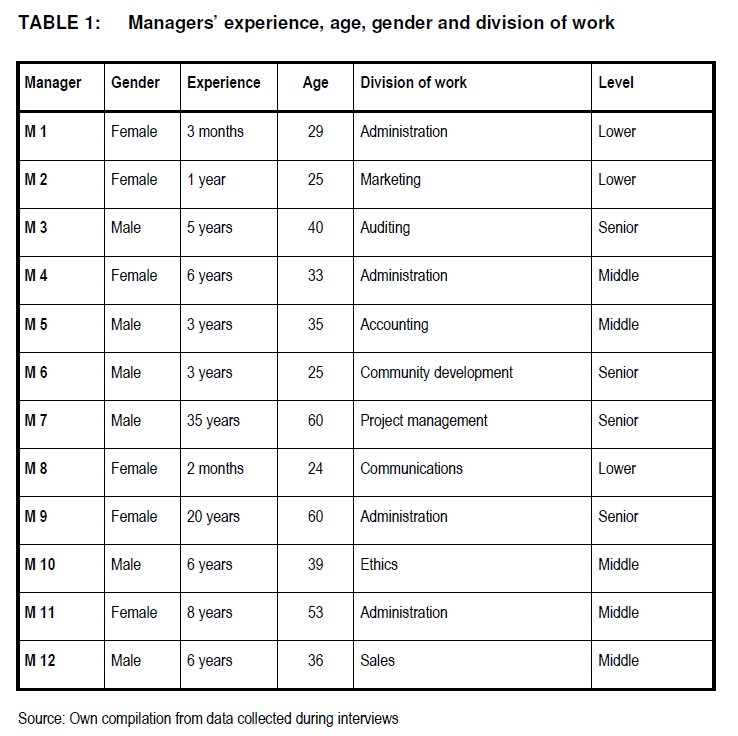
Purposive sampling was used in selecting the sample. Subjects were approached based on the fact that they were managers who took key decisions within their respective companies and with the assumption that they, at some point, had experienced some form of data and/or information overload. Twelve managers were interviewed in this study. Organisation sizes ranged from small (less than 20 employees) to large firms. The subject demographics are shown in table 1.
Twenty potential participants were identified but twelve were chosen based on the fact that data saturation occurs generally before twelve interviews (Guest, Bunce & Johnson 2006:74). Saturation had indeed occurred by twelve interviews, in that, much of the data became repetitive and there were clear patterns emerging.
3.1.1 Interviews
The phenomena investigated by the researchers involved the subjects' perceptions, in terms of thinking, and experiences. Some research questions were specific as they aimed to find out whether managers were familiar with certain concepts, which included "data and information", while other questions were open ended as the study was aimed at understanding the experiences of managers and the strategies they employed.
The interviews were planned for 30 minutes but most took much longer. Subjects voluntarily participated in the extended interviews despite some managers indicating that they were working to a schedule (interviews were conducted during normal working hours). Subjects were reassured of total anonymity and that the results would be used for research purposes only.
Each subject was asked the same series of interview questions. Subjects appeared to be at ease when answering the questions; it is believed that positive interview conditions led to unbiased sharing and meaningful conclusions drawn from the discussions of the managers' perceptions and experience.
3.1.2 Subject demographics
Table 1 illustrates demographics.
3.2 Data analysis
The interviews were recorded and later transcribed by the researchers. Additionally, field notes were taken during each interview and proved helpful during the data analysis phase.
The data analysis method that was used for this study was content analysis. Content analysis measures the semantic content or the "what?" aspect of a message. Its breadth makes it a flexible and wide-ranging tool that can be used as a stand-alone methodology or as a problem-specific technique (Cooper & Schindler 2008:423).
3.2.1 Data analysis techniques
To comply with the pursuit of rigor, the first three steps identified by Taylor-Powell and Renner (2003:2) for content analysis were followed, namely: getting to know the data, focus on the analysis, categorising the information into themes.
During the initial phase of analysis, the data collected from the interviews was categorized according to the literature, namely: data overload, information overload and decision making. The data was then analysed in Atlas ti, a qualitative data analysis tool, through thematic coding.
3.2.2 Codes and themes
The interview transcripts were coded line by line in order to create and generate themes for the study (Saldana 2009:3). Using the interview transcripts we followed a process whereby we analysed the data and from there we found that common concepts were present in the data; these can be called codes. Topic coding was utilized for the analysis of the data, which is described by Richards (2005:88) as labelling text according to its subject.
The codes were then linked to "families", which refers to themes or categories. A theme is a phrase or sentence that identifies what a unit of data is about and/or what it means (Saldana 2009:139).
Twenty codes were generated from the interview transcripts containing the outputs for the coding exercise. These codes were then grouped into five themes. Figure 1 presents the codes and eventual themes.
3.2.3 Trustworthiness
A number of actions were taken to ensure the trustworthiness of the research. First, the research commenced with an interview protocol, which refers the interview schedule with the pre-developed questions, which provided adequate coverage of the investigative question guiding the study (Cooper & Schindler 2008:291).
A pilot study, which included two interviewees, who were chosen based on the fact that they were managers with decision making powers within their organisations, was conducted.
The trustworthiness of the protocol was tested during the pilot study. The subjects were asked questions in a probing manner in order to address the research questions. The subjects were also asked whether they had experienced any difficulty in answering any of the questions. The result of the pilot indicated that, while the data collection technique was adequate, there were several questions, which were re-worded or re-phrased to enable a better understanding of the concepts and to avoid any ambiguity.
In terms of testing for validity and reliability, the transcripts were given to a third colleague to read and there was consensus regarding the code and theme development. The same researchers who conducted the interviews also transcribed them; this reduced the possibility of transcription error.
4. FINDINGS
The findings are reported per theme as shown in Figure 1.
The themes are as follows: manager's perceptions, emotions and overload, decision-making influence, email burden and pursued strategies. Each is expanded upon in the next section.
4.1 Managers' perceptions
The concepts data and information, as well as data overload and information overload, were initially confusing for managers as they assumed both meant "information overload". The concepts were explained to the managers at the beginning of the interview so as to create clarity on what the study was about. Managers could therefore, based on the given explanation, distinguish between data and information, as well as the overload thereof
All twelve the managers confirmed to having experienced some level of overload in their work. One subject stated that she experienced data overload on a daily basis while the rest of the subjects indicated that they had periodic episodes of data overload and that it was centred on their respective job schedules. The main cause of data overload seems to stem from "irrelevant data" that is sent to the managers or that managers receive whether internally within the organisation or externally.
Another subject explained that she did not think she experienced data overload but rather information overload: "Information overload is a different story for me, I do not experience data overload". ''Data does not confuse me and it does not overwhelm me. Information is demanding you need to be conscious when you read it and make sure that you understand the information; whereas data is something else, you have not interpreted it yet," said another subject.
The subjects were asked to rate their data and information overload, individually, on a 5-point Likert scale where five was serious overload. Five of the subjects had an equal distribution of data and information overload experienced. Four of the subjects reported that they experienced more data overload than information overload and three of the subjects reported that they experienced more information overload than data overload. Managers on the lower level seemed to experience more of an overload than those on a more senior level.
Based on their responses, it appears that the subjects suffered more from data overload than from information overload, although there is only a marginal difference. Based on these responses, it is clear that overload is generally experienced by managers before they interpret the data given or sent to them and is reduced upon interpreting it. It is through the interpretation that managers are able to eliminate the "non-useful" information and make use of that which is useful in order to make decisions.
4.2 Emotions and overload
This study showed that managers generally react negatively to data and information overload. When asked how they felt when they experienced data and information overload, the majority of those interviewed said they felt exhausted, overwhelmed, frustrated, uncomfortable, pressurized and stressed out as a result of data overload, information overload or the combination thereof.
Some quotes from managers that illustrate this initial negativity included:
"It made me feel uncomfortable. "Exhausted. I felt tired just thinking about reading through all that information." "When you have information overload you are overwhelmed, you have difficulty focussing, and it's hindering, it prolongs the process" "Frustrated, because you need to sort through all this data before you make a decision." "Really frustrated and I felt as though I was really put under pressure."
4.3 Influence on decision making
The effect of data and information overload on decision making was explored quite extensively in this study. The concept of decision making appeared in many of the responses given by the managers. One subject mentions that when experiencing data or information overload one tends to feel as though you might miss something important and thus be unable to make an informed decision. All the companies and organisations that the managers worked in employed "generic" decision-making processes. Many of them embrace a hierarchical decision-making style where someone has to give approval before key decisions can be taken. Eight of the subjects admitted that they, themselves, could make many decisions independently without the need to consult or seek approval as they held such senior positions.
The managers felt that the core data and information required for decision making was subject to various factors, which included: determining critical elements or outputs required; the specific decision being made; the mandate, the achievement goals and the current projects; identifying the most relevant data which would be figures relating to output (with relevance being related to impact on one's environment), and finally reliance on professional experience to determine what the core data is.
When asked whether they had ever had to make a decision in the face of data or information overload, ten of the managers confirmed that they had and it became clear from their responses that the overload caused a negative emotional response. Eleven of the managers said that data and information overload did affect their decision making. Ten of the managers mentioned that owing to data and information overload they felt as if they were put under pressure to make decisions. One subject mentioned that: "When you are required to make a decision and you are faced with data and information overload, your mind can become fragmented because focus is now split". It is clear that the existence of data and information overload is widely acknowledged and the focus should rather be on how it is or should be addressed.
The majority of the subjects reported that sorting through large amounts of data or information takes a long time and that the sorting process wastes time. One subject stated that information overload is hindering as it prolongs the process of decision making. One of the subjects summarized how data and information overload influences time:
"An overload of data or information means that time is wasted on making sense of data then understanding the gathered information before one can make a decision, meaning that there might be a delay in decision making!'.
In paradoxical statements, however, managers revealed less information would not necessarily simplify decision making. Instead, they reported that information overload induced quicker thinking, adrenaline-fuelled decisions, and sharper decision making capabilities. Most of the managers reported that they often needed more information in order to make informed decisions and that less information was not necessarily better, particularly with regard to decision making. This indicates that a great influx of data and information is not always overload and that the importance of data or information is directly linked to the relevance derived by the managers.
4.4 Email as a source of both data and information overload
A key method of communication that is used by the managers is email. All twelve of the managers identified email as their most prominent communication tool. While this is true, the preferred method of communication in most cases was verbal communication, particularly when dealing with colleagues within the organisation.
During the interviews it was noticed that the subjects kept referring to email when addressing the issue of data and information overload, which indicated that emails could very well be one of the main sources of data and information overload in business.
One of the subjects explained that in his organisation people have the habit of sending out email to protect themselves, so the information is not in actual fact sent for work purposes but as a security measure. Some of the managers expressed their dislike of the "reply to all" function as it creates unnecessary data for them.
The managers all indicated that they use email on a daily basis and the use thereof is not limited to a time frame. In fact, one subject said that: "in my organisation we make use of emails even during meetings". When asked about the number of emails received by each manager on a daily basis, the number that was in excess of sixty (60) emails per day.
4.5 Strategies pursued to address data overload and information overload
This study set out to find strategies for the management of data and information overload, as well as for effective decision making. A good strategy is defined as a highly focused, problem-solving activity (Rumelt 2011:1).
The study identified two categories, namely, management of overload strategies and decision-making strategies. In terms of management of data and information overload, practices applied by subjects included:
■ Screening and filtering: managers employ screening and filtering when it comes to disposing of and eliminating irrelevant data and information. Managers screen by considering the individual from whom the data or information originates (source), the subject topic of the information suggesting they consider what the information relates to, to whom it relates and the impact of the information on the managers themselves, the staff members and the organisation.
One subject stated that the advantage of being a manager was having someone at hand to filter the incoming information before you have to work with it but that it did not mean that the data or information would always be particularly relevant.
Managers also indicated that they screen data and information based on urgency, so they look at factors such as: how soon the work needs to be done, how soon the message relayed warrants a response, and so on.
■Organising, sorting and prioritizing: the first step in dealing with data or information overload is very basic. Organize the data accordingly, based on aspects such as: subject matter, who the data comes from (sender) as well as by order of priority. Once that has been done, one will be able to make sense of the data and thus have information at hand. The information can then be, further, sorted according to preferred categories and, finally, prioritized according to tasks.
Managers structure the information they receive in ways that enable them to easily access and understand it and they also ensure that they structure it in ways that are most useful to them. The way in which the data is organised and sorted depends on how the managers normally organise data and information; it could be by way of manual or electronic means, or through a system of delegation. The prioritization of the information once again goes back to the factors mentioned before and these are the urgency and the importance placed on the data or information at hand.
■Consulting: managers utilize the appropriate human resources to the maximum in order to deal effectively with incoming data and information as this not only aids in the organisation of data and information, but often drastically reduces the amount of overload experienced by managers.
■Effective management of time: a strategy that was identified in both the management of overload, as well as in decision making was "effective management of time." It is important that a set time frame be allocated for the accomplishment of various tasks. Managers find that by using a time management schedule, they are able to work more effectively. Time management is without doubt a critical part of management as it not only, assists with the organisation of work but also reduces delays in the decisionmaking process. Responsiveness in management is key, because it eliminates delays in decision making and reduces potential overload that might be caused by follow-up queries.
Other practice strategies applied by subjects in terms of decision making included: The use of core data as guide in decision making: when making a decision, managers often focus on aspects that they feel are the most relevant as this diminishes distractions and aids in effective and unobstructed decision making.
■Assuming vigilance: while it is true that managers need to take cognisance of the rules and regulations that govern a situation and ultimately the decision, it is imperative that managers consider all factors that could contribute to the outcome of the decision and the potential impact of the decision.
Therefore, while it is important not to delay the decision making process unnecessarily, it is also equally important that managers do not act hastily when making important decisions within the organisation.
5. MANAGERIAL CONTRIBUTION AND DISCUSSIONS
This study aimed to assist managers, particularly, but not exclusively, those who take key decisions within their respective organisations, with strategies that may enable them to handle and deal with data and information overload. This may, in turn, assist them with their decision making in the face of data and information overload.
Several methods to dealing with data and information overload were identified in the study. Emails were found to be one of the leading causes of data and information overload. The influx of emails results in relevant and irrelevant information (Soucek & Moser 2010:1459). It is important that email overload not be confused with data and information overload. While it stands alone as overload, it should be understood that email overload contributes to overall data and information overload.
In correlation with our findings Hemp (2009:5-6), suggested strategies when dealing with overload caused by emails. These actions could be beneficial to the study as they address one of the main causes of overload as identified by the subjects. The selected strategies are discussed and linked to our findings.
Some of the strategies suggested are, firstly, avoid distractions by turning off email notifications and instead, allocate a specific time of the day to work on emails.
Secondly, avoid putting emails into folders as this could lead to overload in the event that those emails are left unattended. These two suggested actions by Hemp link directly with the "effective time management" strategy of our findings.
The third suggestion, which links directly with the "assumption of vigilance" strategy from our findings, is that managers should, where possible, acknowledge receipt of emails even if they only intend to respond later. This suggestion implies that the acknowledgement will reduce potential overload from repeat queries.
Managers also employ several specific "strategies" to enhance decision making. These are: deliberate time management, searching for core data to aid decision making and the assumption of constant vigilance. The strategies identified in the study can be associated with those identified in previous studies such as Edmunds and Morris (2000:23-26), which included: maintaining currency, personal information management, push technologies and the use of intelligent agents.
The effective use of core data to aid decision making is not dissimilar to maintaining currency and personal information management, as all the above strategies involve using some of the data and filtering the rest in order firstly limit overload and secondly, to aid in decision making.
The same goes for the strategy identified by Savolainen (2007:617), which is the filtering strategy that involves the selection of some data and information in order to reduce overload.
However, the withdrawal strategy, also identified by Savolainen (2007:618), is not similar to any of the proposed strategies in this study. Its focus is on directing one's attention away from certain information sources; none of the managers mentioned the utilization of this strategy, instead, they indicated that sometimes more information is preferable when making a decision.
6, LIMITATIONS AND FURTHER RESEARCH
While there has been extensive research done on information overload, less has been done on data overload, particularly in a non-Information Technology environment. Furthermore, much of the research done was quantitative in nature and thus did not focus on the "human impact" factor of data overload, that is, the majority of the studies on data and information overload did not employ a phenomenological assessment. The results of this study could serve as a guideline rather than as absolute criteria owing to the "social desirability" error present in the study.
One of the challenges during the interviews was getting participants to understand the ITTD technique. Initially they were unwilling to entertain the idea of someone else in their jobs (even though this was hypothetical). Time had to be spent making sure participants were comfortable with the research approach before proceeding with the interviews.
Future research could re-visit the ITTD method of data collection by taking into consideration the best way to explain the method to participants. The data and information overload of lower-level employees should also be considered for future research as there are indications that would suggest that the main overload, whether through data or information, may already be filtered by the time it reaches managers, thus bringing to mind the question "who really suffers from overload in the workplace?"
The ultimate research focus should be that the identified strategies can be used in an organisation to aid handling data and information overload so as not only to benefit productivity but also to influence effective decision making.
7. CONCLUSION
The purpose of this study was to gain a deeper understanding of how managers cope with data and information overload and to make sense of how data and information influence the decision making of managers.
From the analysis it was possible to confirm that data and information overload are ever-present problems in companies and organisations. The data suggests that managers across all levels experience data and information overload. It is also important to note that, while the majority of the managers in the study reported that their decision making was not directly affected by data and information overload, they did acknowledge that overload does affect them. The study identified strategies with which managers respond to data and information overload.
A direct link exists between overload (data and information) and time. Due to the time taken to deal with overload, a delay in the decision making process could result which could have potentially negative consequences.
It was also found that data and information overload has the ability to bring about negative emotional responses which could also have an effect on decision making. The findings indicate that managers have strategies that they use to deal with data and information overload.
REFERENCES
- ALJUKHADAR M, SENECAL S & DAOUST C. 2012. Using recommendation agents to cope with information overload. International Journal of Electronic Commerce 17(2)41-70.
- ANDERSON SP & PALMA Α. 2012. Competition for attention in information (overload) age. Rand Journal of Economics. 43(1) 1-25.
- BAKER M. 2010. Next generation sequencing: adjusting to data overload. Nature Methods 7(7):495-499.
- BAWDEN D, HOLTHAM C & COURTNEY N. 1999. Perspectives on information overload. Aslib Proceedings 51(8):249-255.
- BAWDEN D & ROBINSON L. 2008. The dark side of information: overload anxiety and other paradoxes and pathologies. Journal of Information Science 35(2):180-191.
- BEAUDOIN CE. 2008. Explaining the relationship between internet use and interpersonal trust: taking into account motivation and information overload. Journal of Computer-Mediated Communication 13(3):550-568.
- BETTIS-OUTLAND Η. 2012. Decision-making's impact on organisational learning and information overload. Journal of Business Research 65(6):814-820.
- BOLLOJU N, KHALIFA Μ & TURBAN E. 2002. Integrating knowledge management into enterprise environments for the next generation decision support. Decision Support Systems 33:163-196.
-
BUCHANAN J & KOCK Ν. 2001. Information overload: a decision making perspective, international Conference on Multiple Criteria Decision Making (MCDM) Ankara, Turkey. [Internet: www.merlin.mngt.waikato.ac.nz/department; downloaded on 2012-05-10.
» www.merlin.mngt.waikato.ac.nz/department - ]
-
CARLEVALE AE. 2010. Exploring the influence of information overload on middle management decision-making in organizations. (Dissertation: PhD in Management in Computer Information Systems. Arizona, University of Phoenix. [Internet: http://pqdtopen.proquest.com/pubnum/3437432.html; downloaded on 2012-05-10.
» http://pqdtopen.proquest.com/pubnum/3437432.html - ]
- COOPER DR & SCHINDLER PS. 2008. Business research methods. 10lh ed. New York, NY: McGraw-Hill.
- EDMUNDS A & MORRIS A. 2000. The problem of information overload on business organisations: a review of literature. International Journal of Information Management (20):17-28.
- EPPLER MJ & MENGIS J. 2004. The concepts of information overload: a review of literature from organisation science, accounting, marketing, MIS and related disciplines. The Information Society 20:325-344.
- FARHOOMAND AF & DRURRY DH. 2002. Managerial information overload. Communications of the ACM 45(10):127-131.
- FRISHAMMAR J. 2003. Information use in strategic decision making. Management Decision 41(4):318-326.
- GOMEZ-RODRIGUEZ M, GUMMADI KP & SCHÖLKOPF Β. 2014. Quantifying information overload in social media and its impact on social contagions. [Internet: arXiv preprint arXiv: 1403.6838; downloaded on 2016-09-10.
- ]
- GUEST G, BUNCE A & JOHNSON L. 2006. How many interviews are enough: an experiment with data saturation and variability. Field Methods 18(1):59-82.
-
HEMP P. 2009. Death by information overload. Harvard Business Review. [Internet: http://www.ocvets4pets.com/archive17/Death_by_lnformation_Overload_-_HBR.org.pdf; downloaded on 2015-07-15.
» http://www.ocvets4pets.com/archive17/Death_by_lnformation_Overload_-_HBR.org.pdf -
]
» www.uwex.edu/ces/pdande/evaluation/evaldocs - HWANG Ml & LIN JW. 1999. Information dimension, information overload and decision quality. Journal of Information Science 25(3):213-218.
- JONES Q, RA VID G & RAFAELI S. 2004. Information overload and the message dynamics of online interaction spaces: a theoretical model and empirical exploration. Information Systems Research 15(2):194-210.
- KHANNA P, JONES CD & BOIVIE S. 2013. Director human capital: information processing demands, and board effectiveness. Journal of Management 40(2):557-585.
- KLAUSEGGER C, SINKOVICS R & ZOU H. 2007. Information overload: a cross-national investigation of influence factors and effects. Marketing Intelligence and Planning 25(7):691-718.
- MALHOTRA NK, JAIN AK & LAGAKOS SW, 1982. The information overload controversy: an alternative viewpoint. Journal of Marketing 46:27-37.
-
MCAFEE A. & BRYNJOLFSSON E. 2012. Big data. Harvard Business Review [Internet: http://www.rosebt.com/uploads/8/1/8/1/8181762/big_data_the_management_revolution.pdf; downloaded on 2014-05-14.
» http://www.rosebt.com/uploads/8/1/8/1/8181762/big_data_the_management_revolution.pdf - ]
- NICOLINI D. 2009. Articulating practice through the interview to the double. Management Learning 40(2):195-212.
- RICHARDS L. 2005, Handling qualitative data: a practical guide, London, UK: Sage,
-
RUMELT R. 2011. The perils of a bad strategy. Strategic thinking. [Internet http://www.mckinsey.com/business-functions/strategy-and-corporate-finance/our-insights/the-pehls-of-bad-strategy; downloaded on 2012-02-02.
» http://www.mckinsey.com/business-functions/strategy-and-corporate-finance/our-insights/the-pehls-of-bad-strategy - ]
- SALDANA J. 2009, The coding manual for qualitative researchers, London, UK: Sage,
- SAVOLAINEN R, 2007, Filtering and withdrawing: strategies for coping with information overload in everyday contexts, Journal of Information Science 33(5):611-621.
- SIMPERL E, THURLOW I, WARREN P, DENGLER F, DAV1ES J, GROBELNIK M, MLADENIC D, GÓMEZ-PÉREZ J & MORENO C. 2010, Overcoming information overload in the enterprise, the active approach, IEEE Computer Society. 39-46,
- SOUCEK R & MOSER Κ. 2010, Coping with information overload in email communication: evaluation of a training intervention, Computers in Human Behaviour 26:1458-1466.
- SPEIER C, VALACICH, JS & VESSEY I.1999. The influence of task interruption on individual decision making: an information overload perspective. Decision Sciences 30(2):337-360.
- TARAFDAR M, GUPTA A & TUREL O.2013, The dark side of information technology use, Information Systems Journal 23(1 ):269-275,
- TAYLOR RN. 1975, Age and experience as determinants of managerial information processing and decision making performance, Academy of Management Journal 18(1):74-81,
- ]
- VEEL K. 2011, Information overload and database aesthetics. Comparative Critical Studies 8.2-3:307-319.
- WALGRAVE S & DEJAEGHERE Y. 2016. Surviving information overload: how elite politicians select information. An International Journal of Policy, Administration and Institutions, 00:1-16.
- WOODS DD, PATTERSON ES & ROTH EM. 2002 Can we ever escape from data overload? A cognitive systems diagnosis, Cognition, Technology & Work (4):22-36.
- YANG J, LIM SY, PARK HJ & PARK NH. 2013, Solving the data overload, IEEE vehicular technology magazine 8(1):31-39,
- YOUNG DL, GOODIE AS, HALL DB & WU E. 2012. Decision making under time pressure, modeled in a prospect theory framework. Journal of Organizational Behaviour and Human Processes 118:179-188.
- ZOU Y & WEBSTER J. 2014. Information overload in using content management systems: causes and consequences. In PACIS:235-243.