Factors affecting South African Small and Medium Enterprises risk identification and management
Abstract
It is indicated that 75% of small businesses fail within the first five (5) years of business operations. Small businesses can be blindsided by risks that management has failed to account for. However, risk management has the capacity to reduce business failure rates by relating good management practices across a business to risk events and aiding in the production of a consolidated response from the entire business. Still, small businesses are often hesitant in voluntarily complying with risk standards. Small businesses often fail to employ risk management because of the opportunity cost thereof in business or operational terms. Considering this, the aim of this article was to identify the factors affecting South African Small and Medium Enterprises (SME's) risk identification and management practices. In order to determine what relationship small businesses have with risk management the small businesses were surveyed in the Sedibeng District Municipal Area (SDMA). The survey determined which risks they could identify and how closely their actions to address those risks matched theoretical best practice. A quantitative approach was used and a structured questionnaire was employed to extract the required information. Exploratory factor analysis (EFA), reliability and descriptive analysis were the quantitative methods used to extract the knowledge presented. What was found is that small business owners were risk adverse and had limited awareness of the risks their businesses were exposed to. Experience drove both risk awareness and risk response in their businesses. Small businesses focus on business risk and operational risk but are not cognisant of many of the other risk types. Risk management was consequently lacking, and amounted to limited crisis management, and the processes that embody small business risk management factored into the three (3) steps of risk identification, risk treatment, and the revision of feedback from employees. The implication of the findings is that small businesses are especially vulnerable to risk events and require a means through which to address risk exposures in a way that is tailored to their limitations. JEL CLASSIFICATION: A12, G3, G32, D8, I25
Small businesses; risk; risk intervention; risk management; risk standard; quantitative
1. INTRODUCTION
Risk, as per definition, is embodied in the reduction of business asset value or forfeited business opportunities and originates from shortfalls in internal activities of the business or from events in the external business environment (Aven & Renn 2009:7; Baloch, Saeed, Ahmed, Oláh, Popp & Máté 2009; Marx & de Swardt 2013:35). Risk is present when frequency, exposure, probability, or the ultimate outcome of risk is unknown (International Organization for Standardization (ISO) 2009:15; Kaplan & Garrick 1981:13-17; Knief 1991:55). The concepts of the probability of a risk event and the exposure generated by a risk event are traditionally used in determining the needed response to risks. However, risks realised without enough preparation, can result in immediate business cessation.
All business, however, comes with risk as there is an initial investment of time, capital, or both from which profits are expected to arise through entrepreneurial activities. One may state that without risk, there would be no motivation to conduct business (Shpak, Sorochak, Hvozd & Sroka 2018). Risks are primarily identified in practical relation to the business and are contextually bound to the source, nature, or archetype relating to the specific outcomes of a risk event or situation (Marx & de Swardt 2013:30; Valsamakis, Dutoit & Vivian 2013:33). Risk can be classified by its outcome or by its origin. Risks can be classified broadly by their origins as pure risks, control risks, or opportunity risks (Hopkin 2018:46). Pure risk is defined as a risk that can only have a negative outcome with no possibility of acquiring economic or strategic benefits (Hopkin 2018:47). A control risk is a risk with uncertainty in regard to the source from which the risk arises or from the uncertainty of the effect of the focus (Borghesi & Audenzi 2013:19-27; ISO 2009:1-3). Pure and control risks, once identified, have the capacity to be insured against if an insurer offers cover for the identified risk (Kahane & Kroll 1985:191-199; Oláh Virglerova, Popp, Kliestikova & Kovács 2019a; Oláh, Kovács, Virglerova, Lakner, Kovacova & Popp 2019b; Valsamakis et al. 2013:34).
Opportunity risks, also known as speculative risks, are risks taken as part and parcel of the business process (Borghesi & Audenzi 2013:3-8). Opportunity risks are the main focus for the business function of organisations (Hopkin 2018:47). Opportunity risks differ from pure and control risks in that they are entered under the expectation of an economic reward and are usually uninsurable (Hopkin 2018:48). Arranging risk by outcome helps in determining if an investment is worth entering, however, risk management can be challenging from this perspective, as it does not address the particulars of the risks faced. To address this concern, risks can be analysed by their origin and their outcomes.
By dismantling risk into individually identifiable themes, each risk can be approached in a manner that allows for management of these risks. The risk can come about from within the business and its day-to-day operations or from events and situations that arise from the external business environment, within which it exists. Theory suggests that risk can broadly be classified grouped into one (1) of two (2) categories that are either internal or external, particular or fundamental, unsystematic or systematic (Foucault 1991:197-210). Broadly, risk can be split into one (1) of two (2) categories, the first being characterised by what is outside of the direct control of the business, internal risks (Type 1 risks) and the second being those risks that are within the direct control of the business, external risks (Type 2 risks). Kruger (2020) presents a comprehensive typography of risk that places risk in this context and defines them with a plurality of references.
If a business takes on risks that they can handle they will survive, however, small businesses must, at times, take on excess risk to remain afloat. In many cases they do not fully identify the risks to which they are vulnerable, and underestimate potential losses (Hopkin 2018:32). As opposed to large businesses, small businesses have trivial capacity to take on risks due to their low bargaining power and small financial reserves, which in turn make them more vulnerable to risk events in the external environment (Small Enterprise Development Agency (SEDA) 2016:14). Additionally, small businesses have internal managerial and man power limitations that limit risk management efficacy (Bruwer, Coetzee & Meiring 2017:9).
The main cited causes for small business failure are managerial shortfalls, poor cash flow controls, a lack of experience, the lack of strategic planning, inappropriately managed growth, poor stock control, wrong working attitudes, lax credit granting, capital shortage and inappropriate geographical location (Cannon & Edmondson 2005:311; Henderson 1999:310; Lussier 1996:79; Meyer & Synodinos 2019:11; Probst & Raisch 2005:98). Furthermore, the most common risks that small businesses experience day to day are employee risk, business risk, managerial risk, reputational risk, operational risk, moral risk, legal risk and risk to the personal wellbeing of the small business owner (Kruger 2017:116). These aspects add to the challenges of the business environment, which has become an increasingly competitive domain and resulted in the growth of companies capable of adapting and the decline of those too small or unwilling to evolve (Diedericks 2015:26). To control risks requires the development of plans and strategies that minimise the chances of small business failure through a systematic process. Risk management serves as a comprehensive starting point in this process as it addresses the vulnerabilities of the business on multiple levels and brings it together in a meaningful intervention.
A risk framework is a grouping of processes by which risks are identified in context to the business; a strategy developed to address those risks and a mechanism is derived to review risk (Hopkin 2018:262). Although similar to the risk management process, it must be differentiated. A risk framework must abide by the tri-part concept of risk architecture (RA), risk strategy (RS) and risk protocols (RP) within the larger tri-part environment of the external, internal and risk management (RM) context (Raz & Hillson 2005:54). Risk Architecture defines roles, responsibilities, communication and risk structure (Hopkin 2018:78). Risk strategy measures risk policy, risk attitudes, risk appetite and the risk philosophy of the business (Hopkin 2018:78), with RP coalescing into a unified expression of rules and procedures, risk management methodologies and the tools and techniques that should be used (Hopkin 2018:78).
The development of individual risk frameworks requires an understanding of the role of the business as it relates to their internal and external environment. The internal environment of a business is the composite sum of affairs within the power of the business to control such as its operations and business activities and thereby meet the requirements of the stakeholders within the business (Badenhorst, Cant, Du Toit, Erasmus, Grobler, Kruger, Machando, Marx, Strydom & Mpofu 2013:333). The internal business framework governs which activities need to be performed to maintain profitability within the business. The risk portion of that framework is governed by the business's RA, RS and RP (Badenhorst et al. 2013:334).
The external environment is beyond the immediate control of a business and consists of the physical, political, economic and social environment within which the business is situated (Andersen 2006:84). The dynamics and turbulence of a business environment greatly complicate the decision-making processes in modern businesses (Melnyk, Sroka, Adamiv & Shpak 2017). Therefore, the risk management policy serves as the main driver of risk management throughout the business and the conceptual scaffolding around which RA, RS and RP are built (Hopkin 2018:80; Pearson 2015). These three (3) factors cumulatively contribute to and support the risk management process by contextualising risk, clarifying the business context to its the internal and external environment and defining risk management practices in the business (Chapman 2011:86).
Risk frameworks also come together in risk standards but the terms are not synonymous in practice (Chapman & Ward 2003:114). A risk framework forms part of a risk standard in that it is used to develop a holistic approach to risk (ISO 2018:1-5). However, risk standards go beyond risk frameworks to include processes and practices developed for specific industries and scenarios according to their technical and industry specifications (ISO 2018:1-5). To be effective, the, administration and continuous development of a risk framework into the culture and managerial capacities of a business, the creation and application of which is unique and practically suitable for an individual business.
Cost-effective risk management is thus an essential component of survival and competitiveness as it creates awareness of business threats and opportunities through consistent observation and feedback (Diedericks 2015:17-32; O'Gorman 2001:69; Watson 2009:96). However, the creation and application of a risk management system is time-consuming and resource-intensive, which if not handled correctly, can result in costs that outweigh the benefits derived therefrom (Harvey 2008:9; KMG Capital Markets 2013:1). To either construct a risk management system or to implement one through a highly skilled risk manager is expensive and time-consuming (Gwangwava, Manuere, Kudakwashe, Tough & Rangarirai 2014:8). To overcome this limitation a general small business risk intervention tool can be developed to begin the process of risk management. In light of this, the aim of this article was to identify the factors affecting South African SME's risk identification and management.
The smaller the business, the less likely it is to be informed of adequate risk management standards or the manner in which to successfully implement a risk management framework (Weissinger 2013:20). However, risk management must maintain certain characteristics to be considered completely defined. Risk management must be continuous, forward looking, iterative, systematic and a process in which the responsibility is shared (Valsamakis et al. 2013:12-14). Risk management must relate all internal and external events, economic climates, economic activities and actions taken throughout a business as coordinated parts of a whole (Valsamakis et al. 2013:12-14). Risk management must then also guide the process of responding to those events in a manner that matches the goals and capacity of the business to which it relates (Valsamakis et al. 2013:12-14).
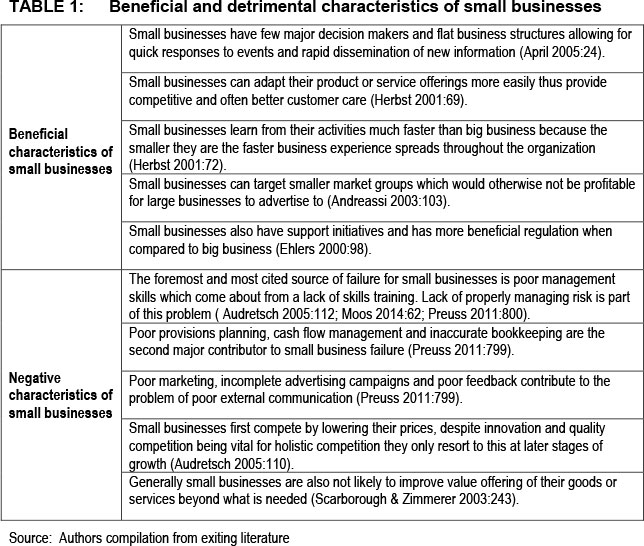
These are challenging requirements; however, they are not insurmountable if the process is guided and managed correctly. The first step in this process is to define small businesses and understand the context under which small businesses operate and what they need to survive. The defining characteristics of a small business differ between countries quantitatively and qualitatively. What are consistently observed throughout the comparison of national definitions are the themes of business turnover and the number of employees, which are defined by quantitatively measurable metrics (April 2005:124; International Leadership Development Programme 2014:15; Scarborough & Zimmerer 2002:45). Moreover small business management teams are limited to a single person or a very small number of owner partners that actively participate in business activities (Van Aardt & Bezuidenhout 2014:22). Small business employees tend to be generalists that perform multiple activities instead of being highly specialised; as a result, organisational structures are informal and flat (April 2005:98). The beneficial and negative characteristics of small businesses determine their capabilities and are shown in Table 1.
When analysing theory, the risk management process can be broken up into six (6) individual steps. These steps in order are: (1) identifying risks, (2) designing risk management systems, (3) continually monitoring risk, (4) identifying highly volatile risks, (5) taking actions and then (6) adjusting the system based on experience and revision (Beck 2006:333; Chicken 1996:105; Hopkin 2018:188; Institute of Risk Management (IRM) 2002:4; Valsamakis et al. 2013). However, for a small business these comprehensive steps and processes might not always be possible. As such, a simplistic approach would encompass two (2) of the most important steps as identified. These are the identification and management of risk.
Risk identification is the first step in the risk management process and is executed by searching for loss and gain scenarios relevant to the business context (Aven & Zio 2014:1649-1656). Risk audits across the business define risks pertinent to the business, the scope and possible losses (Borghesi & Audenzi 2013:134). Before risk can be managed or measured, it must be perceived and before appropriate action can be taken, the risk characteristics of a business must be known Chicken 1996:396; (Marx & de Swardt 2013:350). Identification of risk requires a thorough understanding of all activities undertaken by the business entity and includes concerns such as technical standards and legal limitations (Aven & Zio 2014:1647; Chicken 1996:318). The identification process begins by first determining, which political factors, technical indicators, performance standards, or opportunities for co-operation are relevant to the business (Aven & Zio 2014:1648; Borghesi & Audenzi 2013:72). Risks that are pertinent to the business are described in this step, providing further details of the risks and framing them in context of the business (IRM 2002:5).
Following the identification of risks decisions on how to manage them can be made. Complete risk assessment allows for appropriate treatment or management. Risk treatment or management is the decision on how risk is avoided, reduced, transferred or retained (Marx & de Swardt 2013:228). Treating risk is the process by which all participants of a business address risk in relation to their function in the business and how aware of and trained they are to address the risks that they are likely to encounter (Burns 2010:391). The degree to which a business is capable of treating or managing risks, which are relevant to it, is dependent on its size, the influence that it has accrued, the political sway it has and its financial strength relative to the risk it faces (Hopkin 2018:376). A larger business can mobilise more resources inside the business itself and its community and account for a larger proportion of employment within a country. Thus, it can influence its local environment and holds political sway. However, smaller businesses may face numerous challenges in the proper management of risks. In light of the aforementioned, this article explores factors affecting South African SME's risk identification and management.
2. METHODOLOGY
The radical structuralist or positivist paradigm was selected as the overarching research paradigm for this study as it most accurately addresses the considerations needed to be maintained in the development of a risk management intervention tool. A descriptive singlesample cross-sectional design approach was followed. This involved the use of a structured questionnaire to collect data from a sample only once. The research instrument was constructed through the review of literature and the predominant risk management standards at the time. It was presented for review by risk management specialists and was subsequently piloted with a random selection of SMEs within who did not form part of the final study's sample. The study applied a quantitative approach and used primary data collected using structured questionnaires, which were processed through predefined statistical analysis. The target population for this study consisted of small businesses operating within the Sedibeng District Municipal Area (SDMA) which contains a high aggregation of small businesses (Meyer 2009:18; Republic of South Africa 1996:15;). Emfuleni was a municipal area of particular interest taking their large fiscal deficits and inability to render basic sewage, electricity, and water supply needs. Several factors already strain and challenge the enabling environment of SMEs and their growth potential. These factors include amongst others crime, strict legislation in favour of the worker, violent and destructive union action through strikes, Eskom's nation-wide failure for providing reliable electricity, ageing and insufficient infrastructure which negatively impacts on business growth. A sample that is challenged so thoroughly was theorised to have a higher chance of demonstrating a robust understanding of the value and process of risk management and would serve as a valuable comparison to Lesedi and Midvaal. First, a purposive sampling technique was utilised as it focuses on characteristics of a population based on the objective of the study, particularly formal small businesses employing less than 50 employees (Thompson 2012:238). Secondly, a convenience sampling technique was employed based on the participant selection criteria as described in the sample description. The combination of purposive and convenience sampling was used due to the nature of the sample and that no complete list of business names in the area was available. The sample was obtained through trained fieldworkers who administered the questionnaires in the different regions that comprise SDMA and the appointment of an external service provider who specialises in data collection. The sample was proportionally distributed according to economic activity within the municipal area of the Sedibeng District as indicated in brackets (Neethling 2016:93). The SDMA comprises of the local municipalities namely, Lesedi (20% of sample), Midvaal (20% of sample) and Emfuleni (60% of sample).
The questionnaire employed Likert scales with the exception of the demographic section. This type of scale is a psychometric response scale measuring the degree to which a participant agrees or disagrees with a particular research question (Bertram 2008:1). The questionnaire included aspects linking to risk identification and risk management. The risk identification section aimed at identifying how risk is perceived and experienced by small business owners. Questions posed to respondents included aspects such as, "How strongly do you agree or disagree with the following statements, a risk is an event that results in a pure loss, I do not always have enough cash to pay my employees and changes in interest rates have had an effect on my business. Questions were arranged into theoretical factor groupings of individual risk identification and responses provided to respondent ranged from strongly disagree (1) to strongly agree (4). The risk management section aimed at asking business owners to what extent they manage risk and included questions like, "How regularly do you or those in your business do the following, identify which risks may affect the business, report risks by management, monitored risks by business employees. Questions were arranged into theoretical factor groupings of individual risk management processes and responses provided to respondent ranged from never (1) to daily (6). Exploratory factor analysis was applied to see if theoretically verified groupings factored together in practice. A total of 332 questionnaires were gathered. A number greater than 300 is considered good for factor analysis (Byrne 2010:5; Kline 2011:116; Malhotra 2010:724). The data was analysed using the Statistical Package for Social Sciences (SPSS) version 25.
3. RESULTS AND DISCUSSION
From the sample, only 38% of the businesses were older than five (5) years. Approximately 30% of small businesses employed risk management standards and 18% appointed risk management personnel to oversee it. This is interesting since it shows that, despite being underrepresented, risk management is still an important consideration for more experienced small businesses owners. A total of 52% of small business owners in the sample had a diploma or higher-level qualification indicating a higher average level of education, this implies that either small business owners could not find work in the formal economy as employees, or purposely chose to enter into business. However, the number of highly educated individuals would suggest the latter. The most common age for small business owners is 31 to 40 years. The majority (73%) of small businesses are run by the owners as opposed to managers.
The intention of the majority (62%) of small business owners is to grow their businesses while the remainder just desire to maintain their current lifestyle. However, this proves to be difficult as is evidenced by most small businesses having only between one (1) and four (4) employees and showing that employing additional employees becomes disproportionally more difficult. Furthermore, most small businesses operate in services (28.92%), trade (16.57%), or production (10.24%). Entering services and trade is easy since it requires a relatively low amount of capital and skill. More businesses exist as private companies (34.6%) than any other legal form and are primarily home-based (23.8%) or situated on outlying business zoned areas (25.3%) this is likely due to a cost reduction mind-set.
4. EXPLORATORY FACTOR ANALYSIS
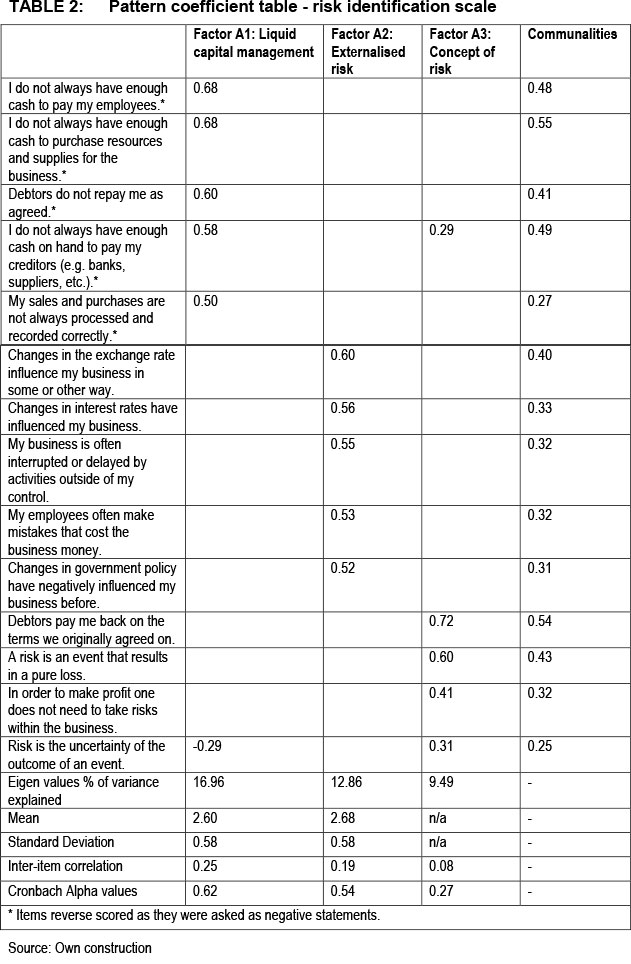
The items from the scales presented (risk identification and management) were analysed using principle component analysis and the rotation method employed was an Oblimin method with Kaiser normalisation. Prior to performing the principle component analysis, the KMO and Bartlett's test of sphericity were analysed to ensure data suitability. This provided a KMO score of 0.64 (A: Risk identification scale), and 0.92 (B: Risk management scale) respectively, which are in line with the required cut-offs. The Bartlett's test of sphericity showed an approximate chi-squared of 464.82 with 91 degrees of freedom (A: Risk identification scale) and 1848.13 with 136 degrees of freedom (B: Risk management scale) and both were shown to be significant where p=0.000 <0.05. Resultantly, factor analysis could be considered appropriate for both scales. Table 2 shows how questions factored together in the pattern matrix coefficient table, the Eigen values of the factors as well as other descriptive data.
Once the suitability of factor analysis had been confirmed, this risk identification scale was shown to have three (3) factors with Eigen values over one and a cumulative variance of 39.302% (Table 2). The Oblimin rotation revealed the presence of the theoretically supported simple substructures in the scale, shown in Table 2. Factor one (1), was subsequently labelled Liquid capital management (A1) and accounted for 16.96% of total variance. Factor two (2) was labelled Externalised risk (A2) and explained 12.86% of variance. Factor three (3), received the label Concept of risk (A3) and explained 9.49% of the variance. The factors extracted are consistent with how small businesses perceive risks and their relation to it. They however maintained weak correlations between each other (0.01 to 0.036).
If small businesses conformed to the theoretical academic ideals, this scale should have yielded six (6) factors, relating to various categories of risk and risk as a construct. It should be noted that this scale was not meant to be comprehensive but was intended to determine whether small businesses acted in line with the theoretical underpinnings of the concepts that each factor embodies. It was also expected variation would exist between the factors rendered and the groupings identified in theory. True to expectations, when EFA was applied to the risk identification items, only two factors, Liquid capital management (A1) and External risk (A2) could be deemed reliably.
The Cronbach's Alpha of Factor A1 was 0.62 with an inter-item correlation of 0.25, thus proving the reliability of this scale. This factor consisted of three (3) variables relating to pure liquidity risk and one factor relating to operational risk. The questions were grouped together as Liquid capital management, seeing that the operational risk relates to disparities in the availability of cash. Liquidity capital management has been shown to be a major factor in small business survival, sustainability and growth (Edem 2017:147; SEDA 2018:19).
The Cronbach's Alpha of Factor A2 was 0.54, which is below the score of 0.60 that is considered acceptable, however, with an inter-item correlation of 0.19, reliability can still be assumed. When scales are smaller than 10 items the inter-item correlation can be reported as an alternative to the Cronbach's Alpha as long as the value is between 0.15 and 0.55 (Clark & Watson 2016:309-319; Gliem & Gliem 2003:85). Factor A2 addresses questions that relate to externalised risk factors and includes considerations pertaining to government interference, changes in interest rates, exchange rates and operational risks outside of the business owner/ manager's personal control. These factors group together to discuss the business environment, over which a business has no control (Waemustafa & Sukri 2016:1324).
The Cronbach's Alpha of Factor A3 was 0.269 with an inter-item correlation of 0.08, in this event this factor could not be deemed reliable as the Cronbach's Alpha and inter-item correlation is too low. Factor A3 addressed questions designed to determine whether the participant understood risk as a concept. Risk can be classified as pure risk, opportunity risk, or control risk (Hopkin 2018:45; Marx & de Swardt 2013:30; Valsamakis et al. 2013:33). If this factor proved significant it would mean that the perspective that the small business owners had of risk could be determined, however, with the results given it cannot.
When analysed from the position of the small business, these factors, and the exclusion of some, are sensible as they demonstrate the limitation of a small business in identifying risks in a categorical manner, indicating a poorly developed understanding of risks and the nuanced particularities thereof. In addition to the former, it also indicated that small businesses looked at risks as either being outside of their scope to address (External risks) or relating only to a loss of Liquid capital (money) through the various other risk types (Edem 2017:147; SEDA 2018:19). As long as the ability to identify and discern between different risk types remains absent in small businesses their vulnerability to risk will persist and threaten their survival, sustainability and growth. From the frequency data it is found that the participants were willing to enforce debt collection and would prioritise the payment of their employees above paying their own creditors and purchasing business resources and supplies. The legal repercussions of not paying employees on time is a ground that creates sufficient motivation for a business to threaten its long-term stability for short-term liquidity (Finn 2015:46). The purchase of supplies and payment of creditors allow business operations to proceed smoothly, as the proof of credit worthiness engenders the extension of additional credit in the supply chain. What can be stated from the results presented is that small business owners/managers prioritise addressing legal risks. Whether the business needs to decide between paying their employees or paying their debt and purchasing stock is not indicated but worth investigation.
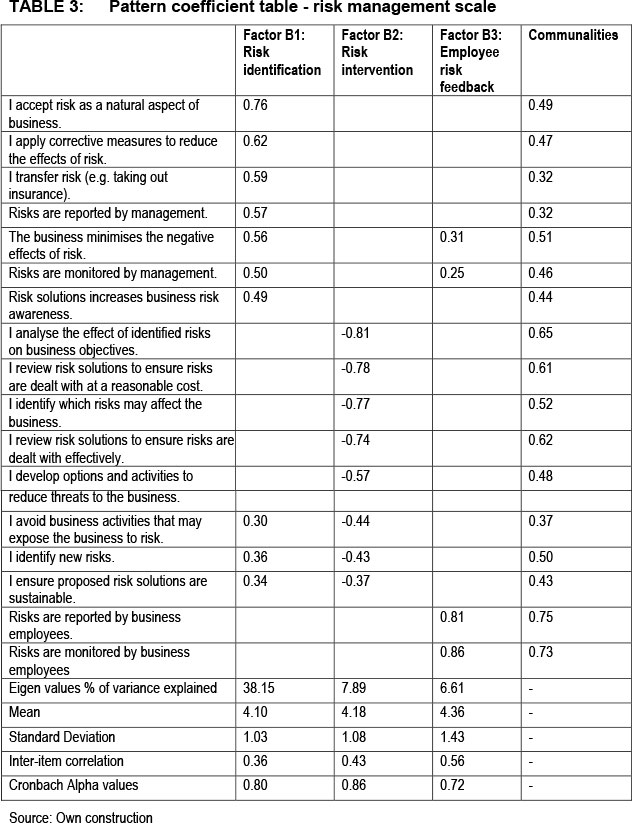
Factor analysis (Table 3) was used to determine if the small business owners would group the various questions relating to the individual risk management steps together as is found in theory, or whether they would group them different (Marx & de Swardt 2013:30). As most previous studies were based on large companies with specialised risk management division, the results for this data based on small to medium businesses may be interesting.
What was found is that the risk management scale, factored out into three (3) components: Factor B1, Risk identification, Factor B2, Risk intervention and Factor B3, Employee risk feedback, instead of the expected six (6) groupings as per the original study. It was intended to produce components that matched the steps laid out in theory (Valsamakis et al. 2013:48). However, as the composition and nature of the type of businesses differed so much, it is not surprising that the results differ. Despite the variation between theory and practice, Factors B1, B2 and B3 have shown to be reliable and practical in the small business context.
Factor B1 was labelled as risk identification as the questions relate to concepts in which actions are taken to actively identify risks. It addressed how regularly risks are identified by the small risk manager. The ideal in this regard is that risk interventions run continuously, identified and assessed through reporting, communication and monitoring of risks. It is shown that 5-10% of the respondents had never actively applied risk identification and a third to half of the respondents stipulated that they apply risk identification daily or monthly.
While this might be, preliminarily, considered sufficient when accounting for start-up considerations, it was found that small businesses have a misconception of the risks their business face until their effects are realised in the business (Kruger 2017:116). Although a mean of 4.10 would strongly indicate that small businesses apply risk identification monthly, there is still a full degree of standard deviation (1.03) in these results.
Factor B2, risk intervention, serves as a grouping of questions that show the managerial tendencies of the small business owner as all the items used in this component deal with considerations and interventions notably within the hands of only the owner of the business. It addressed the questions that collectively addressed the treatment, reporting and monitoring and reaction planning of risks by management at a mean of 4.18, this meant that they were, on average, treating their risk monthly. However, the standard deviation of 1.08 would imply that this range extends from bi-annually through to weekly. The frequency with which small businesses declared their risk interventions indicates how regularly they engage with their identified risks. However, it does not speak to how efficiently they address those risks. Half of the individual processes required to manage risks have been grouped together under Factor A2, this brings into question what informs the small business's idea of risk intervention and what they would define as a sufficient risk intervention. Only one (1) in every four (4) small businesses survived beyond five (5) years; this would suggest that what interventions the small business owner implements are not enough for survival. To combat this phenomenon requires a clear definition of the individual procedures required to conceptually address the concept of risk intervention. This definition must account for the particularities of its individual constituent parts and only unify those parts into a singular approach once they have accounted for the theoretical knowledge and practical procedures that would qualify it as sufficient and allow it to be adopted by the business.
Factor B3, employee risk reporting, creates a clear separation between the involvement of the owner/manager and the employees in the business. The mode for all the questions in B3 reported daily incorporation of employee insights into the risk management process of the business. The mean was 4.36 and the standard deviation is 1.43. This factor represents the risk monitoring and reporting that is actuated and guided by employees in the business. Risk reporting embodies how information on risks within a business are grouped (Aven & Zio 2014:1655). Small businesses have few major decision makers and flat business structures allowing for quick responses to events and rapid dissemination of new information (Aven & Zio 2014:1655).
The conglomeration of steps in this scale indicates the lack of risk awareness and a shallow understanding of best practice for risk management (Hopkin 2018:35; Valsamakis et al. 2013:48). This indicates that small business owners/managers' perception of risk management processes are conceptually or cerebrally grouped differently from theory and can serve as a motivating factor for more clearly separated risk management processes in practice (Highhouse, Nye, Zhang & Rada 2017:403). In effect the small business owner would identify a risk, intervene to the best of their ability, and draw on the experiences of their employees to augment their future activities. Although this sounds complete, the lack of structure and specificity indicate a failure to address key concerns relating to the six (6) core concepts of risk management.
5. CONCLUSION AND RECOMMENDATION
The aim of this article was to explore how small businesses identified and managed their risks. The study found that many of the predetermined scales initially employed in this thesis did not factor out as per the theory that described them. What was found is that small businesses had limited awareness of the risks their businesses were exposed to and that those who were aware of the risks were disinclined or reluctant to take them. The main finding is that small and medium businesses have an underdeveloped awareness of the risks they face and insufficient systems with which to manage them. This was pronounced in the fraudulent "compliance" that many claimed to have documents such as those generated by ISO. In certain cases the role and duties of a Safety Health Environment and Quality (SHEQ) representative was marginalised to a sub function of another employee and documentation was often lacking. With the current awareness of risks amongst small businesses it will be difficult for them to build a realistic understanding of the value that risk management can provide them. What is required is that small businesses are met with a means of educating them in regard to risk identification and risk management. To meet that need a small business risk management intervention tool has been developed to address their needs.
The vulnerability of small businesses is inherent to their characteristics; however, the largest shortcoming lies in the lack of awareness of risks that they have not yet experienced and a failure to incorporate awareness of realised risks into their continued managerial considerations. The second essential point to note is how small businesses manage their risks. Small businesses address risk from an operational perspective, if the risk has not manifest in practice it is rarely considered. When risks are realised, they are managed in general terms, in accordance with the limited concept of risk that small businesses carry (Booysen & Visser 2012:61; Diedericks 2015:75; Everson, Beston, Jourdan, Soske, Harris, Posklensky, Martens, Garcia & Jo Perraglia 2013:26). Small businesses do not address risks in a systematic way, leaving them inherently more vulnerable to risk events than their larger counterparts over time (Balkenhol & Evans-Clock 2003:37; ISO 2018:9; Nieuwenhuizen 2003:88). Furthermore, unless small businesses apply risk interventions independently, they are unlikely to persist and be embedded into the business culture of small businesses. Systematic interventions must thus be applied as the business grows so as to guide, but not dictate, their processes to a best practice level. Hence, interventions should be constructed to contain and ensure the persistence of essential considerations of the managerial interventions required in a systematic and comprehensive manner.
The primary limitation of this study is that it did not explore the underlying motivations and responses of the small business owners through a qualitative data gathering phase. A study of the reasons behind the lack of risk management practices would be able to elucidate the absence of practical risk management intervention despite the value proposition that it supports. Another limitation was the inability to generalise the results to the rest of the world. Although the sample is statistically significant and highly indicative of small businesses in the context of municipalities that offer a variety of competency and incompetent management, it was still limited to the SDMA. Due to the differences in what is classified as a small businesses internationally and with reference to regional and demographical differences the results cannot be generalised to the entire South Africa or other nations unless a comparative study is actively pursued, it is recommended that the study be conducted in parallel within other provinces and internationally in future.
Having identified and validated the factors that underlie the small business risk management position the next action to be taken is an intervention. A suitable intervention has been developed from a theoretical perspective, the Small Business Risk Management Intervention Tool (SMRMIT) developed by Kruger (2020). It is suggested that this theoretical tool be piloted with a representational sample of selected small and medium businesses with a jointly implemented qualitative study to probe those factors that undermine their risk management. Once this is done the SBRMIT will be able to be applied at a national level as a transition mechanism that can guide businesses to meaningful, ethical, and sufficient risk management. It is also advised that an education module be generated alongside the tool that expands on individual risk types, means of evaluating and estimating losses and means of integrating risk responses with business culture.
ACKNOWLEDGEMENTS
The authors would like to acknowledge the Department of Higher Education and Training -National Research Foundation, South African Research Chair Initiative (DHET-NRF SARChI) in Entrepreneurship Education for their contribution towards some of the costs towards the publication of this manuscript.
REFERENCES
- ANDERSEN TJ. 2006. Perspectives on strategic risk management. 1st ed. Herndon, VA: Copenhagen Business School Press DK.
-
ANDREASSI T. 2003. Innovation in small and medium-sized enterprises. International Journal of Entrepreneurship and Innovation Management 3(1-2):99-106. (DOI:https://doi.org/10.1504/IJEIM.2003.002222;downloaded on 02 February 2019.
» https://doi.org/10.1504/IJEIM.2003.002222 - )
-
APRIL WI. 2005. Critical factors that influence the success and failure of SMEs in Namibia in the Khoman Region. (Masters Dissertation, Stellenbosch: University of Stellenbosch). [Internet:http://hdl.handle.net/10019.1/3316; downloaded on 05 January 2018.
» http://hdl.handle.net/10019.1/3316 -
]
» https://doi.org/10.1080/13669870802488883 - )
-
AVEN T & ZIO E. 2014. Foundational issues in risk assessment and risk management. Risk Analysis: An International Journal 32(10):1647-1656. (DOI:https://doi.org/10.1111/risa.12132; downloaded on 06 February 2019.
» https://doi.org/10.1111/risa.12132 -
)
» https://doi.org/10.1080/03085140600844902 - )
-
BALKENHOL B & EVANS-CLOCK C. 2003. Private Equity and Capitalisation of SMMEs in South Africa: Quo Vadis? Social Finance & InFocus Programme on Boosting Employment through small enterprise development, Working paper No. 34, Sandton: Ebony Consulting International (Pty) Ltd. [Internet:https://www.google.com/url?sa=t&r ct=j&q=&esrc=s&source=web&cd=&ved=2ahUKEwiPhpee5uPsAhUlQEEAHYDJCSAQFjAAegQ IAxAC&url=https%3A%2F%2Fwww.findevgateway.org%2Fsites%2Fdefault%2Ffiles %2Fpublications%2Ffiles%2Fmfg-en-paper-private-equity-and-capitalisation-of-smmes-in-south-africa-quo-vadis-2002.pdf&usg=AOvVaw0hpAbJBBBi54MPUJt0E73f; downloaded on 15 April 2019.
» https://www.google.com/url?sa=t&r ct=j& q=& esrc=s& source=web& cd=& ved=2ahUKEwiPhpee5uPsAhUlQEEAHYDJCSAQFjAAegQ IAxAC& url=https%3A%2F%2Fwww.findevgateway.org%2Fsites%2Fdefault%2Ffiles %2Fpublications%2Ffiles%2Fmfg-en-paper-private-equity-and-capitalisation-of-smmes-in-south-africa-quo-vadis-2002.pdf& usg=AOvVaw0hpAbJBBBi54MPUJt0E73f -
]
» http://dx.doi.org/10.4102/sajems.v20i1.1569 -
BALOCH MS, SAEED A, AHMED I, OLÁH J, POPP J & MÁTÉ D. 2018. Role of Domestic Financial Reforms and Internationalization of Non-Financial Transnational Firms: Evidence from the Chinese Market. Sustainability 10(11):3847:1-16. (DOI:https://doi.org/10.3390/su10113847; downloadeded on 03 May 2019.
» https://doi.org/10.3390/su10113847 - )
- )
-
BERTRAM D. 2008. Likert scales are the meaning of life. [Internet:http://poincare.matf.bg.ac.rs/~kristina/topic-dane-likert.pdf; downloaded on 18 March 2018.
» http://poincare.matf.bg.ac.rs/~kristina/topic-dane-likert.pdf -
]
» http://hdl.handle.net/10394/16545 - )
- BORGHESI A & AUDENZI GB. 2013. Risk management: How to Assess, Transfer and Communicate Critical Risks. 1st ed. New York, N.Y.: Springer Milian.
-
)
» http://hdl.handle.net/1805/344 - BURNS P. 2010 Entreprenureship and small businesses: start-up, growth, and maturity. 3rd ed. Cape Town: Palgrave Macmillian.
- BYRNE BM. 2010. Structural equation modelling with AMOS: basic concepts, applications and programming. . 2nd ed. New York, NY: Routledge.
-
CANNON MD & EDMONDSON MD. 2005. Failing to learn and learning to fail (intelligently): How great organizations put failure to work to innovate and improve. Long Range Planning 38(3):299-319. (DOI:https://doi.org/10.1016/j.lrp.2005.04.005; downloaded on 10 September 2018.
» https://doi.org/10.1016/j.lrp.2005.04.005 - )
- CHAPMAN C & WARD SC. 2003. Project risk management: processes, techniques and insights. 1st ed. Chichester: John Wiley & Sons.
-
CLARK LA & WATSON D. 2016. Construct validity: basic issues in objective scale development. Psychological Assessment 7(3):309-319. (DOI:https://doi.org/10.1037/14805-012; downloaded on 09 October 2019.
» https://doi.org/10.1037/14805-012 -
)
» https://www.kmgcapitalmarkets.com/index.php/news/item/60-risk-management-more-expensive-than-you-think# -
]
» https://www.google.com/url?sa=t& rct=j & q=&esrc=s& source=web& cd=& ved=2ahUKEwij7s3y9uPsAhUKJ8AKHa6SCiQ QFjABegQIAhAC& url=https%3A%2F%2Frepository.nwu.ac.za%2Fbitstream%2Fhandle%2F1039 4%2F34652%2FKruger_NA_23587202.pdf%3Fsequence%3D1& usg=AOvVaw3Nhu7I7pdjtvWruUJcbvCE -
EDEM DB. Liquidity management and performance of deposit money banks in Nigeria (1986- 2011): An investigation. International Journal of Economics, Finance and Management Sciences 5(3):146-161. (DOI:10.11648/j.ijefm.20170503.13; downloaded on 07 December 2018.
» https://doi.org/10.11648/j.ijefm.20170503.13 -
)
» https://go.gale.com/ps/anonymous?id=GALE%7CA18622665& sid=googleScholar& v=2.1& it=r& lin kaccess=abs& issn=07329334& p=AONE& sw=w - )
-
EVERSON MEA, BESTON CA, JOURDAN CI, SOSKE SE, HARRIS CA, POSKLENSKY JA, MARTENS FJ, GARCIA JA & JO PERRAGLIA S. 2013. Internal Control-Integrated Framework, Committee of Sponsoring Organizations of the Treadway Commission (COSO). [Internet:https://www.google.com/url?sa=t&rct=j&q=&esrc=s&source=web&cd=&cad=rja&uact=8&ved=2ahUKEwivvP65gO TsAhXVilwKHWdHCX0QFjAAegQIAhAC&url=https%3A%2F%2Fna.theiia.org%2Fstandards-guidance%2Ftopics%2FDocuments%2FExecutive_Summary.pdf&usg=AOvVaw0T7JRLrXiOkZ5u4YV1H8ia; downloaded on 07 November 2018.
» https://www.google.com/url?sa=t& rct=j& q=& esrc=s& source=web& cd=& cad=rja& uact=8& ved=2ahUKEwivvP65gO TsAhXVilwKHWdHCX0QFjAAegQIAhAC& url=https%3A%2F%2Fna.theiia.org%2Fstandards-guidance%2Ftopics%2FDocuments%2FExecutive_Summary.pdf& usg=AOvVaw0T7JRLrXiOkZ5u4YV1H8ia -
]
» https://www.google.com/url?sa=t& rct=j& q=& esrc=s& source=web& cd=& ved=2ahUKEwiwgpuc-OPsAhXKasAKHVLjDXIQFjAAegQIAxAC&url=http%3A%2F%2Fdspace.nwu.ac.za%2Fbitstream%2Fhandle%2F10394%2F4749 %2Fmeyer_n.pdf%3Fsequence%3D1& usg=AOvVaw2wArMiKHY0Bu_TBVru3qCs - FINN A. 2015. A national minimum wage in the context of the South African labour market. 1st ed. Cape Town: University of Cape Town.
- FOUCAULT M. 1991. The Foucault effect: Studies in governmentality. 2nd ed: University of Chicago Press.
-
]
» https://doi.org/10.3390/su11174806 -
GWANGWAVA E, MANUERE F, KUDAKWASHE G, TOUGH C & RANGARIRAI F. 2014. An assessment of risk management practices in SMEs in Zimbabwe: a review and synthesis. IOSR Journal of Humanities and Social Science 19(8):06-14. [Internet:https://www.semanticscholar.org/paper/An-Assessment-of-Risk-Management-Practices-in-Smes-Gwangwava-Manuere/b794fd9dcdf4addb058ffca4d62b399bb23aa7e7?p2df; downloaded on 05 February 2019.
» https://www.semanticscholar.org/paper/An-Assessment-of-Risk-Management-Practices-in-Smes-Gwangwava-Manuere/b794fd9dcdf4addb058ffca4d62b399bb23aa7e7?p2df - ]
- HARVEY J. 2008. Introduction to managing risk. 1st ed. London: CIMA.
-
HENDERSON AD. 1999. Firm strategy and age dependence: A contingent view of the liabilities of newness, adolescence, and obsolescence. Administrative Science Quarterly 44(2):281-314. (DOI:https://doi.org/10.2307/2666997; downloaded on 04 Mach 2018.
» https://doi.org/10.2307/2666997 -
)
» https://www.gov.za/documents/national-small-business-act?gclid=Cj0KCQjwufn8BRCwARIsAKzP696phHjsK8eeiJ6wPWKNIGgw9EfK5T23CcjLyiBVzXPGS6POhHYH0VMaAuDFEALw_wcB -
HERBST FJ. 2001. An investigation of the product life cycle concept as an instrument in marketing decisionmaking for selected small organisations in Africa. Pretoria: University of Pretoria. (Thesis-PhD). [Internet:http://hdl.handle.net/2263/25485; downloaded on 03 April 2019.
» http://hdl.handle.net/2263/25485 - ]
-
HIGHHOUSE S, NYE CD, ZHANG DC & RADA T. 2017. Structure of the dospert: Is there evidence for a general risk factor? Journal of Behavioral Decision Making 30(1):400-406. (DOI:https://doi.org/10.1002/bdm.1953; downloaded on 02 May 2019.
» https://doi.org/10.1002/bdm.1953 -
)
» https://www.google.com/url?sa=t& rct=j& q=& esrc=s& source=web& cd=& cad=rja& uact=8& ved=2ahUKEw i0x5KUgeTsAhWOYMAKHSgYB9kQFjAAegQIBBAC& url=http%3A%2F%2Fwww.seda.org.za%2FPublications%2FPu blications%2FThe%2520Small%2C%2520Medium%2520and%2520Micro%2520Enterprise%2520Sector% 2520of%2520South%2520Africa%2520Commissioned%2520by%2520Seda.pdf& usg=AOvVaw3ygA947dR8b0J xbE-TNPui - INTERNATIONAL LEADERSHIP DEVELOPMENT PROGRAMME. 2014. Informal small medium and micro enterprises retailers in South Africa. 1st ed. Johannesburg: Henley Business School.
-
INTERNATIONAL ORGANIZATION FOR STANDARDIZATION (ISO). 2009. ISO Guide 73:2009. Geneva: International Organization for Standardization. [Internet:https://www.iso.org/obp/ui/#iso:std:iso:guide:73:ed-1:v1:en; downloaded on 01 June 2018.
» https://www.iso.org/obp/ui/#iso:std:iso:guide:73:ed-1:v1:en -
]
» http://hdl.handle.net/10500/2098 -
INTERNATIONAL ORGANIZATION FOR STANDARDIZATION (ISO). 2018. Risk management: ISO 31000. Geneva, Switzerland: International Organization for Standardization. [Internet:https://www.iso.org/obp/ui/#iso:std:iso:31000:ed-1:v1:en; downloaded on 28 July 2018.
» https://www.iso.org/obp/ui/#iso:std:iso:31000:ed-1:v1:en - ]
-
INSTITUTE OF RISK MANAGEMENT (IRM). 2002. A risk management standard. London: Institute of risk management. [Internet:https://www.google.com/url?sa=t&rct=j&q=&esrc=s&source=web&cd=&ved=2ahUKEwiU2cuE9uPsAhV xolwKHVC9BLIQFjAAegQIAxAC&url=https%3A%2F%2Fwww.theirm.org%2Fmedia%2F4709%2Farms_2002_irm.pdf&usg=AOvVaw0mR-ONhMIzemHwhY2n5YdT; downloaded on 27 August 2018.
» https://www.google.com/url?sa=t& rct=j& q=& esrc=s& source=web& cd=& ved=2ahUKEwiU2cuE9uPsAhV xolwKHVC9BLIQFjAAegQIAxAC& url=https%3A%2F%2Fwww.theirm.org%2Fmedia%2F4709%2Farms_2002_irm.pdf& usg=AOvVaw0mR-ONhMIzemHwhY2n5YdT - ]
-
KAHANE Y & KROLL Y. 1985. Optimal insurance coverage in situations of pure and speculative risk and the risk-free asset. Insurance: Mathematics and Economics 4(3):191-199. (DOI:https://doi.org/10.1016/0167-6687(85)90015-0; downloaded on 26 September 2019.
» https://doi.org/10.1016/0167-6687(85)90015-0 - )
-
KAPLAN S & GARRICK BJ. 1981. On the quantitative definition of risk. Risk Analysis 1(1):11-27. (DOI:https://doi.org/10.1111/j.1539-6924.1981.tb01350.x; downloaded on 25 October 2018.
» https://doi.org/10.1111/j.1539-6924.1981.tb01350.x - )
- KLINE RB. 2011. Principles and prcatice of structural equation modeling. 3rd ed. New York, NY: The Guliford Press.
- ]
- KNIEF R. 1991. Risk management: Expanding horizons in nuclear power and other industries. 1st ed. New York, NY: Hemisphere Publishing Corporation.
- ]
-
KRUGER NA. 2020. A risk manaement tool fo SMMEs: the case of Sedibeng District Municipality. Vanderbijlpark North West University. (Thesis- PhD.) [Internet:https://repository.nwu.ac.za/bitstream/handle/10394/34652/Kruger_NA_23587202.pdf?sequence=1&isAllowed=y; downloaded on 01 June 2020.
» https://repository.nwu.ac.za/bitstream/handle/10394/34652/Kruger_NA_23587202.pdf?sequence=1& isAllowed=y - ]
- ]
- MALHOTRA NK. 2010. Marketing research: an applied orientation. 6th ed. Upper Saddle River, NJ: Pearson Education Prentice Hall.
-
MELNYK O, SROKA W, ADAMIV M & SHPAK Y. 2017. Information diagnostic support of enterprise under the conditions of uncertainty. Acta Universitatis Agriculturae et Silviculturae Mendelianae Brunensis 65(4):1403-1414. (DOI://doi.org/10.11118/actaun201765041403; downloadeded on 03 May 2018.
» https://doi.org/10.11118/actaun201765041403 - )
- ]
-
MEYER N & SYNODINOS C. 2019. Entrepreneurial skills, characteristics and intentions amongst unemployed individuals in the Vaal-Triangle Region of South Africa. Journal of Contemporary Management 16(2):1-22. (DOI: 10.35683/jcm198.0024; downloaded on 03 May 2018.
» https://doi.org/10.35683/jcm198.0024 - ]
-
MOOS MN. 2014. Evaluating the South African small business policy to determine the need for and nature of an entrepreneurship policy. Pretoria: University of Pretoria. (Thesis-PhD). [Internet:http://hdl.handle.net/2263/46221; downloaded on 01 July 2018.
» http://hdl.handle.net/2263/46221 - ]
-
NEETHLING JR. 2016. A comparative analysis of business owner's perceptions of the creation of an enabling developmental environment in the Sedibeng Municipal region. Vanderbijlpark: NWU. (Dissertation- Masters). [Internet:http://hdl.handle.net/10394/24915; downloaded on 22 August 2018.
» http://hdl.handle.net/10394/24915 - ]
- NIEUWENHUIZEN C. 2003. The nature and development of entrepreneurship. In Nieman G, Hough J & Nieuwenhuizen C. eds. Entrepreneurship: A South African Perspective. Pretoria: Van Schaik.
-
O'GORMAN C. 2001. The sustainability of growth in small-and medium-sized enterprises. International Journal of Entrepreneurial Behavior & Research 7(2):60-75. (DOI:https://doi.org/10.1108/13552550110396095; downloaded on 19 September 2019.
» https://doi.org/10.1108/13552550110396095 - )
- )
-
OLÁH J, KOVÁCS S, VIRGLEROVA Z, LAKNER Z, KOVACOVA M & POPP J. 2019b. Analysis and comparison of economic and financial risk sources in SMEs of the visegrad group and serbia. Sustainability 11(7):1853:1-19. (DOI:https://doi.org/10.3390/su11071853; downloaded on 03 May 2020.
» https://doi.org/10.3390/su11071853 - )
- )
-
PREUSS L. 2011. On the contribution of public procurement to entrepreneurship and small business policy. Entrepreneurship & Regional Development: An International Journal 23(9):787-814. (DOI:10.1080/08985626.2010.546433; downloaded on 08 October 2019.
» https://doi.org/10.1080/08985626.2010.546433 - )
-
PROBST G & RAISCH S. 2005. Organizational crisis: The logic of failure. The Academy of Management Perspective 19(1):90-105. (DOI:10.5465/AME.2005.15841958; downloaded on 05 December 2019.
» https://doi.org/10.5465/AME.2005.15841958 - )
-
RAZ T & HILLSON D. 2005. A comparative review of risk management standards. Risk Management: an International Journal 7(4):53-66. (DOI:10.1057/palgrave.rm.8240227; downloaded on 02 January 2018.
» https://doi.org/10.1057/palgrave.rm.8240227 - )
- ]
- SCARBOROUGH NM & ZIMMERER TW. 2002. Essentials of entrepreneurship and small business management. 3rd. Upper Saddle River, NJ: Prentice Hall.
-
SHPAK N, SOROCHAK O, HVOZD M & SROKA W. 2018. Risk evaluation of the reengineering projects: a case study analysis. Scientific Annals of Economics and Business 65(2):215-226. (DOI:10.2478/saeb-2018-0014; downloaded on 19 March 2019.
» https://doi.org/10.2478/saeb-2018-0014 - )
- ]
-
SMALL ENTERPRISE DEVELOPMENT AGENCY (SEDA). 2018. SMME Quarterly Update 1st Quarter 2018. Pretoria. [Internet::https://www.google.com/url?sa=t&rct=j&q=&esrc=s&source=web&cd=&cad=rja&uact=8&ved=2ahUKE wjc7PKwgeTsAhVIecAKHVmcCswQFjAAegQIAxAC&url=http%3A%2F%2Fwww.seda.org.za%2FPublications%2 FPublications%2FSMME%2520Quarterly%25202018-Q1.pdf&usg=AOvVaw1N5EmgzI7vYceLLNp0yeF-; downloaded on 29 March 2019.
» https://www.google.com/url?sa=t& rct=j& q=& esrc=s& source=web& cd=& cad=rja& uact=8& ved=2ahUKE wjc7PKwgeTsAhVIecAKHVmcCswQFjAAegQIAxAC& url=http%3A%2F%2Fwww.seda.org.za%2FPublications%2 FPublications%2FSMME%2520Quarterly%25202018-Q1.pdf& usg=AOvVaw1N5EmgzI7vYceLLNp0yeF- - ]
- THOMPSON SK. 2012. Sampling. 3rd ed. Hoboken, NJ: John Wiley & Sons.
- VALSAMAKIS AC, DUTOIT GS.& VIVIAN RW. 2013. Risk management. 5th ed. Pretoria: Pearson Education.
- VAN AARDT I & BEZUIDENHOUT S. 2014. Entrepreneurship & new venture management. London: Oxford University Press.
-
WAEMUSTAFA W & SUKRI S. 2016. Systematic and Unsystematic Risk Determinants of Liquidity Risk Between Islamic and Conventional Banks. International Journal of Economics, Finance and Financial Issues 6(4):1321-1327. (DOI:10.6084/m9.figshare.4052316; downloaded on 10 April 2019.
» https://doi.org/10.6084/m9.figshare.4052316 - )
- ]
-
WEISSINGER R. 2013. Risk management: How ISO standards can help. ISO Focus+ 4(2):19-21. [Internet:https://www.iso.org/files/live/sites/isoorg/files/news/magazine/ISO%20Focus%2B%20(2010-2013)/en/2013/ISO%20Focus%2B%2C%20February%202013.pdf; downloaded on 07 June 2015.
» https://www.iso.org/files/live/sites/isoorg/files/news/magazine/ISO%20Focus%2B%20(2010-2013)/en/2013/ISO%20Focus%2B%2C%20February%202013.pdf