Supply Chain resilience and design in retail supermarkets
Abstract
The Fast-Moving Consumer Goods (FMCG) industry continues to present and deliver products to end consumers irrespective of the conditions faced in the business. The nature of disruptions that unexpectedly affect retail supermarkets needs to be strategically addressed to ensure product availability to the end consumer. The Resilience concept is an important supply chain upcoming research area that can remove disruptions without affecting the retail business operations. This article sought to understand supply chain resilience and supply chain design in the retail industry. South African retail supermarkets encounters varied threats to its business and the limited literature on the concepts of supply chain design and supply chain resilience have prompted this study. The limited literature on both concepts has prompted this study especially in a developing economy such as South Africa. A quantitative research design was adopted. Purposive sampling was used to identify managers and supervisors of the selected retail supermarkets in Durban South Africa within the FMCG retail industry with an estimated population of 1509 and a sample size of 306. The multiple regression analysis was engaged to display the extent of supply chain resilience and design in the selected retail outlets. The study revealed that transport network, technology advancement and environmental changes contributed mostly to the dimensions that affect the retail supply chain when designing for resilience. The study enables supply chain retailers in the retail industry to understand the factors to consider when designing their supply chain. This study adds to the academic body of knowledge by being one empirical study that conducted analysis on the constructs of supply chain design and supply chain resilience.
FMCG; product availability; retail supply chain; supply chain design and supply chain resilience
1. INTRODUCTION
According to Christopher and Peck (2004:7) many organisations are still devoid of the criticality of resilience as a strategy to develop risk and business continuity management. A 2014 Deloitte study conducted by Marchese and O'Dwyer (2014) argue that building a resilient supply chain is easier said than done. Marchese and O' Dwyer (2014) suggest that the importance of resilient supply chain is recognised by companies, but there is a lack of capability to use the tool effectively and make decisions, hence struggling with implementing or understanding the value of the tool at their disposal (Marchese & O'Dwyer 2014:129). The evolution of supply chain resilience is improving in terms of strategies, principles, and definitions of the concept. The exploration and understanding of supply chain design and the relationship amongst the elements of supply chain resilience to a practical environment such as the retail sector is lacking.
A previous study was conducted on retail centre resilience by Dolega and Celinska-Janowicz (2015:8) in a developed economy (United Kingdom). In that study, resilience was treated as a dynamic and evolutionary procedure. The disruption factors that impacted on retail centres were economic crises aftermath, shift of dynamics of consumer culture and high rise of internet sales. Dolega and Celinska-Janowicz (2015) assert that the application of the resilience concept to sectors such as retail was scarce. There is a need to minimise disruption impacts to the retail supply chain through the design for resilience to achieve optimal performance. The relevance of this research is based on these justifications: the gap in theory identified by Bahmra, Dani and Burnard (2011:5388) stating the need for further research on the concept of resilience; and the social and economic importance of designing supply chain for resilience to the retail industry in South Africa. The purpose of this study was to evaluate the relationship between supply chain design and supply chain resilience in the context of better understanding the concepts in the retail supermarkets in Durban, South Africa.
1.1 Fast Moving Consumer Goods sector in the South African market
According to the NPI Governance Consulting report (2018), South Africa remains the heart and gateway to Africa's development, with well-developed retail market, beverages, and agriculture industries. The FMCG industry is competitive and fast-paced, however economic, social, and environmental challenges have impacted South Africa's (SA's) retail space (Dicey 2016). According to Statistics South Africa (Stats SA) (2016), the economy contracted by 0.3% in 2016. The decline in consumer sentiments was attributed to the lack of economic growth and political uncertainty. Despite all of this, the retail sector continued to perform better. In 2017, according to Ernest and Young analysis of the 12 largest retailers, SA's retailers return on equity (ROE) was strong, for specialty retailers 51.6%, grocery retailers 22.3% and clothing 41.1% (Ernest & Young 2017:2). In the national Budget speech as announced in February 2017, SA's economy grew by 1.3% compared to 1% growth in 2016, with the trade sector (retail, wholesale and motor trade) as the second largest contributor (Mafini & Loury-Okoumba 2016:617; Stats SA 2018). The growth in the economy will allow for business continuity.
This section discusses the relevant concepts related to resilience with a brief review of different thoughts by scholars on the topic.
2.1 Defining resilience
Different scholars have defined resilience in several ways and the issue of lack of consensus was identified (Mensah & Merkuryev 2014:314; Spiegler, Naim & Wikner 2012:2). Resilience is not just concerned with reducing the probability of failure but stresses the recovery need from unexpected turbulence in the operating environment (Uday & Marais 2015:495). Christopher and Peck (2004:14) presented the principles of resilience: reengineering, risk culture, agility, and collaboration. This source has been cited frequently and serves as a basis to understand supply chain resilience (SCRES) (Briano, Caballini, Giribone & Revetria 2010; Christopher, Mena, Khan & Yurt 2011; Mandal 2012).
Hohenstein, Feisel, Hartmann and Giunipero (2015:90) investigated the phenomenon of SCRES in the United States. The intent was to analyse research on the SCRES phenomenon by providing a framework that can guide further research needs. These authors discovered four resilience dimensions towards achieving performance: readiness, response, recovery, and growth. Each dimension possesses an element/strategy to strengthen resilience. The elements were then grouped into proactive SCRES strategy for-ante disruption phase and include collaboration, human resource management, inventory management, predefined plans, redundancy, and visibility to create the readiness phase. The remaining elements were called reactive strategy and include agility, collaboration, flexibility, human resource management and redundancy that are needed to recover, respond, and grow post disruption. Hohenstein et al. (2015:90) view agility to be distinct from flexibility which consists of sub-elements such as communication, information sharing, velocity and responsiveness and quick supply chain redesign to reduce disruption impact.
Jüttner and Maklan (2011:247) classified four determinative elements of resilience that consider the conceptual core of all suggestions in SCRES literature. These include flexibility, velocity, visibility, and collaboration. Based on the literature reviewed by Ponis and Koronis (2012:926), the authors examined the model of resilience from distinct areas and suggested organisational and supply chain resilience. The authors highlighted that the antecedents of SCRES antecedents are redundancy, flexibility, agility, velocity, visibility, availability, resource mobilisation, supply chain structure knowledge and collaboration. These authors attempted to group these elements into four discrete first level structural elements to develop a framework. Flexibility and velocity were viewed as antecedents of agility. Flexibility and agility were furthermore differentiated from redundancy. Collaboration is the third element with visibility as its element. This contradicts the work of Christopher and Peck (2004:19) who highlighted that visibility is an element of agility. The fourth first level element in the planned framework is the supply chain structure knowledge.
Tukamuhabwa, Stevenson, Busby and Zorzini (2015) emphasised that the most frequently cited strategies of SCRES include flexibility, redundancy, collaborative supply chain relationships and supply chain agility consistent with other scholars (Jüttner & Maklan 2011:247; Ponis & Koronis 2012:926). These principles deduced by Christopher and Peck in 2004, forms the basis of this research interest (Christopher & Peck 2004:6; Rice, Canito, Sheffi, Fleck, Disraelly, Lowtan, Lensing and Pickett 2003:31; Sheffi & Rice 2005:41) coupled with an increasing socio-economic, financial and technological risk propensity in the retail sector. The concept of SCRES has gained much attention as there is an increase in disruption incidences such as Hurricane Katrina, the Fukushima nuclear disaster, and the July-August 2018 California wildfires (Nauslar, Abatzoglou & Marsh 2018:1). There were also natural disasters in the form of storms and flooding that occurred in the Durban, KwaZulu-Natal province in October 2017 as was reported in News24 by Singh (2017).
2.2 Antecedents of Supply Chain Resilience
Supply chain resilience antecedents include supply chain reengineering, supply chain collaboration, supply chain agility and supply chain risk culture as presented by Christopher and Peck (2004). The next section discusses these antecedents.
2.2.1 Supply Chain Reengineering
The reality of today's competitive environment expressed by fierce competition, has caused many organisations to respond to the variation in customer demands and changing regulatory conditions, by rethinking its way of conducting business (Habib & Shah 2013:2) and finding new solutions to their business-related issues (Goksoy, Ozsoy & Vayvay 2012:91). Other reasons why organisations opt to reengineer their processes include: growth, competition, developments in technology and changing workforce (Kotter & Schlesinger 1979:2). Reengineering aims to achieve performance improvements through process redesign of an organisation's operation, increasing its value-added content and minimising waste, with emphasis on the importance of quality in the system (Mavetera 2012). In support of this thought, scholars such as Habib and Shah (2013:2) and Nisar, Ahmad and Ahmad (2014:219) stated that organisations that ignore the call to change in respect to its environment will lose its market share. Nzewi, Nzewi and Moneme (2015), suggested a thorough and complete change in organisational processes, structures, systems of management, employee tasks, performance ratings, systems of incentives, skill advancement and technology use.
2.2.2 Supply chain collaboration
Collaboration amongst supply chain partners is not simply transactions; it influences sharing of information and creation of knowledge for a sustainable competitive advantage. To build supply chain collaboration, it is critical to comprehend the ways that firms integrate processes, exchange information, connect and mutually create knowledge with partners (Cao, Vonderembse, Zhang & Ragu-Nathan 2010:6614). Supply chain collaboration is seen as applying of shared knowledge to a system and exchanging of information thereof. The ability to share this knowledge will increase customer service level efficiency and effectiveness, the entire supply chain visibility and also reduce risks (Scholten Sharkey & Fynes 2014:215). The lack thereof may lead to inefficiencies in production, process waste, cost inflation and redundant inventory stock hence supply chain collaboration is referred to as a core competence in a worldwide market (Li 2012:61). The objective of supply chain collaboration lies in improving operational flexibility that comes from facilitating cooperation amongst supply chain members to manage supply and demand uncertainty (Botes, Niemann & Kotze 2017:183) and can also be used to improve demand forecasts, inventory management and accuracy of information (Li 2012:61).
Literature has highlighted the essentials of collaboration to building a resilient supply chain (Jüttner & Maklan 2011:248; Petit, Croxton & Fiskel 2013:56) since during crisis, it holds the supply chains together (Richey, Roath, Whipple & Fawcett 2010). Wilding (2013:3) and Christopher et al. (2011:71) have indicated the essence of firms investing in collaborative relationships as an enabler of supply chain resilience, but this has often been ignored. Simatupang and Sridharan (2002:45) purported to evaluate collaborative practice using three (3) scopes: information sharing, decision synchronisation and incentive alignment. Information sharing is referred to as "the act of taking and spreading timely and appropriate data for decision makers to plan and control supply chain operations". Information sharing has been acknowledged to have a significant effect on supply chain collaboration through cost saving, increase in visibility, integrating supply chain plans which reduces a bullwhip effect (Hudnurkar, Jakhar & Rathod 2014:197). Decision synchronisation refers "to the collective planning and operational decision making". Incentive alignment is defined as "the extent that members of the supply chain can share costs, risks and profits. All the listed three dimensions assist supply chain partners to ensure a swift flow of products to the customers.
2.2.3 Supply chain agility
It was suggested by Mandal (2012:51), that to explore avenues to make a supply chain resilient entails firms to rely on information technology which can assist in daily implementation of solutions to strategic problems. Mandal (2012:51) argued that the better enabler of supply chain agility is information technology. Some studies view agility as characterised by responsiveness, flexibility, spans organisational structures, processes, and information systems (Shaw, Burgess, De Mattos & Stec 2005:3499). Brusset (2016:47) viewed agility as an operational capability that can be used in managing network from the demand-side of a supply chain. The basic principle to create agility is for the partners in a supply chain to fuse their collective capabilities within changing markets and customer demand (Gligor 2013:2).
2.2.4 Supply chain risk culture
Risk culture is termed to be an element of corporate culture (Power, Ashby & Palermo 2013:4) and a product of organisational learning (Roschman, 2014:11). Culture can be a resource and not a limitation (Caretta & Schwizer 2017:16). It is neither exclusive nor the same throughout a firm (Schein 2010). Ernest and Young (2014:3) conducted a survey on institutionalising culture in organisations and the executives agreed that ultimately, risk culture focuses on the business model that firms decide to follow and its day to day conduct of business. Mandal (2012:50) articulates that for a supply chain to be resilient, risk culture must be built across its partnering members and elements. Roslan and Dahan (2013) argued that an important feature of risk management which board executives should understand is risk culture. The argument was that implementing risk management will not succeed if risk culture is not adopted at all levels within the organisation. The results of the study showed that a substantial association exists between enterprise risk management (ERM) and risk culture. The issue of culture is one that an organisations' management finds difficult to deal with. This is because culture is a delicate issue especially when dealing with a diverse set of human beings; hence it involves critical understanding and training to be able to deal with it. Culture promotes learning, knowledge sharing, trust, social and environmental responsibility (Kumar, Subramanian & Arputham 2018:98).
2.3 Supply chain design
In recent years, most nations have been facing natural disasters and disruptions to their economy on a huge scale. Firms need to be alert and proactive by examining their supply chain and having an entire vision of the supply chain in terms of the entities and flows. In managing the flows (information, material, and money), proper design, control and planning of the supply chains is imperative and to recognise the network that links all the entities in the supply chain. All these evaluations can be possible by designing the supply chain to be resilient against disruptions. Disruptions can cripple or collapse an entire supply chain (Cantor, Blackhurst & Cortes 2014:159; Kern, Moser, Hartmann & Moder 2012:61; Madadi, Kurz, Mason & Taaffe 2014:105). This implies that the negative effects ripple through the supply chain due to relationships amongst the entities that care less for their supply chain design. Having better measures will provide a supply chain with the ability to produce better results and establish resilience more than their competitors. This notion was supported by Garcia and You (2015:153) that the success of industrial concerns depends on an optimal supply chain design. Supply chain design was recognised initially by Fine (1998:12), as a feature of supply chain management that is rich and past issues of buyer-supplier associations, vertical integration or make/buy.
The nature of the supply chain is shaped by the supply chain design and includes those decisions that impact patterns of investment by the firm amongst its many supply chains. The decisions on the investment designs influence the relationship that exists among supply chain partners, the performance measurement systems suitable to the supply chain, the extent of supply chain visibility and the entire susceptibility of the supply chain (Melnyk, Narasimhan & Decampos 2014:1888). In another view, Ivanov, Dolgui, Sokolov and Ivanova (2016:1436) stated that supply chain design has to do with planning of facility location, customer's allocation and selection of suppliers whereby lead time, fluctuations in demand and inventory are incorporated into the model. This implies that the scholar's ideas indicate that decisions on supply chain design are taken strategically, mostly by the corporate leaders, and forms a core investment idea to the supply chains.
In defining supply chain design, Melnyk et al. (2014:1889) described the concept as 'identifying the desired strategic outcomes for the firm and developing, implementing, and managing over time the resources, processes, and relationships that seek to make the attainment of such desired outcomes inevitable over time'. The authors viewed supply chain design as the outcome of a process formed by three prominent dimensions (influencers, design decisions and building blocks). Nel and Badenhorst-Weiss (2010:198) cited that conscious efforts have not been made to design a supply chain; hence there is a necessity to plan for resilience at the level of the supply chain design (Sabouhi, Pishvaee & Jabalameli 2018:658). In view of this investigated aspects and concerns of supply chain design, it can be argued that any supply chain that fails to design and redesign its operational and structural processes continuously, may face extinction. A study conducted by Badenhorst-Weiss and Nel in 2011, suggested that supply chain design forms an integral part of supply chain management and improves supply chain integration. The authors alluded that supply chain design involves different ways of structuring a supply chain: understanding the demand of supply chains consumers, choose a supply chain strategy and structuring the supply chain which assisted organisations to analyse their supply chain design practices.
Habermann, Blackhurst and Metcalf (2015:492) explored two design strategies: the dispersion or the co-location of supply chain partners to decrease risk associated with supply chain disruption, in the context of better understanding and controlling of risk in supply chain. The authors discovered that co-location with suppliers seems to have a valuable impact on reducing disruption and, that the supply side factors impact is higher than the customer side as inventory risks are borne solely by the supplier. Co-location allows the suppliers to be on the same location as the customer. Co-location with suppliers relates to vendor managed inventory, where suppliers has the liberty to schedule, produce and supply production to meet customer inventory service levels to reduce cost and increase efficiency. This means that the daily inventory management activities of the customers are furnished by the supplier (Pol & Inamdar 2012:46). The idea of vendor managed inventory seems to be a good strategy for businesses. The need arises to re-examine the design of supply chain to meet with competitive strategy. Supply chains can be designed to achieve alternate outcomes such as adopting innovation, increase in responsiveness, improve sustainability, reduce cost, and reduce lead times.
2.4 Supply chain design dimensions
Supply chain design has been well-thought-out as an essential factor that influences supply chain resilience (Carvalho, Barroso, Machado, Azevedo & Cruz-Machado 2012:331). As emphasised by Melnyk et al. (2014:1890), supply chain design is perceived as a process outcome and defined by three dimensions with an ordered connection: influencers, design decisions and building blocks.
2.4.1 Influencers
The influencers include business model, economic, political, technological, environmental influences and lastly, strategic desired outcome. According to Melnyk et al. (2014:1890), the influencer embodies the external environment of a business and affects the decisions usually taken at corporate level and the subsequent section will discuss the factors.
•
Business modelThe importance of a business model includes how an enterprise carries out its day to day business affairs and delivers customer value. Customers become enticed to settle the value they get for purchasing a product, and these payments are transformed into profit for the business (Trkman, Budler & Groznik 2015:588). In a highly complex and uncertain environment such as the FMCG industry, the implication is that the retailers become aware that strategies have a lot to do with insights, swift investigation, and new learning (McGrath 2010:248). This industry's environment is also characterised by turbulence and requires new business models for its optimal operation (Trkman et al. 2015:588). Business model gives detail of what connects a firm's internal function areas to external ones (suppliers, partners) in an integrated system to deliver on a firm's strategy (Raju & Singh 2018:27).
•
TechnologyIn retail operations, technology developments are important in the rationalisation of flow of goods, services, and information. Having a resilient supply chain implies a joint decision made by all the partners in the chain towards succeeding in their business. With the emergence of digitisation, online retailing trade is becoming a threat to the retail industry as it brings flexibility, efficiency, and awareness to consumers with knowledgeably experience. Technology empowers retailers to advance service delivery to customers, increase sales, advance management operations, and reduce cost (Grewal, Roggeveen & Nordfalt 2017:2). With competition growing in the South African retail environment, the use of technology will place any retailer ahead of its competitors. In embracing fresh and untapped business ventures, retailers that are more agile in responding to consumers faster and in a cost-effective way will thrive in the long run. Although the benefits of introducing technology were known, only a few retailers adopted it (Pantano & Viassone 2014:43). It is also known that investing in technologies does not always offer anticipated returns (Sethuraman & Parasuraman 2005). Technology can only be beneficial when there is a motivation for users to adopt them (Davies, Bilotta, Hapeshi, Salvia & Servidio 2011). The focus then, is for retailers to consistently provide relevant values for consumers using functional and integrative supply chain technology that links all aspects of the supply chain (Magutu, Aduda & Nyaoga 2015:45).
•
Political InfluencesChen, Chen, Wang, and Zheng (2018:43) discovered that political uncertainty forces firms into an uncertain stream of cash flow, as firms that receive subsidies from the government wait for decisions to be made in that regard. According to Chawdhury (2016:4), political instability has to do with the tendency of a change occurring in the executive arm of a government which may be constitutional or unconstitutional thereby hampering any country's development. Business confidence in South Africa reduced drastically due to political uncertainty, poor performance of the economy, confusion in policy and lack of good leadership in general (Macduff 2017). Literature documentation recently has grown on the study of hostile effect of political uncertainty on firm's financial activities (Boutchkova, Doshi, Durney & Molchanov 2012:2; Brogaard & Detzel 2015:2). A theoretical model with evidence that political uncertainty presents a risk premium was developed by Pastor and Veronesi (2012:1220). Several studies have investigated emerging markets on the economic influence of political uncertainties on corporate decisions. The mammoth effect of political uncertainty impacts directly on the retail sector since the services sold by the retailers are basic necessities of life. When the pockets of consumers are low, their patronage to the retail stores are reduced since the cost of consumption goods tend to rise.
•
Environmental influencesDifferent industries experience increasing environmental pressures (Lee, Min & Yook 2015; Tognetti, Grosse-Ruyken & Wagner 2015). It is critical that firms focus on pollution prevention at source, invest in environmental protection, decrease or eliminate pollution and damage to the environment, and reduce the cost to the general public (Ding, Zhao, An, Xu & Liu 2015:564). A focus on environmental supply chain responsibility paves new ways to collaborate with suppliers through emerging environmentally friendly technologies and training (Kovacs 2008). This may lead to increased cost and higher prices for products that are environmentally friendly. Coordination of supply chain can be obtained by implementing the centralised or decentralised decision-making technique (Ding et al. 2015:564). Government are responsible for regulating activities in firms to favour environmental sustainability by imposing penalties on defaulting firms or by motivating businesses to participate in environmental protection through incentive-based policies.
2.5 Building blocks
Building blocks are suggested to include investments such as physical structures (storage and manufacturing capacity) and transportation means (logistics capacity) (Melnyk et al. 2014:1890). It is the second level in the supply chain design dimension. The use of various modes of transport employed to convey goods, will ensure constant product availability from retailers. For instance, retailers can pick up a consignment that was shipped by using a truck to move such products to their warehouses. Retailers can successfully run a distribution centre well, with technology that allows communications between the retailer and the transporter hence enabling immediate sorting and store delivery of products. This can only be achieved through integrating the retailer's logistics with that of its suppliers (Fernie & Sparks 2014:5).
2.5.1 Design decisions on retail supply chain system
Due to companies' experiences of unforeseen events such as material supply shortages, natural disasters, and customer demand changes, it becomes pertinent to adopt some alterations in the design of supply chain network. Such changes can range from expanding the supply chain, mergers and acquisition or other cost-cutting decisions. These physical network design decisions include the capacity positioning and transportation network (Melnyk et al. 2014:1890). Location has been identified to be critical in retail stores success (Roig-Terno, Baviera-Puig, Buitrago-Vera & Mas-Verdu 2013:191) with transportation affecting the store location (Lin, Chen & Liang 2018:12). According to Craighead, Blackhurst, Rungtusanatham and Handfield (2007:139), the wider the geographical spacing among entities in a location of supply chain, the less dense the location will be. The authors use the term 'supply chain density' to describe the geographic space of nodes within a supply chain. This study assists in understanding supply chain design and supply chain resilience as experienced in the retail supermarkets in South Africa.
3. RESEARCH DESIGN AND METHODS
3.1 Research Design
A quantitative research approach was employed to solicit answers from the respondents. It is an approach that is used to test theories with associated variables. The quantitative approach allows the investigator the flexibility and avenue to use a large sample to get reliable results that are valid (Creswell 2009).
3.2 Sampling
Purposive sampling is used in this study as the expertise of the participants are sought to answer the research questions (Bryman 2012:416). Participants in a study are chosen for the knowledge and expertise and not just because of their availability (Daniel 2012). The managers and supervisors of the selected supermarkets were identified to be part of this study. The technique used in this study involved the selection of participants that are experienced and knowledgeable of supply chain design and supply chain resilience issues (Creswell & Clark 2011). The participants had the potential to provide the information required, articulate, express their opinion through their expertise and satisfy the criteria set by the investigator (Palinkas, Horwitz, Green, Wisdom, Duan & Hoagwood 2015:534). A questionnaire was used to elicit responses from the participants (managers and supervisors of the retail stores) and was divided into four structured sections: Section A included the distinctive demographic, personal and company profile with other general information. Sections B, C and D included a series of statements on the study phenomenon with responses constructed on a five-point Likert scale ranging from strongly agrees to strongly disagree. The questionnaire design was adapted from the work of Christopher and Peck (2004).
This study used content validity as the research instrument applied and was developed previously from literature, showing the adequate measurement of the concept of supply chain design and supply chain resilience. The researcher visited the head offices to obtain a gatekeeper's permission letter before visiting the different stores located in Durban central business district in South Africa and distributing the questionnaires. The unit of analysis for this study was the selected individual supermarkets stores. The tables of Sekaran and Bougie (2013:296) and Gill, Johnson and Clark (2010) were used to determine the sample size used for the data collection. The sample size was 306 and was deduced from the population number of 1509. This denote the estimates of the proportionate representative population of managers and supervisors in the retail sector that surround the eThekwini Metro (Mbhele 2014:190; Sekaran and Bougie 2013:296; Taherdoost 2017:238). Data was captured using SPSS software version 22. The multivariate analysis was used to elicit and deduce the results from the collected data.
4. RESULTS
4.1 Reliability Test
For this study, the researcher used the interim consistency reliability to test for reliability of the independent and dependent variables using Cronbach coefficient Alpha, the minimum criterion level of 0.7 as recommended by Nunnally (1978). The independent variables outcome for interim consistency reliability had an alpha value of 0.814 and the dependent variables alpha value was 0.865.
4.2 Correlation Analysis
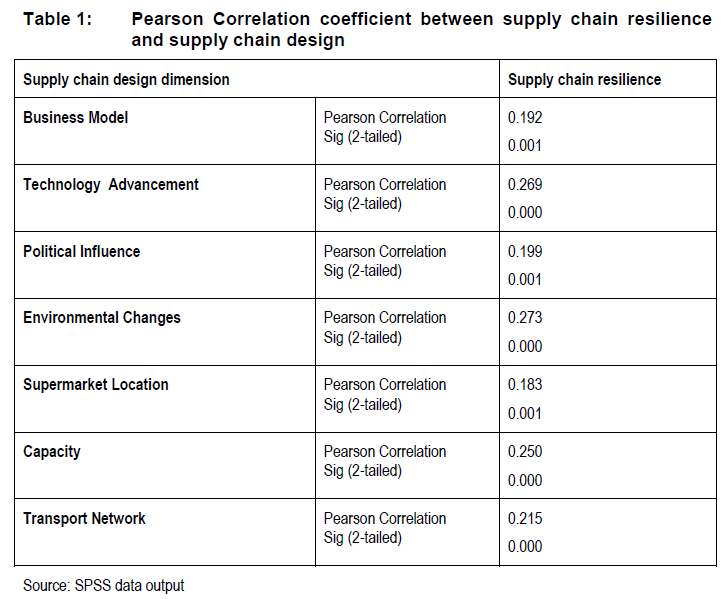
This analysis indicates the dependent and the independent variables.
Table 1 indicates the association between the supply chain design and supply chain resilience. The association is moderately positive and statistically significant with r values of ranging from 0.2 to 0.3, respectively. The results posit that these factors prompt the retailers to always increase the disruption mitigation strategies and build in resilience to their supply chain. Most world economies seem to be affected by these factors as the country of South Africa. Ideally, it is suggested that redesigning the retail business by considering these dimensions will allow resilience.
4.3 Multivariate Analysis
A multivariate data analysis was conducted for the study. Table 2 (A, B and C) were used to regress the relationship with supply chain design and supply chain resilience.
The R Square tells the extent or degree of variance in the dependent variable (supply chain resilience) that is explained by the model (comprising the independent variables). The value is 0.163 expressed in percentage, meaning that the model explains 16.3 percent of the variance in supply chain resilience. For this study, R square value is 0.163, F = 8.148, with 7 degree of freedom at a significance level, p < 0.05 using the standard multiple regression method. The association amongst the criterion and predictor variables is explained by 16.3% of the variance in supply chain resilience and the supply chain design dimensions. The dimensions of supply chain design that includes business model (β = 0.53, p < 0.05), technology advancement (β = 0.161, p < 0.05), political influence (β = 0.005, p < 0.05), environmental changes (β = 0.149, p < 0.05), supermarket location (β = 0.120, p < 0.05), capacity (β = 0.030, p < 0.05) and transport network (β = 0.174, p < 0.05) were found to be statistically associated with supply chain design. In determining the actual variables that are included in the model and have contributed to predicting the dependent variables, the researcher looked at the Beta values. For this analysis, the variables that are significant include (technology advancement = 0.010, environmental changes = 0.020 and transport network = 0.002). The variable with the largest beta coefficient relates to transport Network with a value of 0.174. This shows that the variable (transport network) makes the strongest individual influence in amplifying the variance in the dependent variable (supply chain resilience). The Durbin-Watson value is 1.589 and there are no issues of multicollinearity, all the tolerance values should be above 0.10 and the VIF values should bel less than 10.
4.4 Discussion on Multiple Regression
The empirical evidence from the multiple regression analysis indicates that technology advancement is associated to supply chain resilience. Vaquero, Urrea and Mundet (2014:149) supported the result and alluded that technology can be associated with resilience in the capacity at which individuals cope with challenges of an advanced technology development. Additionally, the Pearson moment correlation coefficient captures a wealth of information with significant statistical linear relationships that exists between the predictors or independent variables and the dependent variable (supply chain resilience). The standard multiple regression was acceptable in investigating the degree of variance in the dependent variable (supply chain resilience). The model that emerged from the analysis using seven predictor variables indicated that (R Squared = 0.404, adjusted R Squared = 0.143, F = 8.148, df = 7, p < 0.05) and 40% of the variance in supply chain resilience was explained by the connection existing amongst the predictor and criterion variables. In the same light, transport network, technology advancement and environmental changes were all statistically significant in predicting the variance in supply chain resilience (p < 0.05) and no multicollinearity assumptions were violated in the analysis. The statistic outcome of the analysed result has achieved this objective sought in the study and support the work of Melnyk et al. (2014) on the dimension levels of supply chain design.
5. RECOMMENDATIONS
Retail supply chain businesses must remain competitive and provide basic necessities of life, as humans depend on food for survival. It is then critical that retailers combine different modes of transportation to get food to its destinations despite any challenges that might occur. Retail transport network is the reason for the fruition of the business itself, as products are moved from one place to another ensuring product availability in stores. Retailers need to continually update and advance their technology, to keep abreast of online real time information for the growth of the business. This would also entail scanning the environment for best practices or even to benchmark competitors in the business. The hostile business environment, within which retail exists, continually presents unanticipated issues or disruptions such as economic influences and changes in the environment. The retail supply chain partners need to admit that the business environment is complex and ever changing, hence the business needs to swiftly adapt to such changes to achieve optimal performance and a better position in the market. When the economy is fluctuating especially the fiscus value, one would expect a price increase in the sale of goods. This is one of the uncontrollable variables in the environment, but it is recommended that a country's government should ease out some regulations on businesses for continuity sake. This can be done by reducing excessive tax burdens imposed on businesses, to allow for attractive investment to the economy. It is also recommended that retailers support and develop local suppliers, to reduce food costs and even take advantage of ensuring product availability. As sourcing is related to value for money, retailers develop local suppliers to gain this advantage. Retailers can invest in suppliers by sourcing some products such as vegetables which are delivered directly to the supermarkets. This gesture boosts the local economy and enables shorter supply chain which leads to predictable deliveries to the stores. Jobs are also created for the surrounding community which becomes a part of corporate social responsibility of the retailers.
6. CONCLUSION
This study statistically discovered that transport network, technology advancement and environmental change, are the most influential factors that contribute to the variance in supply chain design and were positively related to supply chain resilience. It is then critical, that no matter what it takes, as far as business survival is the target, supply chain partners must ensure that these variables are placed foremost in their strategic plans for the retail supply chain. This forms the basis of collaboration and better communication or sharing of information at all levels in the retail supermarket supply chain.
REFERENCES
2. LITERATURE REVIEW
-
BADENHORST-WEISS JA & NEL J. 2011. A conceptual framework to analyse supply chain designs. ACTA Commercii. 11(2):1-18. (DOI:https://doi.org/10.4102/ac.v11i2.146.
» https://doi.org/10.4102/ac.v11i2.146 -
)
» https://doi.org/10.1080/00207543.2011.563826 -
)
» https://doi.org/10.1093/rfs/hhr100 -
BOTES A, NIEMANN W & KOTZE T. 2017. Buyer-Supplier Collaboration and Supply Chain Resilience: A case study in the Petrochemical Industry. South African Journal of Industrial Engineering 24(4):183-199. (DOI:http://dx.doi.org/10.7166/28-4-1736.
» http://dx.doi.org/10.7166/28-4-1736 -
)
» https://doi.org/10.2139/ssrn.2105786 - )
-
BRIANO E, CABALLINI C GIRIBONE P & REVETRIA R. 2010. Objectives and perspectives for improving resiliency in Supply Chains. WSEAS Transactions on Systems 9:(2):136-145. [Internet:https://http://www.wseas.us/e-library/transactions/systems/2010/89-140.pdf; downloaded on 13 March 2017.
» https://http://www.wseas.us/e-library/transactions/systems/2010/89-140.pdf -
]
» https://doi.org/10.1080/00207540903349039 -
)
» https://doi.org/10.1016/j.cie.2011.10.003 -
BRUSSET X. 2016. Does supply chain visibility enhance agility. International Journal Production Economics 171:46-59. (DOIhttps://doi.org/10.1016/j.ijpe.2015.10.005.
» https://doi.org/10.1016/j.ijpe.2015.10.005 -
)
» https://doi.org/10.1016/j.jaccpubpol.2018.01.005 -
CANTOR DE, BLACKHURST JV & CORTES JD. 2014. The clock is ticking: the role of uncertainty, regulatory focus, and level of risk on supply chain disruption decision making behavior. Transport Research, Part E: Logistics Transport Review 72:159-172. (DOI:https://doi.org/10.1016/j.tre.2014.10.007.
» https://doi.org/10.1016/j.tre.2014.10.007 - )
- )
- CARETTA A & SCHWIZER P. 2017. Risk Culture in Banking. Springer: Palgrave Macmillan. (pp 11-30.
-
)
» https://www.businesslive.co.za/redzone/news-insights/2016-05-11-fmcg-insights-into-a-changing-retail-scene/ -
)
» https://mpra.ub.uni-muenchen.de/72319/ -
CHAWDHURY J. 2016. Political Instability a Major Obstacle to Economic Growth in Bangladesh. Centria University of Applied Sciences. [Internet:https://www.theseus.fi/bitstream/handle/10024/120469/Thesis-Political-instability.pdf?sequence=1; downloaded on 27 August 2018.
» https://www.theseus.fi/bitstream/handle/10024/120469/Thesis-Political-instability.pdf?sequence=1 -
]
» https://www.tralac.org/news/article/11515-south-africa-s-retail-sector-an-overview-of-2016-trade.html - )
-
CHRISTOPHER M & PECK H. 2004. Building the Resilient Supply Chain. International Journal of Logistics Management 15(2):1-14. (DOI:https://doi.org/10.1108/09574090410700275.
» https://doi.org/10.1108/09574090410700275 - )
-
CHRISTOPHER M, MENA C, KHAN O & YURT O. 2011. Approaches to managing global sourcing risk. Supply Chain Management; International Journal 16(2):67-81. (DOI:https://doi.org/10.1108/13598541111115338.
» https://doi.org/10.1108/13598541111115338 -
)
» https://10.5539/ijbm.v7n2p89 - CRESWELL JW. 2009. Research Design: Qualitative, Quantitative, and Mixed Methods Approaches. 3rd edition. Thousand Oaks, CA, US: Sage Publications, Inc.
-
CRAIGHEAD CW, BLACKHURST J, RUNGTUSANATHAM MJ & HANDFIELD RB. 2007. The Severity of Supply Chain Disruptions: Design Characteristics and Mitigation Capabilities. Decision Sciences 38(1):131. (DOI:https://doi.org/10.1111/j.1540-5915.2007.00151.x.
» https://doi.org/10.1111/j.1540-5915.2007.00151.x -
)
» https://doi.org/10.1016/j.ifacol.2016.07.773 -
DAVIES B, BILOTTA E, HAPESHI K, SALVIA E & SERVIDIO R. 2011. From User Cognition to User Interaction Modalities in Consumer Behavior. In Pantano E, Timmermans H. Eds. Advanced Technologies Management for Retail: Frameworks and Cases, IGI Global [Internet: https://pdfs.semanticscholar.org/11ca/d694c7cf251294975a5d7a5449207d695804.pdf; downloaded on 22 August 2018]. (pp 253-269.
» https://pdfs.semanticscholar.org/11ca/d694c7cf251294975a5d7a5449207d695804.pdf -
)
» https://doi.org/10.1016/j.jclepro.2008.04.013 -
]
» https://doi.org/10.1016/j.ijpe.2015.05.018 -
DING H, ZHAO Q, AN Z, XU J & LIU Q. 2015. Pricing strategy of environmental sustainable supply chain with internalizing externalities. International Journal of Production Economics 170(Part B):563-575. (DOI:https://doi.org/10.1016/j.ijpe.2015.05.016.
» https://doi.org/10.1016/j.ijpe.2015.05.016 -
)
» https://doi.org/10.1016/j.apgeog.2018.08.007 -
]
» https://doi.org/10.1016/j.tre.2014.04.006 -
ERNEST & YOUNG. 2014. Shifting focus: Risk culture at the forefront of banking. Risk Management Survey of Major Financial Institutions. (pp 1-81). [Internet:https://www.ey.com/Publication/vwLUAssets/ey-shifting-focus-risk-culture-at-the-forefront-of-banking/$File/ey-shifting-focus-risk-culture-at-the-forefront-of-banking.pdf; downloaded on 27 August 2018.
» https://www.ey.com/Publication/vwLUAssets/ey-shifting-focus-risk-culture-at-the-forefront-of-banking/$File/ey-shifting-focus-risk-culture-at-the-forefront-of-banking.pdf -
]
» https://doi.org/10.1016/j.ism.2015.07.002 -
]
» https://www2.deloitte.com/us/en/insights/deloitte-review/issue-14/dr14-risk-to-resilience.html -
FERNIE J & SPARKS L. 2014. Retail logistics: changes and challenges. ResearchGate 1-25. [Internet:https://www.researchgate.net/publication/241410437_Retail_logistics_changes_and_challenges; downloaded on 31 January 2019.
» https://www.researchgate.net/publication/241410437_Retail_logistics_changes_and_challenges - ]
-
GARCIA DJ & YOU F. 2015. Supply chain design and optimization: Challenges and opportunities. Computers and Chemical Engineering. 81:153-170. (DOI:https://doi.org/10.1016/j.compchemeng.2015.03.015.
» https://doi.org/10.1016/j.compchemeng.2015.03.015 -
)
» https://doi.org/10.3390/fire1010018 - GLIGOR DM. 2013. The Concept of Supply Chain Agility: Conceptualisation, Antecedents, and the Impact on Firm Performance. Graduate School, University of Tennesse, Knoxville. (Doctoral dissertation.
- )
-
)
» https://dx.doi.org/10.1007%2Fs10488-013-0528-y -
GREWAL D, ROGGEVEEN AL & NORDFALT J. 2017. The Future of Retailing. Journal of Retailing 93(1):1-6. (DOI:https://doi.org/10.1016/j.jretai.2016.12.008.
» https://doi.org/10.1016/j.jretai.2016.12.008 -
)
» https://doi.org/10.1111/j.1540-6261.2012.01746.x -
HABERMANN M, BLACKHURST J & METCALF AY. 2015. Keep your friends close? Supply Chain Design and Disruption Risk. Decision Sciences 46(3):491-526. (DOI:https://doi.org/10.1111/deci.12138.
» https://doi.org/10.1111/deci.12138 -
)
» https://pdfs.semanticscholar.org/0b8bZ28a0c28f0e261eb43b689553d561420376a5.pdf - HABIB MN & SHAH A. 2013. Business process reengineering: Literature review of approaches and applications. Kuala Lumpur, Malaysia. (3rd Asia-Pacific Business Research Conference). (pp 1- 25.
- )
-
HOHENSTEIN N, FEISEL E, HARTMANN E & GIUNIPERO L. 2015. Research on the phenomenon of supply chain resilience: A systematic review and paths for further investigation. International Journal of Physical Distribution and Logistics Management 45(1/2):90-117. (DOI: https://10.1108/IJPDLM-05-2013-0128.
» https://10.1108/IJPDLM-05-2013-0128 -
)
» http://web.mit.edu/scresponse/repository/SC_Resp_Report_Interim_Final_8803.pdf -
HUDNURKAR M, JAKHAR S & RATHOD U. 2014. Factors Affecting Collaboration in Supply Chain: A Literature Review. Procedia Social and Behavioral Sciences 133:189-202. (DOI:https://doi.org/10.1016/j.sbspro.2014.04.184.
» https://doi.org/10.1016/j.sbspro.2014.04.184 -
)
» https://doi.org/10.1111/rmir.12025 -
)
» https://worldconferences.net/proceedings/icssr2013/toc/092%20-%20AZREEN%20-%20Mediating%20Effect%20of%20Enterprise%20Risk% 20Management%20Practices%20on%20Risk% 20Culture% 20and%20Organizational%20Performance.pdf -
JÜTTNER U & MAKLAN S. 2011. Supply Chain Resilience in the Global Financial Crisis: An Empirical Study. Supply Chain Management: An International Journal 16(4):246-2. (DOI:https://10.1108/13598541111139062.
» https://10.1108/13598541111139062 - )
-
KERN D, MOSER R, HARTMANN E & MODER M. 2012. Supply risk management: model development and empirical analysis. International Journal of Physical Distribution and Logistics Management 42(1):60-82. (DOI:https://doi.org/10.1108/09600031211202472.
» https://doi.org/10.1108/09600031211202472 - )
-
KOTTER JP & SCHLESINGER LA. 1979. Choosing strategies for change. Harvard Business Review 57(2):106-114. [Internet:https://hbr.org/2008/07/choosing-strategies-for-change; downloaded on 23 April 2019.
» https://hbr.org/2008/07/choosing-strategies-for-change -
]
» https://doi.org/10.1080/00207540500117805 -
)
» https://doi.org/10.1108/09574090210806333 -
KUMAR G, SUBRAMANIAN N & ARPUTHAM RM. 2018. Missing link between sustainability collaborative strategy and supply chain performance: Role of dynamic capability. International Journal of Production Economics 203:96-109. (DOI:https://doi.org/10.1016/j.ijpe.2018.05.031.
» https://doi.org/10.1016/j.ijpe.2018.05.031 -
)
» https://doi.org/10.1080/00207543.2012.710764 -
)
» http://www.statssa.gov.za/?p=11101 -
LI L. 2012. Effects of enterprise technology on supply chain collaboration: analysis of China-linked supply chain. Enterprise Information Systems 6(1):55-77. (DOI:https://doi.org/10.1080/17517575.2011.639904.
» https://doi.org/10.1080/17517575.2011.639904 -
)
» https://doi.org/10.1016/j.ijpe.2015.05.012 -
)
» https://doi.org/10.1080/00207543.2015.1037934 -
MACDUFF A. 2017. South African business confidence hit by political uncertainty and corruption - analyst. [Internet:http://www.engineeringnews.co.za/article/south-african-business-confidence-hit-by-political-uncertainty-and-corruption-analyst-2017-09-28; downloaded on 08 February 2019.
» http://www.engineeringnews.co.za/article/south-african-business-confidence-hit-by-political-uncertainty-and-corruption-analyst-2017-09-28 -
]
» https://www.researchgate.net/publication/270281481_Promoting_Resilience_through_ Technology_Art_and_a_Child_Rights-Based_Approach - )
- MAFINI C & LOURY-OKOUMBA WV. 2016. Buyer-supplier Commitment, Trust and Cooperation as influencing factors to Business Performance in the Fast-Moving Consumer Goods Industry. (28th Annual Conference of the Southern African Institute of Management Scientists). (pp 617- 632.
- )
- )
-
MANDAL S. 2012. An Empirical Investigation into Supply Chain Resilience. The IUP Journal of Supply Chain Management 9(4):46-61. [Internet:https://www.researchgate.net/publication/255858490_An_Empirical_Investigation_into_Supply_Chain_Resilience; downloaded on 12 November 2018.
» https://www.researchgate.net/publication/255858490_An_Empirical_Investigation_into_Supply_Chain_Resilience - ]
- )
- MAVETERA CG. 2012. An Evaluation of the Supportiveness of Systems Development Methodologies to Strategic Goals during Business Process Reengineering. Potchefstroom Campus of the North West University. (Masters of Science in Computer Science.
- )
-
MCGRATH RG. 2010. Business Models: A Discovery Driven Approach. Long Range Planning 43(2-3):247-261. (DOI:https://doi.org/10.1016/j.lrp.2009.07.005.
» https://doi.org/10.1016/j.lrp.2009.07.005 - )
-
MELNYK SA, NARASIMHAN R & DECAMPOS HA. 2014. Supply chain design: issues, challenges, frameworks, and solutions. International Journal of Production Research 52(7):1887-1896. (DOI:https://10.1080/00207543.2013.787175.
» https://10.1080/00207543.2013.787175 - )
-
MENSAH P & MERKURYEV Y. 2014. Developing a Resilient Supply Chain. Procedia-Social and Behavioral Sciences 110(2014):309-319. (DOI:https://doi.org/10.1016/j.sbspro.2013.12.875.
» https://doi.org/10.1016/j.sbspro.2013.12.875 - )
- )
-
NEL JD & BADENHORST-WEISS JA. 2010. Supply chain Design: Some Critical Questions, Department of Business Management University of South Africa (Unisa) South Africa. (DOI:https://10.4102/jtscm.v4i1.68.
» https://10.4102/jtscm.v4i1.68 - )
-
NISAR QA, AHMAD S & AHMAD U. 2014. Exploring factors that contribute to success of business process reengineering and impact of business process reengineering on organizational performance: A qualitative descriptive study on banking sector at Pakistan. Asian Journal of Multidisciplinary Studies 2(6):219-224. [Internet:https://www.academia.edu/10402818/Exploring_Factors_that_Contribute_to_Success_of_Business _Process_Reengineering_and_Impact_of_Business_Process_Reengineering_on_Organizational_Performance_A_Q ualitative_Descriptive_study_on_Banking_Sector_at_Pakistan; downloaded on 30 May 2018.
» https://www.academia.edu/10402818/Exploring_Factors_that_Contribute_to_Success_of_Business _Process_Reengineering_and_Impact_of_Business_Process_Reengineering_on_Organizational_Performance_A_Q ualitative_Descriptive_study_on_Banking_Sector_at_Pakistan - ]
-
NPI GOVERNANCE CONSULTING. 2018. Enterprise Development and Transformation in the FMCG and Agriculture sector. [Internet:https://npiconsulting.co.za/wp-content/uploads/2018/03/NPI-BEE-FMCG-ESD-Report.pdf; downloaded on 27 August 2018.
» https://npiconsulting.co.za/wp-content/uploads/2018/03/NPI-BEE-FMCG-ESD-Report.pdf - ]
-
NZEWI HN, NZEWI US & MONEME PC. 2015. Business Process Reengineering and Performance of Courier Service Organizations iIn Anambra State, Nigeria. American Journal of Social and Management Sciences 6(1):24-33. [Internet:https://ssrn.com/abstract=2780435; downloaded on 02 February 2019.
» https://ssrn.com/abstract=2780435 - ]
- )
-
PANTANO E & VIASSONE M. 2014. Demand pull and technology push perspective in technology-based innovations for the points of sale: the retailers' evaluation. Journal of Retail and Consumer Services 21(1):43-47. (DOI:https://doi.org/10.1016/j.jretconser.2013.06.007.
» https://doi.org/10.1016/j.jretconser.2013.06.007 - )
- )
-
PETIT TJ, CROXTON KL & FISKEL J. 2013. Ensuring supply chain resilience: Development and Implementation of an Assessment Tool. Journal of Business Logistics 34(1):46-76. (DOI:https://doi.org/10.1111/jbl.12009.
» https://doi.org/10.1111/jbl.12009 - )
- ]
-
PONIS ST & KORONIS E. 2012. Supply Chain Resilience: Definition of Concept and Its Formative Elements. Journal of Applied Business Research 28(5):921-929. (DOI:10.19030/jabr.v28i5.7234.
» https://doi.org/10.19030/jabr.v28i5.7234 - )
-
RAJU GS & SINGH SP. 2018. Business model practices in Indian retail sector: A conceptual study. Indian Journal of Commerce and Management Studies 9(1):24-28. (DOI:http://dx.doi.org/10.18843/ijcms/v9i1/04.
» http://dx.doi.org/10.18843/ijcms/v9i1/04 - )
- ]
-
RICHEY RG, ROATH AS, WHIPPLE JM & FAWCETT SE. 2010. Exploring Governance Theory of Supply Chain Integration: Barriers and Facilitators to Integration. Journal of Business Logistics 31(1):237-256. (DOI:https://doi.org/10.1002/j.2158-1592.2010.tb00137.x.
» https://doi.org/10.1002/j.2158-1592.2010.tb00137.x - )
- )
-
ROIG-TERNO N, BAVIERA-PUIG A, BUITRAGO-VERA J & MAS-VERDU F. 2013. The retail site location decision process using GIS and the analytical hierarchy process. Applied Geography 40(2):191-198. (DOI:https://doi.org/10.1016/j.apgeog.2013.03.005.
» https://doi.org/10.1016/j.apgeog.2013.03.005 - )
- ]
-
SABOUHI F, PISHVAEE S & JABALAMELI MS. 2018. Resilient supply chain design under operational and disruption risks considering quantity discount: A case study of pharmaceutical supply chain. Computers and Industrial Engineering 126:657-672. (DOI:https://doi.org/10.1016/j.cie.2018.10.001.
» https://doi.org/10.1016/j.cie.2018.10.001 - )
-
SCHOLTEN K, SHARKEY P & FYNES SF. 2014. Mitigation Processes - antecedents for building supply chain resilience. Supply Chain Management: An International Journal 19:211-228. (DOI:https://10.1108/SCM-06-2013-0191.
» https://10.1108/SCM-06-2013-0191 - )
-
SETHURAMAN R & PARASURAMAN A. 2005. Succeeding in the big middle through technology. Journal of Retailing 81(2):107-111. (DOI:https://doi.org/10.1016/j .jretai .2005.03.003.
» https://doi.org/10.1016/j .jretai .2005.03.003 - )
- )
-
SHEFFI Y & RICE JB (JNR). 2005. A Supply Chain View of Resilient Enterprise. MIT Sloan Management Review 47(1):41-48. [Internet:https://www.researchgate.net/publication/255599289_A_Supply_Chain_View_of_the_Resilient_Enterprise; downloaded on 23 May 2017.
» https://www.researchgate.net/publication/255599289_A_Supply_Chain_View_of_the_Resilient_Enterprise - ]
- )
-
SINGH K (NEWS24). 2017. KZN storm declared a provincial disaster. [Internet:https://www.news24.com/SouthAfrica/News/kzn-storm-declared-a-provincial-disaster-20171012; downloaded on 02 June 2018.
» https://www.news24.com/SouthAfrica/News/kzn-storm-declared-a-provincial-disaster-20171012 - ]
- )
-
STATISTICS SOUTH AFRICA (STATS SA). 2016. The economy shrinks in the fourth quarter of 2016. [Internet:http://www.statssa.gov.za/?p=9622; downloaded on 11 September 2019.
» http://www.statssa.gov.za/?p=9622 - ]
- ]
-
TAHERDOOST H. 2017. Determining Sample Size; How to Calculate Survey Sample Size. International Journal of Economics and Management Systems 2:237-239. [Internet:https://www.iaras.org/iaras/filedownload s/ijems/2017/007-0032(2017).pdf; downloaded on 20 August 2018.
» https://www.iaras.org/iaras/filedownload s/ijems/2017/007-0032(2017).pdf - ]
- )
-
TRKMAN P, BUDLER M & GROZNIK A. 2015. A business model approach to supply chain management. Supply Chain Management: An International Journal 20(6):587-602. (DOI:https://10.1108/SCM-06-2015-0219.
» https://10.1108/SCM-06-2015-0219 - )
- )
-
UDAY P & MARAIS K. 2015. Designing Resilient Systems-of-Systems: A Survey of Metrics, Methods, and Challenges. Systems Engineering 18(5):491-510. (DOI:https://doi.org/10.1002/sys.21325.
» https://doi.org/10.1002/sys.21325 - )
- ]
-
WILDING R. 2013. Supply chain temple of resilience. Institute of Operations Management [Internet:https://www.researchgate.net/publication/259619660_Supply_Chain_Temple_of_Resilience; downloaded on 11 March 2017]. (pp1-12.
» https://www.researchgate.net/publication/259619660_Supply_Chain_Temple_of_Resilience