Entrepreneurial intention: Perspectives from women in a South African province
Abstract
The objective of this study was to assess the entrepreneurial intention of women in a South African province. The study employed a quantitative, exploratory research design, utilising a self-administered survey of 200 women in South Africa's North West province. A non-probability sampling approach was followed. Data were analysed using the Statistical Package for Social Sciences (SPSS) by means of an exploratory factor analysis, Pearson's product-moment correlation and multiple regression analysis. Findings revealed that moderate entrepreneurial intentions exist among women in the North West province. Entrepreneurial self-efficacy was found to yield the greatest influence on entrepreneurial intention, followed by risk-taking attributes and cultural perspectives. It also emerged that attitudes towards entrepreneurship, cultural perspectives, risk-taking and self-efficacy had a significant and positive relationship with entrepreneurial intention. There was no statistical difference in entrepreneurial intention in terms of age, educational qualifications and employment status. The study provides guidelines for governmental and non-governmental role players in harnessing and promoting entrepreneurial intention among women. The study provides insights into the existence of entrepreneurial intention in a rural setting in South Africa, which has been neglected in literature. This study contributes to the existing body of knowledge on entrepreneurial intention in South Africa. The findings can be used to guide policy interventions as they highlight factors which should be integrated into programmes enhancing women's entrepreneurial intention. JEL CLASSIFICATION: M10
Entrepreneurship; entrepreneurial intention; South Africa
1. INTRODUCTION
Long held traditional perceptions of men acting as the sole providers for their families are progressively changing around the world (Zeb, 2018). While this positive shift in economic participation has been noted, women entrepreneurs continue facing challenges when wanting to contribute to economic growth. Authors such as Georgieva (2017) and Meyer and Klonaridis (2020) have argued that a woman's economic participation is highly beneficial for families, communities and the economy. The South African President, Cyril Ramaphosa, pointed out that raising the income and standard of living of women is key to building stable communities (Ramaphosa, 2020). The importance of women entrepreneurship is of such magnitude that the expansion thereof around the globe has been key in overcoming economic challenges and furthering economic development (Meunier et al., 2017; Zeb, 2018). Statistics from some emerging markets, such as the case of Ghana, have shown that women's inclination to engage in entrepreneurial activities was at 38%, which is greater than that of men, at 35%. However, in many emerging markets this drive to engage in entrepreneurial activities is driven through necessity, rather than through opportunity (Quartey et al., 2018; Zhu et al., 2019). In other contexts, cultural constraints, gender bias and lack of societal support deter women from becoming entrepreneurs in countries such as Brazil, Canada, Portugal, Spain, the United Kingdom and the United States (Mastercard Index of Women Entrepreneurs, 2018).
According to Statistics South Africa (2019), South Africa's population count is at approximately 58.8 million people, 51% of whom are women. However, seen against these statistics, women's involvement in entrepreneurial activities in South Africa was low at 10.2%, compared to men at 11.4% in 2019 (Bosma et al., 2020). In comparison to Africa, participation of women in entrepreneurship in South Africa is amongst the lowest on the continent, and particularly low between the ages of 18 and 34, and only peaks among those in the 45-54 age bracket (Kelley et al., 2017; Sekatane, 2018). These findings are consistent with the MIWE report (2018), which indicates that South Africa is ranked 42nd of 57 countries profiled in terms of women business owners, which translates to only 18.8% participation. This problem appears to be most pressing in the North West province in South Africa, based on the indication of Statistics South Africa (2018) that only 44% of women are economically active, despite being in the majority in the province, as opposed to 56% of economically active men. Moreover, in 2017, the unemployment rate was higher at 28.3% for women compared to 25.4% for men in the subject province. Despite a population size of around 3.9 million and a contribution of 6.4% to South Africa's Gross Domestic Product, the North West province is a predominantly rural and poor province where a trend of migration towards the Gauteng province in search of job opportunities has become evident (Statistics South Africa, 2017; 2018). The migration of workers also drains the province of potential entrepreneurs. Studies on female entrepreneurship in the North West province, such as by Henning and Akoob (2017), reveal that factors such as gender discrimination, lack of education and domestic violence impede women's entrepreneurship and deprive female entrepreneurs of opportunities. A lack of business and financial skills and the lack of business networks have been found to act as barriers to women entrepreneurship in the North West province, however this phenomenon has not been explored exhaustively (Henning & Akoob, 2017).
This indicates that the contribution of the North West to the national GDP will be further hampered. Given the key role of entrepreneurship in job creation, it is important to determine factors inhibiting women's entrepreneurial intentions in the North West province.
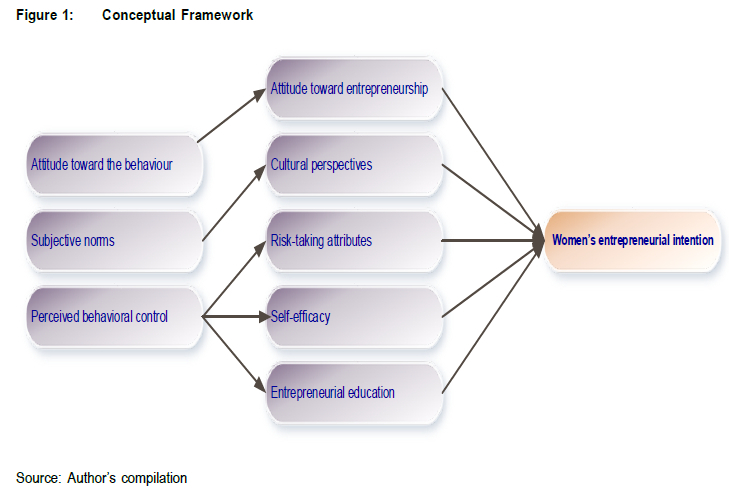
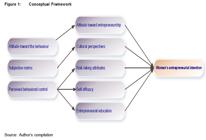
This study embraces Ajzen's (1991) Theory of Planned Behaviour (TPB) to assess the entrepreneurial intentions of women. The TPB argues that intention is measured by three elements, namely, (i) attitude towards the behaviour, (ii) subjective norm and (iii) perceived behavioural control. This theory has been tested in numerous studies (Gird & Bagraim, 2008; Kautonen et al., 2013a; Malebana & Swanepoel, 2015; Dinc & Budic, 2016) which explored the entrepreneurial intentions of diverse people in various environments all over the world. However, in the North West province, there is scant research on the entrepreneurial intentions of any population group, particularly that of women. This study seeks to bridge this gap by using the TPB to assess the intentions of women to start businesses.
The sections that follow present an overview of the pertinent literature on the topic under discussion, namely the TPB, entrepreneurial intention, as well as female entrepreneurship.
2.1. Theory of Planned Behaviour
The TPB was developed by Ajzen (1991) as a result of identified shortcomings of his original Theory of Reasoned Action (TRA). In 2005, Ajzen elaborated that the inclusion of perceived behavioural control into the TPB was as a result of shortcomings in the TRA. It is for this reason that at the heart of the TPB lies the notion that intentions reflect the effort that individuals are prepared to make to engage in a particular behaviour (Ajzen, 1991; Krueger et al., 2000). Ajzen (2005:117) points out that "a person's intention to perform a behaviour is the most important immediate determinant of that action". The TPB, to this effect, proposes three 'determinants of intention', notably, (i), subjective norm (ii) attitude towards the behaviour, and (iii) perceived behavioural control (Schlaegel & Koenig, 2014). Subjective norm (SN) refers to perceived pressure influencing behaviour emanating from an individual's social context (Ajzen, 1991; Ajzen & Cote, 2008). These authors also make mention to the fact that social pressure is generally informed by normative beliefs, which can be defined as "the expectation that a given referent individual or group would approve or disapprove of performing a behaviour" (Ajzen & Cote, 2008:302). Attitude toward the behaviour (ATB) can be defined as "a disposition to respond favourably or unfavourably to an object, person, institution or event" (Ajzen, 2005:3).
Hypothesis 1 (Hi) can therefore be set as follows: A positive relationship exists between attitude towards entrepreneurship and entrepreneurial intent.
Studies, by Fretschner and Weber (2013), showed that strong beliefs around responsibility, financial success and self-reliance result in a positive attitude towards entrepreneurship. Perceived Behavioural Control (PBC) refers to the "perceived capability to perform the behaviour" (Ajzen & Cote, 2008:301). Beliefs on control concern themselves with the existence of factors likely to accelerate or encumber performance of a particular behaviour. To this effect, Walter and Dohse (2012) found that entrepreneurial role models, and social support in terms of knowledge, significantly impact entrepreneurial intentions. Perceived Behavioural Control is therefore at the nexus of social capital (a network of relationships) and the ability to identify a business opportunity (Ramos-Rodríguez et al., 2010).
The TPB as a tool to assess entrepreneurial intention has been verified in a number of studies, as well as in the South African context. In the South African context, studies by Gird and Bagraim (2008), Malebana and Swanepoel (2015), as well as Mbuya and Schachtebeck (2016) have confirmed validity of the TPB instrument. In the global context, prominent studies such as by Kautonen et al. (2013a), Dinc and Budic (2016), Palupi and Santoso (2017) have investigated entrepreneurial intent amongst an adult population, while also taking gender into account. However, a critique of the TPB is however the lack of synthesised evidence linking intention to action, thereby calling for an investigation into the relationship between intention and behaviour (Kautonen et al., 2013b). Consequently, a stream of research has emerged positively linking intention to action using the original constructs of the TPB, with some of these studies finding that entrepreneurial motivation positively affects the intention-behaviour-link in the TPB. These studies thereby act as predictors of observable action based on self-assessed entrepreneurial intent (Kautonen et al., 2013a; Kautonen et al., 2013b; Alam et al., 2019).
2.2. Entrepreneurial intention
Bird (1988:442) states that "intentionality is a state of mind directing a person's attention toward a specific object or a path to achieve something". Hisrich et al. (2013:17) define entrepreneurial intention as "the motivational factors that influence individuals to pursue entrepreneurial outcomes". Entrepreneurial intention can be regarded as the pre-cursor to new venture creation, before such a venture is launched in reality (Travis & Freeman, 2017). As intention can be considered a psychological process, it requires persistence, perseverance and courage from an individual (Bird, 1988). Entrepreneurial intention is therefore a fundamental antecedent to new venture creation (Lee et al., 2011; Martins et al., 2019). Krueger et al. (2000) state that intentionality is at the heart of entrepreneurial activity, adding that intentionality plays an intermediary role between the act of new venture creation and the antecedents of such intentions.
Given the importance of entrepreneurial intention in predicting entrepreneurial behaviour, the body of knowledge surrounding this concept has been expanded by scholars such as Liñán and Chen (2009), Schlaegel and Koenig (2014) and Shinnar et al. (2018). Two opposing theories, the Entrepreneurial Event Model (EEM) and TPB, have been extensively used to investigate entrepreneurial intention (Solesvik et al., 2012; Schlaegel & Koenig, 2014). Krueger et al. (2000:416) argue that "these models offer sound theoretical frameworks that specifically map out the nature of processes underlying intentional behaviour". The EEM, developed by Shapero and Sokol (1982), links perceived desirability, propensity to act, as well as perceived feasibility as dimensions of entrepreneurial intention. According to Krueger et al. (2000:418), "perceived desirability is the extent to which an individual is attracted to becoming an entrepreneur, considering intrapersonal and extrapersonal factors". Propensity to act is a "person's disposition to act on one's decisions" (Shapero & Sokol, 1982), while personal feasibility is the "extent to which an individual perceives their personal ability to start a business is referred to as personal feasibility" (Krueger et al., 2000:418). Authors such as Carsrud and Brännback (2011) expand the discussion on entrepreneurial intent by focusing on implementation intentions, rather than traditional environmental barriers to entrepreneurial intent. These authors further argue that often a significant lag exists between the intention to start a business and actual implementation, often owing to availability of opportunities. The inclusion of personal behavioural goals is therefore recommended.
While the dimensions of the TPB are traditionally used to measure entrepreneurial intent, the inclusion of several factors have emerged which aid in the determination of entrepreneurial intent. Authors such as Mbuya and Schachtebeck (2016), Malebana (2016) as well as Meyer and Hamilton (2020) have argued that entrepreneurship education can be a predictor of entrepreneurial intention as the principal aim of entrepreneurship education is to prepare an individual to think like an entrepreneur and start a new business (Tobias & Ingrams, 2010).
Hypothesis 2 (H2) can therefore be set as follows: A positive relationship exists between entrepreneurship education and entrepreneurial intent.
Similarly, self-efficacy, when seen as an individual's belief in his/her own abilities, has a link to entrepreneurship in that an individual will believe that one's own abilities are sufficient in mitigating risks and solving challenges when involved in new venture creation (Bandura, 1994; Sadriwala & Khan, 2018).
Hypothesis 3 (H3) can therefore be set as follows: A positive relationship exists between self-efficacy and entrepreneurial intent.
In addition, cultural factors are critical when encouraging entrepreneurial behaviours as society has an influence on one's perception of entrepreneurship as a career option (Liñán et al., 2013). Other authors have found that culture and gender moderate the relationship between entrepreneurial perceptions and intentions (Shinnar et al., 2012), thereby suggesting that the entrepreneurial intentions of women are lower in 'masculine' cultures.
Hypothesis 4 (H4) can therefore be set as follows: A positive relationship exists between cultural perspectives and entrepreneurial intent.
Lastly, authors such as Tipu (2017) and Meyer (2018) have suggested that the element of risk-taking, when viewed from a gender perspective, has borne inconsistent results. These authors further argue that risk-taking is essentially a decision-making variable and therefore can be factored in when evaluating intention.
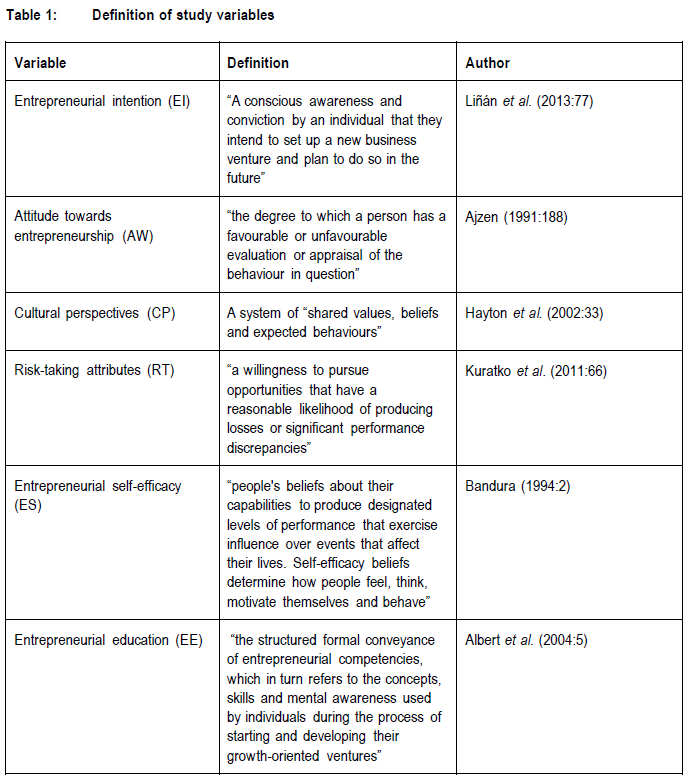
Hypothesis 5 (H5) can therefore be set as follows: A positive relationship exists between risk-taking and entrepreneurial intent. A summary of the variables utilised in this study is presented in Table 1.
The conceptual framework underpinning this study is shown in Figure 1.
2.3. Female entrepreneurship
Women's participation in the mainstream economy has been acknowledged as being pivotal to achieve a number of positive socio-economic outcomes, such as sustainable economic development, improved health outcomes, poverty alleviation, as well as improved welfare and education (Statistics South Africa, 2014). The South African government proposed the National Development Plan (NDP), which coherently articulates the country's future, highlighting the need for active economic participation of women as key if economic development and women's empowerment are to be realised (National Planning Commission, South Africa, 2011).
To this effect, Golla et al. (2011:4) aptly state that "a woman is economically empowered when she has both the ability to succeed economically and the power to make economic decisions". The Global Entrepreneurship Monitor (GEM) report states that the higher the level of female participation in entrepreneurship, the more likely women are to contribute substantially to economic growth and to their children's education, mentor other women and be active in society (Kelley et al., 2017). While a wide range of highly funded government initiatives exist in South Africa to promote entrepreneurial development (Herrington et al., 2017), the Department of Trade and Industry (2005) stresses that any such initiatives must be both efficient and effective in supporting female entrepreneurship. However, several studies point to a myriad challenge that female entrepreneurs encounter to this day (Deborah et al., 2015; Pounder, 2016; Sekatane, 2018), thereby impeding participation of women in entrepreneurship (Sekatane, 2018).
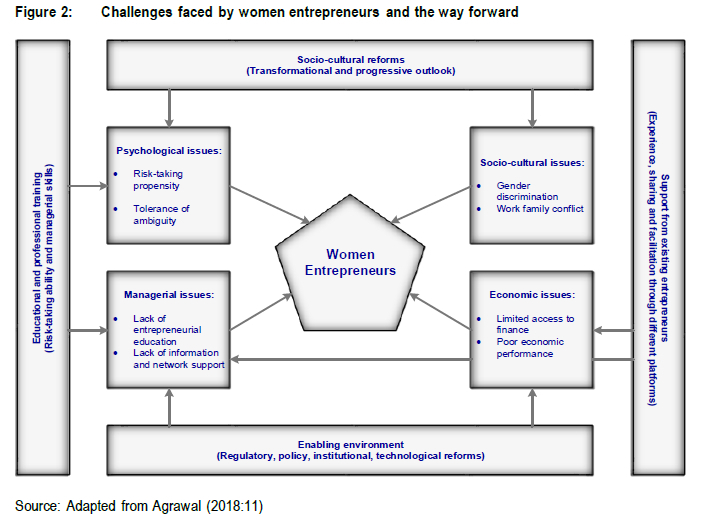
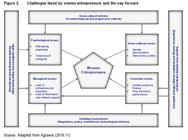
Entrepreneurs face a number of generic challenges, irrespective of gender. These challenges include inadequate planning, leading and control skills in the micro-environment, organising, competitive threats and economic, social, political and legal challenges in the macro-environment (Nieman et al., 2008; Louw & Venter, 2010). Panda (2018) however argues that even though the challenges might be generic to both men and women, their intensity tends to be higher for women. In different studies, inhibiting factors such as lack of financial knowledge, family concerns, finance, heightened competition in the market and a weak economy have been cited (Itani et al., 2011; Troyani, 2019; Zhu et al., 2019). Current research on female entrepreneurship however also largely ignore the existence of secondary choice-behaviours, as well as an overt focus on educational qualifications as representing employability (Elo et al., 2020). These authors argue that in a developed market context, discrimination and external institutional aspects, as well as sociocultural norms act as barriers to economic participation (Elo et al., 2020). Other studies which have investigated barriers confronting women entrepreneurs in various countries found commonalities in most of them (Belwal et al., 2014; Panda & Dash, 2014; Karan & Shokeen, 2017; Nziku & Struthers, 2018; Panda, 2018). Agrawal (2018) summarises the challenges faced by women entrepreneurs (Figure 2).
3. MATERIAL AND METHODS
The main purpose of this study was to assess the entrepreneurial intention of women in the North West province of South Africa. This study made use of a quantitative research approach to achieve this objective. As the aim of this study was to identify relationships between selected concepts (i.e. attitude towards entrepreneurship, cultural perspectives, risk-taking attributes, self-efficacy and entrepreneurial education) and entrepreneurial intention, a quantitative research design was deemed appropriate. The study followed a post-positivistic philosophical stance which allowed for a deductive research approach to be selected. In ascertaining entrepreneurial intentions, literature was utilised to deduce a testable relationship between independent variables with entrepreneurial intention.
A survey strategy was adopted in the form of a self-administered questionnaire. Responses were collected from women located in the North West province in South Africa, covering an area of 104,882 km2. The population for this study consisted of women between the ages of 18 and 60, residing in the selected province. Approximately 1 million women fall into this category in the North West province (Statistics South Africa, 2019). As no database of women who are between the ages of 18 and 60 for the province exists, the sample for this study predominantly comprised groups of women sharing similar interests and activities. These included, inter alia, women's empowerment initiatives, heritage preservation interests and fitness activities. The study employed a convenience sampling approach as the researcher had a previous working relationship with some of the coordinators of the shared interest groups. The study made use of an existing entrepreneurial intention questionnaire, proposed by Liñán and Chen (2009). This questionnaire had also previously been validated in other studies (Liñán et al., 2013; Malebana, 2014; Malebana & Swanepoel, 2015; Mbuya & Schachtebeck, 2016). The questionnaire contained three sections, with Section A containing demographic questions. Section B contained questions on one dependent and five independent variables, namely (i) entrepreneurial intention (dependent variable), (ii) attitude towards entrepreneurship, (iii) cultural perspectives, (iv) risk-taking attributes, (v) entrepreneurial self-efficacy and (vi) entrepreneurial education. Section C sought to determine more detailed responses on future entrepreneurial endeavours, such as targeted industry and type of business.
A 7-point Likert scale was adopted for this study to accurately gauge strength of responses. Data were analysed by means of the Statistical Package for the Social Sciences (SPSS), version 25, and made use of descriptive statistics, factor analysis, Pearson product-moment correlation analysis and regression analysis. To determine the reliability of the instrument, the questionnaire was pre-tested and administered twice (one week apart) to ten respondents with similar characteristics to the study population. The study adhered to strict ethical principles with respondents being provided with a cover letter outlining right to withdraw at any point, the voluntary nature of the study, statement of confidentiality and anonymity, as well as a consent form. Ethical clearance to conduct the study was obtained from the relevant Research Ethics Committee.
4. FINDINGS AND DISCUSSION
A total of 250 paper-based questionnaires were distributed and 207 were returned, thereby yielding a response rate of 82,8%. In total, 200 of the 207 returned questionnaires proved usable. In terms of demographics, representation of women in the sample was the highest in the age group of 30-39 at 33% (n=66), followed by the age group of 20-29 at 32% (n=64). Women in the age group of 50-59 constituted 6% (n=14) of the sample, while only 3% (n=5) were over the age of 60. In terms of qualifications, 9.5% (n=19) of the respondents held postgraduate degrees, while 15.5% (n=31) did not hold a school leaving or any formal educational qualification. Twenty percent (n=40) had a post-Matric (school leaving) certificate or diploma, while 22% (n=44) held a Bachelor's degree. The respondents who held a school leaving (matric) certificate formed the highest proportion of the respondents at 33% (n=66). In terms of entrepreneurial education, 73.5% (n=147) of the sample had not attended any entrepreneurial education course or programme, while only 26.5% (n=53) had attended such.
4.1. Factor and reliability analysis
As the original scale by Liñán and Chen (2009) was amended for clarity in wording, and a section of Entrepreneurial Education added, an Exploratory Factor Analysis (EFA) was conducted. In conducting the EFA an assessment of the suitability of data, factor extraction, as well as factor rotation and interpretation were performed. Values for the Kaiser-Meyer-Olkin (KMO) Test for Sampling Adequacy stood above 0.8 for all scales, higher than the 0.6 cut-off value (Pallant, 2016). Bartlett's test of sphericity for all scales was significant at 0.000, indicating that factor analysis was appropriate. One item in the entrepreneurial education scale was removed due to a low factor loading and removed from further analysis. For the factor extraction Kaiser's criterion was followed and factors with eigenvalues great than one retained (Pallant, 2016). All factors were retained as per the original model, however cultural perspectives and entrepreneurial education split into two factors. For cultural perspectives, the split was based on one factor indicating as positive cultural perspectives, mainly relating to the close social environment of the respondents, while the other factor referred to negative cultural perspectives, relating to the general social environment. Communality values were in excess of the recommended value of 0.3 (Pallant, 2016), indicating good fit. For entrepreneurial education, two factors emerged under the themes of education fails women entrepreneurs (Factor 1) and education is needed for women entrepreneurs (Factor 2). Communality values were also in excess of the recommended value of 0.3.
Creswell and Creswell (2018) note that the internal consistency of the scale is qualified by a Cronbach's Alpha value varying between 0 and 1, with a scale exceeding a coefficient of 0.7 is deemed reliable. Cronbach's Alpha values of the six individual constructs for this study varied from 0.5 to 0.9. Entrepreneurial intention had the highest coefficient at 0.960, followed by self-efficacy at 0.951, 0.944 (attitude towards entrepreneurship), 0.845 (risk-taking attributes) and 0.810 (cultural perspectives), thereby indicating good internal consistency. A low Cronbach's Apha value (0.533) was observed for the scale of entrepreneurial education. Based on the low number of items (five) in the scale, the mean inter-item correlation was considered as a measure of internal consistency. Pallant (2016) indicates a minimum value of 0.20 for mean inter-item correlations. The entrepreneurial education scale recorded a mean inter-item correlation of 0.191, which according to Clark and Watson (1995) is deemed appropriate as it falls within a range of 0.15 and 0.5. While below the threshold suggested by Pallant (2016), other studies making use of the same scale recorded similar results which were deemed acceptable (Van Tonder, 2017; Anwar & Saleem, 2019).
4.2. Descriptive statistics
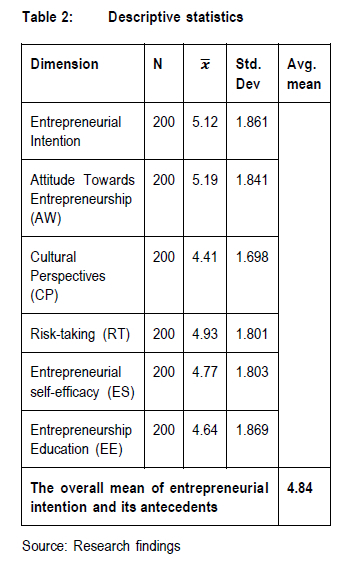
This section provides the mean, standard deviation and average mean of entrepreneurial intention and its dimensions. The variables utilised in this study are presented in Table 2.
Respondents were requested to indicate their level of agreement on a scale from 1 (strongly disagree), 4 (unsure) to 7 (strongly agree).
For Entrepreneurial Intention, a mean of 5.12 was recorded, suggesting that respondents slightly agreed with an intention to become entrepreneurs. Despite respondents indicating slight agreement towards EI, respondents seemed to indicate the importance of entrepreneurship in society by indicating determination to start a business in the near future. This compares favourably with other studies (Kelley et al., 2017; Vinindwa, 2019) in terms of entrepreneurial intentions among women. Although EI does not always translate into new venture creation, Martins et al. (2019) argue that intention plays a pivotal role in predicting the start of any entrepreneurial activity. The average mean for attitude towards entrepreneurship yielded a value of 5.19, which indicated slight agreement. The statement "If I had the opportunity and resources, I'd like to start a business" (x=5.58; SD=1.841) yielded the highest agreement, thereby implying that a positive evaluation of entrepreneurship might be evoked by the availability of opportunities and resources. Eagly and Chaiken (2007) argue that individuals develop positive attitudes about an object if association with positive characteristics can be established. This sentiment is affirmed by Belwal et al. (2014), who found that women favoured new venture creation owing to association with a positive reception and support by society. In terms of cultural perspectives, a mean of 4.41 was recorded, thereby tending towards being 'unsure' about views on the respondent's cultural environments concerning women entrepreneurship. This could be attributed to the subjective nature of perspectives. Although cultures differ from one geographical area or group to the next, authors such as Liñán et al. (2013) have found a positive relationship between cultural factors and entrepreneurial intention of individuals. Hofstede (1991) further argues that culture is primarily shaped by the social environment of people. In terms of risk-taking, a mean of 4.93 was recorded, suggesting being 'unsure' tending towards 'slight agreement'. This suggests that the respondents did display the required attributes to a certain degree to pursue entrepreneurship despite its inherent risks. This finding is congruent with growing consensus among researchers (Harris et al., 2006; Dalborg et al., 2015; Humbert & Brindley, 2015) that women are more risk-averse compared to their male peers.
Tipu (2017) suggests that individuals who are more likely to become entrepreneurs have lower levels of risk-aversion. A similar finding in terms of lack of agreement emerged for self-efficacy and entrepreneurial education, with a mean of 4.77 and 4.64, respectively. Overall, entrepreneurial intention and its predictors yielded a mean of 4.84, therefore despite displaying low levels of agreement, examination of predictors or independent variables is of importance. Liñán and Chen (2009) affirmed that entrepreneurial intentions can be determined by both cognitive or exogenous factors. As intention is a critical precursor of entrepreneurial behaviour (Martins et al., 2019), it can be driven by factors such as beliefs, culture, availability of resources, attitudes, and requisite skills and abilities (Malebana & Swanepoel, 2015).
In terms of Section C of the questionnaire, most of the respondents (81.5%; n=163) indicated that they would like to own a business in the future, with catering and accommodation emerging as the preferred sector in which they would like to operate, followed by agriculture, chosen by 18.4% (n=30) respondents. 39.9% of respondents wished to operate a small business, followed by a micro business (38%).
4.3. Correlation analysis
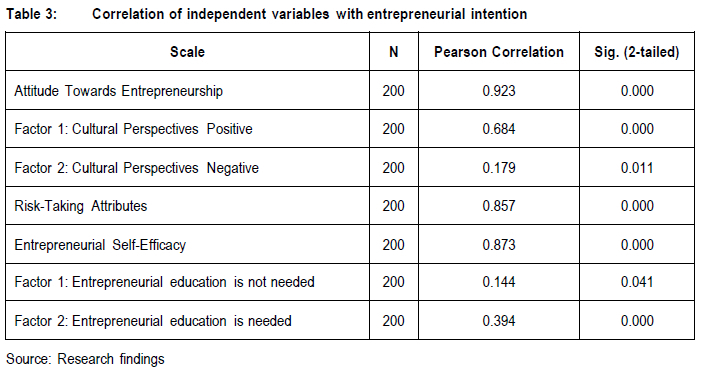
The Pearson product-moment correlation coefficient was used to describe the relationship between the independent variables and the dependent variable. The results of the correlation analysis are presented in Table 3. Cohen (1988) states that the strength of a relationships can be considered small when r values fall in the range of 0.10 and 0.29, medium between 0.30 and 0.49 and large between 0.50 and 1.0.
The relationship between EI and AW indicated a significant, strong and positive correlation (r =0.92, p<0.000). This finding indicates that a stronger attitude towards entrepreneurship implies an increase in the EI of women. This finding is consistent other studies which had similar findings (Malebana, 2014; Dinc & Budic, 2016; Van Tonder, 2017; Meyer, 2018) and confirms H1. Similarly, EI and positive cultural perspectives displayed a significant, strong and positive correlation (r =0.68, p<0.000). This indicates that women would be likely to develop the intention to start a business if their cultural milieu encouraged entrepreneurial behaviour. This finding is in-line with other studies such as Liñán et al. (2013) and Alexander & Honig (2016) who found a positive and significant influence of culture on entrepreneurial intention through the antecedents of the TPB (personal attitude and perceived behavioural control), thereby confirming H4. The findings also compare favourably with that of Mungai and Ogot (2012) who found a significant influence of cultural norms on the development of entrepreneurial intention. Conversely, the relationship between EI and negative cultural perspectives did not indicate a statistically significant and positive correlation (r =0.18, p <0.011), indicating that a cultural perspective that does not promote women's entrepreneurial behaviour does not affect entrepreneurial intent. Both risk-taking and self-efficacy displayed statistically significant and positive correlation, r=0.86, p<0.000 and r=0.87, p<0.000, respectively. Higher levels of self-efficacy and risk-taking attributes therefore increase entrepreneurial intention, confirming H3. These findings corroborate the work of other researchers who established a positive relationship between risk-taking attributes and the intention to start a business, thereby confirming H5 (Moraes et al., 2018; Dalborg et al., 2015). Lastly, a positive and statistically significant correlation between entrepreneurial intentions and education failing women entrepreneurs (r =0.14, p=0.041), as well as education needed for women entrepreneurs (r =0.39, p<0.000) was found, confirming H2. Walter and Dohse (2012) and Doan and Phan (2020) also found entrepreneurial education to positively influence entrepreneurial intention. However, these findings are contradicted by other studies which revealed that entrepreneurial education did not affect entrepreneurial intention (Khalifa & Dhiaf, 2016; Van Tonder, 2017).
4.4. Regression analysis
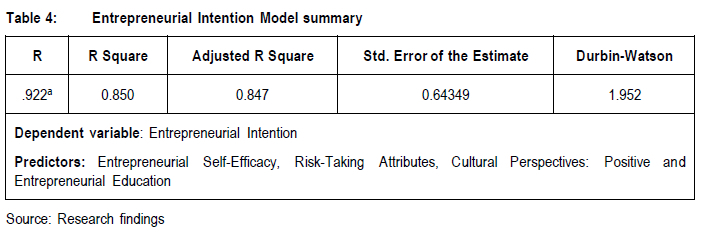
Having discovered the relationships between the independent and dependent variables in the preceding section, it is also of importance to establish the unique influence of these independent variables on the dependent variable. In-line with the objectives of this study, multiple regression was conducted to identify the predictor variables yielding the greatest influence on the dependent variable. Preliminary analyses were carried out to ensure that the assumptions of normality, linearity, multicollinearity and homoscedasticity were not violated. Three variables that did not meet the requirements included (i) attitude towards entrepreneurship, (ii) cultural perspectives: negative and (iii) entrepreneurial education fails women. The results of the regression analysis are indicated in Table 4.
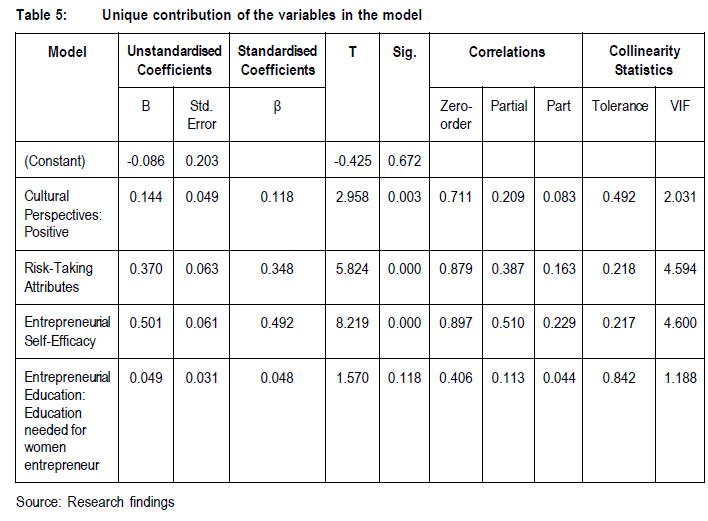
The final model, which included cultural perspectives: positive, risk-taking attributes, entrepreneurial self-efficacy and education needed for women entrepreneurs, explained 85% of the variance (R2 =0.850) in entrepreneurial intention. This indicates that the variables in the final model provided a good fit. Unique contributions of each variable are shown in Table 5.
Results indicate that the variable that made the largest unique contribution to explain entrepreneurial intention was entrepreneurial self-efficacy (β=0.49), followed by risk-taking attributes (β=0.35) and cultural perspective (β=0.12). The finding on self-efficacy is in-line with findings by authors such as Saraih et al. (2018), while the finding for risk-taking is supported by authors such as Herdjiono et al. (2017) and those for cultural perspectives by Solesvik et al. (2014). The three variables also made a statistically significant unique contribution in predicting EI (0.000, 0.000 and 0.003, respectively). Results also indicated that entrepreneurship education needed for women entrepreneurs made less of a contribution (β=0.048), the factor was however not statistically significant (p=0.118).
5. CONCLUSION AND IMPLICATIONS
This study confirmed that women in the North West province in South Africa possess an intention to start their own business, albeit with a low level of agreement. The study also found that positive and strong relationships exist between entrepreneurial intention and attitude towards entrepreneurship, cultural perspectives, self-efficacy and risk-taking attributes. The relationship between entrepreneurial intention and entrepreneurial education was positive although its strength was weak. The study also found that self-efficacy, risk-taking attributes and cultural perspectives can be seen as predictors of EI.
Due to the positive influence of entrepreneurship education on EI, policy-makers are prompted to focus on the provision of such entrepreneurial education programmes at an earlier stage, ideally at school level, which is currently not standard practice in South Africa. This can establish entrepreneurship as a viable career path. Further, universities are prompted to introduce targeted entrepreneurship education programs across urban and rural South Africa. South African commercial banks should make their offerings such as loans, insurance and savings products more easily accessible to women wishing to start businesses and re-align currently rigid repayment structures. In the North West province, women with entrepreneurial intentions should be proactive in creating linkages in networks, or ideally, initiate such social networks.
The study also faced some limitations, most prominently the cross-sectional nature, which did not allow for assessment of entrepreneurial intention over a period of time. Also, due to the employed convenience sampling approach, findings cannot be generalised. Future studies could include, through a longitudinal study and use of TPB, if women who had entrepreneurial intent translated the intent into new venture creation. Future studies could adopt a qualitative approach to provide further insights into the social standpoint of women concerning their role in business and society.
REFERENCES
2. LITERATURE REVIEW
-
AGRAWAL R. 2018. Constraints and Challenges Faced by Women Entrepreneurs in Emerging Market Economy and the Way Forward. Journal of Women's Entrepreneurship and Education (3-4):1-19. [DOI: 10.28934/jwee18.34.pp 1-19].
» https://doi.org/10.28934/jwee18.34.pp 1-19 - AJZEN I & COTE N. 2008. Attitude and the prediction of behaviour. In: W. Crano & R. Prislin (eds.), Attitude and attitude change. New York, NY: Psychology Press.
-
AJZEN I. 1991. The theory of planned behavior. Organizational Behavior and Human Decision Processes 50(2):179-211. [DOI: 10.1016/0749-5978(91)90020-T].
» https://doi.org/10.1016/0749-5978(91)90020-T - AJZEN I. 2005. Attitudes, personality, and behavior. Maidenhead, England: Open University Press.
-
ALAM MZ, KOUSAR S & REHMAN CA. 2019. Role of entrepreneurial motivation on entrepreneurial intentions and behaviour: theory of planned behaviour extension on engineering students in Pakistan. Journal of Global Entrepreneurship Research, 9(50):1-20. [DOI: 10.1186/s40497-019-0175-1].
» https://doi.org/10.1186/s40497-019-0175-1 - ALBERT F, SCIASCIA S & POLI A. 2004. Entrepreneurship education: Notes on an ongoing debate. Proceedings of the 14th Annual Internet Conference. Italy: University of Napoli Federico.
-
ALEXANDER I & HONIG B. 2016. Entrepreneurial Intentions: A Cultural Perspective. Africa Journal of Management 2(3):235-257. [DOI: 10.1080/23322373.2016.1206801].
» https://doi.org/10.1080/23322373.2016.1206801 -
ANWAR I & SALEEM I. 2019. Exploring entrepreneurial characteristics among university students: An evidence from India. Asia Pacific Journal of Innovation and Entrepreneurship 13(3):282-295. [DOI: 10.1108/APJIE-07-2018-0044].
» https://doi.org/10.1108/APJIE-07-2018-0044 - BANDURA A. 1994. Self-efficacy. In: V. Ramachaudran (ed.), Encyclopedia of Human Behaviour (pp. 71-81). New York, NY: Academic Press.
-
BELWAL S, BELWAL R & SAIDI F. 2014. Characteristics, Motivations and Challenges of Women Entrepreneurs in Oman's Al-Dhahira Region. Journal of Middle East Women's Studies 10(2):135-151. [DOI: 10.2979/jmiddeastwo mstud.10.2.135].
» https://doi.org/10.2979/jmiddeastwo mstud.10.2.135 -
BIRD B. 1988. Implementing Entrepreneurial Ideas: The Case for Intention. The Academy of Management Review 13(3):442-453. [DOI: 10.2307/258091].
» https://doi.org/10.2307/258091 - BOSMA N, HILL S, IONESCU-SOMERS A, KELLEY D, LEVIE J & TARNAWA A. 2020. Global Entrepreneurship Monitor: 2019/2020 Global Report. London, England: London Business School.
-
CARSRUD A & BRÄNNBACK M. 2011. Entrepreneurial motivations: what do we still need to know? Journal of Small Business Management 49(1):9-26. [DOI: 10.1111/j.1540-627X.2010.00312.x].
» https://doi.org/10.1111/j.1540-627X.2010.00312.x -
CLARK LA & WATSON D. 1995. Constructing validity: Basic issues in objective scale development. Psychological Assessment 7(3):309-319. [DOI: 10.1037/1040-3590.7.3.309].
» https://doi.org/10.1037/1040-3590.7.3.309 - COHEN JW. 1988. Statistical power analysis for the behavioral sciences. 2nd ed. Hillsdale, NJ: Lawrence Erlbaum Associates.
-
DALBORG C, VON FRIEDRICHS Y & WINCENT J. 2015. Risk perception matters: Why women's passion may not lead to a business start-up. International Journal of Gender and Entrepreneurship 7(1):87-104. [DOI: 10.1108/IJGE-01-2013-0001].
» https://doi.org/10.1108/IJGE-01-2013-0001 -
DEBORAH A, WILHELMINA S, OYELANA A & IBRAHIM S. 2015. Challenges Faced by Women Entrepreneurs and Strategies Adopted by Women Entrepreneurs to Ensure Small Business Success in Nkonkobe Municipality, South Africa. Journal of Economics 6(1):37-49. [DOI: 10.1080/09765239.2015.11885015].
» https://doi.org/10.1080/09765239.2015.11885015 - DEPARTMENT OF TRADE AND INDUSTRY. 2005. South African Women Entrepreneurs: A burgeoning force in our economy. A special report 2005. Pretoria: Department of Trade and Industry.
-
DINC M & BUDIC S. 2016. The Impact of Personal Attitude, Subjective Norm, and Perceived Behavioural Control on Entrepreneurial Intentions of Women. Eurasian Journal of Business and Economics 9(17):23-35. [DOI: 10.17015/ejbe.2016.017.02].
» https://doi.org/10.17015/ejbe.2016.017.02 -
EAGLY A & CHAIKEN S. 2007. The Advantages of an Inclusive Definition of Attitude. Social Cognition 25(5):582-602. [DOI: 10.1521/soco.2007.25.5.582].
» https://doi.org/10.1521/soco.2007.25.5.582 -
ELO M, AMAN R & TÄUBE F. 2020. Female Migrants and Brain Waste -A Conceptual Challenge with Societal Implications. International Migration, October (2020):1-24. [DOI: 10.1111/imig.12783].
» https://doi.org/10.1111/imig.12783 -
FRETSCHNER M & WEBER S. 2013. Measuring and Understanding the Effects of Entrepreneurial Awareness Education. Journal of Small Business Management 51(3):410-428. [DOI: 10.1111/jsbm.12019].
» https://doi.org/10.1111/jsbm.12019 -
GEORGIEVA K. 2017. To end poverty, tap full potential of women starting businesses. The World Bank. [Internet: http://www.worldbank.org/en/news/opinion/2017/10/30/to-end-poverty-tap-full-potential-of-women-starting-businesses; downloaded on 21 February 2019].
» http://www.worldbank.org/en/news/opinion/2017/10/30/to-end-poverty-tap-full-potential-of-women-starting-businesses -
GIRD A & BAGRAIM J. 2008. The Theory of Planned Behaviour as predictor of entrepreneurial intent amongst final-year university students. South African Journal of Psychology 38(4):711-724. [DOI: 10.1177/008124630803800410].
» https://doi.org/10.1177/008124630803800410 - GOLLA A, MALHORTRA A, NANDA P & MEHRA R. 2011. Understanding and Measuring Women's Economic Empowerment: Definition, Framework and Indicators. Washington: International Center for Research on Women.
- HARRIS C, JENKINS M & GLASER D. 2004. Gender differences in risk assessment: Why do women take fewer risks than men? Judgement and Decision Making 1(1):48-63.
-
HAYTON J, GEORGE G & ZAHRA S. 2002. National Culture and Entrepreneurship: A Review of Behavioral Research. Entrepreneurship Theory and Practice 26(4):33-52. [DOI: 10.1177/104225870202600403].
» https://doi.org/10.1177/104225870202600403 -
HENNING S & AKOOB K. 2017. Motivational factors affecting informal women entrepreneurs in North West Province. Southern African Journal of Entrepreneurship and Small Business Management 9(1):1-10. [DOI: 10.4102/sajesbm.v9i1.91].
» https://doi.org/10.4102/sajesbm.v9i1.91 -
HERDJIONO I, PUSPA Y, MAULANY G & ALDY B. 2017. The Factors Affecting Entrepreneurship Intention. International Journal of Entrepreneurial Knowledge 5:5-15. [DOI: 10.1515/ijek-2017-0007].
» https://doi.org/10.1515/ijek-2017-0007 - HERRINGTON M, KEW P & MWANGA A. 2017. Global Entrepreneurship Monitor South African Report 2016/2017. Cape Town: University of Cape Town.
- HISRICH RD, PETERS MP & SHEPHERD DA. 2013. Entrepreneurship. 9th ed. New York, NY: McGraw-Hill/Irwin.
- HOFSTEDE G. 1991. Cultures and organizations. London, England: McGraw-Hill.
-
HUMBERT A & BRINDLEY C. 2015. Challenging the concept of risk in relation to women's entrepreneurship. Gender in Management: An International Journal 30(1):2-25. [DOI: 10.1108/GM-10-2013-0120].
» https://doi.org/10.1108/GM-10-2013-0120 -
ITANI H, SIDANI Y & BAALBAKI I. 2011. United Arab Emirates female entrepreneurs: Motivations and frustrations. Equality, Diversity and Inclusion: An International Journal 30(5):409-424. [DOI: 10.1108/02610151111150654].
» https://doi.org/10.1108/02610151111150654 -
KARAN R & SHOKEEN S. 2017. Women Entrepreneurs in India - Issues and Challenges. International Journal of Economics and Management Studies 4(12):17-23. [DOI: 10.14445/23939125/IJEMS-V4112P103].
» https://doi.org/10.14445/23939125/IJEMS-V4112P103 -
KAUTONEN T, VAN GELDEREN M & FINK M. 2013a. Robustness of the Theory of Planned Behavior in Predicting Entrepreneurial Intentions and Actions. Entrepreneurship Theory and Practice 39(3):655-674. [DOI: 10.1111/etap.12056].
» https://doi.org/10.1111/etap.12056 -
KAUTONEN T, VAN GELDEREN M & TORNIKOSKI E. 2013b. Predicting Entrepreneurial Behaviour: A Test of the Theory of Planned Behaviour. Applied Economics 45(6):697-707. [DOI: 10.1080/00036846.2011.610750].
» https://doi.org/10.1080/00036846.2011.610750 - KELLEY D, BAUMER B, BRUSH C, GREENE P, MAHDAVI M, MAJBOURI M, COLE M, DEAN M & HEAVLOW R. 2017. Global Entrepreneurship Monitor 2016/2017 Report on Women's Entrepreneurship. Boston, MA: The Fenway Group.
-
KHALIFA A & DHIAF M. 2016. The Impact of Entrepreneurship Education on Entrepreneurial Intention: The UAE Context. Polish Journal of Management Studies 14(1):119-128. [DOI: 10.17512/pjms.2016.14.1.11].
» https://doi.org/10.17512/pjms.2016.14.1.11 -
KRUEGER N, REILLY M & CARSRUD A. 2000. Competing models of entrepreneurial intentions. Journal of Business Venturing 15(5-6):411-432. [DOI: 10.1016/S0883-9026(98)00033-0].
» https://doi.org/10.1016/S0883-9026(98)00033-0 - KURATKO D, MORRIS M & COVIN J. 2011. Corporate entrepreneurship and innovation. Mason, OH: SouthWestern Cengage Learning.
-
LEE L, WONG P, FOO M & LEUNG A. 2011. Entrepreneurial intentions: The influence of organizational and individual factors. Journal of Business Venturing 26(1):124-136. [DOI: 10.1016/j.jbusvent. 2009.04.003].
» https://doi.org/10.1016/j.jbusvent. 2009.04.003 -
LIÑÁN F & CHEN Y. 2009. Development and Cross-Cultural Application of a Specific Instrument to Measure Entrepreneurial Intentions. Entrepreneurship Theory and Practice 33(3):593-617. [DOI: 10.1111/j.1540-6520.2009.00318.x].
» https://doi.org/10.1111/j.1540-6520.2009.00318.x -
LIÑÁN F, NABI G & KRUEGER N. 2013. Cultural values and entrepreneurship. Entrepreneurship & Regional Development 25(9-10):703-707. [DOI: 10.1080/08985626.2013.862961].
» https://doi.org/10.1080/08985626.2013.862961 - LOUW L & VENTER P. 2010. Strategic management: Developing sustainability in Southern Africa. 2nd ed. Cape Town: Oxford University Press.
-
MALEBANA M. 2014. The Effect of Knowledge of Entrepreneurial Support on Entrepreneurial Intention. Mediterranean Journal of Social Sciences 5(20):1020-102.8 [DOI: 10.5901/mjss.2014.v5n20p1020].
» https://doi.org/10.5901/mjss.2014.v5n20p1020 -
MALEBANA M. 2016. Does entrepreneurship education matter for the enhancement of entrepreneurial intention? Southern African Business Review 20(1):365-387. [DOI: 10.25159/1998-8125/6056].
» https://doi.org/10.25159/1998-8125/6056 -
MALEBANA M & SWANEPOEL E. 2015. Graduate entrepreneurial intentions in the rural provinces of South Africa. Southern Africa Business Review 19(1):89-111. [DOI: 10.25159/1998-8125/5835].
» https://doi.org/10.25159/1998-8125/5835 -
MARTINS F, SANTOS E & SILVEIRA A. 2019. Entrepreneurial Intention: Categorization, Classification of Constructs and Proposition of a Model. Brazilian Business Review 16(1):46-62. [DOI: 10.15728/bbr.2019.16.1.4].
» https://doi.org/10.15728/bbr.2019.16.1.4 - MASTERCARD INDEX OF WOMEN ENTREPRENEURS. 2018. Mastercard Index of Women Entrepreneurs. New York, NY: Mastercard.
-
MBUYA J & SCHACHTEBECK C. 2016. Future entrepreneurs: Does the field of study matter? A comparison of students in a South African urban environment. Problems and Perspectives in Management 14(2):228-235. [DOI: 10.21511/ppm. 14(2-1).2016.12].
» https://doi.org/10.21511/ppm. 14(2-1).2016.12 - MEUNIER F, KRYLOVA Y & RAMALHO R. 2017. Women's entrepreneurship: How to measure the gap between new female and male entrepreneurs? Policy Research Working Paper (pp. 1-26). Washington DC: World Bank Group.
-
MEYER N. 2018. South African female entrepreneurs' intention to remain in business. (Doctoral thesis). Potchefstroom, South Africa: North-West University. [Internet:https://repository.nwu.ac.za/bitstream/handle/10394/31976/Meyer_N.pdf?sequence=1&isAllowed=y downloaded on 1 June 2020].
» https://repository.nwu.ac.za/bitstream/handle/10394/31976/Meyer_N.pdf?sequence=1& isAllowed=y -
MEYER N & KLONARIDIS R. 2020. The identification of female entrepreneurs' business growth factors: Evidence from South Africa. International Journal of Business and Management Studies, 12(1):208-224. [DOI: 10.34109/ijefs.202012109].
» https://doi.org/10.34109/ijefs.202012109 -
MEYER N & HAMILTON L. 2020. Female entrepreneurs' business training and its effect on various entrepreneurial factors: Evidence from a developing country. International Journal of Economics and Finance Studies, 12(1),135-151. [DOI: 10.34109/ijefs.202012109].
» https://doi.org/10.34109/ijefs.202012109 -
MORAES G, LIZUKA E & PEDRO M. 2018. Effects of Entrepreneurial Characteristics and University Environment on Entrepreneurial Intention. Revista de Administração Contemporânea 22(2):226-248. [DOI: 10.1590/1982-7849rac2018170133].
» https://doi.org/10.1590/1982-7849rac2018170133] -
MUNGAI E & OGOT M. 2012. Gender, Culture and Entrepreneurship in Kenya. International Business Research 5(5):175-183. [DOI: 10.5539/ibr.v5n5p175].
» https://doi.org/10.5539/ibr.v5n5p175 - NATIONAL PLANNING COMMISSION, SOUTH AFRICA. 2011. National Development Plan Vision 2030. Pretoria: Government Printers.
- NIEMAN G, HOUGH J & NIEUWENHUIZEN C. 2008. Entrepreneurship. Pretoria: Van Schaik.
-
NZIKU MD & STRUTHERS J. 2018. Female entrepreneurship in Africa: Strength of weak ties in mitigating principal-agent problems. Journal of Small Business and Enterprise Development 25(3):349-367. [DOI: 10.1108/JSBED-03-2017-0115].
» https://doi.org/10.1108/JSBED-03-2017-0115 - PALLANT J. 2016. SPSS Survival Manual. 6th ed. Berkshire, England: Open University Press.
-
PALUPI D & SANTOSO BH. 2017. An empirical study on the Theory of Planned Bahavior: The effect of gender on entrepreneurship intention. Journal of Economics, Business and Accountancy 20(1):71-79. [DOI: 10.14414yjebav.v20i1.626j.
» https://doi.org/10.14414yjebav.v20i1.626j -
PANDA S. 2018. Constraints faced by women entrepreneurs in developing countries: Review and ranking. Gender in Management: An International Journal 33(4):315-331. [DOI: 10.1108/GM-01 -2017-0003].
» https://doi.org/10.1108/GM-01 -2017-0003 -
PANDA S & DASH S. 2014. Constraints faced by entrepreneurs in developing countries: A review and assessment. World Review of Entrepreneurship, Management and Sustainable Development 10(4):174-2473. [DOI: 10.1504/WREMSD.2014.064951].
» https://doi.org/10.1504/WREMSD.2014.064951 - POUNDER P. 2016. Entrepreneurship and gender disparity in the Caribbean. Journal of Research on Women and Gender 6(1):4-23.
-
QUARTEY P, DANQUAH M, OWUSU G & IDDRISU A. 2018. Unmasking the contributing factors of entrepreneurial activities among men and women in Ghana. Journal of Economic Studies 45(1):114-125. [DOI: 10.1108/JES-08-2016-0152].
» https://doi.org/10.1108/JES-08-2016-0152 -
RAMAPHOSA C. 2020. From the Desk of the President. [Internet: https://www.polity.org.za/article/from-the-desk-of-the-president-monday-9-march-2020-202; downloaded on 9 March 2020].
» https://www.polity.org.za/article/from-the-desk-of-the-president-monday-9-march-2020-202 -
RAMOS-RODRÍGUEZ A, MEDINA-GARRIDO J, LORENZO-GÓMEZ J & RUIZ-NAVARRO J. 2010. What you know or who you know? The role of intellectual and social capital in opportunity recognition. International Small Business Journal: Researching Entrepreneurship 28(6):566-582. [DOI: 10.1177/0266242610369753].
» https://doi.org/10.1177/0266242610369753 -
SADRIWALA K & KHAN L. 2018. Entrepreneurial self-efficacy and its impact on entrepreneurial intentions. International Journal of Management Sciences and Business Research 7(9):9-21. [DOI: 10.13140/RG .2.2.36084.19843].
» https://doi.org/10.13140/RG .2.2.36084.19843 - SARAIH U, ARIS AZZ, MUTALIB S A, AHMAD TST, ABDULLAH S & AMLUS MH. 2018. The influence of self-efficacy on entrepreneurial intention among engineering students. Paper presented at the MATEC Web of Conferences.
-
SCHLAEGEL C & KOENIG M. 2014. Determinants of Entrepreneurial Intent: A Meta-Analytic Test and Integration of Competing Models. Entrepreneurship Theory and Practice 38(2):291-332. [DOI: 10.1111/etap.12087].
» https://doi.org/10.1111/etap.12087 - SEKATANE M. 2018. South African women entrepreneurs: Challenges and coping strategies. In: D. Opoku & E. Sandberg (eds.), Challenges to African entrepreneurship in the 21st century. Palgrave Macmillan.
- SHAPERO A & SOKOL L. 1982. The social dimensions of entrepreneurship. In: Kent, C., Sexton, D. and Vesper, K. (eds.), Encyclopaedia of Entrepreneurship (72-90). Englewood Cliffs: Prentice Hall.
-
SHINNAR R, HSU D, POWELL B & ZHOU H. 2018. Entrepreneurial intentions and start-ups: Are women or men more likely to enact their intentions? International Small Business Journal: Researching Entrepreneurship 36(1):60-80. [DOI: 10.1177/0266242617704277].
» https://doi.org/10.1177/0266242617704277 -
SOLESVIK M, WESTHEAD P, KOLVEREID L & MATLAY H. 2012. Student intentions to become self-employed: The Ukrainian context. Journal of Small Business and Enterprise Development 19(3):441-460. [DOI: 10.1108/14626001211250153].
» https://doi.org/10.1108/14626001211250153 -
SOLESVIK M, WESTHEAD P & MATLAY H. 2014. Cultural factors and entrepreneurial intention: The role of entrepreneurship education. Education and Training 56(8/9):680-696. [DOI: 10.1108/ET-07-2014-0075].
» https://doi.org/10.1108/ET-07-2014-0075 - STATISTICS SOUTH AFRICA. 2014. Gender series volume I: Economic Empowerment, 2001 - 2014. Pretoria: Statistics South Africa.
- STATISTICS SOUTH AFRICA. 2017. Gross Domestic Product Q4 2017. Pretoria: Statistics South Africa.
- STATISTICS SOUTH AFRICA. 2019. Mid-year population estimates. Pretoria: Statistics South Africa.
-
TIPU S. 2017. Entrepreneurial risk-taking: Themes from the literature and pointers for future research. International Journal of Organizational Analysis 25(3):432-455. [DOI: 10.1108/IJOA-08-2015-0898].
» https://doi.org/10.1108/IJOA-08-2015-0898 - TOBIAS J & INGRAMS A. 2010. Creating a different kind of an innovator: Using health communication theory in entrepreneurship education to foster behaviour change among entrepreneurship students in Sub-Saharan Africa. Journal of Education for International Development 4(3):1-20.
- TRAVIS J & FREEMAN E. 2017. Predicting entrepreneurial intentions: Incremental validity of proactive personality and entrepreneurial self-efficacy as a moderator. Journal of Entrepreneurship Education 20(1):45-57.
- TROYANI L. 2019. Six unexpected trends separating men vs women small business owners. Small Business Owner Report. Seattle, OR: Plan Beyond.
- VAN TONDER C. 2017. Entrepreneurial intention of the youth in Gauteng. (Master's dissertation). Johannesburg: University of Johannesburg.
- VININDWA I. 2019. Factors Influencing Entrepreneurial Intentions Among Black Female Millennials. (Master's dissertation). Johannesburg: University of Johannesburg.
-
WALTER GW & DOHSE D. 2012. Why mode and regional context matter for entrepreneurship education. Entrepreneurship and Regional Development 24(9/10):807-835. [DOI: 10.1080/08985626.2012.721009].
» https://doi.org/10.1080/08985626.2012.721009 - ZEB A. 2018. Determinants of successful women entrepreneurship in Pakistan. Abasyn Journal of Social Sciences 11(1):62-86.
-
ZHU L, KARA O & ZHU X. 2019. A comparative study of women entrepreneurship in transitional economies. Journal of Entrepreneurship in Emerging Economies 11(1):66-80. [DOI: 10.1108/JEEE-04-2017-0027].
» https://doi.org/10.1108/JEEE-04-2017-0027