Managing Financially Distressed Suppliers in Supplier Development Programmes: A Case Study in the South African Retail Industry
Abstract
An increased dependence of firms on their supply base contributes to the mitigation of supply chain disruptions and the significance of investment decisions towards current suppliers. Through the lens of information processing theory (IPT), the study aimed to determine how a large South African retailer identifies and manages financially distressed suppliers who participate in supplier development programmes. A single case study approach was followed. Ten semi-structured interviews were conducted with twelve senior managers to obtain a deep understanding of the processes used by the South African general retailer. The findings indicate that the retailer screens its supply base by leveraging its close relationships with suppliers to collect information on various early warning signals of financial distress. Corrective action, such as training suppliers, offering preferential payment terms and providing financial assistance to suppliers, is used to ensure supply continuity and the sustainability of suppliers. The findings show that supplier development programmes mitigate supply disruptions. The study contributes to supplier development literature in a South African context, by showing that a supplier's BBBEE-level does not guarantee supplier development support. The study provides managerial insight into the importance of maintaining a close relationship with suppliers and regularly communicating and visiting suppliers who participate in the supplier development programme.
Case study; financially distressed suppliers; Information Processing Theory (IPT); retail industry; South Africa; supplier development and supply disruptions
1. INTRODUCTION AND PROBLEM STATEMENT
It is imperative for buying firms to be cognisant of the well-being and status of their suppliers to circumvent risks that may tarnish the firm's reputation, operations, revenue, and eventually overall competitive advantage (Bingaman, Becher, Held, McPherson, Sriram & Iyer 2012:1; Platt & Platt 2013c:232; Yawar & Seuring 2018:227). Supply risks and disruptions occur from a wide range of problems within supplier operations. These issues can be due to problems during manufacturing, a lack of compliance with social or environmental standards and/or cash flow concerns (Bode, Hübner & Wagner 2014:24). Supply chain disruptions stemming from financially troubled suppliers can be considerable as they may lead to increased lead-times, failure to meet customer specifications and increased costs relating to switching costs or grants to maintain supplier operations (Ellis, Henry & Shockley 2011:66). In extreme cases, financially troubled suppliers can cause a complete cessation of production which has a devastating effect on the financial performance of the buying firm and the reputation of both partner firms (Bode & Wagner 2012:10; Mägerle 2014:2).
Financial distress is defined as the inability of firms to satisfy their monetary obligations promptly or as set out by the agreements between them and their supply chain partners (Lian 2017:397). Existing research on financial distress is mainly focused on the prediction of financial distress and the recognition of early warning signals (Finley 2009:2,4; Gualandris & Kalchschmidt 2014:256). This is imperative since financial distress precedes bankruptcy and still allow firms some time to take corrective action to prevent further problems and corporate decline, like bankruptcy (Cheng, Hoang, Limanto & Wu 2014:315; Platt & Platt 2008b:130). The retail industry is known for its interconnected network and flow of goods and the loss of key suppliers is a high-impact risk for retailers (Oke & Gopalakrishnan 2009:171). Retailers are heavily reliant on their suppliers to provide consumers with the needed goods (Juneja 2018:Internet; Money Matters 2018:Internet). When these suppliers become financially distressed, the product supply to retailers are affected, and retailers lose their ability to provide customers with products when and where they are needed. This ultimately results in a loss of customers (Mägerle 2014:2).
Buying firms make use of supplier development programmes to reduce supply uncertainties (Busse, Schleper, Niu & Wagner 2016:443; Yawar & Seuring 2018:227). Supplier development improves the performance of the overall supply chain by enhancing any performance deficiencies present in the suppliers' performance. This makes supply chains more competitive, efficient and responsive (Kumar & Routroy 2017a:1191; Pooe 2016:7; Pooe, Mafini & Loury-Okoumba 2015:1). The involvement of buying firms in supplier development improves the economic performance of suppliers and considerably reduces supply chain risks (Yawar & Seuring 2018:227). The heavy reliance by retailers on their suppliers highlights the impact that financially distressed supplier operations could have on the retailer's operations if disruptions were to occur. Due to this strategic impact, this study focuses its attention on how a retailer can identify and manage distressed suppliers to minimise supply disruptions and ensure supply continuity. The focus of the study is specifically on supplier development programmes since these are among the tools used by retailers to improve performance deficiencies of suppliers and to mitigate supply disruptions (Pradhan & Routroy 2014:210; Shahzad, Sillanpää, Sillanpää & Imeri 2016:57). This study draws from the Information Processing Theory (IPT) to determine how the retailer gathers, process and act on information regarding financially distressed suppliers. The IPT define firms as information processing systems that need to improve their capabilities in gathering, processing and acting on information from the environment to mitigate uncertainty (Daft & Weick 1984:285; Fan, Cheng, Li & Sun 2017:64; Tushman & Nadler 1978:614).
The purpose of this single case study was to determine how a large South African retailer manages financially distressed suppliers that participate in supplier development programmes in a developing country context.
The following research questions guided the study:
How does the retailer screen its supply base to assess the risk of financial distress?
How does the retailer determine whether financially distressed suppliers are worth developing, rather than substituting?
What actions does the retailer apply when it identifies a financially distressed supplier?
How does the retailer use the knowledge obtained from its experience with financially distressed suppliers?
Do supplier development programmes mitigate supply disruption risks?
This study contributes to the literature in three (3) ways. Firstly, it is a replication of the study by Bode et al. (2014:24-43) who explored how global manufacturing firms differ in their behaviours and capabilities when managing distressed suppliers. Therefore, this study contributes to the body of knowledge by confirming the transferability of the study by Bode et al. (2014:24-43). Secondly, the study builds on the study by Bode et al. (2014:24-43) by examining how buying firms manage financially distressed suppliers in supplier development programmes and by expanding it to a developing country context, determining the generalisability of the study by Bode et al. (2014:24-43). Thirdly, the study may assist South African retailers that are faced with financially distressed suppliers, how to manage supplier development programmes and their decision whether to develop further or substitute distressed suppliers.
In the next section, context will be provided through a review of the relevant literature, followed by a description of the methodology. The article concludes with the findings, academic and managerial contributions, limitations, and opportunities for future research.
2.1 The retail industry
The South African trade industry consists of five (5) divisions, including wholesale, motor, accommodation, food and beverages and retail (Statistics South Africa 2018:Internet). The retail industry comprises of various sectors, the largest being (1) general dealers, followed by (2) textiles and clothing; (3) food and beverages; (4) hardware, paint and glass; (5) pharmaceutical, cosmetics and toiletries; (6) household furniture and appliances; and (7) other retailers (BusinessTech 2018:Internet). In 2017, for every R100 that consumers spent at retail stores, R44 was spent at general dealers and R18 at textiles and clothing (BusinessTech 2018). The focus of this single case study is a large South African general retailer.
South African retailers perform a significant role in the economy due to their contribution to the gross domestic product (GDP), and the reduction of unemployment (Udekwe & de la Harpe 2017:1; Smith 2016:Internet). Retailers take part in the sale of merchandise to the general public and interact directly with consumers (Juneja 2018:Internet; Money Matters 2018:Internet; Dennis & Piatti 2016:2). They occupy the middle ground between producers and consumers. Therefore, retailers are heavily reliant on their suppliers to ensure that products are available when, and where, the customers needed them (Juneja 2018:Internet; Money Matters 2018:Internet). The flow of goods is delayed to the retailer, and ultimately to the consumer, when disruptions occur at the supplier stage (Käki, Salo & Talluri 2015:274). If a retailer is unable to provide consumers with the required products, consumers might switch to alternate retailers due to the intense competition within the industry (Govind, Luke & Pisa 2017:1).
2.2 Information processing theory
Information Processing Theory define firms as information processing systems that need to improve their capabilities in gathering, processing and acting on information from the environment, to mitigate uncertainty (Daft & Weick 1984:285; Egelhoff & Sen 1992:444; Fan et al. 2017:64; Tushman & Nadler 1978:614). Information processing is the collection of data, the transformation of data into information, and the communication and storage of information in the firm (Egelhoff & Sen 1992:451; Tushman & Nadler 1978:614). Based on IPT, firms can improve their effectiveness when they fit their information processing capabilities to their information processing needs, which is the amount of internal and external uncertainty the firm faces (Egelhoff & Sen 1992:452; Fan et al. 2017:65; Premkumar, Ramamurthy & Saunders 2005:261; Tushman & Nadler 1978:614). Bode et al. (2014) expanded the IPT theory further by applying it in a different supply chain management field, namely supplier financial distress.
Inter-organisational interactions create great uncertainty due to the different business objectives and stakeholders involved (Premkumar, Ramamurthy & Saunders 2005:260-261). Transactions between the businesses can be made with imperfect facts, accompanied by varying levels of information which increases the uncertainty in these interactions (Premkumar et al. 2005:260). Trust between parties can reduce risks and thereby the uncertainty in such transactions (Galbraith 1974:36; Premkumar et al. 2005:261). For this reason, firms develop long-term relationships and make relationship-specific investments with suppliers to minimise the risk and uncertainty of the transactions (Galbraith 1974:36; Premkumar et al. 2005:261). The information processing model of Daft and Weick (1984:284-295) explains a firm's reaction to changes in its environment and follows a sequential process of scanning, interpretation and action. Following the process suggested by Bode et al. (2014:27), the last stage is distinguished further between actions with the intention of solving the problem and activities focused on long-term learning. Therefore, the last stage of "action" will be divided into the action phase and the learning phase.
Scanning refers to data collection and is defined as the process of screening the environment and providing environmental data to managers of a firm (Daft & Weick 1984:286). Based on IPT, firms will scan the environment when they have specific information processing needs. These needs arise when the buying firm identifies changes in the environment and realises that its suppliers may be financially at-risk, subsequently creating a possibility of potential supply disruptions. The potential or risk of supply disruptions motivates buying firms to scan their supply base for information on suppliers' financial health and any early warning signals (Bode et al. 2014:27). Buying firms should incorporate structured and routine ways of assessing the financial health of their suppliers. This will identify any early warning signals that will enable firms to safeguard supply continuity (Finley 2009:2,4; Gualandris & Kalchschmidt 2014:256). In the most basic terms, interpretation involves giving meaning to the data collected (Daft & Weick 1984:286). During the interpretation stage, managers create cognitive maps based on the data they have collected and will then identify how to proceed (Daft & Weick 1984:286; Egelhoff & Sen 1992:446). An essential consideration in this stage is the reliability of early warning signals received by the buying firm (Bode et al. 2014:27). For instance, rumours of financial viability are less reliable than earlier payment requested by suppliers, corporate restructuring, personnel layoffs and more frequent supplier stock-outs.
When the analysis of data indicates that the current state of affairs is below the acceptable level, corrective action is needed (Bode et al. 2014:27; Daft & Weick 1984:286). Buying firms all manage financially distressed suppliers in different ways, but these methods generally differ in their level of cooperativeness. Aggressive supplier negotiations with financially distressed suppliers, supply base diversification and short-term contracts are considered uncooperative actions (Finley 2009:5; Hou & Zhao 2012:993). Active monitoring of suppliers, enhanced information sharing, long-term contracts, and assisting distressed suppliers in reducing costs and improving cash flows, are cooperative (Bode et al. 2014:28; Swinney & Netessine 2009:5). Organisational learning is the process of acquiring knowledge about the outcome relationship between the organisation and its environment (Daft & Weick 1984:286). Learning is distinguished into two primary levels, namely lower-level and higherlevel learning. Lower-level learning refers to the firm's ability to remain stable in the changing environment and can be defined as "incremental changes in routines within existing assumptions and schemes" (Bode et al. 2014:28; Lant & Mezias 1992:48-49). Higher-level learning refers to more drastic changes with a long-term impact, where alternative routines, rules, technologies, goals and purposes are needed (Bode et al. 2014:28; Lant & Mezias 1992:49).
2.3
Supply chain risk managementSupply chain risk management (SCRM) is broadly defined as, "an inter-organisational collaborative endeavour that utilises quantitative and qualitative risk management methodologies that identify, evaluate, mitigate and monitor unexpected macro and micro-level events or conditions which might adversely impact any part of a supply chain" (Ho, Zheng, Yildiz & Talluri 2015:5036). The main focus of SCRM is to adopt a more proactive attitude towards possible risks that could occur in the supply chain and to reduce their negative impact to ensure a continuous supply of goods and services (Zsidisin & Ritchie 2009:5). In the context of financially distressed suppliers, the implementation of SCRM capabilities have become increasingly important, due to the increased risk of supply disruptions caused by suppliers becoming insolvent (Blome & Schoenherr 2011:49; Ellis et al. 2011:65). Supply disruptions refer to any unforeseen situation that impedes the normal flow of materials and goods in the supply chain (Craighead, Blackhurst, Rungtusanatham & Handfield 2007:132; Ellis et al. 2011:65; Li & Chen 2010:547). The risk identification aspect of SCRM focuses more on financial crises when analysing suppliers who are experiencing financial distress (Blome & Schoenherr 2011:49).
The main difference between risk identification of a financially 'healthy' supplier and the financially distressed supplier is the use of increased financial indicators to allow for early identification of financially induced supply disruptions (Blome & Schoenherr 2011:49; Ellis et al. 2011:65). The use of internal financial evaluations of suppliers who are financially distressed by SCRM has increased since the supplier's financial situation needs to be monitored continuously to reduce the potential for supply disruptions (Blome & Schoenherr 2011:49). Supply disruptions caused by financially distressed suppliers relate to the dependency of buyers on their suppliers; therefore, the interconnectedness between buyers and suppliers means that delays from the supplier will result in delays in the buyer's supply chain (Bode & Wagner 2012:13). Financial distress that results in the supplier going out of business is disruptive for the buying firms and their supply chains, for the reason that the buying firms are unable to purchase the required materials to ensure the normal flow of operations (Bode & Wagner 2012:15).
2.4
Financially distressed suppliersFinancial distress is the preceding stage to corporate decline which leads to bankruptcy (Platt & Platt 2002a:185). Suppliers who are financially distressed experience the inability to make payments to their upstream suppliers, salaries of their employees, and business loans (Bode et al. 2014:26). The concept of financial distress contains numerous situations where firms are confronted with financial difficulty. The terms used to describe these situations include insolvency, bankruptcy, failure and default (Geng, Bose & Chen 2015:237).
2.4.1 Financial distress signals
Supplier default does not happen at random but gradually escalates into a financial crisis (Cheng et al. 2014:315). There are various early warning signals before a supplier becomes financially distressed or bankrupt (Bode et al. 2014:26; Cheng et al. 2014:315). These warning signals include higher levels of stockouts, decreased levels of communication, workforce reduction, changes in upstream suppliers, and sudden discounts from suppliers to encourage more frequent purchases from the buying firm (Cancro & McGinnis 2004:Internet; Chamber of Commerce and Industry 2017:Internet). It is the buying firm's responsibility to take note of warning signals to ensure that the financial health of suppliers in its supply base is up to standard. This would prevent any potential disruption induced by financially distressed suppliers (Bode et al. 2014:26; Cancro & McGinnis 2004:Internet; Cheng et al. 2014:315).
2.4.2 Financial decline
Financial decline does not mean the supplier is bankrupt or insolvent, but the supplier could be experiencing a decrease in profits, decreased financial resources, lack of managerial leadership, or poor managerial decision-making (Ghazzawi 2018:40). The financial decline within organisations may be the result of a combination of different factors such as unsuccessful management and external competition (Bode & Wagner 2012:15). Therefore, the causes of financial decline can be categorised into internal or external factors. The internal causes of financial decline refer to failures that are within the control of management (Lukason & Hoffman 2014:82). Internal mistakes made by management include various aspects, namely poor decision making, internal conflict, managerial resistance to change, and strategic alignment failure (Ghazzawi 2018:43; Lukason & Hoffman 2014:82). The external causes refer to events which occur outside the firm and are not within the control of management (Lukason & Hoffman 2014:82). Such pressures include new competitors entering the market, changing regulations, new technological developments and unforeseen incidents like the death of key personnel (Ghazzawi 2018:60; Lukason & Hoffman 2014:82). Management's slow response to changes in the external environment increases the potential for the financial decline (Lukason & Hoffman 2014:83).
2.4.3 Financial distress turnaround strategies
Strategic turnaround actions focus on long-term profitability by resolving the external causes of financial distress (Bruynseels & Willekens 2012:225). One such action is a strategic restructuring of the firm like managerial restructuring. This refers to the replacement of top management to improve strategic decision-making regarding external changes (Koh, Durand, Dai & Chang 2015:20). Suppliers can also engage in cooperative agreements such as strategic alliances with their buyers in order to develop long-term buyer-supplier relationships. Subsequently, increased cooperation could provide the supplier with access to financial resources during difficulties (Bruynseels & Willekens 2012:225). Operating turnaround actions focus on the internal causes of financial distress and is more short-term orientated, aiming to improve short-term financial performance (Bruynseels & Willekens 2012:225). Operating actions include improving efficiency, increasing sales, reducing costs, and disposing of assets (Bruynseels & Willekens 2012:225; Koh et al. 2015:20). Costs can be reduced by cutting overheads and assets like additional equipment, or unused land can be sold off (Koh et al. 2015:20).
2.5 Supplier development
Supplier development is defined as the efforts made by the buying firm to enhance the capabilities and performance of suppliers through the dedication of financial and non-financial resources, to enhance buyer-supplier performance, and ensure that suppliers meet their current obligations to the buying firm (Pradhan & Routroy 2014:209; Pooe 2016:4; Yawar & Seuring 2018:227).
2.5.1 Supplier development practices
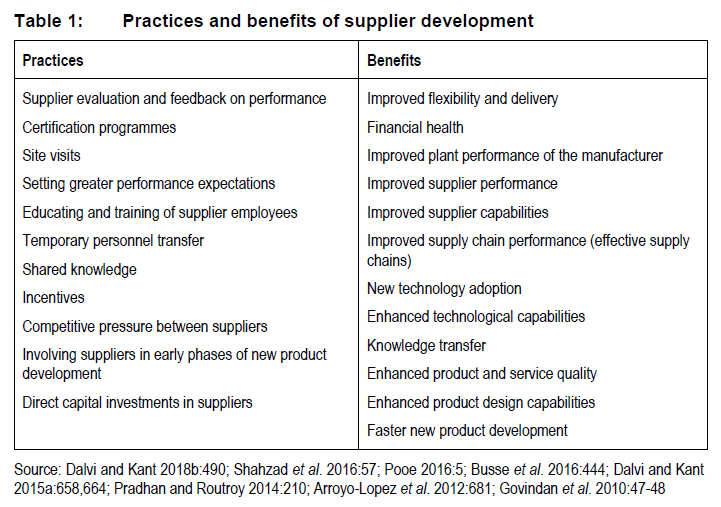
Supplier development practices can range from remedial to strategic (Govindan, Kannan & Haq 2010:45). Remedial practices are implemented to improve a supplier's quality levels, while strategic practices are implemented to ensure drastic improvements in supplier performance that can contribute to the buying firm's competitive advantage (Govindan et al. 2010:45). The supplier development practices implemented should match the needs of the specific supplier and the environment in which the firm operates and may differ based on the buying firm's commitment and dedication towards developing a specific supplier (Routroy & Kumar 2014:2; Shahzad et al. 2016:56). Improved supplier performance can be realised when buying firms are actively involved in the development of suppliers, using practices like the investment in production equipment and the training of suppliers' employees (Arroyo-Lopez, Holmen & de Boer 2012:698). Other practices include: supplier evaluation and feedback, the use of certification programmes, temporary personnel transfer, knowledge sharing, incentives schemes and early involvement in new product development (Arroyo-Lopez et al. 2012:681; Busse et al. 2016:444; Dalvi & Kant 2015a:658,664; Dalvi & Kant 2018b: 490; Govindan et al. 2010:47-48; Pooe 2016:5; Pradhan & Routroy 2014:210; Shahzad et al. 2016:57). Table 1 provides a summary of supplier development practices used by buying and manufacturing firms.
2.5.2 Benefits of supplier development
The three (3) primary performance outcomes derived from supplier development practices are improved supplier performance, realising competitive advantage, and a stronger buyer-supplier relationship (Dalvi & Kant 2015a:659; Pradhan & Routroy 2014:210). When buying firms work side-by-side with the employees of their suppliers, they are able to improve product quality, enjoy reduced cycle times, achieve lower costs, and experience an increase in capacity (Dalvi & Kant 2015a:670; Govindan et al. 2010:45; Pooe 2016:4). A number of other benefits can be derived from the implementation of successful supplier development programmes as indicated in Table 1.
2.5.3 Barriers to supplier development
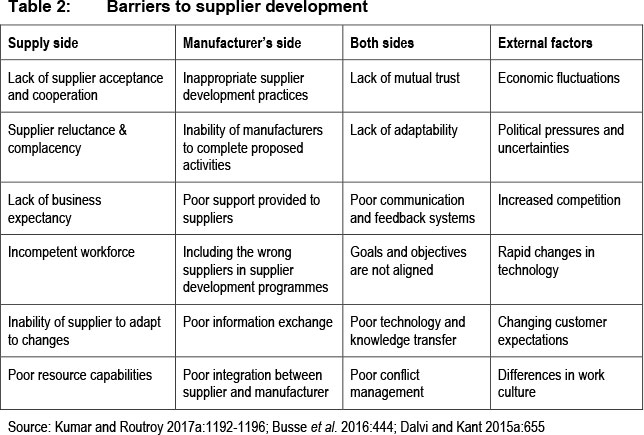
Barriers to supplier development are defined as the hindrances that affect the implementation of supplier development (Busse et al. 2016:444; Kumar & Routry 2017a:1192). Such barriers can obstruct supplier development practices and limit the benefits to be derived from these activities. Barriers to supplier development can stem from the supply side, the manufacturing side, both and from external sources (Kumar & Routroy 2017a:1192-1193). The different barriers to supplier development are included in Table 2 below.
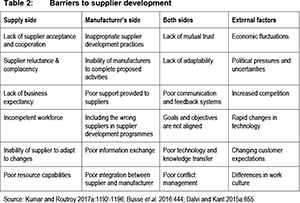
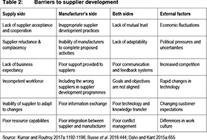
The implementation of supplier development activities will prove to be difficult and unsuccessful without the supplier's acceptance and cooperation (Busse et al. 2016:444; Kumar & Routroy 2017a:1192). In practice, firms must be proactive in identifying potential barriers to supplier development practices and in developing potential mitigation strategies to diminish the negative impact such barriers can have on supplier development practices (Kumar & Routroy 2017a:1207).
2.5.4 Supplier development In the context of Broad-based Black Economic Empowerment
Broad-based Black Economic Empowerment (BBBEE) is a core requirement for large firms in South Africa and is used to restore the economic and societal imbalances of the past (Rogerson 2012:280; Vermeulen & Oosthuizen 2016:1881). The formal definition of BBBEE refers to "the feasible economic empowerment of all black people including women, workers, youth, people with disabilities and people living in rural areas through diverse, but integrated socio-economic strategies" (Parliament of the Republic of South Africa 2014:4). Enterprise and supplier development (ESD) constitute 40 points to a firm's B-BBEE status level and is regarded a priority element which requires firms to achieve a sub-minimum of 40% of the points required (Dayaram 2016:Internet; Department of Trade and Industry 2012a:Internet; Department of Trade and Industry 2017b:Internet). Firms will be discounted by one (1) level if they fail to comply with the requirements for priority element ESD (Goldberg 2015:10). Enterprise and supplier development can be divided and summarised into three (3) sub-categories, namely:
1. Preferential procurement, which refers to the purchases made by the firm (Dayaram 2016:Internet). Preferential procurement targets increased to 40% and 12% respectively for firms that are more than 50% black-owned, and more than 12% black women-owned (Department of Trade and Industry 2012a:1; Pooe 2016:1).
2. Supplier development, which assists the financial and operational growth of suppliers. It should only include black-owned, black women-owned qualifying small enterprises (QSE) and exempted micro enterprises (EME) as beneficiaries (Dayaram 2016:Internet; Department of Trade and Industry 2012a:1).
3. Enterprise development assists any firm in its start-up, management, or improvement (Dayaram 2016).
The alignment of a firm's ESD strategy with its overall business strategy allows for the realisation of long-term, sustainable results (Van Wyk 2017b:48). If firms wish to achieve a good score on the ESD element, they need to procure goods from suppliers with even better BBBEE status levels (Foulds 2014:24; Pooe 2016:1). Preferential procurement is changing the way South African corporations are purchasing products, and from whom they purchase. Preferential procurement is focused on establishing a supply chain that accelerates transformation in South Africa (Van Wyk 2016a:24). Therefore, South African firms focus on ESD and preferential procurement when developing suppliers to improve their BBBEE scores and to accelerate transformation (Ganzevoort 2017:47; Van Wyk 2016a:24). The next section provides a discussion of the methodology followed in this study.
3. METHODOLOGY
3.1
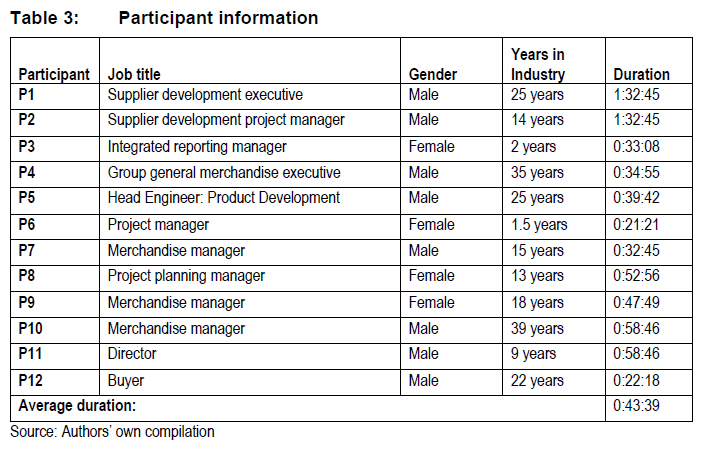
Research design and samplingA single case study design was used to fully understand how the specific general retailer manages financially distressed suppliers that participate in supplier development programmes. The purpose of a single case study design is to describe and interpret what is happening in a system and why it is happening through an examination of the relevant processes (Plano Clark & Creswell 2015:289). Case study research in business usually investigates the functioning of some aspect of the business (Myers 2013:78). The unit of analysis in this study was a large general South African retailer selling consumer goods such as groceries, textiles, electronics, appliances, stationery, hardware, outdoor and gardening merchandise. The retail industry was selected for its significant contribution to the South African economy and a retailer's reliance on its suppliers. The selected retailer is a large JSE-listed firm with an extensive supplier development programme and head offices located in the Gauteng region. A total of 10 face-to-face semi-structured interviews were conducted with 12 participants employed by the retailer. The final sample size was based on the guidelines of Guest, Bunce and Johnson (2006:61), which states that 6-12 interviews are generally sufficient for developing meaningful themes when sampling from a homogenous population. Purposive sampling, more specifically criterion sampling, was used to identify the South African retailer and participants. The retailer must have experienced financially distressed suppliers that participated in supplier development programmes, allowing the researchers to purposefully identify and select that retailer (Polit & Beck 2012:519). This was confirmed by a meeting with the supplier development executive of the firm. The participants had to have at least two years' experience of working with suppliers that participate in supplier development programmes. Snowball sampling was also used to gain access to other appropriate participants in the firm (Polit & Beck 2012:516-517; Creswell 2012:209). Interviews commenced with the supplier development executive and project manager. The researchers asked for referrals after each interview to ensure that all appropriate participants were included in the study. A description of the participants is included in Table 2.
3.2
Data collection and analysisData were collected in the form of 10 face-to-face, semi-structured interviews with 12 participants. In the case of two (2) interviews, two (2) participants were interviewed simultaneously. The two (2) lead researchers interviewed the participants. Semi-structured interviews offer some flexibility which allows the researcher to obtain more detailed responses from participants on how the retailer identifies and manages financially distressed suppliers (Gill, Stewart, Treasure & Chadwick 2008:291; Rowley 2012:262). A discussion guide was developed based on the research questions and relevant supplier development literature. The discussion guide was pre-tested with two (2) participants. Minor revisions were made based on the feedback of the two (2) participants. Interviews commenced with a few biographical questions, followed by more complex questions based on the research questions. Interviews lasted between 20 and 90 minutes, with an average of 43 minutes as seen in Table 3. All interviews were audio-recorded on multiple devices and transcribed by the researchers. Completed transcripts were compared to the recordings with the necessary corrections made to ensure verbatim transcripts. Before each interview, the participants were reminded that their participation was voluntary and that their participation and personal information will be kept confidential. This was done by removing the names of all participants from the transcripts and replacing them with pseudonyms. All participants were required to read and sign the informed consent forms before the interviews could commence. Participants were also informed that they may decline to answer any question.
Thematic analysis was used to analyse the data. The researchers systematically identified codes, using inductive methods, where after similar codes were grouped together to identify emerging themes from the data set (Braun & Clarke 2012:57). After that all transcripts were coded, similar or redundant codes were combined or eliminated as needed. The revised codes were then grouped into five different themes aligned with the five research questions and the significant patterns in the data. All researchers were actively involved in the coding and analysis process and reviewed the other party's perspectives. This was done to avoid the biased perspective of only one (1) researcher and thereby increased the trustworthiness of the study.
3.3 Trustworthiness
Four (4) techniques were employed to ensure the trustworthiness of this study, more specifically the credibility, dependability, transferability, and confirmability (Polit & Beck 2012:584). Credibility was ensured by making the participants feel at ease, so that they are forthcoming, and all responses are truthful (Shenton 2004:67). In addition, site triangulation was employed. This entails recruiting each participant from a unique firm to prevent the themes identified from being exclusive to a particular firm (Shenton 2004:65). Before every interview, participants were reminded that their responses and participation are confidential and that they may decline to answer any question they do not feel comfortable with. Dependability was ensured by creating a comprehensive record of the method used for implementation and the research design (Shenton 2004:72). Transferability was ensured through a comprehensive description of the context of the study, the various participants, their job designation, as well as the length of the interviews with each participant (Shenton 2004:70). Confirmability was established through the use of open-ended and the appropriate probing questions during interviews and producing accurate, word-for-word transcriptions of all interviews (Milne & Oberle 2005:415-416).
4. FINDINGS
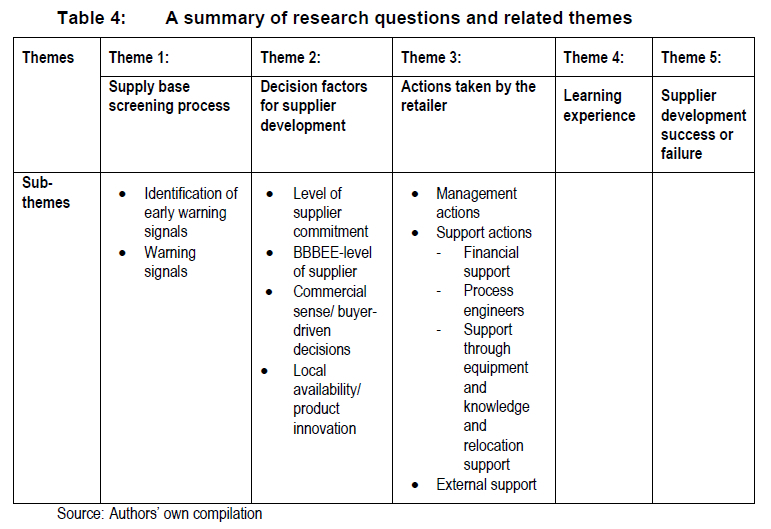
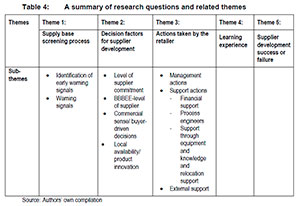
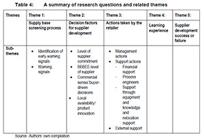
Five (5) main themes were identified, namely, (1) Supply base screening process, (2) Decision factors for supplier development, (3) Actions taken by the retailer, (4) Learning experience, and (5) Supplier development success or failure. A summary of the research questions and related themes are seen in Table 4 below.
4.1 Supply base screening process
This theme examines the process followed by the retailer when screening its supply base to identify the potential for financial distress. Early warning signals refer to various indicators that signal the potential for financial distress. During the screening process, the retailer uses multiple ways to identify and track such early warning signals. Two (2) sub-themes were identified. The first sub-theme examines how early warning signals are identified and the second identifies the various early warning signals.
4.1.1 Identification of early warning signals
An easy way to identify the potential for financial distress is to track the financial performance of suppliers. However, six (6) participants indicated that the retailer does not have direct access to the financials of suppliers that participate in the supplier development programmes, nor do they consistently keep track of the financial performance of these suppliers:
"So, from a supplier development perspective, we don't have access to their financial records, we don't look at their financial records, we don't send in accountants to look and assess their financial situation." (P8, female, project planning manager)
For the retailer to identify early warning signals during the screening process, ten participants have emphasised the importance of close relationships and mutual trust with suppliers. Four participants have emphasised regular meetings with suppliers. Close relationships and regular meetings enable the retailer to identify problems much sooner, while mutual trust encourages a supplier to tell the retailer when they are experiencing problems:
"You know the guys must trust you or must have the confidence to come and talk to you about it. We don't have any access to financiais, even from our side from a development point of view. It is quite out of the norm to get access to financiais. We will ask them now because we are so close to them." (P1, male, supplier development executive)
"You have a relationship and you meet with him on a regular basis, you quickly pick up when there is a problem." (P10, male, merchandise manager)
The findings regarding close relationships and trust between the retailer and the supplier to identify early warning signals supports the literature which states that trust between partners and long-term relationships can reduce risk and uncertainty (Galbraith 1974:36; Premkumar et al. 2005:261).
4.1.2 Warning signals
When screening the supply base, the retailer leverages its close relationship and mutual trust with the supplier to identify various early warning signals that signal the potential for financial distress. The most prominent early warning signal mentioned by nine participants is fill rates. This refers to the ability of a supplier to deliver an order in full and on time using current inventory and without creating a backorder (Market Business News 2018):
"So, if, for example, they may be distressed, their fill rates will show that because they won't be delivering stock to us..." (PI, male, merchandise manager)
Other early warning signals include supplier compliance, which refers to their ability to comply with relevant product and quality standards, and cash flow concerns:
".where a lot of our suppliers couldn't put stuff on the shelves because of SABS compliance." (P3, female, integrated reporting manager)
"So, late delivery is important, that's probably one of the big red flags. The suppliers would contact myself or the supplier payment department, and they would request early payment or different payment terms, and that would be the two red flags for me." (P9, female, merchandise manager)
Another early warning signal is when a supplier is unable to procure the needed raw materials due to cash constraints, causing a shortfall in the finished products demanded by the retailer:
"So, it's very frustrating for us because then you know, when things go wrong they ask, they phone us and say the chains have placed an order for 50,000 cooler boxes, but I've got no money for raw materials." (P4, male, group general merchandise executive)
An indication of potential problems is a sudden decrease in the quality of the products manufactured by the supplier, and a sudden stop in communication from the supplier with the retailer:
"The merchant group firstly pick up that there is a problem in the quality of service that I am getting." (P3, female, integrated reporting manager)
"The other, you talked about signs, is a lack of communication. So, if there is always good communication and then all of a sudden communication stops..." (P2, male, supplier development project manager)
The screening process followed by the retailer correlates with the first phase of the IPT, namely scanning (Daft & Weick 1984:286). Through close relationships and regular communication, the retailer identifies the above-mentioned early warning signals to identify the risk of financially distressed suppliers well in advance and to reduce its impact. The proactive management of risks by tracking early warnings signals corroborate with the literature on SCRM in having routine interaction with suppliers to identify potential problems in advance (Cheng et al. 2014: 314-321; Gualandris & Kalchschmidt 2014:249-268; Zsidisin & Ritchie 2009).
4.2 Decision factors for supplier development
When participants were asked how they determine whether a distressed supplier should be further developed, six participants indicated that development is always preferred over substitution. This is due to the retailer's reliance on the suppliers:
"So, the one thing that we're very proud of is that we don't just swap and change vendors, we have a supplier for a certain category of product, we will work continuously with that vendor to ensure that we fix whatever problems there are. Only if we come to a position where we are just unable to solve the problem, then we will go and find an alternative." (P7, male, merchandise manager)
Even though supplier development is preferred over supplier substitution, various factors affect the retailer's decision whether or not they should actually develop the distressed supplier. These factors are discussed below.
4.2.1 Level of supplier commitment
The level of supplier commitment affects the decision of whether a distressed supplier should be developed. Three participants indicated supplier commitment is fundamental. If suppliers are not committed to the development process, if they are not willing and eager to grow and succeed by working hard and sharing important information, they will not be developed further and will not be part of the development programme:
"The problem is they're either too small or they literally don't want to. Some suppliers don't, you know, and it's, they're comfortable where they are... You can give them financial assistance, you can give them HR assistance, you can give them Business Management assistance and help them and the resources, but if they don't have the drive and the passion to succeed, no matter what you do, you're not going to succeed." (P9, female, merchandise manager)
4.2.2 BBBEE-Level of supplier
When deciding whether or not to develop a distressed supplier further, seven participants indicated that a high BBBEE-level supplier would be preferential. However, ten participants indicated that BBBEE is not the primary determinant when selecting suppliers for development. Although a supplier with a BBBEE level will be preferential for the retailer's BBBEE scorecard, it is not the primary determinant:
"It [BBBEE] is part of our selection criteria, it definitely is a preferential criterion for us, but it's not our main driver, you know... So, you have to keep that balance. Commercial sense first, then yes BBBEE is preferential." (P1, male, supplier development executive)
4.2.3 Commercial sense/ buyer-driven decisions
Eleven participants indicated that the primary determinant, when considering whether or not to further develop distressed suppliers, is whether the product of the supplier makes commercial sense. To make commercial sense, the ends must justify the means. In other words, the demand for and the profitability of the product of the supplier must justify the investment made by the retailer, whether it is in the form of money, time or assets. All development decisions initial and further development of distressed suppliers are therefore buyer-driven, referring to the end-consumer:
"Well, I think the selection for supplier development fund is first there needs to be a need for the product because we're not going to invest in the business if we don't need the product." (P7, male, merchandise manager)
4.2.4 Local availability/ product innovation
Eight (8) participants indicated that when a supplier produces a product that can prevent the retailer from importing that product, the supplier will be further developed. Reducing imports by producing a product locally, not only reduces the procurement cost and lead time for the supplier, but also improves the local economy by assisting locals in becoming entrepreneurs. Three participants also indicated that the ability of a supplier to produce more innovative products that the retailer can sell to its customers, is grounds for further development:
"We look for suppliers that can produce imported products rather than bringing a product in from China or anywhere else in the world." (P10, male, merchandise manager)
"So, innovation, innovation plays a role. So, to differentiate ourselves, in one instance we've developed a product that is different to the norm... Because we have contact with the supplier, we can actually help design a product that allows you to be different in the market." (P2, male, supplier development project manager)
The decision on whether to further develop or substitute distressed suppliers correlates with the second phase of Daft and Weick (1984:286) model. The retailer is focused on supplier sustainability and establishing long-term relationships (Galbraith 1974:36; Premkumar et al. 2005:261). The retailer will only decide to substitute a distressed supplier if that supplier is not committed to the development programme since a lack of commitment is a barrier to supplier development (Busse et al. 2016:444; Kumar & Routroy 2017a:1192). The retailer is entirely buyer-driven when deciding which suppliers should be further developed. This contradicted the literature, which states that firms focus their efforts on BBBEE suppliers to increase their scorecard results (Foulds 2014:24-25; Ganzevoort 2017:46-47; Pooe 2016:112). Further development decisions that are based on local availability and product innovation adds to the literature by adding important development decisions that should be considered (Bode et al. 2014:27; Govindan et al. 2010:45).
4.3 Actions taken by the retailer
4.3.1 Management actions
Nine participants indicated that the retailer is pro-active in its SCRM initiatives and in identifying potential supply disruptions to ensure the continuous flow of goods. The retailer is focused on maintaining good relationships with distressed suppliers that participate in supplier development programmes and regular communication with these suppliers to ensure that potential disruptions are identified and managed as early as possible to minimise the supply disruption:
"I would definitely say proactive because we rely heavily on our suppliers." (P3, female, integrated reporting manager)
The retailer does not have a documented procedure that indicates which specific actions should be taken to assist suppliers when they are financially distressed. The reason for this is that each case is unique, and the action is dependent on the specific situation of the supplier. Therefore, a majority of the participants indicated that the retailer first assesses a situation before any action is taken:
"There's no formal process, there's no, there's no guideline that tells me step one, step two, step three. So, it actually just comes from my experience and my experience as to understanding obviously..." (P8, female, project planning manager in supplier development programme)
"But then how each one behaves is unique. It's like different, it's like personalities at the end of the day you are dealing with." (P4, male, group general merchandise executive)
Eight (8) participants indicated that the relative B-BBEE level of the supplier does not affect the actions taken to help that supplier:
"No. So, like I said, if we identified someone as distressed, whether they will BBEEE rated high or not, we would have the same remedial action for all of them." (P8, female, project planning manager)
Eleven participants indicated that the rationales of the actions taken by the retailer to assist suppliers are to ensure supplier sustainability:
"Yeah, always, you have to. Whenever we get, we call it get into bed with the supplier, it's for a long-term position and if we are going to buy something from you, it's not just for today, we want to buy stuff from you for as long as we can." (P4, male, group general merchandise executive)
The retailer strives to be proactive when assisting suppliers. This finding supports literature as SCRM is focused on taking on a more proactive attitude to reduce the negative impact that supply disruptions may have (Zsidisin & Ritchie 2009). The specific actions taken are dependent on the conditions of the supplier but is focused on supplier sustainability and creating long-term relationships (Galbraith 1974:36; Premkumar et al. 2005:261; Routroy & Kumar 2014:2; Shahzad et al. 2016:56).
4.3.2 Support actions
The study identified numerous support actions that the retailer offers to financially distressed suppliers to improve their situation.
4.3.2.1 Financial support
Support actions include financial assistance and preferential payment terms to improve the cash flow of the supplier, and internal financial support where consultants assist suppliers in their bookkeeping and management of funds:
"So, we then look at paying them in advance to ensure that they have cash flows to maintain the business... because ultimately, like I said to you, if, if we are loyal to any particular vendor, we want them to be around, we want them to be sustainable and around for a long period of time, because if they had to close next month, we have to go and find an alternative supplier, which makes my life a lot more difficult." (P7, male, merchandise manager)
"Not only do we supply engineers, but we supply people that even teach accounting skills." (P10, male, merchandise manager)
4.3.2.2 Process engineers
The retailer also assists suppliers in decreasing costs by sending in process engineers to improve the efficiency and effectiveness of their operations and to train suppliers in running these operations and doing things better:
"Changing process flows, changing floor layouts, new machines and to improve what they do, how they do things and staff training, all of those things are successful." (P6, female, project manager)
4.3.2.3 Support through equipment and knowledge and during relocation
Other support actions include (1) procuring the needed equipment for suppliers, (2) assisting suppliers in meeting product and quality requirements, (3) assisting suppliers during their relocation to bigger and better factories, and (4) providing suppliers with the needed expertise on how to run their business:
"Yeah so, we bought them machinery and that for them, to actually assist them to improve their manufacturing..." (P12, male, buyer)
"One of our other interventions is, we've got to physically relocate a full factory to ensure that they can supply our demand." (P2, male, supplier development project manager)
The actions of this retailer can be classified as cooperative since they emphasise development over substitution (Bode et al. 2014:28; Swinney & Netessine 2009:5). Support activities that corroborate the literature include financial assistance given to distressed suppliers, preferential payment terms, equipment purchased on behalf of suppliers, assistance to meet quality requirements and the training of suppliers and providing them with the needed skills and expertise (Govindan et al. 2010:45; Routroy & Kumar 2014:2; Shahzad et al. 2016:56). The retailer also assists suppliers during relocation to new facilities and provides them with process engineers to improve the efficiency of their operations. These two support actions contribute to the existing literature to help distressed suppliers (Govindan et al. 2010:45; Routroy & Kumar 2014:2; Shahzad et al. 2016:56).
4.3.3 External support
The retailer collaborated with government and other institutions to identify and help distressed suppliers:
"We do a bit of work with the IDC. You know the IDC? They got more money than us, but we work together just trying to identify potential opportunities for local manufacture, but specifically around distressed companies." (P4, male, group general merchandise executive)
All the actions mentioned correlate with the third phase of Daft and Weick's (1984:286) model, to improve the current situation and to help distressed suppliers so as to minimise the risk of supply disruptions. The external support actions, where the retailer joins forces with government and other institutions to assist distressed suppliers, contribute to the current literature of supplier development practices as more ways to support distressed suppliers and to minimise the risk of supply disruptions (Bode et al. 2014:24-43; Daft & Weick 1984:284-295; Routroy & Kumar 2014:1-26; Shahzad et al. 2016:56-70; Swinney & Netessine 2009:109-127).
4.4 Learning experience
This theme examines how the retailer uses the knowledge obtained from dealing with distressed suppliers to improve processes and assist other suppliers who experience similar problems. All twelve participants indicated that they have gained new knowledge during the time they worked with distressed suppliers and that they would use that knowledge to make better decisions when similar disruptions occur in the future. Such knowledge includes tracking early warning signals more closely, the importance of supplier commitment and the importance of using that knowledge to prevent similar disruptions in the future:
"So, that was the one where we learned the biggest lesson where we actually need to just be more careful of watching how their fill rates and what their fill rates are." (P3, female, integrated reporting manager)
"I think, the one good learning is how much we need the merchants to buy into the programme." (P3, female, integrated reporting manager)
"So, you try and prevent it next time when you do go into a situation, you try and prevent that, plan for it better." (P1, male, supplier development executive)
The retailer does not document all the lessons learned. However, five (5) participants indicated that they do have systems and reports in place to document all meetings with suppliers and possible disruptions:
"No, who's going to write that, me? No. I don't have it no." (P4, male, group general merchandise executive)
"No, look what we have is, like [name of supplier] for example and many of the others, I have a file that every time I meet with them, we have a contact sheet that is minuted." (P10, male, merchandise manager)
Ten participants indicated that the learning experiences are shared to ensure that the same mistakes are not repeated. Only one (1) participant indicated that they do not share their learning experiences with co-workers:
"So, I think we definitely share, but it's not like a formal share. So, you know, we have team meetings on a weekly basis. And yeah, sometimes we'll, we'll talk about something that happened in the past week. And yeah, and I think in lots of cases, you know, if somebody's having a challenge with any particular instance, they will ask their colleagues, you know, for input through experience, we kind of guide each other on potential fixes." (P7, male, merchandise manager)
Five (5) participants indicated that the retailer made changes in its SCRM processes and sourcing strategies based on the knowledge they obtained from working with financially distressed suppliers:
"I think it's just evolved over time and I guess from a supplier development fund perspective there has been risk management processes that have been put in place to make sure we pick-up issues a lot earlier than too late." (P3, female, integrated reporting manager)
"Yes. So, that's been a complete change-over in the programme, but in the supply chain, as you mentioned, we found that often our own supply chain is, is not as great as we thought. Because we sometimes make it very difficult for our small suppliers to be able to supply into us, that's something that we've learned now out of this whole thing, and we highlighted that to the different divisions to update it." (P1, male, supplier development executive)
The learning process and the adaptations made based on the learnings, correlate with the fourth phase of Daft and Weick's (1984:286) model, namely learning. The retailer is implementing single-loop learning, as they adapt processes and make incremental changes to their processes based on their learnings experiences (Bode et al. 2014:28; Lant & Mezias 1992:48-49). Learning is also shared within the business to ensure that mistakes are not repeated.
4.5 Supplier development success or failure
This theme determines whether the supplier development programme was successful in its efforts to mitigate potential supply disruption risks from financially distressed suppliers. Seven participants indicated that supplier development plays more of an intervention role when it comes to supply disruption risks. The purpose of supplier development is not to prevent disruptions from occurring, but rather to intervene once a disruption occurs and to minimise the negative impact of the disruption. Once a disruption occurs, it is no longer the prevention of disruptions, but rather an intervention to minimise the negative impact:
"I think we recover more from disruptions rather than totally avoid them." (P2, male, supplier development project manager)
"Yes, we can mitigate the impact. But you wouldn't be a development programme if you totally just, prevent it." (P2, male, supplier development project manager)
"I think it's impossible to, to prevent [a disruption] but that's why you are here, to try at all times. (P10, male, merchandise manager)
Only two (2) participants indicated that supplier development prevents supply disruptions from financially distressed suppliers who participate in the supplier development programme:
"If it's something as simple as cash flow problems, then we assist with cash flow to ensure that supply is sustainable, and there's no disruption." (P8, female, project planning manager)
Six (6) participants indicated that the supplier development programme does mitigate the impact of supply disruptions induced by financially distressed suppliers:
"It can. It definitely can, it makes it much, it helps a lot. I've seen numerous suppliers that would have never been able to either get in or resolve the concern if it wasn't for the programme like this. But unfortunately, not all programmes look at this the same. We are fortunate that we sit within our business. If it was a supplier, if it was a development programme that sat outside of our business, we would not have made any difference. We wouldn't have been able to mitigate or assist with those, but because we sit inside our business, we have access, we understand the business, we can identify inside of the business." (P1, male, supplier development executive)
The ability of supplier development to intervene and develop suppliers to get back to acceptable levels of performance supports the literature (Dalvi & Kant 2015a:653; Pooe 2016:4; Yawar & Seuring 2018:227). The purpose of SCRM is to take on a more proactive attitude when dealing with supply disruptions to reduce the negative impact of these disruptions (Zsidisin & Ritchie 2009:5). Supplier development takes on the same focus and acts as an initiative to mitigate supply disruptions and minimise the negative impact supply disruptions may have on supply chain participants.
5. SUMMARY OF THE FINDINGS AND CONCLUSION
This study aimed to identify how a large South African retailer manages financially distressed suppliers that participate in supplier development programmes. The first research question focused on determining how the retailer screens its supply base to assess the risk of financial distress. During the screening process, the retailer seeks to identify various early warning signals that signal the potential for financial distress. Since the retailer does not have access to the financials of the supplier, the merchandise managers work closely with the suppliers to quickly identify any early warnings signals of financial distress. The retailer gathers information on the financial health of suppliers by leveraging their close relationships, mutual trust, and by hosting regular meetings. These actions reduce uncertainty and assist them to quickly identify early warning signals which include fill rate, cash flow concerns a decrease in quality, an inability to procure raw materials, a lack of communication, and a lack of supplier compliance. The retailer thus screens its supply base by working closely with suppliers and regularly meeting with suppliers to identify and track these early warning signals. The various warning signals add to the literature, by identifying the fill rate, a decrease in quality and a lack of supplier compliance as other warning signals (Bode et al. 2014:24-43; Cancro & McGinnis 2004:Internet; Cheng et al. 2014:314-321; Finley 2009:1-18; Gualandris & Kalchschmidt 2014:249-268; Zsidisin & Ritchie 2009).
The second research question examined how the retailer determines whether a distressed supplier is worth development rather than substitution. The retailer prefers development over substitution and will, therefore, try always to develop distressed suppliers, however, this is not the case. Certain factors affect the retailer's decision of whether or not to develop a distressed supplier. When a supplier is not committed to the development process, the retailer will instead choose to substitute the supplier, because non-committed suppliers are usually hesitant to implement changes and share important information. When a supplier is financially distressed and there are no other local suppliers available, the retailer will choose to develop the distressed supplier. If a financially distressed supplier can produce new innovative products that the retailer can offer its customers, the retailer will also choose to develop the distressed supplier. The last factor that affects the retailer's decision of development is whether the outcome will make commercial sense. The retailer will only invest time and money into the development of a distressed supplier, if the product of the supplier is successful in the market and demanded by end-consumers. It is important to note that the BBBEE-level of suppliers does not affect the decision of whether or not a distressed supplier should be further developed.
The decision to substitute suppliers when there is a lack of commitment corroborates literature since a lack of supplier commitment was identified as a barrier to supplier development (Busse et al. 2016:444; Kumar & Routroy 2017a:1192). Local availability and innovative products are two factors that affect the development decision and contributes to supplier development literature, as these factors were not mentioned as reasons for developing financially distressed suppliers (Foulds 2014:24-25; Ganzevoort 2017:46-47; Pooe 2016:1-12). Literature states that South African firms develop BBBEE suppliers to improve their scorecards (Foulds 2014:24-25; Ganzevoort 2017:46-47; Pooe 2016:1-12). In contrast, the findings indicate that the BBBEE-level of suppliers does not affect the development decisions of the retailer. The retailer's development decisions are somewhat dependent on whether the outcome after support has been given to the supplier, justifies the investment made by the retailer.
The third research question examined the specific actions taken by the retailer after identifying a financially distressed supplier. The retailer strives to be proactive when assisting suppliers to reduce the negative impact of disruptions caused by distressed suppliers, which supports the focus of SCRM (Zsidisin & Ritchie 2009). Support provided to suppliers is dependent on the conditions and characteristics of the supplier. All support actions are focused on keeping the supplier sustainable and is therefore cooperative in nature, supporting the IPT literature (Bode et al. 2014:24-43; Routroy & Kumar 2014:1-26; Shahzad et al. 2016:56-70; Swinney & Netessine 2009:109-127; Daft & Weick 1984:284295). Various support actions are offered to suppliers to better assist them, including financial assistance, preferential payment terms, process engineer support, supplier compliance, relocation support, capital equipment, expertise support, and collaboration with external parties.
The fourth research question examined how the retailer used the knowledge gained from dealing with a distressed supplier. After dealing with financially distressed suppliers, the retailer gains new knowledge, such as the importance of keeping a close eye on early warning signals and the importance of a supplier's commitment to the development process. The lessons learned are not documented but is shared with co-workers to prevent similar disruptions in the future. The retailer uses the knowledge gained to change organisational process as required to prevent similar disruptions in the future or to act faster. This corroborates the literature which stated that organisations should use the knowledge obtained from dealing with distressed suppliers to adapt organisational processes and prevent similar disruptions in the future (Bode et al. 2014:24-43; Daft & Weick 1984:284-295; Lant & Mezias 1992:47-71). The retailer is implementing single-loop learning, as they adapt processes and make incremental changes to their processes based on their learning experiences (Bode et al. 2014:28; Lant & Mezias 1992:48-49).
The fifth and last research question focused on determining whether supplier development mitigates supply disruption risks. The majority of participants indicated that the retailer's supplier development programme plays an intervention role. The retailer's supplier development programme does not prevent supply disruptions from occurring, but rather intervenes when disruptions occur to reduce the negative impact of the disruption. Through close relationships with the suppliers, the supplier development programme of the retailer can mitigate supply disruptions by providing them with the ability to identify potential disruptions sooner and to act faster to reduce the impact of these disruptions. Close relationships with suppliers support the literature which stated that active involvement in supplier operations ensure successful development practices that has the ability to mitigate supply disruption risks (Arroyo-Lopez et al. 2012:698; Dalvi & Kant 2018b:Internet; Govindan et al. 2010:47-48; Shahzad et al. 2016:57).
6. MANAGERIAL IMPLICATIONS
Firstly, when screening the supply base for the risk of financial distress, close relationships, mutual trust and regular meetings are vital. When there is trust between the supplier and the buying firm, the supplier will be confident to contact the buyer and notify him of any problems. Managers should create close relationships with suppliers that participate in supplier development programmes to ensure that early warning signals are identified well in advance, and corrective action is taken immediately to mitigate supply disruptions. Secondly, managers should keep a close eye on the fill rates of suppliers through constant communication and data sharing. The moment when fill rates start dropping, the buying firm should meet with the supplier to investigate why the fill rates are dropping and to implement corrective action as soon as possible. Thirdly, when managers decide whether to develop or substitute suppliers, the focus should be placed on whether the product makes commercial sense, rather than focusing all efforts on BBBEE suppliers.
Retailers want their suppliers to succeed and sustain for they are dependent on them; therefore, is it essential to develop suppliers whose product makes commercial sense, for these products are demanded by end consumers and will improve the sustainability of the suppliers. Fourth, managers should learn from experiences and adapt based on these learnings. Although each case is unique, buying firms should learn from past disruptions by determining what could be done differently the next time around to prevent further disruptions. Furthermore, they can help the supplier sooner and adapt their processes going forward so that the same mistakes are not repeated in the future. It is imperative that these learning experiences are shared with all employees working with suppliers to prevent the same mistakes in the future. Learnings can be shared during regular meetings and through verbal or written communication. Lastly, supplier development programmes can mitigate supply disruptions. Supply disruptions can severely impact the profit and reputation of the buying firm, and therefore this study emphasises the importance of supplier development programmes. The firms should implement supplier development programmes focused on supplier sustainability to minimise the impact of supply disruptions on buying firms.
7. LIMITATIONS AND DIRECTIONS FOR FUTURE RESEARCH
Firstly, this study used a single case study design within the retail industry which could create concerns regarding the generalisability of the findings to other firms operating in the retail industry. Therefore, future research should include multiple retailers with their supplier development programmes so that findings could be compared by replicating the study in different industries within firms who have established supplier development programmes. Secondly, the study only focused on the buyer-perspective or the perspective of the retailer regarding how financially distressed suppliers are managed. Future research should make use of both the buyer and supplier perspectives to get a dyadic view of how financially distressed suppliers are managed within supplier development programmes. Thirdly, the study collected data using a single qualitative method. Future studies may include multiple data sources such as firm reports to triangulate the data points. Lastly, the study excluded mediating factors like personal relationships between buyers and suppliers. Subsequent research can determine how personal relationships between buyers and suppliers can impact business agreements like preferential payments.
REFERENCES
2. LITERATURE REVIEW
-
ARROYO-LOPEZ P, HOLMEN E & DE BOER L. 2012. How do supplier development programs affect suppliers? Insights for suppliers, buyers and governments from an empirical study in Mexico. Business Process Management Journal 18(4):680-707. (DOI:http://dx.doi.org.uplib.idm.oclc.org/10.1108/14637151211253792.
» http://dx.doi.org.uplib.idm.oclc.org/10.1108/14637151211253792 -
)
» https://www2.deloitte.com/content/dam/Deloitte/us/Documents/manufacturing/us-auto-distressed-supplier%20management-03052013.pdf -
]
» https://doi.org/10.1111/jscm.12036 -
BLOME C & SCHOENHERR T. 2011. Supply chain risk management in financial crises: a multiple case-study approach. International Journal of Production Economics 134(1):43-57. (DOI:https://doi.org/10.1016/j.ijpe.2011.01.002.
» https://doi.org/10.1016/j.ijpe.2011.01.002 - )
-
)
» https://businesstech.co.za/news/business/242127/the-biggest-players-in-south-africas-retail-industry/ -
BODE C & WAGNER SM. 2012. Financial distress of suppliers: causes, management and consequences. [Internet:https://www.capsresearch.org/media/1894/2012-0406_financial_distress_of_suppliers_causes_management_and_consequences.pdf downloaded on 10 March 2018.
» https://www.capsresearch.org/media/1894/2012-0406_financial_distress_of_suppliers_causes_management_and_consequences.pdf - ]
-
BRUYNSEELS L & WILLEKENS M. 2012. The effect of strategic and operating turnaround initiatives on audit reporting for distressed companies. Accounting, Organizations and Society 37(4):223-241. (DOI:https://doi.org/10.1016/j.aos.2012.03.001.
» https://doi.org/10.1016/j.aos.2012.03.001 - )
-
]
» https://doi.org/10.1108/APJML-11-2014-0161 -
BUSSE C, SCHLEPER MC, NIU M & WAGNER SM. 2016. Supplier development for sustainability: contextual barriers in global supply chains. International Journal of Physical Distribution & Logistics Management 46(5):442-468. (DOI:https://doi.org/10.1108/IJPDLM-12-2015-0300.
» https://doi.org/10.1108/IJPDLM-12-2015-0300 -
)
» http://www.seesa.co.za/enterprise-and-supplier-development/ -
)
» https://www.gov.za/sites/default/files/gcis_document/201904/42391gon567.pdf -
CHAMBER OF COMMERCE AND INDUSTRY. 2017. Financial distress: the 10 warning signs. [Internet: https://www.cciq.com.au/news/mediareleases/financial-distress-the-ten-warning-signs/; downloaded on 20 April 2018.
» https://www.cciq.com.au/news/mediareleases/financial-distress-the-ten-warning-signs/ -
]
» https://doi.org/10.1177/0893318992005004003 -
CHENG MY, HOANG ND, LIMANTO L & WU YW. 2014. A novel hybrid intelligent approach for contractor default status prediction. Knowledge-Based Systems71(1):314-321. (DOI:https://doi.org/10.1016/j.knosys.2014.08.009.
» https://doi.org/10.1016/j.knosys.2014.08.009 -
)
» https://doi.org/10.1016/j.ijpe.2016.11.015 -
CRAIGHEAD CW, BLACKHURST J, RUNGTUSANATHAM MJ & HANDFIELD RB. 2007. The severity of supply chain disruptions: design characteristics and mitigation capabilities. Decision Sciences 38(1):131-156. (DOI:https://doi.org/10.1111/j.1540-5915.2007.00151.x.
» https://doi.org/10.1111/j.1540-5915.2007.00151.x -
)
» http://journals.co.za.uplib.idm.oclc.org/docserver/fulltext/sh_twa/12/1/sh_twa_v12 _n1_a16.pdf?expires=1528388917& id=id& accname=57715& checksum=CABAAC9D59FAC678E0D14A7B62F5CF45 -
DAFT RL & WEICK KE. 1984. Toward a model of organisations as interpretation systems. Academy of Management Review 9(2):284-295. (DOI:https://doi.org/10.5465/amr.1984.4277657.
» https://doi.org/10.5465/amr.1984.4277657 -
)
» https://campussuite-storage.s3.amazonaws.com/prod/1280306/3a32f069-629b-11e7-99ef-124f7febbf4a/1725579/58932d90-3aaf-11e8-967c-0a3eb131039c/file/ILJ_Winter_2018.pdf#page=38 -
)
» https://hdl.handle.net/10520/EJC170705 -
DALVI MV & KANT R. 2018b. Effect of supplier development activities on performance outcomes: an empirical study. Benchmarking: An International Journal 25(2):489-516. (DOI:https://doi.org/10.1108/BIJ-07-2016-0107.
» https://doi.org/10.1108/BIJ-07-2016-0107 -
)
» https://doi.org/10.1108/02635571011008399 -
]
» https://doi.org/10.1177/1525822X05279903 -
DENNIS A & PIATTI D. 2016. African powers of retailing: new horizons for growth. [Internet:https://www2.deloitte.com/content/dam/Deloitte/za/Documents/consumer-business/Deloitte-African-powers-of-retailing-Feb16.pdf; downloaded on 20 April 2018.
» https://www2.deloitte.com/content/dam/Deloitte/za/Documents/consumer-business/Deloitte-African-powers-of-retailing-Feb16.pdf -
]
» https://doi.org/10.1080/00207721.2011.617891 -
]
» https://doi.org/10.1111/jbl.12086 -
DEPARTMENT OF TRADE AND INDUSTRY. 2017b. BBBEE procurement, transformation and verification. [Internet:http://www.thedtic.gov.za/financial-and-non-financial-support/b-bbee/b-bbee-procurement-transformation-verification/; downloaded on 22 April 2018.
» http://www.thedtic.gov.za/financial-and-non-financial-support/b-bbee/b-bbee-procurement-transformation-verification/ -
]
» https://doi.org/10.1108/BIJ-12-2015-0120 -
)
» https://doi.org/10.1016/j.simpat.2009.12.010 -
ELLIS SC, HENRY RM & SHOCKLEY J. 2011. Making sense of supply disruption risk research: a conceptual framework grounded in enactment theory. Journal of Supply Chain Management 47(2):65-96. (DOI:https://doi.org/10.1111/j.1745-493X.2011.03217.x.
» https://doi.org/10.1111/j.1745-493X.2011.03217.x -
)
» http://dx.doi.org/10.5539/ijbm.v9n11p80 -
)
» https://marketbusinessnews.com/financial-glossary/fill-rate/ -
FINLEY F. 2009. How to spot, and help, at-risk supplier. Supply Chain Management Review 13(5):1-18. [Internet:https://www-proquest-com.uplib.idm.oclc.org/docview/221134647?accountid=14717; downloaded on 05 June 2018.
» https://www-proquest-com.uplib.idm.oclc.org/docview/221134647?accountid=14717 -
]
» https://accountlearning.com/characteristics-of-retailing/ -
]
» https://doi.org/10.1016/j.ijpe.2008.08.045 -
GALBRAITH JR. 1974. Organization design: an information processing view. Matrix Organization & Project Management 4(3):28-36. (DOI:https://doi.org/10.1287/inte.4.3.28.
» https://doi.org/10.1287/inte.4.3.28 - )
-
GANZEVOORT W. 2017. Risk vs reward. [Internet:http://journals.co.za.uplib.idm.oclc.org/docserver/fulltext/tfmmag_ v2_n11_a11.pdf?expires=1528389899&id=id&accname=57715&checksum=BBCF8C0B2E67C630F940E8906EACB745; downloaded on 04 June 2018.
» http://journals.co.za.uplib.idm.oclc.org/docserver/fulltext/tfmmag_ v2_n11_a11.pdf?expires=1528389899& id=id& accname=57715& checksum=BBCF8C0B2E67C630F940E8906EACB745 -
]
» https://doi.org/10.3390/jrfm1010129 -
GENG R, BOSE I & CHEN X. 2015. Prediction of financial distress: an empirical study of listed Chinese companies using data mining. European Journal of Operational Research 241(1):236-247. (DOI:https://doi.org/10.1016/j.ejor.2014.08.016.
» https://doi.org/10.1016/j.ejor.2014.08.016 - )
-
]
» https://doi.org/10.4102/jtscm.v9i1.187 -
GILL P, STEWART K, TREASURE E & CHADWICK B. 2008. Methods of data collection in qualitative research: interviews and focus groups. British Dental Journal 204(6):291-295. (DOI:https://doi.org/10.1038/bdj.2008.192.
» https://doi.org/10.1038/bdj.2008.192 -
)
» https://doi.org/10.1080/07421222.2003.11045841 -
]
» https://doi.org/10.1108/MBE-08-2013-0046 -
GOVIND A, LUKE R & PISA N. 2017. Investigating stock-outs in Johannesburg's warehouse retail liquor sector. Journal of Transport and Supply Chain Management 11(0):1-11. (DOI:https://doi.org/10.4102/jtscm.v11i0.303.
» https://doi.org/10.4102/jtscm.v11i0.303 -
)
» https://doi.org/10.1515/mper-2016-0007 -
)
» https://www.fin24.com/Economy/retail-sectors-role-in-saving-sa-economy-20161013 -
GUALANDRIS J & KALCHSCHMIDT M. 2014. A model to evaluate upstream vulnerability. International Journal of Logistcs Research and Applications 17(3):249-268. (DOI:https://doi.org/10.1080/13675567.2013.860959.
» https://doi.org/10.1080/13675567.2013.860959 -
)
» https://doi.org/10.1287/msom.1070.0199 -
)
» https://doi.org/10.4102/sajhrm.v15i0.827 -
HO W, ZHENG T, YILDIZ H & TALLURI S. 2015. Supply chain risk management: a literature review. International Journal of Production Research 53(16):5031-5069. (DOI:https://doi.org/10.1080/00207543.2015.1030467.
» https://doi.org/10.1080/00207543.2015.1030467 -
)
» http://journals.co.za.uplib.idm.oclc.org/docserver/fulltext/tfmmag_v2_n11_a1 2.pdf?expires=1528300893& id=id& accname=57715& checksum=295B428CA8D0DB6996EABBDC660BFF5C -
)
» https://doi.org/10.1016/j.jclepro.2018.01.234 -
JUNEJA P. 2018. Characteristics, functions and services of a retailer. [Internet:https://www.managementstudyguide.com/characteristics-functions-and-services-of-a-retailer.htm; downloaded on 04 June 2018.
» https://www.managementstudyguide.com/characteristics-functions-and-services-of-a-retailer.htm - ]
- )
-
KOH S, DURAND RB, DAI L & CHANG M. 2015. Financial distress: lifecycle and corporate restructuring. Journal of Corporate Finance 33:19-33. (DOI:https://doi.org/10.1016/j.jcorpfin.2015.04.004.
» https://doi.org/10.1016/j.jcorpfin.2015.04.004 - )
- )
-
LANT TK & MEZIAS SJ. 1992. An organizational learning model of convergence and reorientation. Organization Science 3(1):47-71. (DOI:https://doi.org/10.1287/orsc.3.1.47.
» https://doi.org/10.1287/orsc.3.1.47 - )
- )
-
LIAN Y. 2017. Financial distress and customer-supplier relationships. Journal of Corporate Finance 43:397-406. (DOI:https://doi.org/10.1016/j.jcorpfin.2017.02.006.
» https://doi.org/10.1016/j.jcorpfin.2017.02.006 - )
- )
-
MÄGERLE T. 2014. Enhancement of an implemented rating model and impact on existing risk management processes: a hands-on approach from financial supplier risk management within the automotive industry. [Internet:https://run.unl.pt/bitstream/10362/14600/1/Magerle_2014.pdf; downloaded on 25 March 2018.
» https://run.unl.pt/bitstream/10362/14600/1/Magerle_2014.pdf - ]
- ]
-
MILNE J & OBERLE K. 2005. Enhancing rigour in qualitative description: a case study. Journal of Wound, Ostomy and Continence Nursing 32(6):413-420. (DOI:https://doi.org/10.1097/00152192-200511000-00014.
» https://doi.org/10.1097/00152192-200511000-00014 - )
- ]
- MYERS MD. 2013. Qualitative research in business & management. 2nd ed. Los Angeles, CA: Sage.
- )
-
PARLIAMENT OF THE REPUBLIC OF SOUTH AFRICA. 2014. Broad-Based Black Economic Empowerment Amendment Act (No. 46 of 2013). [Internet: https://www.gov.za/sites/default/files/gcis_document/201409/37271act46of2013.pdf; downloaded on 22 April 2018.
» https://www.gov.za/sites/default/files/gcis_document/201409/37271act46of2013.pdf - ]
-
PLATT H & PLATT M. 2002a. Predicting corporate financial distress: reflections on choice-based sample bias. Journal of Economics and Finance 26(2):184-199. (DOI:https://doi.org/10.1007/BF02755985.
» https://doi.org/10.1007/BF02755985 - )
- )
-
PLATT H & PLATT M. 2013c. Risks to auto sector recovery: bankruptcies of auto suppliers in East Asia and USA. Journal of Asia Business Studies 7(3):231-243. (DOI:https://doi.org/10.1108/JABS-02-2013-0010.
» https://doi.org/10.1108/JABS-02-2013-0010 - )
-
POOE D. 2016. The latest 'big thing' for South African companies: enterprise and supplier development-proposing an implementation framework. Journal of Transport and Supply Chain Management 10(1):1-12. (DOI:https://doi.org/10.4102/jtscm.v10i1.234.
» https://doi.org/10.4102/jtscm.v10i1.234 - )
- )
-
PRADHAN SK & ROUTROY S. 2014. Analysing the performance of supplier development: a case study. International Journal of Productivity and Performance Management 63(2):209-233. (DOI:https://doi.org/10.1108/IJPPM-09-2012-0106.
» https://doi.org/10.1108/IJPPM-09-2012-0106 - )
- )
-
ROGERSON CM. 2012. Supplier diversity: a new phenomenon in private sector procurement in South Africa. Urban Forum 23(3):279-297. (DOI:https://doi.org/10.1007/s12132-012-9148-y.
» https://doi.org/10.1007/s12132-012-9148-y - )
- )
-
ROWLEY J. 2012. Conducting research interviews. Management Research Review 35(3/4):260-271. (DOI:https://doi.org/10.1108/01409171211210154.
» https://doi.org/10.1108/01409171211210154 - )
- )
-
SHENTON AK. 2004. Strategies for ensuring trustworthiness in qualitative research projects. Education for Information 22(2):63-75. (DOI: https://doi.org/10.3233/EFI-2004-22201.
» https://doi.org/10.3233/EFI-2004-22201 - )
- ]
-
STATISTICS SOUTH AFRICA. 2018. Five facts about the retail trade industry. [Internet:http://www.statssa.gov.za/?p=11101; downloaded on 04 June 2018.
» http://www.statssa.gov.za/?p=11101 - ]
- )
-
TUSHMAN ML & NADLER DA. 1978. Information processing as an integrating concept in organizational design. Academy of Management Review 3(3):613-624. (DOI :https://doi.org/10.5465/amr.1978.4305791.
» https://doi.org/10.5465/amr.1978.4305791 - )
- )
-
VAN WYK M. 2016a. 'Black' designated group supplier. [Internet:http://journals.co.za.uplib.idm.oclc.org/docserver/fulltext/tfmmag/2/8/tfmmag _v2_n8_a7.pdf?expires=1528299212&id=id&accname=57715&checksum=65E7CFC3249506833D39E1290C667B48; downloaded on 04 June 2018.
» http://journals.co.za.uplib.idm.oclc.org/docserver/fulltext/tfmmag/2/8/tfmmag _v2_n8_a7.pdf?expires=1528299212& id=id& accname=57715& checksum=65E7CFC3249506833D39E1290C667B48 - ]
- ]
-
VERMEULEN M & OOSTHUIZEN G. 2016. Local supplier development framework. c[Internet:http://toc.proceedings.com/34666webtoc.pdf; downloaded on 01 April 2018.
» http://toc.proceedings.com/34666webtoc.pdf - ]
- )
- ZSIDISIN GA & RITCHIE B. 2009. Supply chain risk management-developments, issues and challenges. Boston, MA: Springer.