Generation Y female students' entrepreneurial attitude
Abstract
Worldwide entrepreneurship is essential within the contemporary economic development of a country. Its role in a country's economy is widely acknowledged as a major source of innovation, job creation, and economic growth. Consequently, the generation of business ideas and the conversion thereof into profitable business ventures is a salient point in economic growth. South African students and graduates are confronted with a critical shortage of employment opportunities. The literature suggests that students' attitude towards entrepreneurial activity has a noteworthy effect on their intention to become an entrepreneur; that is, self-employment is commonly favoured as a career path rather than the pursuit of employment. Female entrepreneurship in particular is depicted by employment-creation, economic growth, and innovation. The purpose of this study was to determine South African female Generation Y university students' attitudes towards entrepreneurship. A descriptive research design, following the single cross-sectional approach, was used for the purpose of this study. A self-administered questionnaire was used to collect the data from a convenience sample of 400 South African female Generation Y students. The data were analysed by means of descriptive statistics and a one-sample t-test. The results confirm that positive and negative entrepreneurial attitudes significantly affect the South African Generation Y female students' entrepreneurial intention. The implication of these results is that South African female Generation Y students perceive entrepreneurship as their future form of employment and maintain the view that entrepreneurs should be appreciated and the government should support young entrepreneurs. Currently, the growth rate of female entrepreneurs in South Africa is low. This study provides important insights for researchers, academics, and government to maintain positive attitudes towards entrepreneurship, which will serve to boost economic growth fuelled by female entrepreneurs. JEL CLASSIFICATION: L26, I23, I29
Attitude; entrepreneurship; female students and South Africa
1. INTRODUCTION
Worldwide entrepreneurship is essential within the contemporary economic development of a country (Meyer 2018:159; Zaki & Rashid 2016:31). Its role in a country's economy is widely acknowledged as a major source of innovation, job creation, and economic growth (Iglesias-Sanchez, Jambrino-Maldonado, Velasco & Kokash 2016:209). Consequently, the generation of business ideas and the conversion thereof into profitable business ventures is a salient point in economic growth (Zerihun 2014:17). Entrepreneurs are essential to the economy of a country as they are risk takers and are able to recognise business opportunities (Kritikos 2014:2).
It is apparent within the literature that to ensure economic growth and development in a country, the youth (acknowledged as the Generation Y cohort; that is, individuals born between 1986-2005) must be geared towards (Markert 2004:21) entrepreneurship (Fadeyi, Oke, Ajagbe, Isiavwe & Adegbuyi 2015:31). Generation Y, which can be referred to as the next big generation, is powerful in that they are self-confident and have a good success rate when embarking on new opportunities (Oertzen 2017:14). In 2018, the South African Generation Y cohort represented 38 percent of the total South African population (Statistics South Africa 2018). A significant portion of this cohort comprised university students, whose contributiom to the economy is significant due to their implicit potential for high future earnings. (Bevan-Dye, Dhurup & Surujlal 2010:174). Plainly, the size of this cohort in South Africa makes Generation Y students invaluable to the future of the country (Zhang, Cobanoglu & Omran 2017:733). Generation Y is confronted with poverty and a critical shortage of employment opportunities (Pyöria, Ojala, Saari & Jarvinen 2017:2). As such, creating an entrepreneurial culture amongst Generation Y students is vital in increasing employment opportunities and economic growth in the country (Steinberg South Africa 2014:2).
The creation of an entrepreneurial culture is a constant concern for the government in an emerging economy such as South Africa (Atiase, Mahmood, Wang & Botchie 2018:646; Mamabolo, Kerrin & Kele 2017:1), a country which had one of the highest unemployment rates worldwide (Mncayi 2016:68), standing at 27.5% in 2018 (Statistics South Africa 2018). Entrepreneurship is crucial for the survival and growth of the economy in that it contributes to generating employment opportunities, consequently relieving the high levels of unemployment and poverty in the country (Littlewood & Holt 2018:544). Furthermore, in South Africa, entrepreneurs are seen as the future of the country as they are the primary producers and drivers of new business ventures (Mamabolo et al. 2017:10). Female unemployment has been greater than that of their male counterparts, standing at 29.5% in 2018 (Statistics South Africa 2018). Accordingly, the South African government initiated different projects to promote entrepreneurship, which is distinguished by the various supporting mechanisms presented to prospective entrepreneurs in the country, such as business mentoring programmes and funding opportunities (Chimucheka 2014:410).
Entrepreneurship is becoming an increasingly important element towards economic growth. Female entrepreneurs are making significant contributions to the global entrepreneurship field. Entrepreneurship plays an important role in providing female entrepreneurs with employment opportunities (Islam, Bohari & Abalala 2018:1). Females are seen traditionally as homemakers, but in the South African environment women are making strides within the economic environment, creating a shift in their role within the economy (Irene 2016:14). Although evidence from the literature suggests an increase of female entrepreneurs, entrepreneurial participation from their male counterparts is still higher (Global Entrepreneurship Monitor (GEM) 2017). Possible reasons for this slow growth in entrepreneurial participation include lack of entrepreneurial training (Irene 2017:2) and poor financial support structures (Ramaswamy 2013:164). Ambepitiya (2016:161) emphasises that female entrepreneurs are needed in emerging economies and that they have the capability to stimulate economic growth by creating employment opportunities. Various researchers opine that an individual attitude towards entrepreneurship has a significant influence on an individual's decision to become an entrepreneur (Vuorio, Puumalainen & Fellnhofer 2018:362; Yousaf, Shamim, Siddiqui & Maham 2015:31; Zollo, Laudano, Ciappei & Zampi 2017:273).
Attitude is described as a taught tendency of an individual to respond to a situation, object, or person (Alport 1935:810). Pickens (2005:44) simplified Alport's (1935) description and stated that attitude is a mind-set or a propensity to act in a certain way due to an individual's experience and personal nature. According to Yao, Wu & Lo (2016:64), attitude is a psychological tendency to respond in a specific way towards an object or situation. These reactions can be positive or negative. Prevailing research substantiates this statement as researchers define attitude as the purpose to have a positive or negative evaluation and these factors affect an individual's decision to perform certain behaviours (Sanne & Wiese 2018:3; Xie 2014:28). Entrepreneurial attitudes signify positive or negative attitudes towards entrepreneurial participation (Tshikovhi & Shambare 2015:152). A positive attitude is seen as the favourable assessment of specific behaviour. In the entrepreneurial environment this is seen as the positive assessment which an individual has of entrepreneurial activities (Tshikovhi & Shambare 2015:153). Kritikos (2014:1) indicates various assessments that relate to entrepreneurs which are positive. These assessments indicate that when it comes to economic growth, entrepreneurs are vital components, particularly for their role in creating employment opportunities. Conversely, a negative attitude is defined as an unfavourable behaviour towards an activity (Tshikovhi & Shambare 2015:153). As stated by Vadavadagi and Joshi (2013:87), entrepreneurship is sometimes seen in a negative light due to various stigmas around it; for example, start-up challenges, entrepreneurs being generalised as dishonest or looking out for their own interests only. Such attitudes negatively influence the decision of an individual to become an entrepreneur.
From the literature, it is evident that several studies have been concerned with entrepreneurial attitude (Hörnqvist & Leffler 2014:511; Indarti & Efni,2018:311; Yousaf et al. 2015:23). There are limited studies focusing on students' entrepreneurial attitude (Palalic, Ramadani, Dilovic & Dizdarevic 2017:393; Yao et al. 2016:60; Zollo et al. 2017:268). An extensive search from the literature revealed a dearth of studies in the South African context and none that specifically focused on the country's female Generation Y student cohort. Therefore, reporting on female Generation Y students' attitude towards entrepreneurship in the South African context is a contribution that will aid academics, researchers, and government in determining effective means to propagate entrepreneurship amongst the female Generation Y students. This study strives to provide insights for academics, researchers, and government in retaining a positive entrepreneurial attitude for Generation Y female students for the purpose of encouraging this cohort to develop their entrepreneurial skills. In order to provide these insights, the purpose of the study was to determine the South African female Generation Y students' attitudes towards entrepreneurship.
2. METHODOLOGY
A descriptive research design following the single cross-sectional approach was used for the purpose of this study.
2.1 Sampling method
Female students, aged from 18-24 years, made up the target population of this study. The students are female undergraduates registered as full time students at public higher education institutions (HEIs) in South Africa. The sampling frame consisted of 26 registered public HEIs in South Africa, which are made up of 11 general academic universities, nine comprehensive universities, and six universities of technology (Department of Higher Education and Training 2017:8). For this study, two HEI campuses (one traditional university and one university of technology) located in Gauteng province of South Africa were chosen from the sampling frame using non-probability judgement sampling. A non-probability convenience sample of 400 female Generation Y students (200 per campus) was drawn.
2.2 Research instrument and data collection
The data for this study was collected by using a self-administered survey questionnaire that consisted of two sections. The first section sought to investigate demographic information and the second section with the purpose of determining female Generation Y students' entrepreneurial attitude. The second section comprised ten items adapted from the Karhunen and Ledyaeva (2010) study, pertaining to positive and negative attitudes (five items each). All scaled responses were measured using a five-point Likert scale that ranged from 1=disagree to 5=agree (5), based on the participants' agreement or disagreement to the statements relating to the attitude towards becoming entrepreneurs.
The questionnaire was piloted on a convenience sample of 49 South African students that did not form part of the main sample. A Cronbach alpha value of 0.794 was returned for the entire scale, which is above the recommended level of 0.70. This indicated acceptable internal-consistency reliability (Pallant 2016:6). Subsequently, the questionnaire was administered to the main sample during or after classes (200 per HEI campus), after permission was solicited from and granted by lecturers. Participation in the questionnaire was voluntarily and the students were informed of their rights and that the information they provided would be kept confidential. The data were collected and analysed using descriptive statistical analysis and a one-sample t-test. The Statistical Package for Social Sciences (IBM SPSS), Version 25 was utilised for this study.
3. RESULTS
3.1 Sample description
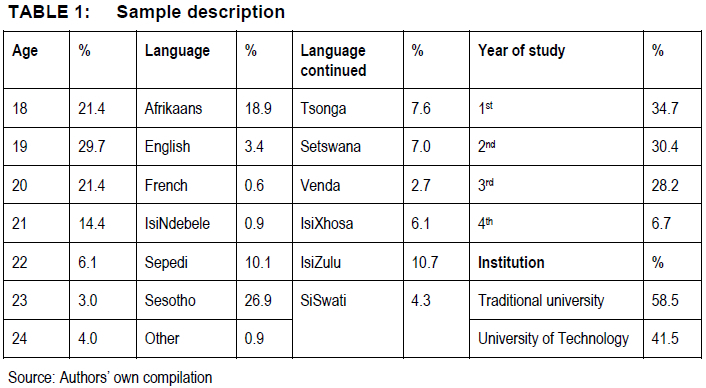
From 400 questionnaires, 328 completed questionnaires were returned, indicating an 82% response rate. As indicated in Table 1, the majority of participants indicated being 19 years (29.7%) of age, followed by those specified being 18 years (21.4%) of age, and 20 years (21.4%) of age. The sample comprised fewer participants from a university of technology (41.5%) than participants from a traditional university (58.5%). The majority of the participants were first year (34.7%) students, followed by second year (30.4%), third year (28.2%), and fourth year (6.7%) students.
3.2
Reliability and validityA Cronbach alpha value of 0.755 was calculated for the entire scale measuring attitude towards entrepreneurship. The Cronbach alpha value for the constructs positive attitudes and negative attitudes were 0.752 and 0.800, respectively; hence, offering proof of internal-consistency reliability (Brace, Kemp & Snelgar 2012:382). The average inter-item correlation for each of the two constructs was also determined to be 0.380 (positive attitudes) and 0.446 (negative attitudes). These values complied with the recommended range of 0.15 to 050 (Clark & Watson 1995:316), granting evidence of reliability, as well as signifying convergent and discriminant validity.
3.3
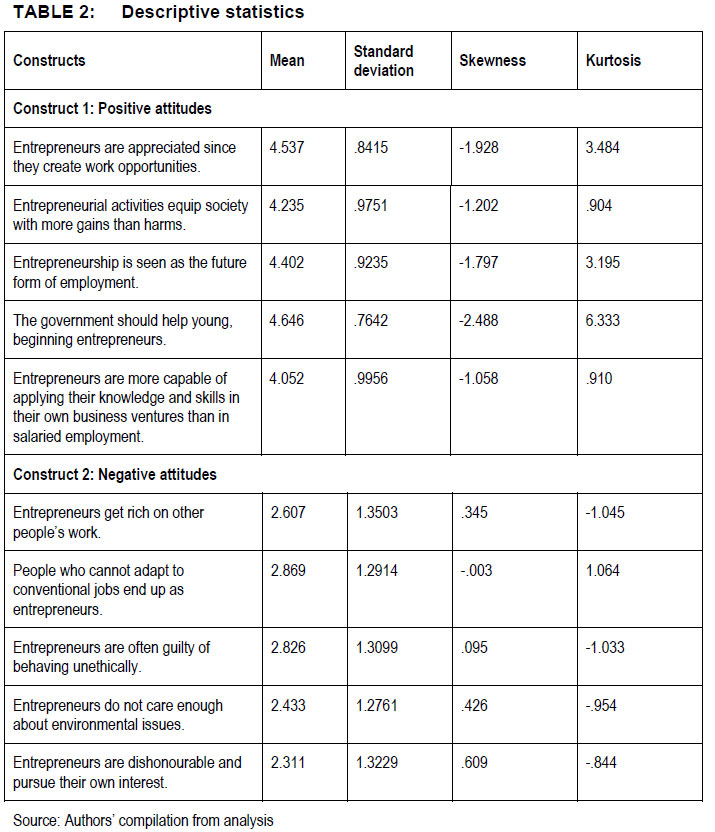
Descriptive analysisOnce reliability and validity of the scale had been ascertained, the descriptive statistics were calculated. Table 2 reports the means and standard deviations referring to female Generation Y students' attitudes towards entrepreneurship.
As presented in Table 2, the highest mean was recorded for positive attitudes item 4 (mean=4.646), followed by positive attitudes item 1 (mean=4.537). The lowest mean was recorded for negative attitudes item 5 (mean=2.311). These results suggest that female students within the South African environment are of the opinion that government should be more supportive towards young, beginning entrepreneurs. They also feel that there should be more appreciation shown for entrepreneurs as they provide work opportunities. The low mean of negative attitudes proposes that participants do not perceive entrepreneurs as being dishonourable.
3.4 One-sample t-test
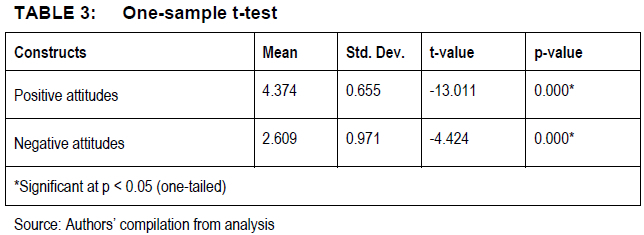
A one-sample t-test was performed in order to determine whether positive and negative attitudes were statistically significant. The expected mean was set at 3 (that is, in the agreement area of the scale) and the significance level at the conventional 0.05 level. As shown in Table 3, significant p-values (p=0.000 <0.05) were calculated for both the constructs of entrepreneurial attitude, indicating statistical significance. This proposes that South African female Generation Y students do demonstrate positive entrepreneurial attitudes towards becoming entrepreneurs. The calculated means, standard deviations, t-values and p-values are outlined in Table 3.
4. DISCUSSION
This study gauged female Generation Y students' entrepreneurial attitude in the South African context. The results provide important insights into the general entrepreneurial attitude of female students. Statistical means in the interest area of the five-point Likert-scale were verified on all items. The highest mean was recorded on positive attitudes, suggesting that female students from the Generation Y cohort exhibit positive entrepreneurial attitudes and they see the benefits of entrepreneurship; this finding is consistent with previous studies. Amanamah (2017:131) found that male and female tertiary students indicate positive entrepreneurial attitudes and they perceive entrepreneurship as an important incentive for job creation. Authors such as Nieuwenhuizen and Swanepoel (2015:8) discovered that male and female Masters students demonstrate positive attitudes in becoming entrepreneurial and that there is a significant difference between Masters students from emerging and developed countries. Furthermore, the lowest mean for this study was recorded for negative attitudes, proposing that female students from the Generation Y cohort do not perceive entrepreneurs as being dishonourable. Kaseorg and Raudsaar (2013:31) opine that students (male and female) that do not have any prior knowledge of entrepreneurship have negative attitudes towards entrepreneurship.
As a result, the findings of the study suggest that positive attitudes and negative attitudes do have a significant effect on South African female Generation Y students' entrepreneurial attitude. This is in line with previous studies on attitudes (Paunescu, Popescu & Duennweber 2018; Tshikovhi & Shambare 2015) as stimuli of entrepreneurship. The findings of this study contribute to the limited literature available on Generation Y female students' attitude towards entrepreneurship, specifically in the South African context.
5. CONCLUSION
Entrepreneurship is essential to the contemporary economic development of a country. Female entrepreneurs, specifically, are seen as vital contributors to economic growth, since entrepreneurship is developing into a crucial element of employment for females worldwide. The results of this study denote that South African female Generation Y students have a positive attitude towards entrepreneurship, despite the fact that the literature suggests the growth of female entrepreneurs is slow. Possible reasons for slow growth comprise a lack of entrepreneurial training or education and a poor funding system. In addition, South Africa faces high levels of poverty and unemployment. Thus, entrepreneurship is vital to any country's economy and is acknowledged as a major source of innovation, employment creation, and economic growth. Furthermore, South African Generation Y students are essential to the future growth of the economy as university students implicitly have the potential for higher future earnings. Understanding female Generation Y students' attitudes towards entrepreneurship in the South African context will aid academics, researchers, and government in determining effective means to promote entrepreneurship as a career path to female Generation Y students.
It is recommended that the educational process of introducing entrepreneurship should start at a young age; that is, entrepreneurial programmes should be introduced from an early stage and throughout at all (primary, secondary, tertiary) levels of education. This will aid in establishing a culture of entrepreneurship in the country. Female students, in their right as the crux of this study, should be given the opportunity to expand and build on their identities within the entrepreneurial field. The approach to this could be for universities to provide specialised networking opportunities, workshops, and enable the creation of new business ventures. Moreover, female students from this sample study hold the opinion that the government should support young, beginning entrepreneurs. It is recommended that government be more involved in the process of promoting a culture of entrepreneurship, especially amongst female students, by developing more initiatives and programmes catered to this topic. Initiatives could include the funding of various programmes where female students can improve their skills and also receive training in order to improve their knowledge or introduce mentoring programmes providing specific support they may need to develop their entrepreneurial skills.
The sample of this study focused on two out of 26 universities in South Africa. Possibilities for future research include the investigation of entrepreneurial attitude across more universities in South Africa, or a comparative study between South Africa and other (emerging or developed) countries, or assessing the entrepreneurial attitudes of male Generation Y students.
REFERENCES
- ALPORT GW. 1935. Attitudes. In Murchison C handbook of Social Psychology.
- AMBEPITIYA KR. 2016. The role of women entrepreneurs in establishing sustainable development in developing nations. World Review of Business Research 6(1):161-178.
-
AMANAMAH RB. 2017. Tertiary students' Attitude towards Entrepreneurship in Ghana. Journal of Small Business and Entrepreneurship Development 5(2):125-133. (DOI:10.15640/jsbed.v5n2a12.
» https://doi.org/10.15640/jsbed.v5n2a12 - )
-
ATIASE VY, MAHMOOD S, WANG Y & BOTCHIE D. 2018. Developing entrepreneurship in Africa: Investigating critical resource challenges. Journal of Small Business and Enterprise Development 25(4):644-666. (DOI: 10.1108/JSBED-03-2017-0084.
» https://doi.org/10.1108/JSBED-03-2017-0084 -
)
» https://doi.org/10.5901/mjss.2014.v5n2p403 -
BEVAN-DYE AL, DHURUP M & SURUJLAL J. 2010. Black generation Y students' perceptions of national sport celebrity endorsers as role models: Sport Management. African Journal for Physical Health Education, Recreation and Dance (1):172-188. (DOI:http://dx.doi.org/10.4314/ajpherd.v15i4.47289.
» http://dx.doi.org/10.4314/ajpherd.v15i4.47289 -
)
» https://doi.org/10.6007/IJARPPG/v2-i1/1714 -
CLARK LA & WATSON D. 1995. Constructing validity: Basic issues in objective scale development. Psychological Assessment 7(3):309-319. (DOI:https://psycnet.apa.org/doi/10.1037/1040-3590.7.3.309.
» https://psycnet.apa.org/doi/10.1037/1040-3590.7.3.309 -
)
» https://doi.org/10.1108/IJLMA-12-2016-0160 -
)
» https://doi.org/10.4102/sajesbm.v9i1.121 -
DEPARTMENT OF HIGHER EDUCATION AND TRAINING. 2017. Statistics on post-school education and training in South Africa 2015. [Internet:http://www.dhet.gov.za; downloaded on 01 February 2019.
» http://www.dhet.gov.za -
]
» http://dx.doi.org/10.1142/S0218495810000574 -
)
» https://wol.iza.org/uploads/articles/8/pdfs/entrepreneurs-and-their-impact-on-jobs-and-economic-growth.pdf -
GLOBAL ENTREPRENEURSHIP MONITOR (GEM). 2017. Entrepreneurial Behaviour and Attitude. Babson College. [Internet:https://www.babson.edu/Academics/centers/blank-center/global-research/gem/Documents/GEM%202016-2017%20Global%20Report.pdf; downloaded on 01 February 2019.
» https://www.babson.edu/Academics/centers/blank-center/global-research/gem/Documents/GEM%202016-2017%20Global%20Report.pdf -
]
» https://doi.org/10.4102/sajesbm.v9i1.111 -
HÖRNQVIST M & LEFFLER E. 2014. Fostering an entrepreneurial attitude - challenging in principal leadership. Education and Training 56(6):551 -561. (DOI:10.1108/ET-05-2013-0064.
» https://doi.org/10.1108/ET-05-2013-0064 -
)
» https://doi.org/10.17512/pjms.2018.17.2.14 -
IGLESIAS-SANCHEZ PP, JAMBRINO-MALDONADO C, VELASCO AP & KOKASH H. 2016. Impact of entrepreneurship programmes on university students. Education and Training 58(2):209-228. (DOI:10.1108/ET-01-2015-0004.
» https://doi.org/10.1108/ET-01-2015-0004 -
)
» http://dx.doi.org/10.4102/AC.v15i1.270 -
)
» http://dx.doi.org/10.1108/JEC-12-2016-0046 - IRENE BNO. 2016. Gender and entrepreneurial success: A cross cultural study of competencies of female SMEs operations in South Africa. Cardiff: Cardiff Metropolitan University. (Doctoral thesis.
-
)
» https://doi.org/10.3390/su10113893 -
)
» https://doi.org/10.1177%2F2158244017697158 -
ISLAM MDM, BOHARI AAH & ABALALA TS. 2018. Perceptions to start up business as a career choice among Saudi Female Higher Education students. Societies, 8(31):1-22. (DOI:10.3390/soc8020031.
» https://doi.org/10.3390/soc8020031 -
)
» https://doi.org/10.4102/sajim.v20i1.915 -
)
» https://cdn.americanprogress.org/wpcontent/uploads/2014/11/MillennialEntrepren.pdf - KASEORG M & RAUDSAAR M. 2013. Student attitudes towards entrepreneurship. International Journal of Business and Management Studies 2(2):31-43.
- ]
-
LITTLEWOOD D & HOLT D. 2018. Social Entrepreneurship in South Africa: Exploring the influence of environment. Business and Society 57(3):525-561. (DOI:https://doi.org/10.1177%2F0007650315613293.
» https://doi.org/10.1177%2F0007650315613293 -
)
» http://dx.doi.org/10.1108/JEEE-03-2014-0005 - )
-
MARKERT J. 2004. Demographics of age: Generational and cohort confusion. Journal of Current Issues and Research in Advertising 26(2):11-25. (DOI:http://dx.doi.org/10.1080/10641734.2004.10505161.
» http://dx.doi.org/10.1080/10641734.2004.10505161 - )
- )
- MNCAYI P. 2016. An analysis of the perceptions of graduate unemployment among graduates from a South African University. International Journal of Social sciences and Humanity Studies 8(1):67-83.
- )
- OERTZEN L. 2017. Generation Y travelers' hotel consideration: the impact of travel mode and reference room price. Vienna: Modul Vienna University. (Doctoral thesis.
- )
- )
- PALLANT J. 2016. SPSS survival manual 6th ed. London: Open University Press.
- )
- PICKENS J. 2005. Attitudes and perceptions. In Borkowsji. Ed. Organisational Behaviour in Health Care. Sudbury, MA: Jones and Barlett Publishers.
- )
-
RAMASWAMY G. 2013. Psychosocial and psycho entrepreneurial predictors: An exploratory study on Indian women entrepreneurs. Women Studies (42):163-192. (DOI:https://doi.org/10.1080/00497878.2013.747380.
» https://doi.org/10.1080/00497878.2013.747380 - )
- )
-
STATISTICS SOUTH AFRICA. 2018. Statistical release P0302: 2018 mid-year population estimates. [Internet:https://www.statssa.gov.za/publications/P0302/P03022018.pdf; downloaded on 01 February 2019.
» https://www.statssa.gov.za/publications/P0302/P03022018.pdf - ]
- ]
- TSHIKOVHI N & SHAMBARE R. 2015. Entrepreneurial knowledge, personal attitudes and entrepreneurship intentions among South African Enactus students. Problems and Perspectives in Management 13(1):152-158.
- VADAVADAGI P & JOSHI SP. 2013. Attitude of management students toward entrepreneurship: A study of selected districts of North Karnataka. Pacific Business Review International 5(8):79-87.
-
VUORIO KP, PUUMALAINEN K & FELLNHOFER K. 2018. Drivers of entrepreneurial intentions in sustainable entrepreneurship. International Journal of Entrepreneurial Behaviour & Research 24(2):359-381. (DOI:http://dx.doi.org/10.1108/IJEBR-03-2016-0097.
» http://dx.doi.org/10.1108/IJEBR-03-2016-0097 - )
-
YAO Y, WU X & LONG D. 2016. University students' entrepreneurial tendency in China: Effect of students' perceived entrepreneurial environment. Journal of Entrepreneurship in Emerging Economies 8(1):60-81.(DOI: 10.1108/JEEE-03-2015-0021.
» https://doi.org/10.1108/JEEE-03-2015-0021 - )
- )
- ZAKI IM & RASHID NH. 2016. Entrepreneurship impact on economic growth in emerging economies. The Business and Management Review 7(2):31-39.
- )
-
ZHANG T, COBANOGLU C & OMRAN BA. 2017. Generation Y's positive and negative eWOM: Use of social media and mobile technology. International Journal of Contemporary Hospitality Management 29(2):732-761. (DOI:10.1108/IJCHM-10-2015-0611.
» https://doi.org/10.1108/IJCHM-10-2015-0611 - )