Exploring how service failure severity affects behavioural intention in the banking industry
Abstract
The global banking industry is identified as very competitive, and is prone to service failure largely due to multiple interactions between clients and contact-personnel within that industry. It is therefore imperative for the banking industry adequately to understand how severely clients view service failures, so that it can provide adequate recovery strategies to improve service quality, and ultimately offer the superior service solutions that clients require. The current study examines the influence of service failure severity on client satisfaction and behavioural intention of clients within the retail banking industry of South Africa. The study finds that there is a negative relationship between levels of service failure severity and client satisfaction and behavioural intentions after service failure, and that gender is not a determining factor in these variables. Based on these results, marketers and banking service managers are able to gain a better understanding of the impact of service failure severity on client behaviour, and to strengthen client relationships after a service failure.
banking industry; behavioural intention; client satisfaction; service failure seventy
1. INTRODUCTION
In a dynamic business environment such as South Africa, services are integral to the growth and development of the emergent economy (Rejikumar 2015:1; Singhal, Krishna & Lazarus 2013:192). However, with services come the probability that service failure will occur; and in the banking industry specifically, this probability is relatively high (Singhal et al. 2013:193).
Previous research into service failure has focused on various aspects of service failure, including service failure itself, service failure severity, and service recovery after a service failure (Allen, Brady, Robinson & Voorhees 2015:658; Garg 2014:24; Shanka 2012:1-9; Valenzuela, Cooksey, Chandralal & Hassan 2013:465).
Service failure in the banking industry has been empirically researched in the field of marketing in both developed and developing countries. For instance, Garg (2014:24) and Valenzuela eí al. (2013:464) investigated service recovery in a service failure setting in India and Australia, while other academics such as Masukujjaman and Akter (2010:19-37), Mistry (2013:132-140), Richard (2013:2), and Shanka (2012:132-140) examined client satisfaction levels in a service failure setting in Ghana, Ethiopia, and Bangladesh.
It is thus clear that service failure can influence client satisfaction and behavioural intentions, no matter where the banking industry is located (McCollough, Berry & Yadav 2000:121; Varela-Neira, Vazquez-Casielles & Iglesias 2010:32).
Although studies on service failure in the banking industry have been conducted globally, the severity of the failure is an area that can be further investigated. It is imperative that marketers consider service failure severity, as this will enable them to address the failure with appropriate remedies (Zourrig, Hedhli, & Chebat 2014:239).
The South African retail banking industry provides a suitable framework in which to conduct the study, given the high levels of service failure identified by clients in that industry (Coetzee, Van Zyl & Tait 2013:1). More specifically, this research provides insights into the level or severity and causes of service failure severity in the retail banking industry, and into how this influences behavioural intention.
An investigation of earlier literature, the research objectives, the methodology, and the results are presented next, followed by the conclusions, implications, and recommendations, and the limitations of this study.
The relationship between service failure severity and behavioural intentions within the South African banking context is of great importance to this research study. A detailed discussion of the context in which both concepts operate is elaborated on in the following sections in order to gain a deeper understanding of this focus of interest.
2.1 The banking industry of South Africa
The South African banking industry currently consists of registered banks, mutual banks, local branches of foreign banks, and foreign banks with approved local representative offices (The World Economic Forum Competitive Survey 2012/13:lnternet). The Banking Association of South Africa (2012:lnternet) identifies the South African banking system as well-developed and regulated, and describes it as similar to those of many industrialised countries. It also mentions that legislation, technology, products, and the number of participants have changed the industry, injecting high levels of competition. In addition, South African banks are rated second out of 144 countries for reliability, and the country is rated third for development in the financial industry (SA Goodnews 2016: Internet).
Within the banking industry in South Africa, both the retail and the private banks are major role players (Coetzee et al. 2013:4). However, the focus of this study is limited only to the retail banking industry. Private banking and retail banking differ considerably from each other: private banking involves a dedicated banker, while retail banking involves day-to-day client services (Coetzee et al. 2013:2).
Retail banks are further characterised by high levels of client contact and are therefore prone to service failure (Petzer & Mostert 2012:7). It is in this regard that major emphasis would be placed on the retail banking environment due to their stronghold on service provisions thereof.
Various authors investigating the South African banking industry have found that the nature of success and superior service offerings lies within the retail bank's ability to recognise the importance of meeting or exceeding client needs and expectations when experiencing the service, and of establishing a point-of-difference that will maintain and improve their competitive position (Coetzee et al. 2013:2; Koutovalas & Siomkos 2006:193; Mylonakis 2009:9).
2.2 Service failure and service failure severity
Service failure has been defined as any service-related problem that occurs during a client's experience of the organisation. Maxham and Netemeyer (2003:54) and Johnston and Michel (2008:80) found that this includes situations when the service fails to live up to the client's expectations. Maxham and Netemeyer (2003:54) also mention that the process and speed taken to deliver the service, the courtesy of service employees, and the success or failure of any aspects of the service offering - any or all of these factors might be responsible for classifying a service as satisfactory or otherwise.
Service failure severity therefore refers to the magnitude of the service failure according to the client: the more severe a failure is seen to be, the more negative the response will be from the client - and, in turn, the stronger the service recovery will need to be to ensure that the client is satisfied (Zourrig et al. 2014:240).
Boshoff (2014:1417) argues that when clients experience service failure, they can be expected to reconsider their relationship with the bank, deciding either to stay in or opt out of the relationship. They may even engage in retributive behaviour such as negative word-of-mouth and switching to a competitor, depending on the service failure severity (Boshoff 2014:1417; Zourrig et al. 2014:240).
Clients' responses to service failure can lead to extreme damage. According to Varela-Neira et al. (2010:34), the client might stop using the product, complain to the organisation, complain to a third party, or spread negative word-of-mouth referrals. Smith and Bolton (1998:66) argue that, on the basis of prospect theory, different types of service failures have different consequences.
Furthermore, Smith and Bolton (1998:66) suggest that each type of service failure will have a different effect on clients' reactions and level of satisfaction, as these are responses to specific clients' situations.
2.3 Client satisfaction levels in a service failure setting
According to Rootman, Tait and Sharp (2011:184), the banking industry is a very competitive and complex service industry, which explains the growing interest in understanding how clients evaluate the service they experience {Stauss & Schoeler 2004:150). Eshghi, Haughton and Topi (2007:93) argue that a number of researchers have contextualised the relationship between client expectation, perceived service quality, and client satisfaction, and found that there is a strong positive correlation between all three variables. However, this study focuses on the direct relationship between service failure severity and client satisfaction.
Client satisfaction has been regarded as the key to success in the highly competitive retail banking industry (Mistry 2013:133). Brown and Lam (2008:44) suggest that client satisfaction represents client assessments of consumption-related fulfilment. Armstrong and Kotier (2003:17) support this, saying that client satisfaction refers to the degree to which the perceived performance of the service offering is relative to the client's expectations. They explain that, if the service performance falls short of expectations, the client is dissatisfied. On the other hand, if performance matches expectations, the client is satisfied. And if performance exceeds expectations, the client is highly satisfied - possibly even delighted.
According to Nicholls, Roslow and Tsalikis (1995:39), client satisfaction is based on the employees' attention, skills, professionalism and courtesy, and the speed of the process while delivering the service. Hoffman and Kelley (2000:420) contend that service failures caused by employees' behaviour are one of the most challenging from which to recover. According to Al-Eisa and Alhemoud (2009:294), fast service, courtesy, and the helpfulness of employees are fundamental characteristics of client-satisfaction expectations of retail banks.
It is imperative to understand how service failure influences how clients respond to it. Armstrong and Kotier (2003:17) and Varela-Neira et al. (2010:34) stress that an increase in service failure severity leads to a decrease in the level of client satisfaction - which, in turn, affects clients' behavioural intentions.
2.4
Behavioural intention after a service failureService failures or mistakes are unavoidable, even for the best service provider (Tronvoll 2012:285; Zourrig et al. 2014:239). So organisations should attempt to understand how clients react to service failure, and then make an effort to remedy the wrong that occurred {Tronvoll 2012:285).
According to Komunda (2013:8), behavioural intention has been used as a contingent variable in many studies, possibly because of its strong ability to define client behaviour, which is the primary objective of behavioural intention models. Ladhari (2009:310) states that the behavioural intention of clients can be either favourable or unfavourable. He adds that favourable behavioural intentions occur when the client is satisfied with the service. This often results in a connection with the service provider, increased volume of business, expressed positive word-of-mouth referrals, and a willingness to pay premium prices.
Marketers have focused their efforts on understanding clients' behavioural intentions better, and have identified different unfavourable behavioural intention variables. The majority of studies suggest that there are three variables: complaints, negative word-of-mouth referrals, and seeking compensation (Smith and Bolton 1998:66; Spreng, Harrel & Mackoy 1995:15; Varela-Neira et al. 2010:34). However, in comparison with favourable behavioural intention, unfavourable behavioural intention occurs when the client is dissatisfied with the service. This often leads to a higher probability of brand-switching, engaging in negative word-of-mouth, and an unwillingness to pay premium prices (Ladhari 2009:310).
2.5
The influence of gender on service failureVarious authors have found that demographics (such as gender) influence the severity of a service failure and, therefore, clients' perceptions of service recovery (Al-Foqahaa 2010:2659; Komunda 2013:6; Varela-Neira et al. 2010:33). In terms of gender, unsatisfied female clients are more likely to voice their complaints than their male counterparts.
Mattila, Cho and Ro (2009:121) speculate that male clients are more susceptible to receiving compensation after service failure to induce satisfaction, whereas female clients require a sincere apology to rebuild loyalty and satisfaction after a service failure. In general, demographics shape behavioural intentions, and are deemed to affect the service failure perceptions.
3. PROBLEM INVESTIGATED
The South African retail banking industry is characterised by a multitude of competitive banks with similar services and, as a result, is deemed to experience service delivery challenges (Rootman et al. 2011:184). The industry is very competitive in nature, as most banks compete for the same cohort of clients; but they are inherently affected by service failure problems (The Banking Association of South Africa 2012:lnternet).
In order to establish and retain a competitive advantage among clients, a retail banking service provider should focus on providing superior services and ensure client satisfaction so that clients exhibit repurchase behaviour and spread positive word-of-mouth referrals (Coetzee et al. 2013:2). They also need to understand better how service failure affects their clients and, in turn, the organisation. This will result in banks building client loyalty, enhancing the quality of their services, and ultimately improving client satisfaction (Rose & Hudgins 2008:20).
While numerous studies have been conducted to understand the influence of service failure severity across different markets, the Financial Stability Board (2013:lnternet) has found that the severity of service failure varies from country to country due to the context of the industry and the nature of the service failure. It is therefore important to understand that service failure findings in a South African setting might not be representative of the general population, and so should not be generalised to other studies for those reasons. Service failure severity is also an important component to investigate, as the level of the wrong-doing will influence how a service failure is remedied.
It is also evident from the literature that clients need to experience a service recovery strategy (provided by the retail bank) to restore them to a state of satisfaction. Previous studies have proposed that unfavourable behaviour intention variables from clients after a service failure have included complaints, negative word-of-mouth referrals, and seeking compensation.
The literature also indicates that client demographics could play a role in the importance and influence of their perception of service failure severity, client satisfaction and behavioural intention thereof each variable. While many studies have sought to identify client satisfaction after service failure and recovery in the banking industry, few studies have been conducted with the aim of understanding the effect of service failure severity on clients in the retail banking industry.
The purpose of this study, therefore, is to determine the influence and the relevance of service failure severity for client satisfaction, and the behavioural intent of clients in the retail banking industry.
4. RESEARCH OBJECTIVES
4.1
Primary objectiveThe primary objective of this study was to investigate the impact of service failure severity on the client satisfaction and behavioural intention of clients within the South African banking industry.
4.2
Secondary objectivesThe secondary objectives of this study were:
■ To examine the service failure severity experienced by retail banking clients as a result of service failure.
■ To determine the levels of client satisfaction and behavioural intention with retail banking services after experiencing a service failure.
■ To determine whether client perceptions differ significantly, based on gender, with regard to overall service failure.
■ To determine whether client perceptions differ significantly, based on gender, with regard to overall satisfaction and behavioural intention after experiencing a service failure.
5. HYPOTHESES
The following hypotheses were developed in support of the stated research objectives for the research study:
■
Hi: There is a negative relationship between levels of service failure severity and client satisfaction and behavioural intentions within the banking industry.■ H2: Client perceptions differ significantly, based on gender, with regard to overall service failure.
■ H3: Client perceptions differ significantly, based on gender, with regard to overall client satisfaction and behavioural intention after service failure.
6. RESEARCH METHODOLOGY
6.1
Research designIn order to achieve the stated objectives of this study, the researchers employed a descriptive research design that is quantitative in nature.
6.2
Population and sampleThe target population of the study included all individuals who have experienced a service failure in the banking industry in the Gauteng Province of South Africa. A non-probability sampling technique, in the form of convenience sampling, was used to select research participants from the target population who were willing and able to participate in the study.
6.3
Measuring instrumentThe researchers made use of fieldworkers to identify potential research participants, to screen the prospective respondents for eligibility, and to request the respondents to complete the questionnaire. The survey questionnaires were distributed for completion and collected by marketing management Honours students from the University of Johannesburg.
The questionnaire was self-administered. It had several sections, including a screening question that ensured that only those who had experienced a service failure in the South African retail banking industry took part in the study.
The first section of the questionnaire focused on respondents' demographic information. The sections that followed were all measured on a five-point Likert-type scale, where respondents were requested to indicate their level of agreement with various items, where 1 represented 'strongly disagree' and 5 represented 'strongly agree'.
The second section of the questionnaire focused on respondents' level of service failure severity, measured by eight items.
The third section of the questionnaire included eight items measuring client satisfaction and behavioural intentions in response to the service failure experience.
6.4 Data analysis
The Statistical Package for Social Sciences (SPSS) Version 22 was used to capture, edit, clean, and analyse the data. This analytical tool can also be used to run descriptive analyses and advanced statistical analyses aimed at testing different types of hypotheses.
Principal component factor analysis of the items was conducted to confirm the essential dimensions of service failure. The results for the items were normally distributed, and the final sample size was 281 and therefore deemed to be sufficiently large to conduct analysis as recommended by Zikmund and Babin (2010:312).
Parametric tests were then used to test the hypotheses formulated for the study. A Pearson correlation coefficient and independent sample t-test were used to test the stated hypotheses for the research study.
According to Burns and Bush (2010:533), data needs to be tested for normality before being used in a parametric test such as the independent sample t-test. The use of a parametric test in the form of an independent sample t-test was decided on, after checking that the data met the assumptions associated with the test.
With regard to the hypotheses formulated for the study, a 95 per cent confidence interval and a subsequent five per cent level of significance were relied on. A p-value of five per cent or less shows that a hypothesis may be supported, thus indicating the relationships among the research constructs.
7. RESULTS
This section provides a detailed description of the results of the analyses of the research data.
7.1 Demographic profile of the respondents
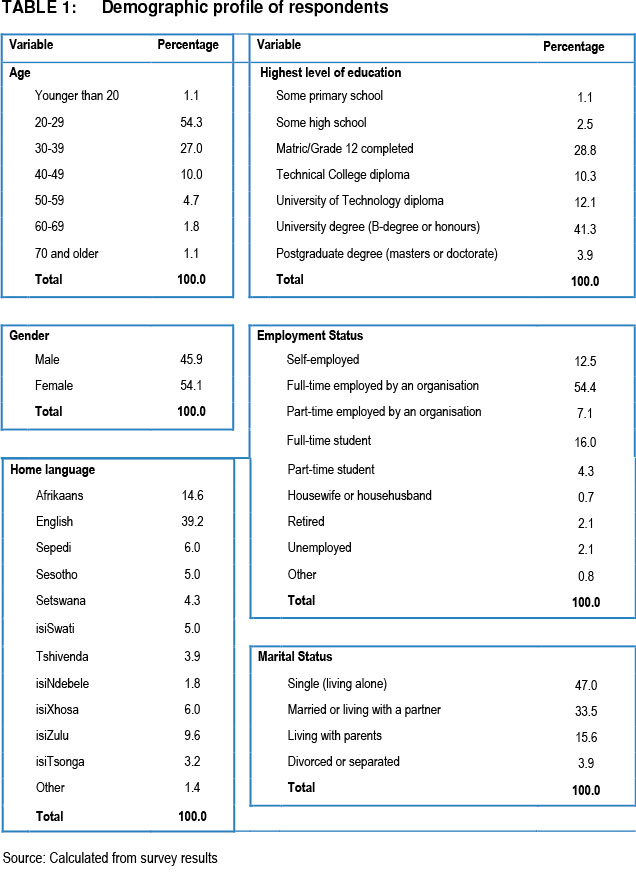
Table 1 presents the demographic profile of respondents for age, gender, education level, home language, employment status, and marital status.
It is important to note that all the respondents have experienced a service failure at a retail bank in South Africa.
From Table 1, of the 281 respondents, 129 were reported to be males, while 152 were females, representing 45.9 per cent and 54.1 per cent respectively. In terms of education, 41.3 per cent indicated a university degree (B-degree or Honours) as their highest level of education, followed by Matric/Grade 12 completed (28.8 per cent). Those who indicated primary school as their highest level of education were the smallest group, making up 1.1 per cent of all respondents.
In terms of age groups, the 20-29 years-old bracket was the largest group, making up 54.3 per cent of the total respondents. The second-largest age group was the 30-39 year-olds. This group made up 27.0 per cent of the total respondents and, combined with the 20-29 years-old group, made up 81.4 per cent of all the respondents. Those aged 70 or older and 20 or younger were the smallest groups; together they made up 2.2 per cent of all the respondents.
The results relating to language differentials indicate that the majority of all the respondents were English-speaking (39.2 per cent), followed by the Afrikaans-speaking (14.6 per cent) and isiZulu- speaking groups (9.6 per cent).
With regard to employment status, 54.4 per cent were reported to be employed full-time by an organisation, making up the majority of all the respondents, followed by full-time students (16 per cent) and self-employed respondents (12.5 per cent). With respect to marital status, the results show that single (living alone) respondents were in the majority (47 per cent), followed by those who are married (or living with a partner), who had 33.5 per cent share of the population sample.
7.2 Service failure severity
Principal component factor analysis was performed which confirmed that all eight items measuring service failure severity were loaded under one factor which was named 'service failure severity'. This implies that all the selected scale items indeed validly measured this construct with each commonality scores above 0.60.
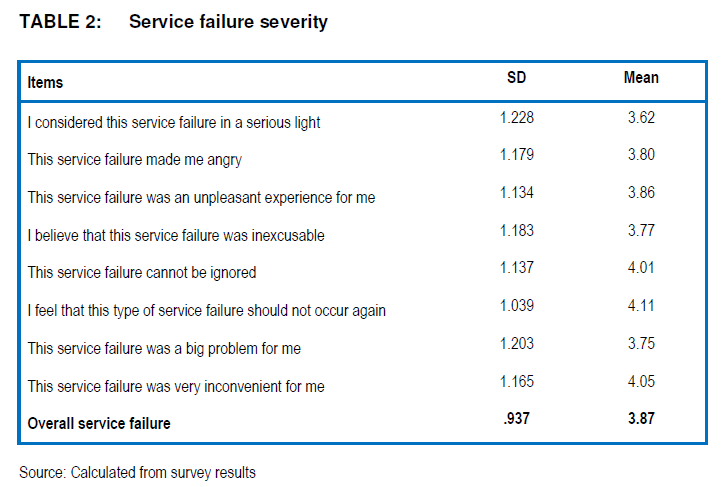
Table 2 provides an overview of the standard deviations and mean rating scores realised for each of the items measuring service failure severity on a five-point Likert scale. Therefore service failure severity was measured on an eight-item scale.
It is evident from Table 2 that all of the items are above the mid-point of the scale. The scale items with which the respondents agreed most include Ί feel that this type of service failure should not occur again' (mean=4.11, s.d=1.039) and This service failure was very inconvenient for me' (mean=4.05, s.d=1.165), which confirms the presence of service failure.
The items with which respondents agreed least include Ί considered this service failure in a serious light' (mean=3.62, s.d=1.228) and This service failure was a big problem for me' (mean=3.75, s.d=1.203).AIthough these two statements were indicated 'least agreed with' both however still show that they are towards agreeing (above mid-point) as seen in the results below.
The internal reliability of standardised variables was tested using Cronbach's alpha, and proved to be appropriate for the eight items measuring service failure severity. Cronbach's alpha service failure severity was 0.924 which is well above the recommended 0.7 (Tavakol & Dennick 2011:54). Therefore the eight items reliably measure service failure severity as supported by Zikmund and Babin (2010:350).
Given this, the overall mean was found to be 3.87 and the standard deviation .937 of service failure severity. The overall mean score indicates high levels of agreement with the eight selected items measuring service failure severity.
7.3 Client satisfaction and behavioural intention
Principal component factor analysis was also performed which confirmed that all seven items measuring client satisfaction and behavioural intention were loaded under one factor which was named 'client satisfaction and behavioural intention'. This implies that all the selected scale items indeed validly measured this construct with each commonality scores above 0.60.
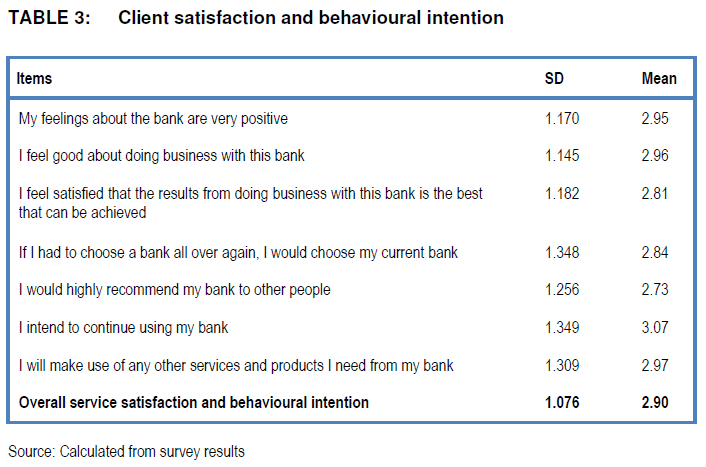
Table 3 provides a description of the standard deviations and mean scores realised for each of the items measuring client satisfaction and behavioural intention on a five-point Likert-type scale. Furthermore, client satisfaction and behavioural intention were measured on a seven-item scale derived from Fourie (2014:123-124).
It is evident that somewhat neutral in regarding their satisfaction levels and the behavioural intentions, as shown in Table 3. The scale items that indicate that respondents somewhat agreed with the statement Ί intend to continue using my bank' (mean=3.07, s.d=1.349). All the remaining statements such as Ί will make use of any other services and products I need from my bank' (mean=2.97, s.d=1.309) scored below middle point of the scale (3) indicating that respondents did not strongly agree with these statements. Furthermore, the items respondents agreed least (below mid-point) with statements such as Ί would highly recommend my bank to other people' (mean=2.73, s.d=1.256) and also Ί feel satisfied that the results from doing business with this bank is the best that can be achieved' (mean=2.81, s.d=1.182). Lastly, this result shows that clients exhibit neutral feelings towards overall behavioural intention and satisfaction with their selected bank (mean=2.90, s.d=.1.076)
The internal reliability of standardised variables was tested using Cronbach's alpha, and proved to be appropriate for the seven items measuring overall client satisfaction and behavioural intention. Cronbach's alpha for overall client satisfaction and behavioural intention was 0.940 which is well above the recommended 0.7 (Tavakol & Dennick 2011:54).
Therefore the seven items reliably measure service failure severity as supported by Zikmund and Babin (2010:350).
Client satisfaction and behavioural intention have an overall mean of 2.90 and an overall standard deviation of 1.076. The overall mean score was reported to be above the mid-point of the scale of 2.50, indicating high levels of agreement with items measuring client satisfaction and behavioural intention.
7.4 Hypothesis testing
This section presents the results for the four alternative hypotheses that were formulated for the research study.
The data obtained for all scale items used to measure each construct were tested for normality, and were found to fall within acceptable limits. The study also met the requirements for the sample size, as it was deemed to be sufficient (250) and representative of the target population. Parametric tests were used, therefore, to test the hypotheses formulated for the study.
An analysis of Pearson's correlation coefficient was conducted to explore the relationships between the independent and dependent variables.
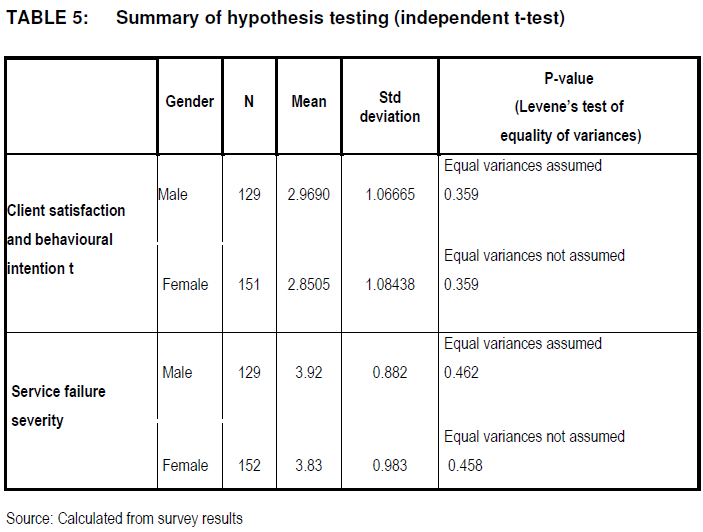
According to Hair et al. (2013:316), the larger the correlation coefficient, the stronger the association between two variables. An independent sample t-test was conducted to determine whether there were significant differences between the male and female respondents with respect to overall service failure, overall satisfaction, and behavioural intention after service failure. Therefore these results are highlighted in the Table 4 and Table 5 and will be discussed further in the following sub-sections.
7.4.1 Hypothesis 1
There is a negative relationship between levels of service failure severity and client satisfaction and behavioural intentions within the banking industry.
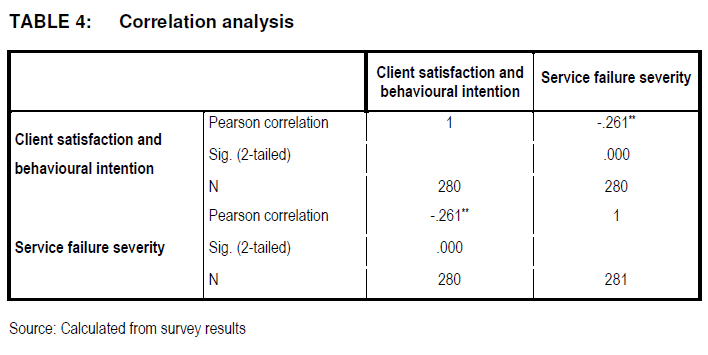
The correlation between the variable Overall service failure' and Overall satisfaction and behavioural intention' is -.261, and the statistical significance of this correlation is a p-value of 0.000.
Furthermore, the p-value of this correlation is less than .05; therefore we can conclude that the results are not due to chance. The correlation coefficient is between ±.21 and ±.40, which means that there is a weak relationship between the two variables, according to the rule of thumb.
Moreover, SPSS generated a negative Pearson's value. This means that there is a negative relationship: as one variable increases in value, the second variable decreases in value. Therefore, as overall service failure with a bank increases, it means overall satisfaction and behavioural intention decrease proportionately. As a result there is a negative weak correlation between the two variables (r= -0.261, p< 0.001).
Thus Hypothesis 1 indicates that there is a negative relationship between levels of service failure severity, client satisfaction, and behavioural intention after service failure. It can therefore be accepted, given the acceptable level of significance noted above.
7.4.2 Hypothesis 2
Client perceptions about overall service failure severity differ significantly according to gender.
The independent sample t-test was conducted to uncover whether there is a significant difference between gender groups with regard to service failure severity. The mean overall service failure level score for males is a slightly higher at 3.92 than that of the female respondents at 3.83. The standard deviation for males is somewhat smaller (.882) than for females (.983), and the statistical significance of this independent sample t-test is a p-value of .462. The hypothesis, which stated that client perceptions about overall service failure differ significantly according to gender groups, cannot be rejected, as there is insufficient evidence to accept this proposition as the p-value was greater than .05. It can therefore be conclude that there is no significant difference between men and women's perceptions of service failure severity.
7.4.3 Hypothesis 3
Client perceptions about overall satisfaction and behavioural intention after service failure differ significantly according to gender.
The independent sample t-test was conducted to investigate whether there is a significant difference between satisfaction and behavioural intention. The mean scores for overall satisfaction and behavioural intention level for males was found to be slightly higher at 2.97 than those for female respondents (2.85).
The standard deviation for males is somewhat smaller (1.067) than for females (1.084) and the statistical significance of this independent sample t-test produced a p-value of .359. Hypothesis 3, which stated that clients differ significantly according to gender with regard to overall satisfaction and behavioural intention after service failure, cannot be rejected as the p-value was greater than .05. It can therefore be conclude that there is no significant difference between men and women's overall satisfaction and behavioural intention.
8. DISCUSSION
The respondent profile indicates that the sample was diverse in terms of age, gender, language and educational level. The results indicate that in in general respondents' service failure experiences were severe, and that these the failure experienced should not be ignored and should not occur again as it inconvenienced them. This finding is in line with previous research which found that high level of service failure are likely to be found in high contact service industries such as the banking industry (Petzer & Mostert 2012:7; Rejikumar 2015:1).
The study revealed that in general respondents were neutral with regards to their levels of client satisfaction and behavioural intentions after experiencing a service failure. More specifically, did not strongly rate that they were satisfied or dissatisfied with their banks and that their banks were doing the best that could be achieved. In addition, respondents appeared to not have strong positives behavioural intentions as they had neutral tending towards not agreeing that they would recommend their banks to others. Given the importance of banking services in the day to day lives of consumers, this finding is of concern, but is also expected, as previous findings indicate that client satisfaction levels in the banking industry are generally low (Huang 2011:513). Although consumers may continue to use their banks, this is loyalty due to high switching costs (Abratt & Russell 1999:5; Stan, Caemmerer & Cattan-Jallet 2013:1545), and not necessarily due to high levels of satisfaction.
The study revealed that there is a negative relationship between levels of service failure severity, client satisfaction and behavioural intention after service failure. This finding is expected as there is substantial research proving this relationship strategy (Kim & Jang 2016:1696; Petzer, Mostert & Fourie 2014:38; Varela-Neira et al. 2010:35; Wang, Wu, Lin & Wang 2011:355).
When there is a failure in service, without any service recovery, clients will be unsatisfied. Clients will also be unwilling to demonstrate positive behaviours such as use the service again and recommend the service should there be no service recovery strategy (Petzer et al. 2014:40; Wang et al. 2011:357).
The study found that men and women experience the same service failure severity after a service failure. This finding is contradictory to previous studies which indicated that women were likely to perceive service failure as more severe in comparison to men (Al-Foqahaa 2010:2659; Komunda 2013:6; Varela-Neira et al. 2010:33). The same can be said for overall client satisfaction and behavioural intention.
Men and women experienced the same levels of client satisfaction and behavioural intention after a service failure. This finding was also contradictory to previous research which generally found that women experienced higher levels of dissatisfaction after a service failure and had more negative behavioural intentions after a service failure men (Al-Foqahaa 2010:2659; Komunda 2013:6; Varela-Neira et al, 2010:33).
9. IMPLICATIONS
This research study provided insights into the service failure severity experienced by retail banking clients as a result of service failure. The factors investigated relate to service failure severity, client satisfaction, and behaviour intention within the retail banking environment of South Africa.
Given the high levels of service failure severity and neutral client satisfaction and behavioural intentions revealed in this study, it is crucial for banking service managers to enhance their service delivery and excellence and client satisfaction in order to ensure a reduction in service failure severity.
The study found no significant differences among the gender groups of clients with respect to perceived service failure severity and overall client satisfaction and behavioural intention levels after a service failure experienced. The implication here is that there service managers should be prepared to deal with unsatisfied clients from both men and women.
Further implication for marketers and banking service managers is to ensure that platforms for client complaints and service improvements are readily available, and that banks respond quickly to service failures, manage complaints well, and ensure that they meet clients' needs when implementing the service recovery strategy.
In the light of this finding, it is crucial that marketers develop gender neutral service recovery strategies, as the clients' gender will not influence how they perceive overall service failure and clients satisfaction and behavioural intention after experiencing a service failure. Despite previous research that found that women were likely to experience service failure severity, this is not the case in this study and it is of value for banking service managers to take this into consideration when developing service recovery strategies.
Retail banks should proactively conduct research to profile the segments that usually have high probabilities of complaining and experiencing service failure. If left unattended, banks could ultimately lose consumer trust and loyalty due to high levels of complaints arising as a result of service failure severity.
Even though high levels of service failure were uncovered among the respondents, the study also revealed that client satisfaction and behavioural intention levels were not strongly negative after a service failure. Clients feel that they will continue to use their banks, and that they will also make use of any other services and products they need from their banks after a service failure.
The implication for marketers here is to not assume that continuation of the service means clients are satisfied. The nature of banking is such that generally switching costs are high, despite technology advancements. Banking services managers need to devise better listening tools, to understand what services clients are unhappy with and then develop strategies to address these issues.
10. LIMITATIONS AND FUTURE RESEARCH
The limitation of the study is that non-probability convenience sampling was used to select respondents, along with the fact that the study only included respondents from Gauteng. The results of this study thus cannot be generalised to the entire South African population.
However, the results will assist marketers to explore the aspect of service failure severity and its underlying impact on satisfaction and behavioural intention, thereby bringing deeper understanding.
Moreover, service managers can also use the results to evaluate the service failure severity and to implement proper recovery strategies to improve satisfaction and service quality. It is therefore recommended that future research consider using probability sampling and a longitudinal approach in order to negate the effects of non-probability sampling techniques.
Other factors such as type of service failure should be investigated failure as these could likely the effect of service failure severity on behavioural intentions further. Findings from such studies could help to ascertain the applicability of the findings in different contexts. This would support retail banking service providers in developing suitable service recovery strategies that restore client satisfaction levels and eliminate unfavourable behavioural intensions by clients.
Lastly, this study was conducted in the retail banking industry in South Africa, and given the size and importance of services in the global economy; the study can be expanded to various service industries to make the findings more generalizable.
11. CONCLUSION
The overall purpose of this study was to investigate the effect of service failure severity on behavioural intention and client satisfaction in the South African retail banking industry.
It is therefore concluded that service failures experienced by retail banking clients in the South African banking industry are severe, and that their impact is underestimated. Service failure is an incremental issue for banks, as clients feel that service failures should not occur and that, if they do, they should not be ignored.
Surprisingly, the results also show that there is no difference in consumer perceptions among gender groups about behavioural intentions and client satisfaction after experiencing service failure. This could be because both gender groups experience the same level of service failure; but there might also be other factors, such as cultural patterns, that explain this pattern, and thus enhance our knowledge and understanding. However, this result is statistically insignificant, and requires further study to explore this relationship.
The study contributes to service failure seventy research by providing insights into the effect of service failure on client satisfaction and behavioural intentions in the South African context. While most studies have been focused on service failure severity and recovery strategies, this study has shown that service failure severity is high in the banking industry of South African. Thus there is a need for researchers and service managers to develop proper recovery strategies that address the issue.
The results of this study highlight that service failure severity should be acknowledged and carefully examined, to ensure that clients do not experience dissatisfaction and that banks provide excellent service and complaint management systems to deal effectively with service failure severity. These results are thus vital to the banking industry of South Africa, given that it is operating within an emergent economy, and given the need to improve service delivery in that context.
REFERENCES
2. LITERATURE REVIEW
- ABRATT R & RUSSELL J. 1999. Relationship marketing in private banking in South Africa. International journal of Bank Marketing 17(1):5-19.
- AL-EISA AS & ALHEMOUD AM. 2009. Using a multiple-attribute approach for measuring client satisfaction with retail banking services in Kuwait. International Journal of Bank Marketing 27(4):294-314.
- AL-FOQAHAA S. 2010. Situational dimensions of customers' complaining behaviour when dissatisfied with banking services in Palestine. An-Najah University Journal for Research 24(9):2657-2690.
- ALLEN AM, BRADY MK, ROBINSON SG & VOORHEES CM. 2015. One firms loss is another's gain: capitalizing on other firms' service failures. Journal of the Academy of Marketing Science 43(5):648-662.
- ARMSTRONG G & KOTLER P. 2003. Marketing: an introduction. 6lh ed. Upper Saddle River, NJ: Pearson Prentice Hall.
- BURNS AC & BUSH RF. 2010. Marketing research. 6th ed. Upper Saddle River, NJ: Pearson Prentice Hall.
- BOSHOFF C. 2014. The influence of buffering variables on clients willingness to engage in retribution behaviour after service failure. South African Electronic Publications 17(3):297-309.
- BROWN SP & LAM SK. 2008. A meta-analysis of relationships linking employee satisfaction to customer responses. Journal of Retailing 84:243-255.
- COETZEE J, VAN ZYL Η & TAIT M. 2013. Perceptions of service quality by clients and contact-personnel in the South African retail banking sector. Southern African Business Review 17(1):1-22.
- DABHOLKAR PA & SPAID Bl. 2012. Service failure and recovery in using technology-based self-service: effects on user attributions and satisfaction. The Service Industries Journal 32(9):1415-1432.
- ESHGHI A, HAUGHTON D & TOPI H. 2007. Determinants of customer loyalty in the wireless telecommunications industry, Telecommunications Policy 31(2):93-106,
-
FINANCIAL STABILITY BOARD. 2013. Recovery and resolution planning for systemically important financial institutions: guidance on identification of critical functions and critical shared services. [Internet: http://www.financialstabilityboard,org/wp-content/uploads/r_1307 16a.pdf?page_moved=1; downloaded on 2016- 09-01.
» http://www.financialstabilityboard,org/wp-content/uploads/r_1307 16a.pdf?page_moved=1 - ]
- FOURIE S. 2014. Investigating online complaint intention and service recovery expectations of clothing retail customers. Potchefstroom: North-West University. (DCom-thesis.
- )
- GARG A. 2014. Service recovery paradox in Indian banking industry: an empirical investigation. South East Asian Journal of Management7'(2):1-12.
- HAIR JF, CELSI MW, ORITINAU DJ & BUSHRP. 2013. Essentials of marketing research. 3rd ed. New York, NY: McGraw Hill.
- HALSTEAD D & PAGE TJ. 1992. The effects of satisfaction and complaining behaviour on customer repurchase intentions. Journal of Customer Satisfaction, Dissatisfaction, and Complaining Behaviour 5:1-11.
- HOFFMAN KD & KELLEY SW. 2000. Perceived justice needs and recovery evaluation: a contingency approach. European Journal of Marketing 34(3/4):418-432.
- HOLLOWAY BB & BEATTY SE. 2003. Service failure in online retailing: a recovery opportunity. Journal of Service Research 6(1 ):92-105.
- HUANG MH. 2011. Re-examining the effect of service recovery: the moderating role of brand equity. Journal of Services Marketing 25(7):509-516.
- JOHNSTON R & MICHEL S. 2008. Three outcomes of service recovery: customer recovery, process recovery and employee recovery. International Journal of Operations and Production Management 28(1):79-99.
- KIM J-H & JANG SC. 2016. Factors affecting memorability of service failures: a longitudinal analysis. International Journal of Contemporary Hospitality Management 28(8):1676-1701.
- KOMUNDA M. 2013. Customer complaints behaviour, recovery and behavioural intention: literature review. International Journal of Business and Behavioural Science 3(7):1-29.
- KOUTOUVALAS DK & SIOMKOS GJ. 2006. An examination of the relationship between service quality perceptions and customer loyalty in public versus private Greek banks. International Journal of Financial Services Management 1 (2/3):190-204.
- LEWIS BR & SPYRAKOPOULOS S. 2001. Service failures and recovery in retail banking: The customers' perspective. International Journal of Bank Marketing 19(1):37-47.
- MASUKUJJAMAN Μ & AKTER Α. 2010. Quality of categorized service and customer satisfaction in banking industry: an empirical study on private commercial banks in Bangladesh. Journal of Business and Technology 1:19-37.
- MAXHAM JG III & NETEMEYER RG. 2003. Firms reap what they sow: the effects of shared values and perceived organizational justice on customers' evaluations of complaint handling. Journal of Marketing 67':46-62.
- MCCOLLOUGH MA, BERRY LL & YADAV MS. 2000. An empirical investigation of customer satisfaction after service failure and recovery. Journal of Service Research 3(2):121-137.
- MILLER JL, CRAIGHEAD CW & KARWAN KR. 2000. Service recovery: a framework and empirical investigation. Journal of Operations Management 18(1):387-400.
- MISTRY SH. 2013. Measuring customer satisfaction in banking sector with special reference to banks of Surat city. Asia Pacific Journal of Marketing & Management 2(7):132-140.
- MYLONAKIS J. 2009. Customer relationship management functions: a survey of Greek bank customer satisfaction perceptions. Journal of Bank Management 8(2):7-31.
- NICHOLLS JAF, ROSLOW S & TSALIKIS J. 1995. Bank transactions: satisfaction and customer attributes. The Journal of Marketing Management 5(1 ):39-45.
- PETZER DJ & MOSTERT PG. 2012. Attitude towards, and likelihood of, complaining in the banking, domestic airline and restaurant industries. Southern African Business Review 16(2):1 -23.
- PETZER DJ, MOSTERT PG & FOURIE S. 2014. Online complaint intention and service recovery expectations of clothing retail customers. The Retail and Marketing Review 10(2): 38-58.
- REJIKUMAR G. 2015. An empirical study on antecedents of perceived service recovery quality in e-banking context. The Journal of Internet Banking and Commerce 2015:1-10.
- RICHARD O. 2013. Factors that determine customer satisfaction level in banking institutions: evidence from Ghanaian banking industry. Asian Journal of Business Management Sciences 2(7):1-13.
- ROOTMAN C, TAIT Μ & SHARP G. 2011. Relationship marketing and customer retention lessons for South African banks. Southern African Business Review 15(3):184-206.
- ROSE PS & HUDGINS SC. 2008. Bank management and financial services. 7th ed. Boston, MA: McGraw Hill.
-
SA GOODNEWS. 2016. SA fast facts. [Internet: http://www.sagoodnews.co.za/sa-fast-facts.html; downloaded on 2016-09-01.
» http://www.sagoodnews.co.za/sa-fast-facts.html - ]
- SINGHAL S, KRISHNA A & LAZARUS D. 2013. Service failure magnitude and paradox: a banking perspective. Journal of Relationship Marketing 12(3):191-203.
- SHANKA MS. 2012. Bank service quality, customer satisfaction and loyalty in Ethiopian banking sector. Journal of Business Administration and Management Science Research 1(1):1-9.
- SMITH AK & BOLTON RN. 1998. An experimental investigation of customer reactions to service failure and recovery encounters: paradox or peril? Journal of Service Research 1(1):65-81.
- SPRENG RA, HARREL GD & MACKOY RD. 1995. Service recovery: impact on satisfaction and intentions. Journal of Service Marketing 9(1): 15-23.
- STAN V, CAEMMERER Β & CATTAN-JALLET R. 2013. Customer loyalty development: the role of switching costs. Journal of Applied Business Research 29(5): 1541-1554.
- STAUSS B & SCHOELER A. 2004, Complaint management profitability: what do managers know? Managing Service Quality 14(2/3):147-156.
- TAVAKOL M & DENNICK R. 2011. Making sense of Cronbach's alpha. International Journal of Medical Education 2:53-55.
-
THE BANKING ASSOCIATION OF SOUTH AFRICA. 2012. 2012 South African banking industry overview. [Internet: http://www.banking.org.za/index.php/our-industry/2012-south-african-banking-sector-overview/; downloaded on 2013-06-25.
» http://www.banking.org.za/index.php/our-industry/2012-south-african-banking-sector-overview/ - ]
-
THE WORLD ECONOMIC FORUM COMPETITIVE SURVEY. 2012/13. Global competitiveness report 2012-2013. [Internet: http://www.weforum.org/reports/global-competitiveness-report-2012-2013; downloaded on 2013-06-30.
» http://www.weforum.org/reports/global-competitiveness-report-2012-2013 - ]
- TRONVOLL B. 2012. A dynamic model of customer complaint behaviour from the perspective of service dominant logic. European Journal of Marketing 46:284-305.
- VALENZUELA F, COOKSEY R, CHANDRALAL L & HASSAN R. 2013. Service recovery in the Australian banking industry. Contemporary Management Research 9(4):463-482.
- VARELA-NEIRA C, VÀZQUEZ-CASIELLES R & IGLESIAS V. 2010.The effects of customer age and recovery strategies in a service failure setting. Journal of Financial Services Marketing 15(1):32-48.
- WANG YS, WU SC, LIN HH & WANG YY. 2011. The relationship of service failure severity, service recovery justice and perceived switching costs with customer loyalty in the context of e-tailing. International Journal of Information Management31 (4):350-359.
- YOUNAS A & JAN H. 2012. The impact of service recovery on customer loyalty (case company: Swedbank). Gävl, Sweden: University of Gävl. (DCom-thesis.
- )
- ZOURRIG H, HEDHLI K & CHEBAT JC. 2014. A cross-cultural perspective on customer perceptions of service failures' severity: a pilot study. International Journal of Quality and Service Sciences 6(4):238-257.
- ZIKMUND WG & BABIN BJ. 2010. Essentials of marketing research. 4,h ed. Beijing, China: Cengage Learning.