Service Encounter Experience Antecedents and Outcomes in the Zimbabwean Restaurant Industry
Abstract
Despite the worldwide importance of the restaurant industry, there is a lack of research, specifically within the emerging market context, regarding the antecedents and patronage outcomes of service encounter experiences in the restaurant industry. Especially in the services marketing domain, service encounter experience is an emerging concept. It is important for businesses such as restaurants, and their management, to identify the factors influencing their patrons' service encounters and the effect of the delivered service encounters on business success. The primary objective of this study is to determine the antecedents and patronage outcomes of service encounter experiences of patrons in the Zimbabwean restaurant industry. A convenience sample of 400 respondents completed a self-administered questionnaire focusing on how four selected antecedents influence service encounter experiences, and how service encounter experiences relate to three selected patronage outcomes. From a quantitative analysis, three of the antecedents proved to significantly influence service encounter experiences, namely ambience factors, service quality delivery and typology of patrons. In addition, the empirical results showed statistically significant relationships between service encounter experiences and both re-patronage intention and patronage loyalty. The study contributes by providing practical recommendations to restaurant managers, based on the results, to improve the success rate of restaurants operating in emerging markets.
Ambience factors; patronage loyalty; patronage retention; re-patronage intention; service contact levels; service delivery quality; service encounter experiences and typology of patrons
1. INTRODUCTION AND RESEARCH PROBLEM
During 2019 and beyond, many of the fastest growing economies will be situated in Sub Saharan African countries (Adegoke 2019). According to the Finance minister of Zimbabwe, Hon Prof Mthuli Ncube, the economy is expected to grow by 6% over the next few years (AFP News Agency 2018). Such economic growth will surpass the original budget projection of 4.5% (AFP News Agency 2018). The service sector is the country's largest contributor to its Gross Domestic Product (GDP) (Plecher 2019). In particular, Zimbabwe's service sector contributed 60.59% towards the country's GDP in 2017 (Plecher 2019). It is clear that the services sector makes a significant contribution towards the country's economy (Zimstat 2018), and therefore the Zimbabwean service sector is regarded as one of the three major economic sectors in the country (Zimbabwe Market Overview 2019). Based on 2017 figures, the Zimbabwean service sector contributes more to GDP than the other critical sectors such as agriculture (8.34%) and industry (21.41%) combined (Plecher 2019).
The tourism and hospitality industry, within which the restaurant industry operates, is among other service industries that are triggering the growth of the services sector in Zimbabwe (Zhou 2018:1-3). The nature of the restaurant industry, in general, is lucrative, important to the economy and highly competitive, since a limited customer base is available (Dixon, Miscuraca & Koutroumanis 2018:106-110). In addition, the mature and fragmented restaurant industry in general has led to the extreme standardisation of the core restaurant services (Bonadonna, Alfiero, Cane & Gheribi 2019:8). A fragmented restaurant industry is characterised by the presence of many operators without any single dominant player (Dixon et al. 2018:106). In the case of the Zimbabwean fast food restaurant industry there are many restaurant businesses ranging from international brands such as KFC, Steers, Nandos, Mugg and Bean, and local brands such as Chicken Inn, Chicken Slice, and Chicken Matty (Shumba, Zindiye & Donga 2017). Urban and tourist resort centres are located in high human density geographically areas (Saidi 2018:6). Competition is increased by restaurants entering the market in most urban centres and tourist resort areas in Zimbabwe increases competition (Zimtrade 2014). Increased competition has seen the prevalence of both international and local fast food brands operating in the Zimbabwean market.
Restaurants compete on the basis of food quality, service delivery quality, and ambience factors (Mhlanga 2018:9-10; Nel, Williams, Steyn & Hind 2018)). In the changing Zimbabwean restaurant industry, other factors, such as the service encounter experiences of patrons may also influence the success rate of these businesses. In service industries, exchange value is created when patrons interact with contact employees and service facilities, in what is known as service encounters (Grönroos 2007:373; Lin & Mattila 2010:823; Lovelock & Wirtz 2011:68). Service encounter experiences is the viable alternative for differentiation and competitive advantage within the restaurant industry since quality food alone can no longer guarantee the survival and success of restaurants (Ariffin, Bibon & Abdullah 2017:86,87).
Despite the importance of the restaurant industry to the Zimbabwean service sector, and the economy, there is a lack of global research in emerging markets on the antecedents and patronage outcomes of service encounter experiences in the restaurant industry. In addition, a research gap exists in that Voorhees, Fombelle, Gregoire, Bone, Gustafsson, Sousa and Walkowiak (2017:9) emphasise that many service businesses focus on the core service encounter, but fail to leverage the opportunities available in the pre- and post-core encounters. This suggests that service industries struggle to fully and effectively consider antecedents and patronage outcomes as part of their patrons' service encounters. There are no official statistics on the sizes of various segments of the restaurant industry in Zimbabwe, although it is noticeable that fine dining and fast food restaurants, cafes as well as coffee shops operate in the country. Anecdotal evidence suggests that fast food restaurants command more than half of the restaurant market share in Zimbabwe. This is inferred from the fact that fast food restaurants usually target low-income earners (Dixon et al. 2018:106:107), which includes the majority of Zimbabweans. This study will, therefore, focus on identifying relationships between antecedents and service encounter experiences, as well as, between service encounter experiences and patronage outcomes within the restaurant industry, in particular fast food restaurants, in Zimbabwe.
2. RESEARCH OBJECTIVES
The primary objective of the study is to determine the antecedents and patronage outcomes of service encounter experiences of patrons in the Zimbabwean restaurant industry. Identifying the relationships between service encounter experiences and selected antecedents, as well as, selected patronage outcomes, creates opportunities to positively influence patrons' service encounter experiences. In turn, this could ultimately lead to increased patron support for and the success rate of Zimbabwean restaurants. This study can also guide restaurant managers of restaurants on where to improve in terms of their service encounter experiences.
Marketing literature has identified attitudinal post dining behavioural constructs as possible outcomes of service encounter experiences (Hwang & Hyun 2012:665). In addition, this study draws on a patronage retention model conceptualised by Zeithaml, Bitner and Gremler (2013:477), the theory of reasoned action (Ajzen 1991) and the social exchange theory (Blau 1964), to propose relationships between service encounter experiences and selected outcomes. From a literature search, the study identified selected aspects that are proposed as antecedents of service encounter experiences.
3.1 Antecedents of service encounter experiences
Since high contact level businesses are characterised by the presence of a patron during service delivery and low service contact businesses are characterised by having part of the service delivery without the direct involvement of a patron (Lovelock & Wirtz 2011:71), it is suggested that service contact levels (the presence or non-presences of patrons) effect service encounters. For this study, service contact levels refer to the duration, frequency, intensity and variety of encounters between restaurant patrons and either one of or both the service personnel and service facilities (which in the restaurant context can relate to, for example, meal deliveries/collection, reservations and waiting times).
Ambience factors incorporate various aspects in the atmosphere of a setting and have been proven to affect service delivery (Ha & Jang 2010; Lin & Liang 2011:355; Zeithaml et al. 2013:296). Ambience factors were defined for this study as the inanimate background characteristics in restaurants that affect patrons' five senses (for example relating to the restaurants' lighting, temperature, aroma, noise levels and décor).
Service delivery quality is a critical part of businesses operating in service industries in terms of their patrons' service encounter experiences (Ryu & Han 2010:324; Ryu, Lee & Kim 2012:201; Tesfom & Birch 2011:378). The concept of service delivery quality was defined for this study as the intangible aspects accompanying or surrounding a meal served to restaurant patrons, which include menu advice as well as staff friendliness and competence.
Typology of patrons is the subjective element of service encounter experiences (Hwang & Hyun 2012:659), and implies that experiences generated from the same or similar service encounters are perceived differently by various patrons (Hwang & Hyun 2012:659), for example, based on their personalities. Restaurants tend to strive to find a common ground to provide experiences that can appeal to a broad spectrum of patrons. Typology of patrons, for the purpose of this study, refers to the types of, and interaction between, restaurant patrons with an inclination towards their personalities.
3.2 Service encounter experiences
The work of Pine and Gilmore (1998) initially discussed the service encounter experiences construct. A service encounter experience is a situation where a patron has an awareness and perception as a result of some level of interaction with several elements in a context generated by a service provider (Otengei, Changha, Kasekende & Ntayi 2014:82). Businesses design service encounter experiences to produce a positive perception in the mind of a patron that is expressed by the patron through the sense of delight, integrity, confidence, passion or support (Buttle 2009:171). Therefore, the term service encounter experiences is increasingly used in describing what businesses offer to their patrons during service delivery or what happens at service "touch points" where patrons and service providers "meet".
Authors (Ismail, Melewar, Lim & Woodside 2011:205; Schmitt 2011:55) regard the service encounter experiences concept as a key construct in services marketing. Often, the following terms are used to describe service encounter experiences: memorable experiences (Pine & Gilmore 1998), customer experiences (Cook, Bowen, Chase, Dasu, Stewart & Tansik 2002:159; Tseng, Qinhai & Su 1999:51), consumption experiences (Arnold, Reynolds, Ponder & Lueg 2005:341; Petzer & Mackay 2014:2; Wong 2004:368), idiosyncratic service experiences (Collier, Barnes, Abney & Pelletier 2018:150) or dining experiences in the restaurant industry context (Ariffin et al. 2017:35; Hwang & Hyun 2012:661; Sulek & Hensley 2004:236; Wall & Berry 2007:60).
Since many products and services have become homogeneous, many businesses are currently using service encounter experiences as a competitive tool to differentiate themselves from competitors (Petermans, Janssens & Van Cleempoel 2013:1). Service businesses, for example, including restaurants, aim to meet patrons' needs and wants through pleasant service encounter experiences (Hwang & Hyun 2012:659). Service encounter experiences have been studied in different contexts by various researchers (Arnould & Price 1993; Csikszentmihalyi 1990; Dodson 1996; Farber & Hall 2007; Pine & Gilmore 1998), but in practice, the concept service encounter experiences does not have unified terminology or specific theoretical models (Zatori 2013:20). This is also evident from the various terms mentioned above as synonyms for service encounter experiences.
A service encounter incorporates everything that a patron goes through during the service delivery and consumption process (Bitner 1992:60; Jang & Namkung 2009:453), and refers to the various interactions between a patron and a service during the complete service delivery period (Shostack 1987:243). On the one hand, a service encounter can be regarded as only the interaction between service contact employees and patrons (Bradley, Sparks, McColl-Kennedy, Jimmieson & Zapf 2010) On the other hand, a service encounter refers to the complete service delivery process including the broader interaction between a service business, contact employees and patrons (Grönroos 2007; Jayawardhena, Souchon, Farrell & Glanville 2007). As mentioned, in a restaurant, patrons' experiences are not generated from simply consuming food alone, but from all events and activities that takes place during the entire service encounter (Ariffin et al. 2017:35; Mhlanga, Hattingh & Moolman 2015:143). For the purpose of this, a service encounter experience of a restaurant patron refers to the period between the time a patron enters a restaurant to the time he/she departs from the restaurant, and includes all the aspects relating to the interaction between a restaurant patron, the restaurant service and the restaurant service employees.
Service encounter experiences impact loyalty dimensions such as patronage loyalty, patronage retention and re-patronage intention (Ali & Omar 2014:177; Brakus, Schmitt & Zarantonello 2009:53).
3.3 Outcomes of service encounter experiences
Patronage retention is a function of patronage satisfaction and pleasant service encounter experiences (Godson 2009:81). Logically, patrons must be satisfied with their service encounter experiences in order to continue patronising the same business. This suggests that when patrons experience pleasant service encounters they are more likely to be retained by the business. Patronage retention is defined as marketing efforts directed to existing customers (Hoffman, Bateson, Wood & Kenyon 2009:346), and in the service context, patronage retention is defined as the psychological commitment of a patron towards a business, such as a restaurant (Han & Ryu 2009:492). Many scholars (Egan 2011:74; Hoffman et al. 2009:346; Zeithaml et al. 2013) agree that patronage retention should be given more attention than patronage acquisition. Patronage retention is often a focus area for businesses operating in highly competitive markets, such as restaurants, as restaurants rely more on repeat business than on business from newly acquired patrons, as a result of costly marketing efforts (Egan 2011:74; Gummesson 1999:183). A model conceptualised by Zeithaml et al. (2013:477) and literature show that patronage retention leads to lower service delivery and marketing costs, higher volumes of purchases, price premiums, higher profits, and positive word-of-mouth communication (Buttle 1996:5; Egan 2011:76; Godson 2009:72).
For the purpose of this study, Patronage retention refers to patrons' level of repeated patronage to a specific restaurant.
Service marketing literature shows that service encounter experiences influence and sustain re-patronage intention (Egan 2011:58). Re-patronage intention has also been specified as an indicator of actual re-patronage behaviour (Jang & Namkung 2009:454). This relationship between service encounter experiences and re-patronage intention is drawn from the theory of reasoned action (Ajzen 1991), which assumes that normative behavioural intentions are regulated by attitudes developed towards an object and/or situation. In addition, previous research highlighted that re-patronage intention is an outcome of satisfying service encounter experiences (Hwang & Hyun 2012:665). According to Hwang and Hyun (2012:665), re-patronage intention is a post-dining behavioural intention of restaurant patrons and refers to patrons' likelihood to re-visit a specific service outlet (Hwang & Hyun 2012:665; Khan, Aadean, Salman, Nadeen & Rizwan 2016:87).
For this study, Re-patronage intention relates to patrons' intention to re-visit a specific restaurant and is defined as patrons' likelihood to repeat the same patronage behaviour with regard to a restaurant.
The social exchange theory (Blau 1964; Gouldner 1960) provides some theoretical basis for proposing the relationship between service encounter experiences and patronage loyalty. The theory is contextualised to this study by suggesting that when a patron enjoys a favourable service encounter experience, a state of indebtedness exists that has to be reciprocated in order to restore equilibrium in the service encounter (Tsai 2001:501). This implies that when a patron experience a pleasant service encounter, the patron feels obligated to be loyal to the service provider. Consequently, patronage loyalty is also expected to translate into purchase behaviour (Egan 2011:57). Patronage loyalty refers to the behaviour exhibited by patrons where they consistently patronise the same business, in a market where there are a considerable number of alternative businesses to support (Sharmeela-Banu, Gengeswari & Padmashantini 2013:87).
In this study, Patronage loyalty refers to the behaviour of patrons where they consistently patronise the same restaurant, although there are a number of alternative restaurants to support.
From the literature discussion, the following hypotheses are proposed:
H1: There is a significant relationship between Service contact levels and Service encounter experiences.
H2: There is a significant relationship between Ambience factors and Service encounter experiences.
H3: There is a significant relationship between Service delivery quality and Service encounter experiences.
H4: There is a significant relationship between Typology of patrons and Service encounter experiences.
H5: There is a significant relationship between Service encounter experiences and Patronage retention.
H6: There is a significant relationship between Service encounter experiences and Re-patronage intention.
H7: There is a significant relationship between Service encounter experiences and Patronage loyalty.
4. RESEARCH METHODOLOGY
The quantitative research design used was deemed appropriate for this exploratory study since the study used a structured questionnaire to gather responses from a large sample, and statistically tested hypotheses (Struwig & Stead 2013:3-4; Zikmund, Babin, Carr & Griffin 2010:94).
The study's target population included all patrons of restaurants in Zimbabwe. No sampling frame of all the Zimbabwean restaurant patrons is available, and the researchers used the non-probability convenience sampling technique (Struwig & Stead 2013:116) to select a sample of restaurant patrons from the capital city of Harare.
The researcher and fieldworkers approached patrons in restaurants after they enjoyed meals. Verbal consent to approach patrons was obtained from the relevant restaurant owners. Prior to inviting patrons, the following research ethical aspects were considered: voluntary participation, anonymity of respondents, the option of respondents to withdraw without any negative consequences and the confidentiality of collected data. Before participation, potential respondents were informed about the study's purpose and objectives, as well as, their implied consent when completing the questionnaires.
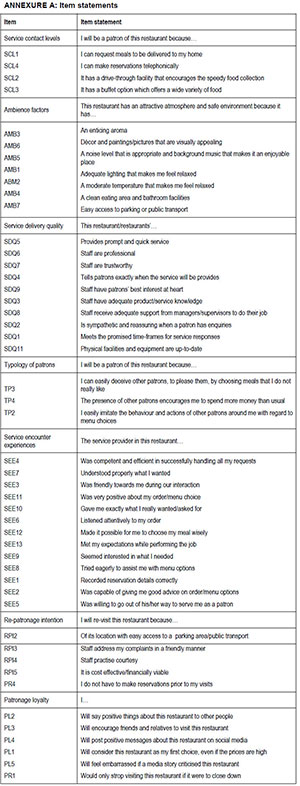
A self-developed, self-administered, English questionnaire was developed and used as the study's research instrument. The questionnaire items were developed based on literature. Section A consisted of 58 items that gathered respondents' perceptions about restaurant aspects relating to the four selected independent variables (service contact levels, ambience factors, service delivery quality and typology of patrons), service encounter experiences and the three selected patronage outcomes. Section A used an ordinal scale in the form of a seven-point Likert-type scale ranging from 'strongly disagree' (1) to 'strongly agree' (7). Section B used nominal scales to gather biographic (for example gender and age) as well as demographic data relating to how often respondents visit restaurants, their reasons for visiting and their restaurant expectations.
Marketing academic scrutinised the measuring instrument to ensure face validity. The content validity of the measuring instrument was ensured by conducting a pilot study among 20 potential respondents. Following the pilot study, minor changes were made to questionnaire item statements to ensure that respondents understand the questionnaire items as intended.
The computer programmes Microsoft Excel and Statistica (Version 13) were used to conduct the data analysis. Data analysis was performed in six phases. Firstly, descriptive statistics were calculated to summarise the sample of respondents (Struwig & Stead 2013:165). Secondly, Exploratory Factor Analyses (EFA) were conducted to determine the construct validity of the research instrument. Items with factor loadings of at least 0.4 were considered as valid (Hair, Black, Babin & Anderson 2014:115). During the third step, Cronbach's alpha coefficients were calculated to determine the reliability of the research instrument. Cronbach's alpha coefficients equal to or greater than 0.70 were regarded as reliable (Hair et al. 2014:123). Fourthly, based on the factor structure resulting from the EFA, descriptive statistics relating to the variables were calculated (Struwig & Stead 2013:165). During the fifth data analysis step, Pearsons' Product Moment Correlations were calculated to identify correlations between variables (Lind, Marchal & Wathen 2012:463). In the final step, multiple regression analyses were conducted to test the influence of the four selected independent variables on the intervening variable, as well as, the influence of the intervening variable on the three selected dependent variables. Therefore, the multiple regression analyses made it possible for the researchers to identify significant relationships between the variables (Hair et al. 2014:157), to test the formulated hypotheses.
5. EMPIRICAL RESULTS
5.1 Sample description
A total of 400 usable questionnaires were collected for analysis. The majority of the respondents are male (57%), with 43% of the respondents being female. Most of the respondents are between 20 and 29 years old (51%), while 23% are between 30 and 39 years old. A total of 45% of the respondents are single in terms of marital status (45%). The next highest percentage relating to respondents' household structures is 40%, for those living with a spouse/partner, as well as, with more than 3 children living at home.
In terms of frequency of dining, respondents visit restaurants rather monthly than weekly. This is evident since 47% of the respondents visit restaurants more than once a month, but not weekly and 28% of the respondents visit restaurants at least once per week. Regarding the preferred reservation methods, respondents prefer to make reservations in person (57%) and through telephone bookings (24%).
5.2 Validity and reliability results
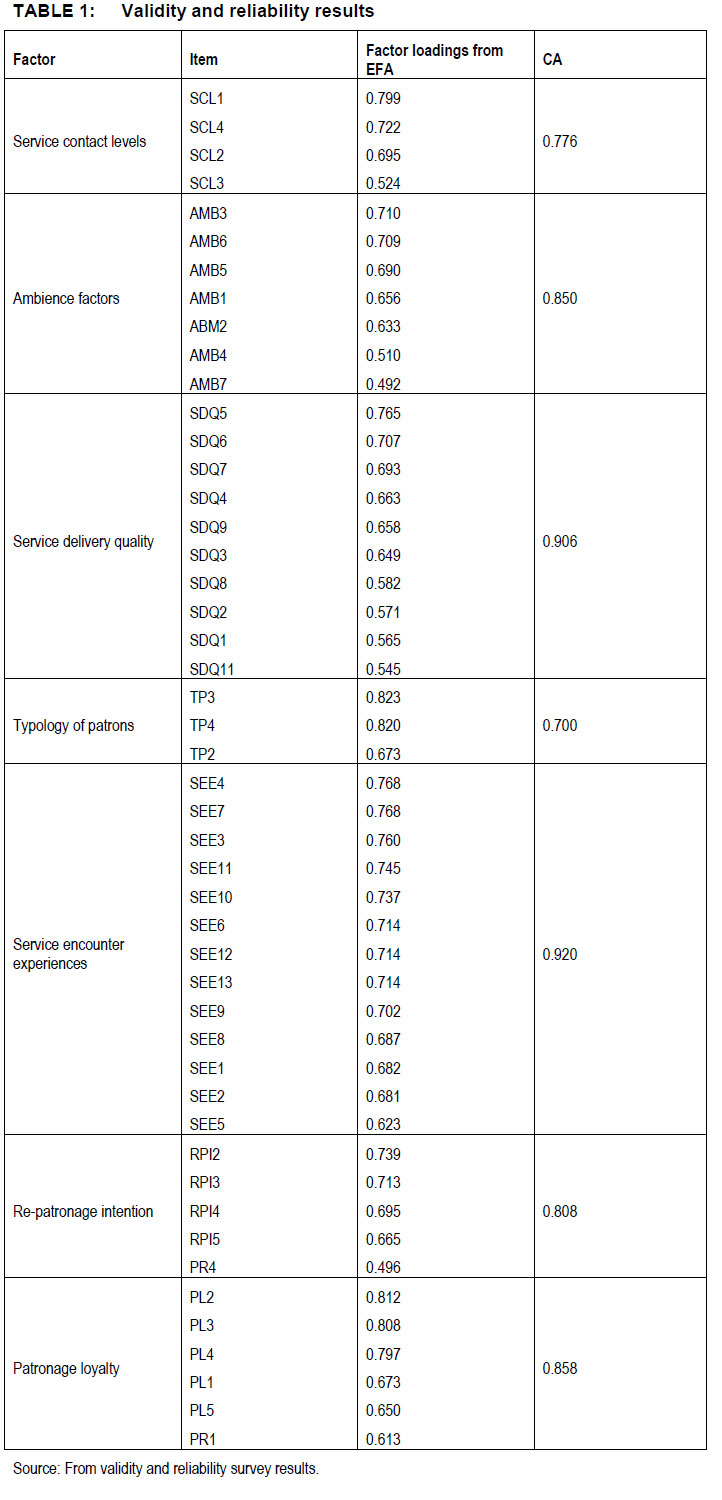
In terms of the EFA results, items loaded onto five distinct factors (see Table 1).
Four of the factors that emerged from the EFA represented the independent variables proposed in the study. Firstly, four of the five items aimed to measure service contact levels loaded onto one factor. Therefore, this factor was named Service contact levels and it refers to the duration, frequency, intensity and variety of encounters between restaurant patrons and either one of or both the service personnel and service facilities (which in the restaurant context can relate to, for example, meal deliveries/collection, reservations and waiting times). The factor loadings for Service contact levels ranged from 0.524 to 0.799, and the Cronbach's alpha coefficient was 0.776, therefore these values show construct validity and reliability respectively. All seven items developed to measure ambience factors loaded together. The factor was labelled Ambience factors and was defined as the inanimate background characteristics in restaurants that affect patrons' five senses (for example relating to the restaurants' lighting, temperature, aroma, noise levels and décor). These items' loadings ranged from 0.492 and 0.710. The Cronbach's alpha coefficient was calculated as 0.850. Based on the EFA factor loadings and the Cronbach's alpha coefficient, the factor can be regarded as valid and reliable. Ten of the 12 items developed to measure service delivery quality loaded onto a single factor and this factor was labelled Service delivery quality. The factor was defined as the intangible aspects accompanying or surrounding a meal served to restaurant patrons, which include menu advice as well as staff friendliness and competence. The Service delivery quality item loadings ranged from 0.545 to 0.765, showing validity. In addition, the Cronbach's alpha of 0.906 shows reliability. Three of the six items developed to measure typology of patrons loaded onto one factor. This factor was named Typology of patrons and met the criteria for construct validity, with factor loadings ranging from to 0.673 to 0.823, and reliability with a Cronbach's alpha coefficient of 0.700. Typology of patrons, for the purpose of this study, refers to the types of, and interaction between, restaurant patrons with an inclination towards their personalities.
All 13 items developed to measure service encounter experiences loaded onto a single factor, and therefore this factor was labelled Service encounter experiences. For the purposes of this study, based on the items' loading, Service encounter experiences is defined as the feelings or knowledge acquired by patrons when they interact with staff in a restaurant context, relating to variables restaurant aspects, for example, reservations, menu options and meals. The factor loadings for this factor ranged from 0.623 to 0.768, which provided evidence of construct validity. The Cronbach's alpha coefficient for Service encounter experiences was 0.92, and this showed the factors' reliability.
Four of the original five items developed to measure re-patronage intention loaded onto a single factor. The other re-patronage item cross-loaded and was eliminated from further analyses. In addition, one item developed to measure patronage retention also loaded onto this factor. The loading of this item is justified since it shows that respondents' re-patronage intention relates to whether they have to make restaurant reservations before visits. As all the items on this factor related to patrons' intention to re-visit restaurants, the factor was labelled Re-patronage intention. For this study, Re-patronage intention relates to patrons' intention to re-visit a specific restaurant and is defined as patrons' likelihood to repeat the same patronage behaviour with regard to a restaurant. The factors' construct validity was confirmed as the factor loadings ranged between 0.496 and 0.739. In addition, the reliability was confirmed as the Cronbach's alpha coefficient of this factor was 0.72.
All five of items developed to measure patronage loyalty loaded onto a single factor. One item originally developed to measure patronage retention also loaded onto this factor. The loading of this item with these other items shows that respondents' loyalty to a restaurant will remain until the restaurant closes down. The factor was labelled Patronage loyalty as all the items of this factor related to patrons' loyalty. For the purpose of this study, Patronage loyalty refers to the behaviour of patrons where they consistently patronise the same restaurant, although there are a number of alternative restaurants to support. The factor loadings between 0.613 and 0.812 show the construct validity of this factor and the Cronbach's alpha coefficient of 0.85 reflects the factors' reliability.
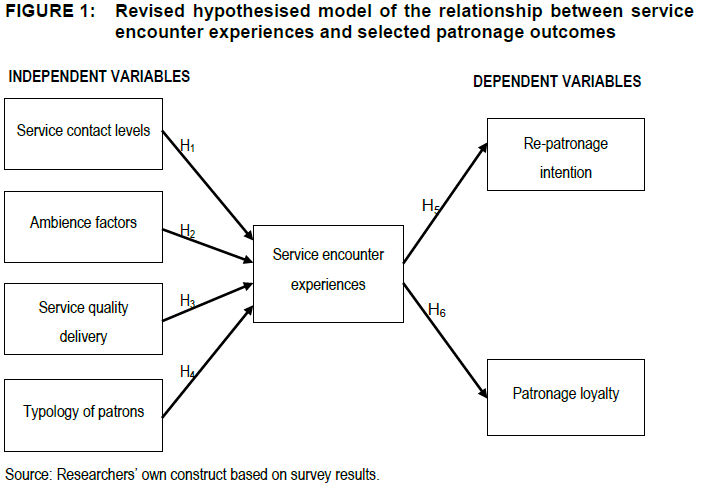
Based on the EFA factor loadings and the Cronbach's alpha coefficients, the validity and reliability of the study's measuring instrument are confirmed. It is evident from the analyses that excluding the two items mentioned above, no other patronage retention items loaded onto factors with loadings equal to or exceeding the 0.4 cut-off and this factor was eliminated from the study's hypotheses and further analysis. Therefore, the revised hypothesised model is presented in Figure 1.
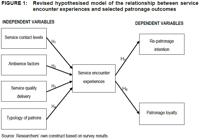
As evident in Figure 1, the revised hypotheses are as follows:
H1: There is a significant relationship between Service contact levels and Service encounter experiences.
H2: There is a significant relationship between Ambience factors and Service encounter experiences.
H3: There is a significant relationship between Service delivery quality and Service encounter experiences.
H4: There is a significant relationship between Typology of patrons and Service encounter experiences.
H
5: There is a significant relationship between Service encounter experiences and Re-patronage intention.H6: There is a significant relationship between Service encounter experiences and Patronage loyalty.
5.3 Descriptive statistics and relationships between variables
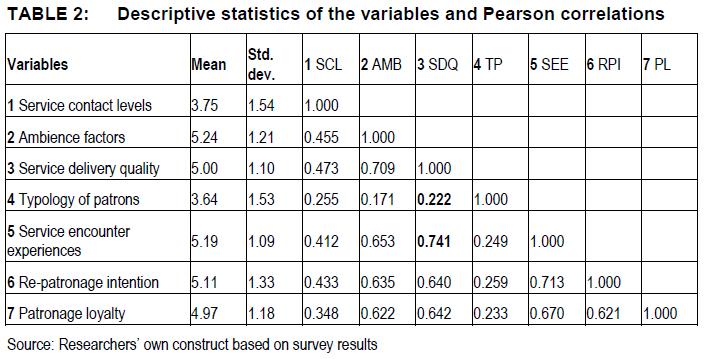
Table 2 summarises the descriptive statistics of the variables, as well as the Pearsons' Product Moment Correlations.
The mean scores for all the factors, as presented in Table 2, indicate that the respondents agreed with the statements relating to all the factors (means ranged between 4.97 for Patronage loyalty and 5.24 for Ambience factors), except Service contact levels (mean = 3.75) and Typology of patrons (mean = 3.64). This shows that respondents are currently not in agreement with the levels of service contact offered by Zimbabwean restaurants. The respondents indicated that home deliveries, drive-through facilities, buffet options, telephonic reservations and bar facilities during waiting times are not readily available.
In addition, respondents revealed that, as Zimbabwean restaurant patrons, they are uncomfortable making independent menu choices and they do not spend more due to the presence of other patrons.
The small standard deviations (Std. dev.) for the factors highlight little variation between the responses. The responses for the factor Service encounter experiences (1.09) varied the least and the responses for the factor Service contact levels (1.54) varied the most.
From Table 2 it is also evident that positive correlations exist between all the factors. The highest positive correlation exists between Service encounter experiences and Service delivery quality (r=0.741). This implies that the respondents associate the levels of service delivery quality they receive in restaurants with their service encounter experiences in these restaurants. The lowest correlation exists between Service delivery quality and Typology of patrons (r=0.222). This suggests that respondents link, although to a small degree, the levels of service delivery quality they receive in restaurants with the typology of patrons in the restaurants. In other words, according to the respondents, levels of the service quality delivered in Zimbabwean restaurants are associated with how restaurant patrons are categorised and/or how they interact during service delivery.
To confirm the results of the Pearsons' Product Moment Correlations, multiple regression analyses were performed to identify which statistically significant relationships exist between the factors. The results show that three of the independent variables have statistically significant, positive relationships with the intervening variable. Ambience factors statistically significantly influence Service encounter experiences (b=0.223, p<0.001). Service delivery quality statistically significantly influences Service encounter experiences (b=0.530, p<0.001,). In addition, Typology of patrons statistically, significantly influences Service encounter experiences (b=0.060, p<0.05). These three independent variables explain more than 58% of the variance (R2=58.98%) in Service encounter experiences. The independent variable, Service contact levels, presented no statistically significant relationship with Service encounter experiences.
Service encounter experiences (intervening variable) has statistically significant, positive relationships with both the dependent variables. Service encounter experiences statistically significantly influence Re-patronage intention (b=0.773, p<0.001, R2=50.82%). This means that when patrons have pleasant service encounters in restaurants, patrons are more inclined and motivated to re-visit the restaurants. Service encounter experiences also statistically significantly influence Patronage loyalty (b=0.823, p<0.001, R2=44.85%). This reveals that when patrons have pleasant service encounters in restaurants, patrons are loyal towards, and will remain, patrons of the restaurants.
Based on the multiple regression analysis results, hypothesis H1 is rejected since no statistically significant relationship exists between Service contact levels and Service encounter experiences. Hypotheses H2, H3 and H4 are accepted since Ambience factors, Service delivery quality, as well as, Typology of patrons have statistically significant relationships with Service encounter experiences. This shows that a positive focus on restaurants' ambience factors, having friendly and competent staff as well as varying service offerings on the basis of different types of patrons could lead to positive, enjoyable service encounter experiences for Zimbabwean restaurant patrons.
In addition, hypotheses H5 and H6 are accepted, as significant relationships exist between Service encounter experiences and Re-patronage intention as well as between Service encounter experiences and Patronage loyalty. It is evident that positive, enjoyable service encounter experiences in restaurants lead to improved levels of re-patronage intentions and patronage loyalty among Zimbabwean restaurant patrons.
6. MANAGERIAL IMPLICATIONS
The primary objective was to determine the antecedents and outcomes of service encounter experiences of patrons in the restaurant industry in Zimbabwe, to guide managers.
The study considered four antecedents of service encounter experiences. One of these antecedents, namely Service contact levels, had no significant relationship with service encounter experiences. On the other hand, three of the antecedents (Ambience factors, Service delivery quality and Typology of patrons) were identified as having significant, positive relationships with service encounter experiences of Zimbabwean restaurant patrons. These three significant positive relationships paved the way for the study's practical recommendations for managers on improving restaurant ambience factors and service delivery quality as well as on how to positively use the typology of patrons for pleasurable service encounter experiences.
Respondents revealed adequate levels of satisfaction with Zimbabwean restaurants' Ambience factors (seen through this factor's mean), but recommendations regarding ambience factors include that management ensures a restaurant has an enticing aroma, adequate lighting, moderate temperature and an acceptable noise level. Attractive décor and paintings/pictures should be part of the restaurant interior. Eating and bathroom facilities should be kept clean. In addition, the location of the restaurant must be within easy access to a parking area and public transport.
Respondents revealed acceptable satisfaction levels with Zimbabwean restaurants' Service delivery quality (seen through the factors' mean), however, some service delivery quality strategies include that restaurant management ensures that staff provides prompt and quick service within the promised time-frames. Restaurant staff should be trustworthy, professional and have patrons' best interest at heart. Management must provide staff with adequate managerial support and ensure that they have product/service knowledge. Restaurants' physical facilities and equipment should be up-to-date.
The means of the Typology of patrons variable showed that Zimbabwean restaurant patrons are currently not in agreement with the stated typology items. Since the typology of patrons positively influences service encounter experiences, restaurants should pay attention to aspects linked to the typology of patrons. Restaurants could consider how patrons' behaviour and menu options influence other patrons and use this to the advantage of the restaurant. For example, carefully plan seating arrangements (layout of tables and chairs).
This study also provides general strategies to improve restaurant Service encounter experiences: Ensure that staff is friendly, competent, interested in patrons' choices and records reservations correctly, while listening to patrons attentively.
The study focused on three patronage outcomes; however, the results of the study revealed that the two outcomes of Re-patronage intention and Patronage loyalty are pertinent in the Zimbabwean restaurant context. In addition, both of these outcomes were seen to have significant positive relationships with Zimbabwean restaurant patrons' service encounter experiences.
From the positive and significant relationships between the service encounter experiences construct and the patronage outcomes namely re-patronage intention and patronage loyalty, practical recommendations on improving patrons' service encounter experiences in restaurants (linked to each of the outcomes) are provided in this study.
Since Re-patronage intention is an indicator of purchase behaviour (Cheng, Lam & Hsu 2006:100), and an outcome of service encounter experiences, management must strive to attain higher levels of re-patronage intention by ensuring that the location of the restaurant are within easy access to a parking area and public transport. All patrons must be allowed to visit and dine in a restaurant with or without making a reservation. Management should ensure that dining in a restaurant business is financially viable for the restaurant owners as well as cost-effective for patrons. Prices should include a reasonable profit margin while being within an acceptable price range for patrons. Restaurants should ensure, through regular training that staff practises courtesy and address patrons' complaints in a friendly manner.
The levels of service encounter experiences of patrons in the restaurant industry must be enhanced in order to elicit patronage loyalty. The Patronage loyalty of patrons needs to be promoted by owners of restaurants and management by focusing on gaining repeat purchases by loyal patrons. Repeat purchases ensure a steady stream of revenue to the business. Repeat purchases could be encouraged by providing discounts for repeat visits (e.g. through loyalty cards). Positive word-of-mouth communication is a credible source of information to potential patrons and is a less expensive source of promotion, and a restaurant should encourage word-of-mouth messages through online (e.g. social media) competitions where patrons can win free/discount meal vouchers for messages they post about the restaurant. Restaurants could also post positive messages on social media to improve the image of the restaurant.
Despite these recommendations, there are some limitations associated with this study which practitioners and future researchers in the area of service encounters should take note of. The main limitation is based on the fact that this is a cross-sectional study. The data was collected from a cross-section of restaurant patrons, and there is always a possibility that the patrons' views may change due to dynamic changes in the economy, the adoption and application of new technology as well as changes in patrons' preferences and tastes due to the effects of globalisation. A future longitudinal study, to identify changing and current trends, would add value to the Zimbabwean restaurant industry. The participation of the respondents, although voluntary, was in some instances marred. Some the patrons, especially those contacted or approached during lunch hour, were in a hurry. This presents the possibility that some patrons paid little attention in responding to some of the measuring instrument questions.
7. CONCLUSION
The study has shown that three important restaurant aspects, namely ambience factors, service delivery quality and typology of patrons influence restaurant patrons' service encounter experiences. It is crucial for restaurant management to implement the study's recommendations regarding these antecedents to ensure positive service encounter experiences for patrons. Another major conclusion drawn from this study is that patrons in the restaurant industry do not view their patronage intention as being separate to their re-patronage intention and patronage loyalty. The study also concludes that re-patronage intention and patronage loyalty result from restaurant patrons' service encounter experiences.
In summary, Zimbabwean restaurants' ambience, service quality of their food and employees as well as a consideration of the typology of their patrons determine their patrons' service encounter experiences. Also, Zimbabwean restaurant managers should ensure that their patrons' service encounters are satisfactory, as this may increase patrons' re-patronage intention and patronage loyalty, which may ultimately improve these restaurants' success.
It is imperative for restaurant industry management to implement the recommendations in this study to improve the levels of their patrons' service encounter experiences since pleasant service encounter experiences improve the two studied patronage outcomes, namely re-patronage intention and patronage loyalty. Following the implementation of these recommendations, Zimbabwean restaurant could be more successful and the same effect is possible in other developing emerging market countries with similar restaurant industries.
REFERENCES
3. LITERATURE REVIEW
-
ADEGOKE Y. 2019. Africa will have some of the world's fastest-growing economies in 2019 - and a looming debt crisis. [Internet:https://qz.com/africa/1522126/african-economies-to-watch-in-2019-and-looming-debt/; downloaded on 01 May 2019.
» https://qz.com/africa/1522126/african-economies-to-watch-in-2019-and-looming-debt/ -
]
» https://www.aljazeera.com/news/2018/10/zimbabwe-economy-grow-6-percent-finance-minister-181001162723823.html -
]
» https://doi.org/10.7603/s40930-014-0010-2 -
AJZEN I. 1991. The theory of planned behaviour. Organizational behaviour and human decision processes 50(2):179-211. (DOI:https://doi.org/10.1016/0749-5978(91)90020-T.
» https://doi.org/10.1016/0749-5978(91)90020-T -
)
» https://doi.org/10.1086/209331 - )
-
ARIFFIN HF, BIBON MF & ABDULLAH RPSR. 2017. Restaurant's atmospheric elements: What the customer wants. Journal of Asian Behavioural Studies 2(3):85-94. (DOI:https://doi.org/10.21834/jabs.v2i2.182.
» https://doi.org/10.21834/jabs.v2i2.182 -
)
» https://doi.org/10.3390/agriculture9040077 -
)
» https://doi.org/10.1509/jmkg.73.3.52 -
ARNOLD MJ, REYNOLDS KE, PONDER N & LUEG JE. 2005. Customer delight in a retail context: investigating delightful and terrible shopping experiences. Journal of Business Research 58:1132-1145. (DOI:http://dx.doi.org/10.1016/j.jbusres.2004.01.006.
» http://dx.doi.org/10.1016/j.jbusres.2004.01.006 - )
- BLAU P. 1964. Power and exchange in social life. New York: John Wiley & Sons.
- )
- BRADLEY GL, SPARKS BA, MCCOLL-KENNEDY JR, JIMMIESON NL & ZAPF D. 2010. Understanding communication process in difficult service encounters: A Fresh Approach. LaLonde les Maures, France. (11th International Research Seminar in Service Management.
-
)
» http://dx.doi.org/10.1080/00222216.2007.11950107 -
)
» https://doi.org/10.2307/2092623 - BUTTLE F. 2009. Customer relationship management. Concepts and technologies. 2nd edition. New York: Routledge.
-
CHENG S, LAM T & HSU CH. 2006. Negative word-of-mouth communication intention: an application of the theory of planned behaviour. Journal of Hospitality & Tourism Research 30(1):95-116. (DOI:http://dx.doi.org/10.1177/1096348005284269.
» http://dx.doi.org/10.1177/1096348005284269 - )
-
COLLIER JE, BARNES DC, ABNEY AK & PELLETIER MJ. 2018. Idiosyncratic service experiences: When customers desire the extraordinary in a service encounter. Journal of Business Research 84:150-161. (DOI:10.1016/j.jbusres.2017.11.016.
» https://doi.org/10.1016/j.jbusres.2017.11.016 -
)
» https://doi.org/10.1362/146934711X589435 -
COOK LS, BOWEN DE, CHASE RB, DASU S, STEWART DM & TANSIK DA. 2002. Human issues in service design. Journal of Operations Management 20:159-174. (DOI:http://dx.doi.org/10.1016/S0272-6963(01)00094-8.
» http://dx.doi.org/10.1016/S0272-6963(01)00094-8 -
)
» http://dx.doi.org/10.1016/j.indmarman.2006.02.012 - CSIKSZENTMIHALYI M. 1990. Flow: The psychology of optional experience. New York: Harper & Row.
-
DIXON DP, MISCURACA, JA & KOUTROUMANIS DA. 2018. Looking strategically to the future of restaurants: Casual dining or fast casual? Entrepreneurship Education and Pedagogy 1(1): 102-117. (DOI:https://doi.org/10.1177%2F2515127417737288.
» https://doi.org/10.1177%2F2515127417737288 - )
- EGAN J. 2011. Relationship marketing. Exploring relational strategies in marketing. 4th edition. Pearson Education.
- )
- GODSON M. 2009. Relationship Marketing. USA: Oxford University Press.
-
)
» http://doi.org/10.1177%2F1096348009350624 - GRÖNROOS C. 2007. Service management and marketing. Customer management in service competition. 3rd edition. United States: John Wiley & Sons.
- GUMMESSON E. 1999. Total relationship marketing: rethinking marketing from 4Ps to 30Rs. Oxford: Butterworth Heinemann.
-
HA J & JANG S. 2010. Perceived values, satisfaction, and behavioural intentions: The role of familiarity in Korean restaurants. International Journal of Hospitality Management 29:2-13. (DOI:https://doi.org/10.1016/j.ijhm.2009.03.009.
» https://doi.org/10.1016/j.ijhm.2009.03.009 -
)
» https://doi.org/10.21511/ppm.15(2-2).2017.12 - HAIR JF, BLACK WC, BABIN JB & ANDERSON RE. 2014. Multivariate data analysis. 7th ed. Essex, England: Pearson.
-
HAN H & RYU K. 2009. The roles of physical environment, price perception, and customer satisfaction in determining customer loyalty in the restaurant industry. Journal of Hospitality and Tourism Research 33(4):487-510. (DOI:https://doi.org/10.1177%2F1096348009344212.
» https://doi.org/10.1177%2F1096348009344212 -
)
» https://doi.org/10.1177%2F014920630102700406 -
HWANG J & HYUN SS. 2012. The antecedents and consequences of brand prestige in luxury restaurants. Asian Pacific Journal of Tourism Research 17(6):656-683. (DOI:https://doi.org/10.1080/10941665.2011.640697.
» https://doi.org/10.1080/10941665.2011.640697 - )
- )
-
JANG S & NAMKUNG Y. 2009. Perceived quality emotions, and behavioural intentions: Application of an extended Mehrabian-Russell model to restaurants. Journal of Business Research 62:451-460. (DOI:http://dx.doi.org/10.1016/j.jbusres.2008.01.038.
» http://dx.doi.org/10.1016/j.jbusres.2008.01.038 - )
-
)
» http://http://www.zimstat.co.zw/ - KHAN MN, AADEAN Z, SALMAN M, NADEEN B & RIZWAN M. 2016. The impact of product and service quality on brand loyalty: Evidence from quick service restaurants. American Journal of Marketing Research 2(3):84-94.
-
LIN JC & LIANG H. 2011. The influence of service environments on customer emotion and service outcomes. Managing Service Quality 21(4):350-372. (DOI:http://dx.doi.org/10.1108/09604521111146243.
» http://dx.doi.org/10.1108/09604521111146243 - )
-
LIN IY & MATTILA AS. 2010. Restaurant service scape, service encounter, and perceived congruency on customers' emotions and satisfaction. Journal of Hospitality Marketing and Management 19:819-841. (DOI:https://doi.org/10.1080/19368623.2010.514547.
» https://doi.org/10.1080/19368623.2010.514547 - )
- LOVELOCK C & WIRTZ C. 2011. Services marketing: People, technology, strategy. 7th edition. New Jersey: Pearson Education, Inc.
- MHLANGA O. 2018. Measuring restaurant service quality in East London, South Africa: A comparison of restaurant customer expectations and perceptions. African Journal of Hospitality, Tourism and Leisure 7(2):1-12.
- MHLANGA O, HATTINGH Z & MOOLMAN HJ. 2015. The influence of demographic variables on customers' experiences in formal full-service restaurants in Port Elizabeth, South Africa. Tourism 63(2):143-160.
- NEL J, WILLIAMS A, STEYN R & HIND C. 2018. Customer experiences and expectations of sit-down restaurants: An auto-ethnographic perspective on retail failure. African Journal of Hospitality, Tourism and Leisure 7(3):1-16.
- OTENGEI SO, CHANGHA G, KASEKENDE F & NTAYI JM. 2014. Understanding key determinants of brand loyalty in full service restaurants in Uganda. Advances in Hospitality and Tourism Research 2(2):79-107.
- PETZER D & MACKAY N. 2014. Dining atmospherics and food service quality as predictors of customer satisfaction at sit-down restaurants. African Journal of Hospitality, Tourism and Leisure 3(2):1-14.
- PINE BJ II & GILMORE JH. 1998. Experience economy: Work is theater and every business a stage. Boston, MA: Harvard Business School Press.
-
PLECHER H. 2019. Share of economic sectors in GDP in Zimbabwe 2017. [Internet:https://www.statista.com/statistics/455310/share-of-economic-sectors-in-the-gdp-in-zimbabwe; downloaded on 23 October 2019.
» https://www.statista.com/statistics/455310/share-of-economic-sectors-in-the-gdp-in-zimbabwe - ]
- )
-
RYU K, LEE H & KIM WG. 2012. The influence of quality of physical environment, food, and service on restaurant image, customer perceived value, customer satisfaction, and behavioural intentions. International Journal of Contemporary Hospitality Management 24(2):200-223. (DOI:https://doi.org/10.1108/09596111211206141.
» https://doi.org/10.1108/09596111211206141 - )
-
SAIDI U. 2018. Repackaging "traditional" architecture of the African village in Zimbabwe. [Internet:http://dx.doi.org/10.5772/intechopen.81450; downloaded on 18 August 2019.
» http://dx.doi.org/10.5772/intechopen.81450 - ]
-
SCHMITT BH. 2011. Experience marketing: concepts, frameworks and consumer insights. Foundations and Trend in Marketing 5(2):55-122. (DOI:http://dx.doi.org/10.1561/1700000027.
» http://dx.doi.org/10.1561/1700000027 - )
-
SHARMEELA-BANU SA, GENGESWARI K & PADMASHANTINI P. 2013. An extensive review on the impact of customer retention practices towards the performance of SMEs. International Journal of Academic Research in Business and Social Sciences 3(7):85-97. (DOI:10.6007/IJARBSS/v3-i7/11.
» https://doi.org/10.6007/IJARBSS/v3-i7/11 - )
- SHOSTACK GL. 1987. Planning the service encounter, in the service encounter, In John A, Czepiel Michael, Solomon R & Carol F. Surprenant. Eds. New York: Lexington Books. (pp 243-254.
- )
- )
- STRUWIG FW & STEAD GB. 2013. Research: Planning, designing and reporting. 2nd edition. Cape Town: Pearson.
-
SULEK JM & HENSLEY R. 2004. The relative importance of food, atmosphere, and fairness of wait. The case of a full-service restaurant. Cornell Hotel and Restaurant Administration Quarterly 45(3):235-247. (DOI:http://dx.doi.org/10.1177/0010880404265345.
» http://dx.doi.org/10.1177/0010880404265345 - )
-
TESFOM G & BIRCH NJ. 2011. Do switching barriers in the retailing banking industry influence bank customers in different age groups differently? Journal of Service Marketing 25(5):371-380. (DOI:10.1108/08876041111149720.
» https://doi.org/10.1108/08876041111149720 - )
- )
-
TSENG MM, QINHAI M & SU CJ. 1999. Mapping customers' service experience for operations improvement. Business Process Management Journal 5(1):50-64. (DOI:10.1108/14637159910249126 .
» https://doi.org/10.1108/14637159910249126 - )
-
VOORHEES CM, FOMBELLE PW, GREGOIRE Y, BONE S, GUSTAFSSON A, SOUSA R & WALKOWIAK T. 2017. Service encounters, experiences and the customer journey: Defining the field and a call to expand our lens. Journal of Business Research 79:269-280. (DOI:https://doi.org/10.1016/j.jbusres.2017.04.014.
» https://doi.org/10.1016/j.jbusres.2017.04.014 - )
-
WALL EA & BERRY LL. 2007. The combined effects of the physical environment and employee behaviour on customer perception and restaurant service quality. Cornell Hotel and Restaurant Administration, Quarterly 48(1):59-69. (DOI:http://dx.doi.org/10.1177/0010880406297246.
» http://dx.doi.org/10.1177/0010880406297246 - )
- ZATORI A. 2013. The impact of the experience management perspective on tour providers. In Koerts D & P Smoth P. Eds. Breda, Netherlands: Breda University of Applied Sciences. (3rd International Research Forum on Guided Tours.
- )
- ZHOU Z. 2018. The tourism sector: A bright light in Zimbabwe's depressed economic environment. African Journal of Hospitality, Tourism and Leisure 7(1):1-5.
-
ZIMBABWE MARKET OVERVIEW. 2019. Report by Export.gov. [Internet:https://www.https://www.export.gov/article?series=a0pt00000000GtjAAE&type=Country_Commercial__kav; downloaded on 23 October 2019.
» https://www.https://www.export.gov/article?series=a0pt00000000GtjAAE&type=Country_Commercial__kav - ]
- ]
-
ZIMTRADE. 2014. Annual Report. Zimtrade: The National Trade Development and Promotion Organisation of Zimbabwe. [Internet:http://www.tradezimbabwe.com/how-we-can-help/virtual-library/annual-reports/; downloaded on 10 July 2016.
» http://www.tradezimbabwe.com/how-we-can-help/virtual-library/annual-reports/