Examining the Effectiveness of Entrepreneurship Policy Implementation in Malawi
Abstract
A total of 92% of the Malawian population is involved in the small and medium-sized enterprise sector in the form of self-employment, family or individual businesses. The article aims to examine the effectiveness of the entrepreneurship policy in promoting entrepreneurship education and training and small business development in Malawi. The specific objectives are to identify the gaps in the entrepreneurship policy currently being used in Malawi and to assess the effectiveness of the implementation of the entrepreneurship policy in the country. The study used the quantitative research methodology using a survey questionnaire. A total of two hundred and sixty participants were purposively sampled for the study. A response rate of 59% was achieved in the study. In total 75% of the respondents indicated that they had been involved in an entrepreneurial activity while 64% of the respondents showed that their organisations offered entrepreneurship or other related services. The study results revealed that 20% of the funds used in small and medium-sized enterprises (SMEs) were internally generated and 13% were loans from a government agency among others. A total of 58% of the respondents indicated that the most common business support services available to entrepreneurs in Malawi is Entrepreneurship Development while the remainder indicated that entrepreneurs in the country have access to Business Counselling and Mentoring. The factors impeding the development of SMEs in Malawi were indicated as inadequate availability of debt financing, inadequate availability of venture capital, inadequate availability of qualified labour, among others. The factors influencing the development of entrepreneurship in Malawi were indicated as availability of capital, labour and raw materials, bad experience of owners, bribery and corruption, education background, environmental conditions, fear of failure, friends and government support/policies.
Entrepreneurship education; entrepreneurship policy and small business development
1. INTRODUCTION
Entrepreneurship is an instrument for economic growth, social mobility and job creation in developing and developed countries. It is for this reason that governments have put the stimulation of entrepreneurship high on their agendas. The fundamental question dominating entrepreneurship research and policy mechanisms 'is why only some people see new business opportunities and only some people take actions to exploit the opportunities they see by getting involved in entrepreneurship actions?' Thi Thu & Hieu (2017). Malawi is not a developed country and its population barely survives on less than a dollar a day. Mkandawire and Duan (2016) observe that Malawi is a poverty ridden country which has households that are unable to fulfil their daily requirements. Poverty is associated with households that lack adequate income, employment opportunities, entrepreneurship spirit and credit opportunities. Arguably, the population of people living on less than $1.25 a day in the Sub-Saharan Africa including Malawi still remains the highest in the world The Food and Agriculture Organization of the United Nations (2015).
There have been attempts by the Malawian government to develop the entrepreneurial mindset of the population through the revamping and restructuring of public organisations entrusted with national entrepreneurship development such as Technical Education, Vocational and Entrepreneurial Training Authority (TEVETA), Small and Medium Enterprise Development Institute (SMEDI) and Malawi Rural Development and Enterprise Fund (MARDEF). There has been also a proliferation of Higher Education Institutions (HEIs) both public and private that are offering entrepreneurship education and training which are registered by the National Council for Higher Education (NCHE) with the sole purpose of spurring entrepreneurship development in the country through the provision of entrepreneurship education and training (EET) Delaney Harrington and Toker (2019).
According to the Ministry of Industry and Trade (MoIT) (2015) across the country, a broad range of support programmes targeting SMEs are being provided by different government departments and institutions as well as the private sector but the level of access to support by SMEs is unsatisfactory with most businesses not aware of the support providers. This results in SMEs not benefiting as much as they could from the available support. One of the main reasons why this is the case is that, despite concerted efforts by various support agencies to communicate their offerings to micro small and medium enterprises (MSMEs), there is a lack of a single source of information of all available support institutions and on how to access them MolT (2015).
In Malawi, for example, while the number of HEIs offering EET has increased and the restructuring and repositioning of the public institutions involved in entrepreneurship development has taken place, the economic growth rates have stagnated around 6.1% (2013), 6.3(2014) and 5.8%(2015) per annum and the unemployment rates have been estimated to soar to over 35% in the past five years. In addition, according to Malawi Government Secretary for Labour, Youth and Manpower Development, youth unemployment is estimated to be 70% thereby reaching "alarming levels in the country" Ntchindi (2016:3). This situation could be attributed to the lack of a clear and effective entrepreneurship policy to guide the development of entrepreneurship and small businesses in the country. In Malawi, small and medium enterprises have been considered as significant contributors towards job creation, development and economic growth Chetama, Dzanja, Gondwe and Maliro (2016).
2. RESEARCH PROBLEM
Nielsen (2016) has argued that while some work has been undertaken on the structures of entrepreneurship policy at national level in many countries, little research has been done to fully understand the organisational mechanisms of entrepreneurship policy delivery at local level. Brown and Hanlon (2016) compound this by observing that research in entrepreneurship education and training has failed to provide much evidence that it is actually teaching the skills that are most important to future entrepreneurs and that most of the linkages between entrepreneurship education and training and the real world remain underspecified. They conclude that approaches to entrepreneurship education and training have failed to keep up with the rapidly changing world and that there is a gap between what is taught in entrepreneurship and what entrepreneurs do Brown and Hanlon (2016). Hyder and Lussier (2016) state that the failure rate of small businesses are high globally and if it is better understood why entrepreneurs fail, it should be possible to increase the success-failure ratio.
The aim of the article is:
a. To identify the gaps in the entrepreneurship policy currently being used in Malawi.
b. To assess the effectiveness of the implementation of the entrepreneurship policy in the country.
The gaps in the entrepreneurship policy in use in Malawi were highlighted through the review of the relevant literature while the effectiveness of the implementation of the policy in the country was determined by a questionnaire that was administered on personnel involved in entrepreneurship development in the country. It should be noted that there have not been studies on entrepreneurship policy and its effectiveness in recent years in Malawi.
David and David (2015:337) determine policy as referring to "specific guidelines, methods, procedures, rules, forms and administrative practices established to support and encourage work toward stated goals". Policies are instruments for strategy implementation and they set boundaries, constraints and limits on the kinds of administrative actions that can be taken to reward and sanction behaviour; they clarify what can and cannot be done in pursuit of organisational objectives David and David (2015). Abioro and Adefeso (2016) argue that public policy refers to the actions of the government and the intentions that determine those actions and that public policy is the study of policy making by the governments. It is the "sum of government activities whether acting directly or through its agencies to influence the lives of the citizens usually containing decisions of the governments' resolutions on what it will and what it will not do, consisting of the political decisions that go in line with the political will and implementation of the programmes to achieve societal goals" Abioro and Adefeso (2016). In other words, public policy focuses on public problems that require actions as the output produces the type of governance in a country.
It is the case in entrepreneurship policy and other policy areas that political decision makers are elected and not re-elected, policies are changed and reforms are implemented Nielsen (2016). Mann and Shideler (2015) argue that government policies must be designed to spur entrepreneurship and must not characterise entrepreneurship as a "one size fits all" if they are to have the necessary impact. They state that government policies must be devised to encourage entrepreneurship and that as economies mature entrepreneurship levels decline. The reality is that government policies and programmes targeting economic growth may in fact only increase the number of business rather than spur innovation. They conclude that technical assistance programmes should aim to aid innovators through formulating business plans, securing funding and providing legal help to protect innovators intellectual property as well as lower the risk and start-up costs of non-innovative entrepreneurs thereby creating firms which grow the local economy. In developing entrepreneurship, government policy has a big influence in order to establish an environment and create infrastructure that supports entrepreneurship Mirzanti, Simatupang and Larso (2015). Heller and Stephenson (2015) argue that policies conducive to entrepreneurship are related to economic outcomes. Entrepreneurship policies are policy measures taken to stimulate entrepreneurship aimed at the pre-start, start-up and early post-start phase of the entrepreneurial process Mirzanti et al. (2015). These policies need to change with the changing environment. Ibrahim and Ibrahim (2015) concur by stating that policy changes should be regarded as an evolutionary process in which the government programmes are repeatedly reformed and redefined because of the consequences of the competition among the advocacy coalitions comprising the policy system. Ibrahim and Ibrahim (2015) further argue that policy changing has two characteristics which are stability and changing:
a. Stability: This covers a number of public policies which are more incremental referring to the past.
b. Policy changing: This is minor and marginal. Policy changing is defined as major and minor changes on the subsystem of the policy or government programme. The major change refers to the changes in the core aspects while minor changes refer to the changes in the secondary aspects of government policies and programmes.
Abioro and Adefeso (2016) caution that there exists a sharp disconnection between the government and the governed which has resulted into policy formulation that fails to meet the needs of the people. They concur that public policy decision making is the actions taken within the governmental setting to formulate, adopt, implement and evaluate the change Abioro and Adefeso (2016). They also conclude that the development of a public policy starts with the public recognition that a problem exists and that there are three pre-public policy development stages namely: problem definition or issues formation, policy demand, and agenda formation. The next stage from the pre-policy stages in the development of a public policy is deliberation and policy adoption. From the policy agenda, the decision makers helped by the input of several groups, policy experts and constituents' debate and bargain over alternative policy formulations, settling on an alternative or a combination of alternatives to respond to the problem Abioro and Adefeso (2016). After this, decisions are made, policies are formulated and policy statements are issued taking the form of orders, regulations and laws.
Mirzanti et al. (2015) argue that much as in developing entrepreneurship government policy has a big influence in establishing an environment and creating the infrastructure that supports entrepreneurship, the challenge in developing an entrepreneurship policy being that one policy applied in certain areas cannot be applied in other areas automatically. They add that entrepreneurship has emerged as a focus of public policy and that in implementing the entrepreneurship policy, "one size does not fit all" and in the long run the government should provide a conducive environment for the emergence of productive entrepreneurship rather than unproductive entrepreneurship.
Daniell, Morton and Insua (2016) add that policy analysis should be taken as a framework for thinking about policy problems and making choices which should comprise typical stages in decision making processes such as establishing the problem context, determining the alternative policy options, predicting their consequences, assessing their outcomes and recommending a policy choice. Within the policy process, the critical issues in public decision-making are determining the criteria used for evaluating the policies and determining who is able to influence such choice Daniell et al. (2016). Williams (2015) determines whether informal entrepreneurs should be included when formulating public policy on entrepreneurship and argues for four possible policy options available to policy makers regarding informal entrepreneurship as follows: take no action at all, pursue the eradication of informal entrepreneurship, move formal entrepreneurship into the formal economy and transform the informal entrepreneurship into formal entrepreneurship.
Nielsen (2016) asserts that collaboration in the support system could play a vital role in the success of entrepreneurship support systems. It ensures information sharing and joint problem solving. Mtsitsi, Dzanja, Gondwe and Kamwana (2016) state that small and medium enterprises are regarded as one of the drivers of sustainable economic development in Malawi and that by improving their financial performance it is guaranteed there are improved returns from the business translating into improved livelihood for the business owners. Zidana (2016) also points out that findings in Malawi show that 1, 050,320 people were employed by 41% of the countries' small and medium-sized enterprises which attests to the pivotal role of small and medium-sized enterprises in the Malawi economy. Edoho (2015) argues that policy makers need to embrace an entrepreneurship paradigm as a strategy for the economic recovery of Africa and the multilateral agencies should redirect their foreign aid programmes towards promoting entrepreneurship and small and medium enterprise development. Edoho (2015) agrees that entrepreneurship and MSMEs have driven innovation that has stimulated economic growth, created wealth and generated high-skilled jobs in industrialised and emerging economies and that the vast opportunities in Africa require an entrepreneurial strategy to exploit. In order to be successful, entrepreneurship policy should involve the entire process of entrepreneurship including opportunity identification, idea evaluation and action which is business implementation Mirzanti et al. (2015).
3.1 Entrepreneurship Policy Interventions
Policies within areas such as opportunity, capital, ability, incentives and motivation across different target groups may be implemented at different levels to foster entrepreneurial activity (Nielsen 2016). In entrepreneurship policy, the importance of fitting policies and programmes to the context in which they are implemented is critical (Nielsen 2016). Schulz, Urbig and Procher (2016) caution that in order to design an efficient and well-targeted entrepreneurship policy and programme, policy makers should consider the relevant heterogeneity in response to the public measures. Wright, Roper, Hart and Carter (2015) add that an important strand of the government policy on small and medium-sized enterprises seem adept at recovering from recession in their potential to play a significant role in driving the future. They argue that entrepreneurship policy intervention could target innovation, exporting finance, leadership and management development in supporting MSMEs growth. Some of the bottlenecks to finance access can be addressed by supply-side policies aimed at promoting the provision of credit and equity finance, access to information and advice about alternative sources of finance Wright et al. (2015).
On the contrary, Nielsen (2016) argues that the business development agencies, incubator schools and education institutions, private advisory services and others are each responsible for their part of entrepreneurship support or promotion but also working together for the common purpose of implementing the entrepreneurship policy. Acs, Astebro, Audretsch and Robinson (2016) state that entrepreneurship-friendly policies are those which in some ways make it easier or cheaper for a person to start a new business, may or may not be conditional on that they have developed a new business idea or invented something. Such policies range from subsidised lending or other business cost subsidies, reduced taxes on equity investments, reduced hiring costs, provision of information or other market-making mechanisms, location-specific or industry-specific subsidies to start business in a given location or industry Acs et al. (2016).
The creation of a business environment, appropriate conditions and the protection of the interests of small entrepreneurs should be encouraged by the state economic policy which should include the taking of measures for the adoption of a proper entrepreneurship policy Erkomaishvili (2016). The following are the measures that must be priorities of the state support for the development of small entrepreneurs: tax preferences, allowances, preferential bank loans, small enterprise development programmes adoption and protection of appropriate legislation. Coad, Frankish, Roberts and Storey (2016) observe that governments are continually faced with the choice of using tax payers' funds to support and stimulate start-ups or instead to delay the support until the performance indicators become clear. On the other hand, Ibrahim and Masud (2016) argue that the governments in developing countries see entrepreneurship as a solution for the many economic and social vices and its benefits encourage the countries to come up with many policies and programmes that enhance entrepreneurship especially among the teeming youths.
Okumagbo and Okinono (2016) point out that the countries in developing nations have not been able to achieve much success in sustainable entrepreneurship development because most of the programmes initiated are politically motivated for personal benefits and at the same time as a weapon to witch-hunt their political opponents; there is no autonomy of project execution by the agencies , the agencies are mainly concerned with project supervision but denied access to funds allocated for the project implementation. This indicates there is lack of coordination in the organisational structures and activities of the development agencies and most of the development programmes are initiated without community inputs rendering them unsustainable Okumagbo and Okinono (2016).
3.2 Policy Implementation and Collaboration
Stankevice and Matijosaitience (2015) argue that the contemporary environment requires policy makers to act responsibly by ensuring that there is institutional coordination as this plays a central role in fostering rates of innovation and competitiveness and that a dynamic economy necessitates efficient institutional cooperation and coordination in the form of close cooperation between ministries as well as between national authorities and local stakeholders. The coordination in policy making and programme implementation has been widely acknowledged as an important pre-condition for the strengthening of knowledge management and innovation capacities at both national and regional levels Stankevice and Matijosaitience (2015). Shamsuddin, Sarkawi, Jaafar, and Abd Rahim (2017) confirm that financial and non-financial support from the government is positively related to SMEs performance and there is an interaction of absorptive capacity as a moderator on government business support service and SMEs performance.
Stankevice and Matijosaitience (2015) further advise that efficient institutional cooperation and coordination can only be attained by having clear purposeful and consistent guidelines. Nielsen (2016) argues that collaboration in the support system has proved to play an important role in the success of entrepreneurial support systems and the government need to support and encourage entrepreneurship as it is a source of innovation, growth and job creation. The support structures must fit into the changing political situations in which different prioritisation and reforms constantly shape the environment (Nielsen 2016). In other words, according to the strategic choice theory, the entrepreneurial orientation of the government affects the configuration of the structures delivering the policy (Nielsen 2016). Shu, Clercq, Zhou and Liu (2019) state that the government institutional support refers to the extent to which the government provides small firms with incentive programmes, policies and plans to remedy the adverse influences of an inadequate institutional infrastructure or the inefficient enforcement during political, economic and societal transitions.
Johnson, Whittngton, Scholes, Angwin and Regner (2017) define an organisations' configuration as consisting of the structures, processes and relationships through which the organisation operates and argue that by configuring the organisation so that all the above elements fit together and with key strategic challenges helps in promoting organisational success. Nielsen (2016) further states that collaboration represents the organisational configuration of the policy delivery structures which are made up of different organisations, institutions and individuals. The government and network actors rely on the conducive collaboration mechanism between the actors and steer the structure in the right direction Nielsen (2016).
3.3 Micro, Small and Medium Enterprise (MSME) Policy in Malawi
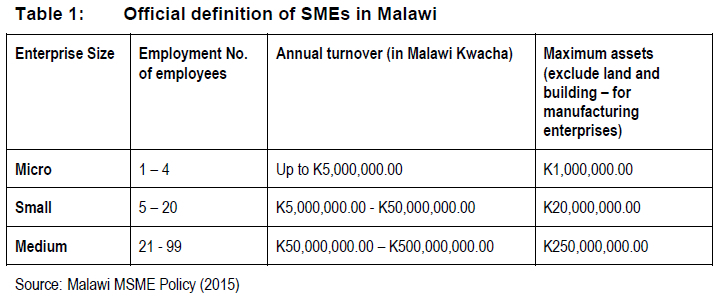
The definition of SME is based on five main parameters which are labour, capital, loan size, fixed asset and annual sales turnover Ndesaulwa and Kikula (2016). Policy makers often use one criterion to define SMEs. The size limit is one of the most common definitions in developing countries. The Malawi SME Policy (2015) draft provides the definition of SMEs where they are categorised based on the number of employees, annual turnover and maximum assets as in Table 1.
The common barriers to the development and growth of MSMEs in Malawi include weak institutional and regulatory framework, high cost of doing business, weak value chain integration, lack of specific policies aimed at women and the youth, limited access to credit and business development policies, lack of a coherent and organised MSME voice to represent the sector and an inability to meet production standards and few opportunities to export
4. METHODOLOGY
The study used a self-administered questionnaire containing closed-ended questions which was administered to the selected participants in the entrepreneurial development sector in the country. The study was descriptive in design as it sought to portray the situation of EET and small business development in Malawi by giving an in-depth description of its characteristics and what is occurring.
4.1
The SampleThe sample for the study was purposively selected from the personnel registers/records of the Human Resources Departments of the public institutions and HEIs involved in entrepreneurship. The public institutions and HEIs were again purposively sampled based on their involvement in entrepreneurship development and EET in the country. In total eight-five respondents were purposively sampled for the study and the questionnaire was sent to be completed and fifty returned the completed questionnaires providing a response rate of 59%.
4.2
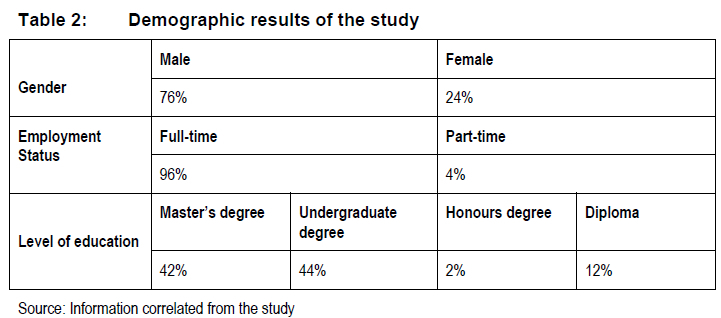
The ResultsIn total 56 responses were generated from the items in the questionnaire. Demographically, the results are illustrated in Table 2 below:
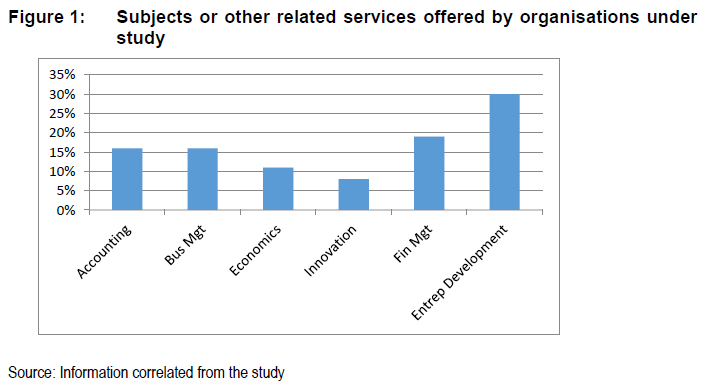
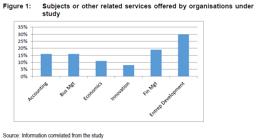
In total 29 respondents indicated that they had been involved in start-ups, which is 50%. A total of 8 respondents representing 14% indicated that they had been managers in a new or young business while another 6 respondents which represents 11% indicated that they had been managers in a medium-sized/large business. A total of 14 respondents representing 25% had no connection with business start-ups or SMEs. A total of 64% of the respondents indicated that their organisations offered entrepreneurship or other related services while 36% had their organisations not involved in entrepreneurial services or other related services. A total of 16% of the respondents indicated that their organisation offered Accounting as a module that was taught to prospective entrepreneurs; 16% indicated Business Management was offered by their organisation; 11% indicated Economics; 8% indicated Innovation; 19% indicated Financial Management and 30% indicated Entrepreneurship Development. Other subjects that were indicated by the respondents were Public Policy, Auditing, Agribusiness, Value Addition and Tailoring. This is illustrated in Figure 1 below.
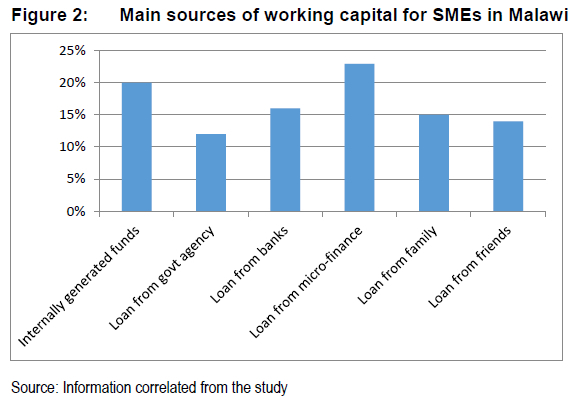
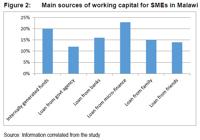
The study results revealed that 20% of the funds used in SMEs were internally generated, 13% were loans from a government agency, 15% were loans from banks, 22% were loans from microfinance, 15% were loans from family and 14% were loans from friends. This is presented in Figure 2 below.
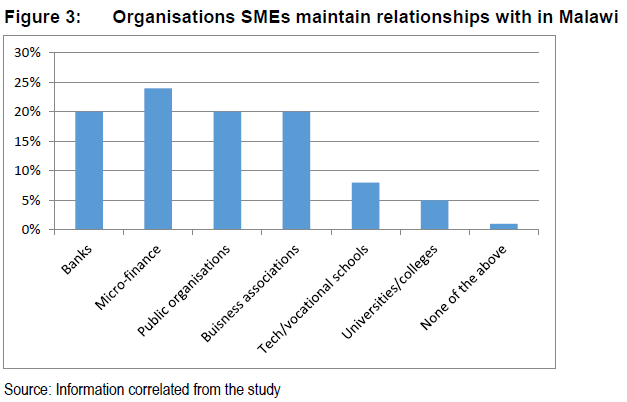
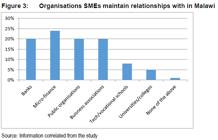
A total of 58% of the respondents indicated that the most common business support services available to entrepreneurs in Malawi is Entrepreneurship Development while the remainder which is 42 % indicated that entrepreneurs in the country have access to Business Counselling and Mentoring. Other business support services that are offered in the country as indicated by the respondents include Marketing Strategy, Quality Control Training and General Marketing. In total 20% of the respondents indicated that SMEs in Malawi maintain relationships with banks while 24% indicated that SMEs maintain relationships with microfinance institutions. A total of 20% respondents showed that SMEs in Malawi maintain relationships with public organizations and another 20% of the respondents indicated that the SMEs maintain relations with business associations; 8% with technical and vocational schools; 5% with universities and colleges, and 1% showed that SMEs had no relationship with any of the above institutions. This is demonstrated in the figure below:
The factors impeding the development of SMEs in Malawi were indicated as inadequate availability of debt financing rated at 78%, inadequate availability of venture capital rated at 85%, inadequate availability of qualified labour rated at 54%, lack of raw materials rated at 45%, lack of market demand rated at 53%, lack of information rated at 82%, intensity of competition rated at 55%, late payment rated at 65%, lack of support services rated at 52%, management team lack of skills rated at 76%, reluctance to take on new debt rated at 34%, low skilled labour rated at 50%, lack of business space rated at 35%, no time to grow the business rated at 42%, and finally lack of training opportunities rated at 74%.
The factors influencing the development of entrepreneurship in Malawi were indicated as availability of capital rated at 88%, availability of labour rated at 55%, availability of raw materials rated at 65%, bad experience of others rated at 47%, bad experience of owner rated at 58%, bribery and corruption rated at 78%, education background 94%, environmental conditions rated at 66%, family background rated at 37%, fear of failure rated at 53%, friends rated at 68%, government support/policies rated at 86%, relatives rated at 41%, religion rated at 15%, social status rated at 47%, society rated at 47%, and traditionalism rated at 39%.
5. DISCUSSION
The public institutions that were sampled for the study were selected because of the nature of activities which were entrepreneurial act as the training company. According to Claudia (2017) the training company is defined as an interactive learning method for developing entrepreneurship and it is presented as a modern concept of interdisciplinary integration and application of knowledge as well as an approach to the teaching and learning process which ensures conditions for testing.
Thamahane and Karodia (2017) assert that to create an environment that is conducive for entrepreneurial growth in a country, it is important that current challenges and motivational factors that influence potential entrepreneurs in starting a business are understood and dealt with effectively. The first thing that should take place is the setting up of organisations that provide leadership and direction in entrepreneurship development.
Generally, in Malawi credit delivery has been characterised by high default rates regardless of the type of clientele which makes lending to the SMEs by financial institutions very limited Mtsitsi et al. (2016). Chetama et al. (2016) established that loans were among the products which were found to be offered by micro-finance institutions to SMEs although their accessibility was affected by, among others, high interest rates in Malawi. The majority of the SMEs were outside established networks of the formal financial services sector. It is observed that a vibrant micro, small and medium enterprise (MSME) sector is key to poverty alleviation and growth in poor countries especially those in sub Saharan Africa all of which require easy access to finance at a cheaper price. The vibrancy of the MSME sector resulting from the policy changes also means increased demand for financial services to boast capital. Currently, small businesses in poor countries including Malawi face many challenges in accessing finance capital to enhance operations and increase profitability Chetama et al. (2016). Their inability to provide adequate collateral for loans means they cannot access formal credit from the commercial banking sector that considers this group of borrowers to be the riskiest as they are perceived to be highly likely to default Chetama et al. (2016). As a result, the lack of finance stifles development of viable small business projects
Alhassan, Hoedoafia and Braimah (2016) argue that small enterprises have limited access to capital as traditional banks shy away from them due to the high risk associated with lending to SMEs. Microfinance provides numerous benefits for beneficiaries such as owners of SMEs for expanding their businesses. They help them to build productive capacity, create jobs and contribute to poverty alleviation in developing countries by adopting new technologies. It is established that loans improve income levels, business expansion, competitiveness, increase sales volume and thereby more profits. It is thought that access to loans enable SMEs to overcome their liquidity constraints and undertake investments Alhassan et al. (2016). Not much information is available on entrepreneurial culture in Malawi. It seems that in the country there is a prevalent culture that does not recognise the value of entrepreneurial activity.
Mole, North and Baldock (2017) narrate that to improve SME growth and competitiveness governments often encourage business owner-managers to make use of external sources of business support. Whether they seek this depends on the degree to which they perceive themselves to need the business support service. To improve output and SME competitiveness, one mechanism available is to encourage and support the use of business advisers. Although they are not the only conduit for knowledge, advisers can diffuse new methods, knowledge and best practice to SMEs Mole et al. (2017). A resource-based theory perspective emphasises the competitive benefits to be gained from seeking and taking-up external business assistance.
External sources of advice increase strategic knowledge leading to competitive benefits and increasing the small businesses' potential Mole et al. (2017). External assistance can overcome information and knowledge gaps particularly in the smallest and youngest small businesses because of their resource and skill deficiencies Mole et al. (2017). Cho (2015) concludes that small-scale entrepreneurship programmes help would-be entrepreneurs to set up a business and existing entrepreneur to improve on their performance. Unlike training programmes, which are generally offered at a set time, for a set duration, and on a specific topic, advisory services, are usually offered on a continuous basis with more customised content, at least during the first stages of a small-scale entrepreneurship program. The advisors can be experts, peers, or mentors in various business areas. Their roles range from answering specific business-related questions and guiding participants in making strategic decisions to facilitating access to other resources for support Cho (2015).
In total 20% of the respondents indicated that SMEs in Malawi maintain relationships with banks while 24% indicated that SMEs maintain relationships with microfinance institutions. A total of 20% respondents showed that SMEs in Malawi maintain relationships with public organisations and 20% of the respondents indicated that the SMEs maintain relations with business associations. A total of 8% maintain relationships with technical and vocational schools while 5% with universities and colleges, and 1% showed that SMEs had no relationship with any of the above institutions. Universities can be seen as potential sources of future entrepreneurs since the education offered by universities mostly influences the career selection of students Mamun, Nawi, Dewiendren and Shamsudin (2016).Universities have a key role in promoting entrepreneurship since educational institutions are ideally considered as the place that shapes entrepreneurial cultures and aspirations among students while they are studying to survive in todays' robust business world Mamun et al. (2016). Surprisingly their contact with the entrepreneurial world in Malawi is minimal at 5%.
The factors impeding the development of SMEs in Malawi were indicated as inadequate availability of debt financing which was rated at 78% and inadequate availability of venture capital rated at 85% among others. Financial problems have long been one of the biggest challenges entrepreneurs in Sub-Saharan Africa faced over the years. They place inadequate funds as the biggest and critical hurdle to starting a firm and compete with other firms. In fact, without adequate finance, proper functioning and growth of small firms becomes a complicated nightmare. The lack of finance makes the opportunity cost of lending much higher for entrepreneurs. Lenders demand much higher levels of collateral from entrepreneurs Legas (2015).
Cho (2015) further observes that limited access to credit is often one of the most binding constraints to entrepreneurship. Many small-scale entrepreneurship programmes provide financial support to ensure that participants have the working capital and equipment they need to get started in business. Among the financial instruments used in these programmes, microfinance is by far the most common, but consumer loans, cash grants, saving accounts, micro-insurance, in-kind transfer of equipment and tools, and workshops with basic business infrastructure (electricity, water, basic equipment) are also used to help entrepreneurs manage their resources. A general trend is that policy attention to financial services shifts over time from loans to a more general agenda of financial inclusion making financial services accessible to disadvantaged or low-income people and from microfinance to exposure to diverse financial products for managing risks.
Pangeran (2016) indicates that financial literacy among entrepreneurs is above average and financial literacy contributes significantly towards entrepreneurial skills. For entrepreneurs financial literacy is a requirement. They should be able to make an informed judgment and effective decisions about the use and management of funds. Financial literacy has major implications for the well-being and the ability of the individual entrepreneurial activity Pangeran (2016). People with high-financial literacy levels make better financial decisions such as budgets, expenditures, savings, investment, and financial risk management. High financial literacy can increase the income and welfare of micro and small entrepreneurs. Financial literacy includes an increase in financial knowledge and skills, and changes in financial behavior Pangeran (2016).
Thamahane and Karodia (2017) argue that after developing an idea, the first challenge that entrepreneurs are going to face when starting a business from scratch is that of raising capital. It is argued that the reason entrepreneurs have a hard time accessing formal credit is because they lack the credit history. Even if the entrepreneur has access to formal credit, this is usually more expensive in developing countries than developed ones. Usually, the main funding sources in developing countries are personal funds and/or funds of the family members of the entrepreneur. Other options are business angels, venture funds, and developed capital markets, but are mostly available in developed countries.
The lack of raw materials was rated at 45% while the lack of market demands was put at 53%. Legas (2015) states that market size is also an important factor determining the status of entrepreneurship in an economy. Big markets enhance opportunities for entrepreneurs as they can enter growing markets to meet excess demand that other companies cannot meet. Growing markets enhances entrepreneurial activities Legas (2015). The lack of information was rated at 82%, intensity of competition 55%, late payment 65%, and lack of support services at 52%, reluctance to take on new debt at 34%, lack of business space at 35%, no time to grow the business at 42%, and lack of training opportunities at 74%. Contrary, it has been observed that the most common challenges facing SMEs include lack of funding, lack of skills, government legislations and inability to take risk Thamahane and Karodia (2017).
The inadequate availability of qualified labour was rated at 54%, management team lack of skills was rated at 76% and low skilled labour at 50%. SMEs require well-trained owners who act as managers and skilled workers to support the owners and execute the daily operations. Xaxithep (2017) observed that the labour input whether managerial or operational has a direct impact on the business turnover because manpower in the main input of production and most SMEs use traditional methods of production which require a large amount of manpower. Similarly, the service industry and trade are relatively labour-intensive Xaxithep (2017). The management team of the SME is responsible for providing leadership to the venture team.
The factors influencing the development of entrepreneurship in Malawi were indicated as availability of capital which was rated at 88%, availability of labour rated at 55%, availability of raw materials rated at 65% and education background rated at 94%. Similarly, Kew (2015) also states that the following obstacles hinder entrepreneurial development in a country: access to finance; lack of management, technical and marketing skills; and access to infrastructure and markets. Most people in the sub-Saharan Africa perceive lack of capital, lack of skills, lack of support and lack of market opportunities as the main obstacles to entrepreneurial ambitions Kew (2015).
Other barriers identified in sub-Saharan Africa include the lack of links to professional networks, corruption, lack of property rights and the over-regulated information and communications technology sector, the lack of an enterprise culture in many countries; unfavourable legal, policy and regulatory frameworks for entrepreneurship; the lack of entrepreneurship education across formal and informal educational systems; the lack of access to affordable financing in the form of start-up, investment or working capital; and lack of knowledge about and access to relevant business development services and support schemes for youth already in business or for those interested in pursuing an entrepreneurial career Kew (2015).
The factors of bad experiences of others which was rated at 47%; bad experiences of owner rated at 58%; family background rated at 37%; fear of failure rated at 53%; friends rated 68%; relatives at 41%; religion rated at 15%; social status rated at 47%; society rated at 47% and traditionalism rated 39% are social in nature, hence, could be linked to what the entrepreneur sees happening around him or her. The role of entrepreneurial role models cannot be over-emphasised in this regard. Brownson (2017) pointed out that an individual observes the role model engaging in various social behaviours and notes the reinforcements received by the model, if the observer values the reinforcements or recognises the positive outcomes of such behaviour then, the observer will attempt to replicate the role model's behaviour and obtain similar types of reinforcements. They indicated that entrepreneurial role models may appear in the guise of family members, employers, teachers or anyone who the individual has had the opportunity to observe. They further suggested that role models other than the parents may help explain the entrepreneurial career decisions of individuals without parental role.
Malebana (2016) indicates that any entrepreneurial activity is considered as a social process that is embedded in the networks of the interpersonal relationships. These social networks promote entrepreneurial activity by facilitating the efforts of entrepreneurs in starting new ventures and enhancing the performance of their ventures. The formation of entrepreneurial intention depends on the social circumstances to which individuals are exposed Malebana (2016). In addition, entrepreneurial activity can be facilitated or hindered by certain socio-cultural practices, values and norms prevailing in the environment Malebana (2016). An individuals' social networks and relationships may include people who play different roles such as family members, friends, current or ex-colleagues and business connections. These social networks are vital throughout the stages of the venture life-cycle and provide the entrepreneur with various forms of social support and resources from pre-start up to a stage when the venture is fully established Malebana (2016).
Corruption is one of the serious challenges facing entrepreneurs in Sub-Saharan Africa on their way to meet government requirements to start a business and around 27.8 percent of small firms in Sub-Sahara Africa are expected to give gifts to officials to get things done Legas (2015). The factor of environmental conditions was rated 66%. Thi Thu and Le Hieu (2017) indicated that environment conditions for entrepreneurship include economic resources, lack of employment opportunities and the political climate. Individuals cannot be viewed as atomized decision-makers who operate as autonomous entities. They state that the intention toward a new venture creation do not exist in isolation. It is reasonable to focus on the entrepreneurial process as an embedded process in a social, cultural and economic context Thi Thu and Le Hieu (2017). Previous research that recognised the importance of external influence factors for an individuals' interest to become an entrepreneur concentrated particularly on a persons' social networks, on the image of entrepreneurs in society, on socio-cultural norms, and on perceived supports/barriers to entrepreneurship Thi Thu and Le Hieu (2017).
Accordingly, the factor of government support/policies was rated at 86%. Xaxithep (2017) state the implementation of government policies need to be extensive if the government aims to achieve its target of promoting SME development. There is a need for effective implementation of SME promotion policies such establishing an enabling environment for business, improved dissemination and enforcement of laws and regulations relating to business and enhancing the capacity of government officers in charge of enterprise development or other related duties Xaxithep (2017). Government policies related to entrepreneurship education and should aim at quality enhancement and appropriateness for the market demand Xaxithep (2017). Also, government support programs for SMEs success can enhance and improve the activities of entrepreneurs by tackling the disparities in the available resources and the required competence with the help of entrepreneurship support program Pinho (2017).
6. CONCLUSION
The study concludes that a more specific and hands-on entrepreneurship policy needs to be developed and implemented in Malawi. The MoIT needs to continue to provide leadership in this regard and that there is also a need for effective and committed coordination on this. The policy implementation needs to be devolved to the local authorities which are in touch with the SMEs. There is a need for involving practicing entrepreneurs in the education and training of future entrepreneurs. The study contributes to a better understanding of the effectiveness of entrepreneurship policy implementation in Malawi.
7. LIMITATIONS
The major limitation of the study was the non-availability of study participants when visited by the researcher and time constraints. There was also a challenge of participants being sceptical of participating in the study for unknown reasons.
8. FURTHER RESEARCH
The article recommends further studies on the policy making processes used by MoIT in Malawi.
REFERENCES
3. LITERATURE REVIEW
- ABIORO T & ADEFESO HA. 2016. The Menace of Poverty and Challenges of Public Policy Making in Nigeria. Journal of Sustainable Development 9(1):177-188.
- ACS Z, ASTEBRO T, AUDRETSCH AT & ROBINSON DT. 2016. Public Policy to Promote Entrepreneurship: A Call to Arms. Small Business Economics 47:34-51.
- ALHASSAN E A, HOEDOAFIA, M A & BRAIMAH I. 2016. The Effects of Microcredit on Profitability and the Challenges of Women Owned SMEs: Evidence from Northern Ghana. Journal of Entrepreneurship and Business Innovation 3(1):29-47
- BROWN C & HANLON D. 2016. Behavioral Criteria for Grounding EET Programmes: A Validation Study. Journal of Small Business Management 54(2):399-419.
- BROWNSON CD. 2017. Exposure to External Role Models as a Determinant of Entrepreneurial Culture in Southern Nigeria. Advances in Social Sciences Research Journal 4(13):129-132
- CHETAMA JC, DZANJA J, GONDWE S & MALIRO D. 2016. The Role of Microfinance on Growth of Small-scale Agribusiness in Malawi: A Case of Lilongwe District. Journal of Agricultural Science 8(6):84-93.
-
CHO Y. 2015. Entrepreneurship for the poor in developing countries. World Bank, IZA World of Labor 2015:167 [Internet:https://wol.iza.org/articles/entrepreneurship-for-poor-in-developing-countries/long; downloaded on 14 February 2019.
» https://wol.iza.org/articles/entrepreneurship-for-poor-in-developing-countries/long - ]
- CLAUDIA I. 2017. The Role of Training Companies in Entrepreneurial Education, Annals of the Constantin Brâncusi University of TârguJiu. Economy Series. (Issue 1/2017.
- )
- COAD A, FRANKISH J & ROBERTS RG & STOREY JD. 2016. Predicting New Venture Survival and Growth: Does the Fog Lift? Small Business Economics 47:217-241.
- DAVID FR & DAVID FR. 2015. Strategic Management: Concepts and Cases. Essex: Pearson Education.
-
DANIELL KA, MORTON A & INSUA DR. 2016. Policy analysis and Policy analytics. [Internet:https://www.semanticscholar.org; downloaded on 23 March 2019.
» https://www.semanticscholar.org - ]
- EDOHO FM. 2015. Entrepreneurship and Economic Change in a Developing Region: Opportunities and Challenges in Africa. Review of Contemporary Business Research 4(2):1-13.
-
THE FOOD AND AGRICULTURE ORGANIZATION OF THE UNITED NATIONS (FAO). 2015. Livelihood diversification and vulnerability to poverty in rural Malawi. [Internet:www.fao.org/economic/esa; downloaded on 08 July 2018.
» www.fao.org/economic/esa -
]
» https://info.undp.org - HELLER LR & STEPHENSON EF. 2015. Economic freedom, home-ownership and state labour market conditions. Journal of Entrepreneurship and Public Policy 4(2):142-151.
- HYDER S & LUSSIER R. 2016. Why Business Succeed or Fail: A Study on Small Business in Pakistan. Journal of Entrepreneurship in Emerging Economies 8(1):82-100.
- IBRAHIM A & IBRAHIM MA. 2015. The Strategy and Political Resources in the Changing Spatial Policy. International Journal of Administrative Science and Organization 22(1):61-68.
- IBRAHIM NA & MASUD A. 2016. Moderating role of entrepreneurial orientation on the relationship between entrepreneurship skills, environmental factors and entrepreneurial intention: A PLS Approach. Management Science Letters 6:225-236.
-
KEW J. 2015. Africa's Young Entrepreneurs: Unlocking the Potential for a Brighter Future. [Internet http://publications.gc.ca/pub?id=9.816560&sl=0; downloaded on 05 September 2018.
» http://publications.gc.ca/pub?id=9.816560&sl=0 - ]
- LEGAS H. 2015. Challenges to Entrepreneurial Success in Sub-Saharan Africa: A Comparative Perspective. European Journal of Business and Management 7(11):23-35.
- MALEBANA MJ. 2016. The Influencing Role of Social Capital in the Formation of Entrepreneurial Intention. Southern African Business Review 20:51-68.
-
MALAWI SME POLICY. 2015. [Internet:https://cepa.rmportal.net/; downloaded on 24 March 2019.
» https://cepa.rmportal.net/ - ]
- MAMUN AA, NAWI NBC, DEWIENDREN AA & SHAMSUDIN SFFB. 2016. Examining the Effects of Entrepreneurial Competencies on Students' Entrepreneurial Intention. Mediterranean Journal of Social Sciences 7(2):119-127
- MANN J & SHIDELER D. 2015. Measuring Schumpeterian activity using a composite indicator. Journal of Entrepreneurship and Public Policy 4(1):57-84.
-
MINISTRY OF INDUSTRY & TRADE (MOIT). 2015. Directory of Micro, Small & Medium Enterprises (MSMES) Support Providers. [Internet:www.moit.gov.mw; downloaded on 07 July 2018.
» www.moit.gov.mw - ]
- ]
- MIRZANTI IR, SIMATUPANG TM & LARSO D. 2015. Mapping on Entrepreneurship Policy in Indonesia. Procedia-Social and Behavioural Sciences 169:346-353.
- MKANDAWIRE M & DUAN X. 2016. Factors Influencing Credit Demand among Household Non-agriculture Enterprises in Malawi. Open Journal of Business & Management 4:312-321.
- MTSITSI L, DZANJA JK, GONDWE S & KAMWANA B. 2016. Effects of Microcredit on the Financial Performance of Small-Scale Cooking Oil Processors in Central Malawi. Journal of Agricultural Science 8(6):156-168.
- MOLE K, NORTH D & BALDOCK R. 2017. Which SMEs seek external support? Business characteristics, management behaviour and external influences in a contingency approach. Environment and Planning C: Politics and Space 35(3):476-499.
- NDESAULWA A P & KIKULA J. 2016. The Impact of Innovation on Performance of Small and Medium Enterprises (SMEs) in Tanzania: A Review of Empirical Evidence. Journal of Business and Management Sciences 4(1):1-6
- NIELSEN PS. 2016. Entrepreneurship orientation in policy making: A determinant of collaboration and organizational adaptability in entrepreneurship policy delivery. Entrepreneurship and Innovation 17(1):43-54.
- NTCHINDI M. 2016. Malawi's Job Crisis Exposed. The Daily Times. Blantyre: Blantyre Print & Publishing. (09 June, pp 3.
- )
- OKUMAGBO PO & OKINONO O. 2016. Human Capability and Entrepreneurship Development in the Nigeria Delta Region of Nigeria. Information and Business Review 8(1):38-46.
- PINHO JCM & THOMPSON D. 2017. Institutional-driven dimensions and the capacity to start a business: A preliminary study based on two countries International Marketing Review 34(6): 787-813.
- SHAMSUDDIN J, SARKAWI MN, JAAFAR AR & ABD RAHIM NF. 2017. Malaysian SMEs Performance and the Government Business Support Service: The Moderating Effects of Absorptive Capacity. International Journal of Supply Chain Management 6(4): 326-331.
- SCHULZ M, URBIG D & PROCHER V. 2016. Hybrid Entrepreneurship and Public Policy: The Case of Firm Entry Deregulation. Journal of Business Venturing 31:272-286.
- )
-
SHU C, CLERCQ DD, ZHOU Y & LIU C. 2019. Government institutional support, entrepreneurial orientation, strategic renewal, and firm performance in transitional China International. Journal of Entrepreneurial Behavior & Research 25(3):433-456. [Internet:https://doi.org/10.1108/IJEBR-07-2018-0465; downloaded on 03 March 2019.
» https://doi.org/10.1108/IJEBR-07-2018-0465 - ]
- PANGERAN P. 2016. Entrepreneurial Capability and New Product Development Performance in Micro and Small Enterprises: The Moderating Role of Financial Literacy. Mediterranean Journal of Social Sciences 7(1):97-104.
- THAMAHANE T C & KARODIA AM. 2017. Factors that Influence Entrepreneurship in University Students: A Case Study of Two Departments at the University of the Western Cape (Republic of South Africa). Kuwait Chapter of Arabian Journal of Business and Management Review 6(6):1-30
- THI THU T D & LE HIEU H. 2017. Building up the Entrepreneurial Intent Construct among Technical Students in Vietnam. Journal of Small Business and Entrepreneurship Development 5(1):7-18.
- XAXITHEP S. 2017. Entrepreneurship, Human and Social Capital, and Government Policy in Small and Medium Enterprise Development in Laos. Japan Social Innovation Journal 7(1):33-50
- WRIGHT M, ROPER S, HART M & CARTER S. 2015. Joining the dots: Building the evidence base of SME growth policy. International Small Business Journal 33(1):3-11.
- ZIDANA R. 2016. Exploring Alternative Sources of Financing Small and Medium Enterprises (SMEs) in Malawi: Lessons from Elsewhere. International Journal of Management &Commercial Innovations 3(2):455-460.