Perceptions by users of an Open Innovation platform regarding the innovation value chain
Abstract
BACKGROUND: Stimulating entrepreneurial activity is at the forefront of economic development attributable to its contribution to job creation and economic growth. As competitive markets rise, businesses are required to increasingly innovate in order to obtain and maintain a competitive advantage, especially within the reality of the globalization of modern economies. In recent years, collaborative practices such as Open Innovation are utilized to maintain a competitive advantage and remain sustainable. Whilst the benefits of Open Innovation are widely spoken about, little is understood about the successes of Open Innovation intermediaries in accelerating the commercialisation of new ideas. PURPOSE: The perceptions of Open Innovation by users of an Open Innovation platform regarding taking ideas-to-market were investigated in this article. METHODS: A quantitative research method using self-administered questionnaires was utilised for collecting data from 192 respondents registered onto the Open Innovation platform. FINDINGS: Results indicate that respondents have similar views regarding entrepreneurship, the innovation value chain and Open Innovation regardless of their industry, level of education or business focus. CONCLUSIONS: The article helps entrepreneurs make better decisions about commercialisation through the use of Open Innovation and could assist policy makers in identifying what is needed to promote early-stage entrepreneurial activity in South Africa.
entrepreneurship; innovation value chain; Open Innovation; total early-stage entrepreneurial activity
1. INTRODUCTION
Developing countries are characterised by low Gross Domestic Product (GDP) per capita income and high Total early-stage Entrepreneurial Activity (TEA) rates (Turton & Herrington 2012:41). TEA rate refers to the prevalence rate of individuals in the working age population who are actively involved in business start-ups, either in the phase of starting a new business or within the first 3 years after the start of the business (Dantas, Moreira & Valente 2015:2).
Economic growth is often strongly associated with innovation as new and competitive businesses are created through new ideas and inventions (Urbancová 2013:84). As ideas increase, the potential for entrepreneurship and subsequently innovation capabilities increase. In earlier times, entrepreneurship was originally defined by Schumpeter (1934:78) as the ability of an entrepreneur, who comes across a worthwhile idea, to introduce an idea to a market or industry. Thus entrepreneurship entails the discovery, evaluation and utilisation of opportunities in order to introduce new goods and services, markets, processes and raw materials through organising efforts that previously had not existed. Studies have linked the phenomenon of innovation to entrepreneurship (Bessant & Tidd 2011:6). Drucker (2011:215) proposes that for the successful commercialisation of new ideas through entrepreneurship, innovation is mandatory.
Bessant and Tidd (2011:11) remark that innovation resulting from entrepreneurship is a managed but often difficult extensive process made possible through the skills, capital, and determination of entrepreneurs. Transforming ideas into successful commercial outputs is known to as innovation (Smith 2006:107). The innovation value chain presents innovation as a sequential process entailing the transformation of ideas into commercial products and services through an integrated flow occurring inside a business unit, across units or outside the business (Hansen & Birkenshaw 2007:3).
In South Africa, there has been recent interest in using innovative approaches such as Open Innovation to stimulate entrepreneurship (Cunningham 2012:77). Open Innovation refers to the purposive inflow and outflow of knowledge in order to accelerate internal innovation and expand markets beyond boundaries of the business (Chesbrough 2003). The Innovation Hub is a science park in Pretoria using Open Innovation as one of the methods through which the Gauteng provincial government aims to stimulate innovation and successful commercialisation. They have piloted a web-based platform called OpenIX, an Open Innovation intermediary, which is been used as a method of connecting solution seekers with solution providers {Piller & Diener 2013:4).
The solution providers could be inventors or entrepreneurs with an invention or solutions to organisational or market challenges and needs. Solution seekers are understood as small to large businesses, as well as the market in general, seeking solutions to challenges within their businesses and its environment. OpenIX presents an opportunity to investigate what is needed to bridge the gap from invention or idea to successful commercialisation
In the remainder of this article, previous literature and research regarding the innovation value chain from idea-to-market and how Open Innovation is used with the value chain is explained. The problem statement of the research and the main reason and objectives for undertaking this research is then formulated.
The results are drawn from descriptive approaches indicating the perceptions of Open Innovation users. The article concludes with discussions and recommendations for business development.
2.1 The innovation value chain
The innovation value chain is brought about as a business' new knowledge needed for innovation, is converted into products or services and later exploited in order to escalate the business's growth and the value provided to the consumers (Ganotakis & Love 2012:840). Consistent with Bessant and Tidd's perspective (2011:390) the innovation value chain is a steady but at times complex process that warrants the reduction of uncertainty through various phases in the chain.
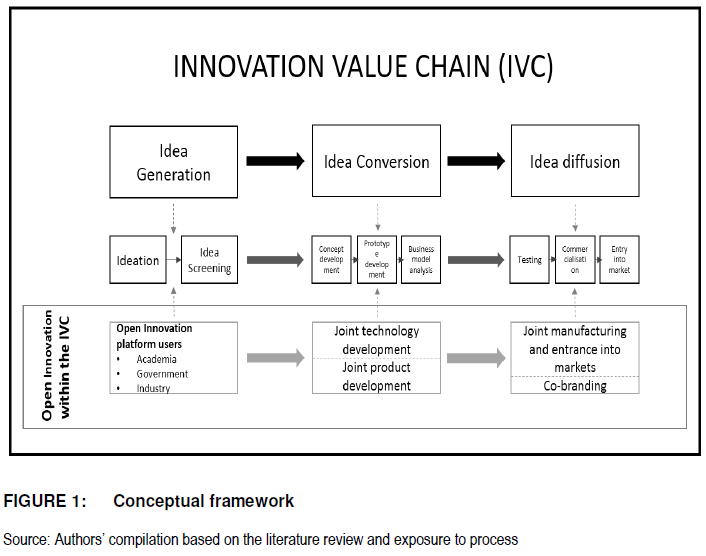
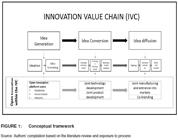
Hansen and Birkinshaw (2007:3) are of the opinion that the innovation value chain embodies innovation as a "sequential, three-phase process" comprising of idea generation, idea conversion into a concept and diffusion of the concept into the market.
2.1.1 Idea generation
The first phase of the innovation value chain, idea generation, is understood by Hansen and Birkinshaw (2007:3) to occur within a business department, across departments in a business, as well as outside the business. During this initial step of the innovation value chain new opportunities and customer requirements are identified (Marais & Schutte 2010:102). Research is conducted within the business, giving rise to new ideas and concepts {Smith 2006:108). Ideas stem from unexpected incidences, process needs, demographic and behavioural changes, industry and market trends, as well as new knowledge as a result of individual genius {Drucker 2011:208; Kuratko 2014:149). Ideas are generated in a large number of ways but it is important that these ideas serve to add value to the end-user, therefore, strong screening mechanisms need to be in place {Hansen & Birkinshaw 2007:5).
Idea screening and selecting involves filtering the ideas according to the business's innovation strategy. Marais and Schutte (2010:102) explain that during screening and selection, the feasibility of ideas is evaluated by ways of ensuring that ideas integrate with the various product or service offerings as well as the objectives of the business. The capability of the business to carry out the idea and also meet its future demand should be analysed through ranking, profiling and scenario building (Bessant & Tidd 2011:395).
2.1.2 Idea con version
The second phase in the innovation value chain, idea conversion, includes all activities involved in converting the selected ideas into products or services which will be ready for commercialisation (Hansen & Birkinshaw 2007:3). It is during conversion that ideas are transformed and combined into concepts that are formally defined, enclosing features that add customer value (Marais & Schutte 2010:102). This knowledge is transferred to R&D personnel, designers and marketing departments and subsequently translated into innovation outputs (Bessant & Tidd 2011:393).
At this stage, if R&D-derived knowledge forms outputs other than what was expected from the initial idea, Ganotakis and Love (2012:840) emphasise that either it is sent back for refinement or used despite being different to what was expected. The defined concepts are then developed through modelling, prototyping and feasibility assessments (Marais & Schutte 2010:102). Models are designed to demonstrate the appearance of the future product in order to give an impression of the overall look of the invention; at this stage, they may have no functioning capability {Smith 2006:111).
The concept and model are turned into an invention through prototyping the fundamental working principles of the defined concept. Smith (2006:112) further adds that unlike models, the prototypes are designed for functionality in order to ensure that the functional features product are as expected. Bessant and Tidd {2011:396) argue that prototypes undergo much iteration as the designers come to learn more about the problem and alternative solutions. Once the prototype has been developed, the fit of the prototype with the overall business model is investigated (Marais & Schutte 2010:102). Materials that will be utilised for manufacturing the product and the processes by which the product will be manufactured are evaluated {Smith 2006:114).
2.1.3 idea diffusion
Quite often the idea conversion phase overlaps with the diffusion phase (Bessant & Tidd 2011:393) due to the fact that the developed concept frequently requires buy-in from the rest of the business departments as well as their targeted market. Hansen and Birkinshaw (2007:5) emphasise that businesses need relevant units that serve to support and spread new product concepts and business models across all areas within and outside the business. During the idea diffusion phase concepts are tested and implemented in the market for further development opportunities and feasibility studies, ensuring that functionality is as intended and that performance is what end-users require (Smith 2006:110).
Once products have been refined, formalised and market-tested on a limited scale first, before the commercialisation step commences thereafter. (Marais & Schutte 2010:103). Commercialisation is the final step in the innovation value chain and involves producing and launching the final product for entrance into the market (Smith 2006:108). The production that takes place is not yet full-scale since individuals operating the manufacturing process need to familiarise themselves with the production of the new product (Smith 2006:118). The main purpose of commercialisation is introducing ideas into new markets and extending the business offerings in existing markets (Marais & Schutte 2010:103).
Launching the product or service into the market is another crucial step in commercialisation. Van Hemert, Nijkamp and Masurel (2013:438) highlights that continually engaging in the market, through meetings with business partners, consumers, business communities and everyday individuals, allows businesses to have an understanding of the market and gain useful insights regarding the overall industry. Launching the product through buy-in from various role-players speeds up the commercialisation process. Once, the new product is successfully launched, it should add value to the value chain by creating profits for the business, social advantages to communities, and personal benefits for consumers.
2.2 Open Innovation within the innovation value chain
Open Innovation plays a role within each of the phases in the innovation value chain. Other than generating ideas from within the business, ideas may stem from external knowledge bases (Van Hemert et ai. 2013:430). Ideas may be sourced externally from other businesses within the same sector and even outside that sector through Open Innovation (Hansen & Birkinshaw 2007:4). This means ideas may also originate from various role players within academia, industry and government. This relationship is referred to as the triple-helix (Leydesdorff 2006:3). With Open Innovation, ideas and new knowledge for ideas are generated from suppliers, consumers, competitors, academia, investors, government agencies as well as independent entrepreneurs. Protection of ideas is vital since ideas are shared within multi-disciplinary teams (Janssen, Bouwman, Van Buuren & Haaker 2014:18).
During the idea conversion phase, Open Innovation practices are applied through the use of joint technology development as well as joint product development (Theyel 2013:264). Developing the technology with external parties such as customers and suppliers allows the business to understand the needs of the public as well as the limitations the concepts may have. Joint development with suppliers offers businesses the prospect of understanding the importance of materials and equipment to be used (Theyel 2013:264).
Technology discovered or created outside the business may be acquired when defining the concept and developing the prototype through continuous feasibility studies (Marais & Schutte 2010:104). Conversely, prototypes and technologies developed internally during this phase may be transferred out of the business through outbound Open Innovation. This situation can occur, for instance, when the business does not have the ability to realise sufficient revenue in its own market or when the technology is a spin-off which cannot be used for the core business (Von Nell & Lichtenthaler 2011:133). During the idea diffusion phase, businesses are able to sell prototypes to external parties if they perceive them not feasible for the business's own model but possibly worthwhile in other industries or markets (Gassmann & Enkel 2004:10).
For start-up entrepreneurs, commercialisation through Open Innovation occurs through identification and implementation of agreements with businesses seeking solutions for commercialisation (Gans & Stern 2003). During the production of the products through Open Innovation, equipment is shared with external parties and manufacturing occurs through a joint undertaking (Theyel 2013). This often occurs when the businesses taking part in Open Innovation are in close proximity and sharing manufacturing and equipment makes commercial sense. Through Open Innovation as a commercialisation strategy, there is also joint access to new markets through co-branding (Mortara, Napp, Slacik, & Minshall 2010:378). This helps entrepreneurs lower the cost of trying to identify and access new markets. Strategic alliances with other entrepreneurs and entering into supplier-customer relations are typical practices of Open Innovation at the commercialisation stage (Van Hemert ef ai. 2013:436).
From the literature review, a conceptual framework (Figure 1) was developed to indicate the relationships between the relevant concepts and factors investigated in the study. The factors were identified during the literature review of various models describing Open Innovation and the innovation value chain (Chesbrough 2003; Hansen & Birkinshaw 2007:3).
3. PROBLEM STATEMENT AND OBJECTIVES
The development and advancement of entrepreneurship is fundamental in developing countries (Turton & Herrington 2012:41). Despite the finding by Turton and Herrington (2012:41) that TEA rates are generally high in developing countries, South Africa faces challenges regarding encouraging entrepreneurial activity, the greatest contributor to job creation (Fal, Sefolo, Williams, Herrington, Goldberg & Klaasen 2010:2).
Although literature proposes that inventing new technology is critical for entrepreneurship, Small and Medium-sized Enterprise (SME) development and job creation (Litwin & Phan 2013:834), there's little understanding about what is actually needed to successfully take ideas to market in Southern Africa. It appears that the understanding of idea-to-market has focused mainly on the extreme ends of the innovation value chain, i.e. research and development (R&D) on one end and marketing on the other (Chaminade & Edquist 2010:102). In doing this, the range of activities and processes of the innovation value chain have been overlooked.
There is no clear distinction between what constitutes an invention and what makes an innovation, thereby creating unrealistic expectations on what could be an entrepreneurial opportunity (Braunerhjelm 2010:19). An invention does not necessarily translate into an entrepreneurial opportunity. The inventor often perceives himself as the only factor critical in taking his idea to market, not realising that the inventor and the entrepreneur (the commercialisation entity) are not always present in one person (Stibel 2009).
Furthermore, this has been compounded by a lack of understanding of how the entrepreneur, if it is a different person, can add value and compliment the inventor in successfully taking the idea to market.
Open Innovation allows access to external resources since inventors are able to leverage on the global innovation community {Chesbrough 2003). Thus, in general and as applied by OpenIX, Open Innovation connects the entrepreneur or inventor with funders, Intellectual Property lawyers, physical facilities, associations, and standards as well as with other role players within the market place. Whilst the benefits of Open Innovation in connecting solution seekers with solution providers is widely spoken about, little is understood on the successes of Open Innovation intermediaries, like the OpenIX, in accelerating ideas to market or helping inventors or entrepreneurs in commercialising their ideas.
Through the examination of the intermediary role of OpenIX, the primary objective of this research was to investigate the perception of Open Innovation by users of OpenIX regarding the innovation value chain. Investigating the OpenIX portal can lead to an in-depth understanding of what is needed to bridge the gap from invention to successful commercialisation.
To achieve the primary objective of this study, the following secondary objectives were formulated:
1. Examine the demographic profile of respondents who make use of the Open Innovation platform.
2. Determine the perceptions of and differences among respondents within various sectors regarding the extracted factors namely innovation, entrepreneurship, Open Innovation, idea-to-market and accelerating commercialisation.
3. Investigate the perceptions of respondents with different levels of education regarding the extracted factors mentioned in objective 2.
4. Determine perceptions of respondents with different business focuses regarding the extracted factors mentioned in objective 2 and the differences amongst the business focuses.
5. Investigate the relationship between accelerating commercialisation {embracing funding through angel investors - informal investors providing a one-time investment i.e. family, friends and business owners, commercial banks and government schemes as well as intellectual property protection) and the respondents' sector, level of education and business focus.
From the conceptual framework and theoretical development the following hypotheses were derived:
6.
Hi: Open Innovation users with different levels of education operating in different sectors and business focuses have similar perceptions regarding the innovation value chain.7. H2: Open Innovation users regardless of their sector, level of education and business focus have the same views concerning funding through angel investors, commercial banks and government schemes and protecting intellectual property.
4. RESEARCH METHODOLOGY
4.1
Research design, population and samplingFor this study, a quantitative descriptive research design was used to gather information (Burns & Bush 2014:103). The targeted population included individuals that made use of the Open Innovation (Ol) platform -The Innovation Hub OpenIX in Pretoria. Eight hundred and two entities have registered onto the platform. The sampling frame and units included startups, government agencies, SMME's, innovators/inventors and entrepreneurs on the platform.
A non-probability, purposive sampling method was utilised enabling a large number of respondents to be given self-administered questionnaires in a relatively short period of time, specifically during workshops (Shiu, Hair, Bush & Ortinau 2001:480). A sample size of 192 respondents was obtained from registered Open Innovation platform members.
4.2
The measuring instrumentThe self-administered questionnaire was designed consisting of two sections that corresponded with the objectives set out for this research (McDaniel & Gates 2013:107). Demographic variables were measured in section A and contained close-ended multiple-choice questions. In section B, the perceptions of respondents regarding innovation, entrepreneurship, idea-to-market, accelerating commercialisation and Open Innovation were measured. The first 46 questions in section Β were close-ended five-point Likert-scale questions where 1= strongly disagree and 5= strongly agree. The last four questions were dichotomous questions.
A pre-test was conducted by distributing the questionnaire to a small fraction of the respondents in order to test for clarity (Malhotra 2010:354). Feedback regarding the questionnaire was incorporated as the researcher that it adhered with the code of ethics formulated by the North-West University.
Questionnaires were handed out at Open Innovation workshops. These workshops served to discuss the technical details of challenges needing solutions as well as the Open Innovation process required for the submission of solutions. During this study, three workshops where held and attended by between 30 - 80 potential respondents. Taking into account ethical considerations, respondents were assured of anonymity as their names and any confidential information did not appear on the questionnaire. Respondents were also informed to complete the questionnaire voluntarily. Participating respondents were requested to completed the printed questionnaire and hand it in after the workshop. Respondents who did not attend workshops but were registered onto the Open Innovation platform were contacted via email and requested to complete an online version of the questionnaire. After a certain period of time, respondents were sent another email reminding them to complete the questionnaire. A total response number of 192 respondents were obtained.
4.3 Data analysis
Data collected from the self-administered questionnaires were entered, cleaned and analysed by the use of the Statistical Package for Social Sciences (SPSS) version 21 and Analysis of Moment Structures (AMOS) version 20. All statistical tests were done at a 5% level of significance.
An Exploratory factor analysis (EFA) was conducted to identify and retain the variables structure that explained each of the specified underlying items of using the innovation value chain to accelerate commercialisation (Churchill & lacobucci 2010:501). Confirmatory factor analysis (CFA) was then conducted to test the fit of the factors retained from the EFA. Cronbach's alpha coefficients were computed to determine the statistical reliability of the measuring instrument (Zikmund & Babin 2015:280). The CFA assessed construct validity by testing whether the researcher's constructs influenced responses as predicted (Burns & Burns 2009:443).
The results for research objectives were fulfilled by Analysis of Variance (ANOVA) tests and cross tabulations. ANOVA tests were conducted to determine whether the identified factors were significantly different amongst variables of interest to this research, namely sector, level of education and business focus (Zikmund & Babin 2015:427). Cross tabulations, based on the chi-square test, were carried out for statements 46-49 in the questionnaire so as to establish the association between the statements and the variables of interest. Where statistical difference exists, the Cramer's V (w < 1) was computed as it measures the strength of association between two categorical variables (Field 2013:740).
5. RESULTS
5.1 Demographic profile of respondents
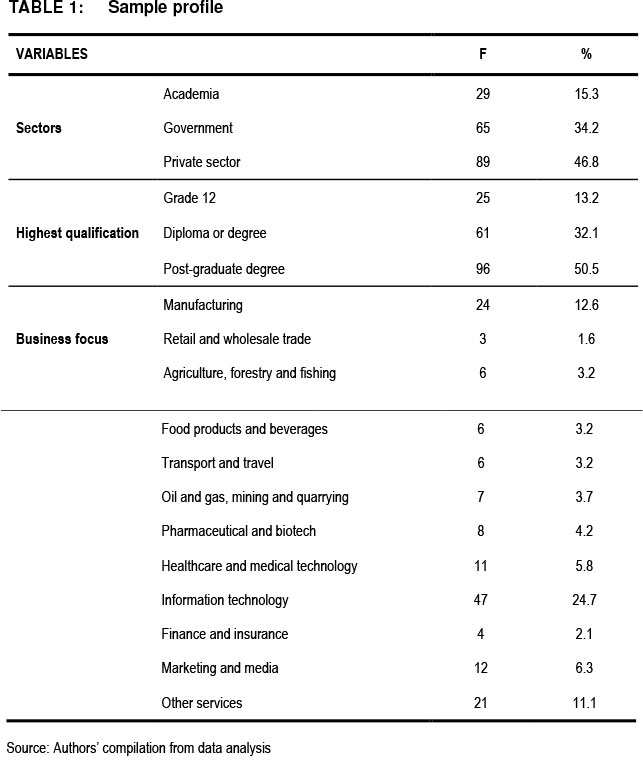
The demographic profile of the respondents is shown in Table 1.
The table indicates that the sample consisted of respondents from three sectors, had a qualification and operated in businesses with various focuses. Most of the respondents originated from the private sector (46.8%) while 34.2 % of the respondents represented the government. The academia was represented by the smallest number of respondents (15.3%). The majority of respondents had obtained a post-graduate degree (50.5%) whilst only 32.1% and 13.2 % of the respondents had obtained a diploma or degree and Grade 12 respectively. Regarding the business focus, 24.7% of the respondents operated mainly in businesses of which the main focus was Information Technology.
5.2 Exploratory factor analysis
The Kaiser-Meyer-Olkin (KMO) Measure of Sampling Adequacy and Bartlett's Test of sphericity were used in order to assess the suitability of the respondent data for factor analysis (William, Brown, & Onsman 2010:5). The KMO statistic showed a discrepancy between 0 and 1.
When the value is 0 this indicates diffusion in the pattern of correlations and that factor analysis is therefore inappropriate. When the KMO value is close to 1, this indicates that the patterns of correlations are relatively compact and therefore a factor analysis will produce reliable factors {Field 2013:684).
When conducting the EFA for this research it was found that the KMO measure of sampling accuracy was 0.92. Bartlett's Test of sphericity indicates the significant difference between a correlation matrix and an identity matrix (Field 2013:685). The EFA for this research was considered suitable since Bartlett's test of sphericity value was 0.000.
5.3 Reliability and validity
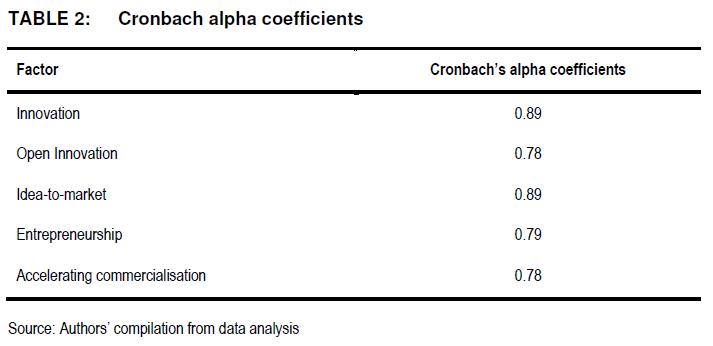
Table 2 reflects the reliability of all the measurement scales in the questionnaire. Cronbach alpha coefficient for each factor was larger than 0.70, indicating a high level of reliability. The factors that measure innovation, entrepreneurship, idea-to-market, Open innovation and accelerating commercialisation identified through the EFA are highly reliable to measure respondents' perceptions of the innovation value chain and its role in accelerating commercialisation.
In order to test the validity of the structure, a confirmatory factor analysis (CFA) was conducted to test the fit of the seven factors retained from the EFA in AMOS. The fit of the model was evaluated using three of the various goodness-of-fit indices: the chi-square statistic, the Root Mean Square Error Approximation (RMSEA) and the Comparative Fit Index (CFI). An exceptional ratio of the chi-square divided by its degrees of freedom should range from 2 to 5. An RMSEA below 0.08 indicates good fit. For the comparative fit index (CFI), a value of =0.95 is recognized as being indicative of a good fit (Hu & Bentler 1999:22).
The results indicated that the data fits the structural equation model relatively well. The ratio of the chi-square divided by its degrees of freedom obtained for the SEM was 1.72, which suggests an appropriate fit. The model produced an acceptable CFI = 0.90 and a RMSEA = 0.06, with a 90% confidence interval of [0.056; 0.068]. The CFA clearly showed that the factors identified through the EFA, are valid to measure respondents' perceptions on using an Open Innovation platform to accelerate commercialisation.
5.4 Inferential statistics
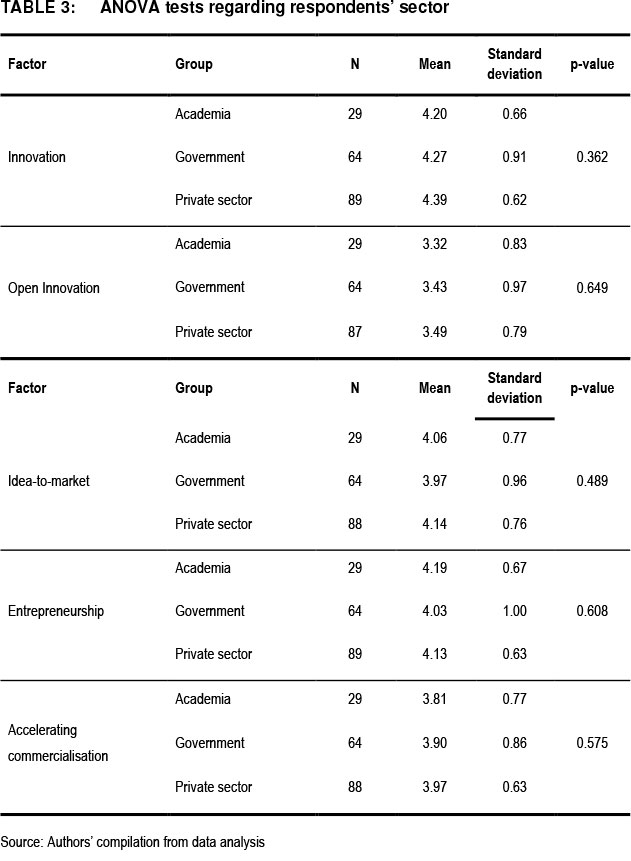
Analysis of variance (ANOVA) tests were used to examine the research objectives since it allows for the investigation of the effects of a variable on an "interval-scaled' dependent variable. This technique determines whether significant differences exist in means between the groups, namely sector, level of education and business focus. The results of the ANOVA tests are reported in Tables 3, 4 and 5, respectively.
Table 3 indicates that respondents in the different sectors had similar views regarding the five extracted factors. Respondents across all three sectors felt the most strongly about views relating to innovation and entrepreneurship. There was therefore no statistically significant difference amongst academia, government and private sector regarding all the factors.
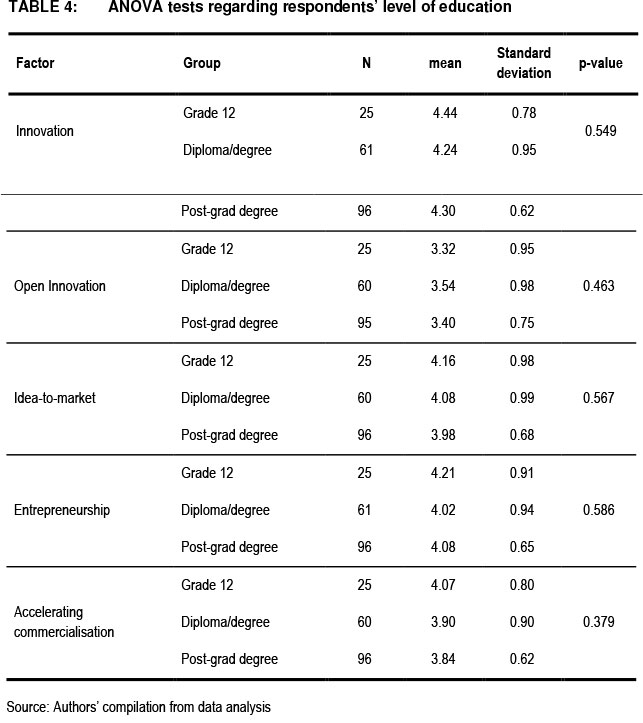
The majority of (n=96) respondents had obtained a post-graduate degree. Results from Table 4 displays that respondents' level of education did not influence their perceptions on innovation, Open Innovation, idea-to-market, entrepreneurship and accelerating commercialisation, as no statistically significant differences amongst the respondent's qualifications regarding these five extracted factors were found.
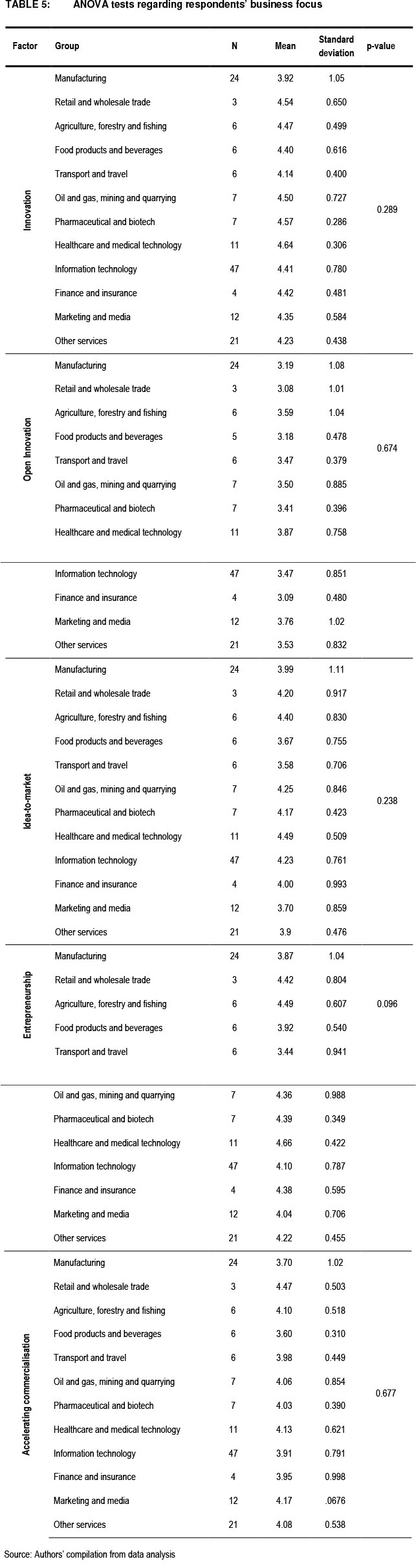
Table 5 indicates that there is no statistically significant difference between respondents' business focus and the extracted factors, thus respondents from various business focuses do not differ in views regarding innovation, Open Innovation, entrepreneurship, idea-to-market and accelerating commercialisation.
Drawing from the results indicated in Tables 3, 4 and 5, the first hypothesis (H1) is supported as no statistically significant differences exist amongst Open Innovation users regarding the five factors exploring innovation value chain.
5.5 Relationships between respondents' perceptions of accelerating commercialisation and their sector, level of education and business focus
Cross tabulations, based on chi-square tests, were carried out to determine whether any association exists between questions relating to commercialisation and respondents' sector, level of education and business focus. The results of the chi-square tests are reported in Tables 6, 7, 8 and 9, respectively.
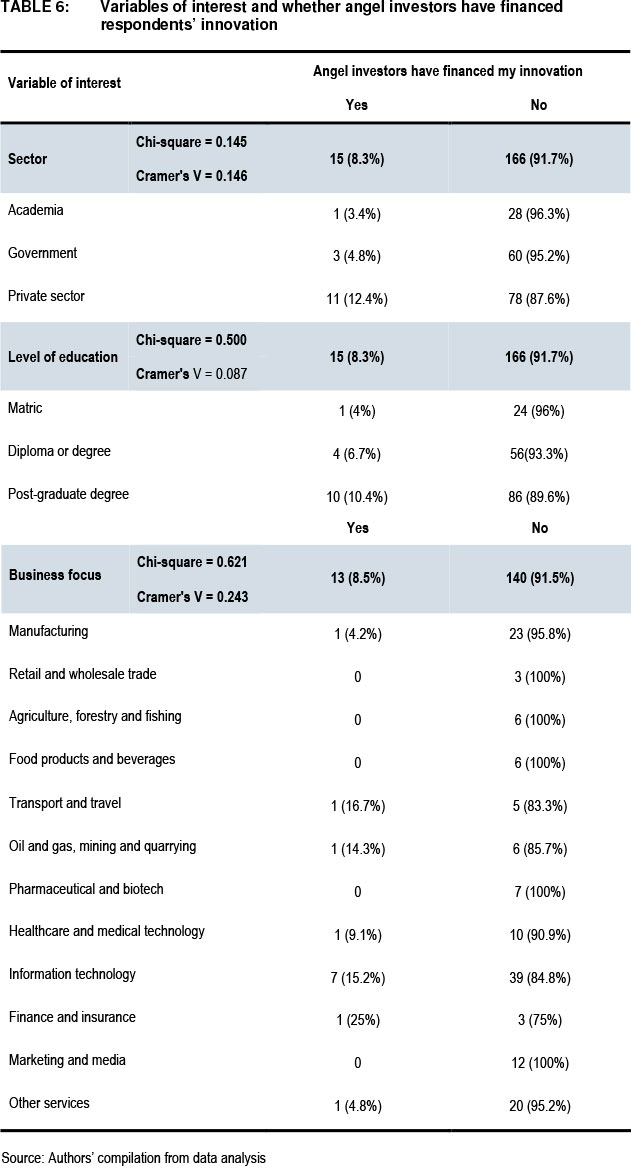
■ From Table 6 it is clear that a large majority of respondents (91.7%) across all sectors, regardless of their level of education (91.7%) or their main business focus (91.5%) had not been financed through angel investment.
■ There was no statistically significant association between the respondents' sector regarding whether angel investors had financed their innovations or not (Chi-square=3.865; p=0.145).
■ With reference to the respondents' level of education, no statistically significant association regarding whether angel investors had financed their inventions (Chi-square=1.385; p=0.500).
■ Similarly, no significant differences existed among respondents' business focus regarding whether angel investors had financed their innovations or not (Chi-square=9.00; p=0.621).
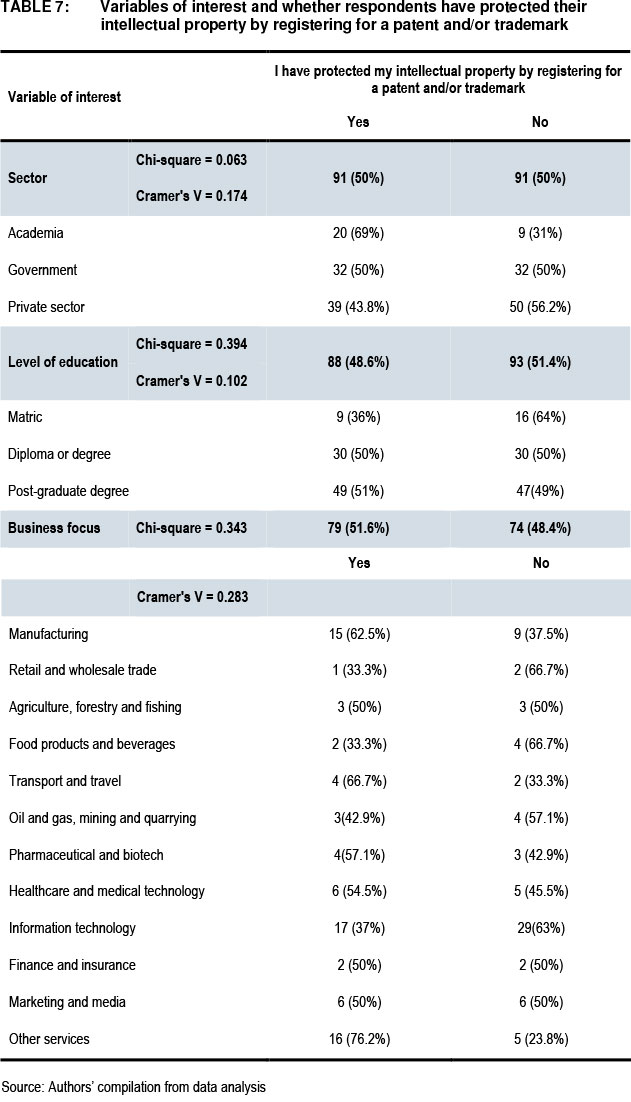
From Table 7 it is clear that the number of respondents across the three sectors (50%) who have registered for a patent and/or trademark are equal (50%) to the number of respondents who have not done so. Furthermore, close to half of the respondents (48.6%) regardless of their level of education protected their IP by registering for a patent and/or trademark. A slight majority of the respondents (51.6%) regardless of their business focus also protected their IP by registering for a patent and/or trademark.
The Chi-square test determined whether an association exists between these variables, resulting in no significant differences among respondents' sector (Chi-square=5.53; p=0.063), level of education (Chi-square=1.86; p=0.394) and business focus (Chi-square=12.28; p=0.343) regarding the protection of IP through patent and/or trademark registration.
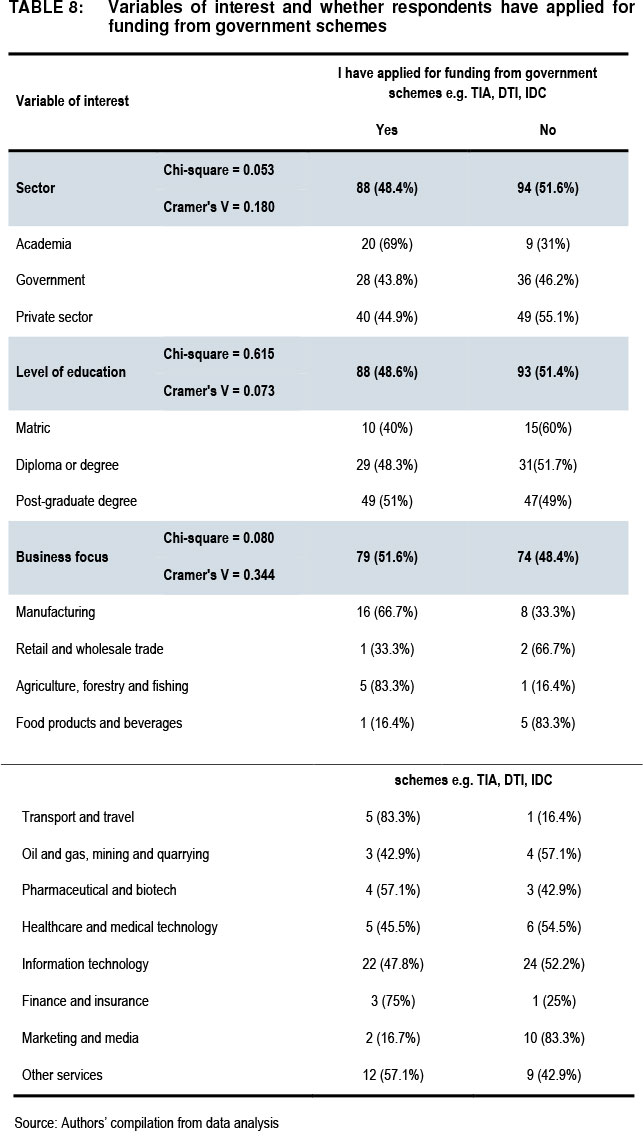
Table 8 shows that a slight majority (51.6%) of the respondents have applied for funding from government schemes, irrespective of their business focus while a slight majority of respondents regardless of their level of education (51.4%) and sector (51.6%) have not applied for funding from government schemes. The Chi-squared test indicated that there was no significant difference (Chi-square=5.89; p=0.053) between respondents' sector, level of education (Chi-square=0.97; p=0.615) and business focus (Chi-square=18.08; p=0.08) regarding whether they had applied for funding from government schemes.
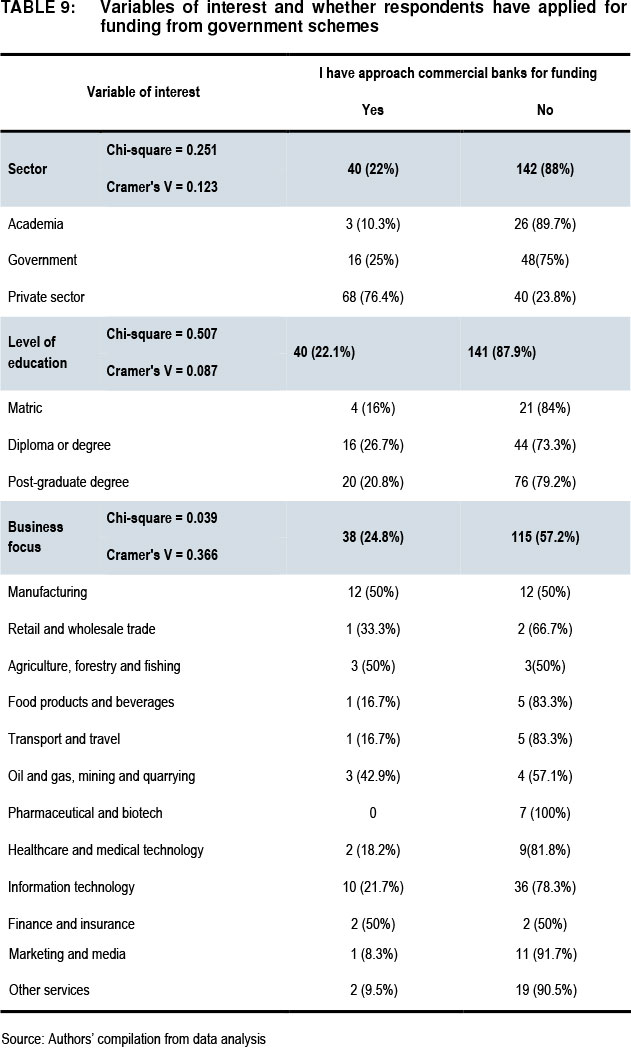
From Table 9 it is clear that a large majority of respondents regardless of sector (88%) and level of education (87.9%) had not approached commercial banks for funding. This tendency is also true regardless of the respondents1 business focus (57.2 %). No statistically significant differences existed amongst respondents' sector (Chi-square=2.76; p=0.25) and level of education (Chi-square=1.35; p=0.507) regarding whether they have approached commercial banks for funding or not. The Chi-squared statistic however revealed that there was a statistically significant association (Chi-square=20.49; p=0.039) between respondents business focus and whether they had approached commercial banks for funding. The Cramer's V value was 0.37 indicating a practical significance of medium strength (Field 2013:740).
Taken together, Tables 6, 7, 8 and 9 provide sufficient evidence for Hypothesis 2.
6. DISCUSSION
The results from exploratory factor analysis indicated that five factors: innovation, Open Innovation, idea-to-market, entrepreneurship and accelerating commercialisation could be used to measure Open Innovation platform users' perceptions. It was further established that the measurement scale used in this study was reliable and valid when it came to measuring the perceptions of Open Innovation platform users in South Africa.
The findings from this study support Kim, Kim & Yang (2009:154) view that private sector, academia and government play an important role in promoting total early-stage entrepreneurial activity through the innovation value chain. Across all three sectors, Open Innovation user's felt the most strongly about views relating to innovation and entrepreneurship. It was also established that respondents regardless of their level of education had similar views about the five extracted factors. Even though this was the case, a majority of respondents (n=96) had obtained a post-graduate degree. This finding is supported by Nielsen (2015:470) who found that entrepreneurs who had obtained a masters or PhD degree in a technical or non-technical field (such as the business focuses identified in this research) not only increase performance in innovation-driven industries but are likely to establish their first business in such industries.
Respondents with a post-graduate degree are anticipated to adapt to changing environments due to their higher absorptive and learning capacities (Nielsen & Sarasvathy 2011:22; Weick 1996:308). The results from this study also indicated that the respondents' business focus did not influence their perceptions on the five factors, particularly Open Innovation. These findings confirm the research conducted by Van De Vrande, De Jong, Vanhaverbeke and De Rochemont (2009:434) who emphasises the significance of Open Innovation across industries regardless of business focus and size.
Fostering commercialisation requires an expenditure of funds. Funding plays an imperative role in the success of new products within the innovation value chain (Smith 2006:27). However, it was established that a majority of respondents (90.5% and 76.8% respectively) regardless of their demographic profiles, had not received financial aid for their innovation from angel investors or commercial banks. Just close to half (47.9%) of the respondents had applied for funding from government agencies. These findings can be substantiated by previous research by the South African Treasury linking the scarcity of angel investments in South Africa to the investor having limited diversification of risks, limited systematic procedures for providing management support and not receiving any form of fiscal support in South Africa (Mazanai & Fatoki 2012:60). Unlike angel investors, commercial banks serve as debt-funders rather than equity-funders thus imposing particularly strict conditions on their investments (Barringer & Ireland 2016:325).
Finally, the results from this study indicated that regardless of sector, level of education and business focus, Open Innovation platform users that had protected their intellectual property by registering for a patent and/or trademark were equal to those who had not done so. This finding can be linked to the significant drop of South Africa's ranking in the Global Innovation Index (Gil) from 43rd in 2008 to 54th in 2016. The index captures elements of South Africa's economy that enable innovative activities and outputs; namely (1) Institutions, (2) Human capital and research, (3) Infrastructure, (4) Market sophistication, (5) Business sophistication, (6) Knowledge and technology outputs and (7) Creative outputs (Dutta, Lanvin & Wunsch-Vincent 2016:xviii). Despite this finding, South Africa in comparison with other Sub-Saharan countries has shown encouraging signs of increased innovation through IP registration.
7. RECOMMENDATIONS
Businesses should utilise the innovation value chain in accordance with their specific business functions and preferences. Demonstrating entrepreneurial behaviour throughout the innovation value chain is crucial regardless of any variations found in different businesses, industries and sectors. Businesses should therefore encourage entrepreneurship amongst managers and innovation departments (Gcaza& Urban 2015:24).
Businesses should consider three key supporting functions necessary for successfully accelerating commercialisation. The first is marketing: In order for the new product or service to succeed, the business should target a specific market develop a positioning strategy, build the brand by developing a marketing mix and lastly launching the new product or service into the market through rigorous campaigning, public relations and communication strategies that fit the identified target market (Lamb, Hair & McDaniel 2013:170).
Funding is the second supporting function. Businesses should consider bootstrapping as a mechanism to minimise the cost of resources throughout the early stages of the innovation value chain (Spinelli & Adams, 2016:248). Businesses should also consider government-funded schemes that have been designed to finance innovation. These schemes aim to develop new marketable technologies that have commercial feasibility. Businesses should not overlook the value of networking and referrals as they potentially provide access to angel investors. Angel investors are invaluable in the innovation value chain because of their willingness to make small investments into completely new products.
Intellectual property protection is the third supporting function needed to successfully commercialise new products or services. Businesses should conduct due diligence on new partners throughout all the phases in the innovation value chain. Further, businesses should understand the different phases of IP, the stakeholders that need to be involved to secure it and the value that the protection could bring.
8. LIMITATIONS AND FUTURE RESEARCH
This study used a non-probability purposive sample by surveying respondents in one Open Innovation Platform in South Africa, thereby limiting the representativeness of the results. It is suggested that future studies should consider investigating the readiness of South African businesses (regardless of their size, industry and business focus) to embrace Open Innovation as a core business strategy.
9. CONCLUSION
The objective of this article was mainly to report on the perceptions of Open Innovation by users of the OpenIX platform hosted by The Innovation Hub regarding taking ideas-to-market. This was accomplished by firstly determining the perceptions of and differences among respondents within various sectors, levels of education and business focuses regarding innovation, entrepreneurship, Open Innovation, idea-to-market and accelerating commercialisation. Secondly determining the association between accelerating commercialisation and the respondents' sector, level of education and business focus.
The findings reported in this article provide implications to both private and public sector. The study assists policy makers with making improved decisions about what is needed to encourage success in taking ideas to market and in essence promoting a total early-stage entrepreneurial activity. This study also helps inventors make better decisions in taking their ideas to market by enabling them to better understand the intricacies and complexities of what it takes to successfully take an idea to market.
REFERENCES
2. LITERATURE REVIEW
- BARRINGER BR & IRELAND DR. 2016. Entrepreneurship: successfully launching new ventures. 6nd ed. Upper Saddle River, NJ: Pearson Educational International.
- BESSANT J & TIDD J. 2011. Innovation and entrepreneurship. 2nd ed. West Sussex, UK: Wiley.
- BURNS AC & BUSH RF. 2014. Marketing research. 7th ed. Essex, UK: Pearson.
- BURNS RB & BURNS RA. 2009. Business research methods and statistics using SPSS. London, UK: Sage.
- BRAUNERHJELM P. 2010. Entrepreneurship, innovation and economic growth - past experience, current knowledge and policy implications. Stockholm, SWE: Centre of Excellence for Science and Innovation Studies, Royal Institute of Technology (Swedish Entrepreneurship Forum; Feb 2010) (Working paper No. 224.
- )
- CHAMINADE C & EDQUIST C. 2010. Rationales for public policy intervention in the innovation process: a systems of innovation approach, In Kuhlman S, Shapira Ρ & Smits R (eds), Innovation policy - theory and practice, London, UK: Edward Elgar, pp, 96-114,
- CHESBROUGH HW. 2003, Open Innovation: the new imperative for creating and profiting from technology, Boston, MA: Harvard Business School Publishing,
- CHURCHILL GA&IACOBUCCI D. 2010. Marketing research: methodological foundations. 10th ed. Mason, OH: Cengage Learning.
-
CUNNINGHAM S. 2012, The fundamentals of innovation system promotion for development practitioners, Pretoria, Mesopartners, [Mesopartner monograph 5, [Internet: http://www.mesopartner.com/fileadmin/user_ iles/books_monographs/MM05_Ed_3_edited_The_fundamentals_of_innovation_system_diagnosis_and_ promo tion_Comic_with_front_back_page.pdf; downloaded 2016-08-18.
» http://www.mesopartner.com/fileadmin/user_ iles/books_monographs/MM05_Ed_3_edited_The_fundamentals_of_innovation_system_diagnosis_and_ promo tion_Comic_with_front_back_page.pdf -
]
» https://wvvw.alexandria.unisg.ch/Publikationen/274 - DIENER Κ & PILLER F. 2013. The market for open innovation, The 2013 RWTH open innovation accelerator survey, 2nd ed, Raleigh, NC: Lulu Publishing,
- DRUCKER PF. 2011. The discipline of innovation. Harvard Business Review: the best of Harvard. Boston, MA: Harvard Business School Press.
-
DUTTA S, LANVIN Β & WUNSCH-VINCENT S. 2016. The Global innovation index 2016: winning with global innovation. [Internet: https://www.globalinnovationindex.org/userfiles/file/reportpdf/GII-2015-v5.pdf; downloaded on 2016-08-25.
» https://www.globalinnovationindex.org/userfiles/file/reportpdf/GII-2015-v5.pdf - ]
-
FAL M, SEFOLO T, WILLIAMS A, HERRINGTON M, GOLDBERG J & KLAASEN M. 2010, State of entrepreneurship in South Africa. [Internet: http://www.gibs.co.za/SiteResources/documents/The%20Entrepreneurial%20Dialogues%20-%20State%20of%20Entrepreneurship%20in%20South%20Africa.pdf; downloaded on 2016-03-13.
» http://www.gibs.co.za/SiteResources/documents/The%20Entrepreneurial%20Dialogues%20-%20State%20of%20Entrepreneurship%20in%20South%20Africa.pdf - ]
- FIELD A. 2013. Discovering statistics using IBM SPSS Statistics. 4lh ed. London, UK: Sage,
- GANOTAKIS P& LOVE JH. 2012. The innovation value chain in new technology-based firms: evidence from the UK. Journal of Product Innovation Management 29(5):839:860.
- GANS JS & STERN S. 2003, The product market and the market for ideas: commercialisation strategies for technology entrepreneurs. Research Policy 32:333-350.
- ]
- GCAZA W & URBAN B. 2015. Beyond the crisis: corporate entrepreneurship in the South African mining industry. Journal of Contemporary Management 12:30-39.
- HANSEN MT & BIRKINSHAW J. 2007. The innovation value chain. Boston, MA: Harvard Business School Press.
- HU L & BENTLER PM. 1999. Cut-off criteria for fit indexes in covariance structure analysis: conventional criteria versus new alternatives. Structural Equation Modelling: A Multidisciplinary Journal 6(1):1-55.
- JANSSEN W, BOUWMAN H, VAN BUUREN R & HAAKER T. 2014. An organisational competence model for innovation intermediaries. European Journal of Innovation Management 17(1 ):2-24.
- KIM Y, KIM W & YANG T. 2012. The effect of the triple helix system and habitat on regional entrepreneurship: empirical evidence from the U.S. Research Policy 41 (1):154-166.
- KURATKO DF. 2014. Introduction to entrepreneurship. 9th ed. Mason, OH: Cengage Learning.
- LAMB CW, HAIR JF & MCDANIEL CD. 2013. MKTG6. Mason, OH: Cengage Learning.
- LITWIN AS & PHAN PH. 2013. Quality over quantity: re-examining the link between entrepreneurship and job creation. Industrial & Labour Relations Review 66(4):833-873.
- MARAIS SJ & SCHUTTE CSL. 2010. The development of Open Innovation models to assist the innovation process. Stellenbosch: SU (Dissertation - Masters).
- MAZANAI M & FATOKI O. 2012. Access to finance in the SME sector: a South African perspective. Asian Journal of Business Management 4(1 ):58-67.
- MCDANIEL C & GATES R. 2013. Marketing research essentials. 8lh ed. West Sussex, UK: Wiley.
- MORTARA L, NAPP JJ, SLACIK I & MINSHALL Τ. 2010. Implementing Open Innovation (Ol): cultural issues. International Journal of Entrepreneurship and Innovation Management 11 (4):369-397.
- NIELSEN K. 2015. Human capital and new venture performance: The industry choice and performance of academic entrepreneurs. Journal of Technology Transfer 40(3):453-474.
- NIELSEN Κ & SARASVATHY SD. 2011. Passive and active learning from entrepreneurship: an empirical study of re-entry and survival. . Aalborg: DRUID Society. (Danish Research Unit of Industrial Dynamics) (Working Paper No. 11-12).
- SCHUMPETER JA. 1934. The theory of economic development: An inquiry into profits, capital, credit, interest, and the business cycle. New Brunswick, NJ: Transaction Publishers.
- SMITH D. 2006. Exploring innovation. New York, NY: McGraw-Hill.
- SPINELLI S & ADAMS RJ. 2016. New venture creation: entrepreneurship for the 21st Century. 10th ed. Singapore: McGraw Hill Education.
-
STIBEL J. 2009, Are You an inventor or an entrepreneur? Harvard Business Review blog network, [lnternet:http://blogs.hbr.org/2009/06/are-you-an-inventor-or-an-entrepreneur/; downloaded 2016-04-15.
» http://blogs.hbr.org/2009/06/are-you-an-inventor-or-an-entrepreneur/ - ]
- THEYEL N. 2013. Extending Open Innovation throughout the value chain by small and medium-sized manufacturers, International Small Business Journal 31 (3):256-274,
- TURTON Ν & HERRINGTON Μ. 2012. Global entrepreneurship monitor report. South African report 2012. Cape Town: UCT.
- URBANCOVÁ H. 2013, Competitive advantage achievement through innovation and knowledge, Journal of Competitiveness 5(1):82-95.
- VAN DE VRANDE V, DE JONG JPJ, VANHAVERBEKE W & DE ROCHEMONT M. 2009. Open innovation in SMEs: Trends, motives and management challenges. Technovation 29:423-437,
- VAN HEMERT P, NIJKAMP Ρ & MASUREL E. 2013. From innovation to commercialization through networks and agglomerations: analysis of sources of innovation, innovation capabilities and performance of Dutch SMEs. Annals of Regional Science 50(2):425-452.
- VON NELL PS & LICHTENTHALER U. 2011. The role of innovation intermediaries in the markets for technology. International Journal of Technology Intelligence and Planning 7(2):128-139.
- WEICK KE. 1996, Drop your tools: an allegory for organizational studies, Administrative Science Quarterly 41(2):301-313,
- WILLIAMS B, BROWN Τ & ONSMAN A. 2010. Exploratory factor analysis: a five-step guide for novices. Australasian Journal of Paramedicine 8(3):1-13.
- ZIKMUND WG & BABIN BJ. 2015. Essentials of marketing research. 6th ed. Mason, OH: Cengage learning.