An Industry perspective on the knowledge areas required from marketing graduates in South Africa
Abstract
There have been several studies on the requirements of marketing graduates in developed countries. It was noted that none of these studies considered the perspective of the marketing industry in emerging countries such as South Africa. The primary objective of this article is to identify the industry's perspective on the knowledge areas required from marketing graduates in South Africa. A quantitative research approach was used to gather empirical data from potential employers of marketing graduates to determine the most sought after knowledge areas as well as areas for improvement. Empirical data were collected through a web-based computer-assisted self-administered online questionnaire. Findings indicate that the top priority for practitioners is knowledge related to areas associated with strategic marketing and marketing context. Design-related knowledge was identified as a less critical area. The importance-performance gaps were the highest for product mix and line decisions, marketing communications, and strategic marketing. Suggestions for educators, employers and marketing students as well as some future research directives are provided.
Employability skills; employers; marketing skills and marketing graduates
1. INTRODUCTION
In 2019, South Africa's official unemployment rate was at 31.0%; this is the highest level observed since September 2003 (Statistics South Africa 2019:12121). The high unemployment rate among graduates remains a concern by the industry, as well as for higher education institutions (Coetzee & Engelbrecht 2019:1; Fongwa 2018:2). More than 600,000 tertiary graduates are struggling to find employment; and are thus unable to put into practice what they have learned (Sharp 2017:196). Recent research suggests that graduates' lack of relevant skills and insight, employers' perceptions regarding the institutions attended, and the differences in expectations from employers and graduates are amongst the main factors leading to graduate unemployment in South Africa (Burger & Fourie 2019:2; Graham, Williams & Chisoro 2019:360).
This article focuses on the expectations of employers in the South African marketing industry. The main objective is to offer an industry's perspective on the knowledge areas required of marketing graduates in South Africa. This study seeks to extend the work of international scholars who have examined a practitioner's view of marketing education (Cheng, Lourenco & Resnick 2016:495; Crittenden & Crittenden 2015:71; Finch, Nadeau & O'Reilley 2018:23; Martin & Echegaray 2019:107; McArthur, Kubacki, Pang & Alcaraz 2017:82; Schlee & Karns 2017:69; Wellman 2010:908; Wilson, McCabe & Smith 2018:52) in the South African context.
The needs and preferences of consumers ought to be comprehended by marketing professionals, in order for organisations to plan, according to the demand for their products (Kotler, Keller, Ang, Tan & Leong 2018:4). The demand factor then, in the view of Zancajo (2018:167), becomes the rules and guidelines for concrete action in the marketing field. The nature of the demand should guide the delivery of marketing professionals (Cheng et al. 2016:495; Wilson, McCabe & Smith 2018:52). The success of organisations relies on how well the needs of the different stakeholders are met (Khanna, Jacob & Yadav 2014:122). Higher education institutions do not function in isolation; but are influenced by a wide variety of stakeholders, just like companies aimed at a profit (Coetzee & Engelbrecht 2019:1).The focus of this article is on employers, who ultimately determine whether graduates are deemed as employable or not. By understanding the needs of stakeholders, such as employers, higher education can develop a marketing mix of activities that could lead to the satisfaction of both students and their employers (Khanna et al. 2014:122).
Despite several attempts at synchronisation between the demand and supply, there have been growing concerns regarding the gap between the expectations of employers and the preparedness of students graduating from higher education institutions (Jackson 2014:27; Mullen, Alexander & Coates 2019:569). Employers in the marketing industry claim that the marketing graduates often do not have the competencies required of them, when entering the working environment (McArthur et al. 2017:82).
The employability of marketing graduates seems to be a concern across the globe. Finch et al. (2018:23) conducted a study in Canada to assess whether higher education institutions are able to prepare students for employment. Most employers interviewed, claimed that well-prepared graduates are difficult to find. In the United Kingdom, an exploratory study conducted by Cheng et al. (2016:496), found that employers believe that marketing education lacks emphasis on the practical implementation thereof. It was suggested that educators should consider the industry requirements, as well as the interests of students when developing academic programmes. In Australia, McArthur et al. (2017:82) advocated that educators should meet the industries' needs by aligning the theoretical marketing knowledge with the relevant industry requirements, as well as developing the employability skills that are required in marketing related professions. Schlee and Karns (2017:79) conducted a content analysis of marketing-job advertisements for entry level marketing jobs in the United States of America. The results once again raised concerns about the purpose of a degree; and whether marketing curricula are suitable for this purpose.
2. PURPOSE
There have been several international studies on the requirements of marketing graduates entering the workplace (Crittenden & Crittenden 2015:75; Finch et al. 2018:23; Harrigan & Hulbert 2011:253; Martin & Echegaray 2019:107; McArthur et al. 2017:82; Shlee & Karns 2017:69; Wellman 2010:908). As stated previously, none of these studies considered the perspective of the marketing industry in emerging countries, such as South Africa. In addition, there seems to be a lack of consensus regarding the critical knowledge areas required from marketing graduates (Finch et al. 2018:24; Martin & Echegary 2019:107; Schlee & Karns 2017:69; Wellman 2010:290).
Some studies indicated that the top priority for practitioners is knowledge related to areas associated with measuring return-on-investment and strategic marketing (Finch et al. 2018:23; Martin & Echegary 2019:121). Others rank marketing communication and channel management as the most crucial conceptual knowledge areas (Harrigan & Hulbert 2011:254; Schlee & Karns 2017:70). Some practitioners expect new graduates to have a deep understanding of marketing contextual dynamics. On the other hand, others believe that the context of each company and industry is unique; and thus only be learned by new marketers when they are in the actual workplace (Finch et al. 2018:23). There seems to be no research, offering marketing practitioners' perspective in South Africa, it is unclear what their perceptions of knowledge are that would be most useful for future marketing managers.
Given the above context, the problem statement is summarised as follows: There is a disagreement in the international literature on the essential knowledge required from future marketers. There has been little research on the marketing practitioners' perspectives; it is unclear what the requirements are for new marketing graduates in South Africa, in order to be employable. It is therefore necessary to investigate this further, by offering an industry perspective on the marketing knowledge areas required of marketing graduates in South Africa.
3.1 Graduate employability
The term graduate employability has been interpreted in different ways. Scholars, such as Crisp and Oliver (2019:74), suggest that it should be interpreted by considering the two terms separately. This means that graduateness is the result of the knowledge and skills attained at higher education institutions; while employability refers to the ability to acquire employment after obtaining a qualification (Coetzee 2014:887). Smith, Hunter & Sobolewska (2019:1046) define the term employability of graduates as "a set of achievements, skills, understandings and personal attributes that make graduates more likely to gain employment and to be successful in their chosen occupations, which benefit themselves, the workforce, the community and the economy". Employability signifies the ability of graduates to gain employment and success in the workplace, thereby benefiting the organisation and society as a whole.
Irrespective of the differences in the interpretations of graduate employability, conceptual knowledge, as well as skills is regarded as essential for graduates, in order to obtain suitable employment (Mullen et al. 2019:569). Acquiring both skills and knowledge can assist the marketing graduate to obtain suitable employment and to succeed in the industry (Wellman 2010:908). The focus of this article is specifically on essential knowledge areas required by entry-level marketing graduates in South Africa.
3.2 Essential knowledge areas required from marketing graduates
Schlee and Karns (2017:81) define marketing knowledge as the theoretical background of the discipline of marketing; and this refers to the subject areas found in most marketing curricula. These include subject areas, such as personal selling, strategic marketing, sales management, as well as international marketing (Finch et al. 2018:25).
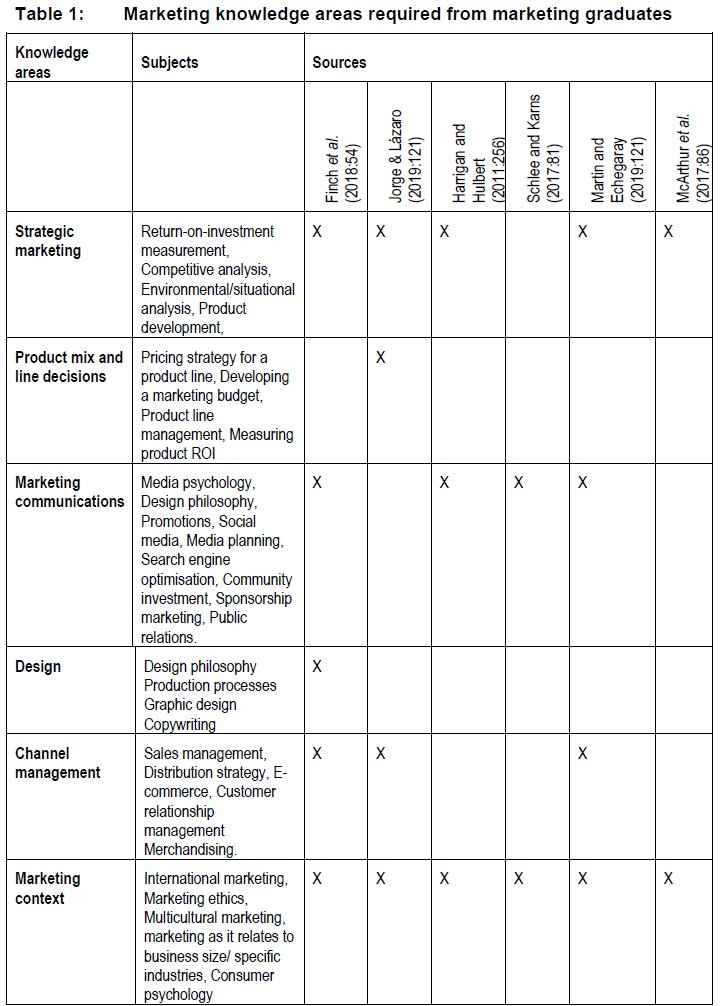
Table 1 summarises the subject areas identified in prominent studies on the knowledge required of marketing graduates in various countries, such as the United States of America, the United Kingdom, Australia, Spain, New Zealand and Canada (Finch et al. 2018:343; Gray, Ottesen, Bell, Chapman & Whitten 2007:272; Jorge & Lázaro 2019:107; Harrigan & Hulbert 2011:253; Martin & Echegary 2019:107; McArthur et al. 2017:86; Schlee & Karns 2017:81). It can also be seen that a list of diverse subject areas were considered as requirements in these studies. These subject areas can be grouped together in five knowledge areas.
1) Strategic marketing forms part of marketing planning that is aimed at differentiation from competitors and reaching company objectives, by capitalising on the strengths required to consistently provide superior value to the customers (Lamb, Hair, Mc Daniel, Boshoff, Terblanche, Elliot, Klopper 2015:4; Moriarty, Mitchel & Wells 2015:220).
2) Product mix and product line decisions entail the assessment and the management of the product mix of a company (Clow & Baack 2016:24).
3) Marketing communications involve the planning and integration of the different marketing communication tools used to communicate with stakeholders and customers (Clow & Baack 2016:25).
4) Design involves conceptualising, creating and the production of marketing to ensure an engaging experience for the intended audience (Oladumiye 2018:31).
5) Channel management is a part of the marketing strategy set-up to reach customers through co-ordinating, controlling and motivating channel members to sell and distribute their products (Kotler et al. 2018:342).
6) Marketing context refers to performing marketing activities in specific organisations based on the understanding of consumer behaviour, culture and unique needs (Kotler & Keller 2016:621; Schlee & Karns 2017:86).
3.2.1 Empirical studies of marketing knowledge areas for graduates
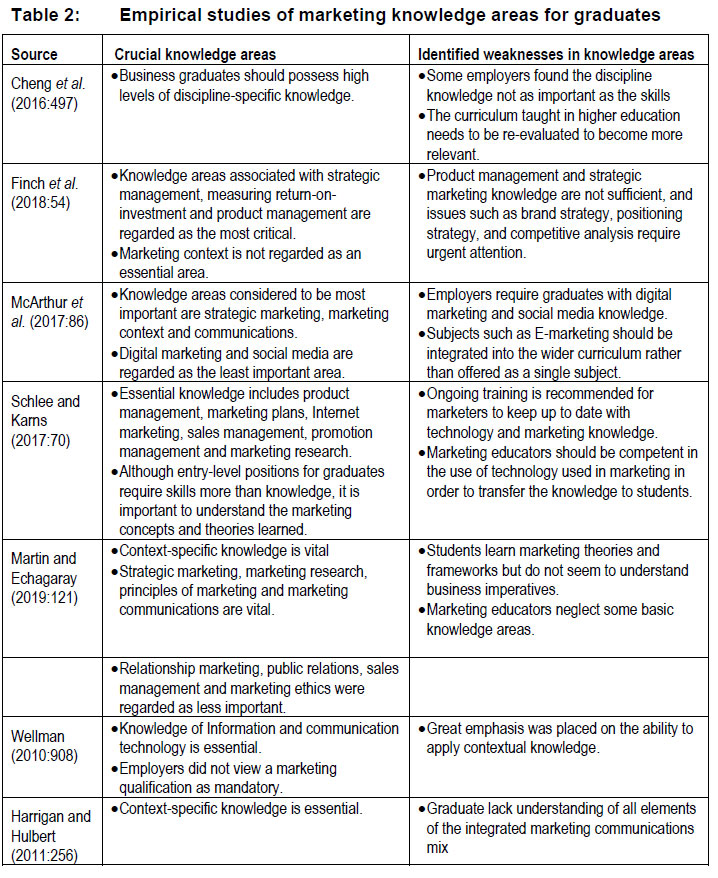
Table 2 summarises the findings of these studies regarding the critical knowledge areas expected from marketing students to acquire - before completing their studies. There is, however, a lack of consensus with regards to the most important knowledge areas. This may be due to the different specialist marketing areas (such as personal selling; digital marketing; marketing research; brand or product management) or a wide variety of positions, in which marketing graduates may be employed (Cheng et al. 2016:495; McArthur et al. 2017:86; Schlee & Karns 2017:69).
These studies were conducted in different countries across the world; and the syllabuses may vary in higher education institutions, from county to country. The current study aims to overcome this lack of understanding by focusing on the South African context.
Strategic marketing was regarded as the most critical marketing knowledge area in several of these studies (Harrigan & Hulbert 2011:256; Martin & Echagaray 2019:121). Employers surveyed across the globe also emphasised the significance of understanding marketing context in depth. This means that they expect graduates to understand their targeted consumers' behaviour, culture and unique needs (Cheng et al. 2016:495; Harrigan & Hulbert 2011:256; Schlee & Karns 2017:69).
4. HYPOTHESES
The literature revealed that the knowledge required of entry-level marketing graduates varies, notably across countries (Cheng et al. 2016:496; Finch et al. 2018; Martin & Echagaray 2019:121; McArthur 2017:86; Wellman 2010:912). This led to the development of the following hypotheses regarding the knowledge areas required from marketing graduates:
•
H1(0): There are no statistical significant differences between the perceived importance ratings of marketing knowledge areas.•
H1(a): There are statistically significant differences between the perceived importance ratings of marketing knowledge areas.•
H2(0): There are no statistically significant differences between the perceived performance ratings of marketing knowledge areas.•
H2(a): There are statistically significant differences between the perceived performance ratings of marketing knowledge areas.•
H3(0): There are no statistically significant differences between the importance and performance ratings for the marketing knowledge areas.•
H3(a): There are statistically significant differences between the importance and performance ratings for the marketing knowledge areas.5. METHODOLOGY
A descriptive research design was used to collect data via a survey from marketing employers in the South African industry. Judgemental sampling was applied as the sampling technique. With this method, the researchers apply their knowledge and experience to identify the most appropriate respondents that could best represent the population of interest (Malhorta 2010:98).
Judgemental sampling was also applied in similar studies, including members of the official marketing association, attendees of a marketing conference and professional networks (Finch, Nadeau & O'Reilley 2012:54). The target population of the current study consisted of marketing practitioners, who could offer their perspective on the employment requirements of marketing graduates in South Africa. Three lists of South African practitioners were used as a sample frame to represent the larger population of marketing practitioners in South Africa: the marketing association of South Africa (MASA); the recruiters of marketing graduates during the last three years; and the active members of the Marketing and Media sector of Bizcommunity in South Africa.
The lists were carefully screened to avoid duplication and to ensure that only one questionnaire was sent to each company. An online survey was then distributed to the most relevant person in each company. Usable questionnaires were received from 169 businesses, representing a 40.0% overall response rate. This is similar to previous international studies on this topic (Finch et al. 2012:54; Gray et al. 2007:271). The non-response bias and the representation of the population of interest were also considered. An assessment of early and late returns revealed no significant differences, signifying a reasonably low non-response bias as proposed by Van Selem and Jankowski (2006:435). The final sample obtained represented an adequate breadth of industrial marketing sectors, company size, and experience levels.
5.1 The research instrument
The research instrument utilised was adapted from Finch et al. (2012:67) for the South African context, based on the input of the marketing representatives of MASA and Bizcommunity. The structure of the questionnaire consisted of two sections. Section one dealt with firmographic; while section two requested employers' views regarding the importance and the performance of the knowledge areas of marketing graduates seeking employment. Dichotomous and multiple-choice questions were used for section one; while 7-point scales were used in section two of the instrument. The importance scale was anchored at (1) needs only a basic understanding; and (7) needs a deep comprehension. Similarly, the performance scale was anchored at (1) very weak and (7) very strong.
5.2 Validity and reliability
In order to meet content reliability, previous research studies were consulted to gain an understanding of the items, constructs and the methods (Finch et al. 2012:56; Martin & Echagaray 2019:121; Wellman 2010:908). Five experienced marketing professionals were nominated and requested to review the questionnaire. They were asked to complete the survey and to provide detailed feedback on the clarity of the questions, as well as the relevance of the items measured in each of the knowledge areas.
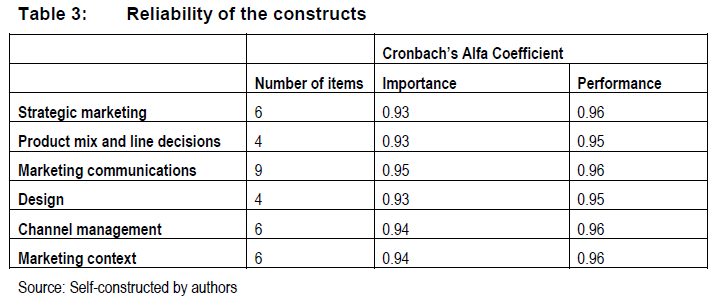
A pilot test was also conducted with ten employers to examine the reliability of the questionnaire. The data from the online survey were analysed, using the Cronbach's Alfa Coefficient, which calculates the internal consistency and the reliability coefficient of the scale. An alpha value of 0.70, or higher, was considered as acceptable (Pallant 2010:100). All of the alpha values reported in Table 3 are above 0.7; and they therefore support the notion of having acceptable levels of internal consistency in reliability for the various scales (Nunnally 1978).
In order to obtain content validity, previous research studies were consulted to gain background information on the theories and the methods of data collection. The research survey included a list of marketing knowledge areas similar to those in the other studies on this topic of education (Finch et al. 2018:56; Wellman 2010:911, 912; Schlee & Harich 2010:436). Selected employers and lecturers of marketing graduates reviewed the content to ensure face validity.
6. FINDINGS
6.1 Sample profile
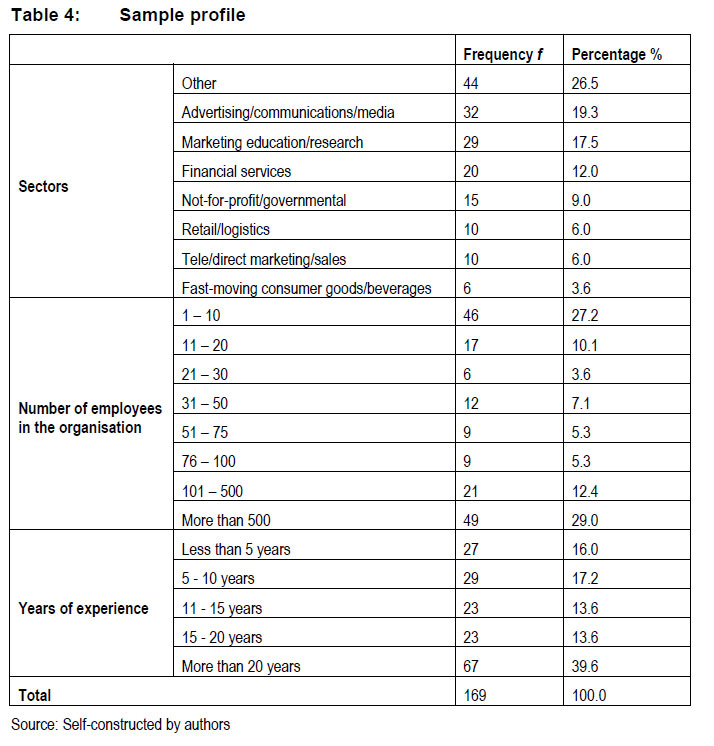
The sample profile is summarised in Table 4. The gender of the respondents in the survey demonstrated an almost equal proportional representation of both gender groups in the sample. The respondents obtained various levels of education,23.7% had completed a post-matric diploma; 28.4% had an undergraduate qualification; 17.8% had an Honours degree; 18.3% had a Master's degree; while 5.9% has a doctorate degree. It is not surprising that a high number of the respondents had obtained postgraduate qualifications; since the individuals on the list used were in managerial marketing positions and they have had extensive experience.
There were several respondents from different industrial sectors participating in the survey. From all the responses received most of the respondents (26.5%) indicated that they were employed in other categories, such as hospitality, real estate and smaller family businesses. This was followed by the advertising/ communications/media (19.3%), the marketing education/research (17.5%) and the financial services (12.0%) sectors.
The majority of the organisations who responded employed less than 100 people; while the rest were larger organisations of more than 500 employees (41.4%). Only a small portion of the respondents (16.0%) had less than five years working experience; while 44.4% have had five to 20 years of experience; and 39.6% had been employed for more than 20 years. The vast majority of the respondents (84.0%) had been employed for more than five years. Those with such high levels of industrial experience typically have an in-depth understanding of the requirements of those in marketing positions.
6.2 The importance of marketing knowledge areas
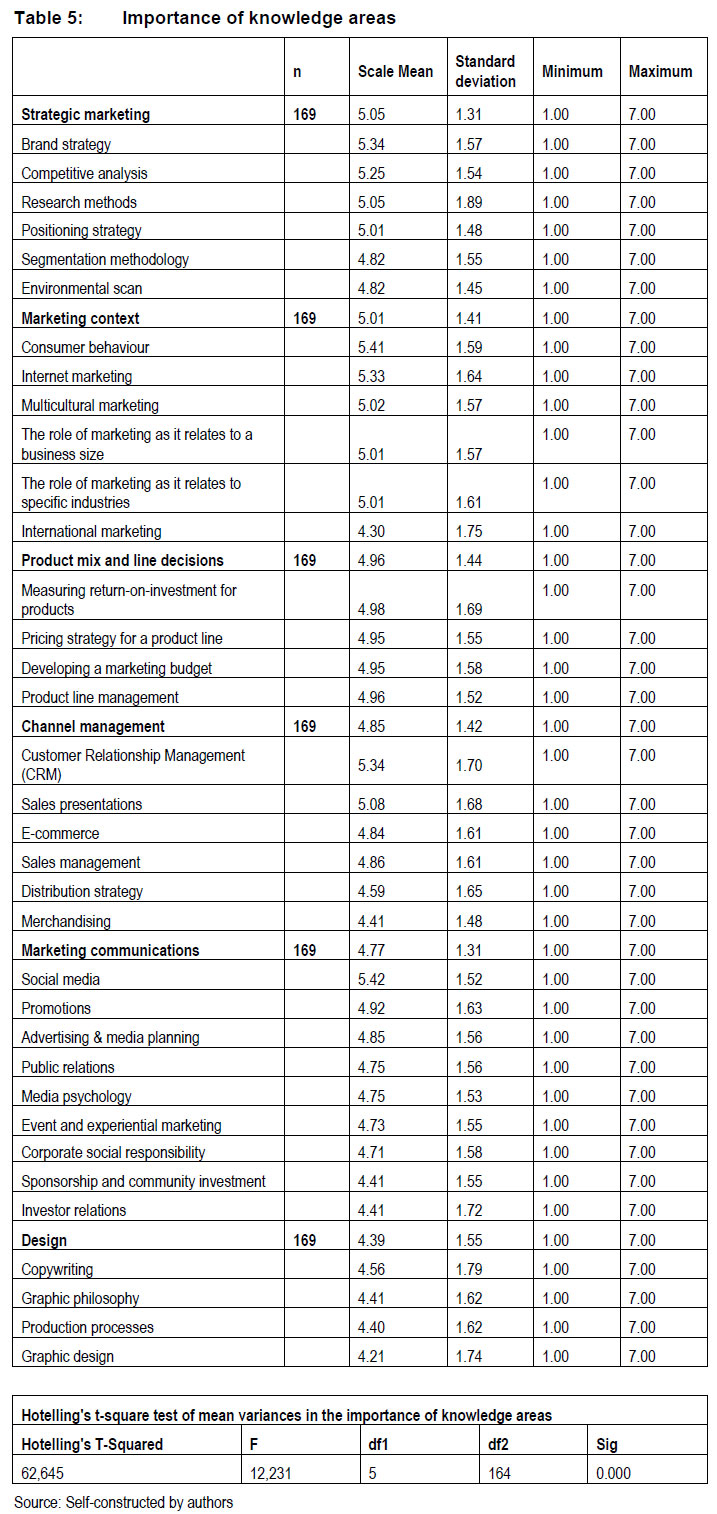
The importance of marketing knowledge areas is presented in Table 5 in increasing order. Overall, the relative high means indicate that the subjects were deemed as rather important by the employers. The two marketing subjects rated as the most critical were social media (M=5.42; SD=1.52) and consumer behaviour (M=5.41; SD=1.59). This was followed by brand strategy (M=5.34; SD=1.57), Internet marketing (M=5.33; SD=1.64) and customer relationship management (CRM) (M=5.34; SD=1.7). Graphic design (M=4.21; SD=1.74) and international marketing (M=4.30; SD=1.75) were rated as the least important subjects. The relatively high standard deviations for these subjects indicate that the respondents varied relatively in their opinions regarding the importance levels.
It can also be seen that employers perceived all six of the marketing knowledge areas as relatively important. Strategic marketing is rated as the most important marketing knowledge area (M=5.05; SD=1.31), thus marketing graduates must have a deep understanding of strategic marketing. Marketing context is rated as the second most important (M=5.01; SD=1.41), thereby implying that it is essential for marketing graduates to have a good understanding thereof. The knowledge area of design is rated lowest (M=4.39; SD=1.55).
The results from the Hotelling's T-squared test showed that there is indeed a significant difference (F (5,164) =12,231; p<0, 05). The null hypothesis H1(0) is therefore rejected in favour of the alternative H1(a), stating that there are statistically significant differences between the perceived importance ratings of the respective marketing knowledge areas.
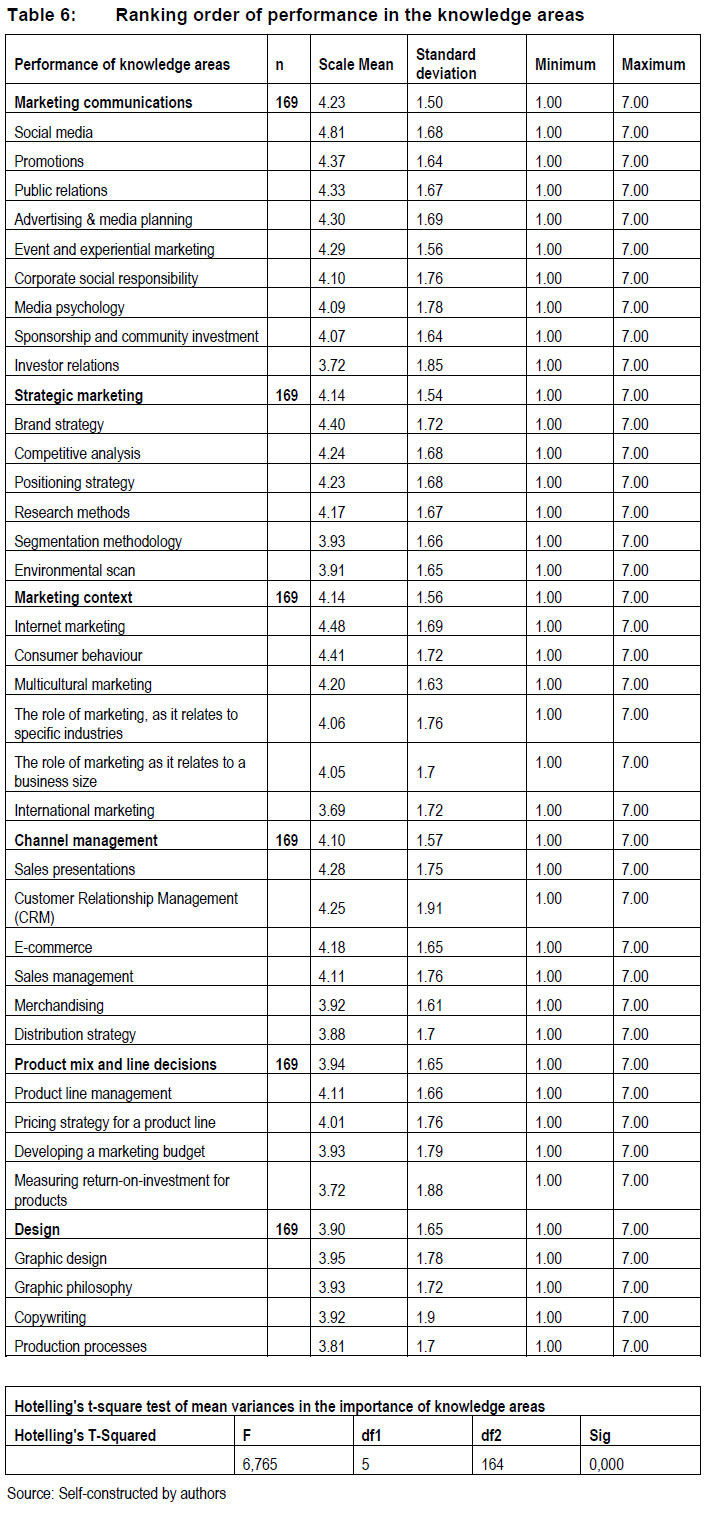
Table 6 shows the means ratings for the performance in the knowledge areas in increasing order and the Hotelling's T-squared test. It shows that the marketing subjects where the respondents rated best in terms of performance; and these areas included Internet marketing (M=4.48; SD= 1.69), consumer behaviour (M=4.41; SD= 1,72), social media, (M=4.81; SD=1.68) and brand strategy (M=4.40; SD=1.72). The perceived performance for international marketing (M=3.69; SD=1.72); was rated as the lowest. This was followed by measuring the return-on-investment for products (M=3.72; SD=1.88) and investor relations (M=3.72; SD=1.85). The comparatively high standard deviations for these items reveal diverse opinions regarding these items.
It can be seen that the employers find marketing graduates to have an adequate level of marketing communications (M=4.23; SD=1.50), strategic marketing (M=4.14; SD=1.54) and marketing context (M=4.14; SD=1.56). The design ratings were obtained with the lowest mean and the highest standard deviation (M=3.90; SD=1.65). The ratings for design imply that the respondents perceived marketing graduates' level of application of the design subject areas to be lower than those of the other ranked areas.
The results of the Hotelling's T-squared test indicate statistical significance, with the null hypothesis being rejected in favour of the alternative (F (5,164) =6,765; p<0, 05). In other words, the results indicate that five of the six mean ratings for the performance dimension differ statistically and significantly. Given the results from the Hotelling's T-squared test, the null hypothesis H2(0) is rejected in favour of the alternative H2(a).
6.3 Importance-Performance Gap Analysis
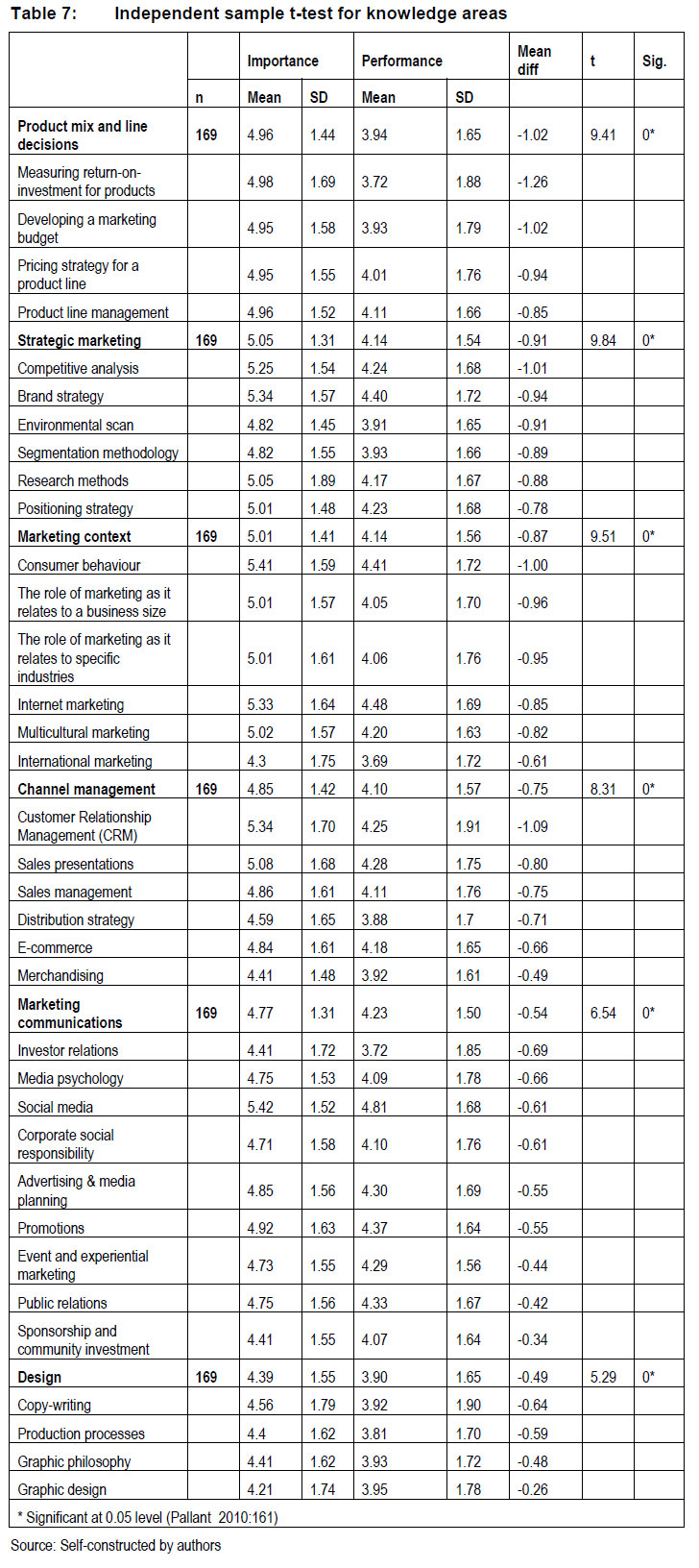
The Importance-Performance Gap Analysis results are presented in Table 7, in declining order, based on the gap between the importance and performance. This attention to the gap is vital; since it would provide educators' direction on those priority areas for improvement. It can be seen that neither the knowledge areas, nor the single item importance exceeded performance. This means that the employers' expectations were not met at all.
Product mix and line decisions. The importance-performance gap is largest in this area (Gap = -1.02). The individual items with the largest gap include measuring return-on-investment for products (Gap = -1.26) and developing a marketing budget (Gap = -1.02).
Strategic marketing. This area maintains the second largest gap (Gap = -0.91). This result can be explained in the light of the fact that it was the highest ranked in terms of importance. The individual item relating to competitive analysis maintained the widest gap of the individual items in this dimension (Gap = -1.01).
Marketing context. At the item level, the three items with the largest gap were consumer behaviour (Gap = -1.00), the role of marketing, as it relates to business size (Gap = 0.96), and the role of marketing as it relates to specific industries (Gap = 0.95).
Channel management. The importance-performance gap in channel management was relatively small (Gap = 0.75). Customer relationship management had the widest gap between importance and performance (Gap = 0.68). The importance-performance gap for customer relationship management, sales presentations, and sales management were observed to be large.
In terms of knowledge areas, the smallest gap was found for design (Gap = -0.49) and marketing communications (Gap = -0.54).
A series of paired t-tests were conducted to determine whether there are differences between the aggregate scores for each of the knowledge areas. The gap analysis shows that importance out-ranks performance in all six of the areas. The results indicate that there are statistically significant differences for the importance-performance means values. The respondents differed in their ratings of the importance-performance ratings of the knowledge areas. This means that the employers surveyed expected higher levels of comprehension compared to the perceived performance.
From the data analysed, the Hypotheses H3(a) were accepted; as there is a statistically significant difference between the importance and the performance ratings of the marketing knowledge areas. The null hypothesis H3(0) is therefore rejected in favour of the alternative H3(a), stating that there are statistically significant differences between the perceived importance and performance ratings of the respective marketing knowledge areas.
7. DISCUSSION
7.1 The importance of marketing knowledge areas
The findings reported significant differences in the importance ratings of marketing knowledge areas. The respondents rated strategic marketing, as the most critical knowledge area. This supports the results of international empirical studies (Harrigan & Hulbert 2011:253; Martin & Echegaray 2019:121; McArthur et al. 2017:86). The consistency of these findings suggest that employers consider strategic marketing to be critically important in other countries, as well as in the South African context. Strategic marketing can be considered important for entry-level marketing graduates; since they are expected to have knowledge of products, services and marketing activities adopted by the organisation (Martin & Echegaray 2019:125). Marketing graduates in South Africa may be employed as marketing assistants to functional specialists; this role would require the graduates to participate in tasks, such as marketing research, product-management strategies and brand strategies.
The relatively high rating of the marketing context is consistent with previous research findings (Finch et al. 2018:25; Harrigan & Hulbert 2011:253; Martin & Echegaray 2019:108; McArthur et al. 2017:120). Marketing graduates should consequently be knowledgeable about the role of marketing in the organisation, consumer behaviour, ethics and multicultural marketing. South Africa is a nation with diverse cultures and languages. This makes the marketing environment unique to other countries. South African marketing graduates can add substantial value to the organisation; if they comprehend the different marketing activities that an organisation has to implement, in order to satisfy their targeted customers' needs. In addition, newly employed marketers should ensure that they understand the organisations' customers - in terms of diversity, language and culture.
Marketing graduates should thus be informed about ethical behaviour, and the need to adhere to the relevant business culture and customers' expectations. This means that the marketing graduates should be able to understand the different cultures in South Africa and to conduct themselves in a manner that would be ethical, rather than offensive to the organisation and its customers. For example, this may include talking to colleagues and customers in a formal manner, dressing according to the organisational restrictions; and not offering bribes to gain accounts.
The design dimension was rated as the least important in the current study. The lower ratings observed in the design dimension were also observed in the findings by Finch et al. (2018:28). This may imply that organisations do not require marketing graduates to perform specialised design skills; and they might rather opt to outsource design services, such as graphic designers instead.
7.2 Performance of marketing knowledge areas
The findings showed a significant difference in five of the performance ratings of marketing knowledge areas. The respondents rated the marketing graduates, as performing the highest in strategic marketing; while design was rated as the lowest in the performance category. The marketing graduates may show understanding in the area of strategic marketing; as this subject seems to be a focal point in marketing education in South Africa. The marketing textbooks used in higher education institutions in South Africa go into great detail on areas, such as competitive analysis, product development, pricing strategy, positioning, segmentation and research methods (Clow & Baack 2016:392; Kotler et al. 2018:261; Lamb et al. 2015:387; Moriarty et al. 2015:35).
Marketing students are taught and tested on these topics throughout their marketing education. As such, the high ratings in the understanding and the application of this marketing knowledge suggest that marketing graduates in South Africa are better prepared in this knowledge area. These results contradict the findings of empirical international studies such as those of Finch et al. (2018:23) and Mc Authur et al. (2014:497) who found that marketing graduates struggle with areas of strategic marketing; and they need further training to apply the knowledge.
The design knowledge area was rated lowest in the performance category, aligned with the findings by Finch et al. (2018:24). The low performance in the design category informs the study that marketing graduates in South Africa, as well as other countries, do not have sufficient understanding of the design category. It has to be interpreted bearing in mind that design area was rated as the least overall important knowledge area by the respondents in this study.
7.3 Importance-Performance Gap Analysis
The findings reported on significant importance-performance gaps that exist with regard to all six knowledge areas. These findings suggest that practitioners observe shortcomings across all of the areas, namely: strategic marketing, marketing context, product mix and line decisions, channel management, marketing communications and design. The importance-performance gap clearly indicates that marketing employers require graduates who are more knowledgeable in marketing subject areas when entering the workplace.
The priority knowledge areas for improvement included product mix and line decisions, strategic marketing, and marketing context. The large importance-performance gap in marketing communication can be attributed to the insufficient product knowledge. If the marketing graduates are limited in product knowledge; this can transcend the gap observed in communicating the product value. This includes all aspects of the integrated marketing communications, such as promotional methods, advertising, social media and public relations. These findings support those by Martin and Echerary (2019:121), who reported the need for improvement in these areas.
The design area ratings are consistent with the findings of Finch et al. (2018:24), who reported a small gap in this importance and performance area. The design area was rated as the least-important area; and it reported the smallest gap. These results suggest that the respondents did not place great value on this category; and they do not place much emphasis on the need for marketing graduates to apply it in marketing jobs. These findings might change in the near future - with the increasing demand for competencies in digital marketing, such as web-page design; hypertext writing or editing; and programming page interactivity (Anderson & Lees 2017:129; McArthur et al. 2017:82).
8. RECOMMENDATIONS
The findings also suggest that there is a "disconnect" between the output of academics, in the form of graduates of marketing teaching, and the views of employers. Unfortunately, the response rate in each industry category was not large enough to allow statistical comparison across industrial sectors. This research focused only on the perception of the employers of marketing graduates; and it did not obtain the viewpoint of other stakeholders in higher education.
The target population of the study, marketing practitioners, may have goals and perspectives that differ from those of students' university staff, parents and local community regarding the particular objectives of an undergraduate marketing qualification.
The limitations identified offer an opportunity for improvement in future research. Firstly, researchers are advised to explore qualitative aspects via in-depth interviews and focus groups with employers, professional bodies and early-career marketers, together with academic institutions to identify experiences and best practice in relation to incorporating, building and assessing the marketing curricula. Secondly, higher education institutions do not function in isolation; but they are influenced by a wide variety of stakeholders. Future research should therefore also investigate the perspective of different stakeholder groups, including students, academics, advisory boards, professional bodies and local communities. Comparing the views of different marketing education stakeholders would allow researchers to assess both the relevance of marketing education and its effectiveness. Thirdly, future researchers are advised to explore the re-curriculation of marketing qualifications to determine the effectiveness and possible areas for improvement.
9. PRACTICAL IMPLICATIONS
9.1
Recommendations for higher education institutionsEducators at higher education institutions should liaise with organisations in the marketing industry, in order to keep up to date with the latest trends and requirements. They should involve employers and offer them ample opportunity to contribute to curriculum development and design.
Graduates should be better prepared for their first job, with a reasonably strong theoretical knowledge of the principles and frameworks. Significant effort should thus be made to fill the largest importance-performance gaps in area such as product mix and line decisions, strategic marketing and marketing context. Developing a strategic, evidence-based marketer, who possesses the ability to plan and execute the basics of a marketing strategy such as product and brand strategies, competitive and market analysis, marketing research, positioning and segmentation strategy, could surely not be taught in the classrooms only. The ways in which subjects are taught should deliver a greater appreciation of the importance of essential knowledge areas; and motivate students to gain a better understanding.
Educators can empower marketing students by working closely with the specialists in different marketing areas. Project-based learning could assist marketing students to understand how the theory learned is practised in the industry. They might also aid marketing students in deciding on a marketing speciality, on which they would like to focus.
Finding work and experience should not be the responsibility of higher education institutions alone. Students should be advised to gain work experience in any 'setting' during the course of their studies; because it provides evidence that they are willing to work hard to achieve their goals; and they are able to balance employment and study.
9.2
Recommendations for employers of graduatesMarketing employers are advised to be more proactive in closing the knowledge gaps. Liaising with marketing educators in developing a programme that would develop employable graduates could contribute in this regard. Marketing students could, for example, be tasked with projects from different companies that would allow them to apply theory; and to gain insight into how their education could play a significant role in the workplace.
Employers are recommended to engage with higher education institutions on an annual basis, to inform them of the changing needs of the industry. For example, technological advances have changed the methods of communication in which organisations communicate with their clients. Marketing graduates are increasingly expected to be updated, and to possess the ability to create valuable content on social media and other digital platforms.
10. CONCLUSION
This article contributes to the marketing discipline and higher education in emerging countries; since it is aimed at providing an insight into the perspectives of the South African industry regarding knowledge areas required from marketing graduates. The findings can guide educators at the tertiary level to focus on specific knowledge areas in order to better prepare graduates when entering the industry.
REFERENCES
3. LITERATURE REVIEW
- ANDERSON D & LEES R. 2017. Marketing education and the employability challenge. Journal of Strategic Marketing 25(2):128-137.
- BURGER P & FOURIE F. 2019. The unemployed and the formal and informal sectors in South Africa: A macroeconomic analysis. South African Journal of Economic and Management Sciences 22(1):1-12.
- CHENG R, LOURENC F & RESNICK S. 2016. Educating graduates for marketing in SMEs: An update for the traditional marketing curriculum. Journal of Small Business and Enterprise Development 23(2):495-513.
- CLOW KE & BAACK D. 2016. Integrated advertising, promotion, and marketing communications. 7th ed. Harlow: Essex Pearson education.
- COETZEE M & ENGELBRECHT L. 2019. How employability attributes mediate the link between knowledge workers' career adaptation concerns and their self-perceived employability. Psychological Reports 0(0)1-22.
- COETZEE M. 2014. Measuring student graduateness: Reliability and construct validity of the graduate skills and attributes scale. Higher Education Research & Development 33(5):887-902.
-
CRISP G & OLIVER B. 2019. Re-imagining Graduate Achievement and Employability. In Re-imagining Graduate Achievement and Employability. Leiden, The Netherlands: Brill | Sense. [Internet: https://brill.com/view/book/edcoll/9789004400832/BP000015.xml; downloaded ; downloaded on 02 August 2019]. (DOI: doi.org/10.1163/9789004400832_006.
» https://brill.com/view/book/edcoll/9789004400832/BP000015.xml - )
- CRITTENDEN VL & CRITTENDEN WF. 2015. Digital and social-media marketing in business education: implications for the marketing curriculum. Journal of Marketing Education 37(2):71-75.
- FINCH D, NADEAU J & O'REILLEY N. 2012. The future of marketing education: a practitioner's perspective. Journal of Marketing Education 35(1):54-67.
- FINCH D, NADEAU J & O'REILLY N. 2018. A survey of undergraduate marketing programs: An empirical analysis of knowledge areas and metaskills. Journal of Education for Business 93(2):23-32.
- FONGWA S. 2018. Towards an expanded discourse on graduate outcomes in South Africa. Education as Change 22(3):1-23.
- GRAHAM L, WILLIAMS L & CHISORO C. 2019. Barriers to the labour market for unemployed graduates in South Africa. Journal of Education and Work 32(4):360-376.
- GRAY BJ, OTTESEN GG, BELL J, CHAPMAN C & WHITEN J. 2007. What are the essential capabilities of marketers? A comparative study of managers. Marketing Intelligence and Planning 25(3):271-295.
- JACKSON TW. 2014. Marketing High Performance Professional Skills: A Case Study Of How An American University Teaches Employability Skills. Journal of Innovative Education Strategies 3(1):27-42.
- JORGE GM & LÁZARO E. 2019. Marketing Graduate Job Profiles in the Spanish Mass Consumer Market: A Content Analysis of Job Listings on the Internet. Esic Market Economics and Business Journal 50(1):107-129.
- KHANNA M, JACOB I & YADAV N. 2014. Identifying and analyzing touchpoints for building a higher education brand. Journal of Marketing for Higher Education 24(1):122-143.
- KOTLER P & KELLER KL. 2016. Marketing management. 19th ed. New Jersey : Pearson Education.
- KOTLER P, KELLER KL, ANG SH, TAN CT & LEONG SM. 2018. Marketing management: an Asian perspective. Singapore: Pearson.
- LAMB CW, HAIR JF, MC DANIEL C, BOSHOFF C, TERBLANCHE N, ELLIOT R, KLOPPER HB. 2015. Marketing. 5th ed. Cape Town, Southern Africa: Oxford University Press.
- MALHORTA NK. 2010. Marketing research, an applied orientation. New Jersey: Pearson Education.
- MARTÍN JG & ECHEGARAY L. 2019. What competencies and skills should marketing professionals possess? An exploratory approach from a professional and academic perspective. Esic Market Economics and Business Journal 50(1)107-129
- McARTHUR E, KUBACKI K, PANG B & ALCARAZ C. 2017. The Employers' View of "Work-Ready" Graduates: A Study of Advertisements for Marketing Jobs in Australia. Journal of Marketing Education 39(2):82-93.
- MORIARTY S, MITCHELL N & WELLS W. 2015. Advertising & IMC: Principles and practice. 3rd ed. United States: Pearson Education.
- MULLEN E, ALEXANDER J & COATES N. 2019. 'Think about what our industry stands for....': exploring the impact of external factors on line manager perceptions of graduate employability. Journal of Higher Education Policy and Management (5):569-581
- NUNNALLY JC. 1978. Psychometric theory. 2nd ed. New York: McGraw-Hill.
- OLADUMIYE EB. 2018. Graphic Design Theory Research and Application in Packaging Technology. Art and Design Review 6(1):29-42.
- PALLANT J. 2010. SPSS survival manual: A step by step guide to data analysis using SPSS. McGraw-Hill International: Crows Nest NSW.
- SCHLEE RP & HARICH KR. 2010. Knowledge and skill requirements for marketing jobs in the 21st century. Journal of Marketing Education 32(3):341-352.
- SCHLEE RP & KARNS GL. 2017. Job requirements for marketing graduates: Are there differences in the knowledge, skills, and personal attributes needed for different salary levels? Journal of Marketing Education 39(2):69-81.
-
SHARP S. 2017. SA's graduate labour market-trends and issues. [Internet:http://www.bizcommunity.com/Article/196/722/157320.html; downloaded on 02 February 2017.
» http://www.bizcommunity.com/Article/196/722/157320.html - ]
- SMITH S, HUNTER D & SOBOLEWSKA E. 2019. Getting in, getting on: fragility in student and graduate identity. Higher Education Research & Development 38(5):1046-1060.
-
STATISTICS SOUTH AFRICA. 2019. Quarterly Labour Force Survey-QLFS Q1:2019. [Internet:http://www.statssa.gov.za/?p=12121; downloaded on 01 August 2019.
» http://www.statssa.gov.za/?p=12121 - ]
- VAN SELEM M & JANKOWSKI NW. 2006. Conducting online surveys. Quality and quantity: International Journal of Methodology 40(3):435-456.
- WELLMAN N. 2010. The employability attributes required of new marketing graduates. Marketing Intelligence & Planning 28(7):908-930.
- WILSON EJ, MCCABE C & SMITH RS. 2018. Curriculum innovation for marketing analytics. Marketing Education Review 28(1):52-66.
- ZANCAJO A. 2018. Educational providers in the marketplace: Schools' marketing responses in Chile. International Journal of Educational Research 88:166-176.