Business Management students' application of deep and surface learning
Abstract
The learning environments created in higher education institutions (HEI) are to a large extent not empowering students to meet demands of the workplace. Business management students who are only exposed to direct teaching environments are more prone to receive surface learning only than deep learning and will not develop the much needed skills such as critical and creative thinking, problem solving, communication and teamwork to function effectively in the work environment, unless they experience deep learning. The purpose of the study was to measure male and female business management students' approach to learning in three different business-related courses. A non-probability, convenience sampling method was used to gather data from 323 final-year business management students at the North-West University in Potchefstroom. The results indicate that students make use of both deep and surface learning approaches depending on the situation, but upon categorisation of the scores into low, moderate and high groupings it was found that a slight majority of the students chose to follow the deep approach to learning, with females being more inclined to follow this tendency. It is recommended that universities' learning environments be adapted so as to advance deep learning and hence accommodate the needs of future working environments.
Business management students; deep and surface learning approach; Higher Education Institutions; learning environment
1. INTRODUCTION
In recent years the pressure from the private sector in South Africa to provide work-ready business management graduates has highlighted the need for higher education institutions (HEIs) to deliver not only technically skilled graduates, but also graduates with the ability to learn after they have secured employment (Henrico 2012:9452). Paadi (2014:130) is of the opinion that employers value graduates who are willing to learn more so, especially if they display this skill early in their careers. According to Brewer (2013:5) HEI's need to focus on students' capacity and approach to learning, and not only technical skills needs, since advances in the ever changing business environment may occur before curricula can adapt.
In this regard Turner and Baskerville (2011:1) believe that students need to be encourage to develop a deep learning approach, rather than surface learning, so that they develop skills such as critical thinking, creative thinking, problem solving, communication and teamwork. Being deep learners will not only contribute positively to their ability to function effectively in the work environment, but also motivate them, to become lifelong learners.
If students at undergraduate level are mainly exposed to learning environments which encourage a surface learning approach, students will be seeking to reproduce course material and memorise isolated facts with minimal understanding thereof (Golightly & Raath 2015:59).
However, students are not classified as being only deep or surface learners, but from their interpretation of the learning environment they adopt the approach that they perceive useful in assisting them to meet the demands of the lecturers and the course (Christie, 2015:246). Therefor, learning environments in business management need to be created in accordance with the requirements of the working environment and the expected outcomes of students' performance.
2. PROBLEM STATEMENT
Many observers of higher education have criticised the occurrence of approaches to surface learning that are increasingly vocationally focused - an issue predominantly true for business education (Borredon, Deffayet, Baker & Kolb 2011:4). Business management programs are known to have relied heavily on traditional information transfer globally to deliver authoritative scientific knowledge through lecture-based classes (Borredon, Deffayet, Baker & Kolb 2011:4).
In recent years the traditional transfer of subject matter in business management programs has become a contentious issue which, according to several researchers, is not an effective pedagogical approach to ensure that deep learning will occur (Baeten, Dochy, Struyven, Parmentier & Vanderbruggen 2016:46; Vos, Van der Meijden & Denessen 2011:128).
For the private sector, newly graduated students need basic cognitive skills such as problem solving, creative thinking and analytical thinking when they enter the working environment, which are enhanced by a deep approach to learning. It is therefor necessary for business management educators to know what learning approach is prevailing among their students in order to adapt the learning environment towards the encouragement of a deep learning approach.
3. RESEARCH AIM AND OBJECTIVES
The primary objective of this research was to measure business management students' application of learning approaches in three different business-related courses in their final year.
From this primary objective, secondary objectives were to:
■ assess the extent to which deep and surface learning are applied by the final-year business management students in their studies;
■ determine the association between gender and deep learning as well as surface learning application; and
■ establish the association between course registered for and deep learning as well as surface learning application.
HEIs have the obligation to develop students as lifelong learners and are challenged to implement it as one of their core activities by educating them to be competent workers in practice (De Viron & Davies 2014:41). By implication, HEIs should empower students to be critical, to develop new ideas, and to solve problems in familiar as well as unfamiliar contexts. According to Van Staden (2012:26), such a focus by HEIs will enable students to become deep learners in all subjects of interest and not only those they enjoy or where lecturers are creative and expect higher levels of performance.
4.1 Deep learning and surface learning
Piaget (1975:39-41) and McNally (1977:10) made the classical statements that the act of learning occurs when learners adapt to the learning environment and capture new information into cognitive structures. According to these researchers the methods of and motivation for learning depend to a large degree on the learning environments students are exposed to. Despite Piaget and McNally's extensive research on learning, a myriad of research on deep and surface learning approaches has stemmed from research on learning over the last four decades (Biggs 1999; Entwistle 2000; Marton & Saljo 1976; Postareff, Párpala & Lindblom-Ylänne 2015; Smyth, Mavor, Platow, Grace & Reynolds 2015; Varunki, Katajavuori & Postareff 2015; Warburton 2003).
Research on deep and surface learning has had a significant influence on HEIs in terms of progress in the way classes are presented as well as how students learn. In the last two decades research has focused extensively on the much needed changes in the pedagogical approaches of educators in HEIs to progress from only the transfer of facts to the active involvement of the students in all aspects of learning. The main motivation for this progress was the notion that students adapt their learning styles according to the situation in which they find themselves at a specific time (Marek, Karwowski, Frankowicz, Kantola & Zgaga 2015:708). A student's approach to learning describes how a student studies when engaging in the learning process and specifically what encourages him/her to adopt a specific way of learning (Mosca, Makkink & Stein 2015:55).
The epistemological level or conception of learning students have reached, substantially affects the manner in which they approach everyday academic tasks. Some students have a thorough understanding of what and how to learn, while others rely on 'question-spotting' where they learn only those pieces of information they expect to recall during assessments.
This basic distinction produces a descriptive concept within two contrasting categories in which a specific intention brings into play the learning process which leads to qualitatively differing learning outcomes, causing deep and surface approaches to learning (Sadi & Dagyar 2015:1067).
Students that follow a surface learning approach are more prone to the acceptance and memorization of isolated facts. They are only able to recall information they have learned without an understanding thereof in the short term, mainly for assessment purposes (Ward & Roden 2016:170). Ingleby, Oliver and Winstone (2014:79-80) point out that these students will occasionally focus on social interactions through team conversations and debates. However, their main focus is on facts, data, concepts and information that can be memorised and applied.
As the most recognised researchers on deep and surface learning, Biggs and Rihn (1984:281) explain that surface learning students see tasks as unrelated standing items they need to complete to achieve a specific goal, usually to pass the subject. They do not focus on the interrelatedness of the tasks and they are more concerned about the completion time of the task than the actual learning gain. Surface learning students will often learn mnemonically and avoid personal or other meanings the task may have.
Deep learning students' approach to learning, on the other hand, is more intrinsically motivated, integrated, reflective, and complex (Sadi & Dagyar 2015:1067). These students use higher-order cognitive skills such as the ability to analyse, synthesize, solving problems and meta-cognitive skills to construct long-term understanding. It involves the critical analysis of new ideas, integrating them into already known concepts and principles, so that this understanding can be used for problem solving in new, unfamiliar contexts. Deep learning also has a sustained, substantial, and positive influence on the manner in which students act, think or feel (Hermida 2015:17).
Ball and Harrison (2015:92) maintain that deep learning students' learning approach stems from intensive practice and experience. In following a deep learning approach there is a movement from specialization to integration which enables these students to understand the world around them. Deep learners reflect on the personal significance of what they are learning and although they are autonomous in the way they are able to motivate themselves to learn, they are also collaborative learners, with high meta-cognitive and learning skills (Hermida 2015:35-36).
Since business management students need to understand the functioning of the business environment and business operations to function effectively in the working environment after graduation, they need to be able to integrate various aspects of business operations to fully understand the manner in which businesses function in the business environments. Therefore it is argued in this article that students should be encouraged to become deep learners.
4.2 Promoting deep learning
According to Ganda, Ngwakwe and Ambe (2014:77), influencing students' approach towards deep learning is a complex process. These authors also argue that it is not possible to induce students to adopt a deep learning approach by merely telling them that it is required.
Although lecturers cannot dictate the learning approaches of students, they might persuade students to follow a deep learning approach by the manner in which the learning environments are created and the students are encouraged to learn. In this regard lecturers can facilitate and encourage deep learning in the classroom by using a variety of teaching methods, such as the application of business related activities or solving contemporary real-life business problems (Blessinger& Carfora 2015:141).
Business management lecturers who are able to encourage a deep learning approach in their students will likely observe their students as being of the intention to understand the course material by using strategies such as reading more widely about the subject, the use of a wide variety of sources and a heightened involvement in business-specific discussions (Millis 2010:1).
To ensure the ideal deep learning approach, Hermida (2015:28-29) suggests that business management lecturers create learning environments where students take responsibility for their own learning by completing tasks in a social context. Henrico (2014:684) also highlights the merit of this approach and states that in these environments business management lecturers should fulfil the role of facilitator rather than teacher so that the students are guided to enhance their critical and creative thinking as well as their problem solving skills; hence deep learning.
5. RESEARCH METHODOLOGY
5.1
Research design, target population and samplingA quantitative, descriptive research design (Burns & Bush 2014:103) was used in this study to investigate business management students' application of learning approaches. The quantitative research method was chosen because it is an economical and practical way of assessing group opinions by means of a questionnaire which for this study was distributed by hand (Delport & Roestenburg 2011:188).
The target population was final-year business management students at the North-West University: Potchefstroom Campus. A non-probability, convenience sampling method was used to select the respondents. The selectivity which is built into non-probability sampling originates from the researchers being aware that this particular group does not represent the broader population (Cohen, Manion & Morrison 2011:155). Therefore the researchers are simply reporting on the specific sample and no generalisation will take place. In this study the ease of locating the final-year business management students of which the researchers are lecturers was an important consideration.
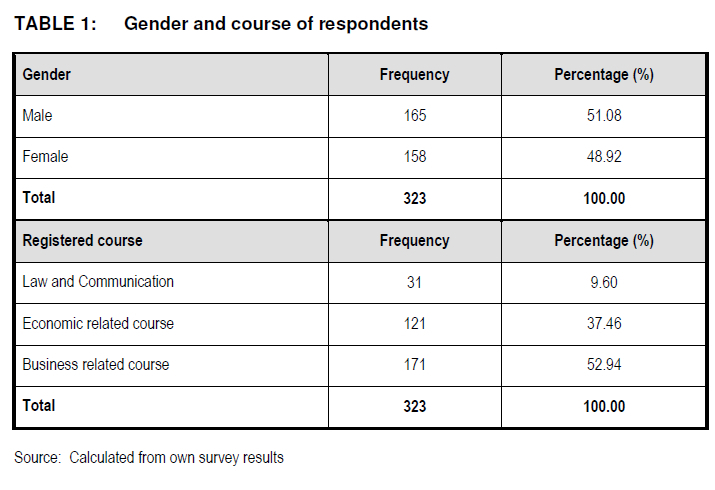
A total of 323 usable questionnaires were returned by 165 (51.08%) male and 158 (48.92%) female final-year students. According to Tabachnick and Fidell (2007:613) the rule of thumb is that it is comforting to have at least 300 respondents for a factor analyses.
5.2
Research Instrument and pretesting of the questionnaireA self-administered, structured, validated questionnaire, namely the Revised Study Process Questionnaire (RSPQ) was used. The RSPQ was designed to assess the extent to which a tertiary student at college or university applies different approaches to learning and the more important motives and strategies comprising those approaches (Biggs etal. 2001).
Section A captures the respondents' biographical information, while Section Β consists of the questions determining the respondents' approach to learning.
Section Β of the questionnaire contains 20 questions or items that students needed to answer on a 5 point Likert scale where A = this item is never or rarely true of me; Β = this item is sometimes true of me; C = this item is half of the time true of me; D = this item is frequently true of me and Ε = this item is always or almost always true of me.
According to the RSPQ, the learning approaches are divided into four sub-scales, namely Deep motive, Deep strategy, Surface motive and Surface strategy. A total score for the deep approach can be calculated by adding the scores of deep motive and deep strategy and for the surface approach a total can be calculated by adding the scores of surface motive and surface strategy.
A higher score indicates a stronger tendency towards a specific approach, while a lower value reflects a weaker tendency towards the approach. A student can therefore reach a score of between 10 and 50 while a score of 30 indicates that a student can make use of both approaches, depending on the situation and the need (Biggs 1987).
Since the questionnaire was not developed specifically for the South African context, the researchers conducted a pre-test for clarity. The pre-test involved 10 independent students who did not form part of the sample for the final study. After the pre-test the respondents indicated that no ambiguity or misunderstandings were prevalent.
5.3
Data collection proceduresAfter the students had agreed to take part in this research the researchers personally went to each class of which the researchers are lecturers and handed out the questionnaires to the students present. The researchers explained the purpose of the research, emphasised that the data collected was confidential and would be used for academic research purposes only. They also ensured that respondents' privacy and dignity were honoured at all times during the data collection process.
5.4
Data analysisThe researchers used the Statistical Package for the Social Sciences (SPSS Version 23) to capture, clean, edit and analyse the data obtained from the questionnaires.
The following analyses were executed:
■ A reliability analysis by ways of computing Cronbach alpha coefficients was subsequently undertaken to determine the reliability of the two factors confirmed by the Confirmatory Factor Analyses (CFA) (Table 2).
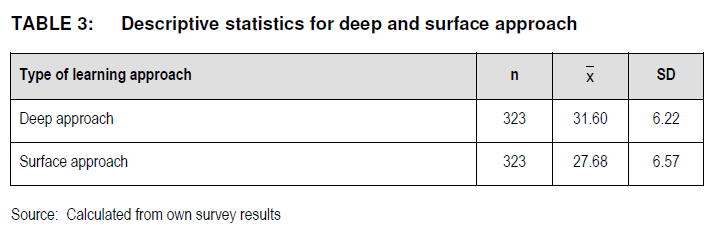
■ Frequency analyses were executed for all the items in the RSPQ-questionnaire and mean scores and standard deviations were computed (Table 3).
■ Validity of the measuring instrument was investigated by firstly applying a confirmatory factor analysis (CFA), followed by an examination of the content validity.
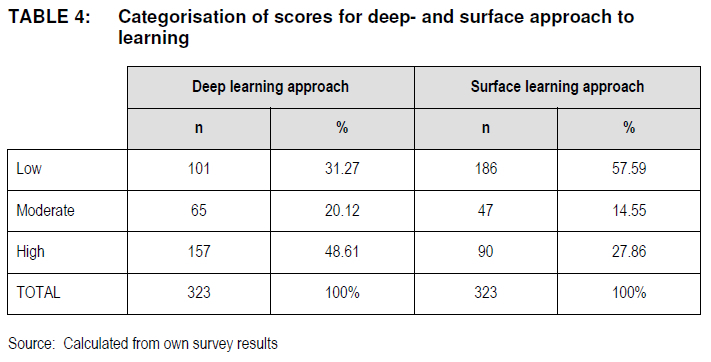
■ The researchers categorised the mean scores for deep and surface approach to learning scores into three groupings, namely low, moderate and high, to better understand the use of the different approaches by the students. There is no prescribed way of categorising the scores in the literature except for Biggs' (1987) indication that a score of 30 indicates that a student can make use of both approaches. According to Biggs (1987) a student can reach a score of between 10 and 50 for the different approaches. The researcher used these guidelines to create an arbitrary categorisation to indicate a low, moderate or high use of a specific approach. A score of between 29 and 31 was used to assign a moderate score for the learning approach. A score of below 29 was considered a low score and above 31 was considered a high score, as depicted in Table 4.
■ Pearson's product moment correlation test was applied to determine associations between several variables (Tables 5 to 7).
■ Statistical significance of the associations was determined by a Chi-square p-value where p<0.05 indicates statistical significance.
■ Cramer's V effect size was used to determine the practical significance of the associations, where
d = 0.01 small effect;
d =0.30 medium effect;
d = 0.50 large effect.
5.5 Psychometric properties of the measuring instrument
Validity was examined by addressing content- and construct validity, while reliability was examined by computing Cronbach alpha coefficients for the two variables (Delport & Roestenburg 2011:173-177).
The findings are reported under results.
6. RESULTS AND DISCUSSION
In this section the empirical results of the research are presented. The first section presents a demographic profile of the respondents. Thereafter the psychometric properties of the measuring instrument are discussed, followed by the results regarding deep and surface learning approaches and the correlations between gender and course registered for.
6.1
Gender and course of respondentsTable 1 represents the gender of the respondents and the course they registered for.
Table 1 reveals that there was an almost equal distribution between male (51.08%) and female (48.92%) respondents in this research. The majority of respondents studied Business-related subjects (52.94%), followed by those who studied Economy-related subjects (37.46%) and those who studied Law- and Communication-related subjects (9.60%).
6.2
Validity and reliability of measuring instrumentsThe psychometric properties of the measuring instrument were investigated by assessing content and construct validity and reliability.
6.2.1 Content validity
Pallant (2013:7) defines content validity as that it refers to the adequacy with which a measure or scale has sampled from the intended universe or domain content. Content validity in this research was determined by bearing in mind the degree to which the items in the questionnaire really measured the factors, namely deep and surface learning.
The total set of behaviours investigated must be appropriate for measuring the behaviour under discussion of the specific respondents in the research, which is another requirement for content validity (Murphy & Davidshofer 2005:158). Three experts evaluated the items that measured the constructs and found that all the items fell within the boundaries of the content domain and that the items in each subscale represented the concept sufficiently. Consequently the instrument was deemed content valid.
6.2.2 Construct validity
Construct validity determines whether the characteristic or construct actually measured what it was supposed to measure (lacobucci & Churchill 2010:257). Construct validity was assessed by means of a confirmatory factor analysis (CFA). Because the Chi-square test is viewed by some as an overly strict indicator of model fit, given its power to detect even trivial deviations from the proposed model (Hancock & Mueller 2010:379), Mueller (1996:90) suggests that the Chi-square test statistic be divided by degrees of freedom.
The two-factor model yielded a Minimum Sample Discrepancy divided by Degrees of Freedom (CMIN/DF) value of 2.45. Interpretation of the size of this value depends to a large degree on the viewpoint of the investigator, but in practice some interpret ratios as high as 3, 4 or even 5 as still representing a good model fit (Mueller 1996:84). It is, however, considered good practice to report multiple fit indices, typically from three broad classes (Hancock & Mueller 2010:379). Mueller (1996:90) described values of above 0.90 as indicative of a good overall fit for a Comparative Fit Index.
A Comparative Fit Index (CFI) of 0.80, which is below the acceptable value, was found for the two-factor model while a Root Mean Square Error of Approximation (RMSEA) value of 0.07 with a 90% confidence interval of [0.06; 0.08] was obtained. Blunch (2013:120) states that models with RMSEA values of 0.10 and larger should not be accepted. The two-factor model satisfied the acceptability of two of the three indicators of the model fit - CMIN/DF and RMSEA. Consequently, the measuring instrument can be deemed construct valid.
6.2.3 Reliability analysis
The reliability of an instrument is an indication of the extent to which the measuring instrument can be used consistently and can be assessed by computing Cronbach Alpha values. An instrument can be considered reliable if the same variable in the same test conditions with the same instrument at repeated measurements gives the same result (Joubert, Hartell & Lombard 2016:288).
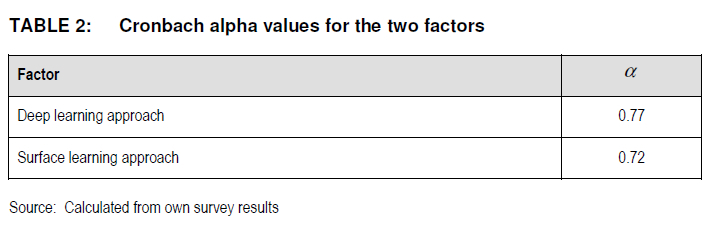
The Cronbach alpha values of the evaluated questionnaires for the research are indicated in Table 2. A value > 0.7 indicates a reliable instrument (Field 2013:679). In this research, both deep and surface learning displayed Cronbach alpha values >0.7. The measuring instrument was therefore considered reliable.
6.3 Results regarding the two factors determining the learning approach of students
This section reports on the descriptive results, measuring the deep and surface learning approach of students. The mean scores and standard deviations for each of the constructs are presented in Table 3.
Table 3 shows that the mean score for the final-year business management students is slightly higher for the deep learning approach ( = 31.60; SD = 6.22) than for the surface learning approach ( = 27.68; SD = 6.57). Biggs (1987) states that a score of 30 indicates that a student can make use of both approaches. He further points out that students will decide which approach they will follow in a specific situation. The final-year business management students' score is close to 30 and thus shows that they make use of both approaches and will decide which approach to use in a specific module or situation.
To obtain more comprehensive insight into the results regarding the deep and surface learning approach of these respondents, the number of respondents predominantly following a specific learning approach were categorised into three groupings, namely low, moderate and high. Table 4 depicts that more students tend to follow a deep approach (48.61% - high degree) than a surface approach (27.86% - high degree).
Table 4 also portrays that the majority of students chooses not to follow the surface approach (57.59% - low degree). The results presented in Tables 3 and 4 are in accordance with objective 1. Although final year Business Management students tend to lean more towards the deep approach to learning there is clearly room for convincing them to follow ways that would enhance the use of a deep approach to learning. Lecturers of HEI's need to play an important role in this development.
Pearson's product moment correlation test was applied to determine associations between deep and surface approach of learning. A Chi-square p-value of 0.83 and Cramer's V= 0.05 was found, indicating that there was no statistically or practically significant association between a deep and surface approach to learning.
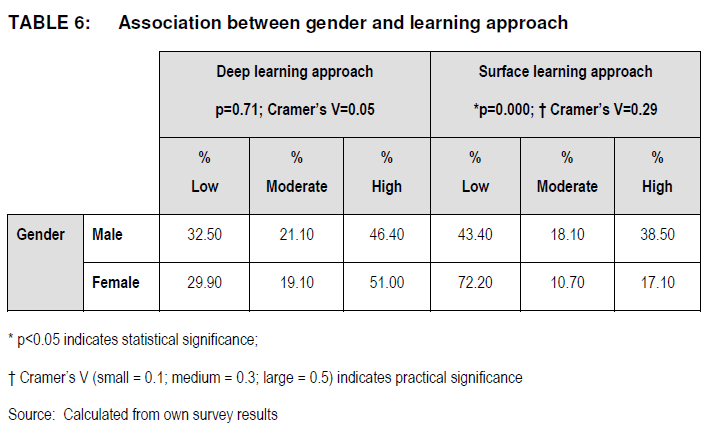
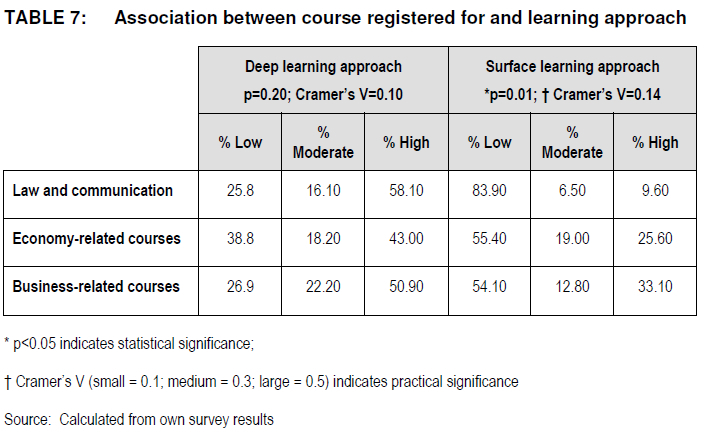
To establish whether associations exist between gender and course registered for in the sample with respect to the two learning approaches, several findings can be reported (Tables 6 & 7).
A Chi-square p-value of 0.71 and a Cramer's V = 0.05 indicates that there is no statistically or practically significant association between a deep approach to learning and gender. Concerning the surface learning approach there was a medium practically as well as statistically significant association as indicated by the Chi-square p-value of 0.000 and Cramer's V-value = 0.29 between a surface approach to learning and gender, meaning there are more male students than females that are high in surface learning.
Due to the fact that male students are apparently more inclined towards surface learning approach lecturers of HEI's should concentrate on improving deep learning among male students.
In all three courses the students indicated that they will make more use of a deep approach to learning than of a surface approach. In the courses Law and Communication, 58.10% indicated that they will make use of a deep learning approach, whereas in the Economy-related courses 43.00% of the students indicated that they will make use of a deep learning approach and in the Business-related courses 50.90% of the students indicated that they will make use of a deep learning approach. It can be concluded that especially in the Economy-and Business-related courses lecturers of HEI's should strive towards promoting deep learning to a bigger extent.
There is no statistically significant association (Chi-square p-value = 0.20) but a small practically significant association measured (Cramer's V = 0.10) between the deep learning approach and the course registered for. With regard to the surface approach and course registered for, a statistically significant and a small practically significant association was measured (Chi-square p-value = 0.01; Cramer's V = 0.14).
7. RECOMMENDATIONS
In order for HEI's and business management lecturers to focus on delivering students that are ready and competent to function effectively in the working environment, the following recommendations based on the findings of the study are provided:
■ Since students will choose the learning approach they will apply according to how they experience a specific situation, students should be made aware of the fact that they should constantly use the approach by which they would benefit most in preparing for their future career. Lecturers could point out which parts of learning matter are mere facts which could be memorised by ways of surface learning and which parts require insight and applications which can be achieved by ways of deep learning. These guidelines will help students to evaluate each situation and choose the applicable learning approach.
■ It was found that only a slight majority of students in business-related courses tend to follow a deep learning approach. Lecturers should provide great effort to persuade students to apply the deep learning approach, by pointing out the advantages of deep learning and providing strategies and motivation for enhancing this practice. The university's academic support system should also provide assistance in the form of additional courses to students in order to encourage them to invest in a deep learning approach.
■ One of the findings was that more male business students than female students choose to follow a surface learning approach. It is recommended that male students should especially be made aware of the benefits of a deep learning approach and the need for practising this for their upcoming future, be it a professional career or further studies.
■ Another finding of this study was that students in Law and Communication-related courses tended to follow the deep learning approach, probably because while preparing for their professional career they realise that they will need to follow this approach in order to meet the demanding needs of their career. All students intending to follow a career which would require the use of prior knowledge and the ability to capture new information into cognitive structures, apply wider reading, critical and creative thinking, problem solving, communication and teamwork to function effectively in the work environment should be made aware of the necessity of applying deep learning in preparation for their career.
■ Business management lecturers need to apply different teaching methods such as business trips, business simulations, business related problem-solving, case studies, etc. to encourage and to promote a deep learning approach.
Regarding the responsibilities of Higher Education Institutions, their challenge is to encourage and prepare the new-generation lecturers with skills and knowledge on how to prepare, organise and develop lessons in such a manner that students will find it not only interesting but will also be motivated to learn more about the subject.
8. CONCLUSION
The aim of this research was to measure and report on business management students' approach to learning in three different business-related courses. Relevant literature addressing surface and deep approaches to learning were studied.
From the literature it can be concluded that business management students' approach to learning is predominantly determined by the learning environment they are exposed to, the manner in which they are encouraged to learn and their exposure to real-life business-related issues. Herewith it can also be concluded that business management students need to develop a deep approach to learning so that they are able to develop the necessary skills to function effectively in the working environment after graduation. In terms of stake holding it is realised that the development of students' approach to learning, hence deep learning, is not only their own responsibility. It is also the responsibility of business management lecturers who need to develop learning environments and use a variety of teaching methods conducive for promoting students' deep learning approach.
The results for this research indicated that this study incorporated nearly an equal numbers of male and female students who registered for three different business-related courses. Regarding the mean scores for deep and surface learning approaches of final-year business management students it is clear that they make use of both deep and surface learning approaches, depending on the specific module and learning situation.
Kember et al. (2008:48) mentioned that a student can start off with a deep approach to learning in a specific module and as the module progresses, change to a surface approach and vice versa. Where students start off with a deep approach and master the study matter well, they may find it sufficient to switch to the less exhausting surface approach. When they start with surface learning they may realise that this strategy is insufficient to get to the core of their study matter and switch to a deep approach.
In modules where students get connections between pre-existing and new knowledge, where they intensively show interest in the work, extract meaning from the content and critically evaluate knowledge, they probably tend to follow a deep learning approach, in contrast to modules where they simply wish to pass the subject with limited interest in the work (Pegrum, Bartle & Longnecker 2015:144).
Upon categorisation of the scores into low, moderate and high groups it was found that a slight majority of the students in all the business-related courses chose to follow the deep approach to learning. No statistically or practically significant association was found between the deep and surface learning approach.
With reference to associations between gender and the learning approaches, in the case of deep learning approach no statistically or practically significant association was found. However, a practically as well as a statistically significant association was found between surface approach to learning and gender, with more males than females following the surface approach to learning.
Results regarding association between course registered for and deep learning as well as surface learning approaches also indicated that no statistically or practically significant association existed between course and deep learning approach, but a statistically and small practically significant association existed between course and surface learning approach. Students in Law- and Communication-related courses tend not to follow the surface learning approach probably because while preparing for their professional career they are aware of the fact that they would benefit from using a wide variety of sources and practising a heightened involvement in subject-specific discussions (Millis 2010:1).
REFERENCES
4. LITERATURE REVIEW
- BAETEN M, DOCHY F, STRUYVEN K, PARMENTIER Ε & VANDERBRUGGEN A. 2016. Student-centred learning environments: an investigation into student teachers' instructional preferences and approaches to learning. Learning Environment Res 19:43-62.
- BAKER R, BRICK JM, BATES NA, BATTAGLIA Μ, COUPER MP, DEVER JA, GILE KJ & TOURANGEAU R. 2013. Summary report of the AAPOR task force on Non-probability sampling. Journal of Survey Statistics and Methodology 1(2):90-143.
- BALL L & HARRISON J. 2015, Learning and teaching theology. WIPF & Stock.
- BIGGS J. 1987. Student approaches to learning and studying. Hawthorn, Victoria, AUS: Australian Council for Educational Research,
- BIGGS J. 1993. What do inventories of students' learning processes really measure? A theoretical review and clarification, British Journal of Educational Psychology 63(1 ):3-19,
- BIGGS J. 1999. Teaching for quality learning at university. Philadelphia, PA: Society for Research into Higher Education and Open University Press.
- BIGGS J, KEMBER D & LEUNG DYP. 2001. The revised two-factor study process questionnaire: R-SPQ-2F. British Journal of Educational Psychology 7'1(1):133-149.
- BIGGS J & RIHN BA. 1984. The effects of intervention on deep and surface approaches to learning. In Kirby J (ed). Cognitive strategies and educational performance. New York, NY: Academic Press, pp. 279-293.
- BLESSINGER P & CARFORA JM. 2015, Inquiry-based learning for multidisciplinary programs: a conceptual and practical resource for educators. West Yorkshire, UK: Emerald Group.
- BLUNCH NJ. 2013. Introduction to structural equation modelling using SPSS and AMOS, London, UK: Sage.
- BORREDON L, DEFFAYET S, BAKER AC & KOLB K. 2011. Enhancing deep learning: lessons from the introduction of learning teams in management. Education in France Journal of Management Education 35(3):324-350,
-
BREWER L. 2013. Enhancing youth employability: what? why? and how? Guide to core work skills. International labout organization, [Internet: http://www.ilo.org/wcmsp5/groups/public/---ed_emp/-~ifp_skills/documents/publication/wcms_213452.pdf; downloaded on 2015-08-23.
» http://www.ilo.org/wcmsp5/groups/public/---ed_emp/-~ifp_skills/documents/publication/wcms_213452.pdf - ]
- BURNS AC & BUSH RF. 2014. Marketing research. 7th ed. London, UK: Pearson Prentice Hall.
- CHRISTIE J. 2015. A study to understand the relationship between student's perception of academic environment, student learning approaches and student learning outcomes among MBA students of Gujarat. Indian Journal of Research 4(6):263-267.
- COHEN L, MANION L & MORRISON K. 2011. Research methods in education. 7,h ed. London, UK: Taylor & Francis, Routledge.
- DE VIRON F & DAVES P. 2014. From university lifelong learning to lifelong learning universities: developing and implementing effective strategies. In Yang J, Schneller C & Roche S (eds). The role of higher education in promoting lifelong learners. Hamburg, DE: UNESCO, pp. 40-59.
- DELPORT CSL & ROESTENBURG WJH. 2011. Quantitative data-collection methods: questionnaires, checklists, structured observation and structured interview schedules. In De Vos AS, Strydom H, Fouché CB & Delport CSL (eds). Research at grass roots: for the social sciences and human service professions, 4th ed. Pretoria: Van Schaik. pp. 171-205.
- ENTWISTLE NJ. 2000. Approaches to studying and levels of understanding: the influences of teaching and assessment. In JC Smart (eds.) Higher education: handbook of theory and research. New York, NY: Agathon, pp. 156-218.
- FIELD A. 2013. Discovering statistics using IBM SPSS statistics. 4th ed. London, UK: Pearson.
- GANDA F, NGWAKWE CC & AMBE CM. 2014. Independent research and a deep approach to learning of accounting concepts: student' view. Mediterranean Journal of Social Sciences 5(6):75-89.
- GOLIGHTLY A & RAATH S. 2015. Problem-based learning to foster deep learning in pre-service geography teacher education. Journal of Geography 114(2):58-68.
- HANCOCK GR & MUELLER RO. 2010. The reviewer's guide to quantitative methods in the social sciences. New York, NY: Routledge.
- HENRICO A. 2012, Activity-based learning: a business management case study, African Journal of Business Management 6(33):9452-9459.
- HERMIDA J. 2015. Facilitating deep learning: pathways to success for university and college. Toronto, CAN: Apple Academic Press.
- IACOBUCCI D & CHURCHILL GA. 2010. Marketing research methodological foundation. 10th ed. Melbourne, AUS: South-Western Cengage Learning.
- INGLEBY E, OLIVER G & WINSTONE R. 2014. Early childhood studies: enhancing employability and professional practice. New York, NY: Bloomsbury.
- JOUBERT I, HARTELL C & LOMBARD K. 2016. Navorsing: 'n gids vir die beginner-navorser. Pretoria: Van Schaik.
- KEMBER D, LEUNG DYP & MCNAUGHT C. 2008. A workshop activity to demonstrate that approaches to learning are influenced by the teaching and learning environment. Active Learning in Higher Education 9(1 ):43-56.
- MAREK T, KARWOWSKI W, FRANKOWICZ M, KANTOLA J & ZGAGA P. 2015. Science, technology, higher education, and society in the conceptual age. New York, NY: Taylor & Francis.
- MARTON F & SALJO R. 1976. On qualitative differences in learning -1: Outcome and process. British Journal of Educational Psychology 46:4-11.
- MCNALLY DW. 1977. Piaget, education and teaching. 2 nded. Hassocks, UK: Harvester Press.
- MILUS BJ. 2010, Cooperative learning in higher education: across the disciplines, across the academy, Sterling, VA: Stylus.
- MOSCA C, MAKKINK A & STEIN C. 2015. Learning approaches used by students in an undergraduate emergency medical care programme, African Journal of Health Profession Education 7(1):55-57,
- MUELLER RO. 1996. Basic principles of structural equation modelling: an introduction to LISREL and EQS. New York, NY: Springer,
- MURPHY KR & DAVIDSHOFER CO. 2005. Psychological testing: principles and applications. 6lh ed. Upper Saddle River, NJ: Prentice Hall.
- PAADI K. 2014, Perceptions on employability skills necessary to enhance human resource management graduates prospects of securing a relevant place in the labour market, European Scientific Journal Special Edition:129-143.
- PALLANT J. 2013, SPSS survival manual: a step by step guide to data analysis using SPSS, 5th ed, Berkshire, UK: Open University Press.
- PEGRUM M, BARTLE Ε & LONGNECKER N. 2015, Can creative podcasting promote deep learning? The use of podcasting for learning content in an undergraduate science unit. British Journal of Educational Technology 46(1):142-152.
- PIAGET J. 1975, The development of thought, New York, NY: Viking Press,
- POSTAREFF L, PÁRPALA A & LINDBLOM-YLÄNNE S. 2015. Factors contributing to changes in a deep approach to learning in different learning environments, Learning Environments Research 18(3):315-333,
- RAMSDEN P. 1997. The context of learning in academic departments. In Marton F, Hounsell D & Entwistle Ν (eds), The experience of learning, Edinburgh, SCO: Scottish Academic Press: Edinburgh, pp,198-216,
- SADI Ö & DAGYAR M. 2015. High school students' epistemological beliefs, conceptions of learning and self-efficacy for learning biology: a study of their structural models. Eurasia Journal of Mathematics, Science & Technology Education 11(5):1061-1079,
- SMYTH L, MAVORA Kl, PLATOW MJ, GRACEC DM & REYNOLDS KJ. 2015. Discipline social identification, study norms and learning approach in university students, Educational Psychology 35(1 ):53-72,
- TABACHNICK BG & FIDELL LS. 2007. Using multivariate statistics. 5th ed. Boston: Allyn & Bacon.
- TURNER M & BASKERVILLE R. 2011. Change in conception of learning: a missing ingredient to support deep learning. Conference paper presented to AFAANZ Conference, Darwin Australia 3-5 July 2011; to CQ University Faculty Research Seminar, 21 September 2011; and to a research seminar at Xuzhou University, China on 28 October 2011.
- VARUNKI M, KATAJAVUORI, Ν & POSTAREFF L. 2015. First-year students' approaches to learning, and factors related to change or stability in their deep approach during a pharmacy course. Studies in Higher Education 1(1):1-23,
- VAN STADEN LJ. 2011, 'n Akademiese steunraamwerk vir EBW onderwysstudente, Potchefstroom: NWU, Potchefstroom-kampus. (Proefskrif - D.Phil.
- )
- VOS N, VAN DER MEIJDEN H & DENESSEN E. 2011. Effects of constructing versus playing an educational game on student motivation and deep learning strategy use, Computers & Education 56:127-137,
- WARBURTON K. 2003. Deep learning and education for sustainability. International Journal of Sustainability in Higher Education 4(1 ):44 - 56,
- WARD H & RODEN J. 2016, Teaching science in the primary classroom, 3rd ed, London, UK: Sage.