The entrepreneurial orientation of college students in a struggling economy context
Abstract
This study investigates the influence of perceived entrepreneurial capabilities and opportunity recognition beliefs on the entrepreneurial orientation of Technical and Vocational Education and Training (TVET) students at a particular polytechnic college in Zimbabwe. A quantitative survey was conducted among 169 polytechnic college students to establish their perceived entrepreneurial capabilities, opportunity recognition beliefs, and entrepreneurial orientations. Correlation and multiple regression analysis were used to analyse the corpus of quantitative data. The results partially confirmed the researchers' postulation that students' entrepreneurial orientations were directly linked to their perceived entrepreneurial capabilities and opportunity recognition beliefs. An implication for entrepreneurship educators and policy-makers is that the effectiveness of entrepreneurship education interventions for future entrepreneurs depends on the capacity of training programmes to integrate and focus on perceived entrepreneurial capabilities and opportunity recognition beliefs of students. The originality of the study lies in the re-constitution of individual opportunity recognition beliefs and perceived entrepreneurial capabilities concepts and a focus on potential entrepreneurs (that is, students) enrolled at a TVET institution in an economically distressed country. This is a previously unexplored research area since much research on entrepreneurial orientation has focused on firms in the developed world as their unit of analysis.
emerging economies; entrepreneurship education; entrepreneurship orientation; opportunity recognition beliefs; perceived entrepreneurial capabilities
1. INTRODUCTION
Disparities in entrepreneurial activity levels in different countries across the globe arguably explain much of the difference in economic development and sophistication of nations (Singer, Arreóla & Amorós 2014:lnternet). Sophisticated and advanced economies in the world are characterised by higher degrees of innovation and entrepreneurship {Audretsch 2006:38; Ylinenpää 2009:1154) compared to emerging economies, where the complexity of entrepreneurship is an emerging quality. Researchers' preoccupation with entrepreneurship derives from the economic value of strong entrepreneurship (Cho & Tien 2014:lnternet; Gyamfi 2014:318; Nieuwenhuizen & Swanepoel 2015:2; Ogbor 2009:21).
According to Nieuwenhuizen and Swanepoel (2015:2), entrepreneurship activity within a particular country creates enterprises, generates wealth and enhances the sustainable competitive advantage of a country. At the same time, research suggests that there is a direct correlation between job creation and the extent of entrepreneurial activity, as well as between the level of economic growth and entrepreneurial activity (Braunerhjelm 2010:2; Carree & Thurik 2010:557-558; Cho & Tien 2014:lnternet; Gyamfi 2014:318).
Given the acknowledged importance of entrepreneurship to the macro-economic imperatives (Lim & Xavier 2015:105-106; Shane & Nicolaou 2015:407; Shrader & Hills 2015:92-93), it is surprising that there is a paucity of literature that explores the intersection of business opportunity recognition, entrepreneurial capabilities and entrepreneurial orientation of (potential) entrepreneurs (Anderson & Evers 2015:260; Stöckmann, Kollmann, Linstaedt & Peschl 2015:16684).
This research gap persists despite the growing consensus in mainstream literature that the degree of entrepreneurship orientation (EO) of economic players makes a difference in the economic disposition of a country (Charantimath 2005:49; Hosho, Muguti & Muzividzi 2013:lnternet; Schwab & Sala-i-Martin 2014:lnternet).
Much of the extant academic research on the determinants of entrepreneurship orientation has targeted the influence of individual traits, demographic and socio-economic variables on entrepreneurship orientation of firms or entrepreneurs (Lin & Envick 2013:465-482; Runyan, Ge, Dong & Swinney 2012:819-836; Sajilan, Hadi & Tehseen 2015:36).
However, it seems that this pre-occupation with these variables has compromised researchers' full appreciation of other individual factors such as opportunity recognition beliefs and perceived entrepreneurial capabilities. Such factors are also integral to the successful entrepreneurship orientation of potential and actual entrepreneurs. For instance, there is a growing body of literature that considers the centrality of opportunity recognition beliefs and perceived entrepreneurial capabilities in the successful adoption of entrepreneurial ventures (Karlsson & Morberg 2013:1-11; Kelley, Singer & Herrington 2012:lnternet; Woldensbet, Ram & Jones 2012:494).
TVET is '...a comprehensive term referring to those aspects of the educational process involving, in addition to general education, the study of technologies and related sciences, and the acquisition of practical skills, attitudes, understanding and knowledge relating to occupants in various sectors of economic and social life' (United Nations Educational, Scientific and Cultural Organisation 2010:5).
The importance of TVET in preparing youth for job-creation opportunities in struggling economies such as Zimbabwe raises a number of critical questions. For instance, one wonders how both theoretical models and empirical findings on student entrepreneurship orientation take full cognisance of cognitive variables especially entrepreneurial capabilities and opportunity recognition beliefs.
The high rates of company closures, job losses and graduate unemployment in Zimbabwe make the interrogation of such cognitive variables relevant to overcoming replicative entrepreneurship and provide new employment creation opportunities. Such efforts are critical to arrest the economic turbulence in the country. The debates about the inclusion of personal efficacy considerations such as opportunity recognition beliefs and entrepreneurial capabilities should be located within the context of Zimbabwean TVET's incapacity to create an entrepreneurship education system that can address the joblessness of graduates and transform them into entrepreneurs (Hosho et al. 2013: Internet; Mauchi, Karambakuwa, Gopo & Kosmas 2011:1306-1308).
Cognitive conditions such as a lack of actual entrepreneurial capabilities and opportunity recognition beliefs contribute to prospective entrepreneurs' failure to benefit profoundly from entrepreneurial education (lakovleva, Kolvereid, Gorgievski & Sorhaug 2014:115-133). More so, cognitive constraints can magnify prospective entrepreneurs' perceptions of social and institutional barriers (Krueger, Hansen, Michl & Welsh 2011:275-279). This often leads to miscalculations of the economic and social desirability of entrepreneurial orientation and intention.
In view of the foregoing discussion, the objective of this research is to respond to the question: Can the perceived entrepreneurial capabilities (PEC) and opportunity recognition beliefs (ORB) of TVET students influence their entrepreneurship orientation (EO)?
From a practical perspective, responding to this question allows for the identification of key individual cognitive qualities critical to generating a steady supply of entrepreneurial skills needed in resilient emerging economies. From a theoretical perspective, the research responds to the call to determine and validate effective antecedents of entrepreneurship orientation, which remains a grey area {Dess, Pinkham & Yang 2011:1077-1078; Miller 2011:873-874; Slevin & Terjesen 2011:976-975). The findings of this research are expected to benefit entrepreneurship orientation theory and entrepreneurship education through locating cognitive competencies which students require in order to be effective entrepreneurs.
First, the article reviews the identified antecedents to entrepreneurial orientation and their relationships with this concept. Second, the research methodology and data analysis techniques are articulated. Third, the findings are presented and discussed. Next, the conclusion and implications for future research are rendered.
2.1 Perceived entrepreneurial capabilities
Luong (2015:11) defines perceived entrepreneurial capabilities as the perception of one's '...knowledge, skills and experience to start a business.1 Therefore, perceived entrepreneurial capabilities are positively identified with efforts to explain new firm creation from a resource-based perspective (Lin & Nabergoj 2014:307). The underlying assumption of this concept is the view that humans possess certain competencies that enable them to identify business opportunities in markets and effectively co-ordinate economic resources (Rae 2007:237; Rae 2014:49). This is illustrated by the Organisation for Economic Cooperation and Development (OECD) which measures perceived entrepreneurial capabilities as the 'percentage of people in the 18-64 age group who believe they possess the required skills and knowledge to start a business' (OECD 2012:11).
Despite the definitional crass that surrounds the use of the term, there is a growing recognition that perceived entrepreneurial capabilities are an important aspect of modern economies (Ebrahim & Schott 2008:1-2; Lima, Lopes, Nassif & Silva 2014:1033-1055; Volkmann, Wilson, Mahotti, Rabuzzi, Vyakarnam & Sepulveda 2009:lnternet; Wu 2007:549-555).
Vibrant entrepreneurial activity is now considered to be a direct consequence of the opportunities for entrepreneurship created in the national economy and an outcome of individuals' possession of entrepreneurial capabilities (Krueger Jr 2000:9). However, while individual endowment with entrepreneurial capabilities is a desirable prerequisite for entrepreneurial activity, this does not necessarily make new venture creation an automatic occurrence. Individual entrepreneurs must have cognitive navigation skills to explore available business opportunities in the market and capitalise on these opportunities. Hechavarria, Renko and Matthews (2012:685-701) contend that prospective business owners should possess the capabilities to incubate a business as much as they should perceive the opportunities for such new venture creation.
While perceived entrepreneurial capabilities can be conceived as inherent individual qualities, Bosma and Levie (2009:lnternet) contend that the quantity and quality of perceived opportunities and capabilities may be enhanced by national conditions such as economic growth, population growth, culture, and national entrepreneurship policy. We infer that national socio-economic and cultural circumstances provide the fertile ground for the germination and fostering of entrepreneurial capabilities.
According to Edoho (2015:3-5), most of Africa's problems do not emanate from the lack of resources, but the acute shortage of the strategy to exploit the resources. They elaborate that '.. .the critical dimension of the growth challenge facing Africa is developing entrepreneurial capabilities and formulating effective strategies to transform a resource curse into resource catalyst' (Edoho 2015:5). Our inference is that while the situated national socioeconomic, cultural and political climate provides the 'cognitive garden' for entrepreneurial capabilities to thrive, the same climate may block individual mental faculties from the identification of and capitalising on entrepreneurial opportunities within the environment.
It is important to underscore that perceived entrepreneurial capabilities are instrumental to the launching and survival of new business ventures (Innovation Policy Platform 2016:lnternet). This is because of their implication to the business founders' alertness to opportunities, their ability to manage a new business, initiate innovations and adapt to change flexibly. It is for this reason that perceived entrepreneurial capabilities are often conflated with self-efficacy, which is a belief in one's abilities to undertake a particular course of action (Hechavarria et aí. 2012:685-701). However, while both entrepreneurial capabilities and self-efficacy are underpinned by individual agency, they are qualitatively different in the consequences they bring. While self-efficacy borders on an individual's possession of beliefs for accomplishing any particular assignment or task, the eventuality of the successful application of perceived entrepreneurial capabilities is new venture creation.
Karra, Philips and Tracey (2008:440-458) proclaim that while entrepreneurial capabilities are crucial to the successful inception of a business venture, they become less relevant as the venture matures. Despite the prominence of the concept in literature, no study has connected the concept to entrepreneurship orientation in resilient economies like that of Zimbabwe. The relationship between entrepreneurial capabilities and entrepreneurial orientation is considered critical to the survival of the fledgling economy. In view of the foregoing discussion, we postulate that:
H1: Perceived entrepreneurial capabilities have an influence on the entrepreneurial orientation of students.
2.2 Opportunity recognition beliefs
Lumpkin, Hills and Shrader (2004:74) define opportunity recognition as 'perceiving a possibility to create new businesses, or significantly improving the position of an existing business enterprise which results in new profit potential.' The perception of this opportunity demands cognitive processing of market ideas and the environmental scanning of the business terrain to locate opportunities which many individuals may conceive as obstacles to be avoided. While the accumulation of resource endowments may lever the entrepreneur's exploitation of identified opportunities, mental openness and cognitive processing remains fundamental to the location and uptake of entrepreneurial opportunities (Propstmeier 2011:2).
In the same vein, individuals such as students may also hold strong beliefs about opportunity recognition and opportunity exploitation in academia. These beliefs may manifest in academically challenged students' coping strategies. Such strategies include alliances with more academically gifted students, effective use of educators' consultation periods and exploitation of resources availed to them such as the libraries, private study rooms, internet and peer networks.
White and D'Souza (2014:22) define opportunity recognition as 'the ability to retrieve information and process that information to make a decision regarding the pursuit of a value creation effort.' While mental processing is essential to opportunity recognition, the desire to pursue the identified opportunity makes entrepreneurial activity a reality.
As such, opportunity recognition is fundamental element of the entrepreneurship process as it constitutes the formative stage of the venture creation process (Shane, Locke & Collins 2012:lnternet; Singh & Gibbs 2013:643-644). It is unsurprising that opportunity recognition is the starting point from which all entrepreneurship emerges (White & D'Souza 2014:22-23) and it is the distinguishing trait of an entrepreneurial from a non-entrepreneurial mind-set (McGrath & MacMillan 2000:2-3). Consistent with the foregoing discussion we postulate the hypothesis that:
H2: Opportunity recognition beliefs have an influence on entrepreneurial orientation of students
2.3 Entrepreneurial orientation
Entrepreneurial orientation (EO) is frequently portrayed as a multi-faceted concept, which is mostly applied at the firm- level (Boehm 2008:82). Miller (2011) conceives entrepreneurship orientation as a performance driven concept comprising of a firm's risk taking, innovativen ess and proactiveness behaviours. Therefore, firms that exhibit these behaviours are interpreted as more entrepreneurially oriented than those that are risk-averse, lack proactivity and innovative qualities.
Other recent studies concur that organisations have entrepreneurship orientation tendencies display one or several of the following aspects of a firm: risk-taking, innovativeness and proactiveness (Deb & Wiklund 2016:lnternet; Xing & Wang 2014: Internet). To the extent that small businesses operations may be conceived as outcomes of an entrepreneur's decisions, it is logical to argue that manifestations of entrepreneurial orientation at the organisational levels signify the activities of an individual.
As Bolton and Lane (2012:219-233) argue, since one can also define an organisation, particularly a small or entrepreneurially founded organisation, as the result of an individual's behaviours, the entrepreneurial orientation dimensions could be measured for an individual. Therefore, there is scope to extrapolate firm's entrepreneurial orientation to activities of individuals such as students. Examples of students' risk taking behaviours include lack of sleep during exam preparations. Peer group consultations among geographically dispersed students via WhatsApp when conducting group assignments or projects resonate with student innovation. Apart from defining entrepreneurship orientation as a firm behavioural tendency, recent studies have conceived it as a form of organisational strategy and philosophy.
Covin and Lumpkin (2011:855-856) define it as a firm-level strategic orientation which captures an organisation's strategy-making practices, managerial philosophies, and firm behaviours that are entrepreneurial in nature. Such an organisational strategy undergirds a firm's corporate vision, mission objectives and strategies including its resource mobilisation capabilities and its proactive orientation towards its external stakeholders (e.g. investors, financiers, customers, suppliers and regulators).
However, entrepreneurship orientation is not only an organisational strategy expressed at firm levels only, but can also resonate with the individual strategy. The overriding individual strategies may range from entrepreneurial interests (e.g. interest in activities related to an entrepreneur's work such as reading business journals), entrepreneurial skills (e.g. skills related to an entrepreneur's work, such as salesmanship), and entrepreneurial traits (e.g. being a leader) (Schmitt-Rodermund & Vondracek 2002:65-75).
Entrepreneurship orientation strategies displayed at organisational levels are mere expressions and extensions of individual entrepreneurial behaviours. This because organisations are a culmination of regulative, administrative and corporate rules, activities and arrangements set by individuals. Hence, entrepreneurs' willingness to take on risks and be proactive in leading their organisation can certainly be important behaviours that individuals (e.g. a student) may take on in other pursuits of life. Individuals, such as students, can easily be observed as risk takers or non-risk takers, as innovative or not (Bolton & Lane 2012:219-233).
Many studies have also examined entrepreneurial orientations across various contexts (see Herrington & Kelley 2012: Internet; Keow 1996:13-26; Schwab & Sala-i-Martín 2014:lnternet; Su & Sohn 2015:2; Vinig & Dorresteijn 2007:lnternet). Vinig and Dorresteijn (2007:lnternet) investigated the extent of entrepreneurial orientation among Dutch, Norwegian and Israeli students. They hypothesised biography, occupational history, self-description, work satisfaction and the country's history as prime determinants of entrepreneurship orientation of students. Their study revealed political climate, tax benefits and gender were related to entrepreneurial orientation even through national culture did not predict the entrepreneurial orientation of the students. The study also concluded that entrepreneurial orientation levels among students did not positively correlate with being out of employment as claimed by the Global Entrepreneurship Monitor (GEM) data for the same countries (see Herrington, Kew & Kew 2010:lnternet).
Keow (1996:13-26) investigated the level of entrepreneurial orientation of vocational and technical school students in Kuantan District in Pahang (Malaysia). The survey which involved the distribution of 337 questionnaires among Form Four students from the two vocational and technical schools in the district correlated entrepreneurial orientation along five categories. These categories were students' personal characteristics, family-related matters, school-related matters, working experience, and environmental factors.
The study findings revealed that although entrepreneurship orientation was influenced by all the factors, school-related matters, working experience, and environmental factors were the most dominant. However, not all student personal and family-related characteristics affected entrepreneurship orientation. Under students' personal characteristics, statistical results indicated that gender had significant effects on the entrepreneurial orientation of students while ethnicity showed no significant difference, with all the ethnic groups showing similar level of entrepreneurial orientation. More so, there were no significant differences in entrepreneurship orientation based on family income, parents' education, and parents' occupation.
Apart from the antecedents of this concept, scholars have also investigated the outcome of entrepreneurship orientation (Schwab & Sala-i-Martín 2014: Internet; Su & Sohn 2015:2; Yong & Ho 2006:147). Irrespective of its level of operation, entrepreneurship orientation has been considered to generate dynamism and change that triggers higher firm and economic performance (Su & Sohn 2015:2-3).
Without such value enhancing qualities businesses would lose their customer base, falter and finally, fold its operations. Businesses that display entrepreneurship orientation and entrepreneurial activity often develop or seek new products to fill existing market gaps or create new markets with new products and services (Yong & Ho 2006:147-148).
The corporate and broader economic impact of entrepreneurship orientation is not only felt in developed countries but also resonates with emerging economies as well. In the developed world context, entrepreneurship orientation is reported to enhance economic sophistication and facilitate innovation of firms, as well as enhance a country's global competitiveness (Schwab & Sala-i-Martín 2014:lnternet). At the core of entrepreneurship orientation is the incubation of employment opportunities that address joblessness and fosters economic growth (Atef & Al-Balushi 2015:73).
It is against this background that the motivation and benefits of entrepreneurial dispositions are most felt in emerging economies where livelihoods tend to be unsustainable due to soaring joblessness and unemployment (Nafukho & Muyia 2010:96-97). As such, the growing consensus in mainstream literature in developing African countries is that entrepreneurship orientation undoubtedly increases the chance of the incubation of new ventures, which drives economic regeneration, unlocks employment opportunities, fosters innovation and generates productive capacities for generating products and services, which would not otherwise be available (Atef & Al-Balushi 2015:73-74; Herrington et at. 2010:lnternet).
2.4 Control variables: gender, marital status, age and field of study
The relationship among perceived entrepreneurial capabilities, opportunity recognition beliefs and entrepreneurial orientation can be affected by control variables such as gender, marital status, age and field of study of the actual or potential entrepreneur. For this reason, a short discussion on the contribution of each of these control variables is critical to the broader understanding of the relationship between the aforementioned independent variables (perceived entrepreneurial capabilities), opportunity recognition beliefs and dependent variables (entrepreneurial orientation).
It is important, however, to note that the control factors incorporated here are not exhaustive given other possible variables such as entrepreneurial disposition of parents and knowledgeable others (e.g. colleagues, mentors) that may moderate the relationships. We conveniently selected only those factors that commonly appear in literature and those that cohere well with a fragile economically distressed emerging economy.
Future studies may include these significant factors which may have been overlooked in the current study. The subsequent sections provide a discussion of each of these control variables.
2.4.1 Gender
A survey of literature reveals the prominent role of gender in shaping entrepreneurship variables (Marlow & McAdam 2013:114; Mueller & Dato-on 2013:1-20; Sullivan & Meek 2012:428) with men being reported to be more entrepreneurial^ oriented than females. Claims about men's stronger orientation towards entrepreneurship can be explained by their perceived higher tenacity, conscientiousness, emotional stability and tolerance for ambiguity in the face of business challenges compared to women.
A study conducted on 267 British students from the University of Bedfordshire and 249 Spanish students from the University of Seville sought to determine the influence of gender difference on entrepreneurship intention. The study reported that females were less inclined to start their own businesses compared to males due to negative attitudes, entrepreneurial career choices and lower self-efficacy (Santos, Roomi & Linan. 2016:49).
The gender based disparities in entrepreneurship dispositions are of interest to the current study as they can mediate the relationship between perceived entrepreneurial capabilities and entrepreneurship orientation of students. Thus, gender is included in the conceptual framework of the study as a control factor.
2.4.2 Marital status
Although the influence of an individual's marital status on entrepreneurship related variables is contested, there is evidence to suggest that it does affect one's inclination to embark on risky adventures (Herrington & Kelley 2012:lnternet; Pfeifer, Sarlija & Zekic 2016:102). The general reasoning is that being married forces one to look for means for subsistence as compared to being single. As such, entrepreneurship related activities in the informal sector are the first readily available option for such people (Herrington & Kelley 2012:lnternet). Apart from this, there is evidence to suggest that married people are most likely to embark on entrepreneurship due to the availability of business support from spouses.
According to Chien (2014:916), spouses render a bundle of financial, human and emotional supportive resources that help them to cope with difficulties and stress associated with business. Following this logic, married people tend to incubate and fare better in business compared to single people without spousal or family support. Contrary to the preceding argument, some scholars argue that married couples are risk-averse and thus would avoid putting the meagre disposable income earned from formal employment at jeopardy (Crespo, Moreira & Simões 2013:579-580).
Other studies demonstrate marriage status' non-significant influence on choices to engage in entrepreneurship {Cao, Li, Ma & Tao 2015:639; Delmar, Davidsson & Gartner 2003:189:216). Because of the lack of consensus on the influence of marital status on entrepreneurship related variables, we include marital status as a control factor in the current study.
2.4.3 Age
Research suggests that an individual's age exerts an influence on various forms entrepreneurial behaviour (Barba-Sánchez, Martines-Ruiz & Jimenez-Zarco 2007:103-112; Hatak, Harms & Fink 2015:38; Neneh 2011:42). A study of the relationships among age, culture and self-employment motivation across different cultures worldwide revealed an identical dome-shaped path in terms of desirability and feasibility beliefs, cresting at young adulthood and a sharp fall toward old age.
It can be inferred that the entrepreneurial activity seems to be concentrated among the young to middle age groups, and declines sharply at old age. This finding complement those of Kaunda (2012:20) whose study on the impact of age on entrepreneurial activity in the South African demonstrated that entrepreneurial activity was relatively low between 18 to 24 years, peaked between 25 to 34 and sharply fell after 50.
However, some studies suggest that the effect of age on entrepreneurship is insignificant (Alimehmeti & Shaqiri 2015:233-240; Zali, Mobaraki & Farsi 2014:140-162). Given these contrasting findings, we include the age as a control variable in our study.
2.4.4 Field of study
Some empirical studies have shown that students' field of study has a high influence on their likelihood to engage in entrepreneurship activities in the near future (Jin, Gilmartin, Sherpard & Chen 2015:1; Maresch, Harms Kailer & Wimmer-Wurm 2016:172). For instance, Ceylan and Ozdilek (2015:223-228) suggest that students doing business related courses have a higher affinity for entrepreneurship compared to those from engineering and other courses due to their extensive exposure to issues relating to the management of business.
Thus, this knowledge gives them the confidence and self-belief in their abilities to succeed as entrepreneurs in the future. Business students' extensive exposure to business related issues increases their self-confidence to make business related decisions, thereby heightening their propensity to engage in entrepreneurship compared to students from other fields.
Duval-Couetil, Shartrand and Reed (2016:1) also observe that university students exposed to entrepreneurship education designed for students from diverse programmes of study rated their entrepreneurial abilities higher than those exposed to entrepreneurship through entrepreneurship programmes embedded in engineering departments. As a result of the confirmed influence of one's field of study on entrepreneurship decisions, 'field of study' is worthy of inclusion as a control variable in this current study.
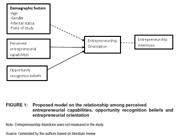
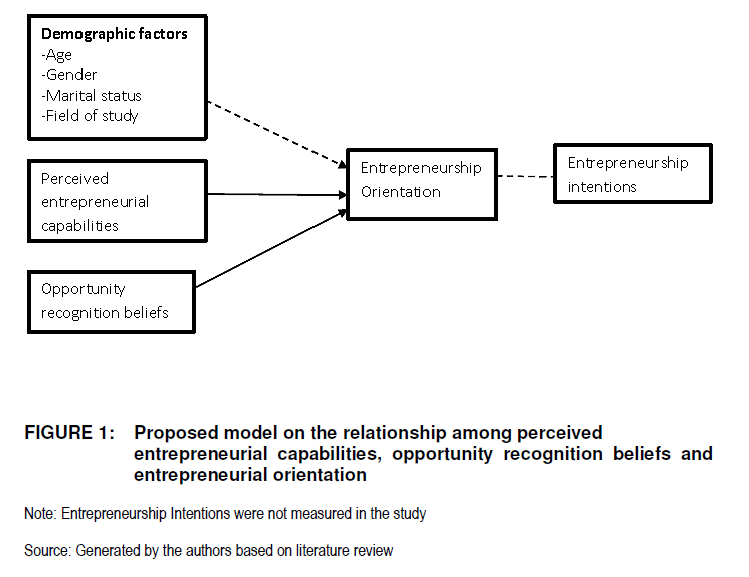
In view of the foregoing discussion, a model founded on the relationships among perceived entrepreneurial capabilities, opportunity recognition beliefs and entrepreneurial orientation is proposed. Demographic variables such as age, gender, marital status and field of study are factored in as control variables in the model.
With reference to the model above, it is important to note that entrepreneurship intentions were not measured in the study as this was not the intended focus of the study.
3. RESEARCH METHODOLOGY
3.1
Research designA research design refers to the plan for the collection, measurement, and analysis of data (Blumberg, Cooper & Schindler 2014:69). A descriptive survey research design was adopted in this study. Saunders, Lewis and Thornhill (2009:360) argue that surveys are statistically important in that the claims based on the results of such quantitative studies are substantiated supported by the field data.
The survey approach was ideal for this study as it facilitated the timeous collection of large quantities of data from numerous respondents at relatively lower cost compared to a longitudinal study. . At the same time, results from quantitative research can be statistically tested for their validity and reliability.
More so, our preoccupation with determining the relationships among opportunity recognition beliefs, entrepreneurial capabilities and entrepreneurial orientation also necessitated the adoption of a research design that is consistent with this intention. This is critical given that the contribution of this study is generating empirical data on key antecedents to entrepreneurial orientation that students should develop to redeem the battered economy of Zimbabwe. Therefore, this research responds to the call to determine and validate the most effective antecedents of individual entrepreneurship-orientation.
3.2
Target populationSince this study was grounded in the relationship among opportunity recognition beliefs, perceived entrepreneurial capabilities and entrepreneurial orientation, students enrolled for an entrepreneurship course, Entrepreneurial Skills Development, were targeted in this study. As Bolton and Lane (2012:219-233) observes, students are the primary focus of entrepreneurial predisposition research as they are a convenient sample group that generally has yet to enter the business world.
Since the intention of the study was not to determine actual entrepreneurial behaviour but rather entrepreneurial orientation, small scale, micro, and medium enterprises {SMME) owner/managers who had already created new ventures and participated in entrepreneurial activities would not be ideal candidates for this study. To the contrary, college students who participated in an entrepreneurial course and were encouraged by their university senior administration and teaching staff to engage in entrepreneurial activity amid the conspicuous levels of unemployment in Zimbabwe were ideal candidates for such a study. Their choice was founded on the understanding that they were familiarised with entrepreneurship literature and values explored in this study.
A total of 471 students studying Engineering, Applied Sciences and Business studies at Kwekwe Polytechnic (Zimbabwe) were targeted. Of this population, a sample of 300 respondents was extracted and subsequently surveyed using simple random sampling. Class registers with lists of student names were used for the sampling process. The names on the list were numbered consecutively to create a sampling frame. Subsequently, an online random number generator was used to randomly pick numbers from the sampling frame, until the desired sample size was derived.
Consistent with ethics guiding research into human subjects, students were informed of the objectives and intended outcomes of the study. They were also informed that participation in the study was voluntary and that they could withdraw from the study at any time without any threats of physical, psychological or emotional harm. Respondents were also informed of their anonymity and that results would be reported in aggregate form to conceal their individual identities. A total of 169 completed and usable questionnaires were received, giving a response rate of 56.3%.
3.3 Data collection
The data collection instrument was a structured questionnaire that comprised an introduction page which summarised research objectives and ethical issues, followed by demographic information and questions on the three entrepreneurship-related variables. Using extant literature relating to entrepreneurship orientation (12 items), opportunity recognition beliefs (7 items) and entrepreneurial capabilities (13 items), self-reported multi-item measuring scales for the preceding concepts were generated. A 5-point Likert scale was used for this measurement and students were requested to administer the questionnaire themselves.
Upon receiving permission to conduct the study from the Lecturers in Charge of the teaching of entrepreneurship in the divisions of Commerce, Engineering and Applied Sciences at Kwekwe Polytechnic in Zimbabwe, the main author distributed the questionnaires to the respondents during lectures at Kwekwe Polytechnic. Using the drop and pick method, data was collected over a three week period.
3.4 Data analysis
Descriptive statistics were initially used to analyse the demographic data. In addition, correlation and multiple regression analysis were then used to ascertain the relationships between independent variables and the dependent variable. This was done using Statistical Package for the Social Sciences (SPSS) 21.
4. RESULTS
4.1 Profile of respondents
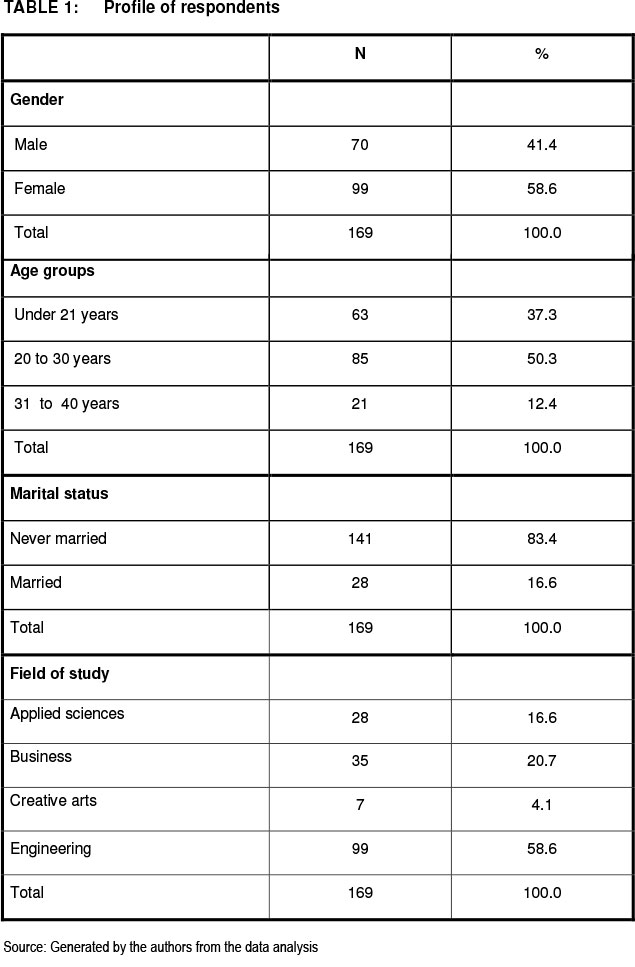
The presentation of results commences with descriptive statistics followed by inferential statistics. Table 1 illustrates the profile of the respondents by gender, age, marital status and the respondents' respective fields of study.
The results highlight that a majority of respondents were female (58.6%) while the remainder were male. Also, slightly more than half (50.3%) of the respondents were in the 20 to 30 years age category, followed by those under the age of 21 years (37.3%) and lastly the 31 to 40 years (12.4%) group respectively.
In addition, 83.4% of the respondents were not married while only 16.6% were married. A majority of the respondents (58.6%) came from the Engineering division, while Applied Sciences and Business comprised 16.6 % and 20.7 % of respondents respectively. The Creative Arts division contributed only 4.1 %.
4.2 Validity and reliability of the research instrument
The researchers emphasised face and content validity by resorting to literature and expert guidance to generate the various items to measure the three main constructs (entrepreneurship orientation, opportunity recognition beliefs and perceived entrepreneurial capabilities) of the study. For instance, extant literature suggests that any research instrument intended to assess the entrepreneurship orientation of an individual should reflect factors like risk-taking, innovativeness and pro-activeness, among others (Deb & Wiklund 2016:lnternet; Xing & Wang 2014:lnternet). Hence, these traits were included in the measuring items for the entrepreneurship orientation construct.
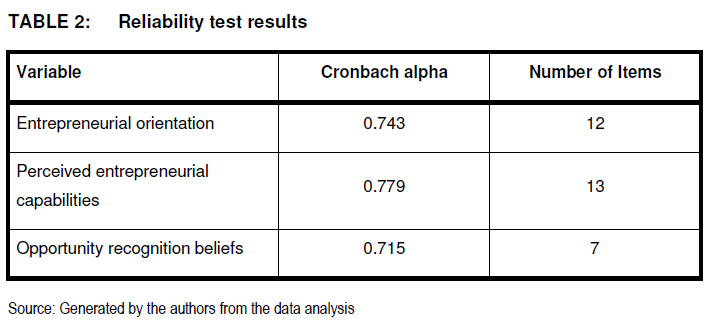
The research instrument also had redeeming aspects as exhibited by the satisfactory levels of reliability. The variables, which were the subject of the study, were also assessed for their reliability using the Cronbach's alpha test and exhibited acceptable levels of reliability as shown in Table 2.
A Cronbach's alpha of 0.7 is considered good while measures with Cronbach's alpha below 0.5 are regarded as unacceptable.
To the effect that all the measures considered had Cronbach's alpha indices above 0.7, these measures were regarded to be good.
4.3 Correlation analysis
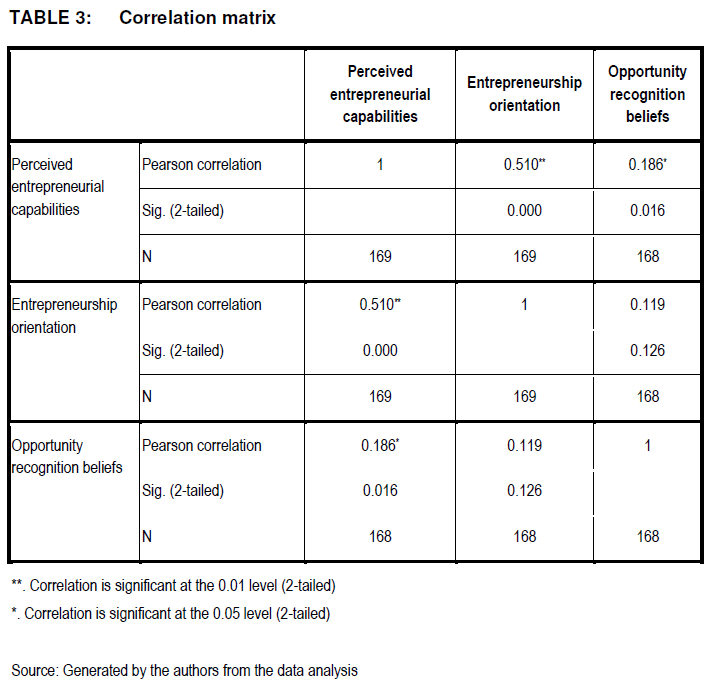
Composite scores were calculated from the numerous items measuring each of the three main variables in the study (see Table 3).
The three continuous variables namely perceived entrepreneurial capabilities, opportunity recognition beliefs and entrepreneurship orientation were then assessed for any correlations using Pearson's Correlation test.
As can be seen in Table 3, perceived entrepreneurial capabilities showed a positive and statistically significant correlation (p<0.01, r=510, n=169) to entrepreneurship orientation.
The variables opportunity recognition beliefs and entrepreneurship orientation were found to have a weak positive correlation, which was not statistically significant (p=0.126, r=119, n=169). Only one hypothesised relationship was statistically significant.
4.4 Regression analysis
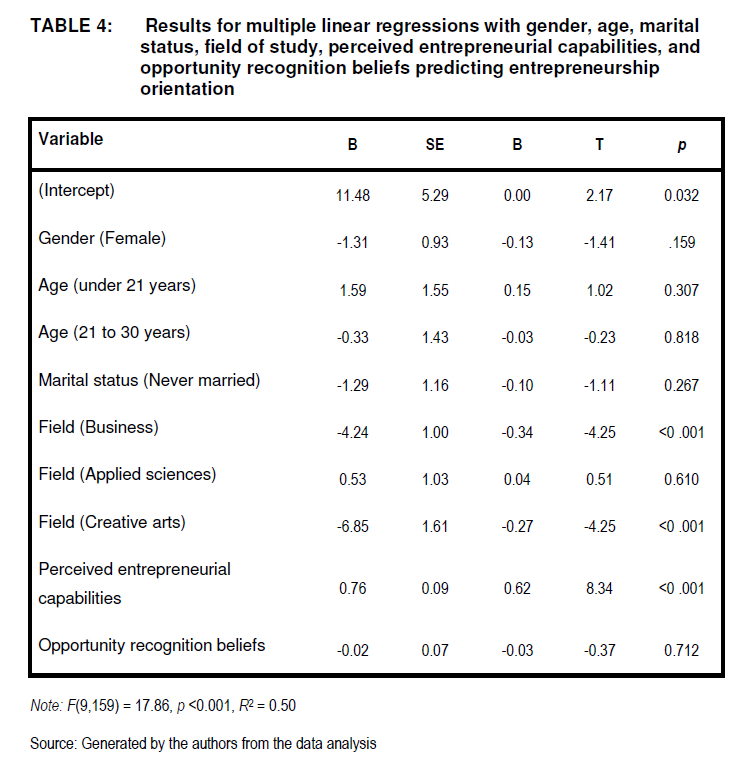
A multiple regression analysis was conducted to test the predictive ability of opportunity recognition beliefs and perceived entrepreneurial capabilities on entrepreneurship orientation. The respondents' gender, age group, marital status and field of study were included in the analysis as control variables since they could potentially affect the predictive impact of the main independent variables on the dependent variable. Since these are categorical variables, they were first dummy-coded before adding them into the regression model. The 'Enter' variable selection method was chosen for the linear regression model. This method forces all selected variables into the model.
The results of the linear regression model were significant, F{9,159) = 17.86, ρ < .001, F? = 0.50, indicating that approximately 50% of the variance in entrepreneurship orientation is explainable by gender, age, marital status, field of study, perceived entrepreneurial capabilities, and opportunity recognition beliefs. The results of the regression model are presented in Table 4.
The results presented in Table 4 reveal that, on the basis of their p-values, the following control variables had a statistically non-significant effect on the entrepreneurship orientation of the respondents: Gender (Female), Age (Under 21 years), Age (21 to 30 years), Marital status (Female), and Field of study (Applied sciences).
Of the total control factors, only Fields of study (Business) and (Creative Arts) significantly predicted the entrepreneurship orientation of respondents (B = -4.24, t(159) = -4.25, p< .001 and Β = -6.85, t( 159)= -4.25, ρ < 0.001 respectively. Based on the beta coefficients for the two control factors in the regression model, Fields of study (Business) and (Creativity) will have a statistically significant but negative predictive effect on the entrepreneurship orientation of the respondents.
Of the two main predictor variables, only perceived entrepreneurial capabilities had a significant and positive predictive effect, as shown by the p-value of <0.001 and beta coefficient of 0.76. This means that, on average, every one unit increase of perceived entrepreneurial capabilities will cause a 0.76 unit change in entrepreneurship orientation.
The other factor, opportunity recognition beliefs, had a non-significant effect as indicated by the p-value of 0.712. Amongst the predictor variables, perceived entrepreneurial capabilities thus exerted the greatest significant variance in the entrepreneurship orientation of respondents.
5. DISCUSSION
In view of the concerns about the failure of tertiary institutions in the Zimbabwe to generate sufficient entrepreneurial capacity and their obsession with training students for formal employment the current study explored the influence of perceived entrepreneurial capabilities (PEC), opportunity recognition beliefs (ORB) on entrepreneurial orientation of students.
Hypothesis 1: Perceived entrepreneurial capabilities have an influence on the entrepreneurial orientation of students
To test the hypothesis on the relationship between perceived entrepreneurial capabilities and entrepreneurial orientation of students, a correlation analysis revealed that perceived entrepreneurial capabilities had a positive statistically significant correlation (p<0.01, r=510, n=169) to entrepreneurship orientation (see Table 3). This finding is particularly important in view of the growing consensus among academics that despite an increase in comprehension of entrepreneurship orientation, academics know little about the forces or antecedents shaping it (Koellinger 2008:lnternet; Krueger 2000:9).
Consistent with outcomes from recent studies that affirm the significance of the cognitive infrastructure in influencing entrepreneurial activity, our findings reveal that perceived entrepreneurial capabilities are strongly connected to one's entrepreneurial orientation(Ahmad, Xavier & Bakar 2014:449; Krueger 2003:105; Markman, Baron & Balkin 2005:1 -19; Sánchez, Carballo & Gutiérrez 2011:433-438; Sommer & Haug 2011:111).
The connection between perceived entrepreneurial capabilities and entrepreneurship orientation was expected given that a self-perception of one's ability to perform a certain task/action was considered to enhance his/her disposition towards such task/action (Bayon, Vaillant & Lafuente 2015:27-49; Ebrahim & Schott 2008:1-20; Walker, Jeger & Kopecki 2013:181-183). Ideally when a prospective entrepreneur perceives him/herself to have a capacity to influence business outcomes positively (e.g. creating a new venture), they are naturally bound to pursue such business inclinations better than if they conceived themselves to be deficient in that respect.
Hypothesis 2: Opportunity recognition beliefs have an influence on entrepreneurial orientation of students
The second hypothesis tested the relationship between opportunity recognition beliefs and entrepreneurship orientation. Opportunity recognition beliefs and entrepreneurship orientation were found to have a weak, positive but statistically non-significant correlation. This finding implies that there is a disconnect between opportunity recognition beliefs and entrepreneurship orientation which is surprising given that literature suggests that the entrepreneurial process is driven by individuals who are alert to business opportunities and have an inclination towards acting on such opportunities.
Further, results from the regression analysis confirmed that the opportunity recognition beliefs variable did not significantly predict entrepreneurship orientation as some past studies (Ebrahim & Schott 2008:1-20; Morris, Webb, Fu & Singhal 2013:352; Piperopoulos & Dimov 2015:970) have previously shown.
Our finding is incongruent to the often expressed view that entrepreneurial behaviour is in pursuit of perceived opportunities in the business environment (Bell 2015:37; Williams 2015:151). The fact that opportunity recognition beliefs do not necessarily translate into entrepreneurship orientation may arise if the recognition of such an opportunity in the business market triggers a feeling of lack of entrepreneurial capacity, fear of failure or public exposure leading to failure to act on entrepreneurial intentions. In addition, an uncertain economic environment such as the one prevailing in Zimbabwe may deepen the perceptions of risk by potential entrepreneurs. Such perceptions may have a negative impact on their entrepreneurship intentions among risk-averse students who usually have limited economic resources to withstand the challenges associated with entrepreneurship (Bullough, Renko & Myatt 2014:492). Hence, students may prefer less risky formal employment opportunities compared to challenging entrepreneurial careers even if abundant entrepreneurship opportunities exist.
The consequence would be that even through opportunities were identified, they were not acted upon and such identification would be inconsequential to entrepreneurial behaviour in general and entrepreneurial orientation in particular. In the current study, although the respondents demonstrated high levels of entrepreneurship orientation, their opportunity recognition beliefs scores where comparatively lower signifying a degree self-doubt in their entrepreneurial abilities.
6. IMPLICATIONS
The most significant finding to emerge from this study is the importance of perceived entrepreneurial capabilities on the entrepreneurial orientation of vocational education students. In the current Zimbabwean economic environment where jobs are lost at a faster rate than they are created, and educational institutions churn out droves of graduates, possession of entrepreneurial capabilities and subsequent entrepreneurship orientation set graduates on a firm starting point in the difficult economic environment.
As a result, entrepreneurship educators should develop and entrench entrepreneurial capabilities into the curriculum rather than teach generic business management if they are to groom a self-reliant generation of potential entrepreneurs. Therefore entrepreneurship learning programmes should be designed in such a way that they emphasise learning by doing to deepen students' self-belief in their abilities to launch and manage new businesses.
Several scholars warn that employing teaching and learning methods that place less emphasis on student experience does entrench definite entrepreneurial inclinations and self-efficacy in students. Traditional pedagogical methods used in conventional management and business education cannot be transferred for implementation in entrepreneurship studies wholesale. Mueller (2011:55) advocates learning processes that involve '...business planning activities, role models, student-oriented teaching and feedback processes...1 to enhance student orientation towards business formation.
The disconnect between opportunity recognition beliefs and entrepreneurship orientation is cause for concern to educators given that it would be more ideal to have entrepreneurially-oriented graduates who recognise and exploit business opportunities they encounter. As was revealed in the literature review, the bulk of entrepreneurship is opportunity-driven and thus only those individuals who believe they can recognise and act on such opportunities stand a better chance to succeed. Therefore, entrepreneurial education encompasses and emphasises experiential learning is what is needed to instil entrepreneurship confidence in students (Belkhir 2015:73; Braun 2014:1).
Lastly, the fact that many TVET students are entrepreneurial^ oriented means that Zimbabwe has a large reservoir of untapped potential entrepreneurs. Policymakers and other stakeholders may need to institute favourable business and entrepreneurship support measures to extract economic value from such a dormant resource. Therefore, establishing business incubators at TVET institutions would be a good starting point.
7. LIMITATIONS AND DIRECTIONS FOR FUTURE RESEARCH
Some limitations in the data collection process may have impacted on the comprehensiveness of the study. For example, the independent variables were confined to only two aspects i.e. perceived entrepreneurial capabilities and opportunity recognition beliefs.
Other variables like entrepreneurship education course characteristics which potentially affects entrepreneurship orientation were not included the study. Therefore, future studies in the same area should encompass such variables to enhance their comprehensiveness. Also, socio-economic constructs should be included as potential moderating or mediating variables.
8. CONCLUSION
In this investigation, the aim was to assess the predictive effect of perceived entrepreneurial capabilities and opportunity recognition beliefs on the entrepreneurial orientation of vocational education students.
Our study confirmed that perceived entrepreneurial capabilities significantly predicted entrepreneurship orientation, in line with extant literature. The failure of opportunity recognition beliefs to significantly forecast entrepreneurship orientation is inconsistent with some established claims that business opportunities drove entrepreneurial behaviour.
Our study concludes that the perceived entrepreneurial capabilities are significant drivers of the entrepreneurship orientation of vocational education level students. This research will serve as a base for future studies and will enhance our understanding cognitive factors enhancing an individual's entrepreneurial orientation.
REFERENCES
2. LITERATURE REVIEW
- AHMAD ZS, XAVIER RS & BAKAR RA. 2014. Examining entrepreneurial intention through cognitive approach using Malaysia GEM data. Journal of Organizational Change Management 27(3):449-464.
- ALIMEHMETI G & SHAQIRI G. 2015. Factors determining entrepreneurial intentions: a case study from Albania. Academic Journal of Interdisciplinary Studies 4(3):233-240.
- ANDERSON S & EVERS N. 2015. International opportunity recognition in international new ventures - a dynamic managerial capabilities perspective, Journal of International Entrepreneurship 13(3):260-276.
- ATEF TM & AL-BALUSHI M. 2015. Entrepreneurship as a means for restructuring employment patterns. Tourism and Hospitality Research 15(2):73-90.
- AUDRETSCH DB. 2006. The knowledge spillover theory of entrepreneurship and economic growth. Research on Technological Innovation, Management and Policy9(5):37-54.
- BARBA-SÁNCHEZ V, MARTINEZ-RUIZ Μ & JIMENEZ-ZARCO A. 2007. Drivers, benefits and challenges of ICT adoption by small and medium sized enterprises: a literature review, Problems and Perspectives in Management 5(1):103-112.
- BAYON MC, VAILLANT Y & LAFUENTE E. 2015. Initiating nascent entrepreneurial activities: the relative role of perceived and actual entrepreneurial ability. International Journal of Entrepreneurial Behavior & Research 21(1):27-49,
- BELKHIR L. 2015. Embedding sustainability in education through experiential learning using innovation and entrepreneurship. Higher Education Studies 5(1):73-81.
- BELL R. 2015. Developing the next generation of entrepreneurs: giving students the opportunity to gain experience and thrive. International Journal of Management Education 13(1):37-47.
- BLUMBERG BF, COOPER DR & SCHINDLER PS. 2014. Business research methods. New York, NY: McGraw-Hill Education.
- BOEHM J. 2008. Entrepreneurial orientation in academia. Wiesbaden, DE: Springer Science & Business Media.
- BOLTON DL & LANE MD. 2012. Individual entrepreneurial orientation: development of a measurement instrument. Education and Training 54(2/3):219-233.
-
BOSMA N & LEVIE J. 2009. Global entrepreneurship monitor: global report 2009. [Internet: http://www.babson.edu/Academics/centers/blank-center/global-research/gem/Documents/gem-2009-global-report.pdf; downloaded on 2016-5-14.
» http://www.babson.edu/Academics/centers/blank-center/global-research/gem/Documents/gem-2009-global-report.pdf - ]
- BRAUN FC. 2014. Entrepreneurial self-efficacy, intent and intensity: does experiential training enhance or inhibit predisposition? Journal of Developmental Entrepreneurship 19(1):1-22.
- BRAUNERHJELM P. 2010. Entrepreneurship, innovation and economic growth. Swedish Entreprenourship Forum: 1-75.
- BULLOUGH A, RENKO M & MYATT T.2014. Danger zone entrepreneurs: the importance of resilience and self-efficacy for entrepreneurial intentions. Entrepreneurship Theory and Practice 38(3):473-499.
- CAO G, LI M , MA Y & TAO R. 2015. Self-employment and intention of permanent urban settlement: evidence from a survey of migrants in China's four major urbanising areas. Urban Studies 52(4):639-664.
- CARREE MA&THURIK AR, 2010, The impact of entrepreneurship on economic growth. In Acs ZJ & Audretsch DB (eds). Handbook of entrepreneurship research. New York, NY: Springer, pp. 557-594.
- CEYLAN S & OZDILEK Z. 2015. Improving a sample lesson plan for secondary science courses within the STEM education, Procedia-Social and Behavioral Sciences 177(1):223-228,
- CHARANTIMATH PM. 2005. Entrepreneurship development and small business enterprise. Belgaum, IND: Pearson Education.
- CHIEN SY, 2014, Franchisor resources, spousal resources, entrepreneurial orientation and performance in a couple-owned franchise outlet. Management Decision 52(5):916-933.
-
CHO Y & TIEN B. 2014. Sub-Saharan Africa's recent growth spurt: an analysis of the sources of growth. [Internet: http://papers,ssm,com/sol3/papers,cfm?abstract_id=2434910; downloaded on 2016-05-12,
» http://papers,ssm,com/sol3/papers,cfm?abstract_id=2434910 - ]
- COVIN JG & LUMPKIN GT. 2011. Entrepreneurial orientation theory and research: reflections on a needed construct. Entrepreneurship Theory and Practice 35(5):855-872.
- CRESPO Ν, MOREIRA SB & SIMÕES Ν. 2013, Who are the poor? Who are the rich? Evidence for Portugal, International Journal of Social Economics 40(6):579-590.
-
DEB Ρ & WIKLUND J. 2016. The effects of CEO founder status and stock ownership on entrepreneurial orientation in small firms, Journal of Small Business Management [Internet:doi: 10.1111 /jsbm. 1223; downloaded on 2016-05-22,
» https://doi.org/10.1111 /jsbm. 1223 - ]
- DELMAR F, DAVIDSSON Ρ & GARTNER WB. 2003. Arriving at the high-growth firm. Journal of Business Venturing 18(2):189-216.
- DUVAL-COUETIL N, SHARTRAND A & REED T. 2016, The role of entrepreneurship program models and experiential activities on engineering student outcomes, Advances in Engineering Education 5(1):1-27.
- EBRAHIM Μ & SCHOTT Τ. 2008. Entrepreneurial intention promoted by perceived capabilities, risk propensity and opportunity awareness: a global study. Halifax, Canada. (56th International Council of Small Businesses; 22 to 25 Jun.
- )
- EDOHO FM. 2015. Entrepreneurship paradigm and economic renaissance in Africa. African Journal of Economic and Management Studies 6(2):2-16.
- GYAMFI GD. 2014. Evaluating entrepreneurship education as a tool for economic growth : the Ghanaian experience. British Journal of Education, Society & Behavioural Science 4(3):318-335.
- HATAK I, HARMS R & FINK M. 2015. Age, job identification, and entrepreneurial intention. Journal of Managerial Psychology 30(1 ):38-53.
- HECHAVARRIA DM, RENKO Μ & MATTHEWS CH. 2012. The nascent entrepreneurship hub: goals, entrepreneurial self-efficacy and start-up outcomes. Small Business Economics 39(3):685-701.
-
HERRINGTON M & KELLEY D. 2012. African entrepreneurship sub-saharan african regional report. [Internet: http://www.babson.edu/Academics/centers/blank-center/global-research/gem/Documents/GEM2012AfricaReport.pdf; downloaded on 2016-05-14.
» http://www.babson.edu/Academics/centers/blank-center/global-research/gem/Documents/GEM2012AfricaReport.pdf - ]
-
HERRINGTON M, KEW J & KEW P. 2010. Tracking entrepreneeurship in South Africa: a GEM perspective. [Internet: http://www.babson.edu/Academics/centers/blank-center/global-research/gem/Documents/GEM2010SouthAfricaReport.pdf; downloaded on 2016-05-14.
» http://www.babson.edu/Academics/centers/blank-center/global-research/gem/Documents/GEM2010SouthAfricaReport.pdf - ]
-
HOSHO N, MUGUTI Ε & MUZIVIDZI D. 2013. Unlocking Zimbabwe's global competitiveness through compulsory entrepreneurship education: evidence from Chinhoyi University of Technology. [lnternet:http://s3.amazonaws.com/academia.edu.documents/32533573/Unlocking_Zimbabwes_Global_ Competitiveness_Through_Compulsory_Entrepreneurship_Education.pdf?AWSAccessKeyld=AKIAJ56TQJRTWSMTNP EA&Expires=1478703767&Signature=z28feo1tDK0cdXLrz1FbZ5yyApg%3D&response-contentdisposition=in line%3B%20filename%3DUnlocking_Zimbabwes_Global_Competitivene.pdf; downloaded on 2016-11-09.
» http://s3.amazonaws.com/academia.edu.documents/32533573/Unlocking_Zimbabwes_Global_ Competitiveness_Through_Compulsory_Entrepreneurship_Education.pdf?AWSAccessKeyld=AKIAJ56TQJRTWSMTNP EA&Expires=1478703767&Signature=z28feo1tDK0cdXLrz1FbZ5yyApg%3D&response-contentdisposition=in line%3B%20filename%3DUnlocking_Zimbabwes_Global_Competitivene.pdf - ]
- IAKOVLEVA TA, KOLVEREID L, GORGIEVSKI MJ & S0RHAUG O.2014. Comparison of perceived barriers to entrepreneurship in Eastern and Western European countries. International Journal of Entrepreneurship and Innovation Management 18(2-3):115-133.
-
INNOVATION POLICY PLATFORM. 2016. Innovation policy platform. [Internet: https://www.innovationpolicy.platform.org/; downloaded on 2016-05-14.
» https://www.innovationpolicy.platform.org/ - ]
- JIN Q, GILMARTIN SK, SHEPARD SD & CHEN HL. 2015. Comparing engineering and business undergraduate students' entrepreneurial interests and characteristics. The Journal of Engineering Entrepreneurship 6(2): 1 -24.
- KARRA Ν, PHILLIPS Ν & TRACEY P. 2008. Building the born global firm: developing entrepreneurial capabilities for international new venture success. Long Range Planning 41(4):440-458.
- KARLSSON Τ & MOBERG Κ. 2013. Improving perceived entrepreneurial abilities through education: exploratory testing of an entrepreneurial self efficacy scale in a pre-post setting. The International Journal of Management Education 11(1):1-11.
- KAUNDA CM. 2012. Entrepreneurial orientation, age of owner and small business performance in Johannesburg. Johannesburg: Witwatersrand University. (MCom dissertation,
-
)
» http://www.babson.edu/Academics/centers/blank-center/global-research/gem/Documents/GEM%202014%20Global%20 Report.pdf -
KELLEY DJ, SINGER S & HERRINGTON M. 2012. Global Entrepreneurship Monitor: global report 2011. [Internet: http://www.gemconsortium.org/; downloaded on 2016-11-09]
» http://www.gemconsortium.org/ - )
-
KOELLINGER P. 2008. Why are some entrepreneurs more innovative than others? Small Business Economics, [Internet: DOI: 10.1007/s11187-008-9107-0; downloaded on 2016-05-10,
» https://doi.org/10.1007/s11187-008-9107-0 - ]
- KRUEGER JR. NF. 2000. The cognitive infrastructure of opportunity emergence. Entrepreneurship: Theory & Practice 24:9-27.
- KRUEGER JR NF. 2003. The cognitive psychology of entrepreneurship. In Acs Ζ & Audretsch D (eds). Handbook of entrepreneurship research. New York, NY: Springer, pp. 105-140.
- KRUEGER N, HANSEN D, MICHL Τ & WELSH D. 2011. Thinking sustainably: the role of intentions, cognitions and emotions in understanding new domains of entrepreneurship. In Lumpkin GT & Katz J (eds). Social and sustainable entrepreneurship: advances in entrepreneurship, firm emergence and growth. Bingley, UK: Emerald Group, pp. 275-299.
- LIM WL & XAVIER SR. 2015. Opportunity recognition framework: exploring the technology entrepreneurs. American Journal of Economics 5(2):105-111.
- LIN S & ENVICK BR. 2013. Gender and entrepreneurial orientation: a multi-country study. International Entrepreneurship and Management Journal 9(3):465-482.
- LIN J & NABERGOJ AS. 2014. A resource-based view of entrepreneurial creativity and its implication in entrepreneurship education. Bangkok: Bangkok University. (2nd International Conference on Innovation and Entrepreneurship, 6-7 Feb.
- )
- LUMPKIN GT, HILLS GE & SHRADER RC. 2004. Opportunity recognition. In Welsch HP (ed.) Entrepreneurship: the way ahead. New York, NY: Routledge. pp. 73-90.
- LUONG MH. 2015. Global entrepreneurship monitor: Vietnam 2014 report. Hanoi, Vietnam: Vietnam News Agency Publishing House.
- MARESCH D, HARMS R, KAILER Ν & WIMMER-WURM Β. 2016. The impact of entrepreneurship education on the entrepreneurial intention of students in science and engineering versus business studies university programs. Technological Forecasting and Social Change 10(4): 172-179.
- MARKMAN GD, BARON RA, BALKIN DB. 2005. Are perseverance and self-efficacy costless? Assessing entrepreneurs' regretful thinking. Journal of Organizational Behavior 26(1):1-19.
- MARLOW S & McADAM M. 2013. Gender and entrepreneurship: advancing debate and challenging myths; exploring the mystery of the under-performing female entrepreneur. International Journal of Entrepreneurial Behavior^ Research 19(1):114-124.
- MILLER D. 2011. Miller (1983) revisited: a reflection on EO research and some suggestions for the future. Entrepreneurship: Theory and Practice 35(5):873-894.
- MCGRATH R & MACMILLAN I. 2000. Discovery driven planning. Boston, MA: Harvard Business Press.
- MORRIS MH, WEBB JW, FU J & SINGHAL S. 2013. A competency-based perspective on entrepreneurship education: conceptual and empirical insights. Journal of Small Business Management 51 (3):352-369.
- MUELLER SL & DATO-ON MC. 2013. A cross cultural study of gender-role orientation and entrepreneurial self-efficacy. International Entrepreneurship and Management Journal 9(1):1-20.
- MUELLER S. 2011. Increasing entrepreneurial intention: effective entrepreneurship course characteristics. International Journal Entrepreneurship and Small Business 13(1 ):55-74.
- NAFUKHO FM & MUYIA MAH.2010. Entrepreneurship and socioeconomic development in Africa: a reality or myth? Journal of European Industrial Training 34(2):96-109.
- NENEH BN. 2011. The impact of entrepreneurial characteristics and business practice on the long term survival of small and medium enterprises (SMEs). Bloemfontein: University of the Free State. (MCom dissertation.
- )
- NIEUWENHUIZEN C & SWANEPOEL E. 2015. Comparison of the entrepreneurial intent of master's business students in developing countries: South Africa and Poland. Acta Commera 15(1):1-10.
- OECD see ORGANISATION FOR ECONOMIC CO-OPERATION AND DEVELOPMENT
- ORGANISATION FOR ECONOMIC CO-OPERATION AND DEVELOPMENT. 2012. Culture: entrepreneurial perceptions and attitudes. Paris, FR: OECD Publishing.
- PFEIFER S, SARLIJA Ν & ZEKIC M. 2016. Shaping the entrepreneurial mindset: entrepreneurial intentions of business students in Croatia. Journal of Small Business Management 54(1):102-117.
- PROPSTMEIER J. 2011. Antecedents of entrepreneurial behavior-opportunity recognition, entrepreneurial intention and the role of human capital. Raleigh, NC: Lulu Entreprises.
- RAE D. 2014. Opportunity-centred entrepreneurship. New York, NY: Palgrave Macmillan.
- RUNYAN RC, GE B, DONG Β & SWINNEY JL. 2012. Entrepreneurial orientation in cross-cultural research: assessing measurement invariance in the construct. Entrepreneurship Theory and Practice 36(4):819-836.
- SAJILAN S, HADI NU & TEHSEEN S. 2015. Impact of entrepreneur's demographic characteristics and personal characteristics on firm's performance under the mediating role of entrepreneur orientation. Review of Integrative Business and Economics Research 4(2):36-52.
- SANTOS FJ, ROOMI MA & LIÑÁN F. 2016. About gender differences and the social environment in the development of entrepreneurial intentions, Journal of Small Business Management 54(1):49-66.
- SAUNDERS MN, LEWIS P & THORNHILL A. 2009. Research methods for business students. 5th ed. New Delhi, IND: Pearson Education.
- SCHMITT-RODERMUND E & VONDRACEK FW. 2002. Occupational dreams, choices and aspirations: Adolescents' entrepreneurial prospects and orientations. Journal of Adolescence 25(1):65-78.
-
SCHWAB K & SALA-I-MARTÍN X. 2014. The global competitiveness report. [Internet: http://www.weforum.org/pdf/Global_Competitiveness_Reports/Reports/factsheet_gcr03.pdf; downloaded on 2016-05-13.
» http://www.weforum.org/pdf/Global_Competitiveness_Reports/Reports/factsheet_gcr03.pdf - ]
-
SHANE S, LOCKE EA & COLLINS CJ. 2012. Entrepreneurial motivation. [Internet: http://digitalcommons.ilr.cornell.edu/articles/830; downloaded on 2016-13-05.
» http://digitalcommons.ilr.cornell.edu/articles/830 - ]
- SHANE S & NICOLAOU N. 2015. Creative personality, opportunity recognition and the tendency to start businesses: a study of their genetic predispositions. Journal of Business Venturing 30(3):407-419.
- SHRADER RC & HILLS GE. 2015. Opportunity recognition: perceptions of highly successful entrepreneurs. Journal of Small Business Strategy 14(2):92-108.
- ]
- SINGH RP & GIBBS RR. 2013. Opportunity recognition processes of black entrepreneurs. Journal of Small Business & Entrepreneurship 26(6):643-659.
- SLEVIN DP & TERJESEN SA, 2011, Entrepreneurial orientation: reviewing three papers and implications for further theoretical and methodological development. Entrepreneurship: Theory and Practice 35(5):973-987.
- STÖCKMANN C, KOLLMANN Τ, LINSTAEDT JW & PESCHL Α. 2015. Linking narcissism and business planning via self-efficacy and entrepreneurial orientation. Academy of Management Proceedings 2015(1): 16684-16684.
- SULLIVAN DM & MEEK WR. 2012. Gender and entrepreneurship: a review and process model. Journal of Managerial Psychology 27(5):428-458.
- UNITED NATIONS EDUCATIONAL, SCIENTIFIC AND CULTURAL ORGANIZATION. 2010. Guidelines for TVET policy review (ED/ESB/TVET/2010/02). Paris, FR: UNESCO.
-
VINIG TG & DORRESTEIJN W. 2007. Determinants of entrepreneurial orientation among students: a comparative study of Dutch, Norwegian and Israeli students. [Internet:https://papers.ssrn.com/sol3/papers.cfm?abstract_id=1Q2Q576; downloaded on 2016-08-09.
» https://papers.ssrn.com/sol3/papers.cfm?abstract_id=1Q2Q576 - ]
-
VOLKMANN C, WILSON KE, MARIOTTI S, RABUZZI D, VYAKARNAM S & SEPULVEDA A. 2009. Unlocking entrepreneurial capabilities to meet the global challenges of the 21st Century: a report of the global education initiative at the World Economic Forum. [lntemet:http://www,gvpartners.com/web/pdf/WEF_EE_Full_Report.pdf; downloaded on 2016-07-07.
» http://www,gvpartners.com/web/pdf/WEF_EE_Full_Report.pdf - ]
- WALKER JK, JEGER Μ & KOPECKI D. 2013. The role of perceived abilities, subjective norm and intentions in entrepreneurial activity. Journal of Entrepreneurship 22(2):181-202.
- WHITE RJ & D'SOUZA RR. 2014. Links between learning speed and opportunity recognition. Annals of Entrepreneurship Education and Pedagogy':21-43.
- WILLIAMS CC. 2015. Beyond necessity-driven entrepreneurship: a study of informal entrepreneurs in England. Entrepreneurship and Innovation 9(3):157-165.
- WOLDESENBET K, RAM Μ & JONES T. 2012. Supplying large firms: the role of entrepreneurial and dynamic capabilities in small businesses. International Small Business Journal 30(5):493-512.
- WU L. 2007. Entrepreneurial resources, dynamic capabilities and start-up performance of Taiwan's high-tech firms. Journal of Business Research 60(3):549-555.
- YLINENPÄÄ H. 2009. Entrepreneurship and innovation systems: towards a development of the ERIS/IRIS concept. European Planning Studies 17(8):1153-1170.
- YONG GLA & HO KW. 2006. Innovation, imitation and entrepreneurship. The Singapore Economic Review 51(02):147-173.
-
XING R & WANG G. 2014. A study on the innovation path of technology-based incubated enterprise from the perspective of entrepreneurial orientation. [Internet:http://en.cnki.com.cn/Article_en/CJFDTotal-KXXG201407014.htm; downloaded on 2016-05-13.
» http://en.cnki.com.cn/Article_en/CJFDTotal-KXXG201407014.htm - ]
- ZALI M, MOBARAKI Μ & FARSI J. 2014. The impact of entrepreneurial ideas and cognitive style on students entrepreneurial intention. Journal of Entrepreneurship in Emerging Economies 6(2):140-162.