The effect of entrepreneurial role models on entrepreneurial intention in South Africa
Abstract
This article reports on a study that investigates the effect of different entrepreneurial role models on entrepreneurial intention and the antecedents of entrepreneurial intention and determines whether or not the knowledge of different entrepreneurial role models varies among the respondents based on their entrepreneurial intention and the antecedents of entrepreneurial intention. A quantitative survey was conducted using a structured questionnaire among 355 final-year commerce students from a comprehensive university in the Eastern Cape and a university of technology in Limpopo. SPSS was used to analyse the data. While significant relationships were found between entrepreneurial role models and entrepreneurial intention and all its antecedents, the results showed that different entrepreneurial role models vary in their relationship with entrepreneurial intention and the antecedents of entrepreneurial intention. The findings revealed that the knowledge of entrepreneurial role models differed significantly among the respondents who had high and low entrepreneurial intention; positive and negative attitudes towards becoming an entrepreneur; high and low perceived behavioural control; strong and weak subjective norms; and high and low entrepreneurial self-efficacy. The results have implications for both entrepreneurship educators and policymakers with regard to entrepreneurship education and policy interventions that could stimulate the entrepreneurial career choice.
Eastern Cape; entrepreneurial intention; entrepreneurial role models; Limpopo
1. INTRODUCTION
Promoting entrepreneurship as a viable career alternative and attempts to understand the associated influences have attracted the attention of policymakers and entrepreneurship scholars (Department of Trade and Industry (DTI) 2013:8; Nyock llouga, Nyock Mouloungni & Sahut 2014:717-718). On the one hand, policymakers are of the view that stimulating entrepreneurial activity can be a solution to rising unemployment rates and can facilitate economic growth (Bridge, O'Neill & Martin 2009:333 & 335; DTI 2013:8). On the other hand, researchers are concerned with both factors that influence entrepreneurial activity and precursors to entrepreneurial behaviour (Boyd & Vozikis 1994:64; Gnyawali & Fogel 1994:44-45).
While various factors can facilitate and inhibit entrepreneurial activity (Cuervo 2005:298-299; Singer, Amorós & Moska 2015:20), it is also acknowledged that entrepreneurship is a social activity that is shaped by the social environment to which entrepreneurs belong (Hisrich, Peters & Shepherd 2008:61; Stephan & Uhlaner 2010:1358).
Researchers indicate that the social environment that is abundant with entrepreneurial role models has a positive effect on the propensity to enterprise (Gnyawali & Fogel 1994:55), entrepreneurial activity (Alsos, Bruyneel & Carter 2007:lnternet; Driga, Lafuente & Vaillant 2005:lnternet), entrepreneurial motivation (Malebana 2014:721; Rahman & Day 2013:28) and the formation of entrepreneurial intentions (Carr & Sequeira 2007:1095; Díaz-García & Jiménez-Moreno 2010:275; Malebana 2016:15). Entrepreneurial role models are individuals who by their attitudes, behaviours and actions influence the desirability and credibility of an entrepreneurial career choice for an individual (Driga et al. 2005:lnternet).
Prior research findings indicate that entrepreneurial intentions precede entrepreneurial activity (Douglas 2013:637; Rauch & Hulsink 2015:196). Thompson (2009:676) defines entrepreneurial intention as self-acknowledged convictions by individuals that they intend to establish new business ventures in the future. Stimulating entrepreneurial intentions has become crucial in South Africa due to a low percentage of individuals who have entrepreneurial intentions of 11.8% and a low total entrepreneurial activity rate of 7.0% (Herrington, Kew & Kew 2015:21-22). As a result, research that examines the determinants of entrepreneurial intentions and activity could help to change this situation.
This study examines whether or not different entrepreneurial role models vary in their impact on entrepreneurial intention and the determinants of entrepreneurial intention based on the social cognitive theory and the theory of planned behaviour. The findings could be valuable to policymakers and entrepreneurship educators in terms of designing policy interventions and entrepreneurship education that could promote the entrepreneurial career choice.
The antecedents of entrepreneurial intention namely, entrepreneurial self-efficacy, the attitude towards becoming an entrepreneur, perceived behavioural control and subjective norms are fundamental concepts in the social cognitive theory and the theory of planned behaviour. These theories are discussed in the following sections in order to shed light on the effect of entrepreneurial role models on entrepreneurial intention and its antecedents.
2.1 Social cognitive theory
Perceived self-efficacy is the core concept in the social cognitive theory that influences an individual's actions and self-motivation (Bandura 1986:21). Self-efficacy refers to "people's judgements of their capabilities to organize and execute courses of action required to attain designated types of performances" (Bandura 1986:391). Perceived self-efficacy affects the choices individuals make, the effort they exert in the chosen activities or behaviours and their perseverance in the face of difficulties and setbacks (Bandura 1986:393-394).
The term entrepreneurial self-efficacy was formed from self-efficacy (Chen, Greene & Crick 1998:297; De Noble, Jung & Ehrlich 1999:lnternet). Entrepreneurship scholars define entrepreneurial self-efficacy as the degree to which individuals believe that they have the necessary skills to successfully start a new business venture (Brice & Spencer 2007:52) or individuals' "beliefs in their own abilities to perform on the various skill requirements necessary to pursue a new venture opportunity" (De Noble et al. 1999:lnternet). The value of entrepreneurial self-efficacy lies in its ability to distinguish entrepreneurs from non-entrepreneurs (Chen et al. 1998:308), the positive relationship it has with individuals' preparation efforts of launching a new venture (De Noble et al. 1999: Internet), its influence on the effectiveness of individuals in managing a new venture once it has been founded (Forbes 2005:599) and the positive effect it has on new venture performance (Moesel & Santiago 2008:1259).
Role models and self-efficacy have a positive effect on an individual's career choice (Bandura 1986:432; Quimbly & DeSantis 2006:302). According to the social cognitive theory, role models can influence individuals' career choices in two ways.
Firstly, role models are vital for observational learning. Observing role models being rewarded with valued outcomes for performing a particular behaviour could encourage other individuals to engage in the same behaviour (Bandura 1986:301). Secondly, seeing other individuals who are perceived as similar to oneself succeed could heighten one's self-efficacy beliefs (Bandura 1986:399; Laviolette & Radu 2008:12).
Individuals who have high entrepreneurial self-efficacy are more likely to report strong intentions for starting a business (De Noble et al. 1999:lnternet; Díaz-García & Jiménez-Moreno 2010:274; Farashah 2015:13) and become nascent entrepreneurs and infant entrepreneurs (Alsos et al. 2007:lnternet). According to Alsos eí al. (2007:lnternet), nascent entrepreneurs are individuals "who have performed managerial tasks, owned all or part of the nascent firm and has been paying wages, salaries or any payment in kind for a period no longer than three months." An Infant entrepreneur is defined as an individual "who has paid wages or salaries for between three and 42 months."
2.2 Theory of planned behaviour
The theory of planned behaviour has gained popularity as a model for studying entrepreneurial intention in both developed and developing countries (for example, Gird & Bagraim 2008:711; lakovleva, Kolveried & Stephan 2011:354; Mahmoud & Muharam 2014:17; Malebana & Swanepoel 2015:91). These researchers have all confirmed the value of this theory in understanding entrepreneurial intention with regard to all the antecedents of entrepreneurial intention. The theory of planned behaviour is not only valuable in entrepreneurship intention research but it can guide the design and evaluation of the effectiveness of interventions that are targeted at influencing entrepreneurial intention and the antecedents of entrepreneurial intention (Ajzen 2005:136-139, Ajzen 2011:85 & 94).
According to the theory of planned behaviour, an individual's intention to start a business is determined by that individual's attitude towards the behaviour or entrepreneurship, subjective norms and perceived behavioural control (Ajzen 2005:117-118). The attitude towards the behaviour is concerned with whether an individual has a positive or negative evaluation regarding the performance of a particular behaviour. The behaviour that leads to favourable outcomes will generate positive attitudes and vice versa (Ajzen 2005:124).
Subjective norms refer to individuals' beliefs pertaining to approval or disapproval of performing a particular behaviour by specific individuals or groups or whether these specific individuals or groups engage or do not engage in the same behaviour. The more individuals believe that their social referents would approve of performing a particular behaviour and they are motivated to comply with these social referents' expectations the higher will be the perceived social pressure to perform the behaviour.
Perceived behavioural control is an individual's perceived self-efficacy or ability to perform a particular behaviour (Ajzen 2005:118), which involves beliefs about the factors that could inhibit or facilitate the successful performance of the behaviour (Ajzen 2005:125).
2.3 Entrepreneurial role models and the formation of entrepreneurial intention
Previous research findings indicate that entrepreneurial role models have a positive effect on entrepreneurial intention (BarNir, Watson & Hutchins 2011:283; Dohse & Walter 2012:887) and the antecedents of entrepreneurial intention (Díaz-García & Jiménez-Moreno 2010:275; Karimi, Biemans, Lans, Chizari, Mulder & Mahdei 2013:208).
According to researchers, exposure to entrepreneurial role models enhances entrepreneurial self-efficacy (BarNir et al. 2011:283; Farashah 2015:14) and contributes to positive entrepreneurial attitudes, perceived behavioural control and subjective norms (Karimi et al, 2013:208; Walter & Dohse 2009:20).
Moreover, entrepreneurial intention can be influenced by positive discussions and involvement in the role models' businesses (Van Auken, Fry & Stephens 2006a:164-165). However, it should be pointed out that the impact of entrepreneurial role models on entrepreneurial intention and its antecedents tend to vary based on the population being studied, as indicated by the findings of Liñán and Chen (2009:606) and Van Auken, Stephens, Fry and Silva (2006b:330-332).
Among entrepreneurial role models that can influence an individual's entrepreneurial career choice are namely, parents, brothers or sisters, other relatives, other entrepreneurs and successful entrepreneurs (Hisrich ef al. 2008:61). While family members or parents and close friends who are entrepreneurs stimulate entrepreneurial intention (Dohse & Walter 2012:887; Pruett, Shinnar, Toney, Llopis & Fox 2009:581), the effects of these role models tend to vary on the antecedents of entrepreneurial intention (for example, Carr & Sequeira 2007:1095; Díaz-García & Jiménez-Moreno 2010:275; Malebana 2016:15; Walter & Dohse 2009:20; Zapkau, Schwens, Steinmetz & Kabst 2015:647-648).
Exposure to entrepreneurial role models can provide an individual with the opportunity to acquire entrepreneurial experience (Krueger 1993:10). Entrepreneurial role models can be a source of positive or negative entrepreneurial experience that can facilitate or inhibit the formation of entrepreneurial intention by impacting on the antecedents of entrepreneurial intention (García-Rodríguez, Gil-Soto, Ruiz-Rosa & Sene 2015:523; Zhang, Duysters & Cloodt 2014:634-637). For example, Van Auken et al. (2006a:165) report that entrepreneurial intention can be positively influenced by directly observing and hearing about the positive aspects of the role model's career.
Entrepreneurial role models who are perceived to be high performers have a stronger effect on entrepreneurial career preference and entrepreneurial self-efficacy than those who are perceived as low performers (Scherer, Adams, Carley & Wiebe 1989:62-65). Geissler and Zanger's (2013:8-11) findings show that perceived success of entrepreneurial role models and identification with role models influence entrepreneurial self-efficacy while identification with role models impacts positively on the attitude towards entrepreneurship and opportunity identification. In addition, Laviolette, Lefebvre and Brunei (2012:733) indicate that in order for role models to influence entrepreneurial self-efficacy and entrepreneurial intention individuals should identify with role models, hold favourable attitude towards the message conveyed by the role models and experience positive emotional arousal.
While not all individuals would have access to entrepreneurial role models, entrepreneurship education can play a vital role in exposing students to entrepreneurial role models, which can be in the form of guest speakers and the use of case studies (Laviolette & Radu 2008:14; Laviolette et at. 2012:735 & 737). Case studies that portray successful entrepreneurship promote identification with the role model and generate favourable attitudes towards the role model (Laviolette et al. 2012:733). Mueller (2011:66-67) found that entrepreneurship education that provides students with the opportunity to interact with entrepreneurial role models has a positive effect on the attitude towards the behaviour but not perceived behavioural control.
In summary, the literature as discussed above indicates that having entrepreneurial role models is vital in the formation of entrepreneurial intention. More specifically, entrepreneurial role models increase the attractiveness of the entrepreneurial career, the perceived social pressure to start a business and the perceived capability for starting a business. However, the effects of these role models vary depending on the degree of interaction between an individual and role models, whether one is exposed to positive or negative experiences and the perceived success of role models.
3. PROBLEM INVESTIGATED
Despite the sufficient empirical evidence of the importance of entrepreneurial role models in stimulating entrepreneurial intention, research on the effect of different entrepreneurial role models on entrepreneurial intention and the antecedents of entrepreneurial intention is still scarce.
Prior research in South Africa has not yet reached consensus on the relationship between entrepreneurial role models and entrepreneurial intention and the focus of this research was only on entrepreneurial intention as a dependent variable (for example, Farrington, Venter & Louw 2012:45; Gird & Bagraim 2008:718-719; Muofhe & Du Toit 2011:13). The research problem for this study is to determine the effect of different entrepreneurial role models on entrepreneurial intention and the antecedents of entrepreneurial intention.
4. RESEARCH OBJECTIVES
In order to fill the gaps that have been stated in the problem statement, the primary objective of the study was to establish the relationship between entrepreneurial role models, entrepreneurial intention and the antecedents of entrepreneurial intention. The secondary objective was to determine whether or not the knowledge of different entrepreneurial role models varies between individuals who have high and low entrepreneurial intention, positive and negative attitude towards becoming an entrepreneur, high and low perceived behavioural control, strong and weak subjective norms and high and low entrepreneurial self-efficacy.
5. RESEARCH METHODOLOGY
5.1
Research designThe study used a descriptive research design which followed a quantitative research approach. A cross-sectional survey was conducted among final-year commerce students in the Limpopo and the Eastern Cape. The chosen research design, approach and method allowed the researchers to collect the data on the demographic characteristics, beliefs, perceptions and attitudes from a large number of respondents so that they could be analysed statistically and be used to describe the individuals studied.
5.2
Population and sampleThe population comprised 814 third-year students who were registered for full-time studies in 2010 for commercial diplomas at two selected universities in the Limpopo and the Eastern Cape provinces. Although the researcher intended to use a census survey of all 814 students, only 355 students participated in the study owing to lack of co-operation from lecturers on other campuses and the absence of some students from lectures that were beyond the researcher's control.
In line with previous research on entrepreneurial intention (Liñan & Chen 2009:602), this sample of students was chosen as a purposive and convenient sample, because as final-year students they were facing important career decisions upon completion of their studies, and starting their own business was a possible option.
The researcher obtained permission from the Heads of Department at the two selected institutions to involve their lecturers and students in the research project. The researcher ensured that the respondents' personal details are kept confidential and that they are not harmed in any way by participating in this study.
5.3 Measuring instrument
Data were collected using a structured questionnaire that was distributed by lecturers to students during their lectures at the two institutions. All the questions pertaining to entrepreneurial intention and its antecedents were adopted without alteration from Liñán and Chen's (2009:612-613) validated entrepreneurial intention questionnaire.
Although this questionnaire was initially tested on the Spanish and Taiwanese samples, it has also been validated in both developed and developing countries (for example see lakovleva et al. 2011:358; Mahmoud & Muharam 2014:19; Malebana & Swanepoel 2015:96).
Questions measuring entrepreneurial intention and its antecedents in the theory of planned behaviour were based on a five-point Likert scale (1=Strongly disagree, 5=Strongly agree). Entrepreneurial self-efficacy was measured by asking the respondents to indicate their level of confidence in their ability to carry out entrepreneurial tasks using a five-point Likert scale (1=Very low confidence, 5=Very high confidence) based on the measures adopted from Kickul and D'lntino (2005:42-43); Kolvereid and Isaksen (2006:377) and McGee, Peterson, Mueller and Sequeira (2009:978).
Questions on entrepreneurial role models measured the respondents' knowledge of entrepreneurs in the family, friends who are entrepreneurs, other people who are entrepreneurs and successful entrepreneurs in the community. These measures were derived from Liao and Welsch (2005:354); Liñán and Santos (2007:448) and Malebana (2012:401).
The questionnaire also had demographic questions that were based on a nominal scale, which involved gender, age, name of institution and qualifications enrolled for, prior employment experience, and prior entrepreneurial exposure (whether the respondents currently own a business or have tried to start a business before or were from an entrepreneurial family background or have friends who run a business or knew other people who are entrepreneurs [1=Yes and 0=No; 1=Male and 0=Female]).
5.4 Data analysis
The Statistical Package for the Social Sciences (SPSS) was used to analyse the data. Descriptive statistics were used for the sample characteristics. Hierarchical multiple regression analysis was used to test the relationship between entrepreneurial role models and the dependent variables, namely: entrepreneurial intention, the attitude towards becoming an entrepreneur, perceived behavioural control, subjective norms and entrepreneurial self-efficacy. The Mann-Whitney U test was used to test the differences among the respondents with regard to their knowledge of entrepreneurial role models and the dependent variables.
The reliability of the measuring instrument was tested by means of Cronbach's alpha. Cronbach's alpha values for the independent and dependent variables were as follows: role models (0.777); perceived behavioural control (0.818); subjective norms (0.826); the attitude towards becoming an entrepreneur (0.872); entrepreneurial intention (0.903); and entrepreneurial self-efficacy (0.940).
Since these values were above 0.7, the measuring instrument was considered to be reliable for use in this study (Field 2013:712). Exploratory factor analysis was conducted using principal component analysis which extracted a five-factor solution with eigenvalues greater than one that in combination accounted for 60.9% of variance. Kaiser-Meyer-Olkin (KMO) measure of sampling adequacy was 0.900, which was well above the acceptable limit of 0.5 (Field 2013:695). Bartlett's Test of Sphericity was highly significant (p < 0.001). Overall, the results suggest that factor analysis was appropriate for the data.
Data were also tested for the independence of errors and multicollinearity. The values of the Durbin-Watson statistic ranged from 1.377 to 1.986, which were well within the acceptable range from 1 to 3 as suggested by Field (2013:337).
Therefore, the data did not violate the assumption of independence of errors. The tolerance values ranged from 0.543 to 0.710 and since they were larger than 0.2, this means that multicollinearity was not a problem. Variance inflation factors (VIF) ranged from 1.017 to 1.840, which were also highly satisfactory since they were below 10.
6. RESULTS
6.1
Demographic profile of the respondentsA total number of 355 respondents participated in the study. The majority (77.7%) of the respondents were from a comprehensive university in the Eastern Cape, while 22.3% was from a university of technology in Limpopo. Of the 355 respondents, 67.8% was female and 32.2% was male. The majority (76.1%) of these respondents were between 18 and 24 years, 22.5% was between 25 and 34 years and just above one percent was between 35 and 64 years. In terms of prior exposure to entrepreneurship, 6.6% of the respondents were currently running their own businesses; 26.7% had tried to start a business before; 34% came from the families with members who were running businesses; 28% had friends who are running businesses; while 57.8% knew other people who are entrepreneurs. With regard to employment experience, 30.8% of the respondents were previously employed.
6.2
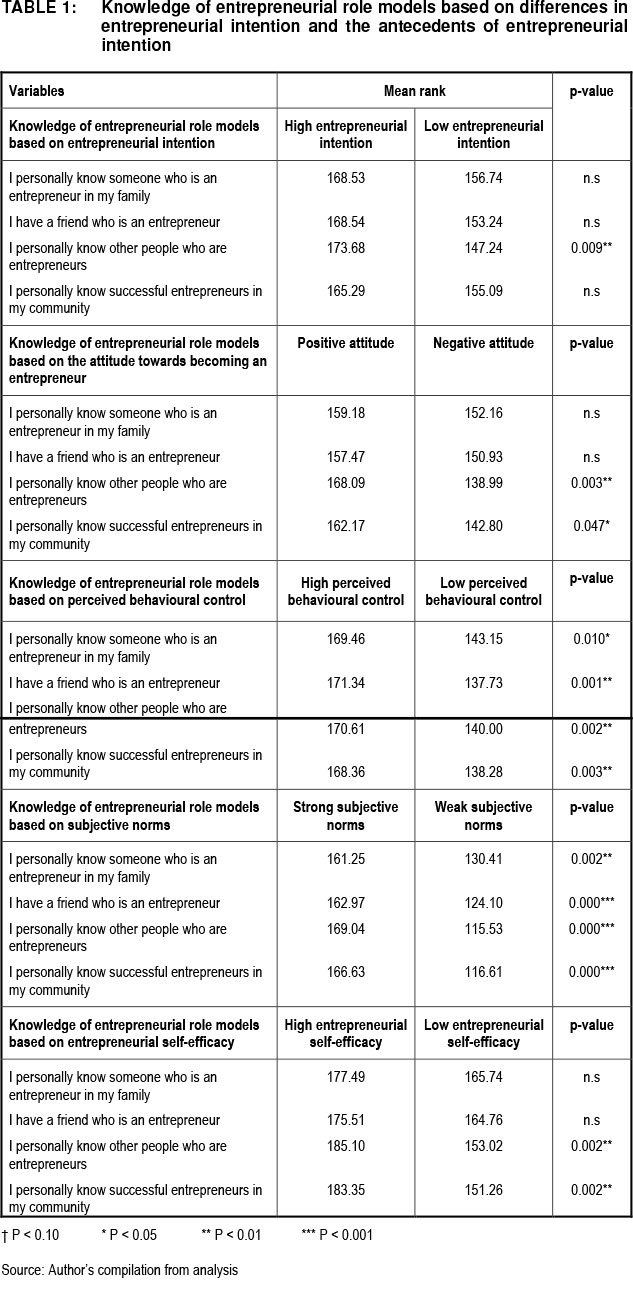
Knowledge of entrepreneurial role models based on the antecedents of entrepreneurial intention and entrepreneurial intentionMann-Whitney U test results (Table 1) revealed that the knowledge of entrepreneurial role models differed significantly among the respondents who had high and low entrepreneurial intention; positive and negative attitudes towards becoming an entrepreneur; high and low perceived behavioural control; strong and weak subjective norms; and high and low entrepreneurial self-efficacy.
However, the findings indicate that these differences vary between entrepreneurial intention and the antecedents of entrepreneurial intention, especially on having family members and friends who are entrepreneurs and knowing successful entrepreneurs in their communities. The respondents who had high entrepreneurial intention were significantly different from those who had low entrepreneurial intention only on personal knowledge of other people who are entrepreneurs (p = 0.009).
The findings indicate that the respondents who had high entrepreneurial intention knew more about other people who are entrepreneurs than those who had low entrepreneurial intention.
Significant differences were found between the respondents who had positive attitudes towards becoming an entrepreneur and those who had negative attitudes towards becoming an entrepreneur on personal knowledge of both other people who are entrepreneurs (p = 0.003) and successful entrepreneurs in the community (p = 0.047).
The results suggest that the respondents who had positive attitudes towards becoming an entrepreneur had more knowledge about both other people who are entrepreneurs and successful entrepreneurs in their communities than those who had negative attitudes towards becoming an entrepreneur.
The respondents who had high perceived behavioural control were significantly different from those who had low perceived behavioural control on personal knowledge of all entrepreneurial role models, namely, having family members who are entrepreneurs (p = 0.010), having a friend who is an entrepreneur (p = 0.001), and knowing both other people who are entrepreneurs (p = 0.002) and successful entrepreneurs in the community (p = 0.003).
The results indicate that the respondents who had high perceived behavioural control knew more about all types of entrepreneurial role models than those who had low perceived behavioural control.
Moreover, the findings revealed significant differences between the respondents who had strong subjective norms and those with weak subjective norms on the knowledge of all types of entrepreneurial role models. The respondents who had strong subjective norms had family members who are entrepreneurs (p = 0.002), they had friends who are entrepreneurs (p = 0.000) and knew both other people who are entrepreneurs (p = 0.000) and successful entrepreneurs in the community (p = 0.000) than those who had weak subjective norms.
With regard to entrepreneurial self-efficacy, the respondents who had high entrepreneurial self-efficacy differed significantly from those who had low entrepreneurial self-efficacy on personal knowledge of both other people who are entrepreneurs (p = 0.002) and successful entrepreneurs in the community (p = 0.002).
The findings suggest that the respondents who had high entrepreneurial self-efficacy knew more about both other people who are entrepreneurs and successful entrepreneurs in their communities than those who had low entrepreneurial self-efficacy.
6.3 The relationship between entrepreneurial role models, entrepreneurial intention and the antecedents of entrepreneurial intention
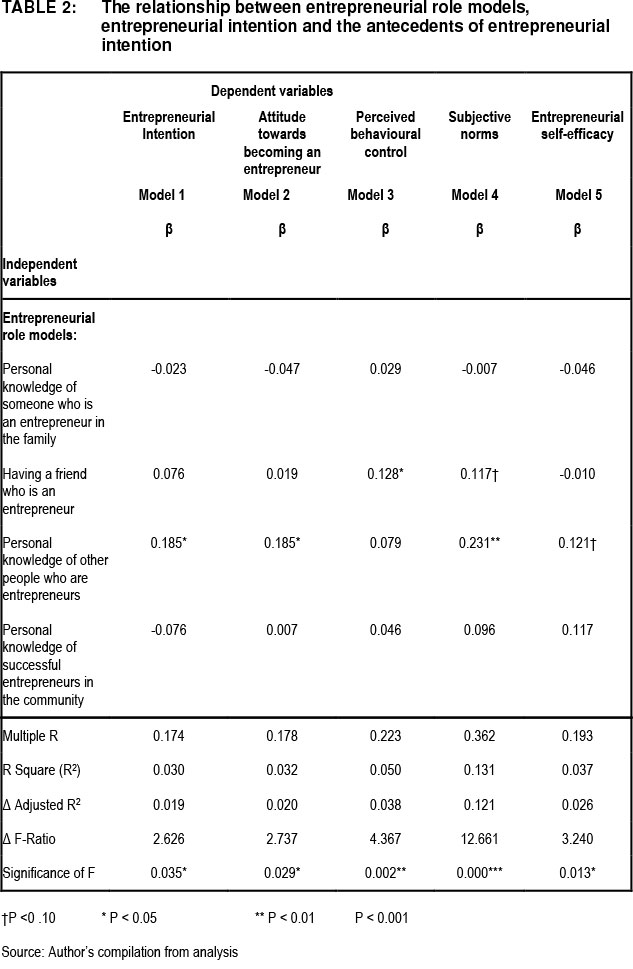
The regression results (Table 2) show that entrepreneurial role models had a significant but very weak relationship with entrepreneurial intention, the attitude towards becoming an entrepreneur, perceived behavioural control, subjective norms and entrepreneurial self-efficacy.
However, the findings indicate that the different role models vary in their relationship with entrepreneurial intention and the antecedents of entrepreneurial intention. Entrepreneurial role models (Model 1) accounted for 3% of variance in entrepreneurial intention (F (4, 335) = 2.626; ρ < 0.05).
Of the four types of entrepreneurial role models, only personal knowledge of other people who are entrepreneurs was significantly related to entrepreneurial intention (β = 0.185, ρ < 0.05). Entrepreneurial role models (Model 2) explained 3.2% of variance in the attitude towards becoming an entrepreneur (F (4, 335) = 2.737; ρ < 0.05), with only personal knowledge of other people who are entrepreneurs being significantly related to the attitude towards becoming an entrepreneur (β = 0.185, ρ < 0.05).
Entrepreneurial role models (Model 3) accounted for 5% of variance in perceived behavioural control (F (4, 367) = 2.737; ρ < 0.01). Having a friend who is an entrepreneur was the only type of entrepreneurial role model that was significantly related to perceived behavioural control (β = 0.128, ρ < 0.05).
The findings (Model 4) revealed that just over 13% of variance in subjective norms can be explained by entrepreneurial role models (F (4, 335) = 12.661; ρ < 0.001). Both having a friend who is an entrepreneurs (β = 0.117, ρ < 0.10) and personal knowledge of other people who are entrepreneurs (β = 0.231, ρ < 0.01) were significantly related to subjective norms. Entrepreneurial role models (Model 5) accounted for 3.7% of variance in entrepreneurial self-efficacy (F (4, 335) = 3.240; ρ < 0.05), with only personal knowledge of other people who are entrepreneurs being significantly related to entrepreneurial self-efficacy (β = 0.121, ρ < 0.10).
The results show that entrepreneurial role models have a higher impact on subjective norms than on entrepreneurial intention, the attitude towards becoming an entrepreneur, perceived behavioural control and entrepreneurial self-efficacy. Despite the varying effects of entrepreneurial role models, the findings suggest that entrepreneurial role models have a positive effect on entrepreneurial intention and the antecedents of entrepreneurial intention.
6.4 The relationship between entrepreneurial role models and start-up experience
Sample characteristics indicate that 6.6% of the respondents were running their own businesses and 26.7% had tried to start a business before. As a result, it became necessary to determine whether there was a significant relationship between entrepreneurial role models and start-up experience, and to establish whether having entrepreneurial role models was a differentiating factor between those who had started their own business and those who did not do so.
Regression analysis results show that 9.4% of the likelihood of being someone who is currently running a business can be explained by having entrepreneurial role models (F (4, 331) = 8.572; ρ < 0.001). Being someone who is currently running a business had a significant relationship with having an entrepreneur in the family (β = 0.169, ρ < 0.01) and a friend who is an entrepreneur (β = 0.131, ρ < 0.05).
Moreover, the findings revealed that 8.7% of the likelihood of being someone who has tried to start a business before can be accounted for by having entrepreneurial role models (F {4, 326) = 7.731; ρ < 0.001). A significant relationship was found between having tried to start a business before and having an entrepreneur in the family {β = 0.173, ρ < 0.01) and knowing both other people who are entrepreneurs (β = 0.217, ρ < 0.01) and successful entrepreneurs in the community (β = -0.168, ρ < 0.05).
These findings suggest that entrepreneurial role models with exception of knowing successful entrepreneurs in the community have a positive effect on the launch of a new venture.
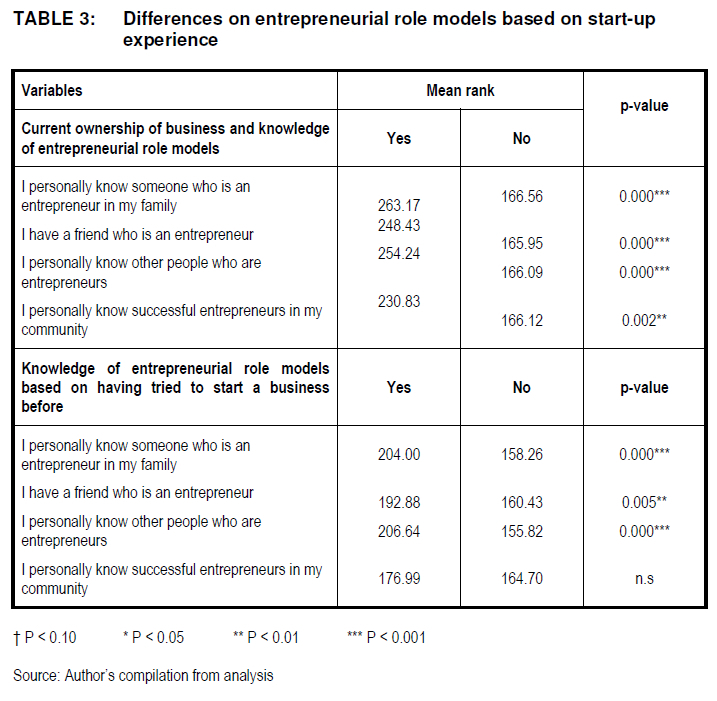
The results of the Mann-Whitney U test (Table 3) indicate that the respondents who were running their own businesses differed significantly on the knowledge of all entrepreneurial role models from those who were not running businesses.
In addition, the respondents who had tried to start their own businesses before were significantly different from those who have not tried to do so on both having entrepreneurs in the family and friends who are entrepreneurs and having more knowledge of other people who are entrepreneurs.
7. IMPLICATIONS
Intention-based models could be valuable to both entrepreneurship educators and policymakers in designing and evaluating interventions that are aimed at stimulating entrepreneurial intention and changing the antecedents of entrepreneurial intention. With regard to the findings of this study, entrepreneurship educators can enhance the formation of entrepreneurial intention and impact positively on the antecedents of entrepreneurial intention by using case studies and entrepreneurs as guest speakers in their classrooms.
More specifically, to have the desired effects, these case studies and entrepreneurs should convey more information about what it takes to become an entrepreneur, what it involves and the potential benefits of being an entrepreneur. The case studies and guest speakers chosen should be representative of successful family entrepreneurship to change entrepreneurial intentions and the antecedents of entrepreneurial intention of students who have been exposed to only the negative experiences of family entrepreneurship. These case studies and guest speakers, where possible, should also be similar to students in terms of gender and other demographics so as to facilitate social comparison and identification with these role models.
The low explanatory power of entrepreneurial role models on entrepreneurial intention and the antecedents of entrepreneurial intention, as it has also been found in BarNir etal. (2011-283-284), suggest that entrepreneurial role models should not be the only intervention for stimulating entrepreneurial intentions.
In addition to providing tangible and intangible support, policymakers should partner with the media to increase exposure of entrepreneurial role models as part of an integrated intervention for stimulating entrepreneurial intention and ultimately improving rural entrepreneurial activity. It is crucial that the media includes successful and unsuccessful entrepreneurial role models to provide a realistic and balanced picture of the entrepreneurial world. Equipped with the knowledge of what contributes to success and failure, individuals would be able to take actions that would ensure success and help them avoid failure when they start their own ventures.
8. LIMITATIONS AND FUTURE RESEARCH
The limitations of this study include the use of convenience samples and its cross-sectional nature. The fact that entrepreneurial role models had a significant relationship with the entrepreneurial intention and the antecedents of entrepreneurial intention does not mean that these role models would influence entrepreneurial behaviour of the respondents. More research is needed in other rural provinces of South Africa and elsewhere to determine the effect of the different types of entrepreneurial role models on entrepreneurial intention and entrepreneurial activity.
9. CONCLUSION
The purpose of this study was to determine the effect of different entrepreneurial role models on entrepreneurial intention and the antecedents of entrepreneurial intention, and to determine whether or not the knowledge of entrepreneurial role models vary based on individuals' entrepreneurial intention, the attitude towards becoming an entrepreneur, subjective norms, perceived behavioural control and entrepreneurial self-efficacy. The findings of the five regression analysis models showed that entrepreneurial role models have a significant relationship with entrepreneurial intention and the antecedents of entrepreneurial intention.
However, the findings indicate that the different entrepreneurial role models vary in terms of their effects on entrepreneurial intention and the antecedents of entrepreneurial intention. In support of Muofhe and Du Toit (2011:13), the results suggest the importance of entrepreneurial role models in the formation of entrepreneurial intention in South Africa.
Surprisingly and contrary to prior research (Carr & Sequeira 2007:1095; Scherer et al. 1989:62; Walter & Dohse 2009:20), having entrepreneurs in the family did not have a significant effect on both entrepreneurial intention and the antecedents of entrepreneurial intention. The results indicate that the experiences of family entrepreneurship in South Africa are not so positive to stimulate the entrepreneurial career choice as similar results have been reported by Gird and Bagraim (2008:719) and Farrington et al. (2012:45).
Personal knowledge of successful entrepreneurs did not have a significant relationship with entrepreneurial intention and the antecedents of entrepreneurial intention. This finding suggests that these entrepreneurs were too distant from the respondents and thus prevented both social comparison and a sense of identification with the respondents that were necessary to stimulate entrepreneurial intention and the antecedents of entrepreneurial intention.
The findings indicate that having a friend who is an entrepreneur had a positive effect on perceived behavioural control and subjective norms. Personal knowledge of other people who are entrepreneurs had a positive influence on entrepreneurial intention, the attitude towards becoming an entrepreneur, subjective norms and entrepreneurial self-efficacy.
The results support prior research that has found a significant relationship between entrepreneurial role models and entrepreneurial intention (Alsos et aí. 2007:lnternet) and the antecedents of entrepreneurial intention (BarNir et al. 2011:283; Díaz-García & Jiménez-Moreno 2010:275; Farashah 2015:14; Karimi eí aí. 2013:208). In line with Scherer et al. (1989:65), the results support the value of the social learning theory in understanding the influence of entrepreneurial role models on the entrepreneurial career choice.
The findings indicate that the knowledge of entrepreneurial role models differed significantly among the respondents who had high and low entrepreneurial intention; positive and negative attitudes towards becoming an entrepreneur; high and low perceived behavioural control; strong and weak subjective norms; and high and low entrepreneurial self-efficacy. The significant relationship between entrepreneurial role models and being someone who is currently running a business and someone who has tried to start a business before suggests that entrepreneurial role models are vital in encouraging individuals to engage in the efforts of launching new ventures.
Furthermore, the results have shown that having entrepreneurial role models accounts for significant differences between individuals who launch new ventures and those who do not attempt to do so. These results corroborate the findings of Driga et aí. (2005:lnternet) and Alsos et al. (2007:lnternet).
The study contributes to entrepreneurial intention research by providing new insights on the effect of different entrepreneurial role models on entrepreneurial intention, the antecedents of entrepreneurial intention and entrepreneurial activity. While the majority of entrepreneurial intention research used role models as an aggregate concept, this study has shown that different types of entrepreneurial role models have varying effects in the formation of entrepreneurial intention, especially in the rural provinces of South Africa, the Eastern Cape and Limpopo.
The results of this study indicate that entrepreneurial role models are vital in improving the low entrepreneurial intention and entrepreneurial activity rates in a developing country such as South Africa.
REFERENCE LIST
Acknowledgements
The researcher would like to thank the National Research Foundation for the partial funding of this study and Professor F, Liñán (University of Seville, Spain) for the Entrepreneurial Intention Questionnaire,_
2. LITERATURE REVIEW
- AJZEN I. 2005. Attitudes, personality and behaviour. 2nd ed. Berkshire, UK: Open University Press.
- AJZEN I. 2011. Behavioral interventions: design and evaluation guided by the theory of planned behaviour. In Mark MM, Donaldson SI & Campbell BC (eds). Social psychology for program and policy evaluation (pp. 74-100). New York, NY: Guilford.
- ALSOS GA, BRUYNEEL S & CARTER S. 2007. Gender differences in entrepreneurial intentions and business start-up. Madrid, SPA: Babson College. (Babson College Entrepreneurship Research Conference; 7-9 June) [Full article received from the authors.
- ]
- BANDURA A. 1986. Social foundation of thought and action-a social cognitive theory. Englewood Cliffs, Ν J: Prentice-Hall.
- BARNIR A, WATSON WE & HUTCHINS HM. 2011 Mediation and moderated mediation in the relationship among role models, self-efficacy, entrepreneurial career intention and gender. Journal of Applied Social Psychology 42(2):270-297.
- BRICE J & SPENCER B. 2007. Entrepreneurial profiling: a decision policy analysis of the influence of entrepreneurial self-efficacy on entrepreneurial intent. Academy of Entrepreneurship Journal 13(2):47-64.
- BRIDGE S, O'NEILL Κ & MARTIN F. 2009. Understanding enterprise, entrepreneurship and small business. 2nd ed. Houndmills, Basingstoke, UK: Palgrave Macmillan.
- CARR JC & SEQUEIRA JM. 2007. Prior family business exposure as intergenerational influence and entrepreneurial intent: a theory of planned behaviour approach. Journal of Business Research 60:1090-1098.
- CHEN CC, GREENE PG & CRICK A. 1998. Does entrepreneurial self-efficacy distinguish entrepreneurs from managers? Journal of Business Venturing 13(4):295-316.
- CUERVO A. 2005. Individual and environmental determinants of entrepreneurship, International Entrepreneurship and Management Journal 1 (3):293-311.
-
DE NOBLE AF, JUNG D & EHRLICH SB. 1999, Entrepreneurial self-efficacy: The development of a measure and its relationship to entrepreneurial action. [Internet: http://www.babson.edu/entrep/fer/papers99/l/l_C/IC%20Text.htm; downloaded on 12 December 2015.
» http://www.babson.edu/entrep/fer/papers99/l/l_C/IC%20Text.htm - ]
-
DEPARTMENT OF TRADE AND INDUSTRY. 2013. Youth Enterprise Development Strategy 2013-2023. [Internet: http://www.dti.gov.za; downloaded on 13 March 2014.
» http://www.dti.gov.za -
]
» http://www.gemconsortium.org/report - DÍAZ-GARCÍA MC & JIMÉNEZ-MORENO J. 2010. Entrepreneurial intention: the role of gender. International Entrepreneurship and Management Journal 6(3):261-283.
- DOHSE D & WALTER SG. 2012. Knowledge context and entrepreneurial intentions among students. Small Business Economics 39(4):877-895.
- DOUGLAS EJ. 2013. Reconstructing entrepreneurial intentions to identify predisposition for growth. Journal of Business Venturing 28(5):633-651.
-
DRIGA O, LAFUENTE Ε & VAILLANT Y. 2005. Gender differences in entrepreneurial activity: an analysis of informal institutional factors. [Internet: http://www.sbaer.uca.edu/research/icsb/2005/065.pdf; downloaded on 18 August 2007.
» http://www.sbaer.uca.edu/research/icsb/2005/065.pdf - ]
- DTI see DEPARTMENT OF TRADE AND INDUSTRY
-
FARASHAH AD. 2015. The effects of demographic, cognitive and institutional factors on development of entrepreneurial intention: toward a socio-cognitive model of entrepreneurial career. Journal of International Entrepreneurship DOI 10.1007/s10843-015-0144-x: 1 -23.
» https://doi.org/10.1007/s10843-015-0144-x - FARRINGTON SM, VENTER DJL & LOUW MJ. 2012. Entrepreneurial intentions: demographic perspectives of South African business students. South African Journal of Business Management 43(3):41-49.
- FIELD A. 2013. Discovering statistics using IBM SPSS Statistics. 4,h ed. London, UK: Sage.
- FORBES DP. 2005. The effects of strategic decision making on entrepreneurial self-efficacy. Entrepreneurship Theory and Practice 29(5):599-622.
- GARCÍA-RODRÍGUEZ FJ, GIL-SOTO E, RUIZ-ROSA I & SENE PM. 2015. Entrepreneurial intentions in diverse development contexts: a cross-cultural comparison between Senegal and Spain. International Entrepreneurship and Management Journal 11 (3):511-527.
- GEISSLER Μ & ZANGER C. 2013. Entrepreneurial role models and their impact on the entrepreneurial pre-founding process. Ponce, Puerto Rico: International Council for Small Business. (581h World Conference of the International Council for Small Business; 20-23 June.
- )
- GNYAWALI DR & FOGEL DS. 1994. Environments for entrepreneurship development: key dimensions and research implications. Entrepreneurship Theory and Practice 18(4):43-62.
-
]
» http://www.gemconsortium.org/docs/download/3616 - HISRICH RD, PETERS MP & SHEPHERD DA. 2008. Entrepreneurship. 7,h ed. New York, NY: McGraw-Hill.
- IAKOVLEVA T, KOLVEREID L & STEPHAN U. 2011. Entrepreneurial intentions in developing and developed countries. Education and Training 53(5):353-370.
- KARIMI S, BIEMANS HJA, LANS T, CHIZARI M, MULDER Μ & ΜΑΗDEI ΚΝ. 2013. Understanding role models and gender influences on entrepreneurial intentions among college students. Procedia-Social and Behavioral Sciences 93:204-214.
- KICKUL J & D'INTINO RS. 2005, Measure for measure: modelling entrepreneurial self-efficacy onto instrumental tasks within the new venture creation process. New England Journal of Entrepreneurship Fall, 8(2):39-47.
- KOLVEREID L & ISAKSEN E. 2006. New business start-up and subsequent entry into self-employment. Journal of Business Venturing 21(6):866-885.
- KRUEGER N. 1993. The impact of prior entrepreneurial exposure on perceptions of new venture feasibility and desirability. Entrepreneurship Theory and Practice 18(1):5-21.
- LAVIOLETTE EM & RADU M. 2008, Symbolic role models and entrepreneurial intention, Halifax, Nova Scotia, Canada: International Council for Small Business. (53rd International Council for Small Business conference; 22-25 June 2008.
- )
- LIÑÁN F & CHEN Y. 2009. Development and cross-cultural application of a specific instrument to measure entrepreneurial intentions. Entrepreneurship Theory and Practice 33(3):593-617'.
- LIÑÁN F & SANTOS FJ. 2007. Does social capital affect entrepreneurial intentions? International Advances in Economic Research 13:443-453.
- MAHMOUD MA & MUHARAM FM. 2014. Factors affecting the entrepreneurial intention of PhD candidates: a study of Nigerian international students of UUM. European Journal of Business and Management 6(36):17-24.
- MALEBANA MJ. 2012. Entrepreneurial intent of final-year commerce students in the rural provinces of South Africa. Pretoria: University of South Africa. (DCom-thesis.
- )
- MALEBANA MJ. 2014. Entrepreneurial intentions and entrepreneurial motivation of South African rural university students. Journal of Economics and Behavioral Studies 6(9):709-726.
- MALEBANA MJ. 2016, The influencing role of social capital in the formation of entrepreneurial intention, Southern African Business Review (In press).
- MALEBANA MJ & SWANEPOEL E. 2015. Graduate entrepreneurial intentions in the rural provinces of South Africa. Southern African Business Review 19(1 ):89-111.
- MCGEE JE, PETERSON M, MUELLER SL & SEQUEIRA JM. 2009. Entrepreneurial self-efficacy: refining the measure. Entrepreneurship Theory and Practice 33(4):965-988.
- MOESEL D & SANTIAGO J. 2008. Perceived entrepreneurial ability, business relationships, and performance among minority and non-minority entrepreneurs in the Midwest. San Antonio, Texas: United States Association for Small Business and Entrepreneurship. (USASBE 2008 conference proceedings; 10-13 January)
- MUELLER S. 2011. Increasing entrepreneurial intention: effective entrepreneurship course characteristics. International Journal of Entrepreneurship and Small Business 13(1 ):55-74.
-
MUOFHE NJ & DU TOIT W. 2011. Entrepreneurial education's and role models' influence on career choice. South African Journal of Human Resource Management 9(1), Art. #345, 15 pages. [Internet: http://dx.doi.org/10.4102/sajhrm.v9i1.345; downloaded 21 November 2013.
» http://dx.doi.org/10.4102/sajhrm.v9i1.345 - ]
- PRUETT M, SHINNAR R, TONEY B, LLOPIS F & FOX J. 2009. Explaining entrepreneurial intentions of university students: a cross-cultural study. International Journal of Entrepreneurial Behaviour and Research 15(6):571-594.
- QUIMBLY JL & DESANTIS AM. 2006. The influence of role models on women's career choices. The Career Development Quarterly 54:297-306.
-
RAHMAN Η & DAY J. 2013. Who is your role model? The relationship between role models and student entrepreneurial motivation. [Internet: http://sbaer.uca.edu/research/icsb/2012/Rahman%20142.pdf; downloaded on 19 March 2014.
» http://sbaer.uca.edu/research/icsb/2012/Rahman%20142.pdf - ]
- RAUCH A & HULSINK W. 2015. Putting entrepreneurship education where the intention to act lies: an investigation into the impact of entrepreneurship education on entrepreneurial behaviour. Academy of Management Learning and Education 14(2): 187-204.
- SCHERER RF, ADAMS JS, CARLEY SS & WIEBE FA. 1989. Role model performance effects on development of entrepreneurial career preference, Entrepreneurship Theory and Practice 13(3):53-71,
- ]
- STEPHAN U & UHLANER LM. 2010. Performance-based vs socially supportive culture: a cross-national study of descriptive norms and entrepreneurship. Journal of International Business Studies 41:1347-1364.
- THOMPSON ER. 2009. Individual entrepreneurial intent: construct clarification and development of an internationally reliable metric. Entrepreneurship Theory and Practice 33(3):669-694.
- VAN AUKEN H, FRY FL & STEPHENS P. 2006a, The influence of role models on entrepreneurial intentions, Journal of Developmental Entrepreneurship 11 (2): 157-167.
- VAN AUKEN H, STEPHENS P, FRY FL & SILVA J. 2006b. Role model influences on entrepreneurial intentions: a comparison between USA and Mexico. Entrepreneurship Management 2:325-336.
-
WALTER SG & DOHSE D. 2009, The interplay between entrepreneurship education and regional knowledge potential informing entrepreneurial intentions. [Internet: www.ifw-kiel.de; downloaded on 13 November 2015.
» www.ifw-kiel.de - ]
- ZAPKAU FB, SCHWENS C, STEINMETZ Η & KABST R. 2015, Disentangling the effect of prior entrepreneurial exposure on entrepreneurial intention. Journal of Business Research 68:639-653.
- ZHANG Y, DUYSTERS G & CLOODT M. 2014. The role of entrepreneurship education as a predictor of university students' entrepreneurial intention. International Entrepreneurship and Management Journal 10(3):623-641.