The effect of organisational citizenship behaviour and unethical pro-organisational behaviour on the relationship between ethical leadership and organisational culture
Abstract
PURPOSE OF THE STUDY: This study investigated the relationship between ethical leadership (EL) and organisational culture (Oc), focusing on the mediating roles of organisational citizenship behaviour (OCB) and unethical pro-organisational behaviour (UPB) within the context of a financial services company in Africa. Given that no empirical study had been performed on the combined mediating effect of OCB and UPB on the relationship between EL and OC, the research aimed to address this significant gap in the literature DESIGN/METHODOLOGY/APPROACH: The study was quantitative in nature, which adopted an explanatory method where empirical data comprising 194 survey responses was obtained from a financial services company to test the hypotheses FINDINGS: The research results affirmed that EL is positively and significantly related to OC, where EL is posited to enhance OC by fostering trust and collaboration among employees. Furthermore, OCB was found to mediate the relationship between EL and OC. This indicates that promoting OCB is essential for fostering a favourable OC. On the other hand, the results showed that UPB does not mediate the relationship between EL and OC RECOMMENDATIONS/VALUE: This research contributes to the understanding of how EL influences OC and highlights the importance of fostering OCB in organisational settings MANAGERIAL IMPLICATIONS: The practical implications provide valuable insights for leaders and scholars aiming to enhance organisational effectiveness and ethical conduct JEL CLASSIFICATION: D23, M14, L840, C31
ethical leadership; financial services; organisational culture; organisational citizenship behaviour; unethical pro-organisational behaviour
1. INTRODUCTION
The example set by leaders can have an impact on the ethical behaviour of followers at lower levels. Put differently, when a leader demonstrates ethical behaviour, it is reasonable to assume that followers will follow suit and create a shared understanding of what constitutes proper behaviour. No study was identified that has included both organisational citizenship behaviour (OCB) and pro-organisational behaviour (UPB) as variables. Existing literature tends to treat these behaviours in isolation, overlooking the possibility that they may operate as competing mechanisms, one reinforcing ethical norms (OCB) and the other potentially undermining them (UPB). This omission is particularly pronounced in the African financial sector, where cultural values such as Ubuntu intersect with ethical leadership practices, creating a unique context for understanding these dynamics.
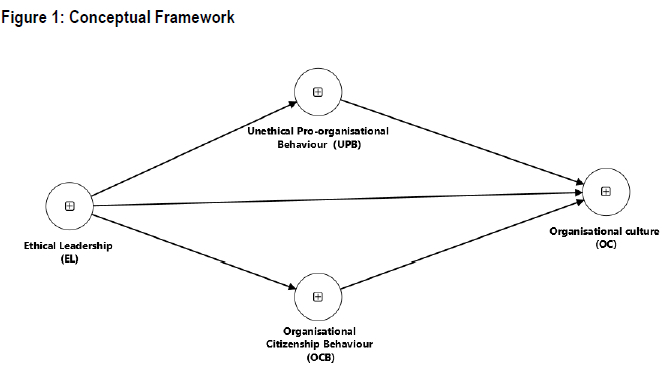
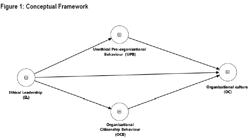
Considering that leaders influence followers' actions (Hsieh et al., 2020), the current paper presents an empirical analysis of the relationship between EL and OC and examines and proposes a theoretical model outlining the potential mediating effects of OCB and UPB as illustrated in Figure 1. Thus, the first purpose of the study was to examine the relationship between EL and OC, and secondly, to investigate the mediating effects of OCB and UPB on the relationship between EL and OC. To this end, the paper builds on previous studies of EL, OC, and OCB, respectively, and its contribution lies in its examination of the mediating effects of two variables, providing valuable insights into how these constructs interact. The paper, therefore, advances the literature by:
a) Integrating dual mediators (OCB and UPB) into a single model to test their simultaneous influence on the EL-OC relationship.
b) Introducing the African/ Ubuntu ethical perspective, which emphasises communal values and moral integrity, to explain why OCB aligns with ethical leadership while UPB conflicts with it.
1.1
Problem statementThe research problem under consideration was whether there is a positive and significant relationship between EL and OC, and whether OCB and UPB mediate this relationship. This study is also the first of its kind to examine the relationships between these variables in the context of the financial sector in Africa. The financial sector is crucial for economic stability and growth. Thus, ethical leadership in this sector can assist in preventing financial scandals and crises, which in turn can have widespread negative impacts on the economy and society at large (Smith, 2014). Additionally, Africa presents a unique economic and social context characterised by rapid growth, diverse cultures, including varying levels of economic development. In this sense, this diversity necessitates a nuanced approach to leadership that considers local ethical norms and practices. In summary, the financial sector in Africa is a critical area for the study due to its role in economic development, the unique challenges and opportunities present in the region, and the potential to influence broader societal outcomes through improved governance and ethical standards.
1.2
Research objectivesThe purpose of the research was to investigate the mediating effects of OCB and UPB on the relationship between ethical leadership and organisational culture. In doing so, the following objectives were investigated:
1) Determine whether ethical leadership has a significant positive relationship with organisational culture.
2) Determine whether OCB and UPB positively mediate the relationship between ethical leadership and organisational culture.
This paper began with an introduction that outlined the research context, purpose, problem statement and research objectives. Next, it will review the literature related to the constructs under the study, focusing on the relationship between EL and OC, including the mediating effects of OCB and UPB. The theoretical and empirical foundations are discussed, followed by the methodology section, which highlights the research methodology that was adopted in the study, including the aim and main hypotheses, and ethical considerations. The results of the study's data analysis are then presented, followed by a discussion of these findings. The final section of the paper highlights the study's key findings and offers management and future research recommendations, and discusses the study's limitations, practical implications, and contributions.
The concept of ethical or responsible leadership is said to be a social and normative phenomenon that develops through interactions between leaders and their followers (Maak & Pless, 2006). In their review of sixty years of research on leadership in Africa, Fourie et al. (2017) concluded that the research has covered an extensive range of themes, including a few studies on ethical leadership. In an African context, ethical leadership has largely been explored from the perspective of the concept of Ubuntu (Malunga, 2006; Muchiri, 2011; Adeleye et al., 2020; Sipondo, 2025) based on the idea that leaders who embody Ubuntu principles seem to be better equipped to create environments where ethical behaviour is the norm, and the well-being of all members is prioritised. Additionally, Ubuntu is thought to have an impact on the organisational culture and the development of leadership in African organisations (Van der Colff, 2003; Fourie et al., 2017). However, many areas of leadership remain under-researched in an African context (Muchiri, 2011), including Brown et al. 's (2005) concept of ethical leadership.
This study, therefore, builds on the work of Brown et al. (2005), who developed a model for ethical leadership. This study explored the relationship between ethical leadership and organisational culture and the mediating effects of OCB and UPB on this relationship. According to Brown et al. (2005), ethical leadership involves modelling normatively acceptable behaviour for followers through one's own behaviour and interpersonal interactions, as well as encouraging such behaviour through decision-making, two-way communication, and reinforcement.
Organisational culture is said to represent an aspect of the workplace environment that helps employees understand their own and others' actions (Jones et al., 2007). According to Kaptein (2009) and Tsai (2011), it relates to an informal organisational control structure comprising common values, beliefs, perceptions, and customs. Ethical leadership shapes organisational culture by impacting the attitudes, convictions, and actions of employees (Shin, 2012). This is further supported by the positive correlation between ethical leadership and employees' work-related attitudes and behaviours (Resick et al., 2013). Thus, leaders serve as informative nets of organisational policies and processes for employees (Mayer et al., 2010).
The concept of organisational citizenship behaviour (OCB) is described within the workplace as conduct relating to employees voluntarily assisting others in the workplace, promoting the eminence of their organisation and leaders in the absence of an explicit or implicit promise of reward for such behaviour (Wang et al., 2023). Resick et al. (2013) highlight two dimensions underpinning OCBs. First, a behaviour relating to co-workers and their helpful attributes and information sharing with each other, and second, a dimension aimed at the organisation itself and the promotion of the organisation's services and products. Thus, OCB is seen as a contributory benefit not only to the actor but the collective (Van Dyne et al., 2000).
At the core of UPB is that it encourages actions whose intention is to advance the effectiveness of an organisation whilst transgressing ethical norms, values, and standards or adequate employee behaviour (Umphress & Bingham, 2011), and adversely affect the organisation and its culture (Giberson et al., 2009). Thus, UPB involves actions that advance the objectives of an organisation, but which are morally questionable and socially unacceptable (Hsieh et al., 2020).In considering ethical leadership in an African context, Mitonga-Monga et al. (2016), found that ethical leadership mediates the link between workplace ethics culture and engagement in Namibia, reinforcing the role of ethics in shaping organisational behaviour in African organisations. Sipondo (2025) conceptualised Ubuntu-based ethical leadership in African public sector organisations, emphasising communal values and moral responsibility.
Turning to the mediating variables, the literature review evidenced that OCB mediates numerous relationships, with the research predominantly conducted in the Middle East (Ekowati et al., 2013; Khokhar & Zia-ur-Rehman, 2017; Alshihabat & Atan, 2020; Alhashedi et al., 2021; Hanaysha et al., 2022; Hanaysha, 2023), and Asian countries (Han et al., 2016; Jiang et al., 2017; Setyowati et al., 2021).
Furthermore, the focus has been on education (Khokhar & Zia-ur-Rehman, 2017; Alshihabat & Atan, 2020; Setyowati et al., 2021; Hanaysha et al., 2022; Hanaysha, 2023), the banking industry (Ekowati et al., 2013), and the private sector (Han et al., 2016; Alhashedi et al., 2021). Accordingly, research has neglected to test this mediation effect within the African financial sector context, and from a review of the literature, the mediating effect of UPB has not yet been investigated. Africa provides a unique setting for evaluating these opposing mediators, as Ubuntu's emphasis on interconnection and community well-being is in line with OCB's cooperative character but fundamentally contradicts UPB's norm-violating inclinations.
Consequently, the study presented an empirical analysis of the relationship between ethical leadership and organisational culture, examining and proposing a theoretical model outlining the potential mediating effects of OCB and UPB as illustrated in Figure 1.
Having regard to the conceptual framework, prior studies (Setyowati et al., 2021; Hanaysha et al., 2022) show that OCB mediates the ethical leadership-organisational culture relationship as it operationalises the leader's influence on collective norms. However, UPB fails as a mediator since ethical leadership reduces UPB, making it more of a potential suppressor than a mediator.
3. METHODOLOGY
The explanatory research method is described by Cohen et al. (2000) and Rahi (2017) as research that aids in determining the causes of a specific phenomenon's occurrence. Given this objective, the explanatory method was adopted in this study. From a quantitative perspective, the process can be understood as explaining the causal relationship between inputs and outputs (Fischer et al., 2017). A survey research method was utilised to gather data, and a questionnaire was distributed electronically (i.e., online via Teams Forms).
The biographic profile of the participants was based on gender, race, age group, line of business, hierarchical level, tenure within the organisation, and educational level. A frequency method was used to determine the frequency distribution of all these variables, and a total of 560 staff members were invited to participate in the survey. After three weeks of data collection, a total of 198 responses were obtained. Of the 198 received responses, four were deleted as retaining them would likely result in biased results. But for this, all data were found to have all the values and consistent responses. To obtain accurate results from the research, the Inverse Square Root Method (Kock & Haday, 2018) was used to determine a minimum sample size, and based on a path coefficient, β = 0.20 was 155. A post hoc analysis using the lowest, path coefficient, β = -0.178, required a sample size, n = 195. As such, the 194 was adequate at a significance level of 5% with adequate statistical power (80%).
3.1 Measures
Multi-item measures, comprising 41 items, were used in this study. The ethics leadership scale (ELS) (comprising 10 items), developed by Brown, Treviño and Harrison (2005), was used to measure ethical leadership. When adopted by Mitonga-Monga, Flotman and Cilliers (2016), it had a Cronbach's Alpha coefficient of α = 0.91. A shortened version of the 58-item corporate ethical virtues (CEV) Scale, developed by Kaptein (2008) and applied with α = 0.91 (Eisenbeiss et al., 2015), and α = 0.96 (Mitonga-Monga et al., 2016) was used as a measure of organisational culture. The shortened scale consisted of 10 items. UPB and OCB were measured using the scales primarily developed by Umphress et al. (2010) and Lee and Allen (2002), respectively. The UPB scale, comprising 6 items, was confirmed with α = 0.85 (Tang et al., 2020), α = 0.93 (Wang et al., 2023) and α = 0.94 (Jiang et al., 2023). The OCB-O scale was developed by Lee and Allen (2002) and comprises eight items. It was confirmed with α = 0.91 (Umphress et al., 2010) and α = 0.90 (Anvari et al., 2017). A five-point Likert agreement scale was used for EL and OCB, while six-point and seven-point Likert scales were used for OC and UPB, respectively.
To examine the validity of the measures, confirmatory factor analyses were conducted. To test the hypotheses of this study, the procedure employed by Preacher and Hayes (2008) and adopted by Mitonga-Monga et al. (2016); Hanaysha et al. (2022); and Hanaysha (2023) was used. The procedure begins with determining the direct effect of EL on OC. According to Preacher and Hayes (2008), if there is a significant and positive effect, then the first condition for the mediation test will be achieved. Thereafter, the significance of the indirect effects and the size of the indirect effect of the two competing mediating variables were determined by using the SmartPLS 4 package.
3.2
HypothesesThe study tested the following hypotheses:
H1. There is a significant positive relationship between ethical leadership and organisational culture.
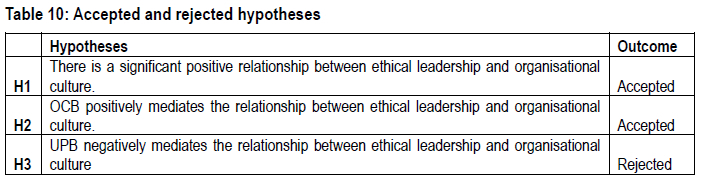
H2. OCB positively mediates the relationship between ethical leadership and organisational culture.
H3. UPB negatively mediates (i.e. a competitive or suppression effect) the relationship between ethical leadership and organisational culture.
3.3
Ethical considerationsBefore distributing the survey to the intended participants, an ethical review application was submitted to the Rhodes University Human Research Ethics Committee (RU-HREC), and approval was granted. Additionally, permission to conduct research within the company was obtained, and only then were participants invited to form part of the study.
4. FINDINGS AND DISCUSSION
The empirical data were analysed to determine if it was normally distributed, if the skewness values fell within the range ±2. As maintained by Hair et al. (2010), considering the distribution of the data set, even though variable UPB 5 with a value of 2.211 constitutes slightly more skewed data, the researchers were satisfied that all other variables are normally or nearly normally distributed. This is informed by EL1 having a skewness of -1.294, suggesting a significant leftward skew, while UPB1 shows a skewness of 1.622, indicating a strong rightward skew. Most items in the EL and OC constructs exhibit negative skewness, as seen in EL2 with 0.034 and OC1 with -0.895, which implies a tendency towards the left side of the distribution. Turning to whether the distribution is flat or peaked, the kurtosis analysis showed that all variables had values below ±7 (Hair et al., 2010), i.e., UPB1 with 1.890, OC3 with 2.705, and OCB1 with -0.414. This meant that there were no concerns regarding kurtosis. Since the data was normally or near normally distributed, it meant that either a Structural Equation Model Covariance (SEM-CB) or Partial Least Squares Structural Equation Modelling (PLS-SEM) can be employed to analyse this data. However, PLS-SEM was employed as it is better for prediction in estimating models, which are meant to provide causal explanations (Chin et al., 2020; Hair et al., 2022).
4.1 Confirmatory factor analysis - Measurement model
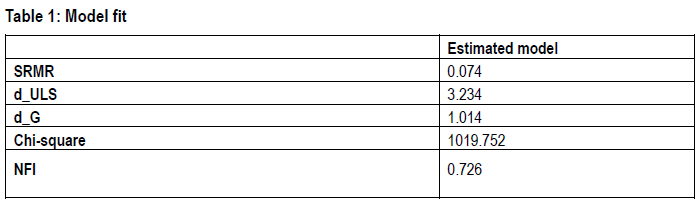
To examine the construct reliability and validity of the measures used in this study, a Partial Least Squares Structural Equation Modelling (PLS-SEM) was performed. The factor loadings for the measurement model were between 0.623 to 0.860, with average loadings above 0.70 for all the constructs (Hair et al., 2022). Additionally, as indicated in Table 1, the model fit was evaluated using various indices, including standardised root mean square residual (SRMR) and NFI, with the saturated and estimated models being compared. The analysis showed SRMR being 0.074. To this end, the study's SRMR fit index showed that the model yielded a better fit to the data (SRMR < 0.08). Considering this, it is safe to conclude that there is a relatively good fit between the hypothesised model and the observed data (Hu & Bentler, 1998). NFI was 0.726, which is lower than NFI > 0.90. Overall, this suggests that the model fits the data moderately well, even though there may be room for improvement to enhance the model's explanatory power. In PLS-SEM, certain fit indices are used. That is, NFI should be treated with caution for several reasons, namely:
• Model complexity - PLS-SEM is often utilised for complex models with many constructs and indicators, and traditional fit indices like NFI are designed for simpler models and may not accurately reflect the fit of more complex PLS-SEM models (Russo & Stol, 2022).
• Model dependence - NFI compares the fit of the specified model to a null model (one with no relationships between the variables). According to Schuberth et al. (2023), if the baseline model is inappropriate, the NFI value can be misleading.
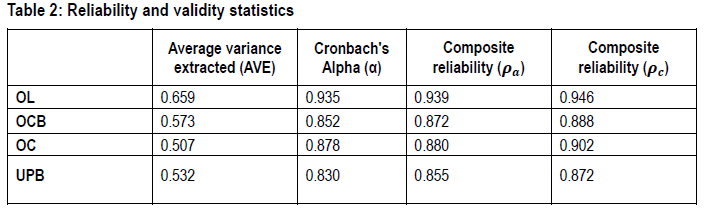
Table 2 presents the reliability statistics performed on the variables forming part of this study. Cronbach's Alpha (α) was used to determine the reliability of the variables, and the results on all constructs (EL, OCB, OC and UPB) demonstrated high internal consistency, with Cronbach's Alpha and composite reliability values exceeding the recommended threshold of 0.7. The values for composite reliability ρa and ρc indicate the internal consistency and reliability of the model's constructs. To this end, the results of the analysis indicated EL with the highest level of reliability, with composite reliability values of 0.939 (ρa) and 0.946 (ρc), followed by OC with composite reliability values of 0.880 (ρa) and 0.902 (ρc), OCB of 0.872 (ρa) and 0.888 (ρc), and though slightly lower than other constructs, UPB with composite reliability values of 0.855 (ρa) and 0.872 (ρc), respectively. This means that the items measuring the constructs are consistent and reliable, and further that the composite reliability values support the attainment of satisfactory convergent validity. The results showed that Ethical Leadership had an average variance extracted (AVE) of 0.659. An AVE greater than 0.50 indicates that the construct has good convergence validity, meaning the indicators are well-represented by the construct they are intended to measure. The lowest values were achieved on UPB, with the average variance extracted being 0.532. As shown in Table 2, all values were found to be above the recommended thresholds, indicating good internal consistency and satisfactory convergent validity (Hair et al., 2022).
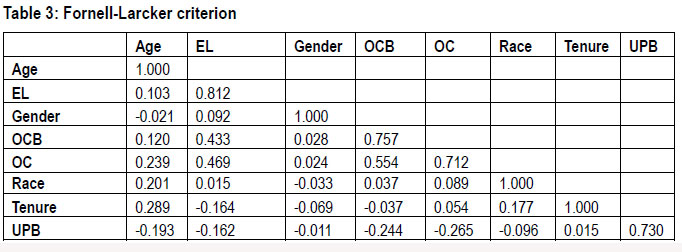
The discriminant validity of the dataset was established through the Fornell-Larcker criterion and the Heterotrait-Monotrait Ratio (HTMT) criterion. In this regard, analysis of the results showed an Average Variance Extracted (AVE) of 0.659 (EL), 0.573 (OCB), 0.507 (OC), and 0.532 (UPB), respectively. In applying the Fornell-Larcker criterion, the square roots of these AVE values were compared to the correlations among the constructs (i.e. the correlation between EL and OCB is 0.554, which should be less than the square root of the AVE for EL, approximately 0.812). This is shown in Table 3.
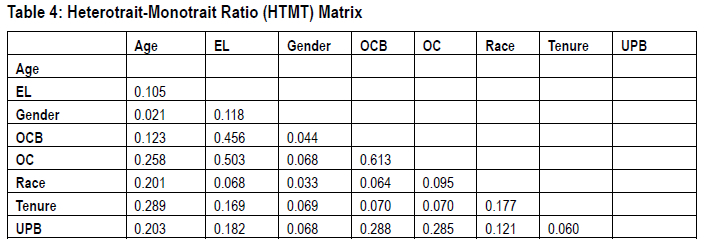
The above comparison helped confirm that each construct is distinct from the others, supporting the validity of the measurement model. Overall, the results suggest that the constructs meet the Fornell-Larcker criterion, indicating adequate discriminant validity within the model. As shown in Table 4, further analysis of the results showed an HTMT of less than 0.85, which indicates adequate discriminant validity and thus supports the constructs' distinctiveness (Henseler et al., 2015).
4.2 Structural model
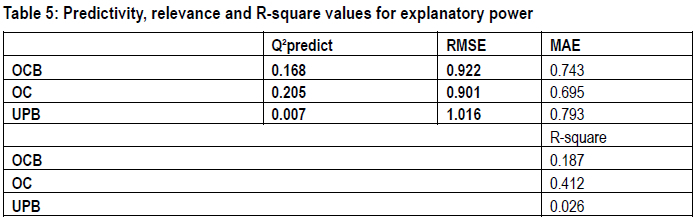
In determining the predictivity relevance, the research assessed the predictive performance of the PLS-SEM approach against a linear model (LM) and an indicator average (lA) approach. An analysis of the predictive relevance of dependent variables (i.e. OCB, OC, and UPB) was performed. This entailed an assessment of the predict, RMSE, and MAE, indicating the predictive power and accuracy of the model. But for a relatively lower value for UPB (0.007), the remainder of the variables showed a value significantly above zero (Q2 >0). This indicates that the model has a good predictive performance or relevance. This demonstrates that the model is capable of predicting the observed values of the dependent variables in the dataset used for the analysis. Table 5 shows the variables' Q2predict, RMSE, and MAE values, respectively. Further analysis shows Q2predict to be moderate for OCB, substantial for OC, and low for UPB. The RMSE was found to be low for OCB and OC, and high for UPB. On the other hand, the MAE values were found to be low for OCB and OC, and moderate for UPB. The model's explanatory power was moderate, with the highest R-squared value being 0.412 for OC (Table 5).
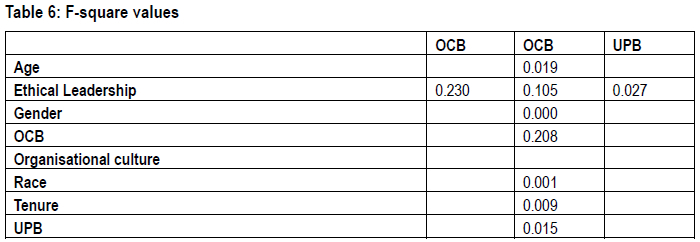
EL and OCB had substantial effects on OC, with F-square values of 0.230 and 0.208, respectively, indicating moderate effect sizes. EL also had a moderate effect on OCB (F-square = 0.105). UPB had no significant impact on OC (F-square = 0.015). Other control variables did not significantly influence OC (Table 6).
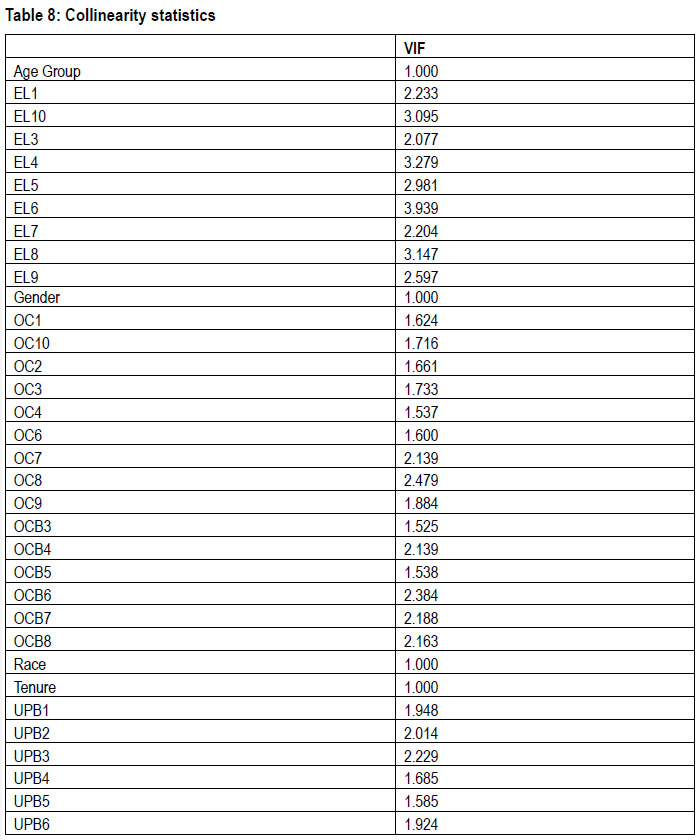
As outlined in Table 7, the analysis results showed that the highest VIF for this study was for EL6 (3.939). Since all of the values were less than 5, this suggests that the multi-collinearity is not a significant concern (Menard, 2001).
4.3 Hypothesis Testing
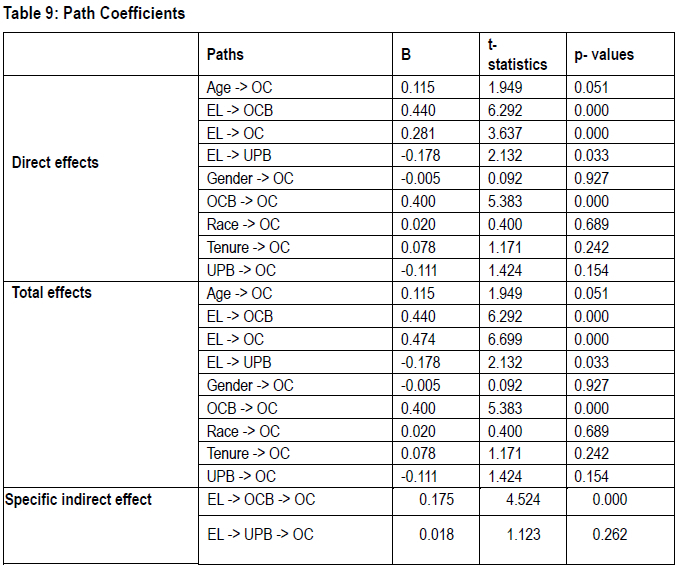
H1 proposed that there is a significant positive relationship between ethical leadership and organisational culture. Table 9 below shows the path coefficients, total effects and specific indirect effects of the variables. This suggests, inter alia, that the path from ethical leadership to organisational culture is statistically significant (H1 β = 0.281, t-statistic = 3.637, p < .001). Considering this, the values indicate a significant positive relationship between ethical leadership and organisational culture, with ethical leadership having a direct effect on organisational culture. The t-statistic and p-value of 0.000 affirm that there is an association between ethical leadership and organisational culture, and further, that organisational culture is dependent on ethical leadership. Accordingly, the relationship is statistically significant at a high level of confidence. The confidence intervals for this relation are also positive, affirming that the positive effect of ethical leadership on organisational culture is consistent across the sampled data. Accordingly, this provided support for H1. In addition to this, the results affirmed the statistical significance of the following relationships:
Ethical Leadership -> Organisational Citizenship Behaviour: β = 0.440, t -statistics = 6.292, p < .001.
Organisational Citizenship Behaviour -> Organisational culture: β = 0.400, t -statistics = 5.383, p < .001.
Ethical Leadership -> Unethical Pro-organisational_ Behaviour: β = -0.178, t -statistics = 2.132, p < .033.
H2 proposed that OCB positively mediates the relationship between ethical leadership and organisational culture. The results of the analysis showed that the 97.5% confidence interval (CI) around the mediation effect of organisational citizenship behaviour did not contain zero, indicating that the mediation effect of organisational citizenship behaviour was statistically significant (H2: β = 0.175, t-statistic = 4.524, p < .001). A p-value of 0.001 indicates a statistically significant relationship between the independent and dependent variables, with organisational citizenship behaviour serving as a mediator. With a total effect of 0.396, this positive effect suggests that higher levels of organisational citizenship behaviour contribute to a stronger organisational culture, reinforcing the idea that engaged employees help to shape a positive work environment. Accordingly, the null hypothesis was rejected, and H2 was supported.
H3 proposed that UPB negatively mediates (i.e. a competitive or suppression effect) the relationship between ethical leadership and organisational culture. A p-value of 0.262 for the relationship -> ethical leadership -> unethical pro-organisational behaviour -> organisational culture, indicates that the observed relationship between ethical leadership and organisational culture, as mediated by unethical pro-organisational behaviour, is not statistically significant at the conventional levels (H3: β = 0.018, t-statistic = 1.123, p < .0262). As such, unethical pro-organisational behaviour was found not to have a meaningful impact on the relationship. With a total effect of -0.099, the negative effect indicates that unethical pro-organisational behaviour detracts from organisational culture. Therefore, the null hypothesis was accepted, and H3 was not supported.
Table 12 shows a summary of the accepted and rejected hypotheses, with a further analysis of the mediators showing that OCB significantly and partially influences the relationship between ethical leadership and organisational culture.
4.4 Discussion of findings
The present study provides several implications for theory. Firstly, this study confirms a significant positive direct relationship between ethical leadership and organisational culture. Accordingly, the first null hypothesis, which states there is not a significant positive relationship between ethical leadership and organisational culture, is rejected. This positive effect shows that ethical leadership fosters an environment that encourages ethical behaviour and values, which can lead to a more positive and cohesive organisational culture. Considering the above, the findings of the study also appear to be consistent with the empirical studies that found that there is a positive and significant association between ethical leadership and organisational culture (Thoms, 2008; Huhtala et al., 2013; Eisenbeiss et al., 2015; Mitonga-Monga et al., 2016; Sagnak, 2017, Wang et al., 2023).
Secondly, the study examined the mediating effect of OCB and UPB on the relationship between ethical leadership and organisational culture. To this extent, the study is the first to examine the combined mediating effect of OCB and UPB:
a) on the relationship between ethical leadership and organisational culture; and
b) within an African and financial sector context.
The results of the statistical analysis show that OCB significantly and partially influences the relationship between ethical leadership and organisational culture. Thus, the second null hypothesis, which states OCB does not positively mediate the relationship between ethical leadership and organisational culture, is rejected. This is in line with the empirical research conducted by Setyowati et al. (2021), who, in their analysis of the effect of organisational culture and job satisfaction on OCB and employee performance at the University of Muhammadiyah Jember, Indonesia, concluded that OCB is positively and significantly related to organisational culture.
The literature reviewed was silent on the mediating effects of UPB on the relationship between ethical leadership and organisational culture. The results of the statistical analysis show that the indirect effect of ethical leadership on organisational culture through UPB is 0.016, with a confidence interval ranging from -0.008 to 0.048. This indicates that the indirect effect is not statistically significant. In this regard, the third null hypothesis stating that UPB does not negatively mediate the relationship between ethical leadership and organisational culture cannot be rejected. In other words, the results imply that UPB does not have an adverse effect on the influence of ethical leadership on organisational culture.
The non-significant findings in the study regarding the mediating role of UPB have several implications. Firstly, this implies that ethical leadership can effectively foster a positive organisational culture without being undermined by unethical behaviours that are intended to benefit the organisation.
Secondly, the acceptance of the null hypothesis regarding UPB suggests that organisations may not need to overly focus on mitigating unethical pro-organisational behaviours when promoting ethical leadership. Instead, they can concentrate on enhancing ethical practices and fostering organisational citizenship behaviours.
Lastly, the lack of significance in the UPB findings highlights the need for further research to explore the complexities of ethical leadership dynamics within different contexts.
5. MANAGERIAL IMPLICATIONS
One of the primary contributions of our study lies in the understanding of how ethical leadership influences OC and highlights the importance of fostering OCB in organisational settings. Organisations should prioritise the development and promotion of ethical leadership practices. In practice, organisations should motivate leaders to set an example for others by acting morally in their day-to-day activities. This includes, inter alia, being open, equitable, and consistent in their decision-making procedures. Additionally, leaders are encouraged to set clear ethical standards, to lead by example, and create an environment that fosters ethical behaviour and discourages unethical actions. This can be achieved through training programmes, ethical guidelines, and a strong ethical culture that values integrity and accountability.
Given the significant positive effect of ethical leadership on organisational citizenship behaviour, management is encouraged to establish a development and training programme that enhances leaders' ethical decision-making, accountability (Sagnak, 2017) and integrity or moral competence (Ghanem & Castelli, 2019).
Since OCB significantly mediates the relationship between ethical leadership and organisational culture, management should implement initiatives that encourage employees to engage in citizenship behaviours. This could include recognition programmes that promote collaboration and support among employees, leading to work motivation and satisfaction (Ali & Ahmed, 2009). Considering the differences observed among respondents from different age and race groups with OCB and organisational culture, organisations should consider implementing diversity and inclusion initiatives.
These initiatives are likely to assist in creating a more inclusive environment that enhances employee engagement and promotes positive organisational behaviours. This alignment can lead to a stronger commitment to ethical practices across the organisation. Management is encouraged to utilise social learning theory by encouraging employees to observe and model the behaviour of ethical leaders. In this sense, social modelling and observational learning would enable the employees to emulate and model the behaviour of others (Kim et al., 2023). This can also be achieved through mentorship programmes, leadership development initiatives, and regular feedback sessions.
The study's findings advance theoretical frameworks in leadership studies by enhancing the understanding of ethical leadership dynamics, integrating key behavioural concepts, developing predictive models, and exploring contextual influences. The study's contribution lies in its examination of the aforementioned relationship and context, providing valuable insights into how these constructs interact.
Firstly, the study confirmed the positive relationship between ethical leaders and organisational culture, thus showing that ethical leadership is one essential way of enhancing organisational culture. It follows that when a leader demonstrates ethical behaviour, it is reasonable to assume that followers will follow suit and create a shared understanding of what constitutes proper behaviour. This relationship is crucial as it helps establish trust, collaboration, and a shared commitment to ethical standards within the organisation. Accordingly, future studies should examine this relationship across different industries and cultural contexts to determine whether the findings are generalisable.
Secondly, the research demonstrates that OCB mediates the relationship between ethical leadership and organisational culture, and as such, promoting OCB can lead to a more favourable organisational culture, which is essential for overall organisational effectiveness. This suggests that OCB can help reinforce the values and norms established by ethical leadership. Thus, when employees demonstrate OCB, they are essentially embodying the ethical standards set by their leaders, which is likely to further entrench these values within the organisational culture.
6. CONCLUSION
The study assessed the role of UPB in this context and emphasised the importance of focusing on positive behaviours rather than negative ones when considering leadership impacts on culture. This comprehensive analysis underscores the importance of ethical leadership in shaping a positive organisational culture and the need for organisations to promote ethical behaviour while mitigating unethical actions. In this sense, ethical leadership grounded in Ubuntu principles strengthens organisational culture by promoting behaviours that reflect communal ethics (OCB), while discouraging behaviours that compromise integrity (UPB). This explains why OCB mediates positively, and UPB fails to mediate.
The practical implications and future research directions provide valuable insights for leaders and scholars aiming to enhance organisational effectiveness and ethical conduct. The financial sector is crucial for economic stability and growth. Thus, ethical leadership in this sector can assist in preventing financial scandals and crises, which in turn can have widespread negative impacts on the economy and society at large (Smith, 2014). Additionally, Africa presents a unique economic and social context characterised by rapid growth, diverse cultures, including varying levels of economic development. In this sense, this diversity necessitates a nuanced approach to leadership that takes into account local ethical norms and practices. Thus, the financial sector in Africa is a critical area for the study, due to its role in economic development, the unique challenges and opportunities present in the region, and the potential to influence broader societal outcomes through improved governance and ethical standards. In conclusion, it is essential to assess the sustainability of ethical leadership practices and their lasting impact on organisational culture. This can have a positive impact if implemented, and provide insights into the durability of ethical initiatives and the challenges they face.
The study has some limitations that should be noted. Firstly, since the dataset on ethical leadership and organisational culture was collected from the same participants, the researcher cannot completely exclude the possibility of common method bias. According to Podsakoff et al., (2003:885) this arises from having a "common rater, a common measurement context, a common item context, or from the characteristics of the items themselves". The second limitation highlights the importance of limiting the generalisability of the results to other contexts. Thus, the findings and conclusions drawn from the research analysis may not be fully generalisable beyond the scope of the dataset (Gelman & Hill, 2007), which represents a specific financial institution. Future studies should consider replicating the present model with a wider data set, i.e., from different sources, to mitigate bias. To this end, it is recommended that such studies replicate the findings of the current study to validate whether the lack of significance regarding UPB is consistent across different samples and contexts. Understanding these dynamics in various settings can provide more generalised insights and practical recommendations.
The current study's findings may be due to specific conditions that do not generalise within the entire financial sector. This means that the study could serve as a foundation for future research that examines how UPB mediates the relationship between ethical leadership and organisational culture. Furthermore, this study was conducted within a specific financial institution in an African context. As such, future works on ethical leadership and the combined mediating effects of the mediators (OCB and UPB) can include other financial institutions to further validate the outcomes of ethical leadership. Finally, future studies can focus on the mediation effect of UPB or how UPB is associated with ethical leadership and organisational culture.
Conflict of interest: The authors declare no conflict of interest with respect to the research, authorship and publication of the article.
Data availability: The data used for this article can be obtained from the authors upon reasonable request.
Ethical clearance and informed consent statement: The researchers obtained ethical clearance from Rhodes University Human Research Ethics Committee with reference 20247704-8627 prior to data collection and obtained informed consent from all participants in this study.
Funding: The authors did not receive any financial support for the research, authorship, or publication of this article.
REFERENCES
2. LITERATURE REVIEW
-
Adeleye, I., Luiz, J., Muthuri, J. & Amaeshi, K. 2020. Business ethics in Africa: the role of institutional context, social relevance, and development challenges. Journal of Business Ethics, 161(4):717-729. [https://doi.org/10.1007/s10551-019-04338-x].
» https://doi.org/10.1007/s10551-019-04338-x -
Alhashedi, A.A.A., Bardai, B., Al-Dubai, M.M.M. & Alaghbari, M.A. 2021. Organizational citizenship behavior role in mediating the effect of transformational leadership on organizational performance in gold industry of Saudi Arabia. Business: Theory and Practice, 22(1):39-54. [https://doi.org/10.3846/btp.2021.12774].
» https://doi.org/10.3846/btp.2021.12774 - Ali, R. & Ahmed, M.S, 2009. The Impact of reward and recognition programs on employee's motivation and satisfaction: An empirical study. International Review of Business Research Papers, 5(4):270-279.
-
Alshihabat, K. & Atan, T. 2020. The mediating effect of organizational citizenship behavior in the relationship between transformational leadership and corporate social responsibility practices: Middle Eastern Example/Jordan. Sustainability, 12(10):4248-4264. [https://doi.org/10.3390/su12104248].
» https://doi.org/10.3390/su12104248 -
Anvari, R., Barzaki, A.S., Amiri, L., Irum, S. & Shapourabadi, S. 2017. The mediating effect of organizational citizenship behavior on the relationship between workplace spirituality and intention. Intangible Capital, 13(3):615-639. [https://doi.org/10.3926/ic.906].
» https://doi.org/10.3926/ic.906 -
Brown, M.E., Treviño, L.K. & Harrison, D.A. 2005. Ethical leadership: A social learning perspective for construct development and testing. Organizational Behavior and Human Decision Processes, 97(2):117-134. [https://doi.org/10.1016/j.obhdp.2005.03.002].
» https://doi.org/10.1016/j.obhdp.2005.03.002 - Chin, W.W., Cheah, J.H., Liu, Y., Ting, H., Lim, X.J., & Cham, T.H. 2020. Demystifying the role of causal-predictive modeling using partial least squares structural equation modeling in information systems research. Industrial Management & Data Systems, 120(12):2161-2209
- Cohen, L., Manion, L. & Morrison, K., 2000. Research methods in education. 5th ed. London; New York: RoutledgeFalmer.
-
Eisenbeiss, S.A., Van Knippenberg, D. & Fahrbach, C.M. 2015. Doing well by doing good? Analyzing the relationship between CEO ethical leadership and firm performance. Journal of Business Ethics, 128(3):635-651. [https://doi.org/10.1007/s10551-014-2124-9].
» https://doi.org/10.1007/s10551-014-2124-9 -
Ekowati, V.M., Troena, E.A. & Noermijati, N. 2013. Organizational citizenship behavior role in mediating the effect of transformational leadership, job satisfaction on employee performance: Studies in PT Bank Syariah Mandiri Malang East Java. International Journal of Business and Management, 8(17):1-12. [https://doi.org/10.5539/iibm.v8n17p1].
» https://doi.org/10.5539/iibm.v8n17p1 -
Fischer, T., Dietz, J. & Antonakis, J., 2017. Leadership process models: A review and synthesis. Journal of Management, 43(6):1726-1753. [https://doi.org/10.1177/0149206316682830].
» https://doi.org/10.1177/0149206316682830 -
Fourie, W., Van der Merwe, S. C., & Van der Merwe, B. 2017. Sixty years of research on leadership in Africa: A review of the literature. Leadership, 13(2):222-251. [https://doi.org/10.1177/1742715015580665].
» https://doi.org/10.1177/1742715015580665 - Gelman, A. & Hill, J., 2007. Data analysis using regression and multilevel/hierarchical models. 23rd printing ed. Analytical methods for social research. Cambridge: Cambridge Univ. Press.
-
Ghanem, K. & Castelli, P., 2019. Accountability and moral competence promote ethical leadership. Journal of Values-Based Leadership, 12(1):1-26. [https://doi.org/10.22543/0733.121.1247].
» https://doi.org/10.22543/0733.121.1247 -
Giberson, T.R., Resick, C.J., Dickson, M.W., Mitchelson, J.K., Randall, K.R. & Clark, M.A. 2009. Leadership and organizational culture: Linking CEO characteristics to cultural values. Journal of Business and Psychology, 24(2):123-137. [https://doi.org/10.1007/s10869-0099109-1].
» https://doi.org/10.1007/s10869-0099109-1 - Hair, J., Black, W.C., Babin, B.J. & Anderson, R.E. 2010. Multivariate data analysis. 7th ed. Upper Saddle River, New Jersey: Pearson Educational International.
- Hair, J.F., Hult, G.T., Ringle, C.M. & Sarstedt, M. 2022. A Primer on partial least squares structural equation modeling (PLS-SEM). 3rd ed. Thousand Oaks, CA: Sage.
-
Han, S.H., Seo, G., Yoon, S.W. & Yoon, D.Y. 2016. Transformational leadership and knowledge sharing: Mediating roles of employee's empowerment, commitment, and citizenship behaviors. Journal of Workplace Learning, 28(3):130-149. [https://doi.org/10.1108/JWL-09-2015-0066].
» https://doi.org/10.1108/JWL-09-2015-0066 -
Hanaysha, J.R., 2023. Impact of participative and authoritarian leadership on employee creativity: organizational citizenship behavior as a mediator. International Journal of Organization Theory & Behavior, 26(3):221-236. [https://doi.org/10.1108/IJOTB-08-2022-0165].
» https://doi.org/10.1108/IJOTB-08-2022-0165 -
Hanaysha, J.R., Kumar, V.V.A., In'airat, M. & Paramaiah, C. 2022. Direct and indirect effects of servant and ethical leadership styles on employee creativity: mediating role of organizational citizenship behavior. Arab Gulf Journal of Scientific Research, 40(1):79-98. [https://doi.org/10.1108/AGJSR-04-2022-0033].
» https://doi.org/10.1108/AGJSR-04-2022-0033 -
Henseler, J., Ringle, C.M. & Sarstedt, M., 2015. A new criterion for assessing discriminant validity in variance-based structural equation modeling. Journal of the Academy of Marketing Science, 43(1):115-135. [https://doi.org/10.1007/s11747-014-0403-8].
» https://doi.org/10.1007/s11747-014-0403-8 -
Hsieh, H.H., Hsu, H.H., Kao, K.Y. & Wang, C.C. 2020. Ethical leadership and employee unethical pro-organizational behavior: a moderated mediation model of moral disengagement and coworker ethical behavior. Leadership & Organization Development Journal, 41(6):799-812. [https://doi.org/10.1108/LODJ-10-2019-0464].
» https://doi.org/10.1108/LODJ-10-2019-0464 -
Hu, L. & Bentler, P.M. 1998. Fit indices in covariance structure modeling: Sensitivity to underparameterized model misspecification. Psychological Methods, 3(4):424-453. [https://doi.org/10.1037/1082-989X.3.4.424].
» https://doi.org/10.1037/1082-989X.3.4.424 -
Huhtala, M., Kangas, M., Lämsä, A. & Feldt, T. 2013. Ethical managers in ethical organisations? The leadership-culture connection among Finnish managers. Leadership & Organization Development Journal, 34(3):250-270. [https://doi.org/10.1108/01437731311326684].
» https://doi.org/10.1108/01437731311326684 -
Jiang, W., Liang, B. & Wang, L. 2023. The double-edged sword effect of unethical pro-organizational behavior: The relationship between unethical pro-organizational behavior, organizational citizenship behavior, and work effort. Journal of Business Ethics, 183(4):1159-1172. [https://doi.org/10.1007/s10551-021-05034-5].
» https://doi.org/10.1007/s10551-021-05034-5 -
Jiang, W., Zhao, X. & Ni, J. 2017. The impact of transformational leadership on employee sustainable performance: The mediating role of organizational citizenship behavior. Sustainability, 9(9):1-17. [https://doi.org/10.3390/su9091567].
» https://doi.org/10.3390/su9091567 -
Jones, T.M., Felps, W. & Bigley, G.A. 2007. Ethical theory and stakeholder-related decisions: The role of stakeholder culture. Academy of Management Review, 32(1):137-155. [https://doi.org/10.5465/amr.2007.23463924].
» https://doi.org/10.5465/amr.2007.23463924 -
Kaptein, M. 2008. Developing and testing a measure for the ethical culture of organizations: the corporate ethical virtues model. Journal of Organizational Behavior, 29(7):923-947. [https://doi.org/10.1002/job.520].
» https://doi.org/10.1002/job.520 -
Kaptein, M. 2009. Ethics programs and ethical culture: A next step in unraveling their multi-faceted relationship. Journal of Business Ethics, 89(2):261-281. [https://doi.org/10.1007/s10551-008-9998-3].
» https://doi.org/10.1007/s10551-008-9998-3 - Khokhar, A.M. & Zia-ur-Rehman, M. 2017. Linking ethical leadership to employees' performance: Mediating role of organizational citizenship behavior and counterproductive work behavior. Pakistan Journal of Commerce and Social Sciences, 11(1):222-251.
-
Kim, C., Lee, C. & Lee, G. 2023. Impact of superiors' ethical leadership on subordinates' unethical pro-organizational behavior: Mediating effects of followership. Behavioral Sciences, 13(6):454-471. [https://doi.org/10.3390/bs13060454].
» https://doi.org/10.3390/bs13060454 -
Kock, N. & Hadaya, P. 2018. Minimum sample size estimation in PLS-SEM: The inverse square root and gamma-exponential methods. Information Systems Journal, 28(1):227-261. [https://doi.org/10.1111/isj.12131].
» https://doi.org/10.1111/isj.12131 -
Lee, K. & Allen, N.J. 2002. Organizational citizenship behavior and workplace deviance: The role of affect and cognitions. Journal of Applied Psychology, 87(1):131-142. [https://doi.org/10.1037/0021-9010.87.1.131].
» https://doi.org/10.1037/0021-9010.87.1.131 -
Maak, T. & Pless, N.M. 2006. Responsible leadership in a stakeholder society - A relational perspective. Journal of Business Ethics, 66(1):99-115. [https://doi.org/10.1007/s10551-006-9047-z].
» https://doi.org/10.1007/s10551-006-9047-z - Malunga, C., 2006. Learning leadership development from African cultures: A personal perspective. INTRAC PraxisNote 25:1-13.
-
Mayer, D.M., Kuenzi, M. & Greenbaum, R.L. 2010. Examining the link between ethical leadership and employee misconduct: The Mediating Role of Ethical Climate. Journal of Business Ethics, 95(S1):7-16. [https://doi.org/10.1007/s10551-011-0794-0].
» https://doi.org/10.1007/s10551-011-0794-0 - Menard, S., 2001. Applied Logistic Regression Analysis. 2nd ed. SAGE Publications.
-
Mitonga-Monga, J., Flotman, A.P. & Cilliers, F. 2016. Workplace ethics culture and work engagement: The mediating effect of ethical leadership in a developing world context. Journal of Psychology in Africa, 26(4):326-333. [https://doi.org/10.1080/14330237.2016.1208928].
» https://doi.org/10.1080/14330237.2016.1208928 - Muchiri, M.K. 2011. Leadership in context A review and research agenda for sub-Saharan Africa. Journal of Occupational and Organizational Psychology, 84:440-452.
-
Podsakoff, P.M., MacKenzie, S.B., Lee, J.Y. & Podsakoff, N.P. 2003. Common method biases in behavioral research: A critical review of the literature and recommended remedies. Journal of Applied Psychology, 88(5):.879-903. [https://doi.org/10.1037/0021-9010.88.5.879].
» https://doi.org/10.1037/0021-9010.88.5.879 -
Preacher, K.J. & Hayes, A.F. 2008. Asymptotic and resampling strategies for assessing and comparing indirect effects in multiple mediator models. Behavior Research Methods, 40(3):879-891. [https://doi.org/10.3758/BRM.40.3.879].
» https://doi.org/10.3758/BRM.40.3.879 -
Rahi, S. 2017. Research design and methods: A systematic review of research paradigms, sampling issues and Instruments Development. International Journal of Economics & Management Sciences, 6(2):1-5. [https://doi.org/10.4172/2162-6359.1000403].
» https://doi.org/10.4172/2162-6359.1000403 -
Resick, C.J., Hargis, M.B., Shao, P. & Dust, S.B. 2013. Ethical leadership, moral equity judgments, and discretionary workplace behavior. Human Relations, 66(7):951-972. [https://doi.org/10.1177/0018726713481633].
» https://doi.org/10.1177/0018726713481633 -
Russo, D. & Stol, K.J., 2022. PLS-SEM for software engineering research: An introduction and survey. ACM Computing Surveys, 54(4):1-38. [https://doi.org/10.1145/3447580].
» https://doi.org/10.1145/3447580 -
Sagnak, M. 2017. Ethical leadership and teachers' voice behavior: The mediating roles of ethical culture and psychological safety. Educational Sciences: Theory & Practice, 17(4):1101-1117. [https://doi.org/10.12738/estp.2017.4.0113].
» https://doi.org/10.12738/estp.2017.4.0113 -
Schuberth, F., Rademaker, M.E. & Henseler, J. 2023. Assessing the overall fit of composite models estimated by partial least squares path modeling. European Journal of Marketing, 57(6):1678-1702. [https://doi.org/10.1108/EJM-08-2020-0586].
» https://doi.org/10.1108/EJM-08-2020-0586 -
Setyowati, T., Az, B., Tobing, D., Nurhayati & Qomariah, N. 2021. The role of organizational citizenship behavior in mediating the relationship between organizational culture and job satisfaction with employee Performance. Quality - Access to Success, 22(185):220-234. [https://doi.org/10.47750/QAS/22.185.29].
» https://doi.org/10.47750/QAS/22.185.29 -
Shin, Y. 2012. CEO Ethical leadership, ethical climate, climate strength, and collective organizational citizenship Behavior. Journal of Business Ethics, 108(3):299-312. [https://doi.org/10.1007/s10551-011-1091-7].
» https://doi.org/10.1007/s10551-011-1091-7 -
Sipondo, A. 2025. Ubuntu ethical leadership in the African public sector: conceptual proposals. International Journal of Public Leadership, 21(2):140-154. [https://doi.org/10.1108/ijpl-10-2024-0119].
» https://doi.org/10.1108/ijpl-10-2024-0119 - Smith, E. 2014. Ethical leadership: A South African financial sector perspective. International Journal of Business Management and Economic Research(IJBMER), 5(5):80-90.
- Tang, P., Yam, K. & Koopman, J. 2020. Feeling proud but guilty? Unpacking the paradoxical nature of unethical pro-organizational behavior. Organizational Behavior and Human Decision Processes, 160:68-86.
-
Thoms, J.C. 2008. Ethical integrity in leadership and organizational moral culture. Leadership, 4(4):419-442. [https://doi.org/10.1177/1742715008095189].
» https://doi.org/10.1177/1742715008095189 -
Tsai, Y. 2011. Relationship between organizational culture, leadership behavior and job satisfaction. BMC Health Services Research, 11(1):1-9. [https://doi.org/10.1186/1472-6963-11-98].
» https://doi.org/10.1186/1472-6963-11-98 -
Umphress, E.E., Bingham, J.B. & Mitchell, M.S., 2010. Unethical behavior in the name of the company: The moderating effect of organizational identification and positive reciprocity beliefs on unethical pro-organizational behavior. Journal of Applied Psychology, 95(4):769-780. [https://doi.org/10.1037/a0019214].
» https://doi.org/10.1037/a0019214 -
Umphress, E.E. & Bingham, J.B. 2011. When employees do bad things for good reasons: Examining unethical pro-organizational behaviors. Organization Science, 22(3):621-640. [https://doi.org/10.1287/orsc.1100.0559].
» https://doi.org/10.1287/orsc.1100.0559 - Van der Colff, L. 2003. Leadership lessons from the African tree. Management Decision, 41(3):257-261.
-
Van Dyne, L., Vandewalle, D., Kostova, T., Latham, M.E., Cummings, L.L. 2000. Collectivism, propensity to trust and self-esteem as predictors of organizational citizenship in a non-work setting. J. Organiz. Behav. 21: 3-23. [https://doi.org/10.1002/(SICI)1099-1379(200002)21:1<3::AID-JOB47>3.0.CO;2-6]
» https://doi.org/10.1002/(SICI)1099-1379(200002)21:1<3::AID-JOB47>3.0.CO;2-6 -
Wang, H., Zhang, Y., Li, P. & Henry, S.E. 2023. You raise me up and I reciprocate: Linking empowering leadership to organizational citizenship behavior and unethical pro-organizational behavior. Applied Psychology, 72(2):718-742. [https://doi.org/10.1111/apps.12398].
» https://doi.org/10.1111/apps.12398