Measuring primary employment relationship satisfaction in South African supervisory relationships
Abstract
Employment relationship management is an important responsibility of all supervisors and subordinates. It therefore stands to reason that employment relationship satisfaction levels of subordinates in supervisory relationships, or primary employment relationships, will be strongly influenced by supervisory behaviour in such relationships. Previous research findings suggested that primary employment relationship satisfaction (PERS) can be regarded as a distinct construct that relates to subordinate perceptions of the levels of trust, compliance, fairness and good faith that their immediate supervisors display in their employment relationship. Literature suggests numerous significant relationships between trust, compliance, fairness and good faith and a host of desirable and undesirable organisational behaviour forms. A valid and reliable measure of PERS was thus required to enable further scientific research into the relationship between PERS and other organisational behaviour phenomena. This article subsequently reports on the development of a measure of PERS, and reports findings related to the validity, reliability and generalisability of the measure. The authors concluded that the measure is more than adequately valid and reliable for purposes of measuring PERS of subordinate employees, and made recommendations on the use of the measure in organisational and research environments.
measure; PERS; primary employment relationship satisfaction; questionnaire; subordinate; supervisor
1. INTRODUCTION
Shanock and Eisenberger (2006:694) found that most employees perceive all of the organisational structures and processes in their employers' organisation as one interactive humanlike entity with various interlinked components and agents. Employees refer to these perceptions to develop global beliefs on the extent to which an employer values their contributions and cares about their well-being.
Subordinate employees in supervisory relationships, however, regard the values and behaviour of their immediate supervisors as the values and behaviour of the employer as a whole. This theory strongly suggests that supervisory relationships should be viewed as primary influences on employment relationship satisfaction of subordinate employees in most types of employment relations environments.
Supervisory behaviour has been found to be significantly related to subordinate job satisfaction, relationship trust levels and a variety of organisational behaviours and outcomes (Tepper 2007:261). Numerous empirical studies also confirmed that employees respond negatively to abusive or generally negative supervisor treatment. These responses may take the form of poor work performance, deviant work behaviour or resignation.
Positive supervisor treatment, however, promotes job satisfaction, organisational trust as well as a host of other positive organisational outcomes (Guest 2004:542-544; Robbins & Judge 2013:59-63; Tekleab & Taylor 2003:590). Employment relationship quality perceptions, as well as employment relationship satisfaction levels of employees should therefore be carefully monitored, maintained and promoted in organisations (Potgieter 2014:91).
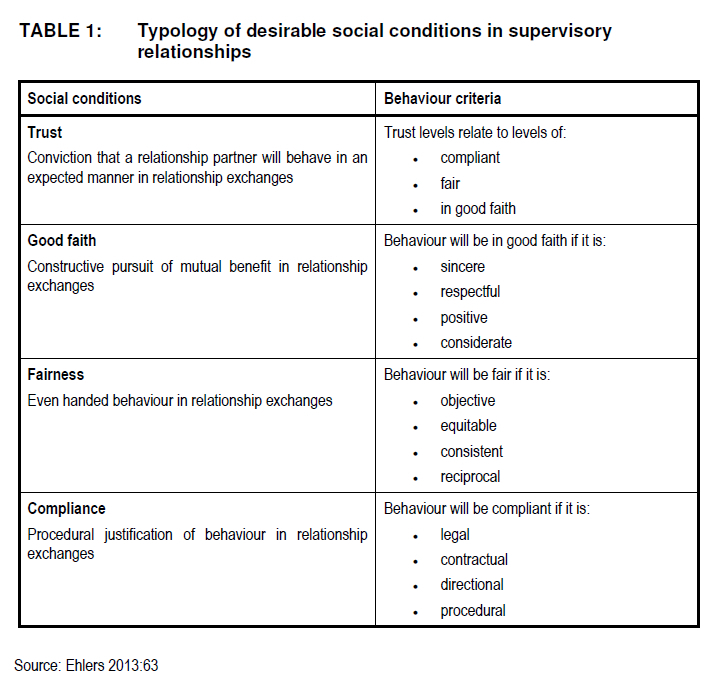
Ehlers (2013:48-68) developed a typology of desirable social conditions in supervisory relationships. The typology categorises trust, justified legal compliance, fairness and good faith as the four primary desirable social conditions in supervisory relationships. The typology recognises the formal and psychological dimensions of employment contracting, and includes a number of sub-categories for each main category.
The content of this typology strongly suggests that primary employment relationship satisfaction (PERS) of subordinate employees will be related to their perceptions of the levels of trustworthiness, compliance, fairness and good faith that their immediate supervisors display before, during and after employment relationship exchanges. Accurate measurement of PERS of subordinate employees can only be achieved through application of a valid and reliable research instrument. There are numerous valid and reliable measures of job satisfaction, relationship trust, conflict styles, leadership styles and other supervisory relationship phenomena (Robbins & Judge 2013:113).
These measures, unfortunately, were developed to measure specific constructs and can therefore not be regarded as valid and reliable measures of employment relationship satisfaction in distinctly South African organisations. The validated typology of desirable social conditions in supervisory relationships (Ehlers 2013:67), however, provided an ideal foundation for developing an integrated, valid and reliable measure of primary employment relationship satisfaction (PERS) of subordinates in distinctly South African organisations.
This article will accordingly report on the development of a valid and reliable measure of PERS of subordinates in distinctly South African organisations. This introduction will be followed by an overview of the research objectives and methodology, as well as a literature review on the nature of employment relationship satisfaction and research questionnaires.
The steps that were implemented to develop the measure of PERS and related findings on validity, reliability and initial norms of the measure will then be described, and conclusions and recommendations will be made in the final section.
2. RESEARCH OBJECTIVES AND METHODOLOGY
2.1
Research objectiveThe primary objective of this study was to develop a valid and reliable measure of primary employment relationship satisfaction (PERS) of subordinate employees in supervisory relationships. Five secondary objectives were pursued in order to achieve the primary objective.
These objectives were to:
i. develop a measure of PERS levels of subordinate employees in South African supervisory relationships;
ii. determine the validity of the measure;
iii. determine the reliability of the measure;
iv. investigate the underlying factor structure of item in the measure, and to
v. establish initial norms for interpreting scores on the measure of PERS.
2.2
Research design and methodologyA descriptive survey research design was required to meet the objectives of this study, and a quantitative questionnaire survey methodology was consequently adopted (Cresswell 2014:201). Analysis of literature and research findings were done from a modernist perspective. The chronological steps that were followed in this study were derived from guidelines that were comprehensively described in the works of Brinkman (2009:31-57); Potgieter (2014:42-62) and Rattray & Jones (2007:234-242). These steps were:
i. Written permission to conduct this study was granted by the SAPS before commencement of the study, and ethical clearance was provided by the Research Ethics Committee of the Tshwane University of Technology during March 2014.
ii. The background to the research problem and specific research objectives were defined, and the target population was defined as all South African Police Service constables stationed in the Tshwane region.
iii. A literature review on the nature of supervision, measurement of organisational satisfaction and desirable social conditions in supervisory relationships were conducted and findings were integrated.
iv. The construct that was to be measured was defined as: Primary employment relationship satisfaction (PERS), which was defined as a unique type of relationship satisfaction that an individual subordinate derives from positive or negative perceptions of the levels of trust, compliance, fairness and/or good faith that immediate supervisors display before, during and after employment relationship exchanges.
v. Biographical items were identified and linked to appropriate rating scales. Biographical questionnaire items related to respondent age, gender, race, qualification and union affiliation.
vi. A validated typology of desirable social conditions in supervisory relationships provided a foundation for identifying and writing 20 questionnaire items that are very strongly related to subordinate satisfaction with social conditions in supervisory relationships.
vii. The 20 PERS related items were linked to a five category Likert type scale with the following options: 0 - Very dissatisfied, 1 - Dissatisfied, 2 - Uncertain, 3 - Satisfied and 4 - Very satisfied.
viii. A draft questionnaire was structured and completed by 20 voluntary respondents who provided verbal feedback to developers after completing the questionnaire. Questionnaire item wording and general lay-out were refined based on feedback received from pre-test respondents as well as feedback received from three human resource management academics who judged the face validity of the draft questionnaire.
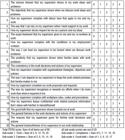
ix. The final version of the questionnaire was structured, printed and distributed to respondents (Annexure A).
x. A convenience sampling approach was implemented (Bless, Higson-Smith & Sithole (2013:172). Station commanders of five SAPS stations in Tshwane granted permissions to conduct the study in their stations, and agreed to distribute questionnaires to all constables under their command. Constables were specifically informed on the voluntary nature of participation and their unconditional right to refrain from participation, to withdraw during completion of the questionnaire or to withhold the completed questionnaire if they experienced the slightest discomfort that is any manner related to the research study. Completed questionnaires were dropped into collection boxes that were placed in secure locations at each station. Completed questionnaires were collected after allowing a period of fourteen days for completion (Theledi 2015:58).
xi. 300 completed questionnaires were returned within fourteen days. This established a final sample size of 300.
xii. Questionnaire data was captured and analysed on a personal computer using SPSS. A variety of general descriptive and inferential statistical procedures were applied in accordance with research objective requirements.
xiii. Literature and research findings were then compared, integrated and discussed, and limitations, recommendations and conclusions were reported.
3.1 Introduction
The diverse South African labour market poses many serious political, social and economic challenges in workplace level supervisory relationships. Supervisors in South African organisations should therefore consciously strive to prevent miscommunication, misunderstanding and conflict with subordinates in all types of employment relationships (Botha & Moalusi 2010:5; Theledi 2014:4).
The nature of effective supervision, and supervisory roles in organisations have been widely researched and reported on in numerous scientific textbooks and publications and will subsequently not be dealt with in this article. The following sections contain a discussion of each of the four desirable social conditions in supervisory relationships, and the nature of measures of organisational and relationship satisfaction.
3.2 A typology of desirable social conditions in supervisory relationships
Table 1 reflects the categories and sub-categories in a validated typology of desirable social conditions in supervisory relationships (Ehlers 2013:48-68).
The following sections contain discussions on the nature of the main categories in the typology, and related research findings.
3.2.1 Trust in employment relationships
Perceptions of trust, consistency, fairness, equity and good faith are strongly interrelated and stem from relationship expectations and exchanges which occur in the formal and psychological dimensions of employment contracting (Cropanzano, Bowen and Gilliland. 2007:39). Trust can be simply defined as the willingness of a party (trustor) to be vulnerable to the actions of another party (trustee) based on the expectation that the trustee will perform one or more actions that are important to the trustor, even if the trustor is unable to monitor or control the trustee (Sparrow & Cooper 2003:99).
Coyle-Shapiro and Shore (2008: 3 20-21) concluded that employees with high levels of trust in their organisations are thus more likely to put greater effort into their roles and co-operate better with others in the workplace, while employees with low levels of trust in their organisations are likely to interact and work less effectively.
Even though trust is regarded as a foundation for effective and harmonious employment relationships, there are no laws that require high levels of trust in an employment contract, rule or regulation to make it valid (Williams 2007:597). Employers, however, are under an implied obligation to create certainty, fairness, equity and consistency in workplace relationships, which mostly requires compliance with labour laws and contractual stipulations, legitimate employment policies and legitimate employment procedures (Gobind 2015:179).
It should also be noted that employees have to perceive employer behaviour as justified or fair in order to have trust in it, and to behave in accordance with related employer expectations (Williams 2007:598). Low levels of trust in employment relationships are strongly related to conflict and negative relationship outcomes, but a climate of trust facilitates open and constructive relationship interaction which can prevent that personal differences evolve into negative or dysfunctional forms of workplace conflict. (Ehlers 2013:52). The above discussion strongly suggests that employment relationship trust levels may be strongly related to perceived levels of compliance, fairness and good faith in employment relationships.
3.2.2 Compliance in employment relationships
Actual levels of legal or contractual compliance can rarely be objectively assessed by supervisors or subordinates, due to their limited knowledge and understanding of applicable labour laws, contracts and often complicated legal principles (Sparrow & Cooper 2003:97). Compliance with legislation, employment contracts or collective agreements, workplace directives and formal procedures provides justifiable reasons for supervisory behaviour and establishes boundaries for harmonious employment relationship behaviour (Nel, Kirsten, Swanepoel & Poisat 2016:113-115).
Holtz and Harold (2009:1195) concluded that there is a strong relationship between overall justice perceptions of employees and organisational trust levels. Research further confirmed that perceived procedural compliance and organisational justice can create powerful mutually beneficial social conditions in employment relationships such as trust and commitment, improved job performance, positive citizenship outcomes, improved customer satisfaction, and diminished conflict in organisational relationships (Cropanzano et al. 2007:45). Subordinate perceptions of compliance by immediate supervisor can subsequently be expected to be related to employment relationship satisfaction levels of subordinate employees.
3.2.3 Fairness in employment relationships
The general fairness of any labour practice can be assessed against four basic requirements. These requirements are objectivity, equity, consistency and reciprocity (Ehlers 2013:60). An unfair labour practice occurs when one or more of these requirements are absent from a relationship exchange. Kickul, Gundry & Posig (2005:215) found that employees are likely to be more sensitive to issues of fairness and equity when trust levels in the employment relationship are low.
Low trust levels and perceived unfairness in the workplace can trigger employees to engage in undesirable organisational conduct (Southey (2010:84). Gerlach, Levine & Struck (2007:422) reported that that employees who experience unfair treatment may deliberately restrict output or even resort to sabotage, and that employees who feel fairly treated are more likely to perform above minimum requirements. DiMatteo, Bird and Colquitt (2011:513) further found that procedural or substantive unfairness in the termination of employment contracts were positively related to increased propensities to retaliate and litigate. The effect on propensities of employees to retaliate or litigate was amplified when a termination was perceived to be procedurally and substantively unfair. Subordinate employee perceptions of the fairness of the behaviour of an immediate supervisors could therefore be expected to be related to the employment relationship satisfaction of subordinates.
3.2.4 Good faith in employment relationships
Good faith can be defined as an honest and sincere intention to create mutual benefit for all parties in a relationship. Good faith is evident when relationship partner displays sincere, respectful, considerate and positive behaviour in relationship exchanges (Heap 2009:10; Riley 2009:7). Bad faith will become evident when dishonesty, disrespect, selfishness or negativity is displayed in relationship exchanges (Ehlers 2013:64; Shimanskaya 2010:11).
Positive perceptions of good faith are related to higher levels of trust in organisational relationships, which in turn strongly relate to a number of positive organisational behaviour outcomes (Botha & Moalusi 2010:5, Guest 2004:543; Tekleab & Taylor 2003:588). Subordinate employee perceptions of good faith in the actions of their immediate supervisors will thus influence their unique experiences of employment relationship satisfaction.
3.3 Measuring satisfaction levels
The process and principles that apply to the measurement of job satisfaction can be assumed to be equally applicable to the measurement of primary employment relationship satisfaction (PERS) levels of subordinates in supervisory relationships. Job satisfaction, which has been very simply defined as a pleasurable or positive emotional state resulting from the appraisal of one's job or job experiences (Locke 1969:312), is one of the most researched areas in organisational behaviour and is strongly related to a variety of desirable organisational outcomes (Robbins & Judge 2013:108).
Even though there are numerous measures of job satisfaction, the Minnesota Satisfaction Questionnaire (MSQ) remains one of the most popular and reliable measures of job satisfaction (Buitendach & Rothmann 2009:1). The long form of the MSQ survey contains 100 questions based on 20 sub scales which measure satisfaction with ability, utilization, achievement, activity, advancement, authority, company policies and practices, compensation, co-workers, creativity, independence, moral values, recognition, responsibility, security, social service, social status, supervision-human relations, supervision-technical variety and working conditions. A shorter version of the MSQ consists of 20 items that can be separated into two subscales for intrinsic and extrinsic satisfaction. The 20 items in the short form MSQ are regarded as those items that best represent each of the 20 original subscales (Martins & Proenca 2012:4).
Each item in the long and short form MSQ is rated on a five point Likert scale, being: 1 - very dissatisfied with this aspect of my job, 2 - dissatisfied with this aspect of my job, 3 - can't decide if I'm satisfied or dissatisfied with this aspect of my job, 4 - satisfied with this aspect of my job and 5 - very satisfied with this aspect of my job. The sum or average of item responses on all items represent a total score. Lower scores indicate lower levels of job satisfaction and higher scores indicate higher levels of job satisfaction (Martins & Proenca 2012:5).
Fields (2002:1-352) described a wide variety of research instruments that are commonly used to measure employee or subordinate satisfaction with a variety of organisational phenomena. These instruments can be used to measure career satisfaction, employee satisfaction with influence, employee satisfaction with ownership, employee satisfaction with work schedule flexibility and supervision satisfaction, among others. Most of these instruments are similar to the MSQ in that they contain individual items that are linked to Likert type rating scales. Some of the questionnaires contain sub-scales which encapsulate specific questionnaire items.
None of the aforementioned research instruments, however, were suitable for measuring PERS levels that are specifically related to trust, compliance, fairness and good faith in South African supervisory relationships. They are, nonetheless, good examples for linking satisfaction related questionnaire items to appropriate rating scales, how to calculate and interpret general and sub-scale scores and judging validity and reliability of satisfaction related questionnaires.
3.4 Summary
Literature strongly suggested that supervisory behaviour is meaningfully related to primary employment relationship satisfaction (PERS) of subordinate employees. The review further confirmed that trust, compliance, fairness and good faith are desirable social conditions in all types of supervisory relationships, and that these desirable conditions can be confidently expected to be strongly related to the PERS levels of subordinates in such relationships. It was also established that a number of existing measures of organisational and relationship satisfaction levels provided useful foundations for developing a specific measure of PERS of subordinate employees.
4. DISCUSSION OF INSTRUMENT DEVELOPMENT AND FINDINGS
The aim of this study was to develop a valid and reliable research instrument that can measure general PERS levels of subordinate employees in supervisory relationships. It was assumed that a measure of general PERS levels of subordinates could be attained through combining measures of subordinate satisfaction with trust, compliance, fairness and good faith in supervisory relationships (Ehlers 2013:63). The measure was developed in accordance with the methodology that was described under section 2.2. The following sections contain discussions of findings that were made after analysing sample data.
4.1
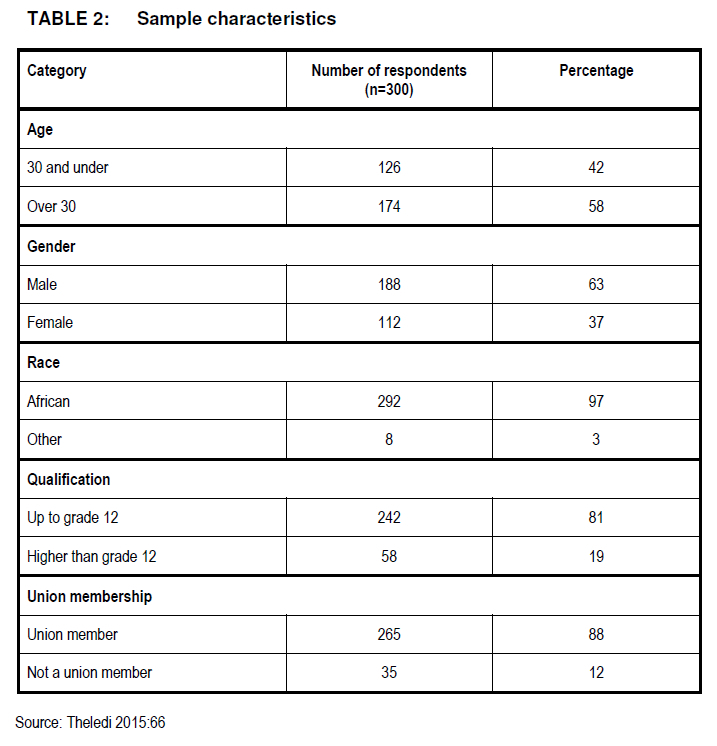
Sample characteristicsTable 2 reflects the characteristics of the sample that was investigated in this study.
4.2
Validity and reliability of the measure of PERSThe questionnaire is more than adequately valid in light of the fact that all items in the questionnaire are directly related to a validated typology of desirable social conditions in supervisory relationships (Ehlers 2013:62-63). Three academics also considered the face validity of the questionnaire and agreed that it was more than adequate for the intended measurement purpose (Bless et al. 2013:234).
Cronbach's alpha coefficient was calculated to determine internal reliability and consistency of questionnaire items. The alpha coefficient of 0,978 was very high, which confirmed that the internal reliability and consistency of the instrument can confidently be regarded as much higher than adequate (Salkind 2014:114).
4.3
Factor structure of the measure of PERSBartlett's test of sphericity confirmed that variances between items can be assumed at a confidence level of 0.00, and a Kaiser-Meyer-Olkin (KMO) test of sampling adequacy returned a value of 0.971.
The aforementioned results confirmed that factor analysis was possible, and a principal component analysis was subsequently conducted (Costello & Osborne 2005:1-8). Communalities between the 20 components were all significantly higher than the minimum level of 0,5 that were recommended by Costello and Osborne (2005:8). Communalities were all in the range of 0.584 to 0.786.
Only one principal component with an Eigenvalue of higher than one (14.12) emerged from a principal component analysis. This component accounted for 70.6% of all variances which far exceeds the 50% minimum accounting level that was suggested by Hayton, Allen & Scarpello (2004:193-197). It was consequently concluded that all 20 items, or components of the questionnaire were strongly related to a single underlying primary component, namely: "Primary Employment Relationship Satisfaction" (PERS) (Costello & Osborne 2005:7).
A related component matrix indicated that all 20 components were strongly correlated with the principal component, with very desirable factor loadings ranging from 0.764 to 0.887 (Costello & Osborne 2005:8).
It was furthermore concluded that the factor loadings representing communalities between the 20 individual components, and the factor loadings representing relationships between the 20 components and the principal component (PERS) were highly acceptable and no factor reduction was subsequently performed (Costello & Osborne 2005:8). Confirmatory factor analysis falls outside of the scope of the current research objectives and was subsequently not conducted.
4.4
Initial norms for the measure of PERSA norm can be described as a specific measure which can be confidently used to compare or interpret another individual's score on the same measure. Norms, or standards for comparison, provide valid and reliable reference points for comparing individual scores with typical scores of another relatively similar sample group (Muchinsky, Kriek, Schreuder 2005:78-85).
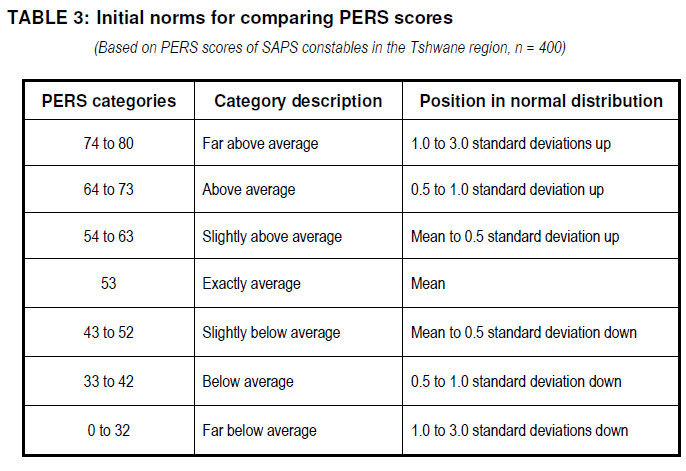
Initial norms for scores on the PERS measure were subsequently derived from the limited sample comprising of SAPS constables in the Tshwane region. However, it should be noted that this sample was thus not representative of all types of subordinate employees in the South African labour market. These initial norms should subsequently only be used for purposes of generic comparisons of scores on the PERS measure (see Table 3).
Mean scores reflect the average score in a dataset and is calculated by dividing the sum of all scores by the number of scores in the dataset (Bless, Higson-Smith & Sithole 2013:256; Salkind 2014:21). The standard deviation (SD) represents the average distance that scores deviate from the mean. A larger SD indicates that there is a larger average distance between the scores in the dataset and the mean, and vice versa (Bless et al. 2013:262; Leedy & Ormrod 2010:271; Salkind 2014:146).
Normal distributions can be used to categorise scores of a group of scores in a dataset. Normal distributions occur when scores are clustered around a mean score in a specific pattern. Common scores are located around the mean and less common scores will be located further from the mean. In normal distributions, approximately 68% (2/3) of scores are within one standard deviation from the mean, 28% are between one and two standard deviations from the mean (either above or below), and only 4% are two or more standard deviations above or below the mean (Leedy & Ormrod 2010:263; Salkind 2014:146).
The researchers needed to investigate the normality of data distribution in the dataset that was used in this study, before making assumptions about normality and identifying norms from the dataset. The Shapiro-Wilk test confirmed that the standard error of skewness of the dataset was .121 and the standard error of kurtosis was 0.240. Both of the aforementioned values were close to 0 and within the acceptable limits of -2 and 2, which suggested acceptable levels of skewness and kurtosis as well as normal distribution of data (Gravetter & Wallnau 2014:102, Salkind 2014:135-152).
The normality of data enabled researchers to use half standard deviations as category limits in an initial norm table. Initial norms for comparing scores on the measure of PERS are reflected in Table 3.
5. LIMITATIONS AND RECOMMENDATIONS
Empirical research findings indicated that the ERS measure is more than adequately valid and internally reliable and consistent. It is, however, recommended that further studies be conducted to find additional confirmation of measure consistency and reliability (Bless et ai. 2013:234).
The sample was not representative of all subordinate employees in South African organisations. Different race groups were also not adequately represented in the sample, and all respondents were employees of the same employer in the Tshwane region.
However, Tett, Pieper, Wadlington, Davies, Anderson and Foster (2009:657) regarded a sample size of 300 as more than adequate for purposes of questionnaire development and exploratory factor analysis. More representative, valid and reliable norms should also be developed to enhance the utility of the questionnaire.
Aggregate PERS scores can be confidently regarded as ordinal or scale level measurements for purposes of statistical analysis (Salkind 2014:108). It is, however, recommended that the scores of the four distinct sub-scales, namely trust, compliance, fairness and good faith, also be considered when interpreting PERS scores. These scores can be regarded as ordinal or scale level measurements, and may provide useful insights into the nature of employment relationship satisfaction in unique supervisory relationships.
6, CONCLUSION
A valid and reliable instrument for measuring primary employment relationship satisfaction (PERS) of subordinates in distinctly South African supervisory relationships was developed and related empirical findings were reported in this article. This primary objective was attained by achieving five secondary objectives, namely:
i. A measure of general PERS of subordinate employees was developed. A general score of PERS can be obtained by combining measurements of subordinate employee satisfaction with trust, compliance, fairness and good faith in supervisory relationships. Higher PERS scores indicate higher levels of satisfaction, and lower scores indicate lower levels of satisfaction. The same principle applies to scores on sub-scales.
ii. The measure is more than adequately valid, since all items were derived from a related validated typology.
iii. The above average reliability of the instrument was confirmed by a very desirable Chronbach's alpha coefficient of 0.978.
iv. All items in the measure is significantly to one factor, namely primary employment relationship satisfaction (PERS).
v. Initial norms for interpreting general scores of the measure was established, but caution should be taken when applying these norms in light of the limited representivity of the sample group from which the initial norms were derived.
The researchers are confident that the Primary Employment Relationship Satisfaction (PERS) measure can be regarded as a valid and reliable measure of the unique type of relationship satisfaction that an individual subordinate derives from positive or negative perceptions of the levels of trust, compliance, fairness and/or good faith that immediate supervisors display before, during and after employment relationship exchanges. This measure can provide ordinal or scale level measurements on the general PERS of subordinates, as well as ordinal or scale measurements of subordinate employee satisfaction with trust, compliance, fairness and good faith in supervisory relationships.
The authors are of the opinion that the measure of PERS can be useful in organisational and research environments. Potgieter (2014:91) was of the opinion that employers should carefully monitor employment relationship conditions in their workplaces, which suggests that the measure of PERS could be used as a trustworthy management tool in this regard.
It is believed that the valid and reliable measure of PERS that was developed in this study, can be confidently and numerous other related inputs, process or outcome phenomena in organisational systems, such as productivity, job satisfaction, deviant behaviour, absenteeism, turnover, racism, citizenship, engagement and various form of workplace discrimination (Robbins & Judge 2013:60-63).
REFERENCES
3. LITERATURE REVIEW
- BLESS C, HIGSON-SMITH C & SITHOLE SL. 2013. Fundamentals of social research methods: an African perspective. Cape Town: Juta.
- BOTHA L & MOALUSI KP. 2010. Values underlying perceptions of breach of the psychological contract. SA Journal of Industrial Psychology 36(1): 1-12.
- BRINKMAN WP. 2009. Design of a questionnaire instrument: handbook of mobile technology research methods. Delft, NL: Nova.
- BUITENDACH JH & ROTHMANN S. 2009. The validation of the Minnesota Job Satisfaction Questionnaire in selected organisations in South Africa, SA Journal of Human Resource Management1'(1):1 -8,
- COSTELLO AB & OSBORNE JW. 2005. Best practices in exploratory factor analysis: four recommendations for getting the most from your analysis. Practical Assessment Research & Evaluation 10(7):1-9.
- COYLE-SHAPIRO JA & SHORE LM. 2008, The employee-organization relationship: where do we go from here ? Human Resource Management 17:166-179,
- CRESSWELL JW. 2014. Research design: qualitative, quantitative and mixed-methods approaches, 4th ed. London, UK: Sage
- CROPANZANO R, BOWEN DE & GILLILAND SW. 2007. The management of organizational justice. Academy of Management Perspectives 21 (4):34-49.
-
DIMATTEO LA, BIRD RC & COLQUITT JA. 2009. Justice, employment, and the psychological contract. Selected Works. Gainesville, FL: University of Florida. [Internet: http://works.bepress.com/larry_dimatteo/6; downloaded on 2012-10-15.
» http://works.bepress.com/larry_dimatteo/6 - ]
- EHLERS LI. 2013. A typology of desirable employment relationship conditions in supervisory relationships. South African Journal of Labour Relations 37(2):48-68.
- FIELDS D. 2002. Taking measure of work: a guide to validated scales for organizational research and diagnosis. Thousand Oaks, CA: Sage.
- GERLACH K, LEVI NE D, STEPHAN G & STRUCK O. 2007. Fairness and the employment contract: North American regions versus Germany, Cambridge Journal of Economics 32(3):421-439,
- GOBIND J. 2015. South African employment relations in context. Randburg: Knowres.
- GRAVETTER F & WALNAU J. 2014. Essentials of statistics for the behavioral sciences. 8,h ed. Belmont, CA: Wadsworth Cengage Learning,
- GUEST DE. 2004. The psychology of the employment relationship: an analysis based on the psychological contract, Applied Psychology 53(4):541-555,
- HAYTON JC, ALLEN DG & SCARPELLO V. 2004. Factor retention decisions in exploratory factor analysis: a tutorial on parallel analysis. Organizational Research Methods 7(2):191-205.
- HOLTZ BC & HAROLD CM. 2009. Fair today, fair tomorrow? A longitudinal investigation of overall justice perceptions. Journal of Applied Psychology 94(5):1185-1199.
- KICKUL J, GUNDRY LK & POSIG M. 2005. Does trust matter? The relationship between equity sensitivity and perceived organizational justice. Journal of Business Ethics 56:205-218.
- LOCKE EA. 1969. What is job satisfaction? Organizational Behavior and Human Performance 4:309-336.
- MARTINS H & PROENCA T. 2012. Minnesota satisfaction questionnaire - psychometric properties and validation in a population of Portuguese hospital workers. FEP Journal - Economics & Management. Working paper 47'1.1 -20
- MUCHINSKY PM, KRIEK HJ & SCHREUDER D. 2005. Personnel psychology. Revised 3rd ed. Cape Town: Oxford University Press Southern Africa
- NEL PS, KIRSTEN M , SWANEPOEL BJ & POISAT P. 2016. South African employment relations. 8th ed. Pretoria: Van Schaik,
- POTGIETER WA. 2014, A measure of perceived employment relationship quality (PERQ), Pretoria: University of Pretoria. (MA-dissertation,
- )
- RATTRAY J & JONES MC. 2007, Essential elements of questionnaire design and development, Journal of Clinical Nursing 16(2):234-243.
- RILEY J. 2009, Good faith in employment relationships, In Australian Institute of Employment Rights, The debate: good faith and the employment relationship. No 2. Port Melbourne, Victoria, AUS: Australian Institute of Employment Rights, p. 7-9.
- ROBBINS S & JUDGE T. 2013. Organizational behaviour. 15th ed. Boston, MA: Pearson.
- SALKIND NJ. 2014. Statistics for people who think they hate statistics. 5lh ed. Thousand Oaks, CA. Sage.
- SHANOCK LR & EISENBERGER R. 2006. When supervisors feel supported: relationships with subordinates, perceived supervisor support, perceived organizational support, and performance. Journal of Applied Psychology 91(3):689-695.
- SHIMANSKAYA I. 2010. The principle of good faith in European international trade. Tampere, FIN; University of Tampere. (Masters-dissertation.
- )
- SPARROW PR & COOPER CL. 2003. The employment relationship: key challenges for HR. Oxford, UK: Butterworth-Heinemann.
- TEKLEAB AG & TAYLOR MS. 2003. Aren't there two parties in an employment relationship? Antecedents and consequences of organization-employee agreement on contract obligations and violations. Journal of Organizational Behavior 24(5):585-608.
- TEPPER BJ. 2007. Abusive supervision in work organizations: review, synthesis, and directions for future research. Journal of Management 33:261 -289,
- TETT RP, FITZKE JR, WADLINGTON, PL, DAVIES, SA, ANDERSON MG & FOSTER J. 2009, The use of personality test norms in work settings: Effects of sample size and relevance, Journal of Occupational and Organizational Psychology, 82(3), pp.639-659.
- THELEDI NL. 2015, Employment relationship satisfaction of constables in the South African Police Service in the Tshwane region . Pretoria :Tshwane University of Technology . [MTech dissertation.
- ]
- WILLIAMS M. 2007. Building genuine trust through interpersonal emotion management: a threat regulation model of trust and collaboration across boundaries. Academy of Management Review 32:595-621.