Beaded bodies: An analysis of album cover art of select South African female musicians
South African female musicians have integrated beads into their attire on album cover art, reinforcing the connection between fashion and music. We analysed album cover imagery to determine how beadwork shapes interpretations of female musicians' images. Where feasible, insights from stylists, often overlooked in musical production, supported our analyses. We obtained these insights through semi-structured interviews with stylists for selected album covers. Our analysis is structured around three themes. Firstly, we read and analyse Sibongile Khumalo's use of ithumbu/lephenya/umgexo as vehicles for expressing artistic identity, historical consciousness, and continuity. Secondly, an exploration of three albums by the maskandi duo Amatshitshi Amhlophe suggests the concept of perpetual ubuntombi (girlhood), despite the members' maturation into womanhood. Lastly, Lebo Mathosa's and Ntsiki Mazwai's albums are evidently absent of physical beads; however, the garments worn recall beadwork in innovative ways. While focusing on beadwork's role in identity formation, we emphasise album cover art as a canvas for expressing diverse identities across time, illuminating the role of album art in fashion and style narratives.
Album cover art; beadwork; fashion; South African female musicians; styling
Beaded bodies: An analysis of album cover art of select South African female musicians
Khaya MchunuI; Luthando Ngazile NgemaII; Tinyiko BaloyiIII
IDepartment of Fashion, University of Johannesburg, Johannesburg, South Africa. https://orcid.org/0000-0001-8451-0187)
IICollege of Human Sciences, Department of Communication Sciences, University of South Africa, Pretoria, South Africa. https://orcid.org/0000-0002-6404-3005)
IIIDepartment of Fashion, University of Johannesburg, Johannesburg, South Africa. https://orcid.org/0000-0001-8636-7353)
South African female musicians have integrated beads into their attire on album cover art, reinforcing the connection between fashion and music. We analysed album cover imagery to determine how beadwork shapes interpretations of female musicians' images. Where feasible, insights from stylists, often overlooked in musical production, supported our analyses. We obtained these insights through semi-structured interviews with stylists for selected album covers. Our analysis is structured around three themes. Firstly, we read and analyse Sibongile Khumalo's use of ithumbu/lephenya/umgexo as vehicles for expressing artistic identity, historical consciousness, and continuity. Secondly, an exploration of three albums by the maskandi duo Amatshitshi Amhlophe suggests the concept of perpetual ubuntombi (girlhood), despite the members' maturation into womanhood. Lastly, Lebo Mathosa's and Ntsiki Mazwai's albums are evidently absent of physical beads; however, the garments worn recall beadwork in innovative ways. While focusing on beadwork's role in identity formation, we emphasise album cover art as a canvas for expressing diverse identities across time, illuminating the role of album art in fashion and style narratives.
Keywords: Album cover art, beadwork, fashion, South African female musicians, styling.
Prelude: Beaded bodies on album sleeves
In this article, we analyse the use of beadwork on album covers featuring select South African female musicians active in the music industry, focusing on covers from 2000 onwards. We examined their styled bodies by reading and interpreting the significance of beadwork in their cover art. Our process involved carefully selecting album covers across various music genres, sourced from online platforms, musicians' websites, and personal collections. Interviews with stylists provided valuable insights into the narratives embedded in album covers, highlighting their role alongside musicians in shaping fashion representations. We approached the stylists through their social media accounts. We then provided the stylists with information letters outlining the purpose of the study, as well as the potential benefits, risks, roles, responsibilities, and rights of participation. These letters also outlined their right to withdraw from the study and issues of confidentiality and anonymity. We did not conduct any interviews without first obtaining a signed consent form.
We chose album covers from 2000 onwards because this period marks the new millennium and supports an analysis of beadwork use on album covers in twenty-first-century South Africa. The selected musicians span a diverse range of local music genres, such as maskandi and kwaito (explained in depth later), as well as jazz, rap, and spoken word.1 Our physical album copies made it possible to read the entire sleeves, allowing us to identify the albums' stylists. When interpreting the aesthetic and expressive elements woven into fashion, it is essential to recognise the contribution of 'manufacturers, publicists, critics, merchandisers, and innovators' (Davis 2020:230). While stylists are typically unacknowledged for their involvement in an album, reading the album sleeves to explore the styling 'completes the circle' (Van Den Boogaard 2023). We interviewed the stylists to generate rich narratives that album covers can and do offer. We acknowledged the roles of both musicians and stylists in selecting the fashion and style for the cover art. For example, for the 2004 album Zandisile, Simphiwe Dana collaborated with others to assume various roles, including album sleeve design and styling. Dana and local fashion designer Palesa Mokubung are credited as stylists.
We used a thematic analysis approach to deepen our reading of the album covers. The beaded bodies in the images on the album covers demonstrate the continued resonance of beadwork with local dress, fashion, and style practices. The analysis focuses on the relationship between dress, adornment, and visual identity, treating album covers as collaborative visual artefacts produced by musicians, stylists, and photographers. As our focus centred on incorporating beadwork into album cover art, we scrutinised how beadwork was integrated into musicians' attire and found that South African female musicians used beadwork to adorn their bodies in multiple forms. While glass as a beadwork material dominates, other materials such as wood (Zamajobe's 2004 album Ndawo Yami and Irene Mawela's 2007 Tlhokomela Sera), shell (Sibongile Khumalo's 2000 Immortal Secrets, Dorothy Masuka's 2003 album Lendaba, and Sho Madjozi's 2018 album Limpopo Champions League), and steel in a tubular design (Gloria Bosman's 2001 album The Many Faces of Gloria Bosman) also feature. This article considers beadwork crafted from these diverse materials, offering a narrative informed by both musicians and stylists. Before we explore this territory in beadwork discourse, we provide a concise history and background of beadwork in the South African context.
Beadwork scholarship in South Africa
In the South African context, beadwork has been extensively explored in anthropology, dress studies, and art history (Morris & Preston-Whyte 1994; Dube 2009; Nettleton 2014a). Before glass became a widely used material of choice, materials such as wood, animal teeth, shell, and clay were used in dress items (Morris & Preston-Whyte 1994; Nettleton 2014a; 2014b; Wijngaarden 2018; Mchunu 2023). Jean Morris and Eleanor Preston-Whyte (1994:9) explain that 'glass beads of European and especially Venetian manufacture first entered Southern Africa as trade goods imported largely through the East Coast port of Delagoa Bay' (see also Boram-Hays 2018:34). During the European invasion of Southern Africa, this port was a significant 'outlet for ivory and slaves, as a way station for Indian Ocean trade, and as an avenue of approach to South African diamond fields and goldfields' (South Africa History Online 2020). Focusing on the Zulu kingdom, Boram-Hays (2018:34) asserts that between 1818-1840 during the reign of King Shaka ka Senzangakhona and King Dingane ka Senzangakhona, ornaments incorporating glass beads were monopolised and functioned as markers of the upper class in society (also Morris & Preston-Whyte 1994:16). However, during Mpande ka Senzangakhona's reign (1840-1872), traders were allowed to travel freer throughout the kingdom and restrictions on wearing beads was loosened, which implied that more beads were allowed in circulation within the kingdom (Boram-Hays 2018:34). The widened availability of beads is believed to have resulted in the proliferation of diverse beadwork styles (Boram-Hays 2018:34).
Nettleton (2014a:90) shows that 'sewing was generally associated with men before the advent of European settlers, traders and missionaries brought cloth, metal needles, cotton thread and, most notably, beads into the rural context'. It was missionaries who introduced 'sewing classes for women, who became the main producers of cloth dress, and beadwork in a very short time. By 1850, beadwork was established as a female occupation/craft/art among black peoples on the east coast of South Africa, a praxis that spread inland with the beads' (Nettleton 2014a:90).
Discourse on South African beadwork has linked it to the visual expression of group identity and ethnic affiliation, for example, South Sotho, Xhosa, Zulu, and Ndebele, among others (Jolles 1991; Boram-Hays 2015; Smuts & Mahlangu 2015; Riep 2015). The book on fertility figures in the Southern African region, edited by Elizabeth Dell (1998), is an example of this. These figures, which incorporate beads, demonstrate visual expressions in the fertility-figures category. Examples include umndwana (Ndebele), ngwana wa pelego (Tswana), nwana (Tsonga), umntfwana (Swati), and umntwana wesigonga (Zulu), amongst others.
It would be careless of us to ignore the role of social engineering in colonial South Africa, followed by administrative apartheid in 1948, in the regional development of beadwork forms. While some female musicians' use of beadwork suggests that certain styles remain confined to specific cultural and ethnic groups, there are instances where these boundaries are bypassed. This article explores the deployment of beadwork in identity formation, a subject others have addressed (for example, Nettleton 2017). We examine album cover art as a platform for expressing identities through beadwork and how these identities manifest across different contexts and periods, illustrating how fashion and style narratives are shaped in album art. We emphasise that women's styling on album covers contributes to the discourse on the cultural intersection of women, fashion, and music in South Africa. These albums, occupying the public sphere and visually portraying Black women, signify a moment in which beadwork communicates identity, memory, and aesthetic innovation. Beyond their contributions to music, these musicians use their album covers to shape material and visual culture.
Album covers speak: The narrativising potential of album cover art
The discourse on album cover art has evolved, building on research about narrative potential and styled representations. This focus prompted us to ask: Does album cover art communicate? Do the adorned, styled, and beaded bodies on album covers convey messages? Our use of "speak" is tied to fashion as a form of communication and expression, which is a long-established idea (Barthes 1983; Barnard 2002; Slade 2009; Davis 2020). Barnard (2002:27) suggests that since fashion does not use written or spoken words, fashion and clothing function as forms of nonverbal communication. The same communicative potential of wearable garb appears in beadwork scholarship (Morris & Preston-Whyte 1994; Van Wyk 2003; Boram-Hays 2018). Tina Campt (2012:5-6) states that photographic images are undoubtedly an invaluable historical resource, but they offer visual culture scholars more, since they allow us to theorise and account for the cultural, historical, and social salience embedded in them. Our thinking and analysis of the communicative power of the bodies adorned, styled, and beaded by South African female musicians on album covers parallels Campt's ideas.
Belton (2015) argues that album covers convey narratives, as do music videos. Expanding on this, it is asserted that when organised as a series of still images, album covers tell a narrative and invite opportunities for multimodal analysis (Belton 2015:4). Wright's (2013) work is another example of how reading still images collectively facilitates reading the narrative that music cover imagery conveys. These studies encourage comprehensive interpretations of album covers that incorporate multiple modes. Yet limited research explores how the styled bodies depicted on cover art can also convey narratives.
Biron (2011), as cited by Wright (2013:142-143),
encourages see[ing] the significance of studying not only the music, but also the album covers and liner notes to understand better how different texts, genres and scenes relate to each other, and how music itself intersects with other art forms.
When music intersects with other forms, it facilitates exploration of the relationship between album cover art and styled bodies. We suggest that examining the styled and beaded bodies in album art can add depth. While some scholars have not explored fashion and dress, others have examined how bodies are styled and presented on album covers.
Çalişkan (2018:191) presents case studies that include Beyoncé, Björk, Madonna, and PJ Harvey to argue that 'when music genres change, cover images also change to symbolise something novel and unique'. This suggests that the musical styles of these artists change from album to album, and that they use the body presented on album covers differently to align with the albums (Çalişkan 2018:191). The proffered argument is that these artists' hairstyles become symbolic and indicative of themselves and the unique work they have created (Çalişkan 2018:193). Notably, these artists are quite different from those analysed in this article; however, the idea of the album cover functioning as a canvas through which the body conveys a narrative remains helpful for our study. In another study, fashion, music videos, visual archives, and album cover art are used to argue that British bhangra2 musicians express sociocultural statements that 'might help to understand the style politics of fashion in British bhangra alongside some of the scholarly work on how cultural politics and identity formation for artists and audiences have been foregrounded' (Dudrah 2016:493).
In the South African context, it is worth highlighting some works like our study. In their anthology on kwaito music, Ndabeni and Mthembu (2018) briefly discuss some album covers and the fashion worn. For example, kwaito star Purity's 2001 I'm Bad album features orange All Star sneakers on the cover (Ndabeni & Mthembu 2018:64). Xavier Livermon's (2020) work also concentrates on kwaito, providing an in-depth discussion of fashion. Livermon (2020:101) identifies fashion as 'an important medium for kwaito consumption and self-fashioning' for those he terms 'kwaito bodies'. Moreover, Livermon (2020:25) finds 'consumption to be a critical practice of self-fashioning and citizenship, and an important analytical tool.' He, however, cautions that consumption as an analytical tool in kwaito 'cannot be reduced to a politics of surrender because as a politics of exuberance there is always an excess that escapes capture' (Livermon 2020:25).
These works are valuable because they combine musicians' styling practices, treating album covers as platforms for expressing statements through style. Our analysis, which draws on different musical genres, underscores the importance of examining South African album covers as sites for documenting women's narratives in music and their diverse ways of articulation. We present these examples in the next section of this article.
Ithumbu/Lephenya/Umgexo on Sibongile Khumalo's Immortal Secrets (2000) and Quest (2002)
Sibongile Khumalo's rise to stardom came after she was awarded the 1993 Standard Bank Young Artist Award in music.3 The late President Nelson Mandela lauded Khumalo as 'the first lady of song' and a national treasure, cementing her career as a respected musician in the post-1994 period. Her first album, Ancient Evenings, was released in 1996. Mchunu (2023) previously examined Khumalo's donning of the boubou4 during musical performances as a case study, and suggested it conveyed ideas about South Africa as a "new nation" and post-colonial nationalism. Extending this analysis, studying her use of beadwork on album art further enriches our understanding of her sartorial choices. For this study, we focused on two of her albums, 2000's Immortal Secrets (Figure 1) and 2002's Quest (Figure 2). By accessing physical copies of these two albums, we identified the stylists and interviewed them: Phinansi Mthiyane for Immortal Secrets and Ivan Van Den Boorgaard for Quest.5
The stylists noted Khumalo's active involvement in the creative process, attending meetings with them and contributing ideas they would present. This underscores her adeptness at building musician/stylist relationships. Mthiyane described his process for styling Khumalo, using a short Afro wig covered with a net and a beaded band symbolising the isimodeni beading style. Mthiyane's combination of the wig and net draws from Swati-inspired techniques for styling married women. Khumalo wore beaded wristbands associated with AmaXhosa, AmaPondo, and AmaZulu on her left wrist, and vhukunda wire wristbands, typical of VhaVenda women, on her right hand. Her neckpieces included two forms. First, Khumalo wears a Cameroonian piece that appears to be made of differently sized seashells. Second, Khumalo's neck is wrapped with a neckpiece featuring chevron-, lozenge-, and diamond-shaped apertures. The piece comprises red and white beads with either a black or dark blue border. On Quest, she wears a neckpiece in the same style, though it uses the dotting technique. This beaded collar is referred to by different names, ithumbu (by Xhosa speakers),6 lephenya (South Sotho speakers), and umgexo (Zulu speakers).
The beaded collar has been the focus of multiple studies that look at it as part of beading practices in South Africa. When beading practice amongst the South Sotho is discussed, Batlokwa takes precedence (see, for example, Kuckertz 2000; Riep 2011; 2013; Franzsen 2021). Lephenya (sometimes referred to as ipenya) is identifiable for its use of bright primary colours and its use by young, unmarried women (Riep 2011:386). Riep (2011:386) refers to lephenya, along with ikoso, sicobosho, and lihoti, as some of the beaded items used by groups such as Batlokwa. In an earlier study, Kuckertz (2000:98) states that beading practice in the South African context largely focused on practices associated with AmaNdebele, AmaXhosa, and AmaZulu, and less on BaSotho. In an attempt to formulate a historiography of beadwork among BaSotho, Kuckertz (2000:100) writes that difaha (plural of beadwork, singular sefaha) can be traced to the nineteenth century. As part of the socio-economic complex, beads were valued in terms of goats and cattle and accessible only to those in the high social hierarchy, like chiefs (a point made earlier) (Kuckertz 2000:100). Over time, this changed when beads were widely accessible to most individuals in society, including, amongst others, new initiates, for example, makolwane (young men), and ditswejane (young women). This would lead to the formulation of beaded pieces such as lephenya.
Beadwork in its various forms among the Zulu-speaking community is well-discussed (see Jolles 1991; Klopper 1992; Morris & Preston-Whyte 1994; Van Wyk 2003; Boram-Hays 2005; 2015; 2018; Dube 2009; Ngema 2013; Du Toit 2015). Morris and Preston-Whyte (1994:75) write that a range of beaded jewellery, including imigexo (plural for umgexo), was used by rural communities as part of women's dress, and that the tourist market and private collectors would have been interested in acquiring some of the items. This interest in acquisition would expand when institutions such as galleries and museums included some of the items in their collections. Klopper (2004:24) also discusses this matter of collection and, to some extent, situates it within the South African National Resources Heritage Act 25 of 1999. As in the case of lephenya, imigexo is generally known for incorporating primary hues while infusing white and black (similar to those worn by Khumalo on Immortal Secrets). For this infusion of these colours, we associate it with the isimodeni beadworking style, identifiable for its colour use, design, and technique. Gatfield (2019:129) explains that isimodeni emerged as a combination of two preceding beadwork styles - Ndwedwe or isinyolovane style and the Nongoma style.7 Gatfield (2019:127) further argues that while the isimodeni became a way in which beadwork tradition was transformed into '"Zulu" tourism commodity', it has 'transmuted into a nationalised form of ethnic identity and sartorial tradition'. This transformation is significant for understanding Khumalo's styling, as it demonstrates that beadwork traditions are not static cultural artefacts but evolving systems of design knowledge that can acquire new meaning across time and contexts. However, it is also important to note that there has been discussion of a more muted colour palette in imigexo, such as its use on Quest. In the muted register, Morris and Preston-Whyte (1994:82-85) show examples from the 1960s, early 1980s, as well as early 1990s.
Album images can foster a sense of social connectedness that draws on and affirms history and culture (Belton 2015:3). On Immortal Secrets, Khumalo's music focused on social issues of the time (for example, the track Mayihlome), but some songs can be viewed as having focused on history, for example, her cover of a Princess Magogo-composed song, Ngilamleleni.8 Hunter (2023:47) suggests that the body becomes a vessel for embodied historical memory, connecting to past generations. Thus, our interpretation of Hunter's notion of embodied historical memory is observed in Khumalo's covering of Ngilamleleni with the theme of the body (voice in this instance) connecting to a historical composition. While the song expresses this concept, we emphasise Khumalo's sartorial expressions of historical memory on her album covers, also facilitated by the stylist. In a recent work, Mathebula (2025) writes about beadwork as embodied monuments of placemaking and heritage production. Mathebula (2025:316) proffers a helpful idea that once beadwork finds rest in the wearer's body, the body becomes 'a site of knowledge and commemoration carrying the history, stories, and cultural significance embedded within beads'. The concentric arrangement, geometric organisation and carefully ordered colour relationships of beaded neck adornments like imigexo constitute a visual language through which cultural knowledge is preserved and transmitted. Khumalo's styling retains these structural characteristics, particularly in the broad circular imigexo, thereby preserving the design intelligence embedded in beadwork practice. However, rather than reproducing a specific historical collar, or communicating marital status or ethnic affiliation alone, Khumalo (2000; 2002), Mthiyane (2023), and Van Den Boorgaard (2023) reinterpret these design principles within a contemporary performance context. The beadwork on the album covers becomes a vehicle for expressing artistic identity, historical consciousness, and connectedness.
Rather than simply borrowing traditional adornments, Khumalo translated the design intelligence embedded within multiple indigenous beadwork traditions into a contemporary visual language. In doing so, she preserves the embodied and commemorative qualities identified in beadwork scholarship while transforming their communicative purpose from markers of community identity to expressions of post-apartheid cultural continuity. It underscores the body as a site of remembrance through clothing choices, including intricate beadwork, while simultaneously demonstrating how indigenous systems of making and meaning can evolve without losing their significance.
Perpetual Ubuntombi: Amatshitshi Amhlophe and their album covers
The all-female ensemble, Amatshitshi Amhlophe, comprises vocalists Winile Sibiya and Mabusi Mtshali. The celebrated duo emerged in the mid-1990s, performing in the male-dominated music genre of maskandi (www.gallomusicpublishers.co.za). Believed to be drawn from the Afrikaans word musikant (musician), maskandi (sometimes referred to as maskanda) is a genre of Zulu folk music that emerged during the early decades of the twentieth century when Zulu-speaking men moved to the urban locales (for example, Johannesburg and Durban) as a result of the migrant labour system (Olsen 2001; Titus 2008; Ntombela 2017). The genre was developed through a combination of musical expressive forms and integrating the guitar to the music (Olsen 2001:51). While it is difficult to define the musical feature of maskandi, as stated it is known for its infusion of musical instruments like the guitar (particularly free guitar introduction called izihlabo), concertina and violin, its responsorial delivery style and spoken self-praises (izibongo) (Biyela 2001; Olsen 2001; Titus 2008; Ntombela 2017; Mlamla & Shumba 2021). For example, these features are heard in Amatshitshi Amhlophe's track Umuntu Uyashintsha from the album Inqola. As a musical style, maskandi has been written about quite extensively. Biyela (2001:27-28) writes that, though it was known as a music genre performed by male musicians, female maskandi musicians emerged over time, including performers such as uTholakele, IziNgane Zoma, ODadewethu, UMeleni, and our case study, Amatshitshi Amhlophe.
While releasing maskandi music, Amatshitshi Amhlophe are regularly seen using beadwork, for example, the covers of Inqola (2000), Isono (2008), and Ingqikithi (2009). At this point, it is important to unpack the duo's name with an understanding of colour and colour symbolism. Amatshitshi roughly translates to "untouched by a man sexually", emphasising purity, which some associate with lighter skin tone. Amhlophe, on the other hand, is a word derived from the isiZulu word mhlophe (white), or okumhlophe (that which is white), which refers to the colour white. Preston-Whyte (2014) reveals sources that study the meanings conveyed by bead colours. In beadwork, white indicates meanings linked to purity and love. The album covers of Amatshitshi Amhlophe reflect the aesthetic of ubuntombi (girlhood). Dressing as intombi in Zulu culture is evident in many settings, where the visual positioning of the "Zulu virgin girl" is marketed and consumed as a cultural idea (Naidu 2009). This visual staging, however, is not merely a celebration of chastity; it simultaneously encodes nubility, a liminal readiness for marriage that defines itshitshi status within Zulu rites of passage. The image of the "Zulu virgin girl" thus holds two meanings at once: she is coded as sexually untouched, yet visually and culturally positioned as marriageable, available for future claim. This paradox, which connotes purity performed alongside marriage-readiness, renders the ubuntombi aesthetic inherently unstable, since it depends on holding both innocence and desirability in view simultaneously. Because this iconography circulates within maskandi, a genre historically authored and consumed by men (Olsen 2001; Titus 2008), we cannot ignore the vulnerability under-lying this construction: the beaded, white-clad body of itshitshi is offered as a culturally sanctioned object of male marital and sexual interest, even as it is publicly framed as protected and pure. Over the years, members of Amatshitshi Amhlophe's continued self-presentation as itshitshi does more than preserve tradition - it re-inscribes adult women's bodies within a patriarchally legible economy of purity and availability, one that risks foreclosing their own agency even as it appears to honour their culture.
These album covers highlight a disconnect between the women's ageing and their branding for the culture of ubuntombi. This is especially important to consider because ubutshitshi (girlhood) is a culturally preserved rite of passage marking the coming of age of itshitshi through umemulo. Amatshitshi Amhlophe's traditional presentation emphasises beadwork and attire representing ubutshitshi. In the isiZulu culture, beadwork plays a significant role in feminine socialisation, signalling gender, age, marital status, and achievements (Twala 1951; Ngema 2013). The Amatshitshi Amhlophe aesthetic upholds the notion of ubutshitshi suggested by the group's name. Despite the artists' ageing or changes in marital status evident in the cover artwork for Inqola, Isono, and Ingqikithi (Figures 3-5), their attire and bead style remain consistent, reflecting loyalty to the band name. Notably, the straps can also be seen on the members' lower legs in the 1995 album Isisho Sabadala. The members of the duo are visibly and comparatively younger than in the albums under our analysis.
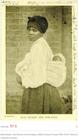
On the album Inqola (2000), the duo is portrayed wearing white-to-off-white bras and an apron-style, multi-coloured, layered skirt secured with metal safety pins. Both members wear black studded leather straps falling across the upper torso. Keeping with the layered theme, a combination of beaded and studded belts is around their waists. Layered straps also appear on the lower leg and wrists of the group member who foregrounds the album cover. The members are presented against a predominantly yellow background, with a colourful bar at the bottom that picks up the colours of the accessories while enhancing the aesthetic appeal. Rather than constituting a politics of visibility, understood as a struggle that foregrounds inequity and dynamics of power (Banet-Weiser 2015b:55), this visual construction operates through an economy of visibility. The economics of visibility act as a moderating force on feminism by shaping a postfeminist cultural landscape, neoliberal capitalism, and the normalisation of the brand and lifestyle of 'girl power' (Mavin et al 2019:1157). In this context, the women's bodies function as a form of currency (Banet-Weiser 2015a:58), their corporeal inscription defined by colour, ornamentation, and decorative framing as a wholly visible, binary affair (Wiegman 1995). In this sense, we read the album cover as reproducing a romanticised and infantilised image of femininity that aligns with the postfeminist cultural logic of "girl power", wherein neoliberal capitalism and brand culture treat girls and women as investments (Banet-Weiser 2015b), perpetuating a notion of perpetual girlhood and foreclosing more critical representations of women in the public sphere.
Amatshitshi Amhlophe's choice of beadwork highlights the dynamic traditional use of beads, expressing and affirming their culture. "Their" culture is that of the AmaZulu, who are also associated with maskandi, which Amatshitshi Amhlophe represents. Musicians often represent culture through their attire on album covers, as shown by Amatshitshi Amhlophe's association with their music genre. The depth of field of maskandi music style and its accompanying performance arts is influenced by South Africa's political, economic, and social climate (Pewa 2005; Mlamla & Shumba 2021). Given the musical genre, Amatshitshi Amhlophe could be seen as representing a specific identity of girlhood (womenhood), especially in a male-dominated musical genre. Ultimately, their album covers affirm the Zulu maiden as a cultural ideal. Khumalo and Amatshitshi Amhlophe's covers demonstrate the literal use of beads, while other musicians evoke beadwork as an art form through alternative techniques.
The absence and presence of beads: Lebo Mathosa and Ntsiki Mazwai
Lebo Mathosa's Lioness (2006) and Ntsiki Mazwai's MaMiya (2007) album covers demonstrate that beads can be suggested without being physically present (Figures 6 and 7). Certain elements associated with beadwork in album art can evoke the presence of beads in the viewer's mind. Jacques Derrida's (2012) notions of the trace and present-absence are helpful. The word trace implies 'the effects of what leaves its trace without ever itself being either present or absent and thereby to transform the terrain' (Royle 2003:50). Although beads are not physically present in the cover art of these albums, we aim to show that from a Derridean deconstruction perspective, the use of knitwear and metal studs creates a presence-absence dynamic, suggesting beads in an innovative and alternative manner on album cover art.
On the Lioness (2006) album cover, Mathosa portrays herself seated confidently, evoking the power and confidence of a lioness. This imagery connects to her identity as a strong woman in the music industry. The dress initially appears delicately beaded, but upon closer inspection, it reveals a knitted texture that creates the illusion of beadwork. The intricate details of the knitted pattern, particularly the diamond design on the skirt, add opulence to the overall look. Each shimmering bead reflects light, enhancing the dress's allure. This analysis explores how Mathosa's innovative use of knitting techniques on the album cover evokes notions of beadwork, linking to concepts of the trace and present-absence.
Kwaito is a variant of house music originating from Soweto in the 1980s. Known for incorporating African sounds, it features a slower tempo than traditional house music and is characterised by a distinct vocal style combining singing, rapping, and shouting. Kwaito provided a platform for raw Black youth expression. It has been argued that while to an outsider, kwaito may seem 'apolitical, unengaged, reactionary,' for the urban Black youth 'the cultural practices that arise in kwaito are as critical a site for political practice as any political and economic institution or action' (Livermon 2020:4). Understanding Mathosa as a musician is crucial to grasping the depth of her innovation. Lebo Mathosa, a kwaito musician, emerged during a time when South African youth aimed to establish a distinct identity in music and style. Mathosa gained prominence as part of the kwaito group Boom Shaka, known for her dynamic stage presence, vocal prowess, and bold fashion choices, including signature hairstyles like box braids and vibrant wigs.
By the release of Lioness, Boom Shaka had disbanded, and Mathosa had a successful solo career with two albums under her belt - 2001's Dream and 2005's Drama Queen. Writing about kwaito, Hlasane and Peterson (2022:346) state that it centralises the
corporeal as a site of producing alternative - and at times autonomous - forms of knowledge, agency and pleasure; a restless aesthetic and vision that thrives on all kinds of innovation related to its weaving of local and international sonic and phonetic repertoires (that centralise but exceed its musical dimensions), visual and print grammars (music videos, street culture and fashion, popular media and new technologies).
Hlasane and Peterson (2022:348) characterise Boom Shaka's contribution to kwaito as a blend of R&B, disco, Afropop, and ragga9 toasting. Mathosa's third studio album reflects the diverse influences of her former group. We analyse the album cover to explore how Mathosa's dress, with its geometric patterns, aligns with the alternative and innovative style typical of kwaito artists.
Scholars discuss the incorporation of beads into geometric designs, including their transformation in knitwear. Victoria Rovine's (2015:154) study of South African knitwear designer Laduma Ngxokolo highlights how he adapts beading patterns in knitwear to create new dress styles that evoke tradition while simultaneously innovating. Hlasane and Peterson (2022:353) highlight Mathosa's pioneering approach to kwaito music, pushing boundaries in both content and style. While they focused on her music videos, we demonstrate that her innovative spirit extended to her album cover art and fashion choices. According to Ephraim Molingoana (2012), Mathosa's stylist, musicians now prioritise their image on album covers, recognising its significance in shaping their identity.
Mathosa broke from tradition by redefining the materiality and colour palette of beadwork, departing from the literal representations seen in previous artists' works. Unlike the overt cultural expressions seen in music videos like Boom Shaka's Bambanani, Mathosa's Lioness departs from typical cultural imagery, opting for a more nuanced approach.
Mathosa's knitted dress on Lioness mimics beadwork patterns, evoking traditional forms. However, her use of engineered knitting techniques showcases an innovative approach aligned with her identity as a kwaito artist.
It is worth noting that Dream's cover art shares a common thread with Lioness's use of beads as a prominent visual element. Mathosa's face takes the stage on the album cover for Dream (2001); she wears a beaded wig that hangs down her face like a fringe. Although excluded from our main analysis, the album cover potentially holds rich intertextualities through Derrida's trace theory. The use of beads conjures up the absent-presence of physical hair. Hair, as a subject, has always been Mathosa's visual marker and a tool for her presentation and representation as a musician since her entry into the music industry, the so-called 'Boom Shaka braids'.
Ntsiki Mazwai's 2007 album MaMiya showcases a distinctive style (Figure 7). Despite being primarily a poetry album, its musical delivery attracted attention in clubs and on the radio. Molebatsi and d'Abdon (2007) also note its crossover quality. The album was nominated at the South African Music Awards. Mazwai's album cover blends nature and urban elements, featuring a striking studded leather dress dyed in red and brown hues. Crafted with meticulous detail, the dress stands out with its vibrant colours and embellished surface.
The meticulously placed studs along the dress seams evoke beadwork, including brass studs. In a doctoral study conducted by Mchunu (2021:204), analysis of the Phansi Museum10 collection revealed similar brass studs fixed onto animal skin (Figure 8). While distinct from Mazwai's dress, there are notable similarities. We argue that the innovative placement of studs suggests the presence of beadwork through alternative forms, aligning with the concept of conjuring beadwork through alternative means.

Historically, brass studs, also known as metal studs, have been incorporated in beadwork. Studies of South Africa's beading tradition provide photographic evidence of their use, particularly in the late 19th century, when beaded bandoliers, waistbands, apron panels, and cloth adorned with brass studs were prevalent (Stevenson & Graham-Stewart 2000:69, 83, 137, 161, 163). Peter Magubane's (2001) photography captures the rich diversity of beadwork, showcasing both the vibrant explosion of glass beads in items like isigolwane (heavily beaded hoops worn around the neck, waist, arms, and legs) and isicholo (cone-shaped women's hat), as well as the inclusion of studs in beadwork in items such as the utshodo (a frontal beaded apron) and the isibamba (pregnancy apron). These items are also captured in the seminal work conducted by Morris and Prestyn-Whyte (1994). Stevenson and Graham-Stewart (2000:37) highlight that the incorporation of studs reflects the individual taste and creativity of beadmakers and users, showcasing their innovative design choices.
On the cover of MaMiya, Mazwai's striking presence reflects her creative spirit, embodying individuality and self-expression. Scholarly works have extensively explored Mazwai's diverse modes of self-expression, including her use of her body, hair, poetry, and music (Molebatsi & d'Abdon 2007; Nyamjoh & Fuh 2014; Tshivhase 2015; Boswell 2016; Seti-Sonamzi 2019). Mazwai rose to prominence as a poet, notably as part of Feela Sista, an all-female poetry group. Recognised for her beadwork, Mazwai often performed in self-made wooden bead tops and A-line skirts. Her beadwork, marketed under House of Mobu, became her signature style, so much so that even when worn by others, these wooden beads were linked with Mazwai.
Mazwai's absence of wooden beadwork on the MaMiya cover prompts inquiry, given her past association with such adornments during the Feela Sista era. This absence highlights her established bead awareness, as evidenced by her fashion brand and self-identification as a bead artist. The presence of brass studs in her dress serves as a reminder of this awareness, conjuring images of 'traditional' beadwork that combines beads and studs in, for example, pregnancy aprons, utshodo, isigolwane, and isicholo. Mazwai's and Mathosa's album covers innovatively embed historical and artistic traces through bodily practices.
Outro: Imaged musicians' beaded bodies
The digital age has transformed music distribution, but imagery remains vital, especially on online platforms. South African female musicians continue to use beadwork creatively, showcasing its enduring role in visual expression and presentation of women musicians' styled and beaded bodies. Imagery on albums released in the late 2010s (for example, Busiswa 2017; Sho Madjozi 2018; Makhadzi 2019; Thembisile Ntaka 2019) and early 2020s (Mpumi Mzobe 2020; Mpho Sebina 2020; The One Who Sings 2021) shows that beads remain a constant feature.
Dudrah (2016) highlights that recalling the past serves more than nostalgia; it helps comprehend today's historical context, enabling the analysis of identity representations within broader social and cultural histories. Our study of album art integrates fashion and communication, revealing the social narratives female musicians and their stylists convey. We developed a dress and fashion history specific to South Africa, interpreting beadwork on album covers as part of a tradition that blends past, present, and future. These album covers capture and narrate dress and fashion stories, making female musicians, their stylists, and beads central to their narratives.
Notes1 Some albums incorporate multiple musical styles, so categorising them within the confines of a single genre is both difficult and limiting.
2 British bhangra can be understood as a type of fusion music genre that uses elements of Punjabi folk music, and it is associated with the Punjabi diaspora in Britain.
3 The Standard Bank Young Artist Awards form part of South Africa's National Arts Festival. The awards aim to support relatively young and emerging South African artists who, despite being known in their fields for their exceptional talent, have not yet achieved national exposure. The awards categories have included jazz, music, drama, dance, film, visual art and performance art.
4 The boubou, sometimes also referred to as the grand boubou (when worn as an ensemble), is a robe visually identifiable for its wide sleeves and flowing silhouette. In fashion and dress studies, it is widely associated with West Africa.
5 Both stylists granted us permission to use their names for this study.
6 We have not provided a discussion of ithumbu as we have with lephenya and umgexo. We are limited by the article's word count but acknowledge scholars such as Van Wyk (2003), Nettleton (2014), and Rozani and Goduka (2017), whose works help to deepen an understanding of beadwork among Xhosa-speaking people.
7 Isinyolovane is characterised by multicoloured bead dotting on a black ground. The Nongoma style is known for its 'stepped (triangular) rhomboid motifs' (Gatfield 2019:127), generally in white, black, green, and red.
8 Princess Constance Magogo Sibilile Mantithi Ngangezinye ka Dinuzulu (1900-1984) was the younger sister of the Zulu King Solomon ka Dinuzulu and Prince Mshiyeni ka Dinuzulu and the mother of Prince Mangosuthu Buthelezi. Magogo was renowned for composing Zulu classical music. Khumalo covered more of her compositions on her self-titled album, Sibongile Khumalo (2005).
9 Ragga is the act of talking in a monotone melody over a reggae music genre beat.
10 Phansi Museum is a Durban-based museum with an impressive collection of books, woodwork, clay vessels as well as beadwork. Further reading is accessible in their website: https://phansi.com/
References
-
Amatshitshi Amhlophe. 2000. Inqola. Apple Music. South Africa: Gallo Record Company. [O]. Available: https://music.apple.com/za/album/inqola/671502157 Accessed 17 July 2026.
» https://music.apple.com/za/album/inqola/671502157 -
Amatshitshi Amhlophe. 2008. Isono. South Africa: Gallo Record Company. YouTube Music. [O]. Available: https://music.youtube.com/playlist?list=OLAK5uy_nrfjim-teTWYtL0B7fMOPo-MlYD2GAN6M Accessed 17 July 2026.
» https://music.youtube.com/playlist?list=OLAK5uy_nrfjim-teTWYtL0B7fMOPo-MlYD2GAN6M -
Amatshitshi Amhlophe. 2009. Ingqikithi. South Africa: Clive Calder Production Records. Gaana. [O]. Available: https://gaana.com/song/ingqikithi Accessed: 17 July 2026.
» https://gaana.com/song/ingqikithi -
Banet-Weiser, S. 2015a. Keynote address: Media, markets, gender: Economies of visibility in a neoliberal moment. The Communication Review 18(1):53-70. https://doi.org/10.1080/10714421.2015.996398
» https://doi.org/10.1080/10714421.2015.996398 -
Banet-Weiser, S. 2015b. 'Confidence you can carry!': Girls in crisis and the market for girls' empowerment organisations. Continuum 29(2):182-193. https://doi.org/10.1080/10304312.2015.1022938
» https://doi.org/10.1080/10304312.2015.1022938 - Barnard, M (ed). 2002. Fashion as communication. London: Routledge.
- Barthes, R. 1983. The fashion system. New York: Hill & Wang.
-
Belton, RJ. 2015. The narrative potential of album covers. Studies in Visual Arts & Communication: An International Journal 2(2):1-7. https://journalonarts.org/wp-content/uploads/2016/01/SVACij_Vol2_No2-2015-Belton-The-narrative-potential_CS02.pdf.
» https://journalonarts.org/wp-content/uploads/2016/01/SVACij_Vol2_No2-2015-Belton-The-narrative-potential_CS02.pdf -
Biyela, TI. 2001. Ucwaningo Olunzulu Lokuqhathanisa Umculo kaMasikandi neSicathamiya Njengobalulekile Esikweni Lesizew samaZulu, Kugxilwe Kakhulu kuPhuzekhemisi kanye NaMambazo Amnyama. PhD thesis, University of Zululand. [O]. Available: https://uzspace.unizulu.ac.za/items/52f3a77c-469e-4c7d-9aef-6ff2644a0cc1. Accessed 27 June 2026.
» https://uzspace.unizulu.ac.za/items/52f3a77c-469e-4c7d-9aef-6ff2644a0cc1 - Boram-Hays, C. 2005. Borders of beads: Questions of identity in the beadwork of the Zulu-speaking people. African Arts 38(2):38-49, 92-93, 95.
- Boram-Hays, C. 2015. Mantle for royalty: The beadwork of the Nongoma region, in Beadwork, art & the body, edited by A. Nettleton. Johannesburg: Wits Art Museum and Wits Press:28-49.
-
Boram-Hays, C. 2018. Between the body and the ancestors: Expressions of religious thought in the clothing of Zulu-speaking women in the Nongoma region of KwaZulu-Natal, South Africa. Southern African Humanities 31:31-54. https://hdl.handle.net/10520/EJC-154053636e
» https://hdl.handle.net/10520/EJC-154053636e - Bosman, G. 2001. The many faces of Gloria Bosman. South Africa: Gallo Record Company.
-
Boswell, B. 2016. 'Conjuring up her wholeness': Post-transitional Black South African women's poetry and its restorative ethic. Scrutiny2 21(2):8-26. https://doi.org/10.1080/18125441.2016.1192675
» https://doi.org/10.1080/18125441.2016.1192675 - Busiswa. 2017. Highly Flavoured. South Africa: Kalawa Jazmee Records and Universal Music.
- Çalışkan, Ö. 2018. Imagery of hair and identity in album covers: Beyoncé, Björk, Madonna, and PJ Harvey, in Feminist interrogations of women's head hair: Crown of glory and shame, edited by S Barak-Brandes & A Kama. London & New York: Routledge:191-203.
- Campt, TM. 2012. Image matters: Archive, photography, and the African diaspora in Europe. Durham & London: Duke University Press.
- Davis, F. 2020. Do clothes speak? What makes them fashion?, in Fashion theory reader, edited by M Barnard. London: Routledge:225-235.
- Dell, E. 1998. Evocations of the child: Fertility figures of the Southern African region. Cape Town, Pretoria, & Johannesburg: Human & Rousseau.
- Delius, P, Phillip, L & Rankin-Smith, F (eds). A long home: Migrant worker words 1800-2014. Cambridge: Cambridge University Press
- Derrida, J. 2012. Specters of Marx: The state of the debt, the work of mourning and the New International. London & New York: Routledge.
- De Villiers, G & Van Rooi, L (eds). 2025. Rethink, refurnish, redress: African memory landscapes in the 21st century. Stellenbosch: Sun Press.
- Dube, H. 2009. Zulu beadwork: Talk with beads. Denver: Africa Direct Inc.
-
Dudrah, R. 2016. 'Balle-Balle, Balle-Balle': Fashion-British bhangra style. Atlantic Studies 13(4):491-511. https://doi.org/10.1080/14788810.2016.1227928
» https://doi.org/10.1080/14788810.2016.1227928 - Franzsen, N. 2021. Vestiges of the Batlokwa. Pietermaritzburg: uMsunduzi and Ncome Museums.
-
Gallo Music Publishers. [Sa]. AmatshitshiAmhlophe. [O]. Available: https://gallomusicpublishers.co.za/composers/amatshitshi-amhlophe/ Accessed 29 June 2026.
» https://gallomusicpublishers.co.za/composers/amatshitshi-amhlophe/ - Hlasane, R & Peterson, B. 2022. Matters of kwaito and why kwaito matters, in Routledge handbook of African popular culture, edited by GA Musila. London & New York: Routledge:346-63.
-
Hunter, WV. 2023. 'The ring shout': A corporeal conjuring of Black-togetherness. Dance Research Journal 55(2):44-57. https://doi.org/10.1017/S0149767723000268
» https://doi.org/10.1017/S0149767723000268 -
Jolles, F. 1991. Comments on bead literacy - based on items collected in the Msinga and Maphumulo regions of KwaZulu (South Africa). Natal Museum Journal of Humanities 3:57-77. https://hdl.handle.net/10520/AJA16815564_297
» https://hdl.handle.net/10520/AJA16815564_297 -
Khumalo, S. 2000. Immortal Secrets. South Africa: Columbia Records. YouTube Music. [O]. Available: https://music.youtube.com/playlist?list=OLAK5uy_nPv4pO7wKOPCnebYtxDGmFlfYKH9VqiJM Accessed 17 July 2026.
» https://music.youtube.com/playlist?list=OLAK5uy_nPv4pO7wKOPCnebYtxDGmFlfYKH9VqiJM -
Khumalo, S. 2002. Quest. South Africa: Columbia Records. Discogs. [O]. Available: https://www.discogs.com/release/7332288-Sibongile-Khumalo-Quest/image/SW1hZ2U6MTI2MTI1NTgw Accessed 17 July 2026.
» https://www.discogs.com/release/7332288-Sibongile-Khumalo-Quest/image/SW1hZ2U6MTI2MTI1NTgw - Khumalo, S. 2005. Sibongile Khumalo. South Africa: HEITA! Records.
-
Klopper, S. 1992. The art of Zulu-speakers in northern Natal-Zululand. An investigation of the history of beadwork, carving and dress from Shaka to Inkatha. PhD thesis, University of the Witwatersrand. [O]. Available: https://emandulo.apc.uct.ac.za/pdfjs/web/viewer.html?file=../../collection/FHYA%20Depot/Theses%20and%20Dissertations/Klopper_1992_PhD_The_Art_of_Zulu_Speakers_in_Northern_Natal_Zululand.pdf & query= Accessed 30 June 2026.
» https://emandulo.apc.uct.ac.za/pdfjs/web/viewer.html?file=../../collection/FHYA%20Depot/Theses%20and%20Dissertations/Klopper_1992_PhD_The_Art_of_Zulu_Speakers_in_Northern_Natal_Zululand.pdf & query= - Klopper, S. 2004. South Africa's culture of collecting the unofficial history. African Arts 37(4):18-25.
-
Kuckertz, HJ. 2000. Tlokwa material culture as it relates to the usage of beadwork. Natal Museum Journal of Humanities 12:97-121. https://www.sahumanities.org/index.php/sah/article/view/204
» https://www.sahumanities.org/index.php/sah/article/view/204 - Leeb-du Toit, J. 2015. Women's creative authority: Recent shifts in Ibandla lama Nazaretha (Shembe) Umnqwazi beadwork patterns (c. 1950-2014), in Beadwork, art & the body: Dilo tse dintsi/ Abundance, edited by A Nettleton. Johannesburg: Wits Art Museum and Wits Press:74-95.
- Livermon, X. 2020. Kwaito bodies: Remastering space and subjectivity in post-Apartheid South Africa. Durham & London: Duke University Press.
- Madjozi, S. 2018. Limpopo Champions League. Johannesburg: Flourish and Multiply.
- Magubane, P. 2001. Arts and Craft. London, Cape Town, Sydney & Auckland: Struik Publishers.
- Makhadzi. 2019. Matorokisi. Thohoyandou: Rita Dee Entertainment.
- Masuka, D. 2003. Lendaba. South Africa: Gallo Record Company.
- Mathebula, D. 2025. Beadwork: Embodied monuments of placemaking and heritage production, in Rethink, refurnish, redress: African memory landscapes in the 21st century, edited by G de Villiers & L van Rooi. Stellenbosch: Sun Press:312-330.
-
Mathosa, L. 2006. Lioness. South Africa: EMI. Apple Music. [O]. Available: https://music.apple.com/za/album/lioness/713355948 Accessed 17 July 2026.
» https://music.apple.com/za/album/lioness/713355948 -
Mavin, S, Elliott, C, Stead, V & Williams, J. 2019. Economies of visibility as a moderator of feminism: 'Never mind Brexit. Who won legs-it!'. Gender, Work & Organization 26(8):1156-1175. https://doi.org/10.1111/gwao.12291
» https://doi.org/10.1111/gwao.12291 - Mawela, S. 2007. Tlhokomela Sera. South Africa: Gallo Record Company.
-
Mazwai, N. 2007. Ma Miya. Gallo Record Company. South Africa. Spotify. [O]. Available: https://open.spotify.com/album/4IsUI8Y1VGth09hPBWeQEV Accessed: 17 July 2026.
» https://open.spotify.com/album/4IsUI8Y1VGth09hPBWeQEV -
Mchunu, K. 2021. Socially engaged creative practices: A transdisciplinary study of Woza Moya. PhD thesis, Durban University of Technology. [O]. Available: https://openscholar.dut.ac.za/items/c57bec2c-b6e8-4dc8-8509-2a53c349e9df Accessed 28 June 2026.
» https://openscholar.dut.ac.za/items/c57bec2c-b6e8-4dc8-8509-2a53c349e9df -
Mchunu, K. 2023. The Boubou and post-colonial musical performances: Ami Koïta, Bi Kidude, and Sibongile Khumalo. Fashion Theory 27(3):411-441. https://doi.org/10.1080/1362704X.2022.2102857
» https://doi.org/10.1080/1362704X.2022.2102857 -
Mlamla, NE & Shumba, K. 2021. A critical discourse analysis of the voice of Maskandi on hostel killings in KwaMashu, Durban: Implications for community safety, health and well-being. African Journal of Development Studies 11(3):271-292. https://journals.co.za/doi/epdf/10.31920/2634-3649/2021/v11n3a13
» https://journals.co.za/doi/epdf/10.31920/2634-3649/2021/v11n3a13 - Mthiyane, P. 2023. Interview by Ngema, LN. [Transcript]. 27 July 2023. South Africa.
-
Molebatsi, N & d'Abdon, R. 2007. From poetry to floetry: Music's influence in the spoken word art of young South Africa. MUZIKI 4(2):171-177. https://doi.org/10.1080/18125980802298575
» https://doi.org/10.1080/18125980802298575 - Morris, J & Preston-Whyte, E. 1994. Speaking with beads: Zulu arts from Southern Africa. London: Thames & Hudson.
- Mzobe, M. 2020. Nompumelelo. South Africa: Nompumelelo Mzobe.
-
Naidu, M. 2009. Topless tradition for tourists: Young Zulu girls in tourism. Agenda: Empowering Women for Gender Equity 79:38-48. http://www.jstor.org/stable/27868946
» http://www.jstor.org/stable/27868946 - Ndabeni, E & Mthembu, S. 2018. Born to kwaito: Reflections on the kwaito generation. Auckland Park: BlackBird Books.
- Nettleton, A. 2014a. The art of those left behind: Women, beadwork, and bodies, in A long home: Migrant worker words 1800-2014, edited by P Delius, L Phillip, and F Rankin-Smith. Cambridge: Cambridge University Press: 90-105.
-
Nettleton, A. 2014b. Women, beadwork, and bodies: The making and marking of migrant liminality in South Africa 1850-1950. African Studies 73(3):341-364. https://doi.org/10.1080/00020184.2014.962874
» https://doi.org/10.1080/00020184.2014.962874 - Nettleton, A (ed). 2015. Beadwork, art & the body. Johannesburg: Wits Art Museum and Wits Press.
-
Nettleton, A. 2017. Dress and a fashioned identity among Black South African migrant miners in the mid-twentieth century. Critical Arts 31(3):18-34. https://doi.org/10.1080/02560046.2017.1383490
» https://doi.org/10.1080/02560046.2017.1383490 -
News24. 2012. The celebrity designer: Ephraim Molingoana of Ephymol. [O]. Available: https://www.news24.com/news24/the-celebrity-designer-ephraim-molingoana-of-ephymol-20150429_24 Accessed 23 May 2023.
» https://www.news24.com/news24/the-celebrity-designer-ephraim-molingoana-of-ephymol-20150429_24 -
Ngema, LN. 2013. Questioning notions of authenticity: Zulu beadwork as cultural tourism. Master's dissertation, University of KwaZulu-Natal. [O]. Available: https://ccms.ukzn.ac.za/Files/articles/notion%20of%20authenticity_final%20thesis%20draft_lnngema.pdf Accessed 04 March 2026.
» https://ccms.ukzn.ac.za/Files/articles/notion%20of%20authenticity_final%20thesis%20draft_lnngema.pdf - Ntaka, T. 2019. Ummeli. South Africa: Nathi Banda.
-
Ntombeli, SA. 2017. Maskandi: A critical general inductive analysis of Zulu maskandi songs. Southern African Journal for Folklore Studies 27(1):42-52. https://unisapressjournals.co.za/index.php/SAJ_FS/article/view/1465/1963
» https://unisapressjournals.co.za/index.php/SAJ_FS/article/view/1465/1963 -
Nyamnjoh, F & Fuh, D. 2014. Africans consuming hair, Africans consumed by hair. Africa Insight 44(1):52-68. https://hdl.handle.net/10520/EJC161964
» https://hdl.handle.net/10520/EJC161964 -
Oberhofer, MA. 2012. Fashioning African cities: The case of Johannesburg, Lagos, and Douala. Streetnotes 20(01):65-89. https://doi.org/10.5070/S5201012052
» https://doi.org/10.5070/S5201012052 -
Olsen, K. 2001. 'Mina ngizokushaya ngengoma'/'I will challenge you with a song': Constructions of masculinity in Maskansa. Agenda 16(49):51-60. https://www.tandfonline.com/doi/abs/10.1080/10130950.2001.9675972
» https://www.tandfonline.com/doi/abs/10.1080/10130950.2001.9675972 -
Pewa, ES. 2005. The philosophical, behavioural, and academic merit of UMaskandi music. Doctoral Thesis, University of Zululand, KwaDlangezwa. [O]. Available: https://uzspace.unizulu.ac.za/collections/308ee95f-6bfb-47e6-bd38-43a05aab9107?cp.page=2 Accessed 3 July 2026.
» https://uzspace.unizulu.ac.za/collections/308ee95f-6bfb-47e6-bd38-43a05aab9107?cp.page=2 -
Phansi Museum. [Sa]. Homepage. [O]. Available https://phansi.com/ Accessed 4 March 2026.
» https://phansi.com/ - Preston-Whyte, E. 2014. Zulu beadwork. Noordhoek: Print Matters.
-
Riep, DMM. 2011. House of the crocodile: South Sotho art and history in Southern Africa. PhD thesis, University of Iowa. [O]. Available: https://iro.uiowa.edu/esploro/outputs/doctoral/House-of-the-Crocodile-south-Sotho/9983777102402771 Accessed 28 June 2026.
» https://iro.uiowa.edu/esploro/outputs/doctoral/House-of-the-Crocodile-south-Sotho/9983777102402771 -
Riep, DMM. 2013. Seeing Sesotho: Art, history, and the visual language of South Sotho identity. Southern African Humanities 25:217-244. https://hdl.handle.net/10520/EJC149096
» https://hdl.handle.net/10520/EJC149096 - Riep, DMM. 2015. Histories of South Sotho beadwork, in Beadwork, art and the body: Dilo tse dintsil Abundance, edited by A Nettleton. Johannesburg: Wits Art Museum and Wits Press:50-73.
- Royle, N. 2003. Jacques Derrida. London & New York: Routledge.
-
Rozani, CN. & Goduka, N. 2017. AmaXhosa Beadwork (lintsimbi) for Identity Affirmation and Economic Empowerment. Indilinga: African Journal of Indigenous Knowledge Systems 16(1):135-147. https://hdl.handle.net/10520/EJC-8fae0b2eb
» https://hdl.handle.net/10520/EJC-8fae0b2eb - Sebina, M. 2020. Lora. South Africa: Shakti Soul.
-
Seti-Sonamzi, V. 2019. On blackness: the role and positionality of Black public intellectuals in Post-94 South Africa. PhD thesis, University of South Africa. [O]. Available: https://www.unisa.ac.za/static/corporate_web/Content/News%20 & %20Media/Articles/Documents/SETIV_58561013%20reduced.pdf Accessed 8 August 2023.
» https://www.unisa.ac.za/static/corporate_web/Content/News%20 & %20Media/Articles/Documents/SETIV_58561013%20reduced.pdf - Slade, T. 2009. Japanese fashion: A cultural history. Oxford & New York: Berg Publishers.
- Smuts, H & Mahlangu, P. 2015. Looking deeply on the way my mother does her beadwork: Conversation with three foremost Ndebele beadwork artists, in Beadwork, art and the body: Dilo tse dintsil Abundance, edited by A. Nettleton. Johannesburg: Wits Art Museum and Wits Press:126-143.
-
South Africa History Online. 2020. Delgoa Bay now known as Maputo Bay, Mozambique. [O]. Available: https://sahistory.org.za/place/delgoa-bay-now-known-maputo-bay-mozambique Accessed 18 June 2026.
» https://sahistory.org.za/place/delgoa-bay-now-known-maputo-bay-mozambique - Stevenson, M & Graham-Stewart, M. (eds). 2000. South East African beadwork 1850-1910: From adornment to artefact to art. Vlaeberg: Fernwood Press.
- The One Who Sings. 2021. Thetha Mama. South Africa & London: Platoon.
-
Titus, B. 2008. Global maskanda, global music historiography? Some preliminary enquiries. SAMUS: South African Music Studies 28(1):43-54. https://hdl.handle.net/10520/EJC133276
» https://hdl.handle.net/10520/EJC133276 -
Tshivhase, M. 2015. On the possibility of authentic self-expression. Communicatio 41(3):374-87. https://doi.org/10.1080/02500167.2015.1093329
» https://doi.org/10.1080/02500167.2015.1093329 -
Twala, RG. 1951. Beads as regulating the social life of the Zulu and Swazi. African Studies 10(3):113-23. https://doi.org/10.1080/00020185108706847
» https://doi.org/10.1080/00020185108706847 - Van Den Boogaard. 2023. Interview by Mchunu, K. [Transcript]. 28 July. South Africa.
-
Van Wyk, G. 2003. Illuminated signs: Style and meaning in the beadwork of the Xhosa- and Zulu-speaking peoples. African Arts 36(3):12-94. https://www.jstor.org/stable/3337941
» https://www.jstor.org/stable/3337941 - Wiegman, R. 1995. American anatomies: Theorizing race and gender. Durham: Duke University Press.
-
Wright, AN. 2013. Exploring the Funkadelic aesthetic: Intertextuality and cosmic philosophizing in Funkadelic's album covers and liner notes. American Studies 52(4):141-69. https://doi.org/10.1353/ams.2013.0121
» https://doi.org/10.1353/ams.2013.0121 - Zamajobe. 2004. Ndawo Yami. South Africa: Giant Steps and BMG Africa.
Accepted: 2026-07-10
Published: 2026-09-15