Situated co-creation: Configurations of artistic practices with generative AI for arts education
Abstract
Beginning with an exploration of the potential of generative AI (gAI) for arts education, I examine how co-creative practices with gAI are configured in contemporary art through techno-material entanglements and artistic attitudes. Rather than anthropomorphising AI or reducing it to a passive tool through anthropocentrism, I understand co-creative practices with gAI as network practices composed of human and non-human elements, as outlined in Bruno Latour's (2005) actor-network theory. Using situational analysis (Clarke et al 2022), I investigate four exemplary artistic positions by examining how agency is negotiated across discursive and praxeological dimensions, as well as through the techno-material affordances of generative networks. In doing so, I develop a typology of artistic attitudes: attributed control, affirmative release of control, loss of control, and shared control. Rejecting the tool metaphor, I tentatively propose alternative terms for AI as connectionist counterparts and collaborators, depending on the praxeological distribution of control. The study is limited by its focus on four case studies, which provide conceptual orientation while risking the production of overly stable distinctions. Taken together, these entangled attitudes towards control offer a condensed account of situated co-creative practices with gAI and an analytical framework for encountering gAI in arts education.
gAI; co-creation; attitudes; agency; techno-material; arts education
Introduction
Al-generated images are increasingly circulating on social media under the hashtag "AI art". These images often appear generic, predictable, and formally repetitive (Meyer 2025a:1). Their imaginative potential is often limited to reproducing profit-maximising aesthetics, lacking surprise and conceptual depth (Meyer 2025b:1). In arts education, these observations raise fundamental questions about the imaginative possibilities and aesthetic potential of gAI. What situations must be in place so that working with gAI results in less predictable aesthetics and instead evokes co-creative processes that enable aesthetic experience? In this article, I explore the potential of gAI for arts education and examine how co-creative practices with gAI in contemporary art are configured against the backdrop of material entanglements and artistic attitudes. I am particularly interested in how artists negotiate agency within co-creative configurations and how gAI is discursively constructed. In doing so, I seek not only to reconstruct and deconstruct co-creative practices with gAI, but also to reimagine them by proposing alternative terminologies for the role of gAI.
Outline of the article's entangled strands
In mainstream media coverage, gAI is sometimes imagined as an autonomous creative entity - as in the case of Botto1 (2021:1) - and sometimes reduced to a mere tool of human control. This ambivalence points to a fundamental tension between anthropomorphising and anthropocentrism. On the one hand, AI is attributed human characteristics; on the other hand, the paradigm of autonomous subjectivity and control remains untouched, manifesting in the understanding of AI as a tool. In both cases, the agency of AI remains unrecognised, with it being exaggerated in the former and neglected in the latter.
In this study, I explore co-creative practices with gAI in contemporary art from an arts educational perspective to reconstruct how artists encounter or counter gAI in terms of control. The analysis draws on a structural mapping of more than 150 artistic positions working with and/or on gAI that were presented in media art institutions across German-speaking regions between 2020 and 2025. The structural mapping does not provide a comprehensive overview; rather, it represents my situated engagement with the field. Based on this structural analysis, I selected four artistic examples - Boris Eldagsen, Beth Frey, Paul Trillo, and Sasha Stiles - to illustrate different ambivalent attitudes towards working with gAI within the tension between attributed control, affirmative release of control, loss of control, and shared control.
I understand en/countering as a form of constructive criticism that not only exposes and deconstructs what co-creative practices with gAI are, but also seeks to unfold new connections and network constellations - beyond the understanding of AI as a tool that is widespread in arts education and towards AI as connectionist counterparts or collaborators.2
Co-creation as network practice
When one searches for AI on Google Images, one mainly encounters supposedly "thinking" humanoid robots depicted in cold, technical shades of blue. This hardly corresponds to the AI models we have recently become familiar with in everyday life, such as ChatGPT or DALLE. According to art and media theorist Peter Weibel (2021:1, author's translation), there is no AI, but rather 'an ensemble of machines, media, programmes, algorithms, hardware, and software that has led to an extraordinarily large, multifaceted, and productive field of research called artificial intelligence'. When Weibel denies the existence of artificial intelligence, he denies the idea of AI as a thinking machine.
Instead of humanising AI or reducing it to a passive tool, I understand co-creative practices with gAI, following Bruno Latour's (2005) actor-network theory, as socio-technical network practices consisting of human and non-human elements. In this understanding, agency is not attributed exclusively to humans but is conceived as distributed agency within a relational network; as Latour (2005:46) proposes: 'an actor is what is made to act by many others'. Actor-network theory enables us to understand infrastructures as co-actors without lapsing into naive subjectification.
In terms of co-creation with gAI, this means that no generative process can take place without a multitude of non-human actors, such as training data, interfaces, code, prompts and servers. Accordingly, I do not understand AI-generated images as the intentional outcomes of a creative act. Rather, I understand them as situated effects of multi-layered processes of mediation. They are expressions of situational entanglements and constitute non-reproducible material concretisations. Even when identical prompts are used, the results always differ.
Exploring co-creative practices with gAI
In what follows, I outline my approach to exploring co-creative practices. My research focus is not on comparing artistic practices that use the same AI model, but rather on exploring the potential of different networks. I draw on situational analysis (Clarke et al 2022:12) to examine the political and economic conditions of AI networks, their affordances,3and the discursive descriptions of the artists' practices and attitudes.
In the case of AI infrastructures, I focus in particular on visible interfaces. I am interested in which actions and effects, such as fine-tuning or the parameter settings, are enabled or constrained. While fine-tuning enables the further training of AI networks, parameters shape visual configuration. Furthermore, I am interested in the type of model, whether it operates through a closed, proprietary or open-source network architecture. This infrastructural difference significantly shapes the political and economic conditions in which co-creative practices with gAI are embedded. The question of infrastructural accessibility is not only a technical one, but also a profoundly political one in terms of power. Inclusions and exclusions are prefigured in the training data, model parameters and source code, while proprietary models establish asymmetrical relations of control over data (Crawford & Joler 2018:1).
Regarding the descriptions of the aesthetic practices, I am interested in how artists engage with the material affordances. On the other hand, I examine how artists negotiate the distribution of agency in co-creative configurations. The criterion of control emerges as an indicator of agency through the artists' descriptions. Dirk Baecker's (2007) Studien zur nächsten Gesellschaft provides a theoretical framework in which he states that the introduction of computers has led to an excess of control, which, according to the assumption, is further reinforced by generative networks. According to Baecker (2007:9), the next society faces the challenge of responding to this. Finally, I discuss the role of gAI within co-creative practices in terms of control.
Co-creative practices with gAI in contemporary art
There is a clear distinction between artists who use AI as a tool to generate and present images, such as Eldagsen (2022), Frey (2025), and Trillo (2024), and artists who explore AI as a medium for developing new forms of collaboration, such as Stiles (2025), Herndon (2021), and Arnal (2024). Artists evaluate control over the creative process differently when working with generative networks. These ambivalent statements expose discursive gaps and epistemic uncertainties in positionings towards the cypher of artificial intelligence.
I understand a tool as something that can be specifically controlled. For me, connectionist4counterparts are dialogically ambivalent partners and adversaries that are still constructed in relation to humans and shaped by unequal distributions of control. In network practice with gAI, however, I understand collaborators as transformative, statistical others with a more balanced distribution of agency. In what follows, I will present four artistic practices as en/countering with generative networks, using them as examples to illustrate artistic-aesthetic practices that engage with gAI as a tool, as connectionist counterparts and as collaborators.
Configurations of artistic practices with gAI
Attributed control: AI as a tool
First, I discuss the artist and photographer Boris Eldagsen (2023:1), whose work has significantly shaped the discourse on AI-generated images, which he terms "promptographies". In 2023, he won the prestigious Sony World Photography Awards for his work Pseudomnesia: The Electrician (2022), but declined the prize to provoke debate about AI-generated images (Eldagsen 2023:1).
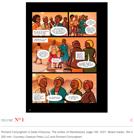
Eldagsen created the work with DALLE 2, a proprietary AI model developed by OpenAI. The interface primarily prefigures the generation and editing of images, whereas parameterised configurations are excluded. As a feature, an image can be uploaded and further edited using inpainting and outpainting methods. While outpainting allows an existing image to be expanded thematically and stylistically beyond its original frame, inpainting adds or replaces elements. Eldagsen generated the two women with a text prompt and then post-processed the image through twenty iterative loops, as shown in Figure 1. In step two, he expands the woman's portrait through outpainting. In step eight, he adds the distracting hand in the lower-right corner using inpainting.
In an interview with Reinhard, Eldagsen (cited by Reinhard 2023:1, author's translation) describes his work with DALLE 2 as follows:
The work on the image doesn't stop with the first generated result. That's when it begins. I see AI as my tool, but I am the one who determines where the journey goes.
This statement stands in tension with the affordances of DALLE 2, which offer neither parametric configurations nor adaptive options such as fine-tuning to co-shape the aesthetic. In addition, the composition and weighting of the training data, which significantly determine the aesthetics of DALLE 2, are not disclosed by OpenAI and act as silent actors in the background.
Although Eldagsen (cited by Reinhard 2023:1, author's translation) acknowledges the role of AI to a certain extent, the following statement indicates an artistic self-understanding shaped by the figure of the Romantic genius: 'The image is a co-creation of the AI programmers, the people who made the images that the AI works with, and me. But the creative authority is mine'. Eldagsen strategically positions himself within the discourse as a sovereign author, claiming autonomy over the creative process. He justifies his control in the selection and iterative processing of images. Nonetheless, cultural imaginaries of AI have material effects, shaping modes of action (Suchman 2006:1). This is exemplified in Eldagsen's practice, where he uses AI as a tool to edit images according to his own ideas. In his interview with Foster, Eldagsen (cited by Foster 2023:1) discusses the potential of gAI and its liberation from material constraints:
I now work purely from my imagination. I no longer need models, a location or a camera. My technical, art historical and creative knowledge is the creative material itself. This frees me from budget constraints and the limitations of photography.
In contrast to the artistic possibilities highlighted by Eldagsen, the theorist and artist Hito Steyerl points to the material dependencies and asymmetrical power relations involved in working with proprietary AI models. Steyerl (AI in Creativity and Critique 2024) does not consider gAI to be a tool that can be controlled; rather, she contends that humans are the ones being controlled. When working with proprietary AI models such as DALLE 2, she argues that users involuntarily lose control over their personal data and intellectual property. This turns them into contributors to data-extractive training processes and infrastructural resources for proprietary AI models (Crawford & Joler 2018:1):
You have no control over the model, you don't know what goes into the model, you assume it is stolen data but you don't know, you have almost zero control over the settings, you don't have any control over the infrastructure what so ever, you cannot see the code ... you are becoming the instrument that is being trained to use a certain set of tools, you are being the resource, you are the raw material, it is your data, your labour, it is your attention (Eldagsen cited by AI in Creativity and Critique 2024:04:26:25).
With regard to arts education, Steyerl's concerns about increasing dependence on generative networks and asymmetrical power relations highlight the need for GDPR-compliant AI technologies. At the same time, Eldagsen's work shows that gAI can facilitate and expand imaginative approaches. Whether gAI functions as another tool for image production, or contributes to a more profound transformation of artistic understanding that shifts the focus from motoric and craft-based skills towards engagement with networks and images, depends on the interface and the attitude of arts educators. In this sense, gAI could reinforce existing post-digital developments in which curatorial practices, such as selecting, collecting, and linking images, have gained importance (Meyer 2015:1).
Students who view AI primarily as a controllable tool often expect clearly defined image results. In my own practice-based research, I observed that this attitude often led to frustration when such expectations were not met. In my view, this underscores the need for more adaptable, process- and image-oriented interfaces, as well as for a conceptual and linguistic re-examination of the role of gAI in co-creative configurations.
Affirmative release of control: AI as connectionist counterparts
In what follows, I introduce Frey, who, like Eldagsen, works with DALLE 2 but deliberately releases control within the artistic process. Bajohr (2021:178, author's translation) describes this approach to gAI in digital literary studies as 'affirmative release of control'. Her artistic practice engages in complex ways with the entanglement of body, gender and technology (Frey 2025:1).
In her physical studio, Frey stages images and uploads them to DALLE 2 as image prompts. In Figure 2, the images shown above are the photographs, whereas those below are the promptographies. According to her own account, she produces countless images in the course of her work, from which she selects only a few (Baumgärtel 2024:1). In an interview with Baumgärtel, Frey (cited by Baumgärtel 2024:1, author's translation) describes her approach to gAI as follows:
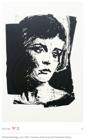
I love producing technical glitches and malfunctions, and I look for ways to confuse the AI. I often work with "impossible" image descriptions ("prompts"), for example: "a woman dressed as sinuses".
Frey undermines normative, generic body shapes and aesthetics by combining semantically distant concepts. This results in absurd visual compositions with disorienting content that are not found in the underlying training data. Uploading self-staged images is another strategy for influencing the aesthetics of AI. The following can be deduced from Frey's artistic practice: Through artistic strategies of affirmative surrender of control, images can not only be statistically reconstructed in countless variations, but moments of surprise and 'indeterminacy' (Jörissen & Marotzki 2009:21, author's translation) can also emerge.
Frey (cited by Zonneveld 2023:1) considers DALLE 2 to be 'just one of the tools in my toolbox'. Unlike Eldagsen, however, she systematically experiments with the statistical transformation of her staged images.
Many of the images I was most satisfied with contained an element of chance. It's about making a suggestion to the AI and seeing what it does with it, rather than demanding precisely defined images (Frey cited by Baumgärtel 2024:1, author's translation).
By affirmatively releasing control, gAI, in my view, fulfils the functions of connectionist counterparts that both encourage and challenge her: 'It helps me push my other work forward as well as generate new ideas on what could be' (Frey cited by Zonneveld 2023:1).
The image of playful counterparts can be found in the experimental use of chance, iteration, rule-breaking and ambiguity. In contrast, connectionism refers to the technological functioning of gAI, in which images are calculated based on probabilities. As a relational network that eludes intentional control and unfolds its own powerful effects in a co-creative process, AI appears as ambivalent partners and adversaries that inspire, disappoint and appropriate data and labour simultaneously. Frey's work thus highlights both the statistical limitations and the lack of intentionality in AI-generated images. Frey (cited by Baumgärtel 2024:1, author's translation) writes:
Once I found my own method of making images in my style, it was easy to repeat, so it soon became banal. ... Using my body as a source for the images not only changed the visual quality of the images but also made me feel more connected to these works.
Regarding arts education, I consider the artistic strategy of using self-staged images as prompts particularly suitable. It may allow students to experiment with the statistical limitations of gAI and to become more emotionally involved in the co-creative process. Further media changes could intensify the process of alienation by increasing contingency and leading to data loss during semiotic translation. For example, Frey's images could be translated back into textual descriptions and then re-entered into an image-generating AI as text prompts. These image descriptions reveal which visual patterns gAI recognises and names, and which it fails to recognise and renders invisible. Analysing these descriptions makes it possible, to some extent, to uncover the normative assumptions underlying algorithmic pattern recognition.
Loss of control: AI as connectionist counterparts
While Frey deliberately releases control in her work with DALLE 2, interviews with Paul Trillo suggest that he involuntarily loses control when working with the text-to-video AI model Sora. Trillo is an American multidisciplinary artist, writer and film director. In 2024, he won the Golden Nica of the AI in Art Award at Ars Electronica with the music video Washed Out "The Hardest Part" (2024).
Similar to DALLE 2, Sora is a proprietary AI model developed by OpenAI. Like DALLE 2, Sora's interface does not offer any parameterisation options. One of its features allows users to upload their own images. Trillo (cited in Washed Out "The Hardest Part" 2024:1) describes working co-creatively with SORA as an exploratory, iterative process - an interplay of searching, discarding and reformulating: 'It felt intimate, as if I was learning about the characters with each generation and getting glimpses into their lives that no one had seen'.
Trillo generated over 700 clips, totalling 230 minutes of footage, before editing them down to four minutes. Across pages of prompt instructions, Trillo (cited in Washed Out "The Hardest Part" 2024:1) describes the rhythm of each shot, the character design, the mood, the lighting, the retro aesthetic, the camera work and the tempo: 'Much of this was about crafting the prompt and getting SORA to do what was in my head, finding the right combination of words to create the desired effect' (see Figure 3).
While Frey affirmatively releases control within the artistic process, the AI model Sora unfolds situated effects that remain beyond Trillo's control:
It's really important to not lose your voice within AI. I think there's a tendency to maybe let the first image you get, [to] just be happy with it .... I worry that there is a sort of homogeneous or monoculture that we're kind of [barrelling] towards where we let these machines or we let the datasets sort of drive our artistic voice and so I think it's really important . that you retain that kind of, that level of control or if you are embracing the kind of chaos of AI that you're doing that with intention and not just letting the inherent aesthetics of AI sort of take over the conversation [Sic] (Trillo cited by The Sparks 2024:01:26:10).
In this quote, Trillo acknowledges the power of material affordances and expresses concern about disempowerment through platform economies and their aesthetic regimes.
It is striking that both Frey and Trillo encounter terminological and conceptual difficulties in describing AI's role. This reveals discursive and epistemic gaps surrounding the concept of AI:
Obviously it is a tool, it's used as a tool for a lot of things but I think there is something much . deeper than it just being a tool . because it sort of rewires your brain and it's sort of like saying a collaborator, your writing partner or someone is a tool or your therapist is a tool, I suppose they help you ... work through your ideas. But I think it's a really reductive way of thinking of these things (Trillo cited by The Sparks 2024:01:21:00).
Through his co-creative practice with Sora, Trillo demonstrates that gAI operates less as a controllable tool and more as a connectionist counterpart. Trillo's concerns reveal the ambivalent, Janus-faced nature of gAI within asymmetrical power relations. This becomes evident in unequal access to and dependence on the network.
Trillo identifies the potential of gAI to work with the collected human data - in the form of images, videos, sound, and other material - used to train AI models. To emphasise the enormous volume of data on which AI models are based, Stiles (2025:01:05:35) refers to this as 'hyperhuman data'.
I pursue larger concepts that I would never have pursued before or just think about stranger ideas, concepts that I would have avoided or routes that I would not have dared to travel down without these kinds of enablers (Stiles cited by The Sparks 2024:1:21:47).
However, it is important to note that, contrary to the romantic notion of the collective unconscious, training data in proprietary models are neither fed into systems uniformly nor statistically averaged. Rather, they are compressed or weighted according to economic and political considerations (Buschek & Thorp 2024:1). In the context of arts education, Trillo's concerns about increasing dependence on generative networks and profit-oriented platform regimes once again highlight the need for configurable, open-source AI technologies.
Shared control: AI as collaborator
As a final artistic position, I discuss the poet and artist Sasha Stiles and her ongoing series REPETAE (2022 - ongoing). Since 2022, Stiles (2022:1) has used her AI-generated alter ego, 'Technelegy', to explore the endless possibilities of repetition and meaning production.
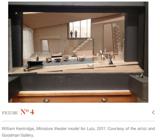
Stiles works primarily with GPT-2 and its successor models. These are large language models developed by OpenAI. Unlike the other artistic positions, Stiles intervenes in the AI network by further training it, a process also known as fine-tuning. Rather than retraining the model from scratch, which would be far too expensive, she develops it further in a specific direction. In Figure 4, Stiles (2025:00:21:10) explains how she trains and adapts her personalised model, Technelegy, to her writing style. She does not consider Technelegy a fixed, finished style, but rather a co-author that co-evolves with her adaptive data sets (Sasha Stiles on philosophy 2023).
Stiles divides her artistic practice into three main, interlocking, and iterative phases: pre-training, prompting, and post-production. As a central element of this practice, pre-training consists of curating her training datasets. Initially, she used only her own poems and notes, but she (Sasha Stiles on philosophy 2023) now supplements her datasets with selected research materials, significant texts, and poems by other authors. The challenge in pre-training lies in curating the appropriate training material:
Really, what it comes down to is creating examples and understanding that the kinds of examples you put in directly influence the outputs; of course, a lot of it has to do with how you manipulate the interface and change variables and parameters. Much of it also relates to the collaborative nature of the interactions (Sasha Stiles on philosophy 2023:1).5
Stiles experiments with different artistic strategies and modes of control in prompting processes. At times, she describes the data sets prescriptively and develops precise prompts to guide her artistic process. At others, Stiles (Sasha Stiles on philosophy 2023:1) provides prompts in the form of examples that are to be statistically blended:6
Really playing with that back and forth and sometimes I'm steering the ship more and sometimes the language model is steering me a little bit more, and then sometimes It's right in the middle, and where everything is clicking and there's that kind of perfect balance [sic].
Post-production is characterised primarily by conceptual curatorial activities. At this stage, Stiles further processes, manipulates and arranges the existing material. Stiles (2025:00:56:18) describes her collaboration with Technelegy as follows:
I want to create a synergistic poetic alter ego that takes the best of me as a human poet, takes the best of what AI has to offer as creative collaborator, and then fuses it together in this third voice that does things that are unexpected and sometimes mysterious, which really at the end of the day, that's kind of what I'm always trying to get at as a poet, is what are the things that I don't know how to name in prose or I don't know how to articulate in other means.
Her work is not about technically outsourcing artistic practices but rather expanding them by using gAI to identify patterns (The Sparks 2024). By fine-tuning gAI with specially curated data sets, Stiles adapts the aesthetics to her needs. At the same time, she positions AI as a collaborator and co-author of her work, granting it agency. By doing so, Stiles (cited by The Sparks 2024:01:40:30) challenges market-based concepts of authorship and envisions new post-anthropocentric network practices as a counter-narrative:
Maybe AI is not here to have to replace us, with its soulless verse or its soulless art but rather to help us write the poems that we don't yet know how to write, the poems that grapple with the anxiety and the longings of a world on the brink of profound changes and transformations, poems that grieve for what we have lost and what we are losing and the poets that dream of what is to come, the voice and soul of the next phase of our humanity.
At this point, I would like to point out that there is currently no evidence that the agency of AI extends beyond its statistical mode of operation. Co-creative processes are always initiated and received by humans. Consequently, they are always based on asymmetrical starting conditions.
For Stiles, the potential of gAI lies less in the quality of its output than in the dialogical process it enables. While gAI accelerates Frey's work, Stiles (cited by The Sparks 2024) describes her own process as particularly time-consuming due to the pre-training. Like Trillo, Stiles uses gAI to access unknown semantic relations within enormous amounts of hyperhuman data. Through fine-tuning, however, Stiles's texts are better tailored to her needs, allowing her to undermine generic platform aesthetics to some extent.
For arts education, curating one's own datasets, fine-tuning, and collaborating with generative networks as artistic strategies offer enormous aesthetic and educational potential. This approach sits at the intersection of artistic-aesthetic practice, technological knowledge about AI networks and ethical reflection on epistemic inclusions and exclusions. Through collaboration with the generative network, Stiles creates a space for reflecting on the distributed agency that exists within network practices. According to Meyer (2024:1, author's translation), these reflexive moments are constitutive of transformative 'network education processes' in arts education.
Summary of the entangled strands
In the following section, I approach co-creative configurations with gAI through three intertwined dimensions: the material-discursive, the praxeological and their potential for arts education. In the context of artistic practices with gAI, a tension can be observed between the limited control artists have over AI models and their attitudes towards agency. Eldagsen exemplifies this tension. Despite his prompt design, he has little influence over the co-creative process, even though he claims exclusive agency for himself. In doing so, he constructs gAI as a tool, as reflected in his application-oriented practice. In contrast, Stiles employs a method that involves a certain degree of control over the generative network through fine-tuning, while also attributing equal agency to gAI. She considers AI to be a collaborator and co-author.
According to Frey and Trillo, agency is unevenly distributed within their co-creative practices. Frey affirmatively releases control over the process, while Trillo expresses his fear of losing control. In contrast to their assessment of agency, both Frey and Trillo refer to gAI as a tool. This reveals the terminological and epistemic gaps associated with the misleading term "artificial intelligence" and highlights the need for linguistic revision. Given the uneven distribution of agency, I tentatively propose conceptualising gAI as connectionist counterparts.
Based on the different artistic strategies and modes of control in co-creative configurations with gAI, the following tendencies, which at first appear contradictory, become apparent: the more artists control the network through parameters and fine-tuning, the more the network is understood as a medium. This is evident in the work of Stiles. Conversely, in constellations where human agency is restricted, AI models appear as tools, as in the works of Eldagsen, Frey and Trillo. Users can work with them through prompting strategies, but they cannot co-constitute them.
The artistic examples show that co-creative practices with gAI unfold across entangled phases that interlock in iterative loops: pre-training, prompting and post-production. Meanwhile, agency within these networked mediation processes is unevenly distributed. In pre-training and post-production, gAI shapes co-creative practice by prefiguring certain possibilities for action and disabling others. The artists make conceptual and curatorial decisions regarding the selection and development of training data, as well as the arrangement, contextualisation and staging of the images within networked processes.
During prompting, humans guide the AI network through prompts, while the network statistically generates various images for humans to select from. While gAI prefigures co-creative practices, humans tend to initiate, conceptualise, receive and validate them (Bajohr 2021:175). The uneven weighting of distributed actions within network practice makes it clear that co-creative practices are characterised by collaborative negotiation among human actors, training data, interfaces, code, prompts, and servers. According to Bajohr (2021:178, author's translation), the changed production conditions with gAI lead to a further distribution of agency and to an 'atomisation of authorship'.
AI-generated images that appear increasingly generic and formally repetitive are circulating under the banner of "AI art". However, artistic positions demonstrate that moments of 'ambiguity' (Jörissen & Marotzki 2009:21, author's translation) can still arise in co-creative work with gAI. Accordingly, all four artists describe moments of surprise in their work with gAI, some more than others, and sometimes to an unwelcome extent. To prevent gAI from statistically reinforcing its own aesthetics (Frey) or from being instrumentalised through market-based logics (Trillo), configurable networks are required. At the same time, there is a need for artistic strategies that operate between targeted control (e.g. fine-tuning) and the affirmative release of control. For me, this is not about regaining control as a sovereign subject, but about co-constitutive network practices in which participants become reflexively aware of their distributed agency within the network (Meyer 2024:1). Affirmative control can be achieved through iterative media shifts (Frey), through blending multimodal image prompts (Stiles), or using self-staged image prompts (Frey).
In addition, the works of Frey, Trillo and Stiles reveal the transformative potential of connectionist expansion. This is particularly evident in the following statement: 'because it sort of rewires your brain' (Trillo cited by The Sparks 2024:1:21:11). Trillo refers to the vast amount of hyperhuman data he can access statistically through generative networks. Human and probabilistic semantics become intertwined, opening different ways of perceiving and situating oneself in the world. According to Michael Seemann, human semantics are characterised by embodied, complex ontologies; however, they remain limited in scope. In contrast, the probabilistic semantics of generative networks are comparatively flat in structure, disembodied and extraordinarily broad in scope (Seemann 2024:1).
The collaborative potential of co-creative practices with gAI becomes evident through the subjectification effects that emerge through negotiation processes between interfaces, training data, prompts and servers. I understand collaboration, following the art educator Krebber (2024:3, author's translation), as a transformative process in which 'the subjects are allowed, encouraged, and required to change'. To accomplish this, participants must reflexively experience their involvement in network practices, as Stiles does. This requires a certain level of network accessibility as well as an exploratory attitude. This leads me to conclude that we need to expand the widespread, tool-based understanding of gAI in arts education. We must also create situations in which gAI is encountered and co-constituted as a medium. Ultimately, the potential of co-creative network practices, as well as the understanding of gAI as tools, connectionist counterparts, or collaborators, depends heavily on the material affordances of network architectures and on the attitudes with which artists en/counter them.
Conclusion
In this article, I draw on a case study to develop a typology of attitudes within co-creative configurations with gAI in arts education: attributed control, affirmative release of control, loss of control and shared control. Depending on the praxeological distribution of control, I tentatively propose conceptualising AI as either a connectionist counterpart or a collaborator. The typology assumes that attitudes towards AI significantly shape co-creative practices. For instance, when students approach AI primarily as a tool, they may expect clearly defined image outcomes. In arts education, this attitude can lead to frustration when images remain indeterminate.
At the same time, I argue that all co-creative practices with gAI are, to varying degrees, characterised by distributed agency. When working with commercial AI models, this distribution of control is inherently ambivalent, as it is accompanied by the loss of data sovereignty or creative labour. In this context, the affirmative release of control may hold pedagogical potential for arts education through co-constitutive network practices, even though co-creative practices with gAI remain structurally ambivalent as long as students rely on commercial AI technologies. Given that there is currently no evidence that the agency of AI extends beyond its statistical mode of operation, co-creative processes are always initiated, conceptually framed and received by humans. Consequently, shared control is necessarily asymmetrical. Drawing on Krebber's understanding of collaboration as a transformative process, I argue that gAI has the potential to transform society by extending human thought and action through connectionist processes.
The study is limited by its focus on four cases that are comparatively distinct. While this selection serves as a conceptual orientation, it also risks producing distinctions that are less stable in practice. Artistic positions are rarely univocal but are instead marked by ambivalence, overlap, and situational shifts between different modes of control. Furthermore, the comparative analysis of possible actions afforded by the interfaces shows that the relational distribution of control in co-creative practices with gAI cannot be measured, but can only be reconstructed to a limited extent. In conclusion, I do not propose the typology as a classificatory system, but as a heuristic framework for reimagining the role of gAI in co-creative practices, opening up alternative ways to engage with and foreground their situated forms of distributed agency. In future research, I could explore artistic positions that engage with adaptive open-source architecture, such as the collective U2p050.
Notes1 Botto exemplifies AI as an autonomous "artist". Initiated by Mario Klingemann in 2021, the DAO (decentralised autonomous organisation) selects, publishes, and sells community-generated images as art, thereby challenging traditional concepts of authorship (Walker 2023:1).
2 From a socio-technical assemblage perspective, I conceptualise gAI as plural, foregrounding its heterogeneous and relational constitution.
3 Affordances refer to a range of actions that are enabled or constrained by technical infrastructures such as interfaces. Affordances are always relational, situational, and mediated by power. The concept was further developed by James G. Gibson (1986) in The ecological approach to visual perception and later reworked by authors such as Bruno Latour (2005:72).
4 The term connectionist refers to the probabilistic ontology of counterparts in relation to the eponymous paradigm. It is based on the assumption that human intelligence can be imitated by neural networks that statistically reconstruct patterns from training data (Bajohr 2021:176).
5 [Editorial note:] Grammar and punctuation have been corrected for clarity; redundant phrasing has been reduced in the original: 'Really what it comes down to is creating examples and understanding that the kinds of examples that you put in really directly influence the outputs and of course, a lot of it has to do with then how you manipulate the interface and how you change variables and parameters. Then a lot of it has to do also with just the collaborative nature of the interactions.'
6 The use of multiple reference images as prompts refers to a more recent development in the use of gAI: moving away from purely text-based prompts towards multimodal prompting combining various image and text elements (Eldagsen 2025).
References
-
AI in creativity and critique - A fireside chat with Hito Steyerl. 2024. AI And Artistic Creation. [Video]. [O]. Available: https://ars.electronica.art/hope/en/events/ai-and-artistic-creation/ Accessed 1 August 2025.
» https://ars.electronica.art/hope/en/events/ai-and-artistic-creation/ -
Arnal, M. 2024. Maria Choir. [O]. Available: https://mariaarnalmusic.com/Maria-CHOIR Accessed 1 January 2026.
» https://mariaarnalmusic.com/Maria-CHOIR - Baecker, D. 2007. Studien zur nächsten Gesellschaft. Frankfurt am Main: Suhrkamp.
- Bajohr, H. 2021. Künstliche Intelligenz und digitale Literatur. Theorie und Praxis konnektionistischen Schreibens, in Digitale Literatur II, edited by H Bajohr & A Gilbert. Hannover: Richard Boorberg Verlag:174-185.
- Bajohr, H & Gilbert, A (eds). 2021. Digitale Literatur II. Hannover: Richard Boorberg Verlag.
- Baumgärtel, T. 2024. 'Es ist so einfach, ein interessantes Bild zu produzieren' - Interview mit der KI-Künstlerin Beth Frey, in ArtGPT, edited by Springerin. Wien: Springerin 1/2024.
-
Botto. 2021. Botto. [O]. Available: https://botto.com/ Accessed 24 July 2025.
» https://botto.com/ -
Buschek, C & Thorp, J. 2024. Models all the way down. A knowing machines project. [O]. Available: https://knowingmachines.org/models-all-the-way Accessed 27 July 2025.
» https://knowingmachines.org/models-all-the-way -
Clarke, A, Washburn, R & Friese, C. 2022. Situational analysis in practice: mapping relationalities across disciplines. 2nd ed. New York: Routledge. https://doi.org/10.4324/9781003035923
» https://doi.org/10.4324/9781003035923 -
Crawford, K & Joler, V. 2018. Anatomy of an AI system. [O]. Available: http://www.anatomyof.ai Accessed 25 July 2025.
» http://www.anatomyof.ai -
Dicke, N & Hallmann, K (eds). 2024. Gemeinschaftlichkeit. Perspektiven künstlerischer und kunstpädagogischer Kollektive und Kollaboration. zkmb:17. [O]. Available: https://zkmb.de/sammlung/gemeinschaftlichkeit-perspektiven-kuenstlerischer-und-kunstpaedagogischer-kollektive-und-kollaboration/ Accessed 23 July 2025.
» https://zkmb.de/sammlung/gemeinschaftlichkeit-perspektiven-kuenstlerischer-und-kunstpaedagogischer-kollektive-und-kollaboration/ -
Eldagsen, B. 2022. Pseudomnesia. [O]. Available: https://www.eldagsen.com/pseudomnesia/ Accessed 27 July 2025.
» https://www.eldagsen.com/pseudomnesia/ -
Eldagsen, B. 2023. Sony World Photography Awards [O]. Available: https://www.eldagsen.com/sony-world-photography-awards-2023/ Accessed 9 July 2025.
» https://www.eldagsen.com/sony-world-photography-awards-2023/ -
Foster, A. 2023. Boris Eldagsen: The woman who never was. Interalia Magazine. [O]. Available: https://www.interaliamag.org/articles/alasdair-foster-boris-eldagsen-the-woman-who-never-was/ Accessed 9 July 2025.
» https://www.interaliamag.org/articles/alasdair-foster-boris-eldagsen-the-woman-who-never-was/ -
Frey, B. 2025. Beth Frey. [O]. Available: https://bethfrey.com/wp-content/uploads/2025/03/Beth-Frey-intro.pdf Accessed 1 August 2025.
» https://bethfrey.com/wp-content/uploads/2025/03/Beth-Frey-intro.pdf -
Gibson, J. 1986. The ecological approach to visual perception. New York: Psychology Press. https://doi.org/10.4324/9780203767764
» https://doi.org/10.4324/9780203767764 -
Herndon, H. 2021. Holly+. [O]. Available: https://holly.plus/ Accessed 24 July 2025.
» https://holly.plus/ -
Jörissen, B & Marotzki, W. 2009. Medienbildung - Eine Einführung: Theorie - Methoden - Analysen. 1st ed. Stuttgart: UTB. https://doi.org/10.36198/9783838531892
» https://doi.org/10.36198/9783838531892 -
Klein, K. 2021. Post-digital, post-internet: Propositions for art education in the context of digital cultures, in post-digital, post-internet art and education, edited by K Tavin, G Kolb & J Tervo. Cham: Palgrave Macmillan: 27-44. https://doi.org/10.1007/978-3-030-73770-2_2
» https://doi.org/10.1007/978-3-030-73770-2_2 -
Krebber, G. 2024. Uncategorized: Collaboration. Entwicklung kunstdidaktischer Konzeptionen der Zusammenarbeit, in Gemeinschaftlichkeit. Perspektiven künstlerischer und kunstpädagogischer Kollektive und Kollaboration, edited by N Dicke & K Hallmann. zkmb:17. [O]. Available: https://zkmb.de/uncategorized-collaboration-entwicklung-kunstdidaktischer-konzeptionen-der-zusammenarbeit/ Accessed 23 July 2025.
» https://zkmb.de/uncategorized-collaboration-entwicklung-kunstdidaktischer-konzeptionen-der-zusammenarbeit/ - Latour, B. 2005. Reassembling the social: An introduction to actor-network-theory. 1st ed. Oxford: Oxford University Press.
-
Meyer, R. 2025a. Die Ästhetik des digitalen Faschismus. FAZ. [O]. Available: https://www.faz.net/aktuell/feuilleton/medien-und-film/die-aesthetik-des-digitalen-faschismus-ki-und-die-globale-rechte-110437299.html Accessed 1 August 2025.
» https://www.faz.net/aktuell/feuilleton/medien-und-film/die-aesthetik-des-digitalen-faschismus-ki-und-die-globale-rechte-110437299.html -
Meyer, R. 2025b. Platform realism: AI image synthesis and the rise of generic visual content. Transbordeur. Photography 9/2025. https://doi.org/10.4000/13dwq
» https://doi.org/10.4000/13dwq -
Meyer, T. 2015. What's next, arts education? Fünf Thesen zur nächsten Kulturellen Bildung. Kulturelle Bildung Online. https://doi.org/10.25529/92552.340
» https://doi.org/10.25529/92552.340 -
Meyer, T. 2024. Imaginäre Aktanten und das Subjekt (in) der Kulturellen Bildung: Überlegungen zur Bedeutung Künstlicher Intelligenz für ästhetische Bildungsprozesse. Kulturelle Bildung Online. https://doi.org/10.25529/2DJ1-2K49
» https://doi.org/10.25529/2DJ1-2K49 -
Reinhard, C. 2023. KI-Künstler Boris Eldagsen: 'Mit dem naiven Glauben an das Foto ist es vorbei'. Berliner Zeitung, 24 April. [O]. Available: https://www.berliner-zeitung.de/kultur-vergnuegen/kunst/interview-fotografie-berliner-ki-kuenstler-boris-eldagsen-mit-dem-naiven-glauben-an-das-foto-ist-es-vorbei-li.340780 Accessed 1 August 2025.
» https://www.berliner-zeitung.de/kultur-vergnuegen/kunst/interview-fotografie-berliner-ki-kuenstler-boris-eldagsen-mit-dem-naiven-glauben-an-das-foto-ist-es-vorbei-li.340780 -
Sasha Stiles on philosophy, technelegy, and the future of literature. 2023. CODE. [O]. Available: https://www.artxcode.io/journal/sasha-stiles-on-philosophy-technelegy-and-the-future-of-literature Accessed 24 July 2025.
» https://www.artxcode.io/journal/sasha-stiles-on-philosophy-technelegy-and-the-future-of-literature - Scorzin, P (ed). 2021. Kann KI Kunst? AI Art: Neue Positionen und technisierte Ästhetiken. Köln: Kunstforum International 278.
-
Seemann, M. 2024. Thicket of meanings. [O]. ctrl+verlust. [O]. Available: https://www.ctrl-verlust.net/thicket-of-meanings/ Accessed 30 July 2025.
» https://www.ctrl-verlust.net/thicket-of-meanings/ -
Stiles, S. 2022. Repetae (2022 - ongoing). [O]. Available: https://www.sashastiles.com/repetae Accessed 24 July 2025.
» https://www.sashastiles.com/repetae -
Stiles, S. 2025. Mentoring an AI co-author. [Video]. [O]. Available: https://www.youtube.com/watch?v=A0E5S33DffE Accessed 24 July 2025.
» https://www.youtube.com/watch?v=A0E5S33DffE - Springerin. 2024. ArtGPT. Wien: Springerin 1/2024.
- Suchman, L. 2006. Human-machine reconfigurations: plans and situated actions. 2nd ed. Cambridge: Cambridge University Press.
-
Tavin, K, Kolb, G & Tervo, J (eds). 2021. Post-digital, post-internet art and education. Cham: Palgrave Macmillan. https://doi.org/10.1007/978-3-030-73770-2
» https://doi.org/10.1007/978-3-030-73770-2 -
The Sparks: Igniting AI for artistic creation. 2024. AI And Artistic Creation. [Video]. [O]. Available: https://ars.electronica.art/hope/en/events/ai-and-artistic-creation/ Accessed 1 August 2025.
» https://ars.electronica.art/hope/en/events/ai-and-artistic-creation/ -
Trillo, P. 2024. Washed Out "The Hardest Part". [Video]. [O]. Available: https://paultrillo.com/ Accessed 24 July 2025.
» https://paultrillo.com/ -
Walker, B. 2023. Botto: Meaning making, automata, and DAOs - Interview with Simon Hudson of Botto DAO. MakersPlace. [O]. Available: https://rare.makersplace.com/2023/12/04/meaning-making-automata-and-daos-interview-with-simon-hudson-of-botto-dao/ Accessed 24 July 2025.
» https://rare.makersplace.com/2023/12/04/meaning-making-automata-and-daos-interview-with-simon-hudson-of-botto-dao/ -
Washed Out "The Hardest Part" - Paul Trillo. 2024. Prix Ars Electronica winners 2024. [O]. Available: https://calls.ars.electronica.art/2024/prix/winners/14198/ Accessed 1 August 2025.
» https://calls.ars.electronica.art/2024/prix/winners/14198/ - Weibel, P. 2021. AAA - Art, algorithmen, artificial intelligence, in Kann KI Kunst? AI Art: Neue Positionen und technisierte Ästhetiken, edited by P Scorzin. Köln: Kunstforum International 278:76-87.
-
Zonneveld, R. 2023. Beth Frey: A fleshy world made from watercolors and AI tools. WEPRESENT by WeTransfer. [O]. Available: https://wepresent.wetransfer.com/stories/beth-frey-sentient-muppet-factory Accessed 17 July 2025.
» https://wepresent.wetransfer.com/stories/beth-frey-sentient-muppet-factory
Accepted: 2026-04-29
Published: 2026-06-15