Teaching African-the med video games design through participatory culture framework
Abstract
This article reflects how the participatory culture framework and inquiry-based assessment model were used in the development of African-themed video games for a game design course at a South African university. The study employed the participatory culture framework in a classroom environment that supports learning through tradition and digital settings. To assess the effectiveness of the framework, Porter's (2009) theoretical framework for digital delivery, which includes identity, accessibility, distribution, interaction, and economics, was employed to elicit valuable feedback from students' reflections. Three video games with African themes were examined as a case study to demonstrate the framework's effectiveness as a tool for inclusive education. The study concluded that the framework enabled students in developing social skills and prioritising community involvement over individual expression.
game studies; participatory culture; digital storytelling; African video games; pedagogy
INTRODUCTION
The landscape of higher education is currently experiencing a radical transformation, particularly in fields such as game design where conventional Western-centric learning approaches no longer cater to the needs of diverse student populations (Kushwaha et al., 2024). Game design as a field of study focuses on teaching students how to make video games by covering topics such as core mechanics, game balance, user interface design, level design, and game narrative. This area provides a unique opportunity to incorporate indigenous knowledge systems and African perspectives into modern digital literacy (Banerji et al., 2016; Henne et al., 2022; Jemmali et al., 2018). However, existing teaching methodologies frequently do not include African epistemologies, storytelling traditions, and collaborative learning approaches that are integral to numerous African cultures (Omolewa, 2007; Tchombe & Wirdze, 2023). Conventional game design curricula have typically consisted of 80 percent practical and 20 percent theoretical content, rooted in Western gaming paradigms and individual learning approaches. This presents significant challenges for African students whose cultural heritage emphasises collective knowledge creation and collaborative problem-solving (ubuntu). With the current cohort of students and the socio-economic factors influencing them, there is a necessity to adopt new learning methodologies and frameworks that are inclusive and socially conscious of both students and the audience of their work through digital platforms (Assié-Lumumba, 201 7; Mpofu & Sefotho, 2024).
The participatory culture framework provides a solution to this pedagogical challenge by highlighting the importance of community involvement over individual expression. It naturally aligns with African philosophical concepts, such as ubuntu, which emphasise collective existence and mutual growth (Randle, 2024). The framework's emphasis on collaborative learning, shared knowledge creation, and community engagement aligns with traditional African educational approaches while preparing students for the challenges of reaching a digital audience (Zitha et al., 2023).
Multimodal approaches, which involve a combination of visual (video and text) and auditory (sound) elements, are in alignment with African oral traditions and storytelling practices. These approaches provide students with diverse pathways to interact with content, express their creativity, and demonstrate their understanding while respecting and honouring their cultural heritage (Rohi & Murhayati, 2024; Sustrino et al., 2023).
The emergence of new technologies in education has created unprecedented opportunities for implementing innovative teaching methods. Digital platforms and tools facilitate the creation of learning environments that encourage various forms of expression and promote collaborative knowledge construction (Alam & Mohanty, 2023). However, there has been limited research on how these technologies can be leveraged effectively to enhance game design education from an African perspective, especially in terms of incorporating cultural elements and traditional knowledge systems.
Despite the lack of information on leveraging new pedagogical models for game design education, there is ample academic literature discussing the advantages of multimodal learning and the obstacles it presents. VanKooten (2016) demonstrates that integrating video during and after alphabetic writing aids in writing composition, transferring skills, knowledge, and habits across various media and contexts, while also fostering the development of critical and rhetorical literacies. Baepler and Reynolds (2014) report that various types of media enhance student commitment, engagement, and confidence, and improve students' rhetorical delivery and invention. Dubisar and Palmeri (2010) emphasise the importance of utilising remixed assessments, suggesting that they enable scholars to draft political arguments that have the potential to reach a wide audience. Alexander et al. (201 6) focus on students' ability to apply print-based composed knowledge to manage unfamiliar activities and assignments.
Considering the aforementioned factors, the above studies demonstrate the role of multimodal composition in the learning process. This article contributes to the existing knowledge base by examining the application of participatory culture in narrative storytelling, specifically in relation to African students. Therefore, the research questions are:
1) How can game design academics use multimodal composition to promote a participatory culture that encourages ubuntu and community engagement among students?
2) How can the development of African-themed video games be promoted using a participatory culture framework?
The intersection of game design pedagogy and African epistemologies presents a unique opportunity to reconsider approaches to teaching and developing digital games. This review explores the key theoretical frameworks and empirical findings that support the integration of African knowledge systems into game design education. Game design education in Africa has typically been influenced by Western pedagogical models, which frequently overlook local knowledge systems and cultural perspectives (Bayeck, 2020).
Recent research by Claybrook (2023) emphasises the importance of adopting an Afrocentric approach that incorporates indigenous knowledge systems and traditional learning methodologies. This shift necessitates a fundamental reconceptualization of how game design is taught, transitioning from merely adapting Western frameworks to developing authentically African pedagogical approaches (Paris, 2012). The ongoing transformation in game design education reflects broader changes in African higher education, highlighting a growing awareness of the need to decolonise curricula and teaching methodologies (Benson et al., 2020; Ndlovu-Gatsheni, 2020). This transformation is particularly relevant in technical fields such as game design, where Western paradigms have traditionally dominated. Seehawer and Breidlid's (2020) study on integrating knowledge in sub-Saharan African classrooms demonstrates how incorporating African epistemologies can improve student engagement and learning outcomes in digital media education.
The participatory culture framework naturally resonates with African philosophical concepts, specifically ubuntu, highlighting the importance of collective existence and mutual growth (Jenkins et al., 2009). This alignment creates opportunities for developing pedagogical approaches that respect both traditional African values and contemporary digital literacy requirements. Alalem's (2023) research demonstrates how participatory approaches can improve digital literacy while preserving cultural authenticity. The fusion of participatory culture with African knowledge systems gives rise to what Mangaroo-Pillay et al. (2023) refer to as 'digital ubuntu' - an amalgamation of traditional collaborative learning approaches with contemporary technological capabilities.
This integration is especially important in game design education, as collective knowledge creation mirrors traditional African learning methods, community feedback and iteration reflect indigenous decision-making processes, and shared storytelling aligns with African oral traditions. African oral traditions offer valuable pedagogical resources that have historically been underutilised in digital education.
Lambert and Hessler (2018) demonstrate how digital storytelling can connect traditional narrative practices with contemporary digital platforms. This connection is particularly significant in game design education, where narrative construction and user engagement are key concerns. Recent research by Claybrook (2023) illuminates how African proverbs, riddles, and narratives can function as sophisticated pedagogical tools in digital contexts. These traditional methods of passing down knowledge can successfully be translated into game mechanics and narratives, leading to culturally authentic learning experiences. Asamoah-Poku (2024) further argues that integrating African storytelling traditions into digital media education not only helps preserve cultural heritage, but also enhances contemporary technical skills.
The connection between multimodal learning and African oral traditions provides a natural framework for integrating traditional storytelling techniques into digital education. VanKooten (2016) demonstrates how incorporating multimodal composition enhances learning experiences, particularly when it aligns with cultural practices. This alignment becomes especially powerful when considering how African oral traditions have historically employed multimodal approaches by integrating gestures and performances in storytelling, using call-and-response techniques, incorporating music and rhythm, incorporating visual symbolism and metaphor, and engaging community participation.
Studies conducted by Long (2022) demonstrate how traditional multimodal approaches can be successfully applied in a digital learning environment, such as game design education. The inclusion of cultural perspectives in technological education necessitates a thoughtful examination of both pedagogical and technical aspects. The technological pedagogical content knowledge model, as discussed by Merono et al. (2021), enhances traditional frameworks by explicitly including cultural knowledge as a core component. It provides a structured approach for integrating African cultural perspectives into technical education.
Research on game-based learning in African contexts reveals unique opportunities and challenges. Bayeck (2020) also identifies the importance of creating video games that authentically depict African culture and traditional storytelling techniques. Ndlovu-Gatsheni (2020) argues that it is essential to dismantle colonial knowledge structures in technical education, while Oyedemi (2021) provides practical frameworks for incorporating decolonial approaches in digital media education. The decolonial perspective is especially relevant in the field of game design education, as Western paradigms have traditionally been predominant in both technical and creative aspects. Although current literature demonstrates the value of integrating cultural perspectives into game design education, there are still significant gaps in our understanding of how African storytelling traditions can enrich digital pedagogy.
This article reveals the rich potential of integrating African storytelling traditions into game design pedagogy and emphasises the importance of further research in this area.
THEORETICAL FRAMEWORKThis section presents the theoretical framework utilised while teaching students.
Participatory Culture Framework
The participatory culture framework aims to encourage participation in the eleven core media literacies that promote a participatory culture in the digital age (Jenkins et al., 2009), namely: (i) play (experimentation); (ii) performance (identity adoption); (iii) appropriation; (iv) simulation (constructing dynamic models); (v) multitasking; (vi) distributed cognition (interacting with tools); (vii) collective intelligence (group work); (viii) decision (evaluating judgement); (ix) transmedia navigation (utilising sources across modalities); (x) networking (finding and sharing information); and (xi) negotiation (understanding and respecting multiple perspectives). The core media literacies require social skills, which are cultivated through networking and collaboration.
Jenkins et al.'s (2009) participatory culture framework represents a significant shift in understanding how digital media enables collaborative learning and creative expression. The framework is based on social constructivist learning theory, with a focus on Vygotsky's (1978) concept of social learning and the zone of proximal development. This theoretical foundation explains why the framework's focus on community involvement rather than individual expression is particularly effective in educational settings. The participatory culture framework inherently aligns with and promotes the ubuntu philosophy through various key mechanisms and shared principles. Ubuntu, often expressed through the phrase umuntu ngumuntu ngabantu(a person is a person through other persons), finds natural expression through the collaborative and community-oriented aspects of participatory culture. The focus on collective intelligence closely aligns with the ubuntu principle of shared wisdom (Hailey, 2008; Jolley, 2011). Similar to how ubuntu emphasises that knowledge and understanding arise from community interaction, the participatory culture framework advocates for group problem-solving over individual achievement, views knowledge sharing as a communal responsibility, and recognises that wisdom is derived from collective experience (Jenkins et al., 2009).
For this reason, students were organised into groups of five for the project and throughout the duration of the course. To cultivate the necessary skills for participatory culture, we implemented an instructional approach centred on inquiry that encompasses digital composing, sharing, discussion, and reflection. An inquiry-based approach was considered the most effective for the classroom setting as it encourages student participation and engagement with their community. Students were encouraged to investigate and question issues that were important to them (Alalem, 2023; Arroyo, 201 3; Edelson et al., 1999; Pedaste et al., 2015).
The framework is unique because it incorporates inquiry-based knowledge into rhetorically captivating and engaging multimodal videos. The students' videos are shared and discussed during class, transforming the classroom into a collaborative and inclusive space for social activism. Moreover, the framework motivates students to engage with the eleven core media literacies necessary for active participation in the technology-driven age. Inquiry-based models start with an initial phase during which students share their prior knowledge of African narratives in video games. This phase builds on students' prior knowledge and experiences to determine and identify critical issues. This is followed by a week-long investigative phase during which students gather information for their groups, enabling them to understand and solve a specific problem. In the end, students synthesise the acquired information into a cohesive format.
Alalem (2023), Beck et al. (2021), and Hutchinson and Novotny (2018) have utilised inquiry-based frameworks. These frameworks consist of three phases, namely identify, understand, and respond. The authors' explanation of an inquiry-based multimodal assignment indicates that the primary focus of multimodal composition should be on identifying the issue and conducting thorough research about it. Stripling (2017) identified a series of phases that include connecting, wondering, investigating, constructing, expressing, and reflecting. Despite the terminology used by previous scholars, the essential components of inquiry models remain consistent, focusing on problem identification and investigation. The framework encompasses the development of the African digital narrative and promotes a culture of participation.
In this article, the phases identified by Alalem (2023) - identify, investigate, compose (multimodal), share, discuss, and reflect - are used. The term 'composed' is employed to refer to the creation of a digital story, as explained by Alalem (2023). This form of multimodal composition is powerful and offers many affordances. It is beneficial for not only promoting participatory culture but also for creating digital delivery and rhetoric.
Multimodal Pedagogical Design for Narrative Storytelling
Digital narratives and storytelling are unique because they enable multimodal composition. They further advocate for the integration of multiple models of expression and representation, especially within the diverse cultural and background landscape of South Africa. To prevent ambiguity with terms such as multimodal, Alalem (2023) and Takayoshi and Selfe (2007) clarify that multimodal content comprises visuals, colours, words, music, sounds, images, and videos transmitted via digital media. Alexander and Rhodes (2014) as well as Shipka (2011) support the multimodal approach by explaining that it does not only include the previously mentioned media but also a wider range of texts produced using technology, such as paintings, photographs, and videos. Shipka (2011) broadens the concept of modality to include resources such as materials and physical elements used for expression and distribution.
Narrative storytelling promotes the integration of semiotic resources developed through digital technologies, such as audio and images, along with various forms of art like drawings and paintings (Lambert & Hessler, 2018). This confirms that digital narratives and storytelling promote varying concepts and perceptions of multimodality. The framework promotes the dissemination and creation of African stories using digital technology, which allows for the integration of creative material. Digital narratives are unique as they are inclusive, transformative, and participatory. They use various multimedia forms, including video and audio, to narrate a short story that reflects the author's perspective (Alalem, 2023; Lambert & Hessler, 2018). According to Lambert and Hessler (2018), digital storytelling is a participatory medium and practice that promotes engagement, drives social change, and documents human perspectives, experiences, and struggles. This is achieved by involving the public as the storyteller and as 'the custodian and source of the narrative' (Lambert & Hessler, 2018).
Narratives have the ability to promote self-awareness, self-expression, and self-revelation. By creating digital stories, students from disadvantaged and marginalised communities are empowered to take control and reclaim their voices and identities. This promotes inclusion and equality in the classroom (Alalem, 2023; Clarke & Adam, 2011; Lambert & Hessler, 2018; Lenette et al., 2018). Digital narratives provide a powerful tool for fostering dialogue and facilitating discussion. Furthermore, digital storytelling offers students the opportunity to develop or create stories based on their culture and geography, enabling them to connect with communities beyond the campus (Adams, 2017).
Alalem (2023) views the digital narrative as a potent instrument for validating the views and ideas of a participatory culture that values diverse forms and freedom of expression, community engagement, sharing, inclusivity, community building, and dialogue. The ability to create and compose rhetorical delivery is one of the benefits of digital narratives. This becomes crucial when composing narratives that will be shared and discussed. For African digital deliveries to be successful, students must not only claim and project their own identities but also ask rhetorical questions that promote the distribution, accessibility, interaction, and narrative thereof (Porter, 2009). Students need to create voice-overs or visual narrations that employ text to establish a narrative story. Multimodal projects provide an opportunity to alleviate the constraints, restrictions, and rigidity of print media, thereby providing room for more meaningful engagement and expression.
This study adopted the digital narrative storytelling framework as it provides a scaffolding method for inexperienced students to develop narrative stories (Alalem, 2023). It is important to note that all students had the skills to develop videos, which were taught in the first semester. To promote knowledge transfer, Alalem (2023) and VanKooten (2016) propose a sequential development model for learning in multimodal environments. This study applied their approach as it is beneficial for students to interact with the various tools and technologies provided. The tools were utilised across various topics taught throughout the semester, including mechanics, game balance, user interface, level design, and game dynamics. Unity software was used for programming and coding, while Maya, an animation software, was used for narrative design.
Porter's Framework for Digital Delivery
Porter's (2009) framework for digital delivery represents a critical theoretical lens for understanding how digital content navigates the complex landscape of contemporary media production and distribution. In the context of African-themed video game development, this framework becomes particularly powerful, offering a multidimensional approach to analysing digital cultural artefacts. There are five dimensional approaches to the digital delivery model addressed by Porter (2009), namely identity, accessibility, interaction, distribution, and economics.
Identity emerges as the most important dimension, especially in African game design. It delves deeper than just visual representation, exploring how digital artefacts serve as media for cultural expression and self-articulation. In the context of African game development, identity encompasses the authentic representation of cultural narratives, the challenging of historical misrepresentations, the creation of digital spaces that reflect indigenous knowledge systems, and the empowerment of students to articulate their cultural experiences through interactive media. The identity component poses profound questions:
1) How do digital games become platforms for cultural storytelling?
2) How can game designers move beyond stereotypical representations to create meaningful cultural narratives?
For African game development, accessibility entails navigating the complex interplay between technological infrastructure, cultural understanding, and inclusive design. The accessibility dimension challenges students to create digital experiences that are genuinely inclusive, taking the diverse technological landscapes present in African contexts into account. While interaction serves as the dynamic space where cultural narratives, game mechanics, and user experiences intersect, the distribution component acknowledges the significance of how a game reaches its audience, being just as essential as the game's content itself. Porter's framework becomes particularly powerful when integrated with participatory culture approaches. It provides a structured methodology for understanding the creation, distribution, and experience of digital culture-based content.
METHODOLOGY
The methodology employed in this study combines the narrative and visual ethnographic approaches with grounded theory. Ethnographic research involves observing events and gathering relevant information from the different video games developed during the course (Morris et al., 2024). This approach further allows the investigator to observe the implementation of the teaching framework in relation to the African-themed video games developed by the students.
For this project, students collaborated in groups to develop their video games. The video games were assessed for effectiveness using an inquiry-based model. The games were evaluated according to the attributes that ensure the components of the participatory culture framework were utilised. We further employed semi-structured interviews that featured a protocol of open-ended questions along with diverse ethnographic follow-up questions. The advantage was that it enabled proper preservation and the ability to compare feedback across various student groups.
The question protocols were as follows:
1) Tell us about the game and why you have chosen this game.
2) Which multimodal techniques did you deploy to the game?
3) How do you envision your work contributing to a sense of community or ubuntuism within the game curriculum?
4) What impact did the use of the participatory culture framework have on your experiences with game development?
Classroom Composition
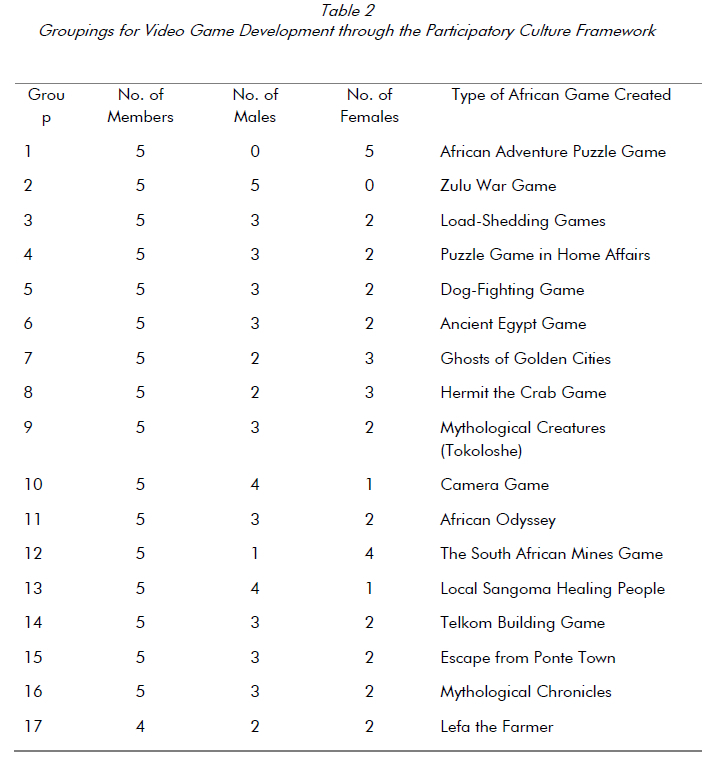
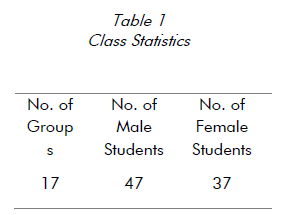
The framework was implemented while teaching a second-year game design project module at a public university in South Africa. The course, which was taught in the second semester, included 84 students from diverse cultures. The class included a diverse representation of all races in the country. There were 47 male students and 37 female students. Table 1 shows the class statistics, while Table 2 lists the number of students in each group along with the video game developed by each group.
The course was taught four times per week. On Mondays, students were required to study independently, Tuesdays were designated for theoretical discussions, Wednesdays for asynchronous learning via Ulwazi, and Thursdays for practical game development. All students were equipped with a laptop and the university had sufficient computer labs. Additionally, a technician was available to assist with any issues. The course focused on developing research skills, critical thinking abilities, innovative thinking, and rhetorical strategies. The course was narrative driven and centred on students. The goal of the interwoven assignments was for students to develop a game that would be both fun and educational, while also teaching people about African culture.
The students were divided into groups and tasked with developing their various games, which facilitated learning during the collaborative process of sharing ideas, reflecting the essence of ubuntu. The students received a briefing on the game they were tasked with developing, followed by collaborating within their groups to create a game based on the information provided. As the students continued to explore and learn throughout the process, they gained more insights into game development and African culture. In order to attain the eleven core media literacies, we adhered to the five pillars of the participatory culture outlined by Jenkins et al. (2009):
1) Low barriers to artistic expression: The students were given opportunities to explore further using the information provided to them.
2) Strong support for creating and sharing creations: The process allowed students to share ideas with one another regarding the project. Although the students initially had limited knowledge, they enhanced their understanding of video games and African culture by sharing ideas among themselves and with their lecturers.
3) Informal mentoring from lecturers as they engaged with students while sharing ideas: The lecturers were more knowledgeable than students and were well positioned to provide guidance.
4) Contributions matter: Game development relied on contributions of both the lecturer and students. No one was excluded while developing their games.
5) Feeling of social connection: This was enhanced within the groups as students developed their games. They interacted with one another to establish the necessary social connections that enhance ubuntu.
Data collection through the Inquiry-Based method
The adopted framework has six components, namely identify, investigate, compose, share, discuss, and reflect. The section discusses the components and explains their implementation in the classroom set-up.
Identify
Identification is crucial for the successful implementation of the framework (Alalem, 2023). Firstly, students were instructed to choose a topic focusing on the unique perspective of African themes, which aligns with my overall theme as lecturer. The agenda was to motivate and stimulate students while setting the tone for the African-themed video games that they would develop (Alalem, 2023). Secondly, students had to choose a theme based on current social issues, especially the issue of ubuntu or African history. Thirdly, students needed to ensure that their voices resonated in their video games by placing themselves at the centre of the narrative (Alalem, 2023; Lambert & Hessler, 201 8). I collaborated with all student groups to determine their themes and gave feedback if a suggested narrative was deemed unsuitable. The overall theme focused on Africanisation using video games. Lastly, the groups were required to deliver a pitch presentation to the entire class. The first question was:
Provide a discussion on your choice of a narrative and why you have selected or decided on this topic. Explain why this topic is of importance to you, as well as how it has influenced the people around you, especially your group members. Explain what you would learn from this topic and how it will benefit your community.
Investigate
The investigation component was used to explain the process of exploring and investigating the topic selected by students. The aim was to (i) provide a deeper understanding of the topic; (ii) impart the required knowledge and skills on this aspect and how they have been utilised; and (iii) enrich the rhetorical effectiveness of digital narrative through video games. Digital narratives can effectively convey ethos and pathos through the incorporation of audio, video, personal voice, and visual elements (Alalem, 2023; Alexander et al., 2012; Lambert & Hessler, 2018). Using accurate information and facts ensures that digital narrative stories are rhetorically effective and powerful. That being said, it is crucial to clarify these aspects to the students.
The students were informed about the significance of the investigative phase as it relates to five of the eleven core media literacy components of the participatory culture framework of Jenkins et al. (2009), namely: (i) judgement, (ii) networking, (iii) distributed cognition, (iv) performance, and (v) multitasking. Performance becomes evident when students assume the role of facilitator or teacher during research (Alalem, 2023). Investigation also requires multitasking. Students use various media environments concurrently to conduct their research, as observed by Alalem (2023) and Jenkins et al. (2009). Distributed cognition can be attained when students use various technologies, such as Ulwazi for learning and Unity for developing video games. The benefit is that it improves their ability to teach and learn.
The students' judgement and networking skills are evident in their selection of narrative stories and their interactions and collaborations with one another (Jenkins et al., 2009). To ensure that all students conducted research, they had to submit a list of documents they referenced. Before commencing the project, the students were assigned a series of smaller tasks to complete, which led up to the main project. Jenkins et al. (2009) indicate that research skills are a key ingredient for participation in the digital age. This study included assignments that required the submission of essays on the topic, including a list of references.
Compose
Stimulating participatory collaboration is one of the key ingredients for composing digital narratives that can be used to stimulate participatory, educational, and inspirational discussions. To ensure effective rhetorical intervention and delivery, students were tasked with documenting their assignments or pitches, allowing them to begin developing their narrative video games. VanKooten (2016) states that both models promote effective knowledge transfer, but for this to occur, they must be incorporated into pedagogical practices and activities.
The compositional aspect of the framework is crucial as it promotes a participatory culture and inclusivity. The strength of participatory media lies in its robustness. Furthermore, eight out of the eleven components of the participatory framework were specifically used, including (i) play, (ii) simulation, (iii) appropriation, (iv) multitasking, (v) distributed cognition, (vi) judgement, (vii) transmedia navigation, and (viii) networking. Jenkins et al. (2009) incorporate experimentation, risk-taking, and problem-solving into the play component. As previously discussed, students adopted new identities when creating their new media. Transmedia navigation refers to the process of transferring a video game from one media platform to another. This process consolidates all elements of the game. Students learnt how their character navigates the video game narrative through simulation and gameplay.
Share
Students designed digital narrative video games to tell a story. Games can also be used to convey messages, inspire people, provide a new perspective, or promote a voice (Dubisar & Palmeri, 2010). According to Jenkins et al. (2009), media products can be distributed via social media and online communities. The students' work was presented at both the weekly school gaming conferences and the end-of-semester exhibitions. While I agree with Alalem (2023) that sharing is a critical component, it is important to exercise caution in how sharing is approached, particularly when video games offer a personalised experience for the student group.
Discuss
Constructive discussion and reflective dialogue are critical components to ensure that the framework is implemented properly. Students were provided with ample opportunities to listen carefully. The purpose of negotiation is to help students understand other students' perspectives on issues.
Refeect
The aim of reflection is to provide a written report on students' experiences while composing their narrative video games. VanKooten (201 6) suggests that the best way to incorporate video game composing is writing a reflective essay.
Analysis of the Students' Reflections
For the analysis, a grounded theory perspective was adopted. Grounded theory is compatible with narrative ethnography in terms of analysis as it can establish narrative and thematic connections between categories and codes (Lal et al., 2012; Tavory & Timmermans, 2009). This involves the capacity to concentrate on the key narrative elements used in developing the video games. Moreover, all feedback from the different game developers was written and downloaded. In the following phase, the researcher coded all the response transcripts to synthesise and extract the key components. Porter's (2009) framework was used to evaluate the key themes derived from the students' reflections.
Finding the Modee for Evaeuation
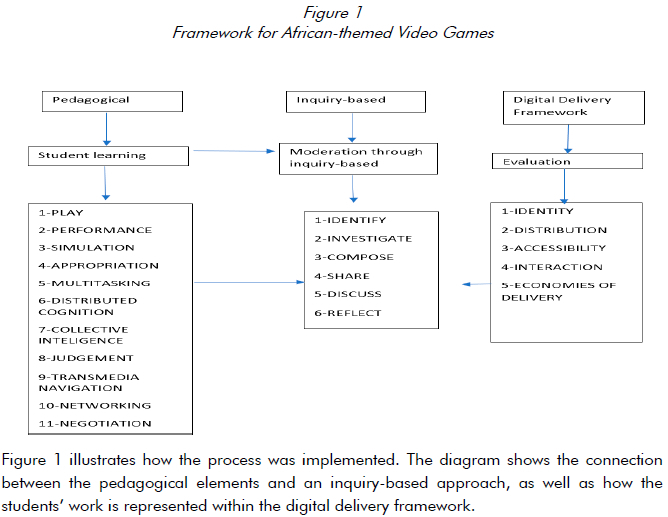
Before discussing the findings, it is necessary to examine Figure 1. The purpose of the discussion is to provide a visual explanation of how the framework was developed. The participatory culture framework has proven to be a valuable tool for teaching game design. This approach has yielded numerous benefits, including the ability to collaborate. By utilising the eleven core media literacies, students were able to develop their video games. These literacies were developed using an inquiry-based model. The digital delivery framework was used to evaluate the video games in terms of digital delivery.
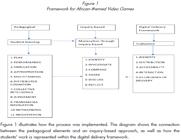
Figure 1 illustrates how the process was implemented. The diagram shows the connection between the pedagogical elements and an inquiry-based approach, as well as how the students' work is represented within the digital delivery framework.
DISCUSSION OF FINDINGS THROUGH PORTER'S FRAMEWORK FOR DIGITAL DELIVERY
This section analyses the students' reflections based on Porter's (2009) framework for digital delivery. The framework includes identity, accessibility, distribution, interaction, and economics.
Identity
While some students expressed concern about sharing their rural township tales, others eagerly anticipated hearing different perspectives when their storylines were shared. One storyline revolved around the tokoloshe, a mythological creature known for stealing crops from farmers. In this game, the player's objective is to protect the crops of the farmer. Meanwhile, some students developed video games in which black and white characters work together equally, promoting equality and partnership. Another group created a video game that revolves around a road trip from Cape Town to Johannesburg. The player is tasked with taking pictures of monuments from each province. A different group focused on meeting people from different provinces and learning about their traditions.
Alalem (2023) and Porter (2009) suggest that video games are developed in a way that resembles text, which serves as a delivery mechanism. The students' attitudes and behaviours during the development and presentation of their video games demonstrate their commitment to promoting inclusion. They also utilised African music to express their distinct identities. Some students felt proud of their African heritage and were excited about introducing a South African narrative.
Accessibiiity
To ensure accessibility and inclusivity, students uploaded their games to platforms and social media sites that are free and easily accessible, such as Canvas and Instagram. Furthermore, students made sure that their video games included elements such as narrative, text, sound, and music to make it easier for individuals to understand the content in various ways. The students indicated that their video games could be accessed through different platforms, including email and WhatsApp, in various formats. The benefit is that all individuals could access the videos in various formats.
Porter (2009) explains the importance of making digital media accessible to everyone, especially those with limited resources. Students used local languages for both voice and text, along with music, to ensure that all audiences could easily understand the narrative. The students' video games were accessible and provided room for multimodal consumption.
Distribution
Porter (2009) explains how to package a message intended for a specific audience. Students believed in sharing their videos with a global audience. The aim was to provide a platform for people worldwide to view their video games, not only to reveal issues but also to understand other people's perspectives. There is a need for video game developers to educate their colleagues about African culture, and students believed that their video games exhibited African culture. Students were eager to share their video games with others, especially via social media. Video games were further showcased at jam events, social media, and the end-of-year academic exhibition.
Interaction
Porter (2009) indicates that it is important to promote interactions that raise awareness of issues. Video games provide players with the option of taking different pathways, each leading to different outcomes. A prime example is the game with the tokoloshe theme. Partnerships with different categories of people yield different results, and game players have to reflect on the results of their choices that led to them losing the game. During class, one of the video games portrayed the tokoloshe as the reason for load-shedding in South Africa. This got the entire class engaged. Another game used Home Affairs as a talking point. The students were able to engage with all these issues and interact with one another while navigating the challenges facing South Africa as a nation.
Economics
Porter (2009) defines economics as the value of a piece of writing or the motivation that prompts the author to write or create a video game. Most students indicated that their games were designed to increase awareness of the various issues in South Africa and how they affect different groups of people. One group indicated that their game was designed to help their colleagues visualise pictures and appreciate the rich and diverse culture of various groups within the country. Twenty-three students found the video games to be a source of emotional joy as they discussed and showcased their local religions and traditional rural settings. All students included citations and references in their reports. Additionally, the students agreed that their video games expressed their views on social and local issues. Some felt that the video games reflected and promoted issues, such as gender inequality. One adventure video game incorporated women in leadership roles.
CASE STUDIES: SELECTED VIDEO GAMES
The following section examines three video games that are distinctive to the South African culture. Video Game 1 empowers women through the character of Nolwazi, a female African warrior. Video Game 2 explores the protection of land in rural South Africa, while video Game 3 focuses on the reduction of load-shedding, which is a current issue in the South African landscape.
Video Game 1 - Nolwazi
Noiwaziwas developed by an all-female group with five members from different races and different countries. The game was designed to raise awareness of the African continent within a futuristic context. Players must journey to various countries in Africa, where they discover historical facts and solve riddles and puzzles with an African theme. Successfully completing these challenges grants players access to the subsequent phase of the game, set in another African country. This game raises awareness through the riddles and puzzles that were crafted with historical context.
The students used signs, symbols, phrases, and discussions to engage with the game. The game demonstrates the effective use of multimodal approaches. The use of riddles and puzzles in the game is beneficial as it reflects the African roots of the group members. The game also highlights the role of women in a community, where they can be seen taking on leadership roles.
Video Game 2 - The Zulu War Game
A group of five male African students created The Zulu War Game. This game is set in rural KwaZulu-Natal. Players are provided with weapons to protect their farmland territory from various threats, such as wildlife and human enemies. The game is significant because it demonstrates that an adventure game can take place in a local South African context. The game not only features local South African content, music, and language but also explores the concepts of ubuntu and the transition from decolonisation to indigenisation. This game highlights the importance of using the participatory culture framework.
To keep game players engaged, the developers used Zulu, a local language, as well as Zulu music. The game features an inventory system that displays the count of animals and enemies slain to protect the homeland. The game's visuals, audio, and narrative components are well presented.
Video Game 3 - The Load-shedding
The Load-shedding was created by a group of five students. This adventure and fighting game aims to solve the load-shedding crisis in South Africa. The game attributes the cause of load-shedding to a tokoloshe. The game begins with a player consulting a sangoma, a highly respected spiritual healer, to receive instructions on how to solve load-shedding. The game player needs to buy or start generators in different locations within the game. However, the obstacle is a tokoloshe that the player must overcome in order to activate the generators.
The game features several rhetorical strategies, including the use of local language, cultures, mythological creatures, and religious figures such as the sangoma. Furthermore, the game utilises multimodal means of communication. This game provides a complete and inclusive experience that addresses current issues within the context of the South African landscape.
LIMITATIONSWhile the Participatory Culture Framework was effective in promoting African-themed game development, several limitations are acknowledged. One major limitation was the reliance on consistent technological infrastructure. Although the university provided adequate computer facilities and some students owned personal computers, this level of technological access may not be readily available at other institutions and classroom environments.
The research was conducted at a single South African university with a class of 84 students, which might not be representative of the broader African game design education landscape. The findings from this research might be influenced by specific institutional culture and resources, the particular demographic composition of the student body, and the urban location of the university. Future research would benefit from implementing this framework in various institutions and diverse educational contexts to validate its broader applicability in game design education. Certain limitations were also encountered in the evaluation method, such as reliance on self-reported student experiences, which may lack accuracy, and the limited capability to measure long-term retention of skills and knowledge. The research also encountered challenges in thoroughly documenting the development process by capturing all aspects of the group interaction and faced difficulty in documenting informal learning moments.
CONCLUSION
The utilisation of the participatory culture framework provided students with the opportunity to work together as a team and to use multimodal approaches in the development of their video games. The students' video games are unique, as they feature various local cultures and experiences. The framework not only illuminates Claybrook's (2023) discussion on the need for an Afrocentric approach to teaching and learning but also transforms teaching from decolonisation to indigenisation. The framework further speaks to the current cohort of students in universities, especially game design students.
As an academic and lecturer, I was pleasantly surprised by the high level of student engagement with the material and my ability to effectively navigate and apply the participatory culture framework. seventeen groups developed twenty distinct video games based on African themes. Students were excited about their work and posted several of their projects on the Instagram accounts dedicated to the game design course. This shows that students are ready to use local content for learning video game development, underscoring the importance of persisting with this approach.
Porter's (2009) framework has been useful in analysing the degree to which South African university students developed their video games for digital delivery. The eleven core principles of Jenkins et al. (2009) were also beneficial in guiding students and giving them a voice. Students were able to communicate in their local languages about the journey and tasks they completed during their games. This further emphasises the point made by Bayeck (2020), who indicated the need for video games featuring African themes to promote African culture.
The framework was applied successfully and the effectiveness of the framework using Porter's (2009) model was evaluated. The framework demonstrated its capability to unite students in a manner that encourages teamwork and active participation, allowing student voices to be heard. Further studies will be conducted to investigate the utilisation of this framework beyond a university set-up and its corresponding impact on projects.
The research questions were addressed and the results demonstrated that game design academics can use multimodal composition to promote participatory culture. In turn, this culture encourages ubuntu and community engagement among students. Students were able to produce multiple video games that reflected their African roots, and they collaborated in the spirit of ubuntu. The framework was used successfully to promote rhetorical and digital delivery of African students.
REFERENCES
LITERATURE REVIEW
- Adams, M. (2017). Affective connections to place: Digital storytelling in the classroom. Kairos: A Journal of Rhetoric, Technology, and Pedagogy, 22(1). https://kairos.technorhetoric.net/22.1/praxis/adams/index.html
- Alalem, A. (2023). Digital storytelling for cultivating a participatory culture in first-year composition. Computers and Composition, 69, Article 102792. https://doi.org/10.1016/j.compcom.2023.102792
- Alam, A. & Mohanty, A. (2023). Educational technology: Exploring the convergence of technology and pedagogy through mobility, interactivity, AI, and learning tools. Cogent Engineering, 10(2), Article 2283282. https://doi.org/10.1080/23311916.2023.2283282
- Alexander, J. & Rhodes, J. (2014). On multimodality: New media in composition studies. National Council of Teachers of English: Champaign, Illinois, United States of America.
- Alexander, K. P., Powell, B. & Green, S. (2012). Understanding modal affordances: Student perceptions of potentials and limitations in multimodal composition. Basic Writing e-Journal, 10(1)/11(1),1-37. http://bwe.ccny.cuny.edu/AlexanderPowellGreenUnderstandingModalAffordances.pdf
- Arroyo, S. J. (2013). Participatory composition: Video culture, writing, andelectracy. Southern Illinois University Press.
- Asamoah-Poku, F. (2024). Preserving traditional Ghanaian folklore through storytelling. European Modern Studies Journal, 8(2), 308-318. https://doi.org/10.59573/emsj.8(2).2024.26
- Baepler, P. & Reynolds, T. (2014). The digital manifesto: Engaging student writers with digital video assignments. Computers and Composition, 34, 122-136. https://doi.org/10.1016/j.compcom.2014.10.002
- Banerji, R. & Chavan, M. (2016). Improving literacy and math instruction at scale in India's primary schools: The case of Pratham's Read India program. Journal of Educational Change, 17(4), 453-475. https://doi.org/10.1007/s10833-016-9285-5
- Bayeck, R. Y. (2020). Exploring video games and learning in South Africa: An integrative review. Educational Technology Research and Development, 68(5), 2775-2795. https://doi.org/10.1007/s11423-020-09764-7
- Beck, E., Goin, M. E., Ho, A., Parks, A. & Rowe, S. (2021). Critical digital literacy as method for teaching tactics of response to online surveillance and privacy erosion. Computers and Composition, 61, Article 102654. https://doi.org/10.1016/j.compcom.2021.102654
- Benson, I. T. J. S. & Kiyasudeen, E. R. J. M. (2020). Virtual reality: A paradigm shift in education pedagogy. Proceedings of the 2020 Seventh International Conference on Information Technology, Abu Dhabi, UAE, 72-79. https://doi.org/10.1109/ITT51279.2020.9320880
- Clarke, R. & Adam, A. (2011). Digital storytelling in Australia. Arts and Humanities in Higher Education, 11(1-2), 157-176. https://doi.org/10.1177/1474022210374223
- Claybrook Jr, M. K. (2023). African proverbs, riddles, and narratives as pedagogy: African deep thought in Africana studies. Journal of Black Studies, 54(3), 215-235. https://doi.org/10.1177/00219347231157113
- Edelson, D. C., Gordin, D. N. & Pea, R. D. (1999). Addressing the challenges of inquiry-based learning through technology and curriculum design. Journal of the Learning Sciences, 8(3-4), 391 -450. https://doi.org/10.1080/10508406.1999.9672075
- Hailey, J. (2008). Ubuntu: A literature review. Tutu Foundation.
- Henne, A., Möhrke, P., Thoms, L.-J. & Huwer, J. (2022). Implementing digital competencies in university science education seminars following the DiKoLAN framework. Education Sciences, 12(5), Article 356. https://doi.org/10.3390/educsci12050356
- Hutchinson, L. & Novotny, M. (2018). Teaching a critical digital literacy of wearables: A feminist surveillance as care pedagogy. Computers and Composition, 50, 105-120. https://doi.org/10.1016/j.compcom.2018.07.006
- Jemmali, C., Banian, S., Mambretti, A. & El-Nasir, M. (2018). Educational game design: An empirical study of the effects of narratives. Proceedings of the 13th International Conference on the Foundations of Digital Games, Article 34, 1-10. http://dx.doi.org/10.1145/3235765.3235783
- Jenkins, H., Clinton, K., Purushotma, R. & Weigel, M. (2009). Confronting the challenges of participatory culture: Media education for the 21st century (Part One). Nordic Journal of Digital Literacy, 2(1), 23-33.
- Kushwaha, A., Kushwaha, R. & Ahmad, S. (2024). Transforming learning: The power of educational Technology. Blue Rose. New Dehli, India.
- Lal, S., Suto, M. & Ungar, M. (2012). Examining the potential of combining the methods of grounded theory and narrative inquiry: A comparative analysis. The Qualitative Report, 77(21), 1-22. https://doi.org/10.46743/2160-3715/2012.1767
- Lambert, J. & Hessler, B. (2018). Digital storytelling: Capturing lives, creating community (5th ed.). Routledge. https://doi.org/10.4324/9781351266369
- Lenette, C., Brough, M., Schweitzer, R. D., Correa-Velez, I., Murray, K. & Vromans, L. (2018). Better than a pill: Digital storytelling as a narrative process for refugee women. Media Practice and Education 20(1), 67-86. https://doi.org/10.1080/25741136.2018.1464740
- Mangaroo-Pillay, M., Roopa, M. & Maisiri, W. (2023). Could digital ubuntu be the South African version of Industry 4.0? The South African Journal of Industrial Engineering, 34(1), 1-12. https://doi.org/10.7166/34-1-2751
- Matthew, K., Mishra, P. & Cain, W. (2013). What is technological pedagogical content knowledge (TPACK)? The Journal of Education, 193(3), 13-19. https://www.jstor.org/stable/24636917
- Merono, L., Calderón, A. & Arias-Estero, J. L. (2021). Digital pedagogy and cooperative learning: Effect on the technological pedagogical content knowledge and academic achievement of pre-service teachers. Revista de Psicodidáctica [English ed.], 26(1), 53-61. https://doi.org/10.1016/j.psicoe.2020.10.002
- Morris, T. J., Collins, S. & Hart, J. (2024). Informal peer-assisted learning amongst medical students: A qualitative perspective. The Clinical Teacher, Article 3721, 1-10. https://doi.org/10.1111/tct.13721
- Mpofu, J. & Sefotho, M. (2024). Challenges of competency-based curriculum in teaching learners with learning disabilities. African Journal of Disability, 13, Article a1268, 1-9. https://doi.org/10.4102/ajod.v13i0.1268
- Ndlovu-Gatsheni, S. (2020). Decolonization, development and knowledge in Africa: Turning over a new leaf Routledge. London, United Kingdom.
- Oyedemi, T.O. (2021). Postcolonial casualties: 'Born-frees' and decolonisation in South Africa. Journal of Contemporary African Studies, 39(2), 214-229. https://doi.org/10.1080/02589001.2020.1864305
- Pedaste, M., Mäeots, M., Siiman, L. A., De Jong, T., Van Riesen, S. A. N., Kamp, E. T., Manoli, C. C., Zacharia, Z. C. & Tsourlidaki, E. (2015). Phases of inquiry-based learning: Definitions and the inquiry cycle. Educational Research Review, 14, 47-61. https://doi.org/10.1016/j.edurev.2015.02.003
- Porter, J. E. (2009). Recovering delivery for digital rhetoric. Computers and Composition, 26(4), 207-224. https://doi.org/10.1016/j.compcom.2009.09.004
- Randle, O. (2024). Providing ubuntuism through participatory culture framework: Sustainable Development Goals 4 and 5. Studies in Learning and Teaching, 5(1), 140-151. https://doi.org/10.46627/silet.v5i1.356
- Rohi, M. P. & Nurhayati, L. (2024). Multimodal learning strategies in secondary EFL education: Insight from teachers. Veles Journal, 8(2), 458-469. https://doi.org/10.29408/veles.v8i2.26546
- Seehawer, M. & Breidlid, A. (2020). Dialogue between epistemologies as quality education. Integrating knowledges in Sub-Saharan African classrooms to foster sustainability learning and contextually relevant education. Social Sciences & Humanities Open, 4(1), Article 100200. https://doi.org/10.1016/j.ssaho.2021.100200
- Shipka, J. (2011). Toward a composition made whole. University of Pittsburgh Press. Pittsburgh, United States of America.
- Stripling, B. (2017). Empowering students to inquire in a digital environment. In S. W. Alman (Ed.), School librarianship: Past, present, and future (pp.51-63). Rowman & Littlefield. Lanham, Maryland: United States of America.
- Takayoshi, P. & Selfe, C. L. (2007). Thinking about multimodality. In C.L. Selfe (Ed.), Multimodal composition: Resource for teachers (pp. 1-12). Hampton Press.
- Tavory, I. & Timmermans, S. (2009). Two cases of ethnography: Grounded theory and the extended case method. Ethnography, 10(3), 243-263. https://doi.org/10.1177/1466138109339042
- VanKooten, C. (2016). "The video was what did it for me": Developing meta-awareness about composition across media. College English, 79(1), 57-80. https://www.jstor.org/stable/44075155
- Vygotsky, L. S. (1978). Mind in society: The development of higher psychological processes. Harvard University Press. Cambridge Press Cambridge, England.
- Zitha, I., Mokganya, G. & Sinthumule, O. (2023). Innovative strategies for fostering student engagement and collaborative learning among extended curriculum programme students. Education Sciences, 13(12), Article 1196. https://doi.org/10.3390/educsci13121196
Date of Review Outcome: 14 December 2024
Date of Acceptance: 21 February 2025