Early education for a sustainable future: the perspectives of pre-service preschool teachers
Abstract
In an era where sustainability is increasingly recognized as a critical component of education, this study delves into the perspectives and practices ofpre-service preschool teachers regarding sustainable environmental education. The research examines the preparedness and enthusiasm of 154 pre-service preschool teachers to integrate sustainable practices into their future classrooms, emphasizing the pivotal role these educators play in shaping early environmental consciousness. Utilizing a quantitative approach with a structured questionnaire and decision tree analysis, the findings reveal generally positive attitudes towards environmental issues among participants, indicating a strong motivation for incorporating sustainability into teacher education programmes. According to the research findings, pre-school teacher candidates stated that they could participate in studies voluntarily to create environmental awareness. Pre-service teachers have high scores on the sub-dimension of 'attitude towards sustainable environmental education'. In addition, the majority of pre-service teachers have positive views towards sustainable environmental education. This study not only highlights the potential for enhancing environmental awareness among future educators but also pinpoints gender differences in responses, underlining the necessity for tailored educational strategies to effectively engage all students. The implications of this research are profound, suggesting that informed, intentional educational interventions can significantly influence the teaching of sustainability principles in early childhood education, thereby fostering a more sustainable future.
Sustainable environmental education; pre-service preschool teachers; environmental attitudes; teacher education; sustainability in early childhood; decision tree analysis
INTRODUCTION AND BACKGROUND
Since the beginning of human existence, individuals have shaped and been shaped by their natural environments (Dunlap et al., 2000). This interaction, initially harmonious, has grown increasingly complex as human activities have expanded in scale and impact (Soga & Gaston, 2020). The natural world comprises a delicate balance, capable of withstanding a certain level of disturbance before reaching a tipping point (Servigne & Stevens, 2020). Unfortunately, unchecked industrial growth, urban expansion, and excessive exploitation of natural resources have pushed many ecosystems beyond this critical threshold, leading to severe and often irreversible environmental degradation, including global warming, rampant pollution, and widespread habitat destruction (Lal, 2012; Laurance, 2010; Prud'Homme, 2012). As these environmental challenges intensify on a global scale, the pivotal role of education in promoting sustainable practices becomes increasingly clear (Kopnina, 2020; Zaléniené & Pereira, 2021). The concept of 'sustainable development' as outlined in the 1987 Brundtland Report (World Commission on Environment and Development, 1987), calls for a comprehensive and integrative approach that harmonizes social equity, economic development, and environmental protection. This framework strives to ensure that we meet today's needs without compromising the environmental resources and ecological stability upon which future generations will depend. Education is key to this approach, empowering individuals with the knowledge and skills to make informed decisions and take responsible actions that help maintain the earth's equilibrium and ensure its resilience for the future (Acosta Castellanos & Queiruga-Dios, 2022; Dillon & Herman, 2023; Shutaleva et al., 2020).
Despite growing awareness of the importance of sustainability, substantial deficiencies in the integration of sustainable practices within educational frameworks remain (Imara & Altinay, 2021). A notable issue is the lack of focused sustainable environmental education during critical early developmental stages (Ardoin & Bowers, 2020). Research consistently underscores the profound impact of early childhood education on the formation of enduring environmental attitudes and behaviours (Liu et al., 2020). Yet, this pivotal stage often receives insufficient attention in the curriculum. Bridging these gaps is crucial for preparing future generations with the comprehensive knowledge, robust skills, and heightened environmental awareness necessary to navigate and address the complex environmental challenges of our time effectively. Enhancing early environmental education can lay the foundation for lifelong sustainable practices, ensuring that children not only grow up aware of the issues but also equipped with the capabilities to contribute to sustainable solutions (Ardoin & Bowers, 2020).
Research consistently demonstrates that the seeds of sustainable environmental education should be sown early, with early childhood experiences playing a fundamental role in shaping enduring attitudes toward environmental stewardship (Ardoin & Bowers, 2020; Campbell & Speldewinde, 2022; Davis & Elliott, 2023). Early exposure to environmental education can deeply influence a child's future lifestyle choices and their interactions with the natural world. Despite this recognition, there remains a notable gap in the literature concerning the readiness of pre-service preschool teachers - those who are instrumental in moulding these early experiences - to effectively deliver sustainability concepts in their teaching. Most existing studies have concentrated on the environmental education of children, rather than on the educators themselves (e.g., Alò et al., 2020; Burgess & Ernst, 2020). This study seeks to address this oversight by comprehensively examining the attitudes, perceptions, and practices of pre-service preschool teachers towards sustainability, aiming to highlight areas for enhancement in teacher preparation programs and ultimately improve the delivery of environmental education at this critical stage of development.
The primary aim of this research is to delve into the attitudes and practices of pre-service preschool teachers concerning sustainable environmental education. This study is designed to uncover how these educators perceive and implement principles of sustainability in their teaching practices, which are pivotal in shaping the environmental consciousness of the next generation. Specifically, it seeks to explore a range of questions: What are the prevailing attitudes among pre-service preschool teachers towards sustainable environmental education? Additionally, the study will examine how various demographic factors, including gender, academic year, and economic status, might influence these attitudes. An analysis of the literature shows that these demographics influence the attitudes of pre-service teachers towards the environment. The results indicate that gender differences play a role in shaping environmental attitudes (Essiz et al., 2023, Kollmuss & Agyeman, 2002, Tomaset al., 2015). Similar to gender, academic level (Kurokawa et al., 2023; Li et al., 2024) and economic status (Hadjichambis & Paraskeva-Hadjichambi, 2020; Li et al., 2024) played a crucial role in shaping environmental attitudes.
Understanding these dynamics is essential for developing targeted interventions that can enhance the effectiveness of environmental education programs and ensure that future educators are well-prepared to foster an ethos of sustainability among their pupils.
Focusing on pre-service preschool teachers provides a unique and valuable perspective to the body of research on environmental education (Orbanić & Kovač, 2021; Tran Ho et al., 2023). By examining the preparedness and attitudes of these future educators, this study identifies critical areas within teacher preparation programmes that require enhancement to better support the integration of sustainability concepts. The insights gained aim to guide the development of more effective strategies that can be implemented within early childhood education curricula. Such strategies are essential for embedding a strong foundation of environmental literacy and sustainable thinking from the earliest stages of education. Ultimately, this research contributes to the broader goal of cultivating a society that is not only aware of environmental issues but also equipped with the knowledge and skills to engage in sustainable practices. This approach ensures that future generations are better prepared to address and mitigate environmental challenges, fostering a more sustainable and conscious life.
Importance of Sustainable Environmental Education
The literature consistently highlights the indispensable role of environmental education in fostering sustainable behaviours, crucial for tackling pressing global challenges like climate change, biodiversity loss, and resource depletion (Ateş, 2020; Dalelo, 2012). Scholars such as Davis and Elliott (2023) advocate for the initiation of environmental education at an early age, emphasizing that young children are not only receptive to learning about environmental issues but are also capable of adopting and promoting sustainable practices. This early introduction is vital as it sets the foundation for a lifetime of environmental stewardship. As young children are more open to new learning experiences, Pramlin-Samuelsson (2011) argues that early childhood is a crucial stage for embedding sustainable habits, values and attitudes.
Empirical studies reinforce this viewpoint. Van De Wetering et al. (2022) provides substantial evidence that early interactions with nature are pivotal in shaping children's attitudes and behaviours towards the environment. These findings argue that immersive experiences in nature during early childhood not only cultivate a deep appreciation and respect for the natural world but also instil habits that support sustainable living. Such foundational experiences are shown to be more than just educational moments; they are transformative encounters that embed sustainable practices into children's daily lives, encouraging them to grow into adults who actively contribute to the sustainability of their environments (Güler Yıldız et al., 2021 ; Hedefalk et al., 2015; Somerville & Williams, 2015).
Sustainability education is action-oriented and emphasizes skills development to address sustainability issues through personal experiences (Jónsson et al. (2021). Sustainable environmental education has a significant impact on individuals' environmental awareness, attitudes and behaviours. Sustainable environmental education aims to make individuals sensitive and responsible towards the environment and encourages them to become individuals who play an active role in solving environmental problems. Through this education, people learn to use natural resources efficiently by understanding their impact on the environment.
For sustainable environmental education, it is important to first create environmental awareness. Environmental awareness means knowing how our behaviours and attitudes affect the environment and changing these protect the environment (Fisman, 2005). Environmental awareness gained at an early age can help shape children's knowledge, skills, responsibility and positive attitudes towards the environment (Copple & Bredekamp, 2009). There are studies showing that early childhood environmental education increases children's environmental awareness and knowledge and that positive experiences related to the environment in early childhood promote positive attitudes towards the natural environment (Chawla & Hart, 1995; Cohen & Horm-Wingerd, 1 993; Ozdemir & Uzun, 2006; Robertson, 2008; Yalcın et al., 201 6).
Given these findings, the necessity of integrating robust environmental education programmes into early childhood education curricula becomes apparent. By doing so, educators can leverage the natural propensity of young children to engage with their environment, fostering a proactive attitude toward environmental conservation and sustainability from a young age.
Early Childhood Education and Sustainability
Extensive research within the field of early childhood education underscores the importance of embedding sustainability into educational curricula to establish a robust foundation for environmental stewardship (Güler Yıldız et al., 2021; Hedefalk et al., 2015; Somerville & Williams, 2015). Davis and Elliott (2014) highlight that integrating sustainability into early childhood education settings can profoundly affect how children perceive and interact with their environment. Such integration fosters not only awareness but also a sense of responsibility towards the environment from an early age, encouraging behaviours that promote ecological health and sustainability.
This research is informed by Bronfenbrenner's Ecological Systems Theory (Bronfenbrenner, 2013) which emphasizes the interplay between individuals and the multiple environmental systems that influence their development. From this perspective, the early childhood education setting is a key microsystem in which children begin to construct meaning about their roles in and responsibilities toward the natural world. Educators, as central figures within this microsystem, are thus positioned to model and scaffold sustainable behaviours and attitudes, shaping children's ecological identity in developmentally appropriate ways.
However, the success of these initiatives hinges significantly on the dedication and insight of educators. Siraj-Blatchford and Pramling-Samuelsson (2016) point out that the effective incorporation of sustainability concepts into the classroom depends largely on teachers' deep understanding of these concepts and their commitment to environmental values. Educators are not merely instructors but role models whose attitudes and behaviours can inspire similar values in their students (Ateş, 2020). Therefore, teacher preparation programmes must prioritize comprehensive training in sustainability to ensure educators are well-equipped to introduce these crucial topics in engaging and age-appropriate ways (Ateş, 2021).
Furthermore, the impact of sustainability education in early childhood extends beyond immediate environmental benefits. Integrating these principles helps cultivate critical thinking, problem-solving, and empathy in young learners - skills that are essential for the conscientious citizens of tomorrow (Davis, 2010a; Ernst et al., 2022; Taimur & Sattar, 2020). As children learn to understand the interconnectedness of their actions with the broader ecosystem, they develop a more holistic view of the world that emphasizes cooperation and stewardship.
The literature also suggests that sustainability education should not be an isolated part of the curriculum but should be interwoven with other educational goals and practices (Hopkins & McKeown, 2002; McKeown & Hopkins, 2003). This approach ensures that sustainability becomes a seamless aspect of learning and daily classroom activities, thereby normalizing these practices in the routine behaviours of children (Nolet, 2009). By doing so, early childhood education can play a pivotal role in shaping a future generation that is environmentally conscious and equipped to handle the complex challenges of sustainability (MacDonald, 2015).
Gaps in the Literature
While the existing body of research (Davis, 2010b; Liu et al., 2020; Pramlin-Samuelsson, 2011 ) provides significant insights into the importance of sustainable environmental education in early childhood, there is a notable deficiency in studies specifically addressing the attitudes and practices of pre-service preschool teachers in this domain. This gap is particularly pronounced when it comes to understanding how these educators translate their knowledge and attitudes into actionable teaching practices within the classroom. The existing literature (Larsen et al., 2017) largely overlooks the mechanisms through which these attitudes are applied in diverse educational settings, which is crucial for developing effective educational strategies that are adaptable across various cultural and socioeconomic backgrounds.
Additionally, the literature (Ates & Gül, 2018) is scant on how pre-service teachers' personal beliefs and values in sustainability influence their professional behaviours and decision-making processes in early educational environments. This oversight extends to the lack of research on the support systems and resources available to these educators as they attempt to integrate sustainability into their curricula. Understanding these dynamics is essential for identifying the barriers and facilitators to effective sustainability education at the preschool level.
This literature review underscores the need for the present study, which aims to address these significant gaps by delving into the specific attitudes and practices of pre-service preschool teachers towards sustainable environmental education. By focusing on this under-researched area, the study not only contributes to filling a critical knowledge gap but also enhances the broader academic and practical discourse surrounding the integration of environmental sustainability in early childhood education. The findings are expected to inform and improve teacher training programmes, ensuring that future educators are better equipped to foster an understanding and appreciation of sustainability among young learners. This alignment with educational needs and practices is pivotal for advancing global sustainability goals and cultivating a more environmentally conscious next generation.
METHODOLOGY
Research Design
The purpose of this study is to assess the demographic characteristics and the attitudes of pre-service preschool teachers regarding sustainable environmental education. For this purpose, a survey model is used. The survey model is a research approach that aims to reveal a specific situation without any intervention (Karasar, 2011). Thanks to this approach, quantitative data can be obtained more effectively in large groups. It is also suitable for assessing the attitudes of pre-service preschool teachers towards sustainable environmental education.
Questionnaire method was used as data collection technique in the research. The demographic characteristics, attitudes, values, performances or opinions of the target audience can be determined by the survey method. This method both provides ease of statistical analysis and facilitates the determination of patterns and correlations between data (Büyüköztürk, 2005).
The research employs a decision tree algorithm, a classification method from data mining, which is chosen for its interpretability and effectiveness in visualizing patterns and relationships in data (Çalış et al., 2014; Karadas & Kadirhanogullari, 201 7; Kadirhanogulları et al., 2022). The decision tree approach facilitates the identification of variables that significantly influence the participants' attitudes towards sustainable environmental education.
Sample
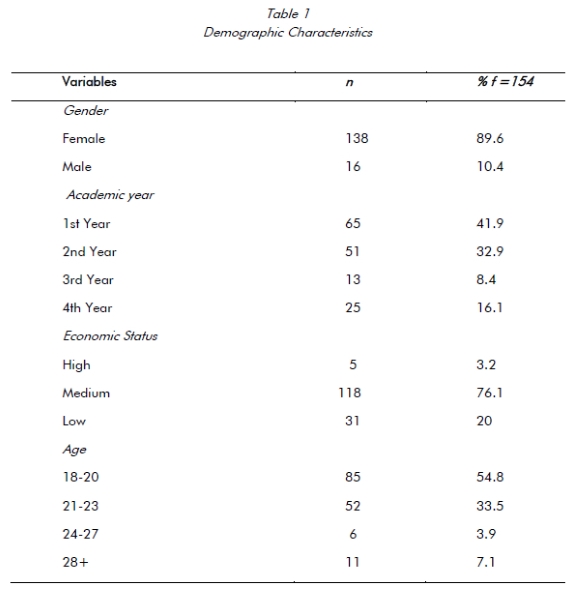
The study's sample consists of 154 pre-service preschool teachers, recruited from various educational institutions to reflect a range of educational backgrounds and training environments. They were students at state universities. The students voluntarily participated in the study. These participants were selected using a convenience sampling method, which, while limiting the ability to generalize the results to all pre-service teachers, provides valuable insights into the attitudes and practices within accessible educational settings. The sample predominantly includes female participants, who make up 89.6% of the group, reflecting the gender demographics typically found within the field of preschool education. Most participants are between the ages of 18 and 20 years, representing 54.8% of the sample, indicative of a young cohort common in undergraduate early childhood education programmes (Öngören, 201 9; Yalçın, Yalçın-Ağgül & Macun, 201 7). The distribution across academic years shows first-year students as the largest group at 41.9%, followed by second-year students at 32.9%, fourth-year students at 16.1%, and third-year students at 8.4%, allowing for a comparative analysis across different stages of their educational journey. Regarding economic status, a significant majority (76.1%) are classified under the 'medium' economic status, with 20% falling into the 'low' economic category, and a smaller fraction (3.2%) in the 'high' economic status bracket. Detailed demographic characteristics are included in Table 1.
Instruments
Data collection for this study was executed using a structured questionnaire, which utilized a Likert scale to assess six critical aspects of sustainable environmental education. The 'Sustainable Environmental Education Attitude Scale' developed by Afacan and Demirci (2011) was used to collect data in the study. Permission was obtained from the researchers before using the scale. There are a total of 30 items in the 5-point Likert scale. The items are scaled as: I strongly agree (5), I agree (4), I am undecided (3), I disagree (2), I strongly disagree (1).
The scale has a six-factor structure as (i) awareness towards sustainable environment (7 items), (ii) negative perceptions towards sustainable environmental education (7 items), (iii) willingness to volunteer for environmental education activities, (iv) frugality in sustainable environmental education (5 items), (v) sensitivity in sustainable environmental education (3 items), and (vi) thrifty consumption in sustainable environmental education (3 items). This comprehensive approach allowed the study to capture a nuanced understanding of participants' engagement and attitudes towards each aspect.
In the study in which it was developed, Cronbach's alpha reliability coefficient was calculated as 0.81 6 for the factor of awareness towards sustainable environment, 0.779 for the factor of negative thoughts towards sustainable environmental education, 0.727 for willingness to volunteer for environmental education activities, 0.745 for the factor of frugality in sustainable environmental education, 0.572 for sensitivity in sustainable environmental education and 0.604 for the factor of thrifty consumption in sustainable environmental education.
In this study, it was calculated as 0.774 for the factor of awareness towards sustainable environment, 0.847 for the factor of negative thoughts towards sustainable environmental education, 0.677 for willingness to volunteer for environmental education activities, 0.895 for the factor of frugality in sustainable environmental education, 0.633 for sensitivity in sustainable environmental education and 0.740 for the factor of thrifty consumption in sustainable environmental education. The reliability coefficient is above 0.70 in all factors. Therefore, it was decided that the scale was reliable. In this study, Cronbach's alpha reliability coefficient of the overall scale was calculated as 0.80 and it was decided that the scale was reliable.
The questionnaire was specifically designed to analyse individual responses for each component separately instead of aggregating them into average scores. This method enables a detailed examination of the specific attitudes and behaviours of pre-service preschool teachers towards environmental education. By avoiding the averaging of scores, the analysis could discern subtle differences and patterns in responses, providing a richer and more accurate depiction of the participants' perspectives and potential areas for intervention (Harper & Thompson, 2011; Robinson, 2014).
Data collection process
The scale used in the research was sent to the participants as an online survey link. An informed consent form was added to the first section of the survey form. Here, it was explained that the purpose of the research, the research was based on volunteering, no distinguishing information would be collected, and the data would be protected. Participants were asked to give their consent by marking the statement 'I agree to participate in the study voluntarily'. The online survey form consisted of a total of 30 items. The survey application took approximately 10-15 minutes. Participants who did not complete the questions in the online survey and sent them incomplete were excluded from the study. The online survey form developed by the researchers consisted of two parts. The first part included questions on age, gender, academic career, and economic status. The second part includes the items of the 'Sustainable Environmental Education Attitude Scale' developed by Afacan and Demirci (2011).The data collection process took approximately four months.
Data Analysis
The data collected from the structured questionnaire were systematically analyzed using the Exhaustive CHAID (Chi-squared Automatic Interaction Detector) algorithm, an advanced statistical technique specifically chosen for its efficacy in revealing the hierarchical relationships among categorical variables (Althuwaynee et al., 2014; Cha et al., 2017). This method is particularly adept at dissecting the complex interplay between various factors that shape attitudes and behaviours, making it ideal for understanding the nuances in how pre-service preschool teachers view and engage with sustainable environmental education.
The CHAID analysis was conducted to classify participants' responses into distinct categories based on their attitudes and practices. It also assessed how demographic factors such as gender, age, and academic year influence these attitudes, allowing for a detailed examination of trends and patterns within the data. For instance, it could reveal whether younger teachers are more inclined towards sustainability practices compared to their older counterparts, or if responses vary significantly between genders or academic years.
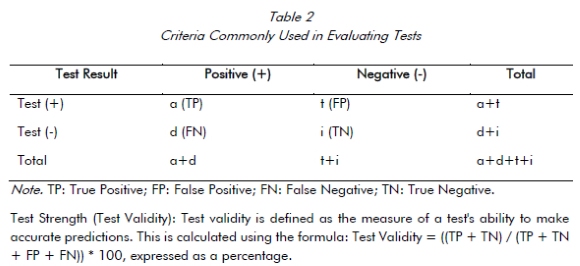
To ensure the reliability and validity of the analysis, the classification results were rigorously evaluated using standard test evaluation criteria. This included the calculation of True Positive, False Positive, True Negative, and False Negative rates, which are critical for assessing the accuracy of the classification model. These metrics help in determining how well the model is performing in differentiating between the actual conditions and predictions, thereby providing a robust measure of its effectiveness. The test validity, expressed as a percentage, encapsulates the overall accuracy of the classification. This metric is crucial as it reflects the algorithm's ability to correctly identify and categorize the different responses, providing confidence in the findings and insights derived from the analysis.
After conducting the decision tree analysis, we calculated the general accuracy of the classification results using the criteria outlined in Table 2, based on methodologies described by Sackett (1973), Çamlıca and Dişçi (2008), and Kadirhanoğulları et al. (2022).
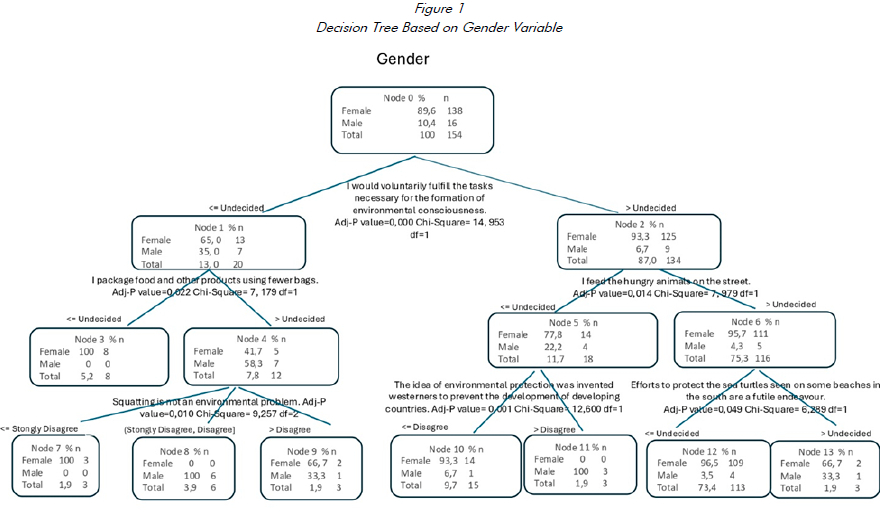
In our study, the Exhaustive CHAID (Chi-squared Automatic Interaction Detector) an algorithm was utilized to generate a decision tree diagram, depicted in Figure 1. This visual representation illustrates how responses to the survey question 'I would voluntarily fulfil the tasks necessary for the formation of environmental consciousness' diverge into distinct behavioural pathways among participants. The branching pattern of the decision tree indicates the varied levels of commitment to environmental actions among the respondents, as measured on a Likert scale ranging from 1 (Strongly Disagree) to 5 (Strongly Agree).
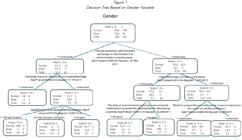
An initial bifurcation in the tree occurred with 20 participants (13 females and seven males) who indicated either 'Undecided' or a lower level of agreement (Node 1). This subgroup was further analysed to assess more specific environmental behaviours. For instance, a subsequent question asked if participants actively reduce the use of bags when packaging food and other products. Responses to this question led to further division: eight participants (all females) maintained their stance of 'Undecided' or lower (Node 3), suggesting a potential lack of commitment or awareness towards minimizing waste. Conversely, 12 participants (five females and seven males) expressed that they 'Agree' or 'Strongly Agree' (Node 4) with proactive waste reduction, indicating a higher level of environmental responsibility.
Further analysis of Node 4 revealed deeper insights into attitudes towards broader environmental issues, such as the perception of squatter settlements as environmental concerns. Within this node, distinctions were observed where three participants (all females) selected 'Strongly Disagree' (Node 7), suggesting a strong recognition of the environmental impacts of such settlements. Six male participants disagreed (Node 8), and an additional three participants (two females and one male) agreed or strong agreement (Node 9), indicating varying degrees of perception regarding the environmental implications of squatter settlements.
These detailed branches, particularly the homogeneity observed in Nodes 7, 8, and 9, underscore the nuances in environmental attitudes and behaviours that can be discerned through decision tree analysis. This method not only highlights the diversity of responses but also pinpoints areas where environmental education and advocacy could be targeted more effectively, particularly in addressing gender differences and the influence of specific environmental attitudes on overall sustainability practices. The findings illustrate the complexity of environmental consciousness among pre-service teachers and reinforce the need for nuanced approaches in environmental education that consider these diverse perspectives and behaviours.
The decision tree outlined in Figure 1 provides a detailed exploration of how participants responded to the statement 'I would voluntarily fulfil the tasks necessary for the formation of environmental consciousness'. The first notable split in the decision tree, identified as Node 2, demonstrates that a significant majority of the participants, 134 in total (comprising 125 females and nine males), affirmatively responded with 'Agree' or 'Strongly Agree'. This high level of agreement suggests a strong general commitment to environmental consciousness among the surveyed group.
Node 2 leads into further nuanced inquiries, the first of which regards participants' willingness to engage in the specific action of feeding stray animals on the street. Here, a divergence in responses is observed: 18 participants (14 females and four males) expressed ambivalence or disagreement (responded with 'Undecided' or lower, captured in Node 5), indicating a potential area of varied commitment or different perceptions of what constitutes environmental responsibility. In contrast, a large majority of 116 participants (111 females and five males), captured in Node 6, affirmatively engaged with the practice, showing a broader sense of responsibility that extends to animal welfare.
Node 5 presents an intriguing branch concerning perceptions of environmental protection narratives. Within this node, a statement about environmental protection being a Western fabrication to impede the development of poorer countries elicited disagreement from 15 participants (14 females and one male), who chose 'Disagree' or 'Strongly Disagree' (Node 10). This suggests a recognition of environmental issues as genuinely global, rather than Western-centric concerns. Conversely, three males in Node 11 viewed this statement with less scepticism, indicating varied interpretations of environmental narratives based on possibly underlying socio-political beliefs.
Further depth is explored in Node 6, branching into discussions about the value of specific conservation efforts, such as protecting sea turtles on southern beaches. Here, a significant majority, 113 participants (109 females and four males), responded with 'Undecided' or lower (Node 1 2), showing perhaps a lack of awareness or priority given to such specific environmental efforts. Meanwhile, a small group, three participants (two females and one male), in Node 13 affirmed the importance of these efforts by agreeing strongly with the conservation measures.
This decision tree analysis, validated at a high accuracy rate of 95.5%, reveals not only the levels of environmental commitment among pre-service preschool teachers but also nuances in how they prioritize different aspects of environmental engagement.
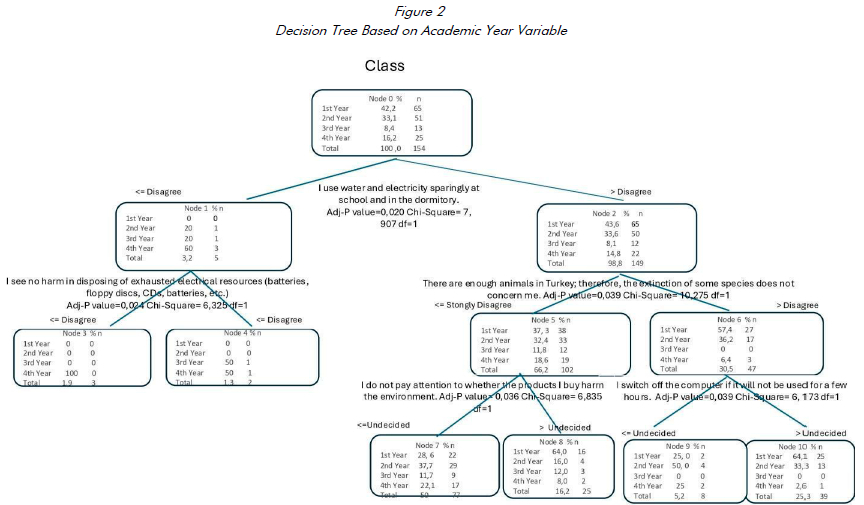
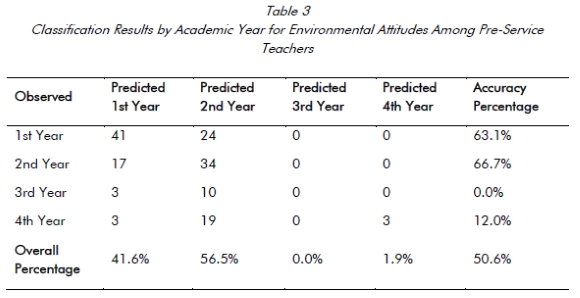
Upon closer analysis of Figure 2, the data reveal a significant divergence in environmental consciousness related to domestic resource usage. In the second branch of the decision tree, associated with the academic year variable from the statement 'I use water and electricity sparingly at home', it appears that a considerable number of participants, totalling 149 across various academic years, expressed either disagreement or strong disagreement with practising resource conservation at home. This group includes 65 first-year students, 50 second-year students, 12 third-year students, and 22 fourth-year students, indicating a widespread reluctance or lack of commitment to reducing resource use among the respondents.
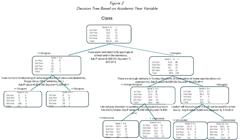
This branch then extends into another environmental concern regarding biodiversity, particularly queried by the statement 'There are enough animals in Turkey; therefore, the extinction of some species does not concern me'. Here, a notable majority of the sample, 102 individuals, responded with 'Strongly Disagree', reflecting a high level of concern for animal extinction across all academic levels - 38 from the first year, 33 from the second, 12 from the third, and 19 from the fourth. Conversely, 47 individuals, indicating less concern, responded with 'Disagree' or a lower level of agreement, with these respondents primarily from the first and second years.
Further intricacies emerge in Node 5, which probes the environmental awareness related to consumer habits with the statement 'I do not pay attention to whether the products I buy harm the environment'. In this segment, 77 individuals, distributed as 22 from the first year, 29 from the second, nine from the third, and 17 from the fourth, indicated an 'Undecided' stance or lower, suggesting either a lack of awareness or indifference towards the environmental impact of their purchasing decisions. However, a smaller group, consisting of 25 individuals, demonstrated a proactive stance by agreeing or strongly agreeing that they are mindful of the environmental impact of their purchases, displaying a more environmentally responsible behaviour pattern.
The distribution and responses across these nodes underscore a varied landscape of environmental attitudes among pre-service teachers, with significant discrepancies in how different cohorts perceive and react to sustainability challenges. The decision tree's overall test validity (see Table 3), calculated at 50.6%, though moderate, provides a credible lens through which these behavioural patterns and attitudes are analysed, offering insights into the areas where environmental education could be significantly enhanced to foster more deeply ingrained sustainable practices among future educators.
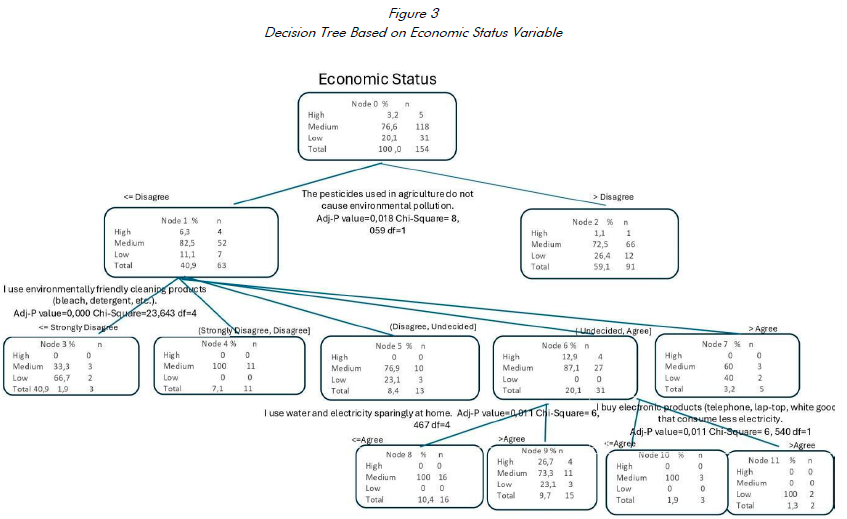
Upon analysing Figure 3, which illustrates responses to the environmental impact of agricultural pesticides, a significant divergence is noted in perceptions based on economic status. From the initial statement, 'The pesticides used in agriculture do not cause environmental pollution', the first branch (Node 1) reveals that a majority of participants - 63 individuals across various economic statuses (four High, 52 Medium, seven Low) - expressed a strong disagreement, underscoring a prevalent concern about the environmental effects of these chemicals.
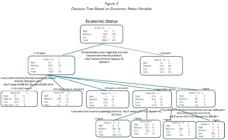
Further inquiry into environmentally responsible consumer behaviours branches from Node 1. It addresses the usage of eco-friendly cleaning products such as bleach and detergents. Here, the responses split: only three individuals (one Medium, two Low) maintained a stance of 'Strongly Disagree', indicating scepticism or indifference towards the environmental claims of such products, while a more substantial number, 31 individuals (four High, 27 Medium), acknowledged using these products by agreeing to the statement. This suggests that while a significant portion of participants recognize and adopt environmentally friendly products, a small group remains unconvinced of their ecological benefits.
Another branch, stemming from Node 6, explores attitudes towards conserving domestic resources. The data indicate a mixed approach to resource conservation: 16 participants, all from the medium economic status, showed lesser enthusiasm ('Agree' or lower) towards minimizing their usage of water and electricity. In contrast, 15 participants (four High, 11 Medium) displayed a strong commitment by responding with 'Strongly Agree'. This variation highlights differing levels of engagement with resource conservation practices, possibly influenced by economic factors.
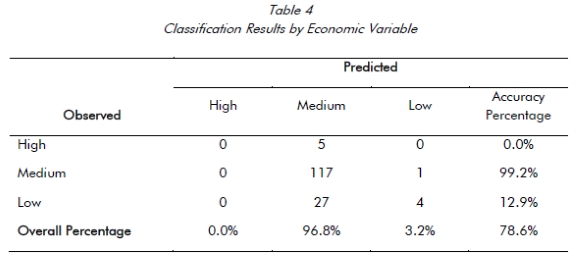
As presented in Table 4, the analysis of these nodes, with an overall test validity of 78.6%, provides valuable insights into how economic status influences environmental beliefs and behaviours. The results indicate a general awareness and acceptance of sustainable practices among most participants but also reveal pockets of resistance or apathy that may be targeted in educational and policy initiatives to enhance environmental stewardship across all socioeconomic groups.
DISCUSSION
Summary of Results
The study revealed that pre-service preschool teachers hold predominantly positive attitudes towards environmental issues and the principles of sustainable environmental education. Analysis of the decision tree initially focused on the gender variable, highlighting that a significant majority of responses to volunteering for sustainable environmental education were positive, suggesting a readiness among participants to engage in proactive environmental activities. However, further examination incorporating academic level and economic status provided additional insights into how these variables influence environmental attitudes and behaviours.
Findings based on academic level indicated varying degrees of environmental consciousness among students at different stages of their education. Specifically, first- and second-year students demonstrated lower engagement in resource conservation and environmentally responsible purchasing behaviours compared to their third- and fourth-year counterparts. This suggests that as students' progress in their academic journey, they may develop a more refined understanding of environmental responsibility, potentially influenced by increased exposure to sustainability-related coursework and discussions. However, the relatively low-test validity for the decision tree model based on academic level suggests that additional factors beyond academic year may contribute to environmental attitudes.
Economic status also played a notable role in shaping participants' environmental perspectives. Students from middle-income backgrounds exhibited the highest level of engagement in sustainable practices, such as using eco-friendly cleaning products and recognizing the environmental impact of agricultural pesticides. In contrast, those from lower economic backgrounds showed more varied responses, with some displaying scepticism about the benefits of environmentally friendly consumer choices. This variation suggests that economic constraints may influence both access to and perceptions of sustainable practices. While higher-income participants generally displayed strong environmental commitments, their relatively small sample size limits broader generalizations.
Further findings showed that most participants actively care for street animals, reflecting a broad commitment to animal welfare and environmental stewardship. When addressing specific environmental protection efforts, such as the preservation of sea turtles, the majority of participants disagreed with the view that such actions are unnecessary, indicating strong support for species conservation. However, the level of agreement with species conservation efforts was less pronounced among first- and second-year students compared to those in later academic years, further reinforcing the role of education in shaping environmental attitudes.
Regarding resource conservation, findings indicated that while almost all participants view water and electricity conservation positively, students from lower economic backgrounds exhibited a greater tendency to be 'Undecided' or to disagree with the necessity of such practices. This may stem from differing household norms regarding resource usage or economic constraints that make conservation seem less pressing compared to immediate financial concerns. Additionally, a substantial number of participants strongly disagreed with the statement that pesticides used in agriculture do not cause environmental pollution, showing a clear concern for the impacts of agricultural practices on the environment. This concern was more pronounced among middle-income students, possibly reflecting greater access to environmental education resources.
These findings suggest that while pre-service preschool teachers generally exhibit a strong environmental consciousness, there are nuanced variations based on gender, academic level, and economic status. Addressing these differences through targeted environmental education programmes could help bridge gaps in awareness and engagement, ensuring that future educators are well-equipped to foster sustainability principles in early childhood education. Future studies could explore additional sociocultural and institutional factors that influence environmental attitudes to develop more comprehensive strategies for environmental advocacy and education.
Theoretical Implications
The findings of this study offer several theoretical implications that contribute to the understanding of sustainable environmental education, particularly in the context of pre-service preschool teacher training. The results indicate generally positive attitudes towards environmental issues and sustainable practices among the participants, suggesting that environmental attitudes can be developed and enhanced through targeted educational efforts. This aligns with prior research which has shown that environmental education significantly improves students' attitudes towards environmental issues (Cao & Jian, 2024; Evcimen et al., 2025; Hajj-Hassan et al., 2022; Küpeli & Bayındır, 2025; Van De Wetering et al., 2022; Li et al., 2024).
The high level of agreement observed in responses related to 'Volunteering for Sustainable Environmental Education' supports the theory of planned behaviour, which posits that attitudes, subjective norms, and perceived behavioural control influence intentions to engage in particular behaviours. The findings show that a majority of pre-service preschool teachers are willing to volunteer for environmental causes, reflecting a readiness to take responsibility for fostering environmental consciousness. This is consistent with Yıldız et al. (2021 ), who found that students had positive attitudes toward volunteering for sustainability-related activities, especially among females. Similarly, Cirit-Gül et al. (2022) reported higher levels of environmental volunteering attitudes among female pre-service teachers compared to males. The gender differences observed in these studies and the current research suggest that socio-cultural factors and gender roles may play a role in shaping environmental attitudes, aligning with social learning theory, which emphasizes learning through observation and social context.
In addition to gender, academic level also played a crucial role in shaping environmental attitudes. Senior-year pre-service preschool teachers exhibited a higher level of environmental consciousness than their first- and second-year counterparts. This may be attributed to increased exposure to environmental education and sustainability-related coursework as students advance in their academic journey. This finding aligns with previous studies (Kurokawa et al., 2023; Li et al., 2024), which suggest that educational interventions targeting sustainability topics are more effective among students with greater academic experience. Similarly, students in higher academic levels demonstrated stronger commitments to proactive environmental behaviours, such as resource conservation and species protection, compared to their lower-level counterparts.
Economic status was another influential factor in shaping environmental perspectives. Middle-income participants demonstrated the highest engagement in sustainable behaviours, including the use of eco-friendly cleaning products and awareness of the environmental impacts of agricultural pesticides. Conversely, participants from lower-income backgrounds displayed more varied responses, possibly due to economic constraints limiting their ability to adopt environmentally friendly behaviours. This aligns with previous studies indicating that financial resources can influence the extent to which individuals prioritize sustainability in their daily lives (Hadjichambis & Paraskeva-Hadjichambi, 2020; Li et al., 2024). Additionally, economic status was linked to variations in resource conservation behaviours, with higher-income participants more likely to engage in deliberate efforts to reduce electricity and water consumption compared to those from lower-income backgrounds.
These findings underline the crucial role of educational institutions in promoting environmental sustainability and suggest that integrating environmental education across various disciplines and educational levels can substantially enhance students' environmental attitudes and encourage sustainable living practices. Such educational efforts are pivotal for equipping future generations with the necessary skills and attitudes to address and mitigate environmental challenges effectively.
On the other hand, the findings contrast with research by Gürbüz et al. (2013), which showed that pre-service teachers often had lower attitudes towards volunteering for environmental causes and were reluctant to join environmental organizations or participate in activities that promote environmental awareness. This discrepancy suggests that while there may be a general willingness to engage in sustainable practices, there are underlying factors - such as a lack of knowledge, resources, or support - that could hinder the actualization of these intentions.
The study also revealed that participants strongly opposed the notion that certain environmental efforts, like protecting sea turtles or reducing the impact of squatter settlements, are unimportant. This high level of awareness aligns with systems thinking approaches in sustainability education, which advocate for understanding complex environmental issues in an interconnected manner (Green et al., 2021). For example, participants' rejection of statements downplaying the importance of biodiversity conservation reflects an understanding of ecological interdependence and the broader impacts of species extinction. Such perspectives are essential for theories that emphasize the moral and ethical dimensions of environmental education, where fostering a sense of environmental responsibility is seen as a key component of effective sustainability education.
The findings regarding resource conservation attitudes suggest that nearly all participants support the careful use of water and electricity, indicating a strong sense of environmental stewardship. This aligns with studies like Caner (2019), which reported high levels of environmental responsibility among pre-service teachers. Gender differences were again evident, with prior research (e.g., Ramstetter & Habersack, 2020) consistently showing that female students tend to hold more positive attitudes towards resource conservation than male students. These results support gender-based theories in environmental psychology, which propose that women may be more inclined towards caring and nurturing behaviours, including environmental conservation.
Regarding participants' views on agricultural practices, the finding that many participants disagreed with the statement that pesticides do not cause pollution highlights a critical awareness of the negative environmental impacts of certain industrial practices. This awareness aligns with environmental theories such as value identity personal norm model (Van der Werff & Steg, 2016) and value belief norm model (Stern et al., 1999) that emphasize the importance of understanding both direct and indirect human impacts on the environment. Such knowledge is crucial for promoting informed and responsible decision-making among future educators.
Conversely, the relatively lower levels of agreement regarding the use of environmentally friendly cleaning products suggest an area where attitudes may not yet fully translate into behaviours. While some participants recognized the importance of using eco-friendly products, others were less committed, indicating potential gaps in knowledge or accessibility to sustainable alternatives. This finding diverges from studies like Gürbüz et al. (2013), which found higher sensitivity among students towards eco-friendly products, pointing to the need for more robust educational programs that bridge the gap between environmental attitudes and everyday practices.
Practical Implications
The findings of this study suggest several practical implications for improving sustainable environmental education, particularly in the training of pre-service preschool teachers. Given the generally positive attitudes observed toward environmental issues, educational programmes can build on this foundation by enhancing the integration of sustainability topics into the curriculum (Maidou et al., 2019). There is an opportunity to capitalize on the existing willingness of pre-service teachers to volunteer for environmental causes by incorporating more hands-on activities, service learning, and community-based environmental projects into teacher education programmes (Ateş, 2020; García-González et al., 2023; Hamilton & Filippi, 2019; Ramey, 2013). This can help translate positive attitudes into concrete actions, thereby reinforcing the practical skills and behaviours necessary for fostering environmental consciousness among young learners (Ginsburg & Audley, 2020).
The findings of this study suggest several practical implications for improving sustainable environmental education, particularly in the training of pre-service preschool teachers. Given the generally positive attitudes observed toward environmental issues, educational programmes can build on this foundation by enhancing the integration of sustainability topics into the curriculum (Maidou et al., 2019). Previous studies have demonstrated that incorporating environmental education across various disciplines enhances students' engagement with sustainability-related issues and fosters long-term behavioural change (García-González et al., 2023; Monroe et al., 2019). There is an opportunity to capitalize on the existing willingness of pre-service teachers to volunteer for environmental causes by incorporating more hands-on activities, service learning, and community-based environmental projects into teacher education programmes (Ateş, 2020; Hamilton & Filippi, 2019; Ramey, 2013). Research has shown that experiential learning strategies, such as project-based learning and real-world environmental problem-solving tasks, lead to increased environmental awareness and pro-environmental behaviours (Ginsburg & Audley, 2020). Furthermore, incorporating interdisciplinary approaches to sustainability education - linking environmental topics with social, economic, and ethical dimensions - has been found to significantly improve students' ability to critically engage with sustainability challenges (Horn et al., 2023). These strategies can help translate positive attitudes into concrete actions, thereby reinforcing the practical skills and behaviours necessary for fostering environmental consciousness among young learners.
The results also indicate that gender differences play a role in shaping environmental attitudes, with female pre-service teachers consistently showing stronger pro-environmental inclinations, especially in volunteering for sustainable initiatives. Research supports this trend, showing that women engage more in sustainability efforts than men (Essiz et al., 2023). Male pre-service teachers participate less in voluntary environmental activities, highlighting the need for engagement strategies such as gamified learning and mentorship programme. Hands-on, problem-based learning can also bridge gender gaps. Addressing different motivational drivers can promote inclusivity in environmental education (Kollmuss & Agyeman, 2002). Teacher education programmes could leverage this finding by developing targeted strategies that engage male students more actively in sustainability efforts (Tomaset et al., 2015). This might involve creating role models, mentorship programs, or activities that resonate more with male students' interests, thereby fostering greater inclusivity in environmental education (Ernst & Erickson, 2018).
Furthermore, the study highlights the need for addressing gaps in knowledge and practices related to specific environmental issues, such as the use of eco-friendly products and the impacts of agricultural pesticides. Teacher training programmes should have greater emphasis placed on educating future teachers about the practical aspects of sustainable living, such as reducing the use of harmful chemicals and adopting environmentally friendly consumer behaviours. This could be achieved by incorporating modules that focus on practical sustainability practices, including workshops, demonstrations, or partnerships with local environmental organizations that promote sustainable products and practices (Careyal et al., 2021).
Given the strong support for species conservation and resource management shown by the participants, educational institutions should ensure that teacher education programmes include comprehensive content on ecological interdependence, biodiversity, and sustainable resource use. For instance, including field experiences, such as visits to conservation sites or participation in wildlife protection initiatives, could provide pre-service teachers with a deeper understanding of these concepts and their importance. Such experiential learning opportunities can also help students internalize the interconnectedness of ecological systems and the human role in maintaining environmental balance.
The findings also suggest that pre-service teachers may benefit from programmes that increase their involvement in environmental organizations and non-governmental groups that focus on sustainability. Encouraging students to join and participate in such organizations during their studies can enhance their awareness and commitment to sustainable practices. Partnerships between educational institutions and environmental non-governmental organizations could be established to facilitate this involvement, offering students opportunities for internships, volunteer work, and participation in advocacy activities.
The variability in responses concerning economic status and environmental behaviours suggests that socio-economic factors may influence the ability to adopt sustainable practices (Branca et al., 2022). This is particularly relevant for pre-service preschool teachers, as their future role involves fostering environmental awareness in young children. Teacher education programmes have to be mindful of these factors by equipping future educators with strategies to integrate sustainability into early childhood education, ensuring that environmental concepts are accessible to all children, regardless of their socio-economic background. Providing resources and guidance on cost-effective, age-appropriate sustainability practices - such as nature-based learning, simple recycling activities, and storytelling about environmental stewardship - can help future teachers model and teach sustainability effectively. Additionally, promoting low-barrier strategies for sustainable living, such as energy-saving habits and affordable eco-friendly alternatives, can prepare educators to create inclusive, resource-conscious learning environments that instil environmental responsibility from an early age.
Limitations and suggestions for future studies
This study has several limitations that should be considered when interpreting the findings. Firstly, the sample was limited to pre-service preschool teachers from specific institutions, using a convenience sampling method. This approach may limit the generalizability of the results to all pre-service teachers or other educational contexts. Future research could address this limitation by using a more diverse and representative sample, including participants from different geographic regions, educational backgrounds, and programme types to ensure a broader understanding of attitudes toward sustainable environmental education.
Secondly, the study primarily relied on self-reported data collected through a structured questionnaire. While this method provides insights into participants' attitudes and beliefs, it may be subject to social desirability bias, where participants might present themselves in a more favourable light regarding environmental behaviours. Future studies could use a mixed-methods approach that combines self-reported data with observational studies, interviews, or longitudinal designs to capture actual behaviours and changes in attitudes over time, offering a more comprehensive picture of sustainable practices.
The decision tree analysis used in this study provided valuable information about factors influencing environmental attitudes; however, it may not capture the full complexity of these attitudes. Future research could apply more advanced statistical techniques, such as structural equation modelling, to better understand the relationships between various demographic factors and attitudes toward sustainability. Additionally, incorporating qualitative methods, such as in-depth interviews or focus group discussions, could help explore the underlying reasons for participants' attitudes and behaviours in more detail.
Another limitation is the focus on attitudes without exploring the potential barriers that may prevent pre-service teachers from engaging in sustainable practices. Future research should investigate specific challenges or constraints that might hinder the adoption of sustainable behaviours, such as lack of resources, institutional support, or time. Understanding these barriers would help in designing targeted interventions that address the practical challenges faced by pre-service teachers in implementing sustainable practices.
The study also did not consider the long-term impact of teacher education programmes on sustainable environmental behaviours once pre-service teachers begin their professional careers. Future studies could examine the effectiveness of sustainability education by tracking graduates over time to see if and how their attitudes and practices evolve as they transition into in-service teaching roles. Such longitudinal research would provide insights into the lasting impact of sustainability education and identify areas for improvement in teacher preparation programmes.
Finally, while the study highlighted gender, academic level, and economic status as influencing factors, future research could explore additional variables, such as cultural background, prior environmental experiences, or specific educational training, to gain a more nuanced understanding of the factors that shape environmental attitudes. The findings suggest that academic level plays a role in shaping sustainability engagement, with senior pre-service teachers demonstrating a higher level of pro-environmental behaviours, likely due to increased exposure to sustainability-related coursework. Similarly, economic status influenced sustainable behaviours, as participants from higher-income backgrounds exhibited greater engagement in environmentally responsible actions, possibly due to increased access to sustainable products and resources. Understanding these variations can help tailor sustainability education programmes to address the unique needs of pre-service teachers across different academic and economic backgrounds. Future studies should consider these aspects to develop more inclusive and effective approaches to environmental education.
CONCLUSION
This study has provided valuable insights into the attitudes of pre-service preschool teachers toward environmental issues and sustainable environmental education. The findings indicate a generally positive disposition towards environmental stewardship and a readiness to engage in sustainable practices, which underscores the potential of integrating these themes more deeply into teacher education programmes. The research highlighted that pre-service teachers are not only supportive of but also eager to participate in activities that promote environmental consciousness. This enthusiasm is evident in their positive responses to opportunities for volunteering in environmental initiatives, suggesting a strong foundational commitment to sustainability. These attitudes present an encouraging sign that future educators could be influential advocates for environmental issues in early childhood education settings. Moreover, the study revealed a gender difference in responses, with female pre-service teachers showing a greater inclination towards environmental activities. This suggests the need for educational strategies that are inclusive and tailored to engage all students effectively in sustainability education. For instance, incorporating practical, hands-on sustainability projects and gamified learning experiences may appeal more to male students, while integrating environmental topics across the curriculum can ensure sustained engagement. Similarly, differences in engagement across academic levels highlight the importance of progressive sustainability education, where first-year students may benefit from introductory sustainability courses, while third- and fourth-year students could engage in more applied, community-based environmental projects. Addressing these variations ensures that sustainability education is both inclusive and impactful. Additionally, the positive attitudes toward specific conservation efforts, such as animal welfare and resource management, suggest that pre-service teachers are receptive to adopting and promoting comprehensive environmental practices. This receptiveness offers educational programmes a strong foundation to build upon, ensuring that sustainability becomes a core component of teaching practices. By fostering these pro-environmental attitudes early in teacher education, programmes can cultivate a generation of educators who are not only environmentally conscious but also equipped to actively integrate sustainability into their classrooms. Future research should continue to explore innovative methods for embedding sustainability into teacher training, ensuring that all pre-service educators, regardless of gender or academic level, are effectively prepared to instil environmental values in young learners and contribute to a more sustainable future.
REFERENCES
LITERATURE REVIEW
- Acosta Castellanos, P. M. & Queiruga-Dios, A. (2022). From environmental education to education for sustainable development in higher education: a systematic review. International Journal of Sustainability in Higher Education, 23(3), 622-644.
- Alò, D., Castillo, A., Marín Vial, P. & Samaniego, H. (2020). Low-cost emerging technologies as a tool to support informal environmental education in children from vulnerable public schools of southern Chile. International Journal of Science Education, 42(4), 635-655.
- Althuwaynee, O. F., Pradhan, B., Park, H. J. & Lee, J. H. (2014). A novel ensemble decision tree-based CHi-squared Automatic Interaction Detection (CHAID) and multivariate logistic regression models in landslide susceptibility mapping. Landslides, 11, 1063-1078.
- Ardoin, N. M. & Bowers, A. W. (2020). Early childhood environmental education: A systematic review of the research literature. Educational Research Review, 31, 100353.
- Ateş, H. & Gül, K. S. (2018). Investigating of pre-service science teachers' beliefs on education for sustainable development and sustainable behaviors, International Electronic Journal of Environmental Education, 8(2), 105-122.
- Ateş, H. (2020). Merging theory of planned behavior and value identity personal norm model to explain pro-environmental behaviours. Sustainable Production and Consumption, 24, 169-180.
- Ateş, H. (2021). Understanding students' and science educators' eco-labeled food purchase behaviours: Extension of theory of planned behavior with self-identity, personal norm, willingness to pay, and eco-label knowledge. Ecology of Food and Nutrition, 60(4), 454-472.
-
Branca, G., Cacchiarelli, L., Haug, R. & Sorrentino, A. (2022). Promoting sustainable change of smallholders' agriculture in Africa: Policy and institutional implications from a socio-economic cross-country comparative analysis. Journal of Cleaner Production, 358, 1-10. doi:10.1016/j.jclepro.2022.131949
» https://doi.org/10.1016/j.jclepro.2022.131949 - Bronfenbrenner, U. (2013). Bronfenbrenner's ecological systems theory. The Psychology Notes HQ Online Resources for Psychology Students. https://www.psychologynoteshq.com/bronfenbrenner-ecological-theory/
- Burgess, E. & Ernst, J. (2020). Beyond Traditional School Readiness: How Nature Preschools Help Prepare Children for Academic Success. International Journal of Early Childhood Environmental Education, 7(2), 17-33.
- Büyüköztürk, Ş. (2005). Questionnaire Development. Turkish Journal of Educational Sciences, 3(2), 133-151.
- Çalış, A., Kayapınar, S. & Çetinyokuş, T. (2014). An Application on Computer and Internet Security with Decision Tree Algorithms in Data Mining. Industrial Engineering, 25(3), 2-19.
- Çamlıca, H. & Dişçi, R. (2008). Determination of limit values in diagnostic tests. Turkish Journal of Oncooogy, 23(1), 26-33.
- Campbell, C. & Speldewinde, C. (2022). Early childhood STEM education for sustainable development. Sustainability, 14(6), 3524.
- Caner, Ö. (2019). Öğretmen adaylarının okul dışı öğrenme ortamlarında sürdürülebilir çevre eğitimine yönelik tutumları [Attitudes of teacher candidates towards sustainable environmental education in non-formal learning environments] (Master's thesis). Akdeniz University, Institute of Educational Sciences, Turkey.
- Carey, J. C., Beitelspacher, L. S., Tosti-Kharas, J. & Swanson, E. (2021). A resource-efficient modular course design for co-teaching integrated sustainability in higher education: Developing the next generation of entrepreneurial leaders. Entrepreneurship Education and Pedagogy, 4(2), 169-193.
- Cha, G. W., Kim, Y. C., Moon, H. J. & Hong, W. H. (2017). New approach for forecasting demolition waste generation using chi-squared automatic interaction detection (CHAID) method. Journal of Cleaner Production, 168, 375-385.
- Chawla, L. & Hart, R.A. (1995). The roots of environmental concern. NAMTA Journal 20, 148-157.
- Cirit Gül, A., Tağrikulu, P., Çobanoğlu, I. H. & Çobanoğlu, E. O. (2022). Evaluation of Prospective Teachers' Attitudes Towards Sustainable Environmental Education. Inonu University Journal of the Faculty of Education (INUJFE), 23(1), 645-670.
- Cohen, S. & Horm-Wingerd, D. (1993). Children and the environment: Ecological awareness among preschool children. Environment and Behavior, 25(1), 103-120.
- Copple, C. & Bredekamp (2009). Developmentally Appropriating Practice in early childhood Programs: Children from birth through age eight (3rd ed.) Washington D.C NAEYC
- Dalelo, A. (2012). Loss of Biodiversity and Climate Change as Presented in Biology Curricula for Ethiopian Schools: Implications for Action-Oriented Environmental Education. International Journal of Environmental and Science Education, 7(4), 619-638.
- Davis, J. (2010a). Early childhood education for sustainability: Why it matters, what it is, and how whole centre action research and systems thinking can help. Journal of Action Research Today in Early Childhood, 2010(April), 35-44.
- Davis, J.M. (2010b). "What is Early Childhood Education for Sustainability?" In Young Children and the Environment: Early Education for Sustainability, J. M. Davis (Ed.), (pp.21-42). Port Melbourne: Cambridge University Press.
- Davis, J. & Elliott, S. (2014). An orientation to early childhood education for sustainability and research-framing the text. In Research in early childhood education for sustainability (pp.1-18). International Perspectives and Provocations; Routledge: New York, NY, USA, 2014.
- Davis, J. & Elliott, S. (2023). Young children and the environment: Early education for sustainability. Cambridge University Press. Cambridge, England
- Dillon, J. & Herman, B. (2023). Environmental education. In Handbook of research on science education (pp.717-748). Routledge. New York, United States of America.
- Dunlap, R. E., Van Liere, K. D., Mertig, A. G. & Jones, R. E. (2000). New trends in measuring environmental attitudes: measuring endorsement of the new ecological paradigm: a revised NEP scale. Journal of social issues, 56(3), 425-442.
- Ernst, J., Curran, C. & Budnik, L. (2022). Investigating the impact of preschool type on young children's empathy. Sustainability, 14(15), 9320.
- Ernst, J. & Erickson, D. M. (2018). Environmental education professional development for teachers: A study of the impact and influence of mentoring. The Journal of Environmental Education, 49(5), 357-374.
- Essiz, O., Yurteri, S., Mandrik, C. & Senyuz, A. (2023). Exploring the value-action gap in green consumption: roles of risk aversion, subjective knowledge, and gender differences. Journal of GoobalMarketing, 36(1), 67-92.
- Evcimen, H., Çiftci, N. & Yıldız, M. (2025). Effect of Environmental Awareness-Based Education on Environmental Attitudes of Nursing Students: A Randomized Controlled Study. Public Health Nursing, 42(1), 411-418.
- Fisman, L. (2005). The effects of local learning on environmental awareness in children: An empirical investigation. The Journal of Environmental Education, 36(3), 39-50.
- García-González, E., Jiménez-Fontana, R. & Azcárate Goded, P. (2023). Service-learning in environmental education of primary preservice teachers: Its effect on sustainable development attitudes. Education Sciences, 15(1), 98. https://doi.org/10.3390/educsci15010098
- Ginsburg, J. L. og Audley, S. (2020). "You do not wanna teach little kids about climate change": Beliefs and barriers to sustainability education in early childhood. International Journal of Early Childhood Environmental Education, 7(3), 42-61. https://files.eric.ed.gov/fulltext/EJ1264526.pdf
- Green, C., Molloy, O. & Duggan, J. (2021). An empirical study of the impact of systems thinking and simulation on sustainability education. Sustainability, 14(1), 394.
- Güler Yıldız, T., Öztürk, N., İlhan İyi, T., Aşkar, N., Banko Bal, Ç., Karabekmez, S. & Höl, Ş. (2021). Education for sustainability in early childhood education: A systematic review. Environmental Education Research, 27(6), 796-820.
- Gürbüz, H., Çakmak, M. & Derman, M. (2013). Biology Teacher Candidates' Attitudes Towards Sustainable Environment. Turkish Journal of Scientific Review, 6(1) 144-149.
- Hadjichambis, A. C. & Paraskeva-Hadjichambi, D. (2020). Education for environmental citizenship: The pedagogical approach. Conceptualizing environmental citizenship for 21st century education, 4, 237-261.
- Hajj-Hassan, M., Chaker, R. & Cederqvist, A. M. (2024). Environmental education: A systematic review on the use of digital tools for fostering sustainability awareness. Sustainability, 16(9), 3733.
- Hamilton, C. & Filippi, M. (2019). Preservice teachers' community-based field experiences: Learning in third spaces. Frontiers in Education, 4, 115. https://doi.org/10.3389/feduc.2019.00115
- Harper, D. & Thompson, A. R. (Eds.). (2011). Qualitative research methods in mental health and psychotherapy: A guide for students and practitioners. (pp.69-81). John Wiley and Sons. New York, United States of America.
- Hedefalk, M., Almqvist, J. & Östman, L. (2015). Education for sustainable development in early childhood education: A review of the research literature. Environmental Education Research, 21(7), 975-990.
- Hopkins, C. & McKeown, R. (2002). Education for sustainable development: an international perspective. Education and sustainability: Responding to the global challenge, 13, 13-24.
- Horn, A., Scheffelaar, A., Urias, E. & Zweekhorst, M. B. (2023). Training students for complex sustainability issues: a literature review on the design of inter-and transdisciplinary higher education. International Journal of Sustainability in Higher Education, 24(1), 1-27.
- Imara, K. & Altinay, F. (2021). Integrating education for sustainable development competencies in teacher education. Sustainability, 13(22), 12555.
- Jónsson, Ó. P., Gudmundsson, B., Oyehaug, A. B. og Didham, R. J. (2021). Mapping education for sustainability in the Nordic countries. Nordic Council of Ministers. https://doi.org/10.6027/temanord2021-511
- Kadirhanoğulları, I. H., Kadirhanoğulları, M. K., Kara, M. K. & Kumlay, A. (2022). Determination of organic food knowledge level in Igdir Province. Kahramanmaraş Sütçü İmam University Journal of Agriculture and Nature, 25(4), 882-889.
- Karadas, K. & Kadırhanogullari, I. H. (2017). Predicting Honey Production using Data Mining and Artificial Neural Network Algorithms in Apiculture. Pakistan Journal of Zoology, 49(5), 1611-1619.
- Karasar, N. (2011). Scientific research methods. Nobel Publication Distribution.
- Kollmuss, A. & Agyeman, J. (2002). Mind the gap: why do people act environmentally and what are the barriers to pro-environmental behavior? Environmental Education Research, 8(3), 239-260.
- Küpeli, K. & Bayındır, D. (2025). Preschool outdoor education environment quality predicts children's environmental attitude, awareness and affinity towards nature (biophilia). Early Years, 1-15. https://doi.org/10.1080/09575146.2024.2444886
- Liu, P., Teng, M., & Han, C. (2020). How does environmental knowledge translate into pro-environmental behaviours?: The mediating role of environmental attitudes and behavioral intentions. Science of the Total Environment, 728, 138126.
- MacDonald, M. (2015). Early childhood education and sustainability: A living curriculum. Childhood Education, 91(5), 332-341.
- Maidou, A., Plakitsi, K. og Polatoglou, H. M. (2019). Knowledge, perceptions, and attitudes on education for sustainable development of pre-service early childhood teachers in Greece. World Journal of Education, 9(5). https://doi.org/10.5430/wje.v9n5p1
- McKeown, R., & Hopkins, C. (2003). EE p ESD: Defusing the worry. Environmental Education Research, 9(1), 117-128.
- Monroe, M. C., Plate, R. R., Oxarart, A., Bowers, A. & Chaves, W. A. (2019). Identifying effective climate change education strategies: A systematic review of the research. Environmental Education Research, 25(6), 791-812.
- Nolet, V. (2009). Preparing sustainability-literate teachers. Teachers College Record, 111(2), 409-442.
- Orbanić, N. D. & Kovač, N. (2021). Environmental awareness, attitudes, and behavior of preservice preschool and primary school teachers. Journal of Baltic Science Education, 20(3), 373.
- Özdemir, O. & Uzun, N.(2006). Yeşil sınıf modeline göre yürütülen fen ve doğa etkinliklerinin ana sınıfı öğrencilerinin çevre algılarına etkisi [Effect of the science and nature activities carried out according to the green classroom model on the environment perceptions of preschool students]. Çocuk Gelişimi ve Eğitimi Dergisi, 1, 12-20.
- Öngören, S. (2019). Öğretmen adaylarının toplumsal cinsiyet algılarına göre okul öncesi öğretmenliğine ilişkin görüşleri. [Prospective teachers' views on preschool teaching according to their gender perceptions.] OPUS International Journal of Society Researches, 11(18), 1773-1796.
- Pramling Samuelsson, I. (2011). Why we should begin early with ESD: The role of early childhood education. International Journal of Early Childhood, 43, 103-118.
- Prud'Homme, A. (2012). The ripple effect: The fate of freshwater in the twenty-first century. Simon and Schuster.
- Ramstetter, L. & Habersack, F. (2020). Do women make a difference? Analysing environmental attitudes and actions of Members of the European Parliament. Environmental Politics, 29, 1063-1084.
- Ramey, L. (2013). Engaging learners in community service learning to enhance teacher preparation curriculum in sustainability education. The Journal of Sustainability Education. https://www.susted.com/wordpress/content/engaging-learners-in-community-service-learning-to-enhance-teacher-preparation-curriculum_2013_06/
- Robertson, J. S. (2008). Forming preschoolers' environmental attitude: Lasting effects of early childhood environmental education (Doctoral dissertation, Royal Roads University). ProQuest Dissertations and Theses Global. https://library-archives.canada.ca/eng/services/services-libraries/theses/Pages/item.aspx?idNumber=708724538
- Robinson, O. C. (2014). Sampling in interview-based qualitative research: A theoretical and practical guide. Qualitative Research in Psychology, 11(1), 25-41.
- Sackett, D. L. (1973). The usefulness of laboratory tests in health-screening programs. Clinical Chemistry, 19(4), 366-372.
- Servigne, P. & Stevens, R. (2020). How everything can collapse: A manual for our times. John Wiley & Sons. Cambridge: Polity Press. England.
- Shutaleva, A., Nikonova, Z., Savchenko, I. & Martyushev, N. (2020). Environmental education for sustainable development in Russia. Sustainability, 12(18), 7742.
- Siraj-Blatchford, J. & Pramling-Samuelsson, I. (2016). Education for sustainable development in early childhood care and education: An introduction. In J. Siraj-Blatchford, C. Mogharreban, & E. Park (Eds.), International research on education for sustainable development in early childhood (pp.1-13). Springer.
- Soga, M. & Gaston, K. J. (2020). The ecology of human-nature interactions. Proceedings of the Royal Society Bibliological Sciences, 287(1918), 20191882. https://doi.org/10.1098/rspb.2019.1882
- Somerville, M. & Williams, C. (2015). Sustainability education in early childhood: An updated review of research in the field. Contemporary Issues in Early Childhood, 16(2), 102-117.
- Stern, P. C., Dietz, T., Abel, T., Guagnano, G. A. & Kalof, L. (1999). A value-belief-norm theory of support for social movements: The case of environmentalism. Human Ecology Review,6(2), 81-97. https://www.jstor.org/stable/24707060
- Taimur, S. & Sattar, H. (2020). Education for sustainable development and critical thinking competency. Quality Education, In Encyclopedia of the UN Sustainable Development Goals: Quality Education, edited by W. Leal Filho. Basel: Springer Nature Switzerland AG. (pp.238-248). doi:10.1007/978-3-319-69902-8 64-1
- Tomas, L., Lasen, M., Field, E. & Skamp, K. (2015). Promoting online students' engagement and learning in science and sustainability preservice teacher education. Australian Journal of Teacher Education (Online), 40(11), 79-107.
- Tran Ho, U., Lepage, B. A. & Fang, W. T. (2023). Environmental education in pre-school teacher training programs in Vietnam: situations and challenges. Journal of Early Childhood Teacher Education, 44(4), 703-722.
- Van De Wetering, J., Leijten, P., Spitzer, J. & Thomaes, S. (2022). Does environmental education benefit environmental outcomes in children and adolescents? A meta-analysis. Journal of Environmental Psychology, 81, 101782.
- Van der Werff, E. & Steg, L. (2016). The psychology of participation and interest in smart energy systems: Comparing the value-belief-norm theory and the value-identity-personal norm model. Energy Research & Social Science, 22, 107-114.
- Yalçın, M., Ağgül Yalçın, F. & Macun, B. (2017). Okul Öncesi Öğretmenlerinin Okul Öncesi Eğitimde Öğretmen Cinsiyeti ile İlgili Görüşleri [Preschool Teachers' Views on Teacher Gender in Preschool Education]. Journal of Bayburt Faculty of Education, 12(24), 693-710.
- Yalçın, F. A., Yalçın, M., Bozan, S. & Gecikli, E.(2016). Preschool teachers' views of environmental education. Bayburt Eğitim Fakültesi Dergisi, 11, 633-642.
- Yıldız, K., Gürbüz, P. G., Esentaş, M., Beşikçi, T. & Balıkçı, I. (2021). Analysis of the relation between sustainable environmental education of university students and their attitude towards environmental problems. International Journal of Social Science Research, 10(1), 35-49.
- World Commission on Environment and Development (WCED). (1987). Our Common Future. Oxford: Oxford University Press.
- Zelezny, L. C., Chua, P. & Aldrich, C. (2000). Elaborating on gender differences in environmentalism-statistical data included. Journal of Social Issues, 56(3), 443-445.
Date of Review Outcome: 21 March 2025
Date of Acceptance: 4 April 2025