Implementing translanguaging pedagogies in a cross-age reading programme with primary school learners in South Africa
Abstract
Many South African primary school classrooms remain dominated by monoglossic ideologies, limiting learners' participation and access to quality education. Research shows that 81% of Grade 4 learners cannot read for meaning across the country's 11 official languages, highlighting the urgent need to recognise and leverage the language(s) learners bring to the classroom. This study employed a qualitative approach to implement a cross-age reading programme informed by translanguaging pedagogy in a context where English and isiXhosa are traditionally taught separately. Participants included 10 Grade 7 tutors and 10 Grade 3 tutees from a primary school in the Eastern Cape. Data comprised audio-recorded reading sessions, learner-written artefacts, and observation notes. Findings indicate that translanguaging activities enhanced learner engagement, scaffolded comprehension, and supported the development of reading, writing, speaking, and digital literacy skills. By allowing learners to draw on their full linguistic repertoires, the intervention provided meaningful scaffolding and fostered emergent biliteracy. The study recommends the flexible and dynamic use of multiple languages in primary classrooms, positioning translanguaging as a transformative pedagogical strategy capable of challenging traditional monoglossic practices and addressing the diverse linguistic needs of learners.
reading; multilingualism; translanguaging; biliteracy; cross-age reading
INTRODUCTION
Many South African educational contexts are linguistically diverse. However, this diversity is frequently not catered for, as evidenced by the prevalence of monoglossic ideologies (Carrim & Nkomo, 2023). These ideologies in multilingual classrooms limit learners' participation and access to quality education, as teachers often struggle to address the linguistic diversity while simultaneously redressing historical educational inequities. Research shows that multilingual classrooms pose challenges for promoting mother tongue-based bilingual education, which is critical for early literacy development (Hooijer & Fourie, 2009). Mullis et al. (2023) in the Progress in International Reading Literacy Study (PIRLS, 2023) highlight this issue, reporting that 81% of South African Grade 4 learners cannot read for meaning across the country's 11 official languages. This highlights the urgent need for pedagogical approaches that leverage learners' full linguistic repertoires to enhance reading and literacy outcomes.
The Language in Education Policy (LiEP) promotes additive multilingualism as a means of redressing colonial inequalities and supporting the development of all official languages (Department of Education, 1997). However, its implementation remains limited, with English dominating classrooms and society due to persistent monoglossic ideologies. Languages are often treated as distinct and separate, with little attention given to the possibility of simultaneous language use in multilingual settings (Guzula et al., 2016). Translanguaging, which allows learners to draw on multiple languages fluidly, challenges these 'pure and bounded' conceptions of language and positions multilingualism as a resource rather than a deficit. Over the past decade, several literacy intervention programmes have been implemented in South African schools, yet their impact has been limited. Many have adopted monolingual or deficit-oriented approaches, and very few have explicitly explored translanguaging pedagogy with primary school learners. Translanguaging pedagogy acknowledges and mobilises learners' full linguistic repertoires, supporting emergent bilingualism, comprehension, and literacy skills simultaneously (Cenoz & Gorter, 2011, 2015b, 2015a).
It is against this background that a cross-age reading programme was implemented, focusing on Grades 3 and 7 learners whose first additional language, English, is the language of teaching and learning. This programme aimed to promote multilingualism by integrating pedagogical translanguaging strategies, scaffolded by older learners acting as More Knowledgeable Others (MKOs). The study aligns with international and local calls for literacy improvement, responding specifically to the question posed by the 2030 Reading Panel: 'What needs to change to ensure that all children learn to read by 2030?' (Spaull & Pretorius, 2022). By foregrounding peer-mediated literacy and translanguaging, this study contributes to understanding how learners' linguistic repertoires can be strategically utilised to develop reading, writing, speaking, and digital literacy skills. This study is particularly timely as South Africa continues to address persistent literacy challenges in the Foundation Phase, offering insights into practical, classroom-based strategies for emergent bilingual learners.
This study is theoretically framed within a translanguaging perspective, informed by a language-as-resource orientation and sociocultural theories of learning. The framework foregrounds the concepts of linguistic repertoire, emergent bilingualism, pedagogic translanguaging, and biliteracy development in multilingual educational contexts. These concepts are particularly relevant in the South African context, where learners' home languages are often marginalised once English becomes the language of learning and teaching.
Translanguaging and a language-as-resource orientation
Translanguaging refers to the fluid and dynamic use of a multilingual speaker's full linguistic repertoire to make meaning, learn, and communicate (García & Wei, 2015). Unlike code-switching, which assumes languages to be separate and bounded systems, translanguaging challenges monoglossic ideologies by recognising that multilingual speakers do not compartmentalise languages in practice (Carrim & Nkomo, 2023; MacSwan, 2022). In educational contexts, translanguaging allows learners to draw on all their linguistic resources simultaneously, rather than suppressing certain languages in favour of others.
This perspective aligns closely with a language-as-resource orientation, which views learners' languages as assets for learning rather than obstacles that must be overcome (Ruiz, 2010). In contrast to deficit-oriented approaches that prioritise rapid transition to English, a language-as-resource orientation values multilingualism as central to cognitive, academic, and identity development. In South African classrooms, however, such an orientation is often undermined by monoglossic practices and school language policies that privilege English despite the multilingual realities of learners (Carrim & Nkomo, 2023; McKinney & Tyler, 2024).
Linguistic repertoire and emergent bilingualism
The notion of a linguistic repertoire is central to translanguaging theory. A linguistic repertoire refers to the full range of linguistic, semiotic, and cultural resources that individuals draw on to communicate and make meaning (Busch, 2012). For emergent bilingual learners, this repertoire includes their home language(s), additional languages, partial competencies, gestures, visual cues, and prior experiences. The term 'emergent bilingualism' is used in this study to emphasise learners' developing multilingual competencies rather than measuring them against monolingual norms (García, 2011). In South African primary schools, emergent bilingual learners are frequently taught through a language in which they have limited proficiency, particularly after the transition from the Foundation Phase to the Intermediate Phase. Research indicates that this transition often coincides with a decline in reading comprehension and academic performance, as learners are expected to 'read to learn' in English without sufficient linguistic support (Pretorius & Spaull, 2016). Recognising learners' linguistic repertoires and allowing them to mobilise these resources through translanguaging can mitigate such challenges and support meaning-making across languages.
Pedagogic translanguaging and literacy development
Pedagogic translanguaging refers to the deliberate and planned use of translanguaging strategies by teachers to support learning (Cenoz & Gorter, 2021). Unlike spontaneous translanguaging, pedagogic translanguaging involves intentional decisions about when, how, and why multiple languages are used in the classroom. These decisions are shaped by learners' language repertoires, the learning objectives, and the sociolinguistic context. Studies conducted in South Africa have begun to demonstrate the pedagogical value of translanguaging for literacy development. Makalela, (2015) found that bilingual print-rich environments enhanced learners' reading comprehension, confidence, and motivation. Similarly, Mgijima and Makalela (2016) showed that translanguaging practices enabled learners to engage more deeply with texts by drawing on familiar linguistic resources. More recent work by Schoeman et al. (2023) illustrates how pedagogic translanguaging supports epistemological access by scaffolding understanding and increasing learner participation, particularly in the Foundation Phase.
Despite this growing body of research, Carrim and Nkomo's (2023) systematic review highlights that relatively few South African studies have focused on translanguaging in early literacy contexts, particularly those that examine simultaneous biliteracy development. This gap is significant, given that many learners are required to develop literacy in their home language and English concurrently, rather than sequentially.
Biliteracy and simultaneous biliteracy in South Africa
Biliteracy refers to the ability to read and write in two or more languages. In multilingual contexts such as South Africa, biliteracy development is often simultaneous, as learners encounter multiple languages in their homes, communities, and schools. However, educational practices have historically favoured sequential models of literacy development, where proficiency in one language is expected before introducing another (Heugh, 2015). Research on biliteracy development in South Africa suggests that strong literacy foundations in the home language support additional language literacy and academic success (Heugh, 2015; Pretorius & Mampuru, 2007). Nevertheless, classroom practices frequently fail to support this process, particularly once English becomes the dominant language of instruction. Interventions that deliberately support biliteracy, especially through flexible language use, remain limited and under-researched.
Translanguaging and cross-age reading
Cross-age reading, also referred to as cross-age tutoring, is grounded in sociocultural theories of learning, particularly Vygotsky's concept of the More Knowledgeable Other (MKO), which posits that learning occurs through social interaction and guided participation (Vygotsky, 1978). In cross-age reading contexts, older learners support younger learners' literacy development by modelling reading strategies, providing feedback, and scaffolding comprehension (Flint, 2010). When combined with translanguaging pedagogy, cross-age reading creates opportunities for multilingual learners to negotiate meaning collaboratively using their full linguistic repertoires. Although South African initiatives such as the Masikhulisane Reading Programme have demonstrated the value of multilingual book-sharing and reading for enjoyment (Janse van Rensburg, 2018), there remains limited research on cross-age reading interventions that explicitly foreground translanguaging as a pedagogical strategy for biliteracy development.
This study responds to this gap by examining how pedagogic translanguaging can be integrated into a cross-age reading programme to support emergent bilingual learners' literacy development. By situating translanguaging within a collaborative, cross-age reading context, the study contributes to ongoing debates about inclusive literacy pedagogies and the development of biliteracy in linguistically diverse South African classrooms.
RESEARCH METHOD AND DESIGNResearch design
This study adopted a qualitative case study design to explore how a pedagogic translanguaging approach could be implemented within a cross-age reading programme to support emergent bilingual learners' literacy development. A qualitative approach was considered appropriate, as the study sought to generate in-depth insights into learners' language practices, interactions, and meaning-making processes within a naturalistic educational setting. The case study design allowed for a contextualised examination of translanguaging practices as they unfolded during reading activities over time.
Research context and site
The study was conducted at a public primary school located in a township in the Eastern Cape Province of South Africa during Term 2 of the school year. The school serves a linguistically diverse and socio-economically disadvantaged community and faces ongoing challenges related to limited resources, infrastructure constraints, and restricted access to age-appropriate reading materials. Despite these challenges, the school has a strong culture of teaching and learning, and both teachers and learners were receptive to literacy interventions aimed at improving reading outcomes. IsiXhosa is used as the language of learning and teaching in the Foundation Phase (Grades R-3), after which learners transition to English as the language of learning and teaching from Grade 4 onwards. This linguistic transition often places additional demands on learners' literacy development, particularly in reading comprehension, and forms an important contextual consideration for this study.
Participant selection and rationale
The participants comprised 10 Grade 3 learners and 10 Grade 7 learners, all drawn from the same school. These grades were purposefully selected to support learners at critical transition points in their schooling. Grade 3 learners were nearing the end of the Foundation Phase and preparing to transition to English as the primary language of instruction, while Grade 7 learners were consolidating literacy skills in preparation for further academic demands in secondary schooling. Participants were identified in consultation with class teachers, who selected learners they regarded as average to good readers. This criterion was adopted to ensure that Grade 7 learners would be able to assume the role of tutors and provide appropriate reading support, while Grade 3 learners would be able to engage meaningfully in shared reading activities. Learners with identified severe reading difficulties were excluded from the study to avoid placing undue pressure on participants and to ensure that the focus remained on examining translanguaging practices rather than remediation.
The inclusion of these specific grades was further informed by the educational disruptions caused by the COVID-19 pandemic. The Grade 3 learners had been in Grade R during the onset of the pandemic, while the Grade 7 learners had been in Grade 3 at that time, resulting in interrupted literacy development for both cohorts. The cross-age reading programme was therefore designed to support learners whose foundational literacy experiences had been affected during critical stages of learning.
Cross-age reading programme design
The cross-age reading programme was implemented over a period of seven weeks, with one reading session per week lasting approximately one hour. During each session, Grade 7 learners were paired with Grade 3 learners, with the older learners assuming the role of tutors and the younger learners acting as tutees. The tutors were expected to model fluent reading, support comprehension, and scaffold the reading process, thereby functioning as the More Knowledgeable Other (Vygotsky, 1978). Before the commencement of the programme, the researcher provided an orientation session to the Grade 7 learners, outlining their roles and responsibilities as tutors. This included guidance on reading aloud, supporting comprehension, encouraging discussion, and allowing the flexible use of languages during reading activities. Tutors were explicitly encouraged to draw on both isiXhosa and English when explaining vocabulary, discussing story content, and engaging tutees in conversation.
The reading sessions incorporated planned translanguaging activities before, during, and after reading. These activities included predicting texts, discussing vocabulary, interpreting visuals, retelling stories, engaging in book talks, and producing written responses. Learners were encouraged to use their home language, English, or a combination of both, depending on their comfort and communicative needs.
Data generation methods
Data were generated through classroom observations, video recordings of reading sessions, and the researcher's reflective journal. Observations focused on learners' language use, interactional patterns, engagement with texts, and the ways in which translanguaging practices emerged during reading activities. Video recordings captured tutor-tutee interactions, allowing for detailed examination of spoken language, gestures, and meaning-making processes. The researcher's journal was used to document reflections on each reading session, including shifts in learner participation, emerging patterns of language use, and moments that illustrated the transformative potential of translanguaging. The use of multiple data sources enabled methodological triangulation, enhancing the credibility and trustworthiness of the findings.
Ethical considerations
Ethical approval for the study was obtained before data collection. Permission to conduct the research was granted by the school principal, and informed consent was obtained from parents or guardians of all participating learners. Learners also provided assent and were informed of their right to withdraw from the study at any point without penalty. To ensure confidentiality and anonymity, pseudonyms were used for all participants, and no identifying information about the school or learners appears in the study. Video recordings and transcripts were securely stored and accessed only by the researcher and a research assistant who acted as a peer reviewer during the analysis process.
Data analysis
Data analysis involved both inductive and deductive thematic analysis (Thornberg & Charmaz, 2014). Video recordings were transcribed selectively, focusing on interactional episodes that illustrated translanguaging practices, literacy development, and tutor-tutee scaffolding. These excerpts were coded using NVivo software, with initial codes emerging from the data and subsequent codes informed by the theoretical framework. Themes were identified through iterative engagement with the data and interpreted in relation to the study's research question and theoretical constructs, including linguistic repertoire, emergent bilingualism, and pedagogic translanguaging. Reflexivity was maintained throughout the analysis process, with the researcher acknowledging her positionality as a multilingual speaker and actively reflecting on how this influenced data interpretation. To enhance the trustworthiness of the analysis, emerging themes were discussed with a research assistant who attended selected reading sessions and reviewed portions of the data. This process helped to minimise potential researcher bias and ensured that interpretations were grounded in the data.
FINDINGS
To address the main research question, 'How can a translanguaging pedagogy be applied to emergent bilingual learners to improve their language and literacy skills?', the following translanguaging activities were evaluated. Each activity sought to enhance specific language and or literacy skills. This section discusses the translanguaging activities implemented in the reading programme. These planned activities resulted in noticeable gains in learners' reading, writing, and interpretation of visuals. In addition, improvement in confidence and self-esteem was observed. Utilising learners' languages in a complementary manner yields numerous advantages (Madiba, 2013).
Translanguaging and vocabulary development
Vocabulary development is central to reading comprehension and fluency, particularly for emergent bilingual learners who are developing literacy across more than one language. In this study, pedagogic translanguaging was deliberately used to support learners' vocabulary development by enabling them to draw on their home language (isiXhosa) and English in complementary ways. During shared reading sessions, the researcher and learners engaged in translanguaging shifts to unpack unfamiliar vocabulary encountered in English and isiXhosa storybooks. These shifts were not random but served a clear pedagogical purpose, which was to ensure comprehension while simultaneously expanding learners' lexical resources across languages. The following interaction, extracted from a video-recorded reading session of The Little Red Hen, illustrates how learners' linguistic repertoires were mobilised as a resource for meaning-making:
Researcher: 'The dog, the pig, and the cow did nothing but sleep all day in the warm sun and watch Little Red Hen work in her garden. One day, Little Red Hen found a grain of wheat.'
Researcher: Yintoni igrain of wheat ngesiXhosa? (What is a grain of wheat in isiXhosa?)
Learner 1: Ingqolowa … I think.
Researcher: Uright. Ingqolowa. (Yes, that is correct. Wheat in isiXhosa is ingqolowa.)
In this interaction, the researcher strategically invited learners to draw on their home language to access meaning, positioning isiXhosa as a legitimate linguistic resource rather than a fallback option. The learner's tentative response ('I think') reflects emerging confidence, which was affirmed through validation rather than correction. This affirmation functioned symbolically to legitimise the learner's linguistic knowledge, an important feature of pedagogic translanguaging (Schoeman et al., 2023). Further vocabulary support occurred when abstract or process-related terms were introduced:
Researcher: 'She mixed the flour with salt and yeast to make the dough.'
Researcher: Yintoni idough ngesiXhosa? (What is dough in isiXhosa?)
Learner 2: Yintlama.
Researcher: 'Yes, intlama. And what about kneading?'
(Learners remain silent)
Researcher: 'Kneading is ukuxova', (demonstrating the action).
Here, meaning was co-constructed through verbal explanation, translanguaging, and embodied demonstration. The silence following the word kneading signalled a lexical gap, which was addressed through a combination of translation and gesture. This illustrates how translanguaging extends beyond spoken language to include semiotic resources, reinforcing the notion of 'linguistic repertoire' as multimodal (Busch, 2012). Bilingual dictionaries (isiXhosa-English and English-isiXhosa) were also made available during reading sessions. Learners used these resources independently to confirm meanings or explore alternative translations, further supporting autonomy in vocabulary learning. The availability of such tools reinforced a language-as-resource orientation, encouraging learners to view both languages as mutually supportive. In preparation for paired reading, Grade 7 tutors were instructed to pre-read selected texts and identify vocabulary they anticipated would be challenging for their tutees. During paired reading, tutors explained these words using isiXhosa, English, or a combination of both. As a result, Grade 3 learners were able to retell stories confidently, often blending languages to convey meaning. This suggests that translanguaging supported not only receptive vocabulary development but also productive language use.
These findings indicate that translanguaging shifts enabled learners to bridge lexical gaps without disrupting the flow of reading. By allowing learners to access meaning through their full linguistic repertoires, vocabulary development became an inclusive and dialogic process. Rather than viewing bilingualism as a barrier to comprehension, translanguaging positioned learners' languages as interconnected resources that supported deeper engagement with texts.
Digital literacy formed an important component of the reading programme, particularly in supporting learners' ability to access, interpret, and present information across languages. Translanguaging was intentionally incorporated into digital literacy activities to allow learners to draw on their home language and additional languages when engaging with online texts and multimodal resources. Following the reading of the children's edition of Long Walk to Freedom, which was available in both isiXhosa and English, Grade 7 learners were tasked with researching additional information about Nelson Mandela using digital devices. Learners were encouraged to search for information in the language they found most accessible and to present their findings in English, the language of learning and teaching in the Intermediate Phase.
During the feedback session, learners reported using both isiXhosa and English when navigating online sources. One learner explained that searching in isiXhosa helped her understand complex historical information, while English sources were used to confirm facts and prepare oral feedback. This flexible language use illustrates how learners strategically mobilised their linguistic repertoires to access and process information, rather than being constrained by a single language.
The feedback session that followed the research task generated a discussion that extended beyond factual recall. Learners drew on their knowledge from history lessons, the storybook, and family discussions to critically engage with Mandela's role in South Africa's liberation. One learner shared that while researching Mandela, her siblings initiated a family discussion, questioning whether Mandela's actions benefited the country as a whole or served particular interests. Although this discussion was reported primarily in isiXhosa, key concepts were articulated in English during the classroom feedback session. Analytically, this interaction demonstrates how translanguaging supported higher-order literacy practices such as critical thinking, synthesis, and evaluation. Learners used isiXhosa to negotiate understanding and express nuanced ideas, while English was used to present and formalise these ideas within the classroom context. This aligns with research suggesting that translanguaging enables learners to engage critically with content by lowering linguistic barriers and supporting deeper comprehension (Cenoz & Gorter, 2021). The use of visual aids, including posters and images, further enhanced learners' digital literacy by integrating visual and linguistic modes of meaning-making. Learners selected images that represented key moments in Mandela's life and explained their relevance using a combination of isiXhosa and English. This multimodal engagement highlights the role of translanguaging in supporting not only print literacy but also visual and digital literacies. Thus, translanguaging in digital literacy activities enabled learners to access information more effectively, engage critically with content, and communicate their understanding with greater confidence. By allowing learners to move flexibly between languages during online research and classroom presentations, the reading programme supported the development of biliteracy and digital literacy in an integrated manner.
Translanguaging strategies to develop learners' comprehension and writing skills
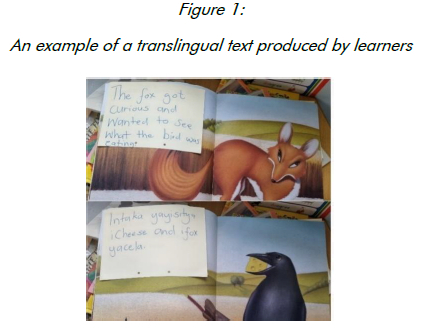
To support learners' comprehension and writing development, a translingual jigsaw activity was implemented, encouraging learners to collaboratively interpret visual texts and produce bilingual written responses. This activity was designed to create opportunities for learners to draw on their full linguistic repertoires while engaging in meaning-making and text production. During the initial reading session, the researcher introduced the big book The Fox and the Crow, deliberately concealing the original written text. Learners were asked to interpret the illustrations and collaboratively generate a title and narrative for each page. This whole-class activity encouraged learners to rely on visual cues, prior knowledge, and linguistic resources across languages to construct meaning. Learners moved fluidly between isiXhosa and English as they discussed characters, predicted events, and negotiated storylines.
The written artefacts produced during this activity provide insight into learners' biliteracy practices. As illustrated in Figure 1, learners generated a translingual text in which English and isiXhosa appeared on the same page. One page was written entirely in English, while another incorporated both languages, reflecting learners' flexible language choices rather than a strict separation of languages. This pattern suggests that learners selected languages strategically, depending on the complexity of ideas they wished to express and their confidence in each language.
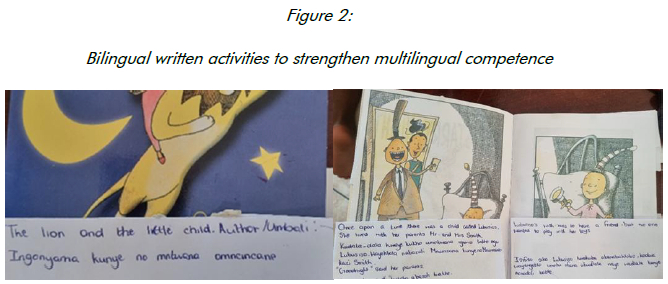
In a subsequent session, pairs of tutors and tutees were given picture books and asked to create their own stories based on the illustrations. The Grade 7 tutors often assumed responsibility for writing in English, while simultaneously providing isiXhosa explanations to support comprehension (see Figure 2). In one pair, the tutor wrote the English version of the story and added isiXhosa translations or explanations orally, enabling the Grade 3 learner to follow the narrative and contribute ideas.
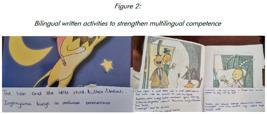
This collaborative process illustrates how translanguaging functioned as a scaffold for writing, allowing learners to participate meaningfully despite differing levels of proficiency.
Analytically, the translingual jigsaw activity demonstrates how translanguaging supports writing as a social and collaborative practice rather than an isolated skill. By removing language restrictions, learners were able to focus on narrative structure, sequencing, character development, and meaning-making. The activity supported the development of key literacy skills, including prediction, problem-solving, creativity, and critical thinking. Importantly, learners were not penalised for mixing languages; instead, their linguistic choices were recognised as legitimate resources for constructing meaning. These findings align with Espinosa et al.'s (2020) assertion that translanguaging can function as a powerful scaffolding tool when learners encounter challenges in writing in a single language. In this study, translanguaging enabled learners to express ideas more fully, maintain engagement with the task, and construct identities as competent writers. Writing was experienced not merely as an academic requirement, but as a meaningful and shared activity situated within a supportive social context. Overall, the translingual jigsaw activity contributed to improved comprehension and writing by validating learners' multilingualism and enabling them to draw on their full linguistic repertoires. This approach fostered inclusivity and respect for all languages in the classroom, while simultaneously supporting the development of biliteracy and broader literacy skills.
Translanguaging activities to develop learners' reading skills
Translanguaging reading practices were integrated throughout the reading programme to support learners' comprehension and engagement with texts written in English and isiXhosa. By allowing learners to draw on their home language while engaging with English texts, translanguaging functioned as a scaffold for meaning-making rather than a departure from reading instruction.
Pre-reading stage: Activating background knowledge and vocabulary
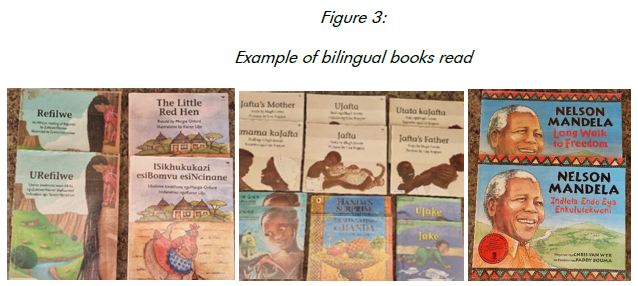
During the pre-reading stage, translanguaging was used to unpack the text, activate learners' background knowledge, and introduce key vocabulary. For example, when reading Refilwe, an English adaptation of the fairy tale Rapunzel, learners discussed the book cover and storyline in both isiXhosa and English. This discussion enabled learners to make connections between the familiar isiXhosa version (uRefilwe) and the English text, thereby drawing on prior knowledge to anticipate meaning. Allowing learners to engage in pre-reading discussions in their home language supported comprehension by reducing cognitive load and enabling learners to focus on meaning rather than decoding unfamiliar vocabulary. This practice aligns with research that emphasises the role of background knowledge and oral language in reading comprehension, particularly for emergent bilingual learners.
While-reading stage: Monitoring comprehension through translanguaging
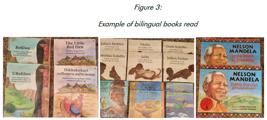
During the while-reading stage, the text was read primarily in English. The researcher paused at key points to check comprehension and invited learners to explain words or events in isiXhosa. In instances where learners struggled to articulate meaning in English, peers were encouraged to provide explanations in isiXhosa, which were then linked back to English vocabulary. In one session, a learner read a section of the story in isiXhosa (Isikhukhukazi esincinyane/ The Little Red Hen) after it had been read in English, confirming understanding and clarifying meaning for peers (see Figure 3). This practice enabled learners to cross-check comprehension across languages, reinforcing the idea that understanding can be constructed through multiple linguistic pathways. Translanguaging during reading thus functioned as an ongoing formative assessment, allowing the researcher and tutors to identify misunderstandings and address them immediately.
Post-reading stage: Meaning-making and retelling
The post-reading stage focused on meaning-making and comprehension. Learners were asked to summarise or retell the story in the language they felt most comfortable using. It was observed that many Grade 3 learners opted to retell the story in isiXhosa, even when the original text had been read in English. Follow-up activities, including written tasks, were then conducted in English, allowing learners to transfer understanding across languages. This sequencing illustrates how translanguaging supported comprehension while gradually strengthening learners' proficiency in the additional language. Rather than enforcing immediate production in English, learners were first given opportunities to demonstrate understanding in their home language, thereby affirming their linguistic identities and supporting confidence.
Bilingual reading circles
Bilingual reading circles further reinforced translanguaging reading practices by creating a collaborative and inclusive literacy environment. Tutors read English versions of texts to tutees and paused to translate, explain, or discuss key ideas in isiXhosa. As a whole-class activity, the researcher sometimes read a paragraph in English, followed by a learner reading the same paragraph in isiXhosa (see Figure 3). These practices supported Grade 3 learners' exposure to English vocabulary while maintaining access to meaning through isiXhosa. For Grade 7 learners, explaining texts in isiXhosa required deeper engagement with content and reinforced comprehension. Critically, bilingual reading circles demonstrate how translanguaging can mediate reading development by enabling learners to engage deeply with texts and with one another. The findings suggest that translanguaging reading practices supported comprehension, supporting learner confidence, and promoted active participation. By legitimising the use of learners' full linguistic repertoires during reading, the programme created opportunities for deeper engagement with texts and contributed to the development of biliteracy.
Translanguaging activities to develop learners' speaking skills
Learners' speaking skills were developed through regular book talks and oral discussions embedded within the cross-age reading programme. Translanguaging played a central role in these activities by allowing learners to express ideas in their preferred language, thereby reducing anxiety and encouraging active participation. During weekly book talks, learners were invited to share their reading experiences, opinions about stories, and interpretations of characters and events. Learners were explicitly encouraged to use isiXhosa, English, or a combination of both, depending on their comfort and communicative needs. As a result, oral discussions were characterised by frequent translanguaging, with learners switching between languages to clarify meaning, emphasise ideas, or compensate for lexical gaps.
Observations indicated that Grade 7 learners often preferred reading texts in English but struggled to retell or summarise these texts orally in English. In such instances, learners switched to isiXhosa to convey meaning more effectively. For example, when a learner hesitated while summarising a story in English and expressed frustration at not finding the appropriate word, she was encouraged to continue in isiXhosa. Once meaning had been established, the learner or peers would often supply English equivalents for key terms. This interactional pattern illustrates how translanguaging functioned as a communicative scaffold, enabling learners to prioritise meaning over linguistic accuracy. These practices highlight the role of translanguaging in supporting oral language development by validating learners' linguistic identities and reducing the cognitive demands associated with monolingual oral production. Rather than silencing learners, translanguaging created space for fuller participation and sustained engagement. This aligns with Madiba's (2013) observation that learners often struggle with oral expression when restricted to a language in which they lack proficiency.
Book talks also functioned as dialogic spaces where learners negotiated meaning collaboratively. Learners responded to one another's contributions, asked questions, and built on shared ideas using both languages. The tutors' use of translanguaging was particularly significant, as they modelled flexible language practices and legitimised the use of isiXhosa alongside English. This modelling appeared to increase tutees' willingness to speak, even when unsure of their English proficiency. In addition to supporting oral language development, translanguaging during book talks contributed to learners' confidence and sense of agency. Learners who were initially reluctant to speak began to participate more actively over time, suggesting that the removal of rigid language boundaries created a more inclusive and supportive environment. As noted by Scheckle (2022), book talks can positively influence learners' reading attitudes and agency. In this study, the integration of translanguaging further enriched these oral literacy practices. The findings suggest that translanguaging activities created meaningful opportunities for learners to develop speaking skills by enabling them to draw on their full linguistic repertoires. Oral discussions became spaces for sense-making, identity affirmation, and collaborative learning, rather than performances constrained by monolingual expectations.
DISCUSSION
This study examined how pedagogic translanguaging could be implemented within a cross-age reading programme to support emergent bilingual learners' literacy development. The findings indicate that translanguaging practices across reading, writing, speaking, and digital literacy activities enabled learners to access meaning, develop comprehension, and engage confidently with texts in both isiXhosa and English. These findings contribute to understanding how multilingual learners can be supported through flexible, scaffolded approaches that position all languages as valuable resources.
Cross-age reading as a site for translanguaging
One of the study's key contributions is the central role of cross-age reading in facilitating translanguaging practices. Older learners (Grade 7) acted as tutors, modelling reading strategies, explaining vocabulary, and supporting comprehension in multiple languages. Younger learners (Grade 3) benefited from these interactions, demonstrating increased confidence, vocabulary growth, and reading fluency. The dyadic nature of the interactions aligns with (Vygotsky, 1978) concept of the More Knowledgeable Other, showing that peer-mediated scaffolding can be enhanced through the strategic use of learners' full linguistic repertoires. Cross-age reading thus provided a structured but flexible environment in which translanguaging could function pedagogically to support literacy development.
Translanguaging and literacy development
Across all literacy domains, reading, writing, speaking, and digital literacy, translanguaging enabled learners to bridge gaps in comprehension, produce meaningful written and oral texts, and develop vocabulary across languages. In pre-, while-, and post-reading activities, learners drew on isiXhosa to negotiate meaning, confirm understanding, and scaffold English production. Similarly, in writing and digital literacy tasks, learners used translanguaging to co-construct narratives, explain concepts, and interact with multimodal texts. These practices illustrate how translanguaging functions not only as a communicative strategy but as a cognitive and pedagogical resource, supporting biliteracy and emergent bilingualism (Cenoz & Gorter, 2021; García & Wei, 2015).
Learners' linguistic repertoires as resources
The findings demonstrate that learners' linguistic repertoires are dynamic resources that can be drawn from for comprehension, communication, and creative expression. By legitimising the use of home languages alongside English, the programme enabled learners to maintain agency and engagement, reinforcing that bilingualism is an asset rather than a barrier. This aligns with a language-as-resource orientation, emphasising that learners' existing linguistic knowledge can scaffold additional literacy skills without diminishing the role of English in academic contexts.
CONCLUSION
The study highlights several implications for literacy interventions in South African classrooms. First, structured peer-mediated programmes, such as cross-age reading, can create meaningful opportunities for translanguaging, particularly in contexts where learners are navigating multiple languages. Second, translanguaging practices should be integrated intentionally across literacy domains, including reading, writing, speaking, and digital literacy, to maximise their pedagogical impact. Finally, recognising and supporting learners' home languages in literacy instruction can promote inclusivity, learner confidence, and deeper engagement with texts, particularly for emergent bilingual learners who have experienced interrupted literacy development. This study contributes to the growing body of research on translanguaging in literacy education by demonstrating how cross-age reading programmes can serve as effective sites for translanguaging pedagogies. While previous South African studies have explored translanguaging in classroom instruction, this study foregrounds the potential of older peers to scaffold younger learners' literacy development through structured, multilingual reading interactions. By documenting learners' oral, written, and digital practices, the study provides concrete evidence of translanguaging in action, bridging a gap in research on peer-mediated biliteracy interventions in South African schools. Overall, the study highlights the transformative potential of cross-age reading programmes that integrate translanguaging. When learners are allowed to draw on their full linguistic repertoires, literacy development becomes inclusive, collaborative, and socially meaningful, supporting both emergent bilingualism and the development of biliteracy.
REFERENCES
LITERATURE REVIEW
- Busch, B. (2012). The linguistic repertoire revisited. Applied Linguistics, 33(5), 503-523.
- Carrim, A., & Nkomo, S. A. (2023). A systematic literature review of the feasibility of a translanguaging pedagogy in the foundation phase. Journal of Languages and Language Teaching, 11(2), 195-210. https://doi.org/10.33394/jollt.v11i2.7158
- Cenoz, J., & Gorter, D. (2011). A holistic approach to multilingual education: Introduction. The Modern Language Journal, 95(3), 339-343.
- Cenoz, J., & Gorter, D. (2015a). Multilingual education. Cambridge University Press.
- Cenoz, J., & Gorter, D. (2015b). Towards a holistic approach in the study of multilingual education. In J. Cenoz & D. Gorter (Eds.) Multilingual Education: Between Language Learning and Translanguaging (pp.1-15). Cambridge University Press.
- Cenoz, J., & Gorter, D. (2021). Pedagogical translanguaging. Cambridge University Press.
- Department of Education. (1997). Language in education policy. Pretoria: Government Printers.
- Espinosa, C. M., Moreno, L. A., & Vogel, S. (2020). Building on strengths: Translanguaging and writing. In Translanguaging and Transformative Teaching for Emergent Bilingual Students (pp.187-206). Routledge.
- Flint, T. K. (2010). Making meaning together: Buddy reading in a first grade classroom. Early Childhood Education Journal, 38(4), 289-297. https://doi.org/10.1007/s10643-010-0418-9
- García, O. (2011). Bilingual education in the 21st century: A global perspective. John Wiley & Sons.
- García, O., & Wei, L. (2015). Translanguaging, bilingualism, and bilingual education. The Handbook of Bilingual and Multilingual Education, 223-240.
- Janse van Rensburg, M. (2018). Understanding the contribution of third space theory in the Masikhulisane reading programme. Master's dissertation, Nelson Mandela University, South Africa.
- MacSwan, J. (2022). Multilingual perspectives on translanguaging (Vol. 1). Channel View Publications.
- Madiba, M. (2013). Multilingual education in South African universities: Policies, pedagogy and practicality. Linguistics and Education, 24(4), 385-395.
- McKinney, C., & Tyler, R. (2024). (Trans) languaging-for-learning: A perspective from the South. Reading & Writing-Journal of the Literacy Association of South Africa, 15(1), 508.
- Mullis, I. V. S., Von Davier, M., Foy, P., Fishbein, B., Reynolds, K. A., & Wry, E. (2023). PIRLS 2021 international results in reading. Boston: Boston College, TIMSS & PIRLS International Study Center.
- Pretorius, E. J., & Spaull, N. (2016). Exploring relationships between oral reading fluency and reading comprehension amongst English second language readers in South Africa. Reading and Writing, 29(7), 1449-1471. https://doi.org/10.1007/s11145-016-9645-9.
- Ruiz, R. (2010). Reorienting language-as-resource. International Perspectives on Bilingual Education: Policy, Practice, and Controversy, 155.
- Scheckle, E. (2022). Mediating meaning in booktalk: Reading Clubs as third spaces. Per Linguam: A Journal of Language Learning = Per Linguam: Tydskrif Vir Taalaanleer, 38(1), 27-43. https://doi.org/10.5785/38-1-988.
- Schoeman, J. C., Geertsema, S., le Roux, M., & Pottas, L. (2023). The effect of pedagogical translanguaging on foundation phase classrooms in a South African private school. Journal of Language, Identity & Education, 1-18.
- Spaull, N., & Pretorius, E. (2022). Coming or going? The prioritisation of early grade reading in South Africa. Early Grade Reading in South Africa, 253.
- Thornberg, R., & Charmaz, K. (2014). Grounded theory and theoretical coding. The SAGE Handbook of Qualitative Data Analysis, 5(2014), 153-169. https://doi.org/10.4135/9781446282243.n11
Reviewed: 06 February 2025
Accepted: 11 February 2026