Food hygiene and food safety practices of households in a township north of Tshwane, Gauteng
Abstract
BACKGROUND: Foodborne illness is still a major public health concern worldwide. Most cases of foodborne illness can be traced to the home. The food safety practices of food handlers in the household are an important determining factor in food safety at the household level AIM: To assess the food safety practices of food handlers in households in Ga-Rankuwa, Tshwane SETTING: The study was conducted in zones 1-9 and zone 16, as well as extension 25 of Ga-Rankuwa, Tshwane METHODS: A quantitative descriptive study design was used for which a structured questionnaire was administered among 339 food handlers. Descriptive and inferential statistical analysis was performed in STATA 13.1 RESULTS: The majority of food handlers reported always washing their hands before (81%) and after handling raw meat, chicken or fish; the majority of food handlers (69%) reported always washing preparation surfaces and utensils with clean, soapy water after handling raw meat, chicken or fish. Less than half (45%) of food handlers reported never thawing frozen meat, chicken or fish in a bowl of cold water CONCLUSION: The food handlers reported appropriate food safety practices regarding hand washing and food preparation surfaces and utensils. However, their practices regarding the storage of meat, chicken and fish were inappropriate CONTRIBUTION: This study builds on the existing body of literature on the food safety practices of food handlers. Moreover, the study findings can serve as a basis for the development of interventions to ensure food safety at a household level
food safety; food hygiene; food handlers; Tshwane; households; foodborne illnesses
Introduction
Food hygiene and food safety remain as critical public health challenges in both developed and developing countries. According to the World Health Organization (WHO), five main aspects to safer food include keeping it clean, separating raw and cooked food, cooking thoroughly, storing food at safe temperatures, and using safe water and raw materials (WHO 2006). This is to ensure the presentation of safer food, optimal health and prevention of foodborne illnesses. Foodborne illness affects 1 out of every 10 people worldwide (WHO 2022a). Takanashi et al. (2009) reported that 70% of diarrhoea cases in developing countries are caused by pathogens transmitted through food. Sub-Saharan Africa accounts for 53% of all foodborne illness and 75% of related deaths globally (Preneuf & Morales 2018). Thus, unsafe food creates a vicious cycle of diarrhoea and malnutrition, particularly affecting elderly, young children and the immunocompromised (WHO 2022a). The majority of cases of foodborne disease are reported to originate from the home (Bloomfield & Nath 2013). In Africa, children under the age of 5 years and people who live in low-income homes are most at-risk to foodborne illnesses (Newell et al. 2010).
A possible cause of foodborne illness is food contamination which can result from poor food safety knowledge and practice of food handlers in the home, which is the main location for foodborne illness outbreak Byrd-Bredbenner et al. (2013). Both Ehuwa, Jaiswal and Jaiswal (2021) and Preneuf and Morales (2018) reported that at least 10%- 20% of foodborne illness outbreaks were due to contamination by the food handlers. An example of such outbreak was documented among paediatric patients attending outpatient clinics in Ethiopia; parasites (Salmonella and Shigella) were found and this was attributed to poor food safety practices (Ayalew, Amare & Bthatesfa 2013). The factors which can lead to food contamination are improper handwashing, not keeping utensils and kitchen surfaces clean, and improper thawing of meat, chicken and fish (Ganta & Kadeangadi 2019). Correct measures of handwashing are important for ensuring food safety in the home.
Available published literature is mainly on the food safety practices in hospitals and schools (Sibanyoni, Tshabalala & Tabit 2017; Teffo & Tabit, 2020). In one study which assessed the food safety practices of households in KwaZulu-Natal, South Africa, 24% of food handlers stated that meat should be uncovered while refreezing and 30% stated that meat should not be refrozen (Mkhungo, Oyedeji & Ijabadeniyi 2018). The majority of food handlers (> 70%) in the KwaZulu-Natal study did not know the appropriate cold storage temperatures. These are critical areas in food safety where there are knowledge gaps, and these areas can result in severe foodborne illness for household members.
The WHO's 2022-2030 strategic plan prioritises the reduction of foodborne illnesses, with the home playing an important role in this strategy (WHO 2022b). The South African government is focused on food safety, with increased regulation of food handling and processing, sales and exports. Additionally, no previously published study has looked at the food safety practices of household food handlers in Gauteng. Thus, the study aims to assess the food hygiene and food safety practices of households in Ga-Rankuwa, Tshwane. The current study addresses this research gap and the findings could have implications for future interventions for food safety in South Africa.
Research methods and design
Study design
A quantitative descriptive study design was used to describe the food safety and food hygiene practices of households in Ga-Rankuwa, Tshwane.
Study population and sampling strategy
The target population was households in Ga-Rankuwa from 11 zones, namely zones 1-9 and zone 16, as well as extension 25 with a total of 7700 households. From this, the sample size of 367 was calculated using the online Raosoft sample size calculator with a 5% margin of error, 95% confidence level and 50% response distribution. Proportionate sampling was used to select number of households from each of the 11 zones. A list of households was obtained from the Ga-Rankuwa Municipality Offices. Probability systemic sampling was used, in which every fifth house was selected, until the sample size of 367 households was met (Leedy & Omrod 2009). Child-headed households were excluded from this study as were selected households in which there were people without knowledge on how food is prepared in the home. If no one was home at the selected fifth house, the next house was then selected (sixth).
Data collection
A pretested structured questionnaire adapted from a previously published study (Gong et al. 2016) was used to collect data. Four research assistants were trained by the researchers on the contents of the questionnaire and interviewing techniques. The research assistants followed the sampling procedure by visiting every fifth house and interviewing the individual responsible for food preparation in the household (food handler). After the interview, the questionnaires were checked for completeness.
Reliability
The study methods were applied consistently and the procedures were standardised by conducting training before the commencement of data collection. The data collection tool was pretested.
Validity
The questionnaire was designed by adapting some existing questions from a validated and reliable questionnaire used in prior research pertaining to food safety (Gong et al. 2016).
Data analysis
The questionnaire data were coded and entered into a Microsoft Excel spreadsheet and imported to statistical software STATA 13.1 for analysis. Descriptive statistics were performed for frequencies, mean and standard deviation. The Pearson chi-square was used to test for the relationship between categorical variables. A p-value of less than 0.05 was considered significant.
Ethical considerations
All participants gave their informed consent before participating in the study. The study was conducted per the Declaration of Helsinki, and the protocol was approved by Sefako Makgatho University Research Ethics Committee (SMUREC/H/263/2016: IR).
Results
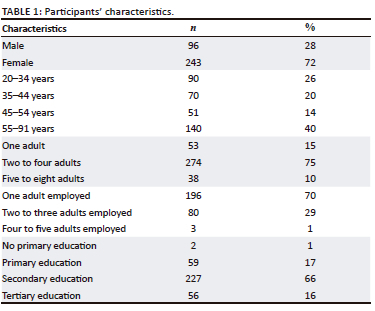
The majority (40%; n = 140) of the participants were between the age range of 55 and 91 years. About 75% (n = 274) of the households had at least two to four adults living in the home, with 70% (n = 196) of households having one adult employed. The majority (66%; n = 227) of the participants had secondary school education (Table 1).
Self-reported handwashing practices
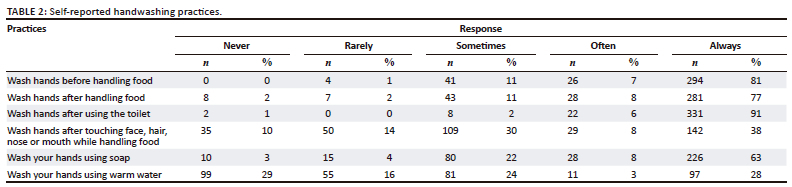
As reported in Table 2, the majority (81%; n = 294) of the participants had best practice of washing hands before handling food and 24% (n = 85) had poor practices of not washing their hands after touching their face, hair, nose or mouth while handling food.
Food preparation surfaces and utensils
The findings in Table 3 show that 38% (n = 139) of the participants have poor practice of using the same preparation surfaces or utensils for meat and vegetables without washing the utensils or surfaces in between. Sixty-nine percent of participants (n = 254) had the best practice of washing the cooking surfaces or utensils with clean warm soapy water after handling raw meat or chicken or fish (Table 3).
Thawing of meat, chicken and fish
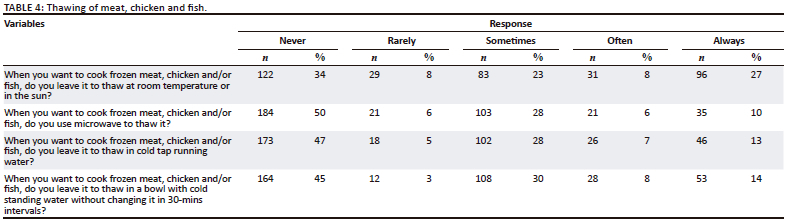
Table 4 shows that 34% (n = 122) of the participants do not leave frozen meat, chicken or fish to thaw at room temperature or in the sun; 50% (n = 184) do not use microwave to thaw frozen meat, chicken and fish before cooking. Fifty-two percent (n = 191) never used the best practice of thawing meat, chicken or fish in cold tap running water. One hundred and sixty-four participants (45%) did not leave frozen meat, chicken or fish to thaw in a bowl with cold standing water without changing it in 30-min intervals.
Relationship between gender, age, education level and food safety hygiene practices
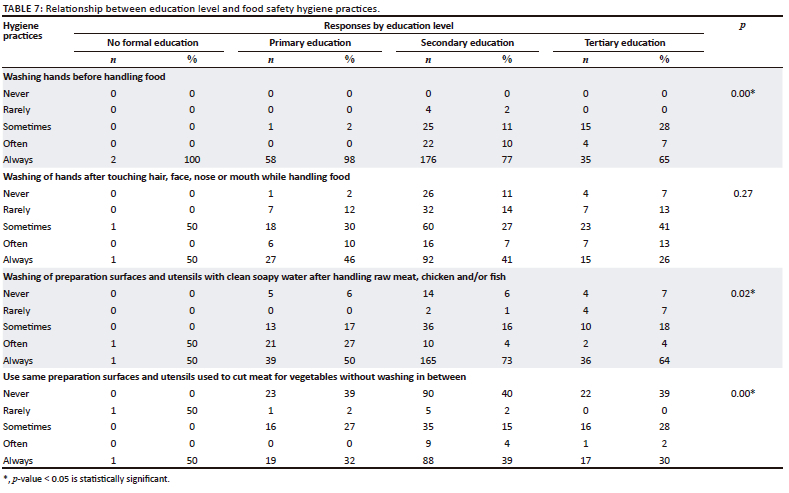
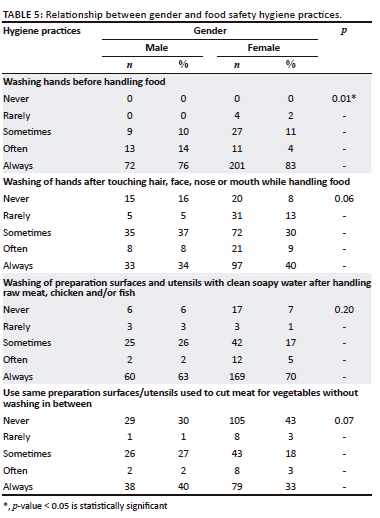
Table 5, Table 6 and Table 7 present the findings of the Pearson chi-square test on the relationship between gender, age and education level with the food handlers' food safety hygiene practices. Table 5 indicates a statistically significant relationship (p < 0.05) between males and females, with females more likely to wash hands before handling food.
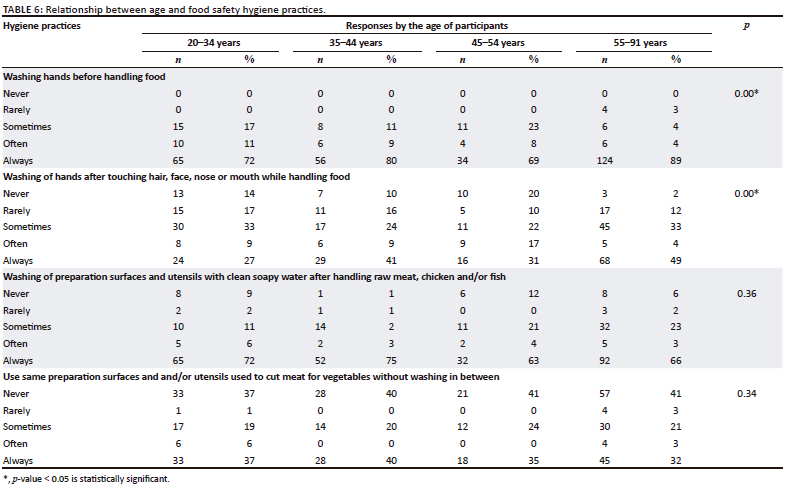
Table 6 illustrates a statistically significant relationship (p < 0.05) between age and the following food safety hygiene variables, namely, washing hands before handling food and washing of hands after touching hair, face, nose or mouth while handling food, whereby older food handlers had better practices as compared to other age groups.
Table 7 indicates a significant relationship (p < 0.05) between education level and the following food safety hygiene variables, namely, washing hands before handling food, washing of preparation surfaces and utensils with clean soapy water after handling raw meat, chicken and/or fish, and lastly using the same preparation surfaces and utensils used to cut meat for vegetables without washing in between. The more educated the food handlers, the better their practices regarding food safety hygiene.
Discussion
The current study assessed food safety practices of households in Ga-Rankuwa, Tshwane. The majority of the participants reported always washing their hands before and after handling food. Similarly, a study by Langiano et al. (2012) reported that the majority of participants reported to always wash their hands with soap and water after handling raw meat. The current study's findings, however, were self-reported, which means that participants could over-report or only report on desirable behaviours. Furthermore, Ruby et al. (2019) reported that people may be very knowledgeable about handwashing, but that knowledge may not be put into practice. Handling food without proper handwashing predisposes individuals to diseases which could be prevented (Centers for Disease Control and Prevention 2020). The researchers are of the view that washing of hands could have improved due to the coronavirus disease 2019 (COVID-19) pandemic where peoples' behaviour was influenced (Mucinhato et al. 2012). Kasza et al. (2022) observed that at least once among 15 households, the food handler did not properly wash their hands during food handling even after touching raw chicken or after sneezing or coughing. In the current study, age had a positive influence (p < 0.05) on the washing of hands before handling food and after touching their hair, face, nose or mouth. Older food handlers were more likely to wash their hands during handling.
More than 50% of respondents in the current study reported always using a wooden cutting board for food preparation. Similarly, Mucinhato et al. (2012) reported that individuals were more likely to use wooden cutting boards, thus increasing the potential risk of cross-contamination. Moreover, Mucinhato et al. (2012) stated that the home food preparation environment can be a serious breeding ground for foodborne diseases. Studies by Kasza et al. (2022) and Møretrø et al. (2021) in six European countries reported on the microbiological analysis of household chicken samples and found that most of the samples were contaminated with Salmonella and Campylobacter which were transmitted to the cutting board during meal preparation. Contamination with Salmonella can also occur after cooking through contact with surfaces and containers of previously contaminated cooking utensils from the uncooked meat (Gallo et al. 2020). In a study by Langiano et al. (2012), most participants believed it was not necessary to clean and disinfect cutting boards between preparing different foods.
According to the current study's findings, the majority of participants (69%) always wash preparation dishes and utensils with clean, warm, soapy water before handling raw meat, chicken or fish. Thirty-nine percent of the participants reported that they never use the same preparation surfaces or utensils to cut meat and vegetables without washing with warm soapy water in between.
The transmission of foodborne diseases is aggravated by unsafe food handling practices (Dagne et al. 2019). A good level of food safety practice of mothers was associated with good levels of educational status (Dagne et al. 2019). Thus, those with higher education are able to read print material even though they may not implement the correct behaviour in food safety. Food safety training is therefore important for individuals to practise safe food handling.
The current study found a significant relationship between the education level of the food handlers and their food safety and food hygiene practices. Similarly, Ababio and Adi (2012) also reported a significant relationship between the education level of food handlers in Kumasi, Ghana, and their food hygiene practices. Therefore, education programmes targeting food handlers in Ga-Rankuwa could be effective in improving their food handling practices and subsequently reducing the risk of foodborne diseases in the home.
Many South Africans depend largely on raw and semi-processed foods and there is a high possibility of cross-contamination between these foods and the kitchen surfaces where they are processed (Mkhungo et al. 2018). Therefore, food handlers in the home have the important responsibility of preventing food contamination during the preparation and distribution of food.
Less than half (45%) of the participants in the current study reported never leaving frozen meat, chicken and fish to thaw in a bowl with cold water before cooking and more than 50% thaw at room temperature. Similarly, Langiano et al. (2012) found that it was common for participants to thaw meat and fish at room temperature. Furthermore, Leygonie, Britz and Hoffman (2012) discovered that the risk of thawing frozen chicken in a bowl of water or over the counter is that the increased water activity combined with the relatively warm temperature is favourable for pathogen growth. To avoid rapid microbial growth, meat, chicken or fish should be thawed in a refrigerator (Food Safety and Inspection Service, United States Department of Agriculture 2013). Food hygiene education, targeting households, should be prioritised as a strategy to prevent foodborne illnesses.
Strengths and limitations
One of the strengths of the study was the use of a questionnaire which had been used in a previously published study and that was adapted for the current study. Also following the pilot study, questions were rephrased if they were ambiguous to the participants. This ensured the validity of the questionnaire. There is also a likelihood of over-, under- or misreporting of findings in self-reported studies. The study was conducted in one area in Tshwane and can be replicated in other areas. Participant responses may be skewed due to their socially desirable ability to provide preferred answers more than real experiences (Grimm 2010).
Implication of the study
The study focused on understanding the practices of food handlers in households. Thus, providers of training can be informed through this study to enable them to put in place appropriate strategies to improve individuals' understanding on food safety and proper food hygiene. Future research can extend this work by examining the actual behaviour of food handlers in households during food preparation.
Conclusion
Food safety concerns include those involved in food preparation, including food handlers, as well as sanitation of the environment and the equipment used. Food safety and a person's diet have an impact on their health and nutritional intake. However, the challenge is that food preparers in households are not formally trained in food safety. What people do in households is what they understand to be best practice learned from other family members.
Competing interests
The authors declare that they have no financial or personal relationship(s) that may have inappropriately influenced them in writing this article.
Authors' contributions
M.M., R.E.G. and L.J.N. conceptualised the study and drafted the manuscript; M.M. conducted data analysis; M.M., R.E.G. and L.J.N. critically reviewed and revised the manuscript. M.M., R.E.G. and L.J.N. wrote, reviewed and edited the final version of the manuscript.
Funding information
The authors received no financial support for the research, authorship, and/or publication of this article.
Data availability
The data that support the findings of this study are available on request from the corresponding author, M.M. The data are not publicly available due to their containing information that could compromise the privacy of research participants.
Disclaimer
The views and opinions expressed in this article are those of the authors and do not necessarily reflect the official policy or position of any affiliated agency of the authors.
Acknowledgements
The authors would like to acknowledge the food handlers that participated in the study.
References
-
Ababio, P.F. & Adi, D., 2012, Effect of education on hygiene practices of food handlers, Unpublished worked, viewed 25 January 2022, from https://www.researchgate.net/publication/278403958_Effect_of_education_on_the_hygiene_practices_of_food_handlers.
» https://www.researchgate.net/publication/278403958_Effect_of_education_on_the_hygiene_practices_of_food_handlers -
Ayalew, H., Amare, B. & Biruhtesfa, A., 2013, 'Review on food safety system: Ethiopian perspective', African Journal of Food Science 7(12), 431-440. https://doi.org/10.5897/AJFS2013.1064
» https://doi.org/10.5897/AJFS2013.1064 -
Bloomfield, S.F. & Naath, K.J., 2013, Home hygiene in developing countries prevention of infection in the home and the peri-domestic setting. A training resource on hygiene for teachers, community nurses, community workers and health professionals in developing countries, International Scientific Forum on Home Hygiene, viewed 05 January 2023, from https://ifh-homehygiene.org/best-practice-training/home-hygiene-developing-countries-prevention-infection-home-and-peri-domestic/.
» https://ifh-homehygiene.org/best-practice-training/home-hygiene-developing-countries-prevention-infection-home-and-peri-domestic/ -
Byrd-Bredbenner C., Bering J., Martin-Biggers J., & Quick V., 2013, 'Food safety in home kitchens: A synthesis of the literature', International Journal of Environmental Research and Public Health 10(9), 4060-4085. https://doi.org/10.3390/ijerph10094060
» https://doi.org/10.3390/ijerph10094060 -
Centers for Disease Control and Prevention, 2020, Handwashing in communities: Clean hands save lives, viewed 20 January 2023, from https://www.cdc.gov/handwashing/why-handwashing.html.
» https://www.cdc.gov/handwashing/why-handwashing.html -
Dagne, H., Raju, R.P., Andualem, Z., Hagos, T. & Addis, K., 2019, 'Food safety practice and its associated factors among mothers in Debarq Town, Northwest Ethiopia: Community-based cross-sectional study', Biomed Research International 2019, 1549131. https://doi.org/10.1155/2019/1549131
» https://doi.org/10.1155/2019/1549131 -
Ehuwa, O., Jaiswal, A.K. & Jaiswal, S., 2021, 'Salmonella, food safety and food handling practices', Foods 10(5), 907. https://doi.org/10.3390/foods10050907
» https://doi.org/10.3390/foods10050907 -
Food Safety and Inspection Service, United States Department of Agriculture, 2013, The Big Thaw - Safe defrosting methods, viewed 29 January 2022, from https://www.fsis.usda.gov/food-safety/safe-food-handling-and-preparation/food-safety-basics/big-thaw-safe-defrosting-methods#:~:text=When%20thawing%20frozen%20food%2C%20it's,foods%20from%20the%20frozen%20state.
» https://www.fsis.usda.gov/food-safety/safe-food-handling-and-preparation/food-safety-basics/big-thaw-safe-defrosting-methods#:~:text=When%20thawing%20frozen%20food%2C%20it's,foods%20from%20the%20frozen%20state -
Gallo, M., Ferrara, L., Calogero, A., Montesano, D. & Naviglio, D., 2020, 'Relationships between food and diseases: What to know to ensure food safety', Food Research International 137, 109414. https://doi.org/10.1016/j.foodres.2020.109414
» https://doi.org/10.1016/j.foodres.2020.109414 -
Ganta, S.R. & Kadeangadi, D.M., 2019, 'A community-based cross-sectional study about knowledge, attitude and practices of food safety measures among urban households', Indian Journal of Health Sciences and Biomedical Research 12(2), 154-159. https://doi.org/10.4103/kleuhsj.kleuhsj_277_18
» https://doi.org/10.4103/kleuhsj.kleuhsj_277_18 -
Gong, S., Wang, X., Yang, Y. & Bai, L., 2016, 'Knowledge of food safety and handling in households: A survey of food handlers in Mainland China', Food Control 64, 48-51. https://doi.org/10.1016/j.foodcont.2015.12.006
» https://doi.org/10.1016/j.foodcont.2015.12.006 -
Grimm, P., 2010, 'Social desirability bias', in J. Sheth & N. Malhotra (eds.), Wiley international encyclopedia of marketing, viewed n.d., from https://doi.org/10.1002/9781444316568.wiem02057
» https://doi.org/10.1002/9781444316568.wiem02057 -
Kasza, G., Csenki, E.Z., Izsó, T. & Scholderer, J., 2022, 'Paradoxical risk mitigation behavior in private households', Food Control 138, 109032. https://doi.org/10.1016/j.foodcont.2022.109032
» https://doi.org/10.1016/j.foodcont.2022.109032 -
Langiano, E., Ferrara, M., Lanni, L., Viscardi, V., Abbatecola, A.M. & De Vito E., 2012, 'Food safety at home: Knowledge and practices of consumers', Journal of Public Health 20(1), 47-57. https://doi.org/10.1007/s10389-011-0437-z
» https://doi.org/10.1007/s10389-011-0437-z - Leedy, P.D. & Omrod, J.E., 2009, Practical research, planning and design, 11th edn., Pearson, Boston, MA.
-
Leygonie, C., Britz, T.J. & Hoffman, L.C., 2012, 'Impact of freezing and thawing on the quality of meat: Review', Meat Science 91(2), 93-98. https://doi.org/10.1016/j.meatsci.2012.01.013
» https://doi.org/10.1016/j.meatsci.2012.01.013 -
Mkhungo, M.C., Oyedeji, A.B. & Ijabadeniyi, O.A., 2018, 'Food safety knowledge and microbiological hygiene of households in selected areas of Kwa-Zulu Natal, South Africa', Italian Journal of Food Safety 7(2), 6887. https://doi.org/10.4081/ijfs.2018.6887
» https://doi.org/10.4081/ijfs.2018.6887 -
Møretrø, T., Moen, B., Almli, V.L., Teixeira, P., Ferreira, V.B., Åsli, A.W. et al., 2021, 'Dishwashing sponges and brushes: Consumer practices and bacterial growth and survival', International Journal of Food Microbiology 337, 108928. https://doi.org/10.1016/j.ijfoodmicro.2020.108928
» https://doi.org/10.1016/j.ijfoodmicro.2020.108928 -
Mucinhato, R.M.D., Da Cunha, D.T., Barros, S.C.F., Zanin, L.M., Auad, L.I., Weis, G.C.C. et al., 2022, 'Behavioral predictors of household food-safety practices during the COVID-19 pandemic: Extending the theory of planned behavior', Food Control 134, 108719. https://doi.org/10.1016/j.foodcont.2021.108719
» https://doi.org/10.1016/j.foodcont.2021.108719 -
Newell, D.G., Koopmans, M., Verhoef, L., Duizer, E., Aidara-Kane, A., Sprong, H. et al., 2010, 'Food-borne diseases - The challenges of 20 years ago still persist while new ones continue to emerge', International Journal of Food Microbiology 30(139 Suppl 1), S3-15. https://doi.org/10.1016/j.ijfoodmicro.2010.01.021
» https://doi.org/10.1016/j.ijfoodmicro.2010.01.021 -
Preneuf, F. & Morales, X., 2018, Food-borne illness cost US$ 110 billion per year in low-and middle-income countries, The World Bank, viewed 24 April 2023, from https://www.worldbank.org/en/news/press-release/2018/10/23/food-borne-illnesses-cost-us-110-billion-per-year-in-low-and-middle-income-countries.
» https://www.worldbank.org/en/news/press-release/2018/10/23/food-borne-illnesses-cost-us-110-billion-per-year-in-low-and-middle-income-countries -
Ruby, G.E., Fatimah, U., Zainal, U., Lihan, S., Noorahya, N. & Radu, S., 2019, 'A cross-sectional study on food safety knowledge among adult consumers', Food Control 99, 98-105. https://doi.org/10.1016/j.foodcont.2018.12.045
» https://doi.org/10.1016/j.foodcont.2018.12.045 -
Sibanyoni, J.J., Tshabalala, P.A. & Tabit, F.T., 2017, 'Food safety knowledge and awareness of food handlers in school feeding programmes in Mpumalanga, South Africa', Food Control 73(B), 1397-1406. https://doi.org/10.1016/j.foodcont.2016.11.001
» https://doi.org/10.1016/j.foodcont.2016.11.001 -
Takanashi, K., Chonan, Y., Quyen, D., Khan, N., Poudel, K. & Jimba, M., 2009, 'Survey of food-hygiene practices at home and childhood diarrhoea in Hanoi, Viet Nam', Journal of Health Population and Nutrition 27(5), 602-611. https://doi.org/10.3329/jhpn.v27i5.3636
» https://doi.org/10.3329/jhpn.v27i5.3636 -
Teffo, L.A. & Tabit, F.T., 2020, 'An assessment of food safety knowledge and attitudes of food handlers in hospitals', BMC Public Health 20, 311. https://doi.org/10.1186/s12889-020-8430-5
» https://doi.org/10.1186/s12889-020-8430-5 -
World Health Organization (WHO), 2006, Five keys to safer food manual, viewed 15 January 2022, from https://www.who.int/publications/i/item/9789241594639.
» https://www.who.int/publications/i/item/9789241594639 -
World Health Organization (WHO), 2022a, Food safety, viewed 15 January 2022, from https://www.who.int/news-room/fact-sheets/detail/food-safety.
» https://www.who.int/news-room/fact-sheets/detail/food-safety -
World Health Organization (WHO), 2022b, WHO global strategy for food safety 2022-2030: Towards stronger food safety systems and global cooperation, viewed 17 April 2023, from https://www.who.int/publications/i/item/9789240057685.
» https://www.who.int/publications/i/item/9789240057685

Accepted: 28 June 2023
Published: 17 Oct. 2023