Considering socio-cultural histories in gold mining tourism: A view of Khutsong township, Gauteng
Abstract
Socio-cultural township tourism plays an important role in representing the legacy and heritage of regions, as it helps preserve and promote the unique identity of an area and encourages interaction between tourists and local cultures. The article recognises the significance of researching potential tourism opportunities arising from socio-cultural ventures in the mining township of Khutsong. The township was selected because of the research void regarding its socio-cultural histories. In this discussion, the authors find that heritage and mining legacies have the potential to create future tourism opportunities. Established on the outskirts of Carletonville in the Gauteng province, Khutsong and its people are closely linked with gold mining histories, with labour and socio-economic impacts having created diverse cultures in the township. Views raised by the local community of Khutsong complemented suggestions that engaged with tourism-specific scholarly literature, namely the quest to create and develop tourism opportunities in economically stressed regions dependent on the mining economy. Yet, the major research gap is how to meet this need. An in-depth capture of the socio-cultural histories is discussed in this article as a starting point for future tourism and further research in this field.
Historical legacies; socio-cultural township tourism; goldmining tourism; community engagement; mining economy; Khutsong; Gauteng
Abstract
Sosio-kulturele informele nedersettingstoerisme speel 'n belangrike rol in die verteenwoordiging van die nalatenskap en erfenis van streke. Dit help om die unieke identiteit van 'n streek te bewaar en te bevorder, en interaksie tussen toeriste en plaaslike kulture aan te moedig. In hierdie artikel word die belangrikheid van navorsing beklemtoon wat potensiële toerismegeleenthede uit sosio-kulturele erfenisse kan skep. Vir hierdie bespreking is die dorp Khutsong naby Carletonville in die Gauteng provinsie van Suid-Afrika as voorbeeld uitgesonder. Khutsong het sy ontstaan te danke aan die goudmynbedryf in die Verre Wesrand-gebied. Hierdie dorp is as voorbeeld gekies vanweë die navorsingsleemte ten opsigte van sy historiese nalatenskap. Die bespreking handel verder ook daaroor dat mynbou-erfenisse in die gebied die potensiaal het om toerismegeleenthede in die omgewing en vir die gemeenskappe plaaslik te skep, en dat Khutsong se geïdentifiseerde erfenis beslis by so 'n groter erfenisfokus kan baat. Khutsong is aan die buitewyke van die dorp Carletonville gevestig, en sy mense is nou met die plaaslike goudmynbedryf se geskiedenis verbind - onder meer met die arbeids- en sosio-ekonomiese impak wat die vestiging van diverse kulture in die dorp tot gevolg gehad het. Die plaaslike gemeenskap van Khutsong se voorstelle rakende toerisme vir hulle gebied het in wese die voorstelle gekomplementeer wat met toerisme-spesifieke akademiese literatuur verband hou. Dit is, naamlik, die soeke na die skep en voorstel van toerismeprodukte in ekonomiese streke wat totaal afhanklik is van die mynbou-ekonomie. Tog is die groot navorsingsleemte, hoe om aan hierdie behoefte te kan voldoen. 'n In-diepte vaslegging van die sosio-kulturele geskiedenisse is in hierdie artikel bespreek as 'n vertrekpunt vir toekomstige toerisme en verdere navorsing hieroor.
Historiese nalatenskappe; sosio-kulturele toerisme; goudmyntoerisme; gemeenskapsbetrokkenheid; mynekonomie; Khutsong; Gauteng
Introduction
Gold mining activities in South Africa began to increase in 1886 after the discovery of the Witwatersrand goldfields, which supplied global markets of major economies that depended on gold as a means of currency.1 The gold-bearing Witwatersrand (reef) had become the largest gold-producing region in the world within a decade of discovery, placing the region at the centre of a political drama, the South African War (1899-1902), as Great Britain seized control of the goldfields in what was previously the Zuid Afrikaansche Republiek' (ZAR).2 The establishment of gold mining operations contributed to the growth of communities within the proximity of mines and these communities, in turn, provided the essential labour force on the mines in many parts of South Africa.3 Khutsong, founded in 1958, is an example of the trend to house black labourers employed in the vicinity of the gold mining town of Carletonville. Although the gold mining economy played a pivotal role in the establishment and decades of survival of Khutsong, it was expected in the late 20th century that the once burgeoning gold mining economy would reach a point of economic stagnation and eventually, closure.4
In proactively thinking about the future of Khutsong and the region in a post-mining context, this discussion relies on the region's long-established mining history and legacy, also embedded in towns such as Khutsong, to bring new economic life to the region. The emphasis here will be on socio-cultural histories as legacies for gold mining tourism in Khutsong and seeing them as opportunities for co-creating a future economy with sustainable tourism practices. Before exploring the potential of socio-cultural tourism in Khutsong, the article discusses concepts vital to understanding township histories and tourism potential. These include an understanding of the meaning of historical legacies in mining regions and how these legacies may become valuable in creating a meaningful, economically active future for socio-cultural tourism.
Historical mining areas as celebrated legacies and heritage regions
A known distinction exists between histories and legacies. While history is complex, centring on major events that took place in the past, legacies, in contrast, focus on the effects, the aftermath, of historical events.5 In defining mining legacies, there is no standardised, contextualised policy that explains them.6 Mhlongo and Amponsah-Dacosta add that the lack of a clear conceptualisation of mining legacy is slowing progress in rehabilitating and transforming abandoned mines into heritage attractions.7 The historical legacies of mining regions can be used as tourism products to preserve sustainability in host communities, especially after mines close.8 Mining legacies, including historic mines, mining towns, and mining infrastructure, are globally renowned for their potential to become tourism sites that reflect the economic, technological, and social development of mining regions.9 Jelen describes mining tourism as a form of cultural tourism that utilises mining heritage for its values and meanings, to attract visitors.10 Since the 21st century, scholarship advocating for mining tourism in South Africa has gained prominence. Tlabela and Munthree observed that there has been recent global growth and interest in marketing heritage and cultural tourism, including mining tourism.11
Worrall et al.,12 Salom and Kivinen,13 Mhlongo and Amponsah-Dacosta,14associate mining legacies with causing negative environmental impacts, especially following mine closure. They argue that in most cases, mine closures affect the environment of local communities, threatening their economic and social well-being.15 For instance, after the closure of the Blyvooruitzicht Gold Mine (Blyvoor) in 2013, the mining site was left desolate and could not be rehabilitated due to acid mine drainage (AMD) that polluted local water sources. The closure of the Klipfontein and Grootvlei Mines on the East Rand in the early 2000s resulted in widespread job losses, while AMD affected the wetland and downstream ecosystems in the region, causing groundwater flooding after the pumping systems were switched off.16
On the other hand, mining legacies can also be positive, because mining operations have contributed to human development, infrastructure development, and socio-economic growth in mining regions.17 Horváth and Csüllög provide an example - the Hungarian city of Salgotarjan, which saw rapid socio-economic development during the mid-19th century after a coal mine was established in the region, and following the closure of the mine a mining museum opened in 1965 so that visitors could explore the legacy of the mining industry and become aware of the positive impact it had on their well-being.18 Jones provides another example that illustrates how the 1850s Australian gold rush led to the development of local infrastructure, including transportation networks, schools, hospitals, housing, and recreational facilities.19 The impact of gold mining also facilitated the establishment of the town of Roxby Downs in 1986, which was tasked with accommodating employees servicing the Olympic Dam Mine processing plant.20
In addition to the European and Australasian experience, positive developments from mining activities have been noted in the African setting. An example is the construction of a network of roads and railways in the Mozambican city of Tete to connect the city with coal mines in the northern regions of the Tete province.21 Another example of a positive mining legacy comes from Botswana in a joint venture between the Botswanan government and De Beers.22 Revenues from diamond mining have been strategically reinvested in education, healthcare, and infrastructure, assisting Botswana to become one of the fastest-growing economies in Africa, with mining at its core.23
South Africa's development has also benefited from mining activities, major examples including the discovery of diamonds and gold in Kimberley and the Witwatersrand, respectively.24 However, there is also some commentary on the negative mining legacies, such as those Warhurst et al. note above. Indeed, most mining communities perceive mining operations as negatively affecting their environment, culture, and history,25 making it difficult to find common ground on achieving sustainable mining communities once mining operations halted. The discussion in the next section thus turns to the potential of reviving historical legacies in former busy townships situated close to gold mines.
Historical legacies, heritage, and township tourism in South Africa
Significant developments on socio-cultural tourism in South African townships during the late 20th century marked a major shift in the tourism sector as the country sought to celebrate its diverse cultural heritage.26 In South African townships, socio-cultural tourism refers to tourism activities that allow visitors to experience the history, traditions and social dynamics of township communities.27 These activities often include visits to places such as historical sites and cultural villages, including interacting with local residents, so as to experience their lifestyle and culture.28 The attempt in this discussion is to argue that the history and culture of Khutsong is alive and well, while also considering sustainable community development through various potential tourism products in the township.
Rogerson argues that apartheid's restrictiveness limited socio-cultural interaction between racial groups because tourism mainly focused on natural attractions, primarily centred in and around national parks and game reserves. At the time, these 'favoured pursuits' were usually delimited to the white minority.29Grundlingh's analysis of tourism during the apartheid era demonstrates that tourism was almost exclusively a white activity with limited tourism potential for black communities.30 In his study, Booyens identifies a revolution in South African tourism spaces, stemming from the emergence of township tourism in the post-1994 period, with government promoting South Africa's rich cultural products.31 This new emphasis highlighted the need to declare and develop new heritage sites to balance the country's skewed landscape of historical memory.32 The apartheid regime had long used history and heritage as tools of oppression. It had only celebrated the achievements and perspectives of the white minority, while mostly excluding or marginalising the histories, cultures, and contributions of black South Africans and other communities.33 Post 1994, historical legacies and heritage as tools of developing township tourism initiatives became prominent in government policy framework on tourism development.34 This is evident in the Tourism Amendment Act 70 of 2000, replacing the Tourism Act 72 of 1993, to strengthen the regulation and oversight of the tourist guide profession and related matters.35
The importance of maintaining sustainable communities after mine closure is generally recognised, which involves mining communities respecting the principles of ecological sustainability, economic vitality, and social equity.36 Warhurst et al. identify that one of the challenges embedded in positive mining legacies is the apparent lack of meaningful engagement and partnerships among mining companies, the government, and communities in mining areas.37 Considering the heritage value of socio-cultural histories in the process, requires more engagement.
Wyllie outlines that the word 'heritage' was used for the first time in South African legislation in 1999, following the implementation of the National Heritage Resources Act No. 25 of 1999.38 This Act declares that heritage plays an important role in defining South Africa's cultural identity and promoting nation-building.39 Diaz-Andreu alludes to the value of heritage, suggesting that mining heritage can symbolise the tangible and intangible history of mining regions and create sustainable communities through tourism opportunities.40 Witz uses a case study of the Lwandle Migrant Labour Museum, situated 40 km outside Cape Town, to emphasise how the region's histories have been reconstituted along tourist routes.41 The re-visualisation of Langa's history to develop tourism initiatives through a migrant labour museum suggests that it is useful to consider how places, people, cultures and histories are constructed to create an image economy.
Khutsong is a township in a region associated historically with the gold mining industry; therefore, it is important to develop an understanding of the definition of mining heritage regions. Pearson and McGowan describe mining heritage regions as sites where minerals were extracted from the ground, sites which thus have heritage significance because of the region's mining history.42 These sites are former mining landscapes classified as extraction industrial heritage sites and fall under the category of evolving cultural landscapes.43 The next section aims to compile valuable literature from former and current mining regions that have leveraged their heritage to develop tourism initiatives.
Local communities and socio-cultural tourism in mining regions
A common view among tourism experts is that the historical legacies of mining regions can be used as tourism products to promote sustainability in host communities, especially after mine closures.44 Sauri-Pujol and Llurdés-Coit45introduce mining heritage as an approach to preserving the history of mines through tourism by redeveloping old mines to represent the cultural heritage of mining regions. Cole agrees, and views this approach as capable of achieving sustainable development in former mining regions.46 The role of mining heritage museums is not merely to maintain physical remnants of the mining past, such as machinery and mine buildings, but also to preserve their intangible history.47 Intangible material from the mining past can include 'socio-facts', described by Jones and Munday as shared structural values48 that influence social behaviour.49
An analysis of the preservation of mining sites found that it offers an opportunity for former mineworkers and community members to become involved in preserving the mines' heritage, such as through museums and historical mining sites.50 Burns argues that information from former mineworkers and the older generation of community members living near the mines must be captured to preserve mining heritage before it is lost or diminished when descendants die.51 Dicks emphasises the need for tourism researchers and practitioners to involve local communities and culture experts in the planning and establishment of tourism products such as museums and related centres.52 Support for such centres tends to fail if the local people are not directly involved from the outset, because residents may contest the 'outside' interpretation of their heritage.53 One example is the Gili Islands in Indonesia, which experienced rapid tourism development without the local community being adequately informed or involved in the planning and implementation of tourism initiatives. This led to tensions and conflicts between local communities on the Gili Islands and the tourism operators. As tourist numbers escalated, the residents also expressed disdain over the lack of equal and fair distribution of tourism benefits and poor environmental management practices.54
Tlabela and Munthree observe that there has been recent global growth and interest in marketing heritage and cultural tourism, including mining tourism.55Tseane-Gumbi and Ani argue that the closure of mining operations should not be viewed as an economic threat to host communities, but rather as an opportunity to establish unique tourism products based on mining heritage.56 An example is Gold Reef City, Johannesburg, situated on the site of an authentic gold mine (Crown Mine, Shaft No. 14), which closed in 1971. Visitors can explore heritage-focused experiences, including underground mine tours to learn about historical mining practices. They can also participate in gold panning and gold pouring demonstrations and explore a reconstructed 19th-century mining village on the site.57
The gold mining history and legacies of Pilgrim's Rest are another mining tourism attraction in South Africa. The small town in Mpumalanga is a historical settlement that serves as a museum, which represents the historical legacies of the country in the early gold rush before deep-level gold was discovered on the Witwatersrand.58 The living museum in Pilgrim's Rest consists of historical buildings, shops, and homes from the 19th century, including a hotel. Guided tours are available for visitors to explore the cultural heritage of the mining town and includes participation in traditional gold panning activities.59
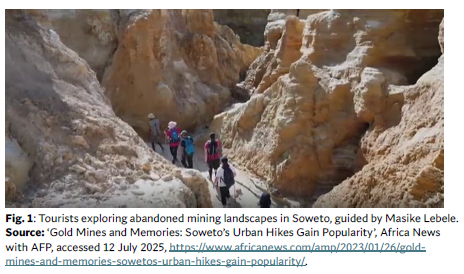
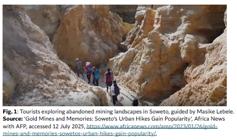
In another example of exploring local heritage, a resident of Soweto, Masike Lebele (Fig. 1), takes groups of hikers on Sunday mornings to explore the abandoned mine dumps nearby. The hike begins at a local shebeen and leads up to the 'mountain-like' mine dumps. Hikers are accompanied by residents for safety reasons.60
From the above scholarly conversations and observations about post-mining tourism initiatives, possible ways forward with positioning Khutsong's heritage of over 60 years as a mining town establishment should be explored.
A history and memory of Khutsong's heritage as a mining town establishment
The history of gold mining and Khutsong are inseparable; mining activities have greatly influenced the township's current cultural identities.61 Providing a historical context of Khutsong township's early developments (1958-1994) will give the reader a sense of Khutsong's identity as a black township situated within the Far West Rand (FWR) gold mining region. The former Department of Native Affairs began planning Khutsong as early as 1936, after acquiring land on the farm Witstinkhoutboom no. 101 IQ. The proposal to develop a black neighbourhood gained greater recognition in 1952, following an urgent need to establish a black residential area. This urgency arose after a need for a residential area in the FWR for black employees was identified).62 The implementation of apartheid policies in 1948 also had a significant influence on the urgent development of Khutsong.63 Mubiwa and Annegarn mention that the Bantu Urban Areas Consolidation Act 25 of 1945 and the Group Areas Act 41 of 1950 transformed the Transvaal into an 'apartheid city' which saw residential areas being segregated according to race.64
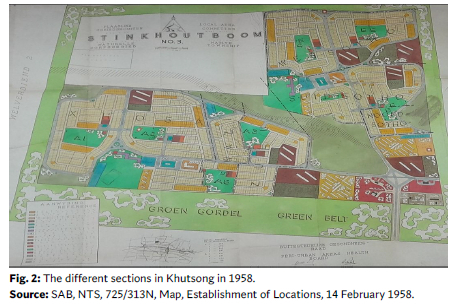
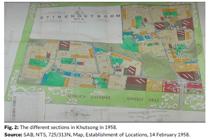
It was only in 1957 that the development of Khutsong gained momentum following negotiations with the Group Areas Board to establish a black township in the FWR.65 On 8 March 1957, the Minister of Native Affairs approved the acquisition of land on the farm Witstinkhoutboom for the establishment of Khutsong.66 A month later, in April 1957, the Peri-Urban Areas Health Board confirmed that the establishment of Khutsong would provide housing for black people who were living in Oberholzer, Welverdiend, Carletonville, Wes-Wits, and Blybank. The first houses in Khutsong were laid out in what is now known as 'Greater Khutsong'.67 The township was also divided into two main sections, the Nguni and Sotho groups.68 Figure 2 displays a map showing the Nguni settlements in the areas of the Xhosa and Zulu sections, while the Sotho groups settled in the Tswana section (classified as West Sotho); the Sotho section (classified as South Sotho); and the Pedi section (classified as Northern Sotho).69
The gold mining economy and the subsequent migrant labour economy have shaped Khutsong's history, making it an economically stable township from its early years.70 Historically, gold mining companies in South Africa have relied on migrant labour, sourcing employees from across South Africa and neighbouring countries such as Lesotho and Mozambique.71 This historical reality as a trend in 20th-century gold mining establishments has shaped the demography of Khutsong, turning it into a multicultural and multinational township.72
The Community Councils Act of 1977 established community councils in black South African townships (including Khutsong). These councils were responsible for managing all black labour employed in the 'white designated' towns and cities of South Africa.73 Community Councils also served as the advisory boards in the townships and took over several significant aspects of township administration.74 However, before long unpopularity turned into hatred towards the community councils in the early 1980s, when the local residents, accused the councils of blatant corruption. There were bitter complaints when backyard shacks were demolished, rents raised and residents who defaulted on their rent payments were ruthlessly evicted.75
In response to this hostility among residents of Khutsong, the government introduced the Black Local Authorities (BLA) Act of 1982, laying the groundwork for the establishment of local government structures in the black townships.76 This Act replaced the Community Councils, which had failed to gain political credibility; the BLA gave local black residents the autonomy to elect their preferred councillors for the first time under the apartheid regime.77 Reuben Mosiane was elected the first councillor of Khutsong in 1983 under the BLA's policies, and his term ended in 1988.78
In the case of Khutsong, the BLA authority was on the verge of collapse as early as 1985, following the rise of violent protests in the township and the emergence of organisations such as the Azanian Students Movement (ASAZM)79 and the Khutsong Residents Organisation (KHURO). These angry protests in Khutsong were closely aligned with the introduction of the AZASM in the township in 1985. The AZA was formed after the efforts of Spankie Lesotho and Stanley Sekotjane, both of whom were pupils at the Badirile Secondary School.80 By the end of 1985, residents from this mining township had formed KHURO to tackle issues of poor sanitation and a lack of streetlights, which allegedly encouraged harassment, theft, and rape by the Marashea81 gang.82
The 1990s and 2000s brought changes to the physical landscape of Khutsong following South Africa's transition to democracy. One outcome was a population increase. Kirshner, confirms that Carletonville's (Merafong's) mining sector declined from 1996 to 2005 due to a decline in international gold prices during that period.83The retrenchment of mine employees during the late 1990s and early 2000s meant that there was an influx of people relocating from the mining hostels into the township. Tunce notes that South Africa's gold mining production declined by 63% from 1996 to 2005, primarily due to a decline in international gold prices. Thousands of unemployed mine workers were now obliged to find other employment in this period.84 The most significant foreign national population comprised Mozambican migrant labourers but there were also workers from other foreign countries including Zimbabwe and Lesotho. Many of these former miners relocated to Khutsong after retrenchment rather than moving back to their home countries.85 This diversified the population of Khutsong, making it a multinational township86 comprising different African nationals.
The population of South African townships also increased exponentially after the 1994 general elections, driven by the Reconstruction and Development Programme (RDP), that was launched by the newly-elected ANC government. The government pledged to provide fully subsidised houses for low-income households.87Khutsong was no exception to this new turn of events and the construction of RDP houses in Khutsong began in 1995. The area soon became increasingly developed with new extensions and sections to accommodate the growing population. Furthermore, some of the residents who were granted RDP homes in South African townships (including Khutsong) took advantage of what they saw as a means of making a living by renting out their homes to foreign nationals, many of whom ran businesses such as tuckshop owners and hairdressers.88
The population of African foreign nationals increased rapidly in Khutsong from May 2008, despite a series of xenophobic attacks targeting foreigners from other African countries in the townships of Gauteng (mainly from Soweto and Alexandra).89Khutsong, unlike many other townships, did not participate in the xenophobic attacks.90 The locally-based community organisation, the Merafong Demarcation Forum (MDF), encouraged the township's citizens not to participate in these attacks, creating a decidedly non-xenophobic identity in Khutsong.91 Kirshner and Phokela suggest that Somalian and Ethiopian nationals flocked to Khutsong, relocating from other townships around Gauteng, because they viewed Khutsong as a safe space in which to live.92 This was in addition to Mozambican nationals who also decided to relocate to Khutsong. They were appreciative of the township's historic value, as many had relatives and friends who had settled there during the 1990s after being retrenched from the mines.93
The first democratic municipal elections in South Africa were held on 5 December 2000 and resulted in the establishment of 284 municipalities. Of these, 16 were 'cross-boundary', meaning that they fell under the administration of two provinces.94 The Merafong Municipality was one of these 16 municipalities under the administration of the Gauteng and the North-West provinces.95
In 2005, the Merafong Municipality was officially incorporated into the administration of the North-West Province; opposition parties believed that the ruling party (ANC) had neglected to communicate and engage adequately with communities from Merafong in demarcating the entire municipality to the North-West Province.96 Ngada adds that Merafong residents (mainly from Khutsong) were against being incorporated into the North-West Province; they preferred Gauteng because of its economic powerhouse status.97 Violent protests broke out on 2 November 2005, when the residents of Khutsong barricaded the roads with burning tyres, tree branches and large rocks. Cars attempting to leave the township were attacked by protestors.98
The protests in Khutsong were also an effort to boycott the upcoming municipal election of March 2006. Residents from the township issued threats to the government that they would not cast their votes and would disrupt the elections.99Arguably, these boycotts and violent protests in Khutsong prior to the elections achieved their goal. Less than 300 voters in Khutsong cast their votes on 1 March 2006 (the lowest tally in the North-West Province). Mavungu believes that the low voter turnout was due to residents being intimidated by previous violence during boycott actions in the township.100
Jolaosho argues that the end of the violent protests in Khutsong is due to various factors. The first was the appointment of Jacob Zuma as the new president of the ANC in December 2007.101 Duncan adds that the Zuma leadership aimed to project a 'caring and people-driven image', while they chose to distance themselves from certain policies introduced under Thabo Mbeki's presidency.102 According to Jolaosho, the government saw it as appropriate to transfer the Merafong municipality to Gauteng before the 2009 general elections to avoid a repetition of the protests in the township during the 2006 municipal elections. On 19 March 2009, the National Council of Provinces officially confirmed the municipality's reincorporation into Gauteng, a move that was well received.103
In recent years, Khutsong has faced challenges, including high unemployment and crime rates; these have affected the community negatively. The Merafong Integrated Development Plan (IDP) 2020-2021 (Amended in 2016-2021) has noted a substantial decline in employment in the region's gold mining sector, with 13,000 people being retrenched between 2006 and 2016. In the Merafong IDP, it was also noted that the decline in the number of people employed in the mining sector in the region led some community members to become proactive and seek employment in other industries, such as trading, finance, business, and community service.104Unfortunately, the general rise in unemployment in the township has led some residents to engage in criminal activity in an effort to support their families..105
A venture is underway to explore the many sides of Khutsong Township's history as a legacy.106 The aim is to create a tourism economy to replace the weaker local gold mining economy that has recently emerged. Current research has also shown that a local gold mining economy is a future possibility.
Defining Khutsong's historical and socio-cultural potential
It can be argued that Khutsong's cultural legacies can be leveraged to create a cultural village in the township. A cultural village in a region has the potential to develop a sense of community and bring financial opportunities to host communities.107Amoradis et al., note that socio-cultural tourism products (such as a cultural village) increase local populations' understanding of their heritage and give them an awareness of its historical roots.108 Other cultural villages have been established elsewhere in South Africa, showcasing the heritage and history of different cultures in the area concerned and the country at large.109
The Segaetsho Cultural Village is one of the most successful cultural tourism products in the rural areas of South Africa. Tourists can experience authentic Batswana culture through traditional dance, food, art, music, fashion, and photography at this Tswana cultural village situated near the Sun City Resort.110 The displays combine the sale of tourism products with demonstrations of local heritage activities at the village and are gaining in popularity. Watching pantsula and gumboot dances, and playing on African musical instruments, is also drawing attention. At the Segaetsho kiosk, tourists can purchase African musical instruments and handmade Tswana crafts and accessories.111
Another example is the Basotho Cultural Village in Phuthaditjhaba, in the Free State.112 Tourists visiting this village can explore the Sesotho culture, including art exhibitions and live stage performances in the unique sandstone amphitheatre. Products offered to tourists provide a deeper insight into the lifestyle of the South Sotho from the 16th century through to the present.113 Khutsong is a diverse township with a population comprising different ethnic groups, predominantly Xhosa, Tswana, and Sotho-speaking people, and it too could offer tourists a range of cultural experiences.114 The township has the potential to establish a similar diverse cultural village to showcase the community's various cultures.
One approach to establishing a cultural village in Khutsong is through Pro-Poor Tourism (PPT), which is defined as tourism that generates net benefits for poor communities.115 These benefits range from developing the community's economy to improving social standards, including caring for the environment and promoting the particular culture of the region.116 Khutsong is situated near Carletonville, making it relatively easy for visitors to access accommodation nearby.117 Tourists could either spend the night or explore Khutsong during the day, which is an advantage compared to other rural cultural villages, where visitors may be obliged to travel long distances on the way home. A diverse cultural village of this kind could be established at the Abe Bailey Nature Reserve (ABNR), which is well-suited for such development, given its spaciousness and attractive natural environment.118
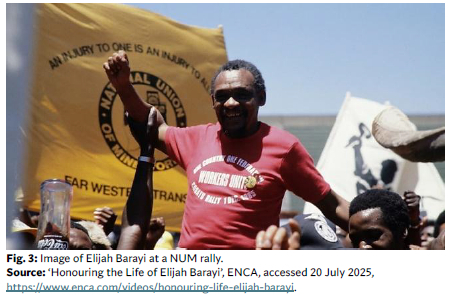
Baskin mentions that one of the most celebrated political figures linked with the apartheid struggle and the FWR is former trade union leader, Elijah Barayi.119 (See Fig. 3). He was one of the most celebrated figures in the formation of the National Union of Mineworkers (NUM).120 Barayi was born in 1930 in the Eastern Cape and joined the struggle in 1952. He was unable to afford tertiary education after completing his matric,121 so he joined the ANC and became a well-known activist. He and other ANC members were eventually arrested in 1960 in the Eastern Cape after refusing to carry identity documentation, and he continued to participate in defiance campaigns against apartheid after his release from prison.122 Barayi later moved to Johannesburg following harassment from Eastern Cape police officers. He served in different positions in mining companies, as a clerk at a gold mine in Brakpan from 1960 to 1973 and also worked at the Blyvooruitzicht gold mine, where he chaired the mine's liaison committee. The management at Blyvooruitzicht denied Barayi the opportunity to stand for a leadership position because he was a firebrand who raised political issues such as racial discrimination and the underpayment of black miners.123Barayi became one of the first members of NUM after meeting Cyril Ramaphosa in 1981. He was elected NUM vice president a year later, playing a crucial role in building the union and stressing mineworkers' concerns.124

Elijah Barayi fits in the tourism context of a 'struggle history' for Khutsong.125He made contributions during his tenure as vice president of NUM to improve the working conditions of black miners and Khutsong's vast working population employed by mining companies.126 In his efforts, Barayi advocated for better wages, safe working conditions, and freedom from racial discrimination.127 In 1983, while working at Goldfields' mine in Carletonville, he led a strike of 9 000 mineworkers. Although the apartheid authorities crushed the strike, it became a key moment in labour history.128
Barayi's narratives and his role on behalf of workers as a leading figure in NUM, had a significant impact on the Khutsong community, and these can be modelled as tourism products. Similar to the inspirational Nelson Mandela and other struggle heroes and heroines, Barayi could be presented as a local hero worthy of remembrance.129 Efforts should be made to establish a memorial of some kind, perhaps a museum, focusing on the contribution made by Barayi and the significance of NUM in Khutsong during the apartheid period. This endeavour may not attract as many visitors as tourism products on Mandela, it could be of great interest to tourists interested in the history of mining and struggle movements such as trade unions. The museum would also showcase the history of Khutsong as a community during apartheid and represent dark tourism from the township, featuring major narratives of the struggle years.
The events of violence and terror that occurred in Khutsong during the demarcation process are recognised as having great potential for developing a dark tourism product in Khutsong.130 Dark tourism refers to the visitation to places where tragedies or historically noteworthy deaths have occurred and how these continue to impact the living.131 Actions taken by the residents of Khutsong are seen as significant in remembering the struggle against apartheid. For example, at the time, the streets of Khutsong were filled with protestors burning tyres and throwing stones at cars; the same was true during the Soweto Student Uprising in 1976.132 The torching of houses belonging to Khutsong councillors, including the home of former Merafong mayor, Des van Rooyen, represented a very dark period in the township.133 One can argue that the efforts by Khutsong residents were successful because their end goal was achieved because Merafong was subsequently incorporated into the administration of Gauteng.134 A tourism package for Khutsong could possibly include the establishment of a memorial to the demarcation process and the legacy of this movement. This has the potential to become a tourist attraction in the township and the Merafong Municipality, and should be investigated.
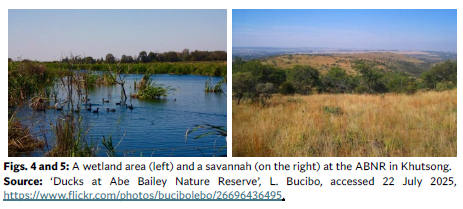
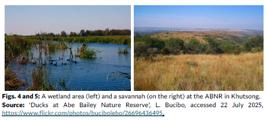
The Abe Bailey Nature Reserve (ABNR)135 has significant tourism potential that could be utilised more widely. The reserve presents many opportunities to preserve the natural heritage and could serve as a recreation area for residents of Khutsong and visitors alike. It could be developed appropriately and be opened up to the public as a tourist attraction. Despite the ABNR's proximity to urban poverty in Khutsong, it still offers great tourism potential to residents and visitors as a bird-watching paradise, because it is home to more than 220 bird species. The nature reserve is also blessed with different landscapes including areas of grassy savannah, bushveld, and wetlands (see Figures 4 and 5). Each of these natural areas provides a different habitat for a certain birds, and there is also unique flora and fauna in the reserve. An attractive picnic site has also been opened in the ABNR. Here, visitors can relax under shady trees, relax and enjoy their refreshments in stunning natural surroundings.136
Natural caves are admired for their beauty and mystery, attracting adventure tourists and researchers who are interested in exploring natural caverns. Such caves are often found in rural areas where impoverished communities have settled.137 One cave in Khutsong is called the Wonderfontein Cave. The cave system is extensive and obtains its water from the drainage of the Wonderfontein Spruit (hence the cave's name) .138 It is of considerable interest, extending in a north-westerly direction for about 9.4 km and the network of interlinked caves is located 15 to 20 meters below the surface.139 The Wonderfontein Cave would almost certainly be of great interest to tourists. It would also raise awareness among township residents about the area's environmental features, and it has the potential to share with tourists the social history and people's memories behind these caves.
Cave tourism offers different cultural, recreational, aesthetic, and scientific activities to satisfy the different interests of tourists.140 Scientific value includes the history of cave formation, which may well attract tourists who are interested in studying rocks and fossils. They are also of aesthetic value, offering an opportunity to view rare geological landforms. Recreational value may also be added. This is a drawcard that appeals to tourists who enjoy energetic activity such as exploring underground cave formations, hiking, and camping near caves.141
The Sudwala Cave complex (located in Mpumalanga) is an example of a successful cave tourism product. It offers guided tours that allow visitors to explore the main sections of the cave system while the tour guides educate them on the history and folklore associated with the caves. The products offered to visitors include scenic nature trails that allow for birdwatching and hiking to explore the lush Mpumalanga landscape.142 Khutsong has access to a cave (although its tourism potential requires in-depth exploration) and is situated in the scenic Abe Bailey Nature Reserve. As discussed above, there is a wide range of bird species to be viewed there, including the greater flamingo, African fish-eagle and yellow-billed stork. The diverse landscape has wetlands and grassy savannahs and is a hikers' paradise.143 This makes Wonderfontein a potential tourism centre to be developed on the environmental legacy of Khutsong.
Three types of tourism initiatives are envisaged in Khutsong. The first is cultural tourism which would see a cultural village being developed in the township. The second could be based around the products of dark tourism using the struggle history in the township, with the focus, for example, such as the 2005-2008 demarcation protests; and thirdly, nature-based tourism could become viable by promoting initiatives such as those suggested for the Abe Bailey Nature Reserve and potentially exploring the Wonderfontein Cave. However, to explore the true potential of this tourism initiative, a visit to the township by tourism experts is recommended because it is vital to test the feasibility and viability of these ideas.
Conclusion
According to Auala et al., the development of township tourism has led to two contradictory schools of thought. One suggests that township tourism is a mechanism aimed at improving the local economy and preserving the heritage of regions and that it should be encouraged. The other argues that township tourism will be a shameful exploitation of the poor living conditions in townships by casting them as a tourist attraction.144 In an economically challenged township like Khutsong, which is currently facing the consequences of mine closure, such as unemployment and poverty, this article aligns with the school of thought that encourages township tourism as a means of supporting the local economy and preserving Khutsong's heritage. Either way, the community members themselves should be closely involved in any decision-making processes concerning tourism initiatives.
The aftermath of the mining boom is generally seen in a negative light, one of degrading the environment and destabilising economic well-being.145 But it is important to look instead for the positive outcome of mining legacies and heritage. The Living Mine Museum in Pilgrim's Rest and the popular Gold Reef City in Johannesburg testify to this. The mining legacies and cultural heritage of Khutsong require close attention. The potential is there to develop tourism initiatives and contribute towards upliftment of the local economy. Various tourism opportunities have been identified here. To showcase the culture of Khutsong, it is suggested that a multi-cultural village be created emphasising the diverse cultures and lively personalities of Khutsong, those who rose above the dark times of apartheid and political/struggle. Highlighting the efforts, for example, of former trade union leader Elijah Barayi is worthy of attention. Added to this, as shown above, the natural environment around Khutsong (and closely situated to the well-known Gatsrante) has great potential to provide tourism opportunities. The article argues that sustainable community development practices are required in townships such as Khutsong that are currently facing economic challenges from the decline of mining activities.
REFERENCES
- Acemoglu, D., S. Johnson and J.A. Robinson. 'An African Success Story: Botswana', Massachusetts Institute of Technology Department of Economics Working Paper Series (July 2001), 1-44.
-
Africa News with AFP. 'Gold Mines and Memories: Soweto's Urban Hikes Gain Popularity'. Accessed 12 July 2025. https://www.africanews.com/amp/2023/01/26/gold-mines-and-memories-sowetos-urban-hikes-gain-popularity/.
» https://www.africanews.com/amp/2023/01/26/gold-mines-and-memories-sowetos-urban-hikes-gain-popularity/ - Amoiradis, C., E. Velissariou and M. Stankova. 'Tourism as a Socio-cultural Phenomenon: A Critical Analysis'. Journal of Social and Political Sciences, 4, 2 (2021), 10-21.
- Ashley, C., D. Roe and H. Goodwin. 'Pro-Poor Tourism Strategies: Making Tourism Work for the Poor. A Review of Experience. Pro-poor Tourism Report No. 1, Overseas Development Institute'. International Institute for Environment and Development and Centre for Responsible Tourism, (2001), 1-57.
- Auala, L.S.N., S.R. Van Zyl and I.W. Ferreira. 'Township Tourism as an Agent for the Socio-economic Well-being of Residents'. African Journal of Hospitality, Tourism and Leisure, 8, 2 (2019), 1-11.
- Baskin, J. Striking Back: A History of COSATU. New York: Verso, 1991.
- Block, B. 'All Little Sisters Got to Try on Big Sister's Clothes: The Community Council System in South Africa'. African Studies Institute (April 1982), 1-13.
- Booyens, I. 'The Evolution of Township Tourism in South Africa'. Tourism, Change and the Global South, 151-166. Routledge 2021.
- Booyens, I. 'Rethinking Township Tourism: Towards Responsible Tourism Development in South African Townships'. Development Southern Africa, 27, 2 (2010), 273-287.
- Burns, P.M. 'Sustaining Tourism Employment'. Journal of Sustainable Tourism, 1, 2 (1993), 81-96.
- Butle, G. and C.M. Rogerson. 'Inclusive Local Tourism Development in South Africa: Evidence from Dullstroom'. Local Economy, 31, 1-2 (2016), 264-281.
- Bruce, D. 'Dictating the Local Balance of Power: Election-related Violence in South Africa'. SA Crime Quarterly, 28 (2009), 3-9.
- Chok, S., J. Macbeth and C. Warren. 'Tourism as a Tool for Poverty Alleviation: A Critical Analysis of Pro-poor Tourism and Implications for Sustainability'. Current Issues in Tourism, 10, 2-3 (2007), 144-165.
-
City of Johannesburg, 'Gold Reef City'. Accessed 12 July 2025. https://joburg.org.za/play/Pages/Play%20in%20loburg/Culture%20and%20Heritage/l inks/Museums/Culture%20and%20Historic%20museums/Gold-Reef-City.aspx.
» https://joburg.org.za/play/Pages/Play%20in%20loburg/Culture%20and%20Heritage/l inks/Museums/Culture%20and%20Historic%20museums/Gold-Reef-City.aspx - Cloete, J. and L. Marais. 'Mine Housing in the South African Coalfields: The Unforeseen Consequences of Post-apartheid Policy'. Housing Studies, 36, 9 (2021), 1388-1406.
- Cole, D. 'Exploring the Sustainability of Mining Heritage Tourism', Journal of Sustainable Tourism, 12, 6 (2004), 480-494.
- Dakile, M.P. 'Defining the Far West Rand Historical Legacy with Emphasis on Township Tourism'. MA dissertation, North-West University, 2024.
- Dicks, B. 'Heritage, Governance and Marketization: A Case-Study from Wales'. Museum and Society, 1,1 (2003), 30-44.
- Douglas, A., G. Hoogendoorn and G. Richards. 'Activities as the Critical Link Between Motivation and Destination Choice in Cultural Tourism'. Journal of Hospitality and Tourism Insights (2023), 249-271.
- Du Preez, G.C. 'Determining the Effect of Polluted Mine Water on the Ecosystem Health of a Karstic Cave Environment in the Witwatersrand Basin'. (MA dissertation, North-West University, 2014).
- Duncan, J. 'Voice, Political Mobilisation and Repression Under Jacob Zuma'. A Decade of Dissent: Reflections on Popular Resistance in South Africa (2010), 12-14.
- Edwards, D.P., S. Sloan, L. Weng, P. Dirks, J. Sayer and W.F. Laurance. 'Mining and the African Environment'. Conservation Letters, 7, 3 (2012), 302-311.
- Ezeuduji, I.O. and S. Nkosi. 'Tourism Destination Competitiveness Using Brand Essence: Incorporating the "Zuluness" of the Zulu Kingdom'. African Journal of Hospitality, Tourism and Leisure, 6, 1 (2017), 1-7.
- Fonseca, A.P., C. Seabra and C. Silva. 'Dark Tourism: Concepts, Typologies and Sites'. Journal of Tourism Research & Hospitality (2015), 1-11.
- Francis, A. and V. Marchese. 'Apartheid South Africa and the Soweto Rebellion'. Erisim Tarihi, 18 (2014), 1-8.
- Gastrow, V. 'Problematizing the Foreign Shop: Justifications for Restricting the Migrant Spaza Sector in South Africa'. Southern African Migration Programme, 80 (2018), 1-41.
- Government of the Republic of South Africa. The National Heritage Resources Act No. 25 of 1999.
- Grundlingh, L. 'Revisiting the "Old" South Africa: Excursions into South Africa's Tourist History under Apartheid, 1948-1990'. South African Historical Journal, 56 (2006), 103-122.
- Harrison, P. and T. Zack. 'The Power of Mining: The Fall of Gold and Rise of Johannesburg'. Journal of Contemporary African Studies, 30, 4 (2012), 551-570.
- Hattingh, T. and A. Schoeman. 'Preliminary Results from Archaeological Investigations at Sudwala Caves, Mpumalanga, South Africa'. Southern African Field Archaeology, 17 (2022), 1-16.
- Hinton, J.J., M.M. Veiga and A.T.C. Veiga. 'Clean Artisanal Gold Mining: A Utopian Approach?'. Journal of Cleaner Production, 11, 2 (2003), 99-115.
- Horváth, G. and M. Csüllög. 'Salgótarján (Hungary).The Rise and Fall of a Mining and Industrial Region'. Post-mining Regions in Central Europe. Problems, Potentials, Possibilities. Oekom Verlag, München (2012), 40-52.
- Kerr, P., K. Durrheim and J. Dixon. 'Xenophobic Violence and Struggle Discourse in South Africa'. Journal of Asian and African Studies, 54, 7 (2019), 995-1011.
- Kim, S.S., M. Kim, J. Park and Y. Guo. 'Cave Tourism: Tourists' Characteristics, Motivations to Visit, and the Segmentation of their Behaviour'. Asia Pacific Journal of Tourism Research, 13, 3 (2008), 299-318.
- Kulwane, B.A. 'Civic Competence in Khutsong'. MA dissertation, University of the Witwatersrand, 2002.
- Kynoch, G. We are Fighting the World: A History of the Marashea Gangs in South Africa, 1947-1999. Ohio: Ohio University Press, 2005.
- Jelen, J. 'Mining Heritage and Mining Tourism'. Czech Journal of Tourism, 7, 1 (2018), 93-105.
- Jolaosho, O. 'Political Aesthetics and Embodiment: Sung Protest in Post-apartheid South Africa'. Journal of Material Culture, 20, 4 (2015), 443-458.
- Jones, D. 'Street Tree Performance in Arid Landscapes: An Assessment of Street Tree Performance at Roxby Downs', in Role of Trees and Arboriculture in the 21st Century. Proceedings of the 9th National Street Tree Symposium, Adelaide (2008).
- Jones, C. and M. Munday. 'Blaenavon and United Nations World Heritage Site Status: Is Conservation of Industrial Heritage a Road to Local Economic Development?'. Regional Studies, 35, 6 (2001).
- Kalule, K.S. 'An Investigation of the Integration of Foreign Migrants into South African Community: A Case of Zimbabweans Living in Luyoloville and New Rest in Gugulethu, Cape Town'. MA dissertation, University of the Western Cape, 2016.
- Kirshner, J. 'Reconceptualising Xenophobia, Urban Governance and Inclusion: The Case of Khutsong'. Urban Governance in Post-Apartheid Cities: Modes of Engagement in South Africa's Metropoles (2014), 117-134.
- Kirshner, J. and C. Phokela. 'Khutsong and Xenophobic Violence: Exploring the Case of the Dog that didn't Bark'. Centre for Sociological Research (2012), 1-22.
- Knight, J. 'Transforming the Physical Geography of a City: An Example of Johannesburg, South Africa'. in Urban Geomorphology, 129-147, Elsevier (2018).
- Lemon, A. 'The Apartheid City', in South African Urban Change Three Decades After Apartheid: Homes Still Apart? 1-16, Cham: Springer International Publishing (2021).
- Lennox, B. '[Pilgrim]age Repositioned: Reinvigorating Technological, Historical and Natural Significances in the Museum-Town of Pilgrim's Rest'. MA dissertation, University of Pretoria, 2022.
- Lonica, A., I. Samuil, M. Leba and M. Toderas. 'The Path of Petrila Mining Area Towards Future Industrial Heritage Tourism Seen Through the Lenses of Past and Present'. Sustainability 12, 23 (2020), 1-32.
-
Lungono, P. 'Our History is About Our Accomplishments: Our legacy is about our impact'. Accessed 11 July 2025. http://petespeaks.com/our-history-is-about-our-accomplishments-our-legacy-is-about-our-impact/#:~:text=Our%20history%20is%20about%20our%20accomplishments%3B%20Our%20legacy%20is%20about%20our%20impact-Home%20Accountability%20Our.
» http://petespeaks.com/our-history-is-about-our-accomplishments-our-legacy-is-about-our-impact/#:~:text=Our%20history%20is%20about%20our%20accomplishments%3B%20Our%20legacy%20is%20about%20our%20impact-Home%20Accountability%20Our - Magadzu, M.S. 'Mine Closure Narratives in Blyvooruitzicht Gold Mine in West Rand, South Africa'. MA dissertation, University of The Free State, 2021.
- Marschall, S. 'Making Money with Memories: The Fusion of Heritage, Tourism and Identity Formation in South Africa'. Historia, 50, 1 (2005), 103-122.
- Marschall, M. 'The Long Shadow of Apartheid: A Critical Assessment of Heritage Transformation in South Africa 25 Years on'. International Journal of Heritage Studies, 25, 10 (2019), 1088-1102.
- Marx, A.W. 'South African Black Trade Unions as an Emerging Working-class Movement'. The Journal of Modern African Studies, 27, 3 (1989), 383-400.
- Matandela, M. 'Redefining Black Consciousness and Resistance: The Intersection of Black Consciousness and Black Feminist Thought'. Agenda, 313-4 (2017), 10-28.
- Matebesi, S. and L. Botes. 'Khutsong Cross-boundary Protests: The Triumph and Failure of Participatory Governance'. Politeia, 30,1 (2011), 4-21.
- Mavungu, E.M. 'Frontiers of Prosperity and Power: Explaining Provincial Boundary Disputes in Post-apartheid South Africa'. PhD thesis, University of the Witwatersrand, 2011.
- Merafong City Local Municipality Integrated Development Plan 2020-2021. Review 2016-2021.
- Mhlongo, S.M. and F. Amponsah-Dacosta. 'A Review of Problems and Solutions of Abandoned Mines in South Africa'. International Journal of Mining, Reclamation and Environment, 30, 4 (2016), 279-294.
- Mochesane, M.V. 'Plant Diversity in Grassland of Selected Nature Reserves and Adjacent Grazing Areas Within the Gauteng Province, South Africa'. MA dissertation, University of South Africa, 2019.
- Mokoena, L.G. 'Cultural Tourism: Cultural Presentation at the Basotho Cultural Village, Free State, South Africa'. Journal of Tourism and Cultural Change, 18, 4 (2020), 470-490.
- Moiloa, M. 'Sidla Abantwana Bethu: Youth Political Imaginary in Khutsong, South Africa'. MA dissertation, University of the Witwatersrand, 2012.
- Mubiwa, B. and H. Annegarn. 'Historical Spatial Change in the Gauteng City-Region'. Department of Geography, Environmental Management and Energy Studies, University of Johannesburg (March 2013), 1-41.
- National Archives of South Africa (NASA), Pretoria (SAB), Native Affairs Department, Transvaal Secretarian (NTS) 725/313N, Government notice, Establishment of locations, Pretoria, 1957.
- Ngada, S. 'The Role of Public Opinion in the Post-violent Protest Recovery in the Merafong Local Municipality, Township of Khutsong'. PhD thesis, Nelson Mandela Metropolitan University, 2013.
- Nhlabathi, S.S. 'Motivations to Engage in Dark Tourism: The Case of Selected Sites in South Africa'. PhD thesis, University of Kwa-Zulu Natal, 2017.
- Nita, J. 'Mining Landscape as a Type of Cultural Landscape'. Prace Komisji Krajobrazu Kulturowego, 23 (2014), 203-212.
- Norum, R. 'Barentsburg and Beyond: Coal, Science, Tourism, and the Geopolitical Mmaginaries of Svalbard's New North'. Postcolonial Perspectives on the European High North: Unscrambling the Arctic (2016), 31-65.
- Park, A. 'A Tale of Two Townships: Political Opportunity and Violent and Non-violent Local Control in South Africa'. Award Winning Sociology Papers, Paper 1 (2009), 1-30.
- Partelow, S. and K. Nelson. 'Social Networks, Collective Action and the Evolution of Governance for Sustainable Tourism on the Gili Islands, Indonesia'. Marine Policy, 112 (2020), 1-12.
- Pearson, M. and B. McGowan. Mining Heritage Places Assessment Manual. Australian Council of National Trusts, 2000.
- Pepper, M., C.P. Roche and G.M. Mudd. 'Mining Legacies: Understanding Life-of-mine across Time and Space'. Proceedings of the Life-of-Mine Conference (2014).
- Pretes, M. 'Touring Mines and Mining Tourists'. Annals of Tourism Research, 29, 2 (2002), 439-456.
- Riukulehto, S. 'Dangerous, Frightening, Homely: Home Experiences of those Living on the Goldmines of the Far West Rand'. New Contree, 89 (2022), 103-121.
- Rogerson, C.M. and J.M. Rogerson. 'Racialized Landscapes of Tourism: From Jim Crow USA to Apartheid South Africa'. Bulletin of Geography. Socio-economic Series, 48 (2020), 7-21.
-
South African Venues. 'About Basotho Cultural Village'. Accessed 19 July 2025. https://www.sa-venues.com/things-to-do/freestate/basotho-culturalvillage/#:~:text=The%20Village%20regularly%20hosts%20art00)%20seven%20days%20a%20week.
» https://www.sa-venues.com/things-to-do/freestate/basotho-culturalvillage/#:~:text=The%20Village%20regularly%20hosts%20art00)%20seven%20days%20a%20week -
South African Venues. 'About Abe Bailey Nature Reserve'. Accessed 19 July 2025. https://www.sa-venues.com/game-reserves/abe-bailey.php.
» https://www.sa-venues.com/game-reserves/abe-bailey.php - Salom, A.T. and S. Kivinen. 'Closed and Abandoned Mines in Namibia: A Critical Review of Environmental Impacts and Constraints to Rehabilitation'. South African Geographical Journal, 102, 3 (2020), 389-405.
- Sánchez-Sánchez, M.D., C. De-Pablos-Heredero, and J.L. Montes-Botella. 'Cultural Tourism: A Methodological Approach Based on the Knowledge of its Demand'. Harvard Deusto Business Research, 9, 1 (2020), 69-83.
- Sauri-Pujol, D. and J.C. Llurdés-Coit. 'Embellishing Nature: The Case of the Salt Mountain Project of Cardona, Catalonia, Spain'. Geoforum, 26 (1995), 35-48.
- Schoeman, M. and C. Puttergill. 'Voting Behaviour in the SA Local Government Elections of 2006 with Specific Reference to the Youth'. Journal of African Elections, 6, 1 (2007), 152-173.
- Seekings, J. 'Why was Soweto Different? Urban Development, Township Politics, and the Political Economy of Soweto, 1978-84'. African Studies Institute, 231 (1988), 11-21.
- Sharma, R. 'Tourism and the Value System: An Impact Assessment from Socio-cultural Perspective'. Himalayan Journal of Sociology & Anthropology, 3 (2008), 106-125.
- Stoffelen, A., B. Adiyia, D. Vanneste and N. Kotze. 'Post-apartheid Local Sustainable Development Through Tourism: An Analysis of Policy Perceptions Among 'Responsible' Tourism Stakeholders Around Pilanesberg National Park, South Africa'. Journal of Sustainable Tourism, 28, 3 (2020), 414-432.
-
Sun International. 'Segaetsho Cultural Village'. Accessed 19 July 2025. https://www.suninternational.com/sun-city/activities/kids/segaetsho-cultural-village/.
» https://www.suninternational.com/sun-city/activities/kids/segaetsho-cultural-village/ - Taylor, S.J. and D. Atkinson. 'Delivering Community Benefits Acts as Insurance for the Survival of Small Protected Areas Such as the Abe Bailey Nature Reserve, South Africa'. Koedoe: African Protected Area Conservation and Science, 54, 1 (2012), 1-9.
- Thorius, T. 'The Effect of Grootvlei Mine Water on the Blesbokspruit'. MA dissertation, Rand Afrikaans University, 2004.
- Tlabela, K. and C. Munthree. 'An Investigation into Tourists' Satisfaction with Culture and Heritage Tourism in South Africa: An Exploratory Study'. International Journal of Culture and Tourism Research, 5,2 (2012), 1-9.
- Tongkul, F. 'Geotourism in Malaysia Borneo', in R.K. Dowling and D. Newsome (eds.), Geotourism, (2005).
- Tourism Second Amendment Act. Act 70 of 2000. Government Gazette 21835, 11 December 2000.
- Tseane-Gumbi, L.A. and K.J. Ani. 'The Political Economy of Mining Tourism: A Strategic Nation-Building Opportunity for South Africa's North-West Province'. African Renaissance, 15, 3 (2018), 125-138.
- Tunce, L. 'The Dynamics of Mining Towns: The Case of Khutsong Township, Carletonville'. PhD thesis, University of the Witwatersrand, 2016.
- Van der Walt, L. 'Barayi, Elijah (1930-1994)'. International Encyclopaedia of Revolution and Protest (2009), 1-13.
- Van Eeden, E.S. 'Ekonomiese Ontwikkeling en die Invloed Daarvan op Carletonville, 1948-1988: 'n Historiese Studie'. PhD thesis, Potchefstroom University for Christian Higher Education, 1992.
- Van Eeden, E.S. 'The Effect of Mining Development on the Cultural Experience of the Carletonville Community'. South African Journal of Cultural History, 12, 1 (1998), 75-89.
- Van Eeden, E.S. (ed.), 'Towards Proactive Activities and Initiatives for a Sustainable Far West Rand in the 21st Century'. NWU Research Report prepared for Sibanye Stillwater (June 2024).
- Van Heyningen, E. 'A Tool for Modernisation? The Boer Concentration Camps of the South African War, 1900-1902'. South African Journal of Science, 106, 5 (2010), 1-10.
- Van Rooyen, E. and K. Naidoo. 'The Promotion of Good Governance through the Eradication of the Notion of Cross-boundary Municipalities'. Journal of Public Administration, 41, 2.2 (2006), 457-476.
- Venter, F. 'The Government of Blacks in Urban Areas in South Africa'. Acta Juridica (1984), 17-28.
- Verbrugge, B. and S. Geenen. 'The Gold Commodity Frontier: A Fresh Perspective on Change and Diversity in the Global Gold Mining Economy'. The Extractive Industries and Society, 6, 2 (2019), 413-423.
- Warhurst, A., M. Macfarlane and G. Wood. 'Issues in the Management of the Socioeconomic Impacts of Mine Closure: A Review of Challenges and Constraints'. Environmental Policy in Mining (2000), 81-100.
- Wilcox, A., N. Mota, M. Haffner and M. Elsinga. 'Compact Housing for Incremental Growth: The K206 RDP Project in Alexandra, Johannesburg'. Urban Planning, 9 (2024), 1-20.
- Witz, L. 'Revisualizing Township Tourism in the Western Cape: The Migrant Labour Museum and the Re-construction of Lwandle'. Journal of Contemporary African Studies, 29, 4 (2011), 371-388.
- Worrall, R., N.D. Brereton and D. Mulligan. 'Towards a Sustainability Criteria and Indicators Framework for Legacy Mine Land'. Journal of Cleaner Production, 17, 16 (2009), 1426-1434.
- Wyllie, R. 'Entrenching Nostalgia: The Historical Significance of Battlefields for South African Tourism'. Historia, 59, 2 (2014), 210-228.
** She is also Acting Director in the School of Social Science. As local/regional historian Elize is currently involved in several multidisciplinary research projects aimed at community engagement and contributing to establish sustainable societies. She is chair of the International Society for Regional History; and the Regional History Society for Southern Africa as well as a Board member of the International Society for History Didactics (ISHD). She serves on the Editorial Boards of several academic journals.
*** Research interests: history education, home and belonging, decolonisation, township histories, and oral history.
1 P. Harrison and T. Zack, 'The Power of Mining: The Fall of Gold and Rise of Johannesburg', Journal of Contemporary African Studies, 30, 4 (2012), 551-552.
2 E. van Heyningen, 'A Tool for Modernisation? The Boer Concentration Camps of the South African War, 1900-1902', South African Journal of Science, 106, 5 (2010), 1-10.
3 J. Cloete and L. Marais, 'Mine Housing in the South African Coalfields: The Unforeseen Consequences of Post-apartheid Policy', Housing Studies, 36, 9 (2021), 1388-1389.
4 L. Tunce, 'The Dynamics of Mining Towns: The Case of Khutsong Township, Carletonville' (PhD thesis, University of the Witwatersrand, 2016), 43. See also E.S. van Eeden, 'Ekonomiese Ontwikkeling en die Invloed Daarvan op Carletonville, 1948-1988: 'n Historiese Studie' (PhD thesis, Potchefstroom University for CHE, 1992), Chapters 3-4.
5 'Our History is About Our Accomplishments: Our Legacy is About Our Impact', P. Lunguno, accessed 11 July 2025, http://pe.te.spe.aks.com/our-history-is-about-our-accomplishments-our-legacy-is-about-our-impact/#:~:text=Our%20history%20is%20about%20our%20accomplishments%3B%20Our%20legacy%20is%20about%20our%20impact-Home%20Accountability%20Our.
6 M. Pepper, C.P. Roche, and G.M. Mudd, 'Mining Legacies: Understanding Life-of-mine Across Time and Space', in Proceedings of the Life-of-Mine Conference (2014), 1449-1466.
7 S.M. Mhlongo and F. Amponsah-Dacosta, 'A Review of Problems and Solutions of Abandoned Mines in South Africa', International Journal of Mining Reclamation and Environment, 30, 4 (2016), 279-281.
8 A. Lonica, I. Samuil, M. Leba, and M. Toderas, 'The Path of Petrila Mining Area towards Future Industrial Heritage Tourism Seen Through the Lenses of Past and Present', Sustainability 12, 23 (2020), 1.
9 R. Norum, 'Barentsburg and Beyond: Coal, Science, Tourism, and the Geopolitical Imaginaries of Svalbard's New North', Postcolonial Perspectives on the European High North: Unscrambling the Arctic (2016), 31.
10 J. Jelen, 'Mining Heritage and Mining Tourism', Czech Journal of Tourism, 7, 1 (2018), 97.
11 K. Tlabela and C. Munthree, 'An Investigation into Tourists Satisfaction with Culture and Heritage Tourism in South Africa: An Exploratory Study', International Journal of Culture and Tourism Research, 5, 2 (2012), 1.
12 R. Worrall, N.D. Brereton, and D. Mulligan, 'Towards a Sustainability Criteria and Indicators Framework for Legacy Mine Land', Journal of Cleaner Production, 17, 16 (2009), 1426-1427.
13 A.T. Salom and S. Kivinen, 'Closed and Abandoned Mines in Namibia: A Critical Review of Environmental Impacts and Constraints to Rehabilitation', South African Geographical Journal, 102, 3 (2020), 389-391.
14 Mhlongo and Amponsah-Dacosta, 'A Review of Problems and Solutions', 279.
15 See Worall et al., 'Towards a Sustainability Criteria', 1426; Salom and Kivinen, 'Closed and Abandoned Mines in Namibia', 389; Mhlongo and Amponsah-Dacosta, 'A Review of Problems and Solutions', 279.
16 T. Thorius, 'The Effect of Grootvlei Mine Water on the Blesbokspruit' (MA dissertation, Rand Afrikaans University, 2004), 75-77.
17 Worrall et al., 'Towards a Sustainability Criteria', 1426.
18 G. Horváth, and M. Csüllög, 'Salgótarján (Hungary), 'The Rise and Fall of a Mining and Industrial Region', Post-mining Regions in Central Europe. Problems, Potentials, Possibilities. Oekom Verlag, München (2012), 41-46.
19 D. Jones, 'Street Tree Performance in Arid Landscapes: An Assessment of Street Tree Performance at Roxby Downs', in Role of Trees and Arboriculture in the 21st Century. Proceedings of the 9th National Street Tree Symposium, Adelaide (2008), 30-33.
20 Jones, 'Street Tree Performance in Arid Landscapes', 32-33.
21 D.P. Edwards, S. Sloan, L. Weng, P. Dirks, J. Sayer, and W.F. Laurance, 'Mining and the African Environment', Conservation Letters, 7, 3 (2012), 302-307.
22 D. Acemoglu, S. Johnson, and J.A. Robinson, 'An African Success Story: Botswana', Massachusetts Institute of Technology Department of Economics Working Paper Series (July 2001), 2-4.
23 Acemoglu et al., 'African Success Story', 2-4.
24 J. Knight, 'Transforming the Physical Geography of a City: An Example of Johannesburg, South Africa', in Urban Geomorphology (2018), 129.
25 Worrall et al., 'Towards a Sustainability Criteria', 1426.
26 I. Booyens, 'Rethinking Township Tourism: Towards Responsible Tourism Development in South African Townships', Development Southern Africa, 27, 2 (2010), 273-274.
27 G. Butle and C.M. Rogerson, 'Inclusive Local Tourism Development in South Africa: Evidence from Dullstroom', Local Economy, 31, 1-2 (2016), 264-265.
28 Butle and Rogerson, 'Inclusive Local Tourism Development', 264-265.
29 C.M. Rogerson and J.M. Rogerson, 'Racialized Landscapes of Tourism: From Jim Crow USA to Apartheid South Africa', Bulletin of Geography. Socio-economic Series, 48 (2020), 8.
30 L. Grundlingh, 'Revisiting the "Old" South Africa: Excursions into South Africa's Tourist History under Apartheid, 1948-1990', South African Historical Journal, 56 (2006), 103-122.
31 I. Booyens, 'The Evolution of Township Tourism in South Africa', in Tourism, Change and the Global South, (2021), 152.
32 S. Marschall, 'Making Money with Memories: The Fusion of Heritage, Tourism and Identity Formation in South Africa', Historia, 50, 1 (2005), 107.
33 S. Marschall, 'The Long Shadow of Apartheid: A Critical Assessment of Heritage Transformation in South Africa 25 Years on', International Journal of Heritage Studies, 25, 10 (2019), 1089.
34 A. Stoffelen, B. Adiyia, D. Vanneste and N. Kotze, 'Post-apartheid Local Sustainable Development Through Tourism: An Analysis of Policy Perceptions Among "Responsible" Tourism Stakeholders Around Pilanesberg National Park, South Africa', Journal of Sustainable Tourism, 28, 3 (2020), 414-432.
35 Tourism Second Amendment Act, 'Act 70 of 2000', Government Gazette 21835, December 11 (2000).
36 J.J. Hinton, M.M. Veiga, and A.T.C Veiga, 'Clean Artisanal Gold Mining: A Utopian Approach?', Journal of Cleaner Production, 11, 2 (2003), 99-103.
37 A. Warhurst, M. Macfarlane and G. Wood, 'Issues in the Management of the Socioeconomic Impacts of Mine Closure: A Review of Challenges and Constraints', Environmental Policy in Mining (2000), 81.
38 R. Wyllie, 'Entrenching Nostalgia: The Historical Significance of Battlefields for South African Tourism', Historia, 59, 2 (2014), 211.
39 Government of the Republic of South Africa, The National Heritage Resources Act No. 25 of 1999.
40 M. Díaz-Andreu, 'Heritage Values and the Public', Journal of Community Archaeology & Heritage, 4, 1 (2017), 2.
41 L. Witz, 'Revisualizing Township Tourism in the Western Cape: The Migrant Labour Museum and the Re-construction of Lwandle', Journal of Contemporary African Studies, 29, 4 (2011), 371.
42 M. Pearson and B. McGowan, Mining Heritage Places Assessment Manual (Australian Council of National Trusts, 2000), 2.
43 J. Nita, 'Mining Landscape as a Type of Cultural Landscape', Prace Komisji Krajobrazu Kulturowego, 23 (2014), 203.
44 Lonica, Samuil, Leba and Toderas, 'The Path of Petrila Mining Area', Sustainability, 12, 23 (2020), 1.
45 D. Sauri-Pujol and J.C. Llurdés-Coit, 'Embellishing Nature: The Case of the Salt Mountain Project of Cardona, Catalonia, Spain', Geoforum, 26 (1995), 36.
46 D. Cole, 'Exploring the Sustainability of Mining Heritage Tourism', Journal of Sustainable Tourism, 12, 6 (2004), 481.
47 C. Jones and M. Munday, 'Blaenavon and United Nations World Heritage Site Status: Is Conservation of Industrial Heritage a Road to Local Economic Development?', Regional Studies, 35, 6 (2001), 586.
48 In general terms it is viewed that 'structural value' might refer to different concepts depending on the context. Apparently, it generally 'involves the value derived from the arrangement and organization of elements within a system, whether it's a physical structure, a classification, or a social construct'. See for example M.D. Sánchez-Sánchez, C. De-Pablos-Heredero, J.L. Montes-Botella, 'Cultural Tourism: A Methodological Approach Based on the Knowledge of its Demand', Harvard Deusto Business Research, 9, 1 (2020), 69-83.
49 Jones and Munday, 'Blaenavon and United Nations World Heritage Site Status', 586.
50 M. Pretes, 'Touring Mines and Mining Tourists', Annals of Tourism Research, 29, 2 (2002), 444.
51 P.M. Burns, 'Sustaining Tourism Employment', Journal of Sustainable Tourism, 1, 2 (1993), 93.
52 B. Dicks, 'Heritage, Governance and Marketization: A Case-Study from Wales', Museum and Society, 1, 1 (2003), 30.
53 Dicks, 'Heritage, Governance and Marketization', 30.
54 S. Partelow and K. Nelson, 'Social Networks, Collective Action and the Evolution of Governance for Sustainable Tourism on the Gili Islands, Indonesia', Marine Policy, 112 (2020), 1.
55 Tlabela and Munthree, 'An Investigation into Tourists Satisfaction', 1.
56 L.A. Tseane-Gumbi and K.J. Ani, 'The Political Economy of Mining Tourism: A Strategic Nation-Building Opportunity for South Africa's North-West Province', African Renaissance, 15, 3 (2018), 126.
57 'Gold Reef City', City of Johannesburg, accessed 12 July 2025, https://joburg.org.za/play/Pages/Play%20in%20Joburg/Culture%20and%20Heritage/Links/Museums/Culture%20and%20Historic%20museums/Gold-Reef-City.aspx.
58 B. Lennox, '[Pilgrim]age Repositioned: Reinvigorating Technological, Historical and Natural Significances in the Museum-Town of Pilgrim's Rest' (MA dissertation, University of Pretoria, 2022), 7-11.
59 Lennox, '[Pilgrim]age Repositioned', 7-11.
60 'Gold Mines and Memories: Soweto's Urban Hikes Gain Popularity', Africa News with AFP, accessed 12 July 2025, https://www.africanews.com/amp/2023/01/26/gold-mines-and-memories-sowetos-urban-hikes-gain-popularity/.
61 E.S. Van Eeden, 'The Effect of Mining Development on the Cultural Experience of the Carletonville Community', South African Journal of Cultural History, 12, 1 (1998), 75.
62 Van Eeden, 'Ekonomiese Ontwikkeling en die Invloed Daarvan op Carletonvile', 56-60.
63 B. Mubiwa and H. Annegarn, 'Historical Spatial Change in the Gauteng City-Region', Department of Geography, Environmental Management and Energy Studies, University of Johannesburg (March 2013), 11.
64 Mubiwa and Annegarn, 'Historical Spatial Change', 11.
65 Van Eeden, 'Ekonomiese Ontwikkeling en die Invloed Daarvan op Carletonville', 56-60.
66 National Archives of South Africa (hereafter NASA), Pretoria (hereafter SAB), Native Affairs Department, Transvaal Secretarian (hereafter NTS) 725/313N, Government Notice, Establishment of Locations, Pretoria, 8 March 1957.
67 SAB, NTS, 725/313N, Establishment of Locations, 27 April 1957.
68 SAB, NTS, 725/313N, Memo, Establishment of Locations, 12 August 1958.
69 SAB, NTS, 725/313N, Memo, Establishment of Locations, 18 February 1958.
70 Tunce, 'Dynamics of a Mining Township', 20.
71 B. Verbrugge and S. Geenen, 'The Gold Commodity Frontier: A Fresh Perspective on Change and Diversity in the Global Gold Mining Economy', The Extractive Industries and Society, 6, 2 (2019), 413.
72 Merafong City Local Municipality Integrated Development Plan 2020-2021, Review 2016-2021, 69.
73 R. Block, 'All Little Sisters Got to Try on Big Sister's Clothes: The Community Council System in South Africa', African Studies Institute, (April 1982), 1.
74 Block, 'The Community Council System in South Africa', 1.
75 J. Seekings, 'Why was Soweto Different?' Urban Development, Township Politics, and the Political Economy of Soweto, 1978-84', African Studies Institute, 231 (1988), 12.
76 F. Venter, 'The Government of Blacks in Urban Areas in South Africa', Acta Jurídica (1984), 18.
77 Venter, 'Black Urban Areas in South Africa', 18-19.
78 B.A. Kulwane, 'Civic Competence in Khutsong', (MA dissertation, University of the Witwatersrand, 2002), 67.
79 AZASM is a student organisation that was formed in 1983. It originated from the black consciousness movements, popular in the country in the 1970s, spearheaded by Steve Biko. See M. Matandela, 'Redefining Black Consciousness and Resistance: The Intersection of Black Consciousness and Black Feminist Thought', Agenda, 313-4 (2017), 11.
80 Kulwane, 'Civic Competence in Khutsong', 70.
81 The Marashea gang was formed in 1947 in black townships of the Transvaal by Sotho migrant workers as a form of protection from urban gangsters and ethnic rivals. They celebrated their identity as Basotho by engaging in internecine battles. See G. Kynoch, We Are Fighting the World: A History of the Marashea Gangs in South Africa, 1947-1999 (Ohio: Ohio University Press, 2005), 3-4.
82 Kulwane, 'Civic Competence in Khutsong', 70.
83 J.D. Kirshner, 'We are Gauteng People: Challenging the Politics of Xenophobia in Khutsong, South Africa', Antipode, 44, 4 (2012), 7.
84 Tunce, 'The Dynamics of a Mining Town', 42.
85 J.D. Kirshner, 'Reconceptualising Xenophobia, Urban Governance and Inclusion: The Case of Khutsong', Urban Governance in Post-Apartheid Cities: Modes of Engagement in South Africa's Metropoles (2014), 122.
86 A township or informal settlement with a mix of migrants (from Zimbabwe, Mozambique, Lesotho, etc.) coexisting with local South Africans. See K.S. Kalule, 'An Investigation of the Integration of Foreign Migrants into South African Community: A Case of Zimbabweans Living in Luyoloville and New Rest in Gugulethu, Cape Town' (MA dissertation, University of the Western Cape, 2016), 28-30.
87 A. Wilcox, N. Mota, M. Haffner, and M. Elsinga, 'Compact Housing for Incremental Growth: The K206 RDP Project in Alexandra, Johannesburg', Urban Planning, 9 (2024), 2.
88 V. Gastrow, 'Problematizing the Foreign Shop: Justifications for Restricting the Migrant Spaza Sector in South Africa', Southern African Migration Programme, 80 (2018), 1-3.
89 P. Kerr, K. Durrheim, and J. Dixon, 'Xenophobic Violence and Struggle Discourse in South Africa', Journal of Asian and African Studies, 54, 7 (2019), 12.
90 Kirshner, 'Reconceptualising Xenophobia', 122.
91 A. Park, 'A Tale of Two Townships: Political Opportunity and Violent and Non-violent Local Control in South Africa', Award Winning Sociology Papers, Paper 1 (2009), 2-3.
92 J. Kirshner and C. Phokela, 'Khutsong and Xenophobic Violence: Exploring the Case of the Dog that didn't Bark', Centre for Sociological Research (2012), 15.
93 Kirshner and Phokela, 'Khutsong and Xenophobic Violence', 15.
94 E. van Rooyen and K. Naidoo, 'The Promotion of Good Governance through the Eradication of the Notion of Cross-boundary Municipalities', Journal of Public Administration, 41, 22 (2006), 457.
95 S. Matebesi and L. Botes, 'Khutsong Cross-boundary Protests: The Triumph and Failure of Participatory Governance', Politeia, 30, 1 (2011), 4.
96 S. Ngada, 'The Role of Public Opinion in the Post-violent Protest Recovery in the Merafong Local Municipality, Township of Khutsong' (PhD thesis, Nelson Mandela Metropolitan University, 2013), 51.
97 Ngada, 'The Role of Public Opinion', 51.
98 M. Moiloa, 'Sidla Abantwana Bethu: Youth Political Imaginary in Khutsong, South Africa', (MA dissertation, University of the Witwatersrand, 2012), 45.
99 D. Bruce, 'Dictating the Local Balance of Power: Election-related Violence in South Africa', SA Crime Quarterly, 28 (2009), 6.
100 E.M. Mavungu, 'Frontiers of Prosperity and Power: Explaining Provincial Boundary Disputes in Post-apartheid South Africa' (PhD thesis, University of the Witwatersrand, 2011), 69.
101 O. Jolaosho, 'Political Aesthetics and Embodiment: Sung Protest in Post-apartheid South Africa', Journal of Material Culture, 20, 4 (2015), 443.
102 J. Duncan, 'Voice, Political Mobilisation and Repression under Jacob Zuma', A Decade of Dissent: Reflections on Popular Resistance in South Africa (2010), 12.
103 Jolaosho, 'Political Aesthetics and Embodiment', 447-448.
104 Merafong City Local Municipality Integrated Development Plan 2020-2022, Review 2016-2021, 29.
105 S. Riukulehto, 'Dangerous, Frightening, Homely: Home Experiences of those Living on the Goldmines of the Far West Rand', New Contree, 89 (2022), 112.
106 See M.P. Dakile, 'Defining the Far West Rand Historical Legacy with Emphasis on Township Tourism' (MA dissertation, North-West University, 2024); E.S. van Eeden (ed.), 'Towards Proactive Activities and Initiatives for a Sustainable Far West Rand in the 21st Century', NWU Research Report prepared for Sibanye Stillwater, June 2024, 304.
107 R. Sharma, 'Tourism and the Value System: An Impact Assessment from a Socio-cultural Perspective', Himalayan Journal of Sociology & Anthropology, 3 (2008), 106.
108 C. Amoiradis, E. Velissariou and M. Stankova, 'Tourism as a Socio-cultural Phenomenon: A Critical Analysis', Journal of Social and Political Sciences, 4, 2 (2021), 11.
109 I.O. Ezeuduji and S. Nkosi, 'Tourism Destination Competitiveness Using Brand Essence: Incorporating the "Zuluness" of the Zulu Kingdom', African Journal of Hospitality, Tourism and Leisure, 6, 1 (2017), 4.
110 A. Douglas, G. Hoogendoorn and G. Richards, 'Activities as the Critical Link Between Motivation and Destination Choice in Cultural Tourism', Journal of Hospitality and Tourism Insights (2023), 266.
111 'Segaetsho Cultural Village', Sun International, accessed 19 July 2025, https://www.suninternational.com/sun-city/activities/kids/segaetsho-cultural-village/.
112 L.G. Mokoena, 'Cultural Tourism: Cultural Presentation at the Basotho Cultural Village, Free State, South Africa', Journal of Tourism and Cultural Change, 18, 4 (2020), 473.
113 'About Basotho Cultural Village', South African Venues, accessed 19 July 2025, https://www.sa-venues.com/things-to-do/freestate/basotho-culturalvillage/#:~:text=The%20Village%20regularly%20hosts%20art.00)%20seven%20days%20a%20week.
114 Merafong City Local Municipality Integrated Development Plan 2020-2021, (Review 2016-2021), 69.
115 C. Ashley, D. Roe, and H. Goodwin, 'Pro-Poor Tourism Strategies: Making Tourism Work for the Poor. A Review of Experience. Pro-poor Tourism Report No. 1, Overseas Development Institute', International Institute for Environment and Development and Centre for Responsible Tourism (2001), 2.
116 S. Chok, J. Macbeth and C. Warren, 'Tourism as a Tool for Poverty Alleviation: A Critical Analysis of 'Pro-poor Tourism' and Implications for Sustainability', Current Issues in Tourism, 10, 2-3 (2007), 145.
117 Kirshner, 'We are Gauteng People', 7.
118 S.J. Taylor and D. Atkinson, 'Delivering Community Benefits Acts as Insurance for the Survival of Small Protected Areas such as the Abe Bailey Nature Reserve, South Africa', Koedoe: African Protected Area Conservation and Science, 54, 1 (2012), 3.
119 J. Baskin, Striking Back: A History of COSATU (New York, Verso, 1991), 60.
120 Baskin, "Striking Back", 60.
121 L. van der Walt, 'Barayi, Elijah (1930-1994)', International Encyclopaedia of Revolution and Protest (2009), 1.
122 Van der Walt, 'Barayi, Elijah', 1.
123 Baskin, 'Striking Back', 60-61.
124 A.W. Marx, 'South African Black Trade Unions as an Emerging Working-class Movement', The Journal of Modern African Studies, 27, 3 (1989), 394.
125 Tunce, 'The Dynamics of Mining Towns', 41.
126 Baskin, 'Striking Back', 60-61.
127 Marx, 'South African Black Trade Unions', 394.
128 Marx, 'South African Black Trade Unions', 394.
129 S.S. Nhlabathi, 'Motivations to Engage in Dark Tourism: The Case of Selected Sites in South Africa' (PhD thesis, University of Kwa-Zulu Natal, 2017), 121.
130 Van Rooyen and Naidoo, 'The Promotion of Good Governance through the Eradication of the Notion of Cross-boundary Municipalities', Journal of Public Administration, 41, 2.2 (2006), 457.
131 A.P. Fonseca, C. Seabra, and C. Silva, 'Dark Tourism: Concepts, Typologies and Sites', Journal of Tourism Research & Hospitality (2015), 1.
132 A. Francis and V. Marchese, 'Apartheid South Africa and the Soweto Rebellion', Erisim Tarihi, 18 (2014), 3.
133 Mavungu, 'Frontiers of Prosperity and Power', 3.
134 M. Schoeman and C. Puttergill, 'Voting Behaviour in the SA Local Government Elections of 2006 with Specific Reference to the Youth', Journal of African Elections, 6, 1 (2007), 158-159.
135 The ABNR is a protected area on the outskirts of Khutsong, home to a diverse range of habitats (grasslands and wetlands) and wildlife (such as zebra and antelope), and a wider range of over 200 different bird species. The nature reserve is named after Abe Bailey (1864-1940), who was an influential figure in the history of South Africa as a major supporter of conservation and philanthropy movements, which saw him donate towards the establishment of the ABNR; See M.V. Mochesane, 'Plant Diversity in Grassland of Selected Nature Reserves and Adjacent Grazing Areas Within the Gauteng Province, South Africa' (MA dissertation, University of South Africa, 2019), 34.
136 'About Abe Bailey Nature Reserve', South African Venues, accessed 22 July 2025, https://www.sa-venues.com/game-reserves/abe-bailey.php.
137 S.S. Kim, M. Kim, J. Park and Y. Guo, 'Cave Tourism: Tourists' Characteristics, Motivations to Visit, and the Segmentation of their Behavior', Asia Pacific Journal of Tourism Research, 13, 3 (2008), 300.
138 G.C. Du Preez, 'Determining the Effect of Polluted Mine Water on the Ecosystem Health of a Karstic Cave Environment in the Witwatersrand Basin', (MA dissertation, North-West University, 2014), 52.
139 Du Preez, 'Cave Environment in the Witwatersrand Basin', 53.
140 F. Tongkul, 'Geotourism in Malaysia Borneo', in R.K. Dowling and D. Newsome (eds), Geotourism (2005), 28.
141 Kim et al., 'Cave Tourism', 301.
142 T. Hattingh and A. Schoeman, 'Preliminary Results from Archaeological Investigations at Sudwala Caves, Mpumalanga, South Africa', Southern African Field Archaeology, 17 (2022), 6.
143 Hattingh and Schoeman, 'Preliminary Results from Archaeological Investigations', 6.
144 L.S.N. Auala, S.R. Van Zyl, and I.W. Ferreira, 'Township Tourism as an Agent for the Socio-economic Well-being of Residents', African Journal of Hospitality, Tourism and Leisure, 8, 2 (2019), 1.
145 M.S. Magadzu, 'Mine Closure Narratives in Blyvooruitzicht Gold Mine in West Rand, South Africa' (MA dissertation, University of The Free State, 2021) 25.