From Rationality to Criticality: Reorienting Policy Research for Inclusive Education in Malawi
Abstract
This policy analysis study examines how education policy research has been framed in recent decades, and its implications for inclusive education. The study draws on Ball's (1993) conceptualisation of policy effects, which distinguishes between first-order effects that focus on policy outcomes and evaluation, and second-order effects that address unintended consequences and foundational assumptions. Policy research focused on first-order effects takes a rationalist approach, while policy research manifested in second-order effects takes a critical approach. Rationalist approaches, which prioritise evidence and evaluation, have dominated education policy research but fail to challenge the underlying logic of policy frameworks. In contrast, critical policy analysis approaches emphasise problematisation rather than problem-solving. To illustrate this situation, this study employs Bacchi's (2009) problematisation theory and "What's the Problem Represented to Be" methodological approach to analyse the inclusive education policy for Malawi. The critical policy analysis asks key questions about problem representation, manifestation, and reframing. The study argues that taking a rationalist approach to analyse policy frameworks leads to constructing inclusive education as a solvable issue rather than a complex socio-political challenge. The study demonstrates how rationalist assumptions obscure deeper systemic inequities and advocates dialectical or transformative policy research approaches that centre learners, teachers, and their ecosystems. The study concludes that reorienting education policy research towards critical perspectives can help to inform and promote more equitable and inclusive education systems.
critical policy analysis; education policy; inclusive education; policy evaluation; problematisation
Introduction
Stacey and Mockler (2024a) elaborated on a position that Ball (1993) first made that the effects of a policy are at two levels. The first level is called first-order effects of policy, focusing on "what is intended to do and whether or not it achieves this" (Stacey & Mockler, 2024a, p. 7). Policy research that has taken this focus is considered rationalist, evidence-based, or evaluation-focused. The second level is called second-order effects of policy, focusing on "potentially unanticipated ramifications-or indeed questioning the underlying logic and rationale of such shifts" (Stacey & Mockler, 2024a, p. 7). Policy research focused on such effects adopts critical policy research approaches. The policy researchers oriented in the first-order effects framing have adopted research designs and approaches that seek to evaluate the impact of the policies in order to give evidence as to what works and what does not. This focus is also important to such researchers because policymakers tend to prefer policy research that speaks to the first-order effects. After all, policy has been seen as a way to structure and inform practices. Often, the sponsors of these research processes emphasise rationality, evidence, and evaluation. Policy analysis research that takes rationalist approaches forgets that the purpose of a policy is not to give solutions to problems. This reorientation is where the second-order effects framing comes in. Policy research framed in the second-order effects looks beyond what the policy can do and whether it has done it. Thus, policy researchers informed by the second-order effects go for the critical policy analysis approaches because "the task of critical policy analysis is one of problematising rather than problem-solving" (Stacey & Mockler, 2024b, p. 257).
This study argues that policy research of the past few decades has failed to inform and change the education systems because it has taken rationalist approaches that seek to show the impact of the policy. This study demonstrates that if policy research is approached from dialectical perspectives, education systems can be enriched with dispositions aimed at transformation and change. Thus, policy research needs to adopt critical policy analysis approaches in which the intention is not only to speak back to the policymakers and sponsors, as in the rationalist approach, but also to look at the value of the agenda that the policy puts forward. This approach entails that the primary feeders of the policy in critical policy research are learners, teachers, and the ecosystems around them. The study demonstrates this argument through a critical policy analysis of the inclusive education policy for Malawi.1 The study responds to the following research questions:
1. How is inclusive education represented as a "problem" in education policy research and policy frameworks, and what underlying rationalist assumptions shape this representation?
2. How has the rationalist framing of inclusive education policy emerged and been sustained in education policy research, and what dimensions of inequality does it leave unexamined?
3. What critical or transformative framings of inclusive education can challenge rationalist approaches, and how might these reframings better support more inclusive education systems?
What is Education Policy?
Before we define education policy, the starting point should be: "What is policy?" This question may sound simple and irrelevant, but it has implications for shaping practices. There have been many contemplations on the meaning of "policy." Is it a written document? What about verbal instructions given for people to follow? Do such qualify as policy? Here, there is a need to return to the celebrated policy theorist, Stephen Ball (1993, p. 10) who observed:
One of the conceptual problems currently lurking within policy research and policy sociology is that more often than not analysts fail to define conceptually what they mean by policy. The meaning of policy is taken for granted and theoretical and epistemological dry rot is built into the analytical structures they build. It is not difficult to find the term policy being used to describe very different "things" at different points in the same study. For me, much rests on the meaning or possible meanings that we give to policy; it affects "how" we research and how we interpret what we find.
In furthering the observation above, Ball noted that a policy can be both a text and a discourse. This definition is expanded later in the theoretical framework. Ball emphasised that policy is not just a thing, as it has been hegemonically perceived. Instead, we can think of policy as processes and outcomes (Ball, 1993). To escape the trap of defining a policy as a thing, perhaps we need to go back to before Ball. We must look at David Easton's (1953) ideas on what constitutes a policy. Mockler and Stacey (2024) precisely captured Easton's policy intuitions. Thus, we can think of a policy as an "authoritative allocation of values" (Easton, 1953, p. 129). Here, we get three keywords of what a policy is. A policy has authority. It allocates. Moreover, it defines values. We may go round and around to try to explain what these keywords mean, but they may not make much sense if they are not contextualised in practice. Thus, let us return to education.
So, what is education policy? Of course, if we have to define what education policy is, we need to be reminded of what Ball said so that we do not conceptually fail to define what policy is. Equally, we must be reminded that a policy is beyond being a thing to include processes and outcomes (Ball, 1993) and authority, allocation, and values (Easton, 1953). Then, we can recontextualise and conceptualise these into the education policy framing. We can now consider Stacey and Mockler's (2024a, p. 6) definition of education policy, namely, that education policy may mean "'official' documents produced by governments and other educational institutions, which position educational issues in ways that reflect particular values and which can have a range of 'effects.'" Into this definition, Ball's and Easton's propositions are incorporated. We see processes (produced by), outcomes (a range of effects), authority (official), allocation (position educational issues), and values (particular values). The study applies this definition of education policy in the context of inclusive education in Malawi.
Inclusive Education: Research, Policy, and Practice
The illustration of the education policy in this study is through an inclusive education focus. Inclusive education has been extensively defined as an educational system in which all learners, regardless of any discriminating factors such as disabilities, race, ethnicity, and language, are educated in the same learning environments with equal educational opportunities and where necessary, support is afforded (Slee, 2018). Thus, the study focuses on how education policy frames inclusive education, and how adopting a critical policy research approach enables problematising inclusive education and surfaces unintended effects of the policy that otherwise remain overlooked through rationalist approaches. Many studies have focused on inclusive education policy analysis globally and in Southern Africa. A good example from the southern African region is the recent extensive study by de Souza et al. (2024), which covered inclusive education policy analysis of 11 countries using a critical policy analysis approach. The study's findings agree with Stacey and Mockler (2024a, p. 5) that "the question of 'implementation' or enactment is also important, as policy may only really take shape (or not) 'on the ground.'"
We cannot talk of inclusive education from any geographical location without mentioning the Salamanca Statement (United Nations Educational, Scientific and Cultural Organisation, 1994). Of course, we must acknowledge that efforts for inclusive education started long before the Salamanca Statement, but its inception gave a global perspective on inclusive education. We can confidently claim that inclusive education, as conceptualised globally, finds its roots in the Salamanca Statement, which emphasises that all learners, regardless of their physical, intellectual, social, or emotional capabilities, should be educated and supported in mainstream schools (Chataika et al., 2012). The influence of the Salamanca Statement on countries' move towards inclusive education is well documented. It is almost redundant to repeat these developments here. Examples of such documentation can be seen in many publications (e.g. Ainscow et al., 2019; Hernández-Torrano et al., 2022; Hunt, 2011; Snoddon & Murray, 2019; Tarantino et al., 2023). The consensus in these publications was that the Salamanca Statement has been instrumental in transforming mainstream schooling systems towards inclusivity. So, maybe the important task here is to pay attention to the developments in Malawi, the context of this study, where equal educational opportunities remain elusive.
In Malawi, the Salamanca Statement and other international protocols on inclusive education have been instrumental in shaping inclusive education research, policy, and practice. Kamchedzera (2015a) highlighted that Malawi's education system has consistently faced challenges in providing access and retention across educational levels, particularly in tertiary institutions. The National Education Sector Investment Plan (NESIP) stressed that implementing inclusive education is non-negotiable to ensure that no learner is left behind (Ministry of Education [MoE], 2020). Yet, evidence from the Education Management Information System indicates that learners with special needs comprise only a fraction of total enrolments, underlining an implementation failure (MoE, 2024). This underrepresentation points to a systemic failure in translating policy into practice. Rationalist assumptions in inclusive education research might claim that Malawi's national policy frameworks, including the final draft, National Inclusive Education Policy (NIEP; MoE, 2023) and the NESIP (MoE, 2020), were formulated to address these disparities. Nonetheless, Kamchedzera (2015a) argued that the lack of coordinated support has hindered the broader adoption of inclusive education practices in Malawi.
A prominent discourse in Malawi's inclusive education policy frameworks primarily addresses human resource requirements, aiming to ensure that teachers are readily available to teach learners with diverse learning needs (Kamchedzera, 2015b). However, the persistent shortage of qualified teachers capable of delivering quality education to learners with special educational needs remains a critical challenge. Research studies such as Slee (2018) and de Souza (2022) have revealed that teachers often lack the specialised content knowledge and pedagogical skills necessary for inclusive education, leading to suboptimal learning experiences. Furthermore, there are limited professional development opportunities for teachers to enhance their inclusive education approaches.
Malawi's legislative commitments reflect the United Nations' (2006) Convention on the Rights of Persons with Disabilities call for equal access to education for all. However, the persistent exclusion of learners with disabilities from mainstream education exposes the dissonance between policy and practice (de Souza, 2024). Education policy research has identified physical access as the main problem. However, accessibility in education encompasses more than physical access. It also involves creating barrier-free learning environments, adaptive technologies, and flexible curricula. This situation reflects systemic barriers that disproportionately affect marginalised groups. Consequently, there is a need to make education systems adopt holistic approaches to accessibility, incorporating physical infrastructure improvements, curriculum adaptations, and the provision of assistive technologies. Additionally, addressing cultural attitudes and biases that perpetuate exclusion is important to promoting a more inclusive educational environment. Thus, effective policy implementation requires explicit guidelines, adequate funding for specialised resources, and clear accountability mechanisms (Mgomezulu, 2017). Chitiyo et al. (2019) underscored the need for strategies such as the recruitment of specialised personnel and the provision of targeted professional development.
Theoretical Perspective
The introduction reflected on what constitutes a policy. Is it a text? What are other ways of policy presentation? Policy is a text that gives "instructions" on how a certain practice should be implemented. This definition has been the traditional approach to policy formulation and implementation, hence much emphasis on rationality, evidence, and evaluation. However, policy can be regarded as both text and discourse (Ball, 1993). It must be acknowledged before going any further that
While policy texts on their own do not and cannot provide us with the whole-or even a whole- story (to do this, we always need to get to the actors or stakeholders in some way because that's how we come to an understanding of the lived effects of policy), they do tell us something about the way that problematisations manifest, and the things that are prioritised within our society. (Mockler & Stacey, 2024, p. 25)
Thus, this study uses the term "policy" as a text or written document while acknowledging that this may exist in other forms. The study uses Carol Bacchi's (2009) theory of problematisation to form a theoretical framework. There has been considerable attention to the theory of problematisation because it offers new ways of thinking about, in this case, inclusive education problems as manifested in the policies. Here, we can only have a very brief overview of what this theory is all about. For a detailed account of this theory, recommended readings are Bacchi (2009, 2025) and Bacchi and Goodwin (2016). Bacchi's problematisation theory challenged rationalist approaches to policy analysis. Bacchi posited that policies do not merely address pre-existing problems. Instead, they actively shape and construct what is understood as the "problem." This perspective shifts the analytical focus from the solutions proposed by policies to the assumptions and representations embedded within them.
In applying this theory to inclusive education policy research, Bacchi's (2009) framework is particularly transformative. Education policies often claim to address issues such as inequality and access. However, employing the problematisation theory, we can critically examine how these problems are framed and what alternative perspectives are excluded. Moreover, Bacchi's theory speaks to the ontological shift from rationalist to critical policy research. Rationalist approaches, focused on measurable impacts and efficiency, often treat policy as a neutral tool to address clearly defined problems. In contrast, critical policy research emphasises the value-laden and contested nature of policy processes. Bacchi's problematisation theory resonates with this shift by exposing how policies are imbued with power relations and ideologies that shape societal values and lived experiences. In Malawi, inclusive education is often framed through rationalist logics as a technical issue of access, resources, and implementation. This theoretical perspective reveals how such representations overlook deeper structural inequalities, cultural contexts, and power relations affecting learners and teachers. Therefore, the theory highlights silences in policy discourse and opens space for more critical, context-sensitive, and transformative approaches to inclusivity.
Research Design and Methodology
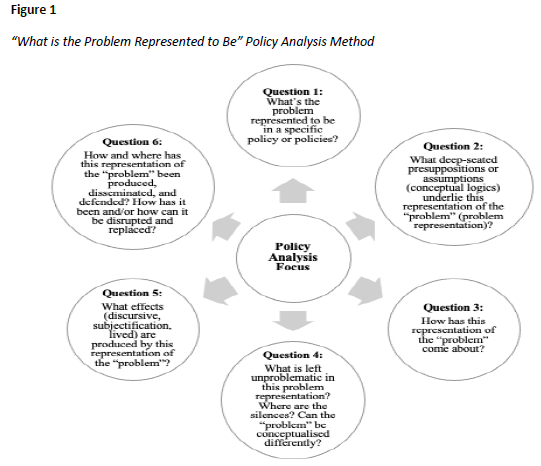
Stacey and Mockler (2024a, p. 4) reminded us that "when conducting policy analysis, it's important to think first about the kind of question one wishes to ask. Then, an approach that is appropriate to answer this question can be considered." Stacey and Mockler provided a list of nine possible questions that policy researchers could ask in their analysis work. All nine questions are relevant. However, this study adapts and concentrates on questions that are more relevant to the analysis of Malawi's policy stipulations on inclusive education. These questions focus on scope, power dynamics, history, and language. The approach here is that Stacey and Mockler's list of questions is embedded in the questions listed in Bacchi's (2009) methodological framework used in this study (see Figure 1), responding to the research questions in the introduction. The intention is to
emphasise that policy is not only about what is and is not said, but also about what is able to be said (or written), and the ways in which language in policy can both reflect and construct ways of thinking about particular issues. (Stacey & Mockler, 2024a, p. 5)
So far, the scope of the questions in this study, as Stacey and Mockler recommended, has been stipulated. What is necessary now is to choose the appropriate approach to answer these questions. The approach here is intertwined because the questions to be answered are found in the approach itself, as shown in Figure 1.
Stacey & Mockler (2024a, p. 4) articulated the
theory and method for text and document analysis-analysing policy as a written document or via text available in the media or online . . . policy analysis via the views of human participants-those who create, enact, or otherwise experience policy.
This study takes the text or document analysis option using a critical policy analysis approach. It has to be noted that "critical research thereby differs epistemologically from rationalist approaches to policy analysis, finding value in multiple perspectives and a range of lived experiences rather than seeking to identify singular truths" (Stacey & Mockler, 2024a, p. 8). Since Bacchi's problematisation was chosen to inform the study theoretically, this choice has implications for the approach to be employed. Thus, the study takes the method of critical policy analysis, abbreviated as WPR for "What is the Problem Represented to be?" (Bacchi, 2009; Bacchi, 2025; Bacchi & Goodwin, 2016). Rinquest and Simba (2024) showed in practical terms how this method works, thus giving it a practical definition (see Figure 1).
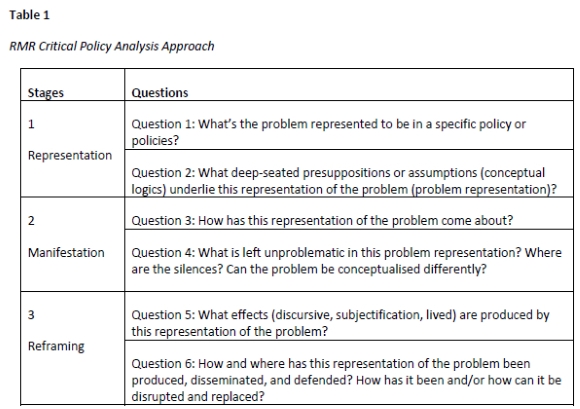
The WPR methodological framework involves a set of six guiding questions designed to uncover the underlying assumptions, values, and power dynamics embedded in policy documents and discourses. These questions interrogate how problems are represented, what is left unproblematised, and the implications for those affected by the policies. Rinquest and Simba (2024) used the WPR's six questions as guiding stages for their analysis and then weighed in the analysis on their research focus. Of course, that was just a methodological intention because in their analysis and discussion, it became more complex and intertwined, and they could not strictly follow the question-turned-stage flow. This study approaches the analysis similarly, but with rethought stages. Problematisation as a theory and the WPR as a methodological tool are combined to create an analytical framework that converts the WPR's six questions into three stages of analysis, following the representation, manifestation, and reframing (RMR) analytical approach, as outlined in Table 1. The RMR framework corresponds to the three research questions for this study.
The study uses a single policy document (the final draft NIEP; MoE, 2023) as its unit of analysis, selected through a purposeful criterion. It is the draft policy intended for the national roll-out of inclusive education, making it a foundational text that shapes subsequent policy directions and practices. Thus, the selection is justified by its strategic relevance rather than representativeness. The analytical process is guided systematically by Bacchi's (2009) WPR approach, with the steps and guiding questions outlined in Table 1 ensuring transparency and coherence in the analysis. Coding was conducted by identifying recurring problem representations, underlying assumptions, and silences within the text, which were then interpreted in relation to rationalist and critical policy perspectives. Trustworthiness is supported through a careful application of the analytical framework and close engagement with the text. Institutional research ethical approval was not required because the study is based solely on the analysis of a public document.
Results
The Problem: Definition and Representation
What's the problem represented to be in a specific policy or policies? This question is the starting point of the critical policy analysis in the WPR approach (Bacchi, 2025; Bacchi & Goodwin, 2016). By asking what the problem is or how it is defined in the policy, the intention is to set the context of the analysis. After assertions, the next critical task is to look at the problem representation. What deep-seated presuppositions or assumptions (conceptual logics) underlie this representation of the problem (problem representation)? The conceptual logics are intended to highlight the problem of what a practice is meant to be (Rinquest & Simba, 2024). The second-order effects of the policy underpin these two questions from the WPR perspective. Before we go any further, let us look at the final draft of NIEP (MoE, 2023), the data source for this study, and how the problem is defined and represented. The quotation below captures both the definition and the representation:
Malawi is a signatory to several universal agreements that advocate for the provision of adequate educational opportunities for learners with diverse needs. From these agreements, Malawi developed more comprehensive strategies to better respond to the educational needs of learners with varied backgrounds, disabilities and conditions. In 2009, Malawi developed the national special needs education policy guidelines. The guidelines provide a framework for Special Needs Education in Malawi. Implementation of the guidelines provided a mechanism for the effective and standardized implementation of Special Needs Education. The Government's commitment to embracing inclusive education started in 2017 as evident in its aspiration to introduce Compulsory Education (CE) as provided for in the Education Act of 2013, and the National Education Policy of 2016. Despite these and other related policy and programming initiatives, access to and participation in education for all remains a challenge at all levels. To address this challenge more comprehensively, GoM [Government of Malawi] through the Ministry of Education resolved to develop a stand-alone policy to ensure equitable access to quality education for all hence the development of NIEP. (MoE, 2023, pp. 9-10)
The problem is inclusive education. We may argue about this designation, but a problem is not necessarily something negative. It may be a concept, a practice, or a structure. Thus, the problem in the NIEP is inclusive education, and is defined as the "advocate for providing adequate educational opportunities for learners with diverse needs" (MoE, 2023, p. 9). This problem, inclusive education, can then be problematised-the most important task in the critical policy analysis. How is this problem (of inclusive education) represented? The problem representation is that "despite these and other related policy and programming initiatives, access to and participation in education for all remains a challenge at all levels" (MoE, 2023, p. 10). In other words, the practice implementation for inclusive education is failing. Why the practice is failing despite the enactment of several policies and programme activities is the question that policy research should answer.
How has the policyholder, the government, responded to the problem representation when it realised that the practice is failing? It is indicated that "to address this challenge more comprehensively, GoM through the Ministry of Education resolved to develop a stand-alone policy to ensure equitable access to quality education for all, hence the development of NIEP" (MoE, 2023, p. 10). Thus, the NIEP is supposed to solve the problem representation (this point will be discussed in detail later), which is inclusive education and that it advocates for equal educational opportunities. Inclusive education is failing in implementation despite the existence of policy frameworks to guide the practice.
Manifestation of the Problem: History, Absences and Alternatives
How has the problem (inclusive education defined and represented) manifested in the NIEP (MoE, 2023)? Here, we look at the preamble of the problem, what remains silent, and what is potentially possible. The historicity of the problem is very important because it helps to contextualise the problematisation (Bacchi, 2009). Given that in the critical policy analysis the goal is not only to provide solutions to the problem, understanding how the problem started helps to design appropriate responses that can inform the implementation of the practice (Stacey & Mockler, 2024a). What is the history of inclusive education as represented in the NIEP?
Malawi's pursuit of education for all began with the introduction of Special Needs Education (SNE) in the 1950s under the guidance of faith-based organizations. The Scottish Ministries established the first special school for learners with visual impairment at Chilanga in Kasungu in 1950. In 1968, Fathers of Immaculate Conception of the Roman Catholic Church established a SNE Teacher Training College at Montfort Campus in the Chiradzulu district. The Malawi Government officially began to provide funding for SNE programmes in 1967. In 1996 the Ministry of Education, Under the UNDP 5th Country Programme established the Learning Difficulties Programme at Montfort Campus to cater for the remaining categories of learners with special educational needs whose needs were not being served in the education system. The provision of SNE services for learners was done primarily through special schools and resource centres and through itinerant teaching programmes. Commitment to education for all was further demonstrated through the Education Development Plan from 1962 to 1967 which planned for Universal Primary Education subsequently culminated in the introduction of Free Primary Education in 1994. (MoE, 2023, p. 9)
The above quotation shows where we come from as a country, from special to inclusive education. Throughout this journey, not everything about inclusive education has been taken on board. Thus, what are the absences? The NIEP itself has an answer to this question. It says:
While the implementation of strategies on Special Needs Education has resulted in improved access to education by learners with diverse needs, Malawi needs to change the discourse and practice in the provision of education to learners with diverse needs for it to graduate to inclusive education. Currently, the provision of support to learners with diverse needs in Malawi is largely limited to learners with disabilities. (MoE, 2023, p. 17)
In observing these absences, the NIEP weighs in on alternatives. The absences' logic and the alternatives' rationale are also discussed later. But the policy mentions that:
In 2017, the Ministry of Education adopted the concept of inclusive education and developed a National Strategy for Inclusive Education (NSIE-2017-2021). The NSIE broadened the scope of inclusive education beyond learners with disabilities and envisioned an education system that enhances access to education by learners with diverse needs at all levels of education. However, the delivery of inclusive education is still sub-optimal because of several key challenges. (MoE, 2023, p. 17)
Reframing the Problem: Considering the Effects and Scope
The problem in the NIEP is that "despite these and other related policy and programming initiatives, access to and participation in education for all remains a challenge at all levels" (MoE, 2023, p. 10). Thus, what effects (discursive, subjectification, lived) are produced by this representation of the problem? The answer to this question is not far. The NIEP stipulates that
The Government of Malawi has over the years emphasized the "all inclusive" approach to education using various guidelines and practices that feature in various policy documents, guidelines and frameworks. However, this has left a lot of areas uncoordinated and/or poorly addressed to secure the provision of meaningful inclusive education. This has resulted in the exclusion of many children from without (out of school) and within the education system. This inclusive education policy provides an opportunity to redefine and recast the delivery framework and management and education services to respond to the diverse needs of all learners in Malawi; ensuring equity of access to quality education to all through appropriate curricula, organizational arrangements, teaching strategies, resource mobilization, allocation and use. All these in partnerships with various stakeholders including communities to achieve quality learning outcomes. (MoE, 2023, p. 8)
In short, the effects of the problem representation include the exclusion of qualifying individuals from education because the system cannot cater for their needs. The effects are, of course, funnelling. If these individuals are left out of the education system, issues of literacy and social well-being come into play. The quote above also addresses how and where this representation of the problem has been produced, disseminated, and defended. How has it been and how can it be disrupted and replaced?
The National Education Policy (2016) and the National Education Sector Investment Plan (NESIP, 2020 to 2030) detail the Ministry of Education's priorities and strategies to improve education delivery at all levels. Specifically, under the inclusive education, gender and other cross-cutting issues, one of NESIP's strategic objectives is to improve governance and management of inclusive education, gender and other cross cutting issues. To achieve this objective the key priority action for the Ministry of Education is to develop and implement National Inclusive Education Policy. (MoE, 2023, p. 18)
The policy stipulation above means that the NIEP has been formulated to disrupt or replace the problem representation. But how can the NIEP achieve this when the policy goal "is that all learners at all levels of the education system should equitably access quality education based on their differences" (MoE, 2023, p. 19). Should learners be educated based on their differences? The issue of language is equally important in critical policy analysis. What is the value of educating learners based on their differences? According to language dictionaries, it seems that "based" means using something specified as the foundation or starting point of something. With this understanding, the NIEP, a policy meant to promote inclusive education, mandates that learners' differences, such as visual and hearing impairments, should be the basis or starting point of their education. This situation is nothing but the philosophy of the special school (de Souza, 2023).
Perhaps, a suitable alternative could be "regardless"? Then, the policy goal could be that all learners at all levels of the education system should equitably access quality education regardless of their differences. Language dictionaries indicate that "regardless" can refer to despite the prevailing situations, or without regard or consideration for. This wording agrees well with the intention of inclusive education rather than "based." Mgomezulu (2017) indicated that trivial language and grammatical errors can change meaning and render an entire policy document useless. Therefore, the NIEP goal does not qualify to be what it is called, at least from the critical analysis perspective. This language issue is just one example of many other issues of concern throughout the NIEP that further research can surface and present for improvements.
Another issue worthy of critical attention in the NIEP is policy mobility and borrowing. Most stipulations seem uncritically borrowed from other policy frameworks and moved into the NIEP without careful consideration of their implications. For example:
The policy stresses the need for educating all learners with diverse needs in an inclusive setting; however, some learners with moderate to severe special educational needs will continue receiving their education in special settings as the system moves towards full inclusion. (MoE, 2023, p. 21)
This strategy stresses the need for educating all learners in an inclusive setting; however, some learners with SEN will continue receiving their education in special settings as the system moves towards full inclusion. (MoE, 2017, p. 11)
This recommendation for a twin-track education system (first quote) was previously stipulated in Malawi's National Strategy on Inclusive Education (2017-2021) (second quote). The stipulation has been borrowed and moved into the NIEP as it appears in the other framework. What is problematic here is not the borrowing and the mobility per se, because this is standard policy formulation behaviour, but the stipulation on the twin-track system of education. A policy that claims to promote inclusive education needs to strongly mandate inclusivity. Otherwise, the unintended ramifications are that stakeholders might argue that the policy says some learners can still be in special schools based on moderate and severe special educational needs. What is the measure of moderate and severity? This stipulation does nothing but perpetuate exclusion at the policy level.
Discussion
This study sought to critique the rationalist approaches to education policy research and motivate for the critical policy research approaches. This critique has been demonstrated by analysing the final draft of Malawi's NIEP (MoE, 2023), which is pending roll-out. The analysis engaged with Bacchi's (2009) WPR policy analysis approach. The first question in the WPR policy analysis process is to define the problem represented. By asking what the problem is represented to be in a specific policy or set of policies, critical policy analysis seeks to challenge the assumption that policies are solutions, instead viewing them as forms of problematisation (Stacey & Mockler, 2024b). From the perspective of this study, the question asks how the problem is represented to be in the NIEP (MoE, 2023). Let us assume for a minute that we have taken a rationalist approach to analyse the policy. We see not the problem but solutions to the problem. In other words, the policy already knows the problem and has crafted its solutions.
Rationalist policy researchers analysing the NIEP would celebrate that the policy is intended to bring some solutions to the problem. Given we are dealing with inclusive education in this study, the problem is represented as the lack of adequate support for inclusivity at all levels of education (scope) to ensure that all learners are afforded equal educational opportunities (power dynamics), and undo past social injustices of special education (history) using clearly defined strategies and protocols for teachers and stakeholders to support inclusivity (language). Now, let us abandon the rationalist approach and return to our chosen approach in this study. Here, criticality supersedes evidence and evaluation (Stacey & Mockler, 2024a). Thus, the intention is not to offer solutions to the difficulties of inclusive education in Malawi but to problematise the problem of inclusive education. From this problematisation, solutions should emerge naturally, not as listed by the Minister in the foreword and indeed in the entire policy document (MoE, 2023). Therefore, the solutions offered in the policy to address challenges in inclusive education may not, as understood in problematisation theory, be the best responses to inclusive education.
From a critical policy analysis perspective, there are many conceptual logics that underpin the problem representation in the NIEP (MoE, 2023). A rationalist policy researcher might say that one deep-seated assumption made in the NIEP is that policies are meant to solve problems. In this case, previous policy frameworks were meant to address the problem of access to education by different marginalised groups. The NIEP acknowledged that the policies have, in some way, failed to address the problem, hence the inception of the present policy. This may sound logical and common sense. But this situation is in fact an ontological flaw and an epistemological mistake. Adopting a critical policy analysis perspective, the solution to policy failures is not to develop a new policy hoping it will address the problem (Stacey & Mockler, 2024b). Hundreds of policy documents may be released to address the problem, but remember, it is not the work of a policy to do this. This takes us to the problem representation in the problematisation theory (Bacchi, 2009).
If the NIEP implementation is approached as one of problem-solving, it is doomed to fail like the previous policy frameworks. We do need a standalone policy on inclusive education in Malawi to give a concentrated focus on the issue (de Souza, 2022). However, the underlying presupposition that the policy will solve a particular problem is problematic. Those rationalist researchers, overshadowed by evidence and evaluation curiosity, would clap their hands to the policymakers for these deep-seated assumptions (see Bacchi, 2025; Bacchi & Goodwin, 2016). This study chooses to differ. The trajectory should be to craft policy stipulations that mobilise a wide range of stakeholders to take measures necessary to enhance inclusive education. Therefore, education policy research for inclusive education needs to reorient itself towards critical policy analysis approaches, which then enable not problem-solving but problematising the assumptions that the policy makes and informs practice implementation towards education change.
Conclusion
This study focused on approaches to education policy research in the past few decades. These approaches range from rationalist to critical approaches. Rationalist policy research's failure to critically surface unanticipated ramifications undermines research's potential to inform practices. Critical policy analysis in inclusive education looks at how institutions can invest in training programmes, continuing professional development, and incentives to attract and retain qualified teachers. Without these criticality measures, the potential benefits of the inclusive education policy remain unrealised. Thus, simply formulating a policy to solve a problem does not help. Instead, we need to decipher underlying assumptions that come with the problem representation in the policies, hence the need for a critical policy analysis approach in policy research for inclusive education. This reorientation can enable recommendations that inform policy formulation processes, not with false pretences that the policies can solve a problem, but with a candid criticality of what issues come into play in inclusive education implementation in Malawi and potentially, beyond.
References
Literature Review
- Ainscow, M., Slee, R., & Best, M. (2019). The Salamanca Statement: 25 years on. International Journal of Inclusive Education, 23(7/8), 671-676. https://doi.org/10.1080/13603116.2019.1622800
- Bacchi, C. (2009). Analysing policy: What's the problem represented to be? Pearson. https://www.researchgate.net/publication/259368372
- Bacchi, C. (2025). What's the problem represented to be? A new thinking paradigm (1st ed.). Routledge. https://doi.org/10.4324/9781032678382
- Bacchi, C., & Goodwin, S. (2016). Poststructural policy analysis: A guide to practice. Springer. https://doi.org/10.1057/978-1-137-52546-8
- de Souza, B. (2022). Reframing policy trajectory for inclusive education in Malawi. Journal of Education, 88, 69-86. https://doi.org/10.17159/10.17159/2520-9868/i88a05
- de Souza, B. (2023). Regular schools as a straitjacket for zone of proximal development: A Vygotskian perspective of Malawian inclusive secondary education. Perspectives in Education, 41(4), 50-64. https://doi.org/10.38140/pie.v41i4.6880
- de Souza, B. (2024). Mitigating policy-to-practice disparities in inclusive education from a bioecological systems perspective: The case of selected secondary schools in the Lower Shire, Malawi. South African Journal of Education, 44(Supp. 1), Art.#2386. https://doi.org/10.15700/saje.v44ns1a2386
- de Souza, B., Kaunda, B., & Potgieter, L. (2024). Inclusive education in southern Africa: A critical policy analysis. Journal of Educational Studies, 23(3), 55-76. https://doi.org/10.59915/jes.2024.23.3.4
- Easton, D. (1953). The political system: An inquiry into the state of political science. Alfred A. Knopf. https://archive.org/details/dli.ernet.507692
- Hernández-Torrano, D., Somerton, M., & Helmer, J. (2022). Mapping research on inclusive education since Salamanca Statement: A bibliometric review of the literature over 25 years. International Journal of Inclusive Education, 26(9), 893-912. https://doi.org/10.1080/13603116.2020.1747555
- Hunt, P. F. (2011). Salamanca Statement and IDEA 2004: Possibilities of practice for inclusive education. International Journal of Inclusive Education, 15(4), 461-476. https://doi.org/10.1080/13603110903131713
- Kamchedzera, E. (2015a). Access and equity for students with disabilities at the University of Malawi: A case of Chancellor College. In T. Halvorsen, H. Ibsen, & V. R. P. M'kumbudzi (Eds.), Knowledge for a sustainable world: A Southern African: Nordic contribution. African Minds. https://www.africanminds.co.za/knowledge-for-a-sustainable-world
- Kamchedzera, E. (2015b). Learner- and teacher-based positive factors amidst constraints in the implementation of inclusive education in Malawi's secondary schools. US-China Education Review B, 5(5), 641-657. https://doi.org/10.17265/2161-6248/2015.10B.003
- Ministry of Education, Malawi. (2017). National strategy on inclusive education. https://planipolis.iiep.unesco.org/sites/default/files/ressources/inclusive_education_strategy2017-2021.pdf
- Ministry of Education, Malawi. (2020). National education sector investment plan. https://planipolis.iiep.unesco.org/sites/default/files/ressources/malawi_nesip_2020-2030.pdf
- Ministry of Education, Malawi. (2023). National inclusive education policy [Final draft, unpublished].
- Ministry of Education, Malawi. (2024). Education management information system. https://emis.education.gov.mw/
- Mockler, N., & Stacey, M. (2024). Document and text analysis in critical education policy studies. In M. Stacey & N. Mockler (Eds.), Analysing education policy: Theory and method. Routledge. https://doi.org/10.4324/9781003353379
- Rinquest, E., & Simba, P. (2024). Beyond intentions: Problematising policy practice challenges for inclusive education and social justice in South Africa. Journal of Education, 96, 78-97. https://doi.org/10.17159/2520-9868/i96a05
- Slee, R. (2018). Defining the scope of inclusive education. Think piece prepared for the 2020 Global Education Monitoring Report: Inclusion and education. UNESCO. https://unesdoc.unesco.org/ark:/48223/pf0000265773
- Snoddon, K., & Murray, J. J. (2019). The Salamanca Statement and sign language education for deaf learners 25 years on. International Journal of Inclusive Education, 23(7/8), 740-753. https://doi.org/10.1080/13603116.2019.1622807