Navigating Evolving Digital Spaces of Teaching and Learning Through Critical Friendship: Arts-Based Self-Study of Two Teacher Educators
Abstract
We are two South African teacher educators who responded to an increasingly challenging educational environment during the COVID-19 pandemic. This paper reflects on our critical friendship journey during the pandemic as we navigated evolving digital teaching and learning spaces such as Zoom, Learn/2021/2022, Microsoft Teams, and WhatsApp. Framing our study within a sociocultural theoretical perspective motivated us to understand more deliberately and to embrace social phenomena to strengthen our pedagogy. We present our self-study research in which we used arts-based methods to explore the critical friendship we forged. Arts-based methods facilitate critical reflection and dialogue through creative engagement with materials such as objects, collages, and images. Utilising the arts enabled us to generate and analyse the data. Self-study research entails learning through collaboration while considering others' contributions to improve one's practice. These others may be supervisors, colleagues, or critical friends. Critical friends may be from the same or different disciplines, or they may be colleagues and peers at different phases in their profession. Through this journey, our critical friendship became a viable source of support and a space for development.
arts-based methods; critical friendship; digital spaces; object inquiry; self-study; teacher education practice
Introduction
We, the authors of this paper, are two South African teacher educators who, in the recent past, have engrossed ourselves in self-study projects to improve our teaching practices. We continue our work as both researchers and participants to improve our understanding and enactment of teaching pedagogy. In so doing, our research partnership has flourished into other networks nationally and internationally. We have come to realise that critical friendship extends beyond the interactions that brought to life collaborative inquiry with others (Pithouse-Morgan & Samaras, 2020).
The COVID-19 pandemic meant a re-envisioning and reshaping of teaching and learning spaces, necessitating novel teaching methodologies and techniques, and we had to navigate ever-evolving digital spaces for teaching and learning. We were able to improve our learning by working collaboratively during the COVID-19 pandemic and acknowledge the role of critical friendship in this process. As a scholarly narrative of our experiences, this paper elucidates how teacher educators can generate solidarity and navigate digital settings constructively to achieve educational transformation through forging a critical friendship bond. The following research question guided our study: "What can we learn about navigating the evolving digital teaching and learning spaces through critical friendship?"
We begin by outlining key aspects of the technological world that teacher educators need to embrace, followed by a discussion of the sociocultural theoretical framework in which our study was embedded. This theoretical perspective inspired us to embrace the social phenomena that reinforced our pedagogy. Then, we consider the benefits of the self-study methodology (including critical friendship, arts-based inquiry, and object inquiry) for improving our teaching practice. After that, as data generation, we present and discuss the objects we chose as metaphors for our educational journey. Next, we display the collage we created to enhance the data analysis process, and discuss the impact of this collage on our learning- sharing the challenges we encountered and the observations we made as we worked collaboratively during the pandemic. Last, we examine the important role of critical friendship in our efforts to contribute positively to change in our tertiary education environment.
Evolving Digital Spaces of Teaching and Learning
Before the COVID-19 pandemic, most higher education institutions employed limited online teaching to augment face-to-face contact sessions. However, during the lockdown period and its aftermath, uncertainty, anxiety, and even antagonism pervaded the higher education teaching and learning landscape. The need to survive during the pandemic and to sustain our academic responsibilities transformed how we as teacher educators had to think about our practice, and how we needed to relate to our students for optimum academic outcomes. Now, four years later, we recall that period of uncertainty and strife and reflect on both the practical and unproductive pedagogical approaches we employed; and we also consider the value of new and innovative teaching and learning styles. Our experiences during the pandemic redirected our thoughts regarding teaching and learning practices and compelled us to critically explore the complex and evolving nature of the new learning spaces available in higher education-a notion that Lamb et al. (2022) supported, too.
As evolving and ever-developing teacher educators, we are required to devise new teaching practices and modes of supervision that complement the digital space. Consequently, we transitioned to online learning and commenced interacting virtually with our students who had to learn to access learning resources through recorded slides and videos on Zoom. These were also uploaded on Learn2021/2022 for students who could not attend our Zoom sessions. Engaging in online teaching compelled us to explore innovative ways to deliver instruction asynchronously (Kortjass & Mkhize-Mthembu, 2023).
Our collaborative experiences during the pandemic also compelled us to view the education environment inversely. It was imperative to understand that in this digital-driven era, students would need to engage more actively in independent learning to build their knowledge and insights without being guided synchronously (Kortjass & Mkhize-Mthembu, 2023). Peter et al. (2020) stated that the pandemic forced humans to detach from the past and re-imagine their future world, and this was what we concentrated on. We had to be acutely aware of our students' backgrounds and ensure all were included. We posed the following pertinent questions to ourselves: "What is expected of us in the rapidly evolving higher education landscape?" "Can sharing our challenges and experiences create a nurturing and learning-rich digital space for our students?"
Essentially, we had to revisit our past pedagogic approaches and allow our students every opportunity to learn independently. At face value, this approach seemed contradictory because the sociocultural approach we endorse advocates powerfully for collaborative learning. The challenge was thus to strike a balance between independent and collaborative teaching and learning in what was frequently referred to as "the new normal," which required the use of digital spaces. We had to acknowledge that even though the digital space presented tremendous opportunities beyond physical borders and was not limited to geographical or physical settings, various negative implications and disadvantages were associated with its learning demands.
Turvey and Hayler (2017, p. 50) argued that "promoting, valuing and assessing professional collaboration is complex, and using digital technologies brings added complexity and new possibilities." We agree with that because one of our challenges was that not all our students were equipped to participate in the digital space, particularly with many coming from poor or disadvantaged social backgrounds. Peter et al. (2020) encountered a similar problem; their study of non-voluntary transition into virtual classrooms highlighted the magnitude of unequal access-such as regions with inadequate or non-existent Wi-Fi, students with no or low-quality digital equipment, and a disparity in levels of comfort and experience with applications like Learn2021/2022, Microsoft Teams, or Zoom meetings. Our focus had always been face-to-face teaching and learning, but COVID-19 compelled us to redirect our thoughts to teaching using online platforms. Students' geographical and socioeconomic status heavily impacted teacher preparation programmes, which lagged behind online platforms. We encountered feelings of isolation and anxiety that heavily impacted our teaching and learning (Naidoo et al., 2023).
We are conscious that scholars have been investigating both asynchronous and synchronous learning methods for decades, often exploring some of the same issues we bring to light, particularly in a South African context. Le Grange (2020, p. 2) explained how online teaching "has laid bare the digital divide as poor students struggle with access to devices and/or connectivity." Despite the advances made in transforming the higher education sector in South Africa, the lack of unceasing access to online resources for those students who hail from disadvantaged contexts has "further engrained exclusion and created walls to learning" (Motala & Menon, 2020, p. 90).
Because of the coronavirus, higher education institutions worldwide were discouraged from conducting face-to-face teaching. They had to swiftly transition their academic programmes to online platforms to ensure minimal interruption of the academic year. The migration to online platforms increased the anxiety levels and the workloads of academics who prior to the pandemic, were already weighed down by taxing teaching loads, research, and community service responsibilities (Naidoo et al., 2023). Key challenges were connectivity issues and not knowing how to use certain applications and features in the digital spaces we accessed. However, as we navigated these new digital spaces with growing confidence, we learned along with our students, to become adept at using the technology at our disposal. Hobbs and Whitsett (2023, p. 14) argued that "paradoxically, the adoption of digital spaces has led us to experience a dichotomous sense of connection and disconnection." We realised that the pandemic was holding us hostage and that working in solitude would not yield the desired results and would only cultivate further isolation.
We encouraged ourselves with the realisation that the digital space could streamline teaching and learning, and influence how students and teachers would be able to process and engage with content to develop critical knowledge and thinking. However, with so much uncertainty due to the pandemic, it was difficult to predict the future. A pivotal challenge was to determine how we could proceed with a teaching and learning process that would be democratic and inclusive of all given that it was an irrefutable obligation that students of all socioeconomic backgrounds and experiences needed to be accommodated in the tertiary context in which we worked. We agree with Peter et al. (2020, p. 11) that a pandemic such as COVID-19 creates "uncertainty [that] strengthens the quest for definitive answers." For us, the prevailing uncertainty during the pandemic meant that we had to be proactive, focus on solving methodological problems, and devise lessons to build new knowledge and understanding during and after COVID-19.
According to Peter et al. (2020), considerate teaching requires reflective dialogue and collaborative discussions in real-time teaching conditions and spaces. However, when we migrated to virtual learning, we needed to revisit the policies that had been applicable in the past. For instance, the lack of infrastructure and teaching and learning resources had to be urgently addressed if we were to render online learning effective and inclusive. Furthermore, the pandemic compelled us to question the quality of education and the demand for equality in the new teaching spaces we had to negotiate. Evidently, social injustice still existed in our education system and needed to be addressed.
Neuwirth et al. (2021) stated that COVID-19 obligated tertiary institutions to adapt to unprecedented challenges and to transition quickly from traditional face-to-face education to distance learning through virtual classrooms. This was true for us because as teacher educators and researchers, we were compelled to forge a critical friendship relationship that helped us embrace the evolving digital space as we were being challenged to re-imagine and re-create the accessibility of the educational environment for students from diverse social backgrounds. Worldwide, most colleges and universities had assimilated online teaching methods into their modules and courses before the pandemic, but COVID-19 restrictions required an almost overnight transformation of curricula to offer teaching and learning opportunities through virtual classrooms. However, while some universities already had robust online facilities, many developing countries found the mass demand for virtual classrooms challenging and ours was no exception. Another issue was that most students from rural settings were not computer literate, nor did they have access to data-driven technology and the internet.
The Sociocultural Theoretical Perspective
The sociocultural theory that was initially advanced by Samaras (2011) is based on the belief that humans are essentially influenced by the social and historical context that mediates their experiences, and that individuals shape the historical period in which they live. Samaras and Freese (2006) argued that learning, thinking, and knowing result from collaboration and appropriating feedback from others, which is a process that is aligned with sociocultural theory. Therefore, embedding our study within the sociocultural perspective motivated us to embrace the social phenomena that strengthened our pedagogy. Rezaee (2011) argued that learning occurs through interaction, negotiation, and collaboration, and we thrive on working and reflecting collaboratively on how our past teaching experiences have influenced how we are currently teaching.
Furthermore, the sociocultural theoretical perspective allows teacher educators to appreciate why students behave as they do. According to Gerhard and Smith (2008), the sociocultural perspective can be used to explore what students learn and who they become. Gerhard and Smith suggested that this two-way inquiry process creates a learning community where individuals can actively participate and contribute to novel ideas about teaching and learning. Moreover, Murphy and Ivinson (2003) stressed that the knowledge acquired by participating in various learning communities gives students and teachers diverse opportunities for acquiring knowledge that is treasured by teaching institutions. Against this background, we were heedful of our students' diversity and planned teaching and learning activities that accommodated their various needs and realities. Working from a sociocultural perspective, it was also crucial for us to expand concepts "to include not only people and artefacts but also digital technologies," as proposed by Rezaee (2011, p. 64).
Samaras and Freese (2006) also drew on sociocultural theory to make claims about how we live, learn, and know. Similar to Samaras (2011) we adopted the principles of Vygotsky (1978) who explained that the sociocultural theory, involves scaffolding, social interaction, and the zone of proximal developments. Therefore, our learning was not isolated but involved guiding each other and sharing our learning experiences. We were influenced by social constructivist theories that enlighten learning regarding individuals constructing and reconstructing world understandings through interaction with sociocultural contexts and human relationships (Bruner, 1996). Furthermore, social constructivism posits that knowledge is constructed and learning occurs through social interactions within a cultural and historical context. Vygotsky emphasised the collaborative nature of learning by constructing knowledge through social negotiation. We collaborated as critical friends and interacted with our students. By adopting sociocultural theory, we understand that students' lived experiences take place in sociocultural settings.
Thus, this theory enabled us to understand that our learning is embedded in social experiences. Our self-study project was underpinned by the sociocultural theoretical perspective, highlighting the importance of working together in educational settings to make sense of our individual learning experiences (Kortjass & Mkhize-Mthembu, 2023). The sociocultural perspective advocates self-study research because it encourages collaborative learning (Samaras, 2011). Working collaboratively as critical friends, we were able to come up with creative teaching and learning strategies that met the demands of the pandemic such as the use of arts-based research. We were mindful that arts-based self-study embraces the sociocultural theory through the use of art forms to elicit and present experiences and ideas that may not be easy to remember or to put in words; consequently, the arts can enhance self-reflection when aiming to improve one's teaching practice (Samaras, 2011). Students were reinvigorated to share their learning through presenting collages, memory drawings, and photographs of artefacts online, using channels such as Microsoft Teams and Zoom meetings. Moreover, we succeeded in creating an online learning community that improved and fortified our work and understanding.
Methodology
Self-study methodology entails research for continued learning and improved practice through collaboration, and its true value lies in embracing the contributions of others. According to Tidwell and Jónsdóttir (2020), self-study research to explore teacher education practice is usually centred on issues within a specific individual's professional work. Austin and Senese (2004, p. 1237) explained that self-study "is based on asking questions-questions asked by myself, students, parents, and colleagues." We, therefore, recounted our respective teaching experiences and relationships as they had occurred when we explored the use of digital spaces during the COVID-19 period. (Samaras, 2011) opined that self-study methodology requires different methods and tools to gather, analyse, and understand data that answer the research questions.
Self-Study Through Critical Friendship
In self-study methodology, critical friendship plays a significant role in supporting and enriching the researcher's reflective practice and inquiry process. Stolle et al. (2019) argued that self-study researchers have encouraged the notion of critical friendship, and this has been recognised considerably within self-study methodology. Schuck (2011, p. 72) asserted that it is the "notion of having both the 'critical' and the 'friend' that make[s] the process [of critical friendship] so powerful." We were motivated by these words to engage in deep discussions about our work, no matter how uneasy it made us feel at times. Some of the characteristics of critical friendship involve collaborative inquiry, critical reflection, and emotional support.
Collaborative Inquiry
Critical friendship involves forming a supportive and collaborative relationship with one or more peers or colleagues who engage in reciprocal dialogue, feedback, and reflection. Dialogue is often used in self-study research. East et al. (2009, p. 57) described dialogue as a method "to examine teaching practice and analyse one's practice critically." Adhering to this advice, we initiated conversations during which we asked questions pertaining to our learning environment, explored our learning experiences, and thought critically about navigating the evolving digital spaces of teaching and learning through dialogue. Additionally, Samaras (2011) argued that a critical friend is a trusted individual who asks thought-provoking questions, presents data for re-evaluation from a different perspective, and provides constructive feedback on someone's work in a supportive, friendly manner. We also engaged in discussions with a colleague who acted as a critical friend throughout our study. She encouraged us to look beyond the surface of our teaching inquiry and asked insightful questions that helped strengthen our study.
Critical Reflection
In critical friendship, researchers are encouraged to engage peers who provide constructive feedback and ask probing questions that challenge the researcher's thinking, prompting deeper exploration and consideration of alternative perspectives. Cole et al. (2022) described critical reflection as best understood as critical thinking concerning personal experiences. We had meaningful conversations and asked constructive questions, believing that the answers would induce positive change.
Emotional Support
Critical friendship extends beyond intellectual engagement to provide emotional support and encouragement to the researcher. Peers in critical friendship extend beyond academic engagement and provide emotional support and encouragement towards each other. They help to sustain motivation and resilience. Hobbs and Whitsett (2023) contended that navigating digital spaces effectively depends on the ability to use its associated technologies, which frequently cause frustration. We, therefore, had to consider being humane, which meant that we had to be conscious of our emotions and of our students' challenges in order to respond to them in a nurturing manner.
Self-Study Through Arts-Based Inquiry
The purpose of scholarly exploration through art is to break through conventional and ordinary perceptions so that the inquirer can view things differently and authentically (Weber, 2014). We therefore engaged in self-study research using an arts-based approach to narrate our daily experiences and challenges as teacher educators who had to navigate the challenges posed by the pandemic. As stated above, the platform we used to launch this investigation was collaboration embedded in critical friendship. The arts-based inquiry we thus engaged in facilitated self-reflection, critical analysis, and dialogue-and resulted undeniably in improving our teaching practice.
Pivotal to our study was the intention to critically analyse and question our teaching and learning practices through arts-based research. LaBoskey (2004, p. 829) stated that one challenge teacher educators face "is to provide ways for students to articulate and interrogate their personal histories and resultant understandings." Therefore, to support our students, we embarked on a quest to connect our own educational practices to our lived experiences without regarding policy and theory. We were intrigued by this creative approach to research, and it proved to be a rewarding journey even though we were entering unchartered waters.
Pithouse-Morgan et al. (2014) explained the significance of engaging in a polyvocal approach, which recognises multiple and diverse voices of scholarly interest because they are at the forefront of the teaching-learning process. Such voices belong pivotally to learners, students, and learning communities. We envisioned that using arts-based research would enhance our voices as critical friends and better illuminate our teaching experiences as we eagerly searched for ways for our educational endeavours to be inclusive and enhance social justice. We thus engaged in arts-based research by focusing on polyvocality as a particularly effective tool in times of ambiguity and despair, such as during the pandemic.
Self-Study Through Object Inquiry
Objects have the capacity to convey rich information about lived experiences (Berger, 2016). They can serve as tangible connections to personal, cultural, and historical narratives. Pillay et al. (2017) asserted that object inquiry allows researchers to use their voices intentionally in response to an unfamiliar terrain as they attempt to make sense of it. In our eagerness to make meaning of our learning, we each selected a meaningful object and presented its significance in terms of our learning in narrative accounts of our respective academic journeys. We found this to be a creative portal for gaining a fresh understanding of the new normal as our reflections about these objects revealed how our lived educational experiences had opened us to new and varied insights. In our search for collegiality and ingenuity, we expanded our knowledge as the bond of critical friendship allowed us to engage frankly in methodological dialogues about object inquiry.
Data Generation
LaBoskey (2004, p. 859) noted that "self-study employs multiple, primarily qualitative methods . . . [which] provide us with opportunities to gain different and thus more comprehensive perspectives on the educational processes under investigation." As data generation, we met via Zoom bi-weekly for a year to share our challenges regarding teaching online and navigating through digital spaces, and audio recorded these discussions. We each then chose an object that represented an aspect of our teaching and learning experiences and wrote a reflective piece on the object. In exploring object inquiry, we posed the following questions to prompt our thinking (Pillay et al., 2017):
1. Describe the object.
2. What does the object say about you as a researcher-teacher?
3. Are others associated with this object? What role do/did they play in your lived experiences?
4. How has your thinking and/or practice changed/evolved/become clear through working with objects?
5. How/why does this matter to you as an educational researcher?
6. How/why will it matter for other educational researchers?
Next, we present images of the objects we selected, accompanied by our narratives.
Author A's Object and Narrative: "Forever Blooming"
I would describe this object (Figure 1) as colourful, lush, textured, beautiful, aromatic, garden-fresh, and with the potential to continue to blossom further if pruned, nurtured, watered, and rooted in good soil. I imagine that the plant's growth is seasonal. Therefore, the potted plant has to survive in a season when it is not cultivated or does not receive any sunlight, but then it flourishes and blooms beautifully in the season when its growth is at its peak.
Symbolically, this potted plant represents me during the pandemic: my endurance, resilience, and ability to grow when nurtured and treated with care. Like this plant, I had to survive various seasons such as the one where I grew as a member of learning communities and cohorts that allowed my research projects to flourish. However, in the "winter" of my experiences, I felt defeated when I did not receive positive feedback about my writing and ideas. Like the potted plant, I was surrounded by other plants that also had to survive and grow in different seasons and, like them, I also needed pruning and repotting to strengthen my roots. To grow and bloom, this plant needed sunlight, water, pruning, and fertiliser-just as I needed my colleagues, co-authors, research communities, and mentors who shared their lived experiences with me. My relationship with others was, therefore nurturing, compassionate, understanding, and worthwhile. In the garden where we spread our roots as educator-researchers, we openly shared our stories and experiences about our teaching and learning in the research space we shared.
We explored many stories of our experiences during the pandemic and highlighted the challenges that compelled us to value all voices and treasure simple moments such as engaging with people face-to-face, returning to physical interaction after lockdown, and just being present with others again, in the moment. In hindsight, I understand that my thinking evolved from an individual, self-centred research perspective to one that allowed me to build relationships with critical friends like Author B. These friends allowed (and still allow) me to navigate the challenges of supervision and teaching online and to identify beneficial cohorts that share my interests. I am now open to viewing myself through the eyes of others and to ask for advice, feedback, and clarity.
I learnt that, as a teacher, educator, and researcher, I must have an intuitive voice but also find my voice in academia. I must provide critical feedback about my research and offer recommendations to learning communities that could make a significant difference and contribute positively to the education field in which I work.
Author B's Object and Narrative: "A Balancing Act"
The pink 350 ml water bottle (Figure 2) is adorned with stickers that read: "Make the planet great again," "Plant me and save the bees," and "Carry me and go." This water bottle is always on my desk, and I fill it up as soon as it is empty. One of my critical friends gave it to me as a gift for my birthday. Because I initially struggled with the self-study research concept, I used objects to help me articulate my thoughts.
This object offered me an inventive way of engaging with my research and sharing my ideas with my critical friend. I feel compelled to drink water when I work because without it, my body's rhythm is unbalanced. Therefore, I regard this bottle as a symbol of the balancing act I constantly have to perform in my work- just as my body always needs to stay in equilibrium. The water in the bottle reminds me that sustaining my health is vital, particularly when I am working. Likewise, sustaining a healthy and balanced relationship with my colleagues is important. During the pandemic, I realised I had to abandon my comfort zone and learn again, but this time it was from a more vulnerable position than when I started my career, and it was far more frightening. Samaras and Freese (2006) acknowledged that one experiences negative sensations in self-study because this type of research entails taking risks and experiencing vulnerability. Referring to the water bottle as a symbol of my experiences thus helped me to talk about my feelings and emotions and to explore whatever I found difficult to articulate about myself.
Experiencing a sense of vulnerability in arts-based research is inevitable. When one abandons one's comfort zone, one learns from a position of vulnerability even though it can be frightening. When I engaged with my critical friend, I told her of my struggles to navigate the digital spaces I knew I needed to access, and I sought assistance on how to improve my practice to provide invaluable learning and teaching experiences that would enlighten and capacitate my students at a time when all seemed so frightening.
Hobbs and Whitsett (2023) acknowledged similar experiences of vulnerability, arguing that while they attempted to support their students and learners, teachers and teacher educators experienced challenges of their own and had to quickly adapt to new ways of teaching.
Analysis and Discussion
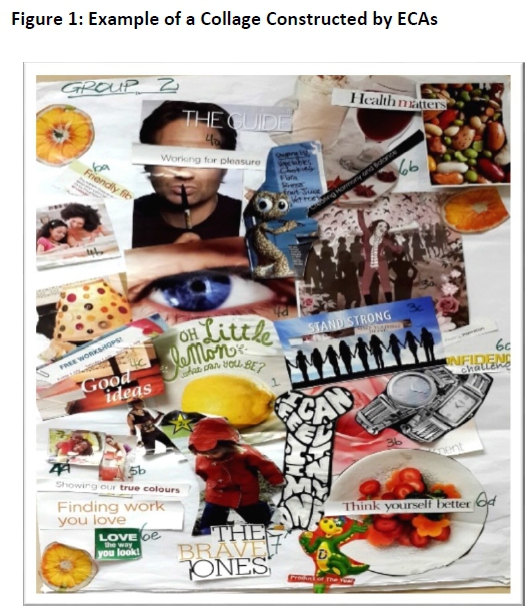
This study was informed by different data sources: recordings, transcriptions of the meeting discussions, and object inquiry narratives. We used these sources to create a collage to make meaning of the data. To create the collage, we met face-to-face. We brought the magazines, the chart, glue, and scissors. According to Chilton and Scotti (2014, p. 163), "collages are visual artworks created by selecting magazine images, textured papers, or ephemera [and then] cutting out or altering these elements and arranging and attaching them to a support such as paper or cardboard." Our collage (Figure 3) was a collection of pictures and texts that guided the data analysis process and allowed us to share our learning and findings more vividly. We were inspired by Pillay (2020, p. 99), who asserted: "Visual modes like drawing, painting, sculpture, and collage can employ the powers of creativity to know the self in surprising ways." The collage-making process used to analyse data made us acutely mindful of how the pictures and texts expressed our views and ponderings.
We captured how the learning zones and zones of possibilities transpired when we were open to new understandings (Samaras, 2011). Because research is a back-and-forth undertaking, we utilised the collage to help us understand our data. We thought inductively as we noticed what was happening in order to make sense of our data, and identified themes that related to our learning about navigating the evolving digital teaching and learning spaces. These themes included learning from each other, enlightenment, building resilience, and technology-a prominent factor.
Learning From Each Other
The text "Making friends: Move! Helps you to connect and reconnect" encapsulates the concept of critical friendship that we forged, and which allowed us to learn from each other. At a deeper level, critical friendship ignited a new sense of hope within us and among our students by encouraging the development of their competencies through a collaborative approach. Pithouse-Morgan et al. (2019) asserted that self-study researchers believe their personal and professional learning and development will empower them to have a more evocative influence on the lives of others.
Enlightenment
The imperative to explore digital spaces reshaped our thinking about teaching and learning, hence, the phrase "shaping spaces" was selected for its significance. Even though we experienced challenges, we were also inspired to find ways to improve our teaching and assist our students. The phrase "Let us explore the world" illustrates that our interest in our task, and our consideration of the outcomes we wished our students to achieve, were kindled irrespective of the dire circumstances we experienced during the pandemic. It was a time of adversity but also of enlightenment as we propelled ourselves through dialogue to a level of self-awareness that enriched our teaching. As noted by Scott and Palincsar (2013), from the sociocultural perspective, learning occurs through interaction, negotiation, and collaboration. Confirmation of this ensued as we shared ideas on uploading teaching material, sharing YouTube links on Learn2021/2022 platforms, and uploading PowerPoint presentations and videos using Kaltura. We recognised that learning from each other strengthened our interaction with students, and we shared discussions on complex problems such as the lack of resources and respecting individuals' confidentiality and privacy.
Building Resilience
We looked forward to finding our voices and eventually drew strength from each other and learned from our own personal experiences and those of our students. We built a resilient, energetic, and critical friend relationship by working closely with each other. Through the learning community we had forged, we engaged in a holistic approach that improved student engagement and attendance. During our conversations, we motivated each other. The phrases, "hang in there" and "becoming an inspiration" capture our support for each other. Borrero and Yeh (2016) concurred that the sociocultural approach to learning contributes to understanding through their connections with others. Our critical friendship enhanced our development and enriched the academic support we extracted to meet our students' needs.
Technology-a Prominent Factor
We saw how our attitudes had ebbed and flowed dynamically and realised that a prominent variable was technology. The image of the woman and man in front of a laptop is reminiscent of our work. Technology acted as a key player in the power relationship between our educational inputs and the desirable outcomes we wished to achieve because it gave us the confidence to teach effectively in a synchronous online learning space. For example, when technology worked flawlessly, we saw evidence of engagement and a neutralised power dynamic to expound through open discussion. Our students were able to participate in lessons and ask questions. The picture of a man holding a cell phone represents the digital medium the students preferred. Using cell phones made teaching and learning sustainable during the pandemic and illuminated our journey as we navigated new digital spaces. Sociocultural perspectives helped us realise the pressing moral and ethical need to complement our endeavours by using the preferred digital devices of our students in teaching and learning (Taylor, 2014).
Critical Friendship
Our critical friendship journey became a valuable source of support and a space for development as we navigated the stormy waters of transition. We realised it would be essential for us to engage in introspection about our teaching practices and how they had been adapted during the COVID-19 pandemic, with particular attention to how we had navigated the digital space. In essence, our critical friendship was embedded in interactive teaching methodologies and engagement in collaborative interactions as critical friends.
Austin and Senese (2004, p. 1236) argued that teachers should "no longer [be] content to work in isolation." We embraced this advice and forged critical friendships in our professional space. Together, we discovered the complexity of our challenges and learned how to support each other to enhance our teaching practices. For example, we questioned whether we should require our students to switch off their cameras during Zoom sessions because connectivity and network issues hindered teaching. We also learned that most students had access to WhatsApp and preferred using that platform and therefore, we uploaded our PowerPoint presentations onto WhatsApp. Moreover, the critical friendship we forged assisted in validating our research as we gained new perspectives and understandings. At the same time, it guided us to revisit our initial insights through peer evaluation and support. To improve our practice, we also needed to listen to our intuitive voices and acknowledge those of others along the journey of self-discovery and accessing digital spaces.
According to Hobbs and Whitsett (2023), navigating the evolving digital environment required a new teaching and learning model that made it easy for educators and students to ask questions without fear of being judged or undermined and, therefore, this platform became a valuable and safe space for interaction. We imparted knowledge through recorded teaching sessions and uploaded recordings on Learn2021/2022. We also uploaded videos using Kaltura, which students could access in their own time. At first, there was a sense that teaching using digital technologies was impossible. Author B recalls saying, "For those of us who grew up in a time before the rise of modern technology, adapting to today's digital world can be quite challenging. The rapid pace of technological advancement often feels overwhelming, especially when learning new tools or platforms that didn't exist during our formative years." However, as we navigated these platforms, numerous possibilities opened up and by depending on each other as critical friends, we learned fast and reaching our students became achievable. We also wanted our students to change their attitude through the way we taught so that they could improve their understanding of the work and, hence, their performance. Thus, we embraced opportunities to learn from each other and interact digitally with our students. As a result, we, as teacher educators and our students, evolved and became adept at accessing useful digital spaces.
The collaborative self-study we initiated enabled us to understand the events that unfolded before us, and we could navigate our way through unchartered spaces and new tensions until new understandings began to blossom-just like Author A's potted plant. Author A commented: "It requires not only acquiring new technical skills but also shifting our mindset to embrace continual change." Moreover, like the plant, we were vulnerable. However, we were nurtured by collaboration, critical friendship, reflection, and courage, so we grew new roots that helped us to discover and sustain our strengths and sustain our development. We also achieved equilibrium in our efforts to support our students as we collaboratively balanced our inputs with the outputs we expected of ourselves and of our students. We became confident in questioning various teaching practices that no longer seemed appropriate and unpacked new educational and professional tools that enriched our professional world. The key was to explore and learn about evolving digital learning spaces, in depth.
Using objects emancipated us from feeling restricted or confined and allowed us to freely express ourselves as we engaged in honest conversations and faced the realities of our lived experiences. Dhlula-Moruri et al. (2017) underscored how objects had deepened their understanding and communication. Objects prompted our innermost thoughts, which were explored in great depth through critical friendship; critical friendship can introduce fresh and multiple insights. Working with a critical friend colleague was valuable because it provided us with a supportive system while we navigated the changing digital landscape of teaching and learning.
This paper illustrates how the creative arts can be used in multiple and valuable ways for learning and teaching in higher education. We call on other teacher educators to use creative arts-based research as a powerful pedagogic and reflection tool. Furthermore, teacher educators could use arts-based research and critical friendship in higher education to support their reflections in inspired, organic, and collaborative ways. This paper also demonstrates how arts-based strategies can be generative in facilitating teaching and learning in emotionally safe and supportive spaces. We encourage other teacher educators to engage in open dialogues and constructive questions that aid them in improving their practice.
We acknowledge that the re-assessing and revisiting processes in self-study research required us to be critical of ourselves, our teaching, and how we address specific problems. Therefore, this paper emphasises valuable, meaningful dialogues and self-inquiring questions that allow teachers and teacher educators to rethink their teaching, deepen inquiry, and seek constructive responses that elicit positive transformation. Our professional perceptions and reflections directed us to identify how short-sighted it is to not value feedback and dissimilar insights in a study of this nature.
Furthermore, there is a need to reflect, engage in continuous inquiry, and give constructive feedback, allowing teacher educators to cherish and develop their insights about their teaching and learning. Hamilton et al. (2008) indicated that for the self to appear accurately in teacher knowledge and practice development, self-study essentially incorporates reflection. We thus engaged in self-reflection, frequent questioning, and filling gaps in our teaching practice (particularly in the context of the pandemic) by cooperating with our students, colleagues, and critical friends (Mkhize-Mthembu, 2023). This collaborative inquiry process enables researchers to share their experiences, insights, and challenges, fostering a deeper understanding of their practice, and promoting professional growth. By engaging in collective reflection and dialogue, researchers are able to openly share their personal experiences, insights, and the challenges they face in their practice. This exchange of perspectives encourages critical thinking and promotes mutual learning, allowing individuals to see their work through different lenses.
Ethical Considerations
We considered and applied ethical considerations conducted in narrative research as a complex sociocultural context. Therefore, we reflected on relational ethics, potential emotional impacts on both participants and researchers, and how these were navigated to enhance the paper's methodological trustworthiness and usefulness. This research was completed through the engagement of multiple data generation sources (LaBoskey, 2004); we used objects and audio recordings to capture our narratives and used a collage as an analysis tool. Additionally, we were conscious that we are emotional beings, so we maintained confidentiality, navigating sensitive topics, managing relational ethics, and handling emotional impacts on both participants and ourselves as researchers.
Limitations of the Inquiry
We acknowledge that our research was subjective and shaped the nature of our inquiry and its outcomes, as posited by (Tidwell & Jónsdóttir, 2020). Because we were mindful of the pitfalls of subjectivity, we allowed ourselves adequate time to generate and evaluate the data (Cope, 2014) that had been obtained from multiple sources (as listed above) for a better understanding of what it was that we had learned from our experiences and each other. Furthermore, we presented our work to critical friends at a conference and received valuable feedback.
Although the learning community we refer to in this paper primarily comprised only two people, our collaboration as critical friends enthused us to reflect in depth on our experiences. This process facilitated our transformation as teacher educators. For instance, we listened more attentively to our students' stories and uncovered many challenging and debilitating experiences in their lives. Arts-based self-study reflection also deepened our thoughts, and we grew closer to each other as a small but powerful learning community. Reflection and collaboration gave birth to new ideas, allowing us to reimagine an optimistic future.
Conclusion
We concede that our approach to navigating the unchartered waters of teaching and learning during COVID-19 was not a one-size-fits-all panacea for the challenges we (and our students) experienced. However, we learned that sharing experiences can contribute significantly to the professional development of teacher educators if they, as did we, embrace collaboration and practical instruction. We were grateful to have a consistent relationship that built over the years. We were both very comfortable in this relationship and never felt that we needed to defend each other's position. We established new insights about critical friendship.
This paper has demonstrated that critical friendship forges a bond of solidarity among teacher educators, which can support them in navigating digital settings for constructive educational transformation. Moreover, teacher educators who work from the stronghold of critical friendship will be capacitated to facilitate students' access to, and success in, their teaching subjects. The paper also underscores that using arts-based methods contributes to imaginative and authentic reflection, leading to educational development and growth. Teacher educators should, therefore, engage in collaborative initiatives to support one another to benefit a diverse range of students. In this process, mutual respect, compassion, and understanding are pivotal.
Based on our experiences, we contend that forging critical friendship bonds can help teacher educators navigate evolving digital spaces supporting teaching and learning. As teacher educators during COVID-19, we found that constant support was necessary for our students and us because it enhanced learning and encouraged good practice. Our collaborative initiatives benefited the diverse needs of our students, while critical friendship opened our hearts and minds so that we learned constructively from each other.
In conclusion, we believe that university lecturers who still lag in this regard can learn from those who have attempted to close the teaching and learning gap by exploring avenues to facilitate democratic learning through digital platforms. For this process to succeed, collaborative learning and the forging of critical friendship relationships amongst knowledgeable and experienced role-players in teacher education are paramount (Kortjass & Mkhize-Mthembu, 2023). This paper elicited teacher educators' teaching and learning experiences during the pandemic through the process of introspection to make valuable changes in teaching practice and professional learning, working collaboratively, and improving our teaching practice. It also calls for self-study researchers to be vulnerable, open, and to take constructive insights. We call teacher educators to forge camaraderie as they navigate digital settings to deepen their understanding of their teaching practices and support students' learning.
Furthermore, by navigating evolving digital spaces of teaching and learning through critical friendship in arts-based research, teacher-educators and researchers can cultivate their educational approach and have a dialogue between their students' social context while constructing their professional learning and pedagogic practice. Through our critical friendship journey, we endeavoured to acknowledge our students' agency in professional and academic learning processes that could contribute to social change. We see arts-based educational research as a reflection, allowing researchers and teacher educators to reflect on their lived experiences imaginatively and genuinely. This paper presents a forum for teachers to share and reflect on enlightening and problematic teaching and learning experiences encountered in the face of uncertainty.
Austin, T., & Senese, J. C. (2004). Self-study in school teaching: Teachers' perspectives. international handbook of self-study of teaching and teacher education practices (pp. 1231-1258). Springer.
Berger, A. A. (2016). What objects mean: An introduction to material culture (2nd ed.). Routledge.
References
- Borrero, N., & Yeh, C. (2016). Using ecological asset mapping to investigate pre-service teachers' cultural assets. International Journal of Multicultural Education, 18(3), 114-137. https://doi.org/10.18251/ijme.v18i3.1183
- Bruner, J. S. (1996). The culture of education. Harvard University Press.
- Cole, C., Hinchcliff, E., & Carling, R. (2022). Reflection as teachers: Our critical developments. Frontiers in Education, 7. https://doi.org/10.3389/feduc.2022.1037280
-
Cope, D. G. (2014). Methods and meanings: Credibility and trustworthiness of qualitative research. Oncology Nursing Forum 41(1), 89-91. 10.1188/14.ONF.89-91
» https://doi.org/10.1188/14.ONF.89-91 - Dhlula-Moruri, M. N., Kortjass, M., Ndaleni, T., & Pithouse-Morgan, K. (2017). A stove, a flask, and a photograph: Learning together through object inquiry in self-study research. In D. Pillay, K. Pithouse-Morgan, & I. Naicker (Eds.), Object medleys: Interpretive possibilities for educational research (pp. 81-98). Sense Publishers.
- East, K., Fitzgerald, L., & Heston, M. (2009). Talking, teaching, and learning: Using dialogue in self-study. In D. Tidwell, M. Heston, & L. Fitzgerald (Eds.), Research methods for the self-study of practice (pp. 55-72). Sense Publishers.
- Hamilton, M. L., Smith, L., & Worthington, K. (2008). Fitting the methodology with the research: An exploration of narrative, self-study and auto-ethnography. Studying Teacher Education, 4(1), 17-28. https://doi.org/10.1080/17425960801976321
- Hobbs, J., & Whitsett, L. (2023). Severed connections and timely reflections: A collaborative autoethnography navigating uncertainty amid COVID-19 in higher education. Journal of Curriculum and Pedagogy, 1-26. https://doi.org/10.1080/15505170.2023.2187900
- LaBoskey, V. K. (2004). The methodology of self-study and its theoretical underpinnings. In J. J. Loughran, M. L. Hamilton, V. K. LaBoskey, & T. Russell (Eds.), International handbook of self-study of teaching and teacher education practices (pp. 817-869). Springer.
- le Grange, L. (2020). Could the COVID-19 pandemic accelerate the uberfication of the university? South African Journal of Higher Education, 34(4), 1-10. https://doi.org/10.20853/34-4-4071
- Mkhize-Mthembu, N (2023). Collage-making as a way to refine my teaching practices and my relationship to learners' learning in my classroom. Studying Teacher Education, 19(2), 204-224. https://doi.org/10.1080/17425964.2022.2129610
- Murphy, P., & Ivinson, G. (2003). Pedagogy and cultural knowledge: A sociocultural perspective. Pedagogy, Culture and Society, 11(1). https://doi.org/10.1080/14681360300200157
- Neuwirth, L. S., Jovic, S., & Mukherji, B. R. (2021). Reimagining higher education during and post COVID-19: Challenges and opportunities. Journal of Adult and Continuing Education, 27(2), 141-156. https://doi.org/10.1177/1477971420947738
- Peter, M. A., Rizvi, F., McCulloch, G., Gibbs, P., Gorur, R., Hong, M., Y, Hwang, L., Zipin, M., Brennan, S., Robertson, Q. J., Malbon, D., Taglietti., R. Barnett., W, Chengbing, P., McLaren, R., Apple, M., Papastephanou, N., Burbules, L., Jackson, P., Jalote, M., . . . Misiaszek, L. (2020). Reimagining the new pedagogical possibilities for universities post-COVID-19: An EPAT collective project. Educational Philosophy and Theory, 54(6), 1-44. https://doi.org/10.1080/00131857.2020.1777655
- Pillay, D. (2020). Recreating a graduate supervisor through art making: An autoethnographic study. Journal of Autoethnography, 1(1), 99-104. https://doi.org/10.1525/ioae.2020.1.1.99
- Pillay, D., Pithouse-Morgan, K., & Naicker, I. (Eds.). (2017). Object medleys: Interpretive possibilities for educational research. Springer.
- Pithouse-Morgan, K., Makhanya, H, Downing, G., & Phewa, N. (2019). Picturing a more hopeful future: Teacher-researchers drawing early memories of school. In K. Pithouse-Morgan, D. Pillay, & C. Mitchell (Eds.), Memory mosaics: Researching teacher professional learning through artful memory-work (pp. 817-869). Springer.
- Pithouse-Morgan, K., Naicker, I., Chikoko, V., Pillay, D., Morojele, P., & Hlao, T. (2014). Entering an ambiguous space: Evoking polyvocality in educational research through collective poetic inquiry. Perspectives in Education, 32(4), 149-170.
- Pithouse-Morgan, K., & Samaras, A. P. (2020). Methodological inventiveness in writing about self-study research. In J. Kitchen, A. Berry, S. M. Bullock, A. R. Crowe, M. Taylor, H. Guôjónsdóttir, & L. Thomas (Eds.), 2nd International handbook of self-study of teaching and teacher education (pp. 1-34). Springer.
- Rezaee, M. (2011). Sociocultural theory revisited: What are the educational implications? Broad Research in Artificial Intelligence and Neuroscience, 2(4) 62-67. https://lumenpublishing.com/journals/index.php/brain/article/view/1899
- Samaras, A. P. (2011). Self-study teacher research: Improving your practice through collaborative inquiry. SAGE.
- Samaras, A. P., & Freese, A. R. (2006). Self-study of teaching practices primer. Peter Lang.
- Schuck, S. (2011). Resisting complacency: My teaching through an outsider's eyes. In S. Schuck & P. Pereira (Eds.), What counts in teaching mathematics: Adding value to self and content (Vol. 11, pp. 61-73). Springer. https://doi.org/10.1007/978-94-007-0461-9_5
- Scott, S., & Palincsar, A. (2013). Sociocultural theory. Education.com. http://www.education.com/reference/article/sociocultural-theory/
- Stolle, P. E., Frambaugh-Kritzer, C., & Freese, A. (2019). Investigating critical friendship: Peeling back the layers. Studying Teacher Education, 15(1), 19-30. https://doi.org/10.1080/17425964.2019.1580010
- Taylor, P. C. (2014). Socio-cultural perspectives and characteristics. In R. Gunstone (Ed.), Encyclopedia of science education (pp. 981-983). Springer.
- Tidwell, D. L., & Jónsdóttir, S. R. (2020). Methods and tools of self-study. In J. Kitchen, A. Berry, S. M. Bullock, A. R. Crowe, M. Taylor, H. Guôjónsdóttir, & L. Thomas (Eds.), 2nd International handbook of self-study of teaching and teacher education (pp. 1-50). Springer.
- Turvey, K., & Hayler, M. (2017). Collaboration and personalisation in teacher education: The case of blogging. Teaching and Teacher Education, 68, 42-52. https://doi.org/10.1016/j.tate.2017.08.003
- Vygotsky, L. S. (1978). Mind in society: The development of higher mental processes. Havard University Press.
- Weber, S. (2014). Arts-based self-study: Documenting the ripple effect. Perspectives in Education, 32(2), 8-20. https://doi.org/10.38140/pie.v32i2.1855