From Freirean Praxis to Fragmented Skills Provision: TVET, Informality, and Labour-Market Misalignment in Guinea-Bissau1
Abstract
Technical and vocational education and training (TVET) is widely promoted as a key instrument for addressing youth unemployment and supporting economic development in low-income countries. Yet evidence of its effectiveness remains uneven, particularly in fragile contexts characterised by informality and weak state capacity. This paper analyses the structure, governance, and labour-market articulation of the TVET system in Guinea-Bissau, a country where vocational training has received sustained policy and donor attention despite persistently limited employment outcomes. This paper builds on both contemporary and historical perspectives on skills formation, including early post-independence educational experiments inspired by Freirean pedagogy. Drawing on an historical account supported by interviews, secondary statistical data, policy and institutional documents, and case studies of two NGO-led training centres, the paper examines why TVET struggles to function as a pathway to stable employment. The analysis shows that the limited impact of TVET is rooted not primarily in deficiencies of training provision, but in a structural misalignment between internationally promoted training models and labour markets dominated by informality, low productivity, and fragmented governance. NGO-led initiatives partially compensate for gaps in public provision but remain constrained by weak integration into national qualification and employment frameworks. The findings challenge supply-driven approaches to skills development and highlight the need to situate TVET reforms within broader strategies of labour market formalisation and institutional strengthening, where the transformative skills education proposed by Freire has been abandoned. The paper contributes to debates on skills formation, pedagogical models, informality, and education policy in fragile economies.
Technical and Vocational Education and Training (TVET); Labour Market Informality; Skills Formation; Freirean Pedagogy; Non-Governmental Organisations
Introduction
Technical and vocational education and training (TVET) has become a central policy instrument in global development agendas, widely promoted as a mechanism to bridge the gap between education systems and labour markets, reduce youth unemployment, and support economic transformation (McGrath & Yamada, 2023; UNESCO, 2022). International organisations, bilateral donors, and national governments increasingly present TVET as a pragmatic response to the limitations of general education systems in low-income countries, particularly in contexts marked by rapid demographic growth and high rates of youth unemployment (Levin et al., 2023; McGrath et al., 2020). This renewed emphasis is reflected in Sustainable Development Goal 4, which explicitly calls for expanded access to quality technical and vocational education and the acquisition of relevant skills for employment, decent work, and entrepreneurship (UNESCO, 2022).
Despite this policy consensus, empirical evidence on the effectiveness of TVET in producing meaningful labour market outcomes remains deeply uneven. In many low-income and fragile states, the expansion of TVET has not translated into improved employment prospects, productivity gains, or structural transformation of labour markets (Allais, 2022; McGrath & Yamada, 2023). This disconnect is especially pronounced in economies dominated by informality, weak state capacity, and limited demand for formally certified skills (Betcherman & Khan, 2018; International Labour Organisation [ILO], 2021). In such contexts, TVET often operates in parallel to-rather than in coordination with-labour market structures, raising questions about its actual role in employment creation and economic development (Allais, 2022; Levin et al., 2023). Moreover, the assumption that skills acquisition automatically leads to employment has been increasingly challenged by political economy approaches, which emphasise the importance of labour demand, institutional coordination, and economic structure in shaping training outcomes (Allais, 2022; McGrath et al., 2020; McGrath & Yamada, 2023).
Guinea-Bissau offers a particularly revealing case through which to examine these tensions. This small, low-income country of roughly two million inhabitants is characterised by a young, rapidly growing population, with over 40% under 15 years of age (African Development Bank, 2022). The economy is narrow and heavily dependent on agriculture, which employs most of the labour force (República da Guiné-Bissau, 2015). Labour markets are dominated by informality, with over 90% of non-agricultural employment taking place outside formal structures (African Development Bank, 2022). Despite access improvements, the education system faces persistent challenges, including high dropout rates, low completion levels, and weak learning outcomes. Political instability and limited state capacity further constrain institutional effectiveness (UNESCO, 2017). In this context, TVET operates in a structurally constrained environment, where limited labour demand and weak institutional coordination limit its capacity to support employment and economic transformation.
Independent since 1973, Guinea-Bissau experienced a successful liberation war and pursued innovative, revolutionary experiments in education that can be interpreted as an early inspiration for vocational education models. These initiatives continued briefly after independence, notably under the guidance of the Brazilian educator Paulo Freire, who inspired the creation of the Maximo Gorki Centre for skills training. Since independence, successive governments and development partners have repeatedly identified TVET as a strategic lever for poverty reduction, youth inclusion, and economic modernisation. Yet indicators of employment quality, labour productivity, and formal job creation remain persistently weak, and the contribution of TVET to labour market integration appears limited. This apparent paradox-sustained policy emphasis on TVET alongside persistently low labour market absorption of trained graduates-raises a set of analytical questions that go beyond issues of curriculum design or institutional capacity. Therefore, this paper asks: "Why have contemporary TVET policies in Guinea-Bissau failed to generate meaningful labour market outcomes, and to what extent does this reflect a shift from Freirean transformative models of education-exemplified by the Máximo Gorki Centre-to technocratic and instrumental approaches to skills development?"
Additionally, we ask what role non-state actors, particularly non-governmental organisations (NGOs), play in compensating for-or reproducing-structural weaknesses in state-led training systems.
This paper addresses these questions by analysing the history, development, structure, and labour-market articulation of the TVET system in Guinea-Bissau. It draws on historical perspectives on skills formation in Guinea-Bissau, including early post-independence educational ideas of Freirean transformative pedagogy, to better understand the structural roots of contemporary TVET challenges. The paper argues that the limited impact of TVET cannot be explained solely by deficiencies in training provision, funding, or pedagogical quality. Rather, it contends that TVET in Guinea-Bissau is constrained by a structural misalignment between internationally promoted training models and a labour market characterised by informality, low productivity, and weak institutional regulation. In this context, TVET risks reinforcing segmented and gendered employment trajectories rather than facilitating pathways into stable and productive work.
Empirically, the paper combines interviews with key informants, historical data, administrative and statistical analyses, as well as documentary evidence from national policy frameworks and international agency reports. Particular attention is given to the role of NGOs in the delivery of technical and vocational training, through two case studies: the School of Arts and Crafts of Quelélé, promoted by the national NGO Ação para o Desenvolvimento (AD), and the vocational training centre of Bissorã, managed by the International NGO Ajuda de Desenvolvimento de Povo para Povo (ADPP). These cases provide insight into alternative models of training provision, their capacity to respond to local labour market conditions, and the limits of NGO-led interventions.
By situating the Guinean case within broader debates on TVET, informality, and state fragility, this paper contributes to the literature in four ways. First, it provides an historical perspective on skills formation in Guinea Bissau, a country that introduced Freirean transformative models of education in experiments led after the independence. Second, it includes an empirically grounded analysis of TVET implementation in a context where formal labour demand is structurally constrained. Third, it highlights the role of NGOs as both innovators and stopgap actors in fragmented training systems. Finally, it advances a critical perspective on the assumption that expanding TVET supply, in and of itself, can generate employment and economic transformation in fragile economies. We argue that, as in general education, TVET has the responsibility to move beyond passive models of instruction, contributing instead to learners' emancipation through participatory practices, critical reflection, and pedagogical rigor.
Recent Developments in TVET Policy and Research (2020-2025)
Recent literature and policy documentation on TVET in Guinea-Bissau remains limited, reflecting broader constraints in education data production and research capacity in fragile contexts (ILO, 2021; UNESCO, 2022). However, a growing body of international programme documentation, country diagnostics, and comparative TVET research provides updated insights into the evolution of skills systems and labour market linkages in low-income and highly informal economies. International investments in skills development have emphasised system strengthening, governance reform, and improved labour market intelligence, signalling a gradual shift from training expansion towards skills system consolidation (Levin et al., 2023; UNESCO, 2022).
Emerging critical literature has begun to challenge not only the structural assumptions underpinning TVET reforms, but also their pedagogical foundations. In this regard, Majola (2025) offers a Freirean critique of TVET policy and pedagogy in South Africa, arguing that dominant frameworks prioritise labour-market alignment and economic outcomes while neglecting the processes by which learners develop agency, critical consciousness, and meaningful career trajectories. The study shows that standardised, competency-based curricula often limit student agency and fail to respond to socio-economic realities, highlighting the need to dialogical, participatory, and humanising pedagogies. This critique is particularly relevant in African contexts marked by inequality and youth marginalisation, where the transformative potential of education depends not only on institutional reform but also on pedagogical practice. This perspective is complemented by political economy approaches to skills formation, which argue that training outcomes depend not only on educational provision but also on labour market demand, institutional coordination, and broader patterns of economic organisation (Allais, 2022; Kilimani, 2017; McGrath et al., 2020; McGrath & Yamada, 2023).
The effectiveness of TVET cannot be assessed independently of the economic structures into which graduates are expected to integrate. In contexts characterised by widespread informality, limited industrialisation, and weak formal labour demand, vocational training alone is unlikely to generate substantial employment gains. New programme initiatives launched in the early 2020s place particular emphasis on improving TVET's responsiveness to labour market needs, strengthening institutional coordination, and expanding access for youth and vulnerable populations (Levin et al., 2023; UNESCO, 2022). However, available evidence suggests that progress remains constrained by structural features of the national economy, including the predominance of informal employment, low industrial diversification, and limited capacity of public institutions to regulate training provision and certification (Betcherman & Khan, 2018; ILO, 2021). These constraints are consistent with broader findings from fragile and post-conflict contexts, where TVET systems often operate in parallel to labour market structures rather than in direct articulation with them (Allais, 2022; McGrath & Yamada, 2023).
Comparative research on skills development in low-income countries has increasingly moved beyond supply-side models of vocational training, emphasising instead the importance of integrated skills systems that connect education, employment, and economic policy (McGrath & Yamada, 2023). This literature stresses that the effectiveness of TVET depends not only on curriculum quality and training delivery, but also on the existence of functioning labour markets capable of absorbing trained workers, credible certification mechanisms, and institutional coordination across education, labour, and economic sectors (Levin et al., 2023; OECD, 2024). In contexts characterised by high informality, vocational training alone has limited capacity to generate productivity gains or stable employment outcomes (Allais, 2022).
Emerging policy debates have also highlighted the growing role of non-state actors, including NGOs and development partners, in shaping TVET provision in fragile contexts. While these actors have contributed to expanding access and piloting innovative training models, their interventions often remain project-based and weakly integrated into national systems (Levin et al., 2023; UNESCO, 2022). This raises questions about sustainability, scalability, and the long-term institutionalisation of skills systems.
Recent literature and policy developments reinforce the need to situate TVET reforms within broader political economy and labour market transformation frameworks. Crucially, integrating insights from Freirean pedagogy and the capabilities approach allows for a more comprehensive understanding of these dynamics. While political economy perspectives highlight structural constraints, Freirean approaches foreground the role of education as a practice of transformation, emphasising dialogue, agency, and the integration of learning with social realities (Freire, 1968/2018). The capabilities approach similarly shifts the focus from narrow employability outcomes to the expansion of human freedoms and opportunities (Majola, 2025). These frameworks suggest that the limitations of TVET cannot be understood solely in terms of system inefficiencies but must also be analysed in relation to the pedagogical paradigms underpinning skills formation.
Taken together, these perspectives provide the conceptual framework for this article. Freirean pedagogy highlights the transformative and emancipatory dimensions of education; political economy approaches draw attention to the structural conditions shaping training outcomes; informality studies emphasise the realities of labour markets in which most workers are employed; fragile-state analysis explains the institutional constraints affecting policy implementation; and the literature on NGO provision illuminates the growing role of non-state actors in skills development. Examining the evolution of TVET in Guinea-Bissau through these interconnected lenses provides a more comprehensive understanding of why vocational training has struggled to deliver meaningful labour-market outcomes despite sustained policy attention and international support.
Methodology
This study adopts a qualitative design to analyse the structure, implementation, and labour-market articulation of technical and vocational education and training in Guinea-Bissau, combining a historical approach with data collection and case studies. The case study approach is particularly suited to examining complex education-labour market relationships in contexts characterised by political instability, weak institutional capacity, and limited availability of longitudinal data. Rather than seeking causal inference, the research aims to generate an analytically grounded understanding of how TVET systems operate in practice and why their employment outcomes remain constrained.
Data Collection and Analysis
The analysis draws on three main categories of data. First, we use direct sources based on two purposive interviews with key informants who were directly involved in the historical development of vocational education. These open interviews, with a former teacher at the Maximo Gorki school (I1) and a former Minister of Education from Guinea-Bissau (I2), were used to reconstruct the evolution of skills formation from the immediate post-independence period to the present. Information was cross-checked against secondary sources to trace the historical trajectory of TVET in the country. Second, quantitative data were collected from national and international sources, including the Relatório da Situação do Sistema Educativo Nacional (República da Guiné-Bissau, 2015a), UNESCO statistical and analytical reports on TVET and labour markets, labour force surveys, and sectoral studies produced by national institutions and employer associations. These data were used to map the evolution of TVET provision, enrolment patterns, gender distribution, territorial coverage, and sectoral specialisation, and to characterise labour market structure and employment dynamics. Third, documentary analysis was conducted on key policy and strategic documents related to education, vocational training, and employment. These include national education laws, sectoral policy frameworks, donor-funded programme documents-notably RESET (República da Guiné Bissau, 2018) and Terra Ranka (República da Guiné-Bissau, 2015b)-and strategic reports produced by international organisations. This material was analysed to identify policy priorities, institutional arrangements, and the underlying assumptions linking TVET expansion to employment and economic development. Some data are drawn from the database of the Quadro Nacional de Qualificações e Ensino e Formação Profissional (QUANEF), the national body responsible for coordinating and developing the qualifications framework and the TVET system in Guinea-Bissau. QUANEF plays a central role in promoting the standardisation of qualifications, improving the quality and relevance of training provision, and strengthening links between education and the labour market. Its registry of training institutions provides one of the most comprehensive available sources of information on TVET provision in the country. However, as reflected in this study, the database also reveals ongoing challenges related to system consolidation, institutional classification, and regulatory oversight (QUANEF, n.d.).
Finally, the paper draws on fieldwork and direct observation to analyse two case studies of NGOs actively involved in TVET provision: the School of Arts and Crafts of Quelélé, a neighbourhood of Bissau, managed by AD, and the vocational training centre of Bissorã, in the Oio region, operated by ADPP. These case studies were selected through purposive sampling based on their longevity, institutional significance, geographical diversity, and contrasting organisational profiles: one nationally rooted civil society organisation, and one international NGO. Together, they represent the most established non-state providers of TVET in Guinea-Bissau. Both institutions place a strong emphasis on employability, entrepreneurship, and practical skills development, making them particularly relevant for examining the relationship between training provision and labour market outcomes2.
The case studies draw on fieldwork conducted at the main training centres operated by both organisations. This fieldwork combined direct observation of training facilities and activities with open-ended interviews conducted with managers, trainers, and trainees. These interactions provided insights into institutional objectives, pedagogical approaches, training practices, and perceived employment outcomes. The analysis was complemented by documentary evidence, including internal activity reports, enrolment and training statistics, curriculum descriptions, evaluation reports, and publicly available programme documentation. The triangulation of observational, interview, and documentary data enabled a more comprehensive understanding of how NGO-led TVET initiatives operate within the broader context of Guinea-Bissau's fragmented skills development system. The case studies were used analytically to explore how non-state actors navigate the constraints of labour market informality, institutional fragility, and limited state coordination in the provision of vocational education and training.
The analysis proceeded in three stages. First, drawing on interviews and documentary sources, we reconstruct the history of TVET in Guinea-Bissau, highlighting the distinction between post-liberation educational innovations and the subsequent formal institutional trajectory. Second, quantitative and descriptive indicators were used to establish a structural overview of the TVET system, focusing on access, institutional diversity, territorial concentration, gender segmentation, and sectoral distribution of training offers. This stage enabled the identification of persistent imbalances between training provision and the labour market structure. Policy and institutional documents were analysed using qualitative content analysis, with particular attention to how problems of unemployment, skills mismatch, and economic modernisation are framed, and how TVET is positioned as a policy solution. This analysis highlighted discontinuities between policy discourse, institutional capacity, and labour market realities. Third, the NGO case studies were examined comparatively to assess the extent to which non-state training providers respond to labour market constraints differently from public institutions, and to identify both their innovative practices and their structural limitations. Across all stages, findings were interpreted through a political-economy lens that emphasises the interaction between education systems, labour market demand, and state capacity, rather than treating TVET outcomes as the result of training quality alone.
Ethical Consent
This research was conducted in accordance with the principles of the Iscte-IUL Code of Ethical Conduct in Research (Iscte-Instituto Universitário de Lisboa, n.d.). Participation in interviews was voluntary, and all participants were informed about the objectives of the research, the intended use of the information collected, and confidentiality. Institutional information was used only with the agreement of the organisations concerned, and documentary sources were restricted to publicly available materials or documents provided for research purposes. Beyond procedural ethics, the research was informed by a Freirean commitment to dialogue and respect for participants as knowledgeable social actors rather than passive sources of information. Interviews and field interactions were therefore approached as opportunities for mutual learning and reflection on the role of vocational education in social and economic transformation.
Limitations of the Study
Several limitations should be acknowledged. First, the analysis is constrained by the limited availability of recent and harmonised data on vocational education and labour market outcomes in Guinea-Bissau. Most available statistical information originates from the previous decade, limiting the possibility of assessing recent trends and tracking the employment trajectories of TVET graduates over time. Second, while the study includes in-depth examination of the two major NGO-led training centres, it does not cover the full diversity of training providers operating in the country. Neither the one public training centre, nor the smaller private centres specialising in administrative, accounting, and service-sector training were included in the study. Their exclusion reflects practical constraints of access to data rather than analytical irrelevance. These limitations do not undermine the study's central objective, which is to examine the historical evolution, institutional configuration, and structural constraints of the TVET system in Guinea-Bissau.
TVET in Guinea-Bissau Today: History, Structure, and Institutional Fragmentation
Foundations of Skills Formation: Militant Education and the Máximo Gorki Centre
Contemporary debates on TVET in Guinea-Bissau are often framed in terms of institutional weaknesses, skills mismatch, and labour market disconnection. However, these challenges cannot be fully understood without situating TVET within the broader historical trajectory of education and skills formation in the country. In particular, the early post-independence period offers an alternative model of education-production linkages, rooted in the pedagogical principles of the African Party for the Independence of Guinea and Cape Verde (PAIGC), and influenced by the political thought of Amílcar Cabral (1924-1973), and the work of Paulo Freire (1921-1997).
During the liberation struggle (1963-1974) and the first years of independence (1973-1980), education in Guinea-Bissau was conceived not as a sectoral policy but as an integral component of political, economic, and social transformation (Koudawo, 1996; Macedo, 1976). The PAIGC developed what has been described as a model of "militant education," combining literacy, political consciousness, technical training, and productive work. Schools in the liberated zones functioned as spaces where learning was directly connected to agricultural production, community organisation, and the broader objectives of national liberation and reconstruction (Borges, 2019). Teachers were understood as political actors and community organisers, and education was explicitly linked to the creation of a "New Man" (Homem Novo) capable of contributing to collective development (Borges, 2019; Macedo, 1976).
The Máximo Gorki Teacher Training and Recovery Centre, established in 1975 in Có, in the Cacheu region, represented one of the most ambitious attempts to institutionalise this model. The Centre was designed to train former combatants and teachers from the liberated areas, combining academic instruction, pedagogical training, and community-based engagement (I1; Borges, 2019, p. 165). Its curriculum integrated subjects such as language, mathematics, and pedagogy with productive activities in agriculture and livestock, as well as health interventions and adult literacy programmes. Crucially, training was organised around the principle of the unity of theory and practice, linking intellectual work with manual production and situating knowledge within the lived realities of local communities, that were visited weekly (I1; Partido Africano para a Independência da Guiné e Cabo Verde, 1978).
The influence of Paulo Freire's pedagogy was central to this model. Invited to Guinea-Bissau since 1975, Freire visited the Máximo Gorki Centre in 1976 and described it as an exemplary application of his principles of education as a political act. Rather than conceiving literacy and training as technical processes, Freire emphasised critical consciousness, dialogue, and the transformation of social relations (Freire, 1978). At the Centre, adult education, teacher training, and community intervention were integrated into a broader project of national reconstruction, in which knowledge production was rooted in local cultures and collective practices (I1). Education was thus embedded in the social relations of production and understood as a mechanism for both individual and societal transformation (Freire, 1978). However, this model proved difficult to sustain. By the early 1980s, the Máximo Gorki Centre had declined and was eventually closed, due to a combination of logistical constraints, financial limitations, institutional instability, and broader political shifts (I1). The 1980 coup d'état and subsequent economic reforms marked a turning point as Guinea-Bissau moved away from the ideological framework of militant education towards more conventional, externally influenced education and training policies (Barreto & Carvalho, 2022). This transition contributed to the gradual disconnection between education systems and local productive structures, a dynamic that continues to shape the TVET sector today.
This historical experience offers a striking contrast with contemporary TVET systems. While current models often emphasise standardised curricula, certification, and alignment with formal labour markets, the Máximo Gorki Centre operated in a context where formal employment was limited, and therefore prioritised community-based production, cooperative organisation, and self-reliance. In this sense, early post-independence educational initiatives were more closely aligned with the realities of an informal and rural economy than many later externally supported TVET programmes. Revisiting this historical trajectory is analytically important for two reasons. First, it demonstrates that alternative models of skills formation, grounded in local economies and community engagement, have existed in Guinea-Bissau, challenging the assumption that current TVET challenges are purely technical or recent. Second, it highlights the role of political economy and ideological shifts in shaping education systems, reinforcing the argument that TVET outcomes cannot be understood independently of broader processes of state formation, labour market transformation, and development policy. In this sense, the Máximo Gorki experience provides a critical lens through which to reinterpret contemporary TVET reforms and their limitations.
Historical Perspective of Formal Vocational Education and Training in Guinea-Bissau
The development of formal TVET in Guinea-Bissau reflects a long-standing tension between formal education hierarchies, labour market realities, and institutional capacity. The first technical school in Bissau was established in 1959, under the colonial administration shortly after the creation of the first secondary school, and remained in operation until 1980. From its inception, however, technical education was socially devalued, perceived as a second-tier pathway associated with rural populations and low-income groups, while general secondary education was reserved for those considered "civilised" within the colonial social order. This hierarchy was reinforced by the broader logic of the colonial system, which classified populations along racial and social lines-distinctions formally abolished in 1961 but persisting in practice. Alongside the Bissau technical school, an arts and crafts school was established on the island of Bolama, targeting students at lower levels of schooling. In the late colonial period, particularly between 1969 and 1973 under the colonial programme, Por Uma Guiné Melhor, short-term vocational courses were introduced, to expand access to practical training. However, these initiatives remained limited in scope and failed to alter the structural marginalisation of technical education within the education system (Furtado, 2005).
Following independence, the relative position of TVET deteriorated further. While in 1974, students enrolled in technical and vocational education represented approximately 19% of those in secondary education, this proportion declined sharply to 11.1% in 1975 (Sena, 1977, cited in Furtado, 2005). This decline reflected both the disruption of institutional structures and the absence of a coherent strategy for integrating vocational training into national development priorities.
Efforts to institutionalise TVET gained renewed momentum in 1980 with the creation of the Technical Institute for Professional Training (ITFP) and the Vitorino Costa Professional Training Centre, under the supervision of the State Commission for National Education and Culture. The ITFP, later renamed the National Institute for Professional Training (INAFOR), was formally mandated to coordinate, plan, and evaluate vocational training policies and programmes. Despite its legal autonomy and broad institutional mandate, INAFOR has remained largely unable to fulfil its coordinating role, reflecting broader challenges of limited resources, weak governance, and institutional fragmentation. During the 1980s, several sector-specific training centres were established, including industrial, administrative, agricultural, and community-based training institutions. These centres diversified the training offer and expanded access to vocational education across different sectors. However, their development followed a largely supply-driven logic, with limited integration into labour market structures or national qualification systems. As a result, training provision remained fragmented, unevenly distributed, and weakly regulated (I2).
From the 1980s onwards, public provision was increasingly complemented by private and community-based training centres. Between 1981 and 2004, nine additional centres were established. Despite this expansion, participation in TVET remained low: enrolment increased only modestly, from 721 students in 2004/2005 to 931 in 2012/2013, indicating limited demand for vocational training. By 2012/2013, nearly half of all trainees (46%) were enrolled in private institutions, reflecting both the growing role of non-state actors and the limitations of public provision (República da Guiné-Bissau, 2015a).
Today, TVET in Guinea-Bissau operates in a context marked by three structural constraints-rapid demographic growth, chronic political instability, and a highly informal economy-with more than half of the population under 25 years, and repeated governance disruptions since independence. Successive reforms have formally integrated TVET into the national education framework, but implementation has remained fragmented and uneven. The 2009-2020 Education Sector Policy Charter (Ministério da Educação Nacional da Guiné-Bissau, 2009) emphasised strengthening system governance, improving quality, diversifying training provision, and expanding access, particularly for women. The Basic Law of the Education System (Law No. 4/2011, article 22) formally incorporated technical and vocational education into the secondary school curriculum (República da Guiné-Bissau, 2011). However, this provision was not implemented, and public secondary schools continued to operate exclusively through the general academic stream. Since the 2015 organic law, responsibility for TVET has been divided between two ministries, further reinforcing institutional fragmentation; the Ministry of Public Service, Administrative Reform and Labor is responsible for professional training, and the Ministry of Education, Higher Education, Culture, Youth and Sports ensures technical and professional education. As a result, training provision is now delivered by a mix of public, private, community, and civil society actors, with limited regulatory oversight and considerable variation in course content, duration, and entry requirements. Funding constraints continue to represent a major structural limitation. Although recent policy initiatives, including the Terra Ranka strategy and the EU-funded RESET programme-to be continued under the new DIRECT programme-have renewed attention to TVET as a driver of economic modernisation, these efforts continue to operate within a context marked by institutional weakness and labour market informality. The African Continental Qualifications Framework (2022) mapping report on Guinea-Bissau further illustrates both the progress and limitations of this reform agenda. While recognising significant advances in the development of national qualifications structures, the report highlights persistent challenges, including overlapping institutional mandates, weak regulatory capacity, limited availability of labour market data, and the continued fragmentation of training provision across public, private, NGO, and community-based providers. The report also notes that many vocational training centres continue to operate with diverse curricula, certification practices, and admission requirements, limiting the portability and recognition of qualifications.
Overall, the evolution of TVET in Guinea-Bissau illustrates a pattern of institutional expansion without corresponding system consolidation. The sector remains characterised by fragmented governance, weak coordination, and a persistent misalignment between training provision and labour market structure-dynamics that continue to shape its limited impact on employment outcomes.
Private Offer of TVET
TVET encompasses a heterogeneous set of institutions operating under different governance arrangements and educational logics. A distinction should be made between formal technical and professional secondary education, vocational training centres, NGO-led training initiatives, and informal apprenticeship systems. Unlike many African countries where technical secondary education is delivered through a network of specialised schools, Guinea-Bissau currently has one institution dedicated to formal technical and professional secondary education, the Liceu Politécnico Sangue Novo, led by the international NGO, SOS Children's Villages. Most skills development opportunities are provided outside the formal education system. Vocational training is delivered through a diverse network of public, private, community-based, and NGO-managed training centres. According to the national qualifications platform (QUANEF), more than 30 accredited training centres operate across the country, offering courses in areas such as administration, accounting, information technology, construction, electricity, mechanics, agriculture, hospitality, and entrepreneurship. Public provision is coordinated through institutions linked to employment and vocational training policies. At the same time, non-state actors play a particularly significant role in expanding access to training in regions underserved by public institutions. Several centres operate under the supervision of the Agência para o Emprego e Formação Profissional (AGEFP), whose network seeks to connect vocational training with employment promotion, labour market insertion, and support for entrepreneurship.
Alongside these formal and semi-formal structures, a large proportion of skills acquisition continues to occur through informal apprenticeship systems embedded in local economic activities. Young people commonly acquire occupational skills through family businesses, artisanal workshops, and informal enterprises in sectors such as carpentry, mechanics, tailoring, metalwork, fishing, and construction. Given that informal employment accounts for more than 90% of jobs outside agriculture, apprenticeship systems remain a major-although largely undocumented-component of skills formation in the country.
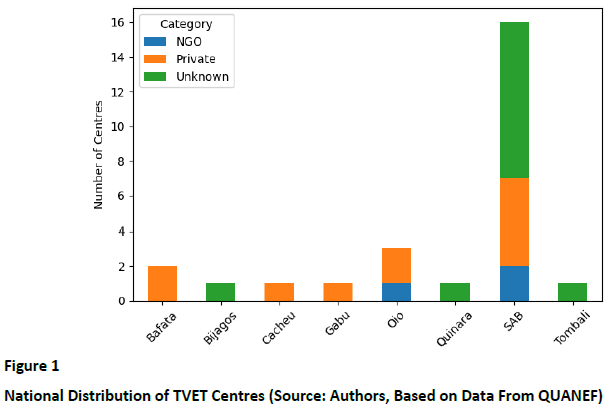
An analysis of training centres registered in the QUANEF database provides further insight into the institutional configuration and territorial distribution of TVET provision in Guinea-Bissau. Focusing on the 33 identified training centres, Figure 1 reveals a highly uneven and fragmented training landscape characterised by a strong concentration in the capital region (Sector Autónomo de Bissau, SAB) and a dominant role of non-state actors.
As shown in Figure 1, TVET provision is overwhelmingly concentrated in the SAB, which hosts most of the identified training centres. This spatial concentration reflects broader patterns of infrastructural inequality and centralisation of educational services, reinforcing disparities in access to vocational training across the country. Beyond spatial distribution, the institutional composition of training centres further illustrates the system's fragmentation. A detailed classification of centres into public, private, and NGO/civil society providers indicates that non-state actors dominate TVET provision. Private institutions and NGO-led centres account for most of the training provision, while clearly identifiable public institutions represent only a small fraction of the total. This distribution underscores the state's limited capacity to serve as the primary provider and coordinator of vocational training. In addition, a substantial proportion of centres fall into an "unknown" category due to the absence of clear institutional classification in the available data. Rather than being a purely technical limitation, this lack of information indicates weak regulatory oversight and incomplete system registration, and reflects the broader institutional challenges affecting the TVET sector.
Importantly, the spatial and institutional patterns observed in Figure 1 also help explain the limited impact of TVET on employment outcomes. The concentration of training opportunities in urban areas, particularly in Bissau, restricts access for rural populations, where most economic activity is concentrated. At the same time, the fragmentation of provision and the absence of standardised certification mechanisms weaken the signalling value of vocational qualifications in the labour market. In this context, TVET functions less as an integrated system supporting labour market transitions and more as a collection of dispersed initiatives operating within a structurally constrained economic environment.
Training Provision and Sectoral Mismatch
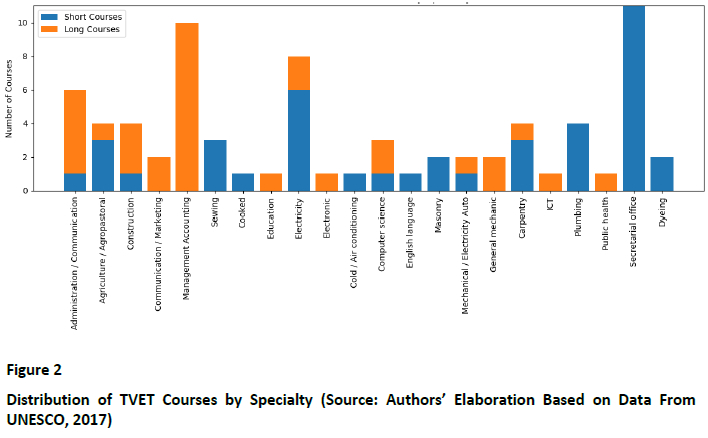
An analysis of training offers reveals a marked mismatch between TVET provision and the structure of the labour market. Although agriculture employs most of the working population and constitutes the backbone of the national economy, agricultural and agropastoral training remains marginal within the TVET system, as shown in Figure 2. Conversely, a large share of training is concentrated in administrative, accounting, and service-oriented fields, despite limited absorption capacity in the formal sector.
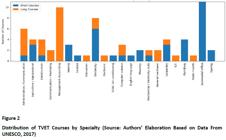
Courses are predominantly organised around theoretical instruction, with limited emphasis on competency-based training, soft skills, critical reflexivity, or sustained workplace learning. Internships, where available, are often short and weakly integrated into curricula. Training pathways are not articulated vertically, requiring trainees to restart training rather than build upon previously acquired skills.
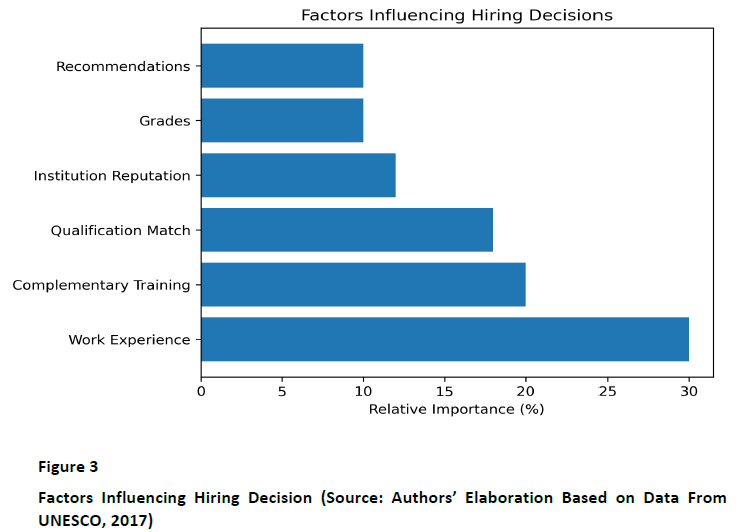
The relationship between training and employment remains weak in Guinea-Bissau, particularly in relation to technical and vocational education. Evidence from employer surveys, presented in Figure 3, indicates that vocational training is not a primary source of recruitment for firms. Instead, employers prioritise prior work experience, informal learning, and complementary training when hiring workers, while formal TVET qualifications play a relatively marginal role (UNESCO, 2017).
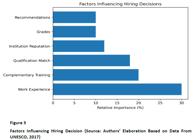
This pattern suggests that the signalling value of vocational credentials in the labour market is limited, reflecting both the weak institutionalisation of certification systems and the misalignment between training provision and employer needs. Recruitment decisions are also influenced by factors such as practical experience, reputation of training institutions, and perceived job readiness, further highlighting the importance of experiential learning over formal qualifications.
This finding reinforces the broader argument that TVET operates within a structurally constrained labour market. In a context where employment is largely informal, and firms rely on practical skills acquired outside formal training systems, vocational education struggles to establish itself as a credible pathway to employment. The limited role of TVET in recruitment reflects not only deficiencies in training provision, but also the absence of strong institutional linkages between training centres and the productive sector. This configuration reflects a supply-driven logic, shaped by institutional constraints and donor priorities rather than systematic assessments of labour market demand.
NGOs as Compensatory Actors in a Fragmented System
In the absence of a coherent and well-coordinated public TVET system, NGOs have emerged as key actors in providing vocational training in Guinea-Bissau. The most prominent are the School of Arts and Crafts of Quelélé, operated by AD, a national NGO, and the vocational training centre of Bissorã, managed by ADPP, an international NGO leading similar schools in other countries. These institutions illustrate both the potential and the limitations of NGO-led training in a context of institutional fragmentation and labour market informality.
The School of Arts and Crafts of Quelélé, established in 2001 in a peripheral neighbourhood of Bissau and conceived as an urban training centre, later expanded through its association with the São Domingos Rural Training Centre, reflecting an effort to reach more rural populations. The centre offers a diverse range of short- and medium-term courses, including accounting, administration, construction, electricity, information technology, sewing, and agricultural processing (AD, 2019). While the training offer spans both technical and service-oriented fields, it is also shaped by resource availability and institutional capacity, rather than systematic labour market analysis.
A defining feature of the Quelélé centre is the integration of practical training components, including mandatory internships across all courses. This emphasis on experiential learning distinguishes it from more theory-oriented public provision and reflects an effort to enhance trainees' employability. The centre also plays a significant role in early childhood education, having long served as the country's primary institution for training pre-school monitors. In recent years, entrepreneurship modules have been incorporated into the curriculum, signalling a shift towards promoting self-employment in a context where formal job opportunities are limited.
Despite these strengths, the training model remains constrained by structural factors. Course accessibility is shaped by tuition fees, which vary significantly across specialisations, potentially limiting participation for lower-income groups. Moreover, while the centre attracts trainees from across the capital region, its reach remains largely urban, reflecting broader territorial inequalities in access to training. Overall, the Quelélé experience illustrates how NGO provision can enhance training quality and diversify opportunities, while remaining embedded in a system characterised by limited coordination and uneven access.
The ADPP vocational training centre in Bissorã provides a complementary model, operating in a rural context and targeting a different socio-economic profile of trainees. Established in 1997 and functioning as a boarding institution, the centre has trained over 1,500 young people, primarily from rural areas. Its training offerings are more closely aligned with productive sectors, including agriculture, construction, energy systems, and water infrastructure, as well as management and administrative training (ADPP, 2019). This sectoral orientation suggests a stronger connection to local economic activities, particularly in agriculture and basic services. In addition to technical training, the centre places significant emphasis on collective organisation and entrepreneurship, encouraging graduates to form cooperatives and pursue self-employment. However, gender disparities remain pronounced. Women represent a relatively small proportion of trainees, and their participation is uneven across sectors, with limited presence in technical and higher-income fields (ADPP-GB, 2019). This pattern reflects broader gender segmentation within both the training system and the labour market.
Taken together, these two case studies highlight the dual role of NGOs in the Guinean TVET landscape. On the one hand, they act as sites of innovation, introducing practical training, internships, and entrepreneurship-oriented approaches that are often absent in public provision. On the other hand, their impact remains structurally constrained. Their programmes are rarely integrated into national certification structures, and the broader economic context limits their capacity to influence labour market outcomes.
These findings reinforce the argument that improving training provision alone is insufficient to address the challenges of employment and productivity in Guinea-Bissau. While these successful NGO-led initiatives demonstrate adaptive capacity and local responsiveness, their effectiveness ultimately depends on supportive institutional frameworks and labour market opportunities. In the absence of these conditions, they function primarily as compensatory mechanisms within a structurally constrained skills system.
Discussion: Rethinking TVET in Informal and Fragile Economies
The pedagogical approach underpinning the Máximo Gorki Centre resonates with broader critical traditions in education that emphasise the relationship between knowledge, production, and social transformation. In particular, the integration of literacy, technical training, and community engagement reflects Paulo Freire's conception of education as a praxis linking critical reflection and action. While developed in a specific post-independence context, this model anticipates later critiques of vocational education that question the assumption that the acquisition of skills alone leads to employment. The closure of the Máximo Gorki Centre and the subsequent evolution of TVET in Guinea-Bissau reveal a striking paradox. Although the Freirean-inspired experiment of the immediate post-independence period left little direct institutional legacy within the country's vocational training system, many of the concerns that informed it have resurfaced in contemporary critiques of TVET. The development of technical and vocational education in Guinea-Bissau proceeded largely independently of Freirean pedagogy, becoming increasingly influenced by technocratic, competency-based, and donor-driven approaches centred on employability, entrepreneurship, and skills provision. As a result, the relationship between education, productive activity, and social transformation that characterised the Máximo Gorki experience gradually disappeared from policy and institutional practice.
However, the limitations of contemporary TVET identified in this study echo many of the issues that Freire sought to address. Freire rejected conceptions of education that treated learners as passive recipients of knowledge and argued instead for educational processes rooted in learners' lived realities, productive activities, and collective agency (Freire, 1978, 2018). Similarly, recent scholarship has challenged the assumption that vocational training can generate employment and development simply through the transmission of technical skills. Political economy approaches emphasise that training outcomes depend on labour market structures, institutional coordination, and broader economic opportunities (Allais, 2022; McGrath & Yamada, 2023), while critical perspectives highlight the importance of learner agency, citizenship, and social participation (Majola, 2025), reinforcing the relevance of revisiting historically grounded models of education-labour integration.
The analysis of TVET in Guinea-Bissau highlights a fundamental disconnect between the expectations placed on vocational training and the structural conditions under which it operates. While TVET is widely promoted as a solution to youth unemployment and economic stagnation, the findings suggest that its limited impact is rooted less in deficiencies of training quality than in the broader political economy of labour markets and state capacity. First, the Guinean case illustrates how TVET expansion in highly informal economies risks reinforcing segmented labour markets rather than facilitating upward mobility. In the absence of a dynamic formal sector and enforceable certification mechanisms, vocational qualifications carry limited signalling value for employers. As a result, training often leads to informal self-employment or underemployment rather than stable wage employment.
Second, the persistent mismatch between training provision and labour market structure underscores the limitations of supply-driven approaches to skills development. The predominance of training in administrative and service-oriented fields-delivered in a largely uncritical and routinised manner-together with the neglect of agricultural and rural training, reflects institutional inertia and donor-driven priorities rather than actual labour market demand. This misalignment contributes to graduate underemployment and weak productivity gains.
Third, the prominent role of private actors and NGOs reveals both the adaptability and the fragility of non-state provision. NGO-led training centres have demonstrated an ability to innovate and respond to local needs, particularly in contexts of state withdrawal. However, their dependence on external funding and their weak integration into national systems limit their scalability and sustainability. Rather than resolving systemic weaknesses, NGO provision often operates as a parallel subsystem.
Fourth, gender disparities in training remain pronounced. Women represent a relatively small proportion of trainees, and their participation is highly uneven across sectors, with limited representation in technical, industrial, and higher-income fields such as construction, mechanics, electronics, and renewable energy (ADPP-GB, 2019). Instead, female trainees are concentrated in traditionally feminised areas such as childcare, sewing, food processing, and domestic services, reflecting broader patterns of occupational segregation within both the training system and the labour market. This segmentation has important implications for employment outcomes, as training pathways associated with male-dominated sectors tend to offer greater opportunities for income generation. In contrast, sectors with higher female participation are often characterised by lower productivity, lower earnings, and greater exposure to informal and precarious forms of work. As a result, TVET may inadvertently reproduce existing gender inequalities by channelling women into occupations with limited economic returns rather than expanding their access to higher-value activities.
The findings further demonstrate that TVET operates in a context of weak state capacity, fragmented governance, and labour markets dominated by informality. In such conditions, vocational training struggles to function as a credible pathway to stable and productive employment. The analysis reveals a persistent mismatch between training provision and labour market structure. While agriculture and informal activities employ most of the population, TVET offerings remain concentrated in administrative and service-oriented sectors with limited absorption capacity. This supply-driven configuration reflects institutional constraints and donor-driven priorities rather than systematic assessments of labour demand. As a result, TVET often channels trainees into low-productivity self-employment or segmented informal activities, rather than supporting upward mobility or contributing to structural transformation.
Taken together, these findings challenge the assumption that expanding TVET supply constitutes an effective stand-alone strategy for reducing youth unemployment and promoting development in fragile and highly informal economies. The Guinea-Bissau case illustrates that, in the absence of a minimally formalised labour market and coherent institutional coordination, TVET risks reproducing existing inequalities while delivering limited productivity gains.
Conclusion
This paper set out to examine why TVET, despite sustained policy attention and international support, has delivered limited labour-market impact in Guinea-Bissau. By analysing the structure of the TVET system, its historical foundations, institutional configuration, and relationship with a predominantly informal labour market, the study shows that the constraints faced by TVET are not merely technical or pedagogical, but fundamentally structural and political.
The contrast between historical and contemporary models of skills formation highlights the limitations of supply-driven approaches to vocational education. While contemporary TVET policies often assume that expanding training provision will improve employment outcomes, this study shows that training alone cannot compensate for weak labour demand, pervasive informality, and limited institutional capacity. Consistent with recent political economy analyses of skills development (Allais, 2022; McGrath & Yamada, 2023), the Bissau-Guinean case demonstrates that the effectiveness of vocational education depends on its articulation with broader economic and social structures.
The Máximo Gorki experience offers an important historical counterpoint. Rather than treating skills acquisition as an end in itself, it linked education to production, community life, and social transformation. Although this model left little institutional legacy within the contemporary TVET system, its underlying principles resonate with current critiques of narrowly technocratic approaches to skills development. Recent scholarship has similarly emphasised the importance of learner agency, citizenship, and participation in vocational education (Majola, 2025), suggesting that the value of TVET extends beyond employability alone. The implications extend beyond Guinea-Bissau. Effective TVET reform requires more than improved governance, qualification frameworks, or curriculum design. It also demands a closer integration between skills formation, labour market realities, and broader development strategies. Re-engaging with the transformative dimensions of vocational education while addressing structural constraints related to informality, economic diversification, and state capacity may offer a more sustainable foundation for skills development in fragile contexts.
Future research would benefit from longitudinal studies tracking the employment trajectories of TVET graduates, as well as comparative analyses across fragile and post-conflict contexts. By combining structural, institutional, and pedagogical perspectives, this paper contributes to a more critical and comprehensive understanding of the role of skills formation in development, highlighting both the limits of current approaches and the potential of alternative models grounded in social transformation.
Ação para o Desenvolvimento. (2019). Relatório de atividades da Escola de Artes e Ofícios do Quelélé [Activity report of the Quelélé School of Arts and Crafts] [Unpublished report].
African Continental Qualifications Framework. (2022). Guiné-Bissau country mapping report 2022: Relatório de mapeamento de preparação para o quadro nacional de qualificações [Mapping report on readiness for the national qualifications framework].
African Development Bank Group. (2022). Guinea-Bissau: Bank group country strategy paper 2022-2026. https://www.afdb.org/sites/default/files/documents/projects-and-operations/guinea_bissau_-_country_strategy_paper_2022-2026_0.pdf
Ajuda de Desenvolvimento de Povo para Povo-Guiné-Bissau. (2019). Estudo analítico do impacto geral do programa contínuo da ADPP-GB no setor da capacitação técnica e vocacional: Escola de Formação Vocacional de Bissorã [Analytical study of the overall impact of the ADPP-GB continuous programme in the technical and vocational training sector: Bissorã Vocational Training School] [Unpublished report].
References
- Allais, S. (2022). Skills for industrialisation in sub-Saharan African countries: Why is systemic reform of technical and vocational systems so persistently unsuccessful? Journal of Vocational Education & Training, 74(3), 475-493. https://doi.org/10.1080/13636820.2020.1782455
- Barreto, A., & Carvalho, C. (2022). Paulo Freire na Guiné-Bissau: Um olhar sobre a Escola de Formação de Professores Combatentes da Liberdade da Pátria-Centro Máximo Gorki [Paulo Freire in Guinea-Bissau: A look at the School for the Training of Teachers, Combatants for the Freedom of the Homeland-Centro Máximo Gorki]. Sinergias: Diálogos Educativos para a Transformação Social, 13, 59-77. https://sinergiased.org/wp-content/uploads/2022/02/Sinergias_13.pdf
- Betcherman, G., & Khan, T. (2018). Jobs for Africa's expanding youth cohort: A stocktaking of employment prospects and policy interventions. IZA Journal of Development and Migration, 8, Article 13. https://doi.org/10.1186/s40176-018-0121-y
- Borges, S. V. (2019). Militant education, liberation struggle, consciousness: The PAIGC education in Guinea-Bissau, 1963-1978. Peter Lang.
- Freire, P. (1978). Cartas à Guiné-Bissau: Registros de uma experiência em processo [Letters to Guinea-Bissau: Records of an Experience in Progress]. Paz e Terra.
- Freire, P. (2018). Pedagogia do oprimido [Pedagogy of the oppressed]. Afrontamento. (Original work published 1968)
- International Labour Organization. (2021). Promoting social cohesion and peaceful coexistence in fragile contexts through TVET: Guide for TVET practitioners. https://www.ilo.org/sites/default/files/wcmsp5/groups/public/@ed_emp/@emp_ent/documents/publication/wcms_791844.pdf
- Iscte-Instituto Universitário de Lisboa. (n.d.). Ethics in research: Best practices, best science. Code of ethical conduct, guideline documents, tools and practical models, and suggested activities. https://www.iscte-iul.pt/assets/files/2022/01/24/1643046250963_Code_of_Ethical_Conduct_in_Research_ISCTE.pdf
- Kilimani, N. (2017). Youth employment in developing economies: Evidence on policies and interventions. Institute of Development Studies. https://hdl.handle.net/20.500.12413/12987
- Koudawo, F. (1996). A educação começa pela escola: Educação do PAIGC versus educação colonial [Education begins with the school: PAIGC education versus colonial education]. In C. Cardoso & J. Augel (Eds.), Guiné-Bissau: Vinte anos de independência (pp. 67-78). Instituto Nacional de Estudos e Pesquisas.
- Levin, V., Santos, I. V., Weber, M., Iqbal, S. A., Aggarwal, A., Comyn, P. J., Katayama, H., & Hoftijzer, M. A. (2023). Building better formal TVET systems: Principles and practice in low- and middle-income countries. World Bank. http://documents.worldbank.org/curated/en/099071123130516870
- Macedo, F. (1976). A educação na República da Guiné-Bissau [Education in the Republic of Guinea-Bissau]. Editorial Franciscana.
- Majola, E. (2025). Reimagining TVET in South Africa: Student agency, conscientisation, and a Freirean pedagogy of transformation. Journal of Vocational Education & Training. Advance online publication. https://doi.org/10.1080/13636820.2025.2585513
2 In addition, field visits and informal discussions were conducted in other vocational institutions and the coordination centre for TVET. While these visits provided valuable insights into institutional functioning and training provision, access to administrative records and training statistics was restricted or inexistant. These observations were therefore used primarily to contextualise findings derived from other sources.