Success as a relational and structurally mediated process: A narrative inquiry of a Black African student in South Africa
Abstract
This narrative inquiry challenges individualist understandings of "student success" in South African higher education. Centring the experiences of a Black African woman from Lesotho in a clinically oriented programme, the study conceptualises success as relational, culturally grounded, and shaped by structural conditions. Using Ubuntu/Botho and a structure-agency lens informed by Mills' sociological imagination and Critical Realism, the analysis shows how funding systems, policy exclusions, and racialised microcultures constrain opportunity, while mentoring, communal study, spirituality, and family support enable situated agency. Three themes are explored: navigating structural barriers and institutional opacity, cultivating belonging through communal and relational practices, and mobilising cultural, spiritual, and narrative resources for resilience. The study argues that success is co-produced within unequal terrains and carries embedded values. It calls for universities to stabilise structural basics, institutionalise mentoring and collaboration, address digital inequities, and integrate plural care systems to build equitable, relational infrastructures of support.
higher education transformation; narrative inquiry; structure-agency; student success; Ubuntu/Botho
Introduction
South African universities have intensified efforts to improve retention and graduation, often relying on metrics that equate "success" with throughput, Grade Point Average (GPA), and time-to-degree. While useful for accountability, such metrics flatten the affective, cultural, and relational dimensions of students' journeys and risk reinscribing a hyper-individualist imaginary of achievement. Our study addresses this gap by re-centring student voice as epistemology and theorising success as a relational accomplishment within structurally unequal contexts.
We analyse a reflective narrative by a Black African woman from Lesotho, read as a lens onto broader public issues rather than an isolated biography. This approach foregrounds how bureaucratic opacity, funding policies, racialised microcultures, and curricular disruptions generate uncertainty and precarity, while mentoring, communal study, familial support, and spirituality mediate belonging and persistence, particularly in a historically White university (HWU) context in South Africa.
Conceptually, we integrate Ubuntu/Botho with a structure-agency framing (Mills and Critical Realism, see below) to argue that "success" is not value-neutral but socially produced and institutionally mediated. This reorientation both critiques deficit logics and offers a relational model of success grounded in African epistemologies and lived experience.
The article firstly advances a theoretically coherent synthesis that centres relationality without overloading the frame by integrating Ubuntu/Botho with a structure-agency lens grounded in Mills' sociological imagination and Critical Realism (Bhaskar, 1998; Letseka, 2012; Mills, 1959); secondly, offers a fine-grained, context-attuned analysis of success under HWU conditions, revealing how bureaucratic opacity, racialised microcultures, and policy exclusions shape student experience (Ahmed, 2012; Boughey & McKenna, 2021); and thirdly proposes actionable institutional implications that move beyond celebrating individual "grit" toward cultivating relational infrastructures of equity and care, consistent with scholarship on communal resilience, belonging, and relational pedagogy (Rendón, 2006; Schreiber & Yu, 2016).
Theoretical Framework
The article is framed by two theoretical approaches. Each of which will be discussed below.
Ubuntu/Botho and African communal epistemologies
Ubuntu/Botho asserts that personhood and flourishing are realised through others' knowledge, resilience, and identity, coexisting within networks of recognition, obligation, and care (Letseka, 2012; 2013; Metz, 2011). From this perspective, individual achievement cannot be separated from communal relations, shared responsibility, and mutual affirmation. This lens reframes mentoring as relational stewardship and resilience as a communal resource, aligning interpretively with the participant's practices of belonging, reciprocity, and service, sustained through collective support, moral obligation, and interdependence (Ige, 2010; Schumann, 2016). This reciprocity, relational accountability, situating persistence and success within African communal epistemologies rather than hyper-individualist models of agency (Boughey & McKenna, 2021; Nyamnjoh, 2012).
Structure-Agency: Mills' sociological imagination and Critical Realism
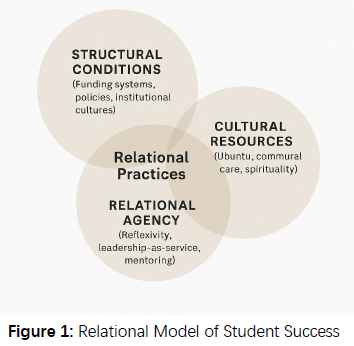
We combine Mills' (1959) sociological imagination, which links personal troubles to public issues, with Critical Realist analyses of structural, cultural, and agential domains. This clarifies how funding systems, bureaucratic rules, and racialised organisational histories (structure) condition possibilities; how Ubuntu/Botho, spirituality, and communal values (culture) mediate meaning; and how reflexivity, mentoring, and leadership-as-service (agency) are enacted within unequal terrains.
In this framing, the absence or presence of "communal resistance" is not itself a structural variable. It is an agential response, enabled and constrained by structures, yet realised through culturally mediated practices of solidarity. In HWU spaces where microcultures of racial exclusion persist, communal practices operate as counter-infrastructures of belonging rather than as evidence of structural sufficiency.
While Communities of Practice (CoP) (Lave & Wenger, 1991) helps describe collaborative learning, we do not retain it as a principal theoretical pillar because the normative and political edge of the argument rests on Ubuntu/Botho and structure-agency. CoP language may appear descriptively in discussions of collaborative learning, but the explanatory and critical burden lies with the two-strand framework above.
Similarly, the argument engages critiques of deficit logic via Bourdieu's (1983) social and cultural capital (used here cautiously, to avoid reifying "lack") and aligns with O'Shea's (2016) warning against the "manufacture of sameness" in first-in-family research, where institutional narratives erase background and cultural history. These touchstones strengthen the claim that "success" is not value-free and must be analysed at the nexus of structure, culture, and agency (Bourdieu, 1983).
Research methods
We adopt narrative inquiry to illuminate how success is co-constructed across intersecting fields of constraint, belonging and agency. Narrative inquiry foregrounds the meanings students assign to relationships, transitions, and institutional life, enabling analysis of affect, identity, and epistemic positioning that are often flattened by metric-driven success models (Clandinin & Connelly, 2000; Riessman, 2008).
Participant and data generation
The study centres the reflective narrative of a Black African woman from Lesotho who completed a BSc in Audiology at a South African HWU, with narratives authored across four years and supplemented shortly after graduation. Prompts focused on transition, dislocation, mentorship, identity, and leadership.
Epistemological positioning
The participant is treated as a co-theorist, consistent with African oral traditions and indigenous epistemologies that regard storytelling as theory-bearing practice. This resists extractive qualitative tendencies and affirms voice, agency, and self-representation.
Analysis
We used a thematic-narrative approach (Braun & Clarke, 2006), combining holistic and close readings to attend to sequencing, metaphor, tone and voice. Initial coding worked across four conceptual domains-structural constraints, cultural identity, and epistemic belonging, community and mentorship, agency and transformation refined iteratively through dialogue between data, literature and the two-strand framework. Themes were constructed for their explanatory leverage rather than selected by frequency.
Ethics
Ethical approval was obtained from UCT's Health Sciences Research Ethics Committee (HREC). The participant gave written informed consent and retained the right to review, revise or withdraw narrative excerpts. Beyond compliance, we adopted relational accountability, emphasising mutual respect, care and shared decision-making across the project's stages.
Findings
We present three interwoven themes that explicate how structural constraints, cultural resources, and relational practices shape the participant's experience of success within an HWU context (Archer, 1995; 2023; Bhaskar, 1998; Boughey & McKenna, 2021; Ige, 2010; Luckett & Shay, 2020; Riessman, 2008; Schumann, 2016).
Confronting structural barriers and institutional opacity
The narrative traces precarious access, bureaucratic delays, contradictory funding conditions, misaligned policies (including the exclusion of international students from compulsory community service), and the anxieties of high-stakes clinical assessment. These factors made success feel contingent, "accidental", and emotionally costly, even amid high academic performance.
The student's narrative begins with a deep sense of precarity. Registration was jeopardised by complications with conditions linked to her Lesotho government bursary. As she recalls,
I almost didn't make it.
This early disruption underscores how access for low-income, first-generation, and international students is conditional and fragile, rather than guaranteed. Such experiences resonate with Ahmed's (2012) critique of institutional "non-performativity", where processes appear supportive in principle but fail in practice. Her first year was marked by bureaucratic delays and the opacity of academic systems, heightening feelings of disorientation:
Without the usual comparisons to peers, I stayed on top of my academic responsibilities ... Knowing that unfinished tasks would accumulate into the next day drove me to remain disciplined.
In the absence of institutional scaffolding, she internalised responsibility for navigating complexity, illustrating how students often compensate for structural shortcomings through private acts of discipline and self-regulation.
Even academically intensive modules demanded self-generated strategies:
Understanding that 'orbicularis oculi' translates to 'the circular muscle of the eye' made the material more logical.
While this 'knowledge behind the knowledge' offered temporary mastery, its necessity reveals how structural gaps in pedagogical support are offloaded onto individual ingenuity.
This sense of precarity deepened as she realised her degree choice did not align with her initial aspirations:
As the year progressed, I struggled with feelings of being in the wrong program ... Watching [medical students] pursue the degree I had initially aspired to made me feel envious and angry.
Here, structural constraints, financial responsibilities, limited programme mobility, and policy exclusions collided with personal hopes, unsettling her sense of belonging.
Her greatest rupture came upon discovering that international students are excluded from South Africa's compulsory community service year:
This revelation left me feeling hopeless about my future career prospects.
This policy exclusion, an institutional decision about who is entitled to state-supported pathways, sharply illustrates the racialised and nationalised boundaries of professional recognition.
Financial obligations rendered withdrawal impossible:
To be eligible for future sponsorship, I would first have to repay the funds already allocated ... something my family simply could not afford.
Here, persistence is revealed not as heroic "grit" but as an endurance produced by constraint, echoing Ahmed's (2012) argument that endurance is often misread as individual resilience rather than evidence of systemic failure.
Family encouragement offered emotional anchoring:
My father reinforced the importance of seizing the opportunity to get a good education while he was alive and able to support me.
Such moments illustrate how familial and communal care complicate hyper-individualist framings of resilience.
Even as she excelled academically, earning class medals, Dean's List recognition, and leadership roles, self-doubt persisted:
I never thought my efforts merited recognition ... it was difficult to gauge my progress compared to my peers.
Institutional opacity made success feel accidental rather than cultivated.
Later, clinical placements introduced new forms of vulnerability:
I often tried to deflect attention away from myself ... fearing my lack of competence would be exposed.
This illustrates how high-stakes assessment cultures intensify insecurity, even for high-achieving students.
Across her narrative, the student reveals what can be understood as a "hidden survival curriculum": Deciphering opaque systems, stretching limited resources, masking uncertainty, and absorbing institutional failures while maintaining the appearance of competence. Such burdens are disproportionately borne by students navigating HWU cultures from the margins. Crucially, her account resists romanticising struggle. Rather than celebrating endurance, it marks structural violence and institutional neglect, calling for university cultures that replace opacity with transparency and precarity with care.
Cultivating belonging through communal and relational practices
Belonging was not produced primarily by formal structures but by peer mentoring, communal study, leadership-as-service and culturally resonant support. These relational ecosystems offered affirmation, recognition and practical navigation, functioning as counter-infrastructures where institutional support was uneven or opaque.
For the student, belonging and resilience were not primarily cultivated through formal academic structures but through student-led spaces of care, peer mentorship, and communal learning practices. These relational ecosystems provided what the institution did not consistently offer. Affirmation, recognition, and culturally resonant forms of support (Du Toit-Brits, 2022; Gershenfeld, 2014; Le, et al., 2024). As she explained,
My mentor was a first-year Audiology Master's student at the time ... she frequently checked in on me to see how I was coping. Despite her support, I often downplayed any challenges, assuring her that I was fine because I did not want to appear as though I was struggling."
This tension between needing support and hesitating to reveal vulnerability reflects the emotional negotiation often required to survive hierarchical and racialised university spaces.
Her early involvement in the Lesotho Students Association (LeSA) further deepened her sense of belonging. Leadership roles enabled her to organise mentorship pairings, facilitate exam-preparation talks, and coordinate social events that nurtured the community. These responsibilities were both empowering and demanding. As she reflected,
I initially believed leadership was about appearing to be the most knowledgeable ... Over time, I realised that the vanity of wanting to be perceived as excellent by onlookers wasn't enough to sustain me ... I decided to have a fresh start, reflecting more deeply on why I chose certain roles.
This reflexive shift from leadership as performance to leadership as service echoes Ubuntu's emphasis on interdependence, relational accountability, and shared flourishing (Letseka, 2012; Nabudere, 2006).
Communal study circles became essential amid the disruptions of COVID-19. With the return to in-person teaching, she recognised the value of embodied presence:
Hearing the lecturer explain concepts in real time proved invaluable.
Yet it was peer companionship walking to class together, studying late in the library, and checking in on each other's well-being that cultivated confidence and sustained motivation. These "micro-practices of care" illustrate the significance of peer collectives as informal infrastructures of resilience within alienating institutional environments. Scholarship underscores that such relational and affective resources are central to persistence, particularly for students navigating historically exclusionary spaces (Rendón, 2006; Schreiber & Yu, 2016).
By her final year, collaborative learning had become central to her academic life. Reflecting on exam preparation, she explained:
My classmate helped fill gaps in my knowledge, and I did the same for her ... Looking back, I wish I had embraced collaborative learning earlier.
Collaboration reconfigured her understanding of success as shared rather than individual, aligning with African communal epistemologies that locate knowledge within relationships rather than within atomised individuals (Ige, 2010; Schumann, 2016).
This theme reveals a dual dynamic: while communal learning and mentorship affirmed and sustained her, they simultaneously highlighted institutional gaps where formal systems failed to offer adequate support. In this sense, student-led practices operate both as acts of resilience and as subtle critiques of institutional neglect, embodying African-centred understandings of success as a collective, relational, and culturally grounded accomplishment (Bomoyi & Mkhize, 2016; Boughey & McKenna, 2021; Nyamnjoh, 2012).
Mobilising cultural, spiritual, and narrative resources for resilience
Resilience appears as a culturally situated, relational achievement sustained by spirituality, counselling, paid clinical exposure, church-based small groups, and later, near-peer mentorship, translating support received into support offered. This plural epistemology of healing and growth challenges the centring of purely Western psychological models.
The student's narrative demonstrates that resilience is not an individual psychological trait but a culturally situated, relational, and narratively sustained practice. Her initial misconceptions about Audiology, coupled with watching medical students pursue paths she once imagined for herself, left her feeling disoriented:
These emotions gradually pushed me into a depressive state.
Here, the fragility of belonging emerges as institutional expectations collide with personal histories and aspirations.
Her sense of alienation deepened upon learning that international students are excluded from South Africa's compulsory community service placements:
This revelation left me feeling hopeless about my future career prospects.
Policy exclusions of this nature reflect broader structural and nationalised boundaries of professional recognition, aligning with critiques of institutional inequity and non-performativity (Ahmed, 2012). Yet she mobilised relational resources to navigate this crisis. After confiding in her mentor, she approached her course convenor, who arranged opportunities to shadow senior students. This highlights how relationally engaged institutional actors can disrupt trajectories of withdrawal and re-anchor students within the academic project.
Her narrative is also marked by profound personal loss:
At the start of the second semester, I received the news that my father had passed away … I began attending counselling sessions ... I also experienced a spiritual transformation during this period.
This reflection highlights a plural epistemology of healing, one that holds spirituality and psychological counselling together rather than in opposition. Such hybridity challenges the academy's privileging of Western psychological models and resonates with African epistemic traditions that recognise spirituality, relational support, and collective care as central to wellbeing (Ige, 2010; McLean & Walker, 2012).
Resilience continued to crystallise through embodied and communal practices. Working weekends at an audiology practice enhanced her confidence in clinical tasks, while joining a church small group provided community and routine. She explained,
I discovered it was much easier to focus and stay productive in someone else's presence … ... This experience taught me the importance of having a support system.
Such co-presence aligns with literature highlighting the importance of relational accountability and collective dignity in African research and learning spaces (Wilson, 2008).
Her subsequent role as a near-peer mentor further demonstrates resilience as relational continuity:
I drew heavily from the guidance and practices I had observed in my own mentors ... I frequently consulted my mentors for advice on creating a safe space for my mentees.
This recursive movement aligns with the support offered, reflecting Ubuntu's emphasis on interdependence, reciprocity, and communal care (Letseka, 2012; Schumann, 2016).
Her story ultimately reveals resilience as an assemblage of cultural, spiritual, personal, and communal practices that resist alienation and reimagine belonging within an HWU context. In doing so, she constructs an alternative ontology of success grounded in family, spirituality, mentorship, and collective care, unsettling the institution's dominant narratives of individualised achievement (Boughey & McKenna, 2021; Nyamnjoh, 2012).
Critical reflections
The findings unsettle dominant framings of student success that equate achievement with throughput, grades, or linear "grit" narratives. Rather than a stable endpoint or individual accomplishment, success emerges as fragile, relational, and continually negotiated, shaped by the interplay of structural barriers, communal solidarities, and cultural-spiritual resources. This resonates with the paper's broader critique of hyper-individualist success metrics in South African higher education, where institutional cultures often overlook the relational, affective and contextual dimensions of student experience.
From the outset, the student's access to university was precarious rather than guaranteed. Registration delays caused by NSFAS processes and conditions attached to a Lesotho government bursary gave rise to the early fear that "[she] almost didn't make it", a moment that exemplifies Ahmed's notion of institutional non-performativity, where procedures exist in principle but fail in practice. Once admitted, institutional opacity deepened insecurity. Lacking clear scaffolding or peer reference points, the student relied on private discipline, as she stated "[k]nowing that unfinished tasks would accumulate into the next day drove [her] to remain disciplined". This reveals how achievement is sometimes secured through self-regulation within neglect rather than supportive academic environments.
These structural exclusions extended beyond logistics into policy barriers. Discovering that international students are barred from South Africa's compulsory community service year left the participant "hopeless about [her] future career prospects", illustrating how nationalised boundaries of professional recognition exacerbate inequity. Financial precarity intensified these pressures: withdrawal was impossible because repayment of bursary funds would have devastated her family. In this light, what is often celebrated as "resilience" appears instead as endurance under constraint, an index of systemic failure rather than an expression of heroic individual strength (cf. Ahmed, 2012).
Against this backdrop of uncertainty and exclusion, relational and communal solidarities emerged as counter-infrastructures of belonging. A first-year Master's mentor "frequently checked in," even though the student often "downplayed any challenges" to avoid appearing as if she were struggling. Over time, peer mentorship and collective practices deepened connection and transformed her understanding of leadership, from performance and status to service, echoing Ubuntu's ethic of interdependence and reciprocity.
Communal study groups further altered her academic trajectory, as "[her] classmate helped fill gaps in [her] knowledge, and [she] did the same for her [friend] ... Looking back, [she] wish[es] [she] had embraced collaborative learning earlier". These micro-practices of mutual care, often invisible in institutional accounts, operated as essential infrastructures of survival, learning and shared meaning-making.
Her cultural inheritance and spirituality also functioned as vital epistemic resources. Following her father's passing, she engaged both counselling and spiritual renewal. Her questioning whether it was "psychology that helped, or ... the spiritual transformation?" reveals a plural epistemology of healing that challenges the university's privileging of purely Western psychological models and affirms African traditions of communal and spiritual meaning-making.
Familial care provided further grounding and intergenerational purpose, as she mentioned that "[her] father reinforced the importance of seizing the opportunity to get a good education." Later, as a near-peer mentor, she transformed support received into support offered, as she "frequently consulted her] mentors for advice." And later tried to create "a safe space for [her] mentees", exemplifying relational continuity and the recursive nature of Ubuntu-informed care.
Taken together, these reflections caution against romanticising resilience as individual grit. Instead, the narrative reframes resilience as a relational response to opacity, precarity and exclusion, made possible by the relational, cultural and spiritual infrastructures that sustained the student's persistence. In this light, success is not the student's burden to achieve alone. It becomes the institution's obligation to host, sustain and recognise, consistent with the study's two-strand framework in which Ubuntu/Botho supplies cultural and relational resources, and a structure-agency lens clarifies how those resources are mobilised within unequal institutional terrains.
Discussion
From personal troubles to public issues
Reading the narrative through Mills' (1959) sociological imagination illuminates how the participant's personal troubles, including uncertainty, grief and self-doubt, are deeply entangled with public issues such as funding architectures, policy exclusions, digital inequities and racialised microcultures within historically white university (HWU) contexts. These interlocking forces make visible that student "success" is not value-free, but is shaped by institutional arrangements and wider political-economic logics (Ahmed, 2012; Boughey & McKenna, 2021).
Beyond hyper-individualism: A relational, Critical Realist synthesis
A Critical Realist framing helps clarify how structural mechanisms precondition the possibilities available to students, how cultural resources, such as Ubuntu/Botho, spirituality, and communal practices, mediate meaning, and how agency is enacted through reflexivity, mentoring, and leadership-as-service (Bhaskar, 1998; Letseka, 2012). This synthesis resists hyper-individualist interpretations of success and avoids romanticising "grit." Instead, it demonstrates how "resilience" can function as an index of systemic failure, where survival depends on compelled endurance under constraint (Ahmed, 2012; ).
Dialoguing with capital and deficit debates
Bringing Bourdieu's (1986) theorisation of social and cultural capital into dialogue with Ubuntu/Botho provides a way to critique deficit narratives without reifying "lack." Simultaneously, O'Shea's (2016) argument about resisting institutional practices that normalise difference into uniform models of success, Thus challenging homogenising portrayals of first-in-family and cross-border students, highlighting the importance of attending to cultural histories, identities and lived realities. Together, these debates underscore the need for relational, culturally grounded approaches that recognise students' diverse repertoires of meaning-making and belonging, thereby strengthening the case for the relational model developed in this study.
Racialised microcultures and HWU contexts
The analysis further exposes how racialised microcultures within HWUs structure belonging, recognition and opportunity. Student-led practices, peer mentoring, communal study, and leadership-as-service operate as counter-infrastructures of care in response to these inequities, filling the gaps left by institutional opacity and inconsistent support (Schreiber & Yu, 2016; Rendón, 2006). These findings strengthen the paper's decolonial relevance by centring student voice, relationality and recognition, principles aligned with Ubuntu/Botho and with broader decolonial efforts to transform post-apartheid higher education (Le Grange, 2016; Nyamnjoh, 2012).
Implications for universities
Guided by the study's Relational Model of Student Success, four priority areas for institutional action are proposed to strengthen belonging, reduce precarity, and enable relationally grounded forms of success. Figure 1 illustrates how academic persistence is generated through the dynamic interplay of structural conditions, cultural resources, and relational agency, all mediated by relational practices such as mentorship, peer solidarity, and communal learning. This model reframes student success as collective, culturally grounded, and structurally mediated, rather than an individual accomplishment. At its centre is a network of student-student and student-staff relationships that transform vulnerability into forms of collective resilience.
1. Stabilise the basics (Structural conditions)
Universities must address the structural frictions that make student participation precarious, including bureaucratic opacity, inconsistent communication, and slow responses to financial or administrative shocks (Booysen, 2016). These frictions create conditions in which students must privately absorb the burden of navigating institutional failures, what Ahmed (2012, 2013) terms 'institutional non-performativity', where systems appear supportive in principle but fail in practice. Such opacity and policy misalignment, including funding disruptions and exclusions affecting international students, heighten precarity and produce endurance mistaken for individual resilience.
Reducing these structural uncertainties through clear communication and rapid response mechanisms aligns with existing scholarship that argues that institutional arrangements, not student deficits, shape the conditions under which persistence becomes possible.
2. Design for belonging (Relational practices)
Belonging should not depend solely on informal or student-led initiatives; rather, institutions must intentionally embed structured peer mentoring, collaborative learning, and relational support into core curricula and clinical training. These practices reflect the relational ecosystems that students themselves often create in the absence of stable institutional support, operating as counter-infrastructures of care in historically exclusionary spaces
Such relational practices align with Ubuntu/Botho's emphasis on interdependence, reciprocity, and collective flourishing, which have been shown to sustain belonging and resilience in HWU contexts. Embedding them institutionally strengthens the relational centre of student success, consistent with the Relational Model outlined in the manuscript (Letseka, 2013; Owusu-Agyeman & Moreeroe, 2023; SASOP, 2021).
3. Close digital and infrastructure gaps
Access to devices, reliable connectivity, and safe, quiet study environments must be treated as core academic infrastructure rather than optional supports. Uneven access to digital resources and study spaces has been widely documented as a structural inequality that directly compromises participation, particularly during disruptions such as the COVID-19 pandemic (Andrews, & Fouché, 2022).
Such gaps exacerbate the fragility of student engagement and reproduce broader patterns of inequity identified in South African higher education. Addressing infrastructural inequalities is therefore essential to enabling academic participation and supporting the structural conditions that underpin relational success.
4. Integrate plural care responsively
Wellbeing supports must recognise and ethically integrate students' diverse cultural and spiritual epistemologies. The narrative demonstrates how students draw simultaneously on counselling, spirituality, communal care, and cultural grounding to sustain resilience, reflecting a plural epistemology of healing that challenges the dominance of Western psychological models.
Formal wellbeing structures should therefore integrate counselling with spiritual and cultural support in ways that affirm students' lived realities and do not offload care responsibilities onto private networks. This approach aligns with African epistemologies of relational and communal care that inform student practices of meaning-making, healing, and belonging.
Conclusion
This narrative inquiry offers a relational and decolonial counter-narrative to dominant, linear, and individualistic models of student success. By centring the lived experience of a Black African woman from Lesotho, the study demonstrates that success in South African higher education is not a neutral, measurable endpoint but a relational, culturally grounded, and structurally contested process. Her account reveals how the pursuit of success unfolds within structural conditions, financial precarity, policy exclusions, institutional opacity, and racialised microcultures, while being sustained by cultural resources such as Ubuntu-informed care, communal belonging, spirituality, and intergenerational support. These relational and cultural forms of grounding shape how students mobilise relational agency, including reflexivity, leadership-as-service, mentoring, and collective problem-solving.
Rather than a story of heroic perseverance, the narrative exposes the precarious negotiations students undertake as they navigate systemic failures. Peer mentorship, family wisdom, and communal learning function not as optional supports but as essential relational practices, the mediating centre of the model, that make academic participation possible in contexts where structural barriers remain entrenched. Valuing such resilience without interrogating the structural conditions that necessitate it risks reproducing a harmful logic in which students are celebrated for enduring inequity rather than protected from it.
By foregrounding the emotional labour of silence, the affective costs of belonging, and the cultural and spiritual resources that scaffold persistence, the study positions student voice as both epistemology and critique. It shows how African students theorise their worlds through story, relationality, cultural identity, and reflexive practice, challenging universities to reckon with their complicity in sustaining exclusionary cultures and bureaucratic non-performativity.
Through a structure-agency framing informed by Ubuntu and Critical Realism, this analysis argues that meaningful transformation requires more than policy reform or improved service delivery. It demands cultivating institutional cultures that support collective, relational forms of success, grounded in recognition, relational accountability, transparency, and care. A just vision of student success is one in which students are not expected to self-repair in silence, but are supported as co-constructors of knowledge, belonging, and institutional possibility.
This narrative, therefore, invites higher education to abandon romanticised stories of individual triumph and instead embrace relational, context-attuned, and culturally resonant understandings of success, ones that honour the lived realities, relational practices, and cultural inheritances through which African students navigate historically white university spaces.
Declaration of generative AI and AI-assisted technologies in the writing process
During the preparation of this work, we utilised ChatGPT grammar correction, sentence restructuring, and enhancing readability. No substantive changes were made to this work's content, analysis, or interpretations. After using this tool, we reviewed and edited the content as needed. We take full responsibility for the content of the publication.
References
- Ahmed, S. 2012. On Being Included: Racism and Diversity in Institutional Life. Durham: Duke University Press.
- Andrews, G. & Fouché, I. 2022. Emergency Remote Teaching in unequal contexts: Reflections on student feedback on two online courses during the Covid-19 lockdown in South Africa. International Journal of Information and Education, 12(6): 518-528.
- Archer, M.S. 1995. Realist Social Theory: The Morphogenetic Approach. Cambridge: Cambridge University Press.
- Archer, E. 2023. Technology-driven proctoring: Validity, social justice and ethics in higher education. Perspectives in Education, 41(1): 119-136.
- Bhaskar, R. 1998. Philosophy and Scientific Realism. In M.S. Archer (Ed), Critical Realism: Essential Readings (pp. 16-47). Routledge: A Realist Theory of Science (new ed.). London: Routledge.
- Bomoyi, Z. A. & Mkhize, N. 2016. Incorporating African Indigenous healing into the counselling services in tertiary institutions. Alternation Special Edition, 18: 118-147.
- Booysen, S. (Ed.). 2016. Fees Must Fall: Student Revolt, Decolonisation and Governance in South Africa. Wits University Press.
- Boughey, C. & McKenna, S. 2021. Decolonising the University: Pedagogies of Resistance. Johannesburg: Wits University Press.
- Bourdieu, P. 1986. The forms of capital. In Richardson, J. (Ed.) Handbook of Theory and Research for the Sociology of Education. New York: Greenwood, 241-258.
- Braun, V. & Clarke, V. 2006. Using thematic analysis in psychology. Qualitative Research in Psychology, 3: 77-101.
- Du Toit-Brits, C. 2022. Exploring the importance of a sense of belonging for a sense of ownership in learning. South African Journal of Higher Education, 36(5): 58-76.
- Gershenfeld, S. 2014. A review of undergraduate mentoring programs. Review of Educational Research, 84(3): 365-391.
- Lave, J. & Wenger, E. 1991. Situated Learning: Legitimate Peripheral Participation. Cambridge: Cambridge University Press.
- Le, H.-G., Sok, S. & Heng, K. 2024. The benefits of peer mentoring in higher education: A systematic review. Journal of Learning Development in Higher Education, 31.
- Le Grange, L. 2016. Decolonising the university curriculum. South African Journal of Higher Education, 30(2): 1-12.
- Letseka, M. 2012. In defence of Ubuntu. Studies in Philosophy and Education, 31: 47-60.
- Letseka, M. 2013. Educating for Ubuntu/Botho: Lessons from Basotho Indigenous Education. Open Journal of Philosophy, 3(2): 337-344.
- Luckett, K. & Shay, S. 2017. Reframing the curriculum: A transformative approach. Critical Studies in Education, 61(4): 1-16.
- McLean, M. & Walker, M. 2012. The Possibilities for university-based public-good professional education: A case-study from South Africa based on the 'Capability Approach.' Studies in Higher Education, 37(5): 585-601.
- Metz, T. 2011. Ubuntu as a moral theory and human rights in South Africa. African Human Rights Law Journal, 11(2): 532-559.
- Mills, C.W. 1959. The Sociological Imagination. New York: Oxford University Press.
- Nabudere, D.W. 2006. Towards an Afrokology of knowledge production and African regeneration. International Journal of African Renaissance Studies - Multi-, Inter- and Transdisciplinarity, 1(1): 7-32.
- Nyamnjoh, F.B. 2012. Media ownership and control in Cameroon: Constraints on media freedom. Promoting Communication for Social Change. Available at: https://www.nyamnjoh.com/2004/12/media_ownership.html (Accessed: 14 April 2026).
- O'Shhea, S. 2016. Avoiding the manufacture of 'sameness': First-in-family students. cultural capital and the higher education environment. Journal of Higher Education, 72(1).
- Owusu-Agyeman, Y. & Moroeroe, E.M. 2023. Relationality and student engagement in higher education. International Journal of Emotional Education, 15(2): 37-53.
- SASOP. 2021/2022. Traditional and spiritual healers on the frontline of mental health care / Traditional healers play a significant role in mental health care. South African Society of Psychiatrists. Available at: https://www.sasop.co.za/post/traditional-healers-play-significant-role-in-mental-health (Accessed: 14 April 2026).
- Rendón , L.I. 2006. Reconceptualizing Success for Underserved Students in Higher Education. Presentation at the National Symposium on Postsecondary Student Success: Spearheading a Dialogue on Student Success. National Postsecondary Education Cooperative, Washington, DC.
- Riessman, C.K. 2008. Narrative Methods for the Human Sciences. London: Sage Publications.
- Schreiber, B. & Yu, D. 2016. Exploring student engagement practices at a South African university: Student engagement as a reliable predictor of academic performance. South African Journal of Higher Education, 30(5): 157-175.
- Schumann, C. 2016. Knowledge for a common world? On the place of Feminist Epistemology in Philosophy of Education. Education Sciences, 6(1): 10.
- Wilson, S. 2008. Research is Ceremony: Indigenous Research Methods. Nova Scotia: Fernwood Publishing.

Accepted: 20 March 2026