
 Chemical Weather and Chemical Climate Conference brings together international experts to discuss state of air quality science in Africa
Rajesh KumarI; Nada MoummadeII; Naaima Ben KadourII; Guy P. BrasseurI, III; Saad TaziII; Claire GranierIV; Wahid MelloukiII; Huiling OuyangV; Tang XuV; Renhe ZhangV
INSF National Center for Atmospheric Research, Boulder, CO, USA
IICollege of Chemical Sciences and Engineering, Mohammed VI Polytechnic University (UM6P), Benguerir 43150, Morocco
IIIMax Planck Institute for Meteorology, Hamburg, Germany
IVCooperative Institute for Research in Environmental Sciences, University of Colorado, Boulder, CO, USA
VDepartment of Atmospheric and Oceanic Sciences and Institute of Atmospheric Sciences, Fudan University, Shanghai 200438, China
After the 1st Chemical Weather and Chemical Climate conference (CWCC) held in Shanghai in 2023, the 2nd CWCC conference was held at the University Mohammed VI Polytechnic (UM6P) in Morocco during 14-16 October 2025.
The conference opened with welcome remarks from the UM6P, Fudan University (founder of CWCC), WMO, IGAC, and the MAP-AQ (founder of CWCC) leadership.
Morning sessions of the conference hosted plenary talks from prominent speakers in the field and covered a wide variety of topics ranging from historical evolution of atmospheric sciences along with a future outlook, global and African emissions, connection between air quality and health, early warning systems, science-policy-governance nexus from African perspective, and introduction to regional and global initiatives focused on advancing environmental sustainability in Africa by integrating multi-platform observations with multi-scale models and emerging AI technologies.
Young scientists attending the conference also presented their work through oral and poster presentations. The top four oral and top three poster presentations delivered by postgraduate students were honored with awards in the form of certificates.
The oral presentation awards were given to Youssef El Hassan and Imane Qadiri from Mohammed VI Polytechnic University (UM6P), Morocco; Jan Niklas Illmann from the University of Wuppertal, Germany; and Lingaona Zhu from Fudan University, China. Medinat Akindele from Carnegie Mellon University, USA; Abdelaziz Motiaa from UM6P, Morocco; and Kazuya Inoue from the National Institute of Advanced Industrial Science and Technology (AIST), Japan won the best poster presentation awards.
The conference concluded with an excellent open discussion on the need for more training of African scientists and forecasters particularly in air quality forecasting, need for geostationary satellites observations of atmospheric composition, excitement and challenges in advancing AI based solutions, and reports from the parallel oral sessions highlighting research and operational needs of different African countries.
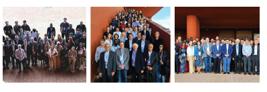
By bringing together researchers from across the world with a common goal of advancing chemical weather and chemical climate science in Africa, we believe this conference will act as a catalyst for accelerated development of solutions to urgent environmental challenges facing Africa.
Two side events organized in fostering engagement and collaboration with African academics, government agencies and stakeholders on climate change and health, and AI for urban sustainability, and climate resilience, with participants expressing interest and willingness in joining related global initiatives.
Before the conference, a training program supported by the World Meteorological Organization (WMO) was also conducted from 9-11 October that included 40 participants from multiple African meteorological agencies. The training was a combination of lectures and practical sessions where participants were given lectures in the morning sessions, and hands-on practical sessions were conducted in the afternoon sessions. Topics covered in the training included multi-platform (in situ and satellite based), air quality modeling, emission inventories, and reanalysis systems. An open discussion session was held at the end of the training program to get feedback from the participants on the design and execution of training as well as collect suggestions for future improvements. All participants from the training program also attended the 2nd CWCC and actively engaged in discussion.
