Ischaemum roseotomentosum (Poaceae: Andropogoneae): extension of an erstwhile Zimbabwean endemic in South Africa
Abstract
BACKGROUND: Ischaemum is a C4 genus mainly found throughout the tropics of South and Southeast Asia, Malesia, South Africa and South America. Ischaemum roseotomentosum was collected during a vegetation condition assessment in Limpopo, South Africa at the Bonwa Phala Game Lodge in the Waterberg District, approximately 20 km west of Bela-Bela. It constitutes a new record for South Africa OBJECTIVES: We document here a new record of Ischaemum roseotomentosum found in Limpopo and discuss its taxonomic affinities and distribution based on available specimens, field observations and a review of the relevant literature METHODS: The collected specimen was morphologically examined at the National Herbarium, Pretoria (PRE), using a light microscope, and compared with type specimens from Zimbabwe in addition to other notable collections from the same area RESULTS AND CONCLUSION: A specimen of Ischaemum roseotomentosum was collected from a private game lodge in the western region of Bela-Bela and subsequently submitted to the National Herbarium (PRE) for identification. It was confirmed as a new record for South Africa
Endemic; Ischaemum; new record; Poaceae; South Africa
Introduction
Ischaemum Linnaeus (1753: 1049) is one of the most taxonomically complex genera within the tribe Andropogoneae (Landge & Shinde 2021, 2022, 2023, 2024). The genus currently comprises approximately 87 species worldwide, the majority of which are endemic to India (Landge & Shinde 2024). According to Fish et al. (2015), two species, I. afrum (J.F.Gmel) Dandy, in Andrews (476: 1956) and I. fasciculatum Brongn. (73: 1831), were previously recorded from South Africa. With the addition of I. roseotomentosum J.B.Phipps in the present study, the number of recognised Ischaemum species in South Africa now increases to three.
Ischaemum roseotomentosum is distinguished by the presence of a sterile lower floret in the sessile spikelet, characterised by the well-developed lemma, a short palea and complete absence of stamens. As noted by Landge and Shinde (2022), this is the first species in the genus reported with a completely sterile lower floret, whereas in the majority of Ischaemum species, the lower floret is staminate or rarely hermaphrodite. The morphological affinities of I. roseotomentosum with the Australian I. albovillosulum B.K.Simon (86: 1989) and the Indian I. dioecum Landge & R.D.Shinde (239: 2022) are notable.
In the present study, we report the occurrence of Ischaemum roseotomentosum as a new record for Limpopo, South Africa and discuss its taxonomic affinities and distribution based on available specimens, field observations, and a review of the relevant taxonomic literature.
Materials and methods
A specimen of Ischaemum roseotomentosum was collected during a vegetation condition assessment conducted at Bonwa Phala Lodge, Waterberg District, Limpopo, South Africa.
The collected specimens were morphologically examined at the National Herbarium, Pretoria (PRE), using a light microscope, and compared with herbarium specimens from Zimbabwe. The specimens were identified using descriptions and keys by Cope (2002), Clayton et al. (2006) and Hyde et al. (2025). The newly collected material has been deposited in the National Herbarium (PRE). Herbarium acronyms follow Thiers (2025, continuously updated).
Taxonomic treatment
Ischaemum roseotomentosum
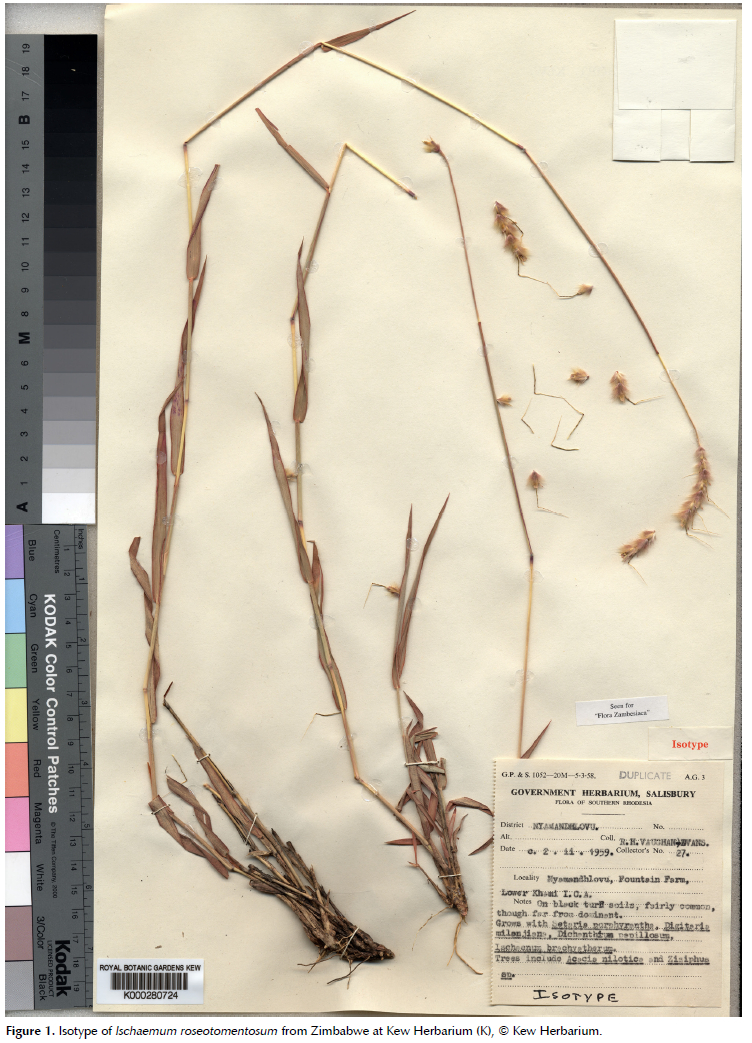
Ischaemum roseotomentosum J.B.Phipps, in Kirkia 3: 30 (1963). Type: ZIMBABWE, Umgusa District, Nyamandhlovu, Fountain farm, 2 Feb. 1959, Vaughan-Evans 27 (SRGH [SRGH0106824-0], holo!; BM, BR! [BRLU000090021787], EA, FR! [FR0030287], K! [K000280724], LISJ, LMJ, MO! [MO-1742330], PRE! [PRE0008620-0], iso.)
Description
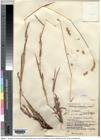
Caespitose perennial, culms up to 1.3 m high, mostly erect. Leaves: leaf laminas 40-150 × 5-8 mm, glaucous, tuberculately pilose near the base, prominently nerved, tapering to an acute point. Sessile spikelet ± 8 mm long, lanceolate (not including the wings of the lower glume); lower glume coriaceous, 2-keeled along its length, flat or convex between the keels, densely villous on the dorsal surface in the lower two-thirds, pilose towards the margins above, wings on the keel form lobes up to 1 mm wide, apex protruded with a central tooth above the lateral lobes, together with side lobes it appears broadly 3-lobed; upper lemma with a geniculate awn about 30 mm long. Pedicelled spikelet 3-4 mm long, barren, much reduced and represented only by its glumes, these similar to those of the sessile spikelet but the lower glume longer than the upper glume (Cope 2002; Clayton et al. 2006; Hyde et al. 2025) (Figure 1). Flowering time: January-April.
Key to the species of Ischaemum in South Africa
1a. Raceme solitary; sessile spikelet lower floret sterile; sessile spikelet lower glume with a central tooth between its two apical wings .................... I. roseotomentosum J.B.Phipps
1b. Raceme paired or digitate; sessile spikelet lower floret fertile; sessile spikelet lower glume without central tooth between its wings:
2a Sessile spikelet lower glume concave across the back, keels not winged; pedicelled spikelet awnless or rarely awned from upper lemma; leaves glaucous, tapering into a long filiform apex .................... I. afrum (J.F.Gmel) Dandy
2b Sessile spikelet lower glume convex or flat across the back, keels usually winged on upper half, rarely wingless; pedicelled spikelet upper lemma awned; leaves dark or bright green, turning reddish brown at maturity, blades tapering abruptly into a fine apex .................... I. fasciculatum Brongn.
Morphology-based comparison with the closely allied species and distribution in Africa
Ischaemum roseotomentosum is distinguished by the presence of multiple, prominent, distinctly striated, dorsally hairy, small, somewhat woody cataphylls clustered at the plant base, collectively giving a swollen appearance. Its only closely allied African congener, I. amethystinum J.-P.Lebrun, shares several morphological features, including a trilobed lower glume in the sessile spikelet, similar lengths of the pedicel and rhachis internode, characteristic basal indumentum, absence of stolons and a perennial life cycle. However, I. amethystinum differs markedly in its more robust, stouter and taller habit, broader culms, longer leaf blades and sheaths, denser basal indumentum on the sheaths, inflorescences bearing two to three racemes, and consistently well-developed pedicelled spikelets. The population structure of these species is geographically disparate: Ischaemum amethystinum is widely distributed across sub-Saharan Africa, ranging from Ivory Coast to Ethiopia (excluding Sudan and South Sudan) and extending into Tanzania, whereas I. roseotomentosum is more restricted in its distribution; it is mostly a southernly distributed species, occurring in Zimbabwe and, more recently, in the Limpopo province of South Africa. Molecular analyses are strongly recommended to further evaluate their phylogenetic affinities and systematic placements within the genus Ischaemum.
Distribution and ecology
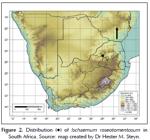
The native range of Ischaemum roseotomentosum is mainly found in Zimbabwe: Gwanda, Ndanga and Nuanetsi districts. It grows on black basaltic soils, in mopane woodland on alluvium in the south of Zimbabwe; elevation of 270-1200 m (Hyde et al. 2025). In Zimbabwe, it grows primarily in the dry tropical climatic region (Hyde et al. 2025). In South Africa, it grows in areas dominated by the woody species: Olea capensis L., Searsia pyroides (Burch.) Moffett and Ziziphus mucronata Willd. In this locality, the species was found in habitats characterised by a range of soil types, including deep sandy soils (Dundee soil form) and structured clay soils such as Valsrivier, Arcadia and Oakleaf. The soil texture varied from sandy to clayey and loamy, with clay content ranging from 18% to 35%.
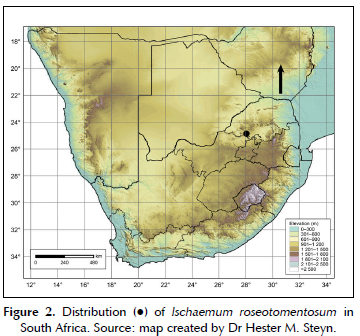
The discovery of Ischaemum roseotomentosum in Bela-Bela, Limpopo, is a significant find, extending the species' known distribution into the central regions of South Africa. This report marks the first documented occurrence of I. roseotomentosum in the country and represents the third species of the genus Ischaemum for South Africa (Figure 2).
Associated taxa
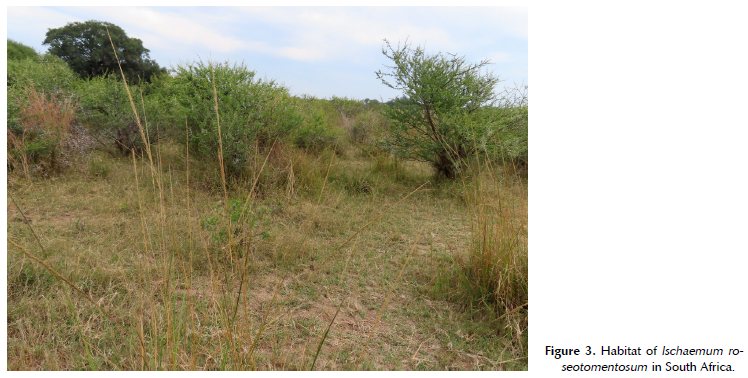
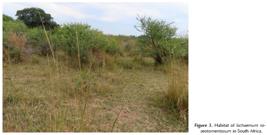
In South Africa, I. roseotomentosum was found 200 m east of the dense riparian vegetation associated with trees such as Olea capensis, Searsia pyroides and Ziziphus mucronata plant community and 20 m north of a large dam that received water from the Klip River. The location of the site is within the Vachellia karroo (Hayne) Banfi & Galasso/V. tortilis (Forssk.) Galasso & Banfi/V. nilotica (L.) P.J.H.Hurter & Mabb. plant community that borders the dam and river. The habitat represents open short woodland. Grass species associated with this veld type include species such as Aristida congesta Roem & Schult, Bothriochloa insculpta (A.Rich.) A.Camus, Cynodon dactylon Pers., Digitaria eriantha Steud., Eragrostis plana Nees, E. rigidior Pilg., Heteropogon contortus (L.) Roem. & Schult., Panicum maximum Jacq. and Urochloa mosambicensis (Hack.) Dandy.
Conservation status and habitat sensitivity
The conservation status is Vulnerable, and Conservation Target is 19% whilst only 3% is statutorily conserved (Mucina & Rutherford 2006). According to the South African National Biodiversity Institute (SANBI) Red List, I. roseotomentosum has not been assessed yet. The vegetation of this area was described by Acocks (1988) as Mixed Bushveld (Veld Type 19). Acocks (1988) described the vegetation as broadleaf tree and grass savanna being typically characterised by sandy plains (see Figure 3). The veld type is classified by Mucina and Rutherford (2006) as Central Sandy Bushveld (SVcb 12). Only a small portion of the Central Sandy Bushveld occurs on the property.
New collection record
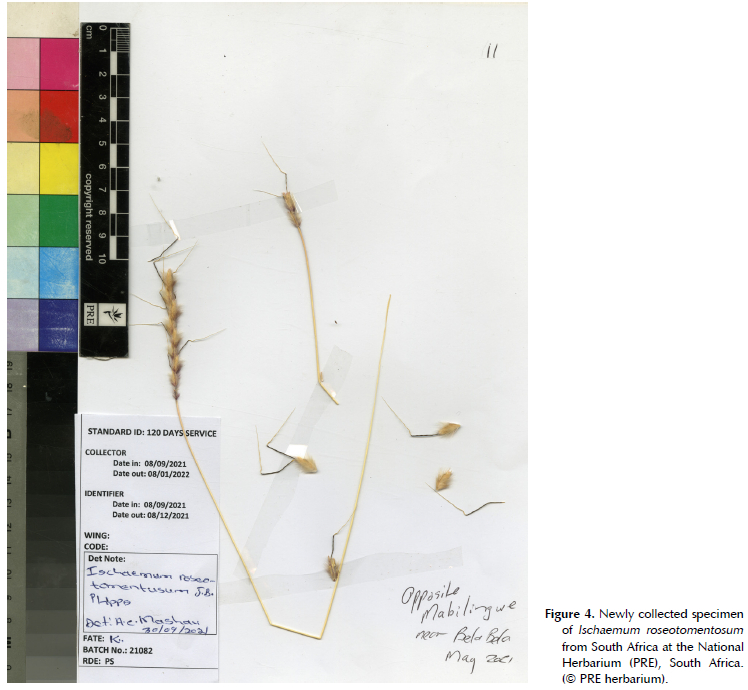
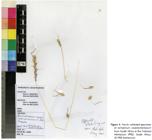
SOUTH AFRICA, Limpopo: Waterberg District in the Bonwa Phala Lodge property, which is approximately 20 km west of Bela-Bela, 2428CC (24°51'1.91''S, 28°2'34.25''E), May 2021, De Beer P11 (PRE) (Figure 4).
Additional specimens examined
ZIMBABWE. Gwanda District, 40 miles [64 km] from Beit Bridge border post on the Bulawayo Road, 4 and 5 Jan. 1956, Rattray 1710 (PRE); Ndanga District, near Chipinda Pools, 1 Apr. 1961, Phipps 2915 (PRE); Nuanetsi District, Mateke Hills, East-west road, north of hills, 23 Feb. 1967, Cleghorn 1436 (PRE).
Competing interests
The authors declare that they have no financial or personal relationships that may have inappropriately influenced them in writing this article.
Authors' contributions
ACM (South African National Biodiversity Institute) prepared the draft and analysed the data, MCM (South African National Biodiversity Institute/University of KwaZulu-Natal) made conceptual contributions, FvO (Working on Grass) wrote original draft and GdB(Ysterberg Enviro) collector and wrote original draft, SNL (The Blatter Herbarium) shaped the taxonomic concept. All authors provided critical feedback and helped to shape the research, analysis and the manuscript.
Acknowledgements
Our grateful thanks to: Dr Hester Steyn (National Herbarium, PRE) for creating the distribution map; and the South African National Biodiversity Institute for support.
References
- Acocks, J.P.H., 1988, 'Veld types of South Africa', ed. 3, Memoirs of the Botanical Survey of South Africa 57, 1-146.
- Andrews, F.W., 1956, The flowering plants of the Sudan, vol. 3, 476 (Compositae-Gramineae), T. Buncle & Co., Abroath, Scotland.
- Brongniart, A.T., 1831, Voyage autour du monde. Phanérogamie, A. Bertrand, Paris.
-
Clayton, W.D., Harman, K.T. & Williamson, H., 2006, GrassBase - The Online World Grass Flora, viewed 25 March 2024, http://www.kew.org/data/grasses-db.html.
» http://www.kew.org/data/grasses-db.html - Cope, T.A., 2002, Gramineae: Flora Zambesiaca. Royal Botanic Gardens, Kew, 10(4), 1-190.
- Fish, L., Mashau, A.C., Moeaha, M.J. & Nembudani, M.T., 2015, 'Identification guide to southern African grasses. An identification manual with keys, descriptions, and distributions', Strelitzia 36, 396-398, South African National Biodiversity Institute, Pretoria.
-
Hyde, M.A., Wursten, B.T., Ballings, P. & Coates Palgrave, M., 2025, Ischaemum roseotomentosum, Flora of Zimbabwe: species information, viewed 16 April 2025, https://www.zimbabweflora.co.zw/speciesdata/species.php?species_id=108440.
» https://www.zimbabweflora.co.zw/speciesdata/species.php?species_id=108440 -
Landge, S.N. & Shinde, R.D., 2021, 'Ischaemum mistryi (Poaceae: Andropogoneae): A new remarkable species from Sub-Tropical Evergreen Forest, India', Phytotaxa 509,3, 272-280, https://doi.org/10.11646/phytotaxa.509.3.2.
» https://doi.org/10.11646/phytotaxa.509.3.2 -
Landge, S.N. & Shinde, R.D., 2022, 'Ischaemum dioecum (Poaceae: Andropogoneae): the most strangest new species from northern western Ghats, Maharashtra, India', Phytotaxa 533,5, 237-255, https://doi.org/10.11646/phytotaxa.533.5.1.
» https://doi.org/10.11646/phytotaxa.533.5.1 -
Landge, S.N. & Shinde, R.D., 2023, 'On the identity and distribution of Ischaemum flumineum (Poaceae: Andropogoneae) in India', Phytotaxa 619,2, 182-188, https://doi.org/10.11646/phytotaxa.619.2.6.
» https://doi.org/10.11646/phytotaxa.619.2.6 -
Landge, S.N. & Shinde, R.D., 2024, 'On the identity of Ischaemum elimalayanum (Poaceae: Andropogoneae: Ischaemineae) with brief taxonomic notes on some allied congeners from India', Phytotaxa 636,2, 111-125, https://doi.org/10.11646/phytotaxa.636.2.1.
» https://doi.org/10.11646/phytotaxa.636.2.1 -
Linnaeus, C., 1753, Species plantarum, vol. 1, Laurentius Salvius, Holmiae [Stockholm], https://doi.org/10.5962/bhl.title.669.
» https://doi.org/10.5962/bhl.title.669 -
Mucina, L. & Rutherford, M.C. (eds.), 2006, 'The vegetation of South Africa, Lesotho and Swaziland', Strelitzia 19, South African National Biodiversity Institute, Pretoria, https://archive.org/details/vegetationofsout19muci.
» https://archive.org/details/vegetationofsout19muci - Phipps, J.B., 1963, 'Ischaemum roseotomentosum, a new species of Gramineae from southern Rhodesia', Kirkia 3, 30-32.
- Simon, B.K., 1989, 'Studies in Australian grasses: 4. Taxonomic and nomenclatural studies in Australian Andropogoneae', Austrobaileya 3, 79-99.
-
Thiers, B.M., 2025 [continuously updated], Index Herbariorum: A global directory of public herbaria and associated staff, New York Botanical Garden's Virtual Herbarium, viewed 15 April 2025, http://sweetgum.nybg.org/science/ih.
» http://sweetgum.nybg.org/science/ih

Accepted: 12 January 2026
Published: 14 May 2026