Impact of spectacle wear on the quality of life of learners with hearing impairment in Ghana
Abstract
BACKGROUND: Visual impairment significantly affects learners with hearing impairment AIM: To assess the impact of spectacle wear on the quality of life (QoL) of learners with hearing impairment in Ghana SETTING: Six schools for the deaf in Ghana METHODS: A prospective case-control study design was used to assess the QoL among learners with uncorrected refractive error (URE) using the quality-of-life impact of refractive correction (QIRC) questionnaire before and after the provision of spectacles RESULTS: A total of 138 learners were enrolled in this study, with 69 learners in both the intervention and control groups, respectively. The mean QIRC score improved significantly for the intervention group: QIRC score before = 43.89 ± 8.96 vs. after = 48.82 ± 6.71 (P < 0.05 and Cohen's d = 0.62) but not the control group: QIRC score before = 50.79 ± 11.66 and 51.77 ± 10.67 (P = 0.607). Among the learners provided with spectacles, those who did not comply with spectacle wear had significant differences (P < 0.05) in mean QIRC scores before and after the intervention. Only visual acuity (VA) and the magnitude of prescription with QIRC scores after intervention had a significant relationship (P < 0.05 CONCLUSION: Uncorrected refractive error affected the QoL of learners with hearing impairment, and spectacle correction significantly improved their QoL CONTRIBUTION: The use of spectacle lenses, VA and magnitude of prescription affected the QoL scores; however, sex and age did not influence the QoL scores
quality-of-life; QIRC; spectacle wear; hearing impairment; vision impairment; Ghana
Introduction
Visual impairment (VI) among learners with hearing impairment (HI) in sub-Saharan Africa is high, ranging from 2.2% to 34.6%.1,2 Visual impairment affects learners' social, physical and psychological well-being, reducing their quality of life (QoL) compared to their colleagues without VI.3,4 The negative impact of VI may lead to a loss in career, education and economic opportunities for persons with VI and their families.4,5,6,7,8
Questionnaires9,10,11,12,13,14,15,16 have been developed and validated on children's vision-related quality-of-life (VRQOL), but there is no specific questionnaire for learners with disabilities.17179,12,13,15,18 and are unsuitable for use in all learners. In assessing VRQOL among learners with disabilities in sub-Saharan Africa, a questionnaire with a broader age-specific range is recommended since these learners are reported to have a wider age range at school because of the late start of school and development.1,2,18
Globally, little is known about VRQOL among learners with HI.1717P < 0.0001). Although VRQOL is related to functional vision (FV), FV does not represent VRQOL entirely as used in the study.19
The questionnaire utilised in this study was the quality-of-life impact of refractive correction (QIRC) because of several factors. Firstly, QIRC has an age-specific coverage for pre-presbyopic (35 years and below) participants suited for learners with a wide age range.16,20 Secondly, the QIRC was developed using a Rasch analysis recommended for psychometric analysis.16,20
There is a paucity of data and a lack of scientifically rigorous studies on the VRQOL among learners with HI and the impact of spectacles in this group. Therefore, the objectives of this study were to determine the VRQOL before and after the provision of spectacle correction and then to compare the VRQOL findings with that of a control group (similar age and sex) of learners with no uncorrected refractive error (URE).
Research methods and design
A prospective case-control study was used to investigate the impact of spectacle correction among learners with URE to address their QoL outcomes. The study was conducted from March 2022 to December 2022. Six schools for the deaf in Ghana, with a total of 1914 learners, were included in this study, with three from each region of the country (Northern and Southern). The study included all learners with URE at the study centres who were provided with spectacles for 3 months in the intervention arm using a purposive sampling. Learners with corrected refractive errors at the time of the study were excluded. The control group comprised of learners with no URE and no ocular morbidity.
To calculate the minimum sample size, a precision of 5%, to report a 95% confidence interval (CI), an adjustment for a non-response rate of 20% and, with a refractive error prevalence of 31.9% according to a study by Ovenseri-Ogbomo et al.,2221

where n = sample size, Zɑ = Standardised normal deviate at 95% level of confidence is 1.96, Zᵦ = Z- value corresponding with Beta error of 20% (80% power) is 0.84, ҏ = mean proportion of satisfaction with treatment p1 (0.97) and p2 (0.82) is 0.90 (9), 1 - ҏ = mean proportion of not satisfied with treatment p1 - p2 is 0.10, ᵭ = difference to be detected (p1 - p2) is 15%, Type 2 error = 0.2, Power = 0.80.
Validation of questionnaire
The questionnaire was piloted among randomly selected 50 normal-sighted learners with HI and from different class at the Cape Coast school for the deaf to validate the data collection tool and QIRC questionnaire, which was able to assess the needed outcome we wanted. These learners were not included in the main study.
Data collection
The tools for the data collection were QIRC questionnaire1623242526,27 The QIRC questionnaire consists of 20-item questions that can be answered in 10 min - 20 min, with each question having its own score.1628,29,30 after the 3 months reassessment were placed in a sub-intervention group along with their matches to make four groups in total. Learners who had difficulty understanding the questionnaire were provided with bilingual staff to overcome language barriers and improve the quality of the data collected. Learners with URE were taken through education of the importance of spectacles; however, no educational resource was given.
Ethical consideration
Ethical approval was obtained from Biomedical Research Ethics Committee (BREC) of the University of KwaZulu-Natal (Reference number: BREC/00003247/2021) and the Ghana Health Service Ethical Review Committee (Reference number: GHS-ERC: 006/04/21). The study adhered to the Declaration of Helsinki's guidelines involving the use of human subjects. Informed consent was obtained after each learner, and their parents or guardians were informed about the study's purpose. There were no risks and discomforts associated with partaking in the study, and the learners received no financial compensation. The study was voluntary, and learners were informed that they could withdraw at any time without incurring fees or losing access to treatment or other benefits to which they would ordinarily be entitled.
Data analysis
Data from the study were analysed using the Statistical Package for Social Sciences, version 21 (SPSS Inc, Chicago, USA). Means, standard deviations, and 95% CIs were determined. A paired sample t-test was conducted to assess the significant difference between QIRC scores (P < 0.05). A standardised Cohen effect size calculation was used to determine the magnitude of the differences in scores. A QIRC scoring conversion sheet was used to convert raw data from the QIRC questionnaire (P < 0.05). A Pearson product-moment correlation coefficient was used to assess the relationship between continuous variables.
Results
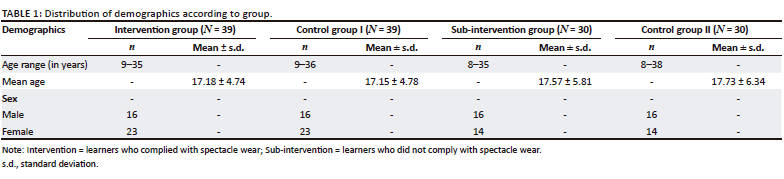
Out of 1914 learners, 69 had refractive error and were provided spectacles, with 39 (56.5%) complying with spectacle wear after 3 months. A total of 138 deaf learners were involved in this study, with 39 learners in the intervention group, 30 in the sub-intervention group, and 69 in the control group. The intervention group comprised of 16 males and 23 females with ages ranging from 9 years to 35 years with a corresponding control, while the sub-intervention group comprised of 16 males and 14 females (age range: 8 years to 35 years) (see Table 1). Among the learners provided with the spectacles, 25 had moderate VI (visual acuity [VA] worse than 6/18 [0.5 logMAR] to 6/60 [1.0 logMAR]), and 22 had mild VI (VA worse than 6/12 [0.3 logMAR] to 6/18 [0.5 logMAR]) and no VI (VA better than or equal to 6/12 [0.3 logMAR]), respectively.
Distribution of mean quality-of-life impact of refractive correction scores according to group
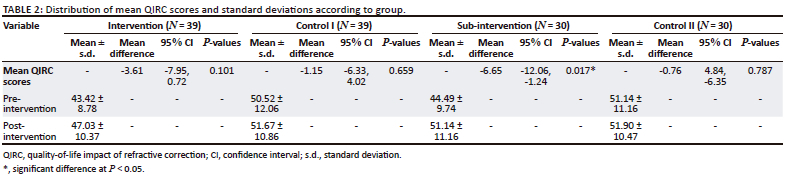
The mean QIRC scores for learners (N = 69) with URE after the 3 months period were 48.82 ± 6.71, while the mean QIRC scores before the provision of spectacles were 43.89 ± 8.96. A significant mean difference (-4.93) was observed between the two QIRC scores (95% CI: -7.60, 2.27, DF = 136, P = 0.0004). A Cohen's d test showed a medium (0.62) effect size on mean QIRC scores before and after the provision of spectacles to learners with URE. The mean QIRC scores for the control group (N = 69) before and after the intervention were 50.79 ± 11.66 and 51.77 ± 10.67, respectively. However, the difference (-0.98) was not significant (95% CI: -4.74, 2.78, DF = 136, P = 0.607). A significant mean difference (6.904) was observed between mean QIRC scores during the pre-test for the intervention and control group (95% CI: -3.40, 10.40, DF = 136, P = 0.0001), with a medium (0.66) effect size. However, no significant mean difference (2.95) was observed between mean QIRC scores during the post-test for the intervention and control group (95% CI: -0.05, 5.95, DF = 136, P = 0.054). Among the subgroups, only learners who did not comply with spectacle wear had significant differences (P < 0.05) with a medium (0.63) effect size on mean QIRC scores before and after the intervention (Table 2).
Distribution of quality of life according to sex
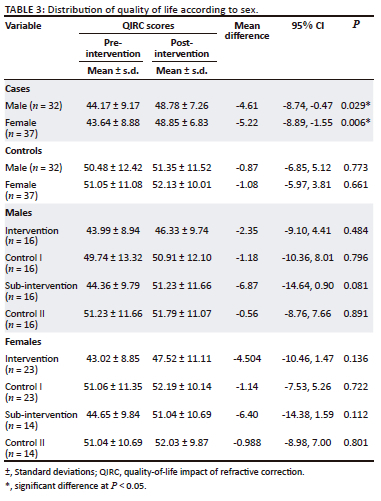
There was a significant difference between mean QIRC scores before and after the intervention between the sexes (P < 0.05). Within the intervention group, males and females had medium (0.56 and 0.66, respectively) effect size in mean QIRC pre- and post-test scores. However, the differences were not significant among the control groups and intervention subgroups and sex (P > 0.05). Also, males with URE had higher mean QIRC scores than females; however, the mean QIRC scores after the intervention were higher among females than males. The differences in both instances were not significant (P > 0.05). Among the control group, females had higher mean QIRC scores before and after intervention than males; however, the differences were not significant (P > 0.05) (Table 3).
Correlation and mean difference between quality-of-life impact of refractive correction scores and other variables
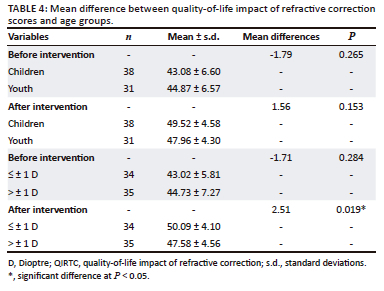
A Pearson product-moment correlation coefficient test found no significant correlation between mean QIRC scores before (r = 2.33, P = 0.06) and after (r = −1.70, P = 0.16) intervention and the age of learners. Also, the learners were classified according to age groups: children (8 years - 17 years) and youth (18 years - 35 years). An independent t-test found no significant difference between mean QIRC scores before and after intervention among the age groups (P > 0.05), as shown in Table 4. Moreover, a significant difference between mean QIRC scores after the intervention was recorded among learners with low (≤ ± 1 D) magnitude of spectacle prescription and those with a high (> ± 1 D) magnitude (P = 0.019), with a medium magnitude change of 0.58 as Cohen's effect size. Furthermore, there was a significant weak and negative correlation between uncorrected visual acuity (UCVA) and mean QIRC scores in the better seeing eye after intervention (r = −0.32, P = 0.007); however, there was no correlation between QIRC scores before intervention and UCVA (r = 0.073, P = 0.551).
Discussion
This study assessed VRQOL among learners with HIs in Ghana. After 3 months of reassessment, this study found improved VRQOL among learners with and without URE. However, there was a significant difference and a medium effect size in VRQOL among learners who were provided with spectacles. This finding suggests that providing spectacles to hearing-impaired learners with URE in Ghana can significantly improve their VRQOL. This finding highlights the importance of early detection and intervention for URE in schools, and the need for accessible and affordable eye care services in low- and middle-income countries like Ghana. The VRQOL after reassessment is similar to QoL findings among learners with HI in India, where there was a significant improvement after intervention.1731,32 learners with HI rely on visual cues; enhancing visual function will benefit their academic and personal lives. This highlights the need for regular vision assessment and intervention to improve their QoL.
The overall QIRC scores were lower among spectacle wearers before and after the intervention compared with the control group. This suggests that spectacles to improve vision may not be enough to improve the overall QoL for individuals with URE. Additional interventions, such as education and counselling on the impact of UREs, may be necessary to address the broader psychosocial effects of vision impairment and URE. Similar studies were conducted among participants with no disabilities33,34 have reported lower QoL among spectacle wearers compared to controls. Bullying, poor academic performance and physical appearance have been reported to affect the QoL of learners who wear spectacles.34,35,36,37 Therefore, the focus should not be on the physical aspects of managing vision impairment only but on addressing the emotional and social well-being of individuals affected by it, especially learners who may face additional challenges (vision cum HIs) in their academic and personal lives. Providing support and resources to address these psychosocial effects can improve the overall QoL for individuals with URE.
In this study, the overall QIRC (48.82) score with spectacles was similar to that reported in a study conducted in the United Kingdom, which found a mean QIRC score of 47.8 ± 5.5 among native English participants with spectacles, contact lenses and refractive surgery corrections.1620,33,38 Factors such as age, magnitude of prescription and visual needs can influence the impact of spectacle wear on QoL.20,33,38
The overall QIRC score was lower than the 63.13 recorded among participants (mean age: 27.64 years ± 2.91 years) with no disabilities in Malawi using a Chichewa QIRC.202016
Furthermore, participants in the current study might have had challenges such as comprehension of the English QIRC questionnaire compared to using Chichewa in Malawi. In Ghana, English is not the first language but the official language with a multi-lingual franca across regions and communities.39
There was an improvement in mean QIRC scores for participants who complied with spectacle wear and those who did not. However, participants who complied with spectacle wear had no significant difference in QIRC scores compared to the non-compliant group. This finding suggests that spectacle wear may not be the only factor for all participants to achieve improved QIRC scores. However, other factors such as visual needs and familiarity with the questionnaire can also improve the QIRC scores, as evidenced in the control groups with increased QIRC scores without intervention. Therefore, factors such as spectacle wear and familiarity with the questionnaire should be considered, among others, when interpreting QIRC scores. Additionally, the mean QIRC scores may not necessarily reflect the actual functional and psychosocial needs, as they are self-reported. Hence, other objective measures should also be considered when evaluating the effectiveness of interventions to improve visual function.
Females with URE had slightly higher mean QIRC scores after intervention than males; however, this difference was not significant. This finding is similar to those by Kaphle et al.203320
Furthermore, there was a significant weak correlation between UCVA and QIRC scores after the intervention. Also, learners with a low magnitude of spectacle prescription had a higher QIRC score after the intervention compared to learners with a high magnitude. This suggests that learners with good UCVA and low magnitude in spectacle prescription had better QoL after the intervention than those with poor UCVA and high magnitude. These findings are similar to those by Kaphle et al.,202020
We recommend that future studies should include learners with a wider range of VIs to increase the generalisability of the findings and determine the effectiveness of spectacle wear for individuals. There is a need to explore the effectiveness of psychosocial, other visual anomalies and optical interventions in improving the quality-of-life outcomes for individuals with UREs. The absence of educational resources on the importance of spectacle wear might have impacted the participants' compliance level.
Conclusion
Learners with URE had a significantly improved QoL after 3 months. The QoL scores were found to be influenced by compliance with spectacle wear, UCVA, and magnitude of spectacle prescription; however, sex and age did not influence the QoL scores. Other interventions such as psychosocial, education and counselling should be incorporated into future visual interventions to improve the overall QoL of the learners.
Competing interests
The authors declare that they have no financial or personal relationship(s) that may have inappropriately influenced them in writing this article.
Authors' contributions
M.A.K., K.P.M., S.K., P.G.-P., and D.S.Q.D. contributed to the study's conception and design. Material preparation, data collection, and analysis were done by M.A.K. The first draft of the article was written by M.A.K., and all authors commented on previous versions of the article. All authors read and approved the final article.
Funding information
This work was supported by the African Researchers' Initiative (ARI) research grant; Deafblind International (DbI), Switzerland; VisionSpring Inc Africa; and, College of Health Science PhD Scholarship, University of KwaZulu-Natal, South Africa.
Data availability
Raw data of this research are available on request from the corresponding author, M.A.K. The website for the QIRC questionnaire can be found here: http://www.pesudovs.com/konrad/questionnaire.html.
Disclaimer
The views and opinions expressed in this article are those of the authors and are the product of professional research. It does not necessarily reflect the official policy or position of any affiliated institution, funder, agency, or that of the publisher. The authors are responsible for this article's results, findings, and content.
Acknowledgements
This article is partially based on M.A.K's dissertation entitled 'Visual function among learners in Schools for the Deaf in Ghana: an observational and interventional study' towards the degree of Doctor of Philosophy in Health Science (Optometry) at the Discipline of Optometry, University of KwaZulu-Natal, South Africa on 24 April 2024 with supervisor Prof K.P. Mashige and co-supervisors Prof S. Kyei, Mrs P. Govender-Poonsamy and Dr D.S.Q. Dogbe. The authors are grateful to Prof K. Pesudovs for providing the permission to use the QIRC Questionnaire.
References
-
1. Kwarteng MA, Mashige KP, Kyei S, Dogbe DS, Govender-Poonsamy P. Prevalence and causes of visual impairment among hearing impaired school-going children in Sub-Saharan Africa: A scoping review. Afr Health Sci. 2022;22(4):199-204. https://doi.org/10.4314/ahs.v22i4.24
» https://doi.org/10.4314/ahs.v22i4.24 -
2. Kwarteng MA, Mashige KP, Dogbe DSQ, Kyei S, Govender-Poonsamy P. Visual functioning among learners with hearing impairment in schools for the deaf in Ghana. Proceedings of the 1st DBI Africa Conference on Deafblindness 12th-14th May 2022 Kenya Institute of Special Education, Nairobi and Online Deafblind Reality in Africa: Meeting the Sustainable Development Goals-Opportunities and Challenges; 2022 [homepage on the Internet]. [cited 2023 Aug 1]. Available from: www.deafblindinternational.org
» www.deafblindinternational.org -
3. Rainey L, Elsman EBM, Van Nispen RMA, Van Leeuwen LM, Van Rens GHMB. Comprehending the impact of low vision on the lives of children and adolescents: A qualitative approach. Qual Life Res. 2016;25(10):2633-2643. https://doi.org/10.1007/s11136-016-1292-8
» https://doi.org/10.1007/s11136-016-1292-8 -
4. Naipal S, Rampersad N. A review of visual impairment. Afr Vision Eye Health. 2018;77(1):a393. https://doi.org/10.4102/aveh.v77i1.393
» https://doi.org/10.4102/aveh.v77i1.393 -
5. Atowa UC, Hansraj R, Wajuihian SO. A review of paediatric vision screening protocols and guidelines. Int J Ophthalmol. 2019;12(7):1194-1201. https://doi.org/10.18240/ijo.2019.07.22
» https://doi.org/10.18240/ijo.2019.07.22 -
6. Resnikoff S. Global magnitude of visual impairment caused by uncorrected refractive errors in 2004. Bull World Health Organ. 2008;86(1):63-70. https://doi.org/10.2471/blt.07.041210
» https://doi.org/10.2471/blt.07.041210 -
7. Khanna R, Raman U, Rao GN. Blindness and poverty in India: The way forward. Clin Exp Optom. 2007;90(6):406-414. https://doi.org/10.1111/j.1444-0938.2007.00199.x
» https://doi.org/10.1111/j.1444-0938.2007.00199.x -
8. Rahi JS, Cable N. Severe visual impairment and blindness in children in the UK. Lancet. 2003;362(9393):1359-1365. https://doi.org/10.1016/s0140-6736(03)14631-4
» https://doi.org/10.1016/s0140-6736(03)14631-4 -
9. Cochrane G, Lamoureux E, Keeffe J. Defining the content for a new quality of life questionnaire for students with low vision (the impact of vision impairment on children: IVI_C). Ophthalmic Epidemiol. 2008;15(2):114-120. https://doi.org/10.1080/09286580701772029
» https://doi.org/10.1080/09286580701772029 -
10. Gothwal VK, Lovie-Kitchin JE, Nutheti R. The development of the LV Prasad-Functional Vision Questionnaire: A measure of functional vision performance of visually impaired children. Invest Ophthalmol Vis Sci. 2003;44(9):4131. https://doi.org/10.1167/iovs.02-1238
» https://doi.org/10.1167/iovs.02-1238 -
11. Wolffsohn JS, Cochrane AL. Design of the low vision quality-of-life questionnaire (LVQOL) and measuring the outcome of low-vision rehabilitation. Am J Ophthalmol. 2000;130(6):793-802. https://doi.org/10.1016/s0002-9394(00)00610-3
» https://doi.org/10.1016/s0002-9394(00)00610-3 -
12. Khadka J, Ryan B, Margrain TH, Court H, Woodhouse JM. Development of the 25-item Cardiff Visual Ability Questionnaire for Children (CVAQC). Brit J Ophthalmol. 2010;94(6):730-735. https://doi.org/10.1136/bjo.2009.171181
» https://doi.org/10.1136/bjo.2009.171181 -
13. Felius J, Stager DR, Berry PM, et al. Development of an instrument to assess vision-related quality of life in young children. Am J Ophthalmol. 2004;138(3):362-372. https://doi.org/10.1016/j.ajo.2004.05.010
» https://doi.org/10.1016/j.ajo.2004.05.010 -
14. Pilling RF. Social and visual function in nystagmus. Br J Ophthalmol. 2005;89(10):1278-1281. https://doi.org/10.1136/bjo.2005.070045
» https://doi.org/10.1136/bjo.2005.070045 -
15. Birch EE, Cheng CS, Felius J. Validity and reliability of the Children's Visual Function Questionnaire (CVFQ). J AAPOS. 2007;11(5):473-479. https://doi.org/10.1016/j.jaapos.2007.02.011
» https://doi.org/10.1016/j.jaapos.2007.02.011 -
16. Pesudovs K, Garamendi E, Elliott DB. The Quality of Life Impact of Refractive Correction (QIRC) Questionnaire: Development and validation. Optom Vis Sci. 2004;81(10):769-777. https://doi.org/10.1097/00006324-200410000-00009
» https://doi.org/10.1097/00006324-200410000-00009 -
17. Gogate P, Bhusan S, Ray S, Shinde A. Impact of correcting visual impairment and low vision in deaf-mute students in Pune, India. Indian J Ophthalmol. 2016;64(12):898-903. https://doi.org/10.4103/0301-4738.198847
» https://doi.org/10.4103/0301-4738.198847 -
18. Kwarteng MA, Mashige KP, Naidoo KS, Boadi-Kusi SB, Govender-Poonsamy P. The prevalence and causes of low vision and blindness among learners at the Akropong school for the blind in Ghana. Afr Vision Eye Health. 2021;80(1):a611. https://doi.org/10.4102/AVEH.V80I1.611
» https://doi.org/10.4102/AVEH.V80I1.611 -
19. Angeles-Han ST, Griffin KW, Harrison MJ, et al. Development of a vision-related quality of life instrument for children ages 8-18 years for use in juvenile idiopathic arthritis-associated uveitis. Arthritis Care Res (Hoboken). 2011;63(9):1254-1261. https://doi.org/10.1002/acr.20524
» https://doi.org/10.1002/acr.20524 -
20. Kaphle D, Kandel H, Khadka J, Mashige KP, Msosa JM, Naidoo KS. Validation and use of quality of life impact of refractive correction questionnaire in spectacle wearers in Malawi: A clinic-based study. Malawi Med J. 2020;32(2):54-63. https://doi.org/10.4314/mmj.v32i2.2
» https://doi.org/10.4314/mmj.v32i2.2 - 21. Ovenseri-Ogbomo GO, Abraham CH, Kio FE. Visual impairment and ocular findings among deaf and hearing impaired school children in central region. J Med Biomed Sci. 2013;2:16-22.
-
22. Julious SA. Sample sizes for clinical trials with Normal data. Stat Med. 2004;23(12):1921-1986. https://doi.org/10.1002/sim.1783
» https://doi.org/10.1002/sim.1783 - 23. Kwarteng MA, Mashige KP, Kyei S, et al. Visual impairment and refractive error among deaf/hard of hearing learners in Ghana. J Vis Impair Blind. 2024.
-
24. Ang M, Ho H, Fenwick E, et al. Vision-related quality of life and visual outcomes after small-incision lenticule extraction and laser in situ keratomileusis. J Cataract Refract Surg. 2015;41(10):2136-2144. https://doi.org/10.1016/j.jcrs.2015.10.049
» https://doi.org/10.1016/j.jcrs.2015.10.049 - 25. Pavithra M, Hamsa L, Madhukumar S. Factors associated with spectacle-wear compliance among school children of 7-15 years in South India. Int J Med Public Health. 2014;4(2):146.
-
26. Kwarteng MA, Katsvanga CC, Kyei S. Childhood vision impairment and refractive error in Zimbabwe: A hospital-based retrospective study. Ethiopian J Health Sci. 2022;32(4):723-728. https://doi.org/10.4314/ejhs.v32i4.8
» https://doi.org/10.4314/ejhs.v32i4.8 -
27. Tagoh S, Kyei S, Kwarteng MA, Aboagye E. Prevalence of refractive error and visual impairment among rural dwellers in Mashonaland Central Province, Zimbabwe. J Curr Ophthalmol. 2020;32(4):402-407. https://doi.org/10.4103/JOCO.JOCO_224_20
» https://doi.org/10.4103/JOCO.JOCO_224_20 -
28. Ilechie AA, Abokyi S, Boadi-Kusi S, Enimah E, Ngozi E. Self-adjustable spectacle wearing compliance and associated factors among rural school children in Ghana. Optom Vis Sci. 2019;96(6):397-406. https://doi.org/10.1097/OPX.0000000000001382
» https://doi.org/10.1097/OPX.0000000000001382 - 29. Brien Holden Vision Institute. Spectacle Compliance among School Children in Malawi, Nigeria and Pakistan 2 Spectacle Compliance among School Children in Malawi, Nigeria and Pakistan; Sydney, AU: Brien Holden Vision Institute; 2019.
-
30. Gajiwala U, Patel R, Sudhan A, et al. Compliance of spectacle wear among school children. Indian J Ophthalmol. 2021;69(6):1376-1380. https://doi.org/10.4103/ijo.IJO_1801_20
» https://doi.org/10.4103/ijo.IJO_1801_20 - 31. Khanna R, Pehere N, Marlapati R, Sannapaneni K. Prevalence of ophthalmic disorders among hearing-impaired school children in Guntur district of Andhra Pradesh. Indian J Ophthalmol. 2019;67(4):530.
-
32. Gogate P, Rishikeshi N, Mehata R, Ranade S, Kharat J, Deshpande M. Visual impairment in the hearing impaired students. Indian J Ophthalmol. 2009;57(6):451. https://doi.org/10.4103/0301-4738.57155
» https://doi.org/10.4103/0301-4738.57155 -
33. Pesudovs K, Garamendi E, Elliott DB. A quality of life comparison of people wearing spectacles or contact lenses or having undergone refractive surgery. J Refract Surg. 2006;22(1):19-27. https://doi.org/10.3928/1081-597X-20060101-07
» https://doi.org/10.3928/1081-597X-20060101-07 -
34. Leske DA, Hatt SR, Castañeda YS, et al. Eye-related quality of life and functional vision in children wearing glasses. J AAPOS. 2020;24(2):91.e1-91.e6. https://doi.org/10.1016/j.jaapos.2019.12.010
» https://doi.org/10.1016/j.jaapos.2019.12.010 -
35. Terry RL, Stockton LA. Eyeglasses and children's schemata. J Soc Psychol. 1993;133(4):425-438. https://doi.org/10.1080/00224545.1993.9712166
» https://doi.org/10.1080/00224545.1993.9712166 -
36. Dias L, Hyman L, Manny RE, Fern K, COMET Group. Evaluating the self-esteem of myopic children over a three-year period: The COMET Experience. Optom Vis Sci. 2005;82(4):338-347. https://doi.org/10.1097/01.opx.0000159365.16184.bf
» https://doi.org/10.1097/01.opx.0000159365.16184.bf -
37. Horwood J, Waylen A, Herrick D, Williams C, Wolke D. Common visual defects and peer victimization in children. Invest Ophthalmol Vis Sci. 2005;46(4):1177-1181. https://doi.org/10.1167/iovs.04-0597
» https://doi.org/10.1167/iovs.04-0597 - 38. Prem Senthil M, Chakraborty R. Associations between clinical measures and quality of life in refractive error. Invest Ophthalmol Vis Sci. 2022;63(7):4223 - A0151-4223 - A0151.
- 39. Sadat M, Kuwornu AA. Views from the streets of Accra on language policy in Ghana. J Educ Pract. 2017;8(2):185-192.
Accepted: 19 Mar. 2024
Published: 23 May 2024