Student experiences and perceptions of peer assessment in undergraduate optometry training in South Africa
Abstract
BACKGROUND: Peer assessments have historically been utilised within the University of KwaZulu-Natal's optometry training programme, yet little is known about the effectiveness of this approach as a teaching and learning strategy. AIM: To explore the benefits and limitations of peer assessment as an educational strategy in optometry training. SETTING: The University of KwaZulu-Natal, South Africa. METHODS: A qualitative exploratory design was employed, recruiting a purposive sample of 60 third- and final-year optometry students. Data were collected through six focus groups. Audio recordings were transcribed and thematically analysed using interpretive content analysis. RESULTS: Three main themes emerged: 'To judge and be judged', 'A learning opportunity' and 'Impact on learning'. Findings indicated that peer assessment facilitates a non-intimidating learning environment; however, lacks expert input, risking the potential of misinformation among peers. CONCLUSION: Peer assessment results should be treated with caution because of students' difficulties with objectivity and peer critique. However, peer assessment has the potential to develop students' critical thinking skills, their understanding of assessment processes and feedback competencies. The results of this study will serve as a baseline for future researchers who wish to conduct research on the impact of peer assessment in undergraduate optometry training. CONTRIBUTION: The findings would contribute towards the improvement of summative assessments in optometry education and training.
optometry; peer assessment; clinical education; peer learning; feedback; educational strategies; clinical training; clinical professions
Introduction
Assessment is an important component in the learning process,12345
Peer assessment is a structured process, in which students assess and provide comments on each other's work as well as share learning experiences.46789
Peer assessments have long been utilised as an educational intervention both within and outside of the health science training programmes.10101112
According to Millers Pyramid of Clinical Competence, a theory developed by George Miller, assessment methods employed progress from evaluating foundational knowledge to assessment of clinical techniques.13
Research methods and design
Study design
This study followed a qualitative descriptive design, which was conducted at the University of KwaZulu-Natal, Westville campus in South Africa. A qualitative study design was selected based on its suitability to explore individuals' in-depth experiences, with the goal of understanding insights on educational modalities, specifically optometry students' perceptions of peer learning and peer assessment.14
Study population and sampling strategy
The population of interest was third- and fourth-year optometry students registered in the 2022 academic year, as most had prior exposure to peer assessment. Purposive sampling was employed to recruit participants, based on their year of study in optometry and experience in peer assessment. Eligible students received direct invitations, with efforts to ensure a representative sample of race, gender and year of study. The study sample consisted of 60 participants, of which 31 were from the third-year level of study (n = 31) and 29 participants from the fourth-year level of study (n = 29). The sample composition included 21 males and 39 females, which was considered statistically adequate against the student population.
Data collection and data analysis
Data were collected through six focus groups, conducted virtually using the ZOOM platform. Each focus group consisted of 8-15 participants in the same level of study and was approximately 40 min in duration. A semi-structured interview guide was developed by the researcher and guided by a literature framework on peer learning,1516
Ethical considerations
Ethical clearance to conduct this study was obtained by the University of KwaZulu-Natal Biomedical and Research Ethics Committee on 15 August 2022. The ethics approval number is BREC/00004287/2022. Voluntary participation was emphasised, and verbal written consent was obtained from all participating students. Pseudonyms were used when direct narratives from participants were reported to ensure anonymity and maintain confidentiality. Participants were informed that they could withdraw from the study at any stage and that there were no known risks associated with participation. In addition, participants were assured of the safety and security of data, which was only accessed by the authors and research assistant and will be destroyed after a period of 5 years.
Results
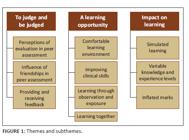
Three main themes emerged from the data, as shown in Figure 1.
Theme 1: To judge and be judged
Theme one highlights responses relating to students' attitudes and experiences with peer assessment, both as examiners and the one being examined. The three sub-themes identified included: 'Perceptions of evaluation in peer assessment', 'Influence of friendships in peer assessment' and 'Providing and receiving feedback'.
Subtheme 1.1: Perceptions of evaluation in peer assessment
Peer assessments are underpinned by an element of judgement in decision-making, where one student (the assessor) is usually required to grade another student and provide feedback. One student echoed her perception of peer assessment below:
'I think that peer assessment is when a student judges or criticises another student and provides feedback to the student regarding their work.' (P15, 3rd Year Student, Female)
This study revealed that students perceived several attributing factors that influenced the manner in which they are peer assessed:
'It happens that sometimes our assessor may be overjudging us and that could be linked to their personality. Emotions and personalities interfere with our assessments.' (P9, 4th Year Student, Male)
The above sentiment raises concerns regarding the credibility of peer assessments being included in the final mark of modules because of subjective factors that affect standardisation and impartiality.
Subtheme 1.2: Influence of friendships in peer assessment
The influence of friendships in providing honest peer assessments was highlighted:
'I feel bad to give people horrible marks, even though they deserve it. The only reason most of us do not give each other bad marks is because most of the people that we assess are our friends and we do not want to tarnish the relationship afterwards.' (P2, 4th Year Student, Female)
In addition, the impact of peer bias on overall clinical performance was raised:
'Some of our fellow peer assessors may not be that honest with you on your performance, it will have a negative effect as you will carry that to your actual assessment.' (P15, 3rd Year student, Female)
Participants voiced concerns about the accuracy of peer assessment outcomes, reporting observations of leniency. It was believed that established friendships among peers impaired their ability to remain impartial:
'I don't think it's a fair assessment because sometimes they can just be marking for their friends, or you know they themselves don't understand the work.' (P25, 3rd Year student, Female)
These sentiments alert that while the role of friendships remained a primary influencer, peer grading can also be influenced by a lack of knowledge. Thus, emphasising the importance of expert input.
Subtheme 1.3: Providing and receiving feedback
A degree of discomfort with the responsibility of being in a position of authority was reported:
'I was an assessor, and I do not think I liked the experience. It was not comfortable being in a position where I had to mark down someone.' (P30, 3rd Year student, Female)
Concurring, another student added:
'It is awkward as an assessor if the clinician is doing poorly, and you must give them a mark as you are both peers and on the same level; but if the clinician is willing to take it as a learning experience, it should be okay.' (P21, 3rd Year student, Male)
The above statement highlights that equivalent roles present as a challenge in providing and accepting peer feedback.
On the other end of the spectrum, instances of student discomfort when being assessed were raised:
'I once had a bad experience where the assessor was saying that I should introduce a minus lens first on best sphere, and it was hard to correct my assessor.' (P25, 3rd Year student, Female)
The above experience highlights the subordinate nature of being assessed, which was exacerbated by peer's gaps in clinical knowledge. Thus, posing a challenge in accepting what was constituted as incorrect feedback. This has implications when peer assessment is used for summative assessment opposed to as formative (learning or practice) opportunities.
Theme 2: A learning opportunity
This theme highlights the potential benefits of peer assessment as a learning opportunity. It includes the following sub-themes 'Comfortable learning environment', 'Improving Clinical Skills', 'Learning through Observation and exposure' and 'Learning Together'.
Subtheme 2.1: Comfortable learning environment
Despite the negative experiences highlighted in the preceding sub-theme, the majority of participants felt that peer assessments presented as a useful learning opportunity, as the non-intimidating context of peer-to-peer engagement facilitated open communication:
'I feel comfortable to ask certain questions from my peers and get clarity.' (P52, 3rd Year Student, Female)
The ease of learning through peer assessment was also noticed, as reduced anxiety was experienced when compared to being assessed by preceptors:
'It is easier to learn at ease as you focus more on the learning when not stressed.' (P27, 3rd Year Student, Female)
Participants indicated that peer assessment created a collaborate environment, allowing students to correct or explain concepts to each other without fear of formal presence.
Subtheme 2.2: Improving clinical skills
Clinical skills development in the field of optometry is critical in preparing students to assess and treat real patients. Participants reported that the comfortable environment associated with peer assessment provided practice opportunities that improved skill transfer and increased clinical competency:
'I think it is more like trial and error because as you make mistakes, your peer can correct you.' (P15, 3rd Year Student, Female)
Peer assessments enable shared experiences and a sense of relatability; as a result, this allows students to reflect on how their own skills measure up. This was reiterated by Participant 12:
'Student-to-student interaction is easier in terms of understanding of each other and interpretation of how one can improve their areas of weakness.' (P12, 4th Year Student, Female)
P12, concurred:
'I'm thinking this is crucial because it helps the student reflect on certain areas and aspects where they are weak and can't reflect themselves.' (P12, 4th Year Student, Female)
Subtheme 2.3: Learning through observation and exposure
Peer assessment was associated with observational learning and reinforcement of clinical procedures, as expressed below:
'I was really learning as she was doing the techniques.' (P32, 3rd Year Student, Male)
In addition to learning from observation, learning through exposure was identified as a key benefit of peer assessments:
'I feel like being in the position to assess somebody else and reading the rubric helps me understand more exactly what is expected of me during the practical assessments. I get to see what I need to do accordingly.' (P4, 4th Year student, Male)
The above indicates that through the process of assessing others, students gain familiarity with the assessment tools and evaluation criteria, therefore assisting in their own practical assessments.
Subtheme 2.4: Learning together
Many participants likened peer assessments to shared learning, as it encouraged teamwork and student interaction, allowing them to share strategies on how to refine their clinical skills:
'It opens a room to share, learn and improve.' (P51, 3rd Year Student, Male)
Furthermore, it was expressed that in the realm of a collaborative team approach, student-student interaction provided immediate feedback, which could be implemented to rectify errors. Thus, emphasising the principle of learning together in a supportive environment:
'I feel like peer assessments are very good for us, they allow us to express ourselves freely and we learn and whenever you do something wrong you get corrected at that time.' (P13, 4th Year Student, Female)
Theme 3: Impact on learning
This theme highlights the potential limitations of peer assessments and its adverse impact on learning. The above theme included three sub-themes 'Simulated learning', Variable knowledge and experience levels' and 'Inflated marks'
Subtheme 3.1: Simulated learning
While peer assessment has its benefits, several participants cited the potential risks to learning. Of concern was that when assessing a peer, who in theory was not a 'real patient with real problems', the learning opportunity was limited:
'When we are performing the techniques on our peers who are normal, they have no significant pathologies.' (P26, 3rd year student, Male)
As such, participants felt that peer assessments were not challenging enough, therefore, questioning the outcome of a peer assessment as being a true reflection of learning, skills or clinical competency.
Subtheme 3.2: Variable knowledge and experience levels
It can be derived from participants' responses that the educational value of peer assessment is impacted by the knowledge and competency level of the peer they are paired with. While some participants reported a positive learning experience working with a knowledgeable peer, for others limited benefit was reported:
'I think the knowledge factor also comes into play; like what if somebody who knows their work gets paired with someone who does not know their work? In that way it is only beneficial to one person.' (P35, 3rd year student, Female)
In many cases, students did not learn anything new because of their peer's lack of knowledge when compared to a qualified assessor with experience, once again highlighting the challenges of educational potential of peer assessments. The influence of limited peer assessor knowledge on the learning process was echoed as follows:
'If the assessor does not know their work, they can pass the wrong information to others.' (P22, 3rd year student, Female)
'It limits the education, such as when you really need information, and you can't ask a preceptor as you have your peer assessor who might also not be sure.' (P26, 4th year student, Male)
Subtheme 3.3: Inflated marks
Almost all participants shared the view that peer assessments have the potential to improve their final marks in certain modules:
'Peer assessment marks should count towards a module mark because the mark does make a lot of difference in improving our final mark.' (P15, 3rd year student, Female)
Despite some participants supporting the inclusion of peer assessments towards their final module mark, other students considered leniency, limited knowledge and experience of peer assessors as significant factors that affected the credibility of their assigned mark:
'Peer assessments shouldn't be a true reflection of student's grades.' (P47, 3rd year student, Female)
'It is good to be retained as a learning approach, but it should carry less weight as to other assessments.' (P24, 3rd year student, Female)
Discussion
This study investigated the experiences and perceptions of undergraduate optometry students towards peer assessment as an educational strategy. Assessment refers to the process of objectively evaluating the knowledge and skills of students to draw an accurate conclusion regarding their performance and competencies.17
The role of existing friendships affecting peer assessments was notably highlighted. Students believed that loyalty among peers resulted in leniency during evaluation. Similar findings were reported in Indonesia.181920
In contrast to findings of peer leniency, a study by Hegg et al.21
The process of providing and receiving feedback, which is an important aspect of assessment aiding the learning process,2223242515
From the perspective of being assessed, students struggled to address peer assessors who provide incorrect feedback. Thus, indicating the gaps in clinical knowledge of some peer assessors and the impact of lack of expert input. These findings indicate the need to create a safe space for feedback review, by encouraging students to be open minded and willing to learn collaboratively, as per the goals of peer assessment. In addition, it is recommended that expert oversight is used to compliment peer assessments, in order to validate the feedback being provided and the corresponding mark allocated.
Despite these challenges, students expressed several benefits associated with peer assessments. A comfortable learning environment increases students' attention and promotes a meaningful learning experience where students are more likely to relax, creating freedom to open up and share their thoughts.2623
Furthermore, the element of relatability among peers and the ability to reflect on weakness were key benefits of peer assessment. Therefore, contributing towards building clinical competency. Curran et al.910271028
Learning together was an important advantage of peer assessments emerging from this study. El-Senousy27
Despite the favourable aspects of peer assessment, several limitations were identified in this study. One of the key findings was that simulated patients, through peer assessment, did not present as a sufficient academic challenge, thus failing to provide a meaningful critical thinking opportunity. As such, this limitation in exposure to managing real patients in a peer assessment environment did not provide a true reflection of clinical skills. Kozmenko and Wallanberg29
Other concerns include peer assessors' lack of knowledge, evidenced by reported uncertainty in clinical techniques. This has implications for passing on incorrect information to students as well as inaccurate gradings. Rubrics are the guidelines for student assessment that assist in clarifying expectations and how a student can meet them. A lack of knowledge of assessment criteria will also affect the ability to carry out a reliable and valid assessment.3031
The inclusion of peer assessment in the overall summative grade was met with contention. While some students welcomed that peer assessment boosted their final mark, others felt that it should be omitted or carry less weight because of limited credibility arising from leniency. However, research has shown that student motivation diminished when peer assessment had no significant impact on summative assessment.3233
Finally, as peer assessors apply assessment strategies that differ considerably from experts,9
Limitations
The study was limited to UKZN senior students; it would have been beneficial to include the perspectives of junior students regarding peer assessment. In addition, the input of lecturers may have aided in a deeper understanding of peer assessment.
The study was conducted within a single institution and does not consider the experiences and perceptions of peer assessments in other institutions, as well as how peer assessments are used.
Recommendations
Peer assessment should be retained as a learning tool in undergraduate optometry training; however, it should be used as a complementary education strategy that integrates expert oversight. Student assessors should be trained on how to fairly assign marks and provide constructive feedback to their fellow classmates. It is further recommended that the current peer assessment approach be modified to consider the inclusion of virtual assessments as well the assignment of two or more peer assessors per student to enhance objectivity. The study will serve as a baseline for future researchers who may conduct research on the impact of peer assessment in undergraduate optometry training.
Conclusion
Peer assessment holds value as a peer learning opportunity and complementary educational intervention in undergraduate optometry training. It creates an enabling environment for peer learning to take place and can be used to facilitate practice that improves clinical competency. Peer assessments can also be used to develop students' skills in providing feedback and understanding assessment processes. However, peer assessment presents as a complex intervention influenced by multiple possible factors. Feedback may be influenced by pre-existing friendships, reducing its full value as feedback may not always be honest, and grading is likely to be lenient or, in some cases, too strict. Therefore, the integration of expert oversight is recommended to quality assure the learning process. Furthermore, where grading is required as part of summative assessments, the results should be treated with caution because students experience difficulty being objective and providing honest critique to their peers. In addition, the use of technological interventions, such as virtual sessions and strategies to maintain anonymity, may further assist in ensuring objectivity. The assignment of more than one peer assessor may also assist in obtaining a holistic view of a student's performance. In order to maximise the learning opportunity, preparing students to provide and receive honest and constructive feedback is critical to the successful use of peer assessment as an educational intervention and is a skill that should be developed in optometry education.
Competing interests
The authors declare that they have no financial or personal relationships that may have inappropriately influenced them in writing this article.
CRediT authorship contribution
Diane van Staden: Conceptualisation, Methodology, Project Administration, Validation, Writing-Review & Editing, Supervision. Lulama Dlamini: Formal Analysis, Investigation, Writing-Original Draft, Project Administration. Nomvula Mathe: Investigation, Writing-Original Draft. Jevon Moodley: Investigation, Writing-Original Draft, Data Curation. Sthandiwe Nguse: Writing - Original Draft, Data Curation. Mzokhona Shozi: Investigation, Data Curation. Sibusile Zikhali: Conceptualisation, Investigation, Writing-Original Draft, Data Curation. Shadette Gopaul: Data Curation, Writing-Review & Editing. All authors reviewed the article, contributed to the discussion of results, approved the final version for submission and publication and take responsibility for the integrity of its findings.
Funding information
The authors received no financial support for the research, authorship and/or publication of this article.
Data availability
The datasets generated and/or analysed during the current study are not publicly available as participants did not grant consent for public release of audio recordings. These may be available from the corresponding author, Diane van Staden, upon reasonable request.
Disclaimer
The views and opinions expressed in this article are those of the authors and are the product of professional research. They do not necessarily reflect the official policy or position of any affiliated institution, funder, agency or that of the publisher. The authors are responsible for this article's results, findings and content.
Acknowledgements
The authors would like to acknowledge all participants that contributed to the study by sharing their insights during the focus groups.
References
- 1.Ifenthaler D, Sahin M. Assessment analytics in education: Designs, methods and solutions. Cham: Springer International Publishing; 2024.
- 2.Yakimowski ME, Beckham LL, Gotch CM. Leading schools with embedded assessment practices. London: Taylor & Francis; 2025.
-
3.Double KS, McGrane JA, Hopfenbeck TN. The impact of peer assessment on academic performance: A meta-analysis of control group studies. Educ Psychol Rev. 2020;32:481-509. https://doi.org/10.1007/s10648-019-09510-3
» https://doi.org/10.1007/s10648-019-09510-3 -
4.Liu NF, Carless D. Peer feedback: The learning element of peer assessment. Teach High Educ. 2006;11(3):279-290. https://doi.org/10.1080/13562510600680582
» https://doi.org/10.1080/13562510600680582 -
5.Schellekens LH, Bok HGJ, De Jong LH, Van der Schaaf MF, Kremer WDJ, Van der Vleuten CPM. A scoping review on the notions of Assessment as Learning (AaL), Assessment for Learning (AfL), and Assessment of Learning (AoL). Stud Educ Eval. 2021;71:101094. https://doi.org/10.1016/j.stueduc.2021.101094
» https://doi.org/10.1016/j.stueduc.2021.101094 -
6.Chen L, Chen H, Xu D, Yang Y, Li H, Hua D. Peer assessment platform of clinical skills in undergraduate medical education. J Int Med Res. 2019;47(11):5526-5535. https://doi.org/10.1177/0300060519861025
» https://doi.org/10.1177/0300060519861025 -
7.Baker KM. Peer review as a strategy for improving students' writing process. Act Learn High Educ. 2016;17(3):179-192. https://doi.org/10.1177/1469787416654794
» https://doi.org/10.1177/1469787416654794 - 8.Pereira D, Flores MA, Niklasson L. Assessment revisited: A review of research in assessment and evaluation in higher education. Assess Eval High Educ. 2016;41(7):1008-1032.
-
9.Curran VR, Fairbridge NA, Deacon D. Peer assessment of professionalism in undergraduate medical education. BMC Med Educ. 2020;20(1):504. https://doi.org/10.1186/s12909-020-02412-x
» https://doi.org/10.1186/s12909-020-02412-x -
10.Maas M, Sluijsmans D, Van der Wees P, Heerkens Y, Nijhuis-van der Sanden M, Van der Vleuten C. Why peer assessment helps to improve clinical performance in undergraduate physical therapy education: A mixed methods design. BMC Med Educ. 2014;14:117. https://doi.org/10.1186/1472-6920-14-117
» https://doi.org/10.1186/1472-6920-14-117 -
11.Van Popta E, Kral M, Camp G, Martens RL, Simons PRJ. Exploring the value of peer feedback in online learning for the provider. Educ Res Rev. 2017;20:24-34. https://doi.org/10.1016/j.edurev.2016.10.003
» https://doi.org/10.1016/j.edurev.2016.10.003 -
12.Ketonen L, Nieminen P, Hähkiöniemi M. The development of secondary students' feedback literacy: Peer assessment as an intervention. J Educ Res. 2020;113(6):407-417. https://doi.org/10.1080/00220671.2020.1835794
» https://doi.org/10.1080/00220671.2020.1835794 - 13.Jackson N, Jamieson A, Khan A. Assessment in medical education and training: A practical guide. London: CRC Press; 2023.
- 14.Barrio Minton CA, Lenz AS. Practical approaches to applied research and program evaluation for helping professionals. London: Taylor & Francis; 2019.
-
15.Lerchenfeldt S, Kamel-ElSayed S, Patino G, Loftus S, Thomas DM. A qualitative analysis on the effectiveness of peer feedback in team-based learning. Med Sci Educ. 2023;33(4):893-902. https://doi.org/10.1007/s40670-023-01813-z
» https://doi.org/10.1007/s40670-023-01813-z -
16.Kleinheksel AJ, Rockich-Winston N, Tawfik H, Wyatt TR. Demystifying content analysis. Am J Pharm Educ. 2020;84(1): 7113. https://doi.org/10.5688/ajpe7113
» https://doi.org/10.5688/ajpe7113 - 17.Morrow JR, Mood DP, Zhu W, Kang M. Measurement and evaluation in human performance. Champaign: Human Kinetics; 2022.
- 18.Izati R. The influence of friendship bias towards peer assessment in EFL class. Retain. 2018;6(2):52-59.
-
19.Marin VI, Benito B, Darder A. Technology-enhanced learning for student agency in higher education: A systematic literature review. Interact Des Archit J. 2020;45:15-49. https://doi.org/10.55612/s-5002-045-001
» https://doi.org/10.55612/s-5002-045-001 - 20.Pandero E. Is it safe? Social, interpersonal and human effects of peer assessment: A review and future directions. New York, NY: Routledge; 2016.
-
21.Hegg RM, Ivan KF, Tone J, Morten A. Comparison of peer assessment and faculty assessment in an interprofessional simulation-based team training program. Nurse Educ Pract. 2020;42:102667. https://doi.org/10.1016/j.nepr.2019.102667
» https://doi.org/10.1016/j.nepr.2019.102667 - 22.Isaacs T, Zara C, Herbert G, Coombs SJ, Smith C. Key concepts in educational assessment. Thousand Oaks: Sage; 2013.
-
23.Cheng W, Warren M. Peer assessment of language proficiency. Lang Test. 2005;22(1):93-121. https://doi.org/10.1191/0265532205lt298oa
» https://doi.org/10.1191/0265532205lt298oa - 24.De Wever B, Noroozi O. The power of peer learning: Fostering students' learning processes and outcomes. Berlin: Springer International Publishing; 2023.
-
25.Adachi C, Tai JHM, Dawson P. Academics' perceptions of the benefits and challenges of self and peer assessment in higher education. Assess Eval High Educ. 2018;43(2):294-306. https://doi.org/10.1080/02602938.2017.1339775
» https://doi.org/10.1080/02602938.2017.1339775 - 26.Li L, Steckelberg AL. Using peer feedback to enhance student meaningful learning. Chicago, IL: Association for Educational Communications and Technology; 2004.
-
27.El-Senousy H. How peer assessment could be interactive and effective. S Afr J Educ. 2020;40(2):1-14. https://doi.org/10.15700/saje.v40n2a1651
» https://doi.org/10.15700/saje.v40n2a1651 -
28.Dooley LM, Bamford NJ. Peer feedback on collaborative learning activities in veterinary education. Vet Sci. 2018;5(4):90. https://doi.org/10.3390/vetsci5040090
» https://doi.org/10.3390/vetsci5040090 -
29.Kozmenko V, Wallenburg B. Simulation in healthcare. Simul Healthc. 2014;9(6):487. https://doi.org/10.1097/01.SIH.0000459412.50486.d9
» https://doi.org/10.1097/01.SIH.0000459412.50486.d9 -
30.Panadero E, Jonsson A. The use of scoring rubrics for formative assessment purposes revisited: A review. Educ Res Rev. 2013;9:129-144. https://doi.org/10.1016/j.edurev.2013.01.002
» https://doi.org/10.1016/j.edurev.2013.01.002 -
31.Tai J, Canny B, Haines T, Molloy E. Implementing peer learning in clinical education: A framework to address challenges in the 'real world'. Teach Learn Med. 2017;29(2):162-172. https://doi.org/10.1080/10401334.2016.1247000
» https://doi.org/10.1080/10401334.2016.1247000 -
32.Pond K, Ul-Haq R, Wade W. Peer review: A precursor to peer assessment. Innov Educ Train Int. 1995;32(4):314-323. https://doi.org/10.1080/1355800950320403
» https://doi.org/10.1080/1355800950320403 -
33.Yorke M. Formative assessment in higher education: Moves towards theory and the enhancement of pedagogic practice. High Educ. 2003;45(4):477-501. https://doi.org/10.1023/A:1023967026413
» https://doi.org/10.1023/A:1023967026413

Accepted: 03 Nov. 2025
Published: 13 Jan. 2026