Refractive error prevalence among the traditional Quranic boarding schools in Al-Gezira, Sudan
Abstract
BACKGROUND: Uncorrected refractive error is an avoidable aetiology of visual impairment, negatively affecting children's quality of life. There is limited evidence related to the prevalence of refractive errors among the children or adolescent population within Sudan. AIM: To determine the prevalence and types of refractive error among children enrolled in traditional Quranic boarding schools in the Al-Gezira state, Sudan. SETTING: This cross-sectional, quantitative study conducted within the student population of traditional Quranic boarding schools in Al-Gezira, Sudan. METHODS: A total of 551 male children from eight schools underwent subjective and objective refraction, including direct ophthalmoscopy as well as binocular vision assessment. RESULTS: Out of the total 551 school children, the refractive error prevalence was 6.2% (n = 34). The prevalence of myopia among the participants was 5.1% (n = 28), followed by hypermetropia 1.1% (n = 6). Astigmatism was diagnosed in 3.3% (n = 18) of the study population classified as myopic astigmatism of 2.4% (n = 13) and hyperopic astigmatism 0.9% (n = 5). CONCLUSION: This study found the prevalence of refractive errors among the children as 6.2%. It provides baseline data about refractive error among the children in this sample, which is useful as a reference point, however further studies need to be conducted in all the Quranic schools of Sudan. CONTRIBUTION: This study offers a principal information about the ametropia among the children in this community and highlights the need for further refractive errors related epidemiological studies within the region.
prevalence; refractive error; hyperopia; myopia; astigmatism; children; Sudan
Introduction
Uncorrected refractive error (URE) is the second leading cause of avoidable blindness worldwide, posing a challenge to the global eye healthcare system.1,2,341,5346,7
Development of refractive error is multifactorial and refractive conditions such as myopia are sometimes associated with genetics. Also, environmental factors such as light intensity or exposure to near work, play a key role in the development of refractive error.89910,114
The potential danger of URE among school-going children poses a major risk to their learning abilities as well as their academic progress,124,131411543
Methods
Study design
This was a cross-sectional, quantitative study conducted among the student population of traditional Quranic boarding schools (Maseed) based in Al-Gezira state, Sudan where children learn and write the Quran. The students' age for this study were between 6 years and 15 years. Inclusion criteria were being all children who attended the Quranic Boarding Schools in Al-Gezira state. Exclusion criteria were any ocular diseases or operations.
Sample size and statistical analysis
As there are no formal registration processes in these traditional schools because of a non-governmental authority for these traditional schools,16

where N is sample size, M is the margin of error, P is an estimated value of the proportion, and Z is the confidence interval.17
A multistage sampling technique using two levels of the sampling process was used while selecting the schools within the region and eight schools were selected. The authors (who were optometrists) conducted this study within two phases among the selected sample. The first phase of the screening collected demographic data including name, gender, age, duration of study in Maseed, and origin of students. In addition, the researchers also collected data related to symptoms, family or personal history, which included systemic and ocular history. Three participants with ocular diseases were excluded from the study.
In the second phase, uncorrected as well as current habitual visual acuities were measured for all participants monocularly and binocularly using Snellen's visual acuity chart. Visual acuity was analysed using decimal notation. Anterior ocular health was assessed using a torch and Heine magnifying binocular loupes, while the posterior segment of eyes were evaluated using a Heine Beta 200 LED Ophthalmoscope. A Heine Beta 200 retinoscope and Nidek-AR-800 autorefractometer was used before subjective refraction. The American Academy of Optometry Clinical Practice and Classification Guidelines were used where necessary regarding the methodology for the refractions.18
Refractive errors were categorised considering the spherical equivalent (SE) of the spectacle prescription. Myopia was defined if SE ≤−0.5 dioptre (D), hyperopia if SE ≥ 1.5 D, and astigmatism if cylindrical component of the spectacle prescription was > 0.5 D. The criteria for exclusion with regard to VA was defined as uncorrected or habitual VA of < 6/9 (decimal acuity of < 0.67) in any eye. The subjective and objective refractions were conducted for children with VA < 6/9 in one or both eyes.
Data analysis was performed using the Statistical Package for Social Sciences (SPSS) version 22 software for Windows 10 (Armonk, NY: IBM Corp) and Microsoft Excel 2016. The data were analysed using descriptive statistics. The relationship between age and myopia, duration period in the school and myopia were determined using Pearson's correlation test with p < 0.05 indicating significance.
Ethical considerations
The study followed the tenets of the Declaration of Helsinki. School authorities have authority to provide student consent and this was obtained from the schools included in the study. Ethical clearance to conduct this study was obtained from the Al Neelain University of Sudan (No. CN/KDP). Quranic school authorities received study information sheet and the consent form in the Arabic language from Al-Neelain University. All the schools agreed to participate in the study. The optometrist visited various schools as per agreement with the necessary authorities.
Results
Demographic profile of the participants
A total of 551 male participants with the mean age of 12.46 years (standard deviation [s.d.]: ± 1.97 years) were included in the study. Schools in the study were from all regions of Sudan and had only male students. Their duration in school ranged from 1 year to 8 years (s.d.: ± 1.55). Two (0.4%) participants had an ocular history of trauma, six (1.1%) had family history of diabetes and 10 (1.8%) were already wearing spectacles. The two participants with a history of ocular trauma had no serious ocular abnormalities and hence were included in the study.
Correlation between age and myopic refractive error
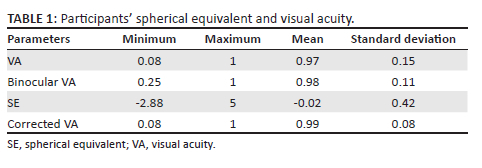
The mean age of the participants with myopia (n = 44) was 12.73 years (s.d.: ± 1.59). The spherical refractive error equivalent among myopic population was −1.08 D (s.d.: ± 0.60). A Pearson correlation coefficient was used to assess the linear relationship between spherical refractive error equivalent and age of the study participants. As shown in Table 1, there was a statistically insignificant correlation between the two variables, r (44) = 0.629, p = −0.075.
Refractive error profile among the study participants
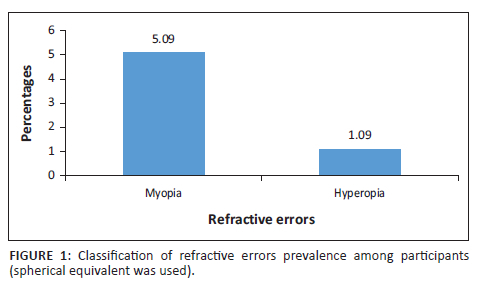
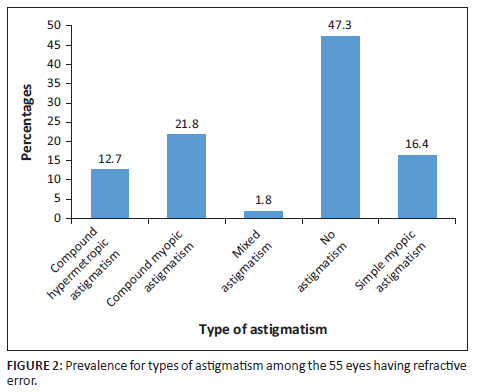
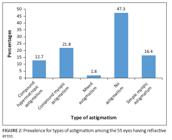
Out of 551 children, refractive errors in either eye appeared in 34 (6.2%) children. The prevalence of myopia among the participants was 5.08% (n = 28), followed by hypermetropia 1.09% (n = 6). Astigmatism was found in 3.27% (n = 18) of the study population classified as myopic astigmatism 2.36% (n = 13) and hyperopic astigmatism 0.90% (n = 5) as in Figure 1 and Figure 2.
Types and degree of refractive errors among the study participants
Of 55 eyes with refractive error, 29 (52.7%) had astigmatism (Figure 2). Compound myopic astigmatism was most common (n = 7 [21.8%]) with most participants with low myopic refractive errors, that is, 44 (80%).
Participants' spherical equivalent and visual acuity profile
Table 1 is based on decimal VA measured using Snellen's visual acuity chart. The mean uncorrected decimal visual acuity was 0.97 (s.d.: ± 0.15), which improved with correction to mean decimal visual acuity of 0.99 (s.d.: ± 0.08).
Discussion
Refractive errors are the leading cause of VI worldwide and their prevalence varies among regions and societies with these differences being partially related to genetic and/or environmental factors.181913
The prevalence of myopia (5.1%, n = 28) was the most common refractive error among the participants followed by hypermetropia at 1.1% (n = 6). This myopia prevalence is comparable to children in East Sikkim1202121n = 18) of our study population had astigmatism with myopic astigmatism of 2.4% (n = 13) and hyperopic astigmatism of 0.9% (n = 5), that is lower than a multicountry refractive error study findings in 2014.22
Most participants with myopia were aged between 11 years and 15 years, which is similar to studies by Olusanya et al. in Ibadan,232425,26 found a positive association between myopia and age.
This study's finding provides introductory information on refractive error prevalence among the specified student population in Sudan. Uncorrected refractive error remains the most common cause of childhood VI in many countries,2526,27,2829
Conclusion
Refractive error prevalence among the children was 6.2%, with myopia being the most prevalent (5.1%), followed by hypermetropia (1.1%). Approximately, 3.3% of the study population had astigmatism with myopic astigmatism of 2.4% and hyperopic astigmatism of 0.9%. This study provides useful baseline data for refractive error among children within Quranic schools in Sudan. However, a wider or larger study needs to be conducted in all the Quranic schools of Sudan. Exposure for these children to intensive near work supports the need for evaluating refractive error prevalence (especially regarding progressive myopia) and changes perhaps in trends while conducting future epidemiologic studies.
Competing interests
The authors declare that they have no financial or personal relationships that may have inappropriately influenced them in writing this article.
Authors' contributions
Z.D.M. and G.S.V. contributed equally to the article.
Funding information
This research received no specific grant from any funding agency in the public, commercial, or not-for-profit sectors.
Data availability
Data sharing is not applicable to this article as no new data were created or analysed in this study.
Disclaimer
The views and opinions expressed in this article are those of the authors and do not necessarily reflect the official policy or position of any affiliated agency of the authors.
Acknowledgements
References
-
1.Bhutia KL, Bhutia SC, Gupta N, Shenga DO. Prevalence of refractive errors among the school-going children in East Sikkim. Indian J Ophthalmol. 2021;69(8):2018-2020. https://doi.org/10.4103/ijo.IJO_112_21
» https://doi.org/10.4103/ijo.IJO_112_21 -
2.Pascolini D, Mariotti SP. Global estimates of visual impairment: 2010. Br J Ophthalmol. 2012;96(5):614-618. https://doi.org/10.1136/bjophthalmol-2011-300539
» https://doi.org/10.1136/bjophthalmol-2011-300539 -
3.Ghalib NM, Ibrahim SM, Bahakim NO. Prevalence of refractive errors among primary school children (6-15 yrs) in Al-Khartoum- Sudan. Syst Rev Pharm [serial online]. 2020 [cited n.d.];11(10):674-675. Available from: https://www.sysrevpharm.org/bstract/prevalence-of-refractive-errors-among-primary-school-children-615-yrs-in-alkhartoum-sudan-66476.html
» https://www.sysrevpharm.org/bstract/prevalence-of-refractive-errors-among-primary-school-children-615-yrs-in-alkhartoum-sudan-66476.html -
4.Ovenseri-Ogbomo G, Osuagwu UL, Ekpenyong BN, et al. Systematic review and meta-analysis of myopia prevalence in African school children. PLoS One. 2022;17(2):e0263335. https://doi.org/10.1371/journal.pone.0263335
» https://doi.org/10.1371/journal.pone.0263335 -
5.Resnikoff S, Pascolini D, Mariotti SP, Pokharel GP. Global magnitude of visual impairment caused by uncorrected refractive errors in 2004. Bull World Health Organ. 2008;86(1):63-70. https://doi.org/10.2471/BLT.07.041210
» https://doi.org/10.2471/BLT.07.041210 -
6.Naidoo KS, Raghunandan A, Mashige KP, et al. Refractive error and visual impairment in African children in South Africa. Invest Ophthalmol Vis Sci. 2003;44(9):3764-3770. https://doi.org/10.1167/iovs.03-0283
» https://doi.org/10.1167/iovs.03-0283 -
7.Ezinne N, Mashige K. Refractive error and visual impairment in primary school children in Onitsha, Anambra State, Nigeria. Afr Vision Eye Health. 2018;77(1):1-8. https://doi.org/10.4102/aveh.v77i1.455
» https://doi.org/10.4102/aveh.v77i1.455 -
8.Demir P, Baskaran K, Theagarayan B, Gierow P, Sankaridurg P, Macedo AF. Refractive error, axial length, environmental and hereditary factors associated with myopia in Swedish children. Clin Exp Optom. 2021;104(5):595-601. https://doi.org/10.1080/08164622.2021.1878833
» https://doi.org/10.1080/08164622.2021.1878833 -
9.Khoshhal F, Hashemi H, Hooshmand E, et al. The prevalence of refractive errors in the Middle East: A systematic review and meta-analysis. Int Ophthalmol. 2020;40(6):1571-1586. https://doi.org/10.1007/s10792-020-01316-5
» https://doi.org/10.1007/s10792-020-01316-5 -
10.Porter G, Hampshire K, Abane A, et al. Youth, mobility and mobile phones in Africa: Findings from a three-country study. Inf Technol Dev. 2012;18(2):145-162. https://doi.org/10.1080/02681102.2011.643210
» https://doi.org/10.1080/02681102.2011.643210 -
11.Porter G, Hampshire K, Milner J, et al. Mobile phones and education in sub-Saharan Africa: From youth practice to public policy. J Int Dev. 2016;28(1):22-39. https://doi.org/10.1002/jid.3116
» https://doi.org/10.1002/jid.3116 - 12.ose R, Sachdeva S. School eye screening and the national program for control of blindness. Indian Pediatr. 2009;46(3):205-208.
- 13.Congdon N, Burnett A, Frick K. The impact of uncorrected myopia on individuals and society. Comm Eye Health. 2019;32(105):7-8.
-
14.Gilal IA, Khanzada MA, Mirza AA, et al. Magnitude of prevalence of refractive errors in school-age children: A cross-sectional study. J Pharm Res Int. 2022;69(8):14-21. https://doi.org/10.9734/jpri/2022/v34i25B35956
» https://doi.org/10.9734/jpri/2022/v34i25B35956 -
15.Mohamed ZD, Binnawi KH, Abdu M. Prevalence and causes of childhood blindness and visual impairment in Quranic boarding schools in Al-Gazira State of Sudan. Sudanese J Ophthalmol. 2017;9(2):44-49. https://doi.org/10.4103/sjopthal.sjopthal_1_18
» https://doi.org/10.4103/sjopthal.sjopthal_1_18 - 16.Sullivan L. Power and sample size determination. Boston University School of Public Health, Boston, 2016; p. 1.
-
17.American Optometric Association. Evidence-based clinical practice guideline: Comprehensive pediatric eye and vision examination. Optom Clin Prac. 2020;2(2):44. https://doi.org/10.37685/uiwlibraries.2575-7717.2.2.1007
» https://doi.org/10.37685/uiwlibraries.2575-7717.2.2.1007 -
18.Gomez-Salazar F, Campos-Romero A, Gomez-Campaña H, et al. Refractive errors among children, adolescents and adults attending eye clinics in Mexico. Int J Ophthalmol. 2017;10(5):796-802. https://doi.org/10.18240/ijo.2017.05.23
» https://doi.org/10.18240/ijo.2017.05.23 -
19.Pradhan N, Sachdeva A, Goel T, et al. Prevalence of refractive errors among school children of 6-12-years of age group and reason for not using spectacles even after correction. Int J Res Med Sci. 2018;6(3):798-801. https://doi.org/10.18203/2320-6012.ijrms20180444
» https://doi.org/10.18203/2320-6012.ijrms20180444 -
20.Singh H, Saini VK, Yadav A, Soni B. Refractive errors in school going children - Data from a school screening survey programme. Natl J Community Med [serial online]. 2013 [cited 2022 Aug 03];4(1):137-140. Available from: https://www.njcmindia.com/index.php/file/article/view/1478
» https://www.njcmindia.com/index.php/file/article/view/1478 -
21.Xie Z, Long Y, Wang J, et al. Prevalence of myopia and associated risk factors among primary students in Chongqing: Multilevel modeling. BMC Ophthalmol. 2020;20:146. https://doi.org/10.1186/s12886-020-01410-3
» https://doi.org/10.1186/s12886-020-01410-3 - 22.Wang L, He M, Ellwein L, RESC Study Group. Prevalence of astigmatism in school-aged children: A multi-country refractive error study in children. Invest Ophthalmol Vis Sci. 2014;55(13):3640.
- 23.Olusanya BA, Ugalahi MO, Ogunleye OT, Baiyeroju AM. Refractive errors among children attending a tertiary eye facility in Ibadan, Nigeria: Highlighting the need for school eye health programs. Ann Ibadan Postgrad Med. 2019;17(1):49-59.
-
24.Michaeline I, Sheriff A, Bimbo A. Paediatric refractive errors in an eye clinic in Osogbo, Nigeria. Ethiop J Health Sci. 2016;26(2):145-152. https://doi.org/10.4314/ejhs.v26i2.8
» https://doi.org/10.4314/ejhs.v26i2.8 -
25.Philip K, Sankaridurg P, Naduvilath T, et al. Prevalence and patterns of refractive errors in children and young adults in an urban region in South India: The Hyderabad eye study. Ophthalmic Epidemiol. 2023;30(1):27-37. https://doi.org/10.1080/09286586.2022.2032202
» https://doi.org/10.1080/09286586.2022.2032202 -
26.Vidusha KSS, Damayanthi MN. Prevalence of refractive errors among school children in the rural field practice area of a tertiary care hospital, Bengaluru. Int J Community Med Public Health. 2018;5(5):1471-1476. https://doi.org/10.18203/2394-6040.ijcmph20181219
» https://doi.org/10.18203/2394-6040.ijcmph20181219 -
27.WHO. Visual impairment and blindness [homepage on the Internet]. 2014. Available from: https://www.who.int/news-room/fact-sheets/detail/blindness-and-visual-impairment
» https://www.who.int/news-room/fact-sheets/detail/blindness-and-visual-impairment -
28.Anh VT, D'Esposito F, Xuan LTT, Van PT, Nga TTH. Prevalence of refractive errors and accuracy of school-based visual acuity screening programs among school children in Vietnam. Res Sq. 2021;1:1-16. https://doi.org/10.21203/rs.3.rs-480579/v1
» https://doi.org/10.21203/rs.3.rs-480579/v1 -
29.Mohamed ZD, Abdu M, Alrasheed SH. Management plan for childhood visual impairment in traditional quranic boarding schools in Al-Gazira State of Sudan. Al-Basar Int J Ophthalmol [serial online]. 2018 [cited n.d.];5(1):1-5. Available from: https://www.bijojournal.org/article.asp?issn=1858-6538;year=2018;volume=5;issue=1;spage=1;epage=5;aulast=Mohamed;type=0
» https://www.bijojournal.org/article.asp?issn=1858-6538;year=2018;volume=5;issue=1;spage=1;epage=5;aulast=Mohamed;type=0
Accepted: 29 Aug. 2023
Published: 24 Oct. 2023