Knowledge, attitude, perception and education on contact lenses for refractive errors in Kenya
Abstract
BACKGROUND: Globally, contact lenses are an important part of the management process for refractive errors. Contact lenses are accepted widely in developed countries, but they are currently less used in developing countries like Kenya AIM: To assess the knowledge, attitudes and perceptions (KAP) (both pre- and post-education) to contact lens uptake specifically for correction of refractive errors by patients attending a Kenyan University Eye Clinic SETTING: Academic Vision Centre, Masinde Muliro University of Science and Technology, Kakamega, Kenya METHODS: A quasi-experimental cross-sectional study was performed by reviewing all records from February 2014 to March 2020; 360 records were purposively selected. Thereafter, a structured questionnaire with educative content on contact lenses was administered by phone and online to determine KAP. Responses were collected over a period of one month. Knowledge, attitudes and perceptions were categorised and scored, and descriptive statistics and paired t-tests were used for data analysis RESULTS: More women (58.3%) and mostly students (59.2%) participated, with ages from 16 to 38 years (mean age and standard deviation of 22.85 ± 4.32). Overall, there was poor knowledge of contact lenses for refractive errors (96.7%). Attitudes to contact lenses were unfavourable, both pre- and post-education (94.7% and 92.8%). Perceptions of contact lens uptake were negative pre-education (92.5%) but positive post-education (95.3% CONCLUSION: Education changed perceptions of contact lens usage for refractive errors correction, but even with some focused education, negative attitudes and poor knowledge regarding contact lenses persisted in the sample. Practitioners should inform patients about contact lenses as a possibility for refractive error management, and institutions training eye care providers should consolidate their clinical teaching regarding contact lenses CONTRIBUTION: This study showed that the more people with refractive errors are knowledgeable about contact lenses, the more uptake of contact lenses will happen, optometrists and ophthalmologists should educate people more on contact lenses
knowledge; attitude; perception; contact lenses; contact lens uptake; refractive errors
Introduction
Refractive errors have been corrected with contact lenses for many years, with both benefits and possible drawbacks.12,34567,8,9,10,11,1213,14
Knowledge, attitude and perception studies are designed to inform health education initiatives and guide policymaking processes.15,1617,18,1920,21,22
In a study in Iran on awareness and attitudes to refractive error correction methods, Moghaddam et al. (2013) found that 80.3%, 87.0% and 71.0% of participants knew nothing about contact lens applications, cosmetic contact lenses and therapeutic contact lenses, respectively. The study focused on practitioners in the prescription and dispensing of contact lenses.232425
Research shows that attitudes toward contact lens uptake are a significant factor which may affect the use of contact lenses in the correction of refractive error.2627,2829,30,31252525
In Saudi Arabia, a study of 1466 female students aged 16 and 31 years indicated that contact lens uptake and acceptance was positive. Half of the participants were part-time users of contact lenses, and cosmetic reasons were the major reason for contact lens use (63.3%). However, nearly 38.7% of the respondents used contact lenses without consultation with an eye care practitioner.32323214
This study is the first in Kenya to consider the impact of focused education on KAP to contact lens usage. The introduction of education in this study took into consideration the public health dimension that was lacking in previous studies. This study will significantly inform patients when making choices regarding means of refractive error correction. The eye care industry and policymakers in Kenya may be better informed because of this study and be guided appropriately when formulating policies regarding eye care management. Practitioners and contact lens industries may also benefit in the provision of contact lenses in Kenya, which may be good for the general public and also assist towards fulfilling global sustainable development goals.33
Methods
This quasi-experimental, cross-sectional study was carried out at Masinde Muliro University of Science and Technology (MMUST) Academic Vision Centre (AVC) in Kakamega County, western Kenya. This is currently the only university in Kenya with an AVC, attracting students from within and outside the country into optometric education and training at degree and postgraduate levels. The study reviewed all clinical records of patients who have attended (between February 2014 and March 2019) at the MMUST AVC. Clinical data of interest for this study were diagnosed refractive errors, with or without correction for patients of 16 years of age and above. A purposive sampling technique was used in selecting the required sample size from all patient records with refractive error as the primary diagnosis. Using Cochran's formula, the minimum sample size was calculated to be 360.
The exclusion criteria were participants unwilling to give consent or assent and those who were not given consent by their parents or guardians to participate in the study. Participants with early presbyopia or unclear contact or other information in their clinic records were also excluded.
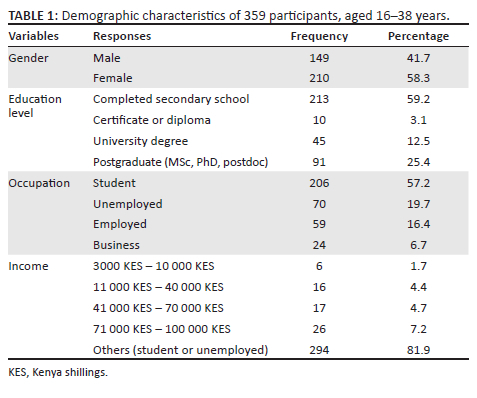
Semistructured questionnaires were used, consisting of both open- and closed-ended questions to elicit KAP of contact lenses, using the Likert scale (0-5). Graded and categorical responses were obtained from 359 participants (Table 1) through an online platform (where the study was also explained to the study participants who consented or assented). For the online survey, a link to the questionnaire was created and made available to participants through WhatsApp, e-mails and SMS. All data were collected over a period of one month.
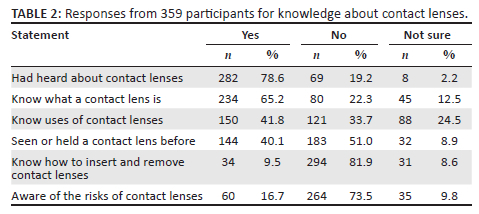
The questionnaire comprised 66 items (questions and statements) divided into Sections A and B (pre- and post-education on contact lens). Section A, which had the pre-education items, included Parts A and B as follows: parts A1 and A2, demographic information (nine items) and general eye health status (eight items), respectively. Further in Section A are Parts B1, B2, and B3: knowledge on contact lenses (seven items), attitude to contact lenses (nine items) and perceptions on contact lenses (13 items), respectively. Section B, being the post-education items, includes Part C, attitudes to contact lenses (nine items) and Part D, perceptions on contact lenses (11 items). Knowledge of contact lenses was determined by six items (Table 2). All items had 'yes', 'no' and 'not sure' numerically scored as 1, 0 and −1, respectively. Knowledge was categorised as binary into 'good knowledge' when the mean score was ≥ 5 and 'poor knowledge' when the mean score was < 5. All responses of 'not sure' scored as −1 and were considered uncertain and thus purposively omitted.34,35,36
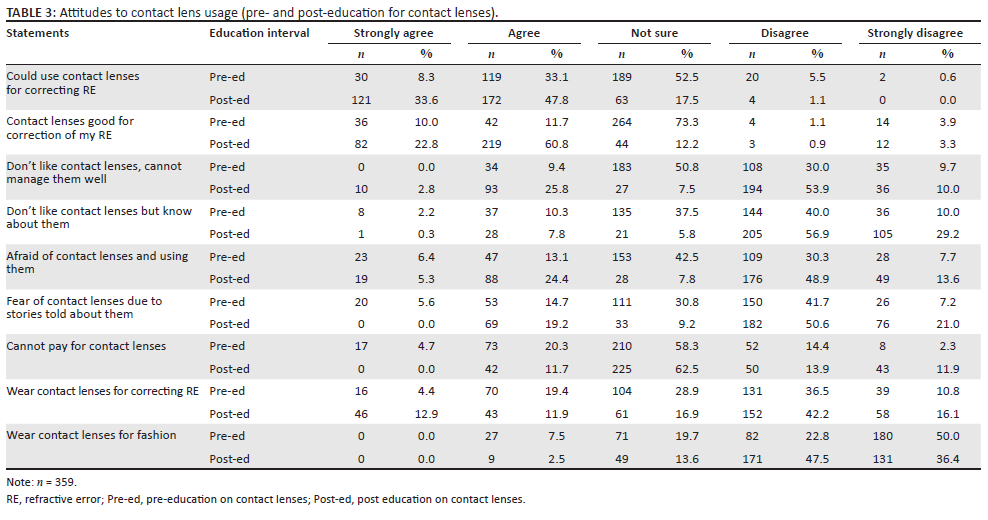
Attitudes to contact lens uptake pre- and post- education, respectively, were determined by nine items in the tool. Responses to the items were 'strongly disagree', 'disagree', 'agree', 'strongly agree' and 'not sure', scored as 1, 2, 3, 4 and 0, respectively. The total possible score for the items was 36 (that is, 9 × 4).3436
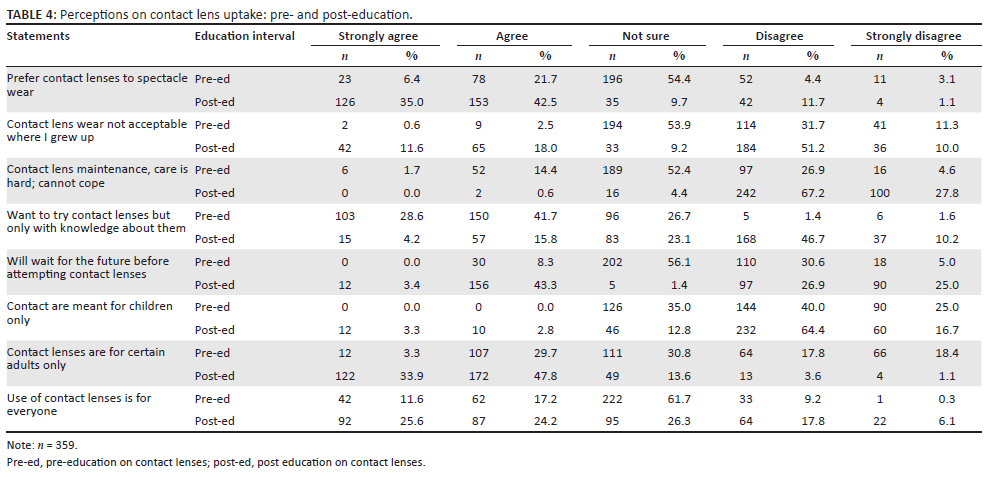
The items that determined attitudes are indicated in Table 3. Perceptions on contact lenses pre- and post- education had 13 and 11 items, respectively, of which eight items determined perceptions in this study (Table 4). The items had responses of 'strongly disagree', 'disagree', 'agree', 'strongly disagree' and 'not sure' scored as 1, 2, 3, 4 and 0, respectively, and given a total of 32 points. Scores ≥ 18 indicate 'positive perception', whereas scores < 18 indicate 'negative perception'.
Statistical analysis
Descriptive statistics (frequencies and percentages) and paired t-tests were used in determining relationships of the variables (KAP), to contact lens uptake for correction of refractive errors.
Ethical considerations
All procedures performed in the studies involving human participants and use of human records were in accordance with the ethical standards of the institutional ethics review committee (IERC) of Masinde Muliro University of Science and Technology (MMUST) (ref. no. MMUST/IERC/80/1). Permission was granted by the National Council of Science and technology and Innovation (NACOSTI) (ref. no. NACOSTI/P/20/3228) and the study complied with the 1964 Helsinki Declaration and its later amendments or comparable ethical standards. Written and verbal informed consent was obtained from all individual participants involved in this study.
Results
In total, 359 (99.7%) respondents took part in the study, with ages ranging from 16 to 38 years. The majority, 210 (58.3%), were women, but their ages did not differ significantly from that of the men. More than half of the participants had completed secondary school (213, 59.2%), were students (206, 57.2%) and were not receiving any income (295, 81.9%). Demographic characteristics of participants are shown in Table 1.
Responses for knowledge about contact lenses were varied according to the questions concerned. There was 100% response to all six questions by participants (Table 2).
Attitudes to contact lens uptake
There was a 100% response to the items by the participants (Table 3).
Perceptions on contact lens uptake
All items were responded to completely by participants in the study (Table 4).
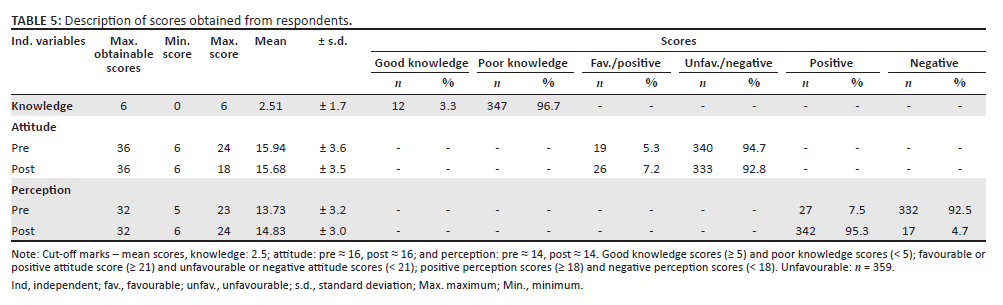
As shown in Table 5, attitudes to contact lens uptake were unfavourable or negative pre- and post-education (340, 94.7% and 333, 92.8%, respectively). Contact lens uptake was perceived more positively post-education (342, 95.3%).
Comparison of knowledge, attitudes and perceptions of contact lens uptake by patients before and after education about contact lenses
The mean scores for attitudes and perceptions were compared pre- and post-education using paired t-tests in Table 6. The results showed no significant change in participants' attitude score towards contact lens uptake (p = 0.275); however, there was a significant change in mean perception scores (from 1.83 ± 0.38 to 1.95 ± 0.21, p < 0.0005). Compared with pre-education, more participants demonstrated positive perception towards contact lens wear (n = 342, 95.3% vs. n = 298, 83.0%).
Discussion
Knowledge of contact lenses could be broadly classified into 'good knowledge' and 'poor knowledge'. However, knowledge about contact lenses goes beyond just knowing about their existence, handling and usage; it also entails identifying materials and basic types of contact lenses and their usages, sources of information about using contact lenses for the first time and functions of contact lenses.37,38,39
In a population-based study in Goa, India, knowledge was considered to be awareness of a contact lens in any dimension, and participants showed low to poor knowledge.4024,41,42
Knowledge on the risks of contact lenses, which includes over-wear syndrome and acanthamoeba infection, were high in the studies carried out among university students in Malaya by Tajunisah.4143,442345
This study showed more unfavourable or negative attitudes to contact lens uptake, as expressed by 'not sure', 'disagree' and 'strongly disagree' in responding to the items in the questionnaire. Attitude is a demonstration of what is learnt, known and envisaged, an extrinsic expression. Attitude could be either 'positive (favourable)' or 'negative (unfavourable).15,46,4728,48,49
In a two-phased study on beliefs and attitudes that create barriers to contact lens uptake, carried out in Italy in phase one and in Spain and Portugal in phase two among adolescents aged between 12 and 18 years, it was demonstrated that a substantial number of these adolescents (n = 146) wore contact lenses in phase one, and 77.5% expressed interest in the use of contact lens in phase two, because they were not users of contact lenses.50
In Karachi, Pakistan, and the Kingdom of Saudi Arabia, from different studies, there were favourable or positive attitudes to contact lens uptake, whether for refractive error correction, cosmesis or sporting activities.42,51,52
In this study, there was a willingness by the participants to try out contact lenses, having been educated about them. Perceptions took into consideration the practices anticipated towards contact lens uptake and its acceptance by the participants in uptake of the same for either refractive errors correction, cosmetics or otherwise, as desired. Contrary to this study, there was positive perception of contact lens uptake reported by a study carried out in Ankara, Turkey. Following their scoring of perception to contact lenses, the mean score was ≥ 4.15.535125,5424
There was no significant difference found when comparing attitudes to contact lens uptake after education about contact lenses. Similar findings were reported in a study done in Thailand.55
Conclusion
Knowledge on contact lens was considerably high in terms of simply knowing and hearing about contact lenses but low in knowledge of handling, usage, risks and uptake for refractive errors and cosmesis. Negative attitudes to contact lens uptake were found. Most participants have had little to no exposure to contact lenses. Negative perceptions to contact lens uptake were altered after receiving the proper education about contact lenses. The expectation and possibility of uptake of contact lenses, as expressed by the altering of the perceptions of patients to contact lens uptake upon receiving education about contact lenses, brings to light the need for eye health care providers to educate their patients comprehensively before dispensing for the correction of refractive errors, so that patients can make informed choices.
It is recommended that similar studies be carried out in other settings within societies. The religious, ethnocultural and diversified environment should be captured and accessed in the same regard as this study to elicit a more comprehensive understanding of KAP of contact lens uptake in terms of refractive error correction. Finally, KAP of already existent contact lens wearers need to be further researched.
Competing interests
The authors declare that they have no financial or personal relationships that may have inappropriately influenced them in writing this article.
Authors' contributions
C.G.T. conceived the present idea and wrote the proposal. C.G.T. and D.W.V.S. developed the theory and concepts, and L.U.O. performed the verifications. D.W.V.S. and L.U.O. verified the analytical methods developed by C.G.T. L.U.O., N.S. and C.G.T. reviewed the statistical aspect of the study. D.W.V.S. and H.C.C. supervised this work. All authors discussed the results and contributed to the final manuscript.
Funding information
The authors received no financial support for the research or authorship. Professor Percy K. Mashige through the University of KwaZulu-Natal paid the publication charges.
Data availability
The data that support the findings of this study are available on request from the corresponding author, C.G.T. The data are not publicly available because of institutional regulations.
Disclaimer
The views and opinions expressed in the submitted article are the authors and not an official position of the institution.
Acknowledgements
Thank you so much to Professor Emmanuel Kwasi Abu of University of Cape Coast, Ghana, for your consistent review, critiquing and grammatical correction of this work.
References
-
1.Jones-Jordan LA, Chitkara M, Coffey B, et al. A comparison of spectacle and contact lens wearing times in the Achieve study. Clin Exp Optom. 2010;93(3):157-163. https://doi.org/10.1111/j.1444-0938.2010.00480.x
» https://doi.org/10.1111/j.1444-0938.2010.00480.x -
2.Todd Craig J. The history of contact lenses - SelectSpecs glasses blog [homepage on the Internet]. 2017 [cited 2019 Mar 19]. Available from: https://www.selectspecs.com/blog, https://www.selectspecs.com/blog/history-of-contacts/
» https://www.selectspecs.com/blog -
3.Siviglia N. History of contact lenses Lancaster, PA; 2010; p. 1-9. Available from: https://lancastermedicalheritagemuseum.org/wp-content/uploads/2018/10/A-History-of-Contact-Lenses-by-Nick-Siviglia-Ph.D.-Sc.D..pdf
» https://lancastermedicalheritagemuseum.org/wp-content/uploads/2018/10/A-History-of-Contact-Lenses-by-Nick-Siviglia-Ph.D.-Sc.D..pdf -
4.Key JE. Development of contact lenses and their worldwide use. Eye Contact Lens. 2007;33(6):343. https://doi.org/10.1097/ICL.0b013e318157c230
» https://doi.org/10.1097/ICL.0b013e318157c230 - 5.Ferraz FH, Corrente JE, Opromolla P, Schellini SA. Influence of uncorrected refractive error and unmet refractive error on visual impairment in a Brazilian population. BMC Ophthalmol. 2014;14:84.
-
6.Adelson JD, Bourne RRA, Briant PS, et al. Causes of blindness and vision impairment in 2020 and trends over 30 years, and prevalence of avoidable blindness in relation to VISION 2020: The right to sight: An analysis for the global burden of disease study. Lancet Glob Health. 2021;9(2):e144-e160. https://doi.org/10.1016/S2214-109X(20)30489-7
» https://doi.org/10.1016/S2214-109X(20)30489-7 -
7.Smith MJ, Walline JJ. Controlling myopia progression in children and adolescents. Adolesc Health Med Ther. 2015;6:133-140. https://doi.org/10.2147/AHMT.S55834
» https://doi.org/10.2147/AHMT.S55834 -
8.Hashemi H, Fotouhi A, Yekta A, Pakzad R, Ostadimoghaddam H, Khabazkhoob M. Global and regional estimates of prevalence of refractive errors: Systematic review and meta-analysis. J Curr Ophthalmol. 2018; 30(1):3-22. https://doi.org/10.1016/j.joco.2017.08.009
» https://doi.org/10.1016/j.joco.2017.08.009 -
9.McCarty CA. Uncorrected refractive error. Br J Ophthalmol. 2006;90(5):521-522. https://doi.org/10.1136/bjo.2006.090233
» https://doi.org/10.1136/bjo.2006.090233 -
10.Morgan IG, Ohno-Matsui K, Saw S-M. Myopia. Lancet (London, England). 2012;379(9827):1739-1748. https://doi.org/10.1016/S0140-6736(12)60272-4
» https://doi.org/10.1016/S0140-6736(12)60272-4 -
11.American Optometric Association. Astigmatism [homepage on the Internet]. 2019. [cited 2019 Mar 16]. Available from: https://www.aoa.org/patients-and-public/eye-and-vision-problems/glossary-of-eye-and-vision-conditions/astigmatism
» https://www.aoa.org/patients-and-public/eye-and-vision-problems/glossary-of-eye-and-vision-conditions/astigmatism - 12.Kaimbo D, Kaimbo W. Astigmatism-definition, etiology, classification, diagnosis and non-surgical treatment. In: Goggin M, editor. Astigmatism - Optics, physiology and management. Rijeka: InTech, 2012; p. 59-74.
-
13.Stapleton F, Keay L, Jalbert I, Cole N. The epidemiology of contact lens related infiltrates. Optom Vis Sci. 2007;84(4):257-272. https://doi.org/10.1097/OPX.0b013e3180485d5f
» https://doi.org/10.1097/OPX.0b013e3180485d5f -
14.Yeung KK, Yee CS. Trend-setting: Global lens distribution: The worldwide use of contact lenses as a form of vision correction gives us a glimpse into the prescribing trends of other countries. Rev Cornea Contact lens [serial online]. 2011 [cited 2020 May 31]. Available from: https://www.reviewofcontactlenses.com/article/trend-setting-global-lens-distribution
» https://www.reviewofcontactlenses.com/article/trend-setting-global-lens-distribution - 15.Gumucio S. The KAP survey model (knowledge, attitude and practices). France: IGC Communigraphie, 2011; p. 74.
-
16.Launiala A. How much can a KAP survey tell us about people's knowledge, attitudes and practices? Some observations from medical anthropology on malaria in pregnancy in Malawi background : KAP surveys. Anthropol Matters J. 2009;11(1):1-13. https://doi.org/10.22582/am.v11i1.31
» https://doi.org/10.22582/am.v11i1.31 -
17.Morgan P, Woods CA, Tranoudis I, et al. International contact lens prescribing in 2016. Contact lens spectrum [homepage on the Internet]. 2016 [cited 2020 Aug 19]. Available from: https://www.researchgate.net/publication/312164301_INTERNATIONAL_CONTACT_LENS_PRESCRIBING_IN_2016
» https://www.researchgate.net/publication/312164301_INTERNATIONAL_CONTACT_LENS_PRESCRIBING_IN_2016 - 18.Kumari R, Chaudhry M, Sharma D. Conversion to contact lens from spectacles - A study about the practitioner's influence/initiative. Indian J Sci Res. 2017;13(1):131-136.
-
19.Key JE. Development of contact lenses and their worldwide use. Eye Contact Lens Sci Clin Pract. 2007;33(6):343-345. https://doi.org/10.1097/icl.0b013e318157c230
» https://doi.org/10.1097/icl.0b013e318157c230 -
20.Cope JR, Collier SA, Rao MM, et al. Contact lens wearer demographics and risk behaviors for contact lens-related eye infections - United States, 2014. Morb Mortal Wkly Rep. 2015;64(32):865-870. https://doi.org/10.15585/mmwr.mm6432a2
» https://doi.org/10.15585/mmwr.mm6432a2 - 21.CDC.com. Fast facts | Contact lenses | CDC healthy contact lens wear and care. Atlanta, GA: Centre for Disease Control and Prevention, 2018; p. 1-2.
-
22.Wire Business. Global contact lenses market review and outlook, 2016-2019 & 2027 - ResearchAndMarkets.com | Business wire [homepage on the Internet]. 2019 [cited 2020 Aug 19]. Available from: https://www.businesswire.com/news/home/20191126005460/en/Global-Contact-Lenses-Market-Review-Outlook-2016-2019
» https://www.businesswire.com/news/home/20191126005460/en/Global-Contact-Lenses-Market-Review-Outlook-2016-2019 - 23.Ak SMR, Pourmazar R. Awareness and attitude toward refractive error correction methods: A population based study in Mashhad. J Patient Saf Qual Improv. 2013;1(1):23-29.
- 24.Tchiakpe MP, Nhyira SA, Nartey A. Awareness and response of undergraduate spectacle wearers to contact lens usage. J Clin Ophthalmol Optom. 2017;1(1):7.
-
25.Ocansey S, Ovenseri Ogbomo G, Abu EK, Morny EKA, Adjei-Boye O. Profile, knowledge, and attitude of contact lens users regarding contact lens wear in Ghana. Cont Lens Anterior Eye. 2019;42(2):170-177. https://doi.org/10.1016/j.clae.2018.10.012
» https://doi.org/10.1016/j.clae.2018.10.012 -
26.Zhu Q, Yang B, Deng N, et al. The use of contact lenses among university students in Chengdu: Knowledge and practice of contact lens wearers. Cont Lens Anterior Eye. 2018;41(2):229-233. https://doi.org/10.1016/j.clae.2017.12.008
» https://doi.org/10.1016/j.clae.2017.12.008 -
27.Duda G, Garrett K. Blogging in the physics classroom: A research-based approach to shaping students' attitudes toward physics. Am J Phys. 2008;76(11):1054-1065. https://doi.org/10.1119/1.2967707
» https://doi.org/10.1119/1.2967707 - 28.Shahsavar Z, Tan BH. Developing a questionnaire to measure students' attitudes toward the course blog? Turk Online J Distance Educ - TODJE. 2012;13(1):200-211.
- 29.Colosi L. Designing an effective questionnaire. Ithaca, New York: Cornell University, 2006; p. 1-6.
-
30.Radhakrishna RB. Tips for developing and testing questionnaires/instruments [homepage on the Internet]. 2007 [cited 2021 Jul 16]. Available from: https://www.researchgate.net/publication/292384518_Tips_for_developing_and_testing_questionnairesinstruments
» https://www.researchgate.net/publication/292384518_Tips_for_developing_and_testing_questionnairesinstruments - 31.DeVellis RF. Scale development: Theory and applications. Vol. 26. 2nd ed. Thousand Oaks, CA: Sage, 2009; p. 1-4.
-
32.Abahussin M, AlAnazi M, Ogbuehi KC, Osuagwu UL. Prevalence, use and sale of contact lenses in Saudi Arabia: Survey on university women and non-ophthalmic stores. Cont Lens Anterior Eye. 2014;37(3):185-190. https://doi.org/10.1016/j.clae.2013.10.001
» https://doi.org/10.1016/j.clae.2013.10.001 -
33.Morton S, Pencheon D, Squires N. Sustainable development goals (SDGs), and their implementation. Br Med Bull 2017;124(1):81-90. https://doi.org/10.1093/bmb/ldx031
» https://doi.org/10.1093/bmb/ldx031 -
34.Wensing M, Grol R. Knowledge translation in health: How implementation science could contribute more. BMC Med. 2019;17:88. https://doi.org/10.1186/s12916-019-1322-9
» https://doi.org/10.1186/s12916-019-1322-9 -
35.Khoza N, Moodley T, Sokhulu S, et al. Knowledge, attitudes and practices of contact lens use in a South African adolescent population. Afr Health Sci. 2020;20(2):768-774. https://doi.org/10.4314/ahs.v20i2.29
» https://doi.org/10.4314/ahs.v20i2.29 -
36.Hager E, Odetokun IA, Bolarinwa O, Zainab A, Okechukwu O, Al-Mustapha AI. Knowledge, attitude, and perceptions towards the 2019 Coronavirus pandemic: A bi-national survey in Africa. PLoS One. 2020;16(2):e0236918. https://doi.org/10.1371/journal.pone.0236918
» https://doi.org/10.1371/journal.pone.0236918 -
37.Medical Device Control Office, Department of Health. Know more about contact lenses [homepage on the Internet]. 2014 [cited 2019 Jun 08]. Available from: https://www.mdco.gov.hk/english/emp/emp_gp/files/KnowMoreAboutContactLenses_Eng.pdf
» https://www.mdco.gov.hk/english/emp/emp_gp/files/KnowMoreAboutContactLenses_Eng.pdf -
38.Moreddu R, Vigolo D, Yetisen AK. Contact lens technology: From fundamentals to applications. Adv Healthc Mater. 2019;8(15):1900368. https://doi.org/10.1002/adhm.201900368
» https://doi.org/10.1002/adhm.201900368 -
39.Sulley A, Young G, Hunt C. Factors in the success of new contact lens wearers. Cont Lens Anterior Eye. 2017;40(1):15-24. https://doi.org/10.1016/j.clae.2016.10.002
» https://doi.org/10.1016/j.clae.2016.10.002 - 40.Usgaonkar UPS, Tambe P. Awareness and attitude toward refractive error correction methods, Among Goan population. J Dent Med Sci. 2018;17(3):4-10.
- 41.Tajunisah I, Ophth M, Reddy SC, et al. Knowledge and practice of contact lens wear and care among medical students of University of Malaya. Med J Malaysia. 2008;63(3):207-10.
-
42.Irfan R, Memon RS, Shaikh MY, Phuah SJ. Knowledge and attitude of youth towards contact lenses in Karachi, Pakistan. J Glob Heal Reports 2019;3:e2019042. https://doi.org/10.29392/joghr.3.e2019042
» https://doi.org/10.29392/joghr.3.e2019042 - 43.Sujatha V, Pandu S. Knowledge, attitude and practice of contact lens users among medical college students in Bangalore. J Evid Based Med Healthc. 2015;2(39):6378-6382.
-
44.Ibrahim NK, Seraj H, Khan R, Baabdullah M, Reda L. Prevalence, habits and outcomes of using contact lenses among medical students. Pak J Med Sci. 2018;34(6):1429-1434. https://doi.org/10.12669/pjms.346.16260
» https://doi.org/10.12669/pjms.346.16260 -
45.Giri PA, Chavan WM, Phalke DB, Bangal SV. Knowledge and practice of contact lens wear and care among contact lens users medical students of rural medical college, Loni, Maharashtra, India. Int J Biol Med Res [serial online]. 2012 [cited 2020 Aug 19];3:1385-1387. Available from: https://www.semanticscholar.org/paper/Knowledge-and-practice-of-contact-lens-wear-and-of-Chavan-Giri/cda15ac956069a0708cd1b1ed8d6f9efc94f8978
» https://www.semanticscholar.org/paper/Knowledge-and-practice-of-contact-lens-wear-and-of-Chavan-Giri/cda15ac956069a0708cd1b1ed8d6f9efc94f8978 - 46.Lawrence N. Attitudes and attitude change. Hawthorne, CA: Psychology Press, 2018; 41-60.
-
47.Roussopoulou E, Rose M. Contact lens wearer attitudes and needs: Similarities and differences. Cont Lens Anterior Eye. 2018;41(suppl_1):S21. https://doi.org/10.1016/j.clae.2018.04.147
» https://doi.org/10.1016/j.clae.2018.04.147 - 48.Maitland A. Attitude measurement. In: Lavrakas PJ, editor. Encyclopedia of survey research methods. England: Sage, 2011; p. 38-39.
-
49.Zahiruddin WM, Arifin WN, Mohd-Nazri S, et al. Development and validation of a new knowledge, attitude, belief and practice questionnaire on leptospirosis in Malaysia. BMC Public Health. 2018;18:331. https://doi.org/10.1186/s12889-018-5234-y
» https://doi.org/10.1186/s12889-018-5234-y -
50.Zeri F, Durban JJ, Hidalgo F, Gispets J. Attitudes towards contact lenses: A comparative study of teenagers and their parents. Cont Lens Anterior Eye. 2009;33(3):119-123. https://doi.org/10.1016/j.clae.2009.12.009
» https://doi.org/10.1016/j.clae.2009.12.009 - 51.Alswailmi FK. Contact lenses: Perception, knowledge and practice among female students in Hafr Al-Batin University. Indo Am J Pharm Sci. 2019;6(5):8963-8970.
- 52.Jazaa Alharbi A, Abdullah Sarriyah JF. Beliefs, attitude and knowledge of contact lens wear and care among Saudi Arabia population. Clin Diagnostic Pathol. 2019;3:1-4. https://doi.org/10.15761/CDP.1000134
-
53.Segnor T, Alkibay S, Sertoglu AE, Kurna SA. Survey to determine perceptions and practices in contact lens use and identify key features of safe use education. Turk J Ophthalmol. 2018;48:288-294. https://doi.org/10.4274/tjo.60465
» https://doi.org/10.4274/tjo.60465 - 54.Krungkraipetch L. Knowledge, attitude and behavior of contact lens used in Burapha university students. J Clin Exp Ophthalmol. 2016;7(1):10.
- 55.Adebasi Y. Assessment of knowledge and compliance regarding contact lens wear and care among female college students in Saudi Arabia. Int J Curr Res Rev. 2012;4(20):162-169.

Accepted: 30 June 2022
Published: 04 Aug. 2023