Reading rate of low vision children using optical devices: A pilot study
Abstract
BACKGROUND: Visual impairment in children negatively impacts their learning ability compared with their normally sighted peers and the use of optical devices may in turn assist the learner in their educational pursuit. AIM: To determine the reading rate of children with low vision, with and without the use of optical devices. SETTING: The study was conducted at an eye clinic in KwaZulu-Natal. METHOD: A pilot study was conducted on 15 children with low vision, aged between 6 years and 19 years (mean = 13.86 ± 3.34 years). Reading rate was assessed at near, using the English Paediatric Rate of Reading Test, and evaluated with and without the use of optical devices. RESULTS: The mean reading rates were 59.32 word per minute (wpm) ± 24.08 wpm and 67.04 wpm ± 25.63 wpm without and with the optical device, respectively (p = 0.087). CONCLUSION: While this was a pilot study having implications on statistical significance, the results indicated an improvement in reading rate with optical devices compared with without. CONTRIBUTION: Vision is integral for the efficient performance of daily tasks. Improved reading performance relates to a happier child despite their visual limitations, hence managing low vision effectively impacts scholarly progression as well as quality of life including physical, mental and social well-being of the child.
vision; impairment; reading; rate; low vision; optical; devices
Introduction
Reading is an essential component that drives the learning process and can be assessed through the measurement of reading rate.1,2,34,5
The World Health Organization clinically defines low vision through measurements of visual acuity and visual fields,6,78,910,11,121314
The use of low vision devices and rehabilitation in the management of children with low vision enables functional use of their residual vision.11
Research methods and design
A quantitative quasi-experimental study design was used in this research.
Instrument
Anecdotal evidence reveals that the reading rate assessment of low vision children is not routinely performed because of poor access of test charts with a range of visual acuities.15,16,17,18,192020
Study sampling
Two primary schools were selected randomly from a list of schools for the visually impaired within the province. While all the parents of the children from Grades 1 to 12 were provided with the study information and consent documents, only the first 20 children of whose parents signed the consent forms were included in the study. This included children from Grades 1, 2, 3, 4, 6, 8, 10 and 11 only. Both males and females, irrespective of ethnicity, were included in the study provided they passed the PRR pre-test. The aetiology of the low vision for the participants was obtained from the school clinical records that were completed by ophthalmologists. Considering that five learners were unsuccessful on the pre-test evaluation, only 15 learners continued to the PRR reading rate assessment.
The procedure for data collection
The overhead fluorescent lighting provided constant illumination as in a clinical setting during the visual assessment. Case history, near and distance unaided and aided visual acuities, retinoscopy, subjective refraction, colour vision, contrast sensitivity, internal ocular health evaluation and optical device selection were conducted on each participant as routinely performed during a low vision assessment. Distance and near visual acuity using the distance Bailey-Lovie and near logMAR charts of the right, left and both eyes, respectively, were measured and recorded in M notation and logMAR.
At this stage, for the initial reading rate evaluation without the assistance of a low vision device, the version of the PRR chart chosen was dependent on the visual acuity following refractive error correction. The PRR test with the Arial design was considered in this study as it replicated the font type used in most of the prescribed books of the learners. Dependent on the participants vision and preferred working distance, a test distance of either 40 cm or 25 cm was considered and maintained using a ruler while the PRR chart was placed on a reading stand. The illumination preferred by each child was considered and used during this reading rate evaluation process. The errors made and reading rate were measured without devices and recorded as total errors (errors per minute [epm]) and words correctly read (correct words per minute [cwpm]) per minute following the procedure depicted by Nirghin.20
Subsequently, visual acuity and reading rate were re-assessed for each participant with an appropriate and preferred optical device providing the best near visual acuity. One child could read 1M at 25 cm without the aid of an optical device. A selection of hand and stand magnifiers were used for the reading rate evaluation depending on the preference of the participant. Many of the children were familiar with the devices as they had used such devices before. A few who had not used them before were trained prior to the reading rate assessment.
Versions A, C, D, E and F of the Arial font PRR chart were used dependent on the participants visual acuity with the low vision optical device. The number of children who were examined with versions A, C, D, E, and F without low vision devices were 1, 4, 3, 5 and 2, respectively, followed by 12 children who used version A and two children used version D with the assistance of low vision devices. On one child, however, the low vision device did not make a clinical difference for near. The reading rate without and with the devices were analysed with the descriptive statistics and paired samples t-test using the Statistical Package for Social Sciences (SPSS) version 18 and presented as frequency distribution tables and figures.
Results
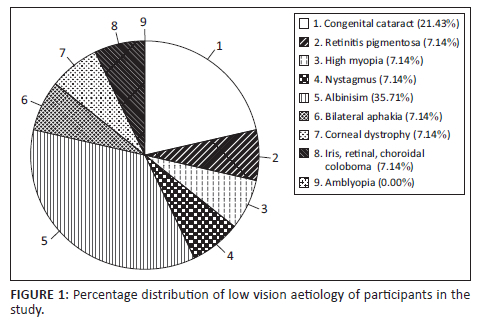
The demographic profile of the participants was black South Africans aged 6 years to 19 (mean = 13.86 ± 3.34) years. This included 80% females (n = 12) and 20% males (n = 3). The disparity in gender could be attributed to a greater population of females enrolled at the school, with females appearing more enthusiastic to participate in the study than males. Albinism (35.7%) and congenital cataract (21.4%) were the most common causes of low vision (Figure 1). Other causes were corneal dystrophy, coloboma of the iris, retina and choroid, retinitis pigmentosa, myopia and nystagmus as well as combination of the listed conditions.
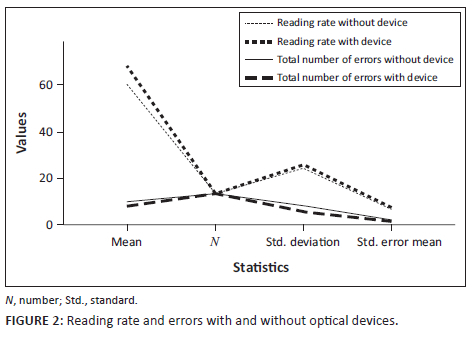
The mean reading errors made by the participants and their reading rate without and with the low vision optical devices were 10 epm (± 8) and 8 epm (± 6) and 59.32 cwpm (± 24.08) and 67.1 cwpm (± 25.6), respectively (Figure 2). An increase in reading rate was observed from Grade 1 to 10 both without and with the low vision devices except for one participant in Grade 11 whose reading rate was 39 cwpm and 66 cwpm, respectively.
While Pearson's correlation coefficient (r = 0.822, R2p = 0.087) may be because of small sample size.
Discussion
Basic and functional literacy should be assessed on low vision individuals.821
In this study, the reading performance of the participants revealed lower errors when reading with low vision optical devices compared with without, with an overall improvement in reading rate by 85%. As reading rate is affected by errors made, lower errors positively impact reading rate. It was evident during the assessment that the accuracy of recording errors was dependent on the skill and attentiveness of the examiner and that the testing environment should be free of distractions.
The increase in reading rate across grades shown in this study is in accordance with a study by Legge et al.222223242526272628
Rumney and Leat revealed that the forward saccade, when reading, is 6.8 characters in persons with normal vision as opposed to a smaller saccadic movement of 3.5 characters in those with low vision with the latter being influenced by abnormal ocular motility or reduced visual span.242229,3014,31
While reading, the eye movements displayed with an optical magnifier differ from that of without the device.3232
There were some limitations identified in this study that may impede on definite conclusions derived from the study results. The sample size was relatively low affecting the generalisation of the study results. The majority of the participants were female, hence a need for a more representative sampling of both genders in upcoming studies. Although the study did include a range of ocular pathologies, the degree of visual impairment and its psychological impact on reading performance was not established, which may contribute to the outcome of low vision management and should be explored in future research.
Conclusion
While this being a pilot study, the evidence displays the clinical relevance of interventions to manage the reading performance of children with low vision. This ensures maximum use of their residual vision to access curriculum and educational resources. The compounding effect is on their personal social and emotional well-being of the child living with low vision exhilarating its effect on their educational pursuit with a positive outcome in their adult life. Furthermore, the results may help inform future research and encourage holistic management of children with low vision, encompassing various sectors within the healthcare system, educational and social services.
Competing interests
The author declares that they have no financial or personal relationships that may have inappropriately influenced them in writing this article.
Author's contributions
U.N. is the sole author of this research article.
Ethical considerations
This study complied with the tenets of the Declaration of Helsinki with the procedures and likely consequences of the study explained to the parents of the subjects, in detail, followed by obtaining their informed consent. The study was approved by the University of KwaZulu-Natal Biomedical Research and Ethics Committee (HSS/0525/2009) and all guidelines stipulated by the committee were adhered to before and throughout the research study.
Funding information
This research received no specific funding from any agency in the public, commercial or not-for-profit sectors, however, would like to acknowledge the College of Health Sciences for fee remission for the degree of Masters in Optometry whereby this study was included as one of the objectives.
Data availability
Data supporting the findings of this study are available from the corresponding author, U.N., on request.
Disclaimer
The views and opinions expressed in this article are those of the author and do not necessarily reflect the official policy or position of any affiliated agency of the author.
Acknowledgements
This article is partially based on the author's thesis 'Design, reliability and validity of a paediatric rate of reading (PRR) chart', for Master of Optometry degree at the University of KwaZulu-Natal, South Africa, with supervisor Prof O.A. Oduntan received November 2012, available here: http://hdl.handle.net/10413/9988.
References
- 1.Garzia R. Vision and reading. Illustrate. Garzia RP, editor. St Louis: Mosby; 1996.
- 2.Scheiman M, Wick B. Clinical management of binocular vision: Heterophoric, accommodative, and eye movement disorders. Philadelphia, PA: Lippincott Williams & Wilkins, 2014; p. 748.
-
3.Bezabih L, Abebe TW, Fite RO. Prevalence and factors associated with childhood visual impairment in Ethiopia. Clin Ophthalmol. 2017;11:1941-1948. https://doi.org/10.2147/OPTH.S135011
» https://doi.org/10.2147/OPTH.S135011 -
4.Eperjesi F, Fowler C. The effects of coloured light filter overlays on reading rates in age-related macular degeneration. Acta Ophthalmol. 2004;82(6):695-700. https://doi.org/10.1111/j.1600-0420.2004.00371.x
» https://doi.org/10.1111/j.1600-0420.2004.00371.x - 5.Alderson J. Assessing reading. 1st ed. Cambridge: Cambridge University Press. 2000; p. 1-377.
- 6.World Health Organization. Blindness and vision impairment. Geneva: WHO; 2021.
- 7.World Health Organization. Global data on visual impairment. Geneva: WHO; 2010.
- 8.Corn AL, Koenig AJ. Perspectives on low vision. In: Corn AL, Koenig AJ, editors. Foundations of low vision: Clinical and functional perspectives. New York NY: American Foundation for the Blind; 1996, p. 8-9.
- 9.Lueck AH. Functional vision: A practitioner's guide to evaluation and intervention. Lueck AH, editor. New York, NY: AFB Press, American Foundation for the Blind; 2004.
-
10.Tseng YC, Liu SHY, Lou MF, Huang GS. Quality of life in older adults with sensory impairments: A systematic review. Qual Life Res. 2018;27(8):1957-1971. https://doi.org/10.1007/s11136-018-1799-2
» https://doi.org/10.1007/s11136-018-1799-2 -
11.Cai Y, Schrack JA, Wang H, et al. Visual impairment and objectively measured physical activity in middle-aged and older adults. J Gerontol A Biol Sci Med Sci. 2021;76(12):2194-2203. https://doi.org/10.1093/gerona/glab103
» https://doi.org/10.1093/gerona/glab103 - 12.Parravano M, Petri D, Maurutto E, et al. Association between visual impairment and depression in patients attending eye clinics: A meta-analysis. JAMA Ophthalmol. 2021;139(7):753-761.
- 13.Virgili G, Acosta R, Bentley SA, Giacomelli G, Allcock C, Evans JR. Reading aids for adults with low vision. Cochrane Database Syst Rev. 2018;10(10):CD003303.
-
14.Lovie-Kitchin JE, Bevan JD, Hein B. Reading performance in children with low vision. Clin Exp Optom. 2001;84(3):148-154. https://doi.org/10.1111/j.1444-0938.2001.tb04958.x
» https://doi.org/10.1111/j.1444-0938.2001.tb04958.x - 15.Ahn SJ, Legge GE, Luebker A. Printed cards for measuring low-vision reading speed. Vis Res. 1995;35(13):42-6989.
- 16.Bailey I, Lovie J. The design and use of a new near-vision chart. Am J Optom Physiol Opt. 1980;57(6):378-387.
-
17.Calabrèse A, Cheong AMY, Cheung SH, et al. Baseline MNREAD measures for normally sighted subjects from childhood to old age. Invest Opthalmol Vis Sci. 2016;57(8):3836. https://doi.org/10.1167/iovs.16-19580
» https://doi.org/10.1167/iovs.16-19580 -
18.Radner W, Willinger U, Obermayer W, Mudrich C, Velikay-Parel M, Eisenwort B. A new reading chart for simultaneous determination of reading vision and reading speed. Klin Monbl Augenheilkd. 1998;213(9):174-181. https://doi.org/10.1055/s-2008-1034969
» https://doi.org/10.1055/s-2008-1034969 - 19.Wilkins A, Jeanes R, Pumfreyz P, Laskier M. Rate of reading test: Its reliability, and its validity in the assessment of the effects of coloured overlays. Ophthalmic Physiol Opt. 1996;16(6):491-497.
-
20.Nirghin U. Design of a paediatric rate of reading test chart. Afr Vision Eye Health. 2020;79(1):1-7. https://doi.org/10.4102/aveh.v79i1.536
» https://doi.org/10.4102/aveh.v79i1.536 - 21.D'Andrea FM, Farrenkopf C. Looking to Learn: Promoting literacy for students with low vision. AFB, editor. New York, NY: AFB Press, 2000; p. 5-6.
-
22.Legge GE, Ahn SJ, Klitz TS, Luebker A. Psychophysics of reading - XVI. The visual span in normal and low vision. Vis Res. 1997;37(14):1999-2010. https://doi.org/10.1016/S0042-6989(97)00017-5
» https://doi.org/10.1016/S0042-6989(97)00017-5 - 23.Natan R, Bulat J. Technology-enhanced comprehension, vocabulary, and word analysis reading intervention for upper grade elementary and middle school students. California: Leap Frog Schoolhouse Inc, 2006.
- 24.Rumney N, Leat S. Why do low vision patients still read slowly with low vision aids? In: Kooijman AC, Looijestijn PL, Welling JA, van der Wildt GJ, editors. Low vision: Research and new developments in rehabilitation. Amsterdam: IOS Press, 1994; p. 269.
-
25.Mangold S, Mangold P. Selecting the most appropriate primary learning medium for students with functional vision. J Vis Impair Blind. 1989;83(6):294-296. https://doi.org/10.1177/0145482X8908300608
» https://doi.org/10.1177/0145482X8908300608 -
26.Hasbrouck J, Tindal G. Oral reading fluency norms: A valuable assessment tool for reading teachers. Read Teach. 2006;59(7):636-644. https://doi.org/10.1598/RT.59.7.3
» https://doi.org/10.1598/RT.59.7.3 -
27.Fellenius K. Reading competence of visually impaired pupils in Sweden. J Vis Impair Blind. 1996;90(3):237-246. https://doi.org/10.1177/0145482X9609000313
» https://doi.org/10.1177/0145482X9609000313 - 28.Kalloniatis M, Johnston A. Visual characteristics of low vision children. Optom Vis Sci. 1990;67(1):38-48.
-
29.Lovie-Kitchin JE, Bowers AR, Woods RL. Oral and silent reading performance with macular degeneration. Ophthalmic Physiol Opt. 2000;20(5):360-370. https://doi.org/10.1046/j.1475-1313.2000.00524.x
» https://doi.org/10.1046/j.1475-1313.2000.00524.x -
30.Maaijwee K, Mulder P, Radner W, Van Meurs JC. Reliability testing of the Dutch version of the Radner Reading Charts. Optom Vis Sci. 2008;85(5):353-358. https://doi.org/10.1097/OPX.0b013e31816bf58b
» https://doi.org/10.1097/OPX.0b013e31816bf58b - 31.Bennett A, Rabbetts R. Clinical visual optics. 3rd ed. Bennett A, Rabbetts R, editors. Oxford: Butterworth-Heinemann, 1998; p. 1-451.
-
32.Dickinson CM, Fotinakis V. The limitations imposed on reading by low vision aids. Optom Vis Sci. 2000;77(7):364-372. https://doi.org/10.1097/00006324-200007000-00011
» https://doi.org/10.1097/00006324-200007000-00011

Accepted: 22 Aug. 2023
Published: 26 Oct. 2023