Helping to preserve minority languages of Muslim communities in Russia through oral Bible translation
Abstract
The Institute for Bible Translation (IBT) in Russia has recently started ten new oral Bible translation (OBT) projects in Dagestan, Russia, among minority language communities. There are no Christians or churches among these language communities. IBT helps these communities preserve their minority languages that are slowly becoming extinct, due to their assimilation with the Russian language and community. This article examines how these OBT projects began, how they are proceeding, the use of machine translation in these projects, and the challenges that both IBT and the communities are facing. Through interviews with the Muslim translators and communities, the author shows how these OBT projects are contributing to the preservation of both the language and culture of these communities. Finally, the author draws some conclusions for other OBT teams working within Muslim contexts.
Language development; Language preservation; Dagestan (Russia); Islam
1. INTRODUCTION
Oral Bible translation (OBT) is a method of translation used for oral preference peoples (communities that prioritise oral over written communication). Younghans et al. (2019:34) highlight the strong resemblance between OBT and written translation, noting that the primary distinction lies in the extensive internalisation process involved in OBT during the initial draft preparation. They point out that internalisation, including early-stage quality exegesis, is a crucial step in creating the most natural translation. The Seed Company (2019:2) describes the process of internalisation as follows:
Within an OBT context, internalization is a form of exegesis designed to equip the translation teams with a good understanding of what a particular passage meant to the original audience and how to communicate that meaning in their current context. Internalization is not rote word-for-word memorisation. Instead, the process is intended to help the translators understand a passage so well they can repeat its meaning (1) clearly in their language, (2) in an order that respects the uniqueness of the language but retains all the material content, and (3) as naturally as if they themselves had experienced the biblical text firsthand.
This internalisation occurs across various levels, including the book, chapter, and passage, and involves activities such as discussion, memory-building activities, relevant exegesis, and the development of key terms and concepts. In his discussion of internalisation, Toler (2020:115) concludes that this process is the essential factor in achieving naturalness in oral translation.
An OBT team works as a group of translators assisted by a translation advisor (TA) who ideally knows the biblical source languages and the target language. Before any translation takes place, both the TA and the entire translation team are trained in OBT principles and methods. The translation team is then led by the TA in several exercises of internalisation, in order for the translators to become familiar with the biblical passage. The two major differences between written Bible translation and OBT are the product and the process of translation (Alexander 2021:2). This means that the process of OBT, including the exegetical discussion, and the product of OBT need to be consistent with oral communication, giving thought to ways in which the particular oral community processes information and how that information is communicated.
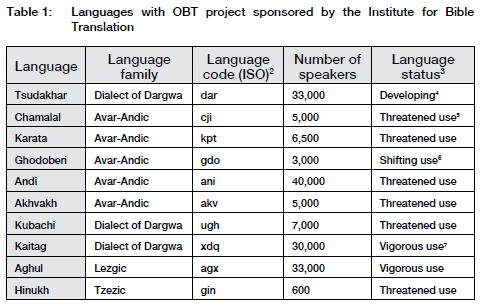
In early 2023, the Russian branch of the Institute for Bible Translation (IBT) began four new OBT projects among minority languages in Dagestan, namely Tsudakhar, Chamalal, Karata, and Ghodoberi.1 The OBT method was chosen for these minority language communities in Dagestan, because they prefer or rely on oral communication over written communication when using their languages. The initial scope of the project was to translate the biblical books of Ruth, Jonah, and the story of Joseph from Genesis (37, 39-50) in two years (2023-2024). In 2024, IBT began another six OBT projects, also in Dagestan (Andi, Akhvakh, Kubachi, Kaitag, Aghul and Hinukh). These minority languages are spoken in Muslim communities with an increasingly radical Islamic identity. There are currently no known Christians or churches in these communities. The new Bible translation projects are required to engage with this changing Islamic context. In addition, IBT wants to help these communities preserve their languages that are in danger of slowly becoming extinct, due to their assimilation with the Russian language and culture. This article aims to show how IBT's OBT projects are contributing towards this goal. Table 1 presents information on the ten languages.
Only one of these languages falls within the category of developing; two are vigorous, indicating stability; six are threatened, and one is shifting, indicating that it is no longer being transmitted to others. Only one of these languages (Aghul) has an official orthography, which was developed in the 1990s.
2. ORAL BIBLE TRANSLATION AND THE MUSLIM CONTEXT
In his article on the Yawo translation project in Mozambique, Houston (2025:39-40) notes that their
central aim is to produce a Bible translation that not only aligns with the Yawo's deep-rooted reliance on orality but also acknowledges their Islamic context. These two elements, orality and Islam, serve as crucial benchmarks for assessing the quality of the translation.
In the OBT projects in Dagestan, orality and Islam both need to be acknowledged and both provide criteria whereby the translation can be assessed. The translation should reflect the oral nature of Dagestanian communication and allow for their Islamic world view, while staying loyal to the source text (Nord 2016:570). Makutoane and Naudé (2004:183) describe the act of translation as the
reproduction of culture in that the act of translation involves transferring aspects of the culture belonging to one group to another group through certain translation strategies.
Naudé and Miller-Naudé (2018) explore how concepts of alterity (the "other"), orality, and performance influence the process and outcomes of Bible translation. They argue that translation is not merely a linguistic act; it also involves cultural and performative dimensions that shape how biblical texts are received and understood in different contexts. Their article emphasises the importance of recognising the "otherness" of both the source and target cultures. The aim of the OBT projects in Dagestan was to create a translation that captures the spoken, oral character of Dagestanian communication, aligns with their Islamic worldview, and stays true to the original text.
Brown (2002:24) highlights the importance of carefully selecting Scripture portions that can have the most significant impact on specific cultural and linguistic groups, particularly for those with a Muslim background. In view of this, the passages chosen for initial translation were from the Old Testament and do not overtly conflict with the Muslim world view. For example, the Joseph story (Gen. 37, 39-50) is one that Brown (2006:7) identifies as a bridge or point of commonality, because the story is in both the Bible and the Qur'an (Chapter 12 [Surah] of the Qur'an, titled Surah Yusuf). It is a shared narrative, found in both the Bible and the Qur'an, which can then serve as a starting point for dialogue and then translation. These communities have come to know the Qur'anic stories mostly by hearing them via re-telling by elderly relatives in their own languages.
Makutoane et al. (2015) examine the relationship between oral cultures and the translation of the Old Testament. They explore the difficulties and methods of translating works that come from or have strong roots in oral traditions. The study examines how translators handle these issues, in order to maintain the biblical message's integrity, while still rendering it understandable and relevant in oral cultures. Overall, they emphasise how difficult it is to strike a compromise when translating between cultural relevance and faithfulness to the original text. Naudé (2021) explores the complex relationship between religious texts and oral tradition, emphasising how sacred writings are transmitted across generations. He discusses the unique challenges involved in translating religious texts, due to their theological significance, linguistic nuances, and the oral traditions that often precede written versions. Naudé highlights that many religious texts originated in oral contexts before being codified in written form, which influences their translation and interpretation.
In discussing the translation of divine familial terms in Bible translations for Muslim majority languages, Miller-Naudé and Naudé (2013:187) recommend a complex functional approach. Any difficult translation decisions will need to be made in the local context,
related to a specific language group in a specific location with specific goals for the translation - these are the clients for whom the translation should be made.
As part of the reason for the projects is to help preserve these minority languages, it was decided that, in the case of these ten OBT projects, any difficult translation decisions would be made with the specific local context and the target language group in mind. Miller-Naudé and Naudé (2016:828-829) discuss the self-censorship of Muslim translators who will attempt to translate terms in a way that will not be offensive or harmful to Muslims, in order to make the Scriptures more accessible to the local audience. An example of this in the IBT projects was translating Genesis 41:38: "Can we find anyone like this man (Joseph), one in whom is the spirit of God?" (NIV). The Muslim translators were unhappy with the expression, "the spirit of God", as it may potentially undermine the strict monotheism and transcendent nature of God as understood in Islam. Instead, it was translated as "Can we find anyone like this man (Joseph) who is filled with God's wisdom and knowledge?".
3. HOW THE PROJECTS BEGAN
One of the aims of the translation projects is to help these communities preserve their local languages. This was achieved by producing both audio recordings of the translated Scriptures on a smart phone application and illustrated books transcribed from the audio recordings. Considering the Muslim context, it was decided that a book should accompany the oral translation to give authority and legitimacy to the oral version. Written Scriptures are highly valued in these Islamic communities. A study by Naudé and Miller-Naudé (2019) examines how theological perspectives and ideological biases influence supplementary texts such as introductions, footnotes, illustrations, and commentaries that accompany Bible translations in Muslim contexts. It explores how these metatexts shape readers' understanding of the Bible. In the case of IBT's translation projects, it was decided that each book or story (such as the Joseph story) would be accompanied by an introduction (oral for the smart phone application and written for the book). In the case of the Joseph introduction, this metatext helps emphasise the commonality of the Joseph story for both Christians and Muslims, found in both the Bible and the Qur'an. The metatext of contextualised illustrations will be used in the smart phone application and the book to emphasise the domestication and relevance of the translated text for the local audience.
IBT initially attempted to find translators with both academic qualifications and an expert knowledge of their local language. One of the first translators declined early on in the project, due to health reasons, and it took nearly a full two years to find another translator who was willing to work with IBT. Where IBT could not find translators who were linguists or philologists, contacts were made with those in the language communities who were already involved in preserving the language. For example, in a local village, our TA met with a group that had already opened a museum and cultural centre for their people group and were writing a book on the grammar of their language. They were immediately willing to help IBT with translation work and have recruited others from different language groups to do the same. None of the translators in these projects had any previous experience in translation.
4. THE USE OF MACHINE TRANSLATION
The original goal of this project was to use machine translation to generate first drafts of translations of these biblical books, which could then be used to assist the team in translating. In the Tsudakhar project, the translators also worked on a smart phone application, called Echonet, translating 8,000 sentences from Russian into Tsudakhar. These 8,000 sentences were generated from the biblical passages that the translators were to translate in the near future such as Ruth, Jonah, Genesis, and Matthew. After the first 8,000 sentences, the language data were not specific enough and the team needed to collect more data.8 These Caucasian languages are also extremely complex grammatically. It was decided, for use in similar projects, to reduce the complexity of the sentences being translated from Russian into the language in question. To date, machine translation has not yielded good enough results for the teams to be able to use these in translation.
5. HOW THE PROJECTS ARE PROCEEDING
At the time of writing, the first four projects (Tsudakhar, Karata, Chamalal, and Ghodoberi) are reaching the end of stage one (the projects were extended from December 2024 until September 2025). The relationships with the translators are currently friendly and strong. By the end of September 2025, three of these projects completed translations of Jonah, Ruth, and the Joseph story, accompanied by the translated text on smart phone apps, in both audio and written form, and written publications. Although the Chamalal project did not find a local translator until recently, this project is still on target. However, due to problems with finding translators, the Ghodoberi project is behind schedule and may not finish on time.
The second group of six projects aims to finish the translation of Ruth, Jonah, and the whole book of Genesis by the end of 2026. Four out of the six are on target, and two are behind schedule, again due to problems finding translators.
6. CHALLENGES ENCOUNTERED IN THE PROJECT
One of the main challenges encountered during the initial stages of this project was finding translators and others (field testers and back translators) willing to work with IBT. The reason for this is that some were forbidden to do so by local imams, while others were reluctant or frightened of translating the Bible, due to their own Islamic beliefs. Another challenge was illness and even death among the translation teams. Many of the people who still speak these languages fluently are elderly. In some projects, it has not been possible to find more than one translator, which makes using the OBT approach nearly impossible, because OBT ideally requires a team of translators.
7. ADVANTAGES OF THE PROJECTS
7.1 Bringing unity between language communities
In the past, Dagestan has experienced a great deal of territorial and political conflict. In last year's OBT seminar for the ten projects in a local village, one translator made a speech in which he mentioned that these Bible translation projects have managed to forge relationships between different language communities in Dagestan and helped bring people closer.
7.2 Language preservation
Sanneh (2009) argues that, rather than being a destructive force, the process of translation has often led to the preservation of indigenous languages and cultures. In the case of these ten IBT OBT projects, the smart phone apps for the Scripture translations will be produced in the local languages and Russian (the Language of Wider Communication) and accompanied by contextualised illustrations drawn by a local artist. The books will be produced in three languages: the local language, Russian, and English. English was chosen, because the children are learning English in schools and at home. This will mean that the books will be popular in local schools and families, as they will be viewed as helping children learn their own local language and English. The head of the Dagestan region, Sergey Melikov, recently stated:
Today we are seeing a trend towards a gradual reduction in the number of people speaking their native languages. In this regard, I consider it necessary to develop and adopt a state program for the preservation and development of the languages of the peoples of Dagestan.9
The IBT OBT projects aim to make a small contribution to the preservation and development of these minority languages.
8. INTERVIEWS WITH MUSLIM TRANSLATORS
8.1 Methodology
In a recent visit to Dagestan (June 2025), the author conducted interviews with eleven of the translators from six of the IBT projects. She asked them eight questions about their involvement with the Bible translation projects and the influence of the translations on the community. The eleven participants all provided verbal informed consent.
8.1.1 Why did you agree to help in this project?
One translator mentioned that she had read the stories of the prophets about ten years ago and they had impacted her heart. Then she was invited by another translator to help in the IBT translation project. She had been working as a teacher in the local school for 27 years and desired a change of profession. She now enjoys the translation work.
The second woman from this project is a philologist and is interested in the religious text of the Bible. She wanted to be involved in a project to bring people of different faiths together and use her philological education to work with religious texts.
In another project, one woman mentioned that she agreed to help out, in order to reinvigorate her language. The second translator wanted to find out whether she would be able to do this translation work and how well she really knows her language. She started to enjoy translating and working in the team. She also realised that there is a great deal more to understand about her language. She started studying dictionaries to grow in her understanding of her language.
In the case of another team, involvement in the project came through personal contact with the TA (the translation advisor for the project). The female translator stated that, first of all, she was approached by the TA who wanted to learn the language. She met him and liked him very much. He then suggested that she should start translating the Holy Scriptures from Russian into her language. She stated:
I realise that it's very hard to translate the Bible and any religious texts, and we must be very careful with the translation.
Her daughter said that, at the beginning of the project, she was not involved. However, she then met the TA and became involved. She said that she has already learnt many new things through the project and multiple new words in her language that the team did not know beforehand.
The translator from a different project began by stating that she never thought she would be involved in translation. Two people came to the village looking for native speakers of her language and were sent to her. She took them to the museum and the library, and then to her home for lunch. Later she met with them in the city, and they explained in more detail about the possible translation project. She started translating and went to a training seminar that she enjoyed very much.
A translator from another language community said that he wanted to save his dialect from disappearing. He realised that his people no longer know the story of the prophets in detail. Although they have heard about the prophet Yusuf (Joseph), for example, from their grandparents, people are now forgetting these religious texts. These are important prophets for Islam. The translators also wish to spread these stories of the prophets.
Another translator stated that belief in the prophets is one of the six articles of the Islamic faith, on which the religion is founded. It is important not to reject even one pillar. In his opinion, Mohammed is, of course, the most important, followed by Abraham, Moses, Jesus, and Noah. He wants his people to understand these Bible stories, which are very similar to those in the Qur'an.
As translators, they agreed with IBT not to translate any stories that directly contradict the Qur'an. For example, the story of Abraham taking Isaac up the mountain to sacrifice him (Gen. 22; Surah As-Saffat (37:99-113)).10 They are ready to give their lives for Islam and so stated that they are unwilling to translate anything in contradiction to the Qur'an.
From the final project, the translator responded that the translation of biblical texts is another opportunity to save and develop his language. He is also interested in spreading the stories of the prophets.
8.1.2 How do you think this project of translating Scripture orally into your language will help preserve your language and community?
Both translators from the first project answered that the project will contribute towards reviving the language and will show that, through this language, they can help support their people intellectually and spiritually. They gave the text to someone from their language group to read. He said that the text made a great impression on them in their own language. They consider themselves to be the only ones capable of producing this translation.
In another project, the first translator mentioned that, in her opinion, the project will help preserve their language and community. This language has had an official alphabet only since 1992. The translator considers this to be a young literary language with perspective for development. The second translator commented that all the young people tend to speak in Russian. It is thus crucial to translate such texts into this language.
Another translator commented that he is sure that any information translated into his language will help preserve the language. These translators commented that they like the fact that the translations will reach people via a smart phone app (audio stories) using the internet. They are themselves completing a book on the grammar of this language, which will be a great additional resource and will have a great effect on both their language and culture. They hope that it will help their children. Another translator mentioned that people ask him why they are translating the Bible and not the Qur'an. Previously, their grandparents told them these religious stories about the prophets, but now they are not told. It is helpful if these biblical stories are passed on orally, but these translations should also be written down in books for the future. Language is part of the culture, and this project is helping them preserve it. Their children are now watching cartoons on phones, even during meals, and when they leave their houses, they talk Russian on the streets. They say that their language and their ethnic identity are dying. This translation team requested IBT to produce cartoons in their languages.
8.1.3 How do you feel as a Muslim about translating the Bible?
One of the translators stated that she hopes that this translation will help someone and bring him/her joy. The second one shared that, although all her relatives are Muslim, she grew up in a town with secular influence. She views the text from the point of view of a person who knows about all different religions and so her perspective is looking at an educational text through secular eyes. She understands that the biblical text gives everyone a moral compass and it does not matter to which religion you belong.
One of the translators commented on how similar she finds the Bible to the Qur'an and that they are translating common stories that are in both religious books. The second translator averred that she finds translating the Bible very interesting, because, as Muslims, they recognise all the prophets. They are currently translating the story of Joseph, which increases their knowledge and does not contradict their religion.
Two translators from another project described translating the Bible as a great joy. They stated that it gives them the feeling that they are doing something significant and useful for their people. The translator from this project commented on how interesting she finds translating the Bible.
The three translators from a different project shared that, at the start of the project, they were concerned about getting involved in translating the Bible. However, they attended an introductory seminar about translation, and when they started translating, they felt calm about translating this holy text. They described it as a curtain behind which they had previously not seen. One of them talked about globalisation in the world and how both Judaism and Islam have spread around the world because they are brother religions descending from Isaac and Ishmael. He commented on how important it is to take into account each other's feelings and listen to each other's opinions. He heard the story of Joseph many times in the past from his Muslim grandparents. He wants to preserve the holy traditions, but he still feels uncomfortable, because he is not translating the Qur'an (even though he said that he would never consider himself worthy to translate the Qur'an).
The translator from the final project said that, in the beginning, it was a shock when he started to translate the biblical stories and realised that they are the same stories as in the Qur'an that his grandmother taught him. He mentioned that it is easier translating the Bible than the Qur'an, because the Qur'an is in Arabic and when translating the Bible, it is possible to listen to different versions of the Bible.
8.1.4 Did you have any hostility directed towards you, due to this project?
Two translators averred that they keep their translation work completely secret and no one in their community knows about it. IBT will use voice disguising software to keep their identity anonymous. One of the translators from another language group mentioned that, initially, there was hostility towards her from some of the more religious members of her family. However, when she explained the reasons behind the project, they agreed to let her take part. The other translator shared that only her husband and sons know that she is translating biblical texts. They told her to be careful and not translate anything she does not understand. She commented that, up to date, she has only translated stories from the Old Testament, and nothing has made her concerned.
One of the translators' husband and other villagers asked her why she is involved in the translation project. In these instances, the translators explained that they are preserving their language. When they were asked why they are translating the Bible, they said that it is an important religious text. People in the village approached one translator and tried to persuade her not to translate. She said that there are many others from other people groups also translating and she does not see anything dangerous or harmful in this translation work.
Other translators commented during the interview that, even the previous day, the young mullah in the village had asked them why they were translating the Bible. The translators replied that IBT was interested in preserving the language of minority communities in Dagestan. The translators pointed out that, although they have approached the schools in their village about helping preserve the language by giving lessons to the children, the local authorities do not permit lessons in the school for the children. The translators commented that the people in their villages and communities do not seem interested in preserving their language. The translators are not concerned about losing Islam, but about losing their language.
The translator from another language commented that he has not experienced any hostility from others, only a lack of understanding. He asked others to take part in the project, by doing a back translation from his language into Russian, and they asked him why he was involved in this project. However, when he explained his motivation, they accepted it.
8.1.5 What have you learnt from this translation project?
One of the translators claimed that she found new possibilities for herself to develop personally during the translation work. She was a teacher for many years but wanted to find something new for herself. She finds the translation work very engaging. The second translator, a philologist, enjoys examining old texts and learning more about her own language. She also appreciates the moral guidance from the texts. She gave an example from the book of Jonah, quoting God when he asks Jonah in Chapter 4: "Do you have good reason to be angry?" (NASB). She thinks that God spoke to her through this passage about whether she has a right to be angry with others in her life.
One of the translators from another project mentioned that she learnt historical stories and formed new relationships with people. The other commented that she enjoys his/her relationship with the TA who persuaded her to take part in the project but does not force her to do anything against Islam. She finds the translation project interesting. She now knows her language better, has discovered many new words in her language, and even her Russian language is improving. She is speaking her language better at home. She observed that, at home and at school, children are now speaking Russian and not the local language. However, she believes that this project will help improve the language level of the community. She also added that she is earning some extra money through the project.
The two translators from a different project commented that they learnt many new words in their language through the project and that this is a great joy for them. Another translator appreciates learning about the relationships in the Bible stories she is translating. She gave the example of how, towards the end of the story of Joseph, the sons changed to respect and love their father, Jacob. Another translator mentioned that he had not previously known the Joseph story completely.
The translators from another language community had not previously heard the story of Ruth, and this translation project helped them remember other religious stories again. They also learnt about the methodology of translation, including key terms and testing. They gained much experience which they can use in other areas. They felt that they are now language specialists; their language base has grown, and they know more words, including some archaic words. They have started to understand the richness of their own language and feel that now they can translate anything from Russian into their local language. One of the translators already writes poems in his own language and feels that he can now express himself more clearly and deeply. Translating is a better way of developing their memory than doing crosswords. They have also started to appreciate other people's opinions and to listen to others. They have learnt that creative people are the most interesting people with whom to spend time.
8.1.6 Would you prefer to do a written or oral project, and why?
Two translators both enjoy doing oral translation. There is no orthography, and it is an unwritten language without an agreed upon official literary form. However, they still write down a short plan in advance to use during the oral translation process. Another translator prefers oral translation and one written translation. The translators from three other teams mentioned that they would prefer to translate by writing, because it is easier to correct and to stop and read the text. The translators from the final group commented that they would also prefer a written project as they consider this more serious than an oral project.
8.1.7 Is it important to your community to have a book produced from the oral translation?
Two translators stated that it would not be important for their community to have a book. Children do not read often. This group does not read books in their own language and an audio recording will attract more attention. This is the only project out of the ten OBT projects that has not requested a book in addition to the smart phone application. All the other translators consider it important for their communities to have an official book to give to schools and libraries that will help preserve the results of this hard work for future generations. A book can be given as a present to both adults and children. The translators from one language group quoted a local proverb expressing that it is better to see something once than to hear it seven times.
8.1.8 What do you think about including local art in this book?
All the translators agreed that local art will make the book more accessible.
9. CONCLUSIONS AFTER THE INTERVIEWS
A clear motivation for the vast majority of translators is to preserve their language and assist with its development. Another motivation is that these peoples are forgetting their religious texts and stories, and the translators find that the biblical stories they have translated (in particular, Joseph) are similar to the stories of the prophets in the Qur'an. A third reason, in some instances, is an interest in philology and the religious texts themselves. However, some are unwilling to translate anything that may directly conflict with the Qur'an. All the translators agreed that these translation projects will help preserve their language and culture in some way. The tendency is that these languages are beginning to disappear, and in the translators' opinions, efforts should be made to preserve them.
One of the translators stated that he feels uncomfortable within his community translating the Bible rather than the Qur'an. In the beginning, several translators were concerned about translating the Bible. The vast majority of people averred that they found it interesting and even fun to translate the Bible, and they were surprised to discover how much the stories in the Bible are like those in the Qur'an. In some instances, the translators work incognito. However, in most cases, the community has asked questions, although without direct hostility, and when the translators have explained their motivation, it was accepted.
Many translators appreciated understanding the biblical stories better and in more depth and this has given them some increased moral guidance. They also gained other knowledge such as the methodology of translation. Everyone commented that they know their language better through these translation projects and have learned new vocabulary. Other advantages include working as a team and improving their memory. Although these are oral Bible translation projects, the majority of the translators mentioned that they would prefer a written project. The overwhelming opinion, apart from the Andi project, is that a book with local art is important for the community.
10. WIDER CONCLUSIONS
I conclude by drawing some general conclusions from the descriptive data of the Russian Federation situation that might be helpful for other non-Christian or Muslim contexts. The author has experience in doing both OBT among the Altai peoples of Siberia, with the help of the local Altai church, and OBT among the minority Muslim peoples of Dagestan, where there are no Christians. This experience has been widely different. It has been a challenge for IBT to find translators who are willing to translate the biblical texts in these Muslim communities. This is an important factor for OBT where translation is improved with a team of translators working together. It was more difficult not only to find translators, but also to work as teams, to do community testing, and to involve the community in the translation, as is usually done in an OBT project from the beginning.
However, despite the difficulties, these oral Bible translation projects are proving to be valuable for these communities; they are viewed as actively contributing to the preservation of endangered languages, fostering unforeseen unity between diverse communities, and reinforcing the profound significance of shared narratives between Christians and Muslims in an increasingly divided world.
BIBLIOGRAPHY
- Alexander, S. 2021. The joys and challenges of checking oral Bible translation. Paper presented at the Bible Translation Conference, 15-19 October, Dallas, Texas.
- Brown, R. 2002. The first foot forward in Scripture selection? Selecting and using Scripture portions effectively in frontier missions. International Journal of Frontier Missions 19(2):10-25.
- Brown, R. 2006. Muslim worldviews and the Bible: Bridges and barriers. Part I: God and mankind. International Journal of Frontier Missions 23(1):5-12.
- Eberhard, D.M., Simons, G.F. & Fennig, C.D. (Eds) 2020. Ethnologue: Languages of the world. Twenty-third edition. Dallas: SIL International.
-
Houston, T.J. 2025. Experimenting with excellence: Quality assessment in a Mozambican oral Bible translation and transcription project. The Bible Translator 76(1):35-53. https://doi.org/10.1177/20516770251315431
» https://doi.org/10.1177/20516770251315431 -
Makutoane, T.J. & Naudé, J.A. 2004. Reanimating orality: The morality play Everyman/Elkerlijk in southern Sotho. Journal for Semitics 13(1):159-185. https://doi.org/10.1080/14781700.2014.992462
» https://doi.org/10.1080/14781700.2014.992462 - Makutoane, T.J., Miller-Naudé, C.L. & Naudé, J.A. 2015. Similarity and alterity in translating the orality of the Old Testament in oral cultures. Translation Studies 8(2):156-174.
- Miller-Naudé, C.L. & Naudé, J.A. 2013. Ideology and translation strategy in Muslim-sensitive Bible translations. Neotestamentica 47(1):171-190.
-
Miller-Naudé, C.L. & Naudé, J.A. 2016. Covert religious censorship: Renderings of divine familial imagery in translations of the New Testament within Islamic contexts. Open Theology 2(1):818-831. https://doi.org/10.1515/opth-2016-0061
» https://doi.org/10.1515/opth-2016-0061 -
Naudé, J.A. 2021. Religious texts and oral tradition. In: Y. Gambier & L. van Doorslaer (eds.), Handbook of translation studies, Volume 5 (Amsterdam: John Benjamins Publishing Company), pp. 191-198. https://doi.org/10.1075/hts.5.rel5
» https://doi.org/10.1075/hts.5.rel5 -
Naudé, J.A. & Miller-Naudé, C.L. 2018. Alterity, orality and performance in Bible translation. In: K. Malmkjær, A. Şerban & F. Louwagie (eds), Key cultural texts in translation (Amsterdam: John Benjamins Publishing Company), pp. 299-313. https://doi.org/10.1075/btl.140.17nau
» https://doi.org/10.1075/btl.140.17nau -
Naudé, J.A. & Miller-Naudé, C.L. 2019. Theology and ideology in the metatexts of Bible translations in Muslim contexts: A case study. In: G.R. Kotzé, C.S. Locatell & J.A. Messarra (eds.), Ancient texts and modern readers. Studies in ancient Hebrew linguistics and Bible translation (Leiden/Boston: Brill), pp. 280-299. https://doi.org/10.1163/9789004402911_016
» https://doi.org/10.1163/9789004402911_016 -
Nord, C. 2016. Function and loyalty: Theology meets skopos. Open Theology 2:566-580. https://doi.org/10.1515/opth-2016-0045
» https://doi.org/10.1515/opth-2016-0045 - Sanneh, L.O. 2009. Translating the message: The missionary impact on culture. Second edition, revised and expanded. Maryknoll, NY: Orbis Books.
- Seed Company 2019. A time to reflect: Initial responses on oral Bible translation from translation consultants. Paper presented at the Bible Translation Conference, 15-19 October, Dallas, TX.
-
Toler, K. 2020. A key ingredient in achieving naturalness in an oral translation. Unpublished MA dissertation. Dallas, USA: Dallas International University. [Online]. Retrieved from: https://www.researchgate.net/publication/346967413_Internalization_A_Key_Ingredient_in_Achieving_Naturalness_in_an_Oral_Translation [Accessed 13 December 2020].
» https://www.researchgate.net/publication/346967413_Internalization_A_Key_Ingredient_in_Achieving_Naturalness_in_an_Oral_Translation - Younghans, H.M., Madden, F. & Ross, D. 2019. A time to reflect: Initial responses on oral Bible translation from translation consultants. Paper presented at the Bible Translation Conference, Dallas, TX.
Date accepted: 3 February 2026
Date published: 29 May 2026
2 ISO language codes, defined by the ISO 639 standard, are used to identify and represent languages (Eberhard et al. 2020).
3 Language status on the Expanded Graded Intergenerational Disruption Scale (EGIDS) (Eberhard et al. 2020).
4 The language is used by all generations and is in written form, though this is not yet widespread or sustainable (category 5) (Eberhard et al. 2020).
5 The language is used for face-to-face communication within all generations, but it is losing users (category 6b) (Eberhard et al. 2020).
6 The child-bearing generation can use the language among themselves, but it is not being transmitted to children (category 7) (Eberhard et al. 2020).
7 The language is used for face-to-face communication by all generations, and the situation is sustainable (category 6a) (Eberhard et al. 2020).
8 The team encountered problems with the orthography, because Tsudakhar has no official writing system.
9 https://bit.ly/4clNoyD.
10 In fact, the story does not contradict the Qur'an, which does not mention the name of the son to be sacrificed by Abraham, but it contradicts the traditional oral exposition of the Qur'an, in which Ishmael is the son rather than Isaac.