Redesigning church practices to reach and disciple non-church-affiliated emerging adults in Alberton, Johannesburg, South Africa, post-COVID-19
Abstract
Reaching and discipling non-church-affiliated emerging adults in a post-COVID-19 Alberton, Johannesburg, South Africa, requires a multifaceted approach. This article employs Osmer's practical theological reflection approach to develop a strategy, using data collected from selected fifteen churches. Interviews with ministry leaders and a survey among emerging adults determine the potential to reach non-church-affiliated emerging adults. Sources were consulted to identify factors to increase this potential, namely: involvement, discipleship, relationship, sound doctrine, leadership, excellence, a missional focus, and an online presence. Scripture and theological tradition reveal an understanding of the universal church, missio Dei, decentralised leadership, and discipleship to develop a strategy for discipling emerging adults. The strategy proposes that the local church should set a standard of doctrine, excellence, and focus, while emerging adult leaders are trained to disciple others, thus increasing their involvement in church and influence among their peers. Further research remains to be conducted to evaluate the effectiveness of the strategy.
Covid-19; Discipleship; Leadership; Non-church-affiliated; Emerging adults
1. INTRODUCTION
Months prior to COVID-19 necessitated global "lockdowns", Barna (2020) observes that, since 2010, percentages for practising Christians in the United States dropped from 45 per cent to 25 per cent in 2020. Were those trends similar in South Africa and, more specifically, in Alberton? At the same time, if this trend is more common among emerging adults (EAs), what needs to be done, in order to reach and disciple those who are no longer attending church weekly?
This article addresses the following research question: What church practices are required to effectively reach and disciple non-church-affiliated EAs of Alberton in a post-COVID-19 South Africa? It does so by answering four subsidiary questions:
What are the churches in Alberton currently doing to reach and disciple EAs post-COVID-19?
What are the reasons for the occurrence of unchurched EAs in Alberton?
How does Scripture and theological tradition inform a biblical understanding of reaching and discipling EAs?
What church practices can be implemented to effectively reach and disciple non-church-affiliated EAs in Alberton, in a post-COVID-19 South Africa?
The research includes both qualitative and quantitative approaches to data collection and analysis, in order to identify the causes for a lack of church attendance as well as potential trends among EAs within 15 selected churches in Alberton. Using the data, church practices are redesigned to reach and disciple EAs in a world that has been changed by COVID-19. To achieve such ends, Osmer's approach of practical theological reflection was used, comprising of four tasks, namely descriptive-empirical, interpretive, normative, and pragmatic. Osmer's approach was selected as the research framework, as it best serves to answer the research question as well as address the target audience, that is, congregation leaders. The findings of this research study will be made available to church leaders upon its completion, substantiating the selection of Osmer's approach for this study.
Osmer's (2008:91) descriptive-empirical task gathers information about the current situation. In this instance, primary data was collected, first, by semi-structured interviews conducted with ministry leaders of local churches. Secondly, due to the physical absence of the researcher after a relocation mid-study, using a quantitative approach to supplement the primary qualitative approach, a survey was conducted using an online questionnaire directed at EAs.
To accomplish Osmer's (2008:93) interpretive task, the primary data obtained in the first task as well as the secondary sources obtained prior to the pandemic were analysed to answer the questions: Why are there non-church-affiliated EAs? What led to this occurrence even before the pandemic necessitated the "lockdowns"? The secondary sources contributed to understanding three concepts, namely non-church affiliation, EAs, and the effect of COVID-19 on both.
Osmer's (2008:93) normative task interprets what the biblical text has to say about the topic and designing an ideal scenario. In this task, Scripture and theological tradition were consulted to describe what effective discipleship of EAs is in a world that has been changed by COVID-19, discipleship that produces spiritually mature EAs who, in turn, aid other EAs in their growth toward spiritual maturity (Nel 2018; Ogden 2003).
Osmer's (2008:93) pragmatic task creates a strategy to implement the ideal scenario. The strategy aims to address the problems discovered in the first two tasks and remain true to the normative voice of Scripture in the third task.
2. THE DESCRIPTIVE-EMPIRICAL TASK: FINDING THE MISSING EMERGING ADULTS
This section answers the first subsidiary question, by discussing relevant topics in a literature review, namely the non-church-affiliated, EAs, church practices, and the effect of the COVID-19 pandemic on the church, in particular. The literature review is followed by the findings from the interviews and survey.
The non-church-affiliated, often known as the unchurched (McConnell 2017) or the "dones" (Schultz 2020), are Christians who are practising aspects of their faith without attending or formally belonging to a local church. To Barna (2006:39), they are viewed as "revolutionaries" who ushered in a great awakening for Christians to be the church, not merely to go to church. Years later, the "great awakening" may not have taken place to the extent that Barna predicted. Between 2010 and 2020, church attendance dropped from 45 per cent of all United States citizens to 29 per cent (Barna 2020). In 2020, 35 per cent of United States adults read their Bible weekly and 69 per cent of them prayed to God weekly (Barna 2020). The fact that Christian practices did not decrease as much as church attendance shows that the "revolutionaries" did not disappear after all.
Emerging adulthood is a life phase between adulthood and adolescence (Arnett 2015:2, 22). It is characterised by exploration and identity formation (Arnett 2015:1-2, 9) before a person reaches self-sufficiency (Arnett 2015:313-316). EAs are often influenced by consumerism, individualism, and secularism. As a result, they hold religious institutions under scrutiny (Arnett 2015:218; Richardson 2013:80; Root 2020:65). Yet, due to the same pressures from society, some desire the stability religion may offer (Bickers 2012:27).
Church praxis that reaches non-church-affiliated EAs aims to address what is lacking when it comes to participation with the church. These have been identified as seven factors:
Involvement. The most influential factor in retaining the unchurched is being involved in a ministry (Rainer 2001a:123) or small group (Rainer 2001b:12).
Discipleship. Discipleship is showing someone else how to be a Christian as they interact with the world (Hirsch 2016:130; Platt 2010:100).
Relationships. A critically important factor in reaching the non-church-affiliated is relationships (Rainer 2001b:5) that offer young people an opportunity to share stories and thereby develop identity (Root 2020:188, 191-192). After all, the church is not there to "re-enchant the world but to re-personalise it" (Root 2017:141).
Good doctrine. The non-church-affiliated and EAs do not want diluted biblical teaching (Bickers 2012:26). Both desire what society is lacking: good doctrine and accountability associated therewith (Rainer 2001a:45; Rainer 2001b:9; Panzer 2019:355).
Exemplary leadership. Leaders help people understand how to be like Jesus and live as a disciple in their respective contexts (Hudson 2019:160, 166).
Excellence. Excellence encourages congregants to invite friends to church (Rainer 2001a:162). Excellence is also noted in preaching. A sermon's presentation should be engaging (Stanley 2012:175), achieved by adopting the "persuasion, illustration and other ways to affect the heart" common in topical preaching (Keller 2017:42).
External/Missional focus. EAs are drawn to being mission partners but repelled when they are regarded as the objects of ministry (Panzer 2019:359). Therefore, EAs are attracted to what is known as a missional church:
a community of God's people that defines itself by, and organises its life around, its real purpose of being an agent of God's mission to the world (Hirsch 2016:88).
Finally, the effects of the COVID-19 pandemic on the church have created a new arena for all the above to take place. Churches have entered the digital age, with the understanding that it offers great benefits for ministry and missions (Campbell 2012; 2020). Yet, digital gatherings cannot replace physical gatherings (Chai 2020:23, 26).
In South Africa, the Christian portion of the population has grown from 78 per cent in 2016 (Lehola 2016:40) to 85.3 per cent in 2022 (Statistics South Africa 2022:24). If South Africans are caught in a world void of a transcendent God (Root 2022) in the same way as the trends indicate of the Western world, then ministries to them must return to an understanding of a God who is God (Root 2022:59) and return to a church that is the body of Christ on earth, namely a loving, uncompromising, and missional church. To build on Root's phrase, the world needs a church that is church.
2.2 Findings
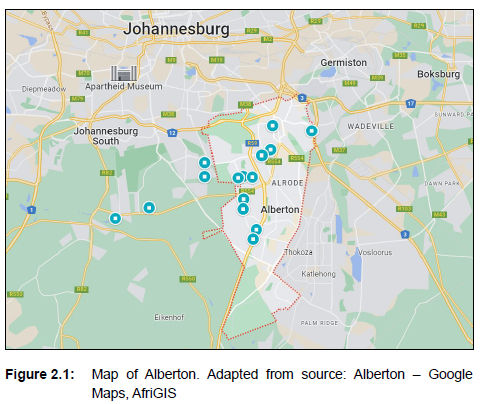
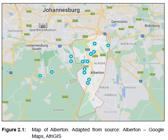
The geographical context of the research study is Alberton, Johannesburg. Fifteen purposively sampled churches of different denominations (six non-denominational churches, four Dutch Reformed Churches (DRC), two Baptist Churches, one Pentecostal Protestant Church, one Methodist Church, and one Apostolic Faith Mission Church), congregation sizes, and demographics (Afrikaans and English suburban churches) participated in the study (Figure 2.1) . The findings are from two different sources: the interviewed leaders (hereafter referred to as YLs) and the responses from the online survey to the EAs.
The YLs consisted of eleven men and four women, each with many responsibilities within their own churches besides ministry to EAs. When considering the YLs' passions and priorities, one would perceive them as coaches (those who equip) and pastors (those who care). The YLs view the church as a people, not a place. For many of the YLs, the church exists for both those inside and outside of its walls. Their functions based on aptitude are internally focused, but they recognise the need for an external focus.
The YLs believe that non-church-affiliated people exist in their context because people were hurt in church, the church being misrepresented, and churches being inward focused, to name a few reasons. When it comes to their ministry to EAs, they describe that an average of 16.7 per cent of their congregations consist of EAs. Over half of the YLs observe that EAs attend their services frequently. However, five of the YLs expressed that they do not. It is interesting to note that there was no consensus as to what an EA is. Five YLs mentioned that EAs are 19 to 35 years old; five mentioned that there is no cut-off age; four stated that EAs are 19 to 29 years old, and one averred that they are students (19-25 years old).
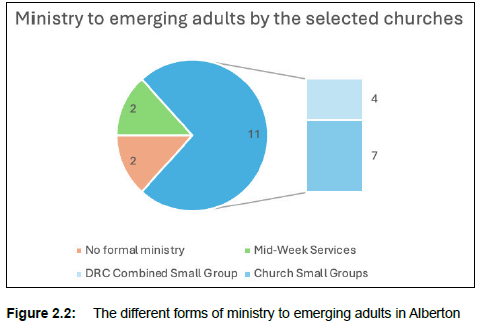
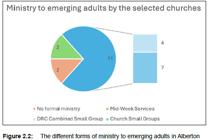
The interviews with the YLs revealed details about the ministries. At the time of their interviews, two of the selected churches did not have a dedicated ministry to EAs. Eleven of the interviewed YLs described their ministry to EAs as via small groups. The four DRC collaborated to form one small group. The remaining two YLs described their ministry as via a smaller mid-week service (Figure 2.2).
COVID-19 impacted the YLs in their ministries in different ways. For some, it was an opportunity to start and even restart their ministries. For others, it was the end of ministry to EAs until 2023. Since COVID-19, all YLs have "gone online" to varying degrees. Some of the YLs encourage the idea of the online church and others are strongly against it.
Secondly, 86 EAs from the selected churches responded to an online questionnaire. The questionnaire was designed to describe the longevity of the EAs' affiliation to their churches in Alberton; the effect of their relationship with their parents on their church affiliation; the state of their current involvement at church; the effect of their view of church on their church affiliation, and the reason why they attend their church. A major part of the online questionnaire was based on Rainer's (2001a:253-257) "Unchurched-Reaching Readiness Inventory" (hereafter referred to as URRI). The URRI is designed to determine a church's potential to reach the "unchurched".
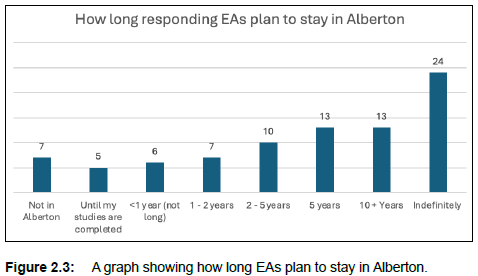
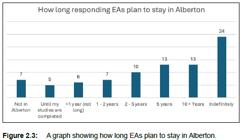
Over half (58%) of the EAs plan to stay in Alberton for five or more years (Figure 2.3). A vast majority (65%) of the EAs are working and potentially settling in Alberton. While living with their parents, the EAs would go to the same church as their parents. Of the respondents, 82.35 per cent attend church monthly and 88.09 per cent of them hear a sermon in person or online at least once a month.
The EAs vary to the extent that they participate in missions. Only 31 (36.90%) EAs would regularly invite others to their gatherings. Of them, 25 (29.76%) share their faith weekly. Half (54.11%) of them are discipled regularly, and 51.77 per cent of them volunteer. Of those who volunteer, 21 per cent volunteer at their respective church's youth or children's ministry, 12.29 per cent volunteer at their church's band, worship or multimedia team, and 20.45 per cent volunteer outside of their local church.
When it comes to how EAs became Christians, a third (29.76%) believe that they are Christian because they were "born a Christian" or raised as one, and another third (30.95%), although born in a Christian family, still made an independent decision to confess their sins and need for Jesus as saviour. The remainder credit family, church ministries, trauma, and the desire to find more meaning in life for becoming Christians.
To discover how the EAs received the reason as to why a church exists, questions such as "Describe the word 'church'" and "Who do you think the church is for?" were posed. A vast majority (67.05%) of the EAs mentioned that church refers to a people and not a place. Half (56.47%) of them stated that the church exists for both believers and non-believers.
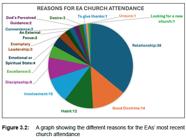
The EAs attributed their most recent church attendance to various factors. Twenty-two EAs admitted being influenced by either family or friends; 16 EAs mentioned different aspects of "a sense of community" such as experiencing love, acceptance, and understanding or feeling welcomed and included; eight EAs mentioned that sound doctrine, church values, and expository preaching made them attend church; eight EAs attended church out of the habit of going to their respective churches for a long time; six EAs attended church to learn more about their faith and for their own spiritual growth; four EAs attended church because of their uncertain spiritual or emotional state at the time; three EAs attended church because of the worship quality, and three EAs attended church because they work for their respective churches.
In the final section of the questionnaire, the URRI determined the theoretical combined potential of the selected churches in reaching the non-church-affiliated. Rainer's (2001a:253-257) original questionnaire employs a five-point Likert scale, where each answer (strongly agree, agree, neutral, disagree, strongly disagree) to 50 statements is assigned a numerical value that, when scored, coincides with the believed potential to reach, in the case of this research study, non-church-affiliated EAs. According to Rainer's (2001a:257) rating system, the selected churches rank at "U3 - Above average potential to reach the unchurched. The church should make several changes, however, to reach more people."
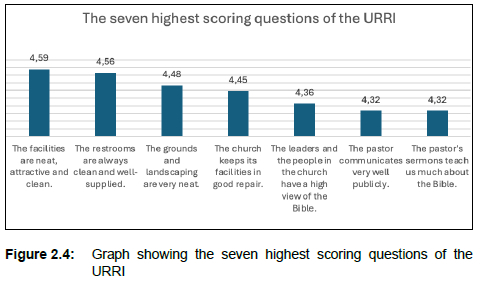
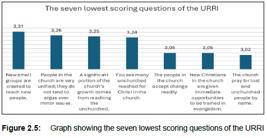
The selected answers listed in Figures 2.4 and 2.5 are the seven highest scoring answers and the seven lowest scoring answers, respectively. The following graphs show the average score of the indicated questions. Five is the highest possible score and one is the lowest possible score.
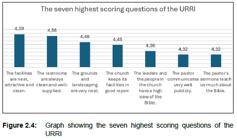
From the highest scoring answers, one can observe, from the EAs' perspective, that the selected churches have neat and well-kept facilities, good doctrine and preaching.
Figure 2.5 suggests two standout categories where the selected churches are underperforming. It would appear that the people within the churches are not unified or do not accept change easily and that reaching the non-church-affiliated is poorly emphasised.
3. THE INTERPRETIVE TASK: DETERMINING WHAT MADE THEM LEAVE
To understand the reasons for the above average potential, this section analyses data from both the interviews with the YLs and the responses from the EAs.
3.1 Rainer's Unchurched Reaching Readiness Inventory
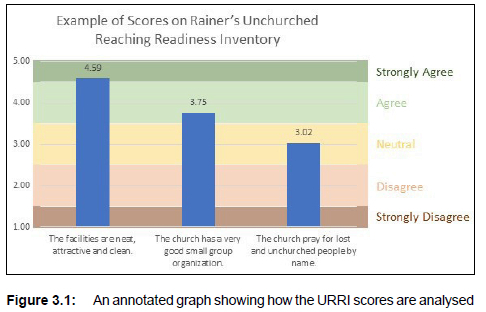
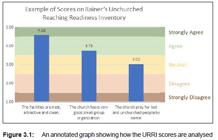
The URRI plays an important role in this research study. The average score for each statement is presented and interpreted in two ways. First, the score is rounded to the nearest 0.5 to indicate the corresponding sentiment from the EAs, as shown in Figure 3.1. Secondly, the scores are interpreted in relation to one another. For example, the 4.59 for "The facilities are neat, attractive, and clean" is the highest or first on the URRI. The 3.75 (the mean score on the URRI) ranks 24th on the inventory and is also the median score. Finally, "the church prays for the lost and unchurched people by name" ranks the lowest at 50th on the URRI.
3.2 Why the responding emerging adults attend church
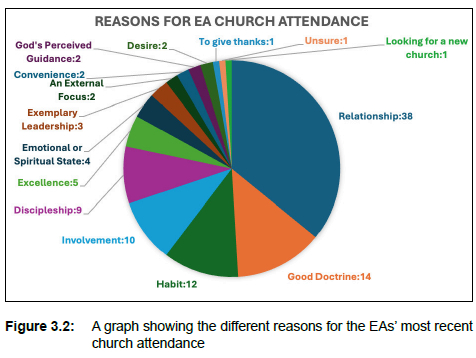
Before analysing the different categories of data, it is worth mentioning, at the outset of this section, the reason why the EAs attend church. Instead of asking the EAs the question, "What would bring you back to church?", they were asked, "What made you attend church?". As such, the results are focused on what is working, and not on what potential protests the EAs have with church. The answers from 85 EAs have been coded into 106 different reasons and 15 major themes for their most recent church attendance (see Figure 3.2). Most of these major themes will be discussed in their respective categories later in this section.
3.3 Different reasons for the EAs' most recent church attendance
3.3.1 Involvement
The first category of data concerning EA involvement in church was analysed. Being involved in a church ministry or small group is the fourth highest reason for EAs' church attendance (Figure 3.2).
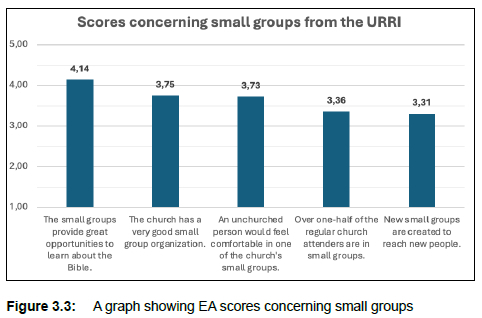
It was noted in the interviews with the YLs that there is a perceived lack of involvement from EAs, primarily because many of them leave for university. As for the EAs who remained in Alberton, there is a strong involvement in small groups, as noted in scores on the URRI (Figure 3.3). "The small groups provide great opportunities to learn about the Bible" ranks 9th on the URRI. This partially confirms the idea that small groups are popular among EAs because they offer an opportunity to be connected to a community and to be taught sound doctrine and interesting biblical facts (Akin & Pace 2017:201; Root 2022:51). Being connected to the community will be discussed later in this section.
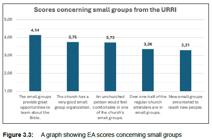
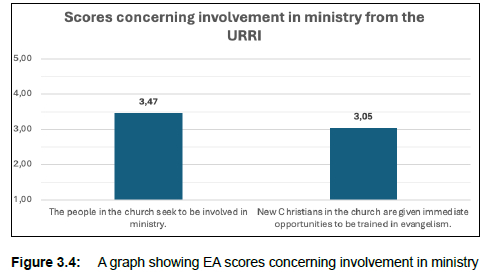
By comparison, the EAs are not as involved in ministries. Although individualistic, EAs view involvement in ministry to others as valuable when they can experience development in identity and community (Richardson 2013:81; Root 2020:65). However, an opportunity for involvement in ministry outside of the church is lacking.
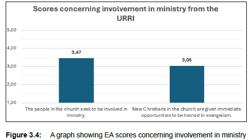
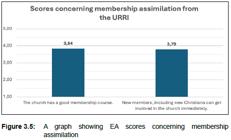
"New Christians in the church are given immediate opportunities to be trained in evangelism" was the third lowest score on the URRI. This is confirmed considering only three of the 15 churches have an intentional assimilation process.
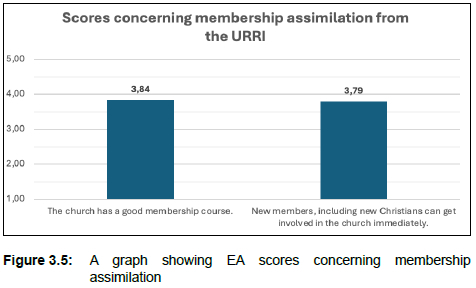
Although the informal assimilation offered by the selected churches was sufficient for EAs to score high on the URRI (Figure 3.5), it lacked providing them with immediate ministry opportunities, especially if the ministry has an evangelistic focus.
3.3.2 Discipleship
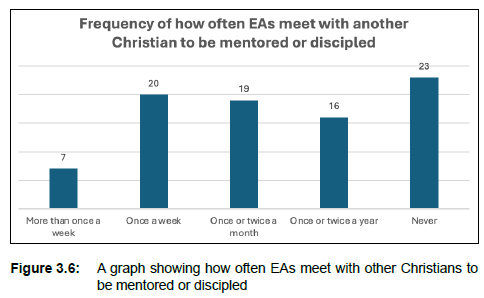
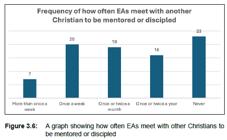
Data concerning the discipleship of EAs was analysed. To grow in spiritual maturity is the fifth most popular reason for EAs' church attendance (Figure 3.2). Discipleship that follows a curriculum occurs in two of the selected churches of Alberton. Informal discipleship, a meeting with people for check-ins, occurs more often. According to Hirsch (2016:112), discipleship has been reduced to the assimilation of ideas such as "following a curriculum and memorising verses", as one of the YLs described. True discipleship shows individuals how to be like Christ as they interact with the world in their unique context (Hirsch 2016:130; Hudson 2019:47; Platt 2010:100). Discipleship does not occur regularly for half of the EAs (see Figure 3.2). The YLs do not have time to disciple others and other EAs are not being trained to be disciple makers.
3.3.4 Relationships
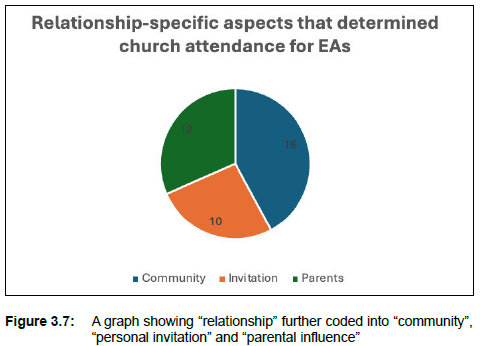
Aspects of relationships are the most popular reason for EA church attendance, thus confirming Rainer's (2001b:5) claim about relationships and showing that this is also true for EAs of Alberton. These were coded (see Figure 3.7) and analysed.
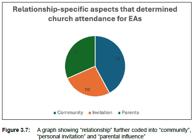
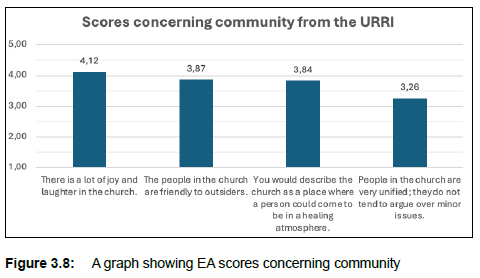
EAs are attracted to churches that are characterised by a loving and purposeful community. A loving community creates the perception of "fellowship", and a purposeful community realises that with relationships come responsibilities. Based on the URRI scores (Figure 3.8), the selected churches are perceived as loving communities.
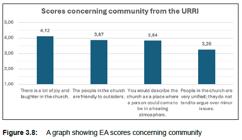
The term 'fellowship' is popular in Christian circles, often connoting social interactions; yet it denotes a purposeful gathering (Stubblefield 2018). Community is there to help people understand the significance of their lives as disciples (Hudson 2019:34-35) and to establish transformative relationships (Hudson 2019:83).
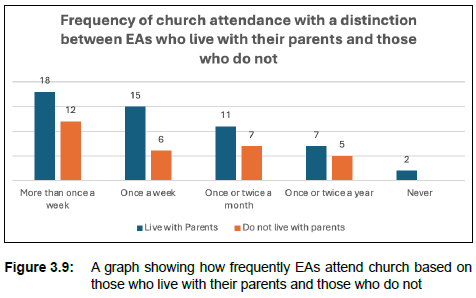
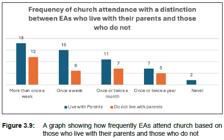
For the EAs who live with their parents, church attendance is usually related to where their parents attend church. Despite a technologically dominated world, the family remains the most influential social structure for cross-generational transmission of religion (Panzer 2019:353). The EAs who no longer live with their parents differ slightly in the frequency of attending church when compared to the EAs who live with their parents (Figure 3.9).
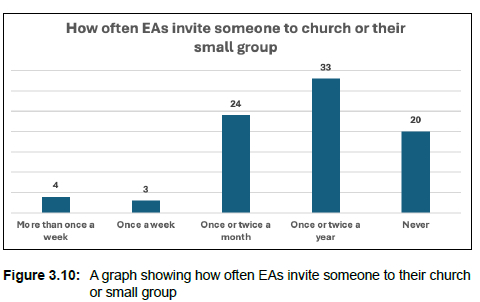
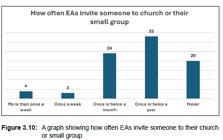
Personal invitations are effective at reaching EAs. However, a minority of EAs are inviting others. "Many people in the church develop relationships with unchurched people" ranked 32nd on the URRI. This below-average score would suggest that intentional relationships are not a focus in the selected churches, and that they are missing an opportunity to reach the non-church-affiliated EAs. The point is reinforced when one considers that only 31 (36.90%) of the EAs regularly invite others to their small group or church (Figure 3.10).
3.3.5 Doctrine
Data concerning sound doctrine was analysed. It is the second most popular reason for the EAs' church attendance. Despite the influences of postmodernism and moralistic therapeutic deism, a "de facto dominant religion" (Smith & Denton 2005:163) among, but not limited to many young people, the non-church affiliated and EAs are drawn to sound doctrine (Panzer 2019:355; Rainer 2001a:45; Rainer 2001b:9).
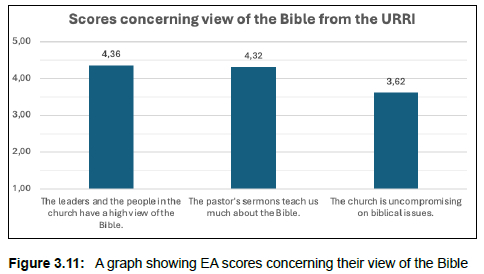
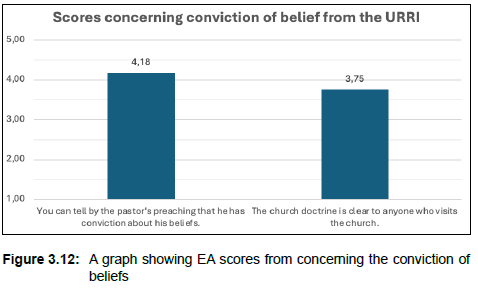
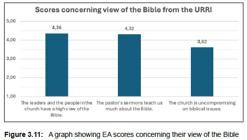
Aspects of sound doctrine that appeal to EAs are undiluted, Bible-based preaching and conviction of beliefs. Based on the scores on the URRI, as shown in Figures 3.8 and 3.9, the selected churches have good, undiluted, Bible-based preaching. Furthermore, the EAs recognise conviction of belief in preaching. It ranks eighth on the URRI. When compared to how clear church doctrine is to anyone who visits the church, ranked 25th on the URRI, a criticism of the preaching is identified. The preaching displays conviction of belief, but to further appeal to the non-church affiliated, clarity of what is believed needs to be more evident.
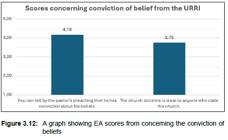
3.3.6 Leadership
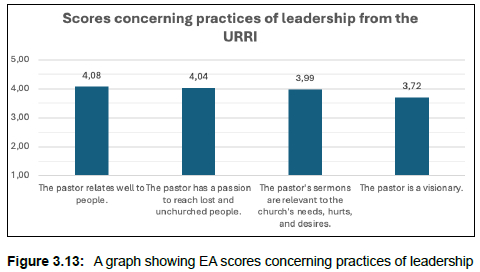
Data concerning leadership was analysed. It was a relatively unpopular reason for church attendance among the EAs (Figure 3.2), despite the fact that church leadership scored relatively well on the URRI (Figure 3.13).
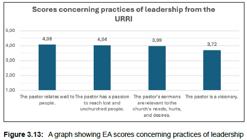
Potential criticisms of the YLs came from the interviews with them. Half of the YLs are too busy to live in the "natural rhythms of life" (Hirsch 2016:224). The vast majority of the YLs were not effective at reaching non-churched-affiliated EAs, because they are more focused on their pastoral roles. Leaders who are effective at reaching the non-church affiliated are often task-driven and goal-oriented and do not fulfil typical pastoral roles (Rainer 2001a:185). In other words, "a missional church needs missional leadership and that takes more than the traditional 'pastor-teacher' role" (Hirsch 2016:191).
In terms of being exemplary disciples and disciple makers, the YLs would be perceived as lacking intentionality. They do not have time for intentional discipleship. Furthermore, less than half of the YLs set an example of personal evangelism. Six of them intentionally make time to share their faith outside of church. The reasons for the lack of personal evangelism could be overwhelming responsibilities, due to the busy nature of the church (Root 2022:200), a lack of passion or focus on personal evangelism as they are pastors not evangelists, or a lack of accountability in personal evangelism (Rainer 2001a:162).
3.3.7 Excellence
Data concerning excellence in terms of church facilities and church services were collected. It is an unpopular reason for church attendance among EAs. This could mean that excellence was not an important aspect to the EAs for choosing a church, or the EAs did not perceive excellence across the 15 selected churches well.
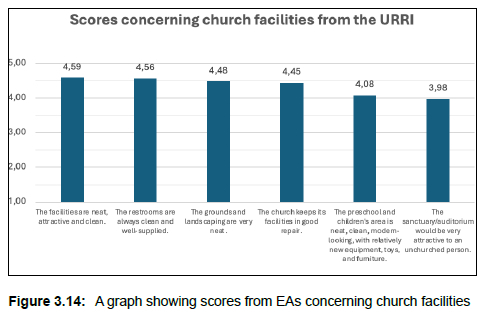
Excellence in terms of the quality of church facilities was well perceived. Aspects of church facilities hold some of the highest scores in the URRI (Figure 3.15). This means that, as far as facilities are concerned, EAs should be sufficiently proud to invite others to attend their church (Rainer 2001:16).
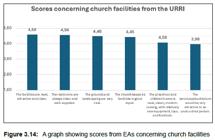
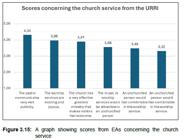
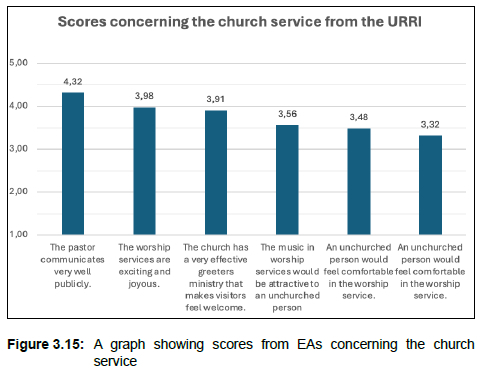
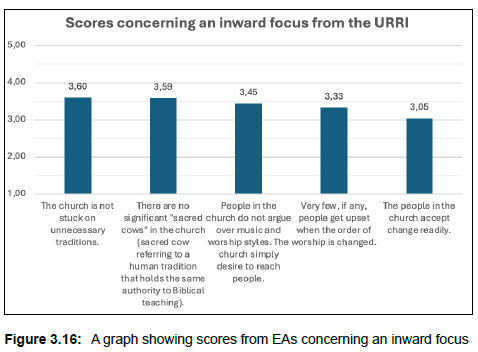
In terms of the church service, a potential lack of appeal to non-church-affiliated EAs could be perceived, due to a wrong approach in preaching brought about by an internal focus. This is observed when the URRI scores that mention the "unchurched" are compared to the scores regarding the atmosphere of the church (Figure 3.16).
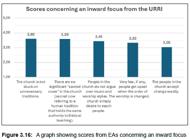
A concern about preaching that would appeal to the non-church-affiliated is that it would not appeal to regular church attendees. This concern assumes that preaching to the non-church-affiliated requires diluted preaching. This study makes it clear that that is not the case. Nonetheless, the high level of excellence in the selected churches suggests that people are sufficiently proud to invite others, but do not know that they should.
3.3.8 External focus
Data concerning the external focus of the selected churches were collected. A third of the EAs believe that the church is a place. Viewing the church as a building arguably indicates that the EAs have an internal focus. For them, going to church as a source of spiritual highs brought about by entertainment (Hirsch 2016:116) or for personal spiritual development without a missional outflow (Hudson 2019:56) will create an internal focus. It creates the idea of "What can the church do for me?".
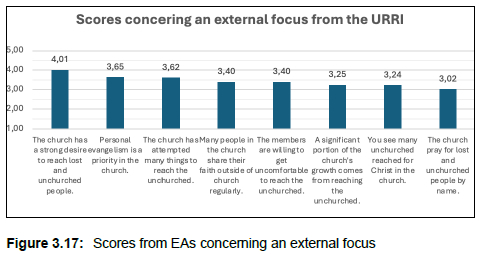
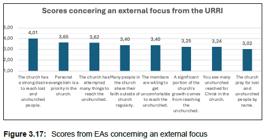
As indicated by the lowest scores from the EAs in the URRI (Figures 3.17 and 3.18), the selected churches are more internally than externally focused. Although the most popular method for reaching the non-church-affiliated among the YLs was equipping their members to do so, few EAs do. The lack of emphasis on personal evangelism is explained by the fact that 59 (70.23%) EAs do not share their faith weekly, and 53 (63.09%) EAs would not regularly invite someone to their church or small group. This lack of an external focus stands out as the major aspect that requires more emphasis, in order to increase effectiveness at reaching non-churched-affiliated EAs.
3.3.9 An online presence
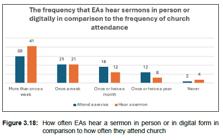
Data concerning an online presence was analysed. The sample of YLs are polarised in their views of the online church. Some view it as a threat to church attendance. However, as the data gathered from the EAs indicates, the online church does not affect their church attendance to any noticeable extent. EAs listen to sermons in person and digitally as much as they attend church (Figure 3.19). Furthermore, EAs did not credit a digital aspect of church for their most recent church attendance. From the data, one cannot conclude that EAs do not attend church because of the existence of the online church. Instead, an online presence, if viewed as a new mission field (Rainer 2020:26-27), could amplify the sense of community (Joynt 2023:192) within and reach from the selected churches of Alberton.
4. THE NORMATIVE TASK: REDISCOVERING WHAT COULD BRING THEM BACK
The process of redesigning church practices takes a step forward when theology informs a biblical understanding of reaching and discipling non-church-affiliated EAs. This section is divided into two parts. First, it is proposed that EAs be viewed as being in an "in-between" spiritual life phase when being "in-between" churches may be a part of their quest for identity discovery. Secondly, different characteristics of church that is church are discussed.
4.1 A spiritual life phase
Lewis (2012:xv-xvi) offers an analogy:
[Christianity] is more like a hall out of which doors open into several rooms. If I can bring anyone into that hall, I shall have done what I attempted. But it is in the rooms, not in the hall, that there are fires and chairs and meals. The hall is a place to wait in, a place from which to try the various doors, not a place to live in.
In Lewis' (2012:xv) analogy, the rooms refer to "creeds of existing communions" or denominations and the hallway, arguably, to being unaffiliated to any church. Besides being inferior to living in a room, being in the hallway should also be temporary, as if it were a phase in one's spiritual life.
EAs are in a life phase that is characterised as being "in-between" (Arnett 2015:14). In this life phase, some EAs do not seek to belong to any given congregation but nonetheless seek to grow their faith (Copeland 2012:13). Some EAs are enthused by their quest for identity in their newfound individuality and begin to live in the hall.
These young "revolutionaries" (Barna 2006:8) who abide in the hall perceive the rooms as inferior. They condescend rooms that have been subject to the influence of a world marked by consumerism, institutionalism, and secularisation. They consider these rooms' appearance as more alike to the world outside of the house. For EAs exploring the halls, and those lost outside the house, the rooms need to bear the appearance of a church that is church (Root 2022:59), namely the loving, uncompromising, and missional body of Christ.
4.2 A church that is a church
Across the world and throughout history, Christians are spiritually connected in the universal church (Gregg 2021:chapter 2) but exist and operate as local communities - local institutions (Sunquist 2019:11). The youth and, as the data from this study has shown, the EAs are more interested in relationships than dogmatic formulas (Nel 2018:171). A networked community is a personalised (Campbell 2012:71), loosely connected set of dynamic, adaptive, and connective relationships that are easy to leave and join and that can take place in physical or digitally mediated spaces (Panzer 2019:356). An understanding of this nature of the church enables believers to meet an EA's need for "hearth and for conversation that begins when it happens and concludes wherever" (Parks 2000:155).
Although being connected to a church is better, an alternative may be offered to non-church-affiliated EAs to reassure them that they are supported in their in-between phase by a network of new friends who are on the "same spiritual journey, with the same questions and confusions, and the same Spirit who binds us all together" (Lottes 2005:129), without insisting on long-term local affiliation. The emphasis is on being united in network. To use Lewis' analogy, a Christian EA is a brother or sister, whether they are in another room or in the hall.
The mission of the church has undergone multiple paradigm shifts from being a fundamental expression of the life of the church, to being synonymous with civilising the pagan, colonialism, and imperialism in their respective epochs, and finally to recognising mission as missio Dei - a mission that exists not for the benefit of the church but as being derived from the nature of God as a missionary God (see Bosch 2011). Nowadays, mission is not a ministry; it is at the heart of who the church is (Akin & Pace 2017:179). Some churches, however, have become preoccupied with their own welfare (Nikolajsen 2013:257). They have
succumbed to the temptation of becoming the star of their own story. They have made themselves their own idol by holding their survival (or growth) as their deepest longing (Root 2022:89).
Remnants of such thinking have been classified throughout this study as having an internal focus.
To reach and involve EAs in leadership, the latter needs to be described as decentralised. The establishment of elders as a process of decentralising leadership in the Bible was first modelled by Moses in Exodus 18:13-26 (Spencer et al. 2014:§3). The precedent set in Exodus 18 for decentralised leadership is to share the responsibility of ministry which is practised in the New Testament by a plurality of elders, deacons, and the church body (Holladay 2016:153; Merida 2014:116).
Ephesians 4:11-12 teaches that individuals with different functions are designed to equip the church for ministry (Bayes 2010; Merida 2014:116). Some argue that, if translated differently, Ephesians 4 makes it clear that ministry is done exclusively by the clergy (see Gordon 1994; Mayes 2015). However, the vast majority of interpreters would reject the idea that ministry belongs only to the clergy, modern staffed leaders of the church (see Arnold 2010; Talbert 2007). Instead, gifted leaders are to equip all of God's people, who are also gifted for the work of ministry and for building up the body of Christ (Lemke 2017:279).
In the contemporary world, leaders within the church are, "in the secondary sense", leaders with functions of apostles (missionaries and church planters), prophets (those who proclaim God's word), evangelists (those who take the Gospel outside of the church), shepherds, and teachers (Vooys 1991:90). Hirsch (2016:191) suggests having a plurality of leaders gifted with different functions. These, in turn, function to equip those under their leadership to be ministers, wherever they find themselves (Hirsch 2016:208).
The Great Commission recorded in Matthew 28:18-20 is given not only to the apostles, who were present when the words were spoken, but also to all those who would subsequently believe (Simonetti & Oden 2002:313). The primary calling of the church is to be a disciple making community (Hudson 2019:22) that "defines itself by, and organises its life around being agents of God's mission to the world" (Hirsch 2016:88). Discipleship is, in short, intentional life-giving relationships. It is "relationship with the Lord … learnt in relationships with other people" (Nel 2018:296). Correctly defined, discipleship is
a process that takes place within accountable relationships over a period of time to bring believers to spiritual maturity in Christ (Ogden 2003:55).
As substantiated in the literature and observed in the collected data, the researcher posits that EAs can be discipled within intentional relationships facilitated by a networked community instead of being discipled exclusively within a formal church affiliation. This does not mean that church affiliation is discarded, but rather that discipleship occurs (or at least starts) while an EA is "in-between" churches.
5. THE PRAGMATIC TASK: INVITING THEM BACK BY WHAT WE DO
A designed strategy to effectively reach and disciple non-church-affiliated EAs in Alberton includes a church networked by intentional relationships that has a set standard of non-negotiable doctrine, non-negotiable excellence, and non-negotiable focus, wherein EAs are discipled to increase their involvement and their influence. This strategy is designed to include eight factors (involvement, discipleship, relationships, sound doctrine, exemplary leadership, excellence, an external focus, and an online presence) that are required to reach non-church-affiliated EAs as identified in the interpretive task.
The strategy was developed by observing and reflecting upon a parallel between the non-church-affiliated EAs' "in-between life" phase and them being "in-between" churches with specific needs to be met by a church that is church. These needs are met by being a church that exists as a networked community, recognising mission as missio Dei, operating with decentralised leadership, and committing to discipleship by the entire community in their own contexts.
5.1 The local church: A hub of relationships
A networked church is not proposed to reinforce individualism or to endorse a do-it-yourself sense of spirituality (Cloete 2020:30). Instead, to negate the possible threat of a networked community over-promoting individuality, a strong emphasis is placed on the network being highly relational. It is proposed to inspire participation, presence, and authenticity (Panzer 2019:356). It is proposed as an alternative to an institution (Hirsch 2016:232), by decentralising power (see Campbell 2012) and encouraging the church to be a community of disciples making disciples (Musa 2020:56), bound together in Christ (Bonhoeffer 1954:24).
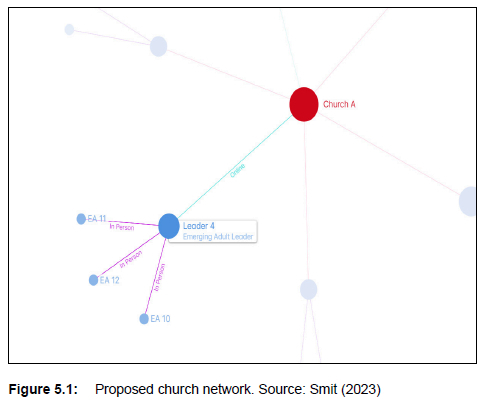
Practically, the church network is structured as a hub (the local church), with many nodes (the EA leaders) (Figure 5.1). From the hub, a standard of non-negotiable doctrine, non-negotiable excellence, and non-negotiable focus is set and maintained.
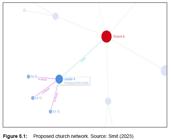
This network of relationships can be tracked and displayed, using software such as Graph Commons, as in Figure 5.1, to keep a record of the EAs and their different types of relationships with the respective church or EA leader.
Non-negotiable doctrine is characterised as sound doctrine. It is established by Christ-centred, expository preaching and a conviction of belief that is exemplified by leaders in the church. To maintain the spiritual health of the church, preaching must have Christ as the subject and not the audience (Keller 2012:77). A good way to maintain Christ-centred preaching would be through expository preaching. Expository preaching is not a matter of "how a preacher says what he says but about how a preacher decides what to say" (Dever 2007:65). Good preaching, in Piper's (2015:90) opinion, "is not 'based on Scripture' but 'saturated with Scripture'". Expository preaching does not exchange good presentations for good content, as they are not mutually exclusive. Non-church-affiliated EAs are not repelled by undiluted biblical preaching (Bickers 2012:26) and good presentation does not reduce the quality of the content. According to Keller (2017:42), "neglecting persuasion, illustration and other ways to affect the heart undermines the effectiveness of preaching". One can preach an expositional sermon, saturated with Scripture and yet with the presentation, persuasion, and illustration that is typical of topical sermons.
The non-negotiable standard of doctrine, when it comes to a conviction of belief, is to be regarded in how clear the beliefs are to anyone in the church and how well the beliefs are exemplified by the leaders and congregation of the church. To be uncompromising in what is believed, there must first be clarity on what is believed (Rainer 2001a:131). There is a need for sound doctrine to be delivered in a clear manner. Hirsch (2016:91) suggests a simple Christology - keeping Jesus central and discarding anything that complicates Christianity's message to the lost.
Once there is clarity, churches can reinforce their beliefs with correction and accountability that is characterised as "speaking the truth in love" (Rainer 2001a:137). Accountability is endorsed in the network by calling on the strong relational bonds that exist between the individuals. Intentional relationships are the means whereby correction is practised, as described in Matthew 18:15-20 (Quarles et al. 2017:212) and characterised in Galatians 6:1 (Cain & Cain 2010:247; Osborne 2017:chapter 12).
Non-negotiable excellence is described as a standard achieved by diligent work, preparation, and execution. In this instance, excellence is focused on the relational aspects of the church and aims to include, engage, and equip.
Include. Forming and maintaining intentional relationships become the most important practices of the church. Cooke (2023:137) describes this "dimension of ministry" as "being welcoming", "demonstrating hospitality, warmth and acceptance", with fellowship as a key strength.
Engage. Non-church-affiliated people and regular church attendees are engaged by how one says things without compromising what is said. This means showing appropriate vulnerability (Rainer 2001a:219), using effective illustrations (Keller 2017:42; Rainer 2001a:219), and explaining difficult jargon.
Equip. Whenever ministry occurs and in whatever form it may take, excellence requires any individual to be well equipped to minister to others. Examples may include congregants who are taught how to share their faith and disciple others, small group leaders being taught to facilitate discussions, and preachers taught how to prepare an engaging yet doctrinally sound sermon.
Non-negotiable focus refers to the church's external focus, namely its role in missio Dei. Instead of giving therapy, life coaching, or informative Bible lessons as its primary objective, the ministry aims to equip EAs at every level of the church network for works of service in their contexts. EAs are taught the "6Ms" framework for missional living (Hudson 2019:25):
Modelling godly character: Allowing the fruit of the Spirit to be evident in their daily lives.
Making good work: Doing daily tasks are viewed as ministry done for God to the world.
Ministering grace and love: Living sacrificially for others, by going the extra mile in ordinary contexts.
Moulding culture: Changing how things are done where they can.
Mouthpiece for truth and justice: Combating lies, snuffing out gossip, and working for the justice of others.
Messenger of the Gospel: Actively evangelising in their contexts.
5.2 The emerging adult leader: A node of relationships
EA leaders create and maintain intentional relationships. They disciple other EAs to:
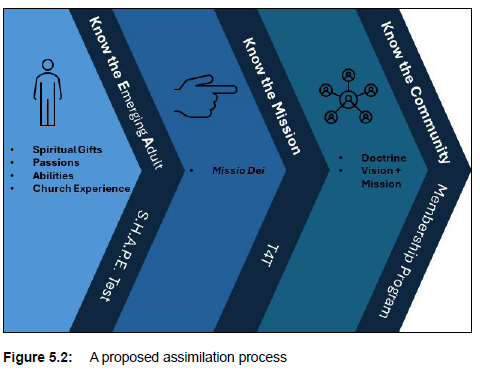
Increase their involvement. EAs are involved to experience being partners in ministry; to develop identity, friendship, and community, while serving in church and in the community, and to mature spiritually, by serving in a ministry. This is achieved using a proposed assimilation, as shown in Figure 5.2.
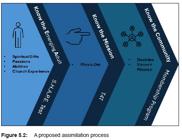
The process focuses on getting to know the EA, using the "S.H.A.P.E test" (see Hill 2017), a free and readily available software program, to match the EA with potential ministries where they will serve best. After that, the EA leader coaches the EAs to perceive the significance of their life in context of Missio Dei. Practically, that includes the 6Ms mentioned earlier supplemented by a process of discipleship and training to evangelise, disciple, plant groups, and develop leaders found in T4T (see Smith & Kai 2011:91-92). Finally, the EA is formally introduced to the church befitting the respective church's assimilation process.
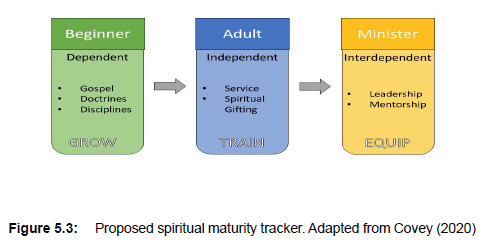
Increase their influence. To aid EAs in their process to spiritual maturity, they are progressively given ministry responsibility, until, ultimately, they are discipling other EAs. They will follow a process of progressing in spiritual maturity proposed by this study (Figure 5.3). The proposed maturity tracker is adapted from Covey's (2020:25-28) maturity continuum to fit the context of spiritual maturity.
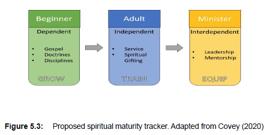
As "beginners", EAs are likened to an "infant in Christ" (1 Cor. 3:1). At this stage, the EAs are dependent on the leader to receive a "diet" that would benefit them to progress in their maturity. The diet is "the elementary teachings of Christ" (Heb. 6:1), particularly, understanding the Gospel, major doctrines, and spiritual disciplines such as prayer and Bible reading (Korner & Joynt 2022:127).
The next stage of spiritual maturity is being an "adult". Adults are characterised as self-sufficient and independent (Arnett 2015:313-316). In this stage, EAs must be guided to understand although they are independent, they should not isolate themselves. Instead, they should understand that they are uniquely gifted to play a role in the body (Rom. 12:3-4). For growth to take place, EAs are provided with opportunities to serve and minister (Bickers 2019:94).
The final stage of spiritual maturity is being a "minister". This is characterised by the EAs' realisation of the interdependence of the individual and community. At this stage, the EAs are actively attempting to reach maturity in themselves and unity with others (Eph. 4:13). Understanding their own individual gifts and functions, EAs can look to guide others to understand theirs.
6. CONCLUSION
In conclusion, the research conducted on redesigning church practices to reach and disciple non-church-affiliated EAs in Alberton, Johannesburg, South Africa, post-COVID-19, has highlighted several key factors. The study used Osmer's practical theological reflection approach to develop a strategy, revealing that the combined potential of the selected churches to reach non-church-affiliated EAs is above average. The eight identified factors (involvement, discipleship, relationship, sound doctrine, exemplary leadership, excellence, a missional focus, and an online presence) are crucial in increasing this potential.
The findings indicate that a multifaceted approach is necessary to address the unique challenges faced by EAs in a post-pandemic world. The study proposes a strategy that uses local churches as central hubs, setting a non-negotiable standard of doctrine, excellence, and focus, while EA leaders are trained to disciple others within their own contexts. This strategy aims to increase EA involvement in church activities and influence among peers by progressively giving them ministry opportunities as part of a discipleship process that may commence before they are formally affiliated with a local church.
Further research is needed to evaluate the effectiveness of this strategy in practice. However, the insights gained from this study provide a foundation for churches in Alberton and beyond to adapt their practices and better serve the EA population in a rapidly changing world.
BIBLIOGRAPHY
2.1 Literature review
-
AfriGIS 2023. Alberton - Google Maps. [Online.] Retrieved from: https://www.google.com/maps/place/Alberton [13 April 2026].
» https://www.google.com/maps/place/Alberton - Akin, D.L. & Pace, S.R. 2017. Pastoral theology: Theological foundation for who a pastor is and what he does. Nashville, TN: B&H Academic.
-
Arnett, J.J. 2015. Emerging adulthood: The winding road from the late teens through the twenties. Second edition. New York, NY: Oxford University Press. https://doi.org/10.1093/acprof:oso/9780199929382.001.0001
» https://doi.org/10.1093/acprof:oso/9780199929382.001.0001 - Arnold, C.E. 2010. Ephesians. Grand Rapids, MI: Zondervan. Zondervan Exegetical Commentary on The New Testament series.
- Barna, G. 2006. Revolution. Carol Stream, IL: Tyndale House Publishers.
-
Barna, G. 2020. Barna: State of the church 2020. [Online.] Retrieved from: https://www.barna.com/research/changing-state-of-the-church/ [13 April 2026].
» https://www.barna.com/research/changing-state-of-the-church/ - Bayes, J.D. 2010. Fivefold ministry: A social and cultural texture analysis of Ephesians 4:11-16. Journal of Biblical Perspectives in Leadership 1(3):113-122.
- Bickers, D.W. 2012. The healthy community: Moving your church beyond tunnel vision. Kansas City, MO: Nazarene Publishing House.
- Bonhoeffer, D. 1954. Life together: The classic exploration of Christian community. New York, NY: Harper Collins.
- Bosch, D.J. 2011. Transforming mission: Paradigm shifts in theology of mission. Twentieth anniversary edition. Maryknoll, NY: Orbis Books.
- Cain, J. & Cain, A. 2010. Commentary on Galatians. Washington, DC: Catholic University of America Press.
-
Campbell, A. 2012. Understanding the relationship between religion online and offline in a networked society. Journal of the American Academy of Religion 80(1):64-93. https://doi.org/10.1093/jaarel/lfr074
» https://doi.org/10.1093/jaarel/lfr074 - Campbell, A. 2020. Digital ecclesiology: A global conversation. Texas A&M University: Digital Religion Publications.
- Chai, R. 2020. "Life together, apart: An ecclesiology for a time of pandemic". Digital ecclesiology: A global conversation. Texas A&M University: Digital Religion Publications.
- Cloete, A.L. 2020. "The church is moving on(line)". Digital ecclesiology: A global conversation. Texas A&M University: Digital Religion Publications.
- Cooke, T. 2023. The end of spectator church: Answering God's call to full engagement. Shippensburg, PA: Harrison House Publishers.
- Copeland, A.J. 2012. No need for church: Ministry with young adults in flux. The Christian Century 129(3):12-13.
- Covey, S.R. 2020. The 7 habits of highly effective people: 30th anniversary edition. New York City, NY: Simon & Schuster.
- Dever, M. 2007. What is a healthy church? Brentway, TN: Crossway Books.
- Gordon, D.T. 1994. "Equipping" ministry in Ephesians 4. Journal of the Evangelical Theological Society 37(1):69-78.
- Gregg, A.R. 2021. The church: An introduction. Wheaton, IL: Crossway. Short Studies in Systematic Theology.
-
Hill, K. 2017. S.H.A.P.E. TEST [Online.] Retrieved from: https://www.freeshapetest.com/ [13 April 2026].
» https://www.freeshapetest.com/ - Hirsh, A. 2016. The forgotten ways. Grand Rapids, MI: Brazos Press.
-
Joynt, S. 2023. Religious communities and well-being during the COVID-19 pandemic: A practical theological consideration of place. In: V. Counted, H. Ramkissoon, L.E. Captari & R.G. Cowden (eds), Place, spirituality, and well-being: A global and multidisciplinary approach (Gewerbestrasse: Springer), Chapter 11. https://doi.org/10.1007/978-3-031-39582-6_11
» https://doi.org/10.1007/978-3-031-39582-6_11 - Keller, T.J. 2012. Center Church: Doing Balanced Gospel Centered Ministry in Your City. Grand Rapids, MI: Zondervan.
- Keller, T.J. 2017. Preaching: Communicating faith in an age of scepticism. London: Hodder and Stoughton Ltd.
- Korner, T. & Joynt, S. 2022. Christian African emerging adults' epistemological understanding of the authority of the Bible with particular reference to contextual evangelism. African Theological Journal for Church and Society 3(1):125-153.
-
Lehola, P. 2016. Community Survey 2016 In Brief. [Online.] Retrieved from: https://www.statssa.gov.za/publications/03-01-06/03-01-062016.pdf [13 April 2026]. https://doi.org/10.9756/SIJCSEA/V3I1/03020060201
» https://www.statssa.gov.za/publications/03-01-06/03-01-062016.pdf -
Lemke, D.L. 2017. A philosophy of disciple-centered leadership. Christian Education Journal 14(2):270-284. https://doi.org/10.1177/073989131701400203
» https://doi.org/10.1177/073989131701400203 - Lewis, C.S. 2012. Mere Christianity. C.S. Lewis Classics edition. Hammersmith, London: Harper Collins Publishers.
- Lottes, J.D. 2005. Jesus as mentor: Biblical reflections for ministry with young adults. Currents in Theology and Mission 32(2):128-138.
- Holladay, C.R. 2016. Acts: A commentary. Louisville, KY: Westminster John Knox Press.
- Hudson, N. 2019. Scattered and gathered. London: Inter-Varsity Press.
- Mayes, R. 2015. "Equipping the saints"? Why Ephesians 4:11-12 opposes the theology and practice of lay ministry. Logia 24(4):7-15.
-
McConnell, S. 2017. Who are the unchurched and how to reach them. [Online.] Retrieved from: https://research.lifeway.com/2017/04/04/who-are-the-unchurched-and-how-to-reach-them/ [13 April 2026].
» https://research.lifeway.com/2017/04/04/who-are-the-unchurched-and-how-to-reach-them/ - Merida, T. 2014. Exalting Jesus in Exodus. Christ-centered exposition commentary. Nashville, TE: Holman Reference.
- Musa, B.A. 2020. Re-imagining place and presence in the virtual church: Community and spiritual connection in the digital era. Digital Ecclesiology: A Global Conversation. Texas A&M University: Digital Religion Publications.
-
Nel, M. 2018. Youth ministry: An inclusive missional approach. Cape Town: AOSIS. https://doi.org/10.4102/aosis.2018.BK83
» https://doi.org/10.4102/aosis.2018.BK83 -
Nikolajsen, B.J. 2013. Missional church: A historical and theological analysis of an ecclesiological tradition. International Review of Mission 102(2):249-261. https://doi.org/10.1111/irom.12028
» https://doi.org/10.1111/irom.12028 - Ogden, G. 2003. Transforming discipleship: Making disciples a few at a time. Downers Grove, IL: IVP Books.
- Osborne, G.R. 2017. Galatians verse by verse. Bellingham, WA: Lexham Press. Osborne New Testament Commentaries.
- Osmer, R.R. 2008. Practical theology: An introduction. Grand Rapids, MI: Wm B. Eerdmans.
- Panzer, R.M. 2019. Hearing the millennials: Ministry alongside an unchurched generation for the sake of the Gospel. Word & World 39(4):351-361.
- Parks, S.D. 2000. Big questions, worthy dreams: Mentoring young adults in their search for meaning, purpose, and faith. San Francisco, CA: Jossey-Bass.
- Piper, J. 2015. The supremacy of God in preaching. Third edition. Grand Rapids, MI: Baker Books.
- Platt, D. 2010. Radical. Colorado Springs, CO: Multnomah Books.
- Quarles, C.L., Köstenberger, A.J. & Yarbrough, R.W. 2017. Matthew. Exegetical guide to the Greek New Testament. Nashville, TN: B&H Academic.
- Rainer, T.S. 2001a. Surprising insights from the unchurched and proven way to reach them. Grand Rapids, MI: Zondervan.
- Rainer, T.S. 2001b. The formerly unchurched: Bridges to the unchurched in the 21st century. Journal of the American Society for Church Growth 12(1):313.
-
Richardson, R. 2013. Emerging adults and the future of missions. International Bulletin of Missionary Research 37(2):79-84. https://doi.org/10.1177/239693931303700205
» https://doi.org/10.1177/239693931303700205 - Root, A. 2017. Faith formation in a secular age. Grand Rapids, MI: Baker Academic.
- Root, A. 2020. The end of youth ministry? Grand Rapids, MI: Baker Academic.
- Root, A. 2022. Churches and the Crisis of Decline. Grand Rapids, MI: Baker Academic.
-
Schultz, T. 2020. The rise of the dones: The "Done with Church" population. [Online.] Retrieved from: https://churchleaders.com/outreach-missions/outreach-missions-articles/177144-thom-schultz-rise-of-the-done-with-church-population. [13 April 2026].
» https://churchleaders.com/outreach-missions/outreach-missions-articles/177144-thom-schultz-rise-of-the-done-with-church-population - Simonetti, M. & Oden, T.C. 2002. Matthew 14-28. Downers Grove, IL: IVP Academic. Ancient Christian Commentary on Scripture.
-
Smit, S.G.J. 2023. Discipleship network. [Online.] Retrieved from: https://graphcommons.com/graphs/f4dd07e7-c85b-426c-ac58-bf55527202ed\ [13 April 2026].
» https://graphcommons.com/graphs/f4dd07e7-c85b-426c-ac58-bf55527202ed\ -
Smith, C. & Denton, M.L. 2005. Soul Searching: The Religious and Spiritual Lives of American Teenagers. New York, NY: Oxford University Press. https://doi.org/10.1093/019518095X.001.0001
» https://doi.org/10.1093/019518095X.001.0001 - Smith, S. & Kai, Y. 2011. T4T: A discipleship re-revolution. Monument, CO: WIGTake Resources.
-
Spencer, A.B., Bird, M.F. & Keener, C.S. 2014. 2 Timothy and Titus. Eugene, OR: Cascade Books. New Covenant Commentary Series. https://doi.org/10.2307/j.ctt1cgdz1n
» https://doi.org/10.2307/j.ctt1cgdz1n - Stanley, A. 2012. Deep and wide: Creating churches unchurched people love to attend. Grand Rapids, MI: Zondervan.
-
Statistics South Africa 2022. Census 2022: Statistical Release. [Online.] Retrieved from: https://census.statssa.gov.za/assets/documents/2022/P03014_Census_2022_Statistical_Release.pdf [13 April 2026].
» https://census.statssa.gov.za/assets/documents/2022/P03014_Census_2022_Statistical_Release.pdf -
Stubblefield, B. 2018. What counts as Christian "fellowship"? [Online.] Retrieved from: https://radical.net/article/what-counts-as-christian-fellowship/ [20 April 2026].
» https://radical.net/article/what-counts-as-christian-fellowship/ - Sunquist, S.W. 2019. Why church?: A basic introduction. Downers Grove, IL: IVP Academic.
- Talbert, C.H. 2007. Ephesians and Colossians. Grand Rapids, MI: Baker Academic. Paideia.
- Vooys, J. 1991. No clergy or laity: All Christians are ministers in the body of Christ, Ephesians 4:11-13. Direction 20(1):87-95.
Date accepted: 9 April 2026
Date published: 30 June 2026