Key determinants of green construction finance uptake in Kenya
Abstract
The construction sector has a significant impact on the environment, yet the uptake of green construction in Kenya remains low, partly due to barriers in accessing green construction finance (GCF). This study evaluates the key determinants influencing GCF uptake in Kenya's construction industry. Using quantitative research methods, a survey of 69 registered developer firms was conducted, evaluating eight key determinants, namely awareness; availability and accessibility; institutional and regulatory factors; financial and cost-related aspects; environmental considerations; technological and technical factors; risk, and sociocultural influences. Findings revealed moderate awareness of technical aspects but poor understanding of financial mechanisms, incentives, and application processes. While GCF is perceived as available, bureaucratic and regulatory barriers limit accessibility. Long-term financial gains and environmental benefits are recognised, yet high upfront costs, regulatory uncertainties, skill gaps, and low public awareness constrain adoption. Technological readiness and certification bodies are crucial for GCF uptake, but sociocultural attitudes, trust deficits, and inadequate policy coherence remain significant barriers to widespread GCF adoption, highlighting the need for targeted interventions. The study contributes to research and policy, by providing recommendations to guide strategies (e.g., combining capacity-building programmes, streamlined institutional and regulatory frameworks, financial incentives, technological support, risk mitigation, and social advocacy) that can improve green finance accessibility and promote sustainable construction practices in Kenya.
green construction finance; sustainable construction; financing barriers; Kenya construction industry; determinants of adoption
Abstract
Die konstruksiesektor het 'n beduidende impak op die omgewing, maar die aanvaarding van groen konstruksie in Kenia bly laag, deels weens struikelblokke om toegang tot groen konstruksiefinansiering (GKF) te verkry. Hierdie studie ondersoek die sleutelfaktore wat die gebruik van GKF in Kenia se konstruksiebedryf beïnvloed. 'n Kwantitatiewe opname van 69 geregistreerde ontwikkelaars is gedoen om agt bepalende faktore te evalueer, naamlik bewustheid; beskikbaarheid en toeganklikheid; institusionele en regulatoriese faktore; finansiële en kosteverwante aspekte; omgewingsoorwegings; tegnologiese en tegniese faktore; risiko, en sosio-kulturele invloede. Bevindings toon matige bewustheid van tegniese aspekte, maar beperkte begrip van finansiële meganismes, aansporings en aansoekprosesse. Alhoewel GKF as beskikbaar beskou word, beperk burokratiese en regulatoriese hindernisse toeganklikheid. Langtermyn finansiële en omgewingsvoordele word erken, maar hoë aanvangskoste, regulatoriese onsekerheid, vaardigheidstekorte en lae openbare bewustheid belemmer aanvaarding. Tegnologiese gereedheid en sertifiseringsliggame is noodsaaklik, maar sosio-kulturele houdings, vertrouensgebreke en onvoldoende beleid samehang bly groot struikelblokke. Die studie bied aanbevelings soos kapasiteitsbou, vereenvoudigde regulasies, finansiële aansporings, tegnologiese ondersteuning, risikovermindering en sosiale bewusmaking om GKF-toeganklikheid te verbeter en volhoubare konstruksiepraktyke te bevorder.
1. INTRODUCTION
The construction industry has been recognised for exerting a significant influence not only on the natural environment, but also on resource consumption, human health, indoor environmental quality, and land usage (Joseph & Ralwala, 2020). For example, in 2020, the construction industry accounted for 36% of global energy use and 37% of global greenhouse gas emissions (UNEP, 2021). Buildings have been described to account for various health-related problems such as sick building syndrome, multiple chemical sensitivity, and building-related diseases (Kibert, 2022; Chao, 2023). The situation is further exacerbated by the various direct and indirect linkages between the construction industry and other industries in any country. The construction industry's notoriety regarding its environmental impact has highlighted the need for green buildings (Anzagira, Duah & Badu, 2021).
In response to increased environmental regulations and the development of more sustainable corporate strategies, green finance, also known as sustainable finance, has emerged (Bigger & Carton, 2020). Green finance attempts to incorporate ideas such as environmental pollution reduction and energy conservation into financial services (Chao, 2023). Private or public funds can support projects expediting the transition to a low-carbon and sustainable economy through tools such as investments, corporate loans, and financial products such as green bonds (Sartzetakis, 2021). According to Berrou, Dessertine and Migliorelli (2019), these tools seek to offer solutions that strike a balance between economic growth and environmental sustainability. However, green finance projects and programmes vary significantly, embracing a vast diversity of industries and areas, which has produced issues in the definition and formulation of principles, rules, and policies (Chao, 2023).
Despite the efforts by the UN and governments around the globe, Joseph et al. (2023) assert that the global construction industry is falling behind in transitioning to sustainability. The construction industry in Kenya is no exception. The extent of green construction in Kenya is limited, and this has been partly attributed to a low uptake of green construction finance (GCF). Financial Sector Deepening (FSD) Africa (2024), a development agency, notes that Africa, one of the most climate-vulnerable regions of the world, currently captures only 3% of sustainable investment global flows, despite half of Africa's GDP being exposed to climate change. This finding points to the challenge for low-income developing countries to capitalise on the green finance boom. The market for green bonds is expected to reach $200 billion in 2024, a growth of 20% compared to the market in 2023. These figures are significantly higher than the $87 billion raised in 2016 (Osano, 2024). However, regardless of the global market growth, there are very few bonds available across Africa.
FSD Africa (2024) argues that the greening of the global financial system needs to consider the unique challenges and opportunities particular to the various African regions. In the absence of foundational skills, data, policies, and regulatory frameworks to promote green finance, developing nations such as Kenya will struggle to offer private investors adequate scale, quality, and returns. The country faces challenges in mobilising green finance, due to the need for external capital flows for investment in energy, transport, waste, water, and agricultural improvements, and underdeveloped financial systems in areas crucial for green investment such as structuring major projects and providing credit and insurance to large and small businesses and households (Forstater et al., 2016). Osano (2024) also asserts that the lack of proper financial structures prevents the Kenyan government from unlocking more green finance. Kripa and Ilollari (2023) point out that the two main challenges in developing countries are the lack of access to green finance products and inadequate awareness and understanding of what green finance entails. Napier (2019) observes that banking policies in Kenya that are not market-driven are likely to raise the price of green bonds, making them prohibitively expensive in comparison to long-term bank finance. Therefore, the country runs the risk of stalling the momentum that currently exists in Kenya for green bonds.
Despite the environmental and financial benefits of green construction, its uptake in Kenya remains low, primarily due to financial, regulatory, and sociocultural barriers. Therefore, it is important to know what causes and affects the use of GCF in Kenyan building projects, in order to determine what is slowing adoption. This study provides evidence to inform policymakers, industry practitioners, and researchers in designing targeted interventions that can accelerate sustainable construction practices in Kenya.
2.1 Green finance concept and definition
'Financing green' and 'greening finance' are two terminologies that are currently used in reference to this concept. 'Financing green' refers to the financing of projects that contribute or intend to contribute to the conservation, restoration, and sustainable use of biodiversity and its services to people (World Bank, 2020). 'Greening finance' focuses on directing financial flows away from projects with a negative impact on biodiversity and ecosystems, and towards projects that mitigate the negative impact or pursue positive environmental impact as a co-benefit (Global Landscapes Forum, 2021).
Green finance lacks a precise, universally agreed upon definition, with most of the studies either omitting a definition or offering widely varying ones (Lindenberg, 2014). According to Höhne et al. (2012), green finance is a broad term describing financial investments for sustainable development initiatives, projects, products, and policies. Zadek and Flynn (2014) argue that green finance and green investment can be used interchangeably, although green finance is wider in scope, as it includes operational costs associated with green investments. In the banking sector, green finance can be defined as financial products and services that consider environmental factors during lending, decision-making, ex-post monitoring, and risk management processes. Green finance is provided to encourage ecologically responsible investments and support low-carbon technologies, industries, projects, and businesses (Turner, 2016). Green finance refers to financial instruments that promote better environmental and sustainable outcomes, including loans, debt structures, and various investments (Kripa & Ilollari, 2023). Simply put, green finance refers to an investment or loan that promotes environmentally positive activities such as the purchase of ecologically friendly goods and services or the construction of green infrastructure (Kelkar, 2023; Agarwal & Weina, 2022).
From the foregoing, green finance could be described as having three components, namely the financing of private and public green investments; the financing of public policies that encourage the implementation of environmentally conscious projects and initiatives, and components of the financial system that deal specifically with green investments, including their specific legal, economic, and institutional framework conditions.
2.2 Green finance benefits
Governments, businesses, investors, and individuals are taking measures to address the climate crisis through decarbonisation (Kelkar, 2023). Addressing the climate challenge requires substantial investment in green finance to support emission-reduction initiatives and climate adaptation (Agarwal & Weina, 2022). Green finance benefits both the economy and the environment, by expanding access to eco-friendly products, promoting social inclusivity, and supporting economic growth, creating a 'great green multiplier' effect (Kelkar, 2023; Agarwal & Weina, 2022).
2.3 Green finance types and sources
There are various types and sources of green construction finance. Green mortgages offer preferential terms to homebuyers of environmentally sustainable properties or those enhancing energy efficiency (Kelkar, 2023). Green mortgages are usually provided by local financial institutions and require long-term local currency financing, although, increasingly, global capital markets and development finance institutions support this asset class in middle-income countries (lEA, 2023; IFC, 2023a). Benefits include lower interest rates, longer repayment terms, and reduced down payments, due to lower utility costs (IFC, 2021a). Adoption of green finance outside the United States of America and the European Union remains limited, due to high due diligence costs and scarce default data (UN Environment & lEA, 2018). Examples of green finance do, however, exist in Colombia and Peru (IFC, 2022, 2024). The successful implementation of green finance relies on robust regulatory frameworks, mature financial markets, and strong investor demand (UNEP, 2022).
Green loans are widely used for sustainable construction and environmental initiatives. Green loans have flexible terms and can be secured, unsecured, concessional, or subsidised to support projects such as solar panels, energy efficiency, and electric vehicles (Zhan & de Jong, 2017; Kelkar, 2023). Green credit cards such as Aspirations' Zero card allow consumers to contribute to environmental initiatives, e.g., planting a tree per purchase (Kelkar, 2023).
Green banks are similar to conventional banks but they focus on funding environmentally friendly projects. Green banks in the United States of America grew from 1 to 20 between 2011 and 2020, investing $7 billion in renewable energy (Kelkar, 2023). Green banks incorporate environmental factors into strategy, raise capital for green assets, and engage in loans, credit, savings products, and green bonds (World Bank, 2020). Green bonds issued by governments or corporations raise funds for environmental projects such as renewable energy and conservation. They are the most significant green financing tool, with issuance exceeding US$500 billion in 2021 and expected to reach US$5 trillion by 2025 (World Bank, 2015; Kelkar, 2023; Agarwal & Weina, 2022; CBI, 2024). Green private capital was initially motivated by corporate image, but private real estate investments in sustainable construction now generate economic returns (Yudelson & Fedrizzi, 2010).
Government grants and tax incentives are also a form of green finance. Many governments, particularly in developed countries, provide grants and tax incentives to promote green construction, often supported by international organisations such as the World Bank, the European Investment Bank (EIB), and the Asian Development Bank Institute (ADBI) (Bon-Gang, 2018; IMF, 2021; Chao, 2023). International assistance programmes and multilateral programmes such as the Global Environment Facility (GEF) Trust Fund, Special Climate Change Fund, Market Accelerator for Green Construction (MAGC) by IFC, and Adaptation Fund support sustainable development, particularly in developing countries (BonGang, 2018; IMF, 2022).
2.4 Green financing for construction projects
Globally, green finance has grown dramatically, rising from $5.4 billion in 2012 to $540 billion in 2021, reflecting increased recognition of environmental and climate crises (Persefoni, 2024). Between 2017 and 2021, green debt financing increased twentyfold, from $10 billion to $230 billion, with green bonds accounting for approximately 70% of this growth, while emerging instruments such as green sustainability bonds and loans have also expanded rapidly (World Economic Forum, 2021; IFC, 2023a).
Equity instruments remain limited, although Real Estate Investment Trusts (REITs) hold potential to scale green construction finance (IEA, 2023). Innovative tools such as carbon retirement portfolios and transition bonds have issued 10% of global green debt financing since 2017 (World Bank, 2021; World Steel Association, 2021). These instruments are, however, nearly absent in developing countries. Private green debt finance is, however, growing in sub-Saharan Africa, albeit from a very low base (IFC, 2022).
Globally, roughly 90% of green construction finance in 2021 targeted green buildings rather than "hard-to-abate" materials such as cement and steel, which contribute 19% of global carbon emissions (World Green Building Council, 2022). In developing countries, 54% of private green debt is linked to projects in the Caribbean and Latin America, 19% to the Pacific and East Asia, and 12% to Central Asia and Europe. The Middle East, South Asia, North Africa, and sub-Saharan Africa contributed only 15%, with South Africa alone accounting for 75% of this investment (World Economic Forum, 2022a; IFC, 2023b; World Economic Forum, 2022b). In 2021, $27 billion was invested in green construction, with 70% directed to decarbonising construction materials, primarily steel and cement. Green loans were the dominant financing instrument (86%), while green bond issuance grew sevenfold from 2019-2021 (World Green Building Council, 2022; World Economic Forum, 2021).
Kenya's green building market has grown steadily, with certified green buildings representing 3% of new construction in 2020, mainly offices and high-income housing (IFC, 2021b). While several REITs exist, no green mortgages or construction loans had been recorded by 2020. Government green economy strategies are in place, but their market impact remains limited (IFC, 2021b). Green finance in Kenya primarily originates from international grants and loans, as well as domestic government allocations. Between the financial years 2017/2018 and 2019/2020, the Kenyan government disbursed KShs 414.23 billion and KShs 427.24 billion, respectively, with roughly 40% domestic and 60% international funding. Actual investment in green projects was KShs 103 billion in 2017/2018 and KShs 120 billion in 2018/2019, while private sector contributions are estimated at KShs 100 billion annually (Were, 2024). Notable private initiatives include Acorn Holding Limited, which raised KShs 4.3 billion ($40.5 million) through a green bond in 2019 to construct climate-resilient student hostels that are Excellence in Design for Greater Efficiencies (EDGE)-compliant (Odhiambo & Amayo, 2024). Similarly, the IFC and International Housing Solutions established the IHS Green Housing Fund to finance 5,000 green, affordable homes, initially focusing on Nairobi and selected counties, ensuring compliance with EDGE standards for energy, water, and material efficiency (Odhiambo & Amayo, 2024).
2.5 Challenges facing green construction finance adoption
Green construction remains largely financed through traditional project financing, which often conflicts with its principles and faces regulatory and practical limitations (Agliardi & Agliardi, 2019). Globally, the sector is still developing, and research on suitable financing mechanisms, including green finance, is limited (Wuni et al., 2019). In developing countries, low private capital flows for green construction reflect market failures in finance and value chains, which are more pronounced in low-income economies (World Economic Forum, 2021).
Barriers include fragmented industry structures, informational asymmetries, localised regulations, and the dominance of small and medium-sized enterprises (World Bank, 2021). Investment decisions often involve multiple stakeholders such as developers, investors, construction professionals, and material suppliers, whose interests may conflict. The absence of green codes and standards complicates the identification of viable projects (World Bank, 2021), while shortages of skilled green construction labour further constrain investment (World Economic Forum, 2022b).
Green construction can also appear relatively costly because market prices rarely reflect the social costs of conventional construction, reducing expected returns (World Economic Forum, 2022a). Consumers and investors may be unwilling or unable to pay the 1%-5% premium for green buildings, particularly in affordable housing, while limited data on default rates and financial returns further discourages investment (World Steel Association, 2021; World Bank, 2021). Financial markets often underprice climate risks such as extreme weather, raising capital costs for green construction, especially in disaster-prone developing countries (World Bank, 2020; World Economic Forum, 2022b).
High costs for measuring and monitoring environmental performance, particularly for "hard-to-abate" materials such as cement and steel also constrain private investment (IFC, 2023a). Additional challenges include low transparency, weak governance and disclosure standards, limited technical capacity, and inadequate regulatory frameworks for green financial instruments (IFC, 2021a). Supply-side constraints such as a shortage of viable green projects, limited innovation, lack of economies of scale, and restricted concessional finance further reduce investment opportunities (IMF, 2021, 2022). Regulatory, currency, macroeconomic, and political risks, compounded by market volatility, increase costs and lower the profitability of green construction investments (Ul Haq & Doumbia, 2022).
3. RESEARCH METHODOLOGY
3.1 Research design
This study evaluates the key determinants influencing the uptake of GCF in Kenya's construction industry, with the aim of identifying factors constraining its adoption. Using a quantitative survey design, 68 indicators across eight determinants were surveyed among Kenyan property developers (Creswell & Creswell, 2018). The quantitative approach allows for descriptive data analysis, which in this study included relative importance indices and rankings to summarise the data, compare determinants, and identify the most influential factors. This method simplifies complex data, highlights trends and patterns, and provides a foundation for actionable recommendations (Creswell & Creswell, 2018; George & Mallery, 2019; Cooksey, 2020). The top-ranked factor for each determinant was used to assess the implications of GCF uptake in construction practices and to provide recommendations for action.
3.2 Target population, sampling, and responses
The study targeted registered property developers in Kenya, who constituted the unit of analysis. Developers were selected because they serve as primary decision-makers and implementers of construction projects, positioning them as key demand-side actors in GCF. According to the Kenya Property Developers Association (KPDA) (2025) online register, 69 developers were registered as of 12 March 2025. Given this relatively small population, the study adopted a census approach, distributing questionnaires to all 69 firms. A total of 55 responses were received, yielding a response rate of 79.7%, which was considered adequate for analysis. Although some missing values in responses were observed, their impact was minimal. Of the 68 questions, 62 had complete responses (n = 55), three had one missing value (n = 54), and another three had two missing values (n = 53). Consequently, no imputation or corrective measures were undertaken.
3.3 Data collection
Data was collected using questionnaires administered to registered developers in June 2025. The questionnaire was divided into two parts. Part one requested demographic data regarding the years of existence and the total number of projects undertaken by participating firms. The second part measured the following determinants of green construction uptake: extent of awareness, availability and accessibility, institutional and regulatory-related factors, financial and cost-related factors, environmental-related factors, technological and technical-related factors, risk-related factors, as well as social and cultural-related factors. A total of 68 indicators were used to measure the eight determinants based on the following 7-point Likert scale: 1=Strongly Disagree, 2=Disagree, 3=Somewhat Disagree, 4=Neutral, 5=Somewhat Agree, 6=Agree, and 7=Strongly Agree. Based on the provided scale, the developers were requested to indicate their level of agreement with a series of statements.
3.4 Data analysis
Quantitative data were analysed using SPSS v.25 (George & Mallery, 2019). Descriptive statistics, including frequencies and percentages, summarised the profile of participating firms. The eight determinants of GCF uptake were further examined, using range, mean, standard deviation, coefficient of variation, and Relative Importance Index (RII). RII is a statistical technique that ranks variables according to their perceived importance by study participants (Zulu, Zulu & Chabala, 2022). The RII was calculated by dividing the mean by the highest possible response (7) in each question. Based on RII values, determinants were categorised into five levels: high (H: 0.8-1), high-moderate (H-M: 0.6-0.8), moderate (M: 0.4-0.6), moderate-low (M-L: 0.2-0.4), and low (L: 0-0.2) (Sogaxa, 2024). RII, combined with descriptive statistics, allows for clear comparison of determinants, highlights trends and patterns, and provides a foundation for evidence-based recommendations. The top-ranked RII factors for each determinant were used to assess implications for GCF uptake and inform recommended actions (Creswell & Creswell, 2018; Cooksey, 2020).
4. FINDINGS AND DISCUSSION
4.1 Developer firms' profile
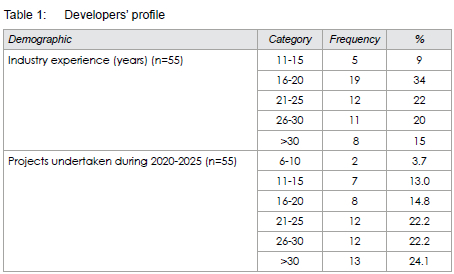
To assess the experience of developer firms in Kenya's construction industry, respondents were asked to indicate the number of years their firms had been operating (see Table 1). Notably, no firms reported less than 11 years' operational experience, with zero responses in both the 1-5 years and 6-10 years categories. Consequently, all sampled firms had over a decade of experience in the sector. The distribution is heavily skewed towards long-established developers: 90.9% of firms reported more than 15 years' industry experience, while 14.5% had been operating for over 25 years. This profile suggests a mature respondent base with significant exposure to market fluctuations, regulatory frameworks, and established business practices.
The absence of firms established over the past 10 years means that the data set does not capture the perspectives or challenges unique to newer, potentially more agile or innovative firms. Zuo et al. (2012) suggest that such firms may demonstrate greater flexibility and willingness to experiment with emerging financial instruments, and their exclusion could limit the generalisability of findings to the broader industry. Given that established firms often act as industry leaders and trendsetters, their buy-in is critical for the widespread adoption of GCF practices. However, policies aiming to facilitate GCF uptake should also consider the needs and potential contributions of emerging firms, which are not represented in this sample.
Respondents were also asked to report the total number of construction projects completed over the last five years (see Table 1). Overall, nearly 70% of the developers indicated having handled more than 20 projects over the past five years. In total, the 55 respondents reported undertaking approximately 1,318 projects over this period, representing an average of 23.9 projects per developer, or about 4.7 projects per year. This finding reflects a highly active developer sample, demonstrating significant engagement in Kenya's construction sector.
Previous research emphasises both the advantages and challenges associated with firm maturity in adopting new industry practices. Osei-Kyei et al. (2019) found that experienced firms generally have greater resource capacity and are better equipped to implement sustainable innovations. Jiang et al. (2022) similarly reported that larger and older firms are more open to green finance, although inertia within established routines may impede rapid change. In contrast, Zuo et al. (2012) observed that newer and younger firms often contribute disproportionately to innovation uptake and industry transformation, due to their openness to novel ideas.
4.2 Green construction finance awareness
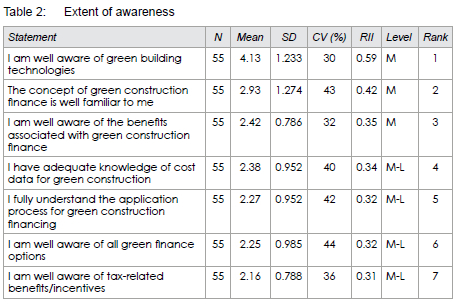
The study assessed developers' awareness of seven aspects of GCF, with results summarised in Table 2. Developers reported the highest awareness for green building technologies (RII = 0.59, Rank 1), indicating moderate familiarity. Awareness of the general concept of GCF ranked second (RII = 0.42), followed by knowledge of associated benefits (RII = 0.35, Rank 3). Awareness of cost data and understanding of application processes was relatively low (Mean = 2.25), while the lowest awareness was found regarding comprehensive knowledge of all green finance options (RII = 0.32, Rank 6), and tax incentives (RII = 0.31, Rank 7). Coefficients of variation (CV) ranged from 30% to 44%, reflecting moderate variability in responses. Overall, ratings cluster in the lower middle region of the scale, indicating limited to moderate awareness of green finance concepts among developers.
The findings indicate that developers are more familiar with technical aspects (e.g., materials, technologies) of green construction than with the financial instruments supporting them, consistent with previous studies (Opoku & Ahmed, 2014; Shen et al., 2018). Moderate awareness of green building technologies may reflect exposure through training, industry forums, or compliance requirements, whereas understanding of green finance concepts, options, and benefits is generally medium to low (RII = 0.35-0.42), highlighting a lack of critical knowledge for scaling adoption (Manga, 2025). Awareness of tax incentives and application processes was particularly low, suggesting that developers either lack information or find procedures complex (Odhiambo & Amayo, 2024). Such limitations hinder engagement with financial institutions and limit demand for green building investments. These findings align with findings by Darko et al. (2017) and Shen et al. (2018), who emphasise that financial literacy and awareness of incentives are key barriers to adopting sustainable financing solutions.
4.3 Green construction finance availability and accessibility
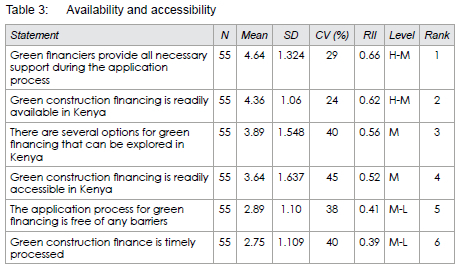
Developers rated six statements on the availability and accessibility of GCF in Kenya (Table 3). The highest rated statement was green financiers provide all necessary support during the application process (RII = 0.66), followed by CGF is readily available in Kenya (RII = 0.62) and several options for green financing can be explored (RII = 0.56). Accessibility-related items, including barrier-free application (RII = 0.41) and timely processing (RII = 0.39) were rated lowest. CV ranged from 24% to 45%, reflecting moderate to high diversity in developer experiences.
The results indicate a distinction between perceived availability and actual accessibility. Developers generally perceive GCF as available (mean > 4.0), but practical ease of access remains limited (mean < 4.0). This finding is consistent with the study of Kamau (2025), who reported that green finance products such as bonds and loans are entering the Kenyan market but remain difficult to navigate for many stakeholders. High ratings for support from financiers suggest growing professionalisation and engagement in the sector, consistent with observations from the Kenya Green Building Society (KGBS, 2025) and international development programs (IFC, 2022). However, lower ratings for barriers and timeliness highlight persistent procedural challenges. Moderate agreement on multiple finance options signals expanding but still early-stage market maturity, aligning with recent developments such as green mortgages, leasing, and locally issued green bonds (Li, Zheng & Zeng, 2023). Barriers in application processes and slow processing corroborate findings by Darko et al. (2017) and KIPPRA (2024), which identify complexity, lengthy due diligence, and bureaucratic delays as constraints to GCF uptake. FSD Africa (2025) and KGBS (2025) emphasise the need for user-friendly, transparent green finance solutions to accelerate sectoral adoption.
4.4 Institutional and regulatory-related factors
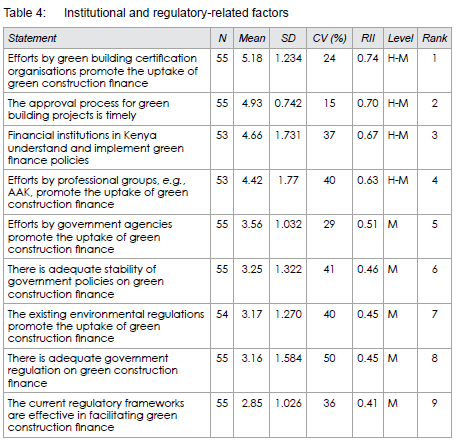
Developers' perceptions of institutional and regulatory factors influencing GCF in Kenya are summarised in Table 4. The highest rated factors were efforts by green building certification organisations to promote GCF (RII = 0.74) and the timeliness of approval processes for green building projects (RII = 0.704), highlighting the pivotal role of specialised bodies such as KGBS in raising awareness, guiding compliance, and supporting project certification (Makena, 2025; FSD Kenya, 2025; IFC, 2023a). Financial institutions were perceived to moderately understand and implement green finance policies (RII = 0.67), reflecting ongoing training, pilot programmes, and collaborations with regulatory bodies (FSD Africa, 2024; KBA, 2024). Professional groups such as the Architectural Association of Kenya (AAK) received moderate endorsement (RII = 0.63).
Conversely, government agencies and broader regulatory frameworks received lower ratings, with RIIs ranging from 0.41 to 0.51. Speciflcally, adequacy, stability, and effectiveness of government policies, as well as environmental regulations were perceived as insufficient to fully support GCF adoption. These findings reflect persistent challenges, including regulatory uncertainty, fragmented oversight, and limited harmonisation across finance, environment, and construction sectors (FSD Kenya, 2025; Manga, 2025; Zuo et al., 2012). These findings indicate that, while certification bodies and financial institutions are driving GCF adoption, weaknesses in overarching policy coherence, regulatory flexibility, and systematic incentives limit broader uptake (Chang et al., 2015; Ngare, 2025; Ollerenshaw, 2025).
4.5 Financial and cost-related factors
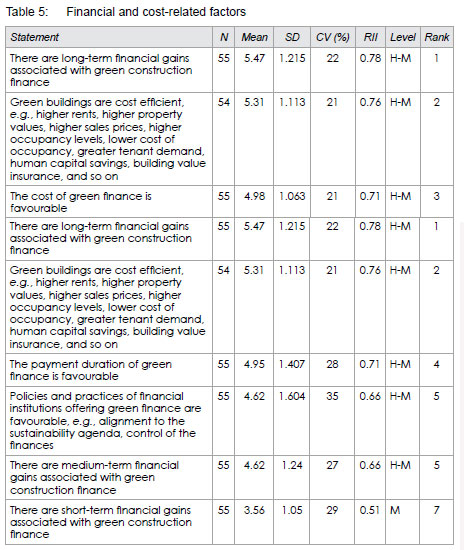
Survey results (see Table 5) from developers on financial and cost-related factors influencing GCF uptake in Kenya reveal generally positive perceptions of long-term economic benefits but mixed views on short-term returns. Developers highly agreed that GCF offers long-term financial gains (RII = 0.78), indicating recognition of benefits such as operational savings and increased asset value. Green buildings were also perceived as cost-efficient, offering higher rentals, property values, tenant demand, and lower occupancy costs (Mean = 5.31; RII = 0.76).
The cost of green finance (RII = 0.71) and favourable payment durations (RII = 0.71) suggest that developers view these financial terms as reasonable, supporting project viability. Policies and practices of financial institutions, including alignment with sustainability agendas, were moderately well-received (RII = 0.66). In contrast, short-term financial gains scored lower (RII = 0.51), reflecting limited perceived immediate benefits, while mediumterm gains were moderately acknowledged (RII = 0.66).
These findings align with prior studies emphasising green construction's financial attractiveness over medium to long time frames. Long-term gains are supported by energy and water savings and enhanced asset values (Li et al., 2023; Ulterino et al., 2020). Favourable financing terms such as concessional loans and longer repayment periods reduce barriers and improve project bankability (KGBS, 2025; Afriwise, 2025). Moderate confidence in institutional policies suggests a need for improvement in aligning products with sector needs (Akomea-Frimpong et al., 2022; Ulterino et al., 2020). Lower scores on short-term gains reflect a common challenge where immediate economic benefits are modest relative to upfront costs (Chao, 2023; Olage, 2025).
4.6 Environmental-related factors
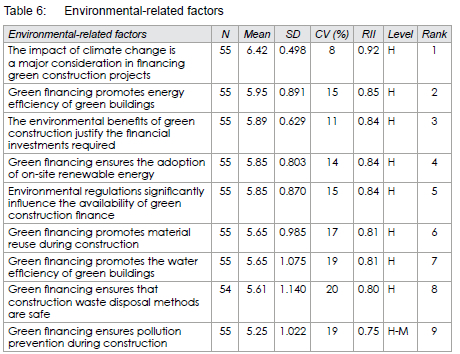
Developers' responses on environmental-related factors influencing GCF adoption (see Table 6) indicate high recognition of environmental benefits across all items. The highest agreement was with the statement that climate change considerations critically influence financing decisions (RII = 0.92). This was followed by strong recognition of energy efficiency promotion (RII = 0.85), the justification of financial investments by environmental benefits (RII = 0.84), the influence of environmental regulations (RII = 0.84), adoption of on-site renewable energy (RII = 0.84), material reuse (RII = 0.81), safe waste disposal (RII = 0.80), and pollution prevention during construction (RII = 0.75).
These results indicate the developers' comprehensive understanding of how GCF supports critical environmental objectives, from climate change mitigation to resource efficiency and pollution control. This awareness aligns with global evidence that environmental considerations drive green building initiatives (Joseph et al., 2023; Marichova, 2020). The emphasis on climate change reflects Kenya's national targets such as the 32% greenhouse gas reduction under its NDC, highlighting the financial sector's role in climate-resilient infrastructure (Njogu, 2024). High ratings for energy and water efficiency correspond with documented benefits of green buildings, including lower operational costs and reduced environmental impact (Ndambuki, 2024). Recognition of environmental regulations reinforces the role of policy frameworks in enabling green investment (Liekefett et al., 2021; UNEP, 2022). Positive perceptions of waste management, material reuse, and pollution prevention suggest that developers value a holistic approach to sustainability.
4.7 Technological and technical-related factors
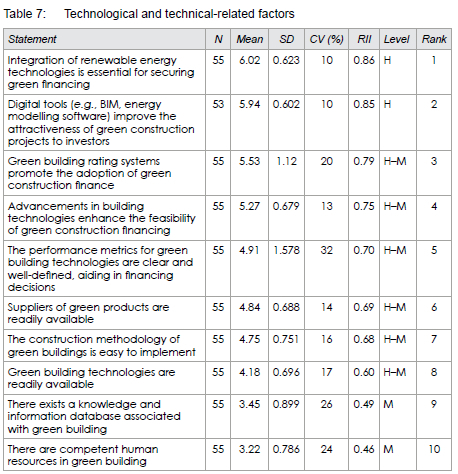
Developers rated eight technological and technical factors influencing GCF adoption (see Table 7). Overall, responses indicate a generally positive perception of technology's role in facilitating GCF. The highest agreement was for the integration of renewable energy technologies as essential for securing green financing (RII = 0.86), followed closely by the view that digital tools (e.g., BIM, energy modelling software) enhance project attractiveness to investors (RII = 0.85). Green building rating systems were also recognised as important enablers (RII = 0.79). Conversely, lower agreement was observed for the existence of comprehensive knowledge databases (RII = 0.49) and the availability of competent human resources in green building (RII = 0.46), indicating gaps in information infrastructure and skilled personnel. CV values ranged mostly between 10% and 32%, showing moderate variability, particularly in knowledge and human resource aspects.
The findings underscore the critical role of renewable energy and digital tools in GCF adoption. The strong consensus on renewable energy integration aligns with global trends, where clean energy is a key criterion for green building certification and financing decisions (Dodge Construction Network, 2021; Steuer & Tröger, 2022). Similarly, high ratings for digital tools reflect awareness that technological solutions enhance transparency, efficiency, and investor confidence, facilitating performance monitoring, risk assessment, and cost optimisation (Nizam et al., 2022; Waqar et al., 2023).
Green building rating systems (e.g., EDGE, LEED, Green Star) were also recognised as essential enablers, standardising sustainability metrics and providing verifiable benchmarks for finance eligibility (KGBS, 2025). Developers generally agreed that advancing technologies improve project feasibility and that suppliers of green products are increasingly accessible, reducing technical barriers and material costs (Njogu, 2024). The moderately positive view on ease of construction methodology indicates that implementation is feasible with available knowledge and technology, despite some challenges.
However, the study revealed critical gaps in knowledge infrastructure and skilled personnel. Low agreement on knowledge databases and competent human resources indicates capacity constraints that may slow adoption and reduce financier confidence (Darko et al., 2017; Opoku & Ahmed, 2014). These findings highlight the need for targeted capacity-building initiatives, investment in knowledge management systems, and specialised training to develop expertise and institutional memory essential for sustained GCF growth.
4.8 Risk-related factors
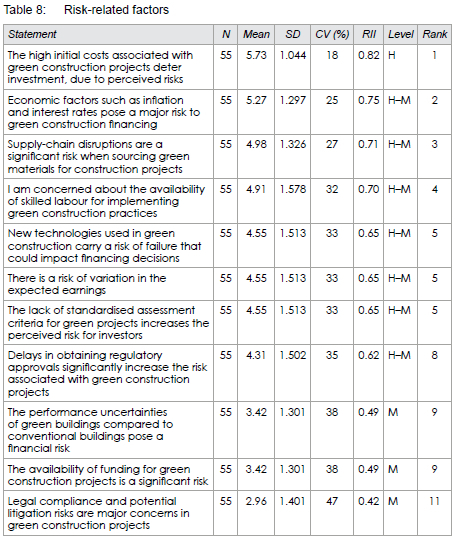
Developers expressed varied concerns regarding risks affecting GCF adoption in Kenya (Table 8). The highest perceived risk was the high upfront costs of green construction projects (RII = 0.82), followed by economic factors such as inflation and interest rates (RII = 0.75). Supply-chain disruptions for green materials (RII = 0.71) and availability of skilled labour (RII = 0.70) were moderately high, while legal compliance and litigation risks were perceived as the lowest (RII = 0.42).
The dominance of upfront cost concerns aligns with literature highlighting significant initial capital outlay as a barrier, despite long-term savings (IISD, 2024; Makena, 2025). Economic instability, including inflation and interest rate fluctuations, further affects project cash flows and financing costs, underscoring the need for inflation-indexed or stabilised green finance products (UNEP, 2023).
Concerns about supply chain vulnerabilities highlight challenges in accessing specialised green materials, which are often unavailable locally or subject to volatility (Ndambuki, 2025). Similarly, the scarcity of skilled labour underscores human capital constraints in green construction, necessitating targeted training and capacity-building programmes (Republic of Kenya, 2022).
Developers also perceived risks from the potential failure of new technologies and uncertainties in green building performance compared to conventional buildings, reflecting limited long-term data (Government of Kenya, 2017). Delays in regulatory approvals and the lack of standardised assessment criteria increase perceived procedural risk, which can hinder finance uptake (Odhiambo & Amayo, 2024; Persefoni, 2024).
Interestingly, legal and litigation risks were viewed as less significant, possibly reflecting confidence in existing regulations. Nonetheless, maintaining compliance vigilance remains important to safeguard green finance credibility.
4.9 Social and cultural-related factors
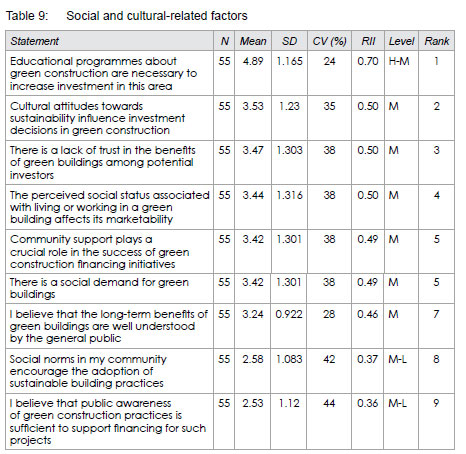
Developers' perceptions of social and cultural influences on GCF adoption were mixed (see Table 9). The highest agreement was for the need for educational programmes to increase investment in green construction (RII = 0.70), highlighting the perceived importance of capacity-building and awareness. Moderate agreement was observed for cultural attitudes toward sustainability (RII = 0.50) and investor trust in green building benefits (RII = 0.50), indicating that sociocultural factors influence investment decisions. Lower agreement was noted for public awareness sufficiency (RII = 0.36) and social norms promoting sustainable practices (RII = 0.37), suggesting gaps in societal engagement.
The prominence of educational programmes aligns with global findings, linking greater knowledge and demand for sustainable buildings with higher investment willingness (Usyu, 2024). Targeted education for developers, investors, financiers, and end-users can bridge knowledge gaps and dispel misconceptions about green buildings. Moderate concerns about cultural attitudes and trust deficits indicate that sociocultural perceptions can either enable or constrain GCF. In contexts such as Kenya, where sustainability may not be deeply embedded, trust-building through transparent performance data, success stories, and credible institutional endorsements is essential (Al Mamun et al., 2022; Bon-Gang, 2018; Heilman, 2016).
Developers acknowledged that social demand, community support, and the prestige associated with green buildings moderately influence financing decisions, reflecting some market awareness but untapped potential. Low agreement on public awareness and social norms highlights the need to strengthen societal engagement, as the broad adoption of green finance depends on visible norms and informed stakeholders.
5. IMPLICATIONS OF GREEN CONSTRUCTION FINANCE UPTAKE FOR PRACTICE
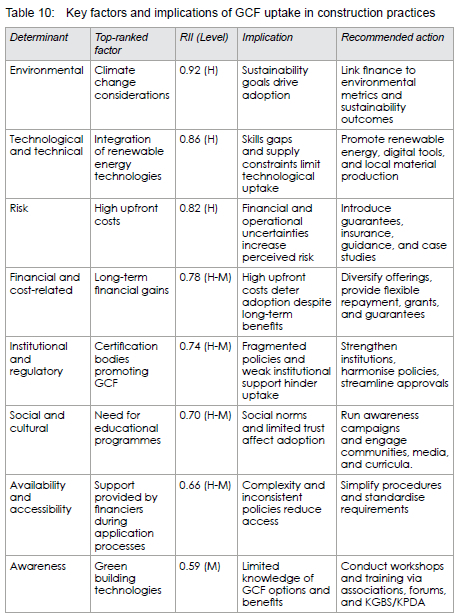
The study shows that interrelated factors influence the uptake of GCF in Kenya. These factors include awareness, institutional frameworks, financial attractiveness, environmental considerations, technological readiness, risk perceptions, and sociocultural influences. Developers indicated moderate awareness of green building technologies (RII = 0.59, moderate) and general GCF concepts (RII = 0.42, moderate-low), indicating moderate familiarity but limited understanding of financial mechanisms, incentives, and application processes (Li, Zheng & Zeng, 2023). Although GCF is generally perceived as available, accessibility is constrained by procedural complexity, regulatory inefficiencies, and sociocultural barriers (Shen et al., 2018; KIPPRA, 2024; FSD Kenya, 2025).
The highest ranked determinants provide key insights for practice. Environmental considerations (RII = 0.92, high) are the strongest driver of GCF uptake, reflecting the influence of climate change urgency, resource efficiency, and sustainability goals on developer decisions. Technological readiness (RII = 0.86, high) enhances project feasibility and reduces risk through renewable energy systems, digital construction tools, and certification frameworks, although skills gaps and local supply-chain limitations remain. Risk perceptions (RII = 0.82, high) such as high upfront costs, supply uncertainties, and unclear performance metrics, continue to limit adoption, highlighting the need for risk-mitigation instruments and clear monitoring. Financial and cost-related factors (RII = 0.78, high-moderate) show that, while long-term gains are recognised, upfront costs and limited short-term returns deter participation.
Other determinants ranked in the high-medium category include institutional and regulatory support (RII = 0.74), as well as sociocultural factors (RII = 0.70), indicating that fragmented policies, weak institutional support, social norms, and limited trust also shape adoption. Awareness (RII = 0.59, moderate) and availability/accessibility (RII = 0.66, high-moderate) suggest that developers' knowledge and the procedural ease of obtaining finance remain moderate barriers.
These insights indicate that improving GCF uptake requires coordinated, multi-domain interventions. Enhancing technical capacity, streamlining regulatory and institutional frameworks, aligning financial and environmental incentives, and fostering social acceptance are all critical. Engaging stakeholders across government, industry, and professional bodies ensures that policies, resources, and knowledge are effectively translated into practice. By addressing these interconnected factors, construction-sector stakeholders can convert interest and awareness into tangible adoption of green finance, supporting sustainable building practices and long-term sectoral growth. Table 10 summarises the top-ranked factor for each determinant, its implications, and recommended actions for improving GCF uptake in Kenya.
6. CONCLUSIONS AND RECOMMENDATIONS
The uptake of GCF in Kenya is shaped by the interplay of environmental, technological, financial, institutional, and sociocultural factors. Developers are motivated by sustainability imperatives and long-term gains, but adoption is constrained by high upfront costs, procedural complexity, and risk perceptions. Addressing these challenges requires coordinated strategies that combine capacity-building, regulatory alignment, financial innovation, technological support, and stakeholder engagement. By implementing these integrated approaches, the construction sector can support wider adoption of GCF, promote sustainable building practices, and enhance long-term resilience and growth in the industry.
Based on the findings and the discussion of top-ranked factors, the following evidence-based strategies are recommended for enhancing GCF adoption in Kenya's construction industry:
• Capacity-building. Continuous training for developers, architects, engineers, and construction workers is essential to improve technical competence and awareness of GCF. Disseminating clear guidance on financing products, application procedures, and life-cycle benefits will strengthen industry knowledge. Professional associations and forums should serve as platforms for knowledge-sharing and capacity-building initiatives.
• Policy alignment and regulatory strengthening. Harmonising and stabilising regulatory frameworks will reduce procedural bottlenecks and create predictable investment conditions. Digitising application processes and introducing fast-track approvals can enhance efficiency. Standardising eligibility criteria across financial institutions and regulatory bodies will improve transparency and accessibility.
• Stakeholder collaboration. Partnerships among government agencies, industry associations, certification bodies, and financial institutions are critical for coordinated action. Collaborative efforts should focus on awareness campaigns, technical support, and training programmes to accelerate GCF adoption.
• Market development and awareness. Financing products should be linked to measurable environmental performance metrics to demonstrate tangible benefits. Highlighting economic and social advantages-such as increased asset value, energy efficiency, and market prestige-will encourage uptake. Educational campaigns, integration of sustainability into curricula, and dissemination of credible data and case studies can build confidence among stakeholders.
• Environmental drivers and technology adoption. Promoting renewable energy adoption, digital construction tools, and innovative technologies will enhance project feasibility and investor confidence. Supporting local production and distribution of green materials can reduce costs and improve availability. Adoption of certification systems and performance monitoring frameworks should be incentivised to ensure compliance and credibility.
• Risk mitigation and financial attractiveness. Introducing financial incentives, grants, and loan guarantees will help address concerns about high upfront costs. Developing tailored loan products with flexible repayment terms and inflation-protected instruments can improve financial attractiveness. Strengthening local supply chains and workforce training will reduce operational and technological risks.
• Social advocacy and public engagement. Public awareness campaigns and engagement with cultural leaders can embed sustainability within societal norms. Leveraging the prestige and market appeal of certified green buildings will encourage adoption. Community involvement and grassroots advocacy are essential for creating broad-based support for green construction practices.
Increasing GCF uptake in Kenya requires an integrated approach that addresses awareness gaps, strengthens institutions and regulations, leverages environmental and technological advantages, mitigates financial and operational risks, and supports social acceptance. Implementing these strategies can create an enabling environment that promotes sustainable building practices, enhances investor confidence, and accelerates the adoption of green construction finance across the sector.
REFERENCES
2. LITERATURE REVIEW
-
Afriwise. 2025. Walking the talk on climate action: Kenya's green finance taxonomy. Afriwise.com [Accessed 23 July 2025].
» Afriwise.com -
Agarwal, S. & Weina, Z. 2022. What is green finance and why is it important? Weforum.org. [Accessed 23 July 2024].
» Weforum.org -
Agliardi, E. & Agliardi, R. 2019. Financing environmentally sustainable projects with green bonds. Environment and Development Economics, 24(6), pp. 608-623. https://doi.org/10.1017/S1355770X19000020
» https://doi.org/10.1017/S1355770X19000020 -
Akomea-Frimpong, I., Kukah, A., Jin, X., Osei-Kyei, R. & Pariafsai, F. 2022. Green finance for green buildings: A systematic review and conceptual foundation. Journal of Cleaner Production, 356, article 131869. https://doi.org/10.1016/j.jclepro.2022.131869
» https://doi.org/10.1016/j.jclepro.2022.131869 -
Al Mamun, M., Boubaker, S. & Nguyen, D. 2022. Green finance and decarbonization: Evidence from around the world. Finance Research Letters, 46(March). https://doi.org/10.1016/j.frl.2022.102807
» https://doi.org/10.1016/j.frl.2022.102807 - Anzagira, L., Duah, D. & Badu, E. 2021. Awareness and application of green building concepts by construction industry stakeholders of sub-Saharan African countries. Journal of Sustainable Development Studies, 14(2), pp. 1-32.
-
Berrou, R., Dessertine, P. & Migliorelli, M. 2019. An overview of green finance. The rise of green finance in Europe. London, UK: Palgrave Macmillan. https://doi.org/10.1007/978-3-030-22510-0_1
» https://doi.org/10.1007/978-3-030-22510-0_1 -
Bigger, P. & Carton, W. 2020. Finance and climate change. In: Knox-Hayes, J. & Wójcik, D. (Eds). Routledge handbook of financial geography. New York: Routledge, pp. 646-666. https://doi.org/10.4324/9781351119061-34
» https://doi.org/10.4324/9781351119061-34 -
Bon-Gang, H. 2018. Chapter 7 - Green construction project financing: Policies, practices, and research efforts. In: Bon-Gang, H. (Ed.). Performance and improvement of green construction projects. Oxford, UK: Butterworth-Heinemann, pp. 85-101. https://doi.org/https://doi.org/10.1016/B978-0-12-815483-0.00007-7
» https://doi.org/https://doi.org/10.1016/B978-0-12-815483-0.00007-7 -
CBI. 2024. Record start for sustainable finance. Climatebonds.net [Accessed 23 July 2024].
» Climatebonds.net -
Chang, R., Zillante, G., Zhao, Z. & Zuo, J. 2015. Research on sustainability and construction firms: Current status and future agenda. ICCREM 2015 - Environment and the Sustainable Building - Proceedings of the 2015 International Conference on Construction and Real Estate Management, 11-12 August, Reston, Virginia: American Society of Civil Engineers, pp. 310-317. https://doi.org/10.1061/9780784479377.036
» https://doi.org/10.1061/9780784479377.036 - Chao, W. 2023. Green finance in the building and building construction sectors. Working paper. Hal.science [Accessed 23 July 2024].
-
Cooksey, R. 2020. Descriptive statistics for summarising data. In: Cooksey, R.W. Illustrating statistical procedures: Finding meaning in quantitative data. Springer, Singapore, pp. 61-139. https://doi.org/10.1007/978-981-15-2537-7_5
» https://doi.org/10.1007/978-981-15-2537-7_5 - Creswell, J. & Creswell, J. 2018. Research design: Qualitative, quantitative, and mixed methods approaches. 5th edition. London: Sage Publications.
-
Darko, A., Zhang, C. & Chan, A. 2017. Drivers for green building: A review of empirical studies. Habitat International, 60(1), pp. 34-49. https://doi.org/10.1016/j.habitatint.2016.12.007
» https://doi.org/10.1016/j.habitatint.2016.12.007 -
Dodge Construction Network. 2021. World Green Building Trends 2021. Architects & Design Professionals. Corporate.carrier.com [Accessed 3 July 2024]
» Corporate.carrier.com -
Forstater, M., Halle, M. & Zadek, S. 2016. Green finance for developing countries. Greenpolicyplatform.org [Accessed: 8 June 2024].
» Greenpolicyplatform.org -
FSD (Financial Sector Deepening) Africa. 2024. Making green finance work for Africa's sustainable future. Fsdafrica.org [Accessed: 8 June 2024].
» Fsdafrica.org -
FSD (Financial Sector Deepening) Kenya. 2025. Decoding Kenya's green finance future. Fsdkenya.org. [Accessed: 29 July 2024].
» Fsdkenya.org -
George, D. & Mallery, P. 2019. IBM SPSS statistics 25 step-by-step: A simple guide and reference. New York: Routledge. https://doi.org/10.4324/9781351033909
» https://doi.org/10.4324/9781351033909 -
Global Landscapes Forum. 2024. Greening finance and financing green: Opportunities and challenges for a holistic approach to boosting finance for nature.globallandscapesforum.org [Accessed: 13 January 2025].
» globallandscapesforum.org -
Government of Kenya. 2017. The green economy strategy and implementation plan (GESIP). Kenya Climate Innovation Centre. greenpolicyplatform.org [Accessed: 13 January 2025].
» greenpolicyplatform.org - Heilman, V. 2016. Factors hindering the adoption of sustainable design and construction practices: The case of office building development in Dar es Salaam, Tanzania. Unpublished Master's Thesis, Städtebau Institut der Universitat Stuttgart
- Höhne, N., Khosla, S., Fekete, H. & Gilbert, A. 2012. Mapping of green finance delivered by IDFC Members in 2011. Köln, Germany: Ecofys.
-
IEA. 2023. Scaling up private finance for clean energy in emerging and developing economies (IEA, Paris). Iea.org [Accessed: 13 January 2025].
» Iea.org -
IFC. 2021a. Ctrl Alt Del. A Green reboot for emerging markets key sectors for post-covid sustainable growth. worldbank.org [Accessed: 13 January 2025].
» worldbank.org -
IFC. 2021b. Kenya green building market snapshot 2020. Market Accelerator for Green Construction (MAGC) program, funded by the UK Government. edgebuildings. com [Accessed: 13 January 2025].
» edgebuildings. com -
IFC. 2022. IFC provides US$60 million loan to BBVA Perú to finance green buildings and fight climate change.". ifc.org [Accessed: 13 January 2025].
» ifc.org -
IFC. 2023a. Building green; Sustainable construction in emerging markets. Ifc.org [Accessed: 13 January 2025].
» Ifc.org -
IFC. 2023b. Capturing the value of green steel. Ifc.org [Accessed: 13 January 2025].
» Ifc.org -
IFC. 2024.Green finance. Ifc.org [Accessed: 8 June 2025].
» Ifc.org -
IISD. 2024. Kenya green economy strategy and implementation plan. Iisd.org [Accessed: 25 July 2025].
» Iisd.org -
IMF. 2021. Investment funds: Fostering the transition to a green economy. In: Global Financial Stability Report. Washington D.C., chapter 3. https://doi.org/10.5089/9781513595603.082
» https://doi.org/10.5089/9781513595603.082 -
IMF. 2022. World economic outlook: Countering the cost-of-living crisis. Imf.org [Accessed: 8 June 2025].
» Imf.org -
Jiang, S., Liu, X., Liu, Z., Shi, H. & Xu, H. 2022. Does green finance promote enterprises' green technology innovation in China? Frontiers in Environmental Science, 10, article 981013. https://doi.org/10.3389/fenvs.2022.981013
» https://doi.org/10.3389/fenvs.2022.981013 -
Joseph, S.K. & Ralwala, A.O. 2020. Sustainable construction literacy: A study of the Kenyan interior design market segment of the construction industry. Africa Habitat Review Journal, 14(3), pp. 1999-2009. https://doi.org/10.4324/9780080557168
» https://doi.org/10.4324/9780080557168 -
Joseph, S., Ralwala, A., Wachira-Towey, I. & Mutisya, E. 2023. Sustainable construction transition (SCT) policy regime in Kenya. Journal of Construction Business and Management, 6(1), 1-16. https://doi.org/10.15641/jcbm.6.1.1257
» https://doi.org/10.15641/jcbm.6.1.1257 - KBA. 2024 The green bonds programme - Kenya. Greenbondskenya [Accessed: 15 September 2024].
-
Kamau, M. 2025. KCB more than doubles green loans as race for climate finance hots up. Standardmedia.co.ke. [Accessed: 20 June 2024].
» Standardmedia.co.ke -
Kelkar, G. 2023. How does green finance benefit organizations and the world? Emeritus.org [Accessed: 23 May 2025].
» Emeritus.org -
KGBS (Kenya Green Building Society). 2025. Sustainable affordable housing pocket guide. Nairobi: KGBS. Kgbs.co.ke [Accessed: 27 June 2025].
» Kgbs.co.ke - Kibert, C. 2022. Sustainable construction: Green building design and delivery. 5th edition. London: John Wiley & Sons.
-
KIPPRA. 2024. Kenya economic report. Kippra.or.ke [Accessed: 27 June 2025].
» Kippra.or.ke -
KPDA (Kenya Property Developers Association). 2025. Registered members. Kpda.or.ke [Accessed: 12 March 2025].
» Kpda.or.ke - Kripa, E. & Ilollari, O. 2023. Green finance management challenges in developed and developing countries. In: CUKUROVA 10th international Scientific Researches Conference, 2-3 April, Adana, Turkey, pp. 533-540.
-
Li, S., Zheng, X. & Zeng, Q. 2023. Can green finance drive the development of the green building industry? Based on the evolutionary game theory. Sustainability, 15(17), pp. 1-17. https://doi.org/10.3390/su151713134
» https://doi.org/10.3390/su151713134 -
Liekefett, K., Berg, B., Zaba, D., Gregory, H., Grapsas, R. & Wood, L. 2021. Shareholder activism and ESG: What comes next, and how to prepare. Sidley Austin LLP. Lexology.com [Accessed: 3 July 2024].
» Lexology.com -
Lindenberg, N. 2014. Definition of green finance. German Development Institute. Cbd.int [Accessed 3 July 2024].
» Cbd.int -
Makena, S. 2025. Green finance as a catalyst for sustainable development at county level. FSD Africa.fsdkenya.blog [Accessed: 23 July 2024].
» Africa.fsdkenya.blog -
Manga, M. 2025. Decoding Kenya's green finance future. FSD Kenya. Fsdkenya.org [Accessed 29 July 2025].
» Fsdkenya.org -
Marichova, A. 2020. Role of the government for development of sustainable construction. Ovidius University Annals of Constanta - Series Civil Engineering, 22(1), pp. 53-62. https://doi.org/10.2478/ouacsce-2020-0006
» https://doi.org/10.2478/ouacsce-2020-0006 -
Napier, M. 2019. What's next for green bonds in Africa.fsdafrica.org [Accessed 29 July 2025].
» fsdafrica.org - Ndambuki, S. 2024. Green buildings are doubling in Kenya, why is the residential sector lagging behind? Daily Nation. [Accessed 23 July 2025].
-
Ngare, P. 2025. Counties struggle to tap green finance for sustainable development. Big3Africa. Big3africa.org [Accessed: 23 June 2025].
» Big3africa.org -
Nizam, K.S., Yu, C., & Mardhiyah, A.N. 2022. Green building construction: A Systematic review of BIM utilization. Buildings, 12(1), pp. 1-29. https://doi.org/10.3390/buildings12081205
» https://doi.org/10.3390/buildings12081205 -
Njogu, S. 2024. Kenya's path to build greener construction sector of the future. Business Daily Africa. businessdailyafrica.com [Accessed: 21 July 2025].
» businessdailyafrica.com -
Odhiambo, Y. & Amayo, S. 2024. Leveraging on green housing to promote sustainable housing in Kenya. KIPPRA. Kippra.or.ke [Accessed: 23 July 2025].
» Kippra.or.ke -
Olage, M. 2025. Kenya's real estate industry pivots to green practices. Mwakilishi. mwakilishi.com. [Accessed: 20 July 2025].
» mwakilishi.com -
Ollerenshaw, C. 2025. Advancing green, affordable homes in Kenya: Insights from Reall's Climate Engagement. Reall. Reall.net [Accessed: 20 July 2025].
» Reall.net -
Opoku, A. & Ahmed, V. 2014. Understanding sustainability: A view from intra-organizational leadership within UK construction organizations. International Journal of Architecture, Engineering and Construction, 3(2), pp. 110-118. https://doi.org/10.7492/IJAEC.2013.012
» https://doi.org/10.7492/IJAEC.2013.012 -
Osano, E. 2024. How green bonds can fund development. FSD Africa. Fsdafrica.org [Accessed: 8 June 2024].
» Fsdafrica.org -
Osei-Kyei, R., Chan, A., Yu, Y, Chen, C., Ke, Y. & Tijani, B. 2019. Social responsibility initiatives for public-private partnership projects: A comparative study between China and Ghana. Sustainability, 11(5), article 1338. https://doi.org/10.3390/su11051338
» https://doi.org/10.3390/su11051338 -
Persefoni. 2024 Green finance explained. Persefoni.com. [Accessed: 16 September 2024].
» Persefoni.com -
Republic of Kenya. 2022 The National Treasury and Economic Planning. Draft national green fiscal incentives policy framework for Kenya. Treasury.go.we [Accessed: 16 September 2024].
» Treasury.go.we -
Sartzetakis, E.S. 2021. Green bonds as an instrument to finance low carbon transition. Economic Change and Restructuring, 54(3), pp. 755-779. https://doi.org/10.1007/s10644-020-09266-9
» https://doi.org/10.1007/s10644-020-09266-9 -
Shen, W. Tang, W., Siripanan, A., Lei, Z., Duffield, C.F. & Peng Hui, F. 2018. Understanding the green technical capabilities and barriers to green buildings in developing countries: A case study of Thailand. Sustainability, 10(10), pp. 1-17. https://doi.org/10.3390/su10103585
» https://doi.org/10.3390/su10103585 -
Sogaxa, A. 2024. SME contractors' management practices to achieve sustainable business performance in the Eastern Cape province, South Africa. Acta Structilia, 31(2), pp. 81-122. https://doi.org/10.38140/as.v31i2.8196
» https://doi.org/10.38140/as.v31i2.8196 -
Steuer, S. & Tröger, T.H. 2022. The role of disclosure in green finance. Journal of Financial Regulation, 8(1), pp. 1-50. https://doi.org/10.1093/jfr/fjac001
» https://doi.org/10.1093/jfr/fjac001 - Turner, B. 2016. Exploring green finance incentives in China. Silo.tips. [Accessed: 16 September 2024].
-
Ul Haq, I. & Doumbia, D. 2022. Structural loopholes in sustainability-linked bonds. Policy Research Working Paper Series, 10200. World Bank., Washington, D.C. https://doi.org/10.2139/ssrn.4099829
» https://doi.org/10.2139/ssrn.4099829 -
Ulterino, M., Kitio, V. & Muzee, K. 2020. Green finance models: Assessing finance product capacity to lower barriers to green building in East Africa. UN Habitat. Unhabitat.org. [Accessed: 23 July 2025].
» Unhabitat.org -
UN Environment & lEA. 2018. Global status report 2017 - Towards a zero-emission, efficient, and resilient buildings and construction sector. Unep.org [Accessed: 23 July 2025].
» Unep.org - UNEP. 2021. 2021 Global Status Report for Buildings and Construction; Towards a zero-emissions, efficient and resilient buildings and construction sector. Nairobi, Kenya: UNEP.
-
UNEP. 2022. SMARTER-Green homes for a better and healthier future. Copenhagen Climate Centre. unepccc.org [Accessed 4 July 2024].
» unepccc.org -
UNEP. 2023. Global status report for buildings and construction: Mainstreaming sustainable solutions to cut emissions from the building sector. unfccc.int. [Accessed: 23 July 2025].
» unfccc.int -
Usyu, C.N. 2024. Green building certifications and their importance in Kenya. Realestateblogpost.com. [Accessed: 23 July 2025].
» Realestateblogpost.com -
Waqar, A., Othman, I., Saad, N., Azab, M. & Khan, A. 2023. BIM in green building: Enhancing sustainability in the small construction project. Cleaner Environmental Systems, 11(September), pp. 1-13. https://doi.org/10.1016/j.cesys.2023.100149
» https://doi.org/10.1016/j.cesys.2023.100149 -
Were, A. 2024. Opportunities and practice of green finance in Kenya. FSD Kenya. fsdkenya.org. [Accessed: 21 July 2025].
» fsdkenya.org -
World Bank. 2020. Global economic prospects 2024. Unlocking private finance for nature. Worldbank.org [Accessed: 21 July 2025].
» Worldbank.org -
World Bank. 2021. State and trends of carbon pricing 2021. worldbank.org. [Accessed: 4 July 2024].
» worldbank.org -
World Economic Forum. 2021. Carbon retirement portfolio: A faster and fairer way to retire carbon-emitting assets. weforum.org [Accessed: 21 July 2025].
» weforum.org -
World Economic Forum. 2022a. Green public procurement: Catalysing the net-zero economy. weforum.org [Accessed: 28 June 2024].
» weforum.org -
World Economic Forum. 2022b. Massive shortfall in green financing for region's emerging markets: Asean chair. weforum.org [Accessed: 24 June 2024].
» weforum.org -
World Green Building Council. 2022. What are green mortgages & how will they revolutionize home energy efficiency? worldgbc.org [Accessed: 4 July 2024].
» worldgbc.org -
World Steel Association. 2021. Climate change and the production of iron and steel. worldsteel.org [Accessed: 4 July 2024].
» worldsteel.org -
Wuni, I., Shen, G. & Osei-Kyei, R. 2019. Scientometric review of global research trends on green buildings in construction journals from 1992 to 2018. Energy and Buildings, 190, pp. 69-85. https://doi.org/https://doi.org/10.1016/j.enbuild.2019.02.010
» https://doi.org/https://doi.org/10.1016/j.enbuild.2019.02.010 - Yudelson, J. & Fedrizzi, S. 2010. The green building revolution. Washington, USA: Island Press.
-
Zadek, S. & Flynn, C. 2014. South-originating green finance: Exploring the potential. iisd.org [Accessed: 4 July 2024].
» iisd.org -
Zhan, C. & de Jong, M. 2017. Financing Sino-Singapore Tianjin eco-city: What lessons can be drawn for other large-scale sustainable city-projects? Sustainability, 9(2), pp. 1-17. https://doi.org/10.3390/su9020201
» https://doi.org/10.3390/su9020201 -
Zulu, S., Zulu, E. & Chabala, M. 2022. Sustainability awareness and practices in the Zambian construction industry. Acta Structilia, 29(1), pp. 112-140. https://doi.org/10.18820/24150487/as29i1.5
» https://doi.org/10.18820/24150487/as29i1.5 - Zuo, J., Zhao, Z. & Wu, G. 2012. Green building research - current status and future agenda: A review. Renewable and Sustainable Energy Reviews, 21(1), pp. 593-601.
Peer reviewed and revised: November 2025
Published: December 2025