A framework for the adoption of decentralised waste-water treatment systems for developing countries: a case study of Bulawayo, Zimbabwe
Abstract
The adoption of decentralised waste-water treatment systems presents a viable solution to the growing sanitation and infrastructure challenges faced by developing countries. Among these systems, constructed wetlands (CWs) have gained attention as cost-effective, environmentally sustainable options for treating domestic waste water. This study aims to develop an adoption framework to guide the implementation of CWs as a decentralised waste-water treatment approach in Bulawayo, Zimbabwe. A quantitative research design is employed, using a structured, closed-ended questionnaire distributed to 120 professionals, including civil engineers, planners, local authority officials, government representatives, community leaders, and non-governmental organisations. To identify respondents, the study employs a snowball sampling technique, which is effective for accessing specialised or hard-to-reach populations through participant referrals. Ninety valid responses (75% response rate) were analysed using SPSS for descriptive statistics, reliability testing (Cronbach's alpha), Relative Importance Index (RII), One-way Anova, and Exploratory Factor Analysis (EFA). The EFA results reveal three principal dimensions influencing CW adoption, namely institutional and public health factors; financing, regulation, and technical capacity, as well as human and contextual conditions. The findings have significant theoretical, practical, and policy implications - advancing understanding of decentralised waste-water adoption and offering guidance for institutional reform, funding strategies, and community engagement to support sustainable sanitation infrastructure. The resulting framework, which integrates PESTLE factors, stakeholder roles, and procedural steps, provides a replicable tool to inform decisionmaking for decentralised waste-water management in developing urban contexts. Although limited to Bulawayo, the framework provides a replicable model for similar urban contexts in developing countries.
waste-water treatment; decentralised waste-water systems; constructed wetlands; sustainability; developing countries
Abstract
Gedesentraliseerde afvalwater-behandelingstelsels bied 'n volhoubare strategie om toenemende sanitasie- en infrastruktuuruitdagings in ontwikkelende lande aan te spreek. Binne hierdie konteks het gekonstrueerde vleilande (GV's) besondere aandag geniet as kostedoeltreffende en omgewingsvriendelike alternatiewe vir huishoudelike afvalwater-behandeling. Hierdie studie het ten doel om 'n konseptuele raamwerk te ontwikkel wat die implementering van GV's in Bulawayo, Zimbabwe, kan rig. 'n Kwantitatiewe navorsingsontwerp is toegepas, met 'n gestruktureerde vraelys wat aan 120 professionele praktisyns versprei is, insluitend ingenieurs, stedelike beplanners, owerheidsamptenare en gemeenskapsleiers. Respondente is geïdentifiseer deur sneeubalsteekproef, wat geskik is vir gespesialiseerde populasies. Negentig geldige response (responskoers van 75%) is statisties ontleed met SPSS, insluitend beskrywende statistiek, Cronbach se alfa, Relatiewe Belangrikheidsindeks, eenrigting-ANOVA en Eksploratiewe Faktorontleding (EFA). Drie kernfaktordimensies is geïdentifiseer, naamlik institusionele en openbare gesondheidsfaktore; finansiering, regulering en tegniese kapasiteit, en menslike en kontekstuele toestande. Die bevindinge het beduidende teoretiese en beleidsimplikasies en bied riglyne vir institusionele hervorming, befondsingsmodelle en gemeenskapsbetrokkenheid. Die voorgestelde raamwerk, wat PESTLE-faktore en belanghebbenderolle integreer, bied 'n herhaalbare instrument om besluitneming vir gedesentraliseerde afvalwater-bestuur in stedelike ontwikkelende kontekste te ondersteun. Alhoewel die studie tot Bulawayo beperk is, toon die raamwerk potensiaal as 'n generiese model vir soortgelyke stedelike kontekste.
1. INTRODUCTION
Providing reliable, efficient, and affordable waste-water treatment poses a significant challenge in many regions worldwide, especially in cities of developing countries. According to Masoud, Alfarra and Sorlini (2022), worldwide, roughly 3.6 billion individuals do not have access to safely managed sanitation services. The World Health Organisation (WHO, 2024) report states that approximately 1.5 billion people do not have access to basic sanitation services such as private toilets or latrines, and 419 million still practise open defecation. The global endeavour to enhance sanitation remains an ongoing challenge, as only 56% of the population in developing countries currently have access to improved sanitation services (UNICEF, 2019). According to estimates from the WHO and the Water Supply and Sanitation Collaborative Council in 2019, a minimum of 21% of urban residents in developing countries do not have access to adequate sanitation services. According to Kazora and Mourad (2018) as well as Aburamadan, Cotella and Darwish (2024), approximately 80%-90% of the waste water produced in developing nations is released into water bodies without undergoing any form of treatment. A lack of adequate sanitation infrastructure results in approximately 62% of the urban population in sub-Saharan Africa resorting to direct waste-water disposal into water bodies (Nansubuga et al., 2016). Sharma et al. (2022) reiterate that waste-water management is one of the significant challenges developing countries face, and the failing infrastructure does not make it any easier. According to the Zimbabwe National Statistics Agency (ZIMSTAT, 2019), roughly 3.7 million people in Zimbabwe do not have access to sanitation.
The limitations and problems of conventional centralised approaches to waste-water collection and treatment are becoming increasingly apparent (Chirisa et al., 2017). According to Cao et al. (2022), the vast majority of developing countries use conventional treatment methods to reduce environmental pollution, but these methods are costly and often result in the release of effluents with high levels of nutrients such as phosphorus and nitrogen, as well as high biological oxygen and bacterial levels that pose risks to the environment. Bekkari, Amiri and Hadjoudj (2022) posit that the conventional technologies used in waste-water treatment are expensive, due to the high costs associated with construction, maintenance, and repair, as well as the requirement for skilled personnel to ensure proper operation. Developing countries lack the funding to construct modernised centralised facilities and the technical expertise to operate them (Beard, Satterthwaite & Mitlin, 2022; Starkl, Brunner & Stenström, 2013).
As a developing country, Zimbabwe faces similar challenges to other nations. Aside from Zhu et al. (2013), similar concerns have been raised by Omohwovo (2024), who highlights that sanitation systems in Africa are often inefficient and fragmented. These shortcomings intensify the urgency of implementing sustainable waste-water interventions to secure universal access to basic sanitation and alleviate pressure on water resources. According to Unicef Zimbabwe (2025), national access to basic drinking water has remained stagnant at roughly 64% since 2020, while only 36% of the population has access to basic sanitation facilities. Although the Zimbabwean government has made efforts to expand access to basic sanitation services through initiatives such as the National Development Strategy (NDS), substantial disparities remain, due to limited resources, recurring droughts, and the accelerating pace of urbanisation (Betera, Wispriyono & Nunu, 2024). Due to urbanisation, the ageing sewer system in Bulawayo, constructed 60 years ago, is gradually collapsing, leading to frequent sewer bursts (Sibanda, 2021).
The outdated and ageing centralised waste-water treatment systems in developing nations are posing a significant health and environmental crisis.
Several authors have extensively recorded that decentralised waste-water systems can serve as a viable substitute for centralised systems (Bernal, Restrepo & Grueso-Casquete, 2021; Capodaglio, 2017; Chirisa et al., 2017; Ferreira et al., 2021; Sharma et al., 2022). Therefore, decentralised waste-water treatment alternatives can be a solution to this ticking time bomb in the city of Bulawayo. However, Chirisa et al. (2017) state that, for the successful adoption of these systems, extensive research is needed on the applicability of the systems, as there is not enough scientific evidence to suggest that the systems can be applied to small developing cities, especially in developing countries. This critical environmental and infrastructural challenge highlights the need for developing a decentralised waste-water treatment adoption framework, with a specific focus on CWs in Bulawayo. Therefore, this study develops a framework for the adoption of decentralised waste-water treatment systems, with a specific focus on CWs in Bulawayo.
2.1 Decentralised waste-water systems
The decentralised waste-water system is gaining increasing attention as a sustainable replacement for the conventional centralised system. Earlier pioneering works by Oswald, Ludwig and Lynch (1953) laid the scientific foundation for algal-bacterial waste-water treatment systems, demonstrating how photosynthetic oxygenation could sustain aerobic processes in oxidation ponds. During the 2000s, Mara (2004) comprehensively documented the design, operation, and performance of decentralised systems such as waste stabilisation ponds and CWs, highlighting their suitability for low-income regions. More recently, in the 2010s and 2020s, several studies have identified decentralised waste-water treatment systems as a long-term solution to the persistent waste-water management challenges faced by developing countries (Pozo-Morales et al., 2017; Mara & Evans, 2018; Werkneh 2024). Therefore, the effective use of the decentralised system can promote the return of treated effluent to the watershed and help reduce sewage's effects on public health and the environment (Iribarnegaray et al., 2018). According to Mara (2004), the main types of decentralised waste-water treatment systems include waste stabilisation ponds, waste-water storage and treatment reservoirs, CWs, upflow anaerobic sludge blanket (UASB) reactors, biofiltration systems, and simple activated sludge variants such as aerated lagoons and oxidation ditches. According to Abu-Awwad (2021), these decentralised systems offer an advantage over centralised systems, as they can be tailored to suit a specific location, thereby overcoming challenges associated with site conditions. In addition, decentralised systems provide the opportunity for waste-water management to be more flexible (Schellenberg et al., 2020). However, Zhang et al. (2020) argue that, even though decentralised is more suitable and flexible for developing urban cities, there are also problems. For example, if not adequately managed, some systems such as septic tanks can become the community's worst nightmare regarding odours and pollution. Moreover, Mara and Evans (2018) state that decentralised wastewater systems also face significant implementation challenges, including the vast scale and slow pace of sanitation progress, inadequate infrastructure, limited monitoring and data, cultural resistance to behavioural change, financial constraints, as well as weak institutional capacity and governance. Despite these overarching challenges, selecting an appropriate technology is critical for success. CWs have emerged as a technology that can mitigate several of these barriers. Their passive operation reduces the need for extensive technical expertise and energy input, while their use of natural processes can lower long-term operational costs and enhance community acceptance, positioning them as a key option for sustainable waste-water management in developing urban areas.
2.2 Constructed wetlands
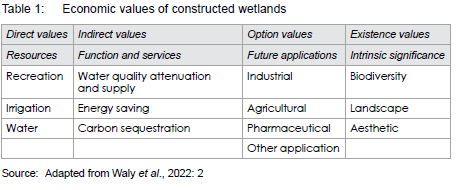
Numerous technological advancements have emerged in relation to decentralised sanitation and water reuse, given their significance in adopting a more sustainable approach to managing waste water. CWs have emerged as a prominent technology in decentralised sanitation in recent years. These waste-water treatment systems are specifically designed to harness and enhance the biological, physical, and chemical processes involved in water purification (Rahman et al., 2020). The pollutant removal, nutrient reduction, and ecosystem services provided by CWs also generate economic benefits, which can be categorised as direct, indirect, option, and existence values (Table 1).
CWs are ponds where plants, algae, and bacteria combine to treat waste water, with diverse design and operational features (Khairalla et al., 2016; Geleto et al., 2025). According to Saha et al. (2025), CWs remove pollutants through sedimentation, adsorption, plant uptake, and microbial activity, effectively reducing organic matter, nutrients, heavy metals, and pathogens. Simpler CWs rely on algae and bacteria, whereas complex systems integrate soil and plants to enhance filtration and biochemical reactions (Fahad, Al-Sahari & Radin Mohamed, 2019).
Effectiveness depends on factors such as soil hydraulic conductivity, microbial communities, oxygen availability, substrate chemistry, and regional climate (Pozo-Morales et al., 2017). CWs can be implemented as surface-flow (SF-CW), subsurface-flow (SSF-CW), or hybrid multi-stage systems (HCW), all reliably removing total suspended solids (TSS) and organic matter (Maiga, von Sperling & Mihelcic, 2019). Subsurface-flow CWs are particularly effective in pathogen removal, and the presence of vegetation enhances nutrient reduction, such as nitrogen and phosphorus (Abdullah et al., 2020; Maiga et al., 2019; Rehman et al., 2022).
CWs depend on processes such as adsorption and precipitation and on physical processes such as filtration and sedimentation for the treatment of waste water (Pinninti et al., 2021: 3). Plants play a significant role in CWs processes. High-density vegetation in CWs offers pollutant adsorption sites and creates micro-environments that act as microbe attachment sites (Machado et al., 2017; Geleto et al., 2025). Apart from plants, micro-organisms are also crucial to the degradation of contaminants and the transition of contamination from the environment to the plant (Oliveira et al., 2021). According to Saha et al. (2025) and Machado et al. (2017), the processes of pollutant degradation in CWs typically involve microbial consortia, each with a unique degrading mechanism for each pollutant. Besides plants and microbes, the choice of media to be used is crucial, because it strongly affects the hydraulic conductivity, macrophyte growth, and the biofilm's attachment (Shingare et al., 2017). The most common media used include gravel, soil, and sand (Kilingo, Bernard & Hongbin, 2022: 15). The combined ecological, operational, and economic advantages of CWs have been widely recognised, promoting both research and practical applications (Hassan et al., 2021; Waly et al., 2022).
2.3 Planning strategies, approaches, and key criterion in constructed wetlands adoption
To successfully adopt CWs as decentralised waste-water treatment systems, proper planning and procedures are essential. This involves initial scoping and outreach to establish key stakeholders and form a core planning team with legal, technical, financial, and community organisation skills. Feasibility studies should be conducted, including user perspectives, land use, and technical efficiency (Hama, Al-Suhili & Ghafour, 2019).
According to Albalawneh and Perilli (2021), construction, operation, and maintenance planning are also critical, with a focus on site evaluation, system design, operator training, and corrective action plans. Proper sludge management and environmental management plans are also necessary for the safety of human beings and the environment (Gutterer et al., 2009). Continuous community engagement and transparent communication throughout the process are essential to align CW adoption with local needs and expectations (Capodaglio, 2017; Agaton & Guila, 2024). A lack of community support can significantly increase project failure, costs, and implementation delays (Agaton & Guila, 2024).
Stakeholder participation is also crucial in successfully implementing CWs as decentralised waste-water treatment systems. According to Reymond, Chandragiri & Ulrich (2020), there are three broad groups of stakeholders: primary, secondary, and tertiary. Primary stakeholders are the end-users who directly benefit from the systems, and their engagement can be done through workshops and awareness campaigns (Abeysekera, 2015). Secondary stakeholders, as the critical players in implementing the systems, include government officials, municipalities, NGOs, as well as health and environmental departments. They are responsible for drafting policies, regulations, and institutional arrangements (USEPA, 2013; Gutterer et al., 2009). Tertiary stakeholders include consulting firms, private civil engineering contractors, and providers of construction and maintenance services. According to Gutterer et al. (2009), they influence the adoption decision but do not necessarily benefit from the systems.
Design considerations are also crucial. Designers must account for discharge standards, local conditions, system resilience, diversity, and redundancy (Nivala et al., 2018). Cost factors include design, permitting, collection systems, materials, and construction expenses (Jung, Narayanan & Cheng, 2018). In Zimbabwe, these challenges are compounded by deteriorating infrastructure, leaving many residents without adequate sanitation. Restoring services is estimated to require US $2.5 billion (Harris, 2018). Limited technical capacity, inadequate financial resources, institutional fragmentation, and weak coordination between local authorities, the Environmental Management Agency (EMA), and community stakeholders further hinder planning, construction, and maintenance (Jerie et al., 2024; Chirisa et al., 2017). Moreover, low public awareness and limited community participation often lead to resistance or neglect of decentralised sanitation initiatives, highlighting the need for integrated technical, institutional, and social planning (Nhapi, Siebel & Gijzen, 2006).
2.4 Key criterion in constructed wetlands adoption
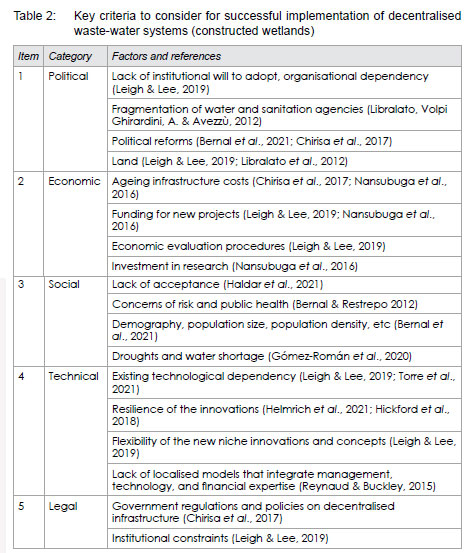
To better understand the factors influencing the adoption and implementation of CWs, this study employed the PESTLE analytical framework to identify key criteria. The PESTLE model, encompassing political, economic, social, technological, legal, and environmental factors, is a strategic tool for examining external forces that can affect the success of projects and systems (Olayiwola et al., 2025: 2). By categorising factors under PESTLE, it is possible to capture a holistic view of both enabling conditions and potential barriers, ranging from policy and institutional arrangements to technical capacity and community engagement.
In the context of CWs, political factors include governance reforms, institutional willingness, and land availability; economic factors cover funding, infrastructure costs, and investment procedures; social factors relate to public health concerns, demographic pressures, and local acceptance; technical factors encompass expertise, technology dependency, innovation resilience, and system flexibility, and legal factors involve government regulations and institutional constraints. Applying the PESTLE framework allows for systematic identification of these criteria, ensuring that both internal and external influences on CW implementation are considered. Table 2 summarises key criteria for successful implementation of decentralised waste-water systems, organised according to the PESTLE framework.
3. STUDY AREA
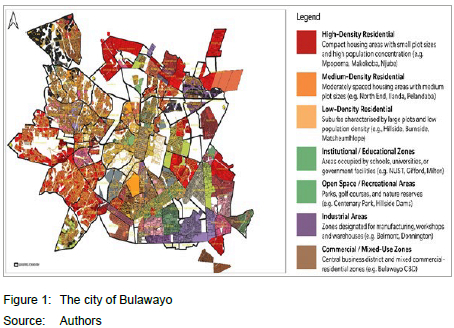
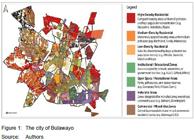
The study focuses on Bulawayo, the second-largest city in Zimbabwe (see Figure 1). According to the 2022 census, Bulawayo has an estimated population of approximately 655,675 residents. The city comprises roughly 129,123 properties, which collectively generate an estimated 80 megalitres of waste water daily. As of 2022, under the Bulawayo Water and Sewerage Services Improvement Project, the proportion of waste water treated at the Southern Areas Sewage Treatment (SAST) facility increased from 30% to 80% following major infrastructure upgrades. According to the Bulawayo Water and Sewerage Services Improvement Project (African Development Bank, 2022), despite this progress, many areas in the city, particularly in southern suburbs such as Sizinda, Tshabalala, and Nketa, remain exposed to raw sewage, highlighting the continued need for further investment and intervention to ensure full sanitation coverage and system reliability. This critical environmental and infrastructural challenge underlines the need for developing a decentralised waste-water treatment adoption framework, with a specific focus on CWs in Bulawayo.
In recent years Zimbabwe, like many developing nations, is grappling with rapid urbanisation (Chirisa et al., 2017). Similar to other urban centres in the country, Bulawayo has experienced substantial population growth, primarily due to rural-to-urban migration. Chinyama, Chipato and Mangore (2012: 2) note that this increase in population has intensified the demand for residential space and exerted significant pressure on aging infrastructure, much of which has not seen major upgrades since the pre-independence era. The result has been widespread overcrowding and considerable strain on water and sanitation systems.
Bulawayo's deteriorating sewer network is a visible consequence of this pressure. Sibanda (2021) reports that the city's sewer system, constructed over 60 years ago, is now severely degraded, with daily sewer pipe bursts being commonplace. Furthermore, chronic failures in the sewer infrastructure and inadequate inflows to treatment plants have led to persistently poor-quality effluent being discharged into the environment. This poses serious health risks, due to the contamination of water sources (Nqobile, 2021).
4. METHODOLOGY
4.1 Research design
This study employed a quantitative research design to examine the implementation of CWs in Bulawayo, Zimbabwe (Zyoud, Bsharat & Dweikat, 2024). The quantitative approach involved a structured survey questionnaire with close-ended questions to facilitate the collection of numerical data (De Vaus, 2013). Quantitative methods also allowed for the application of descriptive and inferential statistical techniques to generate meaningful insights (Mohajan, 2020). Operationalised factors extracted from the literature, including stakeholder roles, implementation procedures, and the 18 PESTLE factors, were initially ranked according to their perceived importance, using descriptive statistics. To identify the most significant factors, Exploratory Factor Analysis (EFA) was applied to the 18 PESTLE factors, reducing the data set into a manageable number of underlying dimensions based on the highest eigenvalues (Salem & Hussein, 2019). A one-way ANOVA (Analysis of Variance) was subsequently applied to examine differences in perceptions among stakeholder groups. The findings from the EFA and ANOVA informed the development of a proposed adoption framework, designed to operationalise decentralised waste-water system implementation in the context of Bulawayo.
4.2 Population, sample and response rate
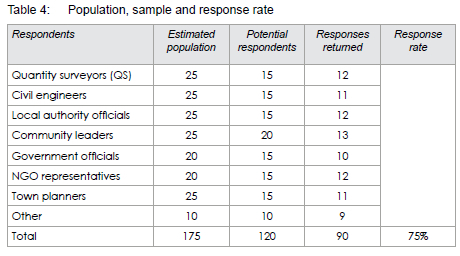
The target population for this study comprised professionals in the waste-water sector within the City of Bulawayo, including individuals with expert knowledge of the city's waste-water treatment system. This population included civil engineers, quantity surveyors, town planners, local authority officials at the Bulawayo City Council (BCC), community leaders, representatives from NGOs, and government officials from the Ministry of Housing and Public Works. The estimated total population was 175, based on figures from relevant professional bodies such as the Zimbabwe Institute of Engineers (ZIE), Zimbabwe Institute of Quantity Surveyors (ZIQS), Zimbabwe Institute of Rural and Urban Planners (ZIRUP), and the Construction Industry Federation of Zimbabwe (CIFOZ).
To identify respondents, the study employed a snowball sampling technique, which is effective for accessing specialised or hard-to-reach populations through participant referrals. It is also known for its networking potential and typically yields high response rates (Ting et al., 2025). The Krejcie and Morgan (1970) sample size determination table was used to guide sample selection. For a population of 170-175, the table recommends a sample size of approximately 118. Accordingly, a total of 120 questionnaires were distributed, aligning with best practices in sample representativeness.
A total of 90 responses were received, resulting in an overall response rate of 75%, which is considered acceptable for academic research (Holtom et al., 2022), especially within sectors such as architecture, engineering, and construction (AEC), where survey fatigue can limit participation. Table 4 presents the estimated population, number of questionnaires distributed (potential respondents), and the number of responses returned across each professional category.
4.3 Data collection
During the period November 2022 and January 2023, a close-ended questionnaire was administered both online and in person to collect numerical data for descriptive and inferential statistical analysis. Both online and physical administration methods are considered appropriate for questionnaires (Price, Jhangiani & Chiang, 2015). The questionnaire was designed in simple English and structured into five sections (A-E). Section A captured the demographic profile of respondents. Section B collected information on policies and legal frameworks governing decentralised waste-water systems in Zimbabwe. Section C focused on strategies, procedures, and approaches for the successful implementation of CWs as decentralised waste-water treatment systems. Section D examined key factors influencing the adoption of these systems, while Section E explored the perceived benefits of CWs. Most of the questionnaire items used a 5-point Likert rating scale, allowing respondents to select answers from a predefined list of options to indicate their perceived level of importance of each survey item (Price, Jhangiani & Chiang, 2015).
4.4 Data analysis
Quantitative data from the structured questionnaire were analysed using SPSS version 30. Descriptive statistics, including means, standard deviations, and frequencies, were used to summarise respondents' profiles and responses, with the mean indicating average scores and the ranking (R) showing how often particular responses occurred (Price, Jhangiani & Chiang, 2015). The Relative Importance Index (RII) was used to rank variables according to their perceived importance (Khan et al., 2022). Relative Importance (RI) values can be categorised into five levels: high (0.8-1.0), high-medium (0.6-0.8), medium (0.4-0.6), medium-low (0.20.4), and low (0-0.2) (Kinemo, 2024: 3, citing Akadiri, 2011). The internal consistency of the Likert-scale sections of the questionnaire was assessed using Cronbach's alpha, with a cut-off of 0.7 and values interpreted as >0.9 = Excellent, >0.8 = Good, >0.7 = Acceptable, <0.7 = Questionable or lower (Bonett & Wright, 2015: 6).
Two inferential statistical analyses were conducted: One-way Anova test and Exploratory Factor Analysis (EFA). The data were first tested for normality, using skewness and kurtosis statistics, with all skewness values ranging from -1.63 to 0.00 and kurtosis from -0.97 to 1.92, within the acceptable range of ±2 (George & Mallery, 2022: 114), indicating approximate normality. Given the robustness of multivariate analyses to mild deviations from normality, the data set was deemed suitable for the one-way Anova test and factor analysis. A one-way ANOVA test was used to examine whether the mean scores of professionals differed significantly across the five PESTLE factors (Gravetter & Wallnau, 2017: 366). Unlike the t-test, which is limited to comparing two groups, a one-way ANOVA allows for the simultaneous comparison of multiple groups as a means to assess whether any statistically significant variation exists among them (George & Mallery, 2022: 188). Prior to the analysis, variables were transformed to generate an average mean score for each PESTLE factor. The analysis yielded p-values ranging from 0.881 to 0.940, all greater than 0.05, indicating that the differences in mean perceptions among professional groups were not statistically significant and are, therefore, broadly similar (Field, 2009: 349; Gravetter & Wallnau, 2017: 410). A post-hoc analysis, using Tukey's HSD, was also performed to investigate pairwise differences between groups, which revealed no significant differences (ns), confirming that no particular professional group's perceptions differed meaningfully from another (Field, 2018: 372).
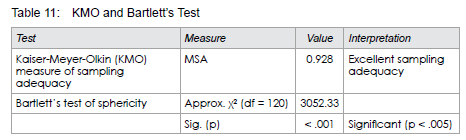
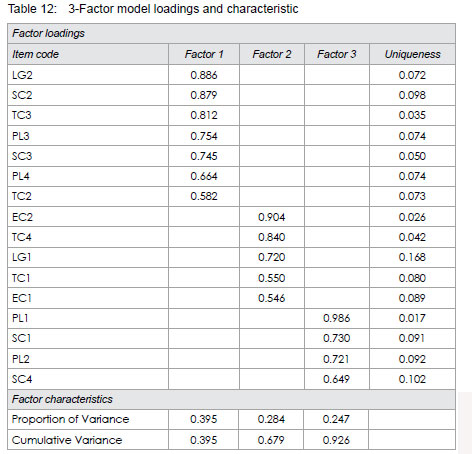
To identify the key factors influencing the adoption and implementation of CWs as decentralised waste-water treatment systems, an EFA was performed on items related to the PESTLE model, presented in Table 2. According to Watkins (2018: 220), factor analysis is a statistical technique used to reduce a large set of related variables into smaller, meaningful groups or underlying themes. The data met normality assumptions and were suitable for factor analysis, as confirmed by Bartlett's test of sphericity, χ2 (120) = 3052.330, p < .001, and the Kaiser-Meyer-Olkin (KMO) measure of sampling adequacy, MSA = 0.928. A Kaiser-Meyer-Olkin (KMO) value of 0.6 or higher, along with a Bartlett's Test of Sphericity showing p < 0.05, suggests that the data set is appropriate for conducting factor analysis (Sürücü, Yikilmaz & Maslakçi, 2022: 9). A maximum likelihood estimation method was used alongside a Promax oblique rotation, given the expectation of correlated factors (Watkins, 2018). Analysis of the 18 items revealed three factors with eigenvalues above 1 (Kline, 2014). A 0.40 factor loading threshold was applied to retain items (Sürücü, Yikilmaz & Maslakçi, 2022: 23). The model showed good fit, with a Tucker-Lewis Index of 0.928, and most of the items had low uniqueness (<0.20), indicating that the factors captured most of the shared variance and supporting the reliability of the structure (Watkins, 2018).
5. RESULTS
5.1 Respondent profile
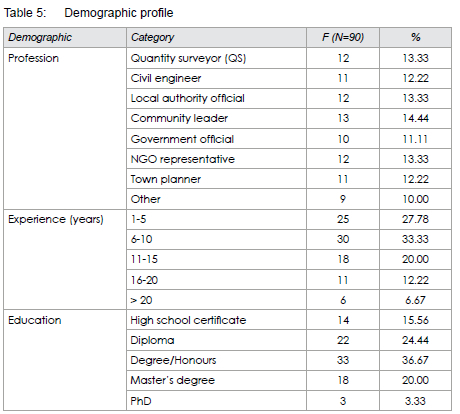
Table 5 presents the demographic profile of participants involved in sanitation and infrastructure development in Bulawayo, highlighting their diverse roles and expertise. The majority of the participants were community leaders (14.4%), local authority officials (13.3%), and NGO representatives (13.3%), followed by quantity surveyors (13.3%), civil engineers (12.2%), town planners (12.2%), and government officials (11.1%). An additional 10% of the respondents were classified as "Other", including architects, structural engineers, mechanical engineers, and an electrical power engineer, whose insights contributed to evaluating alternative systems such as CWs. Regarding professional experience, over 80% of the respondents had 1-15 years' experience, 27.8% had 1-5 years, 33.3% had 6-10 years, and 20% had 11-15 years' experience. Only a small proportion reported more than 15 years' experience, with 12.2% in the 16-20-year range and 6.7% with over 20 years. In terms of educational background, 36.7% of the participants held a bachelor's or honours degree, 24.4% had diplomas, and 20% held a master's degree. Participants with only a high school certificate accounted for 15.6%, predominantly community leaders with limited formal training, while 3.3% had completed doctoral studies, typically among senior professionals. The respondents' varied expertise, experience, and educational backgrounds provided a broad range of perspectives, supporting comprehensive and informed insights into decentralised waste-water systems.
5.2 Stakeholders involved in constructed wetlands implementation
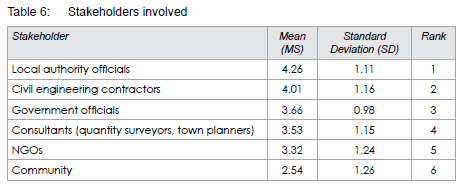
Respondents ranked stakeholder roles in waste-water treatment projects, with Table 6 showing their involvement in implementing CWs based on the mean and the standard deviation. Table 6 indicates that local authority officials had the highest level of involvement (MS = 4.26, SD = 1.11, R = 1), followed by civil engineering contractors (MS = 4.01, SD = 1.16, R = 2), government officials (MS = 3.66, SD = 0.98, R = 3), and consultants (MS = 3.53, SD = 1.15, R = 4). NGO representatives (MS = 3.32, SD = 1.24, R = 5) and community members (MS = 2.54, SD = 1.26, R = 6) were ranked lower, reflecting relatively limited involvement.
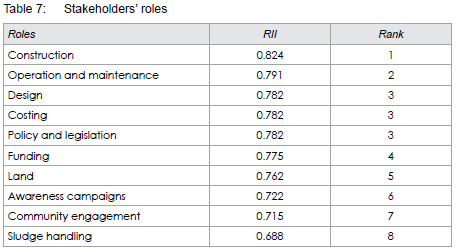
Table 7 shows that, based on the relative importance index (RII), construction was identified as the most prominent stakeholder role (RII = 0.824, R = 1), followed by operation and maintenance (RII = 0.791, R = 2). Design, costing, and policy and legislation were ranked equally (RII = 0.782, R = 3). Funding (RII = 0.775, R = 4) and provision of land (RII = 0.762, R = 5) were of moderate importance, while awareness campaigns (RII = 0.722, R = 6), community engagement (RII = 0.715, R = 7), and sludge handling (RII = 0.688, R = 8) were considered less central stakeholder roles. These findings suggest that, while stakeholders are perceived to play a stronger role in technical and regulatory functions, the relatively low ranking of social and community-oriented roles may undermine long-term sustainability and limit inclusive participation in project implementation.
5.3 Procedures followed when implementing constructed wetlands
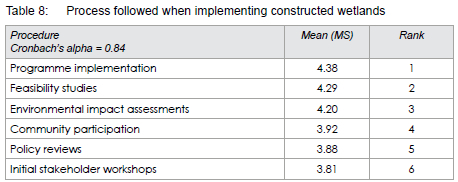
The study also asked respondents about the procedures followed when implementing CWs. Table 8 shows the mean scores of the processes and approaches applied in the implementation of CWs as decentralised wastewater treatment systems.
The respondents' views on the procedures followed when implementing waste-water projects were analysed, using mean scores and ranked accordingly. The findings reveal that the three most commonly followed procedures were programme implementation (MS = 4.38, R = 1), feasibility studies (MS = 4.29, R = 2), and environmental impact assessments (MS = 4.20, R = 3). By contrast, community participation (MS = 3.92, R = 4), policy reviews (MS = 3.88, R = 5), and initial stakeholder workshops (MS = 3.81, R = 6) were ranked lower, indicating comparatively less emphasis during implementation. This aligns with the earlier findings on stakeholder involvement, where community roles were ranked low, suggesting that participatory and inclusive approaches remain secondary to technical and regulatory procedures in practice.
5.4 Factors that are vital for the implementation of constructed wetlands
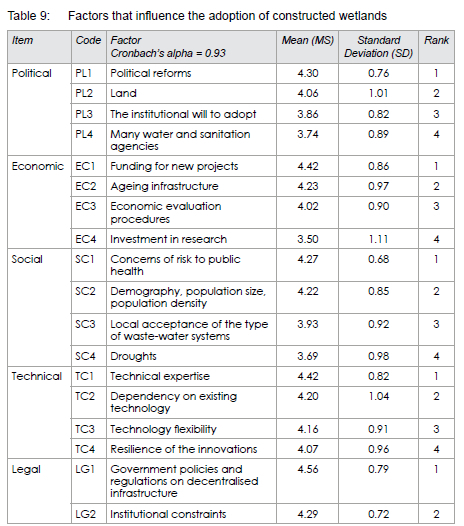
The study further examined factors considered vital for implementing CWs, categorised using the PESTLE framework. The findings were determined based on the ranking (R) with reference to the mean score (MS) to show how respondents rank the importance of each factor presented in Table 9.
Political factors were led by political reforms (MS = 4.30, SD = 0.76, R = 1) and land availability (MS = 4.06, SD = 1.01, R = 2), while the institutional will to adopt (MS = 3.86, SD = 0.82, R = 3) and multiple water and sanitation agencies (MS = 3.74, SD = 0.89, R = 4) were ranked lower. Economic factors were dominated by funding for new projects (MS = 4.42, SD = 0.86, R = 1) and ageing infrastructure (MS = 4.23, SD = 0.97, R = 2), followed by economic evaluation procedures (MS = 4.02, SD = 0.90, R = 3) and investment in research (MS = 3.50, SD = 1.11, R = 4). Social factors prioritised public health risk concerns (MS = 4.27, SD = 0.68, R = 1) and demographic variables (MS = 4.22, SD = 0.85, R = 2), whereas local acceptance (MS = 3.93, SD = 0.92, R = 3) and droughts (MS = 3.69, SD = 0.98, R = 4) were less emphasised. Technical factors were led by technical expertise (MS = 4.42, SD = 0.82, R = 1) and dependency on existing technology (MS = 4.20, SD = 1.04, R = 2), while technology flexibility (MS = 4.16, SD = 0.91, R = 3) and innovation resilience (MS = 4.07, SD = 0.96, R = 4) were lower. Legal factors were dominated by government policies and regulations on decentralised infrastructure (MS = 4.56, SD = 0.79, R = 1) and institutional constraints (MS = 4.29, SD = 0.72, R = 2).
The implementation of CWs was most strongly influenced by political reforms, funding for new projects, public health risk concerns, technical expertise, and government policies and regulations on decentralised infrastructure, representing the top-ranked factor in each PESTLE category.
5.4.1 Professional perceptions on the factors influencing constructed wetlands adoption
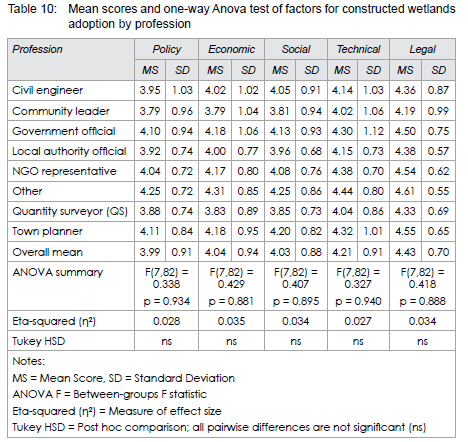
A one-way ANOVA was conducted to compare mean scores across five principal factors and assess any statistically significant differences in how respondents from different professional categories perceived the importance of factors influencing the adoption of CWs (Table 10).
As shown in Table 10, the Legal factor consistently received the highest ratings across all professional groups (4.19-4.61), highlighting its perceived importance. In contrast, Policy and Economic factors recorded the lowest mean scores (3.79-4.31). Respondents categorised as "Other" and town planners generally assigned higher scores across all factors, whereas community leaders and quantity surveyors reported comparatively lower scores. The overall mean scores were 3.99 (Policy), 4.04 (Economic), 4.03 (Social), 4.21 (Technical), and 4.43 (Legal). The ANOVA results indicated no statistically significant differences among professional groups for any of the five factors (Policy: F(7,82) = 0.338, p = 0.934, = 0.028; Economic: F(7,82) = 0.429, p = 0.881, = 0.035; Social: F(7,82) = 0.407, p = 0.895, = 0.034; Technical: F(7,82) = 0.327, p = 0.940, = 0.027; Legal: F(7,82) = 0.418, p = 0.888, = 0.034). The corresponding eta-squared (η2) values indicate very small effect sizes, suggesting that professional affiliation explains only a minor proportion of the variance in ratings. Post-hoc analysis using Tukey's HSD confirmed that pairwise differences between professional groups were not statistically significant.
5.5 Exploratory factor analysis
Exploratory Factor Analysis (EFA) was conducted to identify the underlying factor structure of variables influencing the implementation of CWs, as summarised in Table 8. Prior to analysis, the data were screened for adherence to normality assumptions (skewness values ranged from -1.63 to 0.00, and kurtosis values from -0.97 to 1.92), and the results indicated that the data were approximately normal, allowing the analysis to proceed. As shown in Table 11, the data were also considered suitable for factor analysis. The Kaiser-Meyer-Olkin (KMO) measure of sampling adequacy was 0.928, and Bartlett's test of sphericity was statistically significant, χ2(120) = 3052.33, p < .001, confirming sufficient intercorrelations among variables and supporting the factorability of the dataset.
Given the expectation that the underlying factors would be correlated, maximum likelihood extraction with oblique Promax rotation was employed. The initial analysis of 18 items revealed that the variables clustered onto three factors with eigenvalues greater than 1. Two items, EC3 and EC4,
exhibited cross-loadings below the 0.40 threshold across multiple factors. These items were removed to enhance the clarity and reliability of the factor structure, and a second EFA was conducted with the remaining items. The refined three-factor model achieved a simple structure, with each item loading clearly onto a single factor.
Table 12 presents the factor loadings, uniqueness values, and variance explained. The three factors collectively accounted for 92.6% of the total variance, with Factor 1 explaining 39.5%, Factor 2 explaining 28.4%, and Factor 3 explaining 24.7%. Factor 1 was primarily represented by LG2 (Institutional constraints), SC2 (Public health risk concerns), TC3 (Flexibility of new niche innovations), PL3 (Political reforms), SC3 (Demographic factors), PL4 (Land availability), and TC2 (Innovation resilience). Factor 2 was dominated by EC2 (Funding for new projects), TC4 (Lack of integrated local management-technology-finance models), LG1 (Government regulations), TC1 (Existing technological dependency), and EC1 (Ageing infrastructure costs). Factor 3 included PL1 (Lack of institutional will to adopt), SC1 (Local acceptance), PL2 (Collaboration among sanitation agencies), and SC4 (Droughts and water shortages).
Uniqueness values were generally low, indicating that the items were well represented by the extracted factors. For example, PL1 exhibited a uniqueness of 0.017, suggesting that nearly all of its variance was accounted for by Factor 3. The factor structure provides a meaningful representation of the key political, economic, social, and technical dimensions influencing CW implementation.
6. DISCUSSION
6.1 Stakeholders involved in constructed wetlands implementation
The stakeholder findings (Table 6) align with Avellán (2019), where municipal officials were ranked as the most important stakeholders. According to USEPA (2013), senior local municipal staff are crucial in programme development, due to their experience. Unlike Avellán (2019), which ranked the community second, this study found the community to be the least ranked stakeholder. Avellán (2019) argues that community input is crucial, particularly during project initiation.
Regarding stakeholder roles (Table 7), the findings differ from Gutterer et al. (2009:14), who highlighted overall programme management as the most critical role. In this instance, construction was ranked highest, possibly reflecting respondents' preference for visible project outcomes. Sludge handling was least ranked, consistent with Gutterer et al. (2009), likely because it falls under operations and is perceived as less critical. Nevertheless, all roles are essential for successful implementation, as community engagement and awareness campaigns are equally important in ensuring project acceptance (Gómez-Román et al., 2020).
Procedures followed during implementation (Table 8) also differ from USEPA (2013), where community engagement ranked first and programme implementation was eighth. The tendency in developing countries to prioritise programme implementation over planning and participation may contribute to project failures. Policy reviews and workshops were the least followed procedures, contrasting with the United States of America, where initial planning workshops and policy reviews are formalised. This highlights differences in regulatory frameworks between developed and developing contexts (USEPA, 2013).
6.2 PESTLE factors vital for implementation
The study analysed factors influencing CW implementation using the PESTLE framework (Table 9), combining descriptive and inferential statistics.
Political factors
Political support was ranked highest, consistent with Hassan and South Africa Water Research Commission (2014) but differing from Bassan and Holliger (2015), where it was ranked third. Politics in low-income countries often determine project success or failure, explaining why respondents emphasised political reforms. Fragmentation of the waste-water sector was least ranked. While multiple agencies complicate planning, this is not the most immediate concern (Leigh & Lee, 2019). Trust-building and awareness can mitigate stakeholder hesitation.
Economic factors
Funding for new projects was the highest-ranked factor, similar to Bernal et al. (2021) but differing from Hassan et al. (2014), where it ranked third. Access to financial resources is critical in developing countries (Chirisa et al., 2017), with NGOs often providing key support. Investment in research was least ranked, reflecting a common misconception that projects can succeed without feasibility studies, which contributes to implementation failures.
Social factors
Public health risk concerns were the top-ranked social factor, although this contrasts with Bernal et al. (2021) and Bassan and Holliger (2015), who emphasised community acceptance. Perceptions of waste water-related health risks significantly influence project success (Morris et al., 2021). Co-participatory approaches and engagement can mitigate community apprehension, particularly regarding human-water contact.
Technical factors
Technical expertise was highly ranked, differing from Bassan and Holliger (2014), where it was mid-ranked. Morris et al. (2021) stress the importance of technical capacity, which is particularly challenging in developing countries, due to weak industry-university linkages. Training and capacity-building are essential remedies.
Legal factors
Government regulations and policies were ranked highest, consistent with Morris et al. (2021), although Bernal et al. (2021) emphasised institutional support. A strong regulatory framework facilitates implementation, while institutional constraints and corruption can hinder project approval and sustainability. Overall, these factors align with literature on governance, socio-technical capacity, and resource availability, providing a framework for understanding the multidimensional challenges in implementing CWs in developing countries.
The study also explored professional perceptions with regards to the key factors in CWs adoption (Table 10).
The findings of the one-way Anova test on the professional perceptions indicate that, although professionals assigned varying importance to the different factors influencing the adoption of CWs, these differences were not statistically significant. Legal factors received the highest mean scores across all groups, suggesting a strong consensus that regulatory frameworks and government policies play a pivotal role in promoting decentralised waste-water treatment systems. Technical factors also ranked highly, focusing on the recognised importance of technical expertise, operational capacity, and technological adaptability in implementation. While town planners and those classified as "Other" tended to rate all factors more positively, community leaders and quantity surveyors assigned slightly lower scores to Policy, Economic, and Social factors, possibly reflecting differences in professional focus or engagement with such aspects. However, the one-way ANOVA and post-hoc Tukey HSD results confirmed that these variations were not significant (p > 0.05), and the small effect sizes (η2 < 0.04) suggest that professional background has minimal influence on perceptions, indicating broad agreement among professional groups regarding the key determinants of CW adoption.
6.3 Factor analysis of implementation variables
Table 12 presents the results of the exploratory factor analysis (EFA), which identified three key underlying factors that explain the variation in variables influencing the implementation of CWs. These factors collectively account for 92.6% of the total variance and capture the institutional, financial, technical, and social dimensions that are most critical in determining successful CW implementation in developing countries. The factor structure provides a clear framework for understanding how political, economic, social, and technical considerations interact to shape project outcomes.
Factor 1: Institutional and Public Health (39.5% variance) includes Institutional Constraints (LG2), Public Health Risk (SC2), Flexibility of Innovations (TC3), Political Reforms (PL3), Demographics (SC3), Land Availability (PL4), and Innovation Resilience (TC2). This factor highlights the importance of institutional capacity, policy reforms, and infrastructural readiness. Institutional barriers, fragmented governance, and poor coordination impede service delivery in low- and middle-income countries (Bisung & Elliott, 2017), while public health concerns are critical in densely populated, vulnerable settings.
Factor 2: Financing, Regulation, and Technical Capacity (28.4% variance) comprises Funding for New Projects (EC2), Lack of Localised Models Integrating Management, Technology & Finance (TC4), Government Regulations (LG1), Existing Technological Dependency (TC1), and Ageing Infrastructure Costs (EC1). This factor emphasises the importance of financial support, regulatory frameworks, and technological capacity for sustainable CW implementation. In contexts such as Zimbabwe, insufficient funding, weak PPPs, and outdated technology impede infrastructure development (Mundonde & Makoni, 2023).
Factor 3: Human and Social Conditions (24.7% variance) includes Lack of Institutional Will (PL1), Lack of Acceptance (SC1), Lack of Collaboration Between Agencies (PL2), as well as Droughts and Water Shortage (SC4). This factor underscores how social and political dynamics affect implementation. Weak inter-agency cooperation, low community support, and water scarcity exacerbate challenges in sanitation projects (Lerebours et al., 2022).
7. PROPOSED ADOPTION FRAMEWORK FOR CONSTRUCTED WETLANDS
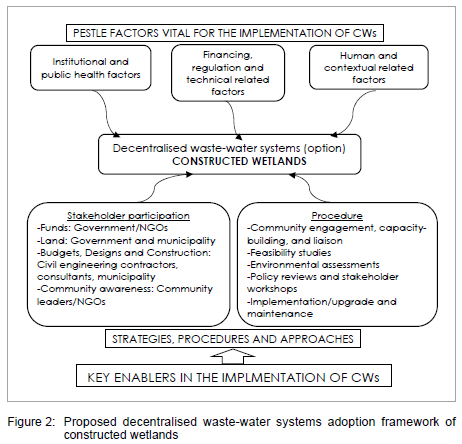
Figure 2 shows the proposed decentralised waste-water system framework to inform the adoption of CWs. The framework was developed, using information deciphered from the analysis of the results from the survey questionnaire. For the PESTLE factors, the final contributing factors from the exploratory factor analysis were used. The bottom part includes the perceived key enablers in the implementation of CWs which includes information about stakeholder participation and the procedures.
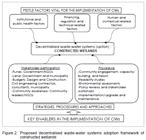
The applicability of the proposed framework is centred on its function as a decision-support and implementation tool for the adoption of CWs within decentralised waste-water management contexts. It provides a structured approach whereby policymakers, planners, and practitioners can identify and address the multifaceted factors influencing adoption. By integrating the PESTLE dimensions with stakeholder participation mechanisms and procedural stages, the framework facilitates a comprehensive assessment of contextual conditions, enabling the formulation of context-sensitive strategies and allocation of roles and responsibilities among actors.
Moreover, it offers practical guidance for aligning policy development, financing mechanisms, and community engagement processes to enhance the long-term sustainability of CW systems. The framework is adaptable to diverse socio-institutional settings, thereby promoting participatory planning, institutional learning, and effective implementation of decentralised wastewater treatment initiatives.
8. IMPLICATION OF FINDINGS
The findings of this study carry several theoretical, practical, and policy implications for decentralised waste-water management in developing countries, particularly regarding the adoption of CWs. From a theoretical perspective, the study contributes to the existing body of knowledge, by integrating the PESTLE analytical model with empirical stakeholder perceptions to develop an adoption framework for CWs. This multidimensional approach advances understanding of how political, economic, social, technical, and legal factors collectively shape the feasibility and sustainability of decentralised waste-water treatment systems. The framework also provides a replicable basis for future studies seeking to explore technology adoption within similar urban and peri-urban contexts.
At a practical level, the results highlight that successful implementation of CWs requires coordinated action among municipalities, government institutions, NGOs, private contractors, and local communities. The identification of key enablers such as institutional reform, funding mechanisms, technical capacity, and stakeholder participation offers a clear roadmap for practitioners and local authorities. Emphasising community involvement and capacity-building can enhance project ownership and long-term maintenance, reducing the likelihood of system failure. The proposed framework can thus serve as a reference tool for planning, executing, and monitoring CW projects.
In terms of policy implications, the findings underscore the need for coherent regulatory and institutional frameworks to support the integration of decentralised waste-water systems into national sanitation strategies. Strengthening policy alignment across ministries, promoting financial incentives, and embedding decentralised systems within municipal infrastructure plans can accelerate adoption. Furthermore, recognising CWs as viable and sustainable alternatives to conventional waste-water systems can guide governments towards more inclusive and environmentally sound sanitation policies.
Overall, the study's findings suggest that improving institutional collaboration, enhancing funding accessibility, and fostering community participation are essential for scaling up CW adoption in developing urban contexts such as Bulawayo. Implementing these insights can contribute to sustainable waste-water management, improved public health, and greater environmental resilience.
9. CONCLUSION AND RECOMMENDATIONS
This study examined the adoption of CWs as decentralised waste-water treatment systems in Bulawayo, Zimbabwe, and proposed a framework to guide their implementation in developing contexts. The research demonstrated that successful adoption depends on coordinated stakeholder participation, robust institutional frameworks, and adequate technical and financial capacity. Political reform, funding availability, technical expertise, and regulatory support emerged as the most critical enabling factors, underscoring the need for integrated planning and policy coherence. The findings highlight the municipality's central role in implementation, supported by government, NGOs, and private contractors, while community engagement remains essential for long-term sustainability. The proposed framework offers a structured approach that integrates PESTLE factors, stakeholder responsibilities, and procedural steps, providing both a practical guide for implementation and a conceptual tool for future research. Based on these insights, several recommendations are made. First, early and continuous community involvement should be prioritised to strengthen ownership and acceptance. Secondly, comprehensive feasibility studies must precede implementation to evaluate technical and economic viability. Thirdly, coordinated institutional planning and capacity-building should be enhanced across all stakeholder levels. Lastly, public education and awareness programmes should be expanded to promote understanding of decentralised sanitation systems. Although this study was limited to domestic waste water in Bulawayo and the proposed framework has not yet been validated, it establishes a foundation for future research. Subsequent studies should test and refine the framework in different urban contexts and for other waste-water types to enhance its applicability and generalisability. Overall, this research contributes to the growing discourse on sustainable waste-water management by demonstrating how CWs can offer a viable, low-cost, and environmentally responsible solution for developing countries.
ETHICSApproved by the Faculty of Engineering and the Built Environment Ethics and Plagiarism Committee, University of Johannesburg (Clearance No. UJ\_FEBE\_FEPC\_00576).
REFERENCES
ACKNOWLEDGEMENTS
This study forms part of a Master's dissertation at the University of Johannesburg and was funded by the Intra-Africa Mobility Scheme (ASIM) under the EU-AU partnership. The research was supported by the Centre for Applied Research and Innovation in the Built Environment (CARINBE).
2. LITERATURE REVIEW
-
Abdullah, N., Ahmad, N., Sohaili, J., Abdul Salim, N., Mat Lazim, Z. et al. 2020. Performance of constructed wetlands using Vetiveria zizanioides for sewage treatment. International Journal of Emerging Trends in Engineering Research, 8(1.2), pp. 227-232. https://doi.org/10.30534/ijeter/2020/3281.22020
» https://doi.org/10.30534/ijeter/2020/3281.22020 -
Abeysekera, R. 2015. Concepts and implications of theory of co-production. Colombo Business Journal, 6(2), article 22. https://doi.org/10.4038/cbj.v6i2.26
» https://doi.org/10.4038/cbj.v6i2.26 -
Abu-Awwad, A. 2021. Wastewater treatment and its reuse in Jordan. Jordan Journal of Agricultural Sciences, 17(Supplement 3), pp. 211-221. https://doi.org/10.35516/jjas.v17i3.80
» https://doi.org/10.35516/jjas.v17i3.80 -
Aburamadan, R., Cotella, V. & Darwish, R. 2024. Sanitation infrastructure challenges in global south poverty pockets: Towards a multidisciplinary approach to sustainable health - The Jordanian case. Journal of Infrastructure, Policy and Development, 8(8), article 5309. https://doi.org/10.24294/jipd.v8i8.5309
» https://doi.org/10.24294/jipd.v8i8.5309 -
African Development Bank. 2022. Implementation Progress and Results Report (IPR). Bulawayo. Afdb.org [Accessed: 4 April 2024].
» Afdb.org -
Agaton, C. & Guila, P.. 2024. Success factors and challenges: Implications of real options valuation of constructed wetlands as nature-based solutions for wastewater treatment. Resources, 13(1), article 11. https://doi.org/10.3390/resources13010011
» https://doi.org/10.3390/resources13010011 -
Akadiri, O. 2011. Development of a multi-criteria approach for the selection of sustainable materials for building projects. PhD thesis, University of Wolverhampton, Wolverhampton, UK. Core.ac.uk [Accessed: 4 April 2024].
» Core.ac.uk -
Albalawneh, A. & Perilli, N. 2021. The efficiency of natural decentralised greywater treatment systems in resolving the wastewater problems in the rural areas of developing countries. In: Environmental Science and Engineering. Springer Science and Business Media Deutschland GmbH, pp. 147-151. https://doi.org/10.1007/978-3-030-51210-1_25
» https://doi.org/10.1007/978-3-030-51210-1_25 -
Avellán, T. 2019. Towards sustainable wastewater treatment systems implementing a nexus approach in two cases in Latin America. ResearchGate [Accessed: 4 April 2024]. https://doi.org/10.53325/CHSF5835
» https://doi.org/10.53325/CHSF5835 -
Bassan, M. & Holliger, C. 2015. Success and failure assessment methodology for wastewater and faecal sludge treatment projects in low-income countries. Journal of Environmental Planning and Management, 58, pp. 1690-1710. https://doi.org/10.1080/09640568.2014.943343
» https://doi.org/10.1080/09640568.2014.943343 -
Beard, V., Satterthwaite, D. & Mitlin, D. 2022. Out of sight, out of mind: Understanding the sanitation crisis in global south cities. Journal of Environmental Management, 306, article 114285. https://doi.org/10.1016/j.jenvman.2022.114285
» https://doi.org/10.1016/j.jenvman.2022.114285 -
Bekkari, N., Amiri, K. & Hadjoudj, M. 2022. Performance of pilot scale constructed wetland as ecological practice for domestic wastewater treatment in an arid climate -Algeria. Water Science and Technology, 86(4), pp. 787-799. https://doi.org/10.2166/wst.2022.242
» https://doi.org/10.2166/wst.2022.242 -
Bernal, D. & Restrepo, I. 2012. Key issues for decentralization in municipal wastewater treatment. In: Twelfth World Wide Workshop for Young Environmental Scientists (WWW-YES-2012), Urban Waters: Resource or Risks? 21-25 May, Arcueil, France. Archives.fr [Accessed: 4 March 2024].
» Archives.fr -
Bernal, D., Restrepo, I. & Grueso-Casquete, S. 2021. Key criteria for considering decentralization in municipal wastewater management. Heliyon, 7(3). https://doi.org/10.1016/J.HELIYON.2021.E06375
» https://doi.org/10.1016/J.HELIYON.2021.E06375 -
Betera, S., Wispriyono, B. & Nunu, W. 2024. Exploring the water, sanitation and hygiene status and health outcomes in Zimbabwe: A scoping review protocol. BMJ Open, 14, article 082224. https://doi.org/10.1136/bmjopen-2023-082224
» https://doi.org/10.1136/bmjopen-2023-082224 -
Bisung, E. & Elliott, S. 2017. Psychosocial impacts of the lack of access to water and sanitation in low- and middle-income countries: A scoping review. Journal of Water and Health, pp. 17-30. https://doi.org/10.2166/wh.2016.158
» https://doi.org/10.2166/wh.2016.158 -
Bonett, D. & Wright, T. 2015. Cronbach's alpha reliability: Interval estimation, hypothesis testing, and sample size planning. Journal of Organisational Behavior, 36(1), pp. 3-15. https://doi.org/10.1002/job.1960
» https://doi.org/10.1002/job.1960 -
Cao, X., Jiang, L., Zheng, H., Liao, Y., Zhang, Q. et al. 2022. Constructed wetlands for rural domestic wastewater treatment: A coupling of tidal strategy, in-situ bio-regeneration of zeolite and Fe(II)-oxygen denitrification. Bioresource Technology, 344, article 126185. https://doi.org/10.1016/j.biortech.2021.126185
» https://doi.org/10.1016/j.biortech.2021.126185 -
Capodaglio, A. 2017. Integrated, decentralised wastewater management for resource recovery in rural and peri-urban areas. MDPI, 6(2), pp. 1-20. https://doi.org/10.3390/resources6020022
» https://doi.org/10.3390/resources6020022 -
Chinyama, A., Chipato, P. & Mangore, E. 2012. Sustainable sanitation systems for low-income urban areas - A case of the city of Bulawayo, Zimbabwe. Physics and Chemistry of the Earth, 50-52, pp. 233-238. https://doi.org/10.1016/J.PCE.2012.08.010
» https://doi.org/10.1016/J.PCE.2012.08.010 -
Chirisa, I., Bandauko, E., Matamanda, A. & Mandisvika, G. 2017. Decentralised domestic wastewater systems in developing countries: The case study of Harare (Zimbabwe). Applied Water Science, 7, pp. 1069-1078. https://doi.org/10.1007/s13201-016-0377-4
» https://doi.org/10.1007/s13201-016-0377-4 -
De Vaus, D. 2013. Surveys in social research. 6th edition. London, UK: Taylor & Francis, Routledge. https://doi.org/10.4324/9780203519196
» https://doi.org/10.4324/9780203519196 -
Fahad, A., Al-Sahari, M. & Radin Mohamed, R. 2019. Wastewater and its treatment techniques: An ample review. Indian Journal of Science and Technology, 12(25), article 146059. https://doi.org/10.17485/ijst/2019/v12i25/146059
» https://doi.org/10.17485/ijst/2019/v12i25/146059 -
Ferreira, M., Silva, G., Fiore, F. & Saron, A. 2021. Systematic review of the last 20 years of research on decentralised domestic wastewater treatment in Brazil: State of the art and potentials. Water Science & Technology, 84(12), article 3469. https://doi.org/10.2166/wst.2021.487
» https://doi.org/10.2166/wst.2021.487 - Field, A. 2009. Discovering statistics using SPSS. 3rd edition. London: SAGE Publications Ltd.
-
Geleto, M., Ulsido, M. & Berego, Y. 2025. Wastewater treatment in tropical, vertical up-flow constructed wetlands with selected macrophytes species: A preliminary analysis. Heliyon, 12(1), article e41207. https://doi.org/10.1016/j.heliyon.2024.e41207
» https://doi.org/10.1016/j.heliyon.2024.e41207 -
George, D. & Mallery, P. 2022. IBM SPSS Statistics 27 step-by-step: A simple guide and reference. 17th edition. New York, USA: Routledge. https://doi.org/10.4324/9781003205333
» https://doi.org/10.4324/9781003205333 -
Gómez-Román, C., Lima, L., Vila-Tojo, S., Lema, J., Sabucedo, J.-M. & Correa-Chica, A. 2020. "WhoCares?": The acceptance of decentralised wastewater systems in regions without water problems. International Journal of Environmental Research and Public Health, 17(23), article 9060. https://doi.org/10.3390/ijerph17239060
» https://doi.org/10.3390/ijerph17239060 - Gravetter, F. & Wallnau, L. 2017. Statistics for the behavioral sciences. 10th edition. Boston, MA: Cengage Learning.
- Gutterer, B., Sasse, L., Panzerbieter, T. & Reckerzügel, T. 2009. Decentralised wastewater treatment systems (DEWATS) and sanitation in developing countries: A practical guide. Water Engineering and Development Centre (WEDC), Loughborough University.
-
Haldar, K., Datta, D., Kujawa-Roeleveld, K., Rijnaarts, H., Vos, J. & Schoenmakers, M. 2021. Institutional challenges and stakeholder perception towards planned water reuse in peri-urban agriculture of the Bengal delta. Journal of Environmental Management, 283, article 111974. https://doi.org/10.1016/j.jenvman.2021.111974
» https://doi.org/10.1016/j.jenvman.2021.111974 -
Hama, A., Al-Suhili, R. & Ghafour, Z. 2019. A multi-criteria GIS model for suitability analysis of locations of decentralised wastewater treatment units: Case study in Sulaimania, Iraq. Heliyon, 5(3). https://doi.org/10.1016/j.heliyon.2019.e01355
» https://doi.org/10.1016/j.heliyon.2019.e01355 -
Harris, L. 2018. Cite ZW. Councils need $2.5bn to resuscitate water, sewer infrastructure. Cite.org.zw [Accessed: 10 March 2022].
» Cite.org.zw -
Hassan, I., Chowdhury, S., Prihartato, P. & Razzak, S.2021. Wastewater treatment using constructed wetland: Current trends and future potential. Processes, 9(11), article 1917. https://doi.org/10.3390/pr9111917
» https://doi.org/10.3390/pr9111917 - Hassan, R. & South Africa Water Research Commission. 2014. Water governance decentralization in Africa: A framework for reform process and performance analysis: Report to the Water Research Commission.
-
Helmrich, A., Markolf, S., Li, R., Carvalhaes, T. & Kim, Y. et al. 2021. Centralization and decentralization for resilient infrastructure and complexity. Environmental Research: Infrastructure and Sustainability, 1(2), article 021001. https://doi.org/10.1088/2634-4505/ac0a4f
» https://doi.org/10.1088/2634-4505/ac0a4f -
Hickford, A., Blainey, S., Ortega Hortelano, A. & Pant, R. 2018. Resilience engineering: Theory and practice in interdependent infrastructure systems. Environment Systems and Decisions, 38, pp. 278-291. https://doi.org/10.1007/s10669-018-9707-4
» https://doi.org/10.1007/s10669-018-9707-4 -
Holtom, B., Baruch, Y, Aguinis, H. & Ballinger, G. 2022. Survey response rates: Trends and a validity assessment framework. Human Relations, 75(8), pp. 15601584. https://doi.org/10.1177/00187267211070769
» https://doi.org/10.1177/00187267211070769 -
Iribarnegaray, M., Rodriguez-Alvarez, M., Moraña, L., Tejerina, W. & Seghezzo, L. 2018. Management challenges for a more decentralised treatment and reuse of domestic wastewater in metropolitan areas. Journal of Water Sanitation and Hygiene for Development, 8(1), pp. 113-122. https://doi.org/10.2166/washdev.2017.092
» https://doi.org/10.2166/washdev.2017.092 -
Jerie, S., Mutekwa, T., Mudyazhezha, O., Shabani, T. & Shabani, T. 2024. Environmental and human health problems associated with hospital wastewater management in Zimbabwe. Current Environmental Health Reports, 11, pp. 380-389. https://doi.org/10.1007/s40572-024-00452-9
» https://doi.org/10.1007/s40572-024-00452-9 -
Jung, Y., Narayanan, N. & Cheng, Y. 2018. Cost comparison of centralized and decentralised wastewater management systems using optimization model. Journal of Environmental Management, 213, pp. 90-97. https://doi.org/10.1016/j.jenvman.2018.01.081
» https://doi.org/10.1016/j.jenvman.2018.01.081 -
Kazora, A. & Mourad, K. 2018. Assessing the sustainability of decentralised wastewater treatment systems in Rwanda. Sustainability, 10(12). https://doi.org/10.3390/su10124617
» https://doi.org/10.3390/su10124617 -
Khairalla, A., Xiwu, L., Ladu, J. & Wenbo, Z. 2016. Performance analysis of the horizontal subsurface flow constructed wetland under different hydraulic loading rates for rural domestic wastewater treatment. Environment Protection Engineering, 42(4), pp. 107-121. https://doi.org/10.5277/epe160409
» https://doi.org/10.5277/epe160409 -
Khan, A., Baig, U., Abbas, M., Shaikh, Z. & Mikhaylov, A. et al. 2022. Crucial causes of delay in completion and performance management of the construction work: Study on the base of relative importance index. Journal of Tianjin University Science and Technology, 55(4). https://doi.org/10.17605/OSRIO/SRCK4
» https://doi.org/10.17605/OSRIO/SRCK4 -
Kilingo, F., Bernard, Z. & Hongbin, C. 2022. Study of domestic wastewater treatment using Moringa oleífera coagulant coupled with vertical flow constructed wetland in Kibera Slum, Kenya. Environmental Science and Pollution Research, 29(24), pp. 36589-36607. https://doi.org/10.1007/s11356-022-18692-3
» https://doi.org/10.1007/s11356-022-18692-3 -
Kinemo, S. 2024. Relative importance index in ranking performance management practices towards organisational performance. NG Journal of Social Development, 13(2), pp. 54-60. https://doi.org/10.4314/ngjsd.v13i2.4
» https://doi.org/10.4314/ngjsd.v13i2.4 -
Kline, P. 2014. An easy guide to factor analysis. London, UK: Routledge. https://doi.org/10.4324/9781315788135
» https://doi.org/10.4324/9781315788135 -
Krejcie, R. & Morgan, D. 1970. Determining sample size for research activities. Educational and Psychological Measurement, 30(3), pp. 607-610. https://doi.org/10.1177/001316447003000308
» https://doi.org/10.1177/001316447003000308 -
Leigh, N. & Lee, H. 2019. Sustainable and resilient urban water systems: The role of decentralization and planning. Sustainability, 11(3), article 918. https://doi.org/10.3390/su11030918
» https://doi.org/10.3390/su11030918 -
Lerebours, A., Scott, R., Sansom, K. & Kayaga, S. 2022. Barriers and enablers to the regulation of sanitation services: A framework for emptying and transport services in sub-Saharan African cities. Frontiers in Environmentai Science, 10, 869403. https://doi.org/10.3389/fenvs.2022.869403
» https://doi.org/10.3389/fenvs.2022.869403 -
Libralato, G., Volpi Ghirardini, A. & Avezzú, F. 2012. To centralise or to decentralise: An overview of the most recent trends in wastewater treatment management. Journal of Environmentai Management, 94(1), pp. 61-68. https://doi.org/10.1016/j.jenvman.2011.07.010
» https://doi.org/10.1016/j.jenvman.2011.07.010 -
Machado, A., Beretta, M., Fragoso, R. & Duarte, E. 2017. Overview of the state of the art of constructed wetlands for decentralised wastewater management in Brazil. Journal of Environmentai Management, 187, pp. 560-570. https://doi.org/10.1016/j.jenvman.2016.11.015
» https://doi.org/10.1016/j.jenvman.2016.11.015 -
Maiga, Y., von Sperling, M. & Mihelcic, J. 2019. Constructed wetlands. In: Mihelcic, J. (Ed.). Water and sanitation for the 21st century: Health and microbiological aspects of excreta and wastewater management. Michigan State University. https://doi.org/10.14321/waterpathogens.66
» https://doi.org/10.14321/waterpathogens.66 - Mara, D. 2004. Domestic wastewater treatment in developing countries. London, UK: Earthscan.
-
Mara, D. & Evans, B. 2018. The sanitation and hygiene targets of the Sustainable Development Goals: Scope and challenges. Journal of Water, Sanitation and Hygiene for Development, 8(1), pp. 1-16. https://doi.org/10.2166/washdev.2017.048
» https://doi.org/10.2166/washdev.2017.048 -
Masoud, A., Alfarra, A. & Sorlini, S. 2022. Constructed wetlands as a solution for sustainable sanitation: A comprehensive review on integrating climate change resilience and circular economy. Water, 14(20), article 3232. https://doi.org/10.3390/w14203232
» https://doi.org/10.3390/w14203232 -
Mohajan, H. 2020. Quantitative research: A successful investigation in natural and social sciences. Journal of Economic Development, Environment and People, 9(4), pp. 50-79. https://doi.org/10.26458/JEDEP.V9I4.679
» https://doi.org/10.26458/JEDEP.V9I4.679 -
Morris, J., Georgiou, I., Guenther, E. & Caucci, S. 2021. Barriers in implementation of wastewater reuse: Identifying the way forward in closing the loop. Circular Economy and Sustainability, 1(1), pp. 413-433. https://doi.org/10.1007/s43615-021-00018-z
» https://doi.org/10.1007/s43615-021-00018-z -
Mundonde, J. & Makoni, P. 2023. Public private partnerships and water and sanitation infrastructure development in Zimbabwe: What determines financing? Environmental Systems Research, 12(1). https://doi.org/10.1186/s40068-023-00295-7
» https://doi.org/10.1186/s40068-023-00295-7 -
Nansubuga, I., Banadda, N., Verstraete, W. & Rabaey, K. 2016. A review of sustainable sanitation systems in Africa. Reviews in Environmental Science and Biotechnology, 15(3), pp. 465-478. https://doi.org/10.1007/s11157-016-9400-3
» https://doi.org/10.1007/s11157-016-9400-3 -
Nhapi, I., Siebel, M. & Gijzen, H. 2006. A proposal for managing wastewater in Harare, Zimbabwe. Water and Environment Journal, 20(2), pp. 101-108. https://doi.org/10.1111/j.1747-6593.2006.00018.x
» https://doi.org/10.1111/j.1747-6593.2006.00018.x -
Nivala, J., Abdallat, G., Aubron, T., Al-Zreiqat, I. & Abbassi, B. et al. 2018. The new German standard on constructed wetland systems for treatment of domestic and municipal waste water. Water Science and Technology, 78(11), pp. 2414-2426. https://doi.org/10.2166/wst.2018.530
» https://doi.org/10.2166/wst.2018.530 - Nqobile, T. 2021. Dodgy Bulawayo water quality sees increase in waterborne diseases. The Chronicle. [Accessed: 10 March 2022].
-
Olayiwola, K., Perera, S., Kagioglou, M., Jin, X. & Sharafi, P. 2025. A PESTEL analysis of problems associated with the adoption of offsite construction: A systematic literature review. Buildings, 15(13), 2146. https://doi.org/10.3390/buildings15132146
» https://doi.org/10.3390/buildings15132146 -
Oliveira, G., Colares, G., Lutterbeck, C., Dell'Osbel, N., Machado, Ê. & Rodrigues, L. 2021. Floating treatment wetlands in domestic wastewater treatment as a decentralised sanitation alternative. Science of the Total Environment, 773, article 145609. https://doi.org/10.1016/j.scitotenv.2021.145609
» https://doi.org/10.1016/j.scitotenv.2021.145609 -
Omohwovo, E. 2024. Wastewater management in Africa: Challenges and recommendations. Environmental Health Insights, 18. https://doi.org/10.1177/11786302241289681
» https://doi.org/10.1177/11786302241289681 - Oswald, W., Ludwig, H. & Lynch, V. 1953. Algae symbiosis in oxidation ponds: III. Photosynthetic oxygenation. Sewage and Industrial Wastes, 25, pp. 692-705.
-
Pinninti, R., Kasi, V., Sallangi, L., Landa, S.R., Rathinasamy, M., Sangamreddi, C. & Radha, P. 2021. Investigating the working efficiency of natural wastewater treatment systems: A step towards sustainable systems. Water Practice and Technology, 16(3), pp. 1012-1025. https://doi.org/10.2166/wpt.2021.049
» https://doi.org/10.2166/wpt.2021.049 -
Pozo-Morales, L., Moron, C., Garvi, D. & Lebrato, J. 2017. Ecologically designed sanitary sewer based on constructed wetlands technology: Case study in Managua (Nicaragua). Journal of Green Engineering, 7(3), pp. 421-450. https://doi.org/10.13052/jge1904-4720.735
» https://doi.org/10.13052/jge1904-4720.735 - Price, P., Jhangiani, R. & Chiang, I. 2015. Research methods in psychology. Surrey, Canada: Kwantlen Polytechnic University.
-
Rahman, M., Halmi, M., Abd Samad, M., Uddin, M. & Mahmud, K., et al. 2020. Design, operation and optimization of constructed wetland for removal of pollutant. International Journal of Environmental Research and Public Health, 17(22), article 8339. https://doi.org/10.3390/ijerph17228339
» https://doi.org/10.3390/ijerph17228339 -
Rehman, A., Zakir, B., Anees, M., Naz, I., Alhewairini, S. & Sehar, S. 2022. Bio-purification of domestic wastewater through constructed wetland planted with Paspalidium flavidum. Water Environment Research, 94(1), e1685. https://doi.org/10.1002/wer.1685
» https://doi.org/10.1002/wer.1685 -
Reymond, P., Chandragiri, R. & Ulrich, L. 2020. Governance arrangements for the scaling up of small-scale wastewater treatment and reuse systems - Lessons from India. Frontiers in Environmental Science, 8. https://doi.org/10.3389/fenvs.2020.00072
» https://doi.org/10.3389/fenvs.2020.00072 -
Reynaud, N. & Buckley, C. 2015. Field-data on parameters relevant for design, operation and monitoring of communal decentralised wastewater treatment systems (DEWATS). Water Practice and Technology, 10(4), pp. 787-798. https://doi.org/10.2166/wpt.2015.097
» https://doi.org/10.2166/wpt.2015.097 -
Saha, S., Biswas Roy, M., Mandal, R. & Roy, P. 2025. Hybrid constructed wetlands for multi-source wastewater treatment: Performance analysis and design insights from urban and industrial wastewater sources. Next Research, 2(3), article 100649. https://doi.org/10.1016/j.nexres.2025.100649
» https://doi.org/10.1016/j.nexres.2025.100649 -
Salem, N. & Hussein, S. 2019. Data dimensional reduction and principal components analysis. In Procedia Computer Science, 163(C) pp. 292-299. https://doi.org/10.1016/j.procs.2019.12.111
» https://doi.org/10.1016/j.procs.2019.12.111 -
Schellenberg, T., Subramanian, V., Ganeshan, G., Tompkins, D. & Pradeep, R. 2020. Wastewater discharge standards in the evolving context of urban sustainability: The case of India. Frontiers in Environmental Science, 8, article 30. https://doi.org/10.3389/fenvs.2020.00030
» https://doi.org/10.3389/fenvs.2020.00030 -
Sharma, M., Tyagi, V., Singh, N., Singh, S. & Kazmi, A. 2022. Sustainable technologies for on-site domestic wastewater treatment: A review with technical approach. Environment, Development and Sustainability, 24(3), pp. 3039-3090. https://doi.org/10.1007/s10668-021-01599-3
» https://doi.org/10.1007/s10668-021-01599-3 -
Shingare, R., Nanekar, S., Thawale, P., Karthik, R. & Juwarkar, A. 2017. Comparative study on removal of enteric pathogens from domestic wastewater using Typha latifolia and Cyperus rotundus along with different substrates. International Journal of Phytoremediation, 19(10), pp. 899-908. https://doi.org/10.1080/15226514.2017.1303809
» https://doi.org/10.1080/15226514.2017.1303809 - Sibanda, P. 2021. Residents fume over raw sewage spilling into homes. News Day Zimbabwe, 31 August. Newsday [Accessed: 17 March 2022].
-
Starkl, M., Brunner, N. & Stenström, T. 2013. Why do water and sanitation systems for the poor still fail? Policy analysis in economically advanced developing countries. Environmental Science and Technology, 47(12), pp. 6102-6110. https://doi.org/10.1021/es3048416
» https://doi.org/10.1021/es3048416 -
Sürücü, L., Yikilmaz, i. & Maslakçi, A. 2022. Exploratory Factor Analysis (EFA) in quantitative researches and practical considerations. https://doi.org/10.31219/osf.io/fgd4e
» https://doi.org/10.31219/osf.io/fgd4e -
Ting, H., Memon, M.A., Thurasamy, R. & Cheah, J.-H. 2025. Snowball sampling: A review and guidelines for survey research. Asian Journal of Business Research, 15, pp. 1-15. https://doi.org/10.14707/ajbr.250186
» https://doi.org/10.14707/ajbr.250186 -
Torre, A., Vázquez-Rowe, I., Parodi, E. & Kahhat, R. 2021. Wastewater treatment decentralization: Is this the right direction for megacities in the Global South? Science of the Total Environment, 778, article 146227. https://doi.org/10.1016/j.scitotenv.2021.146227
» https://doi.org/10.1016/j.scitotenv.2021.146227 -
UNICEF (United Nations International Children's Emergency Fund). 2019. For every child, reimagine. Unicef.org [Accessed: 27 March 2022].
» Unicef.org -
UNICEF ZIMBABWE. 2025. Climate resilient water, sanitation and hygiene. UNICEF supports the Government of Zimbabwe to improve access to climate-resilient and sustainable WASH services, with a focus on the most vulnerable populations. Unicef.org [Accessed: 27 March 2022].
» Unicef.org -
USEPA (United States Environmental Protection Agency). 2013. Handbook for managing onsite and clustered (decentralised) wastewater treatment systems. New York: Amazon.com: Books.
» Amazon.com -
Waly, M., Ahmed, T., Abunada, Z., Mickovski, S. & Thomson, C. 2022. Constructed wetland for sustainable and low-cost wastewater treatment. Land, 11(9), 1388. https://doi.org/10.3390/land11091388
» https://doi.org/10.3390/land11091388 -
Watkins, M. 2018. Exploratory Factor Analysis: A guide to best practice. Journal of Black Psychology, 44(3), pp. 219-246. https://doi.org/10.1177/0095798418771807
» https://doi.org/10.1177/0095798418771807 -
Werkneh, A. 2024. Decentralized constructed wetlands for domestic wastewater treatment in developing countries. Water Process Engineering, 57. https://doi.org/10.1016/j.jwpe.2023.104710
» https://doi.org/10.1016/j.jwpe.2023.104710 -
WHO (World Health Organization). 2024. Sanitation. Who.int [Accessed: 27 March 2022].
» Who.int -
Zhang, X., Wang, T., Xu, Z., Zhang, L. & Dai, Y. et al. 2020. Effect of heavy metals in mixed domestic-industrial wastewater on performance of recirculating standing hybrid constructed wetlands (RSHCWs) and their removal. Chemical Engineering Journal, 379, article 122363. https://doi.org/10.1016/j.cej.2019.122363
» https://doi.org/10.1016/j.cej.2019.122363 -
Zhu, L., Takala, J., Hiltunen, E., Li, Z. & Kristianto, Y. 2013. Comparison of vertical-flow constructed wetlands with and without supplementary aeration treating decentralised domestic wastewater. Environmental Technology, 34(1), pp. 53-60. https://doi.org/10.1080/09593330.2012.679701
» https://doi.org/10.1080/09593330.2012.679701 -
ZIMSTAT (Zimbabwe National Statistics Agency). 2019. Survey findings report. Harare. Zimstat.co.zw [Accessed: 27 March 2022].
» Zimstat.co.zw -
Zyoud, M., Bsharat, T. & Dweikat, K. 2024. Quantitative research methods: Maximizing benefits, addressing limitations, and advancing methodological frontiers. Journal of Multidiscipline Studies, 2, pp. 11-14. https://doi.org/10.5281/zenodo.10939470
» https://doi.org/10.5281/zenodo.10939470
Peer reviewed and revised: November 2025
Published: December 2025