Corporate social responsibility performance of property-development firms in nigerian South-Western urban cities
Abstract
Previous studies on corporate social responsibility (CSR) in the construction and property-development domain have mainly focused on countries in the Global North with very few studies in the Global South. These prior studies have defined the pyramid elements (economic, legal, ethical, and philanthropic) that make up overall CSR, but none of them have assessed how well corporations performed in relation to each pyramid element, particularly in the property-development industry. Consequently, reflecting on the limited CSR studies in the Global South, this study examines the performance of property-development companies regarding the CSR pyramid elements. The study also assesses the barriers and strategic drivers of CSR among property-development companies. The study employed a descriptive survey research, and questionnaires were administered to 43 property-development companies. Descriptive data analysis was done to rank the relative importance of items from the questionnaire. Results showed that, although companies performed 'well' in their legal CSR, and 'average' in their economic and ethical CSR, companies performed 'poorly' in the area of philanthropic CSR. Lack of support by top management, corruption/lack of transparency, lack of knowledge and awareness by professionals, and lack of regulatory framework were identified as significant barriers to CSR implementation among property-development companies. Vision of founders/support by top management, regulatory framework, stakeholder activism, and good relationship-building are potential key strategic drivers of CSR implementation programmes among property-development companies. Given the findings, it is recommended that property-development companies should integrate CSR principles into their vision and mission statement and consider it to be a business function. This can be done by mitigating the barriers identified through the adoption of strategic drivers as postulated by this study.
CSR pyramid; performance; property development; strategic drivers; barriers
1. INTRODUCTION
The construction and property-development sectors play a pivotal role in driving economic growth and meeting the infrastructural demands of rapidly urbanising societies. These sectors are critical in creating employment opportunities and shaping urban infrastructure, which is essential for accommodating the increasing population in cities. As urban populations grow, the demand for housing and commercial properties escalates, placing a growing responsibility on developers to engage in socially responsible practices. This is especially crucial in developing countries, where urbanisation often outpaces the capacity for housing and infrastructure development, leading to significant social and environmental challenges such as construction waste, dust, carbon emissions, and air pollution (Izidor, 2021; Ozorhon, 2013; Aigbavboa et al., 2024).
While urban scholars have pointed out the hazards and extensive use of natural resources within the construction industry, they also highlight its indispensable role in achieving sustainable development goals (SDGs). In this context, the sector's contribution to housing and civil infrastructure is essential for improving the economic, cultural, health, and social dimensions of human development (Aigbavboa et al., 2024).
Research suggests that corporate social responsibility (CSR) initiatives can significantly enhance community relations and promote sustainable development, particularly in regions where government support is limited. Akinde (2020) argues that CSR can bridge gaps in governance and facilitate development, while Zhang et al. (2021) contend that Arms can achieve greater sustainability and improved performance, by adopting socially responsible practices. In the oil and gas sector, for example, CSR has led to positive outcomes, with multinational corporations contributing to community development in areas lacking sufficient government intervention (Izidor, 2021). This highlights the potential for CSR to play a similar role in the property-development sector, where developers can address local community needs through responsible practices. Loosemore and Lim (2017) further emphasise the numerous advantages of CSR, including enhanced corporate reputation and community goodwill.
CSR has long been recognised as a strategic asset that enhances both financial performance and organisational reputation (Rettab, Brik & Mellahi, 2009; Zhang, 2024). Early studies established the ethical and moral foundations for CSR in the 1990s, emphasising the importance of stakeholders, especially the community and customers, competitive advantage, external pressures, and reputation (Carroll, 1999; Martinuzzi et al., 2011; Rowley, 1997; Doane, 2005; Ekung, Ujene & Ebong, 2014). In the construction and property-development sectors, CSR is particularly relevant, given the substantial environmental impact of construction activities (Glass & Simmonds, 2007).
Debates in literature on construction management have focused on improving various aspects of the industry, including contractor selection, project performance, energy efficiency, and quality assurance (Ankrah & Proverbs, 2005; Oke & Ogunsanwo, 2018; Ajayi et al., 2022). However, despite growing attention to CSR, the industry has been slow to address its social and environmental challenges (Ajayi et al., 2022). CSR encourages organisations to go beyond legal requirements in their public outreach and environmental protection efforts, allowing businesses to voluntarily contribute to the communities in which they operate. Osuizugbo et al. (2021: 83-96) stress that adopting effective CSR practices is crucial for the long-term sustainability of both businesses and communities. Carroll's (1991) CSR pyramid categorises social responsibility into four key areas, namely ethical, economic, philanthropic, and legal.
Several studies have explored CSR in construction and property development, including research on drivers and motivations (Zhang, Oo & Lim, 2019); barriers to CSR adoption (Osuizugbo et al., 2021); stakeholder engagement (Mok, Shen & Yang, 2015; Bowen, Edwards & Cattell, 2012); responsible CSR sourcing (Young & Osmani, 2013); CSR corporate ethics (Oladinrin & Ho, 2016), and challenges in CSR implementation (Wentzel, Fapohunda & Haldenwang, 2024: 159-193). Despite this, research on CSR in the property-development sector, particularly in the Global South, remains underexplored. In Nigeria, for example, there is a notable scarcity of data on how property developers engage with social responsibilities and interact with local communities. While studies by Ajayi et al. (2022), Jones, Comfort and Hillier (2006), Ojo, Mbowa and Akinlabi (2014), and Ezechukwu and Uzuagu (2022) have contributed to this field, they highlight the need for more empirical research to better understand CSR practices in this vital industry.
Much of the existing literature on CSR in the construction sector has concentrated on countries in the Global North, particularly focusing on SMEs and construction companies (Zhang et al., 2019; Osuizugbo et al., 2021). However, research on CSR implementation and outcomes in the Global South, particularly within the property-development sector, remains limited. This gap is particularly pronounced in countries such as Nigeria, where the absence of clear guidelines and frameworks for CSR creates a significant challenge in understanding the CSR performance of property-development Arms. Studies have shown that CSR practices can vary widely across countries and industries, with the interpretation and implementation of CSR being influenced by local cultural norms and industry-specific standards (Loosemore et al., 2018; Osuizugbo et al., 2021). Given this variation, the importance of this study becomes evident: it seeks to assess CSR performance within the Nigerian property-development sector, including the barriers and strategic drivers of CSR among property-development companies that can provide valuable insights into broader CSR performance measurement trends in the Global South. By addressing this gap, the study aims to contribute to a more comprehensive understanding of CSR not only in the property-development sector, but also in other sectors in emerging economies.
2.1 Corporate social responsibility
Over the past several decades, CSR has emerged as a central topic in business scholarship, with numerous scholars attempting to define its scope and implications. These efforts have resulted in a range of definitions, each seeking to capture the multifaceted nature of CSR. One of the earliest conceptualisations of CSR can be traced to Watt (1939), who approached the topic from economic, social, and political perspectives. Watt argued that a company's social responsibility includes the obligation to treat its employees with dignity and fairness, emphasising the importance of justice in corporate relations.
Despite the early contributions, a clear consensus on a singular definition of CSR remains elusive. A comprehensive review of the CSR literature reveals that over 38 distinct definitions have been proposed (Carroll & Shabana, 2010; Osuizuigbo et al., 2021), reflecting the concept's complexity and evolution. Among the most influential definitions is that of Carroll (1979), who conceptualised CSR as encompassing four key dimensions, namely economic, legal, ethical, and philanthropic responsibilities. Carroll's framework has become foundational, offering a holistic view of the societal expectations placed on businesses at any given time.
A common thread across many CSR definitions is the recognition that businesses play a critical role in addressing broader societal issues. Carroll and Shabana (2010) further elaborated on this, by emphasising the utility of the CSR pyramid - a model that categorises corporate responsibilities into economic, legal, ethical, and philanthropic layers. This framework provides a useful lens for evaluating both the benefits to society and the strategic advantages to businesses themselves. Notably, while there are various CSR definitions and models, this study aligns with Carroll's (1979) conceptualisation of CSR. The research focuses on assessing the performance of property-development companies through the lens of Carroll's CSR pyramid, examining how these organisations fulfil their multifaceted responsibilities to both society and stakeholders.
2.2 Property development and corporate social responsibility in Nigeria
The real estate and property-development sector plays a pivotal role in enhancing living standards and addressing the growing societal demands for housing and infrastructure. It is central to sustainable development, due to its substantial resource consumption and environmental impact, including the use of energy, water, and raw materials, as well as waste generation and greenhouse gas emissions (Chan, Darko & Effah, 2017; Razali et al., 2017). As a fundamental human need, access to real estate has significant implications for social well-being, with its demand and supply being inextricably linked to population growth, particularly in developing nations such as Nigeria (Adedeji, 2023; Oyesomo, Odunnaike & Akinbola, 2023: 272-289). In this context, it is crucial for real estate operations to comply with environmental regulations and incorporate sustainable practices into their development strategies.
The environmental and societal impacts of the real estate and property-development industry are profound. In addition to the consumption of raw materials, energy, and water, the sector generates waste, pollution, and greenhouse gas emissions during the construction and operational phases (CIB, 2002). Developing nations, including Nigeria, face unique challenges as their industrialisation levels lag behind those of developed nations, intensifying the environmental footprint of real estate development activities (CIB, 2002). Despite its complexity, involving multiple stakeholders, regulatory frameworks, and market dynamics, the real estate industry remains a key driver of economic growth, urbanisation, and infrastructural development.
In recent years, Nigeria's real estate sector has experienced significant growth and transformation. Key urban centres such as Lagos, Abuja, Port Harcourt, and Kano have seen a surge in real estate activities, driven by increased investor interest and the emergence of innovative real estate products. This expansion is positively correlated with broader economic growth and urbanisation trends (Emele, 2022). However, this dynamic environment presents both opportunities and challenges for developers, particularly in terms of integrating CSR initiatives into their business models. CSR has become an essential component of the real estate industry, influencing corporate reputation and investment success. Research indicates that many real estate companies are funding green building projects, affordable housing initiatives, and community-development programmes as part of their CSR strategies, aiming not only to enhance their reputations, but also to address broader social and environmental concerns (Westermann, Niblock & Kortt, 2019; Ezechukwu & Uzuaku, 2022).
Despite the growing importance of CSR, awareness and understanding of sustainability practices remain relatively low among stakeholders in Nigeria's real estate sector. Aghimien et al. (2018) observe that, although various summits and green building councils have been established, there is limited comprehension of sustainable development principles and CSR roles among key players. Similarly, Osuizugbo et al. (2021) identify several barriers to CSR adoption in Nigeria's construction industry, including corruption, inadequate government support, and lack of measurable CSR benefits. Furthermore, Leao-Aguiar, Ferreira and Marinho (2006) argue that property developers must demonstrate their commitment to CSR through investments in workforce health and safety, training, personnel development, diversity, and equal opportunities.
The overall impact of property-development companies on society is shaped by a range of factors, including the types of projects they undertake, their environmental management practices, workforce treatment, staff development strategies, community investments, and adherence to human rights principles.
2.3 Corporate social responsibility pyramid and its elements
McWilliams, Siegel and Wright (2006) highlight that the relationship between CSR, financial performance, and operational success has become increasingly interconnected. Over time, CSR theories have evolved from being primarily grounded in moral and ethical principles to being viewed as a strategic direction for businesses. As a result, several theoretical frameworks such as instrumental, integrative, agency, and stakeholder theories have emerged in the literature to explore the multifaceted nature of CSR. These frameworks address various dimensions of CSR, including philanthropic, legal/political, ethical, and economic responsibilities (Brusseau, 2012).
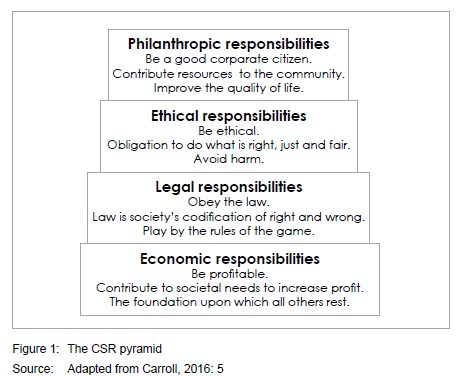
The concept of CSR as a multidimensional construct dates back to 1979, with the seminal work of Carroll (1979). In 1991, Carroll introduced the CSR pyramid, a framework designed to illustrate how the different elements of CSR are interrelated and build upon one another (Carroll, 2016; Baden, 2016). The pyramid's geometric design was chosen for its simplicity and clarity, offering an intuitive way to understand CSR's layered structure. According to this model, a company's CSR responsibilities are ranked in order of importance, with economic responsibilities at the base, followed by legal, ethical, and philanthropic responsibilities at the top. This hierarchical structure suggests that, while all dimensions are important, companies must first focus on meeting their economic obligations before addressing legal, ethical, and philanthropic concerns.
Despite ongoing scholarly efforts to refine and expand upon Carroll's original framework (Carroll, 2003; Baden, 2016: 1-8), the CSR pyramid remains one of the most widely recognised and cited models in CSR literature (Ma et al., 2012; Visser, 2006: 29-56). Schwartz and Carroll (2003) conducted a comprehensive review of CSR textbooks and found that Carroll's CSR pyramid continues to be a dominant paradigm in the field of social issues in management. As they noted, "such use suggests that Carroll's CSR domains and pyramid framework remain a leading paradigm of CSR in the social issues in management field" (Schwartz & Carroll, 2003: 504). Carroll's CSR pyramid has not only shaped how CSR is understood in academia, but also influenced its application in various industries and professional contexts. The model continues to serve as a foundational tool for both scholars and practitioners seeking to understand and implement CSR practices across diverse organisational settings. Figure 1 illustrates the CSR pyramid.
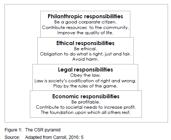
As mentioned earlier, various theorists and empirical researchers have widely used Carroll's four elements that form the basis of the pyramid (Swanson, 1995; Wartick & Cochran, 1985; Wood, 1991, among others). However, to date, no studies have empirically assessed the social responsibility performance of property-development companies using these specific CSR elements, as illustrated in Figure 1. This gap in the literature shows the need for a study of this nature.
2.3.1 Economic responsibility
Economic responsibility is a cornerstone of CSR, serving as the foundation upon which all other CSR activities can be built (Carroll, 1991; Carroll, 2016). For a business to be deemed economically responsible, it must first be profitable. Ezechukwu and Uzuagu (2022) emphasise that profitability is essential for the long-term sustainability of an organisation. Without profit, a business is unable to generate the resources necessary to support the social goods and services that benefit the community. In this way, economic responsibility is about not only securing financial performance, but also enabling organisations to fund initiatives such as sponsoring cultural and sporting events or investing in educational and training programmes that contribute to societal welfare (Ezechukwu & Uzuagu, 2022).
Moreover, economic responsibility plays a vital role in building and maintaining relationships with key stakeholders, including employees, consumers, suppliers, investors, and the broader community (Paulík et al., 2015; Ezechukwu & Uzuagu, 2022). Companies are increasingly expected to contribute to the economic well-being of their communities, by investing in local infrastructure, supporting education, supporting job creation, and ensuring workforce development (Hasibuan et al., 2023; Oleshko, 2023). By aligning business strategies with community needs, companies can enhance both their profitability and their reputation, creating a mutually beneficial relationship with society. For instance, a property-development company that prioritises affordable housing units not only addresses a critical societal need, but also benefits from increased financial performance and turnover rates (Hasibuan et al., 2023).
Economic responsibility, therefore, extends beyond mere profit generation to encompass strategies that support goodwill and contribute to broader community development. As Kesto and Ravi (2017) note, fulfilling economic responsibilities can enhance a company's reputation, enabling it to thrive, while simultaneously fostering social and economic well-being. Carroll (1991) argues that profitability is a prerequisite for addressing a company's legal, ethical, and philanthropic responsibilities, highlighting the interdependence of these CSR elements (Meynhardt & Gomez, 2016).
2.3.2 Legal responsibility
Legal responsibility refers to an organisation's obligation to comply with the laws and regulations established by governmental authorities. According to Carroll (1991), the law represents a codification of right and wrong, and businesses must adhere strictly to legal standards as a fundamental requirement for their continued operation. Carroll (2016) further conceptualises legal responsibility as 'codified ethics', reflecting the core values of fair business practices as legislated by governments at various levels.
Legal responsibilities encompass a wide range of requirements, including adherence to human rights laws, employment regulations, tax laws, consumer protection measures, workplace health and safety standards, and ensuring fair competition with other Arms (Lambooy, 2014: 1-6). These legal obligations form the baseline for an organisation's operations and establish the legal framework within which businesses must function, in order to avoid legal penalties and ensure their legitimacy within society.
2.3.3 Ethical responsibility
While legal obligations dictate what organisations are required to do, ethical responsibilities concern what is considered right, just, and fair, even when not mandated by law. Carroll (2016) emphasises that ethical obligations involve doing 'what is right, just, and fair' and ensuring that organisations avoid harm to individuals or society. This aspect of CSR requires businesses to go beyond legal compliance and proactively create a business environment characterised by fairness, transparency, and moral integrity.
Ethical responsibility involves upholding principles, values, and moral standards that meet or exceed the expectations of stakeholders (Lentner, Szegedi & Tatay, 2015; Paulík et al., 2015). In practice, this means that organisations are expected to treat employees with respect and dignity, adhere to fair labour practices, maintain transparency in business operations, and ensure that their actions do not harm individuals or communities. Ethical responsibility thus reflects a company's commitment to operating with integrity and aligning its practices with the broader ethical expectations of society.
2.3.4 Philanthropic responsibility
Philanthropic responsibility involves voluntary, discretionary actions that contribute to societal welfare. Unlike ethical responsibilities, which are based on moral obligations, philanthropic activities such as donations, sponsorships, and community development are not legally required, and companies are not deemed unethical for not engaging in them (Hussaini, 2020; Pour, Nazari & Emami, 2014). Philanthropic initiatives can include support for causes such as environmental protection, education, public health, and infrastructure, as well as employee volunteer programmes. While not mandatory, these activities help companies build positive relationships with the community and enhance their corporate reputation.
Ultimately, philanthropy reflects corporate citizenship, where businesses use their resources for the public good. Although philanthropic efforts may not directly align with core business operations, they are a crucial aspect of CSR, demonstrating a company's commitment to social responsibility and community well-being.
2.4 Barriers to the adoption of corporate social responsibility
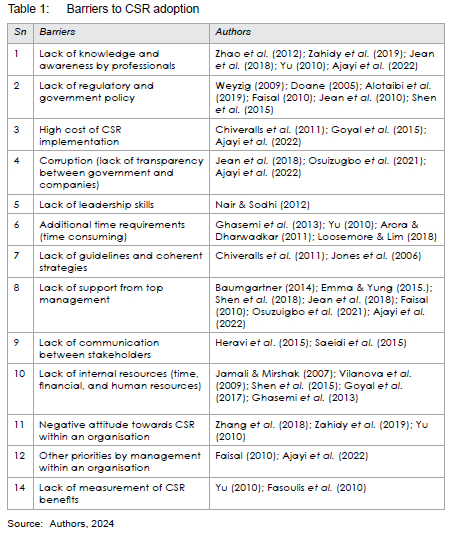
Despite the well-documented benefits of CSR, several factors hinder its adoption within the property-development sector. Understanding these barriers is crucial for developing effective strategies to promote CSR implementation in the industry. The obstacles to CSR adoption vary significantly, depending on contextual factors such as the geographic location of the study and the characteristics of the respondents. While an increasing number of studies conducted in developed countries, including the United States, the United Kingdom, and Australia, have identified and analysed these barriers, research on CSR adoption in the context of developing nations, particularly in Nigeria's property-development industry, remains limited. This gap highlights the need for further investigation into the barriers to CSR implementation in developing countries. Based on a review of the literature, 14 key barriers to CSR implementation in the property-development and construction sectors are outlined in Table 1.
2.5 Strategic drivers of corporate social responsibility
In order to effectively implement CSR practices within property-development companies in developing countries, particularly in Nigeria, it is essential to first identify both the drivers of CSR and the factors that may hinder its adoption. Such an understanding will enable key stakeholders, including directors and government authorities, to take the necessary steps toward promoting the implementation of CSR initiatives. Several factors contribute to the promotion of CSR in the construction industry, steering it toward more responsible practices. Darko, Zhang and Chan (2017) define drivers as factors that influence and encourage the adoption of CSR or specific green building practices. These drivers can be both internal and external to the organisation, and they significantly influence the adoption of sustainable practices.
Abidin (2010) identified public awareness, interest, and knowledge of the benefits of CSR as critical drivers of its implementation in developing economies. The author argues that increasing awareness and understanding of CSR's advantages can promote its adoption. Similarly, Ikediashi et al. (2012) emphasised that the willingness and vision of top-level management, alongside their ability to develop and implement sustainable plans, are essential drivers of CSR in the construction sector. This is largely because top management has the resources and authority to integrate CSR principles into organisational practices.
The role of government is also pivotal in ensuring the widespread adoption of CSR within the property-development sector (Wang, Toppinen & Juslin, 2014). Government action can help institutionalise CSR practices through the establishment of legal frameworks and evaluation mechanisms.
Aghimien et al. (2018) further argue that strong legislative and governmental support can significantly enhance the visibility and effectiveness of CSR initiatives across organisations.
CIB (2002) identified public awareness and education as major drivers of CSR and sustainability in the property-development industry. The author contends that formal and informal education, as well as information dissemination through training programmes targeting clients, government officials, and industry professionals, can deepen understanding of sustainable development and promote environmentally responsible attitudes.
Zhang, Morse and Kambhampati (2017) categorised CSR drivers into four broad categories, namely market drivers (including consumers, labour, and investment), social drivers, government drivers, and globalisation drivers. In addition, Visser (2008) conducted a study on CSR drivers in developing countries, distinguishing between internal and external drivers. According to Visser, internal drivers include political reform, cultural traditions, responses to crises, market access, socio-economic priorities, and governance challenges. External drivers, on the other hand, involve factors such as international standards, investment incentives, stakeholder activism, and supply chain considerations.
3. RESEARCH METHOD
3.1 Research design
The study employed a quantitative research design, using a questionnaire survey to assess the CSR performance of property-development companies in Nigeria. According to Creswell (2014), questionnaires enable researchers to generalise findings to a larger population. This quantitative approach allows for descriptive data analysis (Creswell, 2014), which was used to evaluate CSR performance based on the CSR pyramid framework elements. In addition, the analysis examined and ranked the barriers and strategic drivers of CSR initiatives within the industry. The ranking outcomes formed the basis for recommendations on enhancing CSR implementation among property-development companies in Nigeria.
3.2 Population, sampling, and response rate
As of March 2024, 613 financially up-to-date members of the Real Estate Developers Association of Nigeria (REDAN) are located across the country (Redan, 2024). However, due to practical constraints, this study focused on Lagos, south-western Nigeria, where 43 property-development companies were identified as part of the study. To ensure the accuracy of the study population, the data was validated using Finilib.com, a Nigeria online platform that functions as a directory and search engine for businesses and companies, that is, a centralised database of companies. This approach allowed for a reliable and comprehensive understanding of the property-development landscape in the study area, facilitating a targeted analysis within a broader context of property-development companies across Nigeria.
The sample comprised senior professionals such as managing directors, branch managers, and heads of units within property-development firms (small and large) in Lagos, south-western Nigeria. These individuals were selected for their experience, decision-making roles, and relevance to the study's focus on CSR practices, ensuring that their responses would provide valuable insights into the industry's operations and CSR initiatives.
The study area was selected due to Lagos' status as Nigeria's commercial hub, with a vibrant real estate market and a concentration of property-development companies. This makes it an ideal location for examining CSR practices in the sector. Given the small number of property-development firms (43), a census survey approach was used, as recommended for populations under 100 (Othman & Mia, 2008). This method collects data from every member of the entire population under study, rather than from a sample (Alao & Babalola, 2024). This approach is typically used when the population size is small enough to allow for complete enumeration, ensuring that every unit or individual is included in the survey.
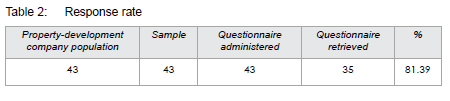
A total of 43 questionnaires were distributed, with 35 valid responses, yielding an 81.39% response rate (see Table 2). While response rates in the property development sector are typically low, due to professionals' demanding schedules (Moyo & Craffold, 2010), recent studies on CSR have reported higher rates, suggesting growing interest in socially responsible practices. For example, Osuizugbo et al. (2021) reported 61%, and Melo, de Oliveira and da Silva (2020) achieved 67%, indicating an increased engagement with CSR within the industry.
3.3 Data collection
The study employed a questionnaire as the primary instrument for data collection, using a two-step approach in its design and administration. Initially, a draft questionnaire was developed based on established parameters, following a thorough review of the existing literature. This draft was then sent to ten potential respondents for feedback. After reviewing their input, the questionnaire was revised accordingly. Subsequently, an online version of the questionnaire, which included an introductory section, was distributed via email to 43 respondents between 13 and 24 May 2024. The questionnaire was divided into two sections to ensure consistency and facilitate analysis. Section A gathered background information on the respondents and their respective property-development companies, while Section B focused on CSR performance, barriers to CSR implementation, and the strategic drivers of CSR initiatives in property-development companies. Section B used a 5-point Likert-type scale, where respondents were asked to rate the level of performance or significance of each item, with response options as follows: 1 = Low; 2 = Slightly High; 3 = Somewhat High; 4 = High, and 5 = Extremely High. To ensure data accuracy and avoid duplication, only one questionnaire was administered per Arm.
3.4 Data-analysis method
The data collected were analysed using the Statistical Package for the Social Sciences (SPSS), with descriptive statistics employed to summarise the results. Percentiles and frequencies were calculated to describe the profiles of the respondents. The mean score (MS) was computed to assess the CSR performance of property-development companies, as well as to identify the barriers and drivers influencing CSR implementation within the industry. For analysis and interpretation, a graduated scale of 1-5, adapted from Adilieme (2019), was used to measure the relative performance of property development companies in terms of their corporate social responsibility roles, barriers, and strategic drivers, where <1.49 = not very often/very poor/very insignificant; 1.50 to 2.49 = not often/poor/insignificant; 2.50 to 3.49 = fairly often/average/fairly significant; 3.50 to 4.49 = often/ good/significant, and 4.50 to 5.0 = very often/very good/very significant. In this context, EFX represents the total score for each item, while EFX/ EF is the mean score, calculated by dividing the total score (EFX) by the number of respondents (EF). The mean score serves to indicate the central tendency and ranks the items based on their significance or impact.
4. RESULT
4.1 Profiles
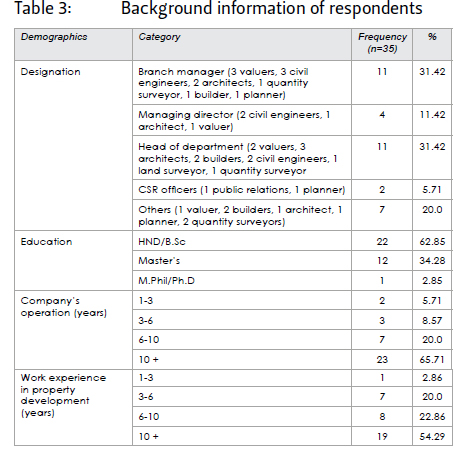
Table 3 shows that most of the respondents (62.84%) were either branch managers (31.42%) or heads of department (31.42%), and 77.14% of the participants had between 6 years' and 10 years' work experience in property development. Most of the participating companies (65.71%) have been in operation for over 10 years, indicating that the property-development companies are not new and can relate to CSR. The majority of the respondents (97.13%) had either a higher national diploma (HND)/B. Sc. degree (62.85%) or a master's degree (34.28%) in relevant disciplines such as Architecture, Real Estate Management, Building Technology, and Quantity Surveying, among others. It can be deduced from the analysis that the respondents' representations are from property-development companies that are mostly qualified and competent, and whose judgements and information provided can be considered reliable and valid.
4.2 Corporate social responsibility performance of property-development companies
The CSR performance of property-development companies was assessed using the framework of the CSR pyramid, which includes the key elements of economic, legal, ethical, and philanthropic responsibilities.
4.2.1 Economic responsibility
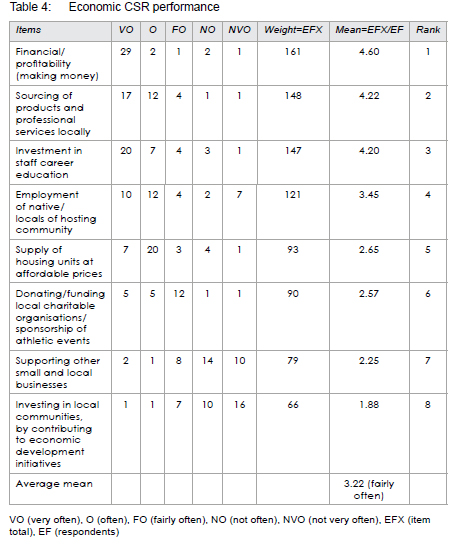
With an average mean score of 3.22, Table 4 indicates that property-development companies in Nigeria 'fairly often' fulfil their economic responsibilities as part of their CSR initiatives. The most highly ranked economic responsibility, with a significant mean score of 4.60, is financial profitability (profit-making), suggesting that property-development companies are primarily profit-driven, with a strong focus on generating financial returns and enhancing profitability. Other economic responsibilities such as sourcing building materials and professional services locally (mean=4.22), and investing in staff educational development (mean=4.20) were more frequently observed. However, support for other small and local businesses received a relatively low rating (mean=2.25). The relatively low overall rating for economic CSR performance can be attributed to the companies' cost-cutting strategies aimed at increasing turnover and profitability, with limited attention to broader economic CSR responsibilities.
Among the various potential economic responsibilities, the most consistently performed CSR activity was financial profit-making. This finding aligns with the work of Carroll (1991), Babalola (2012), and Ezechukwu and Uzuagu (2022), who observed that business stakeholders prioritise income generation and profitability, asserting that the sustainability of a company depends largely on its financial performance. As Handy (2002: 49-55) and Carroll (2016) argued, a company that fails to generate profit is unlikely to sustain its operations in the long term and will struggle to meet its social and economic CSR obligations. Profit generation benefits shareholders and employees and enables the company to fulfil other aspects of CSR. In this study, the use of local building materials and the employment of local professionals may reflect strategies to deliver affordable housing (Ugochukwu & Chioma, 2015: 42-49), while reducing costs, thus improving the overall profit margin. Similarly, investment in staff education likely serves to enhance employees' skills and behaviours, contributing to the company's growth and organisational effectiveness (Hewett et al., 2018; Botke et al., 2018). However, the study found that certain aspects of economic social responsibility (SR) such as the provision of affordable housing at reasonable prices, funding local charitable organisations, and contributing to community economic development initiatives were not frequently carried out by property-development companies. These findings suggest that, while financial profitability and cost-reduction strategies are emphasised, other dimensions of economic SR are less prioritised in practice.
4.2.2 Legal responsibility
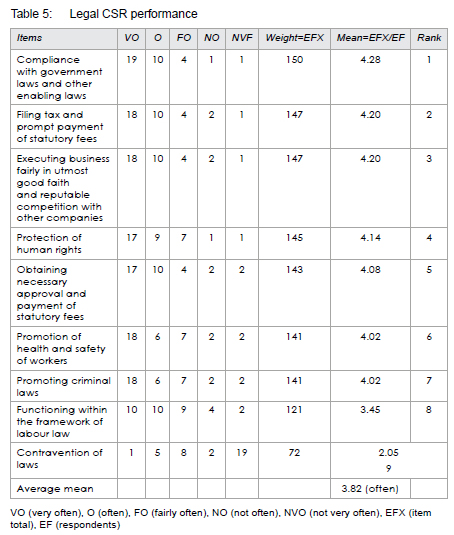
As shown in Table 5, property-development companies in Nigeria demonstrate strong performance in fulfilling their legal CSR responsibilities, with an average mean score of 3.82. Participating companies exhibited high levels of compliance with government laws and regulations, with several indicators surpassing a mean score of 4.0. Specifically, property-development companies 'very often' complied with government laws and other enabling regulations (mean=4.28), paid taxes (mean=4.20), conducted business fairly and in good faith, and maintained reputable competition with other firms (mean=4.20). In addition, they protected human rights (mean=4.14), obtained necessary approvals, and paid statutory fees (mean=4.08).
Table 5 further indicates that these companies performed well in areas related to worker health and safety, adherence to criminal laws, and compliance with labour regulations. The high level of compliance with legal CSR obligations can be attributed to the companies recognition of the importance of operating within a legally defined framework. These findings align with the perspectives of Carroll (2016) and Ezechukwu and Uzuagu (2022), who argue that legal CSR requires organisations to operate in accordance with government laws. This element of the CSR pyramid is mandatory for all organisations, and compliance with legal standards is not only a moral obligation, but also a legal requirement. As Sachs and Ruehle (2009) assert, organisations cannot afford to operate in isolation from ethical and legal considerations; their failure to comply with legal requirements could result in serious consequences such as, for example, legal sanctions, including fines, penalties, and even the suspension of business licenses.
4.2.3 Ethical responsibility
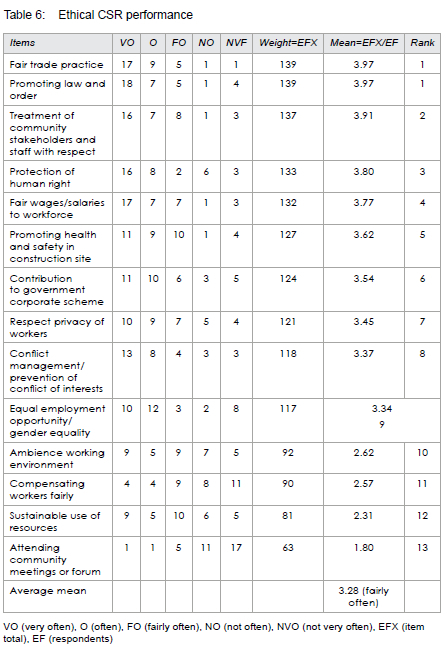
Table 6 reveals that, with an average mean score of 3.28, property-development companies in Nigeria 'fairly often' perform their ethical responsibilities as part of their CSR efforts. Among the 14 items used to assess their ethical performance, seven items had mean scores above 3.5, indicating that these ethical practices are more commonly implemented. Notably, fair trade practices (mean=3.97) and the promotion of law and order (mean=3.97) were the most frequently performed ethical responsibilities, suggesting a focus on maintaining legal compliance and establishing a competitive business advantage.
This aligns with previous studies by Martinuzzi et al. (2011), Doane (2005), and Ekung et al. (2014), which highlight the importance of companies striving for a competitive edge and a strong public reputation. Steiner (2012) further highlights that a critical aspect of CSR is maintaining public support, credibility, and legitimacy, by fulfilling ethical responsibilities toward stakeholders. The study also revealed that property-development companies often engage in ethical practices such as treating community stakeholders and staff with respect, protecting human rights principles, paying fair wages and salaries to their workforce, promoting health and safety, and contributing to government corporate schemes. However, certain ethical responsibilities are performed less consistently, including the privacy of workers, preventing workforce/business conflict, promoting equal employment opportunities and gender equality, and creating a conducive working environment. Some ethical areas such as worker compensation in case of occupational hazards, sustainable resource use, and participation in community service were notably neglected. This neglect may be attributed to the fact that these ethical responsibilities often lack direct legal implications or enforcement mechanisms. Despite this, it is in the best interest of property-development companies to adopt a more comprehensive approach to ethical responsibility, as it can significantly enhance their public image and long-term reputation (Adda, Azigwe & Awuni, 2016). The findings resonate with the views of Sachs and Ruehle (2009), who argue that organisations should not be viewed merely as economic entities, but must also integrate moral and ethical considerations into their operations to ensure sustainable success.
4.2.4 Philanthropic responsibility
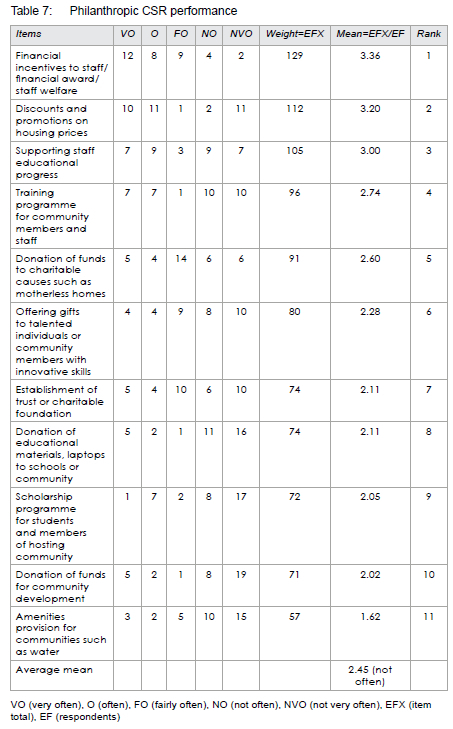
Table 7 presents the findings on the philanthropic CSR performance of property-development companies in Nigeria. On average, companies exhibit a low engagement in philanthropic activities, with a mean score of 2.45, indicating that these CSR initiatives are not frequently undertaken. Despite this, property-development companies do make some contributions to employee welfare, including financial incentives and awards (mean=3.36), support for staff educational advancement (mean=3.00), and offering discounts on housing prices (mean=3.20).
Further, companies engage in some community-focused initiatives, albeit to a lesser extent, such as providing paid training or seminar programmes for community members (mean=2.74) and donating funds to charitable causes (mean=2.60) such as motherless homes. However, more substantive philanthropic actions such as offering gifts to talented individuals or community members with innovative skills (mean=2.28), establishing charitable trusts or foundations (mean=2.11), donating educational materials and laptops to schools (mean=2.05), or funding community development (mean=2.02) are rarely performed. The least frequently practised activity was community service development, which scored the lowest at 1.62.
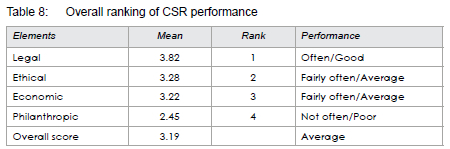
The generally low engagement in philanthropic CSR by property-development companies can be attributed to Nigeria's challenging economic context (see Table 8). As a developing nation, a significant portion of the population comprises low- to middle-income earners who often face difficulties accessing credit facilities, due to poor credit histories and irregular incomes (UN-Habitat, 2011; Akinwande & Hui, 2024). This financial limitation restricts the purchasing power of potential homeowners, resulting in lower demand for properties and, consequently, reduced financial turnover for development companies. Such economic challenges directly impact on the companies' ability to allocate funds for philanthropic activities. Moreover, the literature suggests that economic responsibility serves as the foundation upon which other CSR initiatives are built (Carroll, 1979; Carroll, 1991). In this context, property-development companies in Nigeria may prioritise financial stability and profitability over discretionary philanthropic contributions. There is also ongoing debate regarding the motivations behind corporate philanthropy. Some scholars argue that corporate giving is often driven by strategic business goals rather than purely charitable intentions (Kant, 1785/2002; Adrian, Phelps & Gatte, 2013). While some studies suggest that businesses may not fully exploit marketing opportunities when engaging in philanthropy (Roger, 1997), it is widely recognised that corporate giving, although optional, is increasingly expected by the public and often viewed as an integral part of corporate identity.
In Table 8, the overall CSR performance of property-development companies in Nigeria reveals a strong performance in legal responsibilities, a poor performance in philanthropic responsibilities, and average performance in both ethical and economic responsibilities. This pattern may be attributed to the societal context and the evolving business environment, which increasingly demands organisations to fulfil their roles as both corporate and legal citizens. This finding aligns with the perspectives of Handy (2002), and Baden (2016), who argue that Carroll's CSR pyramid, which places economic responsibilities at the base, suggests that social welfare is often subordinated to economic imperatives. In highly competitive environments, businesses may face pressures to prioritise profits over legal compliance and ethical considerations, a dynamic that has been well-documented in the literature. Studies by Cai and Liu (2009: 764), Shleifer (2004), as well as Staw and Szwajkowski (1975: 45) demonstrate how such pressures can lead to illegal and unethical business practices. Scholars generally agree that the 'profit-before-ethics' mentality is a central factor driving corporate misconduct.
4.3 Barriers to CSR implementation
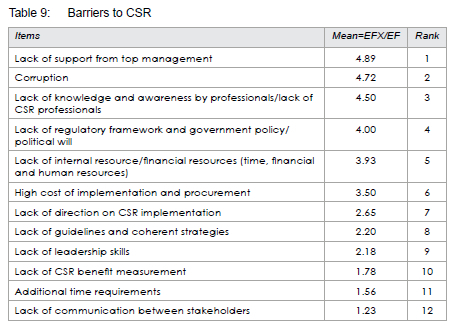
Table 9 presents the ranking of barriers to the implementation of CSR initiatives among property-development companies in Nigeria. The study assessed 12 potential barriers identified in the literature, examining their significance and relative importance within these companies. The findings indicate several factors that hinder the adoption of CSR practices, with the top three barriers being: lack of support from top management (mean=4.89), corruption and lack of transparency (mean=4.72), and insufficient knowledge of CSR or a lack of CSR professionals (mean=4.50). Other notable barriers include the absence of a regulatory framework and government policy (mean=4.00), limited internal resources (mean=3.93), and the high cost of implementation (mean=3.50).
These results are consistent with previous research by Haupt (2016), Fasoulis and Kurt (2019), and Osuizigbo et al. (2021), particularly regarding the lack of top management support in property-development Arms. Since top management is responsible for strategic decision-making, their involvement is critical for the successful initiation and implementation of CSR initiatives. Goyal, Rahman and Kazmi (2017) argue that top management must clearly communicate their vision for environmental responsibility across all organisational management levels to ensure alignment and commitment.
Corruption, another significant barrier, is often linked to a lack of transparency between the government and private sector companies. This finding aligns with studies by Jean, Wang and Suntu (2018), Osuizigbo et al. (2021), and Ayayi et al. (2022), which highlight corruption as a persistent challenge in both public and private sectors in Nigeria. Okolo and Akpokighe (2014) attribute the high levels of corruption in Nigeria's public sector to this issue, with private sector corruption also increasing over time. In line with Jean et al. (2018), who identify corruption as a hidden barrier to CSR implementation in Madagascar, similar challenges are observed in Nigeria, suggesting that corruption is a significant constraint on CSR adoption in developing countries.
A lack of awareness and understanding of CSR is also a critical barrier. Many property-development companies in Nigeria are either unaware of CSR or fail to recognise its long-term benefits, particularly when their financial performance appears optimal without CSR efforts. This lack of awareness indicates that organisations may be unaware of their CSR responsibilities, highlighting the need for greater public education, advocacy, and professional training within the industry.
The study identified the lack of a legal framework, insufficient financial resources, and the high costs associated with CSR implementation as significant barriers. These findings resonate with the research of Shen, Govindan and Shankar (2015), and Zahidy, Sorooshian and Hamid (2019), who similarly reported these challenges among construction companies. Comparing these results to the broader literature, it is evident that, despite contextual differences between countries (e.g., the United Kingdom, the United States, Malaysia, Belgium, and South Africa), similar barriers to CSR implementation are encountered across the construction and property-development sectors. One key reason for these barriers is the absence of clear and comprehensive legal frameworks to guide CSR practices, a concern also raised by Karmakar (2022), who highlights the lack of such frameworks as a major obstacle to CSR implementation.
4.4 Strategic drivers of CSR implementation
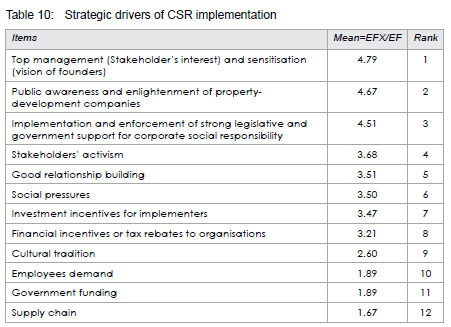
Table 10 presents the strategic drivers of CSR implementation in property-development companies in Nigeria, based on weighted mean score ratings. Three key factors were identified as particularly significant, with mean scores exceeding 4.5: (1) stakeholders' interests and the founders' vision (mean=4.79), (2) public and industry awareness of CSR (mean=4.67), and (3) the implementation and enforcement of strong legislative and government support for CSR (mean=4.51). Other notable drivers include stakeholder activism (mean=3.68), relationship building (mean=3.51), and social pressures (mean=3.50).
These findings align with prior research by Ajayi et al. (2022) and Amaechi, Adegbite and Rajwani (2014). Notably, the role of founder or top management support as a significant driver emphasises a feature of developing economies where weak government policies often leave CSR initiatives largely unregulated. In such contexts, the vision of the founder or senior leadership becomes a critical determinant of CSR practices.
The results are consistent with findings by Khan, Al-Maimani and Al-Yafi (2013), who highlight a lack of understanding of CSR concepts among property-development companies in developing nations, alongside insufficient government support for CSR implementation (Zhang et al., 2020). This suggests that, for CSR initiatives to be effective, alignment between top management and the organisational vision with CSR objectives is essential. Moreover, CSR advocacy should be promoted through public awareness campaigns, while governments must enforce policies that incentivise and facilitate CSR practices.
The study also emphasises the importance of stakeholder power - encompassing employees, clients, vendors, government bodies, and local residents - as a significant factor in driving CSR implementation. This finding resonates with previous research by Ihugba (2012) and Taghian et al. (2015), which confirms the influence of stakeholders in shaping organisational CSR decisions. According to Ihugba (2012), the voluntary and discretionary nature of CSR practices creates opportunities for stakeholder engagement, activism, and organisational development. Similarly, Mehdi et al. (2015) argue that employees and the public are key stakeholders whose involvement is crucial to CSR decision-making processes.
5. CONCLUSION
Existing studies on CSR within the construction and property-development sectors have primarily focused on countries in the Global North, with relatively limited research in the Global South. This study aimed to All this gap, by examining CSR performance, barriers, and drivers of CSR in property-development companies in Nigeria. The findings reveal that Nigerian property-development companies demonstrate poor performance in philanthropic CSR, average performance in ethical and economic CSR, and comparatively good performance in legal CSR.
The study also provides valuable insights into the barriers to CSR implementation within the sector. It was found that key challenges include insufficient top management commitment, low awareness of CSR practices, and corruption stemming from a lack of transparency. The study identified several important drivers of CSR, including strong leadership and top management support, public awareness and education, the enforcement of legal frameworks, and stakeholder activism. These drivers point to the need for heightened advocacy and education on CSR, as well as a call for greater transparency in the industry.
The results show the urgent necessity to promote CSR in the Nigerian property-development sector. The development of a robust legal framework, similar to CSR practices in developed countries such as the United Kingdom, is essential for creating corporate accountability and promoting sustainable development. The study concludes that property-development companies in Nigeria are performing at an average level in terms of CSR, with room for significant improvement across various CSR domains. Emphasising CSR could contribute to regional and economic development, while encouraging businesses to take greater responsibility for their actions. Over time, responsible CSR implementation could also play a key role in addressing Nigeria's infrastructural deficit.
This study makes a significant contribution to the existing literature on CSR, particularly within the Nigerian context, where hardly any research has been conducted on the CSR performance, barriers, and drivers among property-development companies. In light of the barriers identified, the study recommends that the Nigerian government implement a comprehensive legal framework and guidelines to incentivise and encourage CSR practices within the sector. In addition, it is crucial to raise awareness and inform key stakeholders, including top management, investors, and company founders, about the full range of CSR benefits, as increased knowledge could lead to improved CSR outcomes.
Finally, the study calls for future research on CSR benefits and practices within estate surveying and valuation Arms, as this could further inform CSR adoption across the property-development industry and encourage more businesses to integrate CSR programmes into their operations.
REFERENCES
2. LITERATURE REVIEW
-
Abidin, N.Z. 2010. Investigating the awareness and application of sustainable construction concept by Malaysian developers. Habitat International, 34(4), pp. 421-426. https://doi.org/10.1016/j.habitatint.2009.11.011
» https://doi.org/10.1016/j.habitatint.2009.11.011 -
Adda, G., Azigwe, J.B. & Awuni, A.R. 2016. Business ethics and corporate social responsibility for business success and growth. European Journal of Business and Innovation Research, 4(6), pp. 26-42. [Online]. Available at: <www.eajournals.org.> [Accessed: 14 August 2024].
» www.eajournals.org -
Adedeji, I. 2023. Nigerian urbanization and the significance of affordable housing. Journal of Service Science and Management, 16, pp. 351-368. https://doi.org/10.4236/jssm.2023.163020
» https://doi.org/10.4236/jssm.2023.163020 - Adilieme, C.M. 2019. Assessment of student housing satisfaction among students of university of Lagos. Global Journal of Human-Social Science, 19(9), pp. 1-7.
- Adrian, M., Phelps, L. & Gatte, A. 2013. Philanthropy and corporate social responsibility: Is giving enough to truly be ethical? International Journal of the Academic Business World, 7, pp. 83-90.
- Aghimien, D., Aigbavboa, C., Ngcobo, N. & Thwala, W. 2018. Barriers to sustainable construction practices in Nigeria. In: Conference proceedings, International Council for Research and Innovation in Building Construction, 2-3 September 2019, Durban, South Africa, pp. 340-348.
-
Aigbavboa, C., Ebekozien, A., Afetorgbor, E.K., Arthur-Aidoo, B.M. & Thwala, W.D. 2024. Investigating the barriers facing corporate social responsibility in the built environment: Ghana's perspective from a qualitative approach. Property Management, 42(4), pp. 493-506. https://doi.org/10.1108/PM-07-2023-0060
» https://doi.org/10.1108/PM-07-2023-0060 -
Ajayi, A., Oyeyipo, O., Apete, L.A. & Dahunsi, O.S. 2022. Evaluation of corporate social responsibility of construction companies in Lagos State, Nigeria. Journal of Multidisciplinary Engineering Science and Technology, 9(2), pp. 15092-15101. [Online]. Available at: https://www.jmest.org/wp-content/uploads/JMESTN42353994.pdf [Accessed: 16 August 2024].
» https://www.jmest.org/wp-content/uploads/JMESTN42353994.pdf -
Akinde, S. 2020. Corporate social responsibility (CSR): An elixir for socio-economic development in Nigeria. European Journal of Business Management and Research, 5(4). https://doi.org/10.24018/ejbmr.2020.5.4.376
» https://doi.org/10.24018/ejbmr.2020.5.4.376 - Akinleye, G.T. & Adedayo, T.F. 2017. Impact of corporate social responsibility on the profitability of multinational companies in Nigeria. Global Journal of Management and Business Research: (D) Accounting and Auditing, 17(3), pp. 26-35.
-
Akinwande, T. & Hui, E. 2024. Effective affordable housing provision in developing economies: An evaluation of expert opinion. Sustainable Development, 32(1), pp. 696-711. https://doi.org/10.1002/sd.2702
» https://doi.org/10.1002/sd.2702 -
Alao, O.O. & Babalola, O. 2024. Integrating corporate social responsibility as an infrastructural projects financing option in Lagos State, Nigeria. Acta Structilia, 31(1), pp. 1-42. https://doi.org/10.38140/as.v31i1.7131
» https://doi.org/10.38140/as.v31i1.7131 -
Alotaibi, A., Edum-Fotwe, F. & Price, A.D. 2019. Critical barriers to social responsibility implementation within mega-construction projects: The case of the Kingdom of Saudi Arabia. Sustainability, 11(6), article 1755. https://doi.org/10.3390/su11061755
» https://doi.org/10.3390/su11061755 -
Amaeshi, K., Adegbite, E. & Rajwani, T. 2014. Corporate social responsibility in challenging and non-enabling institutional contexts: Do institutional voids matter? Journal of Business Ethics, 134, pp 135-153. https://doi.org/10.1007/s10551-014-2420-4
» https://doi.org/10.1007/s10551-014-2420-4 - Ankrah, N.A. & Proverbs, D. 2005. A framework for measuring construction project performance: Overcoming key challenges of performance measurement. In: Khosrowshahi, F. (Ed.). Proceedings of the 21st Annual ARCOM Conference, 7-9 September, University of London: Association of Researchers in Construction Management, Vol. 2, pp. 959-969.
-
Arora, P. & Dharwadkar, R. 2011. Corporate governance and corporate social responsibility (CSR): The moderating roles of attainment discrepancy and organization slack. Corporate Governance: An International Review, 19, pp. 136-152. https://doi.org/10.1111/j.1467-8683.2010.00843.x
» https://doi.org/10.1111/j.1467-8683.2010.00843.x - Babalola, Y.A. 2012. The impact of corporate social responsibility on Arms' profitability in Nigeria. European Journal of Economics, Finance and Administrative Sciences, 45(1), pp. 39-50.
-
Baden, D. 2016. A reconstruction of Carroll's pyramid of corporate social responsibility for the 21st century. International Journal of Corporate Social Responsibility, 1, article 8. https://doi.org/10.1186/s40991-016-0008-2
» https://doi.org/10.1186/s40991-016-0008-2 -
Baumgartner, R.J. 2014. Managing corporate sustainability and CSR: A conceptual framework combining values, strategies and instruments contributing to sustainable development. Corporate Social Responsibility and Environmental Management, 21, pp. 258-271. https://doi.org/10.1002/csr.1336
» https://doi.org/10.1002/csr.1336 -
Bevan, E.A. & Yung, P. 2015. Implementation of corporate social responsibility in Australian construction SMEs. Engineering, Construction and Architectural Management, 22(3), pp. 295-311. https://doi.org/10.1108/ECAM-05-2014-0071
» https://doi.org/10.1108/ECAM-05-2014-0071 -
Botke, J.A., Jansen, P.G., Khapova, S.N. & Tims, M. 2018. Work factors influencing the transfer stages of soft skills training: A literature review. Educational Research Review, 24, pp. 130-147. https://doi.org/10.1016/j.edurev.2018.04.001
» https://doi.org/10.1016/j.edurev.2018.04.001 -
Bowen, P.A., Edwards, P.J. & Cattell, K. 2012. Corruption in the South African construction industry: A thematic analysis of verbatim comments from survey participants. Construction Management and Economics, 30(10), pp. 885-901. https://doi.org/10.1080/01446193.2012.711909
» https://doi.org/10.1080/01446193.2012.711909 - Brusseau, J. 2012. Corporate social responsibility and sustainable development: Social capital and corporate development in developing economies (finance, governance and sustainability). New York: Saylor Foundation.
-
Cai, H. & Liu, Q. 2009. Competition and corporate tax avoidance: Evidence from Chinese industrial Arms. The Economic Journal, 119(537), pp. 764-795. https://doi.org/10.1111/j.1468-0297.2009.02217.x
» https://doi.org/10.1111/j.1468-0297.2009.02217.x -
Carroll, A.B. 1979. A three-dimensional conceptual model of corporate performance. Academy of Management Review, 4(4), pp. 497-505. https://doi.org/10.5465/amr.1979.4498296
» https://doi.org/10.5465/amr.1979.4498296 -
Carroll, A.B. 1991. The pyramid of corporate social responsibility: Toward the management of organizational stakeholders. Business Horizons, 34, pp. 39-48. https://doi.org/10.1016/0007-6813(91)90005-G
» https://doi.org/10.1016/0007-6813(91)90005-G -
Carroll, A.B. 1999. Corporate social responsibility: Evolution of definitional contract. Business & Society, 38(3), pp. 269-295. https://doi.org/10.1177/000765039903800303
» https://doi.org/10.1177/000765039903800303 -
Carroll, A.B. 2000. Ethical challenges for business in the new millennium: Corporate social responsibility and models of management morality. Business Ethics Quarterly, 10(1), pp. 33-42. https://doi.org/10.2307/3857692
» https://doi.org/10.2307/3857692 -
Carroll, A.B. 2016. Carroll's pyramid of CSR: Taking another look. International Journal of Corporate Social Responsibility, 1(1), article 3. https://doi.org/10.1186/s40991-016-0004-6
» https://doi.org/10.1186/s40991-016-0004-6 -
Carroll, A.B. & Shabana, K.M. 2010. The business case for corporate social responsibility: A review of concepts, research and practice. International Journal of Management Reviews, 12(1), pp. 85-105. https://doi.org/10.1111/j.1468-2370.2009.00275.x
» https://doi.org/10.1111/j.1468-2370.2009.00275.x -
Chan, A., Darko, A. & Effah, E. 2017. Strategies for promoting green building technologies adoption in the construction industry - An international study. Sustainability, 9. 969. https://doi.org/10.3390/su9060969
» https://doi.org/10.3390/su9060969 - Chiveralls, K., Zuo, J., Zillante, G., Wilson, L. & Pullen, S. 2011. Constructing corporate social responsibility: Encouraging CSR through legislation and regulation. In: Ruddock, L. (Ed.). COBRA 2011: Proceedings of the COBRA RICS Conference, 12-13 September, Manchester, UK, pp. 439-543.
- CIB & UNEP-IETC. 2002. Agenda 21 for sustainable construction in developing countries: A discussion document, prepared by Chrisna Du Plessis (CSIR Boutek Report No. Bou/E0204).
- Creswell, J.W. 2014. Research design: Qualitative, quantitative and mixed methods approaches. 4th edition. London: Sage Publications Ltd.
-
Darko, A., Zhang, C. & Chan, A. 2017. Drivers for green building: A review of empirical studies. Habitat International, 60, pp. 34-49. https://doi.org/10.1016/j.habitatint.2016.12.007
» https://doi.org/10.1016/j.habitatint.2016.12.007 -
Doane, D. 2005. Beyond corporate social responsibility: Minnows, mammoths and markets. Futures, 37, pp. 215-229. https://doi.org/10.1016/j.futures.2004.03.028
» https://doi.org/10.1016/j.futures.2004.03.028 -
Ekung, S., Ujene, A. & Ebong, U. 2014. Drivers of corporate social responsibility within construction organisations in Nigeria. International Letters of Social and Humanistic Sciences, 32, pp.14-25. http://doi.org/10.18052/www.scipress.com/ILSHS.32.14
» http://doi.org/10.18052/www.scipress.com/ILSHS.32.14 -
Emele, C.R. 2022. Real estate investment performance measurement in Nigeria: Problems and constraints facing professionals in a highly active but opaque market. Journal of Real Estate Studies, 19(2), pp. 1-22. https://doi.org/10.31357/sljre.v19i02.6069
» https://doi.org/10.31357/sljre.v19i02.6069 -
Ezechukwu, L. & Uzuagu, A. 2022. A review of corporate social responsibility: Its perception, practice, impact, and challenges in Nigeria. Journal of Accounting and Business Education, 7(1), pp. 1-24. http://doi.org/10.26675/jabe.v7i1.26867
» http://doi.org/10.26675/jabe.v7i1.26867 -
Faisal, M.N. 2010. Analysing the barriers to corporate social responsibility in supply chains: An interpretive structural modelling approach. International Journal of Logistics Research and Applications, 13(3), pp. 179-195. https://doi.org/10.1080/13675560903264968
» https://doi.org/10.1080/13675560903264968 -
Fasoulis, I. & Kurt, R.E. 2019. Reframing corporate social responsibility and sustainability in the aftermath of United Nations 2030 Agenda: An empirical study into the tanker and dry bulk maritime sector. Journal of Marine and Island Cultures, 8(1), pp. 61-82. https://doi.org/10.21463/jmic.2019.08.1.06
» https://doi.org/10.21463/jmic.2019.08.1.06 -
Finelib.com. 2024. Nigeria Directory. [Online]. Available at: <http://www.finelib.com./search.php?q=list+of+property+development+companies+in+Lagos&x=39&y=14> [Accessed: 1 May 2024].
» http://www.finelib.com./search.php?q=list+of+property+development+companies+in+Lagos&x=39&y=14 -
Ghasemi, S. & Nejati, M. 2013. Corporate social responsibility: Opportunities, drivers and barriers. International Journal of Entrepreneurial Knowledge, 1(1), pp. 33-37. http://doi.org/10.15759/ijek/2013/v1i1/53754
» http://doi.org/10.15759/ijek/2013/v1i1/53754 -
Glass, J. & Simmonds, M. 2007. "Considerate construction": Case studies of current practice. Engineering, Construction and Architectural Management, (14)2, pp. 131-149. https://doi.org/10.1108/09699980710731263
» https://doi.org/10.1108/09699980710731263 -
Goyal, P., Rahman, Z. & Kazmi, A.A. 2013. Corporate sustainability performance and Arm performance research: Literature review and future research agenda. Management Decision, 51(2), pp. 361-379. https://doi.org/10.1108/00251741311301867
» https://doi.org/10.1108/00251741311301867 -
Handy, C. 2002. What is a business for? Harvard Business Review, 80(12), pp. 49-55. https://doi.org/10.1111/1467-8616.00192
» https://doi.org/10.1111/1467-8616.00192 -
Hasibuan, A., Nasution, S., Triyoolanda, A. & Rahman, I. 2023. Community and stakeholder participation in the implementation of corporate social responsibility programs, its impact on rural communities. JAIEM, 1(1), pp. 12-20. https://doi.org/10.52088/jaiem.v1i1.4
» https://doi.org/10.52088/jaiem.v1i1.4 -
Haupt, T. 2016. The image of the construction industry and its employment attractiveness. Acta Structilia, 23(2), pp. 79-108. https://doi.org/10.18820/24150487/as23i2.4
» https://doi.org/10.18820/24150487/as23i2.4 -
Heravi, A., Coffey, V. & Trigunarsyah, B. 2015. Evaluating the level of stakeholder involvement during the project planning processes of building projects. International Journal of Project Management, 33, pp. 985-997. https://doi.org/10.1016/j.ijproman.2014.12.007
» https://doi.org/10.1016/j.ijproman.2014.12.007 -
Hewett, R., Shantz, A., Mundy, J. & Alfes, K. 2018. Attribution theories in human resource management research: A review and research agenda. The International Journal of Human Resource Management, 29(1), pp. 87-126. https://doi.org/10.1080/09585192.2017.1380062
» https://doi.org/10.1080/09585192.2017.1380062 -
Hussaini, U. 2020. Effects of corporate social responsibility on the performance of commercial banks in Nigeria: A conceptual framework. Dutse International Journal of Social and Economic Research, 4(2), pp. 13-26. https://doi.org/10.13140/RG.2.2.14036.73606
» https://doi.org/10.13140/RG.2.2.14036.73606 -
Ihugba, B. 2012. Compulsory regulation of CSR: A case study of Nigeria. Journal of Politics and Law, 5(2), pp. 68-81. https://doi.org/10.5539/jpl.v5n2p68
» https://doi.org/10.5539/jpl.v5n2p68 -
Ikediashi, D.I., Ogunlana, S.O., Awodele, O.A. & Onwuachi, O. 2012. An evaluation of personnel training policies of construction companies in Nigeria. Journal of Human Ecology, 40(3), pp 229-238. https://doi.org/101080/09709274.2012.11906541
» https://doi.org/101080/09709274.2012.11906541 -
Izidor, S. 2021. Multinational corporations and social responsibilities discharge: Ethical appraisal in Nigeria's oil/gas communities. The International Journal of Humanities & Social Studies, 9(3), article 30. https://doi.org/10.24940/theijhss/2021/v9/i3/hs2103-030
» https://doi.org/10.24940/theijhss/2021/v9/i3/hs2103-030 -
Jamali, D. 2008. A stakeholder approach to corporate social responsibility: A fresh perspective into theory and practice. Journal of Business Ethics, 82, pp. 213-231. https://doi.org/10.1007/s10551-007-9572-4
» https://doi.org/10.1007/s10551-007-9572-4 -
Jean, A.T., Wang, X. & Suntu, S. 2018. Corporate social responsibility in Madagascar: An investigation on Chinese companies. International Journal of Construction Management, 20(1), pp. 29-38. https://doi.org/10.1080/15623599.2018.1462442
» https://doi.org/10.1080/15623599.2018.1462442 -
Jones, P., Comfort, D. & Hillier, D. 2006. Corporate social responsibility and the UK construction industry. Journal of Corporate Real Estate, 8(3), pp. 134-150. https://doi.org/10.1108/14630010610711757
» https://doi.org/10.1108/14630010610711757 - Kant, I. 1785/2002. Groundwork for the metaphysics of morals. New Haven, CT: Yale University Press.
-
Karmakar, S. 2022. Corporate social responsibility (CSR): Challenges and resolutions. [Online]. Available at: <https://www.cyberswift.com/blog/csr-challenges-and-resolutions/> [Accessed: 9 August 2024].
» https://www.cyberswift.com/blog/csr-challenges-and-resolutions/ -
Kesto, D. & Ravi, J. 2017. Corporate social responsibility practices and stakeholders' awareness. Abc Journal of Advanced Research, 6(2), pp. 41-52. https://doi.org/10.18034/abcjar.v6i2.69
» https://doi.org/10.18034/abcjar.v6i2.69 - Khan, S., Maimani, K. & Al-Yafi, W. 2013. Exploring corporate social responsibility in Saudi Arabia: The challenges ahead. Journal of Leadership, Accountability and Ethics, 10, pp. 65-78.
- Kotler, P. & Lee, N. 2005. Corporate social responsibility: Doing the most good for company and your cause. Rajnigandha Chowk, Noida, Delhi: Wiley India Pvt. Limited.
-
Lambooy, T. 2014. Legal aspects of corporate social responsibility. Utrecht Journal of International and European Law, 30(78), pp. 1-6. https://utrechtjournal.org/articles/78/. https://doi.org/10.5334/ujiel.bz
» https://utrechtjournal.org/articles/78/ - Leao-Aguiar, L., Ferreira, E. & Marinho, M. 2006. Integrating CSR, ethics and sustainable development principles into the construction industry. Paper presented at the CIB W107 Construction in Development Countries International Symposium, 18-20 January, Santiago, Chile.
- Lentner, C., Szegedi, K. & Tatay, T. 2015. Corporate social responsibility in the banking sector. Public Finance Quarterly, 60(1), pp. 95-103.
-
Loosemore, M. & Lim, B.T.H. 2017. Mapping corporate social responsibility strategies in the construction and engineering industry. Construction Management and Economics, 36(2), pp. 67-82. https://doi.org/10.1080/01446193.2017.1326616
» https://doi.org/10.1080/01446193.2017.1326616 -
Loosemore, M., Lim, B.T.H., Ling, F.Y.Y. & Zeng, H.Y. 2018. A comparison of corporate social responsibility practices in the Singapore, Australia and New Zealand construction industries. Journal of Cleaner Production, 190, pp. 149-159. https://doi.org/10.1016/j.jclepro.2018.04.157
» https://doi.org/10.1016/j.jclepro.2018.04.157 -
Maráková, V., Wolak-Tuzimek, A. & Tucková, Z. 2021. Corporate social responsibility as a source of competitive advantage in large enterprises. Journal of Competitiveness, 13(1), pp. 113-128. https://doi.org/10.7441/joc.2021.01.07
» https://doi.org/10.7441/joc.2021.01.07 -
Martinuzzi, A., Kudlax, A., Faber, C. & Wiman, A. 2011. CSR activities and impacts of the construction sector, sector profile based on a literature review developed in the course of the FP7 Project IMPACT - Impact measurement and performance analysis of CSR, Wien Vienna University of Economics and Business, Austria. [Online]. Available at: http://csringreece.gr/files/research/CSR-1331562642.pdf [Accessed: 14 August 2024].
» http://csringreece.gr/files/research/CSR-1331562642.pdf -
McWilliams, A., Siegel, D.S. & Wright, P.M. 2006. Corporate social responsibility: Strategic implications. Journal of Management Studies, 43, pp. 1-18. https://doi.org/10.1111/j.1467-6486.2006.00580.x
» https://doi.org/10.1111/j.1467-6486.2006.00580.x -
Ma, Z., Liang, D., Yu, K. H. & Lee, Y. 2012. Most cited business ethics publications: mapping the intellectual structure of business ethics studies in 2001-2008. Business Ethics, 21(3), pp. 286-297. https://doi.org/10.1111/j.1467-8608.2012.01652.x
» https://doi.org/10.1111/j.1467-8608.2012.01652.x -
Meynhardt, T. & Gomez, P. 2016. Building blocks for alternative four-dimensional pyramids of corporate social responsibilities. Business & Society, 58(2), pp. 404-438. https://doi.org/10.1177/0007650316650444
» https://doi.org/10.1177/0007650316650444 -
Mok, K.Y., Shen, G.Q. & Yang, J. 2015. Stakeholder management studies in mega-construction projects: A review and future directions. International Journal of Project Management, 33(2), pp. 446-57. http://doi.org/10.1016/jiproman.2014.08.007
» http://doi.org/10.1016/jiproman.2014.08.007 -
Moyo, A. & Crafford, G.J. 2010. The impact of hyperinflation on Zimbabwean construction industry. Acta Structilia, 17(2), pp. 53-83. https://doi.org/10.38140/as.v17i2.103
» https://doi.org/10.38140/as.v17i2.103 -
Melo, F.C., de Oliveira, A.M. & da Silva, J.F. 2020. Corporate social responsibility: A multiple case study of the civil construction industry in the State of Bahia, Brazil. RISUS Journal on Innovation and Sustainability, 11(3), pp. 73-82. https://doi.org/10.23925/2179-3565.2020v11i3p73-82
» https://doi.org/10.23925/2179-3565.2020v11i3p73-82 - Nair, N. & Sodhi, J.S. 2012. CSR practices by SMEs in India: Lessons from Ave case studies. The Indian Journal of Industrial Relations, 47(4), pp. 583-597.
-
Nelling, E. & Webb, E. 2009. Corporate social responsibility and financial performance: The "virtuous circle" revisited. Review of Quantitative Finance and Accounting, 32(2), pp. 197-209. https://doi.org/10.1007/s11156-008-0090-y
» https://doi.org/10.1007/s11156-008-0090-y -
Nkanga, E. 2007. Nigeria: Telecom operators and corporate social responsibility. This Day, 31 January 2007. [Online]. Available at: www.google.adservices.com [Accessed: 16 August 2024].
» www.google.adservices.com -
Nolan, J. 2014. Refining the rules of the game: The corporate responsibility to respect human rights. Utrecht Journal of International and European Law, 30(78), pp. 7-23. https://doi.org/10.5334/ujiel.ca
» https://doi.org/10.5334/ujiel.ca - Ojo, E., Mbowa, C. & Akinlabi, E.T. 2014. Barriers in implementing green supply chain management in the construction industry. Proceedings of the 2014 International Conference on Industrial Engineering and Operations Management, 7-9 January, Bali, Indonesia, pp. 1974-1981.
-
Oke, M.O. & Ogunsanwo, O.O. 2018. Contributions of the productive sectors to the Nigerian economy performance. Canadian Social Science, 14(6), pp. 60-74. http://dx.doi.org/10.3968/10376
» http://dx.doi.org/10.3968/10376 -
Okolo, P.O. & Akpokighe, O.R. 2014. Corruption in Nigeria: The possible way out. Global Journal of Human-Social Science: F, 14(7), pp. 30-38. https://doi.org/10.14738/abr.49.902
» https://doi.org/10.14738/abr.49.902 -
Oladinrin, O.T. & Ho, C.M. 2016. Enabling ethical code embeddedness in organizations: A review of the process assessment approach. Science and Engineering Ethics, 22(4), pp. 1193-1215. https://doi.org/10.1007/s11948-015-9679-4
» https://doi.org/10.1007/s11948-015-9679-4 -
Oleshko, A. 2023. Business corporate social responsibility in the economic recovery of Ukraine. Baltic Journal of Economic Studies, 9(3), pp. 162-166. https://doi.org/10.30525/2256-0742/2023-9-3-162-166
» https://doi.org/10.30525/2256-0742/2023-9-3-162-166 -
Osuizugbo, I.C., Oyeyipo, O.O., Ojelabi, R.A. & Oshodi, O.S. 2021. Factors inhibiting corporate social responsibility initiatives among construction companies. Construction Economics and Building, 21(1), pp. 8399. https://doi.org/10.5130/AJCEB.v21i1.7359
» https://doi.org/10.5130/AJCEB.v21i1.7359 -
Othman, A.A. & Mia, B. 2008. Corporate social responsibility for solving the housing problem for the poor in South Africa. Journal of Engineering, Design and Technology, 6(3), pp. 237-257. https://doi.org/10.1108/17260530810918261
» https://doi.org/10.1108/17260530810918261 -
Oyesomo, O.C., Odunnaike J.S. & Akinbola, K.B. 2023. Housing affordability in Nigeria: An analysis of Lagos State Government rent-to-own scheme. International Journal of Research and Innovation in Social Science, 7(9), pp. 272-289. https://doi.org/10.47772/IJRISS.2023.70923
» https://doi.org/10.47772/IJRISS.2023.70923 -
Ozorhon, B. 2013. Response of construction clients to low-carbon building regulations. Journal of Construction Engineering and Management, 139(12), article A5013001. https://doi.org/10.1061/(ASCE)CO.1943-7862.0000768
» https://doi.org/10.1061/(ASCE)CO.1943-7862.0000768 -
Paulík, J., Sobeková Majková, M., Tykva, T. & Cervinka, M. 2015. Application of the CSR measuring model in commercial bank in relation to their financial performance. Economics and Sociology, 8(4), pp. 65-81. https://doi.org/10.14254/2071-789X.2015/8-4/5
» https://doi.org/10.14254/2071-789X.2015/8-4/5 -
Pour, B.S., Nazari, K. & Emami, M. 2014. Corporate social responsibility: A literature review. African Journal of Business Management, 8(7), pp. 228-234. https://doi.org/10.5897/AJBM12.106
» https://doi.org/10.5897/AJBM12.106 -
Razali, M., Md. Yunus, N., Zainudin, A.Z. & Mei, J. 2017. Sustainable property development by Southeast Asian property companies. Property Management, 35(1), pp. 109-126. https://doi.org/10.1108/PM-01-2015-0004
» https://doi.org/10.1108/PM-01-2015-0004 -
REDAN (Real Estate Developers Association of Nigeria). 2024. Financial member - Real estate developers. March. [Online]. Available at: <https://web.redanonline.org/wp-content/uploads/2024/03/FM-REAL-ESTATE-DEVELOPERS-MARCH.pdf> [Accessed: 19 November 2024].
» https://web.redanonline.org/wp-content/uploads/2024/03/FM-REAL-ESTATE-DEVELOPERS-MARCH.pdf -
Rettab, B., Brik, A.B. & Mellahi, K. 2009. A study of management perceptions of impact of corporate social responsibility on organizational performance in emerging economics: A case of Dubai. Journal of Business Ethics, 89, pp. 317-390. https://doi.org/10.1007/s10551-008-0005-9
» https://doi.org/10.1007/s10551-008-0005-9 -
Roger, B. 1997. Corporate philanthropy in the UK: Altruistic giving or marketing communications weapon? Journal of Marketing Communications, 3(2), pp. 87-109. https://doi.org/10.1080/135272697345989.
» https://doi.org/10.1080/135272697345989 -
Rowley, T.J. 1997. Moving beyond dyadic ties: A network theory of stakeholder influences. The Academy of Management Review, 22(4), pp. 887-910. https://doi.org/10.2307/259248
» https://doi.org/10.2307/259248 -
Sachs, S. & Ruehle, E. 2009. Sustainable success with stakeholders. The untapped potential. Basingstoke: Palgrave MacMillan. https://doi.org/10.1057/9780230271746
» https://doi.org/10.1057/9780230271746 -
Saeidi, S.P., Sofian, S., Saeidi, P., Saeidi, S.P. & Saaeidi, S.A. 2015. How does corporate social responsibility contribute to Arm financial performance? The mediating role of competitive advantage, reputation, and customer satisfaction. Journal of Business Research, 68, pp. 341-350. https://doi.org/10.1016/j.jbusres.2014.06.024
» https://doi.org/10.1016/j.jbusres.2014.06.024 -
Schwartz, M.S. & Carroll, A.B. 2003. Corporate social responsibility: A three-domain approach. Business Ethics Quarterly, 13(4), pp. 503-530. https://doi.org/10.5840/beq200313435
» https://doi.org/10.5840/beq200313435 -
Shen, L., Govindan, K. & Shankar, M. 2015. Evaluation of barriers of corporate social responsibility using an analytical hierarchy process under a fuzzy environment - A textile case. Sustainability, 7, pp. 3493-3514. https://doi.org/10.3390/su7033493
» https://doi.org/10.3390/su7033493 -
Shleifer, A. 2004. Does competition destroy ethical behavior? National Bureau of Economic Research Working Paper Series, No. 10269. https://doi.org/10.3386/w10269
» https://doi.org/10.3386/w10269 -
Staw, B.M. & Szwajkowski, E. 1975. The scarcity-munificence component of organizational environments and the commission of illegal acts. Administrative Science Quarterly, 20(3), pp. 345-354. https://doi.org/10.2307/2391995
» https://doi.org/10.2307/2391995 - Steiner, J.F. 2012. Business, government and society. New York: McGraw-Hill Irwin.
-
Swanson, D.L. 1995. Addressing a theoretical problem by reorienting the corporate social performance model. Academy of Management Review, 20(1), pp. 43-64. https://doi.org/10.2307/258886
» https://doi.org/10.2307/258886 -
Taghian, M., D'Souza, C. & Polonsky, M. 2015. A stakeholder approach to corporate social responsibility, reputation and business performance. Social Responsibility Journal, 11, pp. 340-363. https://doi.org/10.1108/SRJ-06-2012-0068.
» https://doi.org/10.1108/SRJ-06-2012-0068 -
Ugochukwu, I. & Chioma, M. 2015. Local building materials: Affordable strategy for housing the urban poor in Nigeria. Procedia Engineering, 118, pp. 42-49. https://doi.org/10.1016/j.proeng.2015.08.402
» https://doi.org/10.1016/j.proeng.2015.08.402 - UN-Habitat. 2011. Housing the urban poor in African cities: Quick guide 5: Housing finance. United Nations Human Settlement Programme, Nairobi, Kenya.
-
Vilanova, M., Lozano, J.M. & Arenas, D. 2005. Exploring the nature of the relationship between CSR and competitiveness. Journal of Business Ethics, 87, pp. 57-69. https://doi.org/10.1007/s10551-008-9812-2
» https://doi.org/10.1007/s10551-008-9812-2 - Visser, W. 2006. Revisiting Carroll's CSR pyramid: An African perspective. In: Pedersen, E.R. (Ed.). Corporate citizenship in developing countries. Copenhagen: Copenhagen Business School Press, pp. 29-56.
-
Visser, W. 2008. Corporate social responsibility in developing countries. In: Crane, A. (Ed.). Oxford handbook of corporate social responsibility. Oxford, UK: Oxford University Press, pp. 473-502. https://doi.org/10.1093/oxfordhb/9780199211593.003.0021
» https://doi.org/10.1093/oxfordhb/9780199211593.003.0021 -
Wang, L., Toppinen, A. & Juslin, H. 2014. Use of wood in green building: A study of expert perspectives from the UK. Journal of Cleaner Production, 65, pp. 350-361. https://doi.org/10.1016/j.jclepro.2013.08.023
» https://doi.org/10.1016/j.jclepro.2013.08.023 -
Wartick, S. & Cochran, P. 1985. The evolution of the corporate social performance model. Academy of Management Review, 10(4), pp. 758-769. https://doi.org/10.5465/amr.1985.4279099
» https://doi.org/10.5465/amr.1985.4279099 -
Watt, R.J. 1939. Social responsibilities of business: A labor view. The ANNALS of the American Academy of Political and Social Science, 204(1), pp. 80-85. https://doi.org/10.1177/000271623920400113
» https://doi.org/10.1177/000271623920400113 -
Wentzel, L., Fapohunda, J. & Haldenwang, R. 2024. Challenges in implementing corporate social responsibility: A study of SMEs in South Africa's construction industry. Acta Structilia, 31(1), pp.159-193. https://doi.org/10.38140/as.v31i1.7826
» https://doi.org/10.38140/as.v31i1.7826 -
Westermann, S., Niblock, S.J. & Kortt, M.A. 2019. Does it pay to be responsible? Evidence on corporate social responsibility and the investment performance of Australian REITs. Asia-Pacific Journal of Accounting & Economics, 29(4), pp. 1102-1119. https://doi.org/10.1080/16081625.2019.1673188
» https://doi.org/10.1080/16081625.2019.1673188 -
Weyzig, F. 2009. Political and economic arguments for corporate social responsibility: Analysis and a proposition regarding the CSR agenda. Journal of Business Ethics, 86(4), pp. 417-428. https://doi.org/10.1007/s10551-008-9855-4
» https://doi.org/10.1007/s10551-008-9855-4 -
Wood D.J. 1991. Corporate social performance revisited. Academy of Management Review, 16(4), pp. 691-718. https://doi.org/10.5465/amr.1991.4279616
» https://doi.org/10.5465/amr.1991.4279616 -
Young, J. & Osmani, M. 2013. Investigation into contractors' responsible sourcing implementation practice. In: Proceedings of the Institution of Civil Engineers: Engineering Sustainability, 166(6), pp. 320-329. http://doi.org/10.1680/ensu.12.00029
» http://doi.org/10.1680/ensu.12.00029 - Yu, A.L. 2010. Corporate social responsibility and SMEs - Barriers and opportunities in a Swedish perspective. Unpublished Master's thesis. Stockholm University, Sweden.
-
Zahidy, A.A., Sorooshian, S. & Hamid, Z.A. 2019. Critical success factors for corporate social responsibility adoption in the construction industry in Malaysia. Sustainability, 11(22), article 6411. https://doi.org/10.3390/su11226411
» https://doi.org/10.3390/su11226411 -
Zhang, D., Morse, S. & Kambhampati, U. 2017. Sustainable development and corporate social responsibility. London, UK: Routledge. https://doi.org/10.4324/9781315749495
» https://doi.org/10.4324/9781315749495 -
Zhang, Q., Oo, B.L. & Lim, B.T.H. 2019. Drivers, Motivations, and Barriers to the Implementation of Corporate Social Responsibility Practices by Construction Enterprises: a Review. Journal of Cleaner Production, 210, pp. 563-584. https://doi.org/10.1016/jjclepro.2018.11.050
» https://doi.org/10.1016/jjclepro.2018.11.050 -
Zhang, S., Loosemore, M., Sunindijo, R.Y. & Gu, D. 2021. An investigation of safety climate in Chinese major construction projects. International Journal of Construction Management, 23(8), pp. 1-11 https://doi.org/10.1080/15623599.2021.1972385
» https://doi.org/10.1080/15623599.2021.1972385 -
Zhang, Z. 2024. A study on the impact of corporate social responsibility on financial performance from a multidimensional perspective. In: Proceedings of the 4th International Conference on Economic Management and Big Data Applications, ICEMBDA 2023, 27-29 October, Tianjin, China, pp. 1-8. https://doi.org/10.4108/eai.27-10-2023.2341969
» https://doi.org/10.4108/eai.27-10-2023.2341969 -
Zhao, Z.-Y., Zhao, X.-J., Davidson, K. & Zuo, J. 2012. A corporate social responsibility indicator system for construction enterprises. Journal of Cleaner Production, 29, pp. 277-289. https://doi.org/10.1016/j.jclepro.2011.12.036
» https://doi.org/10.1016/j.jclepro.2011.12.036
Peer reviewed and revised: November 2024
Published: December 2024