Performance Analysis of Secure Cooperative Non Orthogonal Multiple Access and Hybrid Energy Harvesting in Vehicular Network
Abstract
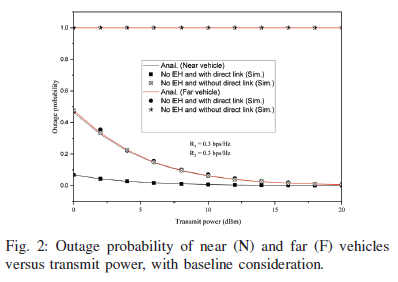
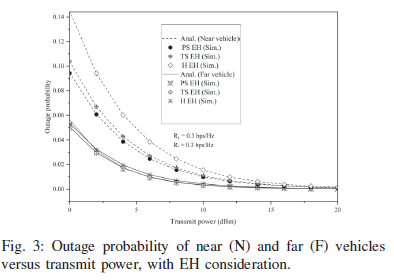
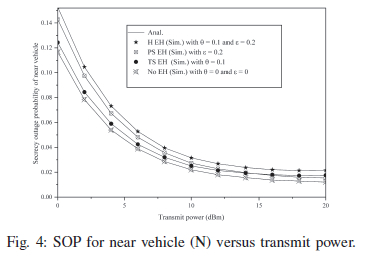
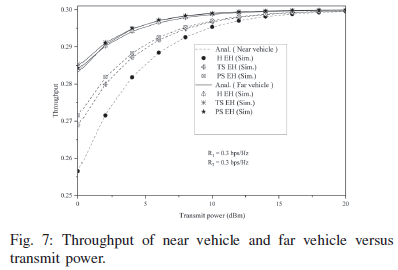
Improving the connectivity, security, and throughput of near and far vehicles in cooperative non-orthogonal multiple access (C-NOMA) communication with energy-constrained relays remains challenging, especially in the presence of eavesdropping attacks. Existing works consider a single energy harvesting (EH) without a direct link (DL) between the base station (BS) and users, thus limiting the performance for both near and far users. To address the above challenges, this study proposes a hybrid EH and secure cooperative NOMA (HSC-NOMA) framework. The near user harvests energy from the received signal and operates as an energy-constrained relay to assist the far user. In contrast, the far user employs selection combining (SC) to select the strongest signal from direct and relayed links. Closed-form expressions for outage probability (OP), secrecy outage probability (SOP), and throughput (T) are derived under perfect successive interference cancellation (SIC). Numerical results illustrate that the proposed framework improves the performance of both near and far users. Outage probabilities of around 0.003 and 0.002 are achieved for the near and far vehicles, respectively, while secrecy outage probabilities are reduced to about 0.020 and 0.090. Furthermore, the proposed approach achieves improved throughput for both vehicles. It attains a higher system throughput of nearly 0.6 (normalized value), outperforming conventional time-switching-only, power-splitting-only, and cooperative NOMA schemes without a direct link.
Non-orthogonal multiple access (NOMA); Hybrid energy harvesting (H EH); Secrecy outage probability (SOP); Sustainable development goals 9 (SDG 9): industry, innovation and infrastructure
 Thumbnail
 Thumbnail
 Thumbnail
 Thumbnail
 Thumbnail
 Thumbnail
 Thumbnail
 Thumbnail
 Thumbnail
 Thumbnail
 Thumbnail