Performance Analysis of Secure Cooperative Non Orthogonal Multiple Access and Hybrid Energy Harvesting in Vehicular Network
Abstract
Improving the connectivity, security, and throughput of near and far vehicles in cooperative non-orthogonal multiple access (C-NOMA) communication with energy-constrained relays remains challenging, especially in the presence of eavesdropping attacks. Existing works consider a single energy harvesting (EH) without a direct link (DL) between the base station (BS) and users, thus limiting the performance for both near and far users. To address the above challenges, this study proposes a hybrid EH and secure cooperative NOMA (HSC-NOMA) framework. The near user harvests energy from the received signal and operates as an energy-constrained relay to assist the far user. In contrast, the far user employs selection combining (SC) to select the strongest signal from direct and relayed links. Closed-form expressions for outage probability (OP), secrecy outage probability (SOP), and throughput (T) are derived under perfect successive interference cancellation (SIC). Numerical results illustrate that the proposed framework improves the performance of both near and far users. Outage probabilities of around 0.003 and 0.002 are achieved for the near and far vehicles, respectively, while secrecy outage probabilities are reduced to about 0.020 and 0.090. Furthermore, the proposed approach achieves improved throughput for both vehicles. It attains a higher system throughput of nearly 0.6 (normalized value), outperforming conventional time-switching-only, power-splitting-only, and cooperative NOMA schemes without a direct link.
Non-orthogonal multiple access (NOMA); Hybrid energy harvesting (H EH); Secrecy outage probability (SOP); Sustainable development goals 9 (SDG 9): industry, innovation and infrastructure
I. INTRODUCTION
Non-orthogonal multiple access (NOMA) was developed for 5th generation (5G) and beyond wireless networks to improve spectral efficiency in massive connectivity networks [1-3]. Conversely, compared with traditional orthogonal multiple access (OMA) methods, cooperative non-orthogonal multiple access (C-NOMA) allows users to share the same resource using power-domain superposition while considering cooperative mode [4-6]. Recent research in [3-5] has highlighted the imbalance in the signal-to-interference-plus-noise ratio (SINR) between near and far vehicles. Typically, far vehicles experience lower SINR than near vehicles. Furthermore, as discussed in [6-8], reducing the disparity in data transmission rates requires allocating a larger portion of power to the far vehicle [5]. However, such a power allocation process may reduce the near vehicle's performance. To improve the data rate of cell-edge vehicles while maintaining fairness, cooperative relaying can be an effective solution [9-15].
As shown in [15-17], relaying systems are energy-constrained and may quickly deplete their available power in the absence of an external energy source. Energy harvesting (EH) has therefore emerged as an important technique in 5G and beyond networks, particularly for energy-limited systems, to improve operational efficiency [16-19]. Two adopted EH techniques are power splitting (PS) and time switching (TS) [18]. The TS energy harvesting (TS EH) alternates between EH and information-decoding (ID) phases. In contrast, PS energy harvesting (PS EH) divides the received signal into power levels, enabling concurrent energy harvesting and information decoding. As demonstrated in [19], the TS protocol performs well at lower transmitted power, whereas PS is more effective at high transmitted power [19]. Considering the benefits of both techniques, hybrid energy harvesting (H EH) integrates both TS and PS protocols, yielding improved performance across diverse conditions. This hybrid scheme improves system efficiency and outperforms individual TS and PS protocols, particularly for energy-limited vehicular relays [19].
As shown in [20-22], the authors examined cooperative NOMA with energy harvesting via PS or TS methods (or without any protocol), considering the direct link to a far vehicle from the base station. Nonetheless, they overlooked an H EH method, hence constraining the system's adaptability to fluctuating energy and channel conditions in vehicle environments. According to [23-26], the authors examined a cooperative NOMA scenario, in which the relay is an unmanned aerial vehicle (UAV) that utilizes simultaneous wireless information and power transfer to transmit information. The authors exclude a link between the BS and the far vehicle, constraining potential diversity and reducing robustness in poor channel conditions. As reported in [26-33], the authors studied cooperative NOMA with energy harvesting using either the PS or TS protocol, assuming that the far user is served only via a relay with no direct link from the base station. However, the system's adaptability fails to capitalize on opportunities to enhance diversity, thereby limiting its reliability in dynamic vehicular situations. Referring to [31], the authors focused on secure communication in reconfigurable intelligent surface (RIS) assisted NOMA systems with two eavesdroppers, using deep reinforcement learning, often neglecting communication liking the base station and vehicles. This oversight induces excessive dependence through the RIS-assisted pathway, which is vulnerable to signal degradation. Similarly, authors in [32] studied full-duplex cooperative NOMA networks with multiple eavesdroppers, and the system still didn't perform well even with deep learning techniques. Note that the link between the base station and the user was excluded. Following [32-34], the authors proposed an analytical framework for cooperative NOMA in Internet of Things (IoT) wireless communication. They focused on improving energy efficiency, outage probability, and throughput, while ignoring the secrecy outage probability. Per [35], the authors examined traditional security approaches, namely cryptographic protocols, for preventing unauthorized access by eavesdroppers. However, such security mechanisms are often computationally expensive, complex to implement, and still exposed to attacks. Physical layer security (PLS) is recommended to strengthen system security as it provides additional security information for monitoring communication systems by leveraging the physical-layer dynamics of wireless channels without requiring secret-key distribution [35]. In references [36-38], the authors refer to cooperative NOMA with a full-duplex relaying system and analyzed the secrecy for performance purposes. Using power-domain non-orthogonal multiple access (P-NOMA) with pure EH improved secrecy capacity. The study in [37] introduces a control-jammer (CJ) to enhance security in a decode-and-forward relay-assisted NOMA network. This proposed CJ scheme effectively protects the privileged information against eavesdropping. Specifically, the work in [37] reduces the secrecy outage probability (SOP) with a power constraint. The authors in [39-44] investigated relay-assisted C-NOMA networks in the downlink, where either amplify-and-forward (AF) or decode-and-forward (DF) relays are used to transmit information from the base station to two users in the presence of an eavesdropper. While the AF relaying strategy increases the received SINR, its reliability performance remains inferior to that of DF relaying due to the noise amplification. In reference [45], the authors show that imperfect successive interference cancellation (SIC) leads to residual interference at the near user in downlink C-NOMA systems with decode and forward (DF) relaying. This residual interference degrades the near-user's signal decoding performance, thereby increasing the secrecy outage probability and reducing the system's secrecy performance [45]. This observation highlights the need to optimize successive interference cancellation (SIC) and power allocation. However, the study is limited by its assumption of fixed SIC parameters and the lack of analysis of advanced strategies. In [46], the authors examine RIS-assisted NOMA systems with an on-off control method to adapt to RIS deviations and improve the secrecy outage probability [23-27].
Although cooperative NOMA has been extensively studied, as indicated in the literature review, many studies rely on simplistic assumptions that present limitations. A common simplification is the assumption that the far vehicle is served only via a relay, ignoring the link between the BS and the far vehicle [28-34]. Many studies address PS and TS protocols independently or omit energy harvesting, thereby restricting the system's ability to respond to energy fluctuations and degrading overall performance as illustrated in [20-22]. Moreover, physical-layer security for C-NOMA under the influence of eavesdroppers (E) has been investigated [35-38]. However, these works neglect the direct transmission or relaying links. The impact of direct transmission in cooperative NOMA was discussed in [20-22], but hybrid energy harvesting and security were not jointly considered. Therefore, the combined effect of hybrid energy harvesting, direct transmission, and selection combining in secure cooperative NOMA systems remains insufficiently explored.
To address the limitations mentioned above, this work proposes a more comprehensive HSC-NOMA framework that includes direct link connectivity, a hybrid EH scheme integrating PS and TS protocols, and the slow-fading channel assumption. Furthermore, physical layer security has been introduced to prevent eavesdropping. Analytical formulations for outage probability (OP), secrecy outage probability (SOP), and throughput (T) are formulated under perfect SIC, showing improved reliability, security, and spectral efficiency.
The following are the major contributions of this study:
1) To propose the HSC-NOMA framework, which integrates cooperative NOMA, hybrid energy harvesting (H EH), and direct links between the base station and vehicles in the presence of an eavesdropper. The near user acts as a relay, and a selection combining (SC) is applied at the far user to enhance the performance.
2) To develop an analytical framework and to derive closed-form expressions for the outage probability (OP), secrecy outage probability (SOP), and throughput (T) for near and far vehicles and under perfect successive interference cancellation (SIC). The analysis jointly considers hybrid energy harvesting (H EH), cooperative relaying, and direct links, thereby enabling the system performance.
3) To benchmark the proposed HSC-NOMA framework against conventional baseline schemes and demonstrate significant performance gains for both near and far users. For transmitted power of 16 dBm or higher, numerical findings show that the proposed framework achieves outage probabilities (OPs) of 0.003 and 0.002 for the near and far vehicles, respectively. In contrast, the secrecy outage probabilities (SOP) are reduced to around 0.020 for the near vehicle and 0.090 for the far vehicle. Moreover, the proposed scheme achieves a higher system throughput (T) of nearly 0.6 (normalized value), outperforming time-switching-only, power-splitting-only, and cooperative NOMA schemes without direct links.
The work is structured as follows. Section II introduces the system model. Section III provides the performance analysis. Section IV presents the results analysis and discussion. Finally, Section V concludes the work and proposes future research.
II. SYSTEM MODEL
As illustrated in Fig. 1, a downlink cooperative NOMA (C-NOMA) communication system is considered, where the base station (BS) communicates with a near vehicle (V1) and a far vehicle (V2). Note that an eavesdropper (E) is connected to BS and V1. All nodes have a single antenna and use half-duplex (HD) mode. The wireless links BS-V1, BS-V2, V1-V2, BS-E, and V1-E have the following channel hsn, hsf, hnf, hse, and hne respectively [3], and note that each channel is supposed to experience Rayleigh fading. Therefore, broadcast links with channel coefficient hk with zero mean and average channel gains λk for k ∈ {sn, sf, se} are taken into account [4], [5]. Additionally, point-to-point links with channel coefficient hi with zero mean and average channel gains λi for i ∈ {nf, ne} [4]. Thus, the corresponding channel gains |hk|2 and |hi|2 follow an exponential distribution, illustrated by their probability density functions (PDF) [6].

A. Energy harvesting
The broadcast signals from BS to vehicles V1, V2 and eavesdrop (E) is given by [7]:

where xN and xF are the transmit signals, from vehicles V1 and V2, respectively. Note that hk ~ CN(0, λk) and Nk ~ CN(0, σk2), pn and pf denote the power allocation coefficient for near and far vehicles, respectively. With pn + pf = 1 and Ps is the total transmit power from the base station [7]. For simplification, it can be assumed that Nsn = Nsf = Nse = Nc. The signal received by near vehicle V1 is:

where Nc ~ CN(0, σ2) and ε is PS energy harvesting factor. The received signal ynf of the far vehicle from the cooperative link can be expressed as:

where x̂F is an estimated value of xF and Nnf is the additive white Gaussian noise equal to Nc for simplification. The power Pv is harvested from V1 to V2 and x̂F is the transmitted signal from V1 to V2 in relay link. The signal yE2, received by eavesdrop from vehicle V1 is

Note that Nne is also the additive white Gaussian noise equal to Nc, for simplification. The proposed hybrid protocol has three steps for communication. The first step concerns the TS with θT as an interval and where the relay V1 receives energy from the BS. Note that θ is the time switching coefficient with 0 < θ < 1 and T is the total transmission block time. Second step within  where V1 use PS energy harvesting with factor ε ∈ (0, 1) with 1-ε to decode the information. The last step
 is related to the transmission of a message from a near vehicle to a far vehicle. The hybrid energy harvesting (H EH) is given by the sum of energy from TS and PS,

where η is a factor defining the energy conversion. Hybrid power harvesting Pv at the near vehicle, is derived as

Introducing (5) into (6), Pv can be defined as

where b = 2V + ηε and V =  .
B. Signal-to-interference-plus-noise ratio
Following the NOMA principle, the receiver at V1 applies successive interference cancellation (SIC) by first decoding the message of vehicle V2, thereafter subtracting it from (2) to recover its own message. According to (2), the SINR (Γa) at near vehicle for recovering xF, is defined by

where  .
The received SINR (ΓSN) at the near user to decode its own information xN can be defined as

From (1), the received SINR (Γb) at V2 from direct link, is derived as

From (3), the received SINR (ΓNF) at far vehicle for detecting the signal xF from near vehicle, can be defined as

Putting (7) into (11),

Using the selection combining (SC) method, the achievable SINR of the far vehicle can be written as

During the transmission of the message from BS to V1, E has access to information xF as well as xN, and their SINR are respectively defined from (1),

While V1 transmits xF to V2, E has access to this information and the SINR (Γe) at E can be computed from (4) and (7).

III. PERFORMANCE ANALYSIS
The proposed HSC-NOMA framework is evaluated by the following main metrics: outage probability (OP), secrecy outage probability (SOP), and throughput (T).
A. Outage probability of vehicle V1
The outage probability of the near vehicle occurs when either xF can't be recovered from SIC or the signal xF is decoded successfully at the far user side while xN is not decoded correctly. Thus, the OP of the near vehicle can be computed as follows:

Considering (8) and (9) in (17), we have:

where signal to noise thresholds γ1 =  - 1, and γ2 =
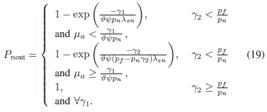
 - 1 are required to successfully recover the signals xN and xF, respectively. Transmission rates for vehicles V1 and V2 are also R1 and R2, respectively, and note that ϑ = 1 - ε. Following some mathematical changes and Pnout in (18) can be further expressed as
B. Outage probability of vehicle V2
The outage probability of V2 can be expressed as follows.

Putting (8), (10) and (11) in (20), Pfout becomes,

Consequently, Pfout can be rewritten, with conditions: X = x = |hsn|2, Y = |hsf|2 and Z = |hnf|2.

Similarly, as shown in (19), when γ2 ≥  , then Pfout = 1. For γ2 <
 , Pfout can be defined as

where ωa =  .
Considering the maximum rule and applying the complement probability theorem (23) becomes,

Through the use of the cumulative distribution function (CDF) and the probability density function (PDF) of the variable X, (24) can be written,
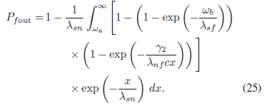
with ωb =  and c = ψ(2V + ηε) (for hybrid energy harvesting) and where V = 0 and ε = 0 correspond to power splitting and time switching protocols, respectively [6]. After some manipulation, Pfout is given by the following expression,

Due to the analytical constraints provided by Rayleigh fading and the interaction of hybrid energy harvesting with cooperative NOMA, there is no closed-form expression for the integral in (26). Thus, numerical approaches are used for assessment, and the findings are verified using Monte Carlo simulations.
C. Secrecy outage probability of vehicle V1
The SOP shows the probability that an E successfully decodes the transmitted message. The amount of secure communication that may be performed when an E is present is defined as the secrecy capacity (SCn). It can be formulated for V1 as
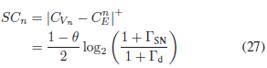
where CVn =  log2(1 + ΓSN) and CEn =
 log2(1 + Γd), CVn is the link capacity of V1 and CEn is the link capacity of E to access xN information. The SOP of at vehicle V1 is defined as

with R3 denoting the secrecy target rate threshold for decoding xN. Putting (27) into (28), the following is obtained,
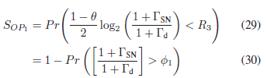
where ϕ1 =  . Inserting expressions (9) and (15) in (30),

where ϕ2 = ϕ1 - 1, k1 = pnψ(1 - ε) and k2 = ϕ1pnψ.
Let us consider U as a function of two random variables U = k1|hsn|2 - k2|hse|2, and its CDF is,

with X = |hsn|2, W = |hse|2 and for u > 0.
Using Leibniz's rule of integration, the PDF of the variable U may be defined as

With X and W as independent random variables, (33) can be expressed as
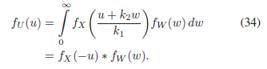
With exponential distribution random variables applied in (34), and after some computation, the PDF of U is reduced to

with k3 = k2λse, k4 = k1λsn and k5 = k1 / (k3 + k4).
From expression (32),

Substituting (35) into (36), and after some calculation, the secrecy outage probability of vehicle V1 is finally expressed as

D. Secrecy outage probability of vehicle V2
Let us consider the high-level signal for reducing the complexity of the proposed method, and the maximum ratio combining (MRC) is taken into account. With (10), (11), (14), and (16), the derivation of the SCf for the far vehicle can be formulated as follows.

in which CVf and CEf indicate the link capacity of V2 and the link capacity of E to access xF information, respectively. Thus, the SOP of vehicle V2 can be defined,

where R4 is the required secrecy target rate to decode xF. Based on (38) and (39), SOP2 can be deduced as

where δ1 is the secrecy target threshold to decode xF, δ1 =  and δ2 = (1 +
 )(δ1 - 1).

where q1 = ψb and q2 = δ1bψ.
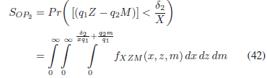
with X = |hsn|2, Z = |hnf|2, and M = |hne|2. These random variables are independent; thus, (42) becomes,

From (43), let us integrate with respect to z (I1),

Similarly, when integrating with respect to m, the result is as follows,

where 
After some mathematical manipulations, I2 can be written as

Integrating with respect to x and referring to (44) and (46), the SOP of the far vehicle V2 is given by [3],

With reference to [47, Eq. (3.324.1)], the above expression becomes,
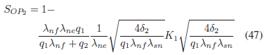
where K1 is the modified Bessel function.
E. Throughput analysis
In this subsection, the downlink throughput for C-NOMA is analyzed,

where Tn and Tf are the throughput of vehicles V1 and V2 respectively. Expressions of Pnout and Pfout are given in (19) and (26), respectively.
IV. NUMERICAL AND SIMULATION RESULTS
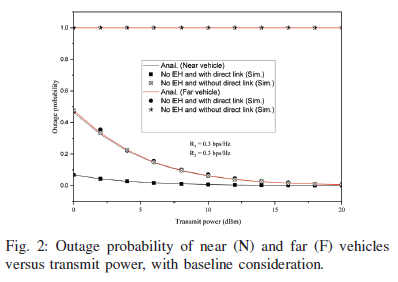
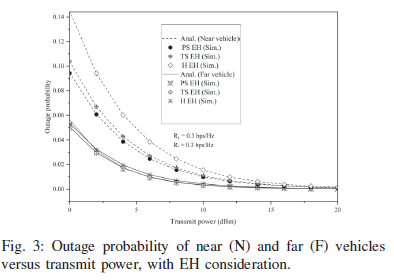
This section presents numerical results from Monte Carlo simulations using MATLAB and Python. The simulation parameters follow [23-25]. The normalized distance between the base station (BS) and near vehicle V1 is set to 3, while the distance between the BS and far vehicle V2 is 10. The power allocation ratio for the near vehicle and the power-splitting ratio are 0.1 and 0.3, respectively. The energy conversion for the energy harvesting (EH) is η = 0.7. The number of Monte Carlo realizations is 106, the bandwidth is 1 MHz, and the received noise power is around -100 dBm. The target data rates for both vehicles are set to 0.3 bps/Hz. The numerical results match the simulations, validating the theoretical results. The outage probability is evaluated as a function of transmit power (dBm) under three baselines: without EH and without a direct link (DL), without EH but with a direct link, and with both EH and a direct link. The first two baselines are presented in Fig. 2, while the third scenario relative to the proposed method is illustrated in Fig. 3.


Fig. 2 shows that without a direct link and energy harvesting, the outage probability of the far vehicle degrades even with increased transmission power. Two scenarios are considered to reduce the outage probability (OP) for the far vehicle. Without the direct link, the outage probability of the far vehicle is very high and remains constant at 1, indicating the direct link's greatest contribution. When integrating the direct link, the outage probability (OP) of the far vehicle decreases from 1 to nearly 0.5 for a transmit power of 0 dBm. The outage probability drops below 0.1 when the transmit power increases from 0 to 20 dBm, which indicates a significant improvement of the proposed framework. The near and far vehicles achieve good performance at higher transmit power, even without energy harvesting. Their outage probabilities are very low and converge to zero. Particularly, for a near vehicle, a significant improvement is achieved, as its outage probability tends toward zero, even in the absence of direct or relay links and at lower transmit power. This is because no power is used for harvesting; all power is fully utilized for information transmission at the near vehicle.
As shown in Fig. 3, this scenario involves integrating cooperative NOMA with energy-harvesting considerations (e.g., TS, PS, and H EH). The outage probability of the far vehicle is lower than that of a near vehicle at low transmit power levels. The SINR of the near vehicle decreases because a portion of the power it receives intended for information transmission is diverted to energy-harvesting (EH) relaying. But for transmitted power greater than 16 dBm, the outage probability for all vehicles is around 0. When adjusting the PS and TS ratios to ε = 0.2 and θ = 0.1, respectively, the performance of the proposed framework significantly improves compared to the system with PS or TS considered separately.
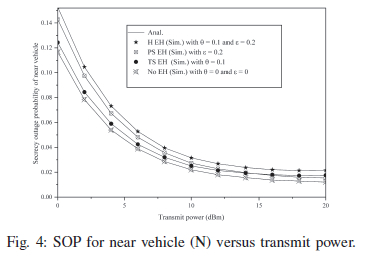
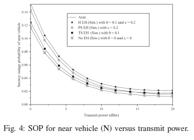
As shown in Fig. 4, the SOP for the near vehicle decreases across all EH-related schemes. The secrecy outage probability decreases while the transmitted power increases (from 0 to 20 dBm), demonstrating that higher transmit power improves the signal quality of legitimate users, whereas the eavesdropper. A lower data rate threshold corresponds to a lower SOP, whereas higher thresholds lead to larger SOP, particularly at low transmit power levels. Therefore, increasing transmit power improves the overall SOP performance regardless of the selected data-rate threshold.
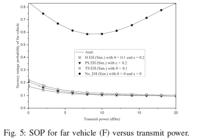
As shown in Fig. 5, without EH, the far vehicle's SOP is very high, resulting in poor transmission performance. When the time-switching (TS) protocol is used, the SOP decreases with increasing transmit power; however, it remains higher than that of the power-splitting (PS) and hybrid schemes (HS). The TS energy-harvesting allocates a portion of its transmission time to harvesting, while reducing the time available for transmitting information. The performance of PS EH is improved by EH and information decoding, enabling more efficient energy use and a lower secrecy outage probability. By combining TS and PS, the hybrid scheme (HS) achieves the best secrecy performance, achieving the lowest SOP through all given transmit power values. This demonstrates that the hybrid approach improves the reliability and security for the far and near vehicles compared to conventional EH schemes and a baseline without EH. With the hybrid EH protocol, the proposed HSC-NOMA framework is more secure compared to TS and PS EH.
As shown in Fig. 6, the consideration of a direct link between BS and the far vehicle reduces the secrecy outage probability (SOP) across all transmit power levels compared to the system without such a link. This improvement arises because V2 benefits from selecting the stronger signal along the direct and cooperative paths, thereby improving the overall secrecy outage probability. As a result, the direct link improves the network's security and reliability by providing an additional communication path to the far vehicle. Additionally, to improve the overall system's performance, the hybrid energy harvesting (H EH) mode is employed with carefully selected parameter values of θ = 0.1 and ρ = 0.2. At transmit power levels of 16.5 dBm and above, the secrecy outage probability (SOP) decreases to 0.025 for vehicle V1 and 0.095 for vehicle V2, demonstrating a significant improvement offered by the proposed HSC-NOMA framework.

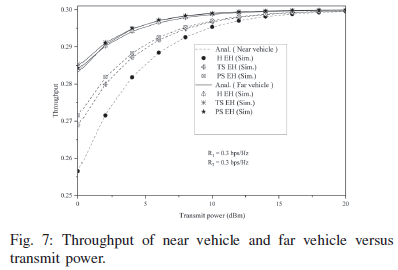
As shown in Fig. 7, at transmit power levels above 16 dB, throughput increases for both near and far vehicles to approximately 0.30. At transmit power below 16 dBm, the far vehicle outperforms the near vehicle in throughput, indicating that the system performs well for both vehicles at lower or higher transmit power.

V. CONCLUSION AND FUTURE WORK
The proposed HSC-NOMA framework integrates a secure cooperative NOMA with hybrid energy harvesting and a direct link, in which the near vehicle operates as an energy-harvesting relay. The results show significant improvement for the overall system (near and far vehicles). The proposed HSC-NOMA framework improves the performance by reducing the outage probability to around 0.003 and 0.002 for near and far vehicles, respectively. These results indicate that the proposed method improves reliability compared to conventional baselines, with TS and/or PS, without a direct link. The secrecy outage probability decreased to about 0.020 for the near user and 0.090 for the far user, showing improved resistance against eavesdropping. The HSC-NOMA framework also improves system throughput to around 0.6 (normalized value). Future work will focus on dynamic optimization of TS and PS ratios in real time to improve the performance.
Data Availability Statement: All data supporting this study are included within this research; no external datasets were used.
REFERENCES
- [1] Q. S. Ahmad et al., "Achievable Sum Rate Analysis for Moving Relay-Assisted Cooperative NOMA System over Rician Fading Channels," IEEE Access, vol. 13, pp. 29778-29788, Feb. 2025.
- [2] K. M. Rabie, "Performance Analysis of Cooperative NOMA Networks over Compound Fading Channels," IEEE Access, vol. 4, pp. 1-10, May 2026.
- [3] M. Imran et al., "Investigating Low Latency Communications With Link-Layer Rate of NOMA Under Nakagami-m Fading Channel in Finite Blocklength Regime," IEEE Access, vol. 13, pp. 24237-24250, Jan. 2025.
- [4] A. Amhaz et al., "Integrated Sensing and Communication: NOMA vs Cooperative NOMA," in Proc. IEEE Global Communications Conference: Next-Generation Networking and Internet, Kuala Lumpur, Malaysia, Dec. 2023, pp. 407-412.
- [5] M.C. Mayarakaca and B.M. Lee, "A Survey on Non-Orthogonal Multiple Access for Unmanned Aerial Vehicle Networks: Machine Learning Approach," IEEE Access, vol. 12, pp. 51138-51165, Mar. 2024.
- [6] M. Imran et al., "Investigating Low Latency Communications With Link-Layer Rate of NOMA Under Nakagami-m Fading Channel in Finite Blocklength Regime," IEEE Access, vol. 13, pp. 24237-24250, Jan. 2025.
- [7] W. Huang et al., "Energy Efficiency in Hybrid NOMA-MEC Networks," IEEE Trans. wireless Commun., pp. 1-14, Mar. 2025.
- [8] Y. Pramitarini et al., "Opportunistic Scheduling Scheme to Improve Physical-Layer Security in Cooperative NOMA System: Performance Analysis and Deep Learning Design," IEEE Access, vol. 12, pp. 58454-58472, Apr. 2024.
- [9] S. P. Indraganti et al., "Survey of Cooperative NOMA for Beyond 5G: State-of-the-Art, Applications and Research Directions," IEEE Open J. Commun. Soc., pp. 40-94, Jan. 2026.
- [11] A. Mukherjee et al., "Performance of Novel Adaptive Schemes for Cognitive Full-Duplex Relaying-Based Downlink Cooperative NOMA," IEEE Trans. Veh. Technol., vol. 73, no. 6, pp. 3161-3179, May. 2023.
- [12] A. Le et al., "Power Beacon and NOMA-Assisted Cooperative IoT Networks With Co-Channel Interference: Performance Analysis and Deep Learning Evaluation," IEEE Trans. Mob. Comput., vol. 23, no. 6, pp. 7270-7283, Jun. 2024.
- [13] B. Zhuo et al., "P-NOMA for Pinching-Antenna Systems (PASS)," IEEE Wireless Commun. Lett., vol. 15, no. 1, pp. 131-135, Mar. 2026.
- [14] Y. Lou et al., "Sum Secrecy Rate Maximization in Movable Antenna-Assisted NOMA Secure Transmission Systems," IEEE Trans. Wireless Commun., vol. 25, no. 1, pp. 13011-13024, Mar. 2026.
- [16] A. S. Parihar et al., "On Performance of SWIPT Empowered NOMA-HetNet with Non-Linear Energy Harvesting," in Proc. IEEE National Conference on Communications (NCC), Chennai, India, Apr. 2024, pp. 1-6.
- [17] A. K. Baranwal, S. D. Roy and S. Kundu, "Performance Analysis of Full-Duplex Cooperative NOMA with Power-Time Splitting Based Energy Harvesting," in Proc. IEEE International Conference on Computing and Communication Systems (I3CS), Shillong, India, May. 2023, pp. 1-6.
- [18] C. Zhai et al., "Wireless Powered Cooperative NOMA With Alamouti Coding and Selection Relaying," IEEE Trans. Mob. Comput., vol. 23, no. 2, pp. 1366-1381, jul. 2024.
- [19] V. N. Vo et al., "Performance optimization for hybrid TS/PS SWIPT UAV in cooperative NOMA IoT networks," ELSEVIER, Alexandria Engineering, no. 107, pp. 559-567, jul. 2024.
- [20] M. Bakshi, B. Lall and R. K. Mallik, "Performance of Full-Duplex Cooperative NOMA Network With Direct Link And Battery-Assisted Non-Linear Energy Harvesting Near User," in Proc. IEEE Open Journal of the Communications Society (COMMSOC), New Delhi, India, Jun. 2024, pp. 1-19.
- [21] Q. S. Ahmad et al., "Achievable Sum Rate Analysis for Moving Relay Assisted Cooperative NOMA System Over Rician Fading Channels," IEEE Access, vol. 13, pp. 29778-29788, Feb. 2025.
- [23] R. Bajpai et al., "Wireless Powered NOMA Assisted Full-Duplex Cooperative U2U Communications System With Fluctuating Two-Ray Channel," IEEE Access, vol. 13, pp. 54068-54079, Apr. 2025.
- [24] H. Q. Ta et al., "Zero-Outage Secrecy in Short Packet IoT-Aided Cellular Cooperative Network With EH-NOMA," IEEE Access, vol. 13, pp. 75235-75245, May. 2025.
- [25] Y. He et al., "Outage Probability Analysis of MISO-NOMA Downlink Communications in UAV-Assisted Agri-IoT With SWIPT and TAS Enhancement," IEEE Trans. Veh. Technol., vol. 12, no. 4, pp. 2151-2164, Apr. 2025.
- [26] M. M Salim et al., "Cooperative NOMA Meets Emerging Technologies: A Survey for Next-Generation Wireless Networks," arXiv preprint arXiv:2505.16327, May. 2025.
- [27] T. Li et al., "Design of Relay Selection Schemes for Uplink Cooperative NOMA Over Nakagami-m Fading," IEEE Trans. Veh. Technol., vol. 12, no. 4, pp. 1-15, Jan. 2025.
- [28] G. W. Machani and T. Malingo, "Cooperative Spectrum Sensing and Sharing in PD-NOMA Cognitive Radio Networks," IEEE Access, vol. 14, no. 2, pp. 2592-2606, Jan. 2026.
- [29] Z. Yang et al., "Delay and Energy Minimization for Cooperative NOMA-MEC Networks With SWIPT Aided by RIS," IEEE Trans. Veh. Technol., vol. 73, no. 4, pp. 5321-5334, Apr. 2024.
- [30] B.P. Chaudhary and R. K. MishraN, "Performance Analysis of SWIPT Cooperative-NOMA Over Rayleigh Fading Channel," in Proc. IEEE International Conference on Computer and Automation Engineering (ICCAE), Sydney, Australia, May. 2023, pp. 78-85.
- [31] X. Qin et al., "Deep-Reinforcement-Learning-Based Uplink Security Enhancement for STAR-RIS-Assisted NOMA Systems With Dual Eavesdroppers," IEEE Internet Things J., vol. 11, no. 17, pp. 28050-28063, Sept. 2024.
- [32] T. Nimi, A. Babu, "Full-Duplex Cooperative NOMA Network with Multiple Eavesdroppers and Non-ideal System Imperfections: Analysis of Physical Layer Security and Validation Using Deep Learning," IEEE Trans. Veh. Technol., vol. 12, pp. 1-16, Jul. 2024.
- [33] V. N. Nayak et al., "Joint Covert and Secure Communication for SWIPT Assisted CNOMA Systems," in Proc. IEEE Internet of Things Journal, Visakhapatnam, India, Feb. 2025, pp. 1-13.
- [34] R. Bajpai et al., "NOMA and Millimeter-Wave-Assisted SWIPT for Full-Duplex Cooperative D2D Communications," IEEE Access, vol. 13, pp. 42254-42261, Feb. 2025.
- [35] N. Ashraf et al., "Performance Analysis of SWIPT-Assisted Cooperative NOMA Network With Non-Linear EH, Interference, and Imperfect SIC," IEEE Access, vol. 13, pp. 77481-77492, Apr. 2025.
- [36] H. Q. Tran et al., "A Comprehensive Analytical Framework under Practical Constraints for a Cooperative NOMA System Empowered by SWIPT IoT," Mathematics, vol. 25, no. 4, pp. 1-15, 2024.
- [37] K. Wang and M. Cheng, "Successive Refinement Coding and SWIPT for Energy-Efficient Cooperative NOMA Systems," IEEE Trans. Broadcast., vol. 72, no. 1, pp. 382-386, Mar. 2026.
- [39] S.D Roy et al., "Secrecy Outage Analysis of Energy Harvesting Enabled Two User Cooperative NOMA," in Proc. IEEE International Conference on Recent Advances in Information Technology (RAIT), Dhanbad, India, May. 2023, pp. 1-6.
- [41] V. N. Nayak et al., "SOP Minimization in Cooperative Relay-Based NOMA Network with Control Jammer," in Proc. IEEE Wireless Antenna and Microwave Symposium (WAMS), Visakhapatnam, India, May. 2024, pp. 1-6.
- [42] B. Jain et al., "Secrecy Outage Probability of NOMA Network under Amplify and Forward Scheme," in Proc. IEEE International Conference on Device Intelligence, Computing and Communication Technologies, (DICCT), Dehradun, India, May. 2023, pp. 1-6.
- [43] W. Guo, X. Wang, "Power Allocation for Secure NOMA Network Based on Q-Learning," IEEE Access, vol. 12, pp. 58454-58472, Apr. 2024.
- [44] T. T. Nguyen et al., "A Low-Complexity Relaying Protocol for Cooperative Short-Packet NOMA-Based Spectrum Sharing Systems," IEEE Trans. Veh. Technol., vol. 73, no. 6, pp. 9044-9049, Jun. 2024.