Challenges and complexities in evaluating severe acute respiratory syndrome coronavirus 2 molecular diagnostics during the COVID-19 pandemic
Background
Severe acute respiratory syndrome coronavirus 2 (SARS-CoV-2), the causative agent of coronavirus disease 2019 (COVID-19), was first identified in Wuhan, China, in December 2019.12345678,9
Complexities of NAAT selection
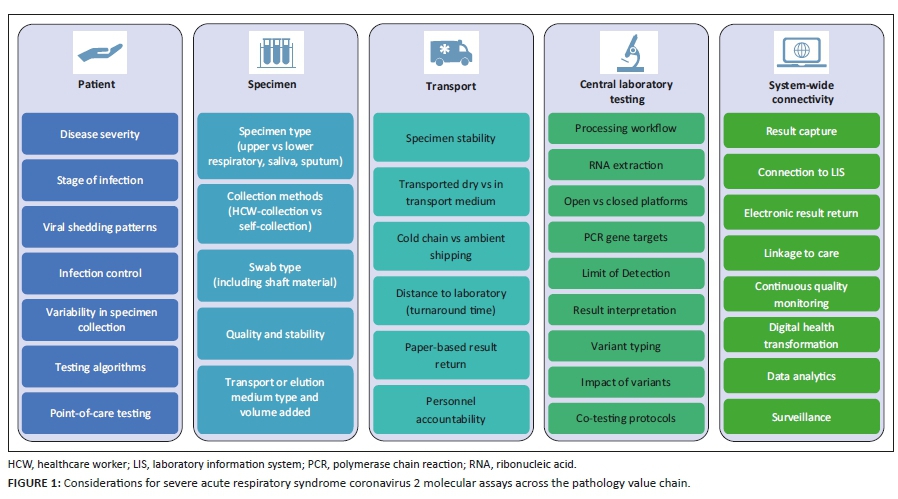
The entire pathology value chain needs to be considered when selecting suitable NAATs. Each step contributes to meaningful and valid test results: patient sampling, specimen type, specimen collection and handling (stability), viral RNA purification, amplification and detection, and result interpretation (Figure 1). Specimen collection and handling challenges include swab type, collection site, collection and pre-treatment methods, and transport. Swabs are manufactured from different materials (cotton, nylon, polyester, rayon and foam) and may be spun or flocked.10,11 Thus, swabs differ in absorption properties, viral capture and release. Swab shafts may be made from wood, plastic or aluminium, and some of these materials are incompatible with certain collection and laboratory techniques (e.g. wooden shafts are unsuitable for paediatric sampling and may inhibit NAAT).10
Viral RNA extraction (or purification) is prone to variability. The majority of RNA purification methods rely on automated magnetic bead extraction performed on automated platforms (e.g. NucliSENS® EasyMag® [bioMérieux, Johannesburg, South Africa]). These differ in processing capacity, input volume, purified RNA elution yield and turnaround time (TAT). Manual methods range from spin columns (e.g. RNeasy Mini Spin [Qiagen, Hilden, Germany]), which rely on centrifugation, to crude approaches that are used where no extraction instrumentation is available. The latter include direct lysis-to-polymerase chain reaction (PCR) kits (e.g. Lyra® Direct SARS-CoV-2 Assay [Quidel®, San Diego, California, United States]), proprietary lysis buffers (e.g. Bosphore EX-Tract Dry Swab RNA [Anatolia Geneworks, Istanbul, Turkey]) or simply heat (where rapid sample preparation is needed).12® Xpress® SARS-CoV-2 cartridge (Cepheid, Sunnyvale, California, United States), 400 µL to the cobas® SARS-CoV-2 assay (Roche, Basel, Switzer;and) and 500 µL to the RealTime SARS-CoV-2 assay (Abbott, Chicago, Illinois, United States). Similarly, most RNA extraction platforms require input of anywhere between 100 µL and 300 µL of raw specimen. Furthermore, for a direct lysis-to-PCR assay, input volume can range from 10 µL preservation buffer (NaGene [Diagnóstica Longwood, Zaragoza, Spain]) to 30 µL raw specimen (SMARTCHEK®), and ideally the patient swab should be added directly to the proprietary medium.
The NAATs used are also variable. They are performed on a variety of platforms that may be closed (dedicated) (e.g. m2000® [Abbott, Chicago, Illinois, United States]) or open ('plug-and-play' approach subsequent to extraction using different systems and instruments). The latter requires compatibility with real-time thermocycler instruments (e.g. CFX96 Touch™ [BioRad, Hercules, California, United States], QuantStudio [Thermo Fisher Scientific, Waltham, Massachusetts, United States]). Throughput ranges from a single test at a time (e.g. GeneXpert® [Cepheid, Sunnyvale, California, United States]) to 1000-1500/day (e.g. Cobas® [Roche, Basel, Switzerland]). Many of the open-platform thermocyclers use 96-well plates and may require specimen batching. As with specimen input volume, the RNA input volume also varies between assays (e.g. 8 µL for the AllPlex SARS-CoV-2 assay [SeeGene, Seoul, South Korea], 10 µL for the TaqPath™ SARS-CoV-2 assay [Thermo Fisher Scientific, Waltham, Massachusetts, United States], and 14 µL for the PerkinElmer™ SARS-CoV-2 RT-qPCR Reagent Kit CE-IVD [PerkinElmer™, Waltham, Massachusetts, United States]. A number of novel assays have RNA input volumes as low as 5 µL. The differences in volume for extraction or PCR may influence theoretical limits of detection.
In addition to these complexities, the SARS-CoV-2 genes (envelope [E], nucleocapsid [N], spike [S], membrane [M], open reading frames 1a and 1b [ORF1ab], RNAse-dependent RNA polymerase [RdRP]) or combination of genes targeted by NAAT are inconsistent. These have been reported to affect overall assay sensitivity and specificity,13,1415
Challenges of robust and rapid NAAT evaluations
The complex variables described above come to the fore when clear, comparative standardised evaluations are conducted. Such evaluations generally had to be performed in parallel with managing COVID-19 testing emergencies. In our case, the most challenging issue experienced early in the pandemic was access to sufficient numbers of relevant clinical specimens available for inclusion in evaluation challenge panels. The volume of extracted RNA per specimen was often only sufficient to test a limited number of NAATs. Thus, constant panel 'manufacture' was required, with the potential to introduce variability (e.g. different specimens) across evaluations. The sample size, the numbers of positive and negative panel specimens, and the range in viral concentration (high, medium or low) of challenge specimens may influence sensitivity scores. The last addresses the need for assays to correctly identify differences in patient risk stratification: while there does not appear to be a difference in median Ct between symptomatic and asymptomatic patients,1616,1717,18
The impact of SARS-CoV-2 variants on technologies15S gene target failure of the TaqPath SARS-CoV-2 assay [Thermo Fisher Scientific, Waltham, Massachusetts, United States] with the Alpha1920
In addition to clinical specimens, several types of reference materials (plasmids, biomimetic standards, or viable, inactivated or lysed virus) have become commercially available (e.g. AccuPlex™ SARS-CoV-2 Reference Material Kit [SeraCare, Milford, Massachusetts, United States]), although these may not always be compatible with NAAT primer or probe sequences. Access to locally manufactured SARS-CoV-2 viral culture supernatant is an asset to expanding an evaluation panel, independent of NAAT target genes. Culture dilutions may be used to measure assay precision, linearity and, potentially, the limit of detection. Another limitation is often kit size, where only a limited number of specimens can be tested per kit supplied or where single-plex PCR assays limit the number of specimens in a test run (e.g. single-plex with 3 gene targets can only assess 32 specimens per 96-well RNA extraction plate including controls).
Other considerations determined during performance evaluation are assay ease of use, time to reportable result and throughput. General considerations, often listed in a TPP are: testing footprint, number of testing steps, operator skills required to perform the test, minimum pipetting volume, biosafety requirements, internal controls, positive and negative batch controls, reagent storage stability, reagent reconstitution required, training needs, maintenance, additional consumables and connectivity options, to name a few. Moreover, it is important to select suitable comparator technology, a limitation also described by Axell-House et al.21
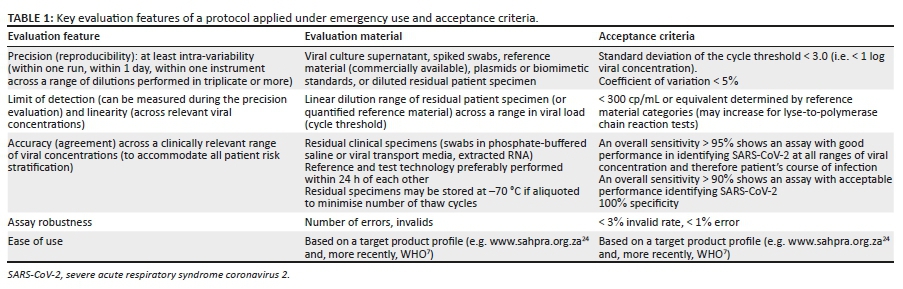
Once an evaluation is completed, method comparison involves determining accuracy (sensitivity and specificity) or agreement, precision (reproducibility), linearity and limit of detection. Recommendations are made based on analytical performance, as well as ease of use. In the absence of acceptance criteria guidelines, we investigated these parameters for an initial 24 assays using a standardised evaluation protocol approach as described in Table 1. Over and above the already mentioned complexities and challenges, it became apparent that single method comparison acceptance criteria might not be applicable to all assays. We identified four types or categories of assays submitted for evaluation: (1) closed systems (incorporating RNA extraction and NAAT), (2) standalone PCR kits to be performed off already purified RNA, (3) direct lyse-to-PCR, where no front-end RNA purification or extraction is available or where there is a need for rapid testing, and (4) standalone RNA extraction or purification kits. The 24 assays were among groups 1 (n = 9), 2 (n = 12) and 3 (n = 3), with the predominant viral gene targets being N (35.0%), followed by ORF1ab (25.0%), E (20%), S (10.0%) and RdRp (10.0%). A sensitivity score of > 90% was achieved by 62.5% (15/24) of assays and > 95% sensitivity achieved by 37.5% (9/24) compared to SOC. Those that employ direct lyse-to-PCR (group 3) were below the acceptance criteria by at least a 20% drop in median sensitivity (72.0%) compared to the median sensitivity in group 1 (95%) and group 2 (92.0%). The clinical specimens used in these assays' evaluation panels covered a range in SARS-CoV-2 VL, with a median target Ct = 27. Group 3 performed well on specimens with high VL (Ct < 30), and hence another challenge is not only in the choice of range in clinical specimens being evaluated, but potentially the need to apply different acceptance criteria, bearing in mind that group 3 assays are designed for use where no front-end RNA extraction (or rapid) system is available. The reduced sensitivity needs to be weighed against the rapid availability of a result which would likely identify patients who are newly symptomatic and at the height of being infectious. Therefore, the diagnostic dilemma facing regulators and end users could be 'no available test' or 'specimens routed a further distance (with ensuing longer TAT) to a testing laboratory with access to front-end RNA extraction technology', or a 'less sensitive test with potentially shorter TAT and greater clinical relevance'.
Conclusion
Selecting clinically relevant, laboratory-compatible and well-performing SARS-CoV-2 NAAT assays or systems for patient care is complex and subject to several challenges, as also highlighted elsewhere.9,22 Current evaluation protocols are not robustly performed under emergency circumstances,2123
Competing interests
The authors declare that they have no financial or personal relationships that may have inappropriately influenced them in writing this article.
Authors' contributions
L.E.S., L.D.N., A.S.-M., T.K., D.R.H., W.P. and W.S.S. contributed equally to the design and implementation of the research, to the analysis of the results and to the writing of the article.
Ethical considerations
The use of residual blood, swab and universal transport medium specimens for research and development of molecular and serology assays for SARS-CoV-2 was approved by the University of the Witwatersrand Human Research Ethics Committee (Medical): M1911201.
Sources of support
W.S.S., L.E.S., L.D.N. and T.K. are supported by funding received from the Bill and Melinda Gates Foundation through the Innovation in Laboratory Engineered Accelerated Diagnostics investment (grant number OPP1171455).
Data availability
Data sharing is not applicable to this article as no new data were created or analysed in this study.
Disclaimer
The views and opinions expressed in this article are those of the authors and do not necessarily reflect the official policy or position of any affiliated agency of the authors.
Acknowledgements
Network of evaluating laboratories: National Health Laboratory Service (Lucia Hans, Kim Steegen, Irene Ketseoglou, Puleng Marokane, Pedro Da Silva, Somayya Sarang, Koleka Mlisana), National Institute of Communicable Diseases (Olga Perovic, Mignon Du Plessis), Clinical Laboratory Service (Blessing Kadira, Lyndel Singh, Timothy Moshema). Developers of viral culture stock: Universities of Stellenbosch and the Western Cape (Tasnim Suliman), National Health Laboratory Service (Bavesh Kana, Bhavna Gordhan) and Harsha Desai and Mohapi Mokone (programme managers engaging with suppliers and regulators).
References
-
1. Zhu N, Zhang D, Wang W, et al. A novel coronavirus from patients with pneumonia in China, 2019. New Engl J Med. 2020;382(8):727-733. https://doi.org/10.1056/NEJMoa2001017
» https://doi.org/10.1056/NEJMoa2001017 -
2. World Health Organization. WHO Director-General's opening remarks at the media briefing on COVID-19 - 11 March 2020 [homepage on the Internet]. 2020 [cited 2020 Apr 2]. Available from: https://www.who.int/director-general/speeches/detail/who-director-general-s-opening-remarks-at-the-media-briefing-on-covid-19---11-march-2020
» https://www.who.int/director-general/speeches/detail/who-director-general-s-opening-remarks-at-the-media-briefing-on-covid-19---11-march-2020 -
3. Center for Systems Science and Engineering (CSSE) at Johns Hopkins University (JHU). COVID-19 dashboard [homepage on the Internet]. © 2022 [cited 2021 Dec 31]. Available from: https://coronavirus.jhu.edu/map.html
» https://coronavirus.jhu.edu/map.html -
4. Foundation for Innovative Diagnostics (FIND). COVID-19 test directory [homepage on the Internet]. © 2022 [cited 2021 Dec 28]. Available from: https://www.finddx.org/test-directory/
» https://www.finddx.org/test-directory/ -
5. Shuren J, Stenzel T. Covid-19 molecular diagnostic testing - Lessons learned. N Engl J Med. 2020;383:e97. https://doi.org/10.1056/NEJMp2023830
» https://doi.org/10.1056/NEJMp2023830 -
6. FIND Dx. SARS-CoV-2 molecular assay evaluation results (3 July 2020) [homepage on the Internet]. 2020 [cited 2020 Jul 27]. Available from: https://www.finddx.org/covid-19/sarscov2-eval-molecular/molecular-eval-results/
» https://www.finddx.org/covid-19/sarscov2-eval-molecular/molecular-eval-results/ -
7. World Health Organization. COVID-19 target product profiles for priority diagnostics to support response to the COVID-19 pandemic v.0.1 [homepage on the Internet]. 2020 [cited 2020 Aug 08]. Available from: https://www.who.int/publications/m/item/covid-19-target-product-profiles-for-priority-diagnostics-to-support-response-to-the-covid-19-pandemic-v.0.1
» https://www.who.int/publications/m/item/covid-19-target-product-profiles-for-priority-diagnostics-to-support-response-to-the-covid-19-pandemic-v.0.1 -
8. Feng W, Newbigging AM, Le C, et al. Molecular diagnosis of COVID-19: Challenges and research needs. Anal Chem. 2020;92(15):10196-10209. https://doi.org/10.1021/acs.analchem.0c02060
» https://doi.org/10.1021/acs.analchem.0c02060 -
9. Vandenberg O, Martiny D, Rochas O, Van Belkum A, Kozlakidis Z. Considerations for diagnostic COVID-19 tests. Nat Rev Microbiol. 2021;19(3):171-183. https://doi.org/10.1038/s41579-020-00461-z
» https://doi.org/10.1038/s41579-020-00461-z -
10. Public Health England. Guidance COVID-19: Guidance on alternative swab types and transport media [homepage on the Internet]. [cited 2021 Dec 22]. Available from: https://www.gov.uk/government/publications/wuhan-novel-coronavirus-guidance-for-clinical-diagnostic-laboratories/covid-19-guidance-for-alternative-swab-types-and-transport-media
» https://www.gov.uk/government/publications/wuhan-novel-coronavirus-guidance-for-clinical-diagnostic-laboratories/covid-19-guidance-for-alternative-swab-types-and-transport-media -
11. Kahamba TR, Noble L, Stevens W, Scott L. Comparison of three nasopharyngeal swab types and the impact of physiochemical properties for optimal SARS-CoV-2 detection. J Vaccines Vaccin. 2020;S6:005. https://doi.org/10.1101/2020.10.21.20206078
» https://doi.org/10.1101/2020.10.21.20206078 -
12. Marais G, Naidoo M, Hsiao N-Y, Valley-Omar Z, Smuts H, Hardie D. The implementation of a rapid sample preparation method for the detection of SARS-CoV-2 in a diagnostic laboratory in South Africa 2020. PLoS One. 2020 Oct 20;15(10):e0241029. https://doi.org/10.1371/journal.pone.0241029. eCollection 2020
» https://doi.org/10.1371/journal.pone.0241029 -
13. Li D, Zhang J, Li J. Primer design for quantitative real-time PCR for the emerging Coronavirus SARS-CoV-2. Theranostics. 2020;10(16):7150-7162. https://doi.org/10.7150/thno.47649
» https://doi.org/10.7150/thno.47649 -
14. Gand M, Vanneste K, Thomas I, et al. Use of whole genome sequencing data for a first in silico specificity evaluation of the RT-qPCR assays used for SARS-CoV-2 detection. Int J Mol Sci. 2020;21(15):5585. https://doi.org/10.3390/ijms21155585
» https://doi.org/10.3390/ijms21155585 -
15. World Health Organization. Tracking SARS-CoV-2 variants [homepage on the Internet]. 2020 [cited 2021 Dec 17]. Available from: https://www.who.int/en/activities/tracking-SARS-CoV-2-variants/
» https://www.who.int/en/activities/tracking-SARS-CoV-2-variants/ -
16. Singanayagam A, Patel M, Charlett A, et al. Duration of infectiousness and correlation with RT-PCR cycle threshold values in cases of COVID-19, England, January to May 2020. Euro Surveill. 2020;25(32):pii=2001483. https://doi.org/10.2807/1560-7917.ES.2020.25.32.2001483
» https://doi.org/10.2807/1560-7917.ES.2020.25.32.2001483 -
17. Rao SN, Manissero D, Steele VR, Pareja J. A systematic review of the clinical utility of cycle threshold values in the context of COVID-19. Infect Dis Ther. 2020;9(3):573-586. https://doi.org/10.1007/s40121-020-00324-3
» https://doi.org/10.1007/s40121-020-00324-3 -
18. Prebensen C, Hre PLM, Jonassen C, et al. SARS-CoV-2 RNA in plasma is associated with ICU admission and mortality in patients hospitalized with COVID-19. Clin Infect Dis. 2020;73(3):e799-e802. https://doi.org/10.1093/cid/ciaa1338
» https://doi.org/10.1093/cid/ciaa1338 -
19. European Centres for Disease Prevention and Control. Rapid increase of a SARS-CoV-2 variant with multiple spike protein mutations observed in the United Kingdom (20 December 2020) [homepage on the Internet]. 2020 [cited 2021 Jan 12]. Available from: https://www.ecdc.europa.eu/sites/default/files/documents/SARS-CoV-2-variant-multiple-spike-protein-mutations-United-Kingdom.pdf
» https://www.ecdc.europa.eu/sites/default/files/documents/SARS-CoV-2-variant-multiple-spike-protein-mutations-United-Kingdom.pdf -
20. National Institute for Communicable Diseases. SARS-CoV-2 sequencing update 26 November 2021. Prepared by the National Institute for Communicable Diseases (NICD) of the National Health Laboratory (NHLS) on behalf of the Network for Genomics Surveillance in South Africa (NGS-SA) [homepage on the Internet]. 2021 [cited 2021 Nov 27]. Availalbe from: https://www.nicd.ac.za/wp-content/uploads/2021/11/Update-of-SA-sequencing-data-from-GISAID-26-Nov_Final.pdf
» https://www.nicd.ac.za/wp-content/uploads/2021/11/Update-of-SA-sequencing-data-from-GISAID-26-Nov_Final.pdf -
21. Axell-House DB, Lavingia R, Rafferty M, Clark E, Amirian ES, Chiao EY. The estimation of diagnostic accuracy of tests for COVID-19: A scoping review. J Infect. 2020;81(5):681-697. https://doi.org/10.1016/j.jinf.2020.08.043
» https://doi.org/10.1016/j.jinf.2020.08.043 -
22. Yuzhong Xu MC, Xinchun Chen, Jialou Zhu. Current approach in laboratory testing for SARS-CoV-2. Int J Infect Dis. 2020;100:7-9. https://doi.org/10.1016/j.ijid.2020.08.041
» https://doi.org/10.1016/j.ijid.2020.08.041 -
23. Mina MJ, Parker R, Larremore DB. Rethinking Covid-19 test sensitivity - A strategy for containment. N Engl J Med. 2020;383:e120. https://doi.org/10.1056/NEJMp2025631
» https://doi.org/10.1056/NEJMp2025631 -
24. South African Health Products Regulatory Authority. MD018: Specification criteria for COVID-19 molecular test kits [homepage on the Internet]. [cited 2020 Sep 14]. Available from: http://www.sahpra.org.za/wp-content/uploads/2020/07/MD018-Specifications-Molecular-Test-kits-v1-22072020.pdf
» http://www.sahpra.org.za/wp-content/uploads/2020/07/MD018-Specifications-Molecular-Test-kits-v1-22072020.pdf

Accepted: 07 Feb. 2022
Published: 26 Apr. 2022