Sentinel laboratory compliance with best practices in Burkina Faso's antimicrobial resistance surveillance network
Abstract
BACKGROUND: Standardising procedures is the best way to harmonise and strengthen the quality of laboratory-based antimicrobial resistance surveillance. Since 2018, Burkina Faso has developed and disseminated the national manual of procedures for performing antibiotic susceptibility tests in sentinel laboratories within its national antimicrobial resistance surveillance network. OBJECTIVE: Our study aimed to assess these sentinel laboratories' compliance with good practices for antibiotics susceptibility tests. METHODS: Four teams evaluated the antimicrobial resistance sentinel sites laboratories throughout Burkina Faso from 19 to 28 September 2022. Eighteen out of 19 sentinel laboratories were evaluated. A four-member technical committee designed and validated the evaluation tool composed of three Microsoft Excel sheets. The evaluation emphasised quality controls for culture media, antibiotic discs and compliance with antimicrobial susceptibility testing procedures by the laboratories. Excel software was used for data recording and graphs and table design. The free R software version 4.2.0 was used for descriptive statistics. An overall score below 80% was considered noncompliance. RESULTS: Most (83.33%) of the sentinel laboratories conducted at least one quality control activity for culture media, and 66.67% conducted at least one quality control activity for antibiotic discs. Over three-quarters (76.47%) of the laboratories were more than 80% compliant with the modified Kirby Bauer antimicrobial susceptibility testing method. CONCLUSION: The evaluation revealed the noncompliance of sentinel laboratories with the national procedure manual, particularly in the quality control component. WHAT THIS STUDY ADDS: This study has provided baseline data on the sentinel laboratories' compliance with the national antimicrobial susceptibility testing procedures manual, particularly in areas performing quality control checks or meeting quality indicators for culture media and antibiotic discs.
culture media; antibiotic susceptibility tests; quality control; sentinel laboratories; Burkina Faso
Introduction
Antimicrobial susceptibility testing (AST) allows for appropriate antibiotic therapy and monitoring of bacterial antibiotic resistance that threatens our ability to treat potentially fatal infections.1,23Proteus isolates were resistant to imipenem, 80% were sensitive to ceftriaxone, and 50% were sensitive to vancomycin.4Streptococcus pyogenes and vancomycin resistance in Staphylococcus aureus isolates from cerebrospinal fluid.5,6,78
To improve data quality, the World Health Organization encourages countries to develop a national action plan to tackle AMR.19
In 2017, Burkina Faso's Ministry of Health developed an AMR national action plan, which included the implementation of laboratory-based surveillance of AMR.10111213,14
Methods
Ethical considerations
Ethical approval was obtained from the Burkina Faso Ministry of Health (No. 004725MS/SG/DGAP/DLBM/Dmp - 24 November 2021). This study did not involve human subjects or animal research. All the methods and procedures carried out in this study were in accordance with the Declaration of Helsinki and adhered to Burkina Faso national health research and ethics guidelines. All participating laboratories received detailed information about the study, including the purpose of the assessment and the audit plan.
Laboratories included
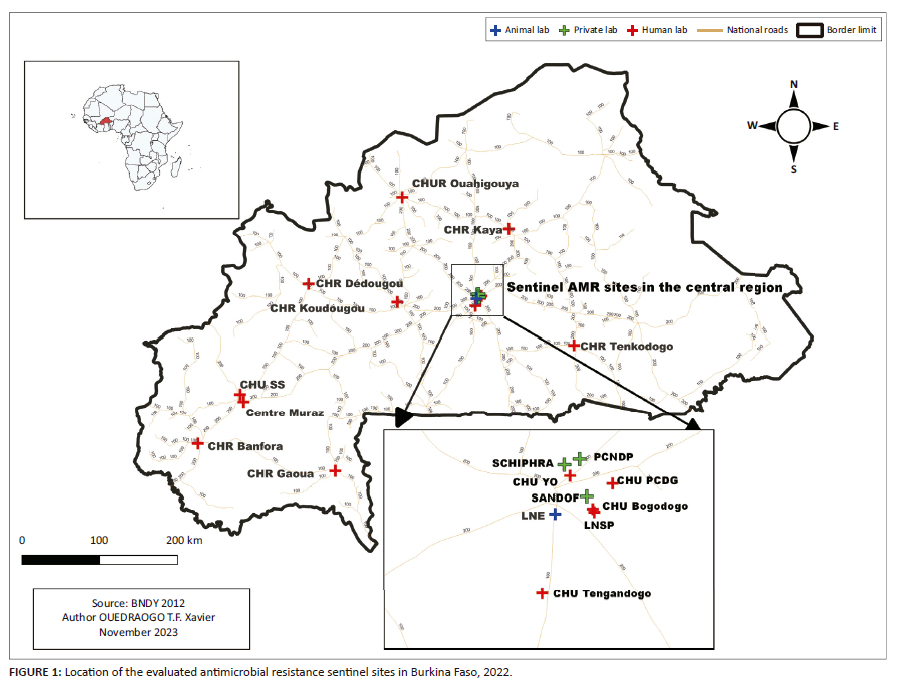
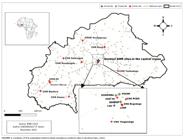
Eighteen AMR surveillance sentinel site laboratories across Burkina Faso were evaluated (Figure 1). Sentinel site laboratories were selected based on their human (biomedical technologists and biologists) and material resources to effectively detect resistance using standardised methods and their geographical distribution to cover the whole country. There were three private laboratories and 15 public laboratories: eight from the district level and seven from the intermediate level.
Development and validation of assessment tool
A technical committee developed and validated the assessment tool. The committee is composed of representatives from the Department of Medical Biology Laboratories of the Ministry of Health, an international expert in the evaluation of biology laboratories, specialists in quality management and microbiologists from the National Antimicrobial Resistance Surveillance Laboratory. The committee reviewed the existing literature on AST and quality control to select the indicators for the assessment tool.11,12,15
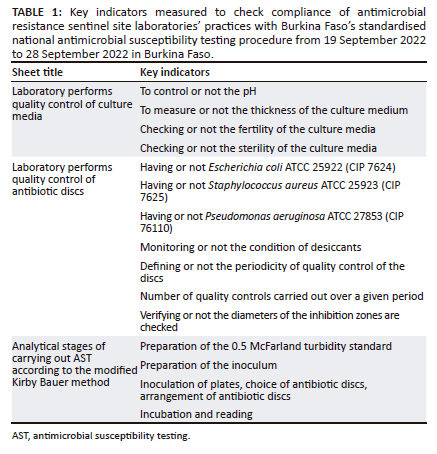
The assessment tool was composed of three Excel sheets. The first sheet contained four indicators on the performance of quality control of culture media (control of the pH, measuring the thickness of the culture medium, checking culture media fertility, and sterility). The second sheet had seven indicators on the presence of reference strains and the performance of quality control of the antibiotic discs (having Escherichia coli ATCC 25922 (CIP 7624), Staphylococcus aureus ATCC 25923 (CIP 7625), and Pseudomonas aeruginosa ATCC 27853 (CIP 76110), monitoring the condition of desiccants, defining the periodicity of quality control of the discs and the number of quality controls carried out over a given period, and verifying if the diameters of the inhibition zones are checked). The last sheet included the stages of carrying out AST according to the modified Kirby Bauer method with 4 stages and 27 sub-stages (Table 1).
Evaluation team
Four teams evaluated the AMR sentinel sites laboratories from 19 September 2022 to 28 September 2022. Each team comprised two evaluators (a microbiologist and a quality manager with proven experience in medical biology) and a supervisor from the directorate of biomedical biology laboratories at the Ministry of Health. All the evaluation team members were trained to use the assessment tool appropriately to evaluate each activity.
Evaluation method and period
The chosen approach was a two-day on-site observation of each sentinel laboratory and review of documents. The evaluation started with an introduction meeting followed by the questionnaire administration. As part of the process, the evaluation verified the existence of critical technical and administrative documents and essential points or steps of the pre-analytical, analytical and post-analytical phases.
The evaluation of AST practice focused on the following steps: preparation of the 0.5 McFarland bacterial inoculum, time and techniques for inoculating the bottles after preparing the bacterial suspension, choice and arrangement of antimicrobial discs, incubation times, temperature, and incubation condition after inoculation.
For the interpretative reading, the following aspects were evaluated: reading times after incubation, measurement of inhibition diameters, interpretation of tracer discs, and detection and reporting of phenotypes of interest for AMR monitoring. In the end, a debriefing meeting was held with the hospital management and laboratory staff to present the evaluation findings before the final report.
Study variables
The records showing that activities to implement key quality control indicators for culture media and antibiotic discs were completed were checked to verify their compliance. Then, evaluators observed laboratory practices and assigned each quality indicator or stage a score. A stage completed per the requirements was worth 1 point. If the requirement was partially met, it was worth 0.5. A requirement not met was worth 0 points. All points obtained were used to calculate each laboratory's compliance rate with the steps for carrying out the AST.
Data analysis
Microsoft Excel software (Microsoft Corporation, Redmond, Washington, United States) was used for data entry and to produce graphs and tables. The free software R version 4.2.01617
Results
Number and checking rate of culture media quality indicators
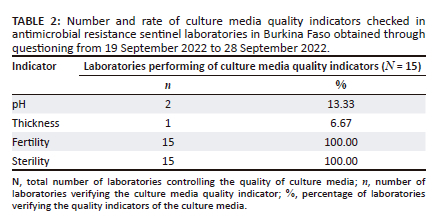
Regarding culture media quality indicators, 15 of 18 laboratories performed at least one quality control indicator (Table 2). All 15 laboratories tested the sterility and fertility of culture media, two laboratories checked media pH after preparation, and one measured the thickness of the agar.
Checking rate of antibiotic disc quality indicators
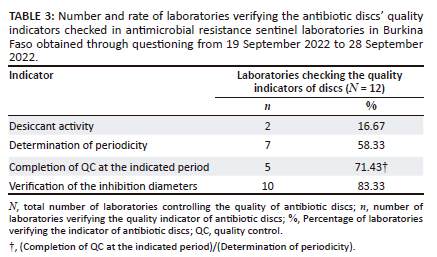
A total of 12 of 18 laboratories performed at least one antibiotics disc quality control check (Table 3). Only 16.67% (n = 2 of 12) of the laboratories monitored the desiccant activity; 58.33% (n = 7 of 12) of the laboratories had defined periodic quality control check times for antibiotic discs, while 71.43% (n = 5 of 7) checked these quality indicators at the indicated frequency. In addition, 83.33% (n = 10 of 12) of the laboratories documented the inhibition diameters according to the critical diameters defined for the reference strain or antibiotic association.
Availability of reference strains
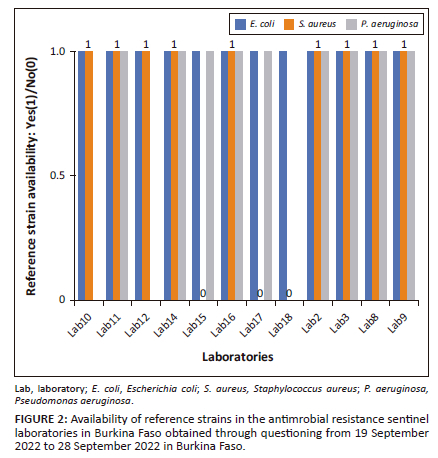
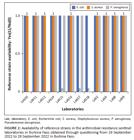
All (n = 12 of 12) laboratories performing quality control of antibiotic discs had the reference strain E. coli ATCC 25922 (CIP 7624) (Figure 2). Two laboratories had the reference strains of E. coli ATCC 25922 (CIP 7624) and S. aureus ATCC 25923 (CIP 7625), and two laboratories had the reference strains of E. coli ATCC 25922 (CIP 7624) and P. aeruginosa ATCC 27853 (CIP 76110). Seven laboratories had all three reference strains.
Compliance rate with modified Kirby Bauer method
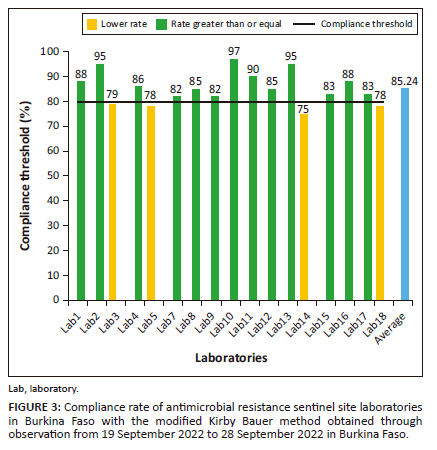
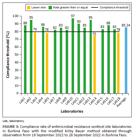
Most (n = 17 of 18) laboratories performed the routine ASTs according to the modified Kirby Bauer method described in the national procedure manual (Figure 3). The average compliance rate for all laboratories was 85.24%. The majority (n = 13 of 17) of laboratories had compliance rates above 80%. The highest and lowest rates obtained were 97% and 75%, respectively.
Discussion
This study is the first to assess the implementation of quality indicators in the AMR sentinel site laboratories since Burkina Faso implemented the AMR surveillance in 2018. This activity has provided baseline data on the sentinel laboratories' compliance with the national AST procedures manual, particularly in areas performing quality control checks or meeting quality indicators for culture media and antibiotic discs. The Ministry of Health meets the requirement to promote good practices in sentinel laboratories by conducting this assessment. An impartial review of documents and records and direct observation of practices allowed an objective assessment of compliance with the national procedure. We analysed the non-conformities identified during the evaluation to determine their impact and severity on operations, processes, patient outcomes, and safety considerations. Thus, the assessors proposed urgent actions depending on the criticality of each detected non-conformity. Each laboratory received reports with proposed improvement plans and recommendations.
A too-acidic agar pH increases ß-lactam activity, while an alkaline pH favours aminoglycoside and macrolide activity. Agar thickness has an impact on the diffusion gradient of the antibiotic.18
Fertility and sterility are the most important indicators in medium quality control. The medium must be carefully checked to avoid contamination before culture.19
Åhman et al. found that many discs exhibited significant quality issues, with 33% (n = 26 of 78) out-of-range readings in the first study and 17% (n = 20 of 120) in the second. Furthermore, discs from certain manufacturers showed unexpected variations in inhibition diameter zones (4 mm - 9 mm) for discs from the same vial.2021E. coli to colistin, currently used as a last-resort antibiotic, has been observed in Asia, Europe, America, Africa, and Oceania (specific percentages for each continent: 66.72%, 25.49%, 5.19%, 2.27%, and 0.32%, respectively).22,23
The reference strains are used to assess the overall performance of the test. They are used for quality control of all steps of culture and the study of bacterial sensitivity to antibiotics.1812
Limitations
The methodology used in our study did not verify the corrective measures taken in the event of non-conclusive control. Also, one laboratory was not evaluated for security reasons. Despite these methodological limitations, we obtained sufficient results that could be evaluated.
Conclusion
The evaluation revealed non-conformities with the national AST procedure for carrying out AST at the sentinel laboratories level, particularly in the quality control component. We formulated proposals for improvement plans to address these non-conformities to provide reliable, accurate, and timely results, and to contribute effectively to the fight against AMR. Regular monitoring of quality indicators will ensure the reliability and accuracy of results from the sentinel sites laboratories.
Competing interests
The authors declare that they have no financial or personal relationships that may have inappropriately influenced them in writing this article.
Authors' contributions
D.Y., E.Z., E.D., M.M., I. Sanou, C.S., S.O., I. Sangare, A.N., A.G.D. and A.S.O. participated in the writing and final approval of the article.
Sources of support
This work was financially and technically supported by United States Centers for Disease Control and Prevention through the African Society for Laboratory Medicine and Jhpiego.
Data availability
Data from the conformity assessment of sentinel laboratory practices for antimicrobial resistance in Burkina Faso are available from https://docs.google.com/spreadsheets/d/16DXQ2NTpmjgWKpGti9PmUabZGIaIwfta
Disclaimer
The views and opinions expressed in this article are those of the authors and do not necessarily reflect the official policy or position of any agency affiliated with the authors.
Acknowledgements
We would like to thank the Ministry of Health, through the Direction of Medical Biology Laboratory, for the information letters sent to the sentinel site laboratories and the mission orders for the evaluators. Thanks also go to the national reference laboratory for antimicrobial resistance for the practical organisation of the evaluations and to all the participating sentinel site laboratories.
References
-
1.Seale AC, Gordon NC, Islam J, Peacock SJ, Scott JAG. AMR surveillance in low and middle-income settings - A roadmap for participation in the Global Antimicrobial Surveillance System (GLASS). Wellcome Open Res. 2017;2:92. https://doi.org/10.12688/wellcomeopenres.12527.1
» https://doi.org/10.12688/wellcomeopenres.12527.1 -
2.Van Belkum A, Bachmann TT, Lüdke G, et al. Developmental roadmap for antimicrobial susceptibility testing systems. Nat Rev Microbiol. 2019;17(51). https://doi.org/10.1038/s41579-018-0098-9
» https://doi.org/10.1038/s41579-018-0098-9 -
3.Tadesse BT, Ashley EA, Ongarello S, et al. Antimicrobial resistance in Africa: A systematic review. BMC Infect Dis. 2017;17:616. https://doi.org/10.1186/s12879-017-2713-1
» https://doi.org/10.1186/s12879-017-2713-1 -
4.Eida M, Nasser M, El-Maraghy N, Azab K. Pattern of hospital-acquired pneumonia in Intensive Care Unit of Suez Canal University Hospital. Egypt J Chest Dis Tuberc. 2015;64(3):625-631. https://doi.org/10.1016/j.ejcdt.2015.03.028
» https://doi.org/10.1016/j.ejcdt.2015.03.028 -
5.Muluye D, Wondimeneh Y, Moges F, Nega T, Ferede G. Types and drug susceptibility patterns of bacterial isolates from eye discharge samples at Gondar University Hospital, Northwest Ethiopia. BMC Res Notes. 2014;7:292. https://doi.org/10.1186/1756-0500-7-292
» https://doi.org/10.1186/1756-0500-7-292 -
6.Wasihun AG, Zemene Y. Bacterial profile and antimicrobial susceptibility patterns of otitis media in Ayder Teaching and Referral Hospital, Mekelle University, Northern Ethiopia. SpringerPlus. 2015;4:701. https://doi.org/10.1186/s40064-015-1471-z
» https://doi.org/10.1186/s40064-015-1471-z -
7.Bayingana C. Antibiotic activity assessment of bacterial strains isolated from urine samples at Butare University Teaching Hospital (Buth) Laboratory. Int J Infect Dis. 2014;21:83. https://doi.org/10.1016/j.ijid.2014.03.600
» https://doi.org/10.1016/j.ijid.2014.03.600 - 8.Kahlmeter G, Olsson-Liljequist B, Ringertz S. Antimicrobial susceptibility testing in Sweden. IV. Quality assurance. Scand J Infect Dis Suppl. 1997;105:24-31.
-
9.Global Antimicrobial Resistance and Use Surveillance System (GLASS) [homepage on the Internet]. [cited 2022 Nov 01]. Available from: https://www.who.int/initiatives/glass
» https://www.who.int/initiatives/glass -
10.OMS | Bureau régional pour l'Afrique. Plan d'action national de lutte contre la résistance aux antimicrobiens du Burkina Faso - Examen et recommandations pour l'accélération des progrès dans le secteur de la santé humaine [homepage on the Internet]. [cited 2023 Oct 08]. Available from: https://www.afro.who.int/fr/countries/burkina-faso/publication/plan-daction-nationalde-lutte-contre-la-resistance-aux-antimicrobiens-du-burkina-faso-examen-et
» https://www.afro.who.int/fr/countries/burkina-faso/publication/plan-daction-nationalde-lutte-contre-la-resistance-aux-antimicrobiens-du-burkina-faso-examen-et - 11.Ministère de la Santé, Burkina Faso. Guide national de surveillance au laboratoire de la résistance aux antimicrobiens. 2018. Ouagadougou: Ministère de la Santé
-
» https://www.iso.org/obp/ui/#iso:std:iso:15189:ed-3:v2:en - 12.Ministère de la Santé, Burkina Faso. Manuel de procedures de réalisation de l'antibiogramme au Burkina Faso. Version 01. 2018. Ouagadougou: Ministère de la Santé
-
14.Bugni E, Cohen R, Mazellier C. Stratégie de gestion du contrôle interne de qualité en laboratoire de biologie médicale Gare au mélange des théories! Ann Biol Clin. 2017;(6):637-645. https://doi.org/10.1684/abc.2017.1290
» https://doi.org/10.1684/abc.2017.1290 -
16.R Core Team. R: A language and environment for statistical computing [homepage on the Internet]. Vienna: R Foundation for Statistical Computing; 2022 [cited 2023 Feb 19]. Available from: https://www.R-project.org/
» https://www.R-project.org/ -
17.Saeed DK, Hasan R, Naim M, et al. Readiness for antimicrobial resistance (AMR) surveillance in Pakistan; a model for laboratory strengthening. Antimicrob Resist Infect Control. 2017;6(1):101. https://doi.org/10.1186/s13756-017-0260-6
» https://doi.org/10.1186/s13756-017-0260-6 -
18.King A, Brown DFJ. Quality assurance of antimicrobial susceptibility testing by disc diffusion. J Antimicrob Chemother. 2001;48(suppl_1):71-76. https://doi.org/10.1093/jac/48.suppl_1.71
» https://doi.org/10.1093/jac/48.suppl_1.71 -
19.Arora D. Quality assurance in microbiology. Indian J Med Microbiol. 2004;22(2):81-86. https://doi.org/10.1016/S0255-0857(21)02885-1
» https://doi.org/10.1016/S0255-0857(21)02885-1 -
20.Åhman J, Matuschek E, Kahlmeter G. The quality of antimicrobial discs from nine manufacturers-EUCAST evaluations in 2014 and 2017. Clin Microbiol Infect. 2019;25(3):346-352. https://doi.org/10.1016/j.cmi.2018.05.021
» https://doi.org/10.1016/j.cmi.2018.05.021 -
21.Cohen D, Swift G. Laboratories and regulator misled over antibiotic susceptibility test discs. BMJ. 2013;346:f837-f837. https://doi.org/10.1136/bmj.f837
» https://doi.org/10.1136/bmj.f837 -
22.Kaye KS, Pogue JM, Tran TB, Nation RL, Li J. Agents of last resort. Infect Dis Clin North Am. 2016;30(2):391-414. https://doi.org/10.1016/j.idc.2016.02.005
» https://doi.org/10.1016/j.idc.2016.02.005 -
23.Dadashi M, Sameni F, Bostanshirin N, et al. Global prevalence and molecular epidemiology of mcr-mediated colistin resistance in Escherichia coli clinical isolates: A systematic review. J Glob Antimicrob Resist. 2021;29:444-461. https://doi.org/10.1016/j.jgar.2021.10.022
» https://doi.org/10.1016/j.jgar.2021.10.022

Accepted: 20 Nov. 2023
Published: 30 Jan. 2024