A new matrix for scoring the functionality of national laboratory networks in Africa: introducing the LABNET scorecard
Abstract
BACKGROUND: Functional national laboratory networks and systems are indispensable to the achievement of global health security targets according to the International Health Regulations. The lack of indicators to measure the functionality of national laboratory network has limited the efficiency of past and current interventions to enhance laboratory capacity in resource-limited-settings. SCORECARD FOR LABORATORY NETWORKS: We have developed a matrix for the assessment of national laboratory network functionality and progress thereof, with support from the African Society of Laboratory Medicine and the Association of Public Health Laboratories. The laboratory network (LABNET) scorecard was designed to: (1) Measure the status of nine overarching core capabilities of laboratory network required to achieve global health security targets, as recommended by the main normative standards; (2) Complement the World Health Organization joint external evaluation tool for the assessment of health system preparedness to International Health Regulations (2005) by providing detailed information on laboratory systems; and (3) Serve as a clear roadmap to guide the stepwise implementation of laboratory capability to prevent, detect and act upon infectious threats. CONCLUSIONS: The application of the LABNET scorecard under the coordination of the African Society of Laboratory Medicine and the Association of Public Health Laboratories could contribute to the design, monitoring and evaluation of upcoming Global Health Security Agenda-supported laboratory capacity building programmes in sub Saharan-Africa and other resource-limited settings, and inform the development of national laboratory policies and strategic plans. Endorsement by the World Health Organization Regional Office for Africa is foreseen.
Background on laboratory systems in Africa
In spite of current funding and partnership opportunities to strengthen laboratory capacity in resource-limited settings, poor access to quality laboratory testing continues to lead to misdiagnosis, inappropriate treatment,1234,5,6
A national laboratory network can be defined as a collaborative group including all (public, private and private not-for-profit) medical laboratories within a country. The networks are typically organised in three to five-tiered structures of testing facilities operating under common principles and procedures with tier-specific roles, responsibilities and functions.778910,11101211
In the same period, substantial funding has been dedicated to integrating laboratory services, developing laboratory policy and strategic planning for tiered laboratory networks, implementing quality system improvement schemes, and increasing the laboratory workforce. Despite the efforts to strengthen laboratory systems and networks and the remarkable level of resources made available, serious gaps remain. Such insufficiencies include shortages in skilled and trained professionals, inadequate and poorly-maintained infrastructures and equipment, inconsistent supply of reagents and consumables, lack of clear national policies and poor leadership. In practice, laboratory diagnostics are unavailable for most fevers131415
Determinants of remaining gaps in national laboratory network capabilities
The causes of persisting deficiencies of the laboratory systems and network are multifactorial and include: the influence of vertical programmes;1681718,1920212223242525
Collectively, these observations call for the development of a novel standardised framework capable of capturing metrics relevant to the laboratory network performance and measuring progress toward a more comprehensive set of laboratory systems standards.
Current normative standards for national medical laboratory networks
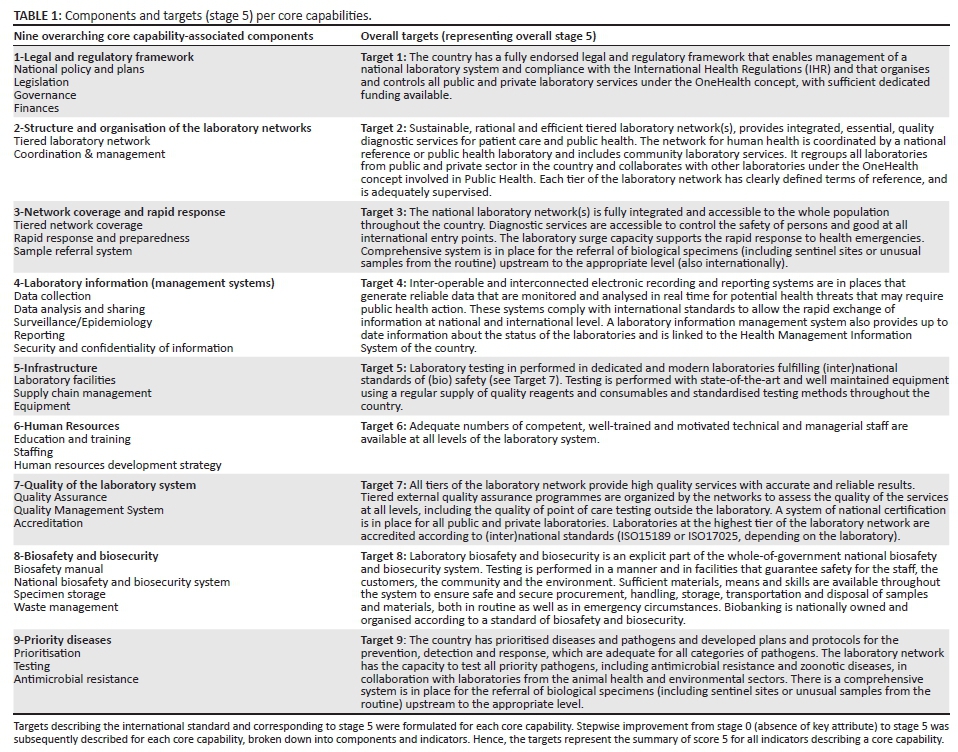
Normative standards, directives and recommendations guiding the development of national laboratory systems and networks include: requirements for public, international and global health;2627,28293031Table 1.
Conceivably, the degree of availability of resources (material, human and technical) and capacity to conduct the necessary improvements toward all key normative standards correlates with the degree of the national laboratory network's capability to carry out essential public health and clinical functions.
Aim
GHSA-supported programmes strive to support the implementation of health security preparedness as a way to comprehensively strengthen laboratory capacity for all essential public health and clinical functions.3132
The assessment tool was designed through a collaborative effort between the Amsterdam Institute for Global Health and Development, the Association of Public Health Laboratories (APHL) and the Royal Tropical Institute - Biomedical Research of the Netherlands (currently DATOS).
Terms of reference: the LABNET scorecard
The desired features for a standardised tool to assess national laboratory network functionality against current normative standards include:
•The overarching assessment of a full set of core capabilities required to achieve all key laboratory standards of global health security.
• Clear indicators describing the maturation of each core capability according to a linear scale of increasing functionality.
• A practical roadmap of what needs to be implemented for the country to achieve next levels of functionality for each core capability. This could serve as the basis to define targeted improvement strategies at regional or at country level that can leverage advancement toward global health security targets and/or the development of well-informed national laboratory policies and plans.
• The possibility to provide a quick visual representation of national laboratory networks functionality within a country and across countries, which can serve advocacy efforts toward high level policymakers.
The capability maturation model (CMM)333435,3634
Design of the scorecard
The scorecard for national laboratory network functionality (hereafter referred to as the LABNET scorecard) was designed as a CMM and began with: (1) the definition of the laboratory network core capabilities necessary to conduct clinical and public health functions supporting global health security targets; and (2) the description of the maturation stages for each capability in such a way that improvements at each stage provide the foundation on which to build improvements undertaken at the next stage. Hence, the scorecard can identify deficiencies and guide advancement of the laboratory network. Core capabilities are typically described by one to four criteria or components against which indicators are developed.
Selection of core capabilities and components
Core capabilities were defined as the overarching functions of the country national laboratory network to detect, assess, notify and respond to health events in accordance with the main normative standards guiding the development of national laboratory network - IHR; GHSA; the WHO guidance to establish national health laboratory systems;373839402730
One to three components best describing each core capability were drawn from the list of most recurrent functions described in normative documents. The nine core capabilities identified across the main relevant guidelines, their corresponding components and targets are shown in Table 1.
Development of indicators and definition of capability levels
Indicators characterising the functionality of each component were developed in the form of questions, to measure the maturity of the system along three key dimensions:
• Inputs: including infrastructure, commodities, technology, equipment, people, legislation, policies, and finances.
• Processes: including networking, procedures for processes, implementation, expansion, coverage, quality and integration of laboratory network services.
• Measurement: including targets, indicators, output, outcomes, cost-efficiency, data reporting systems, data collection and data use to improve the quality of the laboratory network.
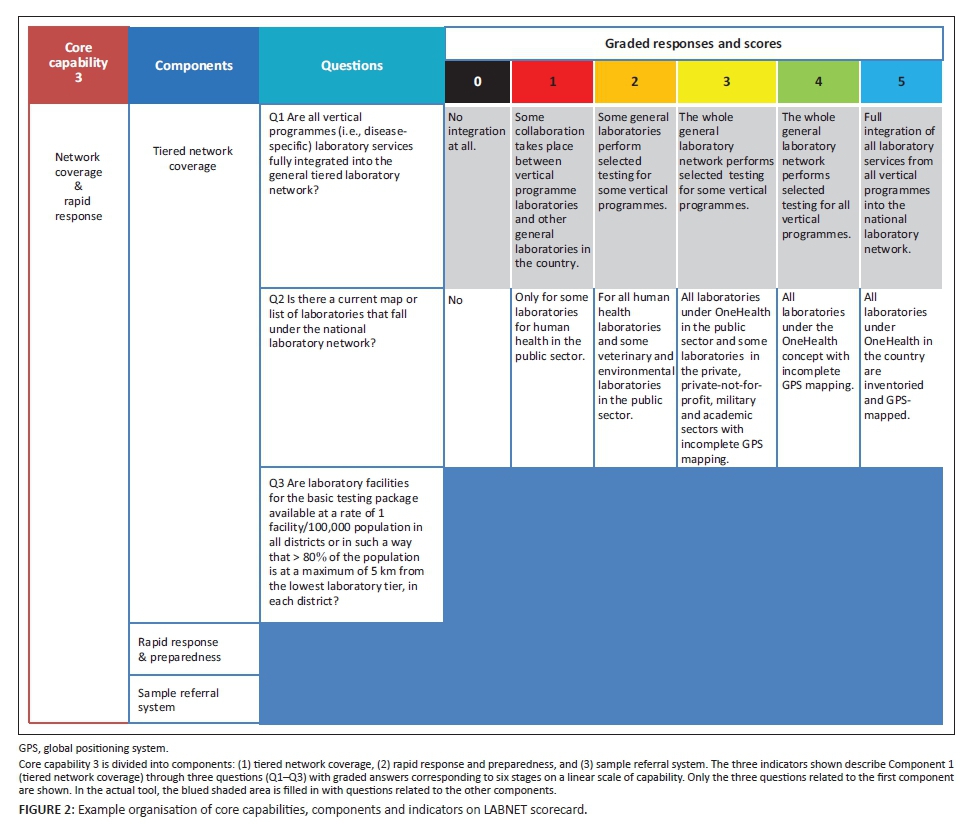
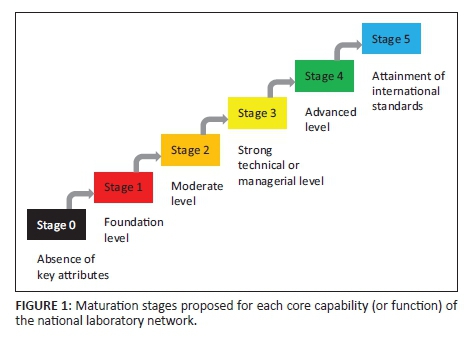
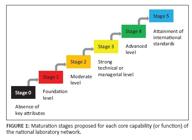
The definition of capability levels in relation to input, process and measurement is provided in Figure 1. Given the anticipated weaknesses of laboratory networks in some areas, a stage 0 was incorporated to match situations in which no key attributes are present in a given core capability. In order to obtain sufficient granularity, each component was broken down in to one to four questions with responses grading from 0 to 5, describing the situation along the capability maturation scale. The measurements are mostly descriptive and qualitative, but some incorporate a quantitative dimension. The example of core capability 3 (coverage and rapid response) and its associated components and indicators broken down into questions with graded responses is shown in Figure 2.
Purpose of the LABNET scorecard assessment
The LABNET scorecard assesses a country's national laboratory network functionality to support the implementation of the IHR 2005 and to reach the GHSA targets of preventing, detecting and responding to infectious disease threats. A regional and international evaluation process is foreseen in GHSA target countries in Africa and Asia, under the coordination of ASLM and APHL, two organisations mandated to implement the GHSA, as a way to accelerate the achievement of the IHR 2005. The LABNET scorecard assessment is voluntary and is applied through a series of external evaluations that will allow a country to measure the progress of the national laboratory network towards the health security targets. The first evaluation will provide a baseline measurement of the national laboratory network capabilities and guide the design and implementation of laboratory strengthening initiatives. Subsequent evaluation(s) will measure progress made and ensure improvements in capacity are sustained.
Scoring system and options for data analysis
Based on the current country situation, each question receives a unique score from 0 (key attribute(s) completely absent) to 5 (key attribute(s) compliant with international standards), describing the level of maturity. Key definitions and rationale behind the questions are incorporated into the scorecard to facilitate the scoring process. Without achievement of all attributes at prior capability level, the national laboratory network cannot achieve the next level. The responses should be supported by documentation whenever possible. The score attributed to each indicator can be used in two ways, as described below.
Percentage-based scoring system
A ratio can be calculated dividing the total number of points scored for all questions within a core capability by the maximum possible score (total number of questions x 5). The percentages are useful in estimating the overall degree of advancement of each core capability toward the standards (Figure 3A). However, the percentages provide little information on the extent to which the various components within a core capability mature and work together towards a functional laboratory network.
Color-scoring system of component and core capabilities
According to the CMM methodology, up to two additional layers of scores can be calculated for each of the component and the core capabilities.
Each component can be assigned a score, which corresponds to the lowest score achieved by any question within that component. This tends to bring the overall results down the scale of maturity, while allowing the identification of critical weaknesses that prevent the system from achieving higher stages. Similarly, each core capability can be assigned a score, which corresponds to the lowest score achieved by any component within that core capability (Figure 3B). Any core capability or component with a low score offers the opportunity for drilling down to identify specific component(s) and/or specific question(s) which have not been adequately addressed by the country and require follow-up actions. Color-coded graphs allow for a straightforward visual representation of scoring (figures 3B and 3C).
Assessment process
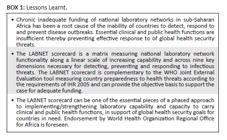
In order to ensure the optimal standardisation of the assessment process, a pool of Francophone and Anglophone assessors from Africa and the United States were trained to use the LABNET scorecards in a joint ASLM and APHL effort and a detailed scorecard instruction manual was developed (supplementary material). The first stage of the evaluation is the country self-reporting for all the indicators across the nine core capabilities of the LABNET scorecard. A national committee led by the country contact point for the national laboratory network and including a wide representation of stakeholders under the One Health concept will complete the self-evaluation. A list of typical committee members is provided in Box 1.

A LABNET scorecard evaluation team comprising three international experts, fluent in the country language, reviews the information prior to a one-week visit to the country. The visit is comprised of an initial two-day workshop during which the evaluation team members review and validate the pre-filled data with the national committee, gather information explaining the scores and collect documented evidence. During the next three days, the evaluation team visits representative laboratory facilities at each tier level. The visits also include key departments, such as the national health data unit and the central procurement and distribution facility for laboratory consumables. Site visits aim to verify information provided at the central level and are not structured laboratory facility assessments.
After completing the country visit, the evaluation team drafts a report to identify scores levels for each indicator, and to describe the status of each component and core capability. Based on the explanations provided to justify the scores assigned to each indicator, the report also includes a root-cause analysis, supporting the evidence-based selection of strategies with highest leverage potential for comprehensive laboratory improvement. Upon validation by ASLM and/or APHL, the report is shared with the host country and with other relevant stakeholders, as permitted by the country.
Validation of the LABNET scorecard: lessons learnt
Following the initial development phase, the LABNET scorecard underwent revision, consolidation and validation, scrutinising the relevance, order of the questions, logic of scores, and clarity of phrasing. In total, more than 40 persons provided input on the LABNET scorecard during:
• the Freetown meeting organised by ASLM during a breakout session attended by 25 experts (Freetown, Sierra Leone, October 2015);
• a meeting of APHL US senior laboratory experts on system assessment of national laboratory network (Silver Spring, MD, US, February 2016); and
• a meeting of 16 African senior laboratory facility and laboratory system assessors (Dakar, Senegal, February 2016).
The feasibility of using the revised and consolidated version of the LABNET scorecard was tested through pilot assessments in Uganda (December 2015) and Tanzania (February 2016). The key lessons learnt were multifold:
1. Getting country buy-in is crucial. A series of interactions between the host country and the implementing coordinating partners needs to take place before the assessment so that the importance of the evaluation and its complementarities with other ongoing assessments is clearly understood. This preparatory work also guides the country in collecting all necessary evidence supporting the scoring beforehand.
2. The LABNET scorecard assessment is a pedagogic tool to introduce system-thinking to stakeholders not previously familiar with the process. Highlighting root-cause of interrelated problems helped the countries to identify single interventions capable of advancing the status of several component and/or core capabilities. For instance, the creation of a department of laboratory directly under the authority of the Ministry of Health was identified as one of the most effective strategies to leverage improvements regarding governance, network coordination, financing, legislation and policy pertaining to the laboratory sector.
3. Metrics including the private laboratory sector were difficult to measure in practice and were kept to the strict minimum in the final version of the LABNET scorecard.
4. The inclusion of sections dedicated to 'priority diseases' (core capability 9) and 'laboratory network coverage and rapid response' (core capability 3) bind the evaluation framework together through their cross-cutting relationship with all other laboratory key functions.
Anticipated utilisation and benefit of the LABNET scorecard assessment
An important outcome of the regional GHSA consultation for laboratory strengthening in October 2015 was the recognition that adequate laboratory network capability to operate is required to support the GHSA and achieve compliance to IHR requirements.7,41422243
Gaps and weaknesses identified during the assessment will allow countries to prioritise areas with most urgent needs, and serve as the basis for the formulation of tailored plans for laboratory capacity strengthening under the GHSA framework. The success story of the SLIPTA/SLMTA programmes11,1244
LABNET scorecard assessment reports include clear visual representations of the status of each core capabilities at the country level or at the regional level, highlighting critical weaknesses for which additional resources are required. These figures can be used by laboratory system managers when advocating to their governments or to international stakeholders for the improvement of laboratory systems.
Perspectives and conclusions
We have developed a new matrix for the comprehensive evaluation of national laboratory functionality. The LABNET scorecard complements the WHO Joint External Evaluation Tool4231
Country buy-in is an essential prerequisite to adoption of the LABNET scorecard and can be facilitated by the endorsement of WHO regional offices. We propose that the LABNET scorecard be applied under the coordination and the leadership and normative organisation of the WHO and its regional offices, through international laboratory professional organisations such as ASLM and APHL. Such a framework can ensure efficiency and economy of scale of the intervention, in a similar fashion to the SLIPTA/SLMTA approach for implementing laboratory quality management systems in Africa.12
Sources of support
This work was funded through the US Centers for Disease Control and Prevention Cooperative agreement 'Building Laboratory Capacity to Support the Global Health Security Agenda' Grant number: 5U2GGH00710-3.
Competing interests
The authors declare the following interest: the study was partly funded by ASLM.
Authors' contributions
P.O. was the project leader; P.O., L.O., T.D., K.L. and J.I. designed the scorecard; P.O. drafted the manuscript; L.O., T.D., K.L., J.I., M.-S.K.-S., J.-B.N. and J.N. critically reviewed the manuscript.
Acknowledgements
The authors are grateful to Patricia Riley (CDC) for sharing her experience on the application of the Capability Maturity Model and to Trevor Peter for providing the initial guidance for the design of the scorecard. We thank Sebastien Cognat, Virginie Dolmazon and Maagdi Saman (World Health Organization Global Capacity Alert and Response) for discussing gaps of national laboratory network assessment in the context of the IHR 2005. We thank Reshma Kakkar and David Mills (APHL), Benjamin Park and Rachel Smith (CDC) for their input to the design of the indicators for Laboratory Information Management System and antimicrobial resistance (AMR) and Sally Liska (APHL) for her help in developing the scorecard manual. We thank Lucy Maryogo-Robinson and Ralph Timperi for reviewing the manuscript (APHL). We are indebted to Steven Aisu (Ministry of Health, Uganda) and Fausta Mosha (Ministry of Health, Tanzania) for facilitating the piloting of the LABNET scorecard in their respective country, and to Ahmad Iyane Sow (MoH, Senegal) for hosting the training of assessors in Dakar, Senegal.
References
-
1. Birx D, de Souza M, Nkengasong J. Laboratory challenges in the scaling up of HIV, TB and malaria programs: the interaction of health and laboratory systems, clinical research, and service delivery. Am J Clin Pathol. 2009;131(6):849-851. http://dx.doi.org/10.1309/AJCPGH89QDSWFONS
» http://dx.doi.org/10.1309/AJCPGH89QDSWFONS -
2. Petti C, Polage C, Quinn T, et al. Laboratory medicine in Africa: a barrier to effective health care. Clin Infect Dis. 2006;42(3):377-382. http://dx.doi.org/10.1086/499363
» http://dx.doi.org/10.1086/499363 - 3. Polage C, Bedu-Addo G, Owusu-Ofori A. Laboratory use in Ghana: physician perception and practice. AM J Trop Med. 2006;75(3):526-531.
-
4. Wurie I. Sierra Leone laboratory systems - now and future. Afr J Lab Med. 2016;5(3), a549. http://dx.doi.org/10.4102/ajlm.v5i3.549
» http://dx.doi.org/10.4102/ajlm.v5i3.549 -
5. Kennedy SB, Dogba JB, Wasunna CL, et al. Pre-Ebola virus disease (EVD) laboratory system and related challenges in Liberia. Afr J Lab Med. 2016;5(3), a508. http://dx.doi.org/10.4102/ajlm.v5i3.508
» http://dx.doi.org/10.4102/ajlm.v5i3.508 -
6. Kennedy SB, Wasunn CL, Dogba JB, et al. The laboratory health system and its response to the Ebola virus disease outbreak in Liberia. Afr J Lab Med. 2016;5(3), a509. http://dx.doi.org/10.4102/ajlm.v5i3.509
» http://dx.doi.org/10.4102/ajlm.v5i3.509 - 7. Best M, Sakandé J. Reconstruction Strategies for Developing a Resilient Laboratory Network and Public Health Institutes in Africa. Afr J Lab Medicine. 2016; In press.
-
8. Peter TF, Shimada Y, Freeman RR, et al. The need for standardization in laboratory networks. Am J Clin Pathol. 2009;131(6):867-874. http://dx.doi.org/10.1309/AJCPCBMOHM7SM3PJ
» http://dx.doi.org/10.1309/AJCPCBMOHM7SM3PJ -
9. Bloland P, Simone P, Burkholder B, et al. The role of public health institutions in global health system strengthening efforts: the US CDC's perspective. PLoS Med. 2012;9(4):e1001199. http://dx.doi.org/10.1371/journal.pmed.1001199
» http://dx.doi.org/10.1371/journal.pmed.1001199 -
10. Gershy-Damet GM, Rotz P, Cross D, et al. The World Health Organization African region laboratory accreditation process: improving the quality of laboratory systems in the African region. Am J Clin Pathol. 2010;134(3):393-400. http://dx.doi.org/10.1309/AJCPTUUC2V1WJQBM
» http://dx.doi.org/10.1309/AJCPTUUC2V1WJQBM -
11. Alemnji G, Zeh C, Yao K, et al. Strengthening national health laboratories in sub-Saharan Africa: a decade of remarkable progress. Trop Med Int Health. 2014;19(4):450-458. http://dx.doi.org/10.1111/tmi.12269
» http://dx.doi.org/10.1111/tmi.12269 -
12. Yao K, McKinney B, Murphy A, et al. Improving quality management systems of laboratories in developing countries: an innovative training approach to accelerate laboratory accreditation. Am J Clin Pathol. 2010;134:401-409. http://dx.doi.org/10.1309/AJCPNBBL53FWUIQJ
» http://dx.doi.org/10.1309/AJCPNBBL53FWUIQJ -
13. Okeke I, Manning R, Pfeiffer T. Diagnostic schemes for reducing epidemic size of African viral hemorrhagic fever outbreaks. J Infect Dev Ctries. 2014;8(9):1148-1159. http://dx.doi.org/10.3855/jidc.4636
» http://dx.doi.org/10.3855/jidc.4636 -
14. World Health Organization. Ebola situation report - 30 March 2016 [page on the Internet]. c2016 [cited 2016 Mar 30]. Available from: http://apps.who.int/ebola/current-situation/ebola-situation-report-30-march-2016
» http://apps.who.int/ebola/current-situation/ebola-situation-report-30-march-2016 - 15. United Nations. Transforming our world: the 2030 agenda for sustainable development. A/RES/70/1. 70th session General Assembly: United Nations; 2015.
-
16. Olmsted SS, Moore M, Meili RC, et al. Strengthening laboratory systems in resource-limited settings. Am J Clin Pathol. 2010;134(3):374-380. http://dx.doi.org/10.1309/AJCPDQOSB7QR5GLR
» http://dx.doi.org/10.1309/AJCPDQOSB7QR5GLR -
17. Nkengasong JN, Messele T, Orloff S, et al. Critical role of developing national strategic plans as a guide to strengthen laboratory health systems in resource-poor settings. Am J Clin Pathol. 2009;131(6):852-857. http://dx.doi.org/10.1309/AJCPC51BLOBBPAKC
» http://dx.doi.org/10.1309/AJCPC51BLOBBPAKC - 18. Ondoa P, Van der Broek A, Jansen C, et al. National laboratory policy and strategic plans in sub-Saharan Africa: gaps and opportunity.
-
19. Nkengasong JN. A shifting paradigm in strengthening laboratory health systems for global health: acting now, acting collectively, but acting differently. Am J Clin Pathol. 2010;134(3):359-360. http://dx.doi.org/10.1309/AJCPY5ASUEJYQ5RK
» http://dx.doi.org/10.1309/AJCPY5ASUEJYQ5RK -
20. World Health Organization. Laboratory assessment tool (WHO/HSE/GCR/LYO/2012.2) [document on the Internet]. c2012 [cited 2016 Mar 30. Available from: http://www.who.int/ihr/publications/laboratory_tool/en/
» http://www.who.int/ihr/publications/laboratory_tool/en/ -
21. World Health Organization. WHO guide for the Stepwise Laboratory Improvement Process Towards Accreditation (SLIPTA) in the African Region (with checklist) [document on the Internet]. c2015 [cited 2016 Mar 30]. Available from: http://www.afro.who.int/en/clusters-a-programmes/hss/blood-safety-laboratories-a-health-technology/blt-highlights/3859-who-guide-for-the-stepwise-laboratory-improvement-process-towards-accreditation-in-the-african-region-with-checklist.html
» http://www.afro.who.int/en/clusters-a-programmes/hss/blood-safety-laboratories-a-health-technology/blt-highlights/3859-who-guide-for-the-stepwise-laboratory-improvement-process-towards-accreditation-in-the-african-region-with-checklist.html -
22. World Health Organization. Antimicrobial resistance surveillance: questionnaire for the assessment of national networks (WHO/CSR/RMD/2003.1) [document on the Internet]. c2003 [cited 2016 Mar 30]. Available from: http://www.who.int/drugresistance/whocdscsrrmd20031.pdf
» http://www.who.int/drugresistance/whocdscsrrmd20031.pdf -
23. World Health Organization. Laboratory assessment tool - short version for Ebola/VHF (only for EVD/VHF diagnosis capacity and not for clinical testing for Ebola/VHF patients) (WHO/HSE/LYO/2012.2 Add1) [document on the Internet]. c2015 [cited 2016 Mar 30]. Available from: http://apps.who.int/iris/handle/10665/70874?mode=full&locale=es
» http://apps.who.int/iris/handle/10665/70874?mode=full& locale=es -
24. World Health Organization. IHR core capacity monitoring framework: checklist and indicators for monitoring progress in the development of IHR core capacities in States Parties (WHO/HSE/GCR/2013.2) [document on the Internet]. c2013 [cited 2016 Mar 30]. Available from: http://www.who.int/ihr/publications/checklist/en/
» http://www.who.int/ihr/publications/checklist/en/ -
25. World Health Organization. Laboratory assessment tool. Annex 1: laboratory assessment tool/system questionnaire (WHO/HSE/GCR/LYO/2012.2) [document o the Internet]. c2012 [cited 2016 Mar 30]. Available from: http://www.who.int/ihr/publications/Annex1_LAT.pdf?ua=1
» http://www.who.int/ihr/publications/Annex1_LAT.pdf?ua=1 - 26. World Health Organization. International Health Regulations (2005). 3rd ed. Geneva, Switzerland: WHO; 2005.
-
27. World Health Organization. The FAO-OIE-WHO collaboration. Sharing responsibilities and coordinating global activities to address health risks at the animal-human-ecosystems interfaces: a tripartite concept note [document on the Internet]. c2010 [cited 2016 Mar 30]. Available from: http://www.who.int/foodsafety/areas_work/zoonose/concept-note/en/
» http://www.who.int/foodsafety/areas_work/zoonose/concept-note/en/ -
28. World Health Organization. Declaration of Alma-Ata. International Conference on Primary Health Care, Alma-Ata, USSR, 6-12 September 1978 [document on the Internet]. c1978 [cited 2016 Jul 27]. Available from: http://www.who.int/publications/almaata_declaration_en.pdf
» http://www.who.int/publications/almaata_declaration_en.pdf -
29. World Health Organization Regional Office for Africa. Technical guidelines for Integrated Disease Surveillance and Response in the African region [document on the Internet]. c2009 [cited 2016 Mar 30]. Available from: http://www.afro.who.int/en/clusters-a-programmes/dpc/integrated-disease-surveillance/features/2775-technical-guidelines-for-integrated-disease-surveillance-and-response-in-the-african-region.html
» http://www.afro.who.int/en/clusters-a-programmes/dpc/integrated-disease-surveillance/features/2775-technical-guidelines-for-integrated-disease-surveillance-and-response-in-the-african-region.html -
30. World Health Organization. The Maputo Declaration on strengthening of laboratory systems [document on the Internet]. c2008 [cited 2016 March]. Available from: http://www.who.int/diagnostics_laboratory/Maputo-Declaration_2008.pdf
» http://www.who.int/diagnostics_laboratory/Maputo-Declaration_2008.pdf -
31. The Global Health Security Agenda. Action packages [page on the Internet]. c2014 [cited 2016 March]. Available from: https://ghsagenda.org/packages
» https://ghsagenda.org/packages -
32. Nkengasong JN, Skaggs BA. Are post Ebola reconstruction efforts neglecting public health laboratory systems? Lancet Glob Health. 2015;3(11):e678. http://dx.doi.org/10.1016/S2214-109X(15)00159-X
» http://dx.doi.org/10.1016/S2214-109X(15)00159-X - 33. Humphrey WS. Characterizing the software process: a maturity framework. Technical Report CMU/SEI-87-TR-11; ESD-TR-87-112. Pittsburgh, PA: Software Engineering Institute; 1987.
- 34. Paulk M, Curis B, Chrissis M, et al. Capability Maturation ModelSM for software, version 1.1. Technical Report CMU/SEI-93-TR-024; ESC-TR-93-177. Pittsburgh, PA: Software Engineering Institute; 1993.
-
35. McCarthy C, Kelley M, Verani A, et al. Development of a framework to measure health profession regulation strengthening. Eval Program Plann. 2014;46:17-24. http://dx.doi.org/10.1016/j.evalprogplan.2014.04.008
» http://dx.doi.org/10.1016/j.evalprogplan.2014.04.008 - 36. Gillies A, Howard J. An international comparison of information in adverse events. Int J Health Care Qual Assur Inc Leadersh Health Serv. 2005;18(5):343-352.
-
37. World Health Organization. Guidance for establishing a national health laboratory system [document on the Internet]. c2014 [cited 2016 Mar 30. Available from: http://apps.who.int/iris/handle/10665/148351
» http://apps.who.int/iris/handle/10665/148351 -
38. World Health Organization Regional Office for Africa. Guide for National Public Health Laboratory Network to Strengthen Integrated Disease Surveillance and Response. Test version.1.; 2008 [cited 2016 October 18]. Available from: http://www.cdc.gov/globalhealth/healthprotection/idsr/pdf/htl-afro-cdc-lab-guidelines-for-nln.pdf
» http://www.cdc.gov/globalhealth/healthprotection/idsr/pdf/htl-afro-cdc-lab-guidelines-for-nln.pdf -
39. World Health Organization. WHO global strategy for containment of antimicrobial resistance (WHO/CDS/CSR/DRS/2001.2) [document on the Internet]. c2001. Available from: http://www.who.int/drugresistance/WHO_Global_Strategy_English.pdf
» http://www.who.int/drugresistance/WHO_Global_Strategy_English.pdf -
40. World Health Organization Regional Office for Africa. Guide for establishing laboratory-based surveillance for antimicrobial resistance [document on the Internet. c2013 [cited 2016 Mar 30]. Available from: http://apps.who.int/medicinedocs/documents/s20135en/s20135en.pdf
» http://apps.who.int/medicinedocs/documents/s20135en/s20135en.pdf -
41. African Society for Laboratory Medicine. Global health security in Africa. Updates on the Freetown, Sierra Leone, Regional global health security consultation [page on the Internet]. c2015 [cited 2016 Oct 17]. Available from: http://aslm.org/what-we-do/global-health-security/
» http://aslm.org/what-we-do/global-health-security/ -
42. World Health Organization. IHR (2005) Monitoring and Evaluation framework Joint External Evaluation tool (JEE tool) [document on the Internet]. c2016 [cited 2016 Mar 30]. Available from: http://www.who.int/ihr/publications/WHO_HSE_GCR_2016_2/en/
» http://www.who.int/ihr/publications/WHO_HSE_GCR_2016_2/en/ -
43. Association of Public Health Laboratories. A biosafety checklist: developing a culture of biosafety [document on the Internet]. c2015 [cited 2016 Jul 27]. Available from: http://www.aphl.org/aboutAPHL/publications/Documents/ID_BiosafetyChecklist _42015.pdf
» http://www.aphl.org/aboutAPHL/publications/Documents/ID_BiosafetyChecklist _42015.pdf - 44. Brown C, Zwetyenga J, Berdieva M, et al. New policy-formulation methodology paves the way for sustainable laboratory systems in Europe. WHO Panorama. 2015;1(1):41-47.
Accepted: 06 Aug. 2016
Published: 31 Oct. 2016