Agreement between Xpert and AmpFire tests for high-risk human papillomavirus among HIV-positive women in Rwanda
Abstract
BACKGROUND: High-risk human papillomavirus (hrHPV) may cause more than 99% of cervical cancers worldwide. Little is known about performance differences in tests for hrHPV OBJECTIVE: This study analysed agreement for detection of hrHPV between the established, clinically validated Xpert HPV assay and the novel isothermal amplification-based AmpFire HPV genotyping assay METHODS: This study was nested in a larger project on cervical cancer screening among approximately 5000 women living with HIV in Kigali, Rwanda. This sub-study included 298 participants who underwent initial screening for cervical cancer using the Xpert HPV assay and visual inspection with acetic acid in 2017 and tested positive by either or both. Participants were rescreened using colposcopy, and cervical samples were collected between June 2018 and June 2019. Samples were then tested for HPV using the Xpert HPV assay and AmpFire HPV genotyping assay. Agreement between results from both tests was analysed using an exact version of McNemar test and chi-square test RESULTS: Overall agreement and kappa value for detection of hrHPV by Xpert and AmpFire were 89% and 0.77 (95% confidence interval: 0.70-0.85). AmpFire was marginally more likely to diagnose hrHPV-positive than Xpert (p = 0.05), due primarily to the extra positivity for HPV16 (p < 0.001 CONCLUSION: Overall, there was good to excellent agreement between the Xpert and AmpFire when testing hrHPV types among women living with HIV. AmpFire was more likely to test extra cases of HPV16, the most carcinogenic HPV type, but the clinical meaning of detecting additional HPV16 infections remains unknown
Xpert HPV assay; AmpFire HPV genotyping assay; high-risk human papillomavirus types; women living with HIV; cervical cancer screening
Introduction
High-risk human papillomavirus (hrHPV) causes virtually all cervical cancer-related cases worldwide.12
Evidence to date indicates that HPV genotyping can help with risk stratification for further triage and management of hrHPV-positive women.3,45,6,7
Xpert is a World Health Organization pre-qualified test,8,93,5,6
The AmpFire is a promising new lower-cost assay, using isothermal amplification along with a real-time fluorescence system in four channels to individually detect 15 types of hrHPV, including HPV16, 18, 31, 33 35, 39, 45, 51, 52, 56, 58, 59 and 68, plus intermediate-risk HPV53 and 66. The AmpFire assay uses a simple processing protocol to detect HPV directly without prior DNA extraction from clinical samples, including dry samples. The assay has a small footprint and a sample-to-result time of approximately 1 h.7,10,11
We recently completed a cervical cancer screening study of approximately 5000 Rwandan women living with HIV. In a subset of women who underwent colposcopy, we compared the analytic performance for HPV detection by the Xpert and AmpFire systems.
Methods
Ethical considerations
This sub-study derived from a larger study on cervical cancer screening among Rwandan women with HIV,12
Study design and sampling
The participants included 298 women living with HIV who were recruited from a larger study of cervical cancer screening, which was carried out among approximately 5000 Rwandan women living with HIV. All women were initially screened by either the Xpert HPV assay (Cepheid, Sunnyvale, California, United States) or visual inspection with acetic acid and those positive by either or both methods were referred for colposcopy. A detailed protocol related to the study population and recruitment was further developed in the parent study.12
The participants included women who were lost to follow-up in the parent study for a period of 6-38 months. After retrieving them, they were enrolled in the present study, for which specimens were collected between June 2018 and June 2019. These women with a delay in colposcopy attendance underwent colposcopy, during which cervical specimens were collected using a LuckMedical Cervical Brush (Luck Medical Consumables Co., Jiangsu, China). These samples were put into 20 mL of the PreservCyt medium (Hologic, Bedford, Massachusetts, United States).
Setting
All women included in the study lived in Kigali, which is the capital and biggest city of Rwanda. The latest Population and Housing Census, dated 2012, indicated that Kigali was populated with 1 132 686 inhabitants.13
Laboratory testing
Cervical specimens were mixed with PreservCyt before being tested for hrHPV. A volume of 1 mL of the mixed sample was added to the Xpert cartridge, which was then placed in the Xpert assay for the analysis. Results from this analysis were available within an hour.
The sample of cervical specimens mixed with PreservCyt was also tested for hrHPV using the AmpFire (Atila Biosystems, Mountain View, California, United States). A volume of 1 mL of this sample was added to a 1.5 mL-micro-centrifuge tube and centrifuged for 10 min at 10 000 revolutions per minute.14
The cut-off point values of positivity applied when using Xpert and AmpFire assays were defined according to the manufacturers' instructions.15,16
Statistical analysis
Agreement statistics (positive, negative and overall agreement, and kappa values) for 14 HPV types, 16, 18, 31, 33, 35, 39, 45, 51, 52, 56, 58, 59, 66 and 68, detected by both tests, were calculated. Results for HPV53, detected by AmpFire but not by Xpert, were excluded. Results from AmpFire were grouped according to the HPV groups as detected by the Xpert HPV assay. Firstly, HPV groups were considered non-hierarchically, recognising that a given specimen could test positive for more than one group. Secondly, the two tests were also compared using risk-based hierarchical HPV group types, considering that different HPV groups are associated with different risks of cervical cancer: HPV16 positive, else positive for HPV18/45, else positive for HPV 31/33/35/52/58, else positive for other high-risk HPV types (HPV51/59/39/56/66/68), or else negative; HPV51/59 and HPV39/56/66/68 have similarly lower risk for invasive cervical cancer and were grouped together. McNemar test and chi-square test was applied to assess significant differences (p < 0.05) in test positivity. Data entry was performed using Epi-Info 7 (version March 2015, Centers for Disease Control, Atlanta, Georgia, United States). Afterwards, data were transferred to the Statistical Package for the Social Sciences Statistics 20 (IBM Corp., Armonk, New York, United States) for the analysis.
Results
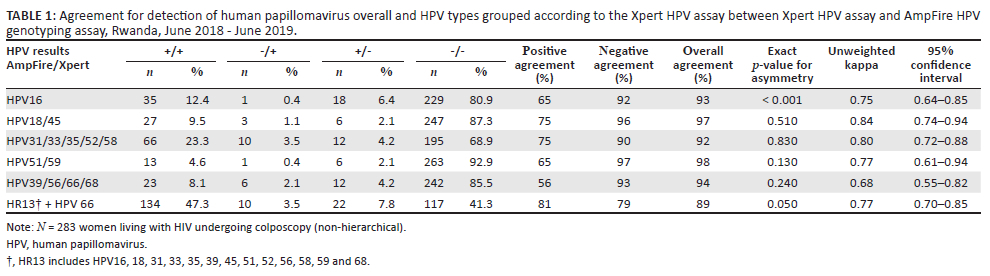
Overall agreement between the two test results for the 14 HPV types was 89% and the kappa value was 0.77 (95% confidence interval: 0.70-0.85). AmpFire was marginally more likely to test positive for the 13 types of HPV (p = 0.05) than Xpert (Table 1). Agreement ranged from 92% (HPV31/33/35/52/58) to 98% (HPV51/59), and kappa values ranged from 0.68 (HPV39/56/66/68) to 0.84 (HPV18/45) for HPV groups. AmpFire was more likely to test positive for HPV16 than Xpert (p < 0.001).
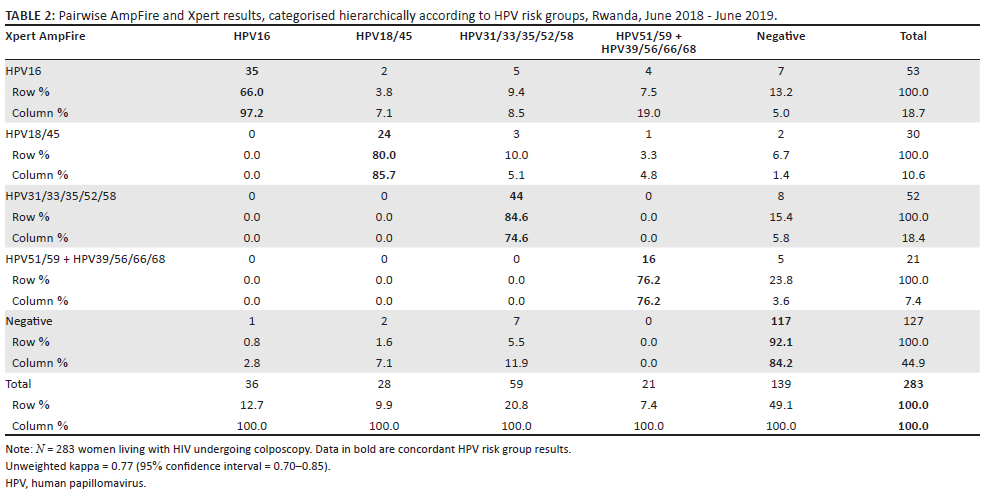
On the hierarchical analysis, the two assays had good agreement with an overall unweighted kappa value of 0.77 (95% confidence interval: 0.70-0.85) (Table 2). The hierarchical analysis also showed a similar pattern to that of non-hierarchical analysis for HPV 16 and HPV 18/45, with extra cases detected by AmpFire. However, for HPV31/33/35/52/58, more extra cases were detected by Xpert than by AmpFire while for other hrHPV types, both tests detected similar numbers of extra cases. Overall, AmpFire was more likely to rank HPV results in categories with higher risk than Xpert (p < 0.001).
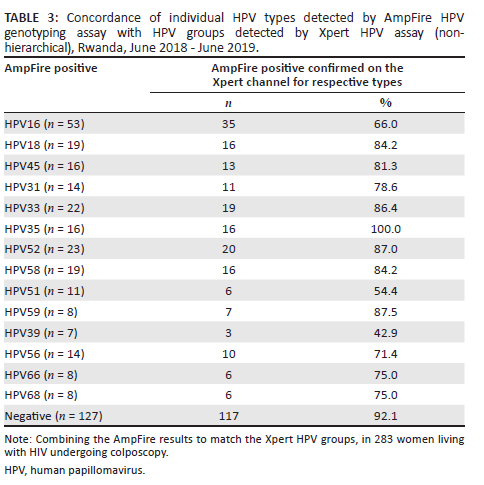
More than 80% of the HPV18/33/35/45/52/58/59 detected by AmpFire were positive in the Xpert channel that tested for that type (as a group of types) (Table 3). By contrast, only 54.4% of HPV51 and 42.9% of HPV39 detected by AmpFire were positive in the Xpert channel that tested for that type (as a group of types).
Discussion
This study sought to compare the Xpert and AmpFire among women living with HIV in Rwanda. We found an overall good to excellent agreement between the two methods for the detection of hrHPV. Notably, AmpFire was more likely to test positive cases for HPV16 than Xpert but the clinical meaning of the detection of these additional HPV16 infections was unknown.
The comparable findings between Xpert and AmpFire HPV regarding the detection of hrHPV may be explained by the well-known performance of these tests. Previous studies have shown that AmpFire could detect all HPV genotypes with sensitivity and specificity of more than 95%.5® and Linear Array, an excellent concordance between these tests and AmpFire has been demonstrated for the detection of 15 hrHPV.16
Further, Xpert has been widely used for the detection of various types of HPV, including hrHPV types. In Zimbabwe, an overall good concordance (77.2%, kappa = 0.698) between Xpert and Seegene Anyplex II HPV HR detection kit was found when testing hrHPV among women aged from 30 to 60 years.17159
Despite the overall agreement between the Xpert and AmpFire, differences in the detection of some types of hrHPV were noticed. These differences could be reflected by the extra cases of HPV16 and other hrHPV, including HPV18 and 45, which were detected by the AmpFire compared to Xpert. However, we could not find any scientific reason that could be attributed to the extra positivity by AmpFire, especially for HPV16. In contrast, Xpert has shown greater potential of detecting more cases of HPV31/33/35/52/58 than AmpFire. This extra detection of some hrHPV by Xpert compared to AmpFire could probably be explained by its greater performance of detecting concurrent infections by hrHPV.
Recommendations
As explained earlier, both assays perform as expected and use simple procedures with less equipment, and a rapid turnaround time, which make them highly recommendable as point-of-care screening for cervical precancer and cancer in low- to middle-income countries.
Strengths
This was the first study to have analysed the agreement between Xpert and AmpFire for the detection of hrHPV among women living with HIV in Rwanda. Thus, our findings may provide new insights regarding the performance of the two assays when applied in low-resource settings.
Limitations
The authors could not determine why there was extra positivity by AmpFire, especially for the detection of HPV16. Further studies, involving larger numbers of specimens and multiple sites, or histopathologic analyses could perhaps be relevant to address this knowledge gap.
Conclusion
This study revealed good to excellent agreement between Xpert and AmpFire when testing hrHPV types among women living with HIV in a Rwandan setting. It has also shown an extra positivity by AmpFire compared to Xpert, especially for HPV16, which requires further studies or adjudication by histopathologic tests.
Competing interests
This study received Xpert HPV tests at a reduced cost from Cepheid (Sunnyvale, California, United States).
Authors' contributions
A. Murangwa and P.E.C. conceived the study and received feedback from K.T.D. and J.C.G. A. Musafili and K.T.D. analysed and interpreted data with substantial inputs from P.E.C., J.C.G., K.A., L.M., G.M., G.K., P.T., F.K. and H.-Y.K. A. Murangwa and K.T.D. drafted the manuscript, which was critically reviewed by other authors. All authors approved the final version of the manuscript before submission.
Sources of support
This study was funded by grants from the National Cancer Institute of the United States National Institutes of Health (5U54CA19016304, 5U54CA254568).
Data availability
The data sets used or analysed during the current study are available from the corresponding author, A. Murangwa, on reasonable request.
Disclaimer
The views and opinions expressed in this article are those of the authors and do not necessarily reflect the official policy or position of any affiliated agency of the authors.
Acknowledgements
Authors thank the study participants for having consented to take part in the study. They also acknowledge the data collectors who have been involved in the fieldwork. Authors are also indebted to the facilitation by the management of the health centres where the initial cervical cancer screening took place.
References
- 1.Walboomers J, Jacobs M, Manos M, et al. Human papillomavirus is a necessary cause. J Pathol. 1999;189:12-19.
- 2.World Health Organization. Preparing for the Introduction of vaccines: Policy and programme guidance for countries. Geneva: WHO; 2006.
-
3.De Sanjose S, Quint WGV, Alemany L, et al. Human papillomavirus genotype attribution in invasive cervical cancer: A retrospective cross-sectional worldwide study. Lancet Oncol. 2010;11(11):1048-1056. https://doi.org/10.1016/S1470-2045(10)70230-8
» https://doi.org/10.1016/S1470-2045(10)70230-8 -
4.Demarco M, Hyun N, Carter-Pokras O, et al. A study of type-specific HPV natural history and implications for contemporary cervical cancer screening programs. eClinicalMedicine. 2020;22:1-9. https://doi.org/10.1016/j.eclinm.2020.100293
» https://doi.org/10.1016/j.eclinm.2020.100293 -
5.Tang YW, Lozano L, Chen X, et al. An isothermal, multiplex amplification assay for detection and genotyping of human papillomaviruses in formalin-fixed, paraffin-embedded tissues. J Mol Diagnostics. 2020;22(3):419-428. https://doi.org/10.1016/j.jmoldx.2019.12.004
» https://doi.org/10.1016/j.jmoldx.2019.12.004 -
6.Poljak M, Oštrbenk Valenčak A, Gimpelj Domjanič G, Xu L, Arbyn M. Commercially available molecular tests for human papillomaviruses: A global overview. Clin Microbiol Infect. 2020;26(9):1144-1150. https://doi.org/10.1016/j.cmi.2020.03.033
» https://doi.org/10.1016/j.cmi.2020.03.033 -
7.Arbyn M, Simon M, Peeters E, et al. 2020 list of human papillomavirus assays suitable for primary cervical cancer screening. Clin Microbiol Infect. 2021;27(8):1083-1095. https://doi.org/10.1016/j.cmi.2021.04.031
» https://doi.org/10.1016/j.cmi.2021.04.031 -
8.Castle PE, Smith KM, Davis TE, et al. Reliability of the Xpert HPV assay to detect high-risk human papillomavirus DNA in a colposcopy referral population. Am J Clin Pathol. 2015;143(1):126-133. https://doi.org/10.1309/AJCP4Q0NSDHWIZGU
» https://doi.org/10.1309/AJCP4Q0NSDHWIZGU - 9.World Health Organization. WHO prequalification of in vitro diagnostics public report product: Xpert® HPV: PQDx 0268-070-00. 2017;(December):1-45.
-
10.Connors KA, Abbott S, Jair K, et al. Cross comparison of AmpFire HPV genotyping assay and Roche human papillomavirus (HPV) linear array for HPV genotyping of anal swab samples. J Virol Methods. 2021;292(July 2019):114113. https://doi.org/10.1016/j.jviromet.2021.114113
» https://doi.org/10.1016/j.jviromet.2021.114113 -
11.Zhang W, Du H, Huang X, et al. Evaluation of an isothermal amplification HPV detection assay for primary cervical cancer screening. Infect Agent Cancer. 2020;15(1):1-6. https://doi.org/10.1186/s13027-020-00328-1
» https://doi.org/10.1186/s13027-020-00328-1 -
12.Murenzi G, Dusingize J, Rurangwa T, et al. Protocol for the study of cervical cancer screening technologies in HIV-infected women living in Rwanda. 2018;8(8):1-9. https://doi.org/10.1136/bmjopen-2017-020432
» https://doi.org/10.1136/bmjopen-2017-020432 - 13.National Institute of Statistics of Rwanda (NISR) & Ministry of Finance and Economic Planning (MINECOFIN). Fourth Rwanda Population and Housing Census. Final results. Kigali: NISR & MINECOFIN; 2012.
-
14.Saidu R, Kuhn L, Tergas A, et al. Performance of Xpert HPV on self-collected vaginal samples for cervical cancer screening among women in South Africa. J Low Genit Tract Dis. 2021;25(1):15-21. https://doi.org/10.1097/LGT.0000000000000575
» https://doi.org/10.1097/LGT.0000000000000575 -
15.Johnson LG, Saidu R, Mbulawa Z, et al. Selecting human papillomavirus genotypes to optimize the performance of screening tests among South African women. Cancer Med. 2020;9(18):6813-6824. https://doi.org/10.1002/cam4.3329
» https://doi.org/10.1002/cam4.3329 - 16.Juliana NCA, Juma MH, Heijmans R, et al. Detection of high-risk human papillomavirus (Hpv) by the novel ampfire isothermal hpv assay among pregnant women in Pemba Island, Tanzania. Pan Afr Med J. 2020;37(183):1-10.
-
17.Fitzpatrick MB, Dube RS, Katzenstein DA, et al. hrHPV prevalence and type distribution in rural Zimbabwe: A community-based self-collection study using near-point-of-care GeneXpert HPV testing. Int J Infect Dis. 2019;82:21-29. https://doi.org/10.1016/j.ijid.2019.02.022
» https://doi.org/10.1016/j.ijid.2019.02.022

Accepted: 26 May 2022
Published: 19 Oct. 2022