South African study of blast phase chronic myeloid leukaemia: A poor prognostic outlook
Abstract
BACKGROUND: Chronic myeloid leukaemia (CML) is a haematological malignancy characterised by the translocation t(9;22)(q34;q11.2), resulting in a constitutively active tyrosine kinase. Globally, overall survival of blast crisis phase (BC) CML is one year. Newer tyrosine kinase inhibitors and allogeneic stem cell transplantation offer remission; however, refractory and relapsed disease remain the biggest challenges. OBJECTIVE: In South Africa, literature is lacking on BC-CML. This study aimed to determine the disease characteristics and overall survival in South Africa. METHODS: This retrospective, laboratory-based study reviewed all new BC-CML diagnoses via flow cytometry at Charlotte Maxeke Johannesburg Academic Hospital in Johannesburg, South Africa, between April 2016 and October 2019. BC-CML was defined as the presence of > 20% blasts with a CML history or the BCR-ABL1 fusion gene (p210/p190) in the appropriate clinical or pathological context. Survival outcomes were inferred from clinical and laboratory data. RESULTS: Twenty-two new cases of BC-CML were diagnosed (median age: 34 years). There were 20 (91%) cases with the fusion transcripts p210 and two (9%) cases with p190 BCRABL1. For blast lineage, 14 cases were myeloid (63.6%), six were lymphoid (27.3%), and two were ambiguous (9.1%). There was a 72.7% mortality (16 cases); sepsis, refractory and relapsed disease were the major causes. Patients who achieved remission had lower blast percentages, simple karyotypes, and a trend towards higher white cell and platelet counts at presentation. CONCLUSION: Optimised management of early-stage CML, prevention and aggressive management of sepsis, with advocation for newer therapies are needed to improve the overall survival of BC-CML in South Africa
chronic myeloid leukaemia; blast phase; major molecular route abnormalities; South Africa; p210 BCRABL1 fusion transcript; p190 BCRABL1 fusion transcript; responses by quantitative reverse transcriptase-polymerase chain reaction; karyotype
Introduction
Chronic myeloid leukaemia (CML) is a haematological malignancy that arises within a pluripotent haemopoietic stem cell.1,2,3BCR-ABL1) fusion gene encoding for a constitutively active tyrosine kinase.4,5,6,78,9,1011,12,13,14,15
Tyrosine kinase inhibitors (TKIs) were the first targeted therapies developed for CML. The introduction of the first-generation TKIs as the mainstay therapy in 1998 halted the natural progression of the disease. This has allowed patients to maintain chronic phase disease with the achievement of morphological, clinical, and molecular remission targets. Since the introduction of second and third-generation TKIs, there has been advancement in both the speed and depth of molecular remission.1617,18
In contrast, the diagnosis of chronic myeloid leukaemia in blast crises phase (BC) CML has been associated with a low median OS of 12 months in the United States. Combination therapy with TKIs and intensive chemotherapy, consolidated with an allogeneic haemopoietic stem cell transplant (AlloSCT), offers patients the most favourable outcomes.19
Methods
Ethical considerations
Ethics clearance was obtained from the University of the Witwatersrand Human Ethics Committee (protocol number M150160). The study was a retrospective analysis of laboratory results obtained from the laboratory information system (LIS) (TrakCare, InterSystems, Cambridge, Massachusetts, United States) and patient consent was not a requisite. Patient privacy was ensured through the use of unique study numbers, with the link to patient identifying information kept in a separate, password-protected Excel spreadsheet.
Study design
This study included all new cases of acute leukaemia diagnosed by flow cytometry at the Charlotte Maxeke Johannesburg Academic Hospital (CMJAH) over 42 months, between 08 April 2016 and 16 October 2019. These cases were identified from the flow cytometry register with the largest proportion of cases received from CMJAH, Chris Hani Baragwanath Academic Hospital (CHBAH) and Helen Joseph Hospital. The LIS was used to collect available clinical data, demographics, laboratory results, treatment responses, OS, and cause of death. The results were collated on an Excel spreadsheet (Microsoft Corporation, Santa Rosa, California, United States) and cases of BC-CML were extracted. Inclusion of cases into the BC-CML category required a preceding history of CML or presence of the BCR-ABL1 fusion gene (p210/ p190) in the context of splenomegaly, peripheral smear features of CML (leucocytosis, left shift, myelocyte peak, eosinophilia and basophilia) and major molecular route abnormalities on conventional cytogenetics (CCy).
Statistical analysis
The data were analysed using STATA software, version 14.1 (Statistics/Data Analysis, StataCorp LLC, College Station, Texas, United States). Continuous data were reported as the median (interquartile ranges [IQR]) and categorical data as percentages and frequencies. The two-sample Wilcoxon rank-sum (Mann-Whitney) test was used to compare continuous variables. Statistical significance was accepted at a two-sided p-value of 0.05.
Results
Twenty-two cases of BC-CML were diagnosed by flow cytometry in the reviewed period between 2016 and 2019. The rate of blastic transformation from chronic and accelerated phase CML could not be determined as the prevalence of CML was unknown for the referring centres.
Patient demographics and treatment history
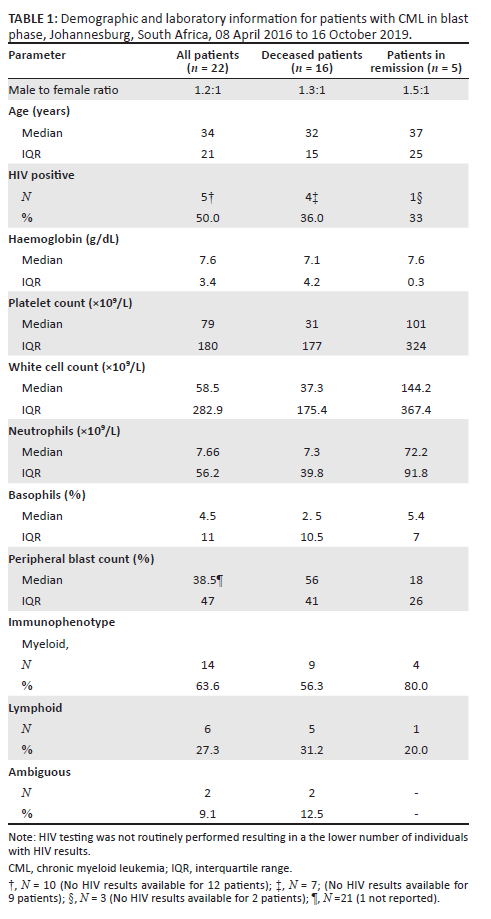
The median age was 34 years (IQR: 21 years) with two patients aged younger than 18 years, and a slight predominance of male patients, 57% (n = 12). HIV testing was performed in less than half (n = 20) of the patients with a 50% positivity (Table 1).
Information on the use of TKI therapy was limited to that documented on the LIS. Imatinib mesylate therapy was reported in one patient; dasatinib in three; and nilotinib in two. None of the patients had been managed with a trial of treatment-free remission (TFR).
Molecular and immunophenotypic results
Twenty cases had p210 BCR-ABL1 fusion transcripts, and two cases had p190 BCR-ABL1. For blast lineage in BC-CML, 14 cases (63.6%) were myeloid, six cases (27.3%) were lymphoid and two cases (9.1%) were ambiguous. Of the lymphoid cases, approximately two-thirds (n = 4) were of B lineage. The p210 case lineages were myeloid in 13 cases; T in one case, B in four cases; and ambiguous in two cases. The p190 cases were of myeloid and T lineage, with the latter relapsing as an ambiguous lineage acute leukaemia (T/Myeloid).
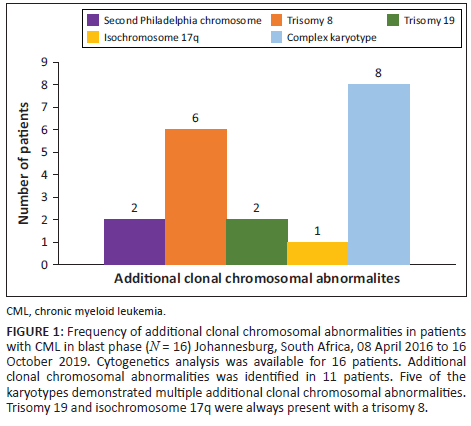
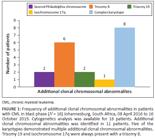
Additional clonal chromosomal abnormalities were detected on CCy in 11 of the 16 individuals with successful karyotypes. Complex karyotypes and trisomy 8 were the most frequently observed, with five CCy demonstrating multiple additional clonal chromosomal abnormalities (Figure 1). One patient bore the T315I mutation at the time of diagnosis of BC-CML with a history of treatment failure on both imatinib mesylate and nilotinib.
Patient outcomes
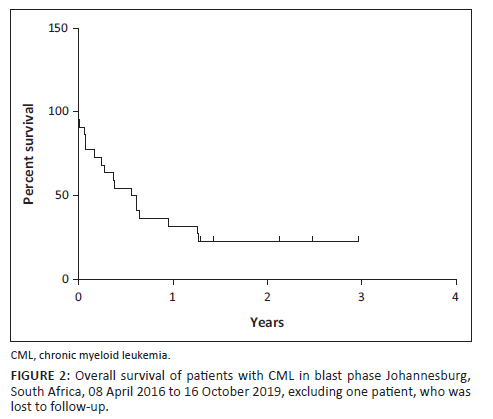
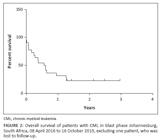
There was a 72.7% (16 cases) mortality with a median OS of 7 months (IQR: 13.6 months) (Figure 2). The details of the therapeutic management of each BC-CML was not available. Five deaths occurred in the first month with sepsis the predominant cause in 80% (four cases). The remaining 11 deaths occurred at a median of 6.7 months (IQR: 4.5 months) with two-thirds of the deaths attributed to relapsed and/or refractory disease, and one-third to sepsis. Patients with the p190 BCR-ABL1 fusion transcript survived a median of 6.1 months (IQR: 3.3 months) with relapsed disease as cause of death.
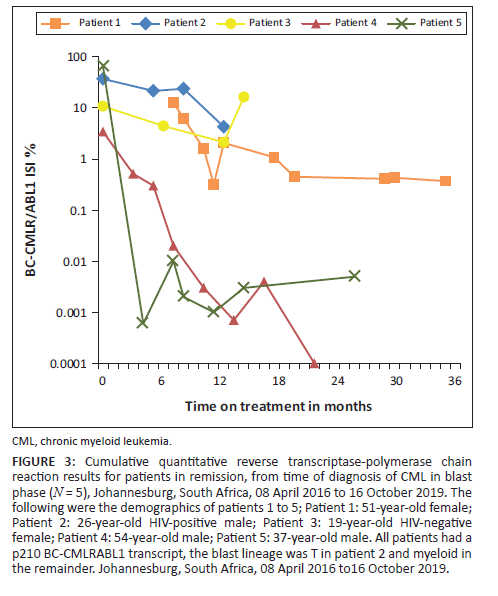
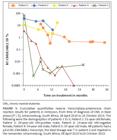
At the time of the study, remission with reversion to chronic phase CML (based on laboratory parameters) was achieved in 22.7% (five cases) with a median remission time of 25.6 months (IQR: 12.5 months). The disease characteristics in the remission group included a dominance of myeloid lineage (80%, four cases) with a second Philadelphia (Ph) chromosome being the only additional abnormality present in one of the three patients with successful CCy. The molecular responses by quantitative reverse transcriptase-polymerase chain reaction were extremely varied from undetectable transcript levels to no molecular response (Figure 3). One patient was lost to follow-up at one year with achievement of a major cytogenetic response at this time point.
The median peripheral blood blast percentage at diagnosis was significantly higher in patients who died, 56% (16 cases) versus those in remission 18% (five cases) (p = 0.03). Conversely, the white cell and platelet counts at diagnosis were lower among patients who died, but the difference was not statistically significant (white cell count for deceased patients: median = 37.3 (IQR: 175.4) versus for patients in remission: median, 144.2 (IQR: 367.4, p = 0.52) and the platelet count for deceased patients: median, 31 (IQR: 177) versus for patients in remission: median, 101 (IQR: 324, p = 0.54) (Table 1).
Discussion
This retrospective laboratory report review determined the disease charatersistics and overall survival of BC-CML in South Africa. The median age of BC-CML in our study was significantly lower than the 61 years reported internationally and corresponds with the younger age at diagnosis of CML in our setting.20,21,22
The risk factors for the development of CML remain largely unknown with acute radiation exposure and rare cases of possible familial predisposition reported.19
Progression from chronic phase CML to BC-CML could not be determined from our study as a result of the paucity of local prevalence data. Indirectly, the rates of transformation at the CHBAH appear high as compared with international reports (~2%), with a yearly number of ~3 new adult cases of BC-CML, in a background of ~12 new cases of CML per year.20,23
The lineage distribution of BC-CML in this study is similar to that reported in the literature with myeloid lineage accounting for around ~52% to 67% and lymphoid for around ~19% to 35%.24,2524,2524,25
The p210 BCR-ABL1 fusion (e13a1 [b2a2]/e14a2 [b3a2]) is the most common transcript seen in CML. Co-expression of p210 with p190 (e1a2) is described, but a very rare phenomenon. Rarer still is an isolated p190 BCR-ABL1 fusion which has been described in 1% of CML. This latter group is associated with poor response to TKI therapy and disease progression in greater than 80% of the group.262726
High-risk cytogenetic abnormalities in CML include a complex karyotype and major molecular route abnormalities which are markers of disease acceleration. This is associated with more rapid disease progression, treatment resistance or suboptimal treatment response.2829BCR-ABL1 transcripts and platelet counts of < 102 × 10^9/L.19,30
The TKIs for the treatment of chronic phase CML at the time of this study included: the first-generation TKI, imatinib mesylate and second-generation TKI, dasatinib (on a compassionate basis) and nilotinib. Currently, in the South African state sector, imatinib mesylate remains the first-line therapy together with hydroxyurea (for cytoreduction) in chronic phase CML. Nilotinib is the second line TKI and is used in situations of treatment failure. Dasatinib is no longer available on compassionate grounds. Importantly, comparable response rates and survival outcomes have been demonstrated for these second-generation TKIs.3132BCR-ABL1 transcripts, TKI therapy used for a minimum of five years, the achievement of a deep molecular response (DMR) ≤ 4.5, a sustained DMR of ≤ 4-4.5 for ≥ 2-3 years, no prior history of accelerated or BC-CML and the ability to perform frequent (monthly initially) responses by quantitative reverse transcriptase-polymerase chain reaction testing which is both sensitive (minimum MR 4.5) and delivered within a rapid turnaround time.33,34,3536
The median OS in our cohort was almost half of that reported in a United States-based study (7 vs 12 months), driven by a substantial proportion of patients with early deaths (defined as deaths within the first month of diagnosis).193738,39,40,4137,424340,44BC-CMLR-ABL1 clone).4537
A separate challenge faced for clinicians in the management of CML is the need to screen and monitor for the development of cardovascular events and second malignancies.4646,474446
At present, the most effective management of BC-CML is its prevention. This is through the achievement of rapid and deeper molecular responses in chronic and accelerated disease, identification of high-risk individuals with close monitoring (laboratory, clinical) and timeous therapy changes in non-responders. More advocay for new and novel treatment approaches in our setting is necessary.
Limitations
The limitations in this study include the paucity of clinical information and reliable outcome data as a result of the retrospective design. Cases without flow cytometry, especially isolated extramedullary transformation, were missed. Furthermore, molecular information, namely CCy or responses by quantitative reverse transcriptase-polymerase chain reaction, was not available for a notable proportion of the patients, preventing an accurate picture of the molecular landscape of BC-CML. Lastly, given the rarity of this entity, factors which affect outcomes are difficult to determine.
Conclusion
A laboratory-based retrospective study of BC-CML was performed in a public health sector setting in South Africa. The results showed that BC-CML occurs at a younger age in adults as compared with international studies. This corresponds to the younger age of chronic phase CML seen in our setting, a finding which may reflect the country demographics, different environmental exposures or genetic predispositions. Disease characteristics were similar when compared with other reports of BC-CML, supporting the use of international treatment protocols and guidelines. There was a dismal overall survival of 7 months, with sepsis and relapsed refractory disease being the major contributors, highlighting the need to advocate for new and novel therapies.
Competing interests
The authors declare that they have no financial or personal relationships that may have inappropriately influenced them in writing this article.
Authors' contributions
K.E.H., N.B. and J.V. were involved in the conceptualisation and methodology, K.E.H. and J.V. in data collection, K.E.H. in data analysis and drafting the initial manuscript, N.B. and J.V. in editing and all authors discussed the results and contributed to the final manuscript.
Sources of support
This research did not receive any specific grant from funding agencies in the public, commercial, or not-for-profit sectors.
Data availability
The authors confirm that the data supporting the findings of this study are available within the article.
Disclaimer
The views and opinions expressed in this article are those of the authors and do not necessarily reflect the official policy or position of any affiliated agency of the authors.
Acknowledgements
We would like to acknowledge all the staff members of the following units for their invaluable contributions towards leukaemia diagnosis and management in Johannesburg: the flow cytometry laboratory at the CMJAH, the Somatic Cell Genetics unit at the CMJAH, the morphology units of the CMJAH, the CHBAH and Helen Joseph Hospital, the medical oncology unit at the CMJAH, the paediatric oncology units at the CMJAH and CHBAH, and the Clinical Haematology Unit at the CHBAH.
References
-
1.Fialkow PJ, Jacobson RJ, Papayannopoulou T. Chronic myelocytic leukemia: Clonal origin in a stem cell common to the granulocyte, erythrocyte, platelet and monocyte/macrophage. Am J Med. 1977;63(1):125-130. https://doi.org/10.1016/0002-9343(77)90124-3
» https://doi.org/10.1016/0002-9343(77)90124-3 -
2.Clein GP, Flemans RJ. Involvement of the erythroid series in blastic crisis of chronic myeloid leukaemia. Further evidence for the presence of Philadelphia chromosome in erythroblasts. Br J Haematol. 1966;12(6):754-758. https://doi.org/10.1111/j.1365-2141.1966.tb00162.x
» https://doi.org/10.1111/j.1365-2141.1966.tb00162.x -
3.Rastrick JM, Fitzgerald PH, Gunz FW. Direct evidence for presence of Ph-1 chromosome in erythroid cells. Br Med J. 1968;1(5584):96-98. https://doi.org/10.1136/bmj.1.5584.96
» https://doi.org/10.1136/bmj.1.5584.96 -
4.Nowell PC. The minute chromosome (Phl) in chronic granulocytic leukemia. Blut. 1962;8:65-66. https://doi.org/10.1007/bf01630378
» https://doi.org/10.1007/bf01630378 -
5.Rowley JD. Letter: A new consistent chromosomal abnormality in chronic myelogenous leukaemia identified by quinacrine fluorescence and Giemsa staining. Nature. 1973;243(5405):290-293. https://doi.org/10.1038/243290a0
» https://doi.org/10.1038/243290a0 -
6.Wang ES. Treating acute myeloid leukemia in older adults. Hematology Am Soc Hematol Educ Program. 2014;2014(1):14-20. https://doi.org/10.1182/asheducation-2014.1.14
» https://doi.org/10.1182/asheducation-2014.1.14 -
7.Schoch C, Schnittger S, Bursch S, et al. Comparison of chromosome banding analysis, interphase- and hypermetaphase-FISH, qualitative and quantitative PCR for diagnosis and for follow-up in chronic myeloid leukemia: A study on 350 cases. Leukemia. 2002;16(1):53-59. https://doi.org/10.1038/sj.leu.2402329
» https://doi.org/10.1038/sj.leu.2402329 -
8.McGahon A, Bissonnette R, Schmitt M, et al. BCR-ABL maintains resistance of chronic myelogenous leukemia cells to apoptotic cell death. Blood. 1994;83(5):1179-1187. https://doi.org/10.1182/blood.V83.5.1179.1179
» https://doi.org/10.1182/blood.V83.5.1179.1179 -
9.Gordon MY, Dowding CR, Riley GP, Goldman JM, Greaves MF. Altered adhesive interactions with marrow stroma of haematopoietic progenitor cells in chronic myeloid leukaemia. Nature. 1987;328(6128):342-344. https://doi.org/10.1038/328342a0
» https://doi.org/10.1038/328342a0 - 10.Strife A, Clarkson B. Biology of chronic myelogenous leukemia: Is discordant maturation the primary defect? Semin Hematol. 1988;25(1):1-19.
-
11.Faderl S, Talpaz M, Estrov Z, Kantarjian HM. Chronic myelogenous leukemia: Biology and therapy. Ann Intern Med. 1999;131(3):207-219. https://doi.org/10.7326/0003-4819-131-3-199908030-00008
» https://doi.org/10.7326/0003-4819-131-3-199908030-00008 -
12.Arber DA, Orazi A, Hasserjian R, et al. The 2016 revision to the World Health Organization classification of myeloid neoplasms and acute leukemia. Blood. 2016;127(20):2391-2405. https://doi.org/10.1182/blood-2016-03-643544
» https://doi.org/10.1182/blood-2016-03-643544 -
13.Döhner H, Estey E, Grimwade D, et al. Diagnosis and management of AML in adults: 2017 ELN recommendations from an international expert panel. Blood. 2017;129(4):424-447. https://doi.org/10.1182/blood-2016-08-733196
» https://doi.org/10.1182/blood-2016-08-733196 - 14.Sokal JE, Baccarani M, Russo D, Tura S. Staging and prognosis in chronic myelogenous leukemia. Semin Hematol. 1988;25(1):49-61.
-
15.Ley TJ, Mardis ER, Ding L, et al. DNA sequencing of a cytogenetically normal acute myeloid leukaemia genome. Nature. 2008;456(7218):66-72. https://doi.org/10.1038/nature07485
» https://doi.org/10.1038/nature07485 -
16.Deininger M, O'Brien SG, Guilhot Fo, et al. International randomized study of interferon vs STI571 (IRIS) 8-year follow up: Sustained survival and low risk for progression or events in patients with newly diagnosed chronic myeloid leukemia in chronic phase (CML-CP) treated with Imatinib. Blood. 2009;114(22):1126. https://doi.org/10.1182/blood.V114.22.1126.1126
» https://doi.org/10.1182/blood.V114.22.1126.1126 -
17.Sasaki K, Strom SS, O'Brien S, et al. Relative survival in patients with chronic-phase chronic myeloid leukaemia in the tyrosine-kinase inhibitor era: Analysis of patient data from six prospective clinical trials. Lancet Haematol. 2015;2(5):e186-e193. https://doi.org/10.1016/s2352-3026(15)00048-4
» https://doi.org/10.1016/s2352-3026(15)00048-4 -
18.Baccarani M, Deininger MW, Rosti G, et al. European LeukemiaNet recommendations for the management of chronic myeloid leukemia: 2013. Blood. 2013;122(6):872-884. https://doi.org/10.1182/blood-2013-05-501569
» https://doi.org/10.1182/blood-2013-05-501569 -
19.Jain P, Kantarjian HM, Ghorab A, et al. Prognostic factors and survival outcomes in patients with chronic myeloid leukemia in blast phase in the tyrosine kinase inhibitor era: Cohort study of 477 patients. Cancer. 2017;123(22):4391-4402. https://doi.org/10.1002/cncr.30864
» https://doi.org/10.1002/cncr.30864 -
20.Patel M, Philip V, Fazel F, Lakha A, Vorog A, Ali N, et al. Human immunodeficiency virus infection and chronic myeloid leukemia. Leuk Res. 2012;36(11):1334-8. https://doi.10.1016/j.leukres.2012.07.012.
» https://doi.10.1016/j.leukres.2012.07.012 - 21.Oliver S, Samy F, Lawton S, et al. National Cancer Intelligence Network Trends in incidence and outcome for haematological cancers in England: 2001-2010 Public Health England, Wellington House, 133-155 Waterloo Road London SE1 8UG: PHE publications gateway number; November 2014.
-
22.Khalidi HS, Brynes RK, Medeiros LJ, et al. The immunophenotype of blast transformation of chronic myelogenous leukemia: A high frequency of mixed lineage phenotype in 'lymphoid' blasts and A comparison of morphologic, immunophenotypic, and molecular findings. Mod Pathol. 1998;11(12):1211-1221. https://doi.org/10.1093/ajcp/109.2.211
» https://doi.org/10.1093/ajcp/109.2.211 -
23.Höglund M, Sandin F, Hellström K, et al. Tyrosine kinase inhibitor usage, treatment outcome, and prognostic scores in CML: Report from the population-based Swedish CML registry. Blood. 2013;122(7):1284-1292. https://doi.org/10.1182/blood-2013-04-495598
» https://doi.org/10.1182/blood-2013-04-495598 - 24.López-Karpovitch X, Cárdenas R, Piedras J. Immunophenotypic characteristics of the blast crisis in chronic myeloid leukemia. Rev Invest Clin. 1997;49(1):31-36.
- 25.Yen CC, Liu JH, Wang WS, et al. Immunophenotypic and genotypic characteristics of chronic myelogenous leukemia in blast crisis. Zhonghua Yi Xue Za Zhi (Taipei). 2000;63(11):785-791.
-
26.Verma D, Kantarjian HM, Jones D, et al. Chronic myeloid leukemia (CML) with P190 BCR-ABL: Analysis of characteristics, outcomes, and prognostic significance. Blood. 2009;114(11):2232-2235. https://doi.org/10.1182/blood-2009-02-204693
» https://doi.org/10.1182/blood-2009-02-204693 -
27.Van Rhee F, Hochhaus A, Lin F, et al. p190 BCR-ABL mRNA is expressed at low levels in p210-positive chronic myeloid and acute lymphoblastic leukemias. Blood. 1996;87(12):5213-5217. https://doi.org/10.1182/blood.v87.12.5213.bloodjournal87125213
» https://doi.org/10.1182/blood.v87.12.5213.bloodjournal87125213 -
28.Issa GC, Kantarjian HM, Gonzalez GN, et al. Clonal chromosomal abnormalities appearing in Philadelphia chromosome-negative metaphases during CML treatment. Blood. 2017;130(19):2084-2091. https://doi.org/10.1182/blood-2017-07-792143
» https://doi.org/10.1182/blood-2017-07-792143 -
29.Hehlmann R, Voskanyan A, Lauseker M, et al. High-risk additional chromosomal abnormalities at low blast counts herald death by CML. Leukemia. 2020;34(8):2074-2086. https://doi.org/10.1038/s41375-020-0826-9
» https://doi.org/10.1038/s41375-020-0826-9 -
30.Cervantes F, Rozman M, Rosell J, et al. A study of prognostic factors in blast crisis of Philadelphia chromosome-positive chronic myelogenous leukaemia. Br J Haematol. 1990;76(1):27-32. https://doi.org/10.1111/j.1365-2141.1990.tb07832.x
» https://doi.org/10.1111/j.1365-2141.1990.tb07832.x -
31.Takahashi K, Kantarjian HM, Yang Y, et al. A propensity score matching analysis of dasatinib and nilotinib as a frontline therapy for patients with chronic myeloid leukemia in chronic phase. Cancer. 2016;122(21):3336-3343. https://doi.org/10.1002/cncr.30197
» https://doi.org/10.1002/cncr.30197 -
32.Sasaki K, Lahoti A, Jabbour E, et al. Clinical safety and efficacy of Nilotinib or Dasatinib in patients with newly diagnosed chronic-phase chronic myelogenous leukemia and pre-existing liver and/or renal dysfunction. Clin Lymphoma Myeloma Leuk. 2016;16(3):152-162. https://doi.org/10.1016/j.clml.2015.12.003
» https://doi.org/10.1016/j.clml.2015.12.003 -
33.Hochhaus A, Saussele S, Rosti G, et al. Chronic myeloid leukaemia: ESMO clinical practice guidelines for diagnosis, treatment and follow-up. Ann Oncol. 2017;28(suppl_4):iv41-iv51. https://doi.org/10.1093/annonc/mdx219
» https://doi.org/10.1093/annonc/mdx219 -
34.Radich JP, Deininger M, Abboud CN, et al. Chronic myeloid leukemia, Version 1.2019, NCCN Clinical Practice Guidelines in Oncology. J Natl Compr Canc Netw. 2018;16(9):1108-1135. https://doi.org/10.6004/jnccn.2018.0071
» https://doi.org/10.6004/jnccn.2018.0071 -
35.Rea D, Ame S, Berger M, et al. Discontinuation of tyrosine kinase inhibitors in chronic myeloid leukemia: Recommendations for clinical practice from the French Chronic Myeloid Leukemia Study Group. Cancer. 2018;124(14):2956-2963. https://doi.org/10.1002/cncr.31411
» https://doi.org/10.1002/cncr.31411 -
36.Hughes TP, Ross DM. Moving treatment-free remission into mainstream clinical practice in CML. Blood. 2016;128(1):17-23. https://doi.org/10.1182/blood-2016-01-694265
» https://doi.org/10.1182/blood-2016-01-694265 -
37.Hehlmann R. How I treat CML blast crisis. Blood. 2012;120(4):737-747. https://doi.org/10.1182/blood-2012-03-380147
» https://doi.org/10.1182/blood-2012-03-380147 -
38.Palandri F, Castagnetti F, Testoni N, et al. Chronic myeloid leukemia in blast crisis treated with imatinib 600 mg: Outcome of the patients alive after a 6-year follow-up. Haematologica. 2008;93(12):1792-1796. https://doi.org/10.3324/haematol.13068
» https://doi.org/10.3324/haematol.13068 -
39.Kantarjian HM, Cortes J, O'Brien S, et al. Imatinib mesylate (STI571) therapy for Philadelphia chromosome-positive chronic myelogenous leukemia in blast phase. Blood. 2002;99(10):3547-3553. https://doi.org/10.1182/blood.v99.10.3547
» https://doi.org/10.1182/blood.v99.10.3547 -
40.Saglio G, Hochhaus A, Goh YT, et al. Dasatinib in imatinib-resistant or imatinib-intolerant chronic myeloid leukemia in blast phase after 2 years of follow-up in a phase 3 study: Efficacy and tolerability of 140 milligrams once daily and 70 milligrams twice daily. Cancer. 2010;116(16):3852-3861. https://doi.org/10.1002/cncr.25123
» https://doi.org/10.1002/cncr.25123 -
41.Giles FJ, le Coutre PD, Pinilla-Ibarz J, et al. Nilotinib in imatinib-resistant or imatinib-intolerant patients with chronic myeloid leukemia in chronic phase: 48-month follow-up results of a phase II study. Leukemia. 2013;27(1):107-112. https://doi.org/10.1038/leu.2012.181
» https://doi.org/10.1038/leu.2012.181 -
42.Saussele S, Lauseker M, Gratwohl A, et al. Allogeneic hematopoietic stem cell transplantation (allo SCT) for chronic myeloid leukemia in the imatinib era: Evaluation of its impact within a subgroup of the randomized German CML Study IV. Blood. 2010;115(10):1880-1885. doi.10.1182/blood-2009-08-237115
» https://doi.org/10.1182/blood-2009-08-237115 -
43.Cortes J, Kim DW, Raffoux E, et al. Efficacy and safety of dasatinib in imatinib-resistant or -intolerant patients with chronic myeloid leukemia in blast phase. Leukemia. 2008;22(12):2176-2183. https://doi.org/10.1038/leu.2008.221
» https://doi.org/10.1038/leu.2008.221 -
44.Morita K, Kantarjian HM, Sasaki K, et al. Outcome of patients with chronic myeloid leukemia in lymphoid blastic phase and Philadelphia chromosome-positive acute lymphoblastic leukemia treated with hyper-CVAD and dasatinib. Cancer. 2021;127(15):2641-2647. https://doi.org/10.1002/cncr.33539
» https://doi.org/10.1002/cncr.33539 -
45.Maiti A, Franquiz MJ, Ravandi F, et al. Venetoclax and BCR-ABL tyrosine kinase inhibitor combinations: Outcome in patients with Philadelphia chromosome-positive advanced myeloid leukemias. Acta Haematol. 2020;143(6):567-573. https://doi.org/10.1159/000506346
» https://doi.org/10.1159/000506346 -
46.Sasaki K, Kantarjian HM, O'Brien S, et al. Incidence of second malignancies in patients with chronic myeloid leukemia in the era of tyrosine kinase inhibitors. Int J Hematol. 2019;109(5):545-552. https://doi.org/10.1007/s12185-019-02620-2
» https://doi.org/10.1007/s12185-019-02620-2 -
47.Jain P, Kantarjian H, Boddu PC, et al. Analysis of cardiovascular and arteriothrombotic adverse events in chronic-phase CML patients after frontline TKIs. Blood Adv. 2019;3(6):851-861. https://doi.org/10.1182/bloodadvances.2018025874
» https://doi.org/10.1182/bloodadvances.2018025874

Accepted: 22 Feb. 2022
Published: 31 May 2022