Serologic evidence of seasonal influenza A and B in HIV patients on combined antiretroviral therapy in Lagos, Nigeria
Abstract
BACKGROUND: Influenza and HIV are endemic in Nigeria but there is no epidemiological data on the co-infection of influenza A and B among HIV patients. OBJECTIVE: We investigated seasonal influenza A and B, and co-infection among HIV patients on combined antiretroviral therapy (cART) in Lagos, Nigeria. METHODS: In a prospective cross-sectional study, clear sera collected from 174 HIV-positive patients between August and September 2018 were analysed for immunoglobulin M-specific antibodies to seasonal influenza A subtypes H1N1 and H3N2, and influenza B by enzyme immunoassay. RESULTS: A total of 39.7% (69/174) of HIV patients were seropositive for influenza A or B viruses with 84.1% (58/69) being positive for influenza A, 13.04% (9/69) seropositive for both influenza A and B, and only 2.9% (2/69) positive for influenza B mono-infection. Median age was 44 (mean 45, mode 40, range 18-74) years. The 41-50 years age group had the highest seroprevalence (39.1%; 27/69). Seropositivity was highest among women (65.2%; 45/69). A total of 88.4% (61/69) of HIV patients seropositive for influenza A or B were on fixed dose cART, while 73.9% (51/69) were virologically suppressed. Furthermore, 27.5% (19/69) were immunocompromised, of which 21.1% (4/19) were severely immunosuppressed (cluster of differentiation 4 < 200 cells/mm>3 CONCLUSION: Influenza A and B was prevalent among HIV patients on cART, which may predispose them to life-threatening complications. We recommend strong advocacy on the need to reduce the risk of exposure to influenza and for the provision of an influenza vaccine in Nigeria.
influenza A; influenza B; HIV co-infection; seroprevalence; Lagos
Introduction
In humans, seasonal influenza viruses cause an annual 3-5 million illnesses and 290 000-650 000 deaths worldwide.121
On the other hand, HIV is a retrovirus that spreads through the body rapidly, causing damage to the immune system by attacking host cluster of differentiation 4 (CD4) cells with resultant AIDS.34
According to the World Health Organization,44,5www.worldometers.info), with up to 3.2 million people living with HIV.66,7,8
Influenza viral infection is a common cause of respiratory illness among HIV-infected persons in whom it can be more severe and prolonged.9101112
In general, the immunogenicity of influenza viral infections in HIV-infected patients is directly proportional to the CD4 cell count and correlates negatively to the viral load.139
However, a lack of epidemiological data on seasonal influenza in HIV-positive individuals is a major problem preventing the development of national policies on influenza preventive strategies in sub-Saharan Africa, including Nigeria. In South Africa, 44% of influenza positive patients having acute respiratory infections are HIV-infected.10
Serological assays usually complement epidemiological and clinical investigations in the detection and identification of influenza viruses. They measure antibodies developed in response to infection with antigenically novel and seasonal influenza viruses.1415,16,17
This study was therefore designed to investigate seasonal influenza A and B virus infections in HIV patients on cART in Lagos, Nigeria.
Methods
Ethical considerations
Permission was sought from the head of the AIDS prevention initiative in Nigeria (APIN) clinic where the samples were collected after tendering the ethical approval (reference no.: LREC.06/10/1030) obtained from the Health Research and Ethics Committee of the Lagos State University Teaching Hospital (LASUTH).
Study area, population and design
A prospective cross-sectional study was designed. Outpatients attending the AIDS prevention initiative in Nigeria (APIN)-Lagos University Teaching Hospital clinic who were previously laboratory confirmed to be HIV-positive were recruited for this study from August 2018 to September 2018. APIN-Lagos University Teaching Hospital clinic is a large university-based HIV clinic in Lagos, Nigeria, with about 15 000 patients currently enrolled in Lagos. After explaining the concept of the study, a total of 174 HIV patients, including 165 on cART, who were unvaccinated for influenza and gave both oral and written informed consent, were bled by venepuncture. Demographic and clinical data were appropriately collected with a designed questionnaire. Results of further laboratory analyses including CD4 count, RNA viral load and cART regimen were obtained from the patients' clinical records.
Sample collection and treatment
Approximately 5 mL of whole blood samples were collected into sterile plain bottles. They were stored in sample coolers stacked with ice packs before being conveyed to the laboratory. The samples were centrifuged at 704 × g for 15 min to obtain clear sera that were aliquoted into labelled sterile plain cryovial tubes. The sera were then stored away at −30 °C until ready for serological analysis.
Laboratory analysis
Clear sera were analysed for the detection and quantitative determination of immunoglobulin M antibody specific for influenza virus by enzyme-linked immunoassay (Demeditec Diagnostics GmbH, Kiel, Germany) in the Department of Microbiology (Virology Research) Laboratory, Lagos State University, Ojo. Following manufacturer's instructions, sufficient amounts of micro titre wells were prepared for the standards, controls and samples as well as for the substrate blank. The samples were diluted with ready-to-use sample diluent provided with the test kit in the ratio 1:100 (2 µL serum + 200 µL sample diluents). Assay absorbance was read at a wavelength of 450 nanometres with an EMax precision Microplate reader (Molecular Devices, LLC, San Jose, California, United States). Sample results were compared with the included standards and controls and were interpreted based on the assay standard curve as recommended by the manufacturer. It should however be noted that positive immunoglobulin M antibody specific for influenza virus implies a recent immunological reaction to circulating live influenza strains as a result of infection since Nigeria does not currently practise influenza vaccination.
Statistical analysis
Raw data were entered into Microsoft Excel, version 2013 (Microsoft Corporation, Redmond, Washington, United States). Descriptive statistics was performed while inferential statistics was analysed with chi-square at p less than 0.05 for statistical significance using GraphPad Prism version 8.0.1 (GraphPad Software Inc., San Diego, California, United States).
Results
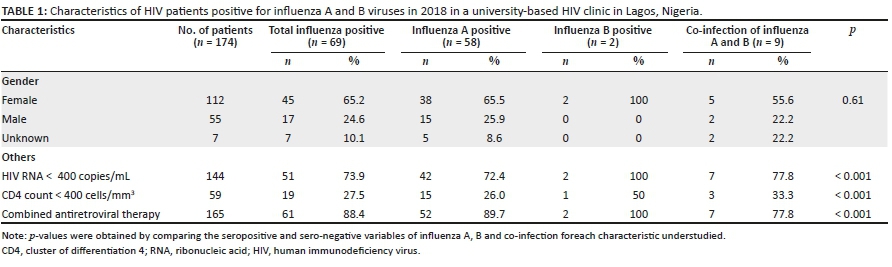
Out of the 174 HIV-positive patients tested, 69/174 (39.7%) were seropositive for influenza A or B viruses, with 58/69 (84.1%) positive for influenza A, 2/69 (2.9%) for influenza B, and 9/69 (13.0%) for both influenza A and B (Table 1). The median age of patients was 44, mean 45, mode 40, and range 18-74 years. Seropositivity was higher in female patients (45/69; 65.2%) compared to male patients (17/69; 24.6%). A total of 51/69 (73.9%) of the patients were virologically suppressed with HIV RNA under 400 copies/mL, and 19/69 (27.5%) were immunocompromised (CD4 < 400 cells/mm33p < 0.001).
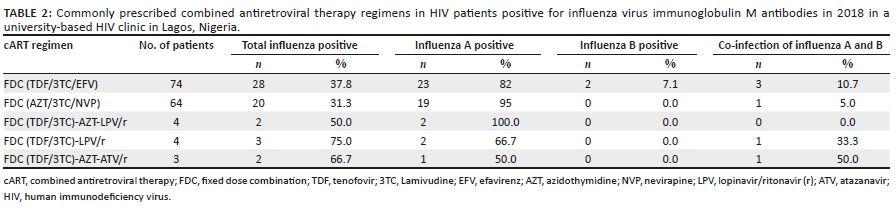
The most commonly prescribed cART used as a single-pill combination at the APIN clinic included atazanavir, azidothymidine, efavirenz, lamivudine, lopinavir or ritonavir, nevirapine, and tenofovir (Table 2). The majority of patients received a combined therapy of tenofovir, lamivudine and efavirenz (74/174; 42.5%) or azidothymidine, lamivudine and nevirapine (64/174; 36.8%).
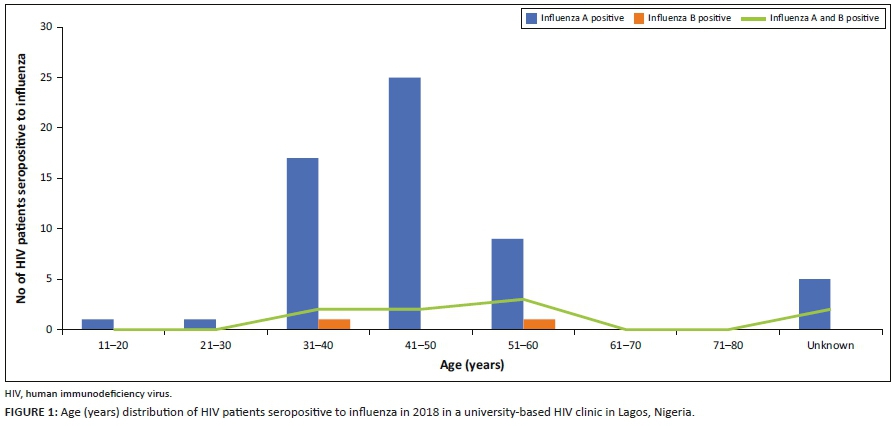
Seroprevalence was highest in patients aged 41-50 years (39.1%; 27/69), with no detections in the age groups 61-70 and 71-80 years (Figure 1).
Discussion
In this study, we described the recent infection of seasonal influenza A and B, and their co-infection, among HIV patients on cART in Lagos, Nigeria, with a high predominance of influenza A virus. While a high proportion of the patients were virologically suppressed, having HIV RNA under 400 copies/mL, 27.5% of them were immunocompromised while 21.1% were severely immunosuppressed (CD4 < 200 cells/mm3
The seroprevalence rate is comparable with the 31% serological response recorded in HIV-positive individuals in Miami, United States.18192021,22
Our investigation further revealed that 84.1% (58/69) were immunoglobulin M seropositive for influenza A, indicating an epidemiological predominance of the influenza A over the influenza B virus during the study period in Lagos, Nigeria. In a study conducted in Malawi,21
Interestingly, 13.04% (9/69) of the HIV patients were seropositive for both influenza A and B viruses. Co-infection of influenza A and B viruses in HIV patients may exacerbate the immunocompromised status by further impairing T-cell responses with resultant fatal consequences in such individuals. This position agrees with previous studies that influenza in HIV-infected persons leads to increased and prolonged hospitalisation, and an elevated risk of in-hospital death.9,11 Furthermore, it is evident from previous reports that even mono-infection due to influenza A (H1N1) pandemic09 (now seasonal influenza virus) caused severe pneumonia leading to acute respiratory distress syndrome and multiple organ dysfunction associated with deaths.23,24 Hence, simultaneous detection of influenza A and B in patients calls for serious public health intervention to ameliorate the menace of influenza co-infection especially in people living with HIV.
Our study demonstrated the highest 39.1% seroprevalence of influenza among HIV patients in the age group 41-50 years which disagrees with the United States Centers for Disease Control and Prevention report that persons older than 65 years are more likely to be at risk of the influenza virus.251126
Based on gender, a higher 65.2% seroprevalence was detected among women compared to 24.6% among men in our study, which is consistent with findings from Malawi279
Of the 19/69 (27.5%) immunocompromised patients seropositive for the influenza virus, 4/19 (21.1%) were severely immunosuppressed (CD4 < 200 cells/mm328
Contrary to studies in South Africa from 2009 to 201111291193330
People with a viral load under 400 copies/mL (73.9%) had the highest seroprevalence of influenza virus. This agrees with a study in the United States between 2010 and 20119
Among the 165 HIV patients on a fixed dose combination of some regularly prescribed cART including tenofovir, emtricitabine, azidothymidine, atazanavir, efavirenz, nevirapine, and lopinavir or ritonavir, 61 (37%) were seropositive for influenza A and B viruses. The direct relationship of cART on patients and their seropositivity to influenza is not well understood. Nonetheless, our study demonstrated that HIV patients on cART were susceptible to recent infection with influenza viruses. In support of this finding, a systematic review done on co-infections and comorbidities of influenza in Africa from 1900 to 201321831
Limitations
One of the limitations of this study is that positive samples for the influenza virus by enzyme linked immunoassay could not be further tested by polymerase chain reaction due to the cost implication. Also, serological evidence from different HIV treatment centres are necessary for representative data in Nigeria. Another limitation is that an HIV-uninfected control group was not included in the study for possible comparison of the prevalence rates of influenza. Finally, it should be noted that the study was conducted over one influenza season and therefore the impact of seasonal changes in influenza strains was not studied. Rather our study has provided sero-epidemiological data on the commonly circulating seasonal influenza virus in HIV patients.
Conclusion
This study demonstrated using serology that HIV patients on cART are susceptible to both influenza A and B viruses. It however revealed low seroprevalence of influenza B mono-infection, and influenza A and B co-infections among HIV patients. Viral co-infections may further impair the already compromised immune system of HIV patients. Strong advocacy on the need to reduce risk of exposure to influenza, and for provision of an influenza vaccine in Nigeria, is recommended to prevent or reduce the complications of viral co-infection.
Competing interests
The authors have declared that no competing interest exists.
Authors' contributions
A.A.A. was responsible for experimental design and research supervision, data analysis, laboratory investigation and manuscript writing. B.A.A. was responsible for sample collection, laboratory investigation, data analysis and manuscript writing.
Sources of support
This research received no specific grant from any funding agency in the public, commercial or not-for-profit sectors.
Data availability statement
Data sharing is not applicable to this article as no new data were created or analysed in this study.
Disclaimer
The views and opinions expressed in this article are those of the authors and do not necessarily reflect the official policy or position of any affiliated agency of the authors.
Acknowledgements
We sincerely acknowledge all the patients who volunteered to be part of this study. We acknowledge the Lagos State University Teaching Hospital (LASUTH) Directorate of Clinical Services and Training and the Hospital Research Ethics Committee for the approval of the study research proposal. We are grateful to the Management and Staff of APIN-Lagos University Teaching Hospital for the approval for sample collection. Special thanks to all the laboratory technologists who supported the student's research work. Many thanks to all the senior faculty members who criticised and reviewed the initial manuscript. The abstract for this study was presented at the 52nd Miami Winter Symposium 2019: Evolving Concepts in HIV & Emerging Viral Infections, organised by Elsevier, University of Miami Miller School of Medicine, International Union of Biochemistry and Molecular Biology in Florida, United States (27-30 January 2019).
References
-
1.WHO. Influenza (seasonal) signs and symptoms [homepage on the Internet]. Geneva: WHO; 2019 [cited 2019 Feb 06]. Available from: https://www.who.int/news-room/fact-sheets/detail/influenza-(seasonal)
» https://www.who.int/news-room/fact-sheets/detail/influenza-(seasonal) -
2.Cohen AL, McMorrow M, Walaza S, et al. Potential impact of co-infections and co-morbidities prevalent in Africa on influenza severity and frequency: A systematic review. PLoS One. 2015;10(6):e0128580. https://doi.org/10.1371/journal.pone.0128580
» https://doi.org/10.1371/journal.pone.0128580 -
3.CDC. HIV basics [homepage on the Internet]. Atlanta, GA: CDC; 2018 [cited 2019 Feb 06]. Available from: https://www.cdc.gov/hiv/basics/index.html
» https://www.cdc.gov/hiv/basics/index.html -
4.WHO. HIV/AIDS key facts [homepage on the Internet]. Geneva: WHO; 2018 [cited 2019 Feb 05]. Available from: https://www.who.int/en/news-room/fact-sheets/detail/hiv-aids
» https://www.who.int/en/news-room/fact-sheets/detail/hiv-aids - 5.UNAIDS. Joint United Nations Programme on HIV and AIDS, 2015. Factsheet 2015: World AIDS day 2015. Geneva: UNAIDS; 2015.
-
6.Awofala AA, Ogundele OE. HIV epidemiology in Nigeria. Saudi J Biol Sci. 2018;25(4):697-703. https://doi.org/10.1016/j.sjbs.2016.03.006
» https://doi.org/10.1016/j.sjbs.2016.03.006 -
7.UNAIDS. Country factsheets Nigeria 2017: HIV and AIDS estimates [homepage on the Internet]. UNAIDS; 2017 [cited 2019 Feb 06]. Available from: http://www.unaids.org/en/regionscountries/countries/nigeria
» http://www.unaids.org/en/regionscountries/countries/nigeria -
8.UNAIDS. UNAIDS data 2018: World's response to HIV [homepage on the Internet]. Geneva: UNAIDS; 2018 [cited 2019 Feb 06]. Available from: http://www.unaids.org/sites/default/files/media_asset/unaids-data-2018_en.pdf
» http://www.unaids.org/sites/default/files/media_asset/unaids-data-2018_en.pdf -
9.Patel P, Bush T, Kojic EM, et al. Duration of influenza virus shedding among HIV-infected adults in the cART era, 2010-2011. AIDS Res Hum Retrovir. 2016;32(12):1180-1186. https://doi.org/10.1089/aid.2015.0349
» https://doi.org/10.1089/aid.2015.0349 -
10.Abadom TR, Smith AD, Tempia S, Madhi SA, Cohen C, Cohen AL. Risk factors associated with hospitalization for influenza-associated severe acute respiratory illness in South Africa: A case-population study. Vaccine. 2016;34(46):5649-5455. https://doi.org/10.1016/j.vaccine.2016.09.011
» https://doi.org/10.1016/j.vaccine.2016.09.011 -
11.Cohen C, Moyes J, Tempia S, et al. Severe influenza-associated respiratory infection in high HIV prevalence setting, South Africa, 2009-2011. Emerg Infect Dis. 2013;19(11):1766. https://doi.org/10.3201/eid1911.130546
» https://doi.org/10.3201/eid1911.130546 -
12.Castrucci MR. Factors affecting immune responses to the influenza vaccine. Hum Vaccin Immunother. 2018;14(3):637-646. https://doi.org/10.1080/21645515.2017.1338547
» https://doi.org/10.1080/21645515.2017.1338547 - 13.Ceravolo A, Orsi A, Parodi V, Rosselli R, Ansaldi F. Influenza vaccination in HIV-positive subjects: Latest evidence and future perspective. J Prevent Med Hyg. 2013;54(1):1.
-
14.Laurie KL, Huston P, Riley S, et al. Influenza serological studies to inform public health action: Best practices to optimise timing, quality and reporting. Influenza Other Respir Viruses. 2013;7(2):211-224. https://doi.org/10.1111/j.1750-2659.2012.0370a.x
» https://doi.org/10.1111/j.1750-2659.2012.0370a.x -
15.Alsuwaidi AR, Al-Mekaini LA, Kamal SM, Narchi H, Souid A-K. Seroprevalence of influenza A and B viruses among unvaccinated children in the United Arab Emirates: A cross-sectional study. BMC Res Notes. 2017;10(1):379. https://doi.org/10.1186/s13104-017-2720-8
» https://doi.org/10.1186/s13104-017-2720-8 -
16.Anjorin A, Oyefolu A, Omilabu S. Seasonal influenza virus infection among unvaccinated pregnant women in Lagos, Nigeria. Int J Infect Dis. 2018;73(Suppl.):368. https://doi.org/10.1016/j.ijid.2018.04.4248
» https://doi.org/10.1016/j.ijid.2018.04.4248 -
17.Sauerbrei A, Langenhan T, Brandstädt A, et al. Prevalence of antibodies against influenza A and B viruses in children in Germany, 2008 to 2010. Eurosurveillance. 2014;19(5):20687. https://doi.org/10.2807/1560-7917.ES2014.19.5.20687
» https://doi.org/10.2807/1560-7917.ES2014.19.5.20687 -
18.Parmigiani A, Alcaide ML, Freguja R, et al. Impaired antibody response to influenza vaccine in HIV-infected and uninfected aging women is associated with immune activation and inflammation. PLoS One. 2013;8(11):e79816. https://doi.org/10.1371/journal.pone.0079816
» https://doi.org/10.1371/journal.pone.0079816 -
19.Hung C-C, Zhao T-L, Sun H-Y, et al. Seroepidemiology of novel influenza A (H1N1) infection among HIV-infected patients in the era of highly active antiretroviral therapy. J Microbiol Immunol Infect. 2013;46(3):151-157. https://doi.org/10.1016/j.jmii.2012.03.002
» https://doi.org/10.1016/j.jmii.2012.03.002 -
20.Agrati C, Gioia C, Castilletti C, et al. Cellular and humoral immune responses to pandemic influenza vaccine in healthy and in highly active antiretroviral therapy-treated HIV patients. AIDS Res Hum Retrovir. 2012;28(12):1606-1616. https://doi.org/10.1089/aid.2011.0371
» https://doi.org/10.1089/aid.2011.0371 -
21.Ho A, Aston SJ, Jary H, et al. Impact of human immunodeficiency virus on the burden and severity of influenza illness in Malawian adults: A prospective cohort and parallel case-control study. Clin Infect Dis. 2017;66(6):865-876. https://doi.org/10.1093/cid/cix903
» https://doi.org/10.1093/cid/cix903 -
22.Ope MO, Katz MA, Aura B, et al. Risk factors for hospitalized seasonal influenza in rural western Kenya. PLoS One. 2011;6(5):e20111. https://doi.org/10.1371/journal.pone.0020111
» https://doi.org/10.1371/journal.pone.0020111 -
23.Domínguez-Cherit G, Lapinsky SE, Macias AE, et al. Critically ill patients with 2009 influenza A (H1N1) in Mexico. JAMA. 2009;302(17):1880-1887. https://doi.org/10.1001/jama.2009.1536
» https://doi.org/10.1001/jama.2009.1536 -
24.Perez-Padilla R, De la Rosa-Zamboni D, Ponce de Leon S, et al. Pneumonia and respiratory failure from swine-origin influenza A (H1N1) in Mexico. N Engl J Med. 2009;361(7):680-689. https://doi.org/10.1056/NEJMoa0904252
» https://doi.org/10.1056/NEJMoa0904252 -
25.CDC. Influenza: People 65 years and older & influenza [homepage on the Internet]. Atlanta, GA: Centers for Disease Control and Prevention, National Center for Immunization and Respiratory Diseases (NCIRD); 2018 [cited 2019 Feb 07]. Available from: https://www.cdc.gov/flu/about/disease/65over.htm
» https://www.cdc.gov/flu/about/disease/65over.htm -
26.Lambert ND, Ovsyannikova IG, Pankratz VS, Jacobson RM, Poland GA. Understanding the immune response to seasonal influenza vaccination in older adults: A systems biology approach. Exp Rev Vaccin. 2012;11(8):985-994. https://doi.org/10.1586/erv.12.61
» https://doi.org/10.1586/erv.12.61 -
27.Ho A, Mallewa J, Peterson I, et al. Epidemiology of severe acute respiratory illness and risk factors for influenza infection and clinical severity among adults in Malawi, 2011-2013. Am J Trop Med Hyg. 2018;99(3):772-779. https://doi.org/10.4269/ajtmh.17-0905
» https://doi.org/10.4269/ajtmh.17-0905 -
28.Sant AJ, McMichael A. Revealing the role of CD4(+) T cells in viral immunity. J Exp Med. 2012;209(8):1391-1395. https://doi.org/10.1084/jem.20121517
» https://doi.org/10.1084/jem.20121517 -
29.Tempia S, Walaza S, Moyes J, et al. Attributable fraction of influenza virus detection to mild and severe respiratory illnesses in HIV-infected and HIV-uninfected patients, South Africa, 2012-2016. Emerg Infect Dis. 2017;23(7):1124. https://doi.org/10.3201/eid2307.161959
» https://doi.org/10.3201/eid2307.161959 -
30.Crotty S. Follicular helper CD4 T cells (TFH). Ann Rev Immunol. 2011;29:621-663. https://doi.org/10.1146/annurev-immunol-031210-101400
» https://doi.org/10.1146/annurev-immunol-031210-101400 -
31.Jambo KC, Sepako E, Glennie SJ, et al. Naturally-acquired influenza-specific CD4+ T-cell proliferative responses are impaired in HIV-infected African adults. PLoS One. 2012;7(6):e38628. https://doi.org/10.1371/journal.pone.0038628
» https://doi.org/10.1371/journal.pone.0038628

Accepted: 01 Oct. 2020
Published: 21 Dec. 2020